Introduction
Parotidectomy is one of the head and neck soft-tissue surgical procedures where biological glue is increasingly being used to achieve haemostasis and prevent fluid collection.Reference Bajwa, Tudur-Smith, Shaw and Schache1 Convention dictates insertion of a percutaneous drain post-surgery to close ‘dead space’ and allow blood and fluid to drain,Reference Hey, Flach, Shahsavari and Manickavasagam2 but this requires an overnight stay and has been associated with complications such as pain, infection, fistula formation, drain obstruction, discomfort and psychological impact.Reference Findik, Topcu and Vatansever3,Reference Cunniffe, Wong, Hilger and Burgan4 Moreover, with regard to thyroid surgery, there is no firm evidence that drains improve patient outcome.Reference Woods, Woods, Duignan and Timon5 Most patients are reluctant to be discharged with a drain, and so stay in until the drain is removed.
Fibrin sealants encourage haemostasis by initiating the final stage of the anticoagulation pathway and mechanically bringing tissue surfaces together.Reference Jain and Wairkar6 The apposition of the skin flap closes dead space, thereby preventing seroma and haematoma formation.
Therefore, fibrin sealant obviates the need for percutaneous drains, potentially allowing for out-patient parotidectomy procedures or a shorter hospital stay.Reference Bajwa, Tudur-Smith, Shaw and Schache1 So far, articles published in the literature pertaining to fibrin sealant use in parotidectomy procedures are only of small sample sizes (n < 120), and there have been no systematic reviews specific to parotidectomy that have evaluated the use of fibrin sealants, thus precluding any formal conclusion about its efficacy and safety.
Our aim was to assess the benefits and post-operative outcomes of fibrin sealant in parotidectomy surgery, both on its own and when used in conjunction with post-parotidectomy drains as compared with conventional procedures using post-operative percutaneous drains without fibrin sealants. We also intended to evaluate the safety and efficacy of drainless parotidectomy procedures with the use of tissue sealants.
Materials and methods
Design
We pre-specified the review objectives, inclusion criteria and methods of analysis in a study protocol. We reported the review according to the Preferred Reporting Items for Systematic Review and Meta-analysis (‘PRIMSA’) guidelines for diagnostic test accuracy studies.Reference McInnes, Moher, Thombs, McGrath and Bossuyt7
Criteria for considering studies for this review
Types of studies
We included retrospective, observational, cohort or cross-sectional, and prospective studies as well as conference abstracts that assessed the use of fibrin sealants in parotidectomy with or without drains. Case reports, commentaries and letters to the editor were excluded.
Participants
We considered patients of any age and gender who had undergone parotidectomy with or without drains. We considered any type of tissue sealants used for closure of parotidectomy flaps and included the use of pressure bandages in some studies.
Conventional procedure
Percutaneous drains are traditionally placed after parotid surgery. In many centres this occurs when drain output is less than 30 ml/day or on post-operative day 3.Reference Patel, Garg and Rice8 Jiang et al.Reference Jiang, Jia, Cai, Yuan, Wang and Zhang9 suggested that the optimum timing is when the output is less than 20 ml in 24 hours. This aims to reduce post-operative haematoma and seroma formation.Reference Jiang, Jia, Cai, Yuan, Wang and Zhang9
Intervention
The use of fibrin sealant in parotidectomy enables the avoidance of post-operative drains. Sealants also aid the formation of blood clots due to the thrombin and fibrinogen components, reducing haematoma and seroma formation and risk of infection.Reference Bajwa, Tudur-Smith, Shaw and Schache1 They expedite discharge from hospital, thus increasing the cost-effectiveness of the procedure. The studies included in our analysis have assessed the efficacy of two types of fibrin sealants: Tisseel™ and Artiss™. We have included studies that reported outcomes for fibrin sealant use alone as well as fibrin sealant paired with post-operative drain use.
Outcome parameters
In our included studies, the primary dichotomous outcome was any combination of reported complications following parotidectomy (i.e. the occurrence of major haematoma or seroma requiring surgical exploration, sialocele, post-operative infection, sepsis, flap necrosis, facial nerve weakness or facial fistula). The secondary continuous outcomes were the length of hospital stay and drain output.
Search methods for identification of studies
A literature search of electronic information sources (Medline, Embase, Cinahl) using the online search engine National Institute for Health and Care Excellence Healthcare Database Advanced Searches (hdas.nice.org.uk) was performed by two independent authors (DMR and FJR). The search was performed in June 2020 over a three-week period and without applying any language restriction. The terms included were: drainless parotidectomy, parotidectomy and parotid surgery, combined with tissue sealant, Tisseel, Artiss and drainless, as shown in Appendix 1. Requests were put into local resources for full texts.
Data collection and analysis
Selection of studies
Eligibility assessment of identified studies was performed by two review authors (DMR and FJR) independently. We screened the titles and abstracts of the studies identified during electronic searches. Relevant studies meeting the inclusion criteria for the review were selected and the full-text articles were retrieved.
Data extraction
Data extraction was undertaken by both review authors (DMR and FJR). The following data were extracted from the full texts of the selected articles: study authors, year of publication, type of study (retrospective, observational, cohort or cross-sectional, and prospective studies as well as conference abstracts), number of participants, type of surgery, the use of drains, type of sealant used, control, outcomes in terms of hospital in-stay and complications, and information about the quality assessment using the risk of bias 1 tool.
Statistical analysis and data synthesis
A table of ‘events’, the number of complications encountered in parotidectomy procedures with fibrin sealants versus those without, was constructed. We generated forest plots to show the variation of the results together with their 95 per cent confidence intervals (CIs). A fixed-effect meta-analysis of the combined complications was conducted using RevMan 5.3 systematic review software (Cochrane collaboration, Copenhagen, Denmark), and funnel plots were obtained using Stata 16 statistical analysis software (Stata, College station, USA). All studies were considered to have been conducted under similar conditions with similar interventions and patients. Hence, we assumed the only difference between studies was their ability to detect the outcomes of interest.
The secondary continuous outcomes were the length of in-hospital stay and drain output. Because of the methodological heterogeneity in the included studies, a narrative analysis of the results was performed.
Significance thresholds based on recommendations to improve the use of statistics in biomedicine were defined by p-values of: p < 0.005 as significant, p > 0.05 as non-significant and 0.005 < p < 0.05 as suggestive.Reference Laccourreye, Lisan, Bonfils, Garrel, Jankowski and Karkas10,Reference Ioannidis11
Assessment of reporting bias
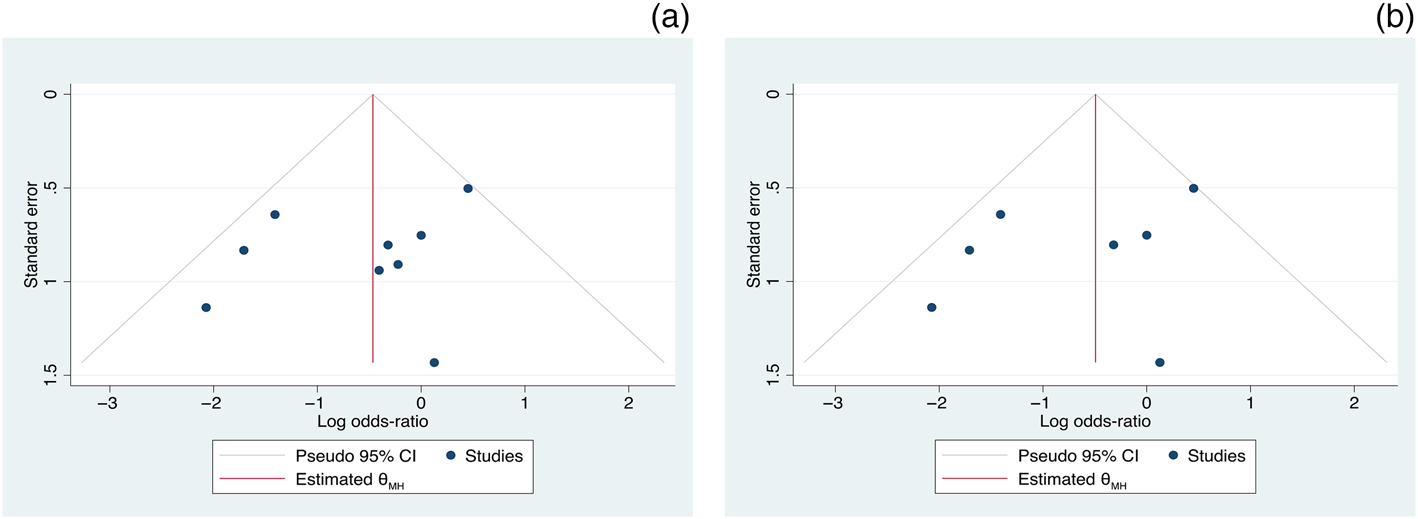
Despite the small number of studies included, funnel plots were constructed to determine whether publication bias was a factor because of the inclusion of grey literature in our analysis.
Results
Search results
In our literature search of Medline for ‘drainless or tissue sealant’, 38 910 results were obtained, and for ‘parotidectomy’, 4259 reports were found. Combination of both terms yielded 15 papers. During a similar search on Embase, 48 928 results were obtained for ‘drainless or tissue sealant’, and 3242 results were obtained for ‘parotidectomy’. Combination of both results retrieved 17 papers. Using PubMed, 50 802 results were generated for ‘drainless or tissue sealant’ and 4 528 258 results for ‘parotidectomy’, giving a combined result of 15 828. Our final comprehensive search identified 15 860 studies; 15 847 were irrelevant and discarded, and the remaining 13 studies were selected for our review based on the inclusion criteria. Four studiesReference Chen, Zhang, Huang and Zhou12–Reference Chandarana, Fung, Franklin, Kotylak, Matic and Yoo15 were excluded as they did not review the use of tissue sealant in parotidectomy surgery specifically. Of the included studies, fourReference Poolovadoo, Aggarwal and Loughran16–Reference AL-Qahtani19 did not have any control group and were included in the qualitative synthesis, and the remaining nine studiesReference Cunniffe, Wong, Hilger and Burgan4,Reference Patel, Garg and Rice8,Reference Heffernan20–Reference Chudek, Wilkie, Hampton, Siau and Panarese26 were quantitatively analysed. The search process performed in June 2020 is detailed in the Preferred Reporting Items for Systematic Review and Meta-analysis (‘PRISMA’) flow diagram as shown in Figure 1.
Shows the Preferred Reporting Items for Systematic Review and Meta-analysis (‘PRISMA’) diagram for the search strategy.

Characteristics of included studies
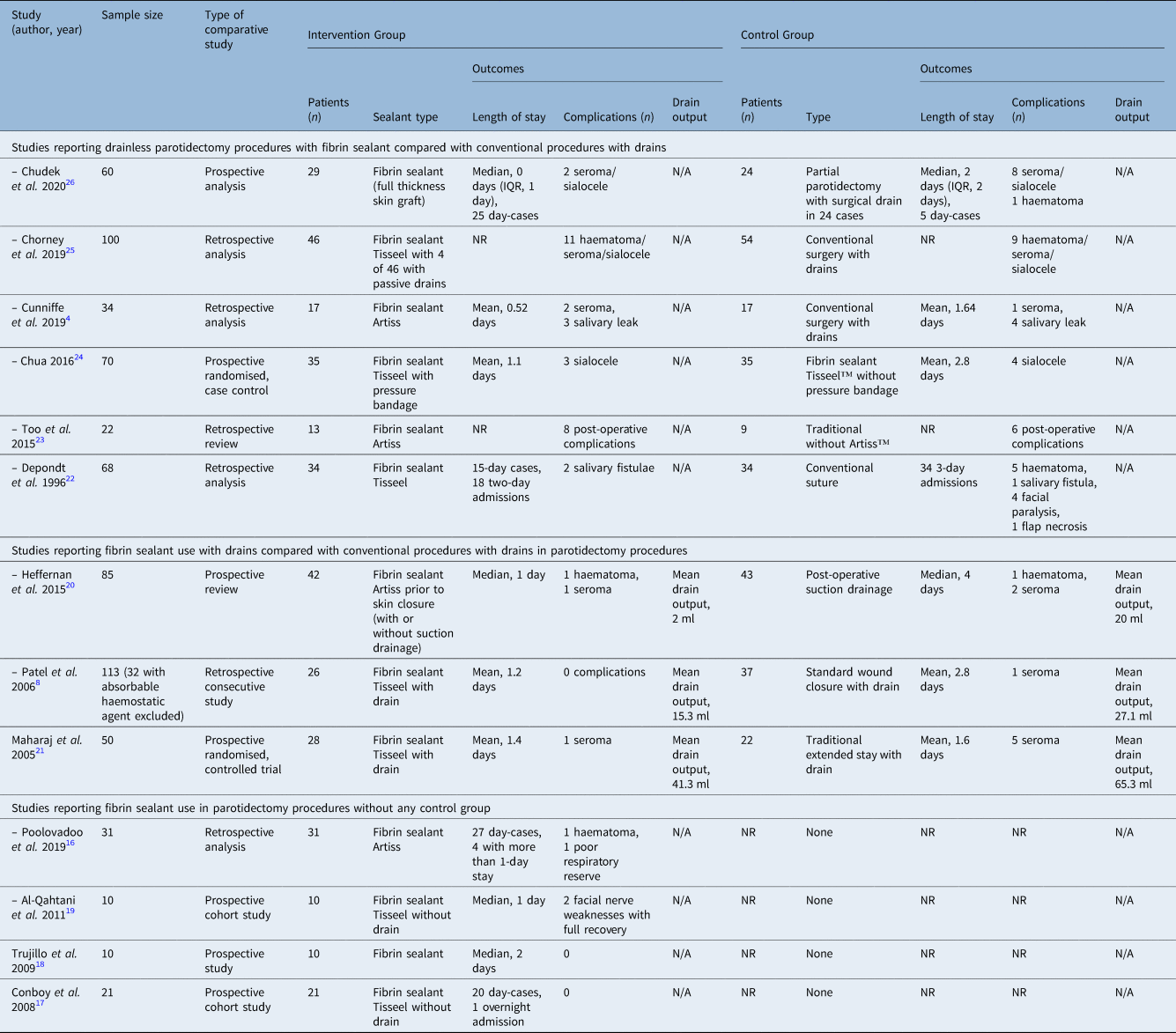
A total of 642 patients were included in our analysis. Of the 13 selected papers, 7 studies were performed prospectively,Reference Conboy, ChB, Brown and ChB17–Reference Maharaj, Diamond, Williams, Seikaly and Harris21,Reference Chua24,Reference Chudek, Wilkie, Hampton, Siau and Panarese26 and 6 were performed retrospectively.Reference Cunniffe, Wong, Hilger and Burgan4,Reference Patel, Garg and Rice8,Reference Poolovadoo, Aggarwal and Loughran16,Reference Depondt, Koka, Nasser, Portier, Guedon and Barry22,Reference Too and Nugent23,Reference Chorney and Ryan25 Four of the studies had no control and only assessed the outcomes of fibrin use in parotidectomy procedures,Reference Poolovadoo, Aggarwal and Loughran16–Reference AL-Qahtani19 and the remaining nine compared fibrin use with the conventional method.Reference Cunniffe, Wong, Hilger and Burgan4,Reference Patel, Garg and Rice8,Reference Heffernan20–Reference Chudek, Wilkie, Hampton, Siau and Panarese26 In the study by Patel et al.,Reference Patel, Garg and Rice8 they assessed three sets of data, the use of absorbable haemostatic agent was not analysed in this paper since we decided to assess fibrin sealants only in drainless cases. Table 1 summarises the main characteristics of the studies.
Characteristics of included studies

N/A = not available; NR = not reported; IQR = interquartile range
Methodological quality of included studies
The inclusion of grey literature (unpublished studies in the form of conference abstracts or letters, which might not have been peer-reviewed) minimises publication bias. The argument for the inclusion of grey literature is to fully take into consideration all existing evidence. These studies often include a smaller sample, but excluding them can lead to the exaggeration of statistically significant results, publication bias and skewing the effect size estimates.Reference McAuley, Pham, Tugwell and Moher27,Reference Conn, Valentine, Cooper and Rantz28 Therefore, Conn et al.Reference Conn, Valentine, Cooper and Rantz28 encouraged the inclusion of grey literature with assessment of heterogeneity. However, because of a lack of methodology details, the papers have been highlighted as high risk of bias as shown in Figure 2. Some papers have not commented on whether participants and outcome assessors have been blinded, and others have not expanded the selection process (as detailed in Appendix 2). Figure 2 provides a summary of the quality of the studies.
Forest plots and methodological quality analysis for the included studies, showing (a) plot with all included studies and (b) plot excluding grey literature. M-H = Mantel–Haenszel; CI = confidence interval.

Findings
Table 1 summarises how the primary and secondary outcomes post-parotidectomy with tissue sealant compare with conventional methods. It provides a numerical comparison of the length of stay, drain output and complication rates for both.
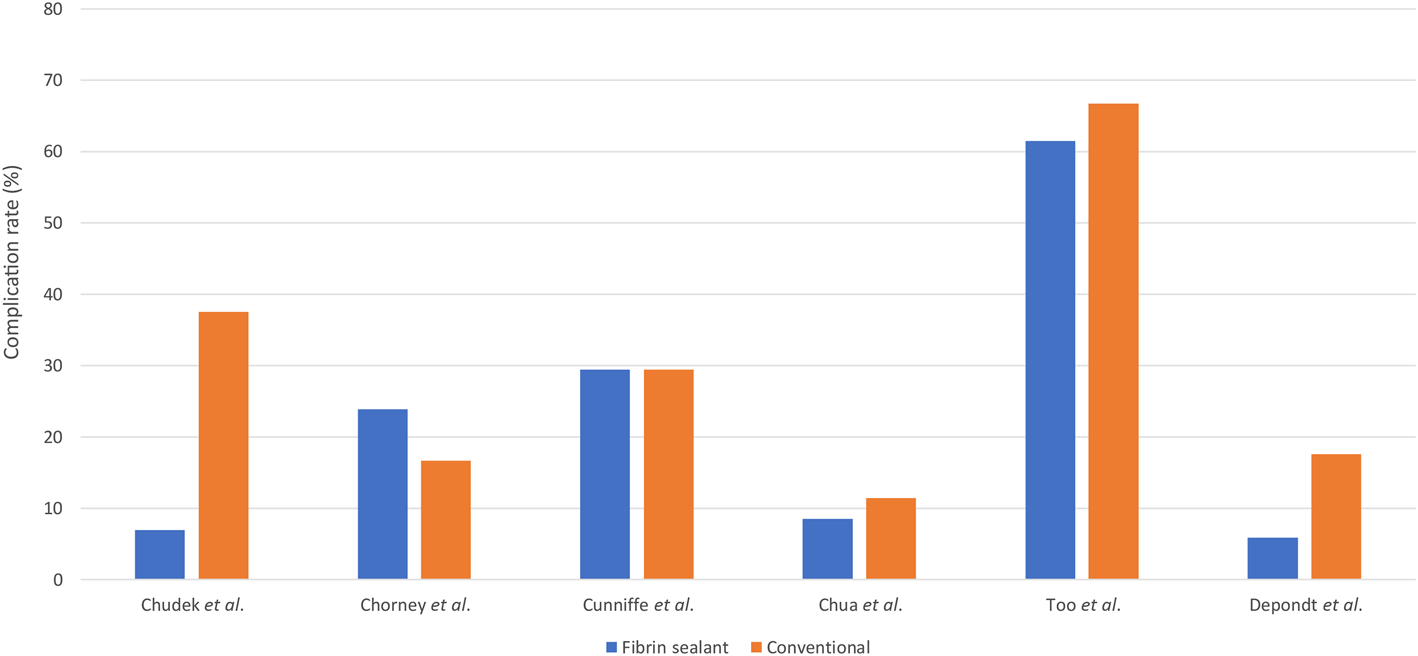
Figure 3 shows the post-operative complications for procedures using fibrin glue compared with conventional ones. Complications rates varied from 2.6 per centReference Patel, Garg and Rice8 to 61.5 per cent Reference Too and Nugent23 with fibrin use and from 2.3 per centReference Patel, Garg and Rice8 to 66.7 per centReference Too and Nugent23 with conventional surgery. The most common complication was seroma formation, reported by six studies,Reference Cunniffe, Wong, Hilger and Burgan4,Reference Patel, Garg and Rice8,Reference Heffernan20,Reference Maharaj, Diamond, Williams, Seikaly and Harris21,Reference Chorney and Ryan25,Reference Chudek, Wilkie, Hampton, Siau and Panarese26 followed by haematoma, reported by three studies.Reference Chua24–Reference Chudek, Wilkie, Hampton, Siau and Panarese26 Other complications reported were salivary leak, salivary fistula, facial paralysis, facial nerve weakness, sialocele, flap necrosis and sepsis.Reference Cunniffe, Wong, Hilger and Burgan4,Reference Patel, Garg and Rice8,Reference Depondt, Koka, Nasser, Portier, Guedon and Barry22,Reference Chua24–Reference Chudek, Wilkie, Hampton, Siau and Panarese26
Graph of complication rates between the sealant and non-sealant groups.

A fixed-effect meta-analysis was carried out over different formulations of fibrin sealants to assess its effectiveness on post-parotidectomy outcomes in terms of complications, as shown in the forest plot of Figure 2.
The findings of this meta-analysis are suggestive of more favourable outcomes in drainless parotidectomy procedures with tissue sealant in comparison with conventional post-operative drain use (p = 0.04; odds ratio = 0.57; 95% CI, 0.33 to 0.98) as shown in Figure 2a. With regards to the use of fibrin sealant in conjunction with post-operative drains as compared with drains alone, our analysis has shown a reduction in complications with fibrin sealant use (p = 0.08; odds ratio = 0.33; 95% CI, 0.09 to 1.15), as shown in Figure 2b. Because of the variation in the secondary dichotomous outcomes as mentioned above, as well as the disparities in methodologies used, mainly in the grey literature (non-peer reviewed literature), a sub-group meta-analysis was performed, excluding the latter. A similar result of fewer complications was observed following the use of fibrin sealant, which is also suggestive of improved outcomes (p = 0.04; odds ratio = 0.55; 95% CI, 0.31 to 0.97) as shown in Figure 2c. Both between- and within-study heterogeneity contributed to variance in our analysis (I2 = 23 per cent; Cochran's Q = 10.43). However, upon filtering out grey literature we note an unchanged variance (Cochran's Q = 10.35) supporting its inclusion in our study, as shown in Figure 4.
Funnel plots for the included studies, showing (a) all included studies and (b) where grey literature was excluded. The horizontal axis represents the log odds-ratio against the vertical standard error of log odds-ratio. CI = confidence interval; M-H = Mantel–Haenszel.

Discussion
Our meta-analysis demonstrated favourable outcomes with the use of fibrin sealant compared with parotidectomy with drains, potentially reducing the incidence of post-operative complications. The randomised, controlled trial by Maharaj et al.Reference Maharaj, Diamond, Williams, Seikaly and Harris21 reported similar results with a lower incidence of haematoma and seroma formations with fibrin sealant use. ChuaReference Chua24 and HeffernanReference Heffernan20 showed a relatively lower rate of complications, with 8.5 per cent and 4.8 per cent, respectively, with the use of fibrin sealant, compared with 11.4 per cent and 6.9 per cent, respectively, in conventional parotidectomy procedures. Other complications included salivary leak, salivary fistula, facial paralysis, sepsis and flap necrosis, reported in the studies by Cunniffe et al.Reference Cunniffe, Wong, Hilger and Burgan4 and Depondt et al.Reference Depondt, Koka, Nasser, Portier, Guedon and Barry22 The former had an equal number of complications with both fibrin sealant use and conventional surgery. Similarly, only one seroma formation was reported by Patel et al.Reference Patel, Garg and Rice8 in both groups.
Complication rates have varied in studies that only reviewed the use of fibrin sealant. TrujilloReference Trujillo18 and Conboy et al.Reference Conboy, ChB, Brown and ChB17 had a 0 per cent complication rate in a sample size of 10 and 21 patients, respectively. Poolovadoo et al.Reference Poolovadoo, Aggarwal and Loughran16 reported 1 post-operative haematoma and 1 decline in respiratory function (6.5 per cent incidence rate). These are relatively low incidences that might not be fibrin sealant related. The study by Chorney and Ryan,Reference Chorney and Ryan25 with one of the largest series of patients, found almost similar wound complication rates between the sealant and non-sealant groups when other factors such as tissue volume removed, smoking history, diabetes and anticoagulant use were accounted for. Chudek et al.Reference Chudek, Wilkie, Hampton, Siau and Panarese26 also demonstrated a reduced incidence of seroma and haematoma in the fibrin sealant group, suggesting the use of fibrin sealant as a possible alternative, enabling the omission of surgical drains while also reducing patient discomfort and anxiety associated with these.Reference Cunniffe, Wong, Hilger and Burgan4
Al-Qahtani et al.Reference AL-Qahtani19 had 2 incidences of facial nerve weaknesses with full recovery out of 10 surgeries performed with fibrin sealant. Although this is a comparatively higher incidence, the sample size is too small draw conclusions. Similarly, Too et al.Reference Too and Nugent23 reported a higher number of complications with fibrin sealant, compared with conventional surgery. However, not all complications were Artiss-related, and their sample size was small as well.
One argument for fluid collection leading to seroma and haematoma formation could be due to uneven distribution of the fibrin glue along the parotid bed and lack of manipulation and compression, leading to less adherence.Reference Cunniffe, Wong, Hilger and Burgan4 Ensuring a more uniform spread of fibrin glue could potentially improve adherence. Five of the included studiesReference Cunniffe, Wong, Hilger and Burgan4,Reference Depondt, Koka, Nasser, Portier, Guedon and Barry22–Reference Chua24,Reference Chudek, Wilkie, Hampton, Siau and Panarese26 showed a comparative or lower incidence rate of post-parotidectomy complications with fibrin sealant, as shown in Figure 3. Hence, fibrin sealant may be considered as an alternative, enabling the omission of surgical drains while also reducing patient discomfort and anxiety associated with these.Reference Cunniffe, Wong, Hilger and Burgan4
Considering drain output volume, a meta-analysis on fibrin sealant use in head and neck surgery by Bajwa et al.Reference Bajwa, Tudur-Smith, Shaw and Schache1 showed a reduction in wound drainage volume with fibrin sealant. A similar result was reported by Maharaj et al.,Reference Maharaj, Diamond, Williams, Seikaly and Harris21 Heffernan et al.Reference Heffernan20 and Trujillo et al.Reference Trujillo18 with the latter reporting a p-value of less than 0.005. Therefore, fibrin sealants may enable drainless surgical procedures, overcoming the pain, distress and discomfort caused by surgical drains.Reference Bajwa, Tudur-Smith, Shaw and Schache1
Cost-effectiveness of a procedure is a crucial part to consider. Length of in-hospital stay is an important contributory factor. Fibrin sealants enable a drainless procedure, meaning most patients can be discharged on the same day. ChuaReference Chua24 and Patel et al.Reference Patel, Garg and Rice8 found a reduction in length of hospital stay. The former study showed a mean length of hospital stay of 1.1 days versus 2.8 days whereas the latter study had a length of 1.2 days versus 2.8 days for drainless and conventional parotidectomy, respectively. Nausea control was the main reason for overnight stay in both studies.
In the study by Depondt et al.,Reference Depondt, Koka, Nasser, Portier, Guedon and Barry22 all patients who had surgery with fibrin sealant were discharged by day 2, while those who underwent conventional surgery were only discharged after day 3 because of complications and drain care. Social aspects can also be a barrier to discharge as shown by Poolovadoo et al.,Reference Poolovadoo, Aggarwal and Loughran16 who reported 4 overnight in-hospital stays out of 31 patients, 1 of which was because of lack of support at home. Cunniffe et al.Reference Cunniffe, Wong, Hilger and Burgan4 stated that 9 out of 17 patients required an overnight stay because of a late afternoon finish in the group with fibrin sealant use, with an average length of stay of 0.52 days compared with 1.64 days in those who had conventional surgery.
The overwhelming majority of patients who underwent parotidectomy with a post-operative drain had two or more days of in-hospital stay. Cost-wise, although fibrin sealant (Artiss in this case) costs £165.75 compared with £30 for a drain per patient as mentioned by Cunniffe et al.,Reference Cunniffe, Wong, Hilger and Burgan4 an overnight hospital stay cost was £241 on a surgical ward in 2018 to 2019.Reference Gardner29 Therefore, the reduction in length of stay in hospital greatly outweighed the price difference.
Our meta-analysis has several limitations. The included studies are of a very small sample size, and the retrospective nature of some studiesReference Cunniffe, Wong, Hilger and Burgan4,Reference Patel, Garg and Rice8,Reference Poolovadoo, Aggarwal and Loughran16,Reference Depondt, Koka, Nasser, Portier, Guedon and Barry22,Reference Too and Nugent23,Reference Chorney and Ryan25 may incorporate selection bias. Participants with drainless parotidectomy for which outcomes were not specifiedReference Chudek, Wilkie, Hampton, Siau and Panarese26 could not be included in our results. Although the inclusion of conference abstracts may contribute to publication bias, our analysis has shown minimal variance when these were excluded. Moreover, Patel et al.Reference Patel, Garg and Rice8 excluded patients sent home with drains from their analysis, thus conferring attrition bias to the study. The studies using fibrin sealant in conjunction with post-operative drains might be subject to confounding results as proper apposition of skin flaps is not feasible with passive drains.Reference Chorney and Ryan25 Therefore, there is a requirement for more robust evidence through larger samples and prospective cohort studies to allow broader conclusions to be drawn.
Conclusion
Fibrin sealant in parotidectomy may be used to facilitate a drainless approach, expediting recovery and offering better comfort to patients. Furthermore, patients are candidates for same day discharges, reducing the length of in-hospital stay, saving on costs and resources. Thus, fibrin sealant offers significant advantages over traditional parotidectomy procedures with drain insertion, with comparable safety. The suggested benefits of fibrin sealant presented in our analysis should be further explored through reformed research of more robustly designed studies comparing the use of fibrin sealant without drains to the use of post-parotidectomy drains.
Competing interests
None declared
Appendix 1. Medical subject heading terms used for the search strategy
((drainless).ti,ab OR (sealant).ti,ab OR (tissue sealant).ti,ab OR (fibrin).ti,ab OR (fibrin sealant).ti,ab) AND ((parotidectomy).ti,ab OR (parotidectomies).ti,ab OR (parotidectomy*).ti,ab OR (parotidectom*).ti,ab OR (post-parotidectomy).ti,ab OR (Postparotidectomy).ti,ab OR (Postparotidectom*).ti,ab OR (Postparotidectomies).ti,ab OR (Post-parotidectomies).ti,ab OR (Parotid surgery).ti,ab OR (Parotid Surgeies).ti,ab OR (Post-parotid surgeries).ti,ab OR (Post-parotid surgery).ti,ab OR (post parotid surgery).ti,ab OR (post parotid surgeries).ti,ab)
Appendix 2. Characteristics and methodological assessment of the included studies
Heffernan 2015Reference Heffernan20

Risk of bias table

Chua 2011Reference Chua24

Risk of bias table

Chudek et al. 2020Reference Chudek, Wilkie, Hampton, Siau and Panarese26

Risk of bias table

Cunniffe et al. 2019Reference Cunniffe, Wong, Hilger and Burgan4

Risk of bias table

Depondt et al. 1996Reference Depondt, Koka, Nasser, Portier, Guedon and Barry22

Risk of bias table

Al-Qahtani 2010Reference AL-Qahtani19

Risk of bias table

Too and Nugent 2015Reference Too and Nugent23

Risk of bias table

Maharaj et al. 2005Reference Maharaj, Diamond, Williams, Seikaly and Harris21

Risk of bias table

Patel et al. 2006Reference Patel, Garg and Rice8

Risk of bias table

Trujillo 2009

Risk of bias table

Conboy et al. 2008Reference Conboy, ChB, Brown and ChB17

Risk of bias table

Chorney and Ryan 2019Reference Chorney and Ryan25

Risk of bias table

Poolovadoo et al. 2019Reference Poolovadoo, Aggarwal and Loughran16

Risk of bias table