

Corruption is the world's most frequently discussed problem.Footnote 1 Authoritarian leaders, from Venezuela's Hugo Chávez's to China's Xi Jinping, have launched intensive corruption investigations in order to win public support. But, do corruption investigations actually score points with the public?
A distinguished literature shows that citizens in democracies are antagonistic to government corruption: the more corrupt the citizens perceive the incumbents to be, the more likely they are to punish the incumbent government in elections (Ferraz and Finan, Reference Ferraz and Finan2008; Chang et al., Reference Chang, Golden and Hill2010; Winters and Weitz-Shapiro, Reference Winters and Weitz-Shapiro2013; Chong et al., Reference Chong, De La O, Karlan and Wantchekon2015; Schwindt-Bayer and Tavits, Reference Schwindt-Bayer and Margit Tavits2016).Footnote 2 Cross-national studies also show that political corruption erodes trust in political institutions, increases anti-government protest, and undermines the regime's long-term legitimacy (Seligson, Reference Seligson2002; Anderson and Tverdova, Reference Anderson and Tverdova2003; Chang and Chu, Reference Chang and Chu2006; Gingerich, Reference Gingerich2009; Morris and Klesner, Reference Morris and Klesner2010).
When leaders fight corruption, as they fight poverty and unemployment, they hope to signal their responsiveness and benevolent intentions to the public, and therefore to garner more public support. As Chinese President Xi Jinping said in a speech in 2014 to justify his anti-corruption drive: “People hate corruption the most, so we must be determined to fight against corruption to win support from the people.”Footnote 3
There is, however, very little research on the effects of corruption investigations on public support in authoritarian regimes. We do not know how citizens react to information disclosed during corruption investigations. Do they perceive the anti-corruption drive as its leaders intend—as a genuine effort by the regime to curb corruption? Or are they shocked by the excessive corruption revealed in the investigations and become disenchanted with the regime? Empirically, it is challenging to estimate the causal effects of corruption investigations, because they are usually not randomized.Footnote 4
In this paper, we argue that corruption investigations may undermine regime support. We start with the assumption that citizens have prior beliefs about the integrity of government officials, which affects their degree of support for the regime. When political leaders launch an anti-corruption drive, scandals of politicians' corrupt activities are revealed to the public. Citizens use this new information to update their level of regime support. If the revelations of corrupt behavior exceed citizens' expectations, they are surprised by the excessive government corruption. They then start to question the integrity of public officials in general, and reevaluate their support for the regime. As a result, corruption investigations may lead to citizens' “informed disenchantment” and undermine regime support.Footnote 5
We substantiate our arguments by examining one of the most intensive anti-corruption drives in the world—the on-going anti-corruption campaign in China. We use a difference-in-differences (DID) strategy to analyze the results of two original surveys that we conducted before and during the campaign. Comparing respondents who are exposed to more investigations and respondents who are exposed to fewer investigations, we demonstrate strong and highly robust evidence that corruption investigations have a negative marginal effect on citizens' regime support. Ideally, we would also like to examine the amount of embezzlement or bribery involved in each investigation, but such information is not available for most officials.
Using our fine-grained survey data, we also explicitly test the updating mechanism. Employing a DID framework, we demonstrate that the respondents who were exposed to more corruption investigations updated their beliefs to exhibit lower posterior beliefs about officials' integrity, relative to those who were exposed to fewer corruption investigations. Consistent with our updating theory, we find that the impact of corruption investigations on people's public support depends on how the investigations relate to their prior beliefs. Interacting respondents' prior beliefs with the intensity of corruption investigations, we show that investigations only have a significantly negative impact on people's public support when their priors are high; the effect is precisely zero when their priors are low. This indicates that corruption investigations provided new information that shocked respondents who had strong prior beliefs about officials' integrity. We also provide evidence that the respondents' media exposure conditions how much they are affected by the investigations: their public support is more negatively affected by the investigations when they are more exposed to the media. As a result, corruption investigations, at the margin, have suppressed citizens' regime support in China.
We are not arguing that China's anti-corruption campaign as a whole has a negative impact on regime support. Estimating such an effect would require a counterfactual where the regime has not carried out an anti-corruption drive. Our research design allows us to estimate the marginal effect of corruption investigations, that is, compared with a few investigations, how would additional investigations affect citizens' regime support. We also focus on the short- and medium-term because our follow-up survey was conducted two years after the campaign started. We leave studying the long-term effects to future research and do not exclude the possibility that persistent corruption investigations could increase regime support in the long run.
Our key contribution is to provide the first, direct quasi-experimental evidence of citizen updating during an anti-corruption campaign in an autocracy. Our findings contribute to the recent literature on information and accountability, which has focused on how information about incumbent performance affects electoral outcomes (Ferraz and Finan, Reference Ferraz and Finan2008; Chong et al., Reference Chong, De La O, Karlan and Wantchekon2015; Arias et al., Reference Arias, Larreguy, Marshall and Querubin2018; Boas et al., Reference Boas, Daniel Hidalgo and André Melo2019; Dunning et al., Reference Dunning, Grossman, Humphreys, Hyde, McIntosh, Nellis, Adida, Arias, Bicalho, Boas, Buntaine, Chauchard, Chowdhury, Gottlieb, Hidalgo, Holmlund, Jablonski, Kramon, Larreguy, Lierl, Marshall, McClendon, Melo, Nielson, Pickering, Platas, Querubín, Raffler and Sircar2019). Although our results are largely consistent with this literature's main finding that revealing malfeasance decreases political support, we examine a naturalistic observational setting for a sample covering a substantial fraction of the world's population and add an interesting twist: when an autocratic government reveals its own corruption, it can suppress citizens' regime support. Most existing research focuses on democracies; we highlight the impact of revealing corruption information in an autocracy, joining a recent literature that shows the surprising consequences of transparency or “the adverse effects of sunshine” in authoritarian regimes (Malesky et al., Reference Malesky, Schuler and Tran2012; Hollyer et al., Reference Hollyer, Peter Rosendorff and Vreeland2015).
Our findings are applicable to other countries that rely on campaigns (intensive and periodic drives rather than institutional routines) to tackle corruption, and to those that have a low-information environment. Anti-corruption campaigns usually involve a series of intensive political operations within a short period of time, so a large amount of information on corrupt activities is disclosed to the public, which is more likely to constitute a shock. Another key contextual condition that is necessary for our updating mechanism to work is citizens' incomplete or inaccurate prior beliefs about public officials. Corruption, by definition, is a discreet behavior. Citizens have misinformation about politics even in developed democracies (Berinsky, Reference Berinsky2017). But without free media, authoritarian regimes are more likely to have a low-information environment due to the opacity of the political system (Zhu et al., Reference Zhu, Lü and Shi2012; Huang, Reference Huang2017; Larreguy et al., Reference Larreguy, Marshall and Snyder2017).
Our findings reveal the irony of corruption investigations in authoritarian regimes in line with the “Tocqueville Paradox”: reforming government is risky for the government because it changes citizens' perceptions and expectations (Finkel and Gehlbach, Reference Finkel and Gehlbach2020). Authoritarian regimes are likely to face a dilemma in fighting corruption: the more the regime publicly punishes corrupt officials, the more the public punishes the regime.
1. Theory and background
In this section, we elaborate on our theory, which is based on a learning model of the citizens, introduce China's current anti-corruption campaign, and derive several testable hypotheses.
1.1 Information about corruption and public support
We start with the premise that citizens' support for the regime is in part a function of their perceptions of the degree of corruption in the political system. They prefer (receive higher expressive utility) to support a government with less corrupt officials.
Since citizens have incomplete information about how corrupt government officials are, they develop prior beliefs based on officials' revealed corrupt behavior (corruption scandals, personal experience, rumors, etc.). Because of the covert nature of corruption, citizens usually have imperfect knowledge about how corrupt their public officials are.
Anti-corruption campaigns involve investigating corrupt officials and revealing corrupt activities. Leaders of the campaign, in order to justify their actions, publicize the details of the corrupt activities of the arrested individuals. Authoritarian leaders, in particular, can use propaganda to shape people's perceptions of the government's effort to combat corruption (Zhu et al., Reference Zhu, Lü and Shi2012: 937). This effort can potentially create an “image-enhancing” effect on public opinion. The paradox, however, is that the more the government seeks to enhance its image, the more the leaders must reveal the corrupt activities of the investigated officials in order to justify their anti-corruption drive. Citizens then update their posterior beliefs about the integrity of officials in the regime based on informational signals in a Bayesian fashion.Footnote 6 If the investigations reveal new information that causes citizens to believe that public officials are more corrupt than they previously thought, the investigations can lead citizens to suppress their support for the regime.Footnote 7
The key insight is that the effect of anti-corruption depends on how the new information relates to citizens' prior beliefs. If they already thought most officials were dishonest, new revelations of corrupt behavior will not change their level of support. In order to update their priors, citizens must receive signals that are different from their priors.
An intensive anti-corruption drive that reveals that many public officials are corrupt is likely to alter citizens' prior beliefs about officials' integrity and suppress their regime support. When citizens are “shocked” by the information revealed in corruption investigations, they start to wonder why there is so much corruption in the system and question the integrity of the whole body of government officials. As Manion (Reference Manion2004: 23) argues, when corruption is widespread, it is difficult to establish government credibility in anticorruption reform. Corruption is, in a sense, expected behavior: as citizens learn that more and more officials are corrupt, they will expect that everyone is corrupt (Persson et al., Reference Persson, Rothstein and Teorell2013: 456).
Therefore, although authoritarian leaders intend to garner more public support by arresting corrupt officials and publicizing corrupt activities, corruption investigations, on the margin, may suppress public support when the investigations reveal a surprisingly high number of cases. Although such investigations may help them achieve other goals—such as eliminating rivals, signaling strength, and consolidating power—they do so at the expense of public support for their regime.
1.2 China's anti-corruption campaign
Consistent with the cross-national evidence, corrupt officials, especially at the local level, are Chinese citizens' top concern (ahead of inequality, crime, food safety, and pollution).Footnote 8 Scholars have pointed to the weak institutional design of corruption investigations as one explanation for China's endemic corruption (Manion, Reference Manion2004; Reference Lü and Lorentzen2016).
Starting in 2012, after Xi Jinping took power, the Chinese Communist Party (CCP) launched an anti-corruption campaign with the stated goal of eliminating “tigers” (high-ranking corrupt officials) and “flies” (low-ranking corrupt officials). By October 2017, a total of 350,000 officials had been investigated for corruption.Footnote 9 Many believe that Xi's anti-corruption campaign is the most intensive and protracted in the People's Republic's history (e.g., Wedeman Reference Wedeman2016).
There is speculation that the current campaign is less a genuine effort to reduce corruption than a politically motivated effort by Xi to weaken his opponents.Footnote 10 Emerging empirical evidence, however, suggests that the effort has been largely genuine and has significantly changed the structure of Party and government incentives so as to reduce bureaucratic opportunities for corruption and structural obstacles to anti-corruption enforcement (Lü and Lorentzen, Reference Lü and Lorentzen2016; Manion, Reference Manion2016). Although examining the motives of the campaign is beyond the scope of this paper, we will show evidence that citizens are unlikely to perceive these investigations as purges, and our results lend more support to the latter interpretation, as citizens view investigated officials as genuinely corrupt, even shockingly so.
The CCP has gone to great lengths to collect and publicize the corrupt activities of investigated officials during the campaign (Chen and Hong, Reference Chen and Hongforthcoming). Many high-ranking officials' trials were made public or broadcast live on TV (such as Bo Xilai's). Although the CCP launched an extensive propaganda campaign in the official media to give a positive spin to its anti-corruption investigations, propaganda alone could not offset the shocking revelations of wide-spread corruption at all levels of the political hierarchy. Many details of official corruption, such as bribery, business deals, kickbacks, mansions, and mistresses, have been disclosed to the public. Scandals involving high-ranking officials and aggregate numbers of corruption investigations are circulated and updated on a daily basis. People can easily find the most up-to-date information about the latest corruption investigations and how many officials have been investigated in their provinces through Internet searches or on social media apps, such as WeChat.
These informational signals are expected to change people's beliefs about public officials and their support for the regime. We specifically hypothesize that corruption investigations suppress respondents' support for the central party and government organizations for two reasons. First, China's unitary political system gives the central party the prerogative to manage personnel affairs down to the vice-provincial level. Under Xi Jinping's political centralization, the center has gained more power in influencing personnel decisions at lower levels (Manion, Reference Manion2016). When corruption scandals are revealed, citizens update their beliefs not only about local corruption but also about corruption in the political system in general, which affects their support for the central organizations. Therefore, citizens' support for the national party and government reflects their overall support for the regime, beyond their support for political organizations at a particular level (i.e., the center). Second, previous research shows that Chinese citizens in general have a high level of trust (high priors) in central political institutions but a lower level of trust (low priors) in local ones (Li, Reference Li2013; Lü, Reference Lü2014). Therefore, corruption investigations are more likely to alter their beliefs in central organizations because corruption among lower-level officials is largely “old news.”Footnote 11
Hypothesis 1: Corruption investigations, on the margin, suppress citizens' support for the central government and Party, ceteris paribus.
We argue that citizen updating is one mechanism driving the results. Specifically, we expect that the revelations of endemic corruption at all levels of the party, government, and military cause the public to update its beliefs about officials' integrity: people exposed to more investigations are less likely to believe in the integrity of public officials, which suppresses their public support.
Hypothesis 2 (Updating Beliefs): Corruption investigations, on the margin, weaken citizens' beliefs about the integrity of public officials, ceteris paribus.
Our theory also predicts that the investigations have heterogeneous effects: corruption investigations should have no effect on people's regime support if they already believe officials' integrity is low; corruption investigations should suppress people's regime support when their prior beliefs about officials' integrity are high.
Hypothesis 3 (Heterogeneous Effects): The marginal effects of corruption investigations depend on citizens' prior beliefs. Such investigations should have no effect on people's regime support if their prior beliefs about officials' integrity are low, while investigations should suppress people's regime support when their prior beliefs about officials' integrity are high.
Our prediction hinges on the assumption that citizens have received the signal, so they are aware of corruption investigations that have been publicized. Empirical studies show that media coverage of political events can significantly increase citizens' political knowledge (Snyder and Strömberg, Reference Snyder and Strömberg2010) and effectively convey the government's message (Stockmann and Gallagher, Reference Stockmann and Gallagher2011). Hence how much corruption investigations affect citizens' public support is also conditional on the extent to which people are exposed to the media.
Hypothesis 4 (Media Exposure): The marginal effects of corruption investigations depend on citizens' exposure to the media. The more people are exposed to the media, the more likely their public support will be negatively affected by corruption investigations.
2. Research design
In this section, we discuss our identification strategy and provide evidence to evaluate key identification assumptions that are required to make causal inference.
2.1 Data
In 2010 and 2014, respectively, we designed and conducted two original surveys in China. The two surveys used the same sampling design (spatial sampling with the same primary sampling units, see Landry and Shen (Reference Landry and Shen2005)) and questionnaire, and both were implemented by the Research Center for Contemporary China (RCCC) at Peking University. Both surveys conducted face-to-face interviews of adult citizens in the same 49 prefecture-level cities, provincial capitals, and districts of provincial-level municipalities (Beijing, Shanghai, Tianjin, and Chongqing). The 2010 baseline survey drew a sample of 6293 and interviewed 3874 respondents (61.6 percent completion rate), and the 2014 follow-up survey drew a sample of 6503 and interviewed 4128 respondents (63.5 percent completion rate).Footnote 12 The completion rates are within the normal range for face-to-face surveys.
Our key outcome variable is regime support, which we define in terms of what Easton (Reference Easton1975: 436–7) refers to as “diffuse support”—citizens' support for the regime's political institutions rather than for the incumbents or their policies. Regime support is a worthy subject for research because it is associated with a wide range of political outcomes, such as political behavior (Tang, Reference Tang2016), policy implementation (Levi, Reference Levi1997), and regime stability (Dimitrov, Reference Dimitrov2013). We were equally interested in their support for political leaders—Xi Jinping, in particular. Although anecdotal evidence suggests that Xi is popular in China, there are no approval ratings of Chinese leaders because direct questions about individual leaders are not allowed in Chinese surveys.
Instead, we focus on citizens' support for the regime. We asked respondents about their levels of support and trust in the most important political institutions (the central government and party) on a scale from 0 (no support/trust) to 10 (high level of support/trust). We therefore have four variables: Trust Central Government, Trust Central Party, Support Central Government, and Support Central Party.Footnote 13 In our main regression analysis, we use Support Central Party—the most relevant indicator of public support for the CCP—to make our presentation parsimonious, but as we show in the online Appendix, our results are consistent using the other three measures or a scale that aggregates information from all four measures.
There is minor missingness in the dependent variables due to item non-response (1.9–3.5 percent). As we show in Appendix Table A1.3, the missingness is balanced in most provinces before and after the beginning of the campaign, indicating that the campaign did not incentivize people to choose “Don't Know” or “No Response.” We acknowledge that there might be social desirability bias in the answers, and we will discuss in more detail how we address this concern in the robustness checks. We use listwise deletion in the main analyses and will use multiple imputation in the robustness checks to show that the results are similar.
Our key independent variable is the number of corruption investigations during the period between the two surveys. We collected the data from Tencent—the largest Internet company in China. During the campaign, Tencent launched a searchable online database of all corruption investigations across China since 2011.Footnote 14 Based on information provided by Party disciplinary committees, courts, and procuratorates from the central to local levels, Tencent's database includes each official's name, position, locality, rank, and reason for investigation. In August 2016, we used Python to scrape Tencent's website and organized the database in an analysis-ready format. To verify this database and ensure that every investigation was made public, we ran an Internet search on every name to find its original source and record the date of the announcement.
The Tencent database has two advantages. First, it is the most comprehensive, public database on China's corruption investigations. It synthesizes information from official statistics at all levels of government and from all branches. Second, Tencent has provided this online database for Internet users to search how many officials in their hometowns have been investigated for corruption. By clicking on their hometowns on a drop-down list, this online interface reports the total number of investigations. This is the only place Chinese citizens can find out this number in a single click, and the database is widely circulated via Tencent's app—WeChat—China's most popular social network app, which has over 800 million users.
Although we believe information on corruption investigations is widely circulated, we nevertheless cannot directly observe the extent to which our respondents received the information. In our analysis, we use an indicator on whether our respondents read political news on social media to proxy for their exposure to media reports on corruption investigations. But, the proxy is imperfect because our survey did not ask whether they specifically read news about the anti-corruption campaign. Our analysis, therefore, focuses on estimating intention-to-treat (ITT) effects, which are the quantity of interest in some recent studies (e.g., Arias et al., Reference Arias, Larreguy, Marshall and Querubin2018) and the most policy relevant.
Theoretically, every citizen's exposure to corruption investigations consists of two components. The first component is the investigations that involve central officials. Between the two surveys, there were 64 central investigations. The second component is the local investigations in the respondent's province.
To measure each respondent's exposure to corruption investigations, we therefore need to calculate the number of both types of investigations. Mathematically, however, unless central investigations exert differential effects on people in different provinces, the number of central investigations will be “netted out” in our DID framework because all respondents are exposed to the same number of central investigations of “tigers.” There are two possible ways in which central investigations can have differential effects on different provinces. First, citizens in an official's hometown province may be more sensitive to news about that official's corruption. Second, most central officials worked in local government before being promoted to the center, so citizens may pay more attention to central officials who used to work in their own province. We test these two possibilities by coding the biographies of corrupt central officials, but find no evidence to support either (Appendix Table A1.5). Regardless of whether we use the sheer number of central investigations or weight the number by corrupt officials' rank,Footnote 15 central investigations have no differential effects on citizen perceptions in different provinces.
This exercise also helps us evaluate another mechanism: citizens decrease their levels of regime support because they view corruption investigations as political purges. We cannot rule out this possibility. But, if citizens do not alter their levels of support after central officials from their hometowns are investigated, it suggests that citizens are unlikely to resent the central party because the center purges their own leaders.
Given that central investigations do not have differential effects on different provinces, the number of local investigations drives local variation in exposure to the campaign. Here, we make a research design decision to focus on investigations within the respondent's province (rather than lower administrative units, such as prefectures or counties). Our reason is that citizens pay more attention to the media coverage of their home provinces (Stockmann, Reference Stockmann2013: 116). The more investigations there are in their provinces, the more likely citizens receive the information treatment. Our results using numbers at different levels support this reasoning (Appendix Table A2.2).
Our main independent variable is therefore Number of Corruption Investigations, which is the total number of corruption investigations in a province between January 2011 (after our baseline survey) and July 2014 (before our follow-up survey). This number includes all the investigations within a province across all administrative levels (from province to village). We employ this simple measure because it is the most intuitive number that could create an impression in people's minds without requiring much cognitive burden. In the robustness checks, we also use Number of Corruption Investigations (Weighted) (which takes into account the varying bureaucratic ranks of corrupt officials), Numbers of Tigers and Flies (which separates high- and low-ranking officials), Number of Corruption Investigations Per Million (which considers population size in each provinceFootnote 16), and Number of Corruption Investigations (Time Discount) (which gives a discountFootnote 17 to investigations that happened earlier). These continuous measures, however, assume a linear relationship. We also test using a quadratic term (Number of Corruption Investigations (Squared)) whether there is a nonlinear relationship: for example, corruption investigations might increase regime support when the number is low and decrease regime support when the number is high. For the same purpose, we also create a dichotomous measure—Number of Corruption Investigations (Above Mean)—which takes 1 when the province's investigations are above the national mean.Footnote 18 In the main analysis, we focus on corruption investigations in the province where the respondents live. But, corruption investigations in other, especially neighboring, provinces might also affect citizens' regime support, which creates a spill-over effect. In one robustness check, we examine this spill-over effect by calculating the spatial lag of corruption investigations. Appendix Table A1.1 shows the distribution of the independent variables across provinces.
We also consider several Demographic Controls that can influence regime support, including Male, Age, Years of Education, Urban,Footnote 19 Han, Party Member, and Per Capita Family Income (log). Appendix Table A1.2 presents these variables' measures and summary statistics.
2.2 Identification strategy
Because our two surveys used the same sampling design and questionnaire and were implemented by the same survey institute, we can treat them as repeated cross-sections (Abadie, Reference Abadie2005: 2).Footnote 20 Repeated cross-sectional designs give researchers many benefits of traditional panel designs, such as the ability to examine dynamics, while problems of attrition and response bias are avoided and sample sizes can be held steady.
Employing a DID strategy, we can then estimate how corruption investigations occurring in different provinces from 2011 to 2014 changed citizens' regime support. Specifically, the first difference is the temporal difference: the extent to which respondents changed their level of regime support from 2010 to 2014. The second difference is the regional difference: the extent to which respondents changed their level of regime support due to exposure to different numbers of corruption investigations in their provinces. The DID design, therefore, can identify differential effects of corruption investigations across provinces.
The identification assumption is that, in the absence of the anti-corruption campaign, the difference in average regime support between provinces is constant over time. One possible violation of this common trends assumption is that the provinces that experienced many corruption investigations were systematically different from those that had few. The campaign might have targeted certain provinces because they have low levels of public support, slow economic growth, or high levels of corruption. Therefore, although we might find an association between corruption investigations and lower levels of public support, the results might suffer from reverse causality or omitted variable bias.
To rule out this possibility, we correlate a province's pre-treatment levels of public support, economic development, and corruption with the number of corruption investigations. As Appendix Figure A1.1 shows, a province's average level of public support (measured by Trust Central Government, Trust Central Party, Support Central Government, and Support Central Party) and economic development (measured by Per Capita GDP and GDP Growth Rate) in 2010 are not significantly correlated with the number of corruption investigations they experienced during 2011–2014. In addition, various measures of corruption before the campaign are not significantly correlated with the number of corruption investigations during 2011–2014.Footnote 21
The common trends assumption cannot be directly tested. But, if we have more than one pre-treatment period for which data are available, pre-existing differences in the trends of the outcome variable can be detected by applying the DID estimator to pre-treatment data (Abadie, Reference Abadie2005: 2). To evaluate the credibility of the common trends assumption, we pool our 2010 and 2014 surveys with another pre-treatment survey—Attitudes Towards Citizenship in China—which was conducted in 2008, used the same sampling design, and was also implemented by RCCC. If the DID assumption is plausible, the DID estimator should be zero when using 2010 as the treatment period (2008 as control). Appendix Table A1.6 shows the results of this placebo test. The coefficient on the first interaction term (Year 2010 × N of Corruption Investigations) is very small and indistinguishable from zero, while the coefficient on the second interaction term (Year 2014 × N of Corruption Investigations) is significantly negative. This placebo test helps bolster the causal interpretation of our analyses.
3. Empirical results
In this section, we present our main empirical results and show that they are highly robust. We then provide evidence to show that people update their beliefs based on new information disclosed in the campaign, and that the effects of corruption investigations depend on people's prior beliefs.
3.1 Average ITT effects
We use ordinary least squares (OLS) to fit the following equation to the repeated cross-section data file that combines the 2010 and 2014 surveys:

where Support Central Partyijt is province j's respondent i's level of support for the central Party in year t, Year2014t is an indicator for the respondents in the 2014 follow-up survey (2010 is the baseline), and Number of Corruption Investigationsjt (omitted when provincial fixed effects are included) is the total number of corruption investigations in province j from January 2011 to July 2014. β 1 is the DID estimator, which is expected to be negative. In some specifications, we also control for several Demographic Controls, including Male, Age, Years of Education, Urban, Han, and Party Member in X and provincial fixed effects μ j. We exclude Per Capita Family Income (log) for now because of the large amount of missing data, but will include it in the robustness checks.Footnote 22 We use clustered bootstrap standard errors at the treatment level (provincial level) to deal with the potential downward bias caused by the small number (25) of clusters.Footnote 23
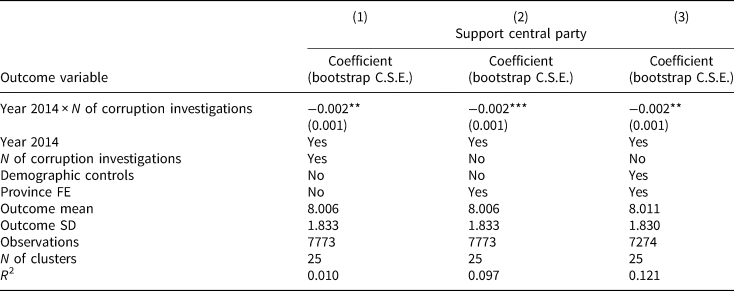
Table 1 presents the estimates. We first present the most parsimonious specification in column (1), add provincial fixed effects in column (2),Footnote 24 and then include Demographic Controls (potentially post-treatment) in column (3). Regardless of which specification we use, the coefficient on the interaction term is consistently negative and significant. Holding everything else constant, every 200 corruption investigations (the average number of investigations in the sample provinces is 199.8) reduce citizen support by 0.4 on a 0–10 scale (5 percent of the mean). In our sample, 9 of the 25 provinces had conducted more than 200 investigations by 2014. These provinces together had over twice of the population in the United States and constituted more than half of China's population. Many provinces, including Jiangsu, Guangdong, Shandong, and Sichuan, had conducted nearly 400 investigations before July 2014, and more investigations occurred after that.
OLS estimates of the effects of corruption investigations on regime support
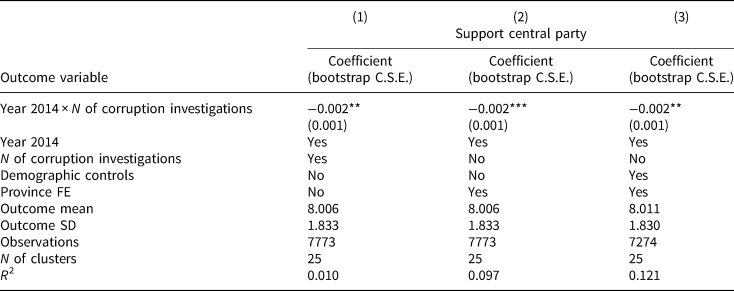
Notes: This table presents the benchmark results. Appendix Table A2.1 shows the full results. Clustered bootstrap standard errors at the provincial level in parentheses. The p-values are based on a two-tailed test: *p < 0.1, **p < 0.5, ***p < 0.01.
Our results are highly robust, as shown in a wide range of robustness checks. For example, one concern regarding survey research in authoritarian regimes is that respondents might over-report their regime support due to political fears (Kuran, Reference Kuran1991). Jiang and Yang (Reference Jiang and Yang2016) show that after the removal of a powerful local politician, Chinese respondents become more willing to express their criticism of the regime. It is therefore possible that the lower public support that we detect is a result of decreased political fear. In our surveys, we asked respondents how much they feared the central government when discussing politics (Political Fear). Obviously, this measure is imperfect because respondents with political fear might be too afraid to say so. Thus, we also examine whether they responded to this question (Response to Political Fear). As survey methodologists show, respondents usually avoid a sensitive question by selecting “Don't Know” or “No Response” (Presser et al., Reference Presser, Couper, Lessler, Martin, Martin, Rothgeb and Singer2004). In one robustness check, we first use the DID framework to examine whether the campaign changes respondents' political fear (measured by Political Fear and Response to Political Fear) but find no evidence. We then control for Political Fear or Response to Political Fear and obtain the same estimates (Appendix Tables A3.7 and A3.8).
In a wide range of robustness checks, we use alternative measures of the outcome variable (Trust Central Government, Trust Central Party, Support Central Government, a scale that aggregates all four measures, and dichotomous coding of these variablesFootnote 25), alternative measures of the independent variables (Number of Corruption Investigations (Weighted), Number of Corruption Investigations Per Million, separating “tigers” and “flies,” Number of Corruption Investigations (Time Discount), Number of Corruption Investigations (Squared),Footnote 26 and Number of Corruption Investigations (Above Mean)), control for Per Capita Family Income (log), drop new migrants, conduct placebo tests by creating 100 “fake” anti-corruption campaigns in which the number of corruption investigations in each province is drawn randomly from a uniform distribution, drop one province at a time, interact with an indicator for provinces that have connections with Xi Jinping,Footnote 27 drop provinces that have connections with Xi Jinping, consider survey design effects, use multiple imputation to deal with missing data, include a spatial lag to examine spill-over effects, use wild bootstrap standard errors, and conduct a sensitivity analysis to assess the influence of unobservables. None of these tests significantly changes or challenges our original results (Appendix Section III).
3.2 Evidence on updating
So far, we have established a negative relationship between corruption investigations and citizens' regime support. Now we provide direct evidence on our updating mechanism that new information disclosed during the campaign has updated citizens' beliefs about public officials.
Our theory predicts that respondents who are exposed to more investigations start to doubt the integrity of public officials. To measure citizens' beliefs about the integrity of public officials (Beliefs in Officials' Integrity), we use a question in the surveys asking the respondents' opinion on the statement “In general, public officials are honest,” which is scaled from 1 (Strongly Disagree) to 4 (Strongly Agree).Footnote 28 Beliefs in Officials' Integrity is estimated to have a strong positive effect on people's regime support (Appendix Table A4.1).
Using the same DID framework, Table 2 presents the ITT of corruption investigations on Beliefs in Officials' Integrity. Consistent with H2, respondents living in provinces that had more corruption investigations have lower posterior beliefs about officials' integrity. For every 200 investigations, respondents' Beliefs in Officials' Integrity decreases by 0.16 on a 1–4 scale (6.8 percent of the mean). We also conduct a causal mediation analysis (Imai et al., Reference Imai, Keele, Tingley and Yamamoto2011) and show that Beliefs in Officials' Integrity mediates 15.8 percent of the total effect of corruption investigations on regime support (Appendix Table A4.3). But, due to strong assumptions required for causal mediation analysis, such as sequential ignorability, this result needs to be interpreted with caution.
OLS estimates of the effects of corruption investigations on Beliefs in Officials' Integrity
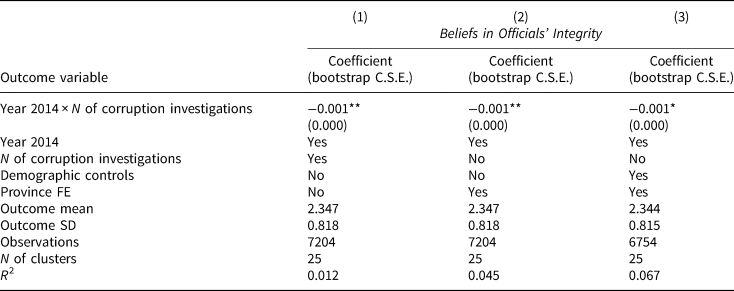
Notes: This table tests the updating mechanism. Clustered bootstrap standard errors at the provincial level in parentheses. The p-values are based on a two-tailed test: *p < 0.1, **p < 0.5, ***p < 0.01.
3.3 Heterogeneous effects
The core insight of our theory is that the effects of corruption investigations should be conditional on people's prior beliefs. If they already have a low opinion of officials' integrity, the revealed corruption during the campaign should not surprise them; if their baseline belief is that officials are largely honest, they should be surprised by the rampant corruption revealed during the campaign and reduce their regime support accordingly. Almost half of our respondents had high priors: in our baseline survey, 43.11 percent of the respondents “strongly agree” or “agree” with the statement “In general, public officials are honest.” To test the heterogeneous effects, we specify a model with a triple interaction term among Year2014, Number of Corruption Investigations, and people's prior beliefs.
We use the provincial mean of Beliefs in Officials' Integrity in the 2010 baseline survey to measure average prior beliefs in each province. This strategy is imperfect, because ideally we want to use an individual-level measure, but we do not have a panel to measure respondents' priors at the individual level. This aggregate measure, which still exhibits significant variations,Footnote 29 will enable us to retain our DID framework. The coefficient on the triple interaction (difference in difference in differences estimator) is then the marginal effect of corruption investigations in provinces with different levels of prior beliefs.
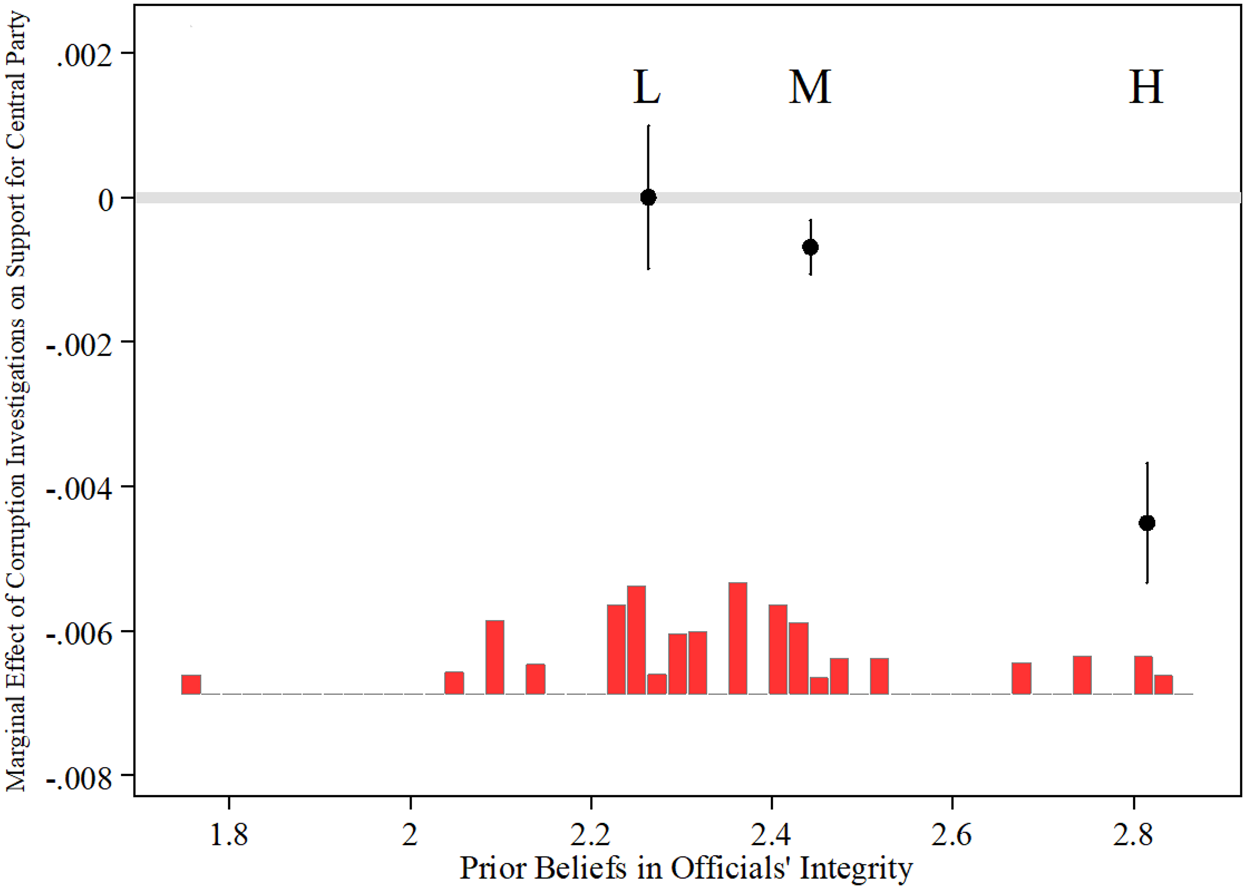
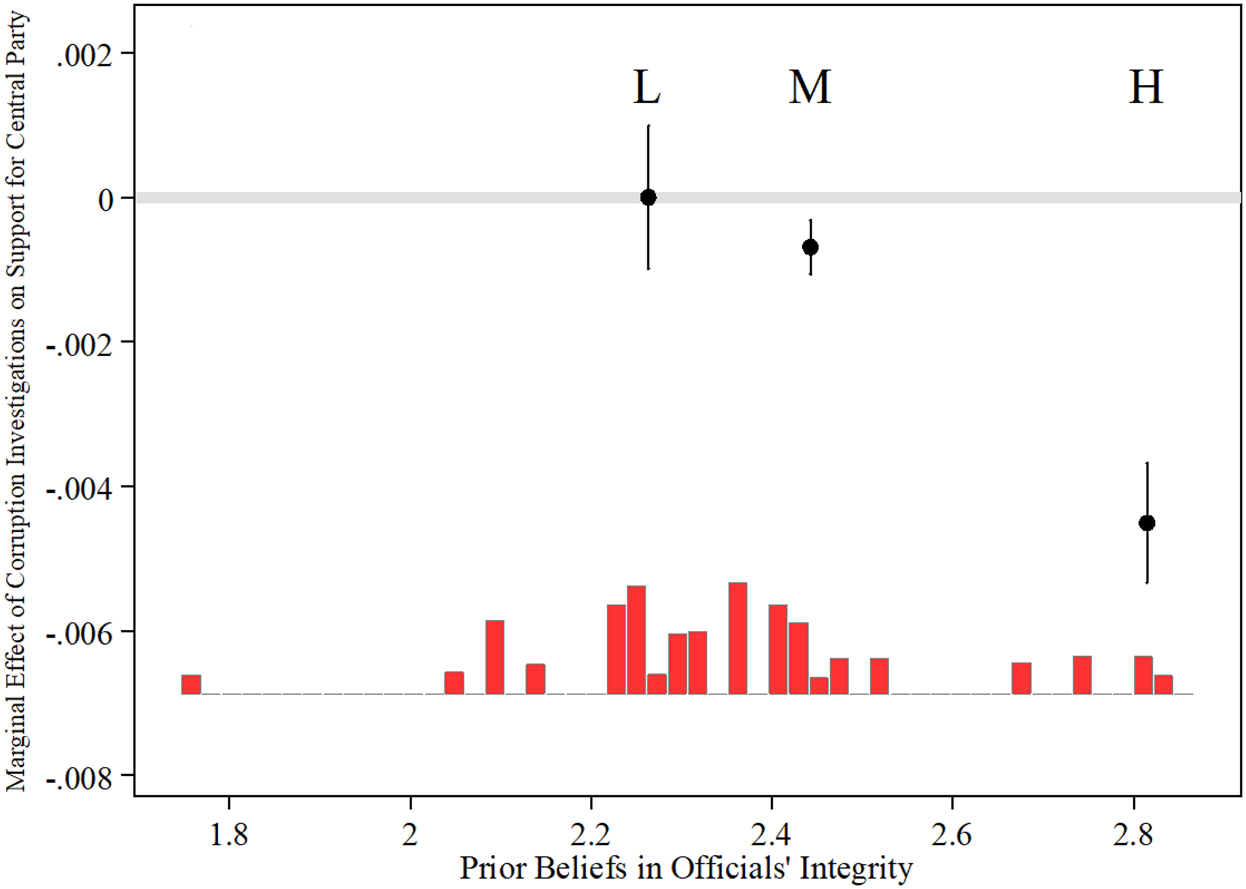
Figure 1 shows the estimates of the marginal effect of corruption investigations on Support Central Party at different levels of prior beliefs. Consistent with H3, corruption investigations have precisely zero effect for respondents who already had a low opinion of officials' integrity, but as people's prior beliefs in officials' integrity become stronger, the marginal effect of corruption investigations becomes statistically significant and negative. At the medium level of priors, the marginal effect of corruption investigations is −0.001 (p < 0.01); at the high level it is −0.005 (p < 0.01). We also use a bootstrapping approach, which produces similar results. Appendix Table A4.2 shows the full estimates. In short, the effect of corruption investigations on regime support is conditional on respondents' prior beliefs about the integrity of public officials.
Marginal effect of corruption investigations at different levels of prior beliefs in officials' integrity. Notes: This graph plots the marginal effects (with 95 percent confidence intervals) of corruption investigations on Support Central Party at three (low, medium, and high) different levels of prior beliefs. The bars refer to the distribution of the moderator. We use the current best-practice method proposed by Hainmueller et al., (Reference Hainmueller, Mummolo and Xu2019) and a binning estimator to divide the provinces into three groups (low, medium, and high) based on their average prior beliefs.
3.4 Media exposure
Finally, we examine another implication of our theory that the more our respondents are exposed to social media, the more we should expect their public support to be more negatively affected by the campaign. We discuss the details of this test in Appendix Section V. Consistent with H4, as people are more exposed to news on social media, the marginal effect of corruption investigations becomes steadily more negative. As Appendix Figure A5.2 shows, in provinces in which the average social media news consumption is below 30 percent, corruption investigations have an insignificant effect on people's support for the Party. In provinces in which 40 percent of the respondents read news on social media, the marginal effect is negative (−0.005) and significant. Appendix Table A5.2 shows the full estimates.
4. Conclusion
Corruption is a global disease: it impedes economic growth, increases inequality, and erodes political legitimacy (Bardhan, Reference Bardhan1997; Seligson, Reference Seligson2002). Although some countries establish independent institutions, such as anti-corruption agencies or a judiciary, to control corruption, many resort to periodic campaigns to crack down on corruption.
Intensive corruption investigations, however, might undermine regime support. The leaders of the campaign can still benefit, for example by eliminating their enemies and consolidating their power, but the institutions they lead have to pay a public opinion cost. (Although observers frequently state that the anti-corruption campaign made Xi Jinping popular, there are no approval ratings for individual leaders in China, so we cannot determine what the public actually thinks of Xi.)
To our knowledge, this is the first quasi-experimental evidence of how corruption investigations affect regime support in an authoritarian regime. Using the case of China's current anti-corruption campaign, we show that citizens update their beliefs about public officials based on new information revealed during such campaigns. The more corruption the campaign reveals, the more it suppresses citizen support for the regime. Our findings reveal a bitter irony: corruption negatively impacts regime support, but fighting corruption is no panacea. In terms of public opinion, the cure may be as bad as the disease.
Supplementary material
The supplementary material for this article can be found at https://doi.org/10.1017/psrm.2021.27
Acknowledgments
We want to thank Jialu Li, Fenglin Guo, and Siyao Zheng for providing excellent research assistance. Eric Chang, Mary Gallagher, Yue Hou, Xiaobo Lü, Melanie Manion, Hsin-Hsin Pan, Liz Perry, Dong Zhang, Boliang Zhu, panel participants at AAS 2017 and APSA 2017, and seminars at Peking University, National Chengchi University, Harvard University, George Washington University, and Hertie School of Governance have provided helpful comments. All errors remain our own.