Introduction
Olfactory function, which is typically understood as being composed of the two independent hierarchical processes of odor detection, as well as odor discrimination and encoding,Reference Martzke, Kopala and Good 1 is suspected to be a marker of cognitive impairment that is associated with various psychiatric conditions.Reference Atanasova, Graux and El Hage 2 A range of cognitive domains have been suggested as being closely connected on a functional or neuroanatomical level to the olfactory system, including memory, emotion processing, and social functioning.Reference Kivity, Ortega-Hernandez and Shoenfeld 3
These patterns have been explored at length in an attempt to better understand the cognitive impairments associated with many psychiatric disorders. Olfactory function has been found to be impaired in persons with schizophrenia,Reference Kopala, Clark and Hurwitz 4 – Reference Moberg, Arnold and Doty 7 seasonal affective disorder,Reference Postolache, Doty and Wehr 8 , Reference Postolache, Wehr and Doty 9 and major depressive disorder.Reference Pause, Miranda, Göder, Aldenhoff and Ferstl 10 , Reference Lombion-Pouthier, Vandel, Nezelof, Haffen and Millot 11
Until recently, research on olfactory function in bipolar disorder had been relatively neglected, in part due to early findings about the relatively intact olfactory function of persons with bipolar disorder compared to other disorders such as schizophrenia,Reference Hurwitz, Kopala, Clark and Jones 12 as well as other studies that showed contradictory results.Reference Amsterdam, Settle, Doty and Abelman 13 – Reference Swiecicki, Zatorski and Bzinkowska 17 More recent studies, however, have shown olfactory dysfunction in a bipolar population as well. Odor identification deficits have been found in patients with affective psychoses, beginning with the first episode and independent of treatment.Reference Brewer, Pantelis and Anderson 18 Cumming etal.Reference Cumming, Matthews and Park 19 found that persons with bipolar disorder showed deficits in odor identification, and that this deficit was significantly related to social competence. Similarly, Hardy etal.Reference Hardy, Rosedale and Messinger 20 have also found that in a bipolar sample, increased odor sensitivity was related to depressive symptoms, and decreased odor sensitivity was related to manic symptoms, as well as poor employment, social avoidance, and social fear.
As this area has developed, attention has turned toward the relationships found by the aforementioned studies between olfactory function and social functioning. As there is a close functional and neuroanatomical relationship between olfactory ability and the regulation of emotions,Reference Millot and Brand 21 – Reference Ludvigson and Rottman 23 it could be the case that olfactory dysfunction is a particularly strong marker for cognitive impairments associated with or underlying social functioning. This could be a result of neuroanatomical connections between the olfactory system and systems underlying social functioning. Some researchers attribute this bidirectional interaction to the connections between olfactory pathways and the limbic system, whereas others note that both functions require the integrity of common neural substrates, such as the orbitofrontal, temporal, and entorhinal cortices, as well as the amygdala.Reference Pitkänen, Pikkarainen, Nurminen and Ylinen 24 – Reference Savic 27
Social cognition has been defined as “how individuals think about themselves, others, social situations, and their interactions,”Reference Penn, Spaulding and Reed 28 and elsewhere in developmental and animal model research as, “the cognitive ability to infer mental states to oneself and to others in terms of thought, emotion, and intention, which makes it possible to predict the behavior of others and to understand the social information of the surroundings.”Reference Baron-Cohen, Leslie and Frith 29
While work on social cognition in bipolar disorder is still limited, recent years have seen growth in this area. In particular, theory of mind (a subdomain of social cognition) is impaired in people with bipolar disorder, not only in symptomatic phases, but also in euthymia.Reference Kerr, Dunbar and Bentall 30 – Reference Martino, Strejilevich, Fassi, Marengo and Igoa 33 Lahera etal.Reference Lahera, Ruiz-Murugarren and Iglesias 34 have shown that social cognition deficits are more pronounced in low-functioning persons with bipolar disorder, and that therefore social cognition could partially predict the relationship between clinical variables and functioning.
In the present study, we examine olfactory function and social cognition deficits in bipolar disorder. First, we evaluated group differences between the bipolar group and control group, hypothesizing that the bipolar group will exhibit deficits in olfactory function, specifically odor recognition. Second, we examined the possibility that olfactory function is a marker of social cognition deficits associated with bipolar disorder by examining the relationship between odor identification and two subdomains of social cognition—emotion perception and theory of mind—in a sample of euthymic bipolar patients. Finally, we also examine relationships of smell identification with general cognition and functioning, and we predict that olfactory performance is also significantly correlated with measures in each of those domains.
Methods
Participants
Thirty-nine euthymic outpatients fulfilling Diagnostic and Statistical Manual of Mental Disorders, 4th Edition, Text Revision (DSM-IV-TR) criteria for bipolar disorder type I or II (American Psychiatric Association, 1994) 35 were recruited from two different mental health centers in Madrid, Spain. Diagnoses were confirmed using the Structured Clinical Interview for DSM-IV-TR. Patients were required to be in state of euthymia, defined as a score lower than 8 on the Hamilton Depression Rating Scale (HDRS) and a score lower than 6 on the Young Mania Rating Scale (YMRS) sustained during the last 3 months. Participants were required to be between the ages of 18 and 70 years.
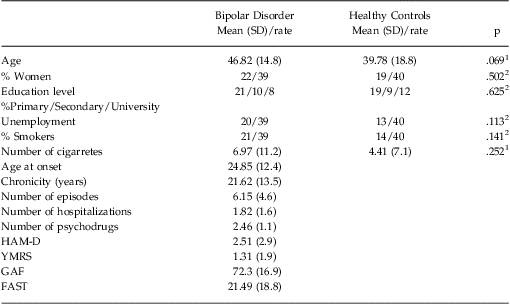
We also recruited 40 healthy controls with sociodemographic characteristics similar to those of the study group. Exclusion criteria for both patients and controls were current psychiatric comorbidity in axis I, substance abuse or dependence (in the last year), a history of head injury, neurological illness, mental retardation, electro-convulsive therapy in the last year, and any medical condition that could affect olfactory functioning (eg, common cold or allergies). All the subjects provided written statements of informed consent, and the Ethics Committee of the Príncipe de Asturias Hospital approved the study. Demographic information for both control and patient groups can be found in Table 1.
Socio-demographic and clinical characteristics of participants

1T-test
2Chi square
Measures
Evaluation of olfactory discrimination
To evaluate olfactory discrimination, we used the University of Pennsylvania Smell Identification Test (UPSIT), a test that has been widely used since 1984. The 40-item UPSIT is a standardized, 4-alternative, forced-choice test of olfactory identification. It is composed of 4 booklets containing 10 odorants each, with 1 odorant per page. The stimuli are embedded in “scratch-and-sniff” microcapsules that are fixed and positioned on strips at the bottom of each page. A multiple-choice question with four response alternatives for each item is located above each odorant strip. The split half reliability of the UPSIT has ranged from .93 to .97, 2-week test-retest reliability has been shown to be .95, and long-term reliability has been shown to be .94.Reference Doty, Shaman and Dann 36
Evaluation of emotion perception
The emotion recognition testReference Baron-Cohen, Wheelwright and Jolliffe 37 consists of a series of photographs of facial expressions by the same model depicting 7 basic emotions (eg, happiness, sadness, anger, fear, surprise, disgust, and discomfort) and 9 complex mental states (eg, scheming, guilt, reflection, doubt, admiration, seduction, interest, arrogance, and boredom) for the patient to identify from the photographs. In one-third of the pictures, the entire face is shown; another third shows only the eyes; and in the final third, only the mouth can be seen. All the photographs are randomly ordered, and scores range from 0 to 60, with performance indexed as number correct.
Evaluation of theory of mind
The comprehension faux pas testReference Stone, Baron-Cohen and Knight 38 , Reference Gregory, Lough and Stone 39 is a verbal test that measures the ability to understand socially awkward situations. There are 20 strips, 10 of which describe faux pas situations and 10 of which do not. If a faux pas is identified, 2 clarifying questions are asked: “Why shouldn't the character have said what he or she did?” and “Why do you think he or she did say it?” To comprehend that a faux pas has occurred, the subject has to understand 2 mental states, namely, that the person making the faux pas does not, at that moment, know he or she has done so, and that the other character was offended or hurt by the first character.
Evaluation of general cognition
Asarnow etal.'s span of apprehension test (SAT)Reference Asarnow, Nuechterlein and Marder 40 was used to assess the capacity for sustained attention. This task presents a sequence of target and non-target stimuli at a fixed rate of 1 per second for a short period of 0.1 seconds, so that the presence of the target stimulus must be captured. The computerized version of the test included in the COGLAB Neuropsychological Test BatteryReference Spaulding, Garbin and Dras 41 (Spanish version by Gurpegui and Cerezo)Reference Gurpegui, Alvarez, Bousoño, Ciudad, Carlos Gómez, Olivares and Bousoño 42 was used. The final capacity for sustained attention score ranged from 0 to 30. The Wisconsin Card Sorting Test (WCST)Reference Heaton 43 was used to assess executive function. This test measures the ability to adequately use information to solve problems and to design a course of action. It also measures whether the patient has the cognitive flexibility to change certain criteria to meet the demands of reality (ie, when the patient receives feedback that his/her answers are incorrect). The results are tabulated as the number of categories completed and are based on the number of correct answers, the number of random errors, and the number of perseverative errors.
Functioning
The Functioning Assessment Short Test (FAST) is a 24-item, interviewer-rated scale of psychosocial functioning with items separated into domains including autonomy, occupational functioning, cognitive functioning, financial issues, interpersonal relationships, and leisure time. Higher scores reflect greater impairment. Receiver Operating Characteristic (ROC) curve analyses in previous studies have demonstrated a sore of 11 to be an appropriate cut-point distinguishing bipolar patients from nonclinical controls.Reference Rosa, Sánchez-Moreno and Martínez-Aran 44 To complement the use of the FAST, a re-analysis using the Global Assessment of Functioning (GAF, taken from DSM-IV)Reference Heaton 43 was performed as well.
In order to best examine the relationship between smell identification and social cognition, it is also important to note the potential for confounds between these two variables. First, it has been shown that odor and taste identification abilities decline with age,Reference Kaneda, Maeshima and Goto 45 as do cognitive abilities in individuals with bipolar disorder and schizophrenia.Reference Green 46 Second, as there is a higher rate of cigarette smoking in bipolar samples,Reference Diaz, James and Botts 47 and smoking has long been known to impair one's olfactory abilities over time,Reference Frye, Schwartz and Doty 48 cigarette smoking remains another potential confounding factor.
Analyses
We used SPSS version 19 for statistical analyses. We tested the normality of the variables using the Kolmogorov–Smirnov test. To evaluate group differences in olfactory function and emotion perception, we conducted an independent sample t-test comparing the bipolar group and the control group on each of those variables. Faux pas test data were not collected among controls, so they were omitted from the analysis pertaining to group differences. Next, we examined Pearson correlations between the smell identification task and the neurocognitve, social cognitive, and functioning measures. We recomputed the above as partial correlations, while controlling for the influence of age and number of cigarettes smoked per day using linear regression.
To evaluate the relationship between olfactory function and social cognition, we completed two hierarchical regression analyses—one predicting emotion perception and the other predicting performance on a faux pas task. First we entered the following variables at step 1: age and number of smoked cigarettes per day. Then we entered measures of neurocognition at step 2, including Asarnow's SAT and the WCST. Third, we entered the odor identification variable, which was represented by the number of smells correctly identified. F tests were conducted at each step of the hierarchical regression; these tested for the significance of the change in R2 value.
Findings
Sample characteristics
The sociodemographic and clinical characteristics of the sample are presented in Table 1. The group of patients with bipolar disorder and the control group presented similar sociodemographic characteristics, with a trend toward higher age in bipolar group (mean = 46.82, SD =14.81) than the control group (mean = 39.78, SD = 18.8).
Group differences on olfactory performance and face emotion recognition
There was a significant difference on performance between the two groups regarding odor identification (t = 3.56, p = .001) with control participants answering more items correctly on the UPSIT (mean = 31.85, SD = 3.6) than participants with bipolar disorder (mean = 27.58, SD = 6.7). Furthermore, bipolar patients showed an impairment in facial emotion recognition, with a significantly lower score in the emotion recognition test (mean = 41.78, SD = 6.9) than healthy controls (mean = 47.97, SD = 3.6), t = 4.859, p < .001.
Relationships between olfactory performance, social cognition, general cognition, and functioning
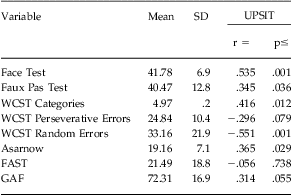
Correlations were computed between performance on the UPSIT and each measure of social cognition, general cognition, and the two measures of functional outcome in the patient group. Better performance on the UPSIT was associated with better emotion recognition and Faux Pas Recognition Test, as well as a greater number of correct WCST categories and number correct on the Asarnow Test. Finally, performance on the UPSIT was associated at trend level with global functioning as measured by the GAF (Table 2).
Correlations between performance on the UPSIT and each measure of social cognition, general cognition and global functioning among individuals with bipolar disorder
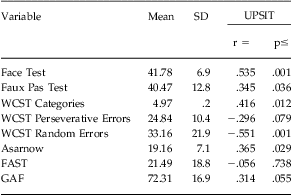
We recomputed the above correlations, while controlling for the influence of age and number of cigarettes smoked per day. The UPSIT was still significantly correlated with the emotion recognition test (r = .39, p = .03) and the WCST total (r = .40, p = .03). However, the relationships between the UPSIT and the comprehension faux pas test, GAF, FAST, and SAT were no longer statistically significant after controlling for age and cigarettes smoked.
Multiple regression models predicting social cognition from UPSIT
For the first regression analysis, we predicted performance on the emotion recognition test in the patient group. For the first step, we entered age and number of cigarettes smoked per day. This first model significantly predicted performance on the emotion recognition test (R 2 = .312, F = 7.029, p = .003). In the second step, we entered performance on both measures of general cognitive functioning. We found that general cognitive variables significantly improved the model (ΔR 2 = .169, p = .017), which contributed 16.9% of variance to the model predicting emotion recognition. In the final step, we entered performance on the UPSIT. This test approached statistical significance in improving the model (p = .055), which contributed 6.5% of variance to the model predicting emotion recognition, beyond the influence of general cognitive ability, age, and cigarette smoking. Alternatively, the partial correlation between the UPSIT and the emotion recognition test approached significance (r = .354, p = .055), independent of the influence of general cognitive ability, age, and smoking. The full model R 2 after all three steps was .546.
Repeating the same regression analysis predicting the comprehension faux pas test, we again first entered age and number of cigarettes smoked per day. This first model did not significantly predict performance on the emotion recognition test (R 2 = .074, F = 1.274, p = .294). Entering the two measures of cognitive ability at step two improved the model (ΔR 2 = .183, p = .017), which contributed 18.3% of variance to the model predicting emotion recognition. At step 3, UPSIT did not significantly improve the model (ΔR 2 = .019, p = .396). The full model R 2 after all three steps was .276.
Discussion
The purpose of the present study was to examine the relationships between olfactory ability and social cognition in bipolar disorder. First, the hypothesis that bipolar patients are impaired in olfactory identification was supported. Second, olfactory function was related to each of the social cognition measures in the study, as well as with two tasks of general cognition. Finally, olfactory function approached statistical significance in predicting performance on facial emotion recognition when accounting for age, smoking, and general cognitive ability, although it did not predict performance on the theory of mind measure when controlling for these variables.
In previous work, Kohler etal.Reference Kohler, Barrett, Gur, Turetsky and Moberg 49 reported an association between facial emotion recognition and odor identification in schizophrenia. Years before, other studies had reported impaired odor identification in patients with autism and severe social difficulties.Reference Suzuki, Critchley, Rowe, Howlin and Murphy 50 , Reference Bennetto, Kuschner and Hyman 51 The present study extends this association to patients with bipolar disorder. The influence of odor perception on emotions, mood, or behavior in humans is still an open research question. In the majority of mammals, the sense of smell is the principal medium for social interaction, and plays important roles in mating, parenting, group affiliation, territorial boundaries, and the identification of enemies.Reference Malaspina, Corcoran and Goudsmit 52 In humans, neuroanatomical and imaging studies show an overlap of olfactory and limbic neural structures.Reference Van Toller 53 , Reference Zald and Pardo 54 While many more studies are needed to confirm these findings, there is preliminary evidence of a link between these two systems, both in clinical and normal populations. This reported overlap between smell and social deficits (in autism, psychosis, and now bipolar disorder) opens the way to a better comprehension of the physiopathology of these disabling psychiatric conditions. Furthermore, it suggests a potential use of olfactory tests as markers of subclinical cases, as have been already studied in Parkinson's and Alzheimer's disease.Reference Rahayel, Frasnelli and Joubert 55 , Reference Haehner, Hummel and Reichmann 56
Our findings indicate that general cognitive factors accounted for much of the relationship between olfactory function and theory of mind. This suggests that olfactory deficits might be a marker of general cognitive disability that leads to impaired performance on theory of mind tasks. However, the pattern of findings from the facial emotion recognition test suggests that above and beyond the influence of cognitive measures, a trend-level relationship persists between olfactory function and emotion perception. While previous work has contended that relationships between olfactory function and cognitive and clinical variables are unrelated, the present study suggests that responses to these findings should be tempered as they apply to social cognition. Nonetheless, a consistent relationship still remains between the two constructs. Future research could explore biological or psychological models that connect emotion recognition and olfactory identification. While our findings are not sufficient to create such a model, this article points to the merits of exploring the relationship between olfactory function and social cognition, and in particular olfactory function and facial affect perception.
This study had a number of limitations. First, all bipolar patients were receiving pharmacological treatment. Conducting studies on patients free from medications is ethically problematic, and, in addition, various studies have found a null effect of psychopharmaceuticals on olfactory capacity.Reference Martzke, Kopala and Good 1 , Reference Moberg, Agrin and Gur 5 , Reference Pause, Miranda, Göder, Aldenhoff and Ferstl 10 , Reference Rupp 57 Second, the emotion recognition test has been widely used but has not been sufficiently validated in the literature in terms of internal consistency and test-retest reliability. Third, there was a statistical trend towards difference between the groups in average age. This is controlled for in this article's more advanced analyses, but it remains a complication for the interpretation of the simple correlations. The number of participants was relatively small, and these relationships, while notable, should also be interpreted with caution, particularly as they pertain to differentiating between subtypes of social cognition. Finally, it is important to clarify that UPSIT measures only identification of odors. Other dimensions of olfactory perception such as odor detection, pleasantness, intensity, memory, familiarity, and discrimination were not assessed in this study. However, the administration of 9 different olfactory tests to 97 healthy subjects revealed that a number of nominally distinct tests were measuring a common source of variance.Reference Doty, Smith, McKeown and Raj 58
Conclusion
The bipolar patients showed a significant impairment in olfactory identification compared to healthy controls. As hypothesized, olfactory dysfunction in bipolar patients was correlated with a deficit in both verbal and nonverbal measures of social cognition. When accounting for age, cigarettes smoked, and general cognitive ability, this relationship remained significant between olfactory function and facial emotion recognition. Future research could explore biological or psychological models that connect emotion recognition and olfactory identification in patients with affective disorders.
Disclosures
Guillermo Lahera has been on the speakers’/advisory boards for Otsuka, Lundbeck, Janssen, and Lilly. Salvador Ruiz-Murugarren has been speaker for Otsuka. Jerónimo Sáiz-Ruiz has been on the speakers’/advisory boards of Servier, Janssen, and Shire. The remaining authors have nothing to disclose.