TWO SPANISH FUTURES
In Modern Spanish, there are two constructions that are most commonly associated with future meaning.Footnote 1 The newer of these is the Periphrastic Future (PF) (sometimes called the Analytic Future [e.g., Berschin, Reference Berschin1986]), in (1). The older of these two forms is the Synthetic Future (SF) (sometimes called the Morphological Future, Simple Future [e.g., Cartagena, Reference Cartagena1995–1996], Grammatical Future [e.g., Matte Bon, 2005], or simply Future [e.g., Butt & Benjamin, 1994]), shown in (2). The SF had future function since the very beginnings of the Spanish language (Moreno Bernal, Reference Moreno Bernal2004; Vossler, Reference Vossler and Becker1922:178–179). I will refer to these as “temporal PF” and “temporal SF,” respectively, because both express the temporal notion of futurity.
(1) Os voy a contar una historia. (COREC, CCCON031B, 20s)Footnote 2
‘I am going to tell (PF) you a story’
(2) Pues eso y bueno, ya te contaré más detalladamente. (COREC, CCCON029D, 20s)
‘Well, now I will tell (SF) you in more detail’
Although both constructions do indeed express futurity, they cannot be considered equivalent constructions. First, both future forms may carry epistemic overtones, though it is often argued that SF is more “contaminated” by such semantics (e.g., Sedano, Reference Sedano1994:237). This debatable (and oft-debated) nonequivalence lies not only in subtle semantic nuances in some contexts, but also in strikingly obvious nonoptionality in others. Unlike the PF, the SF also occurs in nonfuture epistemic modal contexts, as in (3).Footnote 3 Here, the SF does not refer to a future-located event or situation, as indicated by the occurrence of ahora ‘now’ and the third-person plural Present of ‘be’, están, in the question. The epistemicity is further emphasized by the preceding no lo sé si ‘I don't know if’.Footnote 4 I will refer to SF occurrences in this context as “nontemporal SF.”
(3) —¿Y Paquito y María dónde estánahora?
—No lo sé siestarán con sus abuelos o estarán en Valencia dónde andarán. (COREC, CCCON019A, 20s)
‘—And Paquito and María, where are they now?
—I don't know if they might be (SF) with their grandparents or they might be (SF) in Valencia where they might be (SF).’
Romance future forms have been of such great interest to linguists that Moreno Bernal termed the future “the Romance topic par excellence” (2004:121). Studies on this subject go back nearly a century (e.g., Coseriu, Reference Coseriu1957; De Jonge, Reference De Jonge1991; Fleischman, Reference Fleischman1982; Imbs, Reference Imbs1968; Kahane & Hutter, Reference Kahane and Hutter1953; Mattoso Câmera, Reference Mattoso Câmera1957; Montes, Reference Montes1962–1963; Paufler, Reference Paufler1970; Sedano, Reference Sedano1994, Reference Sedano and Olivier1995; Tlaskal, Reference Tláskal1978; Vossler, Reference Vossler and Becker1922) and have continued steadily into the present decade (e.g., Blas Arroyo, Reference Blas Arroyo2000, Reference Blas Arroyo2008; Losada Durán, Reference Losada Durán2000; Orozco, Reference Orozco and Eddington2005; Poplack & Malvar, Reference Poplack and Malvar2007; Sedano, Reference Sedano2006a, Reference Sedano2006b, Reference Sedano and Parodi2007).
THE VARIABLE CONTEXT
One of the mainstays of variationist work is the delimitation of the variable context: the overlapping space in which all of the variants under consideration may occur. The elusive nature of the parameters of morphosyntactic variation has led some researchers to express reservations about including grammatical constructions undergoing semantic change in variation studies at all (e.g., Lavandera, Reference Lavandera1978; Romaine, Reference Romaine1981). Numerous others, however, have defended the usefulness of variationist methods in understanding variation and change in morphosyntactic phenomena (e.g., D. Sankoff, Reference Sankoff and Newmeyer1988; Silva-Corvalán, Reference Silva-Corvalán and Fernández1997; Söll, Reference Söll and Hausmann1983:16; Torres Cacoullos, Reference Torres Cacoullos2001), and such work comprises a good percentage of the variationist work done today.
The solution to the question of true optionality in morphosyntax has been, and continues to be, the object of some discussion, especially among scholars who struggle with the fine distinctions necessary in describing such variation in their own work. David Sankoff hypothesized that any ostensible semantic differences between syntactic constructions in variation, which may be postulated upon reflection, may be neutralized in certain contexts of use, that is, the full panoply of distinctions will not always be salient: “for certain identifiable sets of alternations, these distinctions come into play neither in the intentions of the speaker nor in the interpretation of the interlocutor” (1988:153). Such neutralization in context is an essential component of language change (Poplack & Turpin, Reference Poplack and Turpin1999:140), because if speakers do not at some point equate one variant with another in some contexts, the widely documented processes of semantic and contextual generalization of one construction—often at the expense of another—would not be possible (see, e.g., Bybee, Perkins, & Pagliuca, Reference Bybee, Perkins and Pagliuca1994, for numerous examples of semantic and contextual generalization). Scholars such as Veiga (Reference Veiga1991:26) and Losada Durán (Reference Losada Durán2000) have, in fact, argued for such “textual equivalence” in the case of Spanish futures. Such neutralization, however, is at this point empirically unfalsifiable, as is its alternative: that speakers and hearers are always aware of, and act upon, all possible meaning distinctions every time they utter a particular construction (D. Sankoff, Reference Sankoff and Newmeyer1988). Most studies of Spanish futures have asserted semantic differences, though these are nearly as likely to conflict as to coincide in which meanings should be attributed to which forms (see Aaron, Reference Aaron2006, Reference Aaron2007, for a fuller treatment for Spanish, or Poplack & Malvar, Reference Poplack and Malvar2007, for Portuguese).
Though we may never be able to prove that, for a given speaker at a given moment, possible meaning differences are or are not neutralized in a given context, Torres Cacoullos (Reference Torres Cacoullos2001) reminded us that, in studies of variation among grammaticizing forms, these forms do not need to mean the same thing. Instead, the common element is not exact form-meaning correspondence, but rather a shared history: the constructions in variation have overlapping uses that are diachronically related (e.g., Smith, Reference Smith2001). Tagliamonte and D'Arcy (Reference Tagliamonte and D'Arcy2007b), for example, took as their central context that of obligation/necessity in their examination of variation patterns between several Canadian English forms, some of which also occurred in contexts further along their particular path of grammaticization, such as must in epistemic contexts. A panchronic vision of morphosyntactic variation calls for the identification of the contexts in which, historically, constructions have overlapped functionally, as well as the contexts in which they have not (D. Sankoff, Reference Sankoff and Newmeyer1988:153; Schwenter & Torres Cacoullos, Reference Schwenter and Torres Cacoullos2008; Silva-Corvalán, Reference Silva-Corvalán and Fernández1997:119–120; Wolfram, Reference Wolfram and Preston1993:195, 207). The envelope of variation may therefore include various related functions along parallel paths of grammaticization (Torres Cacoullos & Walker, Reference Torres Cacoullos and Walker2009).
THE CURRENT STUDY: SPANISH FUTURE WITHIN AND BEYOND FUTURITY
However the envelope of variation is eventually defined, it is standard variationist practice to exclude tokens outside this envelope from further quantitative analyses (e.g., Poplack & Tagliamonte, Reference Poplack and Tagliamonte2001; Poplack & Turpin, Reference Poplack and Turpin1999:160). Although such tokens range from highly infrequent occurrences, such as purposive motion clauses in historical present with the same syntactic structure as PF, as in (4), to vast territories of diverse functional spaces, such as non-future-time epistemic modality with SF, as in (5), their role in variationist studies has yet to be adequately explored. With this paper I aim to begin a new discussion. Can these excluded occurrences matter? What kinds of evidence might demonstrate their importance? How might their role be incorporated into variationist and grammaticization methodology?
(4) Y me asomo, me voy a asomar a una ventana, pero resulta que es que era la ventana del cuarto de baño del otro piso. (COREC, CCCON032A, 20s)
‘And I get closer, I go to get closer (ir a ‘go to’ + INF) to a window, but it turns out that it was the window to the bathroom that was on the other floor’
(5) Pero deberéis estar fatigado. (El afán, 19c)
‘But you must (SF) be tired’
Taking into account diachronic evidence from variation patterns between two Spanish future tense constructions, I will show that quantitative analysis of occurrences in frequently occurring contexts that fall outside the envelope of variation may provide valuable explanatory insight regarding diachronic shifts in patterns within the variable context. As such, I will argue that, at least when these occurrences represent a substantial share of a variant's use, it can be of great use to code, quantify, and analyze occurrences outside the variable context alongside variable rule analyses of the variable context. When used as a supplement to multivariate analyses, it can help us to envision the entire emergent life cycle of a construction, including its ebbs and flows, which can, in turn, offer clues into patterns within the variable context that might otherwise seem inexplicable.
In the next section, I will describe the data and methods used in this study. The results will encompass two (related) components, presented in the two sections following Data and Methods. In Multivariate Analyses, I offer a variationist analysis composed of four independent variable rule analyses that show the diachronic trajectory of variation patterns between the PF and the SF in Peninsular Spanish since the 17th century.Footnote 5 In Synchronized Change, I explore the relationship between this trajectory and the distribution patterns of the SF in nonfuture epistemic contexts, as in (3), a context that falls outside the envelope of variation portrayed in Multivariate Analyses. Whereas the use of SF in epistemic contexts does not overlap with uses of the PF, and thus does not fall into the envelope of variation in Peninsular Spanish, quantitative analyses reveal that future-reference variation patterns are in great part shaped by a rise in the use of SF in epistemic contexts. This relationship is evident not only in overall rates of occurrence, but also in the distribution patterns of stative verbs, interrogatives, and temporal adverbials. Here, changes in constraint ordering within the variable context can only be explained when examined under the light of the fact that one variant is grammaticizing its way out of the variable context.
DATA AND METHODS
Corpus
The corpus used in this study was composed of 17 documents representing the mid-13th through the early 21st centuries, and included 16 texts from written genres spanning all time periods, and one collection of transcriptions of 20th-century conversational data to supplement and compare with 20th-century and earlier writing. The documents chosen for this study, all produced in Spain, were selected in diachronic increments of approximately 150–200 years. In the majority of cases, these particular texts were also chosen because they are conservative critical editions and thus most faithful to the original texts. The spoken corpus used is the conversational section from a much longer transcription of 20th-century spoken Peninsular Spanish, Corpus de Referencia de la Lengua Española Contemporánea: Corpus Oral Peninsular (COREC), which is available in electronic format.Footnote 6 The approximate total word count for this corpus is 935,500 words, with the following breakdown: Old Spanish (13th–15th centuries), 311,000; 17th century, 232,000; 19th century, 71,500; 20th-century written, 79,000; 20th-century spoken, 242,000. Please see the Appendix for a complete list of the texts included in this corpus.Footnote 7
Data extraction and exclusions
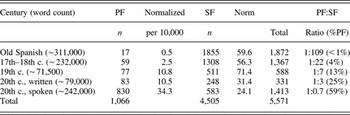
The data used for this study include all non-past-tense tokens of the PF and SF found in the corpora studied. All examples were extracted manually using a careful reading of early texts and computerized searches in texts that were electronically available and that had standard orthography. This original extraction resulted in 5,571 tokens. The frequency of each construction by data set can be seen in Table 1, which shows raw and normalized (per 10,000 words) frequency counts for each construction as well as the relative frequency of PF compared with SF, shown in the ratio.
Absolute and relative frequencies of PF and SF by century, raw and normalized per 10,000 words

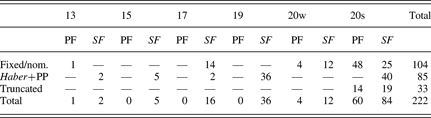
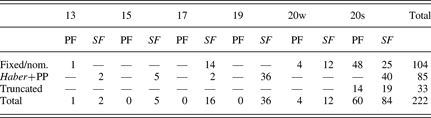
Although the data used for this study include all occurrences of both the SF and the PF, regardless of meaning nuance, because my interest here is in the constraints on productive use of PF and SF and how these constraints were related to semantic changes, certain uses that were originally extracted from the corpora were identified as irrelevant for this purpose and thus set aside. These uses included the past construction of the SF in haber + PP as in (6), truncated utterances, as in (7), and fixed expressions (cf. Poplack & Turpin, Reference Poplack and Turpin1999:144).Footnote 8 The fixed expressions that were excluded were, for the 19th century, yo apostaré as in (8), which occurred only in first person singular, and for the 20th century, the expression si lo sabré yo ‘don't I know it’, in (9), and syntactically unintegrated uses of vamos a ver ‘let's see’ and verá(s) ‘you'll see’, as in (10) and (11), respectively.Footnote 9
(6) Pero habrápasado frío con un chal. (COREC, CCCON018D, 20s)
‘But she must have been (SF) cold with a shawl’
(7) Pues mire, nos va a llamar el—
—Ponme la fecha del Corte Inglés, Antonio. (COREC, CCCON013A, 20s)
‘Well look, the [truncated] is going to call (PF) us—
—Put the date for Corte Inglés [department store] there for me, Antonio’
(8) «Ya entiendo» dixo Sancho: «yo apostaré que auia de dezir rata y no gata» (Quixote, Cap. VI[I], fol. 24r, 17c.)
‘“I understand now,” said Sancho: “I bet (SF) that I should have said rat, and not cat”’
(9) ¡Ay, que no, que esta vida es un continuo sobresalto, si lo sabré yo! (Pobres diablos, p. 22, 20w)
‘Oh, no, (that) this life is a continuous somersault, don't I know (SF) it!’
(10) Noooooo, no es así. Vamos a ver, vamos a ver. (Matar, p. 32, 20w)
‘No, it's not like that. Let's see (PF), let's see.’
(11) No, no se trata de eso. Verá … (Matar, p. 130, 20w)
‘No, it's not about that. You'll see (SF) …’
Also excluded were the two tokens of PF in temporal cuando ‘when’ clauses as in (12), which do not permit variation with SF and which are distributionally unique in that they cannot co-occur with temporal adverbials.
(12) Y cuandovas a comprar tú descubres el asunto. (COREC, CCCON019A, 20s)
‘And whenyou are going to buy (PF) you find out about how it is.’
These were included under fixed phrases and nominalizations for Table 2, which shows the number of tokens discarded in each case. The remaining 5,349 tokens were coded according to certain features, as described in the following section.
Exclusions from general study, token counts
Exclusions from variable rule analyses: Defining the variable context diachronically
A prime example of forms undergoing grammaticization (see, e.g., Bybee, Pagliuca, & Perkins, Reference Bybee, Pagliuca, Perkins, Traugott and Heine1991; Coseriu, Reference Coseriu1957; Poplack & Malvar, Reference Poplack and Malvar2007; Spitzer, Reference Spitzer1918), the synchronic situation of Romance future expression is best understood by incorporating a diachronic perspective. In a panchronic light, then, the most appropriate approach to the idea of variable context in this case is made up of the functional space in which the PF and the SF have overlapped diachronically (as suggested in Torres Cacoullos, Reference Torres Cacoullos2001). This space is by no means homogenous; the SF in particular has been assigned various different meanings, including imperative, general truth, intentionality, and promises (see Aaron, Reference Aaron2007, or Matte Bon, Reference Matte Bon2005, for a description and listing of the majority of these meanings; see also Poplack & Turpin, Reference Poplack and Turpin1999, for a list of purported meanings for French future forms; and Poplack & Malvar, Reference Poplack and Malvar2007, for such a list regarding Portuguese future forms). Like Villa Crésap (Reference Villa Crésap1997), I have chosen to follow Cartagena (Reference Cartagena1995–1996:80), “establish[ing] the simple opposition of temporal future and future of probability.” Here I have called these “temporal” and “epistemic,” respectively.Footnote 10
Only two contexts of PF and SF occurrence were identified that do not (yet) overlap in Peninsular Spanish. The first of these, a non-future-reference, purposive motion clause, such as PF made up of ir a + INF, as in (13), is relatively infrequent. Although the construction is the same, it is not a future at all. It expresses a habitual activity, and as such likely falls outside the grammaticization path for PF, because no possibility for future-time interpretation is found.
(13) los domingos va la familia a hacer la compra (COREC, CCCON034B, 20s)
‘on Sundays the family goes to do (PF) shopping’
The second of these, a non-future-time-reference epistemic use of SF, as in (14), constituted a substantial percentage of data. As such, the occurrences of SF in epistemic contexts without future temporal reference, though excluded from the variable rule analyses, were retained for other analyses. The context in which no futurity reading was possible, which falls at the end of the grammaticization path of SF as a future of obligation (Bybee et al., Reference Bybee, Pagliuca, Perkins, Traugott and Heine1991), will play an important role in my analysis in Synchronized Change.
(14) Hará un par de años o así. (COREC, CACON006D, 20s)
‘It must be (SF, lit. ‘it will make’) a couple of years ago or so'
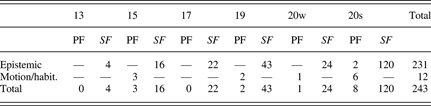
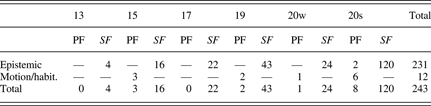
This delimitation resulted in the exclusion of 243 tokens from the variable rule analyses; the number of tokens excluded is shown by data set in Table 3. Further justification for the exclusion of epistemic modal SF contexts from the analysis of variation is that the PF has not yet extended to this use, as shown by speaker repair in (15), which is one of two modal PF tokens listed for the 20th-century spoken data in Table 3.Footnote 11
(15) Hay bodegas de Ribera Duero ¿eh?
—No de la calidad del otro vino.
—Ya, ya.
—Hay mucho vino, sí. ¿eh?
—Coño, pues ¿de qué va a ser—de qué será eso? ¿Del terreno, del tiempo? ¿o del—?
—El terreno, el sol—¡Quién lo sabe! (COREC, CCCON019A, 20s)
‘There are wineries in Ribera Duero, huh?
—Not of the quality of the other wine.
—Yeah, yeah.
—There is a lot of wine, yeah. Huh?
—Shit, well what is that going to be (PF)—what will that be (SF) from? From the land, from the weather? Or from the—?
—The land, the sun—Who knows!’
In (15), the speaker repairs the epistemic modal PF to the SF será ‘will be’. No uses of unrepaired epistemic (non-future-time reference) modal PF were found in these data. It is important to remember that “the future, as it is concretely lived, is by necessity a ‘modal’ tense: modal meanings don't ‘interfere’ with it” (Coseriu, Reference Coseriu1957:13; see also Lloyd, Reference Lloyd1984:137; Losada Durán, Reference Losada Durán2000:46). However, the lack of non-future-time epistemic modal uses of PF confirms, as Bybee et al. (Reference Bybee, Pagliuca, Perkins, Traugott and Heine1991) suggested, that such contexts go beyond futurity in the grammaticization path.
Exclusions from function-based study, token counts: epistemic SF and motion/habitual PF
MULTIVARIATE ANALYSES: 17TH–20TH CENTURIES
Table 4 shows the results of the variable rule analyses for all four data sets. The first four columns, under “Relative frequency PF,” show a sharp rise in PF frequency across the board. It is the second set of columns, under “Probability,” on which I would now like to focus.
Variable rule analyses of the contribution of factors selected as significant to occurrence of PF, 17th–20th centuries

*Square brackets [ ] indicate that this effect does not achieve statistical significance.
17th c.: Log likelihood = –223.076; p = .027; χ2/cell = 0.5203
19th c.: Log likelihood = –199.360; p = .044; χ2/cell = 0.8395
20th c. written: Log likelihood = –156.275; p = .041; χ2/cell = 0.8991
20th c. spoken: Log likelihood = –648.430; p = .039; χ2/cell = 1.1124
17th c. input probability: 0.031 (4%), n = 59/1,329
19th c.: 0.130 (15%), n = 75/507
20th c. written: 0.248 (27%), n = 79/291
20th c. spoken: 0.692 (66%), n = 768/1,147
In exploring these results, it is important to distinguish two phenomena. First, there is retention of lexical PF meanings evidenced in PF-SF distribution patterns. However, because futurity is not the end of the road and these forms have not remained static, there is also innovation in distribution linked to semantic changes in the SF outside of the realm of future temporal expression. In this section, I should like to briefly discuss the former, which is in line with other variationist studies of future temporal expression that have shown the role of retention in variation patterns (e.g., Poplack & Malvar, Reference Poplack and Malvar2007; Poplack & Tagliamonte, Reference Poplack and Tagliamonte2001; Poplack & Turpin, Reference Poplack and Turpin1999; Tagliamonte, Reference Tagliamonte, Chambers, Trudgill and Schilling-Estes2002; Torres Cacoullos & Walker, Reference Torres Cacoullos and Walker2009). The latter, which represents a new area of examination and thus the focus of this paper, will be discussed in Synchronized Change.
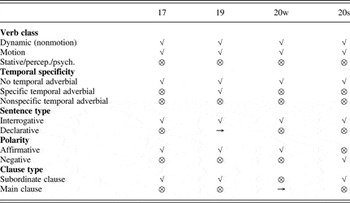
A striking characteristic of the past 300 years of PF-SF variation is its stability. Though the statistical significance of the factor groups varies by century, the stability in overall tendencies is remarkable. Drawing on the diachronic comparison of constraint hierarchies similar to the technique introduced in Poplack and Tagliamonte (Reference Poplack and Tagliamonte2001:5–8), Table 5 shows a visual representation of the direction of effect—regardless of statistical significance—of the contextual factors considered over time. Such comparison of the direction of effect over time allows us to examine how the contextual and semantic generalization during grammaticization are manifest (or not) in reversals of variant choice processes (cf. Ogura, Reference Ogura1993).
Factors' direction of effect by data set

√ = tends to favor the PF more
⊗ = tends to favor the PF less
→ = shows no directional tendency (Probability weight = .50)
First, let us examine evidence for stability. In perhaps the most notable case, we see a similar pattern for temporal specificity in all four data sets, with the PF favored in contexts in which no temporal adverbial was present, and by specific more than nonspecific temporal adverbials. A look at the other factors considered reveals a strikingly similar stability in the direction of constraints over time. Interrogatives always tend to favor use of the PF, while declaratives appear to neither favor nor disfavor this form. Clause type is significant only in the 17th century, but the PF tends to occur more in subordinate clauses than the SF in all periods except 20th-century literature, though the effect is minimal, showing a low range of only 16. Verb class also shows remarkable stability: dynamic verbs (e.g., comer ‘eat’, buscar ‘look for’) and motion verbs (e.g., salir ‘go out’, entrar ‘enter’) consistently favor the PF, whereas stative (e.g., estar ‘be’, tener ‘have’), perceptual (e.g., ver ‘see’, oír ‘hear’), and psychological verbs (e.g., creer ‘believe’, querer ‘want’) consistently disfavor the PF. These patterns show evidence of the PF's original lexical meaning, which was inconsistent with the latter three verb classes.
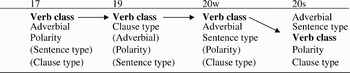
Figure 1 lists the factor groups by century, in descending order of magnitude of effect. Factor groups not selected as significant for the respective data set are shown in parentheses. Figure 1 shows that, of the three significant factors in the 17th century, only one—verb class—survived as a statistically significant constraint over the next 200 years. This factor group shows a classic pattern for generalization: from a robust constraint in the 17th century to a relatively weak constraint in the 20th-century spoken data. The classic nature of the weakening of verb class constraints as the PF generalized is even clearer when we examine the distributional patterns of the PF within particular verb classes, shown in Table 6.
Ordering of magnitude of effect by data set, in descending order, showing decreasing magnitude of effect of verb class.

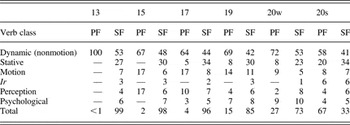
Relative frequencies of verb classes in PF and temporal SF by data set

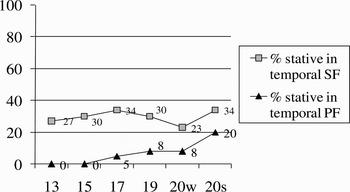
In Table 6, we see a gradual encroachment of the PF into the territories traditionally claimed by SF, which is to be expected in grammaticization (Company Company, Reference Company Company2001, Reference Company Company2003; García, Reference García1985a, Reference García1991; Kroch, Reference Kroch1989). The most obvious change is the emergence of ir ‘go’ as a variable context in the 20th-century spoken data; before this data set, there were no examples of ir a + ir ‘going to + go’ found in the data. Changes can be seen in other verb classes as well. Though most verb classes show low percentages with both the PF and the SF, and are as such not as impressive, the pattern shown with stative verbs is unmistakable. While these verbs have made up a consistent (approximately) 30% of SF usage over the past seven centuries, they have had only minimal presence with the PF. Instead, we see a slow rise; they do not occur with PF until the 17th century, at a mere 5%. This climbs to 8% in the 19th- and 20th-century written data sets, and nearly catches up to the SF rate (30%) in 20th-century spoken data, at 20%. Thus, although it appears that the distribution of verb classes remains steady over time for SF, PF gradually spreads to more classes.
The other changes we see in PF-SF variation since the 17th century are subtler. There are two kinds of change worth noting here. First, there are changes in the statistical significance of given contextual factor groups, which obviously may be due simply to the quantity of data used in each data set, but which also may indicate changes in the relative frequency of a variant within a given context. Second, there are shifts in the relative magnitude of effect of the significant factor groups in each data set. If we take the 17th century to be a portrait of a nascent PF, we find a great deal of consistency with the semantics of the lexical origins of this construction. Favored by dynamic verbs, positive polarity, and lack of temporal adverbials, 17th-century PF was used to refer to dynamic, positive actions that were not explicitly placed in the future temporal framework. All of these contextual features are entirely consistent with this construction's original “agent on a path toward a goal” meaning (Bybee et al., Reference Bybee, Pagliuca, Perkins, Traugott and Heine1991), and are highly predictable from this meaning. In the gradual process of grammaticization, we would expect that early constraints attributable to the lexical origins of the PF would weaken or disappear over time as the PF became a more generalized future. This does appear to be the case. By the 19th century, two of the three original constraints tied to the lexical origins of PF have lost significance, with only verb class retaining a significant effect.Footnote 12
The 20th century shows a reversal: some constraints strengthen. The sentence type constraint, which had not reached significance in previous data sets, emerges as significant in the 20th century, surpassing verb class in magnitude in 20th-century speech. Furthermore, the adverbial constraint, which had lost significance in the 19th century, climbs to the top during the 20th century. Although this may look like a clear case of grammaticization before a rise in frequency (Mair, Reference Mair, Lindquist and Mair2004), a look into the context outside the variable context shown here will provide an alternative answer, unfortunately returning us to the chicken-and-egg question of frequency and change. The strengthening of the sentence type constraint (always minimally present) may also be understood as directly connected to the shift in the occurrence of SF in nearly exclusively future temporal reference contexts to substantial occurrence in nonfuture temporal reference epistemic contexts. I will return to these phenomena in Synchronized Change.
Other early constraints on PF-SF variation, however, do not show the same pattern. If we return to Figure 1, we see that the presence of a temporal adverbial, a significant factor in the 17th century, does not achieve statistical significance in the 19th century, arguably a victim of the generalization of the PF. This factor reappears, however, in the 20th century. If we consider spoken language to be somewhat representative of more innovative language than written language, which is generally more conservative (Biber, Reference Biber1995), then we observe not a classic weakening of the adverbial constraint, but rather a strengthening. The same phenomenon occurs with sentence type, which exerts significant influence on PF-SF variation only in the 20th century. In line with Poplack and Malvar's (2007) interpretation of similar results in Brazilian Portuguese, I believe that these newly significant factor groups are related to the establishment of the PF as the default future, a status that is demonstrated in patterns occurring outside the envelope of variation discussed in this section.
SYNCHRONIZED CHANGE
Back to the (future) form
So far this study has relied heavily upon both grammaticization theory and variationist methodology, following most closely recent work of Shana Poplack and colleagues on future expression that have also drawn on both approaches (e.g., Poplack & Malvar, Reference Poplack and Malvar2007; Poplack & Tagliamonte, Reference Poplack and Tagliamonte1999, Reference Poplack and Tagliamonte2001; Poplack & Turpin, Reference Poplack and Turpin1999; Torres Cacoullos & Walker, Reference Torres Cacoullos and Walker2009). Nevertheless, my analysis of the diachrony of Spanish futurity presented in the previous section left various questions unanswered. For example, the 20th century showed increased magnitude of the adverbial effect, with co-occurring temporal adverbials, especially nonspecific ones, favoring SF over PF. Another unexplained change seen in the 20th century is a growing favoring of PF in interrogative contexts.
A search for answers has led me down an unexpected path that combines the form-based study so essential to the study of grammaticization and the function-based analyses that are the key component of variationist studies. Bybee et al.'s (1991) model would place the 20th-century SF in the last of four stages in the grammaticization of modal-derived futures, due to its epistemic uses. Competition can lead to restriction, fossilization, or even death of conservative forms (Bybee et al., Reference Bybee, Perkins and Pagliuca1994; Company Company, Reference Company Company2003:44). In Portuguese, for example, the SF has simply disappeared from future temporal reference contexts even in educated speech (Poplack & Malvar, Reference Poplack and Malvar2007); its use (if any is to be found) outside of future temporal reference contexts has yet to be analyzed quantitatively. In Peninsular Spanish, the SF has not reached such a dire state (though studies suggest that the restriction to nonfuture epistemic contexts is more advanced in American Spanish [Boyd-Bowman, Reference Boyd-Bowman1960:166; Cartagena, Reference Cartagena1995–1996; Moreno de Alba, Reference Moreno de Alba1978:89; Villa Crésap, Reference Villa Crésap1997:58]). Given the SF's demise in future temporal reference contexts in sister varieties, it seems quite reasonable to postulate that a similar fate awaits the SF of Peninsular Spanish.
Although a straightforward application of grammaticization theory and the variationist framework would allow us to predict most of the patterns we saw in Multivariate Analyses, such as increased PF (relative and raw) frequency and weakening of constraints tied to lexical origins, other patterns have been left unexplained. If the PF is generalizing, and has in fact reached the status of generalized future in the 20th century (Melis, Reference Melis2006), and generalizing forms “begin in very marked or specific contexts and progressively lose restrictions on use and they generalize” (Company Company, Reference Company Company2003:26), then we might expect to see a progressive weakening over time of constraints on PF-SF variation that reflect the lexical origins of the most innovative form in question.Footnote 13
Though we do see such patterns in the 20th century, namely in verb class constraints, which weaken over time as speakers gradually use the PF more with stative, psychological, and perception verbs, we also see trends indicating strengthened constraints. These trends include (i) a strengthening of the temporal specificity constraint, shown in an increase in its relative magnitude of effect, and (ii) an increase in the magnitude of effect of the factor of sentence type, leading to its selection as statistically significant. Even if the constraints shown to be significant in the 20th century could be plausibly explained in terms of the lexical origins of the SF or PF, the fact that they have become stronger over time renders such an argument weak at best.
I will argue here that the territory into which the PF was generalizing became perturbed in the 20th century. As the PF began to take over SF territory, the SF itself continued to grammaticize as well. Whether this upset was evoked by the intrusion of the PF, or evoked by the SF as it lost semantic content as it went along its own path of grammaticization, a closer look at the results of form- and function-based studies uncovers some suspiciously similar phenomena inside and outside the envelope of variation of future temporal reference.
Others who have studied Romance futures from a variationist perspective, such as Almeida and Díaz (Reference Almeida and Díaz1998), Poplack and Malvar (Reference Poplack and Malvar2007), and Poplack and Turpin (Reference Poplack and Turpin1999), in their studies of Spanish, Portuguese, and French futures, respectively, did not consider the possibility that non-future-reference epistemic uses of the French or Portuguese Synthetic (or Morphological) Future might affect patterns of variation in temporal future expression. Poplack and Turpin (Reference Poplack and Turpin1999:160) mentioned that nonfuture uses of SF in Canadian French amount to about 20% of SF data in their spoken corpus. Unfortunately, little is known about the rate or productivity of such uses in the Brazilian Portuguese variety studied by Poplack and Malvar (Reference Poplack and Malvar2007). A handful of nonvariationist studies of Spanish offer quantitative information regarding this use. Sedano (Reference Sedano1994), for example, found epistemic uses of SF made up 58% (148/249) of SF use in her Venezuelan Spanish data, and Moreno de Alba (Reference Moreno de Alba1978:98) found 73% “uncertainty” use. Villa Crésap (Reference Villa Crésap1997:58) found a rate of 70% “uncertainty” in New Mexican Spanish SF, and Durán Urrea and Gradoville (Reference Durán Urrea and Gradoville2006) reported 79% “modal” uses of SF. It is often, though not always, the case that these categories appear to include both future- and non-future-reference occurrences of SF in epistemic contexts, making cross-study (and cross-linguistic) comparison suggestive at best.Footnote 14 Thus, the vitality of epistemic SF may be much greater in Spanish (and perhaps Portuguese) than in French.
Poplack and Turpin, in their study of French, cited low relative frequency as the reason to follow what they characterized as “the standard variationist practice of excluding tokens which do not form part of the variable context,” while acknowledging the possible objection that this practice “effectively obscures any productive role IF [i.e., SF] may play elsewhere in the grammar” (1999:160, emphasis added). My results will show that, in the case of Peninsular Spanish future, to disregard epistemic uses of the SF—nearly a quarter (24%) of 20th-century SF use in speech—would be to discard a tremendous amount of explanatory power: the elsewhere is deeply connected to the here.
In this section, I will attempt to take full advantage of variationist methodology and grammaticization theory by presenting various pieces of evidence that reveal an intimate link between the patterns of variation found in 19th- and particularly 20th-century Spanish future temporal expression, and the path of grammaticization followed by the Synthetic Future.Footnote 15 A comparison of constraints on PF-SF variation in future expression and distributional patterns of epistemic SF shows parallel changes in overall rates of occurrence, sentence type and verb class effects, as well as in the rate of temporal adverbials.
Semantic generalization and functional space
In the case of the SF, in the 20th century there was a rise in nontemporal epistemic uses. We may hypothesize, then, that some of the changes observed in the 20th century are not to be taken as evidence of contextual generalization of PF, nor of new functions within future expression, nor of retention of lexical meanings of either construction, but rather as consequences of the SF's loss of productivity in the realm of future temporal expression and its loss of status as default future (see Poplack & Malvar, Reference Poplack and Malvar2007, for a similar argument for future temporal expression in Brazilian Portuguese).Footnote 16 It is in the presence of incipient or moribund forms, Poplack and Malvar (Reference Poplack and Malvar2007) noted, that the internal stability of the division of constraints conditioning variation within a functional space may be “perturbed,” such that the linear changes one might expect according to Kroch's (1989) constant rate hypothesis are not found. In this case, we will see why this might be through an examination of SF use outside the variable context.
The loss of default future status for SF was not instant, nor has its association with futurity been lost completely; the SF still has a relative frequency of 33% with respect to the AF even in 20th-century Peninsular Spanish speech, and contexts that favor an epistemic reading of SF only account for one-fourth (24%) of SF usage. If there are shifts in the division of labor between PF and SF, and these shifts cannot be adequately explained in terms of the generalization of the PF or the SF within future expression, then we may hypothesize that the division of labor between variants has been somehow perturbed. As Poplack and Malvar (Reference Poplack and Malvar2007) showed, this can happen when a newer form gains default status. In the case of Spanish future temporal expression, in which we know that one variant (the SF) is performing functions outside the variable context, a look at the behavior of these forms outside the variable context may yield clues about the driving force behind these changes.
The search for notable change in SF, especially when it is compared to the striking patterns of generalization and rise in frequency of the PF, seems less than promising. An examination of the SF distribution patterns reveals a (mostly) stable temporal SF, which has occurred in about the same contexts at about the same rate for hundreds of years (Aaron, Reference Aaron2006). At no point do we observe in the temporal SF the same magnitude of change in frequency and distribution that we observe in the temporal PF. There are, nonetheless, some small but important changes in temporal SF distribution in the 20th century. In particular, I would like to address here a decrease in the rate of interrogatives in temporal SF and a rise in the rate of nonspecific temporal adverbials.Footnote 17
In Portuguese future expression, Poplack and Malvar's (2007) results showed an intricately woven functional space that remained internally stable; however, they also found that constraints were transferred from form to form as new forms moved in and older forms moved out of the functional space. For example, the contingency constraint, associated with the SF, was transferred to Present when the SF effectively disappeared. The transference of constraints from one form to another results in strengthening or even reversal of constraints on the choice of a particular form over time, similar to the unexplained changes seen in 20th-century Peninsular Spanish future expression.
Poplack and Malvar's findings inside the realm of Brazilian Portuguese futurity, particularly that incipient and moribund forms can perturb the division of labor between variants for particular forms in variation, appear to apply to the Peninsular Spanish future as well. In this case, however, the key to understanding the particular contexts for change in the 20th-century lies outside the realm of future temporal expression. It appears here that the face of 20th-century Spanish future is altered by the shift of the SF from more tenselike to more moodlike. If we assume a temporal SF that is losing productivity as predicted in grammaticization theory (e.g., Company Company, Reference Company Company2003:50), then new questions are raised: If epistemic uses represent the loss of default future status for the SF, why is the SF losing or gaining ground in particular temporal contexts and not in others? Which shifts in strengths of constraints on variation (temporal adverbials, sentence type, verb class) can be attributed to PF contextual generalization, and which to a growing tendency to use SF in contexts without future temporal reference?
SF outside the variable context and patterns of variation
Frequency
I have suggested the possibility that the path of grammaticization and generalization of the PF within the realm of future temporal expression, the shifting strength of constraints on PF-SF variation, and the semantic change in the SF outside this realm are somehow linked. The first clue that points to such a hypothesis is a simple diachronic observation: the epistemic use of the SF surged in relative frequency at about the same time that the PF surged in relative frequency within future temporal expression.Footnote 18
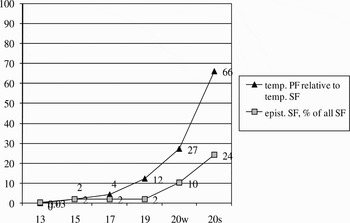
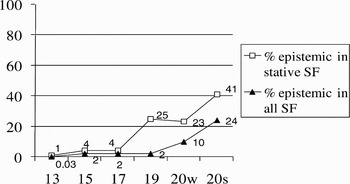
Figure 2 shows the relative frequencies of the epistemic SF (relative to temporal SF) and temporal PF (also relative to temporal SF). As we have seen, the epistemic use of the SF was nearly imperceptible throughout the entire period examined—at only 2%—until the 20th century. As this figure shows, the rise in epistemic use of the SF parallels the rise in use of the PF as a future, with a lag of about a century. Whereas the PF makes up about one-tenth of the data (12%) in the 19th-century texts, epistemic SF reaches the same prominence (10%) in the 20th-century texts. Similarly, the PF makes up about one-quarter of the data (27%) in 20th-century texts, but it is in 20th-century speech that the epistemic SF makes up 24%.
Relative frequencies of temporal PF and epistemic SF by data set.

This figure, at the very least, shows that the rise of these two form-meaning pairings moved in parallel fashion at around the same time. Such a pattern raises an intriguing question: Is this evidence that semantic competition (between PF and SF as future expressions) can, in fact, trigger further grammaticization of an erstwhile stable form (SF)? The diachrony in Figure 2 suggests that this may be the case; that is, it seems that as the PF moved into viable competition with the SF, it began pushing the SF out of the realm of competition (futurity) and into another realm (epistemicity). In other words, it appears that the SF is getting pushed aside.Footnote 19 This appears similar to the Canadian English modals, where “the appearance of deontic have to seems to coincide with the semantic expansion of must to epistemic meanings” (Tagliamonte & D'Arcy, Reference Tagliamonte and D'Arcy2007b:51).
The validity of the notion of a connection between the advancement of the grammaticization of these two forms during their intimate 300-year negotiation of Spanish futurity can be evaluated by turning to variationist methods. This methodology provides the fruits of quantitative analysis in such a way that, if we wish, we can go beyond the comparison of forms in competition within the same semantic space. In this case, we are interested in two forms that are linked in a different sort of way; a form's entire semantic landscape follows it wherever it goes. Just as a form's lexical past may show itself in the retention of older patterns of occurrence (e.g., avoidance of ir ‘go’ with PF), so, too, does a grammaticizing form's future show itself in changes in constraint ordering and magnitudes of effect. Here we explore the nature of this relationship, which has implications for grammaticization theory and our approach to variation.
Changing magnitudes of effect
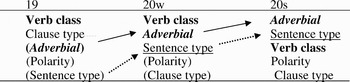
For the clearest portrait of futurity, we will return to the variable rule analyses in Table 4. During the 20th century, as the epistemic use of the SF was on the rise, multivariate analyses revealed changes in the internal landscape of Spanish future expression. As we saw, these changes take two forms: first, a change in the ordering of the constraints conditioning PF-SF variation, through the weakening of the strongest constraint in the history of this variation, verb class, as the PF generalizes into stative contexts; second, tendencies in distribution that were previously not selected as statistically significant, such as a favoring of the PF in interrogative contexts, reaching a relatively higher magnitude of effect than in previous data sets. These strengthened factor groups included sentence type and the presence of a temporal adverbial (previously weakened in the 19th century), shown in Figure 3.
Ordering of magnitude of effect in 19th- and 20th-century data sets, in descending order, showing increasing magnitude of effect of adverbial and sentence type.

As these shifts in distribution took place within future temporal expression, speakers began to use the epistemic SF with more appreciable frequency. Certain contexts show significant differences between temporal and epistemic SF use in the 20th-century speech data, namely, epistemic uses of the SF tend to occur in interrogative contexts with stative verbs and no temporal adverbial. It is interesting to note that these contexts are related to the same contextual features that underwent changes in 20th-century PF-SF variation: verb class, sentence type, and temporal adverbials.
In the first two, the changes move in what may be considered the same direction. The PF generalizes into stative contexts, and the epistemic SF occurs in mostly stative contexts; and both the PF and the epistemic SF occur more often in interrogative contexts than the temporal SF. In these two factors, then, the forms' distributional patterns mirror each other, one inside the realm of future temporal expression, the other outside. In the case of temporal adverbials, a less direct relationship is seen. The rise in epistemic SF use weakens the association of the SF with futurity, which is accompanied by a 20th-century rise in temporal adverbials co-occurring with temporal SF (thereby strengthening the PF's already established tendency to occur without a temporal adverbial). In this section, I will describe the PF and epistemic SF patterns found in each of these three contextual features in an attempt to uncover the systematicity in the distributions of 20th-century PF and epistemic SF, whose similarities seem more than coincidental.
Verb class
Verb class, which shows the disfavoring of PF in contexts inconsistent with motion (such as psychological and stative verbs), is the one constraint in 20th-century PF-SF variation that appears to be the last stronghold of the lexical origins of the PF. This is an example of a classic case of (as of yet incomplete) contextual generalization, as is expected of grammaticizing constructions. While the generalization of PF to stative verbs took place (see Table 6), however, the stative verbs in SF were not as stable as Table 6 would lead us to believe. Even though they stood their ground as futures in SF, stative verbs also began being used disproportionately in nontemporal epistemic SF contexts.
Figure 4 shows the percentage of stative verbs in temporal SF and temporal PF, a visual presentation of the data in Table 6. The top line represents the proportion of temporal SF that occurs with stative verbs. The lower line shows the proportion of temporal PF that occurs with stative verbs. Whereas the SF proportion of stative verbs has remained relatively stable, the proportion of PF with stative verbs has risen from 0% to 20%, at 5% of the PF occurrences in the 17th century, 8% in the 19th and 20th centuries in written data, and 20% in 20th-century speech. Despite this increase, the rate of stative verbs in PF has not yet reached the long-standing rate of about 30% in the temporal SF.
Proportion of stative verbs in temporal PF and temporal SF.

Figure 4, which depicts only future uses of the two forms, might lead us to believe that the encroachment merely involves PF contextual generalization into stative contexts. However, this may be only part of the story. Whereas stative use within temporal SF remained relatively constant, this linguistic context has been losing its status as one of the best contexts for temporal SF. As the PF becomes more common for prediction, the SF becomes more associated with an epistemic reading, and—what is important here—this association of SF with epistemicity is strongest with stative verbs. Narrog (Reference Narrog2005:217) considered the prediction function of future markers to be a modal function; if future temporality is removed, to give a “prediction” about the present, we are left with epistemic modality. This association, then, may reflect a general characteristic of epistemic modality; it may be more useful to make attenuated predictions about general states than about specific actions.
Figure 5 shows the proportion of epistemic SF uses of all SF tokens as a whole and of stative SF tokens. First, as we have previously seen (Figure 2), epistemic SF use in general made up only 2% of the SF in the 19th century, 10% in 20th-century plays, and 24% in 20th-century speech. In stative verbs, the epistemic SF also increases in frequency, but at an accelerated rate. Since the 19th century, about a quarter (23%–25%) of all SF statives have occurred outside the realm of future temporal expression. In 20th-century speech, this rate approaches half, at 41%. The comparative numbers in Figure 5, then, show an increasingly strong tendency for speakers to use SF as an epistemic in stative contexts, an association that increased disproportionately as the use of the epistemic SF grew.
Proportion of epistemic SF in all SF, compared to proportion of epistemic SF in all occurrences of stative verbs in SF.

This result is particularly interesting when we observe the slower yet parallel climb of the PF in stative contexts, which suggests a possible connection between these phenomena. The nature of this connection is not clear. Perhaps as the PF generalized during grammaticization, it weakened the association of future states with the SF construction, allowing the epistemic meanings so easily inferred in stative future contexts to become more salient to speakers, until they were conventionalized as the most frequent context in which the SF was used with epistemic meaning. Or perhaps the ever-frequent stative verbs in SF began to be increasingly associated with epistemicity as the SF lost its ability to express intention, which allowed the PF to emerge in this context. The quantitative evidence in Figure 5 seems to offer support in favor of the second scenario, because the 19th-century rise in stative epistemic contexts is more impressive than the concurrent rise in stative PF contexts. This may be a case of associative fixation through high frequency, in which higher frequency collocations become somewhat more “fixed,” and thus more resistant to change through innovative analogy (Ellegård, Reference Ellegård1953:200; Nurmi, Reference Nurmi, Taavitsainen, Melchers and Pahta1999; Smith, Reference Smith2001:253; Tottie, Reference Tottie1991:440). Whatever the case may be, this is the first piece of what may be thought of as “circumstantial evidence” that the coordinated rise in epistemic SF and changes in PF and SF conditioning is not coincidental.
Sentence type
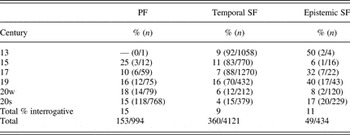
The second piece of evidence for the impact epistemic SF development may have on SF future use and therefore variation patterns involving PF is found in one of the constraints on PF-SF variation that reaches significance for the first time in the 20th-century data sets: sentence type. Table 7 shows the rates of interrogative clauses in temporal PF, temporal SF, and epistemic SF by century.Footnote 20
Proportion of interrogatives with PF, temporal SF, and epistemic SF by data set

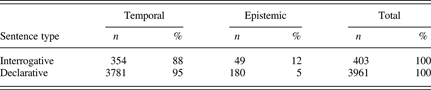
As we can see in Table 7, the epistemic SF and the PF have in common the fact that the proportion of interrogative clauses has generally been greater than in the temporal SF. This tendency is particularly marked for the epistemic SF, which accounts for 12% of interrogatives and only 5% of declaratives, a significant difference (p < .000, χ2 = 42.65468) seen in Table 8, which combines data from all centuries. Returning to Table 7, it is in the 20th century that we see the lowest rates for interrogatives in temporal SF, with 6% (12/212) in written texts and 4% (15/379) in spoken data (bottom two rows of Table 7), which is significantly lower than the 19th-century interrogative rates with temporal SF (p ≤ .0000, χ2 = 39.36498). In the latter data set, the PF and epistemic SF display relatively similar interrogative rates of 15% (153/994) and 17% (49/434), respectively, a difference that is significant only at the .05 level (p ≤ .0408, χ2 = 4.185627).
Distribution of temporal and epistemic SF by sentence type, all data sets
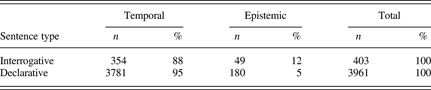
p < .0000, χ2 = 42.65468
With sentence type, then, as with verb class, we see a reflection of epistemic SF distributional patterns in the realm of 20th-century PF-SF variation in future expression. As the epistemic SF rises in frequency, the PF comes to be (significantly) favored in interrogative contexts. Meanwhile, rates of interrogatives in both epistemic SF and the PF show no particular change; instead, it appears that the SF is used ever less in interrogative future contexts.
Before I discuss the possible reasons for the decrease of interrogatives with temporal SF, I would like to address the essential question of function. If PF and epistemic SF have similar rates of interrogative clauses, does that mean that speakers use these forms in interrogatives to perform the same communicative tasks? In terms of the semantics of conjecture, such a proposal makes little sense, because the PF is associated with certainty and the epistemic SF with uncertainty. The similarity of PF and epistemic SF can also not be explained in terms of clause type, because PF is favored in subordinate clauses (Table 5) and the epistemic SF occurs more often than the temporal SF in main clauses (Aaron, Reference Aaron2006:Table 3.21). I would argue that the similar rates of interrogatives with these two form-meaning pairings have no direct relationship with each other, that is, it is not simply because they are both associated with a particular meaning or syntactic feature.
To understand why both the PF and epistemic SF have been favored in interrogatives since their incipient stages (see Aaron, Reference Aaron2006), we must consider again the notions of intention and prediction. We will see that speakers do not use these forms in interrogatives with the same motivations at all: epistemic SF is highly constrained by its inability to express intention, whereas the PF is associated in earlier centuries with intention and subsequently with prediction. The PF's ability to express intention—as measured through the co-occurrence of first-person singular subjects—rose in the 19th century, and then gradually declined (Aaron, Reference Aaron2006). On the other hand, the temporal SF's ability to express intention was declining between the 17th and 20th centuries.
If one function of interrogatives is to ask about intentions, as surely it must be, then we would expect the PF and the SF to be used differently. Interrogatives regarding intention are associated with the second-person singular, because we are more likely to inquire about the intentions of our interlocutors more than those of third parties, as in (16). We would thus hypothesize that the PF would show an increase in second-person uses, that the temporal SF would show a decrease, and that the epistemic SF would show generally low rates of co-occurrence with second-person interrogatives.
(16) MATILDE.— (Queriendo detenerla.) ¿Qué vas a hacer? … repara … (Conjuración, Act III, Scene I, 19c.)
‘MATILDE: [Wanting to stop her.] What are you going to do (PF)? … wait …’
En fin, ¿me dirás qué tienes? En un instante te encuentro … qué se yo … (El afán, Act IV, Scene IV, p. 283, 19c.)
‘Finally, will you tell me (SF) what's wrong? In just an instant I find you … what do I know …’
Likewise, first-person interrogatives make little sense with intention meaning.
Inquiring about intention, of course, is not the only function of interrogatives with future forms. As noted in the case of PF in particular (and SF prior to the 20th century), interrogatives in conjunction with future forms can express a special meaning of rhetorical incredulity, which is a prediction meaning in a specialized context (Aaron, Reference Aaron2006). In fact, it is in this specialized context that we find first-person interrogatives, as in (17).
(17) “—Pero usted está loco! ¿Cómo le voy a echar esa cosa roja ahí en mitad del grano, mitad de la cara?” (COREC, CACON022C, 20s)
“‘But you're crazy! How am I going to put (PF) that red thing on half of the pimple, half of my face?”’
In (17), the speaker expresses disbelief about the prediction that she will put a patch on her face to clear up her pimple. The SF, historically, also occurred in similar contexts, as shown in (18). Even though these two examples both reflect the respective origins of each construction (an active verb with PF and a stative verb with SF), making the former appear more futurelike than the latter, which may intuitively be more epistemic, both allow a future-time reading infused with rhetorical incredulity.
(18) Dixo ella:—¿ Et cómmo non seré triste (Calila, La culebra y las ranas, p. 249, 13c.)
‘She said: And how could I not be (SF) sad’
Given the use of first-person singular in future interrogatives to express rhetorical incredulity, and also given the finding that the PF is the only form associated with this context in the 20th century (Aaron, Reference Aaron2006:Ss.4.3.2), we may expect to find that the PF is the preferred form in first-person interrogatives, at least in the 20th century. We have, then, two concepts commonly associated with particular grammatical persons in interrogative sentences, which help to explain why both the PF and epistemic SF occur more often in interrogatives than the temporal SF. First, intention is associated with second person in interrogatives. Second, prediction, particularly in a context of rhetorical incredulity, is associated with first-person singular subjects. Furthermore, interrogative contexts are ideal for emphasizing epistemic modality, because some interrogatives themselves express this same modality (Narrog, Reference Narrog2005:679–680).
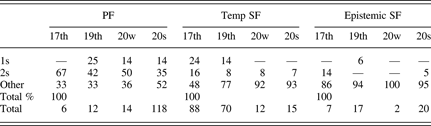
In Table 9 we see the distribution of first- and second-person subjects in interrogative clauses with PF, temporal SF, and epistemic SF in four data sets. In the 17th century, second-person (i.e., likely intention) uses are associated most strongly with the PF, accounting for 67% (4/6), compared with 16% (18/88) in temporal SF and 14% (1/7) in epistemic SF. The only form in this data set that is used with first-person interrogatives is the temporal SF, with 24% of its occurrences in first-person singular. The epistemic SF occurs 86% (6/7) of the time in interrogatives with neither first- nor second-person subjects. This suggests that interrogatives with the PF in the 17th century were mainly used to question intention, whereas, in the temporal SF, prediction was the main function. In the 19th century, the PF is no longer so strongly associated with intention meaning: 25% (3/12) of PF interrogatives occur with first-person singular, and 42% (5/12) with second-person singular. At the same time, temporal SF is used only 8% (6/70) of the time in second person with interrogatives, and epistemic SF does not occur at all with this person in interrogatives (0/17). This suggests that in the 19th century, the PF was used in interrogatives with both intention and prediction meaning, but intention meaning was minimal in interrogative uses of both epistemic and temporal SF. These results also suggest the transfer of rhetorical incredulity uses from temporal SF to PF during this period, as the relative frequency of first-person interrogatives increased with PF to 25% (3/12) and with SF it decreased to 14% (10/70). The 20th-century data sets show a similar picture. In both written and spoken data sets, the PF is the only use that occurs with first-person interrogatives, at 14% (2/14 and 16/118, respectively); there are no first-person interrogative occurrences with SF in the 20th-century data. In the case of second-person subjects with 20th-century temporal SF interrogatives, these make up only 8% (1/12) of interrogatives in written data and 7% (1/15) in spoken data.
Distribution of subject within interrogative clauses (percentages), 17th–20th centuries
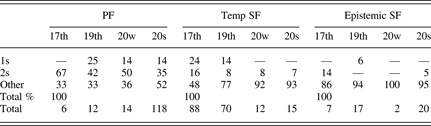
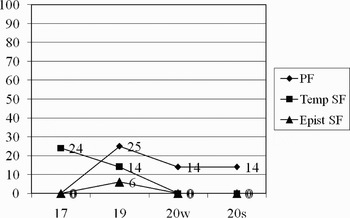
Figure 6 shows a summary of the proportion of first-person-singular interrogatives within all interrogatives for each construction/context since 1600. This suggests that the temporal SF has lost any association with rhetorical incredulity uses, a suggestion that is supported by the fact that an attempt to intuitively identify and code such contexts in the 20th century revealed none used with the SF.
Proportion of first-person-singular interrogatives with PF, temporal SF, and epistemic SF interrogatives by data set.

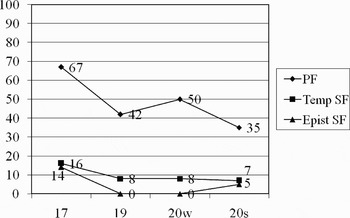
The temporal SF also appears to have lost nearly all association with intention meaning, associated with second-person interrogatives, a meaning that epistemic SF never had. Figure 7 shows a summary of the proportion of second-person-singular interrogatives within all interrogatives for each construction/context.
Proportion of first-person-singular interrogatives with PF, temporal SF, and epistemic SF interrogatives by data set.

Second-person interrogatives are not always imbued with intention meaning. This is most obviously the case in epistemic contexts, with which intention meaning is incongruent. In the case of 20th-century epistemic SF, there is only one occurrence of a second-person interrogative, shown in (19), which is a prediction use in a message left on an answering machine.
(19) Vale Ritchie, pues—hasta mañana entonces. ¿Dónde estarás golfo? (COREC, CPCON006A, 20s)
‘Okay, Ritchie, well—until tomorrow then. Where could you be (SF) rascal?’
It appears that in the 20th century, then, the PF was the sole future form used for both rhetorical incredulity and intention in interrogatives, which may explain why the SF decreased in frequency during this century. It is unclear why these particular contexts pattern in this way.
If the SF was losing functions as the PF was gaining them, then why would 17% of epistemic SF uses in 20th-century speech occur in interrogatives (Table 7)? It certainly is not because of an elevated ability to express intention, as first-person co-occurrence with epistemic SF is extremely rare. It may perhaps be that interrogatives correlate with epistemic modality. Narrog (Reference Narrog2005:679) defined modality as “a linguistic category referring to the factual status of a state of affairs. The expression of a state of affairs is modalized if it is marked for being undetermined with respect to its factual status, i.e., is neither positively nor negatively factual.” We can see the meaning of epistemic SF interrogatives as depicting unknown factual status in the epistemic SF interrogatives in subordinate clauses, 100% (6/6) of which have the head verb no saber ‘not know’.
Here, then, we see that the rise of epistemic uses of SF, especially in the semantically harmonic context of interrogatives, may have led to an intensification of the association of interrogatives in future tense with the PF, which was always favored over SF due to its greater ability to express intention, and thus applicability to a wider range of contexts. Therefore, while there was not a direct push-pull relationship between epistemic SF and the PF, the emergence of the former into the grammar intensified previously insignificant tendencies in PF-SF variation, leading to a change in the division of labor in future expression in the 20th century.
In the case of both stative verbs and interrogatives, the results seem to suggest a correlation between the generalization of the PF into a particular linguistic context within the future realm and the contexts in which epistemic SF tends to occur. As the epistemic SF rises in frequency, the PF comes to express futurity in the linguistic contexts in which the SF is most likely to be used nontemporally.
Temporal adverbials
Another constraint that comes up as significant in 20th-century PF-SF variation is that of the presence of a temporal adverbial. This constraint was also operative in the 17th century and displayed the same tendencies; PF is most favored in the absence of a temporal adverbial, less favored by a specific temporal adverbial, and least favored by a nonspecific temporal adverbial. It then was not selected as significant in the 19th century, but the direction of effect remained the same. Temporal adverbial presence returned as one of the weaker constraints in the 20th-century texts and became the constraint with the highest magnitude of effect in 20th-century speech (see Multivariate Analyses). The SF is favored with nonspecific adverbials, as in (20) and (21), whereas the PF is favored when no adverbial is present, or if there is an adverbial, when it is specific, as in (22) and (23).
(20) Que tarde o temprano se va a venir a España (COREC, CBCON014A, 20s)
‘Sooner or laterhe's going to come (PF) to Spain’
(21) Y aprenderé alemán algún día. (COREC, CACON012A, 20s)
‘And I will learn (SF) German someday’
(22) Oye, mañana—hoy es—martes, mañana por la mañana te llamaré a ver si me puedes hacer un favor. (COREC, CPCON006A, 20s)
‘Listen, tomorrow—today is—Tuesday, tomorrow in the morningI'll call (SF) you to see if you can do me a favor’
(23) está la tía metida en casa y tal y—nos vamos a irmañana a verla. (COREC, CACON019B, 20s)
‘the girl is stuck at home and such and we're going to go (PF) see her tomorrow’
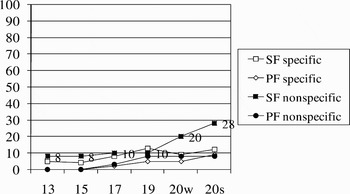
It is likely that this constraint represents a continuation of the same constraint found in the 17th century. Even though this must indeed be the case, such an analysis leaves unanswered why this constraint would appear to weaken in the 19th century, only to rise again in the 20th, becoming the single most important factor in PF-SF variation in 20th-century speech. Figure 8 shows the rate of occurrence of both specific and nonspecific temporal adverbials with temporal uses of the PF and the SF since the 13th century.
Rates of co-occurring temporal adverbials in PF and temporal SF by data set.

Regarding general tendencies, Figure 8 shows that the temporal SF has always occurred more often with temporal adverbials than the PF has. These general patterns, though certainly of interest, are not what catches our attention, however. What is impressive in Figure 8 is the dramatic rise in SF co-occurrence with nonspecific temporal adverbials, from 10% in the 19th century, to 20% in 20th-century texts and 28% in 20th-century speech. No other context shows such a sharp increase.
The increase in the rate of co-occurring temporal adverbials with temporal SF, specific and nonspecific combined, from 18% in the 17th-century data to 40% in the 20th-century speech data (Figure 8), is due to the development of the nontemporal epistemic use of the SF, whose frequency relative to temporal SF use rises from 2% to 24% in the same period (see Figure 2), which would threaten speakers’ (and crucially hearers') association of the SF with future temporal reference. Hearers play an important role in that it may be with the hearer's state of knowledge in mind that a speaker provides extra information to ensure understanding. In other words, if a speaker wants to be understood as referring to a future moment, and the same speaker construes her hearer's associations of SF to include contexts outside futurity, she may produce a temporal adverbial alongside the SF. Thus, as speakers begin to use—and hear—the SF more frequently in nonfuture uses, the meaning of SF no longer includes futurity as an obligatory component.
For example, in (24), the speaker is making a prediction about the behavior of her students at the next class she is to teach, on Wednesday. She is not sure if they will bring the balls that day. She signals twice that she is unsure about this prediction, with no sé si ‘I don't know if’. As noted previously, such contexts of uncertainty in prediction are those in which the SF is most likely to occur in nonfuture contexts. At the same time, the speaker in (24) is referring to other, habitual behavior of her students, that they always forget the balls (se les olvidan ‘they forget them’). Because SF semantics no longer obligatorily include future temporal reference, both times the speaker uses SF traerán ‘they will bring’, she uses a temporal adverbial as well, ese día ‘that day’ and el miércoles ‘on Wednesday’, to signal future temporal reference.
(24) —Y, pero, entonces la clase es de seis a siete.
—De seis a siete.
—Pero, claro, yo tampoco te quiero a tí molestar o—eso.
—Que no, que no te preocupes. Ya verás.
—Bueno, yo voy a las seis y si algún rato pues eso, pues me siento y me callo o—
—Bueno, sí, además ese día, no sé si traerán unas pelotas porque les iba a enseñar a darse unos masajes. ¿Sabes?
—Ah.
—Entonces pero no sé si se les ha—olvidará o qué porque llevamos con las pelotas desde no sé cuándo, ¿sabes? y—y se les olvidan, entonces no sé si el miércolestraerán las pelotas y—si no, vamos a hacer canciones y juegos por ser el último día, ¿sabes? (COREC, CCCON029C, 20s)
‘—And, but, then the class is from six to seven.
—From six to seven.—But, of course, I don't want to bother you, either, or—yeah.
—(That) no, (that) don't worry. You'll see.
—Well, I'll go at six and if for a while well yeah, well I'll sit and be quiet or—
—Well, yeah, also that day, I don't know if they'll bring (SF) some balls because I was going to teach them to give massages. You know?
—Ah.
—So but I don't know if they have—they'll forget or what because we've been talking about the balls since I don't know when, you know?, and—and they forget them, so I don't know if on Wednesdaythey'll bring (SF) the balls and—if not, we're going to do songs and games because it's the last day, you know?’
In (25), the temporal adverbial dentro de un año o dos ‘within a year or two’ is necessary to the meaning of the utterance; without this adverbial, in particular with the occurrence of the epistemic predicate yo creo ‘I think’, the utterance could easily be understood as referring to the present, as in yo creo que no estará terminada ‘I think it's probably not done yet’.
(25) Porque tienen un lío con el Canal de Isabel Segunda y con no sé qué sitio más—y bueno, un lío. Yo creo que hasta dentro de un año o dos no estará terminada. (COREC, CACON021A, 20s)
‘Because they have a mess with the Canal of Isabelle the Second and with I don't know what other place—and well, a mess. I think that even within a year or two it won't be (SF) done.’
Thus, the SF begins to require contextual support in some occurrences in order to effectively communicate future temporal reference. The contextual support that would best ensure the temporal reading of this newly polysemous form is a temporal adverbial. In this case, it appears that the types of adverbials most often chosen were those with which the SF had always (since the earliest Old Spanish data) been most likely to occur: nonspecific adverbials. It is without doubt that this dramatic rise in SF co-occurrence with nonspecific temporal adverbials is behind the return of adverbial presence as a significant factor in 20th-century PF-SF variation. This is yet another link—albeit indirect—between the rise in epistemic SF and the shifts in PF-SF variation patterns. The divergence of SF—and loss of default status—led to an increase of temporal adverbials with temporal SF, and the increase in the rate of co-occurring temporal adverbials led to a restructuring in the ordering of factors conditioning 20th-century PF-SF variation.
SUMMARY OF RESULTS AND IMPLICATIONS: SHIFTING DEFAULTS
This paper has presented a picture of two forms, the PF and the SF, grammaticizing side-by-side, pulling on each other and shaping the results of quantitative analyses. I have suggested that the particular manifestations of the process of grammaticization of the conservative form, in this case, has been helpful in explaining the negotiation of constraints on variation with the innovative form. The importance of examining such contexts in processes of renewal and specialization is affirmed by Tagliamonte (Reference Tagliamonte, Lindquist and Mair2004) and Tagliamonte and D'Arcy (Reference Tagliamonte and D'Arcy2007a), who found that epistemic modality contexts were key to understanding variation between forms of contrasting lexical origins that shared the context of obligation/necessity in Canadian English. This is not meant to imply that the SF's path was able to influence the path of the PF; instead, the SF's continued grammaticization became a key drive in the way it was used as a future, which, in turn, affected the way speakers chose one form over the other. Without an understanding of how the SF was affected by further grammaticization in the 20th century, we would be hard-pressed to explain the shifts in conditioning on variant choice.
In the case of the PF, we see a form that has undergone contextual generalization as it has taken on functions it did not tend to perform in its lexical beginnings, most especially prediction; retention of PF's lexical origins appears in the 20th century only in stative contexts, the last stronghold of the SF as a future form. In the 20th century, however, we see changes in the conditioning of PF-SF variation that do not seem to be related to PF generalization, nor are they retentions from SF, such as obligation meaning (on obligation with SF, see Bello, Reference Bello1984 [1847]; Bybee & Pagliuca, Reference Bybee, Pagliuca, Ramat, Carruba and Bernini1987; Fernández Ramírez, Reference Fernández Ramírez1986:284–285; Lerch, Reference Lerch1919; and Meyer-Lübke, Reference Meyer-Lübke1914:217). Instead, these changes involve the strengthening of constraints that appeared to be weakening in the 19th century. I have argued here that this strengthening is related to the continued grammaticization of the SF in the 20th century, which included a generalization into epistemicity and a weakened ability to express futurity. The evidence for this is found in significant changes in the rates of co-occurring contextual features in 20th-century SF, which are both a result of SF divergence and the reason behind shifts in the division of labor in 20th-century Peninsular Spanish future expression.
There was one general change and three specific changes examined here: (i) a diachronically parallel rise in the relative frequencies of the PF and of epistemic SF; (ii) the generalization of PF into stative contexts as speakers began to increasingly associate stative SF with epistemic meaning; (iii) a decrease in interrogatives with temporal SF as SF interrogatives became increasingly associated with epistemic use and the SF simultaneously lost its ability to express intention and rhetorical incredulity; and (iv) a sharp increase in the co-occurrence of temporal adverbials with temporal SF as the SF began to be bleached of temporal meaning in its epistemic uses. The cases of interrogatives and temporal adverbials lead me to conclude that, for speakers, the SF is losing its status as default future even in the (in this case) relatively conservative region of Spain.
The explanatory power of quantitative analysis of SF outside the variable context does not imply a need to expand the variable context to include an ever-wider scope of functions. In fact, inclusion in variable rule analyses of occurrences of constructions in contexts in which other variants do not occur (e.g., nonfuture-reference epistemic contexts) can skew the data and give flawed and misleading results (see Aaron, Reference Aaron2006, for an empirical test of this claim). Caution in broadening the variable context to include tokens outside the category of the functional space in question, however, does not imply that any piece of the path of grammaticization can be ignored. In quantitative study, sensitivity to quantitative patterns outside the variable context may be the key to understanding otherwise inexplicable changes in distribution within the variable context.
Given the evidence presented here, it appears that the divergence (through grammaticization or other means) of a construction in competition, affecting its relative frequency in particular contexts (factors), can, in turn, cause changes in the ordering of conditions on variation. Furthermore, it appears that the semantic bleaching of an older construction can act as a catalyst in the further grammaticization and semantic generalization of a newer construction into the former's erstwhile semantic territory. The contexts into which the newer construction generalizes, discovered through variable rule analysis, may be directly linked to the contexts into which the older construction generalizes, as was the case with stative verbs, rhetorical incredulity contexts, and intention.
Despite the central role of the variable context in variationist study, other functions of variants outside the envelope of variation, especially if they are frequent, should not be dismissed a priori as irrelevant. As shown here, function-based (variationist) analyses may benefit from equally quantitatively rigorous form-based studies, which can supplement the study's explanatory power. The “bleeding” of the semantics of SF outside of future contexts into the variation patterns within future expression should be of no real surprise. After all, if category membership is a question of degree, the question of the boundary between functional spaces—between what lies within and what lies outside function-based analyses—and the role of that which is outside, needs to continue to be explored critically. In studies of forms undergoing grammaticization, only an approach that takes into account all (frequent) contexts of use can fully account for competition between forms in the dynamic system of grammar in formation.
APPENDIX
OLD SPANISH CORPORA
Mid-13th to mid-14th century
Calila (1250) = Anónimo. In Blecua, J. M. Cacho & Lacarra, M. J. (eds.), Calila e Dimna. Madrid: Castalia.Zifar (1320) = Anónimo. (1929 [1320]). In Wagner, Ch. Ph. (ed.), El libro del Cavallero Zifar (El libro del cauallero de Dios). Ann Arbor: University of Michigan Press.Lucanor (1350) = Manuel, Don Juan. (1969 [1350]). In Blecua, J. M. (ed.), El conde Lucanor o Libro de los enxiemplos del conde Lucanor et de Patronio. Madrid: Castalia.
Late 15th century
Cárcel (1492) = de San Pedro, D. (1972). In Whinnom, K. (ed.), Cárcel de Amor. Madrid: Castalia.Celestina (1499) = de Rojas, F. (1987). In Severin, D. S. (ed.), La Celestina. Madrid: Cátedra.
EARLY 17TH CENTURY
Quixote (1605–1616) = de Cervantes, Miguel. (1996). In Arroyo, F. Sevilla & Hazas, A. Rey (eds.), Don Quijote de la Mancha, vols. 2 and 4 of Obras completas by Miguel de Cervantes. Madrid: Alianza editorial-Centro de Estudios Cervantinos.Dama boba (1562–1635) = Vega, Lope de. (2000). In Vicente, A. Zamora (ed.), La dama boba. Alicante: Biblioteca Virtual Miguel de Cervantes.Príncipe (1562–1635) = Vega, Lope de. (2003). Comedia del Príncipe Ynocente, transcription by Galiana, Silvia Santos. Alicante: Biblioteca Virtual Miguel de Cervantes.
LATE 18TH TO EARLY 19TH CENTURY
Derrota (1789) = Fernández de Moratín, Leandro. (2002 [1789]). La derrota de los pedantes. Alicante: Biblioteca Virtual Miguel de Cervantes.El sí (1790–1810) = Fernández de Moratín, Leandro. (1975). In Dowling, J. & Andioc, R. (eds.), La comedia nueva; El sí de las niñas. Madrid: Castalia.El afán (1831) = Carnerero, José María de, (1784–1843). (2000). El afán de figurar: Comedia en cinco actos, en verso. Alicante: Biblioteca Virtual Miguel de Cervantes.Conjuración (1834) = Martínez de la Rosa, Francisco. (2003 [1834]). La conjuración de Venecia, año de 1310/Francisco Martínez de la Rosa; edición de Marisa Payá Lledó. Alicante: Biblioteca Virtual Miguel de Cervantes, 2003.
LATE 20TH TO EARLY 21ST CENTURY, WRITTEN CORPUS
Billy (1987) = Guerra de Aranguiz, Alicia. (2004 [1987]). Billy escupe la muerte o Un fin de semana en casa de los Dupont. Alicante: Biblioteca Virtual Miguel de Cervantes.Matar (1989) = Cerdán Tato, Enrique. (2004 [1989]). Matar con Mozart y 29 atrocidades más. Alicante: Biblioteca Virtual Miguel de Cervantes. Otra ed.: Alicante, Aguaclara.Pobres diablos (1999) = Zamora Vicente, Alonso. (2002 [1999]). ¡Estos pobres diablos …! Alicante: Biblioteca Virtual Miguel de Cervantes. 1a ed. en [s.l.], Fundación Antonio Nebrija.Algunos modos (2003) = Sánchez Soler, Mariano (1954–). (2003). Algunos modos de vivir o de morir. Alicante: Biblioteca Virtual Miguel de Cervantes.
LATE 20TH CENTURY, ORAL CORPUS
COREC = Corpus de Referencia de la Lengua Española Contemporánea: Corpus Oral Peninsular, director F. Marcos Marín. Available at: www.lllf.uam.es/~fmarcos/informes/corpus/corpusix.html (género conversacional).