Introduction
Dye wastewater is industrial waste which is difficult to deal with because of its high concentration, poor biodegradability, and high chromaticity (Xia et al. Reference Xia, Liu, Ni, Shi, Xue and Qian2014; Kuzyaka et al. Reference Kuzyaka, Galioglu, Altın, Sökmen and Akata2018). With the rapid development of printing and dyeing industries, the increase in wastewater emissions has led to a sharp decline in water quality in the natural environment (Shang et al. Reference Shang, Xi, Liu, Tan, Chen, Wu and Pan2017). In addition, if dye wastewater is discharged to the environment without timely treatment, a series of chemical reactions is generated which produces toxic by-products, which worsen the ecological situation (Crossland et al. Reference Crossland, Noel, Sivaram, Leijtens, Alexander-Webber and Snaith2013; Alijani et al. Reference Alijani, Kaleji and Rezaee2017; Bohac & Bujdak Reference Bohac and Bujdak2018; Karataş et al. Reference Karataş, Senol-Arslan and Ozdemir2018). Photocatalytic degradation is a relatively recent technology which is showing significant potential in terms of its ability to control pollution (Ray et al. Reference Ray, Dhakal, Kshetri and Lee2017; Adeleke et al. Reference Adeleke, Theivasanthi, Thiruppathi, Swaminathan, Akomolafe and Alabi2018). Identifying efficient catalysts for organic dye wastewater treatment is vitally important.
Hydrotalcites are anionic layered clay materials (layered double hydroxides, LDHs) and the molecular formula of a typical hydrotalcite-like compound is Mg6Al2(OH)16CO3·4H2O. Mg2+ and Al3+ in LDHs can be replaced in the structure isomorphously by other divalent and trivalent cations (Zhou et al. Reference Zhou, Li, Ai, Tian and Hong2016). The general formula of the compound is [M 2+1–x M 3+ x (OH)2] x+(A n–) x/n ·mH2O, in which A n– represents interlayer anions, x is the ratio M 3+/(M 2++M 3+), and m is the quantity of crystal water (Pan et al. Reference Pan, Ni, Cao and Li2012; Vialat et al. Reference Vialat, Leroux, Taviot-Gueho, Villemure and Mousty2013). Because LDHs have an exchangeable anion structure, adjustable pore size, thermal stability, and other properties, it can be used in catalysis, medicine, and other industries (Zhou & Keeling Reference Zhou and Keeling2013; Gao et al. Reference Gao, Sasaki and Qiu2018; Li et al. Reference Li, Yu, Altaf, Zhu, Li, Dai and Wang2018) New types of hydrotalcite have been synthesized by changing the metal cations and anions in the hydrotalcite structure, such as Mg/Al/Ce LDHs, Cu-Mg-Al LDHs, and Mg-Al LDHs doped with Tb etc. (Wang et al. Reference Wang, Wang, Dong, Zhang, Pei, Chen and Jin2011; Chen et al. Reference Chen, Bao and Wang2016; Comelli et al. Reference Comelli, Ruiz, Aparicio, Merino and Ponzi2018; Xu et al. Reference Xu, Pan, Meng, Guo, Wu and Chen2019). Research into the application of photocatalytic activity of LDHs has become important (Zhou Reference Zhou2010; Zhang et al. Reference Zhang, Wang, Zhou, Ni and Xia2018). Photocatalytic degradation of pesticides was studied by Da et al. (Reference Da, Prevot, Forano, Wong-Wah-Chung, Burrows and Sarakha2014) using decatungstate intercalated macroporous layered double hydroxides. Visible light-promoted degradation of gaseous volatile organic compounds catalyzed by Au supported on layered double hydroxides was studied by Fu et al. (Reference Fu, Zheng, Zhou, Ni and Xia2019).
In order to evaluate the exchangeability of cations on hydrotalcite laminates (Mao et al. Reference Mao, Zhou, Tong, Yu and Cynthia Lin2017) and to maximize the potential of hydrotalcites in the dye wastewater treatment, the effects of divalent metal ions on the structure, stability, and photocatalytic activity of hydrotalcites were assessed. To this end, M/Cr hydrotalcite (M 3Cr-CO3-LDHs, where M = Mg, Co, Ni, Cu, or Zn), with an M/Cr atomic ratio of 3, was prepared by the co-precipitation method. Photocatalytic performance is assessed by measuring the degradation of MB aqueous solutions under visible irradiation. The effects of irradiation time, catalyst type, and reuse performance of MB degradation were investigated and the reaction mechanism was studied also.
Experimental
Materials
For the present study, analytically pure M(NO3)2·6H2O (M is Co, Mg, Ni, Zn, Cu), Cr(NO3)3·9H2O, Na2CO3, NaOH, isopropanol, p-benzoquinone, ethylene diamine tetraacetic acid disodium salt, H2O2, and MB were purchased from Aladdin Reagent Co., Ltd (Shanghai, China). All solutions were prepared with deionized water.
Preparation of M3Cr-CO3-LDHs
A series of M 3Cr-CO3-LDHs was synthesized employing the co-precipitation method (Pan et al. Reference Pan, Ni, Cao and Li2012). Using a M/Cr molar ratio of 3.0, known amounts of M(NO3)2·6H2O and Cr(NO3)3·9H2O solid were dissolved in boiling water to be used as solution A. Then, 6.40 g of NaOH and 1.06 g of Na2CO3 were dissolved in boiling water as solution B. Under constant stirring, solutions A and B were added drop-wise to a beaker which was filled with deionized water. In this process, the mixed solution was adjusted using NaOH solution until the pH was between 9 and 10. The solution was then stirred continuously for 30 min. Finally, the slurry obtained was aged at 65°C for 24 h. The resulting precipitates were centrifuge washed with deionized water. After that, the samples were dried overnight at 65°C, and they were labeled using the format M 3Cr-CO3-LDH.
Structural Characterization
X-ray diffraction patterns of the samples were recorded an XD-6 instrument using CuKα radiation (Beijing Purkinje General Instrument Co., Ltd., Beijing, China). Infrared spectra were recorded using the KBr disc method on a Nicolet 5700 FTIR spectrophotometer (Thermo Scientific, Waltham, Massachusetts, USA). The thermal properties of the samples were measured using a CRY-2P instrument (Beijing Henven scientific instrument factory, Beijing, China); the heating rate was 10°C/min and the temperature range was 25–800°C. UV-Vis diffuse reflectance spectra (UV-Vis DRS) of the samples were tested using a UV4100 UV-Vis spectrophotometer (Thermo Scientific, Waltham, Massachusetts, USA); BaSO4 was used as a reference standard. The time-dependent UV-Vis spectra of MB solutions were measured using a Shimadzu UV-2600 UV-Vis spectrophotometer (Tokyo, Japan).
Catalytic Experiments
The photocatalytic properties of ZnCr-CO3-LDHs were determined by photodegradation of MB solution under visible light irradiation using a 150 W halogen lamp. A photocatalyst (0.5 g) was mixed with 25 mL of 5 mg/L MB aqueous solution with an additional 0.5 mL of H2O2. The mixed solution was stirred with a magnetic stirrer. A sample solution was taken at a given time and separated through centrifugation. The concentration of MB solution was evaluated by UV-Vis spectrophotometry at 662 nm. The degradation efficiency was calculated using the following equation:

where C 0 is the initial concentration of MB solution after avoiding light, and C t is the concentration of MB solution after a known photoreaction time, A is the initial absorbance of MB solution after avoiding light, and A t is the absorbance of MB solution after a known photoreaction time.
Results and Discussion
XRD Characterization
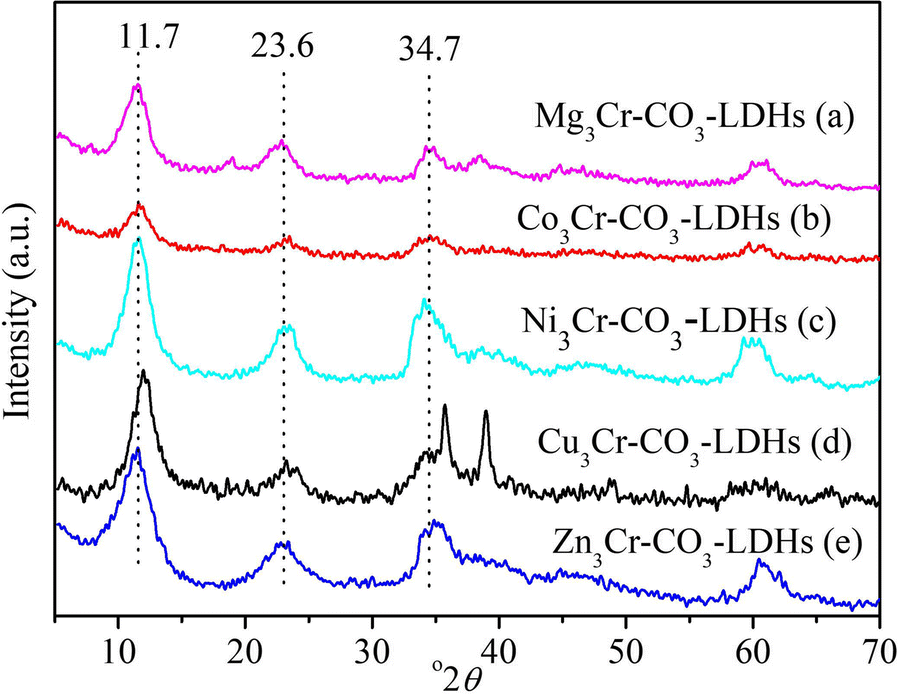
The regularity of the crystal structure, crystallinity, and crystal-cell parameters of the samples was tested using XRD (Chen et al. Reference Chen, Bao and Wang2016). The XRD patterns of five kinds of M 3Cr-CO3-LDHs (Fig. 1) showed that the diffraction peaks were at 11.7, 23.6, and 34.7°2θ, which corresponded to the characteristic diffraction peaks of hydrotalcite; and the crystal face indexes were (003), (006), and (009), respectively. The above-mentioned results were consistent with published information (Prevot et al. Reference Prevot, Forano and Besse2005; Pan et al. Reference Pan, Cao, Ni, Li, Chen, Tang and Xu2011; Yang et al. Reference Yang, Qian, Chu and Zhang2018; Xu et al. Reference Xu, Pan, Meng, Guo, Wu and Chen2019), indicating that the five kinds of M 3Cr-CO3-LDHs had typical layered structures. The diffraction peaks of these five kinds of M 3Cr-CO3-LDHs were strong and sharp, which indicated that the synthesized M 3Cr-CO3-LDHs had fine crystallinity. In addition, the diffraction peak of Zn3Cr-CO3-LDHs was the strongest, which showed that Zn3Cr-CO3-LDHs formed the best crystals. The peak observed at d 009 in Cu3Cr-CO3-LDHs, however, was unidentified and indicated less crystallinity. It may have been a consequence of incomplete washing.
XRD patterns of Mg3Cr-CO3-LDHs (a), Co3Cr-CO3-LDHs (b), Ni3Cr-CO3-LDHs (c), Cu3Cr-CO3-LDHs (d), and Zn3Cr-CO3-LDHs (e)

The layer spacing of the diffraction peak corresponding to the d 003 plane was calculated from the Bragg equation (nλ = 2dsinθ), giving values for CuCr-CO3-LDHs, ZnCr-CO3-LDHs, NiCr-CO3-LDHs, MgCr-CO3-LDHs, and CoCr-CO3-LDHs of 0.747, 0.764, 0.773, 0.765, and 0.749 nm, respectively. These data are similar to the results reported in the literature of d 003 spacing of carbonate hydrotalcite (Sels et al. Reference Sels, De Vos and Jacobs2001; Rives et al. Reference Rives, Prieto, Dubey and Kannan2003; Tichit et al. Reference Tichit, Gerardin, Durand and Coq2006; Yang et al. Reference Yang, Chu and Zhang2019). Comparison of the five d 003 results revealed that the MgCr-CO3-LDHs layer spacing was the largest, which might be due to the fact that Mg has the smallest atomic radius.
FTIR Spectroscopy Analysis
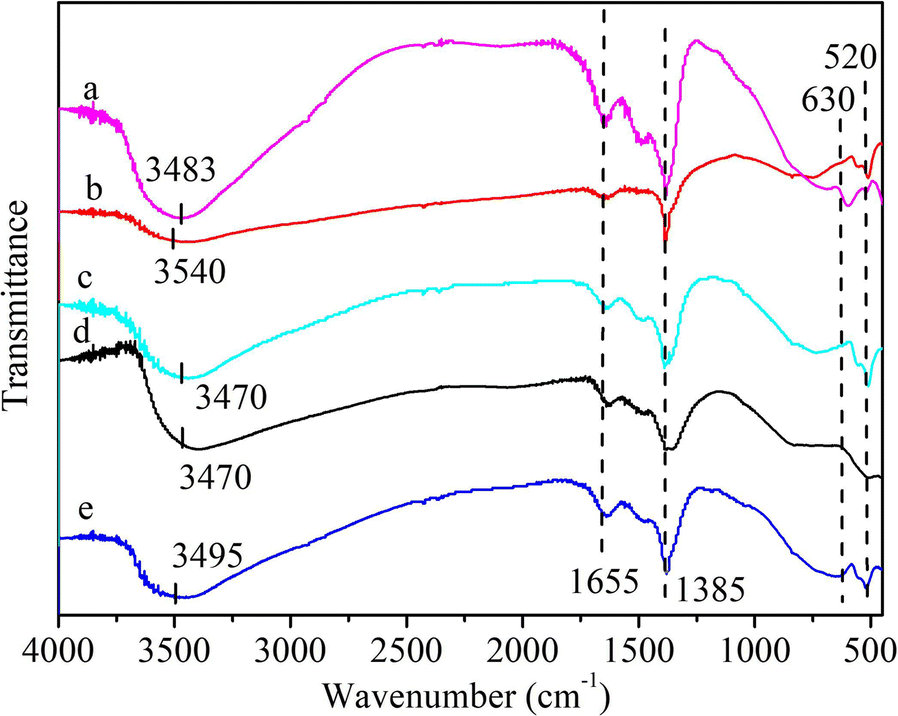
The FTIR patterns of the five kinds of M 3Cr-CO3-LDHs (Fig. 2) revealed five absorption peaks between 3470 and 3540 cm–1 which were ascribed to the stretching vibration of the H2O molecule; this was because the surface and the interlayer space of the LDHs adsorbed a certain number of H2O molecules. Compared with the stretching vibration of free hydroxyl (at ~3650 cm–1), the peak shifted to a lower wavenumber, which indicated that a hydrogen bond between layers of H2O and the CO3 2– ion and the hydroxyl group appeared. In addition, absorption peaks between 1650 and 1665 cm–1 were caused by the bending vibration of –OH in the crystal water. The peak at 1384–1386 cm–1 was ascribed to the anti-symmetric stretching vibration peak of CO3 2–. Absorption peaks between 520 and 630 cm–1 belonged to the characteristic peak of plane-bending vibration of C-O. All the patterns showed the characteristic peaks of hydrotalcite. IR spectra further confirmed the synthesis of M 3Cr-CO3-LDHs had typical structural characteristics of hydrotalcite.
FTIR patterns of Mg3Cr-CO3-LDHs (a), Co3Cr-CO3-LDHs (b), Ni3Cr-CO3-LDHs (c), Cu3Cr-CO3-LDHs (d), and Zn3Cr-CO3-LDHs (e)

TG-DTA Characterization
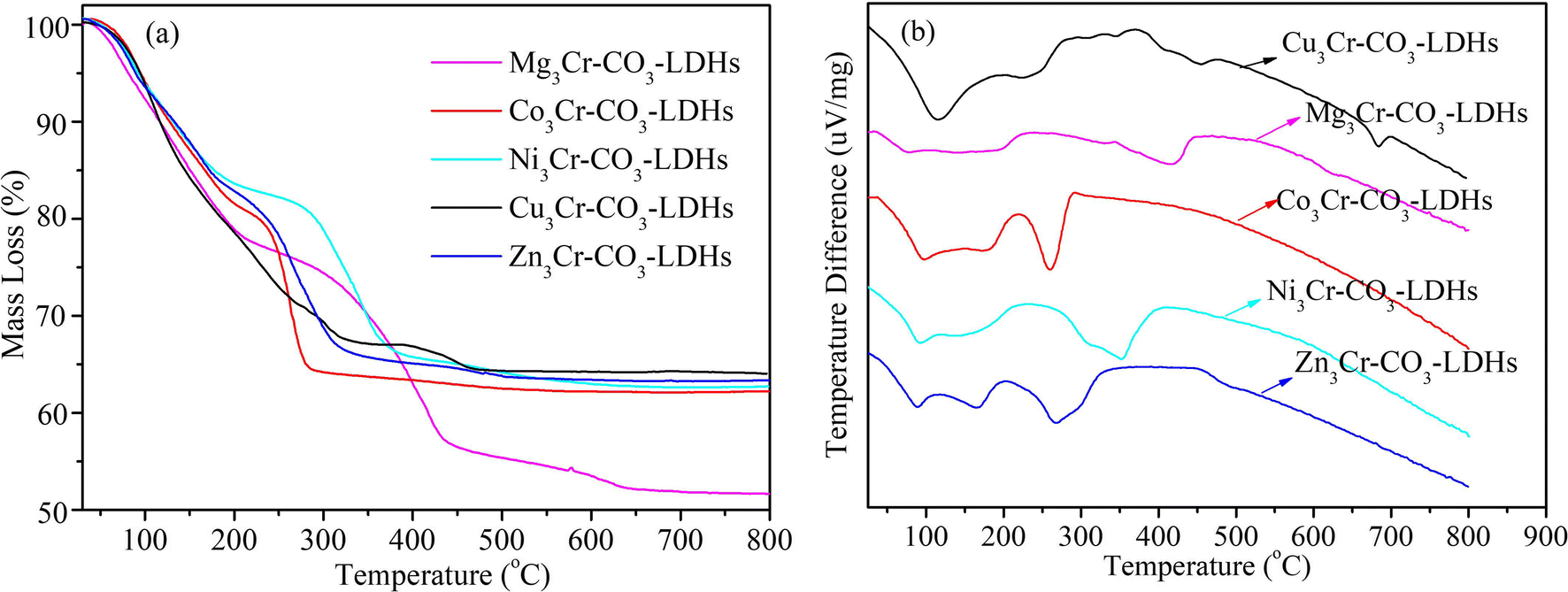
The TG-DTA curves of Mg3Cr-CO3-LDHs, Zn3Cr-CO3-LDHs, Co3Cr-CO3-LDHs, Ni3Cr-CO3-LDHs, and Cu3Cr-CO3-LDHs (Fig. 3a) showed that during the heating process, the thermal behavior of these compounds could be divided into two stages. In the first stage, the weight loss was ~17–25%, and in the second stage, weight loss was ~17–23%. Compared with the five kinds of compounds, Mg3Cr-CO3-LDHs had the largest weight loss: 23%. The comparison of DTA curves showed that the thermal decomposition of the five kinds of M 3Cr-CO3-LDHs was due mainly to two obvious endothermic processes. An endothermic peak appeared at low temperature (i.e. 50–200°C), which corresponded to the removal of surface-adsorbed water and interlayer water. A peak also appeared at higher temperature (i.e. 265–450°C), indicating that the interlayer hydroxyl was dehydrated and interlayer CO3 2– anions were decomposed or removed. These results were similar to the thermal decomposition of typical Mg-Al hydrotalcites (Hibino et al. Reference Hibino, Yamashita, Kosuge and Tsunashima1995).
TG curves of of M 3Cr-CO3-LDHs (a), and DTA curves of M 3Cr-CO3-LDHs (b)

Comparison of second-stage DTA curves (Fig. 3b) indicated the thermal decomposition temperature of Cu3Cr-CO3-LDHs was the highest, which showed that the thermal stability was the best. The relative thermal stabilities of the other four kinds of hydrotalcites were in the order: Mg3Cr-CO3-LDHs > Ni3Cr-CO3-LDHs > Zn3Cr-CO3-LDHs ≈ Co3Cr-CO3-LDHs, consistent with the result reported previously (Pan et al. Reference Pan, Ni, Cao and Li2012), i.e. the order of thermal stability of hydrotalcites obtained from the second law of crystal chemistry.
UV-Vis DRS Analysis
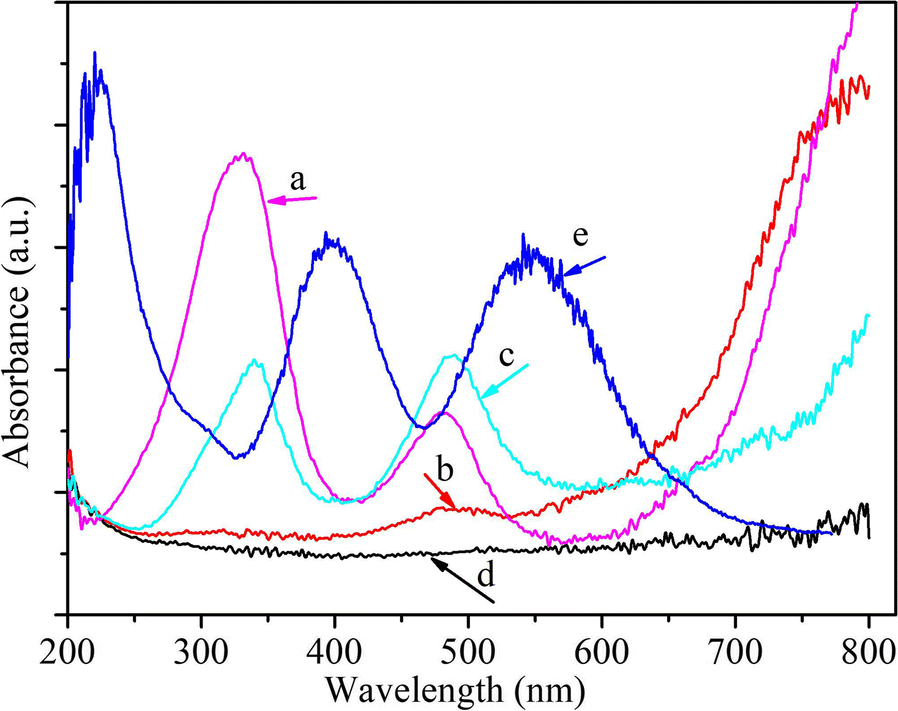
The UV-Vis DRS spectra of LDHs (Fig. 4) showed that Mg3Cr-CO3-LDHs and Ni3Cr-CO3-LDHs (curve a and curve c) contained obvious absorption peaks at ~333 and 480 nm. Co3Cr-CO3-LDHs (curve b) had a weak absorption peak in the visible region (λ > 400 nm), but Cu3Cr-CO3-LDHs (curve d) had almost no absorption peaks, while Zn3Cr-CO3-LDHs (curve e) had obvious absorption peaks at ~410 and 560 nm. In order to utilize these kinds of catalysts effectively in visible light (λ > 400 nm), UV-Vis DRS patterns of the five kinds M 3Cr-CO3-LDHs were compared and analyzed. The absorption region of Zn3Cr-CO3-LDHs was widest, next was Ni3Cr-CO3-LDHs, and Mg3Cr-CO3-LDHs and Co3Cr-CO3-LDHs had narrower spectra, while the absorption region of Cu3Cr-CO3-LDHs was narrowest. With the various divalent metal cations, the final products were different colors (Zhao et al. Reference Zhao, Zhang, Li, Yan, He, Tian and Duan2011), meaning that their absorption of visible light spanned different wavelengths and provided an incentive to explore their visible-light catalytic properties.
UV-Vis DRS patterns of Mg3Cr-CO3-LDHs (a), Co3Cr-CO3-LDHs (b), Ni3Cr-CO3-LDHs (c), Cu3Cr-CO3-LDHs (d), and Zn3Cr-CO3-LDHs (e)

Photocatalytic Properties of ZnCr-CO3-LDHs
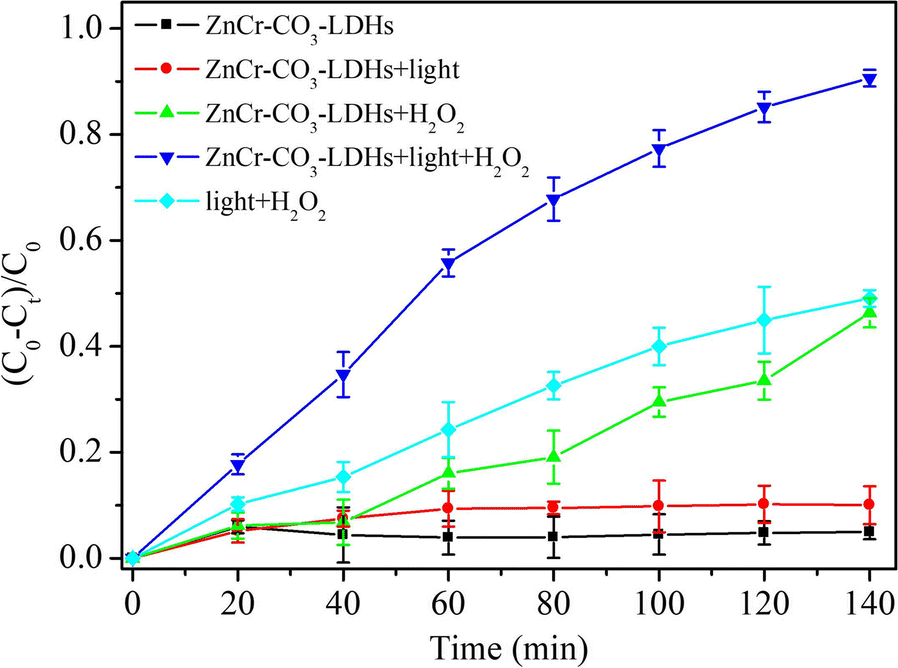
In order to investigate the catalytic activity of ZnCr-CO3-LDHs, MB solution was selected as the substrate for catalytic oxidation. The removal rate of MB was only 5% in the presence of ZnCr-CO3-LDHs without visible light (Fig. 5), which was attributed to the adsorption capability of ZnCr-CO3-LDHs (for MB). In the presence of ZnCr-CO3-LDHs exposed to visible light, the removal rate was 10.06% after 140 min, indicating that ZnCr-CO3-LDHs is a photocatalyst for MB degradation. When both ZnCr-CO3-LDHs and H2O2 were involved in an unilluminated reaction, the removal rate of MB was 46.36% after 140 min. However, MB decreased by 49.08% when using only H2O2 for 140 min under visible light irradiation, which might be due to oxidation of H2O2. When MB solution was exposed to ZnCr-CO3-LDHs, H2O2, and visible light irradiation together, >90.67% of MB was removed after 140 min. The above phenomena indicated that MB was most effectively degraded by ZnCr-CO3-LDHs/H2O2 under visible light irradiation.
Photocatalytic degradation of MB under various conditions

Reuse Performance
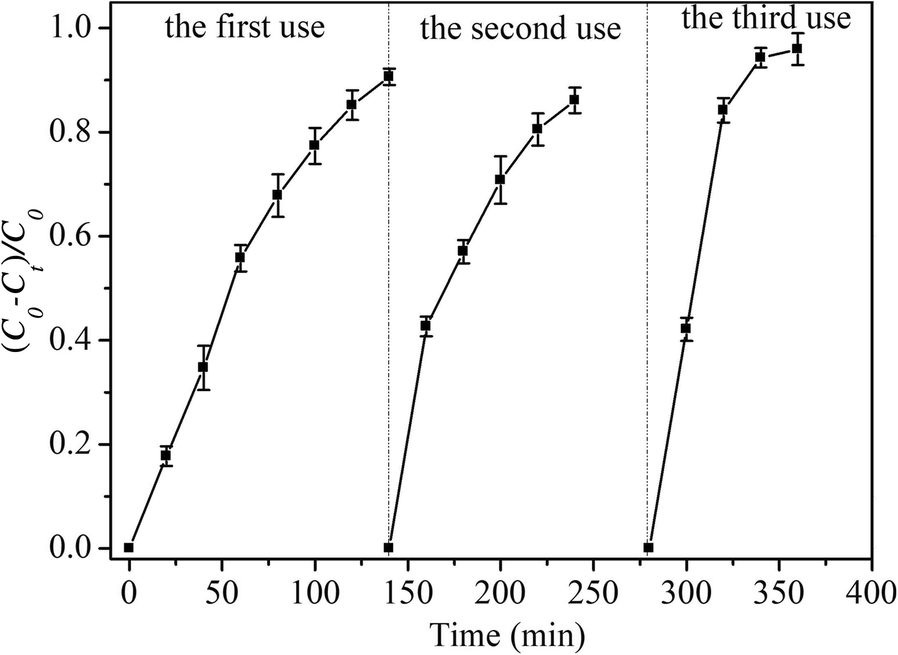
Repeated experiments on photodegradation of MB using ZnCr-CO3-LDHs/H2O2 were performed. After each run, the photocatalysts were collected by centrifugation; distilled water was added to the centrifuge tube and stirred until the catalyst was washed washed thoroughly, and then centrifugation was continued. The process was repeated three times. After the ZnCr-CO3-LDHs were reused three times, the degradation rates of MB solution were still >90% (Fig. 6), indicating that ZnCr-CO3-LDHs were stable and not photocorroded during photocatalytic reactions. In addition, when the photocatalysts were used for the second or third times, the MB was degraded rapidly. The photocatalytic degradation rate of MB was 42.65% (second attempt) and 42.14% (third attempt) after 20 min, which was faster than that of the first time of photocatalytic degradation of MB (17.76%).
Catalyst recycling study of ZnCr-CO3-LDHs for photocatalytic degradation of MB

The quicker degradation might be due to the transition of electrons in the valence band when using ZnCr-CO3-LDHs in the presence of light, resulting in the formation of photogenerated electron-hole pairs on the inside and on the surface of ZnCr-CO3-LDHs. Electrons and holes reacted with H2O2 to produce active species that effectively prevented recombination of electron-hole pairs, and effectively transferred electrons and holes, resulting in a series of redox reactions. In the process of reuse, visible light irradiation may activate ZnCr-CO3-LDHs to produce photogenerated electron-hole pairs. Therefore, the reaction of photogenerated electrons and holes with H2O2 was accelerated and, ultimately, the degradation of MB was also accelerated.
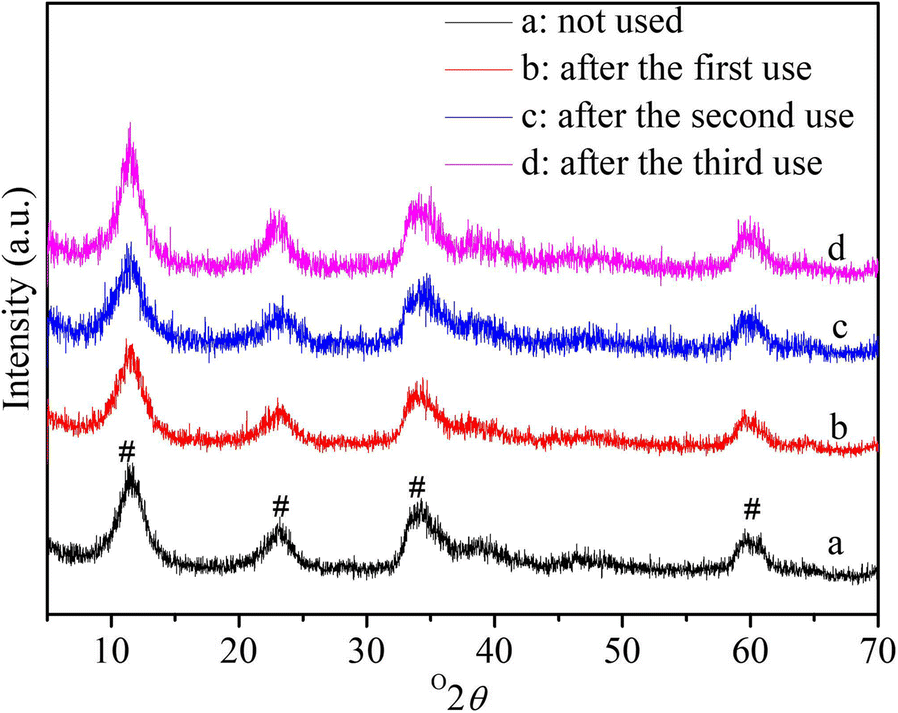
The XRD patterns of ZnCr-CO3-LDHs after different cycles (Fig. 7) showed that the diffraction peaks of ZnCr-CO3-LDHs were unchanged and the peaks were similar in shape when ZnCr-CO3-LDHs were used two or three times. The results indicated that the crystal structure of hydrotalcites did not change obviously after cyclic use, and also proved that ZnCr-CO3-LDHs had good stability.
XRD patterns of ZnCr-CO3-LDHs after various cycle times

Catalyst Types
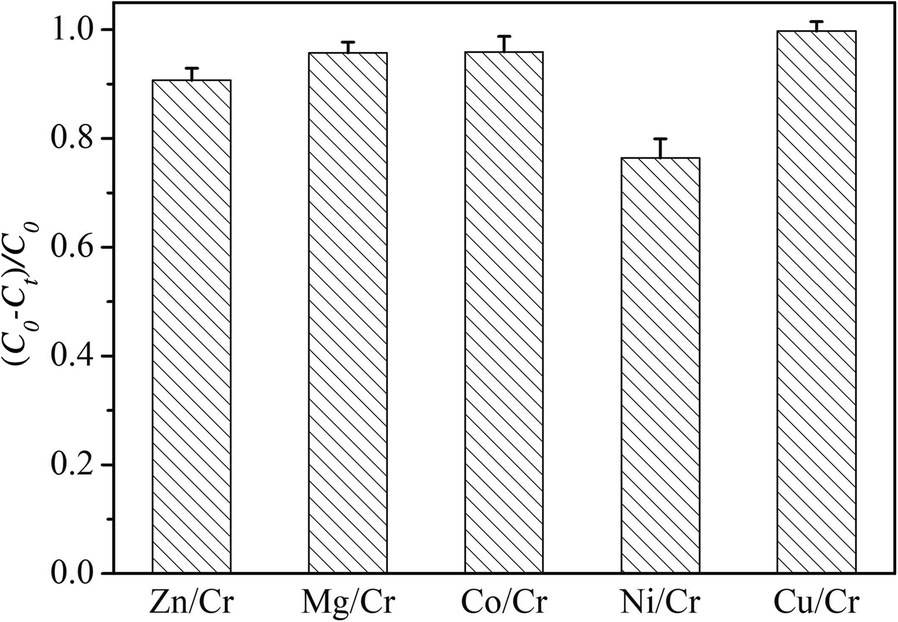
The photocatalytic degradation of MB with different metal ions substituted in MCr-CO3-LDHs (M = Zn, Mg, Co, Ni, or Cu) (Fig. 8) showed that, under the same experimental conditions, the degradation of MB with CoCr-CO3-LDHs after 60 min was nearly 100%, while the degradation with MgCr-CO3-LDHs and CuCr-CO3-LDHs was >90%. But the degradation efficiencies of ZnCr-CO3-LDHs and NiCr-CO3-LDHs were worse; the degradation of MB was 55.78% and 48.14%, respectively, under the same conditions. When M was Mg, Co, or Cu, MB degraded rapidly, and a large number of bubbles was produced during the reaction. When M was Zn or Ni, fewer bubbles were formed. The photocatalytic activity of five kinds of M 3Cr-CO3-LDHs was in the order: Co3Cr-CO3-LDHs > Mg3Cr-CO3-LDHs > Cu3Cr-CO3-LDHs > Zn3Cr-CO3-LDHs > Ni3Cr-CO3-LDHs.
Effect of catalyst types on degradation of MB

Photocatalytic Mechanism
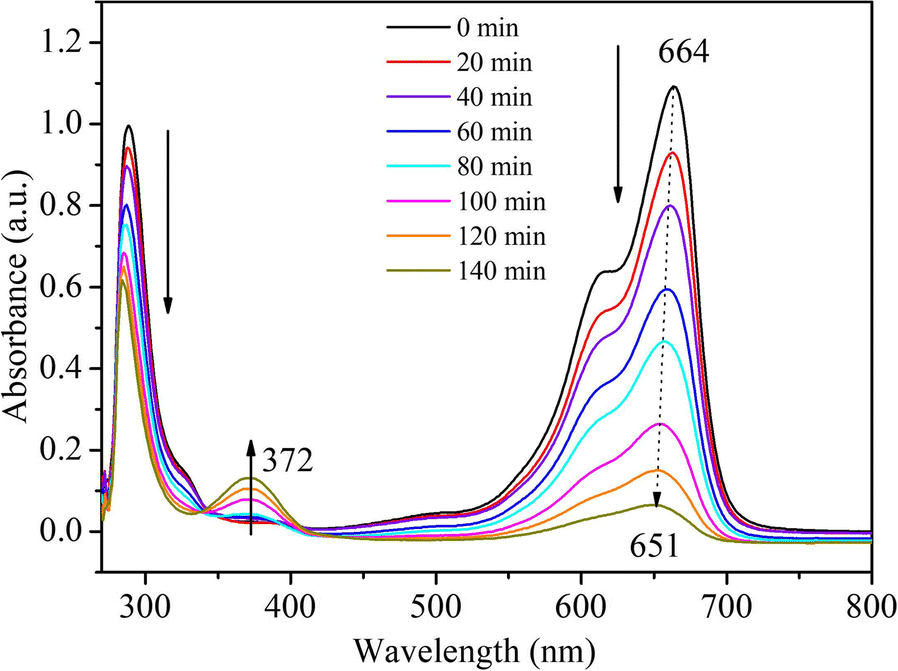
The intermediate products of MB degradation were tested (Fig. 9); the maximum absorption peak (λ = 664 nm) of MB solution decreased gradually with the prolongation of reaction time, and the maximum absorption peak shifted to λ = 651 nm. The blue shift (to lower wavelengths) of the maximum absorption wavelength of MB occurred, possibly due to the demethylation reaction found when photocatalytic degradation of MB takes place, and it removed a methyl to form azure B. According to the literature (Zhang et al. Reference Zhang, Oyama, Aoshima, Hidaka, Zhao and Serpone2001), absorption bands at 654–648, 620, and 610 nm are due to MB molecular transformations to azure A, azure B, and azure C, respectively. The results of photocatalytic degradation of MB agreed with those reported in the literature. In addition, along with the prolonged irradiation time, a new absorption peak appeared in the UV region (λ = 372 nm); the absorption peak was enhanced as illumination time increased, suggesting that new substances appeared during degradation of MB.
UV-Vis absorption spectra of MB with different reaction times in the presence of ZnCr-CO3-LDHs/H2O2 under visible light irradiation.

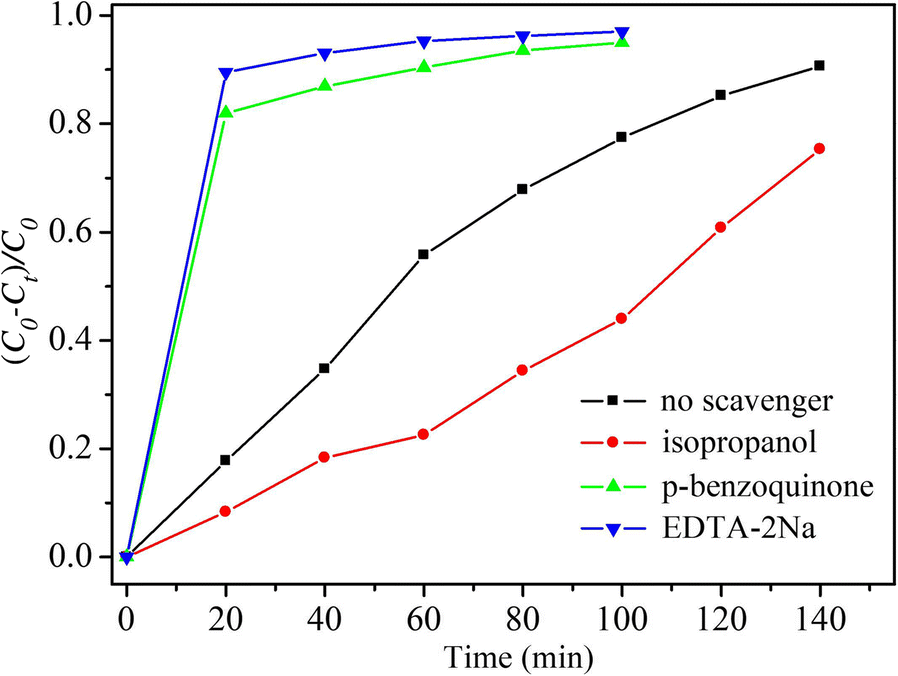
In order to evaluate the role of these active oxidants, scavengers were added to the photocatalytic system. These were isopropanol (IPA) for •OH, p-benzoquinone (BQ) for •O2 – (Yuan et al. Reference Yuan, Wei, Hu, Yao, Jiang, Fang and Chu2015), and ethylene diamine tetraacetic acid disodium salt (EDTA-2Na) for h + (Xiong et al. Reference Xiong, Chen, He, Sun and Wang2012; Pan et al. Reference Pan, Wang, Sun, Xu and Wang2013; Chen et al. Reference Chen, He, Lv, Liu, Wang and Lv2014). The molar ratio of initial concentration of these three kinds of scavengers in the reaction system to MB was 200:1. The photodegradation of MB was slightly inhibited by the addition of IPA (Fig. 10). The results indicated that MB degradation was driven mainly by the participation of •OH radicals. But the reaction was accelerated when EDTA-2Na and BQ were added. The degradation rates of MB exceeded 90% after irradiation for 60 min.
Effect of various scavengers on degradation of MB

Based on the band theory of solids and the mechanism of semiconductor photocatalysis, researchers speculated on the possible mechanism of photocatalytic degradation of MB. Photoinduced e –/h + pairs were generated on the surface of the photocatalyst ZnCr-CO3-LDHs during irradiation (Eq. 1). H2O2 molecules oxidized by photoinduced h + were adsorbed into •OH species on the photocatalyst surface (Eq. 2), while the photoinduced e –-activated H2O2 and O2 molecules were adsorbed into •OH, OH– species on the catalyst surface (Eq. 3), and •O2 – species (Eq. 4), respectively. In addition, •OH species were also generated during irradiation of H2O2 (Eq. 5). H2O2 oxidized the active •O2 – species into •OH, OH–, and O2 species (Eq. 6). •OH and O2 species are known to be the main active species in the photocatalytic reaction (Ishibashi et al. Reference Ishibashi, Fujishima, Watanabe and Hashimoto2000; Xiang et al. Reference Xiang, Yu and Wong2011). The MB molecules were oxidized by •OH and O2 species into small molecules (Eq. 7 and Eq. 8).


When the EDTA-2Na was added to the reaction system, the h + was captured, which caused Eq. 1 to move to the right, so that a large amount of photoinduced e– formed on the catalyst surface and inside. Photoinduced e– deoxidizes H2O2 and O2 molecules to produce •OH and •O2 – species on the photocatalyst surface according to Eq. 3 and Eq. 4. The •OH could oxidize MB effectively, while •O2 – and H2O2 generated •OH and O2 according to Eq. 6. Therefore, in the process of photocatalysis of MB, a large number of bubbles were produced in the solution, and the MB was degraded rapidly. When p-benzoquinon was added, •O2 – in the solution was trapped, which caused Eq. 4 to move to the right. Subsequently, Eq. 1 and Eq. 2 were accelerated, speeding up the generation of •OH and accelerating the degradation of MB. However, one could speculate that the addition of p-benzoquinon did not capture •O2 – rapidly, so that part of •O2 – could react with H2O2 (Eq. 6). This concept is consistent with the fact that a large number of bubbles was produced in the solution during the experiment.
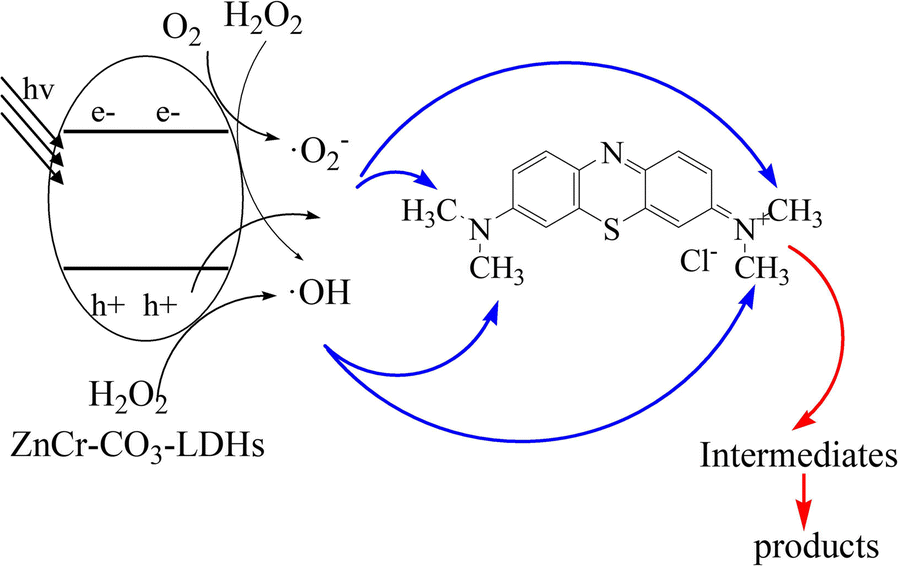
Based on the above discussion, combined with the analysis of UV-Vis absorption spectra, the possible mechanism of ZnCr-CO3-LDHs photocatalytic degradation of MB was considered (Fig. 11). Under visible light irradiation, ZnCr-CO3-LDH was excited, and its valence band electrons were transferred to the conduction band to produce photogenerated electrons (e –) and holes (h +). These e – and h + could move freely in the catalyst. When they moved to the catalyst surface, e – reacted with O2 and H2O2 in the solution to produce •O2 – and •OH, and h + in the valence band reacted with H2O2 to generate •OH. These active species then reacted with MB, causing MB to undergo demethylation, and also oxidized MB to small molecules, thus achieving the purpose of decolorization and degradation.
Possible mechanism of photocatalytic degradation of MB using ZnCr-CO3-LDHs

Conclusions
In the present study, M/Cr hydrotalcites (M 3Cr-CO3-LDHs) (in which M = Mg, Co, Ni, Cu, or Zn), where the M/Cr molar ratio was 3, were prepared by the co-precipitation method. XRD and FTIR tests showed that five kinds of M 3Cr-CO3-LDHs were synthesized successfully, the samples obtained had regular layered structures and were single crystal phases. FTIR and TG-DTA analysis showed the M 3Cr-CO3-LDHs to have thermal stability characteristics typical of carbonate hydrotalcites. In addition, the thermal stability was in the order: Cu3Cr-CO3-LDHs > Mg3Cr-CO3-LDHs > Ni3Cr-CO3-LDHs > Zn3Cr-CO3-LDHs ≈ Co3Cr-CO3-LDHs. When MB solution was exposed to ZnCr-CO3-LDH, H2O2, and visible light irradiation together, more than 90.67% of the MB was removed after 140 min. Photocatalytic activity of the samples was in the order: Co3Cr-CO3-LDHs > Mg3Cr-CO3-LDHs > Cu3Cr-CO3-LDHs> Zn3Cr-CO3-LDHs >Ni3Cr-CO3-LDHs. The results of a reaction mechanisms study showed photocatalytic degradation of MB involved demethylation, and the reactive species contained •O2 -, •OH, and h +.
Acknowledgements
This Project is supported by Zhejiang Provincial Natural Science Foundation of China (No. LY17E040001; No. LQ19E040001).