Who has not heard, Volusius, of the monstrous deities those crazy Egyptians worship? One lot adores crocodiles, another worships the snake-gorged ibis. . .you’ll find whole cities devoted to cats, or to river-fish or dogs (Juvenal, Satires XV; Green Reference Green1974).
Introduction
The fact that animals feature prominently in Egyptian religion is not revelatory; indeed, it was old news by the time Juvenal wrote his satire around AD 128–130 (Green Reference Green1974: 14); and the “snake-gorged ibis” is referenced by Herodotus (2.77, 1–4; de Sélincourt Reference de Sélincourt1954), writing in the fifth century BC. Egyptologists in their turn have examined the animal cults (e.g. Ray Reference Ray1978; Martin Reference Martin1981; Kessler Reference Kessler1989; Ikram Reference Ikram2005) but research has focused mainly on the temple structures relating to the cults and the literary evidence for them (e.g. Ray Reference Ray1976). Whilst both of these research areas are invaluable, they omit one of the most substantial parts of the surviving evidence—the catacombs and their mummified inhabitants.
This paper reports on a Cardiff University project begun in 2009, and directed by one of the authors (Nicholson), with the aim of gaining a better understanding of the Dog Catacombs. We summarise the work of many individuals, including the survey and mapping team led by Steve Mills and the faunal team under Salima Ikram. The intention of this new work has been to investigate animal cults with a focus on the animals themselves, the individuals who operated aspects of the cult (e.g. animal breeders, priests) and the subterranean structures associated with them. The temples and shrines, though undeniably significant, are often only the tip of the iceberg; the greater part being below the waterline or, in this case, below ground.
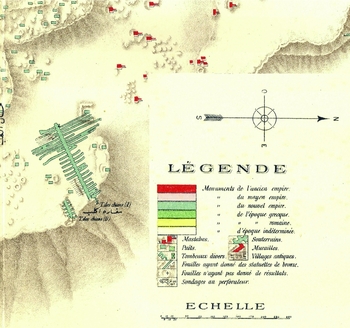
In 1897, Jacques de Morgan (1857–1924) published his Carte de la Nécropole Memphite (de Morgan Reference de Morgan1897); map 10 of this collection shows two catacombs labelled ‘T[ombe] des chiens (A) and (B)’. The key to the map dates them to the New Kingdom (1550–1069 BC) (Figure 1).
Extract from de Morgan's Carte de la Nécropole Memphite (1897) showing the location of the ‘T[ombe] des chiens (A) and (B)’. Only the larger catacomb is currently accessible; both are dated by de Morgan to the New Kingdom, but the grounds for this are uncertain and we have not discovered New Kingdom evidence from the larger catacomb.

De Morgan's map appears to be the first to show these catacombs, which are located on the east of the Saqqara plateau. However, he offered no information detailing who discovered them or when, nor his grounds for dating them to the New Kingdom. Following his publication, the existence of these underground catacombs became well known to generations of Egyptologists, although they were never the subject of detailed study. This lack of research is all the more surprising for the fact that the work of Walter Bryan Emery (1903–1971), at the Sacred Animal Necropolis on the west side of the Saqqara plateau, was widely reported during the 1960s (Emery Reference Emery1965; Bacon Reference Bacon1967a & Reference Baconb; The Illustrated London News 1967) and might have been expected to make the animal cults a focus for research (for an excellent summary of Emery's work see Smith Reference Smith1974).
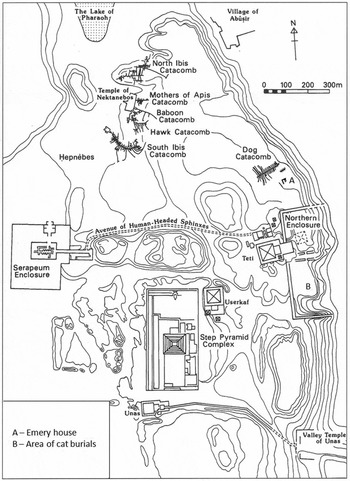
Part of the reason for the ‘Tombes des chiens’ attracting so little attention may have been the media focus on Emery's quest to find the tomb of Imhotep, the architect of the Step Pyramid, rather than on the animal galleries, which he excavated. Emery's death in 1971 effectively ended the widespread interest in the Sacred Animal Necropolis, and any incentive for a new assessment of the Dog Catacombs (see Figure 2 for a map of Saqqara and its monuments).
Map of North Saqqara showing the location of the animal catacombs in relation to other major features (drawn by J. Hodges).

The animal cults
Dog catacombs are the burial place of animals sacred to the dog- or jackal-headed Egyptian deity Anubis. They are, however, only one part of a wider phenomenon of sacred animal cults. Animal worship was already well established by the First Dynasty (3100–2890 BC), and the worship of the Apis bull is recorded from that time on the Palermo Stone (Simpson Reference Simpson1957; Hart Reference Hart1986: 28; Dodson Reference Dodson and Ikram2005: 72), although its origins lay deep in the Pre-dynastic era (5500–3100 BC). The sacred animals of the Dynastic period were the ‘living image’ or ‘divine manifestation’ (ba) of particular deities; thus, the Apis bull was the ba of Ptah, the creator god of Memphis.
A deity manifested as an animal was represented by only a single creature—for example, there was only one Apis alive at any one time. However, the large deposit of animals found in catacombs—Emery found tens of thousands of ibis birds, sacred to the god Thoth, interred at Saqqara (see Martin Reference Martin1981)—are presumably votive offerings (see Ikram Reference Ikram2005: 1) made by pilgrims in gratitude for a favour granted by the god or in the hope of future good fortune. These clearly cannot have lived within the temple precincts but must have been gathered from a much wider area. Although they sometimes shared a burial place with animals that were truly sacred and had lived within the temple, these votive animals greatly outnumber the sacred few. The large scale of the animal cults (see Kessler Reference Kessler1989) was testament to their popularity. This popularity was probably a result of the way in which the cults operated; many of the sacred animals, including the Apis bull, were oracular creatures and would give answers to questions asked of them by pilgrims. Expressions of gratitude to the animals might take the form of payment for a fitting burial for one of the god's representatives—an ibis for Thoth, a cat for Bastet or a dog for Anubis—or by the donation of a bronze statuette or situla (ritual vessel) to the relevant shrine.
The animal cults reached their peak from the Late Period (747–332 BC) through the Ptolemaic Period (332–30 BC), declining some time during the Roman occupation (after 30 BC). In part, this popularity probably stems from the perception of the cults as archetypally Egyptian, a symbol of national identity at a time when the country was increasingly drawn into the world of the Mediterranean and subject to the rule of foreigners such as Libyans and Persians (Dodson Reference Dodson2012); indeed, Kessler (Reference Kessler1989) sees the cults as specifically associated with the ruler. We take the view, expressed by Davies (Reference Davies, Hill and Schorsch2008), that the animal cults were not associated with the king and the state, but were an expression of popular religion. Neither view contradicts the idea that the cults may be a response to troubled times and so represent a symbolic return to Egyptian core values. The cults represented at Saqqara have been elegantly summarised by Ray (Reference Ray1978).
Despite the huge scale of the burial places of many of the sacred animals at sites such as Saqqara and Tuna el-Gebel, the construction of the catacombs, their architecture and the nature of their mummified occupants has attracted relatively little attention. This is in comparison to the study of the cults themselves (e.g. Kessler Reference Kessler1989) and of their above-ground features (Martin Reference Martin1981), including the various temples and shrines (Jeffreys & Smith Reference Jeffreys and Smith1988; Smith et al. Reference Smith, Davies and Frazer2006). The work of Boessneck (Reference Boessneck1987), Kessler and Nureddin (Reference Kessler and Nureddin1994), von den Driesch and Kessler (Reference von den Driesch and Kessler1994), Davies and Smith (Reference Davies and Smith2005) and, most recently, Rowlands et al. (Reference Rowlands, Ikram, Tassie and Yeomans2013), are, however, notable exceptions to this trend.
The project reported here has sought to better understand the nature of one such underground catacomb and to assess how its many mummified occupants were procured and prepared for the cult. It has also attempted to explain why certain galleries within the catacomb are now empty.
The Dog Catacombs
The Dog Catacombs are located on the eastern side of the Saqqara plateau to the north of the Step Pyramid and immediately north of Professor Emery's excavation house. They underlie the southern end of the Early Dynastic (3100–2686 BC) tombs (Figure 2).
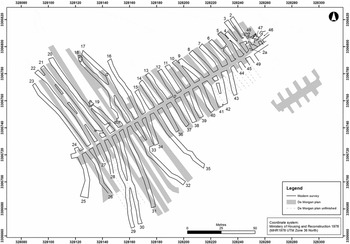
Although de Morgan's map (Reference de Morgan1897) shows two catacombs, the smaller of these (B) is not currently accessible due to extensive sand drifting. It is likely that part of it may have collapsed in the earthquake of 1992, when a large hole appeared immediately north of the Emery house and therefore in approximately the location of the (B) catacomb. Nonetheless, it is known that the form of this catacomb was the same as its much larger neighbour (A) to its north, namely an axial corridor running approximately east–west with a series of galleries opening from it to the north and south. The de Morgan plan gives a length of approximately 45m for the axial corridor and a maximum width of 25m for the complex. The individual galleries are about 7–10m long. It is in these tunnels or galleries that most of the bodies were interred.
The larger catacomb designated as (A) by de Morgan has an axial length of 173m and is 140m at its maximum width. The individual burial galleries in this catacomb are more varied in length, ranging between 3 and 70m.
The current entrance to this larger catacomb is via a flight of stone steps, although this is a secondary entrance; the original ceremonial entrance would have been much larger and would have led directly onto the axial corridor. However, this area has suffered from rock collapse and the galleries on the south side of the axial corridor in this fore part of the catacomb seem to have collapsed before the de Morgan map was made.
Results from the Catacombs of Anubis Project
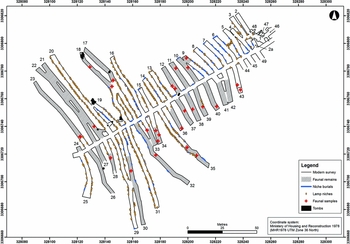
The first stage in the work of the project was to re-plan the complex (Figure 3). This was necessary because of the small scale at which the original de Morgan plan was reproduced; on that plan the two catacombs fitted into a printed area of 40mm2 and were therefore too small to examine in detail. Work by the University of Pisa shows the catacombs in relation to the contours of the plateau (Bresciani & Giammarusti Reference Bresciani and Giammarusti2003: 332). Their map used the de Morgan plan and attempted to locate its position against a modern survey of the plateau; the catacomb was not resurveyed.
Modern survey plan of the Dog Catacombs overlaid on that by de Morgan (Reference de Morgan1897) (shown in grey). The smaller catacomb is currently inaccessible and so shown only in de Morgan's version. Galleries depicted as open-ended are those deemed too unsafe to survey beyond the limit indicated (plan by S. Mills, S. Williams and H. Nouwens).

Cutting the catacomb
The catacombs have been cut into the upper calcareous beds of the Saqqara Member of the Lower Eocene (c. 56–48 my BP) Maadi formation (Youssef et al. Reference Youssef, Cherif, Boukhary and Mohamed1984; Nicholson et al. Reference Nicholson, Harrison, Ikram and Qin2013) deposited in a shallow lagoonal environment. Of some significance may be the fossilised skeleton of a marine mammal preserved in the roof of gallery 8. This fossil is currently under investigation, but at the time of writing is believed to be the first vertebrate fossil to be discovered from this formation at Saqqara. Whether those involved in cutting the catacomb, with only oil lamps as lighting, were aware of its presence is unknown, although one might expect them to have noticed the difference in the rock. Mayor (Reference Mayor2000: 150–51) provides an interesting case for ancient attitudes toward such fossils and suggests that in Egypt they may have been associated with Seth. Anubis and Seth are themselves linked in the late Ptolemaic/early Roman Papyrus Jumhilac (Vandier Reference Vandier1961; Te Velde Reference Te Velde1967: 41; Hart Reference Hart1986: 198). Seth also has chthonic aspects, which might have been regarded as a good omen for those excavating the gallery, although this is by no means certain.
However the ancient quarrymen or miners regarded the fossils, they are likely to have been a small team, not least because of the confined space in which they were working. While there would have been sufficient fresh air for the workers, the atmosphere in the catacomb might well have been improved by making use of the shafts from earlier tombs overlying the galleries. In the case of the Falcon and Ibis Catacombs at Saqqara, present author Nicholson believes that such shafts were deliberately used and that the chambers at their base may even have been starting points for sections of tunnelling. This is less apparent in the Dog Catacombs, but there are sufficient shafts to have been used to help in air circulation and to provide a convenient means of hauling debris from the newly cut galleries to the surface, where it could be dumped.
The rock into which the catacomb is cut is not always stable; this is evident from the collapse of several galleries at the eastern end of the complex, although exactly when the collapse occurred is not known. That at least some of it happened after the galleries were filled is clear from gallery 42, which contains mummies even though its entrance has collapsed. It is also known from the de Morgan Carte that collapse had taken place before his plan was made.
One of the galleries, no. 43, where minor collapse is recorded, is also unfinished and shows the usual means of cutting a tomb, known from many sites in Egypt: notably, the removal of material from the top downward, rather than the cutting back of a face. Why this particular gallery is unfinished is not clear. Given that it is near the entrance of the catacomb, it might have been expected that it would be completed before proceeding further unless it was realised that the rock here was of poor quality. It is also possible that the quarry men believed that they were getting close to the smaller catacomb and did not want to break into it. This would support the premise that the smaller catacomb is indeed the earlier one, and it may be evidence from this smaller complex that led de Morgan to date both catacombs to the New Kingdom. Examination of de Morgan's plan (Reference de Morgan1897) suggests that the smaller catacomb does not extend as far as most of the collapsed galleries, including 43. However, the end of the smaller catacomb is not marked by a solid line on the plan and it may well be that it originally continued, but collapsed when first planned. Usually, dotted lines are used to show such continuation, but perhaps the collapse was such that the map maker was unsure whether or not the catacomb extended.
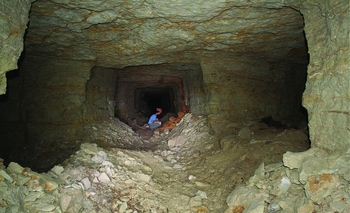
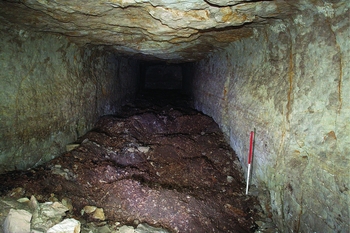
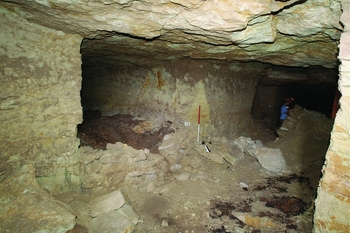
Natural deterioration of the catacomb is apparent from the ‘scabbing’ of material from its ceiling and walls, a process which may be accelerated by humidity (Figure 4). This process is being investigated by the current project (Nicholson et al. Reference Nicholson, Harrison, Ikram and Qin2013).
Looking along the axial aisle of the Dog Catacomb. The effects of scabbing can be seen at the foot of the walls (photograph: P.T. Nicholson).

The mummies
That this was a ‘dog’ catacomb was already apparent to de Morgan and would have been obvious from examination of some of the animals, visible in wall niches, as well as from those piled in the burial galleries. No work seems yet to have addressed the question of whether these canines were actually dogs or other creatures or whether the complex was exclusively for a single species.
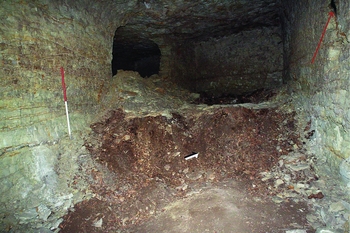
Examination of the mummified remains, supervised by present author Ikram, has shown some interesting and unexpected features (see Ikram et al. Reference Ikram, Nicholson, Bertini and Hurley2013). As it now survives, the great mass of the mummified material is in very poor condition (Figure 5). The wrappings have decayed, leaving the bones largely exposed. In places, the bones are mixed as a result of treasure-hunting at some time before the site was taken into the care of the Ministry of State for Antiquities. In other areas, complete and articulated skeletons are recognisable, and recoverable, amongst the debris; in a few parts of the catacomb, complete, wrapped mummies can be found on the surface of the mummy pile (Figure 6).
Gallery 11 with mummies still in situ. It is obvious that the pile, approximately 1m deep, has been dug into and turned over by robbers (photograph: P.T. Nicholson).

Complete specimens lying on top of the mummy pile in undisturbed gallery 42 (photograph: P.T. Nicholson).

Most of these animals seem to have had only cursory mummification. It is likely that the corpses of the youngest and smallest were simply laid out on, or buried in, the hot sand to desiccate before being anointed with oils or resins and given a minimal wrapping in linen. Some larger animals had a good deal more wrapping applied to them and these may have undergone a more complete desiccation process involving evisceration and coating in natron. Resins and oils were also used on these animals, as is attested by residues attached to the bone and textile. No examples of highly decorated mummies of the sort that are well known from museum collections have been recovered from the site.
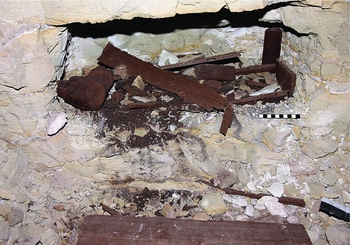
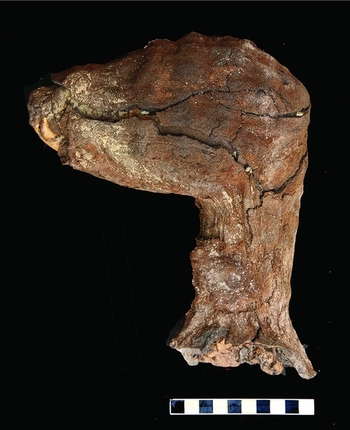
It is possible that the best mummified examples are those that are found in the wall niches of the catacomb, although this difference may result from differential preservation(Figure 7). These niches are cut into the walls of the axial corridor as well as the walls of the burial galleries themselves. In these instances (and possibly also in the axial corridor if it was later filled), they would have been buried by the mummy pile. Although most of the niches are now empty, a number still retain their contents; they are usually adult animals (Figure 8), and in one case accompanied by a puppy. It is quite possible that these are the creatures that were kept in the temple itself and lived out their natural lives there. It may be assumed, given their more elaborate burial, that they were dedicated by the priests themselves or by the most favoured of donors.
Niche 5B with the remains of a wooden coffin and parts of the mummy still in situ (photograph: P.T. Nicholson).

Head and neck of an adult dog from niche 35X (photograph: P.T. Nicholson).

These niche burials make up only a small fraction of the total number of animals from the catacomb. Many are neonates and were probably taken at birth and drowned or left to die from starvation before becoming naturally desiccated. The small size of these animals accounts for the very high numbers currently estimated for the catacomb. The estimate, based on the minimum number of animals represented in a series of 15L samples and averaged across the complex, is approximately 7 723 000. This figure assumes that the axial corridor, as well as the burial galleries, was filled with mummies to a depth of approximately 1m. If the axial corridor is discounted, the figure would be approximately 7 000 000. The number may increase or decrease somewhat as further work is completed, but it is nonetheless clear that very significant numbers of animals were needed.
This raises the question of how the animals, most of them domestic dogs, were obtained. Although the duration of use of the catacombs is not known, there are still too many animals to have been kept at the temple at Saqqara, and it must be assumed that they were bred off-site. The most likely scenario is that there were several puppy farms located nearby, probably in Memphis and its environs, from which most of the animals were sourced. There is no written evidence relating to procurement and it is not known whether such farms were sanctioned in some way or whether they were essentially independent concerns. Similarly, the relationship between pilgrims, wishing to leave votive mummies, and the priests at Saqqara is unclear. It is entirely possible that pilgrims visiting the Anubieion Temple would have seen the healthy adult dogs kept there and assumed that a payment made for the burial of one of the god's representatives would secure the burial of one of these animals in due course, rather than the funds being used for a representative neonate burial. It is equally possible that pilgrims arrived at Saqqara with the tiny mummy of a neonate, having purchased it from a farm in the vicinity, and that this was entirely acceptable, regardless of its age, since the point of the exercise was to secure fitting burial for the god's representative. Its life may have been extremely short but its journey to the afterlife was to be a good one and the afterlife was forever; the animal cults cannot be interpreted within a framework of twenty-first-century sensibilities.
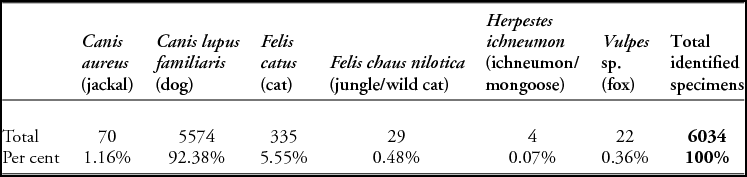
Study of the faunal remains shows that not all of the mummies are those of dogs. Jackals (Canis aureus), foxes (Vulpes sp.) and ichneumon (Herpestes ichneumon) are also present, as are cats (Felis catus), jungle cats (Felis chaus nilotica) and two falcons, possibly kestrels (Falco tinnunculus). Consideration of the reasons for these particular selections is beyond the scope of this paper, but it is likely that all ‘dog-like’ creatures were interchangeable, and that mythological reasons probably underlie the choice of cats and raptors. The percentages of these animals are shown in Table 1.
Frequency of identified specimens by species.

Whether or not the pilgrims saw the particular mummy they were paying for, they were unlikely to see the place in which it was finally laid to rest. Although written evidence for the Dog Catacombs is lacking, there is evidence from the writings of a second century BC temple resident named Hor relating to the ibis cult. This Archive of Hor (Ray Reference Ray1976), suggests that ibis mummies were put into temporary storage and then given a mass burial during an annual ceremony. If this practice was also employed for the large number of dogs, a bi-annual burial ceremony may have been necessary.
The dogs would have been placed in the burial galleries until they became full, at which point a rather poorly constructed wall of stone and mud would be built across the entrance where it met the axial corridor (Figure 9). The wall was not built to the full height of the gallery since it seems that, unlike the galleries which contained ibises or falcons in pots, the dog burials were never stacked more than about 1.2m deep. The niches containing ‘special’ animals were sealed with stone slabs, often rough-hewn pieces from the cutting of the niche itself, before it became obscured by the stacked mummies. There is evidence from the Falcon Catacomb to suggest that the individual burial episodes there were sometimes marked by adding a mud-plaster facing over the ends of the jars before the deposition of the next group the following year. A single gallery might therefore have evidence of several depositional episodes. This sealing phenomenon has not been noted in the Dog Catacombs and, in any case, a mud seal would not work particularly well since the animals were not buried in containers and the mummies are less suitable as a matrix for a mud wall. It is possible that rubble walls were used to mark depositional episodes, but as no gallery has been cleared out by the project, such divisions, if they existed, have not been found.
Gallery 38 (left), showing the remains of the small wall which marked the end of the gallery and prevented its contents spilling into the axial corridor during the time it was in use. At a late stage in the history of the catacomb, remains may have been interred in the axial corridor (photograph: P.T. Nicholson).

There is some evidence, in the form of very small niches, to suggest that not only were special animals buried in niches but votive bronzes were also allocated niches. These small niches are frequently close to the large burial niches and, although all of them have been found empty, it is known that bronze situlae and other items were once present in the catacomb. We found one such situla as well as fragments of other bronzes. It is unclear whether votive bronzes were also buried among the stacked mummies—none have been found by us—and it has not yet been possible to make any investigation with metal detecting equipment. The extensive disturbance of the mummy pile may suggest that robbers believed bronzes to have been present among the mummies, a practice which is known from other catacombs at Saqqara and elsewhere.
There is some evidence for the events that took place at the time of burial, however; in one of the burial galleries there are splashes of resin around one of the wall niches, which were presumably from part of the interment ritual. A vessel containing what may be the same resin (as well as the toe bone of a dog) was found in the same gallery.
After the cult
It is not known for how long the Catacombs of Anubis were in use, although it is reasonable to assume that the one we investigated began around the fourth century BC, when it is known that the animal cults enjoyed particular prominence, and that they may have lasted until sometime in the early Roman period—perhaps the first century AD. Investigation of the Anubieion temple by Jeffreys and Smith (Reference Jeffreys and Smith1988) revealed several phases of temple construction from the sixth to second centuries BC, and it may be that use of the catacomb ceased earlier than currently believed. What became of the Dog Catacombs after they went out of use is uncertain. They were clearly the subject of robbery at some time, almost certainly having been re-discovered via tomb shafts on the surface. A tomb shaft has been cut through by the construction of the axial corridor outside gallery 12, and here robbers have built a platform of loose stone in order to make easier their escape from the gallery floor into the truncated tomb shaft.
The effects of local plundering during antiquity and the early modern period is nothing, however, in comparison to what appears to have been a concerted attempt to empty the catacomb in modern times. One of the most striking features of the catacomb today is that many of the burial galleries are either empty or virtually empty (Figure 10). It might be thought that this is because the complex was constructed with the intention of filling it but that the cult eventually lost popularity and so the galleries were unused. There are, however, strong arguments against this view. The empty galleries are not concentrated together as one might expect if the complex had been filled from back to front or front to back. Rather, the empty galleries are randomly distributed. In many cases these empty galleries are those with the best rock, while some of those still full of mummies have been judged to be too dangerous to enter by Professor John Harrison, the mining geologist on the team. Furthermore, where galleries are empty, it is clear that they have been emptied rather than simply remaining vacant; the floors still preserve a trail of black dust: the remains of mummies.
The new plan of the catacomb showing the location of the remaining mummified remains as well the position of niches for animals and lamps. Note that the lamp positions are almost always associated with empty or partially emptied galleries and do not extend along the surviving mummy pile (plan by S. Mills, S. Williams and H. Nouwens).

The explanation seems to be that the Dog Catacomb was used as a ‘quarry’ for extracting mummies probably for use as sebakh (fertiliser) or for use in paper-making. The emptying has been so efficient and complete that it is unlikely to be the work of local people coming in to extract the occasional few basket-loads of remains for their fields, but rather an organised industrial operation. This is perhaps supported by the fact that mummified remains have not been taken from those galleries which have been judged dangerous. Presumably the organisers, or their workers, thought it imprudent to try to work in the difficult galleries.
Our re-planning of the complex has helped considerably in understanding the catacomb. At regular intervals along many of the burial galleries are located small niches with soot-blackening above them, the sites of small lamps. We initially assumed that these were left by the workers who had cut the galleries or placed the burials within them. However, in looking at the distribution of such lamp niches it became apparent that they occur mainly in empty galleries and that in some, where mummies remain, the lamp niches cease a few metres before the pile of mummies (Figure 11). These, then, appear to be the sites of lamps used by those who were removing mummies and who were aware of the risk of fire if the lamps were placed too close to the mummy pile.
Gallery 9 with the position of one of the lamp niches indicated, situated immediately before the remaining dog mummies (photograph: P.T. Nicholson).

The mummies seem to have been removed either through the shafts or via the entrance. Since the ancient entrance is now buried by sand, and has collapse debris around it, it is not clear whether it was accessible in modern times. A suggestion that it may not have been easily accessible is given by the cutting of steps into the eastern side of a former tomb shaft a little to the north of the ancient entrance. This is the means by which we now enter the catacomb and although it is not very convenient for removing baskets of mummies it would allow workers into the catacomb. A doorway has also been cut through the wall between galleries 5 and 6, presumably also to allow the movement of these workers (Figure 12).
Secondary doorway cut between galleries 5 and 6. As well as having rubble from its cutting nearby, it also has the characteristic lamp niches outside it and along its length (see figure 10) (photograph: P.T. Nicholson).

Why all those galleries in which work was ‘safe’ have not been cleared is uncertain. In the nineteenth and early twentieth centuries it was possible to obtain licences to exploit archaeological sites for sebakh (Gazda Reference Gazda1983: 2), and it may be that such a licence expired before the catacomb was empty or that the reason for its exploitation ceased—for example, chemical fertilisers or guano became more prominent.
Conclusion
The Catacombs of Anubis project has sought to understand a broad range of the evidence from this site, from its construction and use in ancient times to its exploitation at a relatively recent date. A study of this type has not been undertaken previously since focus traditionally has been upon the temples associated with the animal cults or with written evidence, where it exists. Although catacombs have been mapped, there has been little or no attempt to understand them as monuments in their own right.
This new work suggests that the cult of Anubis operated on a far larger scale than previously supposed and that it required a correspondingly large infrastructure. One need only begin to think in the same terms as those proposed by Padgham (Reference Padgham2014) to appreciate the numbers of individuals who might be associated with the cults as priests, animal breeders, embalmers, and makers and sellers of bronzes, as well as those who supported them, to recognise that animal cults were a very significant economic force in Late Period Egypt.
Furthermore, the condition in which we now see the catacomb owes more to recent exploitation than it does to its history as a place of cultic reverence. The empty galleries, secondary doorway and steps and numerous lamp niches all owe their existence to modern industry rather than ancient piety. These features are, nonetheless, a part of the history of the complex and contribute to the ongoing debate about the roles that have been played, and are being played, by ancient monuments within modern industrial society.
Acknowledgements
We are grateful to all members of the Catacombs of Anubis project—Tessa Baber, Louise Bertini, Erin Earl, Delyth Hurley, Sabine Harding, John Harrison, Hendrikje Nouwens, Ying Qin, Mari Rygh, Ariel Singer and Scott Williams. We are indebted to our colleagues in the Supreme Council for Antiquities/Ministry of State for Antiquities in Egypt and their representatives at Saqqara, whose generous co-operation made the project possible. We gratefully acknowledge the support for the project from: the National Geographic Society (grants #8797–10 and GEFNE 4–11); the Wainwright Fund, the University of Oxford; Thames Valley Ancient Egypt Society; and the School of History, Archaeology and Religion, Cardiff University. The project was awarded the Andante Travels Archaeology Award for 2011, and the financial support from this is gratefully acknowledged. Surveying equipment was kindly loaned by the Egypt Exploration Society. Professor H.S. Smith and Ms. S. Davies kindly commented on a draft of this manuscript.