

1. Introduction
We formalize and solve a consumption–investment–insurance problem in a multistate framework where the risk aversion depends on the state. Heterogeneous preferences across states are relevant in both multigeneration models, multiagent models, and single-agent models with health states. The solution is here characterized implicitly and numerically illustrated in a three-state (so-called) disability model of a single individual with risk aversion dependent on whether she is active in the labour market or disabled from working.
The academic tradition of considering consumption–investment problems formulated in continuous time dates back to Merton [Reference Merton1971, Reference Merton1969]. The fundamental, stylized case of an agent seeking to optimize expected utility, with a constant relative risk aversion, of consumption in a Merton market model has been generalized and varied over again and again during the last four decades. The starting point of our work is the generalization of an uncertain lifetime already studied by Richard [Reference Richard1975] and before by Yaari [Reference Yaari1965] in a simpler setting. The uncertain lifetime is matched by access to life insurance which the agent also optimizes. A simple rationale for our work is the following: Richard [Reference Richard1975] worked through, explicitly, the case where the utility of both the consumption and the insurance death benefit paid out upon death are based on the same constant relative risk aversion, although these amounts are clearly to be consumed by different groups of individuals insofar that the decision maker is not present to consume the death benefit. But what happens if the risk aversions are different?
Multistate models are an inevitable tool in the mathematics of life insurance and pensions. The survival model with alive and dead as the only states is the simplest possible and one can, in that case, easily work without the concept of states, as for example, Richard [Reference Richard1975] did. But for generalizations to a disability, multilife, couples, multiple causes of death, and health models, the multistate models are the workhorse models in both theory and practice, typically assumed to be Markovian, see for exampl, Hoem [Reference Hoem1988]. The problem solved by Richard [Reference Richard1975] was generalized to multistate models by Kraft and Steffensen [Reference Kraft and Steffensen2008b]. They allow both income and consumption to be state-dependent and the optimal risk position now includes optimal insurance against all risks to which one is exposed in a given state. A generalization where market and decision constraints are added to the special case of a disability model is the object of study in Hambel et al. [Reference Hambel, Kraft, Schendel and Steffensen2016]. However, in both Kraft and Steffensen [Reference Kraft and Steffensen2008b] and Hambel et al. [Reference Hambel, Kraft, Schendel and Steffensen2016], the risk aversion is homogeneous across states; thus, none of them helps us answer the question posed at the end of the preceding paragraph.
One generalization of Merton’s consumption–investment problem is in the direction of heterogeneous preferences. Heterogeneous preference is a standard topic in multiagent models where heterogeneity exists across agents. It is less standard in single-agent models where heterogeneity exists across the time and space of the single agent. Heterogeneity in time is studied by Steffensen [Reference Steffensen2011] and Aase [Reference Aase2017]. The solution by Steffensen [Reference Steffensen2011] is based on an idea of how to construct a value function, presented by Lakner and Nygren [Reference Lakner and Nygren2006]. They solve a problem with different utility functions for (constrained) consumption and (constrained) terminal wealth by introducing the main idea that a candidate value function can be constructed by distributing initial wealth optimally to the consumption and the terminal wealth projects, respectively, and, thereafter, allocating distributed wealth to risky assets marginally for each project. Steffensen [Reference Steffensen2011] adopts the idea and constructs on that basis a value function to solve a problem with generally age/time-dependent risk aversion by separating the problem in a continuum of marginal terminal wealth problems terminating at a continuum of time points and an initial wealth distribution problem. Lichtenstern et al. [Reference Lichtenstern, Shevchenko and Zagst2020] generalize to an age-dependent subsistence level and discuss calibration to observed life-cycle consumption profiles.
The basic idea in the present paper is to adopt and adapt that technique to state-dependent utility in a multistate model to cope with state heterogeneity. This allows us to study a single agent who changes risk aversion if for example, she becomes disabled or unemployed or whatever the (insurable) risky event, the state transition represents. We believe that our work contributes to state-dependence in the health dimension for which demand was expressed already by Karni [Reference Karni1983]. Several authors have worked with the state-dependent utility since then but most often with either a multiplicative state effect or with the state being the financial state rather than some orthogonal state stemming from, for example, health. See Jarrow and Li [Reference Jarrow and Li2021] for recent theoretical results on the notion of state-dependent utility.
Our setup also allows us to study household problems where the preferences of the household planner change across states – presumably because the household itself changes – for example, if someone in the family dies. A similar type of heterogeneity is studied by Kwak et al. [Reference Kwak, Shin and Choi2011] who work in a three-state model where each state represents the number out of two generations in a household that is alive (2, 1 or 0). What differs from our work is that in Kwak et al. [Reference Kwak, Shin and Choi2011], each generation has its risk aversion such that, initially, when both generations are alive, utility from the consumption of each generation is simply added up, tacitly assuming generation additivity of utility. We, instead, assume that the household has a single representative risk aversion in each state, and we solve for a general J-state model. Also, Choi and Koo [Reference Choi and Koo2005] solves a related problem where; however, the event upon which the preferences change is an optimal stopping time, with the retirement time as the most immediate application in mind.
We address the generalization of Kraft and Steffensen [Reference Kraft and Steffensen2008b] to include state-dependent utility. Other recent contributions and generalizations in the area include Wei et al. [Reference Wei, Cheng, Jin and Wang2020], who consider optimal life insurance in a household with correlated lifetimes; Wang et al. [Reference Wang, Jin, Siu and Qui2021], who allow income to increase in a random and non-hedgeable way and allow for market ambiguity; Wang et al. [Reference Wang, Wang, Wei and Xu2019], who generalize the financial market to a continuous-time, finite-state self-exciting threshold model; and Doctor [Reference Doctor2021], who also generalize the financial market and include inflation risk. Common for the recent literature is that the contributions are driven by generalized financial markets or general insurance risk models whereas our contribution is in the direction of generalized preferences.
Adding the separation idea of Lakner and Nygren [Reference Lakner and Nygren2006] to the already involved solution to the problem with state-dependence studied by Kraft and Steffensen [Reference Kraft and Steffensen2008b], such that also risk aversion can be state-dependent, is the key contribution of the present paper. This makes the key difference to Kraft and Steffensen [Reference Kraft and Steffensen2008b] and this is the key difficulty in the sections ahead. We show that the mathematical structure of the solution is similar to the one obtained by Kraft and Steffensen [Reference Kraft and Steffensen2008b] together with an initial optimal allocation of capital. Further, we exemplify the steps concretely to show the impact of state-varying risk aversion.
The outline of the paper is as follows: In Section 2, we present the problem and the Hamilton–Jacobi–Bellman (HJB) Equation characterizing its solution and formulate a verification theorem. In Section 3, a candidate for the value function is established. In Section 4, we verify that the candidate function fulfills the HJB equation and compare the structure with special cases earlier studied in the literature. We illustrate in Section 5 how our setup impacts consumption and wealth dynamics for an individual with a risk aversion that depends on his state of health.
2. The problem and characterization of its solution
We consider an individual, henceforth called the insured, who makes decisions in a standard Black–Scholes market consisting of a risk-free asset, the bond, and a risky asset, the stock, such that the price dynamics are given by
 \begin{align*}\begin{array}{l@{\quad}l} dB(t)=rB(t)dt, & B(0)=1, \\[5pt] dS(t)=\alpha S(t)dt+ \sigma S(t) dW(t), & S(0)=s_0,\end{array}\end{align*}
where
 $r,\alpha$
, and σ are constants, and W(t) a standard Brownian motion.
We consider a situation where the position of the insured and his insurance policy is described by a finite-state time-inhomogeneous continuous-time Markov chain, Z, on a state space
 $\mathcal{J}$
. The insurance policy terminates at time T, and we denote the Markov chain state of the insured at time
 $t\in[0,T]$
by Z(t). The Brownian motion W and the Markov chain Z are assumed to be independent and defined on the measurable space
 $(\Omega,\mathcal{F})$
, here
 $\mathcal{F}$
is the natural filtration of (Z,W).
We define two equivalent probability measures on the measurable space
 $(\Omega, \mathcal{F})$
. First, the objective measure is denoted by
 $\mathbb{P}$
and second, the pricing measure is denoted by
 $\mathbb{P^*}$
used for pricing both financial market risk (W) and insurance market risk (Z). Thus, we consider life insurance policies as standard marketed contracts, as Richard [Reference Richard1975] and Kraft and Steffensen [Reference Kraft and Steffensen2008b]. Further, we assume the pricing measure exists and is unique such that prices are linear and unique but allow for the possibility that the pricing measure is equal to the objective measure.
Let
 $N^{jk}$
denote the counting process counting the number of transitions from the jth state to the kth such that
 $N^{jk}(t)$
equals the number of transitions made until time t. The process Z has deterministic objective transition intensities
 $\mu^{jk}$
for any transition,
 $j \neq k$
, under the objective measure, and we assume that all positive transition intensities are bounded away from both zero and infinity, but some transition intensities may be equal to zero, that is, no transition is possible. The relation between the counting processes and the transition intensities is, formally,
 $E[N^{jk}(t)-N^{jk}(t-h)|Z(t-h)=j]=\mu^{jk}(t)h+o(h)$
.
The corresponding transition intensities under the pricing measure are denoted by
 $\mu^{*jk}$
with the same properties, formally defined by
 $E^*[N^{jk}(t)-N^{jk}(t-h)|Z(t-h)=j]=\mu^{*jk}(t)h+o(h)$
, where
 $E^*$
is the expectation under then pricing measure
 $\mathbb{P^*}$
. If positive intensities are bounded away from zero and infinity, assuming that the measures (
 $\mathbb{P^*}$
and
 $\mathbb{P}$
) are equivalent corresponds to the assumption that
 $\mu^{*jk}$
is zero if and only if
 $\mu^{jk}$
is zero. The difference between the two transition intensities represents an insurance-risk loading. We consider later the special case of zero-risk loading as this gives access to particularly simple, but not trivial, results. Finally, we assume that Z is Markovian also under the pricing measure which essentially means that also the pricing transition intensities are deterministic. One convenient consequence of that assumption is that the assumed independence between W and Z holds under both the objective and the pricing measure, see Dhaene et al. [Reference Dhaene, Kukush, Luciano, Schoutens and Stassen2017] for that topic on a more general level. Then, for all possible states
 $j\in \mathcal{J}$
, the wealth of the insured evolves according to the jump-diffusion process, with initial wealth
 $x_0$
. The wealth we present here is financial wealth, but is for simplicity referred to as the wealth.
 \begin{align} dX(t)&=\Big(rX(t)+{\sum_{j \in \mathcal{J}}\big(\pi^{j}(t)}X(t)(\alpha-r)+Y^j(t)-c^j(t) \nonumber \\[5pt] &\quad -\sum_{k:k\neq j} \mu^{*jk}(t){b^{jk}(t)} \big)\unicode{x1D7D9}_{\{Z(t)=j\}}\Big)dt \nonumber \\[5pt] &\quad+\sum_{j\in \mathcal{J}}\sum_{k:k\neq j}b^{jk}(t)dN^{jk}(t)+ \sigma{\sum_{j \in \mathcal{J}}\pi^{j}(t)}X(t)dW(t){\unicode{x1D7D9}_{\{Z(t)=j\}}}, \quad t\in[0,T], \\[5pt] {X(0)}&{=x_0,} \nonumber \end{align}
where
 $\pi^{j}$
describes the proportion of wealth invested in stocks in the jth state,
 $Y^j$
is a deterministic function formalizing the income rate in the jth state,
 $c^j(t)$
the consumption rate at time t in the jth state, and
 $b^{jk}(t)$
is the insurance benefit received upon transition from state j to k at time t.
We take the investment proportion, the consumption rates, and the insurance benefits to be the control process. Whereas investment and consumption are standard control processes, the insurance benefit is less standard. When Z is in state j, the policyholder is exposed to making a transition from j to k for all
 ${k\;:\;k\neq j}$
with the intensity
 $\mu^{jk}(t)$
. The policyholder buys insurance protection that pays out the lump sum
 $b^{jk}(t)$
if a transition takes place and for that, the policyholder pays a premium at the rate
 $\mu^{*jk}(t)b^{jk}(t)$
. A controllable insurance sum means that the sum paid out upon any insurance risk can be continuously adjusted. When the policyholder is in state j, she decides on all insurance sums
 $b^{jk}, k:k \neq j$
where the transition rate
 $\mu^{jk}$
is positive. All other insurance sums play no role as long as the policyholder is in state j. They simply do not appear in the dynamics of X. The second line in the dynamics of X is the insurance premium payment paid out of the wealth for the benefits
 $b^{jk}(t), k\;:\;k \neq j$
. That line shows how the pricing transition intensities are used to calculate the premium for the insurance benefits.
We introduce the notion of human capital – and the notation a for it – which is the financial value of future labour income. We speak of the sum of the financial wealth and the human capital as the total wealth of an investor. The human capital is represented in (1) by the labor income process
 $Y^j$
. The labor income rate that drives a is stochastic since it depends on Z; therefore, a itself becomes stochastic. However, by access to the insurance market, the individual can hedge their future income. In that sense, access to the insurance market makes the individual face a complete market. The human capital is, formally, the unique value of the future income hedging portfolio.
With the set-up established, we consider the objective to maximize the expected utility of consumption until termination T, that is,
 \begin{align*} \sup_{c,\pi, b \in \mathcal{A}}E\Bigg[ \int_0^{T} \sum_{j\in \mathcal{J}} u^j(t,c^j(t))\unicode{x1D7D9}_{\{Z(t)=j\}}dt\Bigg].\end{align*}
The supremum is taken over consumption, investment, and insurance processes in the set
 $\mathcal{A}$
of admissible controls and the utility functions are specified as
 \begin{align} u^j(t,c^j(t))=\frac{1}{1-\gamma_j}(g^j(t))^{\gamma_j}(c^j(t))^{1-\gamma_j}.\end{align}
Here, the time-dependence of the utility function appears through
 $g^j$
, a deterministic positive time-weight function, taken to the power of
 $\gamma_j$
for mathematical convenience. The standard subjective utility discounting is included in the setup by a specific exponential choice of
 $g^j$
. In the numerical calculations in Section 5, we assume such an exponential discounting of utility. We note here that
 $\gamma$
is decorated with j which formalizes the essential contribution of this paper compared to Kraft and Steffensen [Reference Kraft and Steffensen2008b]. The value function is, correspondingly, defined as
 \begin{align} V^j(t,x)=\sup_{c,\pi, b \in \mathcal{A}}E_{t,x,j}\Bigg[ \int_t^{T} \sum_{{k}\in \mathcal{J}}u^{{k}}(s,c^{{k}}(s))\unicode{x1D7D9}_{\{Z(s)={k}\}}ds\Bigg],\end{align}
where
 $E_{t,x,j}$
denotes conditional expectation, given that
 $X(t)=x$
and
 $Z(t)=j$
.
We say that the controls,
 $(c^{j},{\pi^j},b^{jk})$
for all
 $j,k\in \mathcal{J}$
are admissible if they meet the following requirements: First, the insured cannot have a negative total capital in the sense of wealth including human capital, that is,
 $X(t)+a(t)\geq0$
for all
 $t \in [0,T]$
. Second, (1) has a unique solution. Third, the expectation in (3), based on that specific strategy, is well-defined. Finally, we have that
 \begin{align*} &E\left[ \int_0^T \sigma {\pi^j(t)} X(t) dW(t){\unicode{x1D7D9}_{\{Z(t)=j\}}} \right] =0, \\[5pt] &E\left[\int_0^T b^{jk}(t) \left( dN^{jk}(t)- \mu^{jk}(t)\unicode{x1D7D9}_{\{Z(t)=j\}}dt \right) \right]=0.\end{align*}
We denote by
 $\mathcal{A}$
the set of admissible controls. It is important to note that the rate of the compensator for the jump process
 $N^{jk}(t)$
is actually
 $\mu^{jk}(t)\unicode{x1D7D9}_{\{Z(t)=j\}}$
, unlike a standard Poisson process that has a deterministic compensator.
Theorem 2.1. (Verification theorem) Assume that there exists a system of sufficiently differentiable functions
 $U^j(t,x)$
,
 $j\in \mathcal{J}$
, and admissible controls
 $(c^j, {\pi^j}, b^{jk}) \in \mathcal{A}$
such that
 $U^j(t,x)$
solves the equation
 \begin{align*}\begin{array}{l@{\quad}l} 0= \sup\limits_{c^j, {\pi^j}, b^{jk} \in \mathcal{A}} \Big\{& (rx+{\pi^j} x(\alpha-r)+\sum_{k \in \mathcal{J}}(Y^k(t)-c^k)\unicode{x1D7D9}_{\{k=j\}} \\[5pt] & -\sum_{k:k\neq j}\mu^{*jk}(t)b^{jk})\dfrac{\partial }{\partial x}U^j(t,x)\\[10pt] & +\; \dfrac{1}{2}{(\pi^j)}^2x^2\sigma^2\dfrac{\partial^2}{\partial x\partial x}U^j(t,x) + \sum_{k\in \mathcal{J}}u^k(t,c^k)\unicode{x1D7D9}_{\{k=j\}}\\[10pt] &+ \sum_{k:k\neq j}\mu^{jk}(t)\Big( U^k(t,x+b^{jk})-U^j(t,x)\Big) \Big\}\\[10pt] &+\; \dfrac{\partial }{\partial t}U^j(t,x),\\[10pt] 0=U^j(T,x),&\end{array}\end{align*}
and such that
 \begin{align*} \mathop{\textrm{arg\,sup}}_{c^j, {\pi^j}, b^{jk} \in \mathcal{A}} \Bigg\{& (rx+{\pi^j} x(\alpha-r)+\sum_{k \in \mathcal{J}}(Y^k(t)-c^k)\unicode{x1D7D9}_{\{k=j\}} \\[5pt] & -\sum_{k:k\neq j}\mu^{*jk}(t)b^{jk})\frac{\partial }{\partial x}U^j(t,x)\\[5pt] & + \frac{1}{2}{(\pi^j)}^2x^2\sigma^2\frac{\partial^2}{\partial x\partial x}U^j(t,x) + \sum_{k\in \mathcal{J}}u^k(t,c^k)\unicode{x1D7D9}_{\{k=j\}}\\[5pt] &+ \sum_{k:k\neq j}\mu^{jk}(t)\Big( U^k(t,x+b^{jk})-U^j(t,x)\Big)\Bigg\},\end{align*}
exists and constitutes
 $(c^{*j}, {\pi^{*j}}, b^{*jk}) \in \mathcal{A}$
.
Then the optimal value function
 $V^j$
to the control problem is given by
 \begin{align*} V^j(t,x)=U^j(t,x),\end{align*}
and
 $(c^{*j}, {\pi^{*j}}, b^{*jk})$
is the optimal control function.
Remark 2.1. Note that the above system is deterministic and holds for all states of Z and X. Specifically it holds for
 $Z(t)=j$
and
 $X(t)=x$
we can; therefore, leave out the indicator
 $\unicode{x1D7D9}_{\{Z(t)=j\}}$
. Clearly, in the above equation we could write
 $\sum_{k \in \mathcal{J}}(Y^k(t)-c^k)\unicode{x1D7D9}_{\{k=j\}}$
simpler as
 $Y^j(t)-c^j$
but we insist on the cumbersome version as it will make certain operations later on easier to follow.
The proof of the verification theorem follows standard calculations, exactly as Asmussen and Steffensen [Reference Asmussen and Steffensen2020], Theorem 6.1, where the verification theorem for the multistate problem with constant risk aversion case is proved. The generalization to state-dependent risk aversion does not make the verification theorem any more complicated. However, as we shall see, constructing a candidate for U and verifying that it fulfils the requirements in the verification, is considerably more complicated.
In the following two sections, first we construct and motivate our value function candidate in Section 3. Second, in Section 4 we verify that this candidate value function fulfils the requirements for U in the verification theorem. Once we have verified this in Section 4, we know by the verification theorem that our candidate value function is indeed the value function of the control problem.
3. The value function
In this section, we develop an intuitive understanding of and construct a candidate value function. The argument for the construction of the candidate value function is informal, whereas the formal verification that it solves the HJB equation, is found in Section 4.
A classical guess for the value function in the case with no insurance state risk and with constant risk aversion is based on the separation of the time and wealth variables such that
 \begin{align*} U(t,x)=\frac{1}{1-\gamma}f(t)^{\gamma}(x+a(t))^{1-\gamma},\end{align*}
where the function f together with a the human capital captures the time dependence of the candidate value function, but this candidate does not include any insurance state variation. Consequently, we turn to the construction in Kraft and Steffensen [Reference Kraft and Steffensen2008b], with insurance state risk included but the risk aversion is constant. They obtain
 \begin{align} U^j(t,x)=\frac{1}{1-\gamma}f^j(t)^{\gamma}(x+a^j(t))^{1-\gamma}.\end{align}
As seen, now the candidate value function depends on the state, as do also the functions
 $f^j$
and
 $a^j$
. This still does not include the state variation of risk aversion, though. Lakner and Nygren [Reference Lakner and Nygren2006] suggest a way to construct a value function that copes with variation of risk aversion where the variation is with respect to consumption and terminal wealth. This is done by dividing the initial wealth into one part for consumption and another part for terminal wealth. Then it is possible to solve each subproblem marginally since each subproblem has no variation in risk aversion. In the end, the optimal allocation of the initial wealth is determined by making sure the marginal indirect utility from the two problems coincide such that the individual does not gain further from moving wealth from one subproblem to the other. Steffensen [Reference Steffensen2011] uses the same method for solving a pure consumption problem with age-dependent risk aversion. This way of constructing a candidate value function gives us the idea of how to include the state-varying relative risk aversion.
We construct our candidate value function by decomposing our problem into several subproblems such that each subproblem is formed by its measure of utility from consumption in a particular state in the state space
 $\mathcal{J}$
. Further, as part of the construction, we also allocate the initial wealth to the different subproblems. We decorate by subscript the subproblem to which a given quantity belongs. Thus, we have a wealth process, an income process, a consumption rate, an investment proportion in state j, and an insurance lump sum upon transition from j to k, all corresponding to subproblem l, given as
 $X_l$
,
 $Y^j_l$
,
 $c^j_l$
,
 $\pi^j_l$
, and
 $b^{jk}_l$
, respectively. The subproblem quantities aggregate to the quantities of the single original problem in the following way,
 $X=\sum_l X_l$
,
 $Y^j=\sum_l Y^j_l$
,
 $c^j=\sum_l c^j_l$
,
 $\pi^j X=\sum_l \pi^j_l X_l$
, and
 $b^{jk}=\sum_l b^{jk}_l$
.
The decomposition into subproblems introduces a long list of control variables, and one can expect that there are different decompositions where the overall optimal controls are distributed differently to the subproblems and where the wealth is distributed to the different subproblems accordingly. These decompositions are all different decompositions of the same overall optimal control and are, thus, all optimal. The ambition here is not to characterize all optimal decompositions but to characterize a single one of them. We, therefore, restrict ourselves to the case where consumption in state k only happens in the subproblem where utility from that consumption is actually measured, that is,
 $c^j_l=0$
for
 $l\neq j$
such that
 $c^j=\sum_l c^j_l=c^j_j$
, and
 $c^j_j$
can henceforth simply be denoted by
 $c^j$
. Similarly, we restrict ourselves to the case where income in the state k is fully allocated to the state where it is received, that is,
 $Y^j_l=0$
for
 $l\neq j$
such that
 $Y^j=\sum_l Y^j_l=Y^j_j$
, and we can denote
 $Y^j_j$
by
 $Y^j$
. We also restrict ourselves to the case where all of the insurance lump sums paid upon jump into state k are allocated to the wealth of the subproblem related to utility from consumption in state k, that is,
 $b^{jk}_l=0$
for
 $l\neq k$
such that
 $b^{jk}=\sum_l b^{jk}_l= b^{jk}_k$
, and we can denote
 $b^{jk}_k$
by
 $b^{jk}$
. Finally, we also restrict ourselves to the case where the insurance premium is financed by the wealth in the subproblem where the corresponding insurance benefits are also earned upon transitions. We emphasize that along with all these restrictions follows a specific initial wealth distribution, and the whole set of controls and initial wealth distribution are integrated parts of the guess on the value function below. If we can find a solution to the HJB equation for a given set of restrictions, we certainly have an optimal solution to the problem. We pay no further attention to the idea that the decomposition of the optimal control is not unique.
We mention, en passant, that these restrictions are no different from the restriction that Lakner and Nygren [Reference Lakner and Nygren2006] make when they allocate all the consumption to their utility of consumption subproblem. One can easily imagine a different allocation where parts of the consumption are withdrawn from the wealth in the utility of terminal wealth subproblem, but the utility of this consumption is measured in the utility of consumption subproblem. That would simply lead to a different distribution of initial wealth but the same overall aggregate optimal solution.
Based on these restrictions, we have that the dynamics of
 $X_l$
are quite similar to the dynamics given by X in (1). We have with initial wealth
 $x_{l,0}$
,
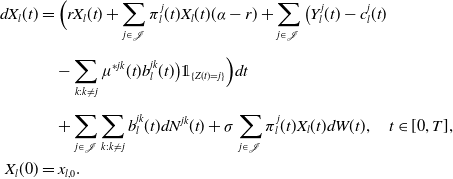 \begin{align} d X_l(t)&=\Big(rX_l(t)+\sum_{j\in \mathcal{J}}\pi^{j}_l(t)X_l(t)(\alpha-r)+\sum_{j\in \mathcal{J}}\big(Y^j_l(t)-c^j_l(t) \nonumber \\[5pt] &\quad -\sum_{k:k\neq j} \mu^{*jk}(t) b^{jk}_l(t) \big) \unicode{x1D7D9}_{\{Z(t)=j\}}\Big)dt \nonumber \\[5pt] & \quad + \sum_{j\in \mathcal{J}}\sum_{k:k\neq j}b^{jk}_l(t)dN^{jk}(t)+ \sigma \sum_{j\in \mathcal{J}}\pi^{j}_l(t)X_l(t)dW(t), \quad t\in[0,T], \\ X_l(0)&=x_{l,0}. \nonumber \end{align}
We look at the dynamics dX in (1) to confirm this to be equal to
 $d(\sum_l X_l)$
. We consider (5) and sum over all the subproblems
 \begin{align*} \sum_{l\in \mathcal{J}}d X_l(t)&=\sum_{l\in \mathcal{J}}\Big(rX_l(t)+\sum_{j\in \mathcal{J}}\pi^{j}_l(t)X_l(t)(\alpha-r)+\sum_{j\in \mathcal{J}}\big(Y^j_l(t)-c^j_l(t) \nonumber \\[5pt] &\quad -\sum_{k:k\neq j} \mu^{*jk}(t) b^{jk}_l(t) \big)\unicode{x1D7D9}_{\{Z(t)=j\}}\Big)dt \nonumber \\[5pt] &\quad +\sum_{l\in \mathcal{J}} \Big(\sum_{j\in \mathcal{J}}\sum_{k:k\neq j}b^{jk}_l(t)dN^{jk}(t)+ \sigma \sum_{j\in \mathcal{J}}\pi^{j}_l(t)X_l(t)dW(t)\Big), \quad t\in[0,T], \\[5pt] \sum_{l\in \mathcal{J}}X_l(0)&=\sum_{l\in \mathcal{J}}x_{l,0}. \nonumber\end{align*}
Inserting the above-explained notation and moving the sum over the subproblems l to the affected parts, we get
 \begin{align*} d\sum_{l\in \mathcal{J}} X_l(t)&=\Big(r\sum_{l\in \mathcal{J}}X_l(t)+\sum_{j\in \mathcal{J}}\sum_{l\in \mathcal{J}}\pi^{j}_l(t)X_l(t)(\alpha-r)+\sum_{j\in \mathcal{J}}\big(\sum_{l\in \mathcal{J}}Y^j_l(t)-\sum_{l\in \mathcal{J}}c^j_l(t) \nonumber \\[5pt] &\quad -\sum_{k:k\neq j} \mu^{*jk}(t) \sum_{l\in \mathcal{J}}b^{jk}_l(t) \big)\Big)dt \nonumber \\[5pt] &\quad +\sum_{j\in \mathcal{J}}\sum_{k:k\neq j}\sum_{l\in \mathcal{J}}b^{jk}_l(t)dN^{jk}(t)+ \sigma\sum_{j\in \mathcal{J}}\sum_{l\in \mathcal{J}} \pi^{j}_l(t)X_l(t)dW(t), \quad t\in[0,T], \\[5pt] \sum_{l\in \mathcal{J}}X_l(0)&=\sum_{l\in \mathcal{J}}x_{l,0}. \nonumber\end{align*}
Now, if we notice
 $\sum_l \pi^j_lX_l= \pi^jX$
,
 $\sum_l Y^j_l = Y^j$
,
 $\sum_l c^j_l = c^j$
, and
 $\sum_l b^{jk}_l=b^{jk}$
, we recognize this as (1) and, thereby,
 $dX(t)=\sum_l dX_l(t).$
When we condition on
 $X(t)=x$
and
 $X_k(t)=x_k$
, and we know that
 $X=\sum_{k\in \mathcal{J}} X_k$
, we are in the subspace where
 $x=\sum_{k\in \mathcal{J}}x_k$
. This relation between x and
 $x_k, k\in \mathcal{J}$
is used frequently from now.
The subproblem corresponding to measuring utility from consumption in state
 $k\in \mathcal{J}$
becomes
 \begin{equation} \sup_{c^k, \pi^k, b^{jk}} E \Bigg[ \int_0^T u^k(t,c^k(t)) \unicode{x1D7D9}_{\{Z(t)=k\}}dt\Bigg].\end{equation}
This draws on our specific decomposition since
 $c^k$
is not only the total consumption rate spent in state k. It is even equal to the consumption rate subtracted from the wealth belonging to subproblem k as the consumption from all other subproblems is zero. Each subproblem isolates a single risk aversion and, therefore, with reference to Kraft and Steffensen [Reference Kraft and Steffensen2008b], a subproblem value function candidate is
 \begin{equation} U^j_k(t,x_k)=\frac{1}{1-\gamma_k}f^{j}_k(t)^{\gamma_k}(x_k+a^j_k(t))^{1-\gamma_k}.\end{equation}
Note again here how all subscripts refer to the subproblem where utility is measured and all topscripts refer to the possible states of Z at time t.
The candidate function of the original problem is now formed by aggregation of the candidate functions of the subproblems, that is,
 \begin{align*} U^j(t,x)= \sum_{k \in \mathcal{J}}U^j_k(t,x_k),\end{align*}
along with the relation between the arguments mentioned above,
 $x=\sum_{k\in\mathcal{J}}x_k$
.
The decomposition into subproblems and an initial wealth allocation follows the fundamental idea by Lakner and Nygren [Reference Lakner and Nygren2006]. Lakner and Nygren [Reference Lakner and Nygren2006] work with such a separation idea under a general utility function. We consider only the case of the power utility, see (2), and we choose the decomposition into subproblems such that each subproblem measures the utility from a specific constant relative risk aversion. That makes the candidate value function for each subproblem further separable in the time and wealth.
We show that the fundamental idea of allocating to subproblems works well together with state-varying relative risk aversion. Based on the general utility function approach by Lakner and Nygren [Reference Lakner and Nygren2006], there is all reason to believe that the decomposition into subproblems works well beyond that case. However, the separability of the subproblem value function candidates in time and wealth cannot be expected to work outside our case of state-varying relative risk aversion. This separability allows, for example, a simple explicit calculation of the distribution of initial capital to subproblems, see below. Applications of the decomposition idea beyond the power utility case are beyond the scope of this paper.
The initial wealth allocated to each subproblem is determined through the marginal indirect utility
 $\frac{\partial}{\partial x_k}U^{j}_k(t,x_k)$
. Following Lakner and Nygren [Reference Lakner and Nygren2006], we want the marginal indirect utility from the different subproblems to coincide such that the individual does not gain further from moving wealth from one subproblem to another. This is a condition on the allocations
 $x_k, k\in \mathcal{J}$
. Further, we want the marginal indirect utility to be independent of the state of Z. Thus, we require from the allocation of wealth that there exists a function
 $\psi$
such that
 \begin{equation} \psi(t,x)=\frac{\partial }{{\partial x_k}}U^{j}_k(t,x_k), \qquad \text{for all } k\in\mathcal{J}.\end{equation}
When noting that the left side depends on only wealth and time, the marginal wealth allocation on the right side must be linked to each other and the wealth through the relation
 $x=\sum_{k\in\mathcal{J}}x_k$
. When taking the derivative with respect to
 $x_k$
, we mean the derivative with respect to the second coordinate of the value function
 $U^j_k$
. Thus, a more direct way to write our assumption (8) is
 \begin{equation} \psi\!\left(t,\sum_{k\in\mathcal{J}}x_k\right)=\frac{\partial }{{\partial x_1}}U^{j}_1(t,x_1)=\frac{\partial }{{\partial x_2}}U^{j}_2(t,x_2)=...=\frac{\partial }{{\partial x_J} }U^{j}_J(t,x_J).\end{equation}
We cannot stress hard enough that, whenever the total wealth realization x is specified below, we always require implicitly that this wealth is allocated optimally such that
 $x=\sum_{k\in\mathcal{J}}x_k$
and such that (9) holds.
The function
 $\psi(t,x)$
representing the marginal indirect utility is the partial derivative of the subproblem’s value function candidate. Thus, it is just an ingredient in our guess on a value function. Only later when we have verified that our candidate solves the HJB equation we know that the allocation of wealth into subproblems is correct. By the notation and assumption introduced above, we can combine (7) and (8) to reach the following relation,
 \begin{equation} x_k=f^{j}_k(t)\psi(t,x)^{-\frac{1}{\gamma_k}}-a^j_k(t).\end{equation}
By plugging this back into the value function, we can write the marginal value functions in terms of the marginal indirect utility as
 \begin{equation} U^{j}_k(t,x_k)=\frac{1}{1-\gamma_k}f^{j}_k(t)\psi(t,x)^{\frac{\gamma_k-1}{\gamma_k}}.\end{equation}
The marginal indirect utility must be determined implicitly as the solution to
 \begin{equation} x=\sum_{k\in\mathcal{J}}x_k =\sum_{k\in\mathcal{J}}\left(f^{j}_k(t)\psi(t,x)^{-\frac{1}{\gamma_k}}-a^j_k(t)\right).\end{equation}
For numerical illustrations, this implicit equation must be solved numerically.
The combination of (11) and (12) forms our candidate value function. This is based on exactly the same idea as the one Lakner and Nygren [Reference Lakner and Nygren2006] and Steffensen [Reference Steffensen2011] use to form a candidate for the value function. But the application of the idea is here clearly much more advanced, and the notation, motivation, and description are correspondingly more involved. We have now established a candidate. In the next section, we verify that our candidate truly solves the HJB equation.
4. Verification
Now we are going to verify our candidate solution indeed solves the HJB equation. By inserting (11) in (3), our implicit candidate function can be presented as
 \begin{align} U^{j}(t,x)=\sum_{k \in \mathcal{J}} \frac{1}{1-\gamma_k}f^{j}_k(t)\psi(t,x)^{\frac{\gamma_k-1}{\gamma_k}}, \end{align}
 \begin{align} x = \sum_{k \in \mathcal{J}}\left( f^{j}_k(t)\psi(t,x)^{-\frac{1}{\gamma_k}}-a^j_k(t)\right). \end{align}
To ease the next computations, we introduce the auxiliary function
 \begin{align*}h^{j}(t,x)=\sum_{k \in \mathcal{J}} \frac{1}{\gamma_k}f^{j}_k(t)\psi(t,x)^{-\frac{1}{\gamma_k}}.\end{align*}
4.1. Partial derivatives
The first step to verifying our candidate value function is to find the partial derivatives. Deriving (13) with respect to time t gives
 \begin{align} \frac{\partial}{\partial t}U^j(t,x)&=\sum_{k \in \mathcal{J}}\left( \frac{1}{1-\gamma_k} \psi(t,x)^{\frac{\gamma_k-1}{\gamma_k}}\frac{d}{dt}f^{j}_k(t)-\frac{1}{\gamma_k}f^{j}_k(t)\psi(t,x)^{-\frac{1}{\gamma_k}}\frac{\partial}{\partial t}\psi(t,x)\right), \nonumber\\[5pt] &=\sum_{k \in \mathcal{J}} \left( \frac{1}{1-\gamma_k}\psi(t,x)^{\frac{\gamma_k-1}{\gamma_k}}\frac{d}{dt}f^{j}_k(t)\right)-h^j(t,x)\frac{\partial}{\partial t}\psi(t,x) .\end{align}
The partial derivative
 $\dfrac{\partial}{\partial t}\psi(t,x)$
is found by differentiating with respect to time t on both sides of the relation (14)
 \begin{align*} &0=\sum_{k\in \mathcal{J}} \left( \psi(t,x)^{-\frac{1}{\gamma_k}}\frac{d}{dt}f^{j}_k(t)-\frac{d}{dt}a^j_k(t)\right)-\frac{h^j(t,x)\frac{\partial}{\partial t}\psi(t,x)}{\psi(t,x)}, \\[5pt] &\Leftrightarrow \frac{\partial}{\partial t}\psi(t,x)=\frac{\sum_{k\in \mathcal{J}} \left( \psi(t,x)^{\frac{\gamma_k-1}{\gamma_k}}\frac{d}{dt}f^{j}_k(t)-\psi(t,x)\frac{d}{dt}a^j_k(t)\right)}{h^j(t,x)}.\end{align*}
Inserting this in (15) equals
 \begin{equation} \frac{\partial}{ \partial t}U^j(t,x)=\sum_{k \in \mathcal{J}} \left( \frac{\gamma_k}{1-\gamma_k}\psi(t,x)^{\frac{\gamma_k-1}{\gamma_k}}\frac{d}{dt}f^{j}_k(t)+\psi(t,x)\frac{d}{dt}a^j_k(t)\right).\end{equation}
For the partial derivative with respect to x, (13) we get
 \begin{align} \frac{\partial}{\partial x}U^j(t,x)&=\sum_{k\in \mathcal{J}}-\frac{1}{\gamma_k}f^{j}_k(t)\psi(t,x)^{-\frac{1}{\gamma_k}}\frac{\partial}{\partial x}\psi(t,x)=-h^j(t,x)\frac{\partial}{\partial x}\psi(t,x).\end{align}
Similarly to the above, differentiating on both sides of (14) with respect to x gives
 \begin{align*} -\frac{\psi(t,x)}{h^j(t,x)}=\frac{\partial}{\partial x}\psi(t,x).\end{align*}
Inserting this in (17) gives
 \begin{align} \frac{\partial}{\partial x}U^j(t,x)&=\psi(t,x), \end{align}
 \begin{align} \frac{\partial^2}{\partial x\partial x}U^j(t,x)&=\frac{\partial}{\partial x}\psi(t,x).\end{align}
This result gives an expression for the partial derivatives of the total value function, where the underlying condition for the wealth allocation is crucial as this was assumed to obtain (14). The partial derivative in (18) represents variation in x, where
 $x=\sum_k x_k$
, but this variation also includes a variation in the reallocation of wealth among the subproblems because
 $\sum_k x_k$
varies with x. By the inclusion of this reallocation, we obtain that (18) does not depend on j. Thus,
 $\psi$
is not only the marginal indirect utility for each subproblem k, see (8), but it also actually coincides with the total marginal indirect utility.
4.2. HJB equation
Next, to verify our candidate value function, we plug it (and its partial derivatives obtained above) into the HJB equation, such that
 \begin{align} 0=& \sum_{k \in \mathcal{J}}\left(\psi(t,x)\frac{d}{dt}a^j_k(t)+ \frac{\gamma_k}{1-\gamma_k} \psi(t,x)^{\frac{\gamma_k-1}{\gamma_k}}\frac{d}{dt}f^{j}_k(t)\right) \nonumber \\[5pt] &\begin{array}{ll} +\sup\limits_{c^j,{\pi^j},b^{jk}}\Bigg\{&\!(rx+{\pi^j} x(\alpha-r)+ \sum_{k\in \mathcal J}(Y^k(t)-c^k)\unicode{x1D7D9}_{\{k=j\}}\\[5pt] &-\sum_{k\in \mathcal{J}}\mu^{*jk}(t)b^{jk}\unicode{x1D7D9}_{\{k\neq j\}})\psi(t,x)\\[5pt] & +\dfrac{1}{2}{(\pi^j)}^2x^2\sigma^2\frac{\partial}{\partial x}\psi(t,x) + \sum_{k\in \mathcal{J}}u^k(t,c^k)\unicode{x1D7D9}_{\{k=j\}}\\[5pt] & +\sum_{k\in \mathcal{J}} \mu^{jk}(t)\unicode{x1D7D9}_{\{k\neq j\}}\Big( U^k(t,x+b^{jk})-U^j(t,x)\Big) \Bigg\},\end{array} \nonumber \\[5pt] 0=& U^j(T,x).\end{align}
The optimal controls are found as the controls that attain the supremum, that is,
 \begin{align} \mathop{\textrm{arg\,sup}}_{c^j,{\pi^j},b^{jk}}&\Bigg\{ (rx+{\pi^j} x(\alpha-r)+ \sum_{k\in \mathcal J}(Y^k(t)-c^k)\unicode{x1D7D9}_{\{k=j\}} -\sum_{k\in \mathcal{J}}\mu^{*jk}(t)b^{jk}\unicode{x1D7D9}_{\{k\neq j\}})\psi(t,x)\nonumber\\[5pt] & +\frac{1}{2}{(\pi^j)}^2x^2\sigma^2\frac{\partial}{\partial x}\psi(t,x) + \sum_{k\in \mathcal{J}}u^k(t,c^k)\unicode{x1D7D9}_{\{k=j\}} \nonumber \\[5pt] & +\sum_{k\in \mathcal{J}} \mu^{jk}(t)\unicode{x1D7D9}_{\{k\neq j\}}\Big( U^k(t,x+b^{jk})-U^j(t,x)\Big)\Bigg\} .\end{align}
Before solving the equation, we need to investigate and elaborate on some parts. First, we reconsider the allocation of the insurance benefit into subproblems. As discussed in Section 3, we restrict ourselves to allocating benefits received upon transition into state k,
 $b^{jk}$
, to the wealth of the kth subproblem. This means that this lump sum affects subproblem k only. Looking at the value function
 $U^k(t,x)$
, we can write it as (13) with the allocated wealth to each subproblem and include the benefit in the kth subproblem,
 \begin{align} U^k(t,x+b^{*jk})=U^k_k(t,x_k+b^{*jk})+\sum_{l:l\neq k}U^k_l(t,x_l).\end{align}
We remind the reader that this allocation of insurance lump sum payments is a choice we make. One could take a different distribution and, most importantly, a different allocation of initial wealth. However, as mentioned earlier we just need to point at one decomposition and the related optimal solution, not all decompositions. The allocation of the state k-insurance benefits to the state-k subproblem is mathematically elegant since it relieves us from carrying around with the cumbersome notation
 $b_l^{jk}$
(since it is zero for
 $l \neq k$
) and the insurance lump sum
 $b^{jk}$
then only appears in a single subproblem value function. Further, we investigate (21) in order to find an expression for the optimal controls. Deriving wrt. the insurance benefit in order to find optimal control
 $b^{*jk}$
and using the chosen allocation as described in (22), we have the first-order condition
 \begin{align} \mu^{jk}(t)\unicode{x1D7D9}_{\{k\neq j\}}\frac{\partial}{{\partial x_k}}U^k_k(t,x_k+b^{jk})-\mu^{*jk}(t)\unicode{x1D7D9}_{\{k\neq j\}}\psi(t,x)=0.\end{align}
The first part could also be seen as
 $\mu^{jk}(t)\psi(t,x+b^{jk})$
since by (8) the marginal indirect utility is
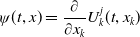 $\psi(t,x)=\dfrac{\partial}{{\partial x_k}}U^j_k(t,x_k)$
for all
 $k\in \mathcal{J}$
. This allocation of the lump sum payment is a choice as previously described, and the above calculation reflects the decision to allocate
 $b^{jk}$
fully to subproblem k. We insert the value function from (7) and derive it with respect to the second parameter
 \begin{align*} \frac{\partial}{{\partial x_k}}U^k_k(t,x_k+b^{jk})&=f^{k}_k(t)^{\gamma_k}(x_k + a^k_k(t)+b^{jk})^{-\gamma_k}.\end{align*}
Altogether the above calculations result in
 \begin{align*} b^{*jk}(t,x)=\left(\frac{\mu^{*jk}(t)}{\mu^{jk}(t)}\right)^{-\frac{1}{\gamma_k}}\psi(t,x)^{-\frac{1}{\gamma_k}}f^{k}_k(t)-(x_k+a^k_k(t)), \qquad \text{ for all } k\neq j.\end{align*}
Remember
 $x_k=x-\sum_{l:l\neq k}x_l$
, we present the optimal controls in (21) in the following way for all
 $j\in \mathcal{J}$
 \begin{align*} c^{*j}(t,x)&=g^j(t)\psi(t,x)^{-\frac{1}{\gamma_j}}. \\[5pt] {\pi^{*j}}(t,x)&=-\dfrac{\alpha-r}{\sigma^2}\dfrac{\psi(t,x)}{x\dfrac{\partial}{\partial x}\psi(t,x)}. \\[5pt] b^{*jk}(t,x)&=\left( \dfrac{\mu^{*jk}(t)}{\mu^{jk}(t)}\right)^{-\frac{1}{\gamma_k}}\psi(t,x)^{-\frac{1}{\gamma_k}}f^{k}_k(t)-(x+a^k_k(t)-\sum_{l:l\neq k}x_l), &\text{for all } k\neq j. \end{align*}
The results for
 $c^j$
and
 ${\pi^j}$
are obtained in a similar way as the optimal insurance payment, and these calculations are standard for consumption–investment problems.
To make sure we have an optimum, we take the second derivative of the inner part of (21) with respect to the controls. The derivation for c and
 $\pi$
are standard, but for the insurance sum we find, by differentiating the left-hand side of (23) and plugging in the candidate control,
 \begin{align*} &\frac{\partial}{\partial b^{jk}} \left( \mu^{jk}(t)\unicode{x1D7D9}_{\{k\neq j\}}\frac{\partial}{{\partial x_k}}U^k_k(t,x_k+b^{*jk})-\mu^{*jk}(t)\unicode{x1D7D9}_{\{k\neq j\}}\psi(t,x) \right) \\[5pt] &=\frac{\partial}{\partial b^{jk}} \Big ( \mu^{jk}(t)\unicode{x1D7D9}_{\{k\neq j\}} f^k_k(t)^{\gamma_k}(x_k+b^{*jk}+a^k_k(t))^{-\gamma_k}-\mu^{*jk}(t)\unicode{x1D7D9}_{\{k\neq j\}}\psi(t,x) \Big) \\[5pt] &= -\gamma_k \mu^{jk}(t)\unicode{x1D7D9}_{\{k\neq j\}} f^k_k(t)^{\gamma_k} (x_k+b^{*jk}+a^k_k(t))^{-\gamma_k-1} <0.\end{align*}
With a negative second derivate, we have an optimum. Later in this section, we elaborate on the optimal control strategies without the marginal indirect utility function
 $\psi(t,x)$
, since it is for intermediate calculations mainly. This means the final results do not depend on
 $\psi(t,x)$
but until our candidate value function is verified as the optimal value function we continue with
 $\psi(t,x)$
present. With the optimal controls defined we are almost ready to solve the HJB equation, but before, we need to rewrite the last term from (20). Therefore, with the design in (22), we first see
 \begin{align*} &\sum_{k \in \mathcal{J}} \mu^{jk}(t)\unicode{x1D7D9}_{\{k \neq j\}}\left( U^{k}\big(t,x+b^{jk}\big)-U^j(t,x)\right)\nonumber \\[5pt] &=\sum_{k \in \mathcal{J}} \mu^{jk}(t)\unicode{x1D7D9}_{\{k \neq j\}} \left( U^k_k(t,x_k+b^{jk})+\sum_{l \in \mathcal{J}}U^k_l(t,x_l)\unicode{x1D7D9}_{\{l \neq k\}} - \sum_{l \in \mathcal{J}} U^j_l(t,x_l) \right).\end{align*}
If we gather the last two terms and, on these terms, interchange the order of summation, we get
 \begin{align} &\sum_{k \in \mathcal{J}} \mu^{jk}(t)\unicode{x1D7D9}_{\{k \neq j\}} \left( U^k_k(t,x_k+b^{jk})+\sum_{l \in \mathcal{J}}U^k_l(t,x_l)\unicode{x1D7D9}_{\{l \neq k\}} - \sum_{l \in \mathcal{J}} U^j_l(t,x_l) \right)\nonumber \\[5pt] &= \sum_{k \in \mathcal{J}} \mu^{jk}(t)\unicode{x1D7D9}_{\{k \neq j\}} U^k_k(t,x_k+b^{jk})\nonumber \\[5pt] &\quad +\sum_{k \in \mathcal{J}}\sum_{l \in \mathcal{J}} \mu^{jk}(t)\unicode{x1D7D9}_{\{k \neq j\}} \left(U^k_l(t,x_l)\unicode{x1D7D9}_{\{l \neq k\}} - U^j_l(t,x_l) \right)\nonumber \\[5pt] &= \sum_{k \in \mathcal{J}} \mu^{jk}(t)\unicode{x1D7D9}_{\{k \neq j\}} U^k_k(t,x_k+b^{jk}) \nonumber \\[5pt] &\quad +\sum_{k \in \mathcal{J}}\sum_{l \in \mathcal{J}} \mu^{jl}(t)\unicode{x1D7D9}_{\{l \neq j\}} \left(U^l_k(t,x_k)\unicode{x1D7D9}_{\{k \neq l\}} - U^j_k(t,x_k) \right)\nonumber \\[5pt] &= \sum_{k \in \mathcal{J}} \mu^{jk}(t)\unicode{x1D7D9}_{\{k \neq j\}} U^k_k(t,x_k+b^{jk}) \nonumber \\ &\quad +\sum_{k\in \mathcal{J}}\sum_{l \in \mathcal{J}} \mu^{jl}(t) \unicode{x1D7D9}_{\{l\neq j\}}\Big( \frac{1}{1-\gamma_k} f^l_k(t) \psi(t,x)^{\frac{\gamma_k-1}{\gamma_k}}\unicode{x1D7D9}_{\{k\neq l\}} - \frac{1}{1-\gamma_k} f^j_k(t) \psi(t,x)^{\frac{\gamma_k-1}{\gamma_k}}\Big). \end{align}
This way of rewriting is possible because the lump sum
 $b^{jk}$
is fully allocated to the kth subproblem. Now everything is prepared to solve the HJB equation. We insert the expression (24) and the optimal controls into the HJB equation to get
 \begin{align} 0&=\sum_{k \in \mathcal{J}} \left( \frac{\gamma_k}{1-\gamma_k}\psi(t,x)^{\frac{\gamma_k-1}{\gamma_k}}\frac{d}{dt}f^{j}_k(t)+\psi(t,x)\frac{d}{dt}a^j_k(t)\right) \nonumber\\[5pt] &\quad +rx\psi(t,x)-\frac{1}{2}\frac{(\alpha-r)^2}{\sigma^2} \frac{\psi(t,x)^2}{\frac{\partial}{\partial x}\psi(t,x)}+\sum_{k\in \mathcal{J}}Y^k(t)\psi(t,x)\unicode{x1D7D9}_{\{k=j\}} \nonumber\\[5pt] &\quad+\sum_{k\in \mathcal{J}} \frac{\gamma_k}{1-\gamma_k}g^k(t)\psi(t,x)^{\frac{\gamma_k-1}{\gamma_k}}\unicode{x1D7D9}_{\{k=j\}} \nonumber \\[5pt] &\quad-\sum_{k\in \mathcal{J}}\mu^{*jk}(t)^{\frac{\gamma_k}{1-\gamma_k}}\mu^{jk}(t)^{\frac{1}{\gamma_k}}f^{k}_k(t)\psi(t,x)^{\frac{\gamma_k-1}{\gamma_k}}\unicode{x1D7D9}_{\{k\neq j\}} \nonumber\\[5pt] &\quad+ \sum_{k \in \mathcal{J}}\mu^{*jk}(t)\unicode{x1D7D9}_{\{k\neq j\}}(x+a^k_k(t)-\sum_{l:l\neq k}x_l)\psi(t,x)\nonumber \\[5pt] &\quad+\sum_{k\in \mathcal{J}}\frac{1}{1-\gamma_k}\mu^{*jk}(t)^{\frac{\gamma_k}{1-\gamma_k}}\mu^{jk}(t)^{\frac{1}{\gamma_k}}f^{k}_k(t)\psi(t,x)^{\frac{\gamma_k-1}{\gamma_k}}\unicode{x1D7D9}_{\{k\neq j\}} \nonumber\\[5pt] &\quad+ \sum_{k\in \mathcal{J}} \sum_{l \in \mathcal{J}} \mu^{jl}(t) \unicode{x1D7D9}_{\{l\neq j\}} \Big(\frac{1}{1-\gamma_k} f^l_k(t) \psi(t,x)^{\frac{\gamma_k-1}{\gamma_k}}\unicode{x1D7D9}_{\{k\neq l\}} - \frac{1}{1-\gamma_k} f^j_k(t) \psi(t,x)^{\frac{\gamma_k-1}{\gamma_k}}\Big), \nonumber \\[5pt] 0&=U^j(T,x).\end{align}
The solution to the Equation (25) can be expressed as the solution to the following equations:
 \begin{align*} \frac{d}{dt}f^j_i(t)&=\tilde r^{j}_i(t)f^j_i(t) -\sum_{l:l\neq j}\tilde \mu^{jl}_i(t)\left(f^l_i(t)-f^j_i(t)\right)-g^i(t)\unicode{x1D7D9}_{\{i=j\}}, \\[5pt] f^j_i(T)&=0.\end{align*}
With
 $\tilde\mu^{jl}_i$
and
 $\tilde r^{j}_i$
defined as
 \begin{align*} \tilde \mu^{jl}_i(t)=& \mu^{*jl}(t)^{\frac{\gamma_i-1}{\gamma_i}}\mu^{jl}(t)^{\frac{1}{\gamma_i}}\unicode{x1D7D9}_{\{l=i\}} + \frac{1}{\gamma_i}\left((\gamma_i-1)\mu^{*jl}(t)+\mu^{jl}(t)\right)\unicode{x1D7D9}_{\{l\neq i\}},\\[5pt] \tilde r^{j}_i(t)=&\frac{\gamma_i-1}{\gamma_i}\left(r+\sum_{l:l\neq j } \mu^{*jl}(t)\right) + \sum_{l:l\neq j}\mu^{jl}(t)\frac{1}{\gamma_i}-\sum_{l\in \mathcal{J}}\tilde \mu^{jl}_i(t)+ \left(\frac{\alpha-r}{\sigma}\right)^2\frac{\gamma_i-1}{2\gamma_i^2}.\end{align*}
The derivation is presented in Appendix A. Note here that the indicator function elegantly indicates that the utility weight of state i appears only in the subproblem i and only in (the differential equation for) the state-wise f corresponding to exactly that same state i. Also, note the interpretation of
 $\tilde \mu$
and
 $\tilde r$
. The intensities
 $\tilde \mu$
are formed as sums of a geometric and an arithmetic means of the two intensities
 $\mu$
and
 $\mu^*$
. The geometric mean is taken with respect to the transition into the state to which the subproblem belongs. The arithmetic mean is taken with respect to all other transitions. The artificial interest rate
 $\tilde r$
contains elements from the financial market plus the impact of the multistate model. The impact from the multistate model is a difference between the arithmetic and the geometric means of the exit intensities
 $\mu^{j\cdot}$
and
 $\mu^{*j\cdot}$
. The system of differential equations for the human capital a becomes
 \begin{align*} \frac{d}{dt}a^j_i(t)&=ra^j_i(t)-\sum_{l:l\neq j } \mu^{*jl}(t)\left(a^l_i(t)-a^j_i(t)\right)-Y^i(t)\unicode{x1D7D9}_{\{i=j\}}, \\[5pt] a^j_i(T)&=0.\end{align*}
Again, note the indicator function elegantly indicates the income in state i appears only in the subproblem i and only in (the differential equation for) the state-wise human capital corresponding to exactly that same state i. This follows from the convention that all income in a particular state is earned for the subproblem of that state exclusively. This concludes our verification. Since these systems of differential equations for both f and a are linear, they have unique solutions and we have, thus, found a solution to the HJB. This means the value function candidate consisting of (13) and (14) is indeed the optimal value function and we write
 \begin{align*} U^j(t,x)=V^j(t,x) &= \sum_{k \in \mathcal{J}} \frac{1}{1-\gamma_k} f^j_k(t)^{\gamma_k}(x_k + a^j_k(t))^{1-\gamma_k}, \\[5pt] x&= \sum_{k \in \mathcal{J}} x_k.\end{align*}
Furthermore, the optimal controls formulated in (21) can as previously mentioned be written without the function
 $\psi$
. First, turning to the optimal investment strategy from (17), we find
 \begin{align*} {\pi^{*j}}(t,x)= - \frac{(\alpha-r)}{\sigma^2} \frac{\psi(t,x)}{x \frac{\partial }{\partial x}\psi(t,x)} = \frac{\alpha-r}{\sigma^2} \frac{h^j(t,x)}{x}.\end{align*}
By the definition of
 $h^j(t,x)=\sum_{k\in \mathcal{J}}\frac{1}{\gamma_k} f^j_k(t)\psi(t,x)^{-\frac{1}{\gamma_k}}$
and by using the definition of
 $\psi(t,x)$
from (8) for all
 $j\in \mathcal{J}$
, we get
 \begin{align*} {\pi^{*j}}(t,x) &= \frac{\alpha-r}{\sigma^2} \frac{\sum_{k\in \mathcal{J}} \frac{1}{\gamma_k} (x_k + a^j_k(t))}{x}.\end{align*}
Second, for all
 $j\in \mathcal{J}$
, the optimal consumption strategy in state j is by (8) given as
 \begin{align*} c^{*j}(t,x)=g^j(t)\psi(t,x)^{-\frac{1}{\gamma_j}}=\frac{g^j(t)}{f^j_j(t)}(x_j+a^j_j(t)).\end{align*}
Third, for the optimal insurance benefit, we look at a transition from the state j to the state k, for all possible states
 $k\neq j$
where the insured can jump to have
 \begin{align*} b^{*jk}(t,x)=\left( \frac{\mu^{*jk}(t)}{\mu^{jk}(t)} \right)^{-\frac{1}{\gamma_k}} \psi(t,x)^{-\frac{1}{\gamma_k}}f^k_k(t)-(x_k+a^k_k(t)).\end{align*}
Again by (8) for all
 $k \neq j \in \mathcal{J}$
, we have
 \begin{align*} b^{*jk}(t,x) &=\left( \frac{\mu^{*jk}(t)}{\mu^{jk}(t)} \right)^{-\frac{1}{\gamma_k}} \frac{f^k_k(t)}{f^j_k(t)}(x_k+a^j_k(t))-(x_k+a^k_k(t)).\end{align*}
For each subproblem, the system of functions (a, f) relates to the solution found by Kraft and Steffensen [Reference Kraft and Steffensen2008b] as we discuss in the following section. However, solving this system for each subproblem is in our case followed by an initial allocation of capital to the different subproblems, and through that part relating the
 $x_k, k\in \mathcal{J}$
, to each other, also these subproblems become entangled. General analytical results about how the state variation of risk aversion impacts the controls are left for future work, but a concrete example where the impact can be illustrated and intuitively explained is presented in Section 5.
4.3. Comparison
We finalize this section on the verification by comparing the system of differential equations for f and a with those obtained by Kraft and Steffensen [Reference Kraft and Steffensen2008b] and further specified in Kraft and Steffensen [Reference Kraft and Steffensen2008a]. They also have functions f and a like ours, but things are simpler since the risk aversion
 $\gamma$
does not depend on the state. If we let
 $\gamma$
be constant the double notation becomes redundant, and we are back with one single value function in the form
 \begin{align*} V^j(t,x)=\frac{1}{1-\gamma}f^j(t)^{\gamma}(x+a^j(t))^{1-\gamma}.\end{align*}
In that case, we do not have to divide the problem into subproblems corresponding to insurance, income, and consumption for every single state. Then we can perform all the calculations above once and reach a single system of differential equations for f and a single system of differential equations for a. They become
 \begin{align*}\begin{array}{l@{\quad}l} \dfrac{d}{dt}f^j(t)=\tilde r^{j}(t)f^j(t) -\sum\limits_{l:l\neq j}\tilde \mu^{jl}(t)\left(f^l(t)-f^j(t)\right)-g^j(t), & f^j(T)=0, \\[10pt] \dfrac{d}{dt}a^j(t)=ra^j(t)-\sum\limits_{l:l\neq j } \mu^{*jl}(t)\left(a^l(t)-a^j(t)\right)-Y^j(t), & a^j(T)=0{,}\end{array}\end{align*}
with
 \begin{align*} \tilde \mu^{jl}(t)=& \mu^{*jl}(t)^{\frac{\gamma-1}{\gamma}}\mu^{jl}(t)^{\frac{1}{\gamma}},\\[5pt] \tilde r^{j}(t)=&\frac{\gamma-1}{\gamma}\left(r+\sum_{l:l\neq j } \mu^{*jl}(t)\right) + \sum_{l:l\neq j}\mu^{jl}(t)\frac{1}{\gamma}-\sum_{l\in \mathcal{J}}\tilde \mu^{jl}(t)+(\frac{\alpha-r}{\sigma})^2\frac{\gamma-1}{2\gamma^2} .\end{align*}
This is the same system as the one obtained in Kraft and Steffensen [Reference Kraft and Steffensen2008b]. We note as it was done both there and in Kraft and Steffensen [Reference Kraft and Steffensen2008a] that we can write f and a as certain conditional expected present values. The function f is the value of future utility weights under a measure with intensities
 $\tilde \mu$
and state-dependent interest rates
 $\tilde r$
, and the function a is the financial value of future income, that is
 \begin{align*} f^j(t)&=\tilde{E}_{x,j}\left[ \int_t^{n} e^{-\int_t^s \tilde r(u)du}d\Upsilon(s)\right], \\[5pt] a^j(t)&=E^*_{t,j}\left[ \int_t^{n} e^{-r(t-s)}dA(s)\right].\end{align*}
Here,
 $\Upsilon$
is the process of accumulated utility weights and A(t) is the process of accumulated income. Like in the general case, we note the interpretation of the artificial parameters
 $\tilde \mu$
and
 $\tilde r$
. The intensity
 $\tilde \mu$
is now a simple geometric mean of
 $\mu$
and
 $\mu^*$
. The part with the arithmetic mean from the general case has vanished because one never jumps to a state which is part of a different subproblem. Namely, there is only one single problem, and all jumps relate to entrance into that single problem. Further, the artificial interest rate
 $\tilde r$
is again the combination of the (usual) market terms and then the multistate market impact which is, simply, the difference between the arithmetic and the geometric means of exit transition intensities. We mention here that this interpretation of the artificial assumptions underlying f in terms of geometric and arithmetic means is mentioned by neither Kraft and Steffensen [Reference Kraft and Steffensen2008b] nor Kraft and Steffensen [Reference Kraft and Steffensen2008a]. Apart from giving insight, it also helps in the implementation phase.
5. Numerical example
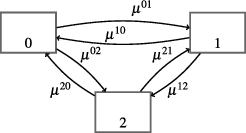
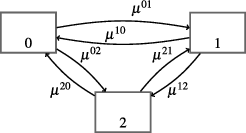
In this section, we illustrate with a numerical example the scope of our setup with state-dependent risk aversion. We illustrate the expected development over time of the wealth process and the consumption process for an individual who controls consumption, investment, and disability insurance before and after retirement. The numerical illustrations are based on the three-state model as illustrated in Appendix B: 4, interpreted as state 0: Active; state 1: Disabled; and state 2: Dead. We assume that
 $\mu^{10}=0$
which together with the obvious
 $\mu^{21}=\mu^{20}=0$
leads to closed form solutions. The life insurance scheme consists of a disability sum of
 $b^{01}$
, paid out upon transitioning to the disabled state 1 and then added to the wealth allocated to consumption during the disability. During disability, the individual receives no labour income, and the disability sum serves as insurance to cover the maintenance of the desired level of consumption. There is no life insurance present which is optimal since we assume that there is no utility from the bequest.
The disability intensity is defined as
 $\mu^{ai}(t)=\mu^{01}(t)=Ae^{(t+z)\log(B)}$
, and the nondifferential death intensity as
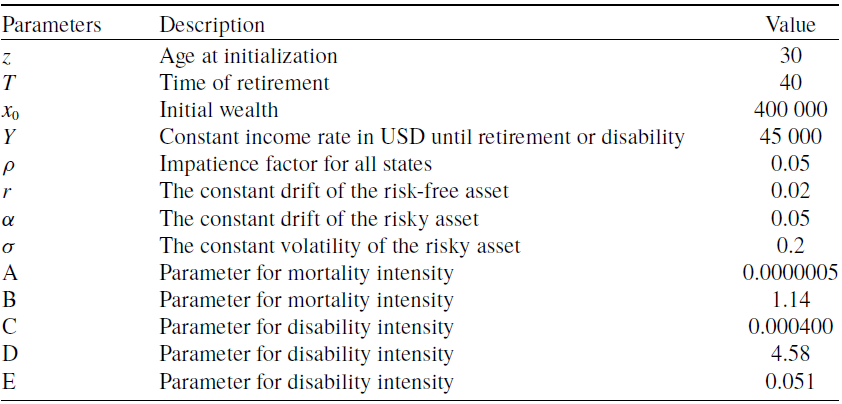
 $\mu^{ad}(t)=\mu^{id}(t)=\mu^{02}(t)=\mu^{12}(t)=C+10^{D+E(t+z)-10}$
with constants defined in Table 1. Note that we assume so-called nondifferential mortality where disability does not accelerate death. The utility functions are defined in (2), and for numerical calculations, we choose the exponential function as the time-weight function
 $g(t)=e^{-\rho t}$
, where
 $\rho$
is the utility discount factor relating the utility of payments at different points in time to each other. In all illustrations, we consider an insured at age 30 at initialization who retires at age 70. We study the wealth and consumption patterns for the two cases where the individual becomes disabled at age 50 and age 80, respectively. Normally, at least in this case of nondifferential mortality, getting disabled after retirement does not change the consumption pattern since the event does not influence the financial situation. However, here consumption changes because the risk aversion changes, and this holds even after retirement.
The parameters used in the numerical examples.
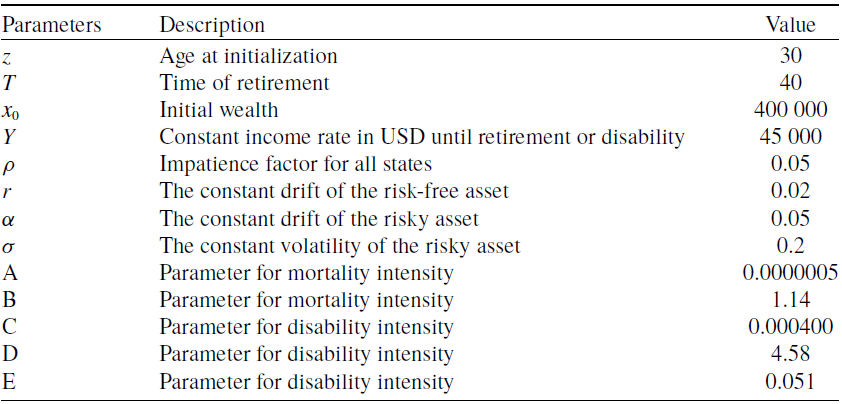
Note: r,
 $\alpha$
and
 $\sigma$
are thought of as corrected for inflation.
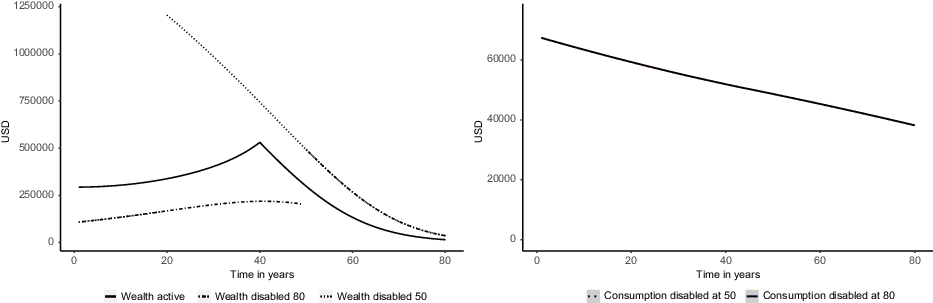
Figure 1 illustrates the benchmark case with the same risk aversion in both states, 0 and 1, namely
 $\gamma_0=\gamma_1=2$
. As in the Appendix B: 4, the wealth is allocated at initialization for two subproblems: One for consumption while active and another for consumption as disabled. The allocation is done such that the marginal indirect utility at
 $t=0$
is the same in each state. In other words, the insured does not gain further from moving wealth between the subproblems regarding the state active and the state disabled, respectively. Recall that the function
 $\psi(t,x)$
represents exactly this marginal indirect utility as
 \begin{align*} \psi(t,x)=\frac{\partial}{{\partial x_k}} V^j_k(t,x_k)=f^j_k(t)^{\gamma_k}(x_k + a^j_k(t))^{-\gamma_k}, \quad \forall k \in \mathcal{J}.\end{align*}
We denote the initial wealth by
 $x^0$
, deviating from the more usual
 $x_0$
since the latter denotes the wealth allocated to subproblem 0 at an arbitrary time point. We denote the initial allocations to the two subproblems by
 $x_0$
and
 $x_1$
such that we have the constraint
 $x^0=x_0+x_1$
. Thus, we solve the following equation for
 $x_0$
 \begin{align} f^0_0(0)^{\gamma_0}(x_0+a^0_0(0))^{-\gamma_0}=f^0_1(0)^{\gamma_1}(x^0-x_0)^{-\gamma_1},\end{align}
and define
 $x_1=x^0-x_0$
, to obtain the optimal allocation at initialization. The figures contain expected wealth where the expectation is taken over financial risk but not over state risk. Thus, the wealth dynamics are state-wise in the state dimension but not in the financial dimension. When disability occurs, the wealth allocated to consumption as active is lost but the wealth allocated to consumption as disabled, together with the disability sum paid out, takes over financing the consumption as disabled (left). Note that, from the onset of disability even after retirement, the wealth is larger for consumption as disabled than for consumption as active although the consumption rates in the two states are the same. This is because the wealth for consumption as active only finances that consumption rate until death or disability (and pays for the disability insurance) whereas the wealth for consumption as disabled finances the same consumption rate until death.
For
 $\gamma_0=\gamma_1=2$
. Left: The expected wealth allocated for the states. Right: The optimal consumption (the two curves overlap).
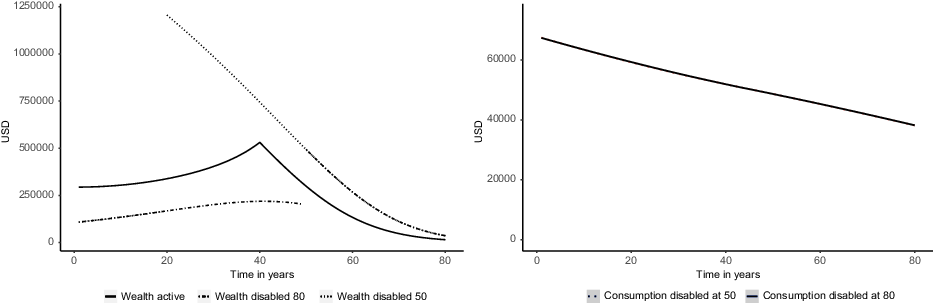
Figure 1 illustrates (right) that the consumption level is the same regardless of the state, resulting in the same consumption curve independent of the time of disability. The optimal strategies are computed in the Appendix B. The wealth allocated to consumption as disabled follows (left) the dotted and dash-dotted lines, respectively. If disability occurs at age 50, the wealth allocated to that problem jumps to the dotted line and that jump is financed by the disability sum paid out. A similar but smaller jump in the disability wealth, also paid by the disability insurance, happens at age 80 if disability occurs then. The allocated wealth at initialization is found by solving (26), resulting in at time
 $t=0$
,
 $x_0=\$ 293, 883.4 $
and
 $x_1= \$106, 116.6$
. We are now going to investigate how splitting in different risk aversion changes the figures.
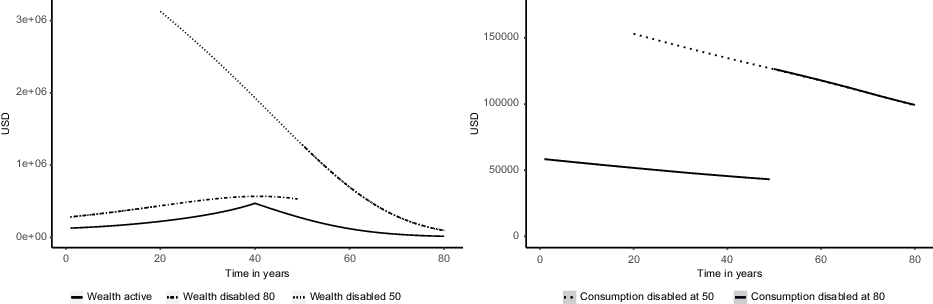
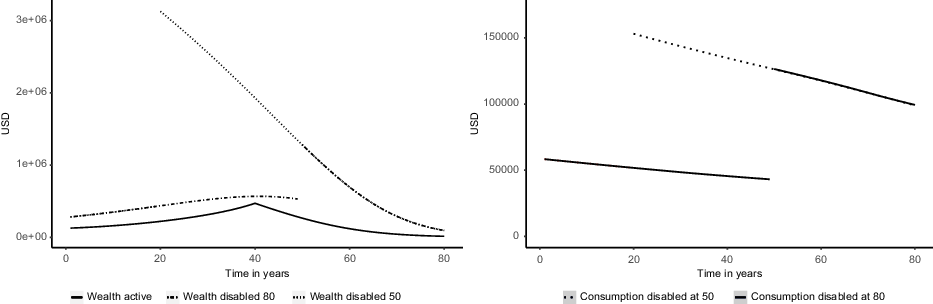
We illustrate first a higher risk aversion for the active state than the disabled state,
 $\gamma_0>\gamma_1$
, in Figure 2. The effect on the wealth allocation (left) at initialization is that a higher proportion of initial wealth is allocated to consuming as disabled than in the benchmark case, since solving (26) results in
 $x_0=\$124,643.6$
and
 $x_1=\$ 275,356.4$
. The wealth of the disabled is higher than the wealth of the active individual no matter when disability occurs.
For
 $\gamma_0=2.2$
,
 $\gamma_1=2$
. Left: The expected allocated wealth. Right: The optimal consumption.
For
 $\gamma_0=2$
,
 $\gamma_1=2.2$
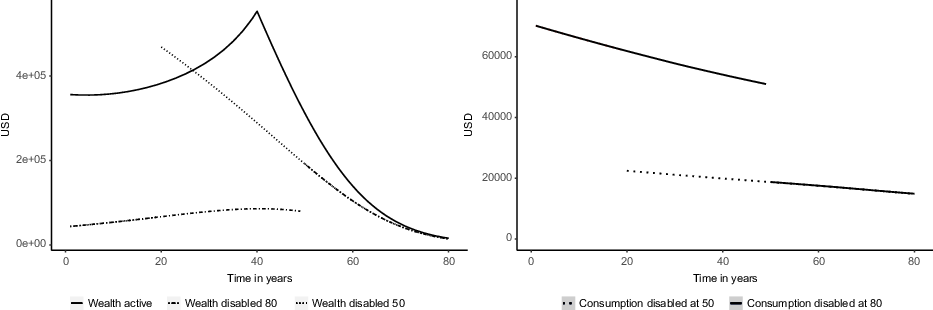
. Left: The expected allocated wealth. Right: The optimal consumption.
This conforms with the observation (right) that, upon disability, the consumption jumps upwards to a higher level but with a steeper slope downwards.
The steeper slope shows that the preference for a stable level of consumption is not as high during disability as it is while being active, due to the fall in risk aversion. When the need for stability is lowered upon disability, the impatience factor
 $\rho$
makes the individual accelerate consumption compared to before the disability occurred. This is the case since we have that
 $\rho>r$
, such that the individual is impatient for consumption relative to the market.
Another factor that affects the slope is that
 $\gamma$
actually does not only represent aversion towards risk but also parametrizes the co-called Elasticity of Inter-temporal Substitution (EIS). The risk aversion expresses the willingness to gamble, and an individual with a higher risk aversion is less willing to gamble. The EIS expresses a willingness to substitute consumption over time, and an individual with a higher elasticity is more willing to substitute consumption over time. It is beyond the scope of this paper to enter further into the delicate distinction of these different meanings of the parameter
 $\gamma$
.
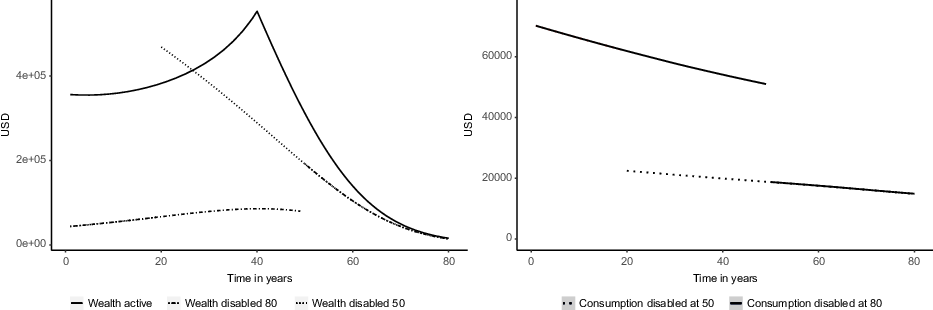
If the risk aversion in the active state is lower than in the disabled state,
 $\gamma_0<\gamma_1$
, we find the patterns in Figure 3. The wealth allocated (left) for consumption as disabled is now lower than in the benchmark case in Figure 1, and at initialization we get from from (26) that
 $x_0= \$357,\!176.8$
and
 $x_1= \$ 42,\!823.2$
. We even see that only if disability occurs before age 60 (roughly, when the dotted line crosses the solid line), the disabled individual holds a larger wealth (until around age 60) than the active individual of the same age. The wealth held by the disabled individual is mainly financed by the disability insurance sum paid out.
The consumption (right) begins at a higher level than in the benchmark case but has a steeper downward slope. As was the case for the disabled individual in Figure 2, this follows from a smaller need for stability together with impatience for consumption. Upon disability, the consumption jumps to a lower but more stable level because the risk aversion is going up.
Appendix A
From Equation (25), we rewrite the term containing
 $(x+a^k_k(t)-\sum_{l:l\neq k}x_l)$
, by changing the order of summation and recalling that
 $x_k=f^j_k(t)\psi(t,x)^{-\frac{1}{\gamma_k}}-a^j_k(t)$
into
 \begin{align} &\sum_{k \in \mathcal{J}}\mu^{*jk}(t)\unicode{x1D7D9}_{\{k\neq j\}}(x+a^k_k(t)-\sum_{l:l\neq k}x_l)\psi(t,x) \nonumber \\[5pt] &=\sum_{k \in \mathcal{J}}\mu^{*jk}(t)\unicode{x1D7D9}_{\{k\neq j\}} x\psi(t,x) \nonumber \\[5pt] &\quad + \sum_{k \in \mathcal{J}}\mu^{*jk}(t)\unicode{x1D7D9}_{\{k\neq j\}}\Big(a^k_k(t)-\sum_{l:l\neq k}(f^k_l(t)\psi(t,x)^{-\frac{1}{\gamma_l}}-a^k_l(t))\Big)\psi(t,x), \nonumber \\[5pt] &=\sum_{k \in \mathcal{J}}\mu^{*jk}(t)\unicode{x1D7D9}_{\{k\neq j\}} x\psi(t,x) +\sum_{k \in \mathcal{J}}\sum_{l\in \mathcal{J}}\mu^{*jk}(t)\unicode{x1D7D9}_{\{k\neq j\}} a^k_l(t)\psi(t,x) \nonumber \\[5pt] &\quad-\sum_{k \in \mathcal{J}}\sum_{l\in \mathcal{J}}\mu^{*jk}(t)\unicode{x1D7D9}_{\{k\neq j\}}f^k_l(t)\psi(t,x)^{\frac{\gamma_l-1}{\gamma_l}}, \nonumber \\[5pt] &=\sum_{k \in \mathcal{J}}\mu^{*jk}(t)\unicode{x1D7D9}_{\{k\neq j\}} x\psi(t,x) +\sum_{k \in \mathcal{J}}\sum_{l\in \mathcal{J}}\mu^{*jl}(t)\unicode{x1D7D9}_{\{l\neq j\}} a^l_k(t)\psi(t,x) \nonumber \\[5pt] &\quad-\sum_{k \in \mathcal{J}}\sum_{l\in \mathcal{J}}\mu^{*jl}(t)\unicode{x1D7D9}_{\{l\neq j\}}f^l_k(t)\psi(t,x)^{\frac{\gamma_k-1}{\gamma_k}}.\end{align}
Further, using
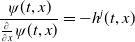 $\dfrac{\psi(t,x)}{\frac{\partial}{\partial x}\psi(t,x)}=-h^j(t,x)$
and
 $x\psi(t,x)=\sum_{k\in\mathcal{J}}f^j_k(t)\psi(t,x)^{\frac{\gamma_k-1}{\gamma_k}}-a^j_k(t)\psi(t,x)$
, we find that
 \begin{align} 0&=\sum_{k \in \mathcal{J}} \left( \frac{\gamma_k}{1-\gamma_k}\psi(t,x)^{\frac{\gamma_k-1}{\gamma_k}}\frac{d}{dt}f^{j}_k(t)+\psi(t,x)\frac{d}{dt}a^j_k(t)\right) \nonumber\\[5pt] &\quad +\sum_{k \in \mathcal{J}}(r+\sum_{l:l\neq j}\mu^{*jl}(t))\left(f^j_k(t)\psi(t,x)^{\frac{\gamma_k-1}{\gamma_k}}-a^j_k(t)\psi(t,x) \right) \nonumber\\[5pt] &\quad+\sum_{k\in \mathcal{J}} \frac{1}{2}\frac{(\alpha-r)^2}{\sigma^2} \frac{1}{\gamma_k}f^j_k(t)\psi(t,x)^{\frac{\gamma_k-1}{\gamma_k}}\nonumber \\[5pt] & \quad+ \sum_{k\in \mathcal{J}}\frac{\gamma_k}{1-\gamma_k}g^k(t)\psi(t,x)^{\frac{\gamma_k-1}{\gamma_k}}\unicode{x1D7D9}_{\{k=j\}}+\sum_{k \in \mathcal{J}}Y^k(t)\psi(t,x)\unicode{x1D7D9}_{\{k=j\}} \nonumber\\[5pt] &\quad+\sum_{k\in \mathcal{J}}\sum_{l\in \mathcal{J}}\mu^{*jl}(t)\unicode{x1D7D9}_{\{l\neq j\}}a^l_k(t)\psi(t,x) \nonumber \\[5pt] &\quad-\sum_{k\in \mathcal{J}}\sum_{l\in \mathcal{J}} \mu^{*jl}(t)\unicode{x1D7D9}_{\{l\neq j\}}f^l_k(t)\psi(t,x)^{\frac{\gamma_k-1}{\gamma_k}}\unicode{x1D7D9}_{\{l \neq k\}} \nonumber\\[5pt] &\quad+\sum_{k\in \mathcal{J}} \frac{\gamma_k}{1-\gamma_k}\mu^{*jk}(t) \Big(\frac{\mu^{*jk}(t)}{\mu^{jk}(t)}\Big)^{-\frac{1}{\gamma_k}}\psi(t,x)^{\frac{\gamma_k-1}{\gamma_k}}f^{k}_k(t)\unicode{x1D7D9}_{\{k\neq j\}} \nonumber \\[5pt] &\quad+\sum_{k\in \mathcal{J}} \sum_{l:l\neq j}\mu^{jl}(t)\left( \frac{1}{1-\gamma_k}f^l_k(t)\psi(t,x)^{\frac{\gamma_k-1}{\gamma_k}}\unicode{x1D7D9}_{\{k \neq l\}}- \frac{1}{1-\gamma_k}f^j_k(t)\psi(t,x)^{\frac{\gamma_k-1}{\gamma_k}} \right), \\[5pt] 0&=V^j(T,x). \nonumber \end{align}
We realize that every term in this expression is a sum over
 $k \in \mathcal{J}$
. If we now take each element in the sum to be zero, also the sum of these elements over
 $k \in \mathcal{J}$
is zero. This creates a separate system of differential equations for f and a, respectively, related to each subproblem. The system reflects that even for the subproblem k we have a list of state-wise functions f and a corresponding to the different states, corresponding to the double state scripting of both f and a. First, we consider the system for f and point out the system for the subproblem i,
 \begin{align*} \frac{d}{dt}f^j_i(t)&=\Big(\frac{\gamma_i-1}{\gamma_i}(r+\sum_{l:l\neq j } \mu^{*jl}(t)) + \frac{(\alpha-r)^2}{\sigma^2}\frac{\gamma_i-1}{2\gamma_i^2}+ \sum_{l:l\neq j}\frac{\mu^{jl}(t)}{\gamma_i}\Big)f^j_i(t)\\[5pt] &\quad- g^i(t)\unicode{x1D7D9}_{\{i=j\}}-\mu^{*ji}(t)^{\frac{\gamma_i-1}{\gamma_i}}\mu^{ji}(t)^{\frac{1}{\gamma_i}}f^i_i(t)\unicode{x1D7D9}_{\{i\neq j\}}\\[5pt] &\quad-\sum_{l \in \mathcal{J}} \frac{1}{\gamma_i}\left((\gamma_i-1)\mu^{*jl}(t)+\mu^{jl}(t)\right)\unicode{x1D7D9}_{\{l\neq j\}}f^l_i(t) \unicode{x1D7D9}_{\{l \neq i\}},\\[5pt] &= \Bigg(\frac{\gamma_i-1}{\gamma_i}(r+\sum_{l:l\neq j } \mu^{*jl}(t)) + \frac{(\alpha-r)^2}{\sigma^2}\frac{\gamma_i-1}{2\gamma_i^2}+ \sum_{l:l\neq j}\frac{\mu^{jl}(t)}{\gamma_i} \\[5pt] &\quad- \sum_{l:l \neq j}\left(\mu^{*jl}(t)^{\frac{\gamma_l-1}{\gamma_l}}\mu^{jl}(t)^{\frac{1}{\gamma_l}}\unicode{x1D7D9}_{\{l=i\}} + \frac{1}{\gamma_i}\left((\gamma_i-1)\mu^{*jl}(t)+\mu^{jl}(t)\right)\unicode{x1D7D9}_{\{l\neq i\}} \right) \Bigg) f^j_i(t) \\[5pt] &\quad- g^i(t)\unicode{x1D7D9}_{\{i=j\}} - \sum_{l:l\neq j}\Big( \mu^{*jl}(t)^{\frac{\gamma_l-1}{\gamma_l}}\mu^{jl}(t)^{\frac{1}{\gamma_l}}\unicode{x1D7D9}_{\{l=i\}} \\[5pt] &\quad+ \frac{1}{\gamma_i}\left((\gamma_i-1)\mu^{*jl}(t)+\mu^{jl}(t)\right)\unicode{x1D7D9}_{\{l\neq i\}}\Big) \left(f^l_i(t) - f^j_i(t) \right), \\[5pt] f^j_i(T)&=0.\end{align*}
To reach a tighter notation, we define
 \begin{align*} \tilde \mu^{jl}_i(t)=& \mu^{*jl}(t)^{\frac{\gamma_i-1}{\gamma_i}}\mu^{jl}(t)^{\frac{1}{\gamma_i}}\unicode{x1D7D9}_{\{l=i\}} + \frac{1}{\gamma_i}\left((\gamma_i-1)\mu^{*jl}(t)+\mu^{jl}(t)\right)\unicode{x1D7D9}_{\{l\neq i\}},\\[5pt] \tilde r^{j}_i(t)=&\frac{\gamma_i-1}{\gamma_i}\left(r+\sum_{l:l\neq j } \mu^{*jl}(t)\right) + \sum_{l:l\neq j}\mu^{jl}(t)\frac{1}{\gamma_i}-\sum_{l\in \mathcal{J}}\tilde \mu^{jl}_i(t)+ \left(\frac{\alpha-r}{\sigma}\right)^2\frac{\gamma_i-1}{2\gamma_i^2}.\end{align*}
This simplifies the differential equation for f to
 \begin{align*} \frac{d}{dt}f^j_i(t)&=\tilde r^{j}_i(t)f^j_i(t) -\sum_{l:l\neq j}\tilde \mu^{jl}_i(t)\left(f^l_i(t)-f^j_i(t)\right)-g^i(t)\unicode{x1D7D9}_{\{i=j\}}, \\[5pt] f^j_i(T)&=0.\end{align*}
The system of differential equations for a becomes
 \begin{align*} \frac{d}{dt}a^j_i(t)&=ra^j_i(t)-\sum_{l:l\neq j } \mu^{*jl}(t)\left(a^l_i(t)-a^j_i(t)\right)-Y^i(t)\unicode{x1D7D9}_{\{i=j\}}, \\[5pt] a^j_i(T)&=0.\end{align*}
Appendix B
Example of Calculations
In this section, we focus on the three-state model illustrated in Figure 4. Repeating the core calculations of the verification, in that case, serves two purposes. First, the derivation is fruitful as a confirmation of the more general result because the notation without summation over states can be more reader-friendly. Second, the results of the three-state model are the formulas underlying the numerical illustration in the following Section.
In the model illustrated in Figure 4, the value function and the implicit function for the marginal indirect utility are described as
 \begin{align} V^{Z(t)}(t,x)&=V^{Z(t)}_0(t,x_0)+V^{Z(t)}_1(t,x_1)+ V^{Z(t)}_2(t,x_2),\nonumber \\[5pt] x&=f^{Z(t)}_0(t)\psi(t,x)^{-\frac{1}{\gamma_0}}-a^{Z(t)}_0(t)+f^{Z(t)}_1(t)\psi(t,x)^{-\frac{1}{\gamma_1}}-a^{Z(t)}_1(t)\nonumber \\[5pt] &+f^{Z(t)}_2(t)\psi(t,x)^{-\frac{1}{\gamma_2}}-a^{Z(t)}_2(t).\end{align}
The candidate value function is given by
 $V^{Z(t)}_i(t,x_i)=\frac{1}{1-\gamma_i}f^{Z(t)}_i(t)\psi(t,x)^{\frac{\gamma_i-1}{\gamma_i}}$
for
 $i=0,1,2$
. The dynamics of the total wealth for
 $t\in[0,T]$
are given in terms of the stochastic differential equation,
 \begin{align*} &dX(t)=\Big( rX(t)+({\pi^{0}(t)X(t)(\alpha-r)}+Y^0(t)\\[5pt] &-c^0(t)-\mu^{*01}(t)b^{01}-\mu^{*02}(t)b^{02})\unicode{x1D7D9}_{\{Z(t)=0\}} \\[5pt] &+({\pi^{1}(t)X(t)(\alpha-r)}+Y^1(t)-c^1(t)-\mu^{*10}(t)b^{10}-\mu^{*12}(t)b^{12})\unicode{x1D7D9}_{\{Z(t)=1\}}\\[5pt] &+({\pi^{2}(t)X(t)(\alpha-r)}+Y^2(t)-c^2(t)-\mu^{*21}(t)b^{21}-\mu^{*20}(t)b^{20})\unicode{x1D7D9}_{\{Z(t)=2\}}\Big)dt\\[5pt] &+(b^{01}dN^{01}(t)+b^{02}dN^{02}(t))+(b^{12}dN^{12}(t)+b^{10}dN^{10}(t))\\[5pt] &+(b^{21}dN^{21}(t)+b^{20}dN^{20}(t))+\sigma {\pi^{0}}(t)X(t)dW(t)\unicode{x1D7D9}_{\{Z(t)=0\}}\\[5pt] &+\sigma {\pi^{1}}(t)X(t)dW(t)\unicode{x1D7D9}_{\{Z(t)=1\}}+\sigma {\pi^{2}}(t)X(t)dW(t)\unicode{x1D7D9}_{\{Z(t)=2\}}.\end{align*}
We specify the HJB equation for state 0, that is, conditional on the policyholder being in state 0. This corresponds to the top script 0. Note that the subscripts 1 and 2 appear several times, as all three subproblems corresponding to income, consumption, and insurance of jumps into each state are all relevant to a policyholder in state 0. The HJB equation is similar if the policyholder is in states 1 and 2, with (some of) the top scripts replaced accordingly. We have

Example of state space with three states, with the true mortality intensities.
Using
 $x_i=x-\sum_{k:k\neq i}x_k$
, for
 $i=1,2,3$
, we find the optimal controls, conditional on being in state 0, as
 \begin{align*} c^{*0}(t,x)&=g^0(t)\psi(t,x)^{-\frac{1}{\gamma_0}},\qquad {\pi^{*0}}(t,x)= -\frac{(\alpha-r)}{\sigma^2} \frac{\psi(t,x)}{x\frac{\partial}{\partial x}\psi(t,x)},\\[5pt] b^{*01}(t,x)&=\Big( \frac{\mu^{*01}(t)}{\mu^{01}(t)} \Big)^{-\frac{1}{\gamma_1}}\psi(t,x)^{-\frac{1}{\gamma_1}}f^{1}_1(t)-(a^1_1(t)+x-x_2-x_0),\\[5pt] b^{*02}(t,x)&=\Big( \frac{\mu^{*02}(t)}{\mu^{02}(t)} \Big)^{-\frac{1}{\gamma_2}}\psi(t,x)^{-\frac{1}{\gamma_2}}f^{2}_2(t)-(a^2_2(t)+x-x_1-x_0).\end{align*}
By inserting the optimal controls into the HJB equation, we find
 \begin{align*} 0&=\frac{\gamma_0}{1-\gamma_0}\psi(t,x)^{\frac{\gamma_0-1}{\gamma_0}}\frac{d}{dt}f^{0}_0(t)+\psi(t,x)\frac{d}{dt}a^0_0(t)+\frac{\gamma_1}{1-\gamma_1}\psi(t,x)^\frac{\gamma_1-1}{\gamma_1}\frac{d}{dt}f^{0}_1(t)\\[5pt] & \quad +\psi(t,x)\frac{d}{dt}a^0_1(t)+\frac{\gamma_2}{1-\gamma_2}\psi(t,x)^{\frac{\gamma_2-1}{\gamma_2}}\frac{d}{dt}f^{0}_2(t)+\psi(t,x)\frac{d}{dt}a^0_2(t)\\[5pt] &\quad+rx\psi(t,x)-\frac{(\alpha-r)^2}{2\sigma^2}\frac{\psi(t,x)^2}{\frac{\partial}{\partial x}\psi(t,x)}+Y^0(t)(\psi(t,x)+\frac{\gamma_0}{1-\gamma_0}g^0(t)\psi(t,x)^{\frac{\gamma_0-1}{\gamma_0}} \\[5pt] &\quad-\mu^{*01}(t)^{\frac{\gamma_1-1}{\gamma_1}}\mu^{01}(t)^{\frac{1}{\gamma_1}}f^1_1(t)\psi(t,x)^{\frac{\gamma_1-1}{\gamma_1}} -\mu^{*02}(t)^{\frac{\gamma_2-1}{\gamma_2}}\mu^{02}(t)^{\frac{1}{\gamma_2}}f^2_2(t)\psi(t,x)^{\frac{\gamma_2-1}{\gamma_2}} \\[5pt] &\quad+\mu^{*01}(t)(x-x_0-x_2+a^1_1(t))\psi(t,x) +\mu^{*02}(t)(x-x_0-x_1+a^2_2(t))\psi(t,x) \\[5pt] &\quad+\frac{1}{1-\gamma_1}\mu^{*01}(t)^{\frac{\gamma_1-1}{\gamma_1}}\mu^{01}(t)^{\frac{1}{\gamma_1}}f^1_1(t)\psi(t,x)^{\frac{\gamma_1-1}{\gamma_1}}\\[5pt] &\quad+\frac{1}{1-\gamma_2}\mu^{*02}(t)^{\frac{\gamma_2-1}{\gamma_2}}\mu^{02}(t)^{\frac{1}{\gamma_2}}f^2_2(t)\psi(t,x)^{\frac{\gamma_2-1}{\gamma_2}} \\[5pt] &\quad+\mu^{01}(t)V^1_0(t,x_0)+\mu^{02}(t)V^2_0(t,x_0)+\mu^{01}(t)V^1_2(t,x_2)+\mu^{02}(t)V^2_1(t,x_1) \\[5pt] &\quad-(\mu^{01}(t)+\mu^{02}(t))\Big(\frac{1}{1-\gamma_0}f^0_0(t)\psi(t,x)^{\frac{\gamma_0-1}{\gamma_0}}\\[5pt] &\quad+\frac{1}{1-\gamma_1}f^0_1(t)\psi(t,x)^{\frac{\gamma_1-1}{\gamma_1}}+\frac{1}{1-\gamma_2}f^0_2(t)\psi(t,x)^{\frac{\gamma_2-1}{\gamma_2}}\Big).\\[5pt] &0=V^0(T,x).\end{align*}
Note that we have changed the order of summation to illustrate clearly the similar change of order of summation in the general case. Further we use that
 $x_i=f^j_i(t)\psi(t,x)^{-\frac{1}{\gamma_i}}-a^j_i$
, for all
 $i \in \{0,1,2\}$
.
 \begin{align*} 0&=\frac{\gamma_0}{1-\gamma_0}\psi(t,x)^{\frac{\gamma_0-1}{\gamma_0}}\frac{d}{dt}f^{0}_0(t)+\psi(t,x)\frac{d}{dt}a^0_0(t)+\frac{\gamma_1}{1-\gamma_1}\psi(t,x)^{\frac{\gamma_1-1}{\gamma_1}}\frac{d}{dt}f^{0}_1(t)\\[5pt] & \quad+\psi(t,x)\frac{d}{dt}a^0_1(t)+\frac{\gamma_2}{1-\gamma_2}\psi(t,x)^{\frac{\gamma_2-1}{\gamma_2}}\frac{d}{dt}f^{0}_2(t)+\psi(t,x)\frac{d}{dt}a^0_2(t)\\[5pt] &\quad+(r+\mu^{*01}(t)+\mu^{*02}(t))\Big( f^0_0(t)\psi(t,x)^{\frac{\gamma_0-1}{\gamma_0}}-a^0_0(t) + f^0_1(t)\psi(t,x)^{\frac{\gamma_1-1}{\gamma_1}}-a^0_1(t)\\[5pt] &\quad+ f^0_2(t)\psi(t,x)^{\frac{\gamma_2-1}{\gamma_2}}-a^0_2(t)\Big)\\[5pt] &\quad+\frac{(\alpha-r)^2}{2\sigma^2}\left(\frac{1}{\gamma_0}f^0_0(t)\psi(t,x)^{\frac{\gamma_0-1}{\gamma_0}}+\frac{1}{\gamma_1}f^0_1(t)\psi(t,x)^{\frac{\gamma_1-1}{\gamma_1}}+\frac{1}{\gamma_2}f^0_2(t)\psi(t,x)^{\frac{\gamma_2-1}{\gamma_2}} \right)\\[5pt] &\quad+Y^0(t)(\psi(t,x)+\frac{\gamma_0}{1-\gamma_0}g^0(t)\psi(t,x)^{\frac{\gamma_0-1}{\gamma_0}} \\[5pt] &\quad+\frac{\gamma_1}{1-\gamma_1}\mu^{*01}(t)^{\frac{\gamma_1-1}{\gamma_1}}\mu^{01}(t)^{\frac{1}{\gamma_1}}f^1_1(t)\psi(t,x)^{\frac{\gamma_1-1}{\gamma_1}} +\frac{\gamma_2}{1-\gamma_2}\mu^{*02}(t)^{\frac{\gamma_2-1}{\gamma_2}}\mu^{02}(t)^{\frac{1}{\gamma_2}}f^2_2(t)\psi(t,x)^{\frac{\gamma_2-1}{\gamma_2}} \\[5pt] &\quad-\mu^{*01}(t)(f^1_0(t)\psi(t,x)^{\frac{\gamma_0-1}{\gamma_0}}+f^1_2(t)\psi(t,x)^{\frac{\gamma_2-1}{\gamma_2}})+\mu^{*01}(t)(a^1_1(t)+a^1_0(t)+a^1_2(t))\psi(t,x)\\[5pt] &\quad-\mu^{*02}(t)(f^2_0(t)\psi(t,x)^{\frac{\gamma_0-1}{\gamma_0}}+f^2_1(t)\psi(t,x)^{\frac{\gamma_1-1}{\gamma_1}})+\mu^{*02}(t)(a^2_2(t)+a^2_0(t)+a^2_1(t))\psi(t,x) \\[5pt] &\quad+\mu^{01}(t)\frac{1}{1-\gamma_0}f^1_0(t)\psi(t,x)^{\frac{\gamma_0-1}{\gamma_0}}+\mu^{02}(t) \frac{1}{1-\gamma_0}f^2_0(t)\psi(t,x)^{\frac{\gamma_0-1}{\gamma_0}} \\[5pt] &\quad+\mu^{01}(t) )\frac{1}{1-\gamma_2}f^1_2(t)\psi(t,x)^{\frac{\gamma_2-1}{\gamma_2}} +\mu^{02}(t))\frac{1}{1-\gamma_1}f^2_1(t)\psi(t,x)^{\frac{\gamma_1-1}{\gamma_1}} \\[5pt] &\quad-(\mu^{01}(t)+\mu^{02}(t))\Big(\frac{1}{1-\gamma_0}f^0_0(t)\psi(t,x)^{\frac{\gamma_0-1}{\gamma_0}}+\frac{1}{1-\gamma_1}f^0_1(t)\psi(t,x)^{\frac{\gamma_1-1}{\gamma_1}}+\frac{1}{1-\gamma_2}f^0_2(t)\psi(t,x)^{\frac{\gamma_2-1}{\gamma_2}}\Big).\\[5pt] &0=V^0(T,x).\end{align*}
Using the notation of
 $\tilde{r}^{ji}$
and
 $\tilde{\mu}^{jl}_i$
, the solution can be expressed as the solution to following differential equations for f and a, respectively,
 \begin{equation*} \begin{array}{l@{\quad}l} \dfrac{d}{dt}f^{0}_0(t)=f^{0}_0(t)\tilde{r}^{00}(t) - g^{0}(t) - \sum_{k:k\neq 0}\tilde\mu^{0k}_0(t)(f^k_0(t)-f^0_0(t)), & f^0_0(T)=0, \\[10pt] \dfrac{d}{dt}f^{0}_1(t)=f^{0}_1(t)\tilde{r}^{01}(t) - \sum_{k:k\neq 0}\tilde\mu^{0k}_1(t)(f^k_1(t)-f^0_1(t)), & f^0_1(T)=0,\\[10pt] \dfrac{d}{dt}f^{0}_2(t)=f^{0}_2(t)\tilde{r}^{02}(t) - \sum_{k:k\neq 0}\tilde\mu^{0k}_2(t)(f^k_2(t)-f^0_2(t)), & f^0_2(T)=0,\\[10pt] \dfrac{d}{dt}a^0_0(t)=ra^0_0(t)-\sum_{k:k\neq 0}\mu^{*0k}(t)(a^k_0(t)-a^0_0(t))-Y^0(t), & a^0_0(T)=0, \\[10pt] \dfrac{d}{dt}a^0_1(t)=ra^0_1(t)-\sum_{k:k\neq 0}\mu^{*0k}(t)(a^k_1(t)-a^0_1(t)), & a^0_1(T)=0,\\[10pt] \dfrac{d}{dt}a^0_2(t)=ra^0_2(t)-\sum_{k:k\neq 0}\mu^{*0k}(t)(a^k_2(t)-a^0_2(t)), & a^0_2(T)=0. \end{array}\end{equation*}
The differential equations for f are three three-dimensional system of differential equations, namely one system consisting of
 $(f^{0}_0,f^{1}_0, f^{2}_0)$
, another of
 $(f^{1}_1,f^{0}_1, f^{2}_1)$
, and the last system of
 $(f^{2}_2,f^{1}_2, f^{0}_2)$
. The three systems are not intertwined, but each system must be solved numerically as a three-dimensional system of the ordinary differential equation.
If; however, we consider the special case where the one policyholder does not return to a left state the numerical calculation becomes easier as then the three-dimensional system reduces to three one-dimensional ordinary differential equations that can be solved one at a time. This is what occurs if “recovery” intensities are zero,
 $\mu^{20}=\mu^{10}=\mu^{21}=0$
. This is the model implemented in the numerical illustration below.
The intuitive interpretation of the f functions is that
 $f^j_i$
measures how important it is to consume in state i in the future given being in state j today. The jump from state j to state i occur with preference-weighted intensity
 $\tilde{\mu}^{jl}_i$
or passing through another state l.