Introduction
Factors in the host blood are related to the host-finding behaviour of the infective third-stage larvae (L3) of skin-penetrating parasitic nematodes. Wauters et al. (Reference Wauters, Klaver-Wesseling and Vetter1982) and Vetter et al. (Reference Vetter, Vingerhoed, Schoeman and Wauters1985) demonstrated that dog serum contained an attractant for L3 of the hookworm Ancylostoma caninum. Subsequently, Tobata-Kudo et al. (Reference Tobata-Kudo, Higo, Koga and Tada2000) and Forbes et al. (Reference Forbes, Ashton, Boston and Schad2003) suggested that the chemotactic factor in serum was the sodium ion for Strongyloides ratti and S. stercoralis, respectively.
Gunawardena et al. (Reference Gunawardena, Fujimaki and Aoki2003) and Kusaba et al. (Reference Kusaba, Fujimaki, Vincent and Aoki2008) demonstrated that L3 of Brugia pahangi, one of the skin-penetrating nematode parasites, were attracted to sera from various mammalian species. and Mitsui et al. (Reference Mitsui, Miura, Bome and Aoki2012) showed that sodium ions, a major component of sera, were the attractant for the L3. However, other substances attracting the L3 remain unidentified.
Safer et al. (Reference Safer, Brenes, Dunipace and Schad2007) reported that an extract of mammalian skin strongly attracted S. stercoralis L3 and that the active component in that extract was urocanic acid (UCA), a histidine metabolite. This is particularly abundant in mammalian skin and skin secretions, suggesting that it serves as an attractant specific to mammalian hosts. Since B. pahangi is a skin-penetrating parasitic nematode similar to S. stercoralis, UCA can be expected to be a chemoattractant for B. pahangi L3, but no attempt has yet been made to assess the chemoattractant activity of UCA for the L3. Identification of the chemoattractant is an important prerequisite for an understanding of the mechanisms of skin-penetrating infection of filarial L3. Thus, we attempted to assess the chemotactic responses of B. pahangi L3 to UCA. During the process of assessment, we found that tris(hydroxymethyl)aminomethane (Tris), which Safer et al. (Reference Safer, Brenes, Dunipace and Schad2007) used to dissolve UCA, strongly attracted the filarial L3 while UCA did not. We hereby report that interesting finding.
The objective of the present study was to attempt to show that the chemoattractant of B. pahangi L3 was Tris not UCA, using a modified agar-plate assay (Mitsui et al., Reference Mitsui, Miura, Bome and Aoki2012).
Materials and methods
Test solutions
UCA and Tris were purchased from Sigma-Aldrich (St. Louis, Missouri, USA) and Wako Pure Chemical Industries Ltd (Osaka, Japan), respectively. Hanks’ balanced salt (HBS) was obtained from Nissui Pharmaceutical Co. Ltd (Tokyo, Japan). All other chemicals were of pure chemical grade. Prior to assays of chemotactic responses of B. pahangi L3, all test solutions were prepared as shown below.
For the assay for chemotactic responses of B. pahangi L3 to UCA or acetic acid (CH3COOH) dissolved in amine solutions, the test solutions were prepared in accordance with the concentration of 200 mm of test solutions used in the previous study (Mitsui et al., Reference Mitsui, Miura, Bome and Aoki2012). In the preparation of UCA dissolved in amine solutions, 195 μl of 10% ammonia (NH3) solution, 147 mg triethylamine (TEA) or 163 mg Tris was added to dissolve 138 mg UCA in 5 ml deionized water (DW). The concentrations of the resulting solutions were 200 mm UCA plus 230 mm NH3, 290 mm TEA or 270 mm Tris, respectively. In the preparation of CH3COOH dissolved in amine solutions, 170 μl of 10% NH3 solution, 101 mg TEA or 121 mg Tris was added to dissolve 60 mg CH3COOH in 5 ml DW. The concentrations of the resulting solutions were 200 mm CH3COOH plus 200 mm NH3, 200 mm TEA or 200 mm Tris, respectively. In addition, 170 μl of 10% NH3 solution, 101 mg TEA, 121 mg Tris or 58 mg NaCl was dissolved in 5 ml DW to a concentration of 200 mm.
In the assay to determine the effect of Tris concentrations on the chemoattractant activity for filarial L3, a solution of 200 mm Tris was serially diluted to concentrations of 100, 50, 25 and 12.5 mm with DW. In the assay to determine the effect of HCl concentrations on the chemoattractant activity of Tris for filarial L3, 0.25, 0.5, 0.75, 1.00 or 1.25 ml of 1 m HCl was added to a solution of 121 mg Tris dissolved in 3 ml DW, and DW was added to the solutions until a volume of 5 ml was reached. The concentration of the resulting solutions was 200 mm Tris plus 50, 100, 150, 200 or 250 mm HCl, respectively. The potential of hydrogen (pH) of the test solutions was measured with a pH meter (Model, D-51 with a glass-electrode of 9678-10D, Horiba Ltd, Kyoto, Japan).
Parasite strain
The filarial nematode B. pahangi used in this experiment was maintained in Mongolian jirds (Meriones unguiculatus) and mosquitoes (Aedes aegypti Liverpool strain) in the Animal Research Center for Tropical Infections at the Institute of Tropical Medicine, Nagasaki University. L3 were harvested from mosquitoes that had fed on microfilaraemic jirds 2 weeks previously. The infected mosquitoes were dissected in HBS solution, and the L3 were collected and washed twice in HBS solution prior to assays of chemotactic responses.
Assay of the chemotactic responses of Brugia pahangi third-stage larvae to test solutions
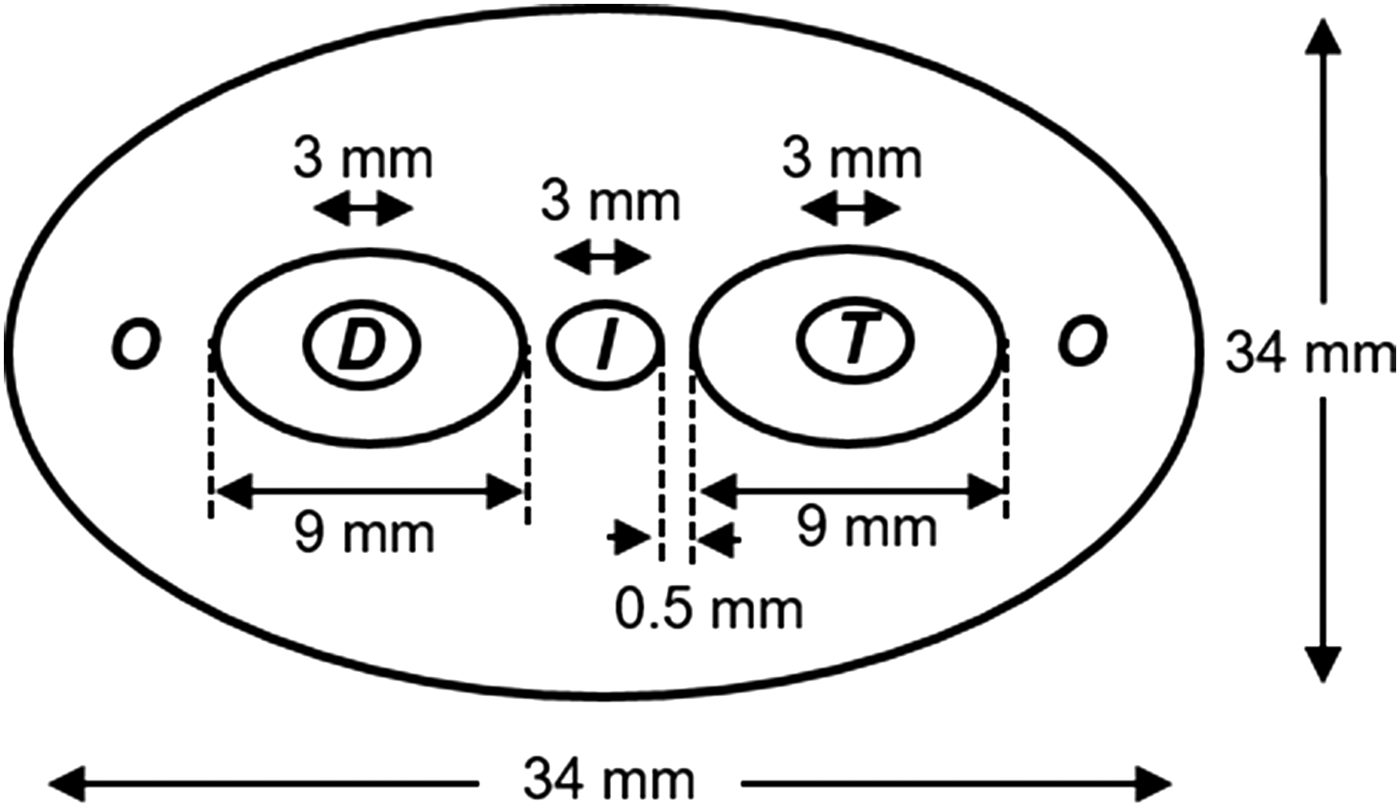
The assays of the chemotactic responses of B. pahangi L3 to test solutions were conducted by the modified method described previously by Mitsui et al. (Reference Mitsui, Miura, Bome and Aoki2012). Briefly, a 34-mm Petri dish (Sumilon, Sumitomo Bakelite Co. Ltd, Tokyo, Japan) was filled with 2 ml of 0.6% (w/v) Noble agar (Difco Laboratories, Inc., Detroit, Michigan, USA) dissolved in hot DW and allowed to cool at room temperature. The agar plate was placed over a template transparent sheet (fig. 1) on which three circles of diameter 3 mm were drawn to indicate areas where 1 μl of DW and L3 (I-area), 2 μl of DW (D-area) and 2 μl of a test solution (T-area) were spotted, respectively. The sheet also had two large concentric circles, each of diameter 9 mm, indicating DW (D) and test solution (T) zones. The O-zones were the areas outside the I-area and the D- and T-zones. One microlitre of DW was spotted in the I-area of an agar plate. Immediately, approximately ten L3 were placed into the I-area on the agar plate using a fine needle. Two microlitres of DW and 2 μl of a test solution were spotted on the left (D) and right (T) areas, respectively. Then the agar plate was placed on a hot plate (ND-1, Asone Corporation, Osaka, Japan) with temperature adjusted to 30–35°C. After 25–30 min, the numbers of L3 accumulating in the four sectors (I-area, D-zone, T-zone and O-zone) were counted under a Nikon SMZ 800 stereoscopic microscope (Nikon Corporation, Tokyo, Japan). The assays were repeated five times for each test solution.
Schematic drawing of the areas and zones on a template transparent sheet to assess the chemotactic responses of Brugia pahangi third-stage larvae to test solutions. The small circles marked I, D and T indicate the areas on to which 1 μl of deionized water (DW) and larvae (I-area), 2 μl of DW alone (D-area) and 2 μl of a test solution (T-area) were placed, respectively. The large concentric circles of D and T indicate respective zones. O indicates the zone outside the I-area and the two D- and T-zones.

Statistical analysis
The proportion of filarial L3 accumulating in the T-zone of a test solution was expressed as 100 × (total number of L3 accumulating in T-zone)/(total number of L3 applied to five agar plates using approximately ten L3 in each plate). A 95% confidence interval (95% CI) of the proportion was calculated according to the procedure described by Wilson (Reference Wilson1927). Furthermore, the proportion of L3 accumulating in the T-zone of each test solution was compared with that of DW (control group) according to the z-test (Daniel, Reference Daniel and Daniel1999).
Results
Chemotactic responses of Brugia pahangi third-stage larvae to urocanic acid or acetic acid dissolved in amine solutions
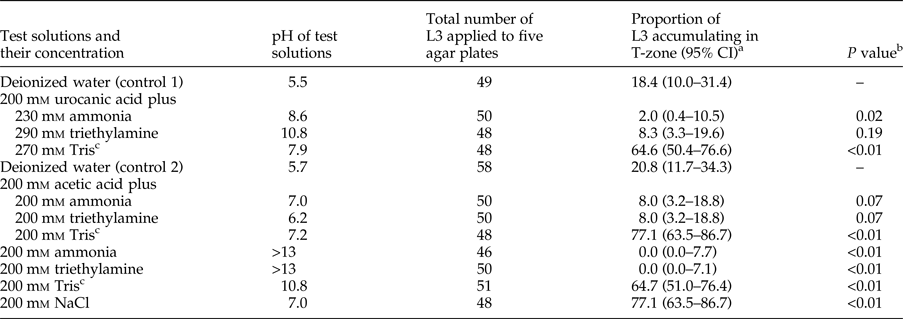
Table 1 shows the chemotactic responses of filarial L3 to test solutions of UCA or CH3COOH dissolved in DW with three amines: NH3, TEA or Tris. The solution of UCA plus Tris significantly attracted L3 compared with DW (control), while neither the test solution of UCA plus NH3 nor that plus TEA significantly attracted the L3. Similarly, the test solution of CH3COOH plus Tris significantly attracted L3, but neither the test solution of CH3COOH plus NH3 nor that plus TEA attracted the larvae. Furthermore, 200 mm Tris alone significantly attracted 65% of L3 compared with DW, whereas the L3 avoided both 200 mm NH3 and 200 mm TEA. In addition, the level of chemoattractant activity of 200 mm Tris alone for L3 was similar to that of 200 mm NaCl.
Chemotactic responses of Brugia pahangi infective third-stage larvae (L3) to urocanic acid or acetic acid dissolved in amine solutions.

a The proportion of L3 accumulating in the T-zone of a test solution was calculated as 100 × (total number of L3 accumulating in the T-zone)/(total number of L3 applied to five agar plates using approximately ten L3 in each plate), and a 95% confidence interval of the proportion is shown as 95% CI.
b The proportion of L3 accumulating in the T-zone of each test solution was compared with that in deionized water as control 1 or 2 according to the z-test.
c Tris: tris(hydroxymethyl)aminomethane.
Effect of tris(hydroxymethyl)aminomethane concentration on chemoattractant activity for Brugia pahangi third-stage larvae
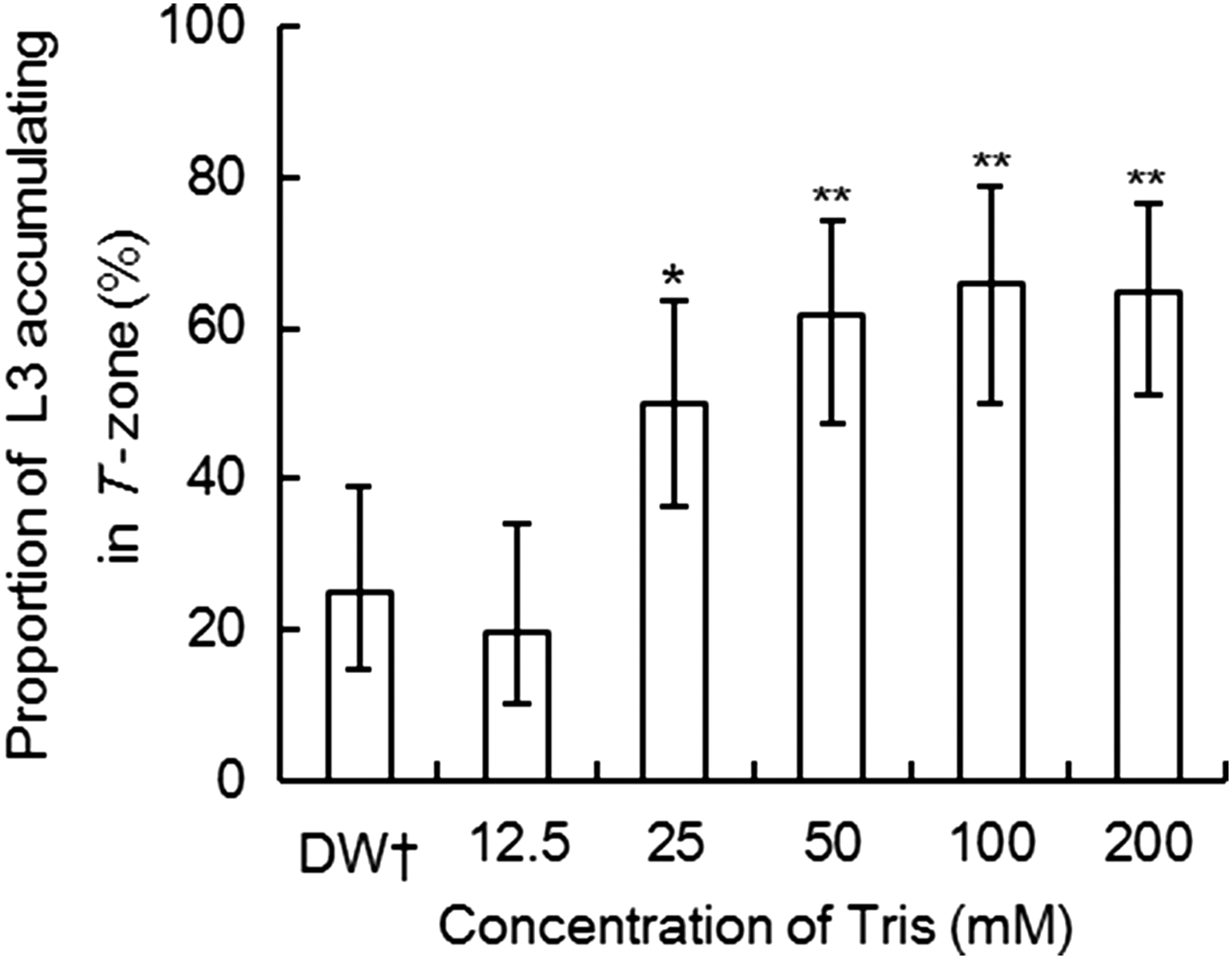
The chemotactic responses of filarial L3 to Tris were observed in the concentration range of 0–200 mm (fig. 2). Tris significantly attracted L3 at concentrations of 25 and 200 mm compared with DW (control). The significant chemoattractant activity of Tris was not observed at a concentration of 12.5 mm.
Effect of tris(hydroxymethyl)aminomethane (Tris) concentrations on the chemotactic responses of Brugia pahangi third-stage larvae (L3). The proportion of L3 accumulating in the T-zone is expressed by white bars. Each error bar shows the 95% confidence interval for the proportions of L3. *P < 0.05, **P < 0.01, the proportion of L3 accumulating in the T-zone of Tris at different concentrations, was compared with that of deionized water (DW) alone as control, z-test. †Control.

Effect of HCl concentration on the chemoattractant activity of tris(hydroxymethyl)aminomethane for Brugia pahangi third-stage larvae
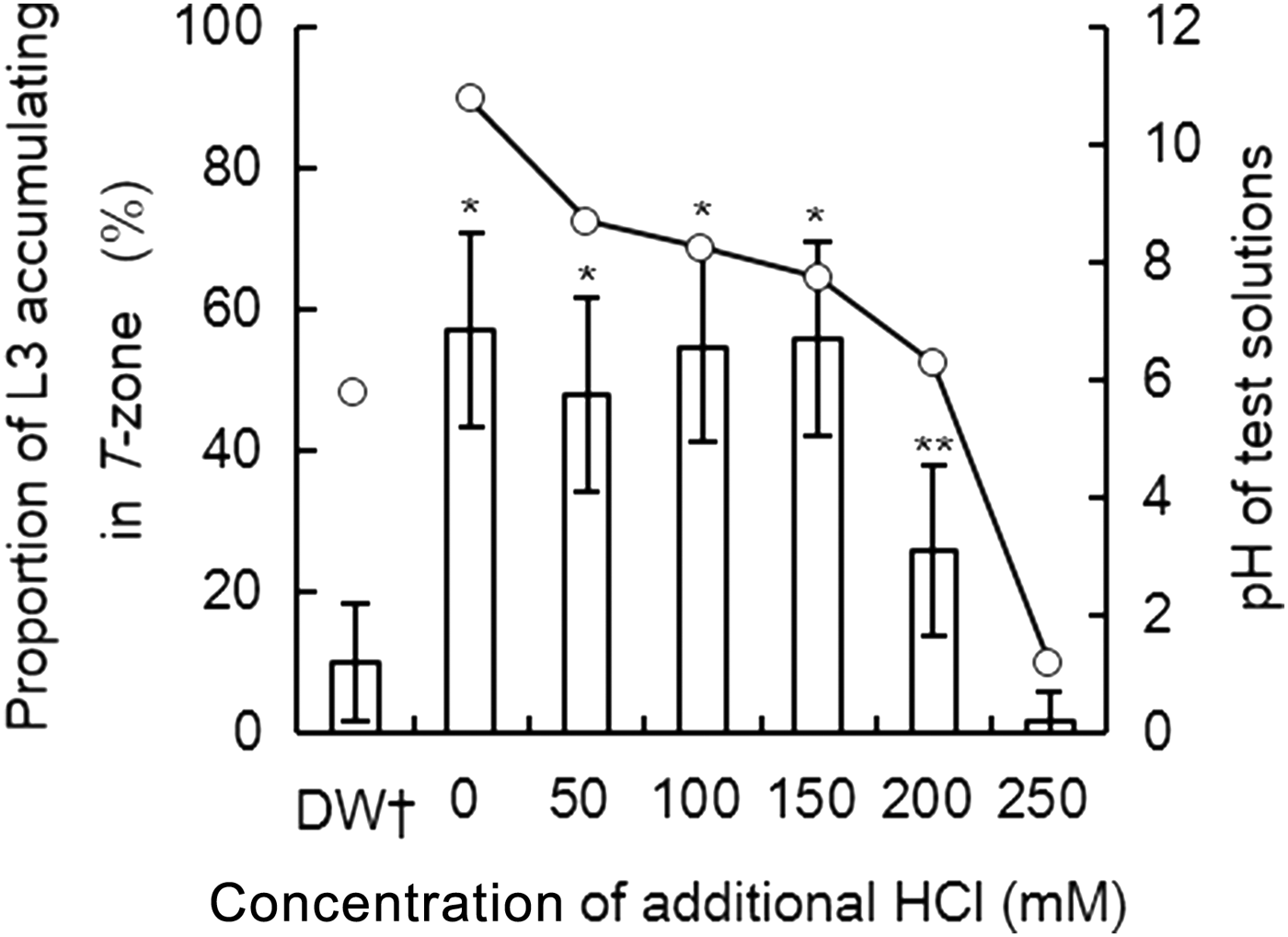
A solution with 200 mm Tris alone dissolved in DW had a pH of 10.8 and significantly attracted 57% of filarial L3 compared with DW (10%, P < 0.01) (fig. 3). As the amount of HCl added to the solution was gradually increased to 50, 100, 150 and 200 mm, the pH of the solution decreased to 8.7, 8.3, 7.8 and 6.3, respectively. The proportion of the L3 accumulating in the T-zone of 200 mm Tris plus 50, 100 or 150 mm HCl was similar to that of 200 mm Tris alone. Even after the addition of 200 mm HCl, the chemoattractant activity of 200 mm Tris for the L3 remained significantly higher than that of DW. When 250 mm HCl was added to a solution of 200 mm Tris (solution pH 1.2), the L3 apparently avoided the test solution.
Effect of additional amounts of HCl on the chemotactic responses of Brugia pahangi third-stage larvae (L3) to 200 mm tris(hydroxymethyl)aminomethane (Tris). The proportions of L3 accumulating in the T-zone are expressed as white bars. Each error bar shows the 95% confidence interval for the proportions of L3. Open circle symbols show the pH of control and test solutions. *P < 0.01, **P < 0.05, the proportion of L3 accumulating in the T-zone of 200 mm Tris plus additional amounts of HCl, was compared with that of deionized water (DW) alone as control, z-test. †Control.

Discussion
Safer et al. (Reference Safer, Brenes, Dunipace and Schad2007) showed that UCA was a chemoattractant for S. stercoralis L3. Since B. pahangi is a skin-penetrating parasitic nematode similar to S. stercoralis, UCA was expected to be a chemoattractant for B. pahangi L3 as well. The present study was initiated to show that UCA is a chemoattractant for B. pahangi L3, but the result derived from the present study differed unexpectedly, revealing that B. pahangi L3 were attracted, not to UCA, but to Tris.
Because of the low solubility of UCA in DW, Safer et al. (Reference Safer, Brenes, Dunipace and Schad2007) added Tris to dissolve UCA in DW and assessed the chemotactic responses of S. stercoralis L3 to the UCA. Tris was hence expected to affect the chemotactic responses of B. pahangi L3 to UCA. In the present study, not only Tris but also NH3 and TEA were supplemented to dissolve UCA in DW. Chemotactic responses of filarial L3 to the test solutions of UCA plus Tris, NH3 or TEA were assessed. L3 were attracted to the solution of UCA plus Tris, while they tended to avoid the solutions of UCA plus both NH3 and TEA. Furthermore, L3 were attracted to a solution of CH3COOH plus Tris, whereas the L3 avoided solutions of CH3COOH plus NH3 and TEA. These results suggested that UCA was not a chemoattractant of B. pahangi L3 but that Tris was the chemoattractant. Indeed, Tris alone significantly attracted L3 compared with DW, whereas the L3 avoided NH3 and TEA. Consequently, Tris was confirmed as a chemoattractant of B. pahangi L3.
Safer et al. (Reference Safer, Brenes, Dunipace and Schad2007) used Tris to dissolve UCA in DW and examined the chemotactic responses of S. stercoralis L3 to the solution, and they showed that UCA was the attractant for S. stercoralis L3. However, they may have accidently observed the chemotactic responses of S. stercoralis L3 to Tris instead of UCA. Further investigations are needed to confirm whether or not Tris is the chemoattractant for S. stercoralis L3.
The minimal concentration of Tris attracting filarial L3 was 25 mm (fig. 2), but that of sodium ions attracting the L3 was reported to be 50 mm (Mitsui et al., Reference Mitsui, Miura, Bome and Aoki2012). Hence, the chemoattractant activity of Tris for L3 may be equal to or slightly higher than that of sodium ions.
The present study showed that the chemoattractant activity of Tris for B. pahangi L3 was affected by the pH of a test solution. When the pH of the test solution of Tris alone was 10.7, 57% of filarial L3 were attracted to the solution. Even after adding HCl at concentrations of up to 150 mm to the test solution (pH 7.8), the chemotactic responses of filarial L3 remained at a level similar to that for 200 mm Tris alone. When the amount of additional HCl was increased to 200 mm (pH of the test solution 6.3), the chemotactic response of the L3 for 200 mm Tris drastically decreased. When the addition of HCl was increased to 250 mm (pH of the test solution 1.2), the proportion of the L3 accumulating towards 200 mm Tris decreased to only 2%. These results reveal that filarial L3 prefer Tris in mildly alkaline conditions to Tris in acidic conditions.
The usual route of infection in mosquito-transmitted filariasis is via the puncture wound left by a mosquito after the mouthparts have been withdrawn from the skin (Ewert, Reference Ewert1967). Mitsui et al. (Reference Mitsui, Miura, Bome and Aoki2012) suggested that filarial L3 recognize sodium ions and reach the puncture wound caused by the bite of a mosquito before the L3 penetrate the skin. The fact that sodium ions are the chemoattractant for filarial L3 is understandable, because sodium ions are a major component of animal blood, and the concentration in human blood is in the range of 130–150 mm. The concentrations of 50–200 mm sodium ions (Mitsui et al., Reference Mitsui, Miura, Bome and Aoki2012), showing chemoattractant activity to L3, are the physiological levels that would be encountered by the L3. On the other hand, Tris is an exogenous substance that does not exist in the bodies of animals. Tris is often used for the preparation of buffer solutions in biochemical studies, but the biological role of Tris in the host is unclear. Therefore, it remains to be seen whether the concentrations of 25–200 mm Tris, showing chemoattractant activity to the L3, are physiological levels that would normally be encountered by filarial L3 or not. However, it is surmised that, in natural infection to a host, filarial L3 recognize not only sodium ions in host blood leaking from the puncture wound made by a mosquito bite (Mitsui et al., Reference Mitsui, Miura, Bome and Aoki2012), but also other substances, such as Tris-related compounds, which have not yet been identified.
To our knowledge, this is the first report of chemotactic responses of B. pahangi L3 to Tris. The identification of the chemoattractant for filarial L3 is an important prerequisite for a better understanding of the mechanisms of skin-penetrating infection of filarial L3, and for efforts to develop convenient and practical methods to prevent filarial infection.
Acknowledgements
We would like to express our thanks to Mr Mitsumasa Miura, Technologist, Department of Parasitology, Institute of Tropical Medicine, Nagasaki University for technical support.
Financial support
The participation of co-investigator K.E.U.-T. in the present study was supported by the Japan International Cooperation Agency (JICA)’s Leader Training Program/Clinical Medicine and Research for Tropical Doctors (JICA, Course No: J 0700841).
Conflict of interest
None.
Ethical standards
The authors assert that all procedures contributing to this work comply with the ethical standards of relevant national and institutional guides on the care and use of laboratory animals. The present investigation was approved by the Ethics Review Committee for Animal Experimentation of Nagasaki University School of Medicine (Approval No. 1110170953), and all animal experiments were performed in the Animal Research Centre for Tropical Infections at the Institute of Tropical Medicine in accordance with the animal experimentation guidelines of Nagasaki University School of Medicine.