Introduction
Otitis media with effusion (OME) is common in children. Some paediatric patients who are candidates for cochlear implantation have effusion at the time of the procedure; this may contribute to surgical complications and intra-operative difficulties. As in stapedectomy surgery (where the inner ear is opened), cochlear implant surgery has traditionally been performed on a ‘sterile’ middle ear with an intact tympanic membrane. Although sterile conditions are not always available, the well-established benefits of cochlear implants and improved surgical techniques have made cochlear implantation feasible in the presence of chronic otitis media.Reference Kennedy and Shelton1, Reference Kim, Chang, Lee, Shim, Oh and Kim2
The management of otitis-prone children with cochlear implants remains controversial, particularly regarding whether ventilation tubes should be placed sooner to prevent potential complications or whether a more conservative approach should be used in which ventilation tube placement is delayed to maintain the integrity of the ‘sterile’ ear.Reference Kennedy and Shelton1 An alternative option is to perform cochlear implantation without delay.
This study describes our experience of cochlear implantation in patients with OME at the time of surgery, and its effect on the procedure, post-operative complications and outcomes. Electrical impedance was used to objectively measure the device and electrode function. The electrode positions were confirmed by positive neural response telemetry findings. Impedance (i.e. the resistance to current flow) measurements may be affected by local cochlear conditions, in particular the nature of the electrode–tissue interface and the resistance of the cochlear fluid and/or tissue medium, but not by neural responses.Reference Clark3
Materials and methods
This retrospective, non-randomised chart review study included data from all paediatric patients who underwent cochlear implantation performed by the senior surgeon and author (FA) at our institution between June 2007 and June 2009. Fourteen paediatric patients over the age of four years, five patients with tympanic membrane perforation (grafting with the implantation) and two patients with a history of meningitis with some cochlear ossification were excluded. The remaining 87 patients had already been diagnosed with congenital severe-to-profound sensorineural hearing loss and had received hearing aid trials for at least 3 months before surgery. However, they showed no improvement despite regular follow-up evaluations. Ethical and study protocol approval were obtained from the institutional review board prior to retrieving the patient files. This study was conducted according to the principles of the Declaration of Helsinki and the Strengthening the Reporting of Observational Studies in Epidemiology (‘STROBE’) guidelines.Reference von Elm, Altman, Egger, Pocock, Gøtzsche and Vandenbroucke4
All patients received a systematic pre-operative evaluation including serial audiological assessments and radiological examinations. Additionally, neurological and psychological evaluations were conducted to identify autistic, hyperactive and agitated patients. All patients and their parents met the surgical and rehabilitation teams before surgery.
The review included age at the time of implantation, sex, cause of hearing loss, side of implantation, middle-ear findings at the time of implantation, intra-operative electrode impedance, follow-up time and peri-operative complications. All operations were performed under general anaesthesia using the minimally invasive incision and double flap transmastoid technique with a cochleostomy approach. When otitis media with effusion (OME) was present, a swab was taken from the mastoid cavity for bacterial culture and sensitivity analysis. All patients received Nucleus® cochlear implant devices; 38 received Contour Advance® devices and 49 received Freedom® devices. Complete electrode insertion was ensured for each patient; impedance measurements and neural response telemetry data were collected by an experienced technician before surgical closure. Electrode impedance was measured using stimulation modes MP1 (the ball electrode) and MP2 (plate electrode). IBM SPSS version 18.0 (Armonk, New York, USA) was used to perform the statistical analyses. A Pearson chi-square test was used to compare the rates of post-operative complications between the cochlear implantation group without OME (n = 70) and the cochlear implantation group with OME (n = 17). P values of less than 0.01 were considered to be statistically significant.
Results
The unilateral ears of 87 paediatric patients were implanted between June 2007 and June 2009. The mean age at implantation was 3.4 years (range 22 months to 4 years). Patients in the cochlear implant with otitis media with effusion (OME) group (n = 17) were slightly younger than those in the non-OME group (mean age 3.24 vs 3.40 years), but this difference was not statistically significant. Thirty-eight (44 per cent) patients were boys, and 49 (56 per cent) were girls. Seventy-nine (91 per cent) patients underwent right ear cochlear implantation. The side of implantation was selected because of either handedness or the anatomical favourability of the cochlea. Hearing loss was congenital in 76 (87 per cent) patients and caused by meningitis in 7 (8 per cent) patients; in 3 (3 per cent) patients, there was a history of gentamicin injection. Neonatal fever with jaundice necessitating hospital admission was the only detected cause of hearing loss in one patient.
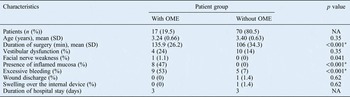
Middle-ear effusion was seen intra-operatively in 17 of the 87 patients (19.5 per cent). The effusion was diagnosed pre-operatively by otoscopic examination and confirmed by tympanometry and pre-implantation computed tomography scanning. No patient had received pre-operative medical or surgical (i.e. ventilation tube insertion) treatment. In patients with effusion, this was first aspirated and implantation was then performed as for those without effusion. Middle-ear mucosal oedema and congestion were the main abnormal intra-operative findings in OME patients. Congested oedematous mucosa was present exclusively in patients with middle-ear effusion (p < 0.001). There was excessive bleeding in the OME group; this was statistically significant compared with the non-OME group (p < 0.001). The bleeding was controlled by irrigating the middle-ear cavity with dilute adrenaline solution. Post-operative mild partial facial nerve palsy occurred in one OME patient, with spontaneous recovery after 1 week. No swab samples showed bacterial growth. All patients were admitted 1 day before surgery and discharged 1 day after surgery; they received three doses of prophylactic antibiotics. Characteristics of both patient groups and their treatment details are shown in Table I.
Characteristics of patients with and without otitis media with effusion

*Statistically significant difference (p < 0.01). OME = otitis media with effusion; SD = standard deviation
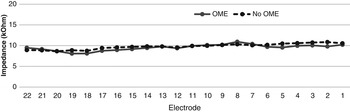
The average duration of surgery was 112 minutes (range 60–240 minutes). There was a significant difference in surgery time between the two groups: surgery took an average of 30 minutes longer in the OME group than in the non-OME group. Full electrode insertion was achieved for all patients; electrode impedance measurements were almost identical in both groups (Figure 1). All implant devices were activated after two weeks. Follow-up periods ranged from five to seven years. There was no evidence of eardrum perforation, late acute OME attacks or acute otitis media during follow up; no wound infection or delayed healing was apparent.
Graph showing the mean impedance measurements for each of the 22 electrodes in each device in patients with and without otitis media with effusion. OME = otitis media with effusion.

Discussion
The management of otitis media with effusion (OME) during cochlear implantation surgery remains controversial. The benefits of early hearing restoration and rehabilitation to deaf children have been well described.Reference Hehar, Nikolopoulos, Gibbin and O'Donoghue5, Reference Lenarz6 However, sterile implant placement in an inflamed or potentially infected middle ear and mastoid represents a theoretical risk for intracranial infection, implant extrusion and bacterial contamination of the implant, requiring removal.Reference Fayad, Tabaee, Micheletto and Parisier7
For OME patients, the debate continues about whether to first treat the effusion and delay implantation, insert a ventilation tube at the time of implantation or perform the cochlear implantation without delay, with no further management of OME. Many surgeons would only proceed with implantation with a clean, dry ventilation tube in place and are reluctant to proceed without ventilation tube placement or delaying implantation.Reference Kennedy and Shelton1 On the other hand, removing the tube and waiting for the tympanic membrane to heal may delay implantation. It is also possible that the tympanic membrane may not heal spontaneously; even if it does, the fluid or infection may return.
The theoretical risk of otitis media after cochlear implantation is not supported clinically. Luntz et al. reported no increase in the incidence, complication rate or severity of otitis media after implantation.Reference Luntz, Hodges, Balkany, Dolan-Ash and Schloffman8 In fact, the overall prevalence of otitis media among children was reported to decrease dramatically after implantation.Reference Luntz, Teszler, Shpak, Feiglin and Farah-Sima'an9 This is likely to result from rigorous pre-operative otitis media control and a decline in the incidence of otitis media with age, with the probable added benefit of mastoidectomy being performed during cochlear implantation surgery.Reference Hehar, Nikolopoulos, Gibbin and O'Donoghue5, Reference Luntz, Hodges, Balkany, Dolan-Ash and Schloffman8, Reference Luntz, Teszler, Shpak, Feiglin and Farah-Sima'an9 Other reports have confirmed a decline in the incidence of otitis media after cochlear implantation.Reference Luntz, Hodges, Balkany, Dolan-Ash and Schloffman8, Reference House, Luxford and Courtney10 The spread of inflammatory mediators from the middle to the inner ear in otitis media can lead to cochlear pathology with subsequent deterioration in cochlear neural responses.Reference Joglekar, Morita, Cureoglu, Schachern, Deroee and Tsuprun11 Generally, electrical impedance can provide useful information about the status of the electrode and its adjacent environment during cochlear implant surgery.Reference Tykocimski, Cohen and Cowan12 In our study, there was no significant difference in impedance measurements between patient groups, indicating a good cochlear environment in both groups. This was supported by the neural response telemetry data obtained for all patients. In one patient, difficulties were caused by concealed middle-ear structures secondary to oedema, inflammation and excessive bleeding, with subsequent temporary facial nerve injury. This risk should be noted by less experienced surgeons. There was no increase in the long-term complication rate for OME patients who had undergone cochlear implantation. No device extrusion or intracranial infection occurred and there was no increase in otitis media incidence in implanted patients.
Some surgeons recommend ventilation tube insertion with or without adenoidectomy before implantation, to allow inflammation in the middle ear to subside and reduce intra-operative difficulties associated with bleeding and oedema.Reference Luntz, Teszler, Shpak, Feiglin and Farah-Sima'an9, Reference Papsin, Bailey, Albert and Bellman13 We think that implementing any pre-implantation surgical option to treat OME or decrease the possibility of its recurrence provides no added benefit. In addition, the time lost in waiting for otitis media to resolve may have significant speech, language and educational implications. Delaying implantation to control otitis media may be unnecessary, and early implantation will minimise auditory deprivation changes in the cochlear nucleus and auditory cortex.Reference Hehar, Nikolopoulos, Gibbin and O'Donoghue5, Reference Fayad, Tabaee, Micheletto and Parisier7, Reference Nikolopoulos, Archbold and O'Donoghue14 This opinion is supported by a number of authors who reported that there is no evidence for the efficacy of active surgical interventions such as ventilation tube placement and adenoidectomy.Reference Fayad, Tabaee, Micheletto and Parisier7, Reference Kempf, Stover and Lenarz15, Reference Lenarz16
Our results agree with those of Kennedy and SheltonReference Kennedy and Shelton1 and Fayad et al.,Reference Fayad, Tabaee, Micheletto and Parisier7 who advocate performing implantation without delay, but we disagree with the need for ventilation tube insertion. We do not think there is a need for surgical management of OME before or after surgery in patients with a clear indication for cochlear implantation because this study showed no increase in long-term post-operative complications.
No infectious complications arose from implant placement, and none of our patients had spontaneous device extrusion related to OME. We think the risk of effusion on the electrode and inner ear is similar to or lower than the risk associated with implantation with a ventilation tube in situ because this exposes the electrode to the external ear. Notably, on a number of occasions, we encountered an intra-operative difficulty such as bleeding or inflamed oedematous tissue, with subsequent surgical delay, but this did not prevent us from accessing the round window. One patient suffered a transient facial nerve injury but this was not a statistically significant occurrence in our cochlear implantation with OME group (p = 0.04). That incident was attributed to drilling very close to the nerve, with possible thermal injury secondary to the middle-ear condition. Short-term medical management (for example, nasal corticosteroids and oral antihistamine) before implantation could improve the middle-ear condition and reduce mucosal inflammation and oedema.Reference Lack, Caulfield and Penagos17
• The management of otitis media with effusion in children receiving cochlear implants remains controversial
• This study examines the pros and cons of implantation without managing the otitis media with effusion
• The condition of the middle ear was the main cause of difficulties during implantation
• Mucosal oedema and bleeding increased surgery time but had no long-term effects
Consistent with the findings of other authors, when middle-ear infection occurred in this study, it did not spread along the electrode into the cochlea owing to the protective seal that forms around the electrode and the round window.Reference Luntz, Hodges, Balkany, Dolan-Ash and Schloffman8, Reference House, Luxford and Courtney10, Reference Reefhuis, Honein, Whitney, Chamany, Mann and Biernath18, Reference Franz, Clark and Bloom19 In addition, in all 17 OME patients, the effusion was found to be sterile. The effusion was reported to be non-sterile in only 17 per cent of children who had a recent history of acute otitis media.Reference Sade20
Conclusion
The surgeon should be aware of possible operative difficulties and balance the risk of a difficult procedure against the benefits of early implantation for children with OME at the time of cochlear implantation. The surgeon should anticipate requiring more surgical time to deal with the inflamed tissue and stop the bleeding. This study showed that active surgical management of OME is not needed during implantation: the intra-operative measurements and long-term complication rates were nearly the same for cochlear implantation in patients with or without OME. However, the small sample size used in our study means that larger case series are necessary to support these results.