Introduction
With population ageing, older people are increasingly being cared for in the community by formal services and informal care, traditionally by family members (Hong, Hasche and Lee Reference Hong, Hasche and Lee2011; Litwin and Attias-Donfut Reference Litwin and Attias-Donfut2009; Roe et al. Reference Roe, Whattam, Young and Dimond2001a, Reference Roe, Whattam, Young and Dimond2001b). A predicted shortfall of family care-givers for older people in the community, due to changes in family commitments, locations and employment, is a concern in Europe and the United States of America (USA) (Butler Reference Butler2007; Employment, Social Policy, Health and Consumer Affairs Council of the European Union 2007).
The migration of women from developing to developed countries to provide care for the frail and dependent has become a global trend in response to the shortage of available family members as care-givers (Ehrenreich and Hochschild Reference Ehrenreich, Hochschild, Ehrenreich and Hochschild2002). Latin American and Filipino women have been the focus of research studies in Europe, the East and the USA (e.g. Anderson Reference Anderson2000; Ayalon and Shiovitz-Erza Reference Ayalon and Shiovitz-Erza2010; Constable Reference Constable, Ehrenreich and Hochschild2002; Gallart Fernández-Puebla Reference Gallart Fernández-Puebla2007; Hochschild Reference Hochschild2003; Salazar-Parreñas Reference Salazar-Parreñas2001), showing that this global trend has traits in common. Migrant women, usually, leave behind their own children in the care of relatives to serve and care for others in foreign places (Hochschild Reference Hochschild2003; Mora and León Medina Reference Mora and León Medina2011; Salazar-Parreñas Reference Salazar-Parreñas2001), creating transnational families (Salazar-Parreñas Reference Salazar-Parreñas2001). Isolated in their employers' homes and facing what is often a depressing job, migrant women find solace in giving the love and care to those that they now care for (Hochschild Reference Hochschild2003; Salazar-Parreñas Reference Salazar-Parreñas2001). With little or no social support at all, migrant women are often the main economic sources for their families (Hochschild Reference Hochschild2003; Mora and León Medina Reference Mora and León Medina2011).
Dependent care in Spain largely remains a private issue involving family carers, predominantly women (de la Cuesta-Benjumea Reference de la Cuesta-Benjumea2011). While there has been an increase of formal services, the role of the state remains residual, for instance 76 per cent of dependent people receive support only from their relatives (Instituto de Mayores y Servicios Sociales (IMSERSO) 2011). The care-giving structure reflects what is being labelled as ‘Mediterranean culture’, where women are at the centre of care and the providers of family welfare (IMSERSO 2011: 641). Figures for Spain have not changed much over the past 20 years, wives and daughters comprise 84 per cent of all care-givers, with a mean age of 52 years, but they are getting older, with 22 per cent reported being more than 60 years of age (IMSERSO 2011). Although in 2007 a law was passed to support family care-givers (Ley 39/2006), this has shown important shortcomings in practice. Support in the form of either developing formal services, providing home services or economic reimbursements for care-giver's work, is not reaching those who need it and there are important differences across the country in the implementation of this law (Garcés et al. Reference Garcés, Carretero, Ródenas and Vivancos2010). The present economic climate has worsened this situation.
Over the past two decades, an important number of women from developing countries care for older people in Spain (Gallart Fernández-Puebla Reference Gallart Fernández-Puebla2007). A study estimated that migrant women care for 90 per cent of older people in Madrid (Rodríguez-Rodríguez et al. Reference Rodríguez-Rodríguez, Martín-Coppola, Marcu, Ramos-Espina, Rojo-Pérez, Fernández-Mayoralas-Fernández, Lardiés-Bosque and Rogero-García2010). Migrants usually work as live-in care-givers, spending 24 hours a day with the dependent person (Berjano-Peirats, Simó and Ariño-Villaroya Reference Berjano-Peirats, Simó and Ariño-Villaroya2005); an important number are illegal, forced to live in exploitative conditions (Vicente and Setién Reference Vicente, Setién, Gónzalez Ferreras and Setién2005). Families are not usually concerned about their experience or training in care-giving as this is compensated by migrants' personal and social skills (IMSERSO 2011). Indeed, care-givers from Latin American countries are much appreciated because of their personal qualities such as kindness and sweetness (Colectivo Ioé Reference Colectivo1999; Parella-Rubio Reference Parella-Rubio2003). It is their personhood rather than their labour force that is being hired (Anderson Reference Anderson2000). Resorting to migrants to care for dependants is not unique to Spain; in Germany it is estimated that 100,000 families receive unregistered home care from nurses coming from Eastern European countries (Boeckxstaens and De Graaf Reference Boeckxstaens and De Graaf2011). Studies of migrant care-givers for older people are available from other European countries, the Middle East and Africa (Badr and Shah Reference Badr and Shah2012; Doyle and Timonen Reference Doyle and Timonen2009; Van Der Geest, Mul and Vermeulen Reference Van Der Geest, Mul and Vermeulen2004; Zechner Reference Zechner2008). Their presence exhibits a private solution to the care deficit public problem and is changing the structures of care-giving.
Background
The impact of care-giving on care-givers' health has been widely acknowledged (del Pino-Casado et al. Reference de la Cuesta-Benjumea2011; McMunn et al. Reference McMunn, Nazroo, Wahrendorf, Breeze and Zaninotto2009; Tolkacheva et al. Reference Tolkacheva, Broese van Groenou, De Boer and Van Tilburg2011). As many as 85 per cent of care-givers recognise the negative effects that caring for a dependent relative has on their lives (IMSERSO 2005). What affects them most is the lack of free time and not being able ‘to go on holidays' (IMSERSO 2005: 44). Even so, some conditions are worse than others; caring for a relative with dementia is known for the strain that it puts on families and the burden of care is much higher than caring for people who have other conditions (Andrén and Elmstähl Reference Andrén and Elmstähl2008; Miura, Arai and Yamasaki Reference Miura, Arai and Yamasaki2005; Shim, Landerman and Davis Reference Shim, Landerman and Davis2011). The literature has reflected care-givers' mechanisms to cope with that burden, depicting them as active agents involved in a process of solving everyday care-giving problems (Ekwall, Sivberg and Hallberg Reference Ekwall, Sivberg and Hallberg2007; Salin, Kaunomen and Ästedt-Kurki Reference Salin, Kaunomen and Ästedt-Kurki2009). Nevertheless, the need for care-givers to have respite is unquestioned and respite care has been developed to help care-givers. However, respite services may not be widely available or not accessed (Shaw et al. Reference Shaw, McNamara, Abrams, Cannings-John, Hood, Longo, Myles, O'Mahony, Roe and Williams2009). Studies have pointed out contextual issues that inhibit the use of respite services (de la Cuesta-Benjumea Reference de la Cuesta-Benjumea2010; Lilly et al. Reference Lilly, Robinson, Holtzman and Bottorf2012). A recent qualitative study found that care-givers of relatives with dementia were worried for their relative's safety in an unfamiliar environment and felt anxious about the public recognition of their relatives' condition and embarrassment that this might cause to them (Robinson et al. Reference Robinson, Lea, Hemmings, Vosper, McCann, Weeding and Rumble2012).
Although migrants classify themselves as the ‘primary care-givers’, they are considered as help and respite for family care-givers (IMSERSO 2005). In terms of burden of care, studies found that they are even more vulnerable than family care-givers (Gallart Fernández-Puebla Reference Gallart Fernández-Puebla2007; Gallart Fernandez-Puebla, Sanchez Cruz and Yarnoz Zabalegui Reference Gallart Fernandez-Puebla, Sanchez Cruz and Yarnoz Zabalegui2012). They are separated from their families, their culture and social networks, adapting to the host country which can be stressful and have a negative impact on their health; they experience emotional and social loneliness (Ayalon and Shiovitz-Erza Reference Ayalon and Shiovitz-Erza2010). On top of that, their working conditions are poor (Gallart Fernández-Puebla Reference Gallart Fernández-Puebla2007; Lassetter and Callister Reference Lassetter and Callister2009; Negy, Schwartz and Reig-Ferrer Reference Negy, Schwartz and Reig-Ferrer2009) and are intensified by their work being behind closed doors, in someone else's home (Ayalon and Shiovitz-Erza Reference Ayalon and Shiovitz-Erza2010). Whether or not they are living in their employer's home and whether or not they have legal permission to work, are the two factors that have a significant impact on their living and working conditions (Anderson Reference Anderson2000). Migrants are more exposed to health-damaging work environments than native workers and their status is considered a source of global health inequalities (Benach et al. Reference Benach, Muntaner, Delclos, Menéndez and Ronquillo2011). They are treated as invisible workers, with low status and often are exposed to abuse and negative working conditions (Ehrenreich and Hochschild Reference Ehrenreich, Hochschild, Ehrenreich and Hochschild2002; Hochschild Reference Hochschild2003). Their burden of care is a matter of concern, and as with family care-givers, it affects their health and the quality of the care they provide.
Qualitative studies are focusing on respite as a process and outcome and are contributing to our understanding of the experience of care-givers and their need for rest. Nonetheless, how care-givers relieve the burden of care needs to be further understood (de la Cuesta-Benjumea et al. Reference de la Cuesta-Benjumea, Galiana-Gomez de Cádiz, Donet-Montagut and Luzán2006). Migrant care-givers' invisibility is still conspicuous, they are present in family life but their experience and need for rest remains unseen.
The present study was aimed at comparing and contrasting family care-givers and migrant care-givers' points of view and their experiences of relieving the burden of care. It has drawn on the results from two complementary studies on women family care-givers' strategies for the relief of burden in advanced dementia (de la Cuesta-Benjumea Reference de la Cuesta-Benjumea2011) and migrant women care-givers' strategies for relief from their care-giving role (de la Cuesta-Benjumea, Donet-Montagut and Galiana-Gómez de Cádiz Reference de la Cuesta-Benjumea, Donet-Montagut and Galiana-Gómez de Cádiz2012). They formed part of a larger study on the burden of care in situations of vulnerability (de la Cuesta-Benjumea et al. Reference de la Cuesta-Benjumea, Galiana-Gomez de Cádiz, Donet-Montagut and Luzán2006).
Method
Aim and design
This study was the ensuing phase of the larger study into burden relief in situations of vulnerability focusing on family care-givers of people with dementia and migrant care-givers of very dependent elderly. The purpose of the main study was to describe the contexts and ways that care-givers use to relieve the burden of care and encompassed two separate but complementary studies, one aimed at describing migrant care-givers and the other, family care-givers' strategies and conditions for relieving the burden of care. Both studies shared similar methodology but were conducted separately. The migrant care-givers cared for people with a range of conditions while the family care-givers cared for people with dementia. Migrant and family care-givers were interviewed and invited to write about their experiences of relieving the burden of care and grounded theory techniques guided data analysis (Charmaz Reference Charmaz2006; Glaser and Strauss Reference Glaser and Strauss1967; Strauss Reference Strauss1987).
The aim of the study presented in this paper was to contrast family care-givers and migrant care-givers' strategies for relief from their caring role that were previously uncovered in the early phases of the larger study (de la Cuesta-Benjumea et al. Reference de la Cuesta-Benjumea, Galiana-Gomez de Cádiz, Donet-Montagut and Luzán2006). The categories and sub-categories that emerged from the two separate studies were the data sources and were contrasted using grounded theory comparative analysis.
In grounded theory, categories and sub-categories are the product of analysis. Categories explicate ideas, events or processes in data; sub-categories subsume common themes and patterns in a given category (Charmaz Reference Charmaz2006). Categories might be integrated into a core category that encompasses the concepts uncovered during analysis (Glaser Reference Glaser1998). Grounded theory is in fact a way of conceptualising data at different levels. According to Glaser (Reference Glaser1998), it is a third-level conceptual analysis. The first level is the data, the second is the conceptualisation of data into categories and sub-categories, and the third is the overall integration into a core category. This conceptual work is not conducted during field work but during coding, writing preliminary analysis, and sorting categories and sub-categories into an integrated theory (Glaser Reference Glaser1998). The general strategy for uncovering categories is the constant comparison where first incidents to incidents are compared, then incident to concept and lastly concepts to concepts (Glaser Reference Glaser1998).
Data sources
Participants in the studies were 23 women family care-givers of relatives with advanced dementia (de la Cuesta-Benjumea Reference de la Cuesta-Benjumea2010, Reference de la Cuesta-Benjumea2011) and 17 migrant women paid care-givers of very dependent persons (de la Cuesta-Benjumea, Donet-Montagut and Galiana-Gómez de Cádiz Reference de la Cuesta-Benjumea, Donet-Montagut and Galiana-Gómez de Cádiz2012). Participants were purposely sampled; also snowball sampling was used to identify those migrant care-givers with the widest and richest experience of care-giving (Morse Reference Morse and Morse1989). Although they cared for people with different conditions and had different relationships, the level of care required in common was of high dependency. The case of family care-givers was advanced dementia and the case of migrant care-givers was being employed due to the enduring and intensive care of the dependent person. Hence, care recipients were completely dependent in activities of daily living, required constant assistance and supervision, and were housebound. Participants were all women recruited with the assistance of health services professionals from various health centres and through non-governmental migrant organisations. Sampling was sequential. As analysis proceeded, the emergence of variations was favoured, and care-givers with different kin relationship, levels of education and care-giving situation were sought.
Migrant care-givers were part of extended families; in most cases they had small children that were left in their countries of origin in the care of a relative. Their legal status was both documented and undocumented. Family care-givers tend to be daughters living with the sick person, receiving little support from their families and the state. In general, their income did not permit them to hire a person to assist them.
Care-givers' participation was voluntary and fully informed and consented. Ethics approval for the studies was granted by the University Research Committee. To preserve anonymity, pseudonyms are used in the findings. Data were obtained between November 2006 and March 2009. In total, 35 semi-structured interviews were conducted, five written testimonies collected and one group discussion conducted to validate results.
Questions guiding interviews with both groups were similar. Participants were asked to relate their experience of burden relief and to elaborate on the strategies they use to achieve rest (see Appendix). Interviews were conducted in convenient places chosen by participants and lasted from 40 to 90 minutes. All interviews were tape recorded and transcribed verbatim.
Analysis proceeded concurrently in each of the studies with data collection using grounded theory procedures (as described above) categories and sub-categories emerged and saturation reached. Each study had a team of researchers and was co-ordinated by the principal researcher. Analysis proceeded independently in each study to ensure the emergence of categories. Discussion and consensus was used in each study to agree on categories.
Data analysis and synthesis
Categories and sub-categories were contrasted using the constant comparative analysis proposed in grounded theory (Glaser and Strauss Reference Glaser and Strauss1967; Strauss Reference Strauss1987) and were re-conceptualised reaching a third level of analysis, that is, where a core category enables the organisation of the other categories (Glaser Reference Glaser2002), in our case the core category was ‘Distancing oneself from a care-giving identity’. Similarities and differences of the categories that emerged during the early phases of the larger study were noticed, grouped and coded at a higher level. Advanced memos were produced during this phase of analysis; diagrams and clusters helped to visualise the relations among the contrasted categories (Charmaz Reference Charmaz2006; Glaser Reference Glaser2002).
Validity was assured by grounding the analysis in data sources and by validating the emerging core category with data from the partial studies. Finding a negative case to this core category contributed to its saturation and rigour of the analysis. Health professionals in contact with family care-givers and migrant care-givers saw the relevance of the category during its presentation in different meetings. Discussion and consensus was also used to agree the core category that emerged.
Findings
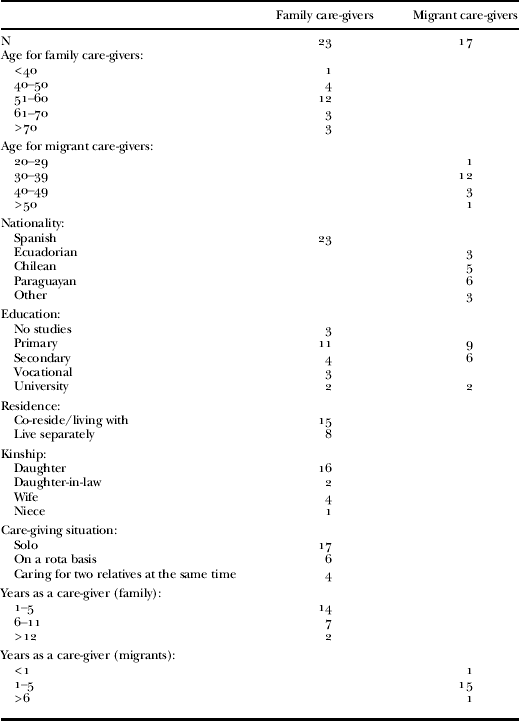
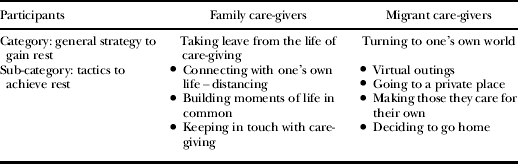
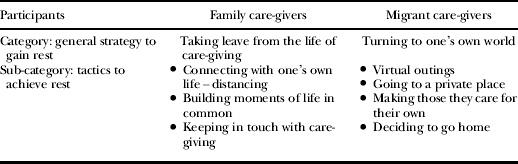
Table 1 presents and contrasts the samples characteristics. Similarities and differences were identified in their approaches to relieving the burden of caring. Table 2 presents the original categories and sub-categories and highlights the similarities and differences found as part of this comparative analysis. Rest for care-givers does not imply being idle and, on the contrary, showed that care-givers rest by thinking, doing and being but in a different manner from that of care-giving, that is: when they are a different person. To leave the life of care-giving is the general strategy that family care-givers use to rest from their care-giving selves while turning to one's own world describes the way migrant care-givers seek to relieve the burden of care (de la Cuesta-Benjumea Reference de la Cuesta-Benjumea2011; de la Cuesta-Benjumea, Donet-Montagut and Galiana-Gómez de Cádiz Reference de la Cuesta-Benjumea, Donet-Montagut and Galiana-Gómez de Cádiz2012). Both strategies are context bound hence, before contrasting them, the context is examined.
Participants' characteristics

Findings contrasted
Different contexts, a similar experience
In family care-givers' experience there is an ‘after’ and a ‘before’ care-giving, denoting that before they had a life which has now disappeared or is being substituted for another that they feel is not ‘normal’ and this happened without moving from their homes or towns. Theirs is an altered life. Now they are tied to care-giving, feeling ‘trapped’ in their homes and ‘with no freedom’. Due to the nature of dementia, care-givers' lives increasingly focus on care-giving activities and duties to a point that they have no life of their own, as one participant said ‘it is as if you step out of life … you don't really live it’ (Carmina, Spanish, 41 years old, takes care of her mother with dementia). Family care-givers' lives now run parallel to the lives of other family members; care-giving takes practically all the space in their lives. They have no time for themselves or a private space where to be themselves. Care-givers have renounced what was theirs:
I did not get out anymore … the disease developed so quickly! And then you do not have a life of your own! I would go out to have coffee but not going out with friends or go for a trip with them or with my boyfriend or say ‘I am going to do a normal life’. No, I have to restrict myself. (Maria, Spanish, 37 years old, takes care of her mother with Alzheimer's disease (AD))
However, this experience is modulated by the family support care-givers have.
As a participant explained, ‘it is family harmony, how one relates to siblings, what will help or not at all’ (Carmina, 41 years old, takes care of her mother with dementia). Sharing care among the family members will permit care-givers to retain a life of their own. For instance, Rosa explained during the interview that they are three sisters and they take care of their sick parents on rota basis, about once a month, and for a week, one of them moves into their parent's home (Rosa, 52 years old, takes care of her mother with AD and her father with mobility problems).
The migrant care-givers' context is that of frustrated expectations. They left their countries and families and migrated with the hope of finding a good job and a salary that would permit them to save enough money and return to their countries (Galiana Gómez de Cádiz and de la Cuesta-Benjumea Reference Galiana Gómez de Cádiz and de la Cuesta-Benjumea2008). Theirs is a dislocated life. On arrival, they found an unexpected situation, low salaries and poor working conditions; unlike family care-givers, they do not a have social network to help them shoulder the care-giving work. They felt trapped, having to endure and adjust their initial expectations. As with family care-givers, due to their migration and working conditions their present life is not normal. Nevertheless, migrant care-givers keep close ties with their families in their countries of origin and with migrant friends. While family care-givers have lost their regular lives, migrant care-givers are away from them. As one participant put it:
It is very hard. I miss a lot my family, this is constant, and I know how to spend the hours and days [without them] but on Sundays at night is when I miss them most, but time passes by reading or when speaking with my brothers. (Edith, Paraguayan, 35 years old, husband and children live in country of origin)
Nonetheless, care-givers might find better conditions in the host country than their country of origin as Kira, 30 years old, explained. She arrived from Romania to a good home where she feels like a daughter, has a better salary than the one she had received in Romania where she worked very hard as a care-giver and now has regular daily breaks from care-giving. She lives with her boyfriend and has been able to build a parallel life from that of care-giving. As a member of the European Union she does not have the difficulties other undocumented migrant care-givers have. On top of that, she can help her family in Romania economically; their basic needs are covered with the money she regularly sends. Her life is not altered nor dislocated, but improved from the life she had before, not surprisingly she feels ‘very happy’. This case illustrates the importance of working conditions in migrant care-giving, and how they can alter the whole experience of being a migrant care-giver.
For participants, their families are both the cause of initiating migration and a source of strength to endure the burden of care. To help their families and ‘bring them their bread’, as they said during the interviews, gives them a purpose in life. This makes the difference with other types of care-givers, as one participant explains:
Laura: One knows that [what she does] is work and that thanks to this work one is feeding many people, one is feeding her son, her brother, her mother. Then, one has to think that thanks to this older person one has this job and is feeding her children, then one thinks in that way and it gives you more life; it gives you spirit and determination to carry on because what you are doing is for your children.
Q: Well, but there are people who came to this country with no children.
Laura: But those with no children in fact care for dependent elderly for three, four months and no more, then they do not support it anymore because there is a lot of responsibility … if they do not have children, they do not last so long … we have to endure for our children, it is for them. (Laura, 27 years old, Paraguayan, her children live in country of origin)
Distancing oneself from a care-giving identity
The comparative analysis shows that in order to relieve the burden of care, migrant and family care-givers have in common the need to distance themselves from a care-giving identity. A care-giver expressed this by saying that she has to go out and ‘forget’ what she leaves behind (Marta, Spanish, 62 years old, takes care of her mother with AD). Many other family care-givers expressed that they have to ‘disconnect’ from care-giving, but in fact, in order to rest, care-givers do have to connect to other selves. The ways and means migrant and family care-givers employ to do that are different.
Migrant care-givers' rest is linked to the fact that they live in a country that is not their own, away from their families and separated from what belongs to them. To rest, for them, will imply a return to their preserved identities and places, this return can be a virtual one when they use information technologies. The locutorio Footnote 1 is a place where they can speak to their children and even see them via the internet. As Edith said, when she connects with her family it is like ‘breathing’ and this keeps her alive. Participants go to locutorio regularly ‘twice or even, three times a week’, as Amalia acknowledged during the interview (Bolivian, 24 years old, her children live in Bolivia). Going to the locutorio is like returning to their homes and to their identities as mothers or wives; via the internet and the phone mothers can follow their children's school progress, celebrate their birthdays and, in sum, care for them – albeit at a distance. In addition, going to the locutorio involves a break from the place where they stay the whole day:
Q: You said you come back ‘as new’ because you have spoken to your son or because you have taken some air?
Laura: Both, I have talked to my son and I get out of the house for a while because being locked in the house drives me mad, is something I cannot stand. (Laura, 27 years old, Paraguayan, her children live in country of origin)
Another mechanism that migrant care-givers use to relieve the burden of care is retiring to places of their own. These could be their bedroom in the home where they are in private to call in their minds what is theirs, imagine their children and speak to them, for some moments they are away, in their imagination connected to their family. Also they go out to share flats where they stay with relatives or peers during their free days or days off. In all these outings participants connect to their felt identity and this provides the needed rest. The break is from being a migrant care-giver:
Q: Being with your own family is how you recovered?
Ester: Yes, the [working] day passed quickly. (Bolivian, 52 years old, her family lives with her in Spain)
When they return to their countries of origin for a visit, their care-giving identity fades away, participants are truly themselves meeting their own kin; these visits are true breaks from care-giving, the effect is that of feeling life more intensively: ‘To come back to what belongs to you gives you a lot of vitality’, concluded Teresa (Uruguayan, 27 years old, all her family lives in country of origin).
Family care-givers, on their part, rest by taking on other identities that some of them had postponed and others lost. To rest or have respite here is not so much about going out to places as with the migrant care-givers; the crux is changing the self so they can distance themselves from a care-giving identity. Hence, activities that can be considered ‘work’ can, paradoxically, produce rest, a care-giver explains:
The way I clear my head is by going to my home and organising things at home! (Laugh.) It is not a time for my self, but it is time for my home! Time for my daughters and for my husband! (Laugh.) But time in inverted commas as neither my daughters nor my husband is at home at this time of the day. (Veronica, Spanish, 50 years old, takes care of her father with AD)
So family care-givers rest when they act as mothers, grandmothers or when they are intimate with their husbands. Staying with their friends or studying can also provide some rest. In these situations care-givers take on alternative selves so they can be ‘others’, as a participant said. Being another person can occur in the very same place where care-giving occurs. This is clearly shown when care-givers relate that they rest when engaging in activities with their sick relative such as watching TV together or reading to them. In this way, care-givers relate to their relative not as care-givers but as a kin and this provides moments of rest.
The family is an important source of alternative identities in both cases; the relationships that they establish with them provide a break from being a care-giver. However, migrant and family care-givers are constrained in connecting to these alternative selves. Most of these difficulties come from migrants' labour conditions and the family commitments family care-givers agree upon. The long working hours, the permanent availability and the few opportunities that migrant care-givers have to socialise restricted their opportunities to be someone different, to resort to their mind to recreate others is thus understandable and shows care-givers' resourcefulness to create symbolic places to rest. It was not unusual for participating family care-givers to agree upon economic arrangements in exchange for care-giving, such as keeping their parents' pension or inheriting the apartment after their death. The salary, in these cases, was received in advance. These economic arrangements altered their kin status in relation to other family members, care-givers felt constrained to ask for respite, as Juana commented during the interview (Spanish, 52 years old, cares for her mother with AD) or felt as if they were taking advantage of the situation by asking for respite breaks, as Carmina said (41 years old, takes care of her mother with dementia). These economic arrangements reinforced the moral obligation care-givers felt, making it very difficult for them to escape from their care-giver's identity.
Hence, to distance oneself from care-giving is not easy. Neither relationships nor places guarantee care-givers' rest. This contrasted analysis shows that there are false exits to a care-giving identity as they apparently distance participants from care-giving. Thus, migrant care-givers express that their employers treat them ‘as if’ they were family and that they relate with the sick person ‘as if’ they were a relative; employers trust them. A participant commented:
I do not feel the pressure of being controlled and questioned if I am doing wrong with granny, it is not that I am overstepping my role but the issue is that they [employers] treat me as if I am one member of the family, as another sister in their home who is taking care of her mother. (Nuria, Chilean, 54 years old, husband, children and grandchildren live in country of origin, emphasis added)
But these fictitious identities keep migrant care-givers connected to care-giving as this bond is established when providing care for the dependent person, as the quote shows. In addition, it puts them at risk of being emotionally exploited, increasing in this way their burden of care. A participant acknowledged that she felt she could not cope with the burden of care but, with gratitude, did not tell the employing family. For loyalty to the family, in her own words: she ‘would endure more than I could’ (Irene, Chilean, 52 years old, lives in own apartment with her children); the affective bond with the care recipient also contributes to care-givers' exhaustion (Laura, 27 years old, Paraguayan, her children live in country of origin). The home can also be a fictitious place that provides rest although not a true rest, as a participant explains:
Irene: We are there, 24 hours a day. It is as if it is our own home, where one can sit in the sofa and not attending request, closes the door, lies down, sleeps and do as ones pleases. This is something one can do on her own home! But if one is going to do this type of work and is alone with Mercedes [the patient] the entire house at my disposal! I was the owner of the house! It was my kingdom but it was not my house, I was working.
Q: Hence you did have a real rest.
Irene: No.
Q: When did you have it?
Irene: Now, in my own home … if I get tire I go for a lie down. (Irene, Chilean, 52 years old, lives in own apartment with her children)
Family care-givers, on their part, stated that there are occasions that they go away but remain ‘connected’ to care-giving. Thus they are physically in another place but worrying and wondering about what they left behind. Some participants stated that the cared for person is ‘in their head’ (Adela, Spanish, 62 years old, cares for her mother with dementia) all of the time and they constantly make phone calls to see if everything is all right or keep watching the cell phone for messages. In other cases, family care-givers go out for short walks and find themselves unoccupied and at a loss with themselves. They have no one to talk with, with no self to act upon. These outings do not provide relief as participants acknowledged, sometimes they returned from short breaks even more tired and feeling very lonely. As opposed to migrant care-givers, family care-givers have not been formally employed to care for the dependent person; for them, resting is not clearly legitimate (de la Cuesta-Benjumea Reference de la Cuesta-Benjumea2010). The verbal indicator of these false exits is when family care-givers speak of achieving rest ‘in inverted commas’ and migrant care-givers speak of ‘a different rest’ than the one they experience when they are in their own homes and with their own kind.
Discussion
Humans develop selves, during childhood and throughout life, which enter virtually in all actions and in varied ways (Mead Reference Mead1972). This study has shown the different selves that care-givers can act upon and the importance of others for care-giver's identity. Indeed, the others are essential for having a sense of self; a person cannot be in a vacuum, and identity is socially achieved (Blumer Reference Blumer1969). In the case of women, their identity as carer is moulded through the services they provide to the dependant (Graham Reference Graham, Finch and Gorves1983). To achieve rest, acting upon other selves is the key; the present study has illustrated the different mechanisms that care-givers use to regain different selves. These selves are gendered; they illustrate women's concerns for the wellbeing of others.
Family care is more than just actions and activities and implies relationships that demand identity and work (Carter Reference Carter, Adams and Clarke2001; Graham Reference Graham, Finch and Gorves1983). Caring is a labour that encompasses emotional bonds and ensures life (Graham Reference Graham, Finch and Gorves1983). It demands an adoption of a lifestyle which isolates care-givers from the outside world (Abel and Nelson Reference Abel, Nelson, Abel and Nelson1990; Finch and Groves Reference Finch, Groves, Finch and Groves1983). Care-givers' work is dictated by the times of the dependent person's needs; care-givers feel powerless to control the conclusion of their care-giving responsibilities, for many it is a boundless activity (Abel Reference Abel, Abel and Nelson1990). However, due to their legal and employment situation, migrant care-givers have less capacity to control the shape of their work and the demands placed upon them (Abel and Nelson Reference Abel, Nelson, Abel and Nelson1990).
Previous studies have emphasised the need for care-givers to have time for leisure, to be relieved from care-giving duties and to get breaks from care-giving (Lilly et al. Reference Lilly, Robinson, Holtzman and Bottorf2012; Robinson et al. Reference Robinson, Lea, Hemmings, Vosper, McCann, Weeding and Rumble2012; Upton and Reed Reference Upton and Reed2005). Women's identity is essentially relational (Abel and Nelson Reference Abel, Nelson, Abel and Nelson1990). Our comparative analysis and synthesis has highlighted that both family and migrant care-givers need to be connected to activities and people that enable them to be recognised as women, mothers, daughters, students or professionals, However, they have limited opportunities to interact with others while in the home and being confined limits their chances to create social bonds. If not truly connected to others, relief might be only achieved on the surface. By contrasting family and migrant care-givers' strategies, this study has reinforced the importance of relationships in burden relief and the need to have alternative selves to that of a care-giver. While for family care-givers this implies the need to retain their regular lives, for migrant care-givers this implies the need to have their work regulated.
Several studies have uncovered care-givers' coping strategies (Ekwall, Sivberg and Hallberg Reference Ekwall, Sivberg and Hallberg2007; Nolan, Grant and Keady Reference Nolan, Grant and Keady1996; Salin, Kaunomen and Ästedt-Kurki Reference Salin, Kaunomen and Ästedt-Kurki2009) but little has being said about strategies or activities that fail to produce the needed rest. The contrasted analysis and synthesis presented in this paper has uncovered this issue under the category of false exits. Family care-givers might go out but to a void. They lost their regular lives and now have no one to relate with, but other care-givers. In spite of being away from their care-giving duties and having time to rest, they do not really rest. Others are not there to enable them to feel a different self. Migrant care-givers might be treated as a family member but their emotions are being put into service; that is, being emotionally exploited (Hochschild Reference Hochschild2003). Under the appearance of being a member of the family, they are in fact requested to go beyond their contractual duties and move into the kinship realm where labour is also emotional (Ehrenreich and Hochschild Reference Ehrenreich, Hochschild, Ehrenreich and Hochschild2002). This might entitle the employer to encroach their off-duty hours (Anderson Reference Anderson, Ehrenreich and Hochschild2002). The migrant care-giver, as the domestic worker does, occupies a symbolic space between the public and the private; she is treated as ‘part of the family’ and as a worker according to her employer's interests (Anderson Reference Anderson, Ehrenreich and Hochschild2002). In fact, she is expected to provide additional caring tasks with no additional cost to the employer and care at the expense of her own social needs (Ayalon Reference Ayalon2009). While this might help them to cope with loneliness (Ayalon and Shiovitz-Erza Reference Ayalon and Shiovitz-Erza2010), the present study shows that, in the long run, this adds to the burden of care.
Frequently, the immigrants are not recognised as care-givers, but are referred to as domestic workers, or as informal family support (IMSERSO 2005; Plá-Juliá et al. Reference Plá-Juliá, Banyuls i Llopis, Cano-Cano, Martí-Gual, Pitxer i Campos, Poveda-Rosa, Sánchez-Velasco, Ventura-Franch and Bartual-García2007). This study has considered them as care-givers and highlighted the points that they have in common with family care-givers. No other studies have approached them in this manner. This highlights the need for migrant care-givers to be included as partners in care provision, which is the recommendation for family care-givers (Lilly et al. Reference Lilly, Robinson, Holtzman and Bottorf2012; Nolan, Grant and Keady Reference Nolan, Grant and Keady1996).
The support that migrant care-givers give to their family is being well documented under the concept of transnational care (Baldassar Reference Baldassar2007; Salazar-Parreñas Reference Salazar-Parreñas2001; Zechner Reference Zechner2008); it refers to all the forms of care and support that families exchange (Baldassar Reference Baldassar2007; Salazar-Parreñas Reference Salazar-Parreñas2001; Zechner Reference Zechner2008). The emotional and moral support that migrants receive has been well described in the literature (Baldassar Reference Baldassar2007, 2008; Wilding Reference Wilding2006); the present study has highlighted its relevance for enduring migrant's working situations and for providing them with respite. Communication technologies have been identified as key in providing emotional support and in maintaining migrants' sense of being part of their families, albeit at a distance (Baldassar Reference Baldassar2007, Reference Baldassar2008; Wilding Reference Wilding2006; Zechner Reference Zechner2008); technologies provide opportunities for a shared co-presence (Baldassar Reference Baldassar2008). The present study has shown that they provide the opportunity for resting from a care-giving identity and has identified the locutorio as the place where most of the transnational care exchanges take place. Here communication technologies are united, where migrants can phone and use the internet at very low cost and send remittances. The importance of migrants' visits to their homeland in transnational care-giving has also been documented (Baldassar Reference Baldassar2008); the present study has revealed them as a way of achieving respite from care-giving and helps them to continue care-giving.
Early literature paid attention to women entering into care-giving out of a sense of obligation (Finch Reference Finch1989) and studies have described the mechanisms that keep this obligation operating (Finch and Groves Reference Finch, Groves, Finch and Groves1983; Robles-Silva Reference Robles-Silva2007). Migrants' obligations to care for their families, in both in the host country and in their countries of origin, have been uncovered in previous studies (Anderson Reference Anderson2000, Reference Anderson, Ehrenreich and Hochschild2002; Ayalon Reference Ayalon2009; Wilding and Baldassar Reference Wilding and Baldassar2009). The present study shows that migrants could experience a double sense of obligation: to their own families and to their employers' when they feel part of the family. Here, their ties to care-giving are strong and hard to lose to relieve their burden of care.
Migrant care-givers usually work with no contracts and this impacts on their wellbeing (Anderson Reference Anderson2000; Vicente and Setién Reference Vicente, Setién, Gónzalez Ferreras and Setién2005). This illegal situation has consequences that employers need to be aware of. Urgent health issues that must be addressed among migrant workers are occupational safety, injury prevention, work-related diseases, discrimination and exploitation (Benach et al. Reference Benach, Muntaner, Delclos, Menéndez and Ronquillo2011; Gallart Fernandez-Puebla, Sanchez Cruz and Yarnoz Zabalegui Reference Gallart Fernandez-Puebla, Sanchez Cruz and Yarnoz Zabalegui2012); all of them relevant in care-giving. The need for improvements in paid care-givers' working conditions and to regulate this workforce has been voiced in the literature (Gallart Fernandez-Puebla, Sanchez Cruz and Yarnoz Zabalegui Reference Gallart Fernandez-Puebla, Sanchez Cruz and Yarnoz Zabalegui2012; King, Parsons and Robinson Reference King, Parsons and Robinson2012), as well as the need for promoting visits to their countries of origin and family reunions (Hochschild Reference Hochschild2003). The present study has highlighted how this regulation will contribute to the relief of burden and shown the benefits that this could have to their health. By maintaining links and connections with their peers and relatives, migrant care-givers do keep their own identities alive and such actions are like places of rest and act as respite.
Limitations of the study
Qualitative research does not aim at generalising but at describing in depth a given experience from participants' points of view. The comparative analysis contrasted two groups with the common experience of caring for a dependent person in adverse conditions but with notable differences among them. By focusing on the common issues of the groups during analysis, some nuances were lost. Data from migrant care-givers were less in amount and descriptiveness. During interviews it was difficult to get rich and descriptive data from them, as they were not always comfortable discussing rest. This may have affected the validity of data gathered and contrasted.
Conclusion
Care of frail and dependent older people is a global issue and the migration of women to care for them is a global trend. Migration moves from the south to the north and from the east to the west affect us all. While paying for care is an alternative for few, the relief of the burden of care is a concern of all. Both migrants and family care-givers share the difficulties in relieving the burden of care. Health professionals and policy makers must pay attention to the fact that, in relieving the burden of care, differences among the two sorts of care-givers are blurred.
Respite goes beyond places, times and activities; as family care itself, it requires identity. Therefore, to contribute to care-givers' relief of burden, health and social care professionals must promote care-givers' leisure activities, rest and regular breaks from caring and their involvement in different social roles. Health and social care professionals, nurses in particular, have an authorised voice and are in special positions to detect care-givers' needs for rest and can contribute to raising general awareness of migrant paid care-givers' needs for rest. In particular, they should encourage families to allow them enough free time and opportunities to link with their families and meet with their own social networks. The importance of regular visits to their countries of origin must also be stressed. In addition, health-care professionals are in an ideal position to convey to care recipients and families the difficulties that led to migration and the consequences that these have for their emotional and physical health. Attention must be given to those strategies that are false exits disguised as rest which can actually add burden to care-givers.
We can reduce the cost of care-giving. Care-giving needs to move beyond the private arena into public policy, especially the development of strategies and programmes to support care-givers and the provision of respite. Otherwise respite will remain an almost self-care activity. Migrant paid care-giving must be regulated and labour policies developed within countries. Regulation will diminish migrant care-givers' vulnerability, improve their working conditions and, last but not least, improve the quality of services and care of older people they care for in the community.
Although health problems associated with care-giving are well understood, less is known about effective interventions to support care-giving work: this is an area of future research. Respite services and programmes need to be under scrutiny, evaluative research in this area seems to be much needed. Family care is an increasingly complex issue, with new actors entering the field. Qualitative research has much to offer for better understanding of the experiences and needs of care-givers. Migrant care-givers ought to be included in studies about family care alongside others such as kinship care-givers and paid care-givers.
Appendix Guide for interview – migrant care-givers
Perhaps it is inappropriate to discuss resting in your present situation, but I wonder about the ways that people like you manage to have some respite from caring while caring for a dependent person. I would like, then, to hear about the things you prefer to do to regain strength or to rest. I am interested in your own experience.
• Perhaps we could start by you telling me the meaning that rest has for you in your situation.
• What things help you to rest?
• What do you do to rest from caring?
• Could you tell me about a situation in which you manage to take a rest (use own terms to address rest such as ‘recharge my batteries’, ‘recover’) from caring?
• Could you tell me of an instance when you needed a rest but could not get it?
Prompt questions:
• Could you give me an example?
• Are there other ways of doing it? Or do you do it in other ways?
• Happens always in that way? Does it change? How?
• Which difficulties do you face?
• Is there anything you would like to add?
Guide for interview – family care-givers
As we discussed, I am interested in care-giving for a person like your (here address kinship), in particular I wonder about the relief of burden in care-giving. I understand that care-giving is arduous work that can wear out people and that tiredness is a common experience in home care-giving.
• Could you tell me about the experience of caring for your relative (insert name of kinship)?
• I would like to know about how you rest: What things help you to rest?
• What do you do to rest from caring?
• Have your ever felt relief or rest? Could you tell me what happened? What does rest mean to you?
• Could you tell me about a situation in which you manage to take a rest (use own terms to address rest such as ‘recharge my batteries’, ‘recover’) from caring?
• Could you tell me of an instance when you would like to have had a rest but could not get it?
Prompt questions:
• Could you give me an example?
• Are there other ways of doing it? Or do you do it in other ways?
• Happens always in that way? Does it change? How?
• Which difficulties do you face?
• Is there anything you would like to add?