The completion of many changes in progress can be diagnosed by reference to the retention or disappearance of a certain phonemic contrast, such as the pin-pen merger in Southern American English or the cot-caught merger in many parts of the Western United States (Labov, Ash, & Boberg Reference Labov, Ash and Boberg2006). The case is different when the change is not a merger and the variation in question is not necessarily viewed in terms of a distinction, but of a variant of a phoneme that exhibits more or less extreme features or values of some sort, such as the height or backness of vowels, the voice onset time of certain consonants, etc. For some of these features, there are established criteria in order to determine whether the tokens of a speaker exhibit the phonetic traits consistent with a completed change. According to the Atlas of North American English (Labov et al., Reference Labov, Ash and Boberg2006), the criterion value for a “raised” vowel (/ɔ/) in bought or a raised vowel (/æ/) in bad is having a normalized F1 value of 700 Hz or lower. This type of variation does not necessarily have phonological consequences such as with the mergers just discussed.Footnote 1 This kind of nonphonemic change is the case that will be discussed in this paper: the devoicing of /ʒ/ in Buenos Aires Spanish.
The /ʒ/ in Buenos Aires Spanish (henceforth BAS) occurs natively in words that contain the orthographic sequences <ll> or <y> prevocalically, such as <yo> /ʒo/ ‘I’ or <calle> /ˈka.ʒe/ ‘street’. The variable devoicing of BAS /ʒ/: [ʒ] ~ [ʃ] has been studied since the mid-20th century (Fontanella de Weinberg, Reference Fontanella de Weinberg1978; Guitarte, Reference Guitarte1955; Malmberg, Reference Malmberg1950; Wolf & Jiménez, Reference Wolf, Jiménez and Barrenechea1979; Zamora Vicente, Reference Zamora Vicente1949; among others). In more recent work (Chang, Reference Chang, Westmoreland and Thomas2008; Wolf, Reference Wolf, Schwartz and Lerner1984), it has been claimed that the change has been completed in some sectors of the population. However, unlike changes such as the pin-pen merger, which involve the loss of a phonemic contrast, or “raised /ɔ/,” which has an established criterion value, the devoicing of /ʒ/ lacks both of these characteristics. There is no phonemic difference between [ˈka.ʃe] and [ˈka.ʒe] in BAS, although several works have discussed the changing sociolinguistic distribution of these variants (Fontanella de Weinberg, Reference Fontanella de Weinberg1978; Rohena-Madrazo, Reference Rohena-Madrazo2008; Wolf, Reference Wolf, Schwartz and Lerner1984; Wolf & Jiménez, Reference Wolf, Jiménez and Barrenechea1979).
In order to determine the completion of this change, this paper will explore the question of how to describe a phonetically voiced or voiceless fricative in a language without a fricative voicing contrast. It will provide an instrumental analysis of the progress of the /ʒ/ devoicing change not just by social group, as in Rohena-Madrazo (Reference Rohena-Madrazo, Colantoni and Rodríguez Louro2013), but also at the individual level within these groups. Furthermore, the current study will use both gradient phonetic evidence and phonological evidence as diagnostics for determining the completion of the change: on one hand comparing the voicing rates of /ʒ/ to those of /s/ and on the other comparing the affrication patterns of BAS /ʒ/ to those of General Spanish /ʝ/.
BACKGROUND ON SPANISH FRICATIVES
The fricative inventory of General Spanish is /f s x/, which are all phonologically voiceless.Footnote 2 BAS has the same three voiceless fricative phonemes but it also has in its inventory a postalveolar fricative phoneme, which is voiced: /ʒ/. This phoneme is usually represented orthographically by <y> or <ll> in prevocalic position, for example <yo> /ʒo/ ‘I’, <llama> /ʒama/ ‘s/he calls’, <vaya> /baʒa/ ‘(you-singular.formal) go!’, <calle> /kaʒe/ ‘street’. The /ʒ/ in BAS is etymologically related to /ʝ/Footnote 3 and to /ʎ/.
In the early 18th century in Argentina, as in most of the Spanish-speaking world, /ʝ/ and /ʎ/ underwent a phonological merger to /ʝ/ (Fontanella de Weinberg, Reference Fontanella de Weinberg1987:163), such that previous minimal pairs <haya> /aʝa/ ‘that there be’ and <halla> /aʎa/ ‘s/he finds’ became homophonous: [aʝa]. This phonological merger is traditionally known in Hispanic linguistics as “yeísmo.” Although yeísmo is widespread throughout the Spanish-speaking world, the phonetic realization of the resulting phoneme /ʝ/ is highly variable. Depending on factors such as phonological position, attention paid to speech, speaker's dialect, etc., it can exhibit realizations ranging from a glide [j], to a fricative [ʝ], to a stop [ɟ], and even to an affricate [ ] (Aguilar, Reference Aguilar1997:69–72; Hualde, Reference Hualde2005:165). Hualde (Reference Hualde, Schmeiser, Chand, Kelleher and Rodriguez2004) discussed the quasiphonemic status of /ʝ/, because it could also be analyzed as an unstressed, nonsyllabic allophone of /i/, as seen in Figure 1. Nevertheless, aside from lexical-phonological factors, there exist allophonic tendencies whereby the palatal obstruent phoneme /ʝ/ is more often realized as a stop or affricate in phrase-initial position or after nasals or laterals; whereas, in intervocalic positions, it is more likely to be realized as a weak fricative, approximant, or glide. For this reason, Morgan (Reference Morgan2010) chose to classify and transcribe this phoneme as /ɟ/, rather than /ʝ/, because it shares similar allophonic tendencies, albeit more variable, with the voiced stops in Spanish /b d ɡ/, which are realized as stops [b d ɡ] in phrase-initial position or after a nasal or homorganic lateral, and in other positions as [β ð ɣ] (ranging from fricative to very lenited approximant realizations).Footnote 4
Word classes and range of realizations in Castilian Spanish (adapted from Hualde, Reference Hualde, Schmeiser, Chand, Kelleher and Rodriguez2004:13).

By the late 18th century in Buenos Aires, the palatal obstruent /ʝ/ had undergone a process of fortition and came to be realized as a grooved postalveolar sibilant fricative: /ʒ/ (Fontanella de Weinberg, Reference Fontanella de Weinberg1973:342; Maspero, Reference Maspero1875:55). This phenomenon is known in Hispanic linguistics as “žeísmo.” This resulting /ʒ/ also had a positional allophonic distribution similar to that of General Spanish /ʝ/, where the affricate realization [dʒ] was more common in phrase-initial position and after nasals (and in initial position could vary with [ʒ]), whereas in intervocalic position the fricative realization [ʒ] was more common (Fontanella de Weinberg, Reference Fontanella de Weinberg1978).
By the mid-20th century, after žeísmo had already become incorporated into BAS, several studies (Guitarte, Reference Guitarte1955; Malmberg, Reference Malmberg1950; Zamora Vicente, Reference Zamora Vicente1949; among others) made mention of the fact that this relatively new phoneme /ʒ/ was sometimes devoiced and realized as [ʃ].
The devoicing of /ʒ/ in Buenos Aires: Previous studies
Among the first and most influential variationist studies of the devoicing of /ʒ/ were those conducted by Fontanella de Weinberg. Fontanella de Weinberg (Reference Fontanella de Weinberg1978) studied the devoicing of /ʒ/ in Bahía Blanca, a city in the province of Buenos Aires, focusing on the phonological restructuring of the palatal system. She found that the phonological distinction between /ʒ/ and /ʃ/ was being lost (claiming that /ʃ/ is the phoneme for foreign loanwords such as ‘show’ and ‘shorts’) for speakers who devoiced /ʒ/ as well as for those speakers who voiced /ʃ/. Fontanella de Weinberg (Reference Fontanella de Weinberg1978; Reference Fontanella de Weinberg1983) found stylistic effects differentiated by education level, where the speakers with a primary- or university-level education decreased their use of [ʃ] in more careful styles, while the speakers with secondary education increased their use of voiceless variant in the more careful styles, regardless of the fact that, according to the author, [ʃ] was not a prestigious variant. In addition, she also found that the devoicing change was led by younger speakers, particularly females, a characteristic trait of changes in progress (see Labov, Reference Labov1972, Reference Labov2001).
Wolf and Jiménez (Reference Wolf, Jiménez and Barrenechea1979) also studied the devoicing of /ʒ/, but in the city of Buenos Aires, with results similar to those of Fontanella de Weinberg (Reference Fontanella de Weinberg1978). The factors of age and sex were important in determining the use of either the voiced or voiceless realization of the phoneme /ʒ/. They found that the women younger than 30 were leading the change, followed by the men, who lagged behind by a generation. Wolf and Jiménez (Reference Wolf, Jiménez and Barrenechea1979) reported the effect of social class as minimal and that speakers who devoiced /ʒ/ were not conscious of the devoicing phenomenon. Furthermore, they concluded that the devoicing seemed to be a change in progress, and for some groups it might be nearing completion.
Wolf (Reference Wolf, Schwartz and Lerner1984) conducted a real-time study with a subset of the speakers who had participated in the Wolf and Jiménez (Reference Wolf, Jiménez and Barrenechea1979) study and found that, for some younger speakers, the devoicing change seemed to have been completed. However, she also found that upper-class speakers appeared to be revoicing their /ʒ/. In other words, the younger male speakers, all within school-age, who had shown some moderate usage of [ʃ] in the 1979 study, exhibited the voiced variant [ʒ] almost exclusively in the 1984 study. Apparently, these “revoicers” were the only ones that were consciously aware of the change from /ʒ/ to [ʃ] and avoided it in order to maintain a social distinction between the upper class and the other social strata. For this reason, Wolf (Reference Wolf, Schwartz and Lerner1984) proposed that the devoicing of /ʒ/ had already been completed in the youngest generation and the revoicing, as a type of age-grading, was evidence of stable variation in the speech community.
Already in the 21st century, several studies have been conducted using instrumental acoustic analysis in order to investigate the progress of the devoicing of /ʒ/ in BAS. Chang (Reference Chang, Westmoreland and Thomas2008) studied the devoicing levels of /ʒ/ and observed that the change was already quite generalized in the younger generation. Chang used categorical methods (auditory categorization) as well as gradient methods (percentage of voicing and relative intensity) in order to measure the voicing of the fricative in a reading task, where participants read aloud a comic strip. He found that the speakers born before 1945 predominantly produced voiced realizations, whereas the speakers born after 1975 produced voiceless variants almost exclusively. The speakers born during the intervening period showed variability in their devoicing of /ʒ/. Chang (Reference Chang, Westmoreland and Thomas2008:26) did not find an effect of sex, as young speakers, male and female, produced [ʃ] consistently: “speakers in the youngest age bracket are all approaching a ceiling of 100% devoicing,” which seemed to suggest that for them the change from /ʒ/ to /ʃ/ had already been completed.
Rohena-Madrazo (Reference Rohena-Madrazo2008) also used instrumental measures in order to determine the devoicing of /ʒ/ in BAS. The data were collected from sociolinguistic interviews and the devoicing of /ʒ/ was determined by examining the voicing bar in the spectrogram as well as the periodicity in the waveform during the duration of the fricative segment /ʒ/. This study confirmed that the men in the younger generation had already caught up with the women in terms of the use of the innovative variant; therefore, for the majority of the younger speakers, the postalveolar fricative had already been devoiced. Furthermore, unlike Chang (Reference Chang, Westmoreland and Thomas2008), Rohena-Madrazo (Reference Rohena-Madrazo2008) found that area of residence as an index of social class was a significant factor in the advancement of the change. Among the older speakers, the middle-class speakers were in the lead of the innovation, ahead of both the upper and working classes, which is characteristic of changes “from below” (see Labov, Reference Labov1972, Reference Labov2001). However, Rohena-Madrazo (Reference Rohena-Madrazo2008) also found that the difference in voicing between the working and middle classes had been lost among the speakers of the younger generation, which is further evidence that the devoicing of /ʒ/ could be nearing its final stages.
Rohena-Madrazo (Reference Rohena-Madrazo, Colantoni and Rodríguez Louro2013) presented a more detailed instrumental study of the devoicing of /ʒ/ in Buenos Aires Spanish, comparing the percentage of voicing of /ʒ/ to the percentage of voicing of /s/. Although the devoicing change of the younger, middle-class speakers seemed to have been completed, it was not the case that all the younger speakers had completed the devoicing change. There was a significant difference between the younger speakers of the middle class and the younger speakers of the upper class. In fact, the younger upper-class speakers maintained voicing rates of /ʒ/ that were not significantly different from the voicing rates of the older middle-class speakers. The older upper-class speakers still maintained the highest levels of /ʒ/ voicing. Similarly to Chang (Reference Chang, Westmoreland and Thomas2008), Rohena-Madrazo (Reference Rohena-Madrazo, Colantoni and Rodríguez Louro2013) did not find any effect of sex on the devoicing of /ʒ/. This study also investigated the variable of style (isolated in a word list vs. running speech in sentences) and found that there was more voicing of /ʒ/ in running speech rather than in isolated words, contrary to what would be expected if [ʒ] were a variant associated with prestige, as Wolf (Reference Wolf, Schwartz and Lerner1984) had suggested. Moreover, Rohena-Madrazo (Reference Rohena-Madrazo, Colantoni and Rodríguez Louro2013) found that the increased voicing in running speech held for /s/ in exactly the same way, suggesting that any stylistic task effect was most likely due to phonetic constraints, such as a greater likelihood of mistiming of the laryngeal and lingual gestures in the more rapid connected speech of the sentences, resulting in more overlap of voicing during the production of both /s/ and /ʒ/ in speakers across all social groups. Nevertheless, Rohena-Madrazo (Reference Rohena-Madrazo, Colantoni and Rodríguez Louro2013) did not examine the possible differences within each group with respect to the change nor did he investigate other possible phonetic or phonological correlates, such as position or manner of articulation, which could be further evidence toward the completion of the devoicing change.
In terms of BAS speakers’ awareness of the devoicing phenomenon, Wolf (Reference Wolf, Schwartz and Lerner1984) had suggested that the upper-class speakers were conscious of the change and had negative evaluations toward the devoicing phenomenon. Colantoni (Reference Colantoni2008) conducted a preliminary pseudosubjective reaction test and found that the voiceless variants were attributed to younger age groups, particularly by older speakers. Furthermore, while lower- and middle-class listeners did not consistently attribute the voiced variant to speakers of any social class in particular, the upper-middle-class and upper-class listeners attributed most of the voiced variants to their own social strata. Colantoni (Reference Colantoni2008) suggested that the younger generation and the lower class were unaware of the voicing variation in /ʒ/, but the upper-middle and upper-class speakers did perceive this variation in [ʃ]~[ʒ], despite the fact that the devoicing of /ʒ/ was spreading to these groups as well. In another recent subjective reaction study, King (Reference King2009) found that 12 of 19 young adult participants were able to identify the voicing variable and most of those associated it with speakers from traditionally upper-class neighborhoods of northern Buenos Aires. She analyzed the production of a subset of the speakers and found that most of them produced the voiceless variant more frequently, indicating that the variation between [ʃ]~[ʒ] might be salient even among younger BAS speakers who use [ʃ] overwhelmingly.
Voiced and voiceless fricatives in the absence of a voicing distinction
Most of the studies discussed thus far examine the variable voicing of /ʒ/ in the context of variation and change in progress or completion of the change. It is complex to determine what a voiced fricative is in a language that lacks a phonemic voicing contrast for fricatives, because it is difficult to demarcate the limit that would separate a voiceless fricative from a voiced one, without the aid of native categorical perception. In the case of /ʒ/ in BAS, previous studies identify several variants: completely voiced [ʒ], partially devoiced [ʒ̊], and completely voiceless [ʃ] (Fontanella de Weinberg, Reference Fontanella de Weinberg1978:223; Wolf & Jiménez, Reference Wolf, Jiménez and Barrenechea1979). These symbols for each category are conceptually interpretable; however, it is unclear what percentage of (de)voicing would correspond to each category, for each of the aforementioned authors.Footnote 5
Recent sociolinguistic studies that employ instrumental methods, such as Chang (Reference Chang, Westmoreland and Thomas2008), do consider the gradient nature of the voicing variability in /ʒ/, such as, the average percentage of voicelessness during the production of the fricative. If /ʒ/ were to be consistently produced as 100% voiceless, then there would be no doubt that the devoicing change has been completed. However, the question remains, does the completion of the devoicing change necessarily imply or require 100% voicelessness in all utterances of /ʒ/?
Recent studies (A. García, Reference García2013; Hualde, Simonet, & Nadeu, Reference Hualde, Simonet and Nadeu2011; Machuca Ayuso, Reference Machuca Ayuso1997; Martínez Celdrán, Reference Martínez-Celdrán2009; Martínez Celdrán & Fernández Planas, Reference Martínez Celdrán and Fernández Planas2007:69–84; Parrell, Reference Parrell2011; Schmidt & Willis, Reference Schmidt, Willis and Alvord2011; Torreira & Ernestus, Reference Torreira and Ernestus2011, Reference Torreira and Ernestus2012) have found evidence of partial or complete voicing of phonologically voiceless stops and fricatives in Spanish. For example, Machuca Ayuso (Reference Machuca Ayuso1997) found in her corpus of conversation speech more than 40% of phonologically voiceless stops /p, t, k/ were realized as [b, d, ɡ]. Torreira and Ernestus (Reference Torreira and Ernestus2011) found that in the Nijmegen Corpus of Spontaneous Spanish (Torreira & Ernestus, Reference Torreira, Ernestus, Chair, Choukri, Maegaard, Mariani, Odijk, Piperidis, Rosner and Tapias2010) 32.7% of voiceless stops presented complete voicing during stop closure. These studies demonstrate that there is variation in stop voicing, despite the phonemic voicing distinction present in Spanish.Footnote 6
A phonemic voicing distinction used to exist in Medieval Spanish sibilants /s̪, s, ʃ/ versus /z̪, z, ʒ/; however, during the late 16th century, the voiced sibilants devoiced and merged with the voiceless fricatives /s̪, s, ʃ/, which later underwent a process of dissimilation, resulting in the three lingual fricative phonemes of North-Central Iberian Spanish: /θ, s, x/ (Penny, Reference Penny2000:43–45). Although modern-day General Spanish does not present a fricative voicing distinction,Footnote 7 there is allophonic voicing of fricatives in coda position before a voiced consonant, for example, /ˈmismo/ → [ˈmiz.mo] ‘same’, /afˈɡano/ → [av.ˈɣa.no] ‘Afghan’ (see Hualde, Reference Hualde2005; Morgan, Reference Morgan2010). This process of fricative voicing assimilation has often been treated as a classic case of complementary distribution, for example, /s/ → [z] / __.Cvoiced, both word-internally and across word boundaries, and /s/ → [s] elsewhere.
However, more recent instrumental studies on the realization of /s/ in Vs.Cvoiced contexts have found a substantial amount of intra- and interspeaker variation in the frequency and degree of voicing of /s/ across several coda /s/-retaining varieties of Spanish (A. García, Reference García2013; Schmidt & Willis, Reference Schmidt, Willis and Alvord2011). Schmidt and Willis (Reference Schmidt, Willis and Alvord2011:7) found that as many as 37% (61/166) of /s/ in Vs.Cvoiced contexts were actually realized as voiceless [s], demonstrating that in Mexico City Spanish, a variety that is quintessentially known for exhibiting /s/ voicing assimilation, this phenomenon is far from categorical.
Interestingly, Schmidt and Willis (Reference Schmidt, Willis and Alvord2011) also found instances of phonetically voiced intervocalic /s/, which is supposed to be voiceless, in 9% (20/214) of instances. This percentage, although small, shows that phonetic variation in voicing does occur in phonologically voiceless fricatives in Spanish as well. Furthermore, other recent instrumental studies have also presented examples of fully voiced fricatives in intervocalic onset position and that this variable and gradient phenomenon can be linked to factors such as the gestural misalignment that can result from increases in speech rate (A. García, Reference García2013; C. García, Reference García2013; Martínez-Celdrán, Reference Martínez-Celdrán, Colantoni and Steele2008; Rohena-Madrazo, Reference Rohena-Madrazo2011, Reference Rohena-Madrazo, Colantoni and Rodríguez Louro2013; Torreira & Ernestus, Reference Torreira and Ernestus2012). In short, these studies present evidence that the notion of categorical voicelessness is inconsistent with phonetic fact.
THE AIMS OF THIS STUDY
The present study aims to investigate the devoicing of /ʒ/ in BAS, building on the results from Rohena-Madrazo (Reference Rohena-Madrazo, Colantoni and Rodríguez Louro2013), using instrumental techniques that capture the variability of the voicing of this fricative. By comparing the present results to those of previous studies, it will be possible to determine the progress of the change, at the individual and at the group levels.
Another objective of this study is to propose a novel method of determining the completion of the devoicing of /ʒ/ in BAS both phonetically and phonologically, considering both positional allophony and phonetic gradience. The phonological method will explore the allophonic tendencies of /ʒ/ determined by position and compare them to those described for its etymological counterpart /ʝ/ and to the other Spanish sibilant /s/. The phonetic method of determining the completion of the devoicing change is by comparing the voicing levels of the postalveolar fricative /ʒ/ to those of /s/ (see Rohena-Madrazo, Reference Rohena-Madrazo, Colantoni and Rodríguez Louro2013). The reasons for using /s/ as a devoicing criterion are the following: (i) out of the fricatives of BAS, /s/ is acoustically and articulatorily most similar to /ʒ/;Footnote 8 (ii) the voicing rates of /s/ have not been shown to be subject to social factors in the way that /ʒ/ has in BAS; and (iii) /s/ does not show the contextual allophonic affrication patterns that /ʝ/ and /ʒ/ do.
Hypotheses: Diagnosing /ʒ/ → /ʃ/
In terms of voicing rates, if the mean voicing rates of /ʒ/ are higher than the mean voicing rates of /s/, then one can say that the change is still in progress or stable (Wolf, Reference Wolf, Schwartz and Lerner1984). However, if there is no significant difference between the percentage of voicing of /ʒ/ and that of /s/, then one can conclude that the devoicing change has been completed and the underlying phoneme for a particular speaker or a group within the speech community is a voiceless postalveolar fricative: /ʃ/.
With regard to the phonetic effects of position, both fricatives should exhibit more voicing in intervocalic position. Browman and Goldstein (Reference Browman and Goldstein1992:157) assumed that “the larynx is positioned appropriately for voicing unless otherwise instructed,” which makes voicing the speech-ready state. Westbury and Keating (Reference Westbury and Keating1986) argued that it is more difficult to stop vocal fold vibration during a singleton stop closure than it is to maintain it throughout the obstruent segment. Kirchner (Reference Kirchner1998:55) described similar tendencies for singleton voiceless fricatives as well. Furthermore, obstruent voicing should be less likely in phrase-initial position than in intervocalic position, because the subglottal and supraglottal pressure difference necessary for voicing tends to be lower in utterance-initial environments (Westbury & Keating, Reference Westbury and Keating1986:153).
With regard to the phonological effects of contextually defined affrication, if the resulting fricative exhibits affrication in phrase-initial position, then it still patterns along the lines of the palatal obstruent of General Spanish /ʝ/ or the traditional voiced postalveolar fricative /ʒ/ of BAS. However, if the resulting fricative does not show contextually conditioned affrication, then it behaves like the other sibilant in the fricative system: /s/. This would be further evidence that the devoicing change has been completed, and as such, one would expect the speakers who no longer show a voicing difference between /s/ and /ʒ/ not to exhibit the affrication patterns.
In order to test these hypotheses a production study was conducted with speakers of BAS.
METHODS
Participants
The participants for this study needed to meet the following selection criteria: to be at least 18 years old, be a native speaker of Spanish, have been born and/or raised in the city of Buenos Aires or its metropolitan area, and to be residing there during the time of the data collection. The participants were recruited using the “friend of a friend” technique (Milroy, Reference Milroy1980). All of the speakers participated voluntarily without monetary compensation.
The main language-independent social factors that were considered were age and social class. As sex was no longer found to be a significant factor affecting the devoicing change in Chang (Reference Chang, Westmoreland and Thomas2008) and Rohena-Madrazo (Reference Rohena-Madrazo, Colantoni and Rodríguez Louro2013), it was not included in the analyses. While the categorization of the speakers by age is relatively straightforward, the classification of speakers into socioeconomic categories is more problematic. There are a multitude of factors that could determine someone's socioeconomic position such as education, income, place of residence, occupation, race, ethnicity (see Guy, Reference Guy and Newmeyer1988). Because place of residence has been an important component in the determination of social class in past investigations (Rohena-Madrazo, Reference Rohena-Madrazo2008, Reference Rohena-Madrazo, Colantoni and Rodríguez Louro2013), it is necessary to examine some demographic facts about Buenos Aires.
Area of residence as a proxy for social class
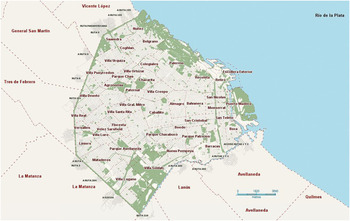
Buenos Aires is the capital of Argentina and its largest city. The Buenos Aires metropolitan area is known as the Conurbano Bonaerense, which is composed of the city of Buenos Aires proper (Ciudad Autónoma de Buenos Aires) and Greater Buenos Aires (Gran Buenos Aires). According to the provisional results of the 2010 census, the population of the city of Buenos Aires is 2,891,082 and the population of the 24 partidos (provincial administrative subdivisions) of Greater Buenos Aires is 9,910,282, for a total metropolitan population of just over 12.8 million (Instituto Nacional de Estadística y Censos, República Argentina, 2010). Figure 2 shows a map of the City of Buenos Aires and Figure 3 shows a map of the Buenos Aires metropolitan area, with the City of Buenos Aires and the Greater Buenos Aires administrative regions indicated.
Map of the City of Buenos Aires (Ciudad Autónoma de Buenos Aires), showing the neighborhood subdivisions as well as the adjacent partidos in Buenos Aires Province (Mapa Interactivo de la Ciudad Autónoma de Buenos Aires, n.d.).

Map of the Buenos Aires metropolitan area with the administrative subdivisions or partidos (Wikimedia Commons, 2006).

During the 20th century, there has been differential development of the northern zone of the Buenos Aires metropolitan area, particularly compared to areas of the south and west. This development has resulted in increased property values and has attracted more affluent, higher-status residents (Ciccolella, Reference Ciccolella1999; Torres, Reference Torres2001). Furthermore, the north-south social distinction is quite salient in the Buenos Aires community. One participant from Rohena-Madrazo (Reference Rohena-Madrazo2008), a 60-year-old man from Southern Buenos Aires, provided a very relevant example regarding his and his wife's place of origin: “Los dos somos del sur, eso tiene una cierta connotación . . . sociocultural. La diferencia norte-sur existe.” ‘We're both from the south; that carries a certain . . . sociocultural connotation. The north-south difference exists.’
Rohena-Madrazo (Reference Rohena-Madrazo2008) devised a socioeconomic index taking into consideration factors such as education, occupation, and place of residence. The speakers in that study patterned into three groups: (i) professionals with postsecondary education (or postsecondary students) living in Northern Buenos Aires, (ii) professionals with postsecondary education (or postsecondary students) living in Southern Buenos Aires, and (iii) manual laborers with elementary school education living in Southern Buenos Aires. These three groups were identified as upper, middle, and working classes, respectively. The distribution of the devoicing of /ʒ/ in these three groups showed a curvilinear pattern, characteristic of changes from below, where the middle social stratum shows higher rates of the innovation. However, in the younger generation, the difference in devoicing rates between the middle class and the working class was eroded; in other words, the differences in education and occupation between these two social classes did not seem to be significant factors affecting the devoicing of /ʒ/. For the younger generation, there were, consequently, two social class groups that differed in their devoicing rates: the upper class and the nonupper class. The component of the socioeconomic index that distinguished these two groups was area of residence (north vs. south), which suggested that area of residence, rather than education or occupation, seemed to be emerging as the relevant social class indicator differentiating the group that disfavored devoicing of /ʒ/ (northerners/upper class) and the group that favored the devoicing innovation (southerners/middle + working classes).
Because the current study included a much longer and detailed reading component, it was not feasible to include the working-class group, because in Rohena-Madrazo (Reference Rohena-Madrazo2008) many had shown visible discomfort and disfluencies during their reading tasks. Taking into consideration these methodological differences, only upper- and middle-class speakers were recruited for the experiments in this study. For the purposes of this study, area of residence was used as a proxy for the speakers’ social class: speakers from northern Buenos Aires were considered to be upper class and the speakers from southern Buenos Aires were considered to be middle class. All of the participants in this study had completed secondary education and, those who were not university students, worked or had worked in professional, administrative, or educational positions.
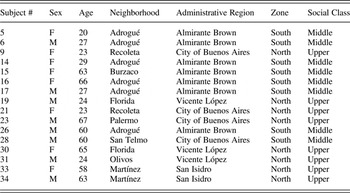
The 16 participants were equally stratified by sex (8 males and 8 females), by age (8 younger speakers, 18–29 years of age, and 8 older speakers, 55 years of age and older), and by socioeconomic class (8 middle-class and 8 upper-class speakers). This subset of 16 speakers shown in Table 1 (also sampled in Rohena-Madrazo [Reference Rohena-Madrazo, Colantoni and Rodríguez Louro2013], from the larger corpus in Rohena-Madrazo [Reference Rohena-Madrazo2011]) represents the first two participants for each cell (sex × age group × social class) who qualified for inclusion in the present study.
Demographic information of the participants in the current production study

Experimental tasks
Two production tasks were analyzed in this investigation: a word list and a sentence list. The word list was meant to elicit more careful citation speech. This word list contained 75 instances of syllable-onsetFootnote 9 sibilant fricatives (35 /ʒ/ and 40 /s/). These target fricatives were evenly distributed between intervocalic (VCV) and phrase-initial (##CV) positions. The sentence list was meant to elicit a reading style of comparatively less careful running speech (Labov, Reference Labov1972). The sentences in the list contained all of the words from the word list.
The participants were instructed to read aloud the word and sentence lists as they would naturally. They were recorded in a quiet room, using a Sony MZ-RH910 recorder and an Audio-Technica ATM75 head-mounted microphone.
Acoustic analysisː Percentage of voicing
The percentage of voicing during frication for /ʒ/ as well as for /s/ was measured instrumentally using Praat 5.1.26 (Boersma & Weenink, Reference Boersma and Weenink2010). The segmentation of the fricatives was carried out by inspecting the onset and offset of high frequency energy. Borzone de Manrique and Massone (Reference Borzone de Manrique and Massone1981) found that the noise components of the postalveolar fricative in Buenos Aires Spanish ranged between 2500 and 5500 Hz. Taking this into consideration, the boundaries of the fricative were placed at the onset and offset of broadband noise at those frequencies or higher, irrespective of any overlap with formant structure, following the segmentation criteria from studies on fricative devoicing in English (Frisch & Wright, Reference Frisch and Wright2002; Smith, Reference Smith1997). For both fricatives, this was the segmentation rubric used instead of one based on changes in formant structure or periodicity in the waveform, because a criterion was needed that could remain agnostic to voicing, because the percentage of voicing would be the dependent variable.
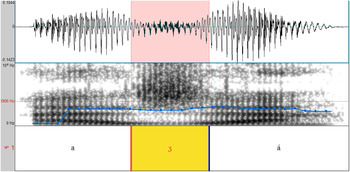
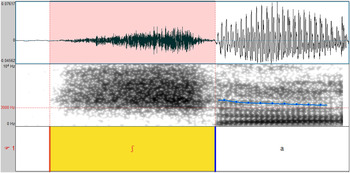
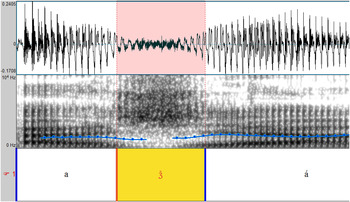
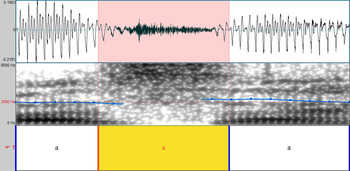
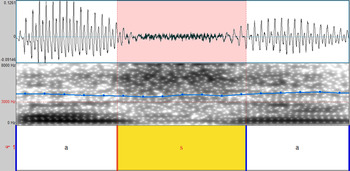
The calculation of percentage of voicing during frication was also conducted in Praat. A total of 21 equidistant points spanning the fricative interval were identified and an F0 value was queried at each of these points. The percentage of voicing for each fricative was determined by calculating the proportion of points for which F0 could be calculated, throughout its duration. Figures 4 to 6 are examples of the segmented fricatives with their corresponding voicing percentage values.
Example of a 100% voiced /ʒ/ <allá> ‘there’ (subject 21, upper class, female, 23 years old).

Example of a 0% voiced /ʒ/ <ya> ‘already’ (subject 5, middle class, female, 20 years old).

Example of a 62% voiced /ʒ/ <allá> ‘there’ (subject 30, upper class, female, 65 years old).

The postalveolar fricative /ʒ/ was not the only fricative that presented variation in voicing. The data in this corpus showed partially and fully voiced tokens of the alveolar fricative as well. Figures 7 and 8 provide some examples. This provides further evidence that voicing variation in phonologically voiceless fricatives does occur (as attested in A. García, Reference García2013; Schmidt & Willis, Reference Schmidt, Willis and Alvord2011; Torreira & Ernestus, Reference Torreira and Ernestus2012), and the distribution of this variation should be studied more systematically in this and other varieties of Spanish.
Example of /s/ in <pasajero> ‘passenger,’ which shows 43% voicing (subject 21, upper class, female, 23 years old).

Example of /s/ in <pasajero> 'passenger,’ which shows 100% voicing (subject 5, middle class, female, 20 years old).

RESULTS AND DISCUSSION
Other variants of /s/ and /ʒ /
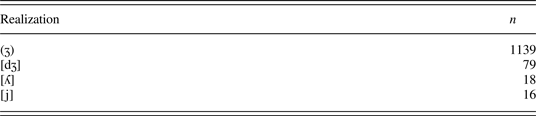
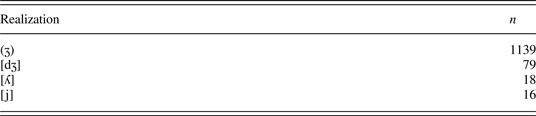
Although the stimuli were designed to elicit sibilant fricative realizations of both /s/ and /ʒ/, not all of the realizations fell within that category. An examination of the variants can be found in the Tables 2 and 3 (some realizations are shown in parentheses so as to remain agnostic to their voicing values).
Realizations of the stimulus obstruent /s/

Realizations of the stimulus obstruent /ʒ/
On examination of Table 2, of the 1335 realizations of /s/, there are no affricate realizations of the phoneme /s/ in the data, as might be expected. Only two instances were realized as other than an alveolar fricative: the interdental fricative [θ]. The two instances of /s/ realized as [θ] occurred in <cazaba> ‘s/he hunted’ in the word list. The pronunciation of <z> as [θ] is not characteristic of BAS but of North-Central Iberian Spanish. This might be a case of hypercareful speech, such that it becomes essentially nonnative.
As seen in Table 3, the vast majority of the realizations of the stimulus obstruent /ʒ/ were postalveolar fricatives. A similar explanation to that of [θ] for /s/ might be appropriate for the approximant realizations of /ʒ/ as [j] and [ʎ]. These marginal approximant realizations of /ʒ/ were also found in Chang (Reference Chang, Westmoreland and Thomas2008:61). These realizations have not been characteristic of BAS for well over a century (Fontanella de Weinberg, Reference Fontanella de Weinberg1978); however, BAS speakers are exposed to these variants, not just in non-Argentinean media, but also in the school system.Footnote 10 It is highly unlikely that in unscripted speech, with other native BAS speakers, the participants would produce these variants. In fact, the vast majority of these nonnative-like realizations occurred not in the sentence reading task, but in the word list task, where there is more attention paid to speech.
Marginal approximant realizations aside, 6% of the stimulus obstruents were produced as affricates. Although not very frequent in the corpus as a whole, a more detailed analysis of the affricated realizations merits investigation. However, because of the discrepancy in the distribution of the affricated variants between /s/ and /ʒ/, the affricated tokens were not included in the statistical analysis of the percentage of voicing; however, their distribution will be considered later when discussing phonological evidence for the devoicing change.
General statistical analysis
The main dependent variable in this investigation was the percentage of voicing of the sibilant in question, either /ʒ/ or /s/. For the statistical analyses, the dependent variable was arcsine transformed; however, for ease of exposition, all of the results are expressed here in percentage of voicing.
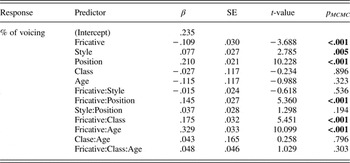
In order to investigate the main effects and interactions of the independent factors on percentage of voicing of the fricatives, the data were analyzed in a linear mixed effects regression model, with subject as a random factor and fricative, position, and style (within-subject), and class and age (between-subject) as fixed effects. For these statistical models, the estimated effect size (β), its standard error, and its corresponding t value are reported. The p-values were calculated using Markov chain Monte Carlo simulations. In the case of significant interactions, the data were divided to explore their effects further.
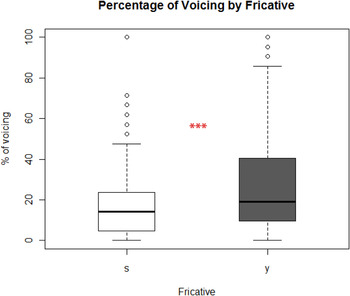
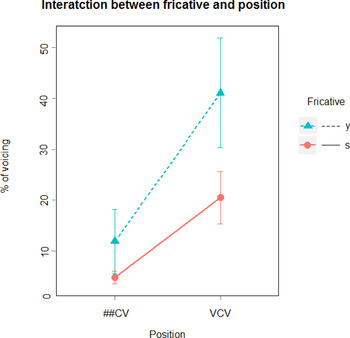
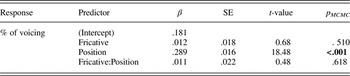
The linear mixed effect regression model produced significant fixed effects for fricative, style, and position (see Table 4). The mean percentage of voicing for /ʒ/ (M = 33.1, SD = 33.4) was significantly higher than that of /s/ (M = 15.9, SD = 15.4). The percentage of voicing for the fricatives in the sentence style (M = 30.3, SD = 28.4) was significantly higher than that of the fricatives in the word list style (M = 17.3, SD = 23.5). The percentage of voicing for the fricatives in phrase-initial position (M = 8.1, SD = 14.2) was significantly lower than that of the fricatives in intervocalic position (M = 30.4, SD = 28.2). There was also a significant interaction between fricative and position. Neither of the main effects for the external factors of age and class were significant, only their interactions with fricative. This was not unexpected, because one would expect differences in voicing rates according to age and class for /ʒ/, but not for /s/. None of the other interactions were significant. It should be noted that the interaction of fricative*style was not significant, which suggests that both /ʒ/ and /s/ are affected by style in the same manner; see Rohena-Madrazo (Reference Rohena-Madrazo, Colantoni and Rodríguez Louro2013) for a more detailed discussion of this effect.
Summary of the linear mixed effect regression model adjusted to the voicing levels of the fricative, with subject as a random factor, for all the data combined
Intercept = /ʒ/, sentences, VCV, older, upper class; total n = 2472

Note: Bold values indicate statistical significance. The p-values were calculated using the Markov Chain Monte Carlo (MCMC) method.
Fricative
The distribution of percentage of voicing was significantly different between /s/ and /ʒ/, with a mean percentage of voicing of /s/ of 16% and that of /ʒ/ of 32%, as can be seen in Figure 9.Footnote 11 Overall, /ʒ/ had a wider range of variation in voicing than /s/ did. It should be noted that the voicing rates of /s/ are indeed low; however, they are not 0%. From these results, one can infer that the devoicing of /ʒ/ has not yet been completed in the BAS speech community as a whole, confirming the findings of Rohena-Madrazo (Reference Rohena-Madrazo, Colantoni and Rodríguez Louro2013). However, for some speakers, depending on several social and individual factors, the change has been completed.
Boxplots showing the voicing rates by fricative. ‘y’ represents /ʒ/. The asterisks indicate a significant difference (‘***’ p < .001).

Fricative and position
As seen in the linear mixed effects model results, the fixed effect of position as well as its interaction with fricative were significant. This interaction is illustrated in Figure 10; the relatively small (but significant) difference between /s/ and /ʒ/ in phrase-initial position (/s/: M = 4.9, SD = 3.9 vs. /ʒ/: M = 11.9, SD = 19.9) is magnified in intervocalic position (/s/: M = 20.5, SD = 16.1 vs. /ʒ/: M = 41.1, SD = 34.0).
Interaction between fricative*position: average voicing rates for /s/ and /ʒ/ in phrase-initial (##CV) and intervocalic (VCV) positions. ‘y’ represents /ʒ/.

From an articulatory standpoint, it takes more effort to stop vocal fold vibration during a stop or fricative than it does to continue throughout (Kirchner, Reference Kirchner1998:55; Westbury & Keating, Reference Westbury and Keating1986). In these cases, ease of articulation is characterized by the minimization of articulatory change during an utterance. Because voicing is the default speech-ready state, devoicing necessarily involves an articulatory change, thus making a voiceless obstruent harder to produce in intervocalic position. Converging with this articulatory effect is the aerodynamic fact that the pressure differential in CVC position is comparatively more favorable for voicing than that in ##CV position (see Hayes & Steriade, Reference Hayes, Steriade, Hayes, Kirchner and Steriade2004; Ohala, Reference Ohala1997; Stevens, Blumstein, Glicksman, Burton, & Kurowski Reference Stevens, Blumstein, Glicksman, Burton and Kurowski1992). Moreover, Rohena-Madrazo (Reference Rohena-Madrazo, Colantoni and Rodríguez Louro2013) proposed that the stylistic effect presented in Table 4, manifested by greater fricative voicing for both /ʒ/ as well as /s/ in the less careful style of the sentence task, was due to the greater amount of coarticulation and gestural reduction or mistiming that occurs during faster running speech, for both fricatives, rather than to any prestige effects.
However, if intervocalic position was most favorable for voicing, then why do the fricatives in intervocalic position not exhibit higher rates of voicing still? This is probably a case when the articulatory and aerodynamic constraints on voicing come into conflict with each other. The conditions for voicing are still nowhere near optimal during the production of a fricative; too much glottal impedance impairs frication and too much oral constriction impairs voicing (see Hayes & Steriade, Reference Hayes, Steriade, Hayes, Kirchner and Steriade2004; Stevens et al., Reference Stevens, Blumstein, Glicksman, Burton and Kurowski1992). According to Ohala (Reference Ohala and MacNeilage1983), these conflicting aerodynamic requirements are what make phonologically voiced fricatives relatively rare segments cross-linguistically (recall the loss of the sibilant voicing distinction in late-16th century Spanish). Perhaps the mean voicing rates of around 20% for /s/ represent a default when articulatory and aerodynamic constraints on voicing contend with each other.
Furthermore, there might be some phonological pressure to maintain a faithful realization of voiceless fricative for /s/ or voiced fricative for /ʒ/. The generally higher voicing rates for /ʒ/ may have been due to an underlying voicing feature associated with that segment in BAS; however, this underlying feature is not necessarily the same for all BAS speakers.
Fricative and social factors: The completion of change across social groups
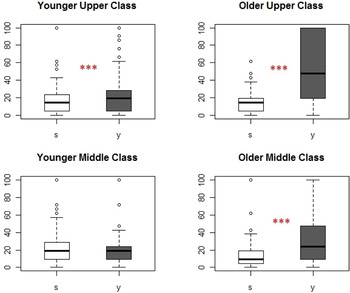
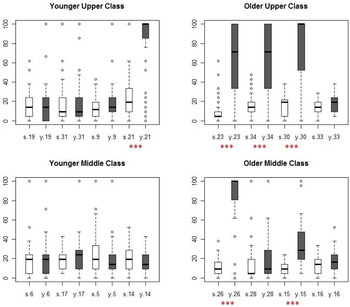
The general results suggest that the devoicing of /ʒ/ has not yet been completed for the speech community as a whole, because /ʒ/ still showed higher voicing rates than the voiceless fricative /s/; however, this was not the case for every social subgroup of the corpus. At this point, it would be fruitful to review the results of Rohena-Madrazo (Reference Rohena-Madrazo, Colantoni and Rodríguez Louro2013) in more detail. In that study, the data were divided into four subgroups: (i) older upper-class speakers, (ii) younger upper-class speakers, (iii) older middle-class speakers, and (iv) younger middle-class speakers. If, in any of the subgroups, the /ʒ/ still maintained higher levels of voicing than those of /s/, then the change had not been completed for that group, as depicted in Figure 11 (based on Rohena-Madrazo, Reference Rohena-Madrazo, Colantoni and Rodríguez Louro2013:51). Among the older upper-class speakers (/s/: M = 13.8, SD = 10.0; /ʒ/: M = 53.2, SD = 38.7), younger upper-class speakers (/s/: M = 18.1, SD = 19.7; /ʒ/: M = 29.0, SD = 33.6), and the older middle-class speakers (/s/: M = 12.1, SD = 11.6; /ʒ/: M = 34.8, SD = 33.7), there were higher voicing rates for /ʒ/ than for /s/. The only subgroup that did not show the same effect for fricative was the younger middle-class speakers (/s/: M = 20.1, SD = 16.9; /ʒ/: M = 18.6, SD = 14.7). These results suggested that the only subgroup for which the change had been completed was the younger middle-class speakers, for whom the /ʒ/ exhibited voicing levels of a phonologically voiceless fricative. According to the findings in previous studies (Rohena-Madrazo, Reference Rohena-Madrazo2008; Wolf & Jiménez, Reference Wolf, Jiménez and Barrenechea1979), where younger middle-class speakers were found to be leading the change, it would be expected that the younger middle-class group show the lowest voicing rates of /ʒ/. Actually, this group was beyond just leading the change—Rohena-Madrazo (Reference Rohena-Madrazo, Colantoni and Rodríguez Louro2013) proposed that they had already completed it.
Voicing rates of /ʒ/ versus /s/ by age and class. Boxplots showing the percentage of voicing for /s/ and for /ʒ/, stratified by age and social class. The values for /s/ are in white and the values for /ʒ/ are in gray and marked by ‘y’. The asterisks indicate a significant difference (‘***’ p < .001).

Chang (Reference Chang, Westmoreland and Thomas2008:62) had reported that the devoicing change had been completed in the younger generation; however, this was not exactly the case for all younger speakers in Figure 11, where the younger upper-class speakers still have not devoiced /ʒ/ completely. However, most of Chang's (Reference Chang, Westmoreland and Thomas2008) younger participants were not from the northern zone of the Greater Buenos Aires area and would have, therefore, fallen into the category of younger middle-class speakers in Rohena-Madrazo (Reference Rohena-Madrazo, Colantoni and Rodríguez Louro2013), which might explain this discrepancy in results. Nevertheless, in both Chang's (Reference Chang, Westmoreland and Thomas2008) and Rohena-Madrazo's (Reference Rohena-Madrazo, Colantoni and Rodríguez Louro2013) results, there was evidence for gradient phonetic variation in the percentage of voicing of /ʒ/. This indicates that, for the devoicing change to be completed, it is not necessary for the /ʒ/ to present 0% voicing, but rather, that its voicing not be significantly different from the voicing of a phonologically voiceless fricative, which, in Rohena-Madrazo (Reference Rohena-Madrazo, Colantoni and Rodríguez Louro2013) was about 17% voicing for /s/.
For the older middle-class speakers and for the upper-class speakers in Rohena-Madrazo (Reference Rohena-Madrazo, Colantoni and Rodríguez Louro2013), the change did not seem to have been completed yet, as these groups all exhibited a robust difference in voicing between /ʒ/ and /s/ (in each case p < .001). However, Rohena-Madrazo (Reference Rohena-Madrazo, Colantoni and Rodríguez Louro2013) found that the mean voicing percentages for /ʒ/ for the older upper-class speakers were significantly higher than those of the three other groups but the differences between the voicing levels of /ʒ/ between the younger upper-class speakers and the older middle-class speakers were not significant. He suggested that, even among the groups who still voiced /ʒ/ robustly more than /s/, there were indications that the change was still in progress, contrary to Wolf's (Reference Wolf, Schwartz and Lerner1984) proposal that the devoicing of /ʒ/ had reached stable variation. Younger upper-class speakers, although they might have been voicers of /ʒ/, showed lower levels of voicing for /ʒ/ than did the older generation speakers of the upper class.
Although the differences between /s/ and /ʒ/ (as shown in Figure 10) are significant in three socioeconomic groups, it is clearer from these boxplots than from Rohena-Madrazo's (Reference Rohena-Madrazo, Colantoni and Rodríguez Louro2013:51) graphs that there is a great deal of variation in the range and distribution of the voicing of /ʒ/ in each of these groups. For these reasons, analyzing the data by individual speaker may present a clearer picture of the type of variation in voicing that was exhibited within each group, thereby shedding light on the progress of the change.
Fricative and social factors: The completion of change at the individual level
The previous section suggests that among the social subgroups that maintained a significant difference in the voicing of /s/ and /ʒ/, there were differences in the voicing of /ʒ/ across some of groups. An interesting question that arises is whether a group that is different from another is different because the voicers in one group have similarly lower voicing rates or whether a group is composed of a variable number of voicers and devoicers. In order to further explore these differences, a one-way analysis of variance was performed for each subject in order to determine whether their voicing rates of /ʒ/ were significantly different from those of /s/. The results are shown in Figure 12.
Voicing rates of /ʒ/ versus /s/ by speaker. Boxplots showing the percentage of voicing for /s/ and for /ʒ/ produced by each speaker, stratified by age and social class. The values for /s/ are in white and the values for /ʒ/ are in gray and marked by ‘y’. The number to the right of the ‘s’ or ‘y’ indicates the subject identification number. The asterisks below the subject's values indicate a significant difference (‘***’ p < .001).

Of the 16 speakers, there are 6 that were definite voicers (whose p-values were all below .001, and one could reliably assume that their percentage of voicing for /s/ and /ʒ/ were significantly different) and 7 speakers who were definite devoicers (whose p-values were all above .174 and one could reliably assume that their percentage of voicing for /s/ and /ʒ/ were not significantly different). There were three speakers whose p-values resulted below .05 (subject 9 [F(1, 150) = 5.416, p = .021], subject 33 [F(1, 146) = 4.812, p = 0.030], and subject 16 [F(1, 142) = 3.989, p = .047]); however, with the Bonferroni correction for multiple comparisons, the alpha level actually resulted in .05/16 = .003. Therefore, one could not reliably assume that the voicing rates for /s/ and /ʒ/ were different for these three speakers, so they were identified as devoicers. The makeup of this corpus, thus, resulted in 6 voicers and 10 devoicers. Nevertheless, even comparing among voicers, the voicing ranges for /ʒ/ appeared to be highly variable. For example, compare subject 21, a young upper-class female for whom more than half of the /ʒ/ tokens were 100% voiced, to subject 15, an older middle-class female for whom the majority of the /ʒ/ tokens exhibited voicing rates of 50% or less, but were still robustly different from her /s/. Comparatively, the devoicers were a much more stable group with regard to fricative voicing, in other words, the voicing rates for each of the two fricatives are roughly comparable across speakers.
This analysis by speaker provides even more convincing evidence against Wolf's (Reference Wolf, Schwartz and Lerner1984) claim that the devoicing of /ʒ/ has reached the level of stable variation. More likely, the change is still continuing, albeit at different rates in different socioeconomic groups. In fact, each of the social group divisions under investigation here contained devoicers. Furthermore, the results of speakers such as subject 15, a robust voicer whose voicing percentage levels for /ʒ/ were quite different from other voicers’, or even the results of other older devoicers raise the question of whether they have maintained those voicing levels since youth or whether they had had higher voicing rates of /ʒ/ and have decreased them throughout their lifetime, as has been found for other changes in progress, such as the change from apical [r] to dorsal [ʀ] for the rhotic phoneme in Montreal French (see Sankoff & Blondeau, Reference Sankoff and Blondeau2007). Unfortunately, as there are no longitudinal data available on the variation in percentage of voicing of /ʒ/ and /s/, there is no way to ascertain whether their comparatively lower voicing percentage of /ʒ/ represents an apparent time change or an actual change across the lifespan.
For the 10 devoicers in this study, it would no longer be appropriate to posit an underlying voiced fricative /ʒ/ as part of their inventory but rather to posit /ʃ/, because its voicing levels resembled those of a phonologically voiceless fricative. If the underlying phoneme is indeed /ʃ/ (i.e., voiceless), then the resulting /ʃ/ should be subject to the same phonetic effects of position that were present for /s/. Recall that there was a significant interaction between fricative and position (see Figure 10), such that /ʒ/ showed much more voicing than /s/ in intervocalic position, where the articulatory conditions for voicing are generally more favorable. For these 10 devoicers, this interaction of position and fricative should no longer be significant if the devoicing has been completed. This is exactly what the results show in a linear mixed effect model run on this subset of the speakers, as seen in Table 5. The resulting phoneme /ʃ/ is affected in the same manner by the phonetic factors (be they articulatory or aerodynamic) that affect /s/ in intervocalic (VCV) and in phrase-initial (##CV) position. Once again, /s/ serves as a benchmark for sibilant fricative behavior.
Summary of the linear mixed effect regression model adjusted to the voicing levels of the fricative, with subject as a random factor, for the subset of devoicers
Intercept = /ʒ/, VCV; total n = 1521

Note: Bold values indicate statistical significance. The p-values were calculated using the Markov Chain Monte Carlo (MCMC) method.
Another notable finding is that none of the speakers from the younger middle-class socioeconomic group exhibited significant differences in voicing between the two sibilant fricatives. For the speakers of this group, the change seems to have been concluded. Rohena-Madrazo (Reference Rohena-Madrazo, Colantoni and Rodríguez Louro2013) contested Chang's (Reference Chang, Westmoreland and Thomas2008:61) finding that all speakers born after 1975 had completed the devoicing change, because there was a significant difference in the voicing of /ʒ/ between the upper-class and middle-class younger speakers, whereby the upper-class speakers still had not completed the change. However, a more detailed individual speaker analysis, as presented in Figure 12, paints a more complex picture.
Of the four younger upper-class speakers in the corpus, only one can be said to be a voicer: subject 21. It seems to be the case that the robust difference between the younger upper-class and younger middle-class speakers reported in Rohena-Madrazo (Reference Rohena-Madrazo, Colantoni and Rodríguez Louro2013) was due mainly to the voicing behavior of subject 21, whose voicing levels of /ʒ/ appear to be quite extreme. Although subject 21 and subject 6 are both 21-year-old females who live in La Recoleta, arguably one of the poshest neighborhoods of Buenos Aires, they exhibited vastly different voicing rates for /ʒ/. What this closer look at the corpus uncovers is that most young speakers seem to be devoicers. Furthermore, the devoicing of /ʒ/ seems to have gained much more ground among the upper-class speakers in general, a finding more congruent with the results of Chang (Reference Chang, Westmoreland and Thomas2008). Interestingly, subject 21 lived in a very luxurious high-rise building, in which each floor had only one apartment—this exceeds conventional standards of poshness even for La Recoleta. Unfortunately, this type of information was not necessarily noted or available for each of the participants in this study. A more in-depth ethnographic investigation is needed in order to determine the reasons behind such stark /ʒ/ voicing differences between some younger upper-class speakers and what social meanings these voicers may be indexing with this behavior.
Phonological evidence for the devoicing change
Thus far, evidence has been presented for a phonetic diagnostic for the completion of the /ʒ/ → /ʃ/ change, using as a benchmark the variable rates of voicing exhibited by the alveolar sibilant /s/. The question remains whether there is also phonological evidence for the /ʒ/ → /ʃ/ change. In order to search for phonological evidence of the devoicing change, one should revisit the contextual variation of /ʝ/ in General Spanish, as discussed in the background on Spanish fricatives.
Recall that the palatal obstruent phoneme /ʝ/ exhibits a wide range of variation in General Spanish and can be realized as [ɟ] ~ [] ~ [ʝ] ~ [ʝ̞] ~ [j] depending on different factors. However, within this variation, the continuant allophones ([ʝ], [ʝ̞], [j]) tend to be more common in intervocalic position, whereas the noncontinuant allophones ([ɟ], []) are most common in phrase-initial or in postnasal/postlateral position (Hualde Reference Hualde2005:165–166). Fontanella de Weinberg (Reference Fontanella de Weinberg1978:223–224) described a contextually determined allophonic distribution of /ʒ/ similar to that of /ʝ/ in General Spanish: the continuant realization [ʒ] occurs most commonly in intervocalic position, while the noncontinuant realization [dʒ] occurs most commonly in postnasal position as well as in phrase-initial position, varying with [ʒ] or its (partially) devoiced variants.
Affrication patterns and the completion of the change: /ʒ/ → /ʃ/
By examining the affrication patterns in the current dataset, we can see whether they align with Fontanella de Weinberg's (Reference Fontanella de Weinberg1978) description. As was illustrated in Tables 2 and 3, of the total realizations of the stimulus obstruent /ʒ/, 79 of 1252 were realized as affricates, whereas none of the total 1335 realizations of /s/ were realized as affricates.
Interestingly, the vast majority (70/79) of the affricated realizations occurred in phrase-initial position (##CV). Although by no means the most frequent realization in the dataset, this distribution is reminiscent of the affrication patterns discussed in Hualde (Reference Hualde2005) for /ʝ/ and in Fontanella de Weinberg (Reference Fontanella de Weinberg1978) for /ʒ/, where the noncontinuant realizations are much more common phrase-initially (or postconsonantally). This also seems to be the case for voicers of /ʒ/ in BAS, who produce [dʒ] realizations in phrase-initial position. If this phenomenon were due to a process of articulatory strengthening at the prosodic boundary, then it would be expected that devoicers also show [tʃ] realizations of the postalveolar fricative in those positions; however, this was not the case. Most telling is that the affricated realizations were produced almost exclusively by the voicers; only 1 of 79 affricates was produced by a devoicer. In all other cases, devoicers produced fricative realizations when the postalveolar fricative phoneme occurred in phrase-initial position.
The affrication patterns that can be gleaned from these results are that the voicers (those who still maintained a significant difference between the voicing rates of /ʒ/ and /s/) exhibited contextual variation that is phonologically parallel to /ʒ/'s etymological analog in other varieties of Spanish, /ʝ/, producing mostly ##dʒV. On the other hand, the devoicers’ postalveolar fricative diverged from the phonological behavior of the voicers’ /ʒ/ (or its etymological analog /ʝ/), surfacing overwhelmingly as a fricative, regardless of position. The devoicers did not show any contextual affrication patterns in phrase-initial position; in other words, the postalveolar fricative exhibited the same behavior as the alveolar fricative in terms of voicing and nonaffrication: ##ʃV behaves like ##sV. This differing phonological pattern is further evidence supporting the claim that for these speakers the change has been completed and, therefore, the devoicers’ underlying phoneme is no longer /ʒ/, but rather the voiceless postalveolar sibilant fricative /ʃ/.
Interestingly, in the informal metalinguistic commentary that many of the subjects offered after the experimental session, the only phonological feature that several speakers mentioned was this affricated pronunciation, which some speakers associated with upper-class speakers. One participant mentioned something along the lines of Las chicas chetas dicen “[d ʒ]o,” ‘the upper-class girls say “[dʒ]o” (I)’. This affrication of /ʒ/ appears to be, at least for some speakers, a sociolinguistic stereotype (Labov, Reference Labov1972) of upper-class speakers in Buenos Aires. It is perplexing; however, that none of the participants identified this affrication, or the voiced realization of /ʒ/, with older speakers, who were mostly voicers as well, and thus show this contextual affrication tendency. Notably, only one participant (subject 30, an older, upper-class female) made any mention of the devoicing as a socially indexed variable, associating it with the speech of the younger generation (or nonnative speakers), and she had a negative opinion of it.
Taking the aforementioned facts into consideration, the devoicing of /ʒ/ seems to exhibit the pattern of change from below in its final stages, perhaps with some correction from above (Labov, Reference Labov1966:225). However, the extent to which the (de)voicing of /ʒ/ is a phenomenon that speakers in today's BAS community are aware of is not very clearly understood. Because this was not the main objective of this study, the observations made unsystematically by some of the participants in this study are inconclusive at best. Some subjective reaction studies have shown preliminary evidence that some BAS speakers do show implicit and/or explicit awareness of the voicing variation of the postalveolar fricative (see Colantoni, Reference Colantoni2008; King, Reference King2009; García, Reference García2012a). However, more detailed perceptual studies are necessary to determine the degree to which this devoicing change, which seems to be all but completed among the younger speakers, or the contextual affrication of /ʒ/ proves to be a phenomenon that the speakers in the community are conscious of, and, if so, to determine for which speakers this is the case.
CONCLUSIONS
This investigation has presented a novel phonetic, phonological, and sociolinguistic analysis of the variable devoicing of the postalveolar fricative /ʒ/ in BAS, comparing its voicing rates to those of /s/ in order to determine the completion of the change at the level of the group and of the individual. The results confirm the data from previous studies (Rohena-Madrazo, Reference Rohena-Madrazo, Colantoni and Rodríguez Louro2013) that for the younger middle-class speakers—as would be the case in a change in progress in its late stages—the devoicing change has been completed. In that group, the postalveolar fricative has devoiced to a level equivalent to that of the other phonologically voiceless sibilant in the system, /s/, and thus should be considered as /ʃ/ in these speakers’ phonemic inventory. Furthermore, the findings of the current study build on those of Rohena-Madrazo (Reference Rohena-Madrazo, Colantoni and Rodríguez Louro2013) and Chang (Reference Chang, Westmoreland and Thomas2008), presenting a more nuanced perspective of whether the devoicing change has been completed among younger upper-class speakers. Although there is evidence of marginally extreme voicing in one upper-class younger speaker, most younger speakers seem to have devoiced /ʒ/ to /ʃ/.
The results of this investigation suggest that the devoicing of /ʒ/ is affected by positional factors, both phonetically and phonologically. The gradient voicing variation for both /s/ and /ʒ/ is such that they exhibit different but higher voicing rates in intervocalic position than in phrase-initial position. Although this effect can be explained by phonetic pressures (both aerodynamic and articulatory), it can also be used as a method to determine the completion of the devoicing change. The devoicers, when producing both /ʒ/ and /s/, exhibited similar voicing increases in intervocalic position and voicing decreases in phrase-initial position. Once this systematic variation in voicing of /s/ is used as a criterion to divide speakers into voicers (those with underlying /ʒ/) and devoicers (those with underlying /ʃ/), the phonological realignment of the postalveolar fricative in BAS becomes evident. The contextual affrication patterns of the resulting fricative /ʃ/ are no longer similar to those of /ʒ/ in BAS and /ʝ/ in General Spanish. In fact, the new phoneme /ʃ/ no longer exhibits context-dependent affrication, exactly like the other voiceless sibilant in the phonemic inventory: /s/. This provides phonological evidence, in addition to the phonetic evidence of comparing fricative voicing rates, to support the completion of the change.
This phonological devoicing change of /ʒ/ to /ʃ/ in BAS is reminiscent of the systematic devoicing change of /z̪, z, ʒ/ to /s̪, s, ʃ/ in Medieval Spanish, both of which can be explained by the markedness of voiced fricatives cross-linguistically, due to the fact that the aerodynamic requirements for phonation and frication are at odds with each other (see Hayes & Steriade, Reference Hayes, Steriade, Hayes, Kirchner and Steriade2004; Stevens et al., Reference Stevens, Blumstein, Glicksman, Burton and Kurowski1992). In this sense, the devoicing of /ʒ/ in BAS is congruent with the diachronic tendencies of the Spanish language as well as with universal linguistic constraints on fricative production. Thus, it appears to be the case that within one or two generations, the fricative inventory of BAS as a whole will be /f, s, ʃ, x/.
This study shows that a detailed instrumental acoustic analysis of /ʒ/, in terms of percentage of voicing, provides much information, such as the differences in voicing rates between social groups. However, these differing voicing rates of /ʒ/ alone cannot paint the whole picture with respect to the completion of the change, because it does not account for the inherent voicing variability within the voiceless category. Rather than relying on categorical notions of voicelessness, the use of the independent criterion of the gradient phonetic variation of /s/ as a system-internal diagnostic tool, along with the intra- and interdialectal phonological patterns of the fricatives involved, provides a firmer footing on which to make determinations about sociophonetic variation and phonological change in BAS from /ʒ/ to /ʃ/.