INTRODUCTION
The tropical reef ecosystems are recognized not only for their great biological diversity and complexity, but also for their susceptibility to local and global anthropic impacts (Roberts et al., Reference Roberts, McClean, Veron, Hawkins, Allen, McAllister, Mittermeier, Schueler, Spalding, Wells, Vynne and Werner2002). On the reefs, fish are among the best-studied groups, as a result of the larger number of specialists, relatively easy taxonomy and long-standing methods of assessment. Nevertheless, there are many tropical reefs worldwide from where information is scant or even absent (Costello et al., Reference Costello, Coll, Danovaro, Halpin, Ojaveer and Miloslavich2010). In a rapidly changing world, knowledge of the composition and functioning of fish assemblages in these ecosystems is essential for conservation (Munday et al., Reference Munday, Jones, Pratchett and Williams2008, Reference Munday, Leis, Lough, Paris, Kingsford, Berumen and Lambrechts2009).
In this context, the subtidal reef environments along the northern/north-eastern Brazilian shelf, between Parcel Manuel Luíz (Maranhão State) and Cape of São Roque (Rio Grande do Norte State), with an extension of approximately 1000 km, are still understudied. For instance, this region was described by Castro & Pires (Reference Castro and Pires2001) as ‘unexplored’ for scleractinian corals, especially along Ceará State. Thus, it becomes clear that the ecosystem is understudied as a whole. In terms of biogeography studies including reef fish from Ceará State, there are only two contributions (Araújo & Feitosa, Reference Araújo and Feitosa2003; Moura, Reference Moura2003), but despite that, this scarcity was noted in the most relevant papers about the south-western Atlantic fish biogeography (e.g. Floeter & Gasparini, Reference Floeter and Gasparini2000; Feitoza et al., Reference Feitoza, Rosa and Rocha2005; Floeter et al., Reference Floeter, Rocha, Robertson, Joyeux, Smith-Vaniz, Wirtz, Edwards, Barreiros, Ferreira, Gasparini, Brito, Falcon, Bowen and Bernardi2008).
The studies on the fish fauna along the Brazilian coast went through a steep increase, both in terms of quantity and quality, but there are still many gaps to fill, especially on the northern/north-eastern Brazilian shelf (Rocha, Reference Rocha2003). Hence, this work presents a thorough assessment of the reef fish occurring along the Ceará State coast, presenting an evaluation of the biogeographic context of the Brazilian reef ichthyofauna.
MATERIALS AND METHODS
Study area
The Brazilian coastline presents two directions along the north-east region, the northern portion is oriented along the east-west direction, facing north, and includes the whole coast of the Ceará State. The northern portion is limited in the east by an inflexion marked by the Cape of São Roque (Rio Grande do Norte State), then, the coastline is north-south oriented. Ceará has 573 km of shoreline (Morais et al., Reference Morais, Irion, Pinheiro and Kasbohm2009), and the associated continental shelf extends from 35 to 90 km off the coast, with the slope starting at a 40–80 m depth (Knoppers et al., Reference Knoppers, Ekau and Figueiredo1999). Sandy beaches, with occasional beach rock formations, dominate the coast. The beach rocks form the coastal reefs and are easily accessed, and their locations are well documented (Smith & Morais, Reference Smith and Morais1984). The subtidal reefs, on the other hand, are poorly mapped and studied.
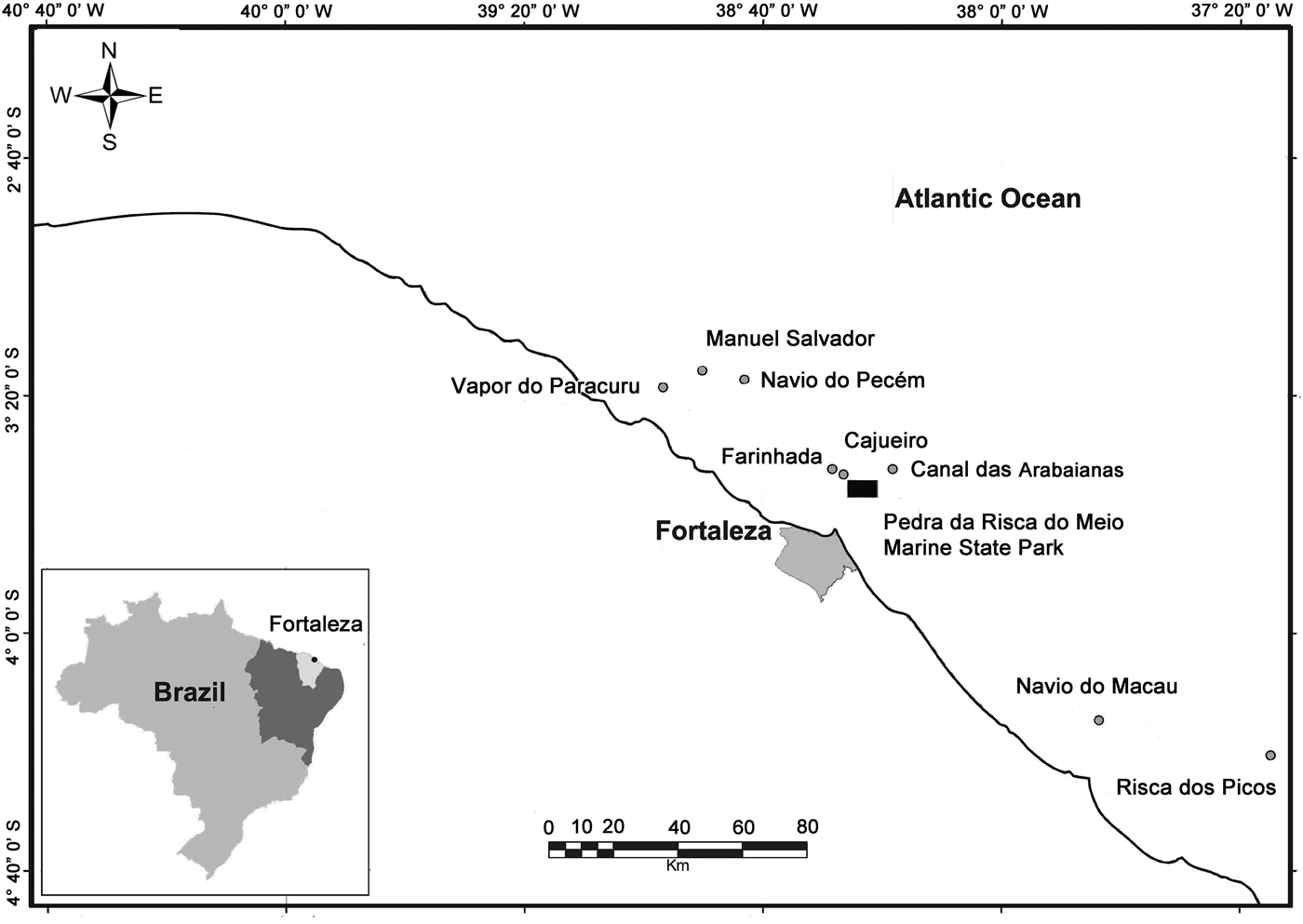
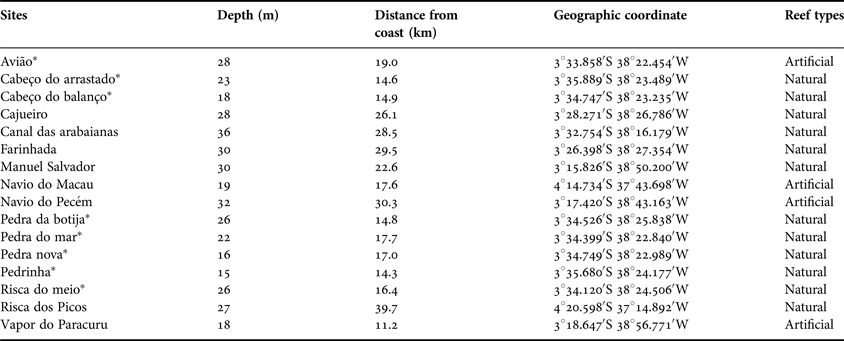
In order to produce a comprehensive inventory of the reef fishes of the region, we visited 16 different reefs, of which 12 were natural and four were artificial, with depths ranging between 16 and 36 m (Figure 1, Table 1). Half of the sites are located inside the Pedra da Risca do Meio Marine State Park (PRM), a conservation unit created in 1997, but still poorly managed (Soares et al., Reference Soares, Paiva, Freitas and Lotufo2011). There were also three sites located along Fortaleza (the state's capital and large urban area), four on the eastern side of the state and three on the western side (Figure 1).
Sampling points off Ceará State, north-eastern Brazil. Geometric symbols indicate specific samplings sites. Black rectangle = Pedra da Risca do Meio Marine State Park (PRM); grey circles = reef sites outside the PRM.

Details of the sampling sites, including depth, distance from the coast, geographic coordinates and type of reef (natural or artificial).
*Sites are located inside the Pedra da Risca do Meio Marine State Park.
Data acquisition
A total of 151 scuba dives were carried out, at approximately 30 min each, between 2002 and 2007. During the dives, the method to assess the fish fauna composition was the visual record, through an intensive search and the analysis of photographic material. Of the six night dives, three were conducted at the Risca do Meio site, two at Pedrinha and one at the Macau shipwreck. The identification of species was based on external morphological characteristics using the available guides (Rocha, Reference Rocha1999, Reference Rocha, Humann and DeLoach2002; Feitoza, Reference Feitoza2001; Humann & DeLoach, Reference Humann and DeLoach2002; Hostim-Silva et al., Reference Hostim-Silva, Andrade, Machado, Gerhardinger, Daros, Barreiros and Godoy2005).
Some species whose visual identification was difficult or impossible, and those that were relevant for the institutional collection, were captured with nets, spearfishing or line and hook (licence – SEMACE 543/200). The identification was based on the keys available for tropical Atlantic fishes (Figueiredo, Reference Figueiredo1977; Figueiredo & Menezes, Reference Figueiredo and Menezes1978, Reference Figueiredo and Menezes2000; Menezes & Figueiredo, Reference Menezes and Figueiredo1980, Reference Menezes and Figueiredo1985; Cervigón, Reference Cervigón1991, Reference Cervigón1993, Reference Cervigón1994, Reference Cervigón1996). The collected specimens were deposited at the Dias da Rocha Ichthyological Collection (CIDRO) of the Instituto de Ciências do Mar (LABOMAR-UFC).
The final checklist of reef fish from Ceará, including the intertidal and subtidal zones, comprises both the species observed during the dives and those from the previous records available (Araújo et al., Reference Araújo, Cunha, Carvalho, Freitas, Nottingham and Barros2000; Cunha et al., Reference Cunha, Monteiro and Nottingham2007, Reference Cunha, Carvalho, Monteiro, Moraes and Araújo2008; Jucá-Queiroz et al., Reference Jucá-Queiroz, Satander-Neto, Medeiros, Nascimento, Furtado-Neto, Faria and Rincon2008; Freitas et al., Reference Freitas, Araújo and Vieira2009; Godinho & Lotufo, Reference Godinho and Lotufo2010). The species list is organized by evolutionary criteria, according to Compagno (Reference Compagno and Hamlet1999), Nelson (Reference Nelson2006) and specific literature for Epinephelidae (Craig & Hastings, Reference Craig and Hastings2007; Smith & Craig, Reference Smith and Craig2007). The valid species names and geographic distribution data were obtained from the online version of the ‘Catalog of Fishes’ (Eschmeyer, Reference Eschmeyer2014).
In one of the sites, a patch reef named ‘Risca do Meio’ located inside the PRM, we performed 21 stationary visual censuses (Bohnsack & Bannerot, Reference Bohnsack and Bannerot1986), between October 2002 and September 2003. These censuses were conducted with the purpose of gathering data about the assemblage structure, for back comparison with other locations where the same method was applied.
Data analysis
With the exception of the checklist, all other analyses performed for the present study comprised only the data from bony fish (Actinopterygii). The zoogeographic patterns were assessed through cluster analysis using two different approaches. The first one was qualitative, based on a binary matrix (presence/absence) of the 320 taxa of bony fish recorded for seven reef areas along the Brazilian north-east region, including intertidal and subtidal zones (Supplementary material). The similarity matrix was calculated using the Sørensen index, and the clusters generated by the hierarchical agglomerative method using the UPGMA amalgamation strategy. The seven areas included in this study were: (1) Ceará – CE (present study; Araújo et al., Reference Araújo, Cunha, Carvalho, Freitas, Nottingham and Barros2000; Cunha et al., Reference Cunha, Monteiro and Nottingham2007, Reference Cunha, Carvalho, Monteiro, Moraes and Araújo2008; Freitas et al., Reference Freitas, Araújo and Vieira2009); (2) Maranhão – MA (Rocha & Rosa, Reference Rocha and Rosa2001; Nunes et al., Reference Nunes, Pascoal, Piorski, Nunes and Piorski2011a, Reference Nunes, Silva, Piorski, Nunes and Piorskib); (3) Risca do Zumbi RN – ZU (Feitoza, Reference Feitoza2001); (4) Paraíba – PB (Rocha et al., Reference Rocha, Rosa and Rosa1998; Souza et al., Reference Souza, Ilarri, Medeiros, Grempel, Rosa and Sampaio2007; Honório et al., Reference Honório, Ramos and Feitoza2010); (5) Abrolhos – AB (Moura et al., Reference Moura, Francini-Filho, Sazima, Flesh, Allen, Ferreira, Dutra, Allen, Werner and McKenna2006); (6) Atol das Rocas (Rocas Atoll) – AR (Rosa & Moura, Reference Rosa, Moura, Lessios and Macintyre1997; Floeter et al., Reference Floeter, Rocha, Robertson, Joyeux, Smith-Vaniz, Wirtz, Edwards, Barreiros, Ferreira, Gasparini, Brito, Falcon, Bowen and Bernardi2008); and (7) Arquipélago de São Pedro e São Paulo (St Paul's Rocks) – SPSP (Lubbock & Edwards, Reference Lubbock and Edwards1981; Feitoza et al., Reference Feitoza, Rocha, Luiz-Junior, Floeter and Gasparini2003).
The second approach was quali-quantitative, using data from stationary visual censuses at the subtidal zones (12–26 m) (Supplementary material). For this analysis, the data from the Risca do Meio site was used along with data from three different studies that used the same method, comprising: Parcel do Manuel Luís – MA (Rocha & Rosa, Reference Rocha and Rosa2001), Rocas Atoll (Rosa & Moura, Reference Rosa, Moura, Lessios and Macintyre1997) and Risca do Zumbi – RN (Feitoza, Reference Feitoza2001). The abundance data were transformed by square root analysis and the distance matrix was calculated using the Bray–Curtis index. The cluster analysis was performed as previously described for the qualitative data.
The abundance data were used for producing rarefaction curves, and also for a more direct comparison by means of trophic categories. The trophic categories followed Ferreira et al. (Reference Ferreira, Floeter, Gasparini, Ferreira and Joyeux2004), including a modification of the category ‘carnivores’ (CAR) to ‘generalist carnivore’ (GEC) as proposed by Honório et al. (Reference Honório, Ramos and Feitoza2010). The trophic categories were assigned to each species after consulting the literature (Randall, Reference Randall1967; Menezes & Figueiredo, Reference Menezes and Figueiredo1980; Ferreira et al., Reference Ferreira, Floeter, Gasparini, Ferreira and Joyeux2004; Honório et al., Reference Honório, Ramos and Feitoza2010) and FishBase (Froese & Pauly, Reference Froese and Pauly2014). The same categories were applied for the data from the different studies in order to allow direct comparisons. All multivariate analyses were performed using the software Biodiversity-Pro (McAleece et al., Reference McAleece, Lambshead, Paterson and Gage1997).
RESULTS
A total of 179 taxa from 66 families were recorded for the reefs of Ceará (Table 2). The most representative families in terms of species numbers were Carangidae (16 species), Haemulidae (12), Labridae (9), Epinephelidae (8) and Pomacentridae (7). Most taxa (154; 86%) are found throughout the western tropical Atlantic, including the Caribbean, while 36 species (20%) are present in both the east and west Atlantic and 18 species (10%) have circumtropical distributions. Also noteworthy is the occurrence of the 16 species (9%) considered to be endemic to the Brazilian province. The species were distributed by trophic guilds as follows: territorial herbivore (2%), roving herbivore (5%), planktivore (10%), omnivore (13%), sessile invertebrate feeder (3%), mobile invertebrate feeder (25%), generalist carnivore (30%) and piscivore (10%) (Table 2).
Checklist of reef fish from the State of Ceará, including geographic range and trophic categories. WA, western Atlantic; EA, eastern Atlantic; SA, south-western Atlantic; EP, aastern Pacific; CIRC, circumtropical; BP, Brazilian Province and blank spaces – absence of information. Abbreviations adopted for trophic category: TH, territorial herbivore; RH, roving herbivore; PLA, planktivore; OMN, omnivore; SIF, sessile invertebrate feeder; MIF, mobile invertebrate feeder; GC, generalist carnivore; PI, piscivore.
°Specimens collected (CIDRO634 to CIDRO658).
*Not identified to the species level.
†Undescribed species.
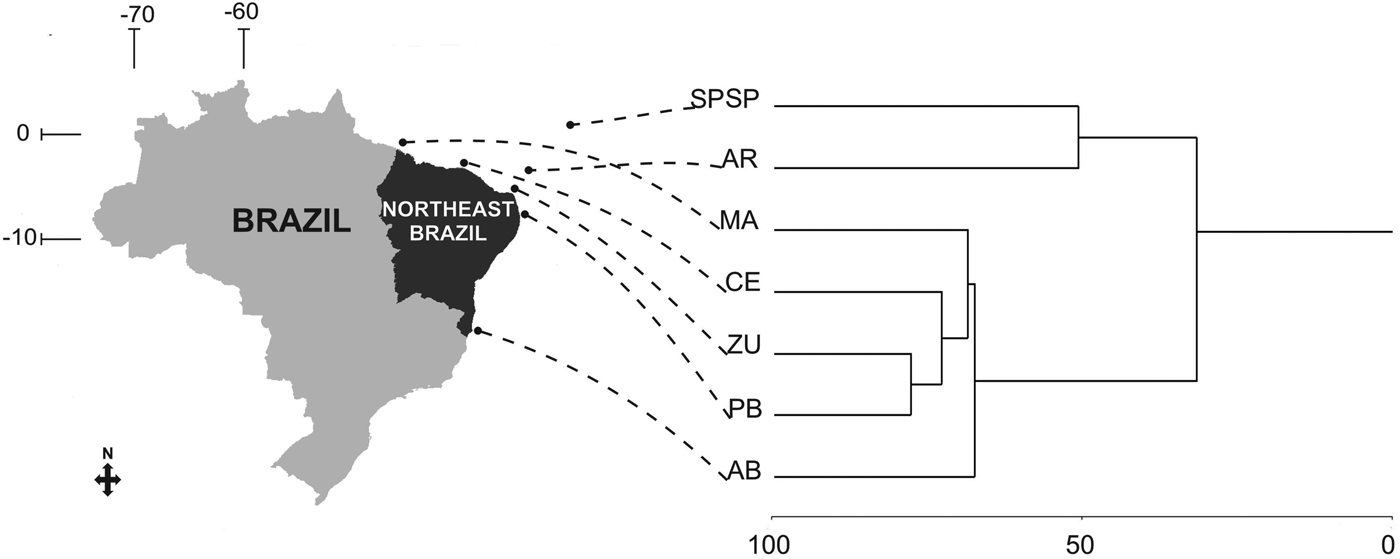
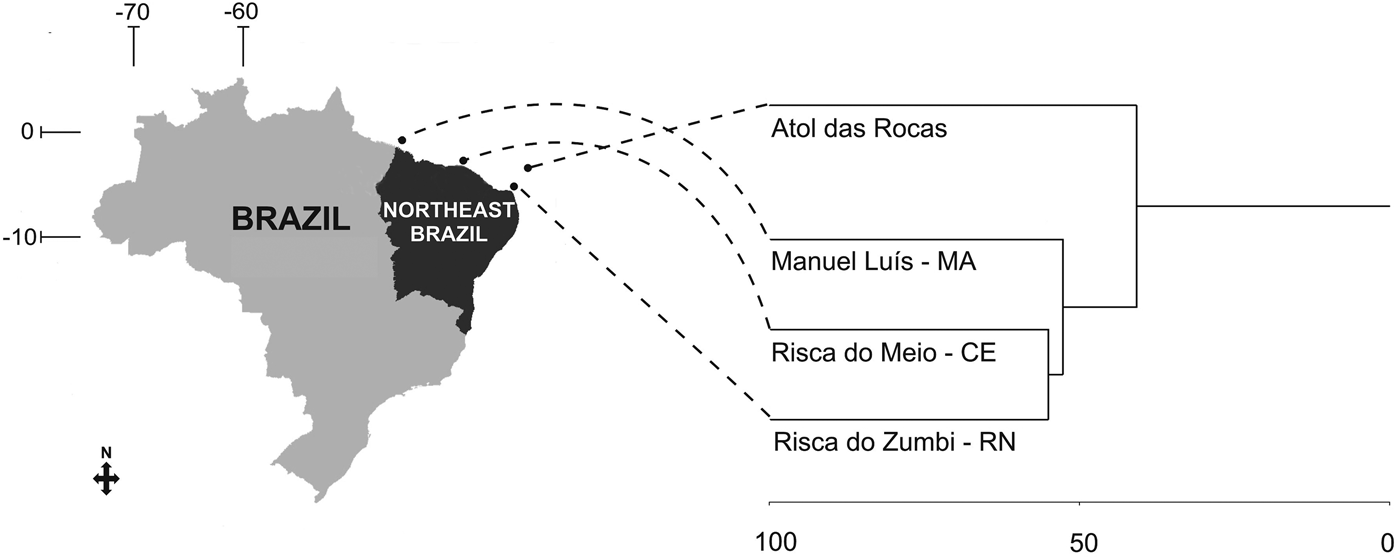
As for species composition, the fish fauna from Ceará were grouped with the other localities along the continental margin (Figure 2), with greater similarity (73%) to the reefs from Risca do Zumbi – RN and Paraiba – PB. The similarity level among the continental areas was 67%, and the oceanic islands formed a distinct group. When abundances are taken into account (Figure 3) a similar pattern was observed; however, the overall similarity level among the continental areas is reduced to 52%.
Dendrogram from the cluster analysis based on presence/absence data (Sørensen index, UPGMA) of 320 reef fish species from seven reef areas of the Brazilian northeastern region: Ceará (CE), Maranhão (MA), Risca do Zumbi – RN (ZU), Paraíba (PB), Abrolhos (AB), Atol das Rocas (Rocas Atoll) (AR) and Arquipélago de São Pedro e São Paulo (St Paul's Rocks) (SPSP).
Dendrogram from the cluster analysis based on quantitative data (Bray–Curtis index, UPGMA) from four localities of the Brazilian north-eastern region: Risca do Meio – CE, Manuel Luís – MA, Risca do Zumbi – RN and Atol das Rocas (Rocas Atoll).
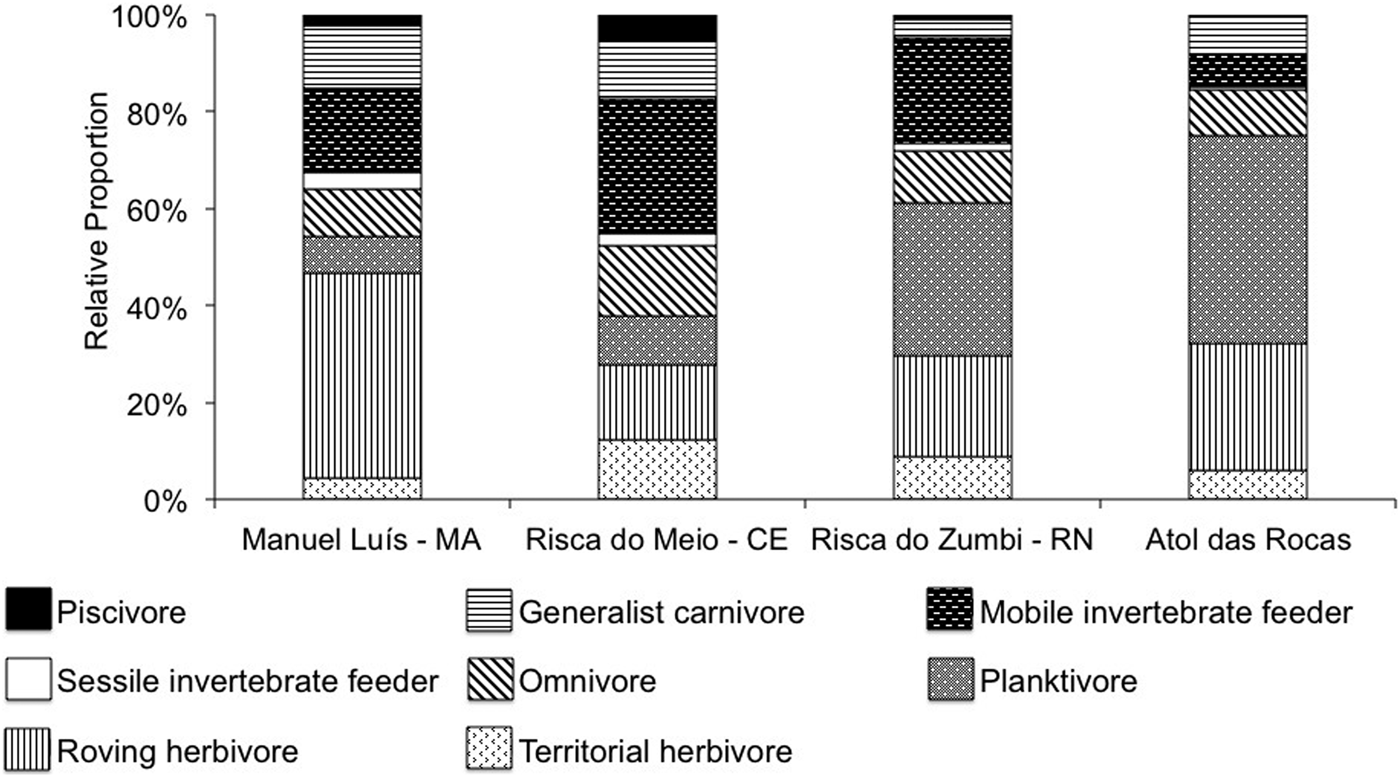
There is no clear pattern for the reefs when they are analysed in terms of trophic categories (Figure 4). For instance, the dominant guild for the Ceará reefs was the mobile invertebrate feeder (MIF), comprising 28% of the recorded fishes. For the Risca do Zumbi reefs, which according to the quali-quantitative cluster analysis were more similar to Ceará, the dominant guild was planktivores (PL), with 32% of the fish. Manuel Luís and Risca do Meio, on the other hand, shared a lesser proportion of planktivores. Additionally, Risca do Meio had a larger proportion of piscivores and a smaller proportion of roving herbivores when compared with all other localities analysed.
Relative abundance of fish assigned to trophic categories, from four reef areas from north-east Brazil: Risca do Meio – CE, Manuel Luís – MA, Risca do Zumbi – RN and Atol das Rocas (Rocas Atoll).
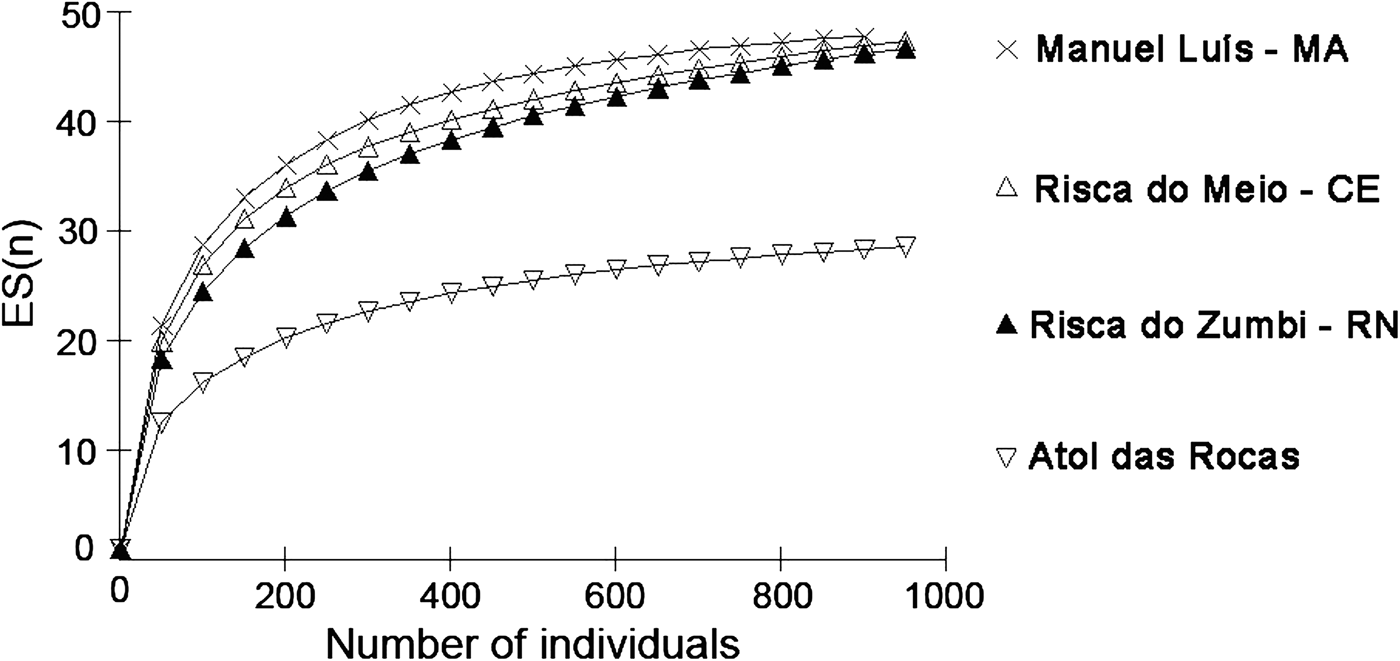
The rarefaction curves (Figure 5) indicated similar numbers in terms of species richness for the continental shelf locations, despite the differences in composition, abundance and trophic structure. The Rocas Atoll, however, showed a smaller richness in comparison to the other three locations.
Rarefaction curves for four reef areas from the Brazilian north-eastern region. ES(n) is the estimated species richness. Locations: Risca do Meio – CE, Manuel Luís – MA, Risca do Zumbi – RN and Atol das Rocas (Rocas Atoll).
DISCUSSION
The list presented here (Table 2) is, at the moment, the most comprehensive assessment for the reef fish from Ceará State, one of the least known regions of the Brazilian coast regarding reef organisms, and we believe that it represents the great majority of local reef species. Nevertheless, this list would include more species if anaesthetics or ichthyotoxics were used to capture the more cryptic species, as done in other regions (Rosa & Moura, Reference Rosa, Moura, Lessios and Macintyre1997; Feitoza, Reference Feitoza2001; Rocha & Rosa, Reference Rocha and Rosa2001). Within a regional perspective, the reef fish from Ceará stand out with 167 species of bony fishes, representing 51% of the north-eastern region species (Rocha, Reference Rocha2003). It is also worth mentioning that 16 out of 46 Brazilian endemic species (Floeter et al., Reference Floeter, Rocha, Robertson, Joyeux, Smith-Vaniz, Wirtz, Edwards, Barreiros, Ferreira, Gasparini, Brito, Falcon, Bowen and Bernardi2008) were registered in the present account, which highlights the biological importance of this area.
As expected, most of the species with distribution limits in the Brazilian north-east (Floeter et al., Reference Floeter, Guimaraes, Rocha, Ferreira, Rangel and Gasparini2001; Feitoza et al., Reference Feitoza, Rosa and Rocha2005) were recorded at the reefs along Ceará State (e.g. Haemulon melanurum (Linnaeus, 1758), Chaetodon ocellatus Bloch, 1787, Chromis scotti Emery, 1968, Haemulon squamipinna Rocha & Rosa, 1999, Halichoeres bivittatus (Bloch, 1791)). The species Halichoeres radiatus (Linnaeus, 1758) is one exception; this species had only been recorded for the Caribbean, oceanic islands from the south Atlantic, and deeper reefs off the north-eastern Brazilian coast (Rocha, Reference Rocha2003; Rocha et al., Reference Rocha, Robertson, Roman and Bowen2005). However, in the present study, juveniles of this species were detected for the first time on near-shore reefs (18 km from the coast). Despite its rarity, with only two records during the study, its presence in both near-shore and deeper reefs (Rocha et al., Reference Rocha, Robertson, Roman and Bowen2005), in sympatry with its sister species Halichoeres brasiliensis (Bloch, 1791), may indicate the first steps of a local enrichment promoted by biodiversity hotspots (Caribbean) and/or isolated oceanic islands (Bowen et al., Reference Bowen, Rocha, Toonen and Karl2013).
Zoogeographic context
The overall pattern that emerged from the cluster analysis (Figure 2) agreed with previous studies, showing a clear distinction of the fauna from the oceanic islands (Floeter & Gasparini, Reference Floeter and Gasparini2000; Feitoza, Reference Feitoza2001; Rocha & Rosa, Reference Rocha and Rosa2001; Araújo & Feitosa, Reference Araújo and Feitosa2003; Moura, Reference Moura2003). This is somewhat expected considering the degree of isolation and small dimension of the Rocas Atoll and St Paul's Rocks, but local ecological factors may have importance as well (Rocha, Reference Rocha2003). These locations are usually regarded as hosting subsets of the Brazilian Province ichthyofauna, but because of their high degree of endemism, are also potential exporters of biodiversity (see H. radiatus discussed previously).
The Brazilian north-eastern continental shelf is relatively homogeneous in terms of oceanographic conditions, and may be regarded as a single system, characterized by a low continental input and oligotrophic water (Knoppers et al., Reference Knoppers, Ekau and Figueiredo1999). These conditions certainly have influence on the high similarity observed in the present analysis (67%, overall). Another important element to take into consideration is the continuous presence of deep reef (from 35 to 70 m deep), acting as a biological corridor connecting different reefs from the region (Feitoza et al., Reference Feitoza, Rosa and Rocha2005).
In the whole north-eastern shelf, two major rivers may act as biogeographic filters and, therefore, affect the local compositions: the Parnaíba river delta (Rocha & Rosa, Reference Rocha and Rosa2001), on the northern side, and the São Francisco river mouth, on the eastern side (Floeter et al., Reference Floeter, Guimaraes, Rocha, Ferreira, Rangel and Gasparini2001). The reefs at Ceará (CE), Risca do Zumbi (RN) and Paraíba (PB) are located between these two major rivers, and the absence of important obstacles may explain their similarities (73%). Additionally, some aspects of the life history of the species may exert, post settlement, considerable influence on the composition of reef fish assemblages (Luiz et al., Reference Luiz, Allen, Robertson, Floeter, Kulbicki, Vigliola, Becheler and Madin2013), and may have also contributed to reorganize the assemblages, making them more similar to each other.
The American tropical Atlantic biogeographic setting obtained in the present study (Figure 2) showed differences in the agreement with the two other studies that included data from Ceará State. The first one, by Moura (Reference Moura2003), used a standardized sampling method throughout the Brazilian coast, with a distinct approach, and yielded a pattern very similar to the one presented here, which strengthens its consistency.
However, Araújo & Feitosa (Reference Araújo and Feitosa2003) observed lower levels of similarity between the fish fauna from Ceará and the neighbouring states of Rio Grande do Norte and Paraíba, differing markedly in the aforementioned results. The numbers of species from Ceará by their account (99), and the use of Jaccard's index, are certainly the main culprits of these differences. Jaccard's index, unlike Sørensen's index used in this study, does not give greater weight to the simultaneous occurrence of species in different areas.
Despite the similarities in the taxonomic composition (Figure 2) and in the species richness estimated by rarefaction (Figure 5), there are still important singularities in terms of the assemblage structure, reflected in the abundances and trophic composition (Figures 3 & 4). The dominance of the mobile invertebrate feeder (MIF) guild in Ceará is related to the great abundance of grunts, especially Haemulon aurolineatum Cuvier, 1830. This species is one of the most abundant MIF on coastal reefs along the Brazilian Province (Ferreira et al., Reference Ferreira, Floeter, Gasparini, Ferreira and Joyeux2004). Besides, the relative abundance of piscivores (PI) observed at Risca do Meio was due to the large number of jacks, with the genus Carangoides accounting for 88% of the PI. However, their high mobility and schooling behaviour may bias the abundance estimates though visual census (Ferreira et al., Reference Ferreira, Floeter, Gasparini, Ferreira and Joyeux2004).
The analyses including abundance data are certainly more sensitive than the qualitative analyses to detect variations in the reef fish assemblage. As an example, the abundance data of herbivorous reef fish from the south Atlantic were more efficient than the analyses based solely on assemblage composition in the detection of a latitudinal gradient (Floeter et al., Reference Floeter, Behrens, Ferreira, Paddack and Horn2005). There are also ecological drivers not considered in the present study that may explain the differences among the continental assemblages considered.
Floeter et al. (Reference Floeter, Guimaraes, Rocha, Ferreira, Rangel and Gasparini2001), based only on species richness data, found a strong correlation between reef fish species distribution along the Brazilian province and environmental variables, such as water temperature, coral richness, distance from mainland, primary production and shelf width. We believe that more assessments taking into account both abundance and biomass, correlating this information with environmental and ecological variables, will surely help to decode the complex distribution patterns and trophic structure of reef fish assemblages along the northern/north-eastern Brazilian coast.
The present work has shown basic information about the reef fish from Ceará and how it is positioned in a regional perspective. These data have a direct application on important matters, such as fisheries administration, conservation unit management and bioinvasion. Studies concerning other taxa and functional aspects of the whole community are essential for a thorough understanding of the reef ecosystems from the north-eastern Brazil region.
ACKNOWLEDGEMENTS
The authors are grateful to V.V. Faria (UFC) for their constructive comments that helped to improve the manuscript and M.E. Araújo (UFPE) for support in the initial phases of the research. We thank the two anonymous referees for their constructive and critical reviews of the manuscript.
FINANCIAL SUPPORT
Coordenação de Aperfeiçoamento de Pessoal de Nível Superior – CAPES (Brazilian Ministry of Education) provided a master's degree fellowship to J.E.P. Freitas. This study was partly financed by Boticário Group Foundation for Nature Protection, grant number: 0553_20021.