


Introduction
Social phobia (SP) is a psychological disorder characterized by a fear of one or more social or performance situations. Although relatively common (between 1% and 9% of community youth and up to 32% of clinic samples; Kendall et al., Reference Kendall, Flannery-Shroeder, Panichelli-Mendel, Southam-Gerow, Henin and Warman1997; Last, Perrin, Hersen and Kazdin, Reference Last, Perrin, Hersen and Kazdin1992; Wittchen, Stein and Kessler, Reference Wittchen, Stein and Kessler1999), the diagnosis of SP in children is recent: prior to DSM-IV youth with these symptoms were diagnosed with “avoidant disorder”. Although once viewed as simple shyness, SP is now recognized to cause significant impairment in youth (LaGreca and Lopez, Reference LaGreca and Lopez1998; Spence, Donovan and Brechman-Toussaint, Reference Spence, Donovan and Brechman-Toussaint1999). If untreated, SP can lead to sequelae such as substance use and depression (Kendall, Safford, Flannery-Schroeder and Webb, Reference Kendall, Safford, Flannery-Schroeder and Webb2004; Kessler et al., Reference Kessler, Nelson, McGonagale, Edlund, Frank and Leaf1996).
Several different anxiety disorders in children are frequently treated in similar ways and are often researched collectively (Barmish and Kendall, Reference Barmish and Kendall2005; Kendall et al., Reference Kendall, Flannery-Shroeder, Panichelli-Mendel, Southam-Gerow, Henin and Warman1997). In particular, children with primary diagnoses of SP, separation anxiety disorder (SAD), and generalized anxiety disorder (GAD) are often studied jointly and treated using protocols that are then adjusted for the presentations of each of these disorders. There are reasons for this: experts conceptualize these disorders as sharing an underlying anxiety construct (e.g. Bell-Dolan and Brazeal, Reference Bell-Dolan and Brazeal1993; Pine and Grun, Reference Pine, Grun and Walsh1998) and these disorders are highly comorbid with one another (Beidel, Turner and Morris, Reference Beidel, Turner and Morris1999; Essau, Conradt and Petermann, Reference Essau, Conradt and Petermann1999; Wittchen et al., Reference Wittchen, Stein and Kessler1999).
Although often treated similarly to other childhood anxiety disorders, SP may differ from other childhood anxiety disorders in potentially important ways. For instance, SP involves a fear of social or performance situations, due to the possibility of embarrassment or humiliation. Children with other anxiety disorders (i.e. SAD, GAD) are less concerned with the opinions of others in comparison to SP youth. Additionally, SP children rate themselves as less socially competent than children with other disorders (Spence et al., Reference Spence, Donovan and Brechman-Toussaint1999). There are also age differences: SP is more prevalent in adolescence than in childhood (Essau et al., Reference Essau, Conradt and Petermann1999; Costello et al., Reference Costello, Angold, Burns, Stangl, Tweed, Erkanli and Worthman1996) whereas SAD is less prevalent in adolescents than in younger children (Costello et al., Reference Costello, Angold, Burns, Stangl, Tweed, Erkanli and Worthman1996). Rao et al. (Reference Rao, Beidel, Turner, Ammerman, Crosby and Sallee2007) examined characteristics of SP children (aged 7–12) and SP adolescents (aged 13–17). In their sample (n = 150), children and adolescents did not differ with regard to functional impairment, but adolescents endorsed significantly higher levels of fear and avoidance, whereas children endorsed significantly more comorbidity (higher prevalence of SAD). Adolescents had higher scores on a measure of social anxiety than children. The increased social fear and avoidance in adolescents suggests that SP may be more difficult to treat during adolescence.
Comorbid disorders may influence the treatment of SP. Studies of comorbidity in youth with SP have found that anxiety and mood disorders commonly co-occur (e.g. Albano, Chorpita and Barlow, Reference Albano, Chorpita, Barlow, Mash and Barkley1996; Beidel et al., Reference Beidel, Turner and Morris1999). Wittchen et al. (Reference Wittchen, Stein and Kessler1999) found that 72% of adolescents and young adults with SP had at least one comorbid diagnosis, with substance use disorders (41%), mood disorders (31%), and other anxiety disorders (50%) being the most common. Essau et al. (Reference Essau, Conradt and Petermann1999) also reported that comorbid diagnoses were common including depression (30%), other anxiety disorders (100%), somatoform disorders (41%), and substance use disorders (24%). An earlier literature review suggested that depression/dysthmia is one of the most common comorbid diagnoses in youth with SP (Brady and Kendall, Reference Brady and Kendall1992). SP generally develops prior to the depressive disorder (Wittchen et al., Reference Wittchen, Stein and Kessler1999) and appears to be a risk factor for depressive disorders (Stein et al., Reference Stein, Fuetsch, Muller, Hofler, Lieb and Wittchen2001).
Regarding treatment, cognitive behavioral therapy (CBT) is an often-recommended intervention for anxiety-disordered youth. CBT has been associated with medium to large effect sizes in several randomized clinical trials (RCT; see Barmish and Kendall, Reference Barmish and Kendall2005; Compton et al., Reference Compton, March, Brent, Albano, Weering and Curry2004), but CBT for anxiety does not automatically address the presence of depression (see Kendall, Kortlander, Chansky and Brady, Reference Kendall, Kortlander, Chansky and Brady1992). CBT for anxiety disorders in youth has been found to successfully treat social phobia as well as other anxiety disorders, but approximately one-third of children who receive CBT continue to meet diagnostic criteria for their primary anxiety disorder (see meta-analysis by Cartwright-Hatton, Roberts, Chitsabesan, Fothergill and Harrington, Reference Cartwright-Hatton, Roberts, Chitsabesan, Fothergill and Harrington2004).
Research has yet to fully examine the reasons for non-response to treatment. Southam-Gerow, Kendall and Weersing (Reference Southam-Gerow, Kendall and Weersing2001) found that the presence of internalizing pathology (anxiety and depression) in the child (as reported by parent or teacher) and older child age were associated with poorer outcomes. Both features may be associated with SP in youth. Research examining those areas in which CBT is less successful is needed.
The present study examined children with primary SP and compared them to children with primary SAD or GAD prior to treatment. We hypothesized that SP children would be older than other anxiety-disordered youth and that they would have more affective disorders (i.e. major depressive disorder and/or dysthymia). We also hypothesized that SP youth would show poorer levels of treatment response when compared to non-SP youth, with an eye toward the presence of affective disorder as a potential explanation.
Method
Participants
One hundred and sixty-six youth (aged 7–17 years) diagnosed with a principal anxiety disorder and their parents participated in individual or family cognitive-behavioral therapy (CBT). Participants completed treatment as either part of an RCT (n = 110) examining the efficacy of cognitive-behavioral therapy or through the outpatient clinic at the Child and Adolescent Anxiety Disorders Clinic (CAADC) at Temple University (n = 56). Exclusion criteria for the RCT were: psychotic symptoms, disabling medical condition, mental retardation, the child's participation in concurrent treatment or taking antidepressant/anti-anxiety medications. At least one parent was required to be English speaking. There were no exclusion criteria for the outpatient clinic, although if a child did not meet criteria for a primary anxiety diagnosis of GAD, SAD, and/or SP they were referred elsewhere.
Of the 166 children, 57.4% were male, 82.5% were Caucasian, 10.4% were African American, 2.6% were Hispanic, and 3.9% were self-identified as mixed race or “other”. Fifty-eight point six percent were below the age of 11 (i.e. 7–11). Eighty children were diagnosed with a principal diagnosis of GAD, 48 with SP, and 36 with SAD based on the Anxiety Disorders Interview Schedule for parents and for children (ADIS-P/C; Silverman and Albano, Reference Silverman and Albano1996). Composite diagnoses were computed using the “or” rule (child or parent reported the diagnosis and the clinician subsequently assigned a clinician severity rating [CSR] of 4 or greater). Fifteen point eight percent of the children were comorbid with GAD, 22.8% with SP, 12.7% with SAD, 10.8% with specific phobia, 10.1% with attention-deficit/hyperactivity disorder (ADHD), 3.2% with oppositional defiant disorder (ODD), 2.5% with dysthymia, and 1.3% with major depressive disorder (MDD). Other comorbid diagnoses were low (e.g. selective mutism [3.0%], agoraphobia [1.9%], panic disorder [.6%]). Family income was reported as below $20,000 (4.1%), $20,000–$40,000 (15.8%), $40,000–$60,000 (22%), $60,000–$80,000 (22.6%) and above $80,000 (35.6%). Two point eight percent of fathers and 1.3% of mothers did not complete high school, were high school graduates without college (27.8% and 26.7% respectively), had some college education (17.4% and 20.7%), completed a 4-year college education (27.8% and 30.7%), obtained graduate school training (23.6% and 18.7%), and self-identified their education as “other” (0% and 2.0%).
Setting and personnel
All procedures were conducted at the CAADC. Structured diagnostic interviews were implemented by doctoral candidates in Clinical Psychology. Diagnosticians reached inter-rater reliability of 0.85 (Cohen's Kappa). CBT was provided by doctoral level psychologists with 4 to 5 years of experience at the CAADC and 6 to 7 years of experience in the community and Masters' level therapists with 2 to 3 years of experience at the CAADC. Supervised pilot experience was initiated after all therapists for each condition studied written materials and participated in training workshops. Workshops included didactic presentation, trainee demonstration, role-plays, videotape playback, and discussion. All therapists participated in weekly 2-hour supervision groups following training and continuing throughout treatment.
Measures
Assessments used for the present study were part of a larger battery of assessments completed by participants.
Diagnostic interview
Anxiety Disorders Interview Schedule for Children (ADIS-C/P; Silverman and Albano, Reference Silverman and Albano1996) The ADIS-C/P is a semi-structured interview for determining DSM-IV diagnoses. It focuses on diagnosing anxiety disorders in youth and has favorable psychometric properties (March and Albano, Reference March and Albano1998). Studies indicate high interrater reliability (e.g. Chavira, Stein, Bailey, and Stein, Reference Chavira, Stein, Bailey and Stein2004), convergent validity (Wood, Piacentini, Bergman, McCracken and Barrios, Reference Wood, Piacentini, Bergman, McCracken and Barrios2002) and retest reliability (e.g. Silverman, Saavedra and Pina, Reference Silverman, Saavedra and Pina2001). The ADIS also permits diagnosis of other disorders and was used to assess comorbid conditions (i.e. mood disorders, externalizing disorders, and pervasive developmental disorders). The diagnostician provided a CSR on a 0 to 8 scale (minimum of 4 required for a diagnosis). Diagnostic training followed guidelines recommended in the ADIS-C/P manual.
Child measures
Children's Global Assessment Scale (CGAS; Shaffer et al., Reference Shaffer, Gould, Brasic, Ambrosini, Fisher, Bird and Aluwahlia1983) The CGAS reflects a child's global functioning over a specified duration using a 1–100 scale with a number of anchor points containing detailed descriptions of behavior. The CGAS is appropriate for use in youth aged 4 to 16 years. It has favorable psychometric properties, with high test-retest reliability and interrater reliability (Shaffer et al., Reference Shaffer, Gould, Brasic, Ambrosini, Fisher, Bird and Aluwahlia1983; Schorre and Vandvik, Reference Schorre and Vandvik2004).
Multidimensional Anxiety Scale for Children (MASC; March, Parker, Sullivan, Stallings and Conners, Reference March, Parker, Sullivan, Stallings and Conners1997) The MASC is a 39-item self-report inventory comprised of 4 major factors: (1) physical symptoms, (2) social anxiety, (3) harm avoidance, and (4) separation anxiety. This factor structure holds for both males and females, in addition to both younger and older youth. Good test-retest reliability has been reported (March et al., Reference March, Parker, Sullivan, Stallings and Conners1997).
Children's Depression Inventory (CDI; Kovacs, Reference Kovacs1981, Reference Kovacs1992) The CDI consists of 27 items assessing affective, cognitive, and behavioral depressive symptoms. Internal consistency and moderate retest reliability have been reported, and the CDI correlates with measures of related constructs (self-esteem, negative cognitive attributions, and hopelessness; Kazdin, French, Unis, Esveldt-Dawson and Sherick, Reference Kazdin, French, Unis, Esveldt-Dawson and Sherick1983; Kovacs, Reference Kovacs1981). Scores on the CDI predict depressive disorders and differentiate depressive disorders from other disorders (Timbremont, Braet and Dreessen, Reference Timbremont, Braet and Dreessen2004).
Parent and teacher report measures
Child Behavior Checklist (CBCL; Achenbach, Reference Achenbach1991; Achenbach and Edelbrock, Reference Achenbach and Edelbrock1991) The 118-item CBCL, completed by parents, assesses child behavioral problems and social competencies. Items are scored 0 to 2 (depending on the degree to which the particular item characterizes the child). The CBCL has both narrow-band and wide-band scales, and normative data are available. The CBCL is able to discriminate between internalizing and externalizing disorders (Aschenbrand, Angelosante and Kendall, Reference Aschenbrand, Angelosante and Kendall2005; Seligman, Ollendick, Langley and Baldacci, Reference Seligman, Ollendick, Langley and Baldacci2004) and favorable psychometric properties have been reported.
Teacher's Report Form (TRF; Achenbach, Reference Achenbach1991; Achenbach and Edelbrock, Reference Achenbach and Edelbrock1986) The primary teacher, as indicated by parents, rated the child's classroom functioning. The TRF allows for a comparison of the child's behavior at home (via the CBCL) and in the school setting. The TRF is particularly useful when gathering information on children whose primary concerns involve social interaction and classroom performance.
Procedure
Cases were referred to the CAADC through multiple sources in the community including clinics and practitioners, media descriptions, public and nonpublic schools, and fliers distributed locally. Parent(s) participated in a brief phone screen. Within a week, clinic staff contacted the parent(s) to arrange an intake. At intake, parents and children signed informed consent forms. Diagnostic interviews were administered to both the child and parents at pretreatment, posttreatment, and follow-up. Self-report and paper-and-pencil forms were completed by parents and children at these assessment points. Parents asked teachers to complete the TRF (however, when necessary and with parental permission, teachers were contacted by staff).
All children were treated using the Coping Cat program (Kendall and Hedtke, Reference Kendall and Hedtke2006a), a version of cognitive-behavioral therapy (CBT) for anxious youth with demonstrated efficacy (see Barrett, Dadds and Rapee, Reference Barrett, Dadds and Rapee1996; Kendall et al., Reference Kendall, Flannery-Shroeder, Panichelli-Mendel, Southam-Gerow, Henin and Warman1997; Nauta, Schooling, Emmelkamp and Minderaa, Reference Nauta, Scholing, Emmelkamp and Minderaa2003). The Coping Cat therapist follows a treatment manual (Kendall and Hedtke, Reference Kendall and Hedtke2006a) and the child uses a workbook (Kendall and Hedtke, Reference Kendall and Hedtke2006b). All sessions were videotaped. Treatment details are specified in treatment manuals (see Howard, Chu, Krain, Marrs-Garcia and Kendall, Reference Howard, Chu, Krain, Marrs-Garcia and Kendall2000; Kendall and Hedtke, Reference Kendall and Hedtke2006a) and manuals were applied flexibly to address differences in ethnicity, development, and individual needs and interests. CBT sessions were divided into two components: the first half focused on teaching skills to the child and/or family, whereas the second half provided the child and/or family the opportunity to practice new skills (exposure tasks). Throughout, the therapist was a “coach”, teaching skills and guiding practice.
Results
Pretreatment comparisons
The groups (i.e. primary SP versus primary non-SP) did not differ significantly on gender (χ2 (1) = .49, ns) or ethnicity (χ2 (4) = 6.43, ns). As predicted, the groups significantly differed on age, (t (160) = –2.6, p = .01). SP youth (M = 10.90) were older than non-socially phobic youth (M = 10.02).
The groups differed significantly on self-, parent- and teacher-rated pretreatment measures. SP children differed significantly from non-SP children on MASC scales. SP children(M = 7.68, SD = 4.03) differed significantly from non-SP children (M = 6.21, SD = 3.76) on the Performing in Public scale (F (1, 153) = 5.28, p = .02): SP children had more severe scores. SP (M = 11.64, SD = 7.27) versus non-SP children (M = 14.40, SD = 6.76) differed significantly on the MASC Separation Anxiety Scale (F (1, 153) = 5.75, p = .02), with SP children showing less severe scores than non SP-children. Last, SP (M = 8.45, SD = 4.52) vs. non-SP children (M = 9.96, SD = 4.14) differed significantly on the Anxious Coping Subscale (F (1, 153) = 4.56, p = .03), with SP children showing lower scores than non-SP children.
Maternal report (CBCL) indicated significant differences. SP children were significantly less social (M = 38.40, SD = 9.29) than non-SP youth (M = 43.25, SD = 8.33), (F (1, 99) = 7.47, p = .01). Father CBCL did not indicate significant differences. Teacher report (TRF) indicated that SP youth (M = 41.03, SD = 5.02) were significantly less happy than non-SP children (M = 44.11, SD = 6.67), (F (1, 95) = 5.78, p = .02).
Treatment outcome
Treatment responder status was determined in two ways. Type 1 responders were individuals whose primary diagnosis at pretreatment no longer met diagnostic criteria at posttreatment. Type 2 responders were participants whose primary diagnosis at pretreatment was no longer primary at posttreatment.
There was a significant difference between SP and non-SP youth on treatment outcome as measured by Type 1 (a more rigorous measure of treatment response) status (χ2 (2) = 6.18, p = .05). Fewer SP youth were responders when compared to non-SP youth. For Type 2 responder status, the difference between the groups (χ2 (1) = 3.30, ns) approached significance (p = .07).
Comorbidity analyses
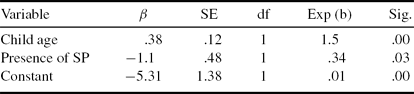
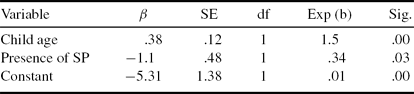
Comorbidity and age. To test the hypothesis that the presence of primary SP was associated with affective difficulties, a logistic regression was conducted. The inclusion of age and SP in the model predicted affective disorder (see Table 1). For every additional unit of age, individuals were 1.5 times more likely to have an affective disorder. With the addition of a primary SP diagnosis, individuals were .35 times more likely to have an affective disorder. A chi-square confirmed that an affective disorder was more likely in primary SP youth versus primary non-SP youth, (χ2 (1) = 9.56, p = .00).
Variables in the logistic regression equation
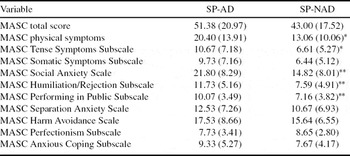
Comorbidity with affective disorders. To examine whether SP youth with comorbid affective disorders (SP-AD) were more severe than youth without comorbid affective disorders (SP-NAD), analyses of self-report measures were conducted. Self-report of anxious (MASC) and depressive (CDI) symptomatology indicated significant differences (see Table 2). SP-AD children showed significantly more severity than SP-NAD children on several MASC scales. SP-AD versus SP-NAD children differed significantly on the MASC Physical scale (F (1, 45) = 4.34, p = .05), Tense/Restless scale (F (1, 45) = 4.78, p = .03), and the Social Anxiety scale (F (1, 45) = 7.59, p = .01). SP-AD vs. SP-NAD differed on subscales of the Social Anxiety scale: Humiliation/Rejection subscale (F (1, 45) = 7.03, p = .01) and Performing in Public subscale (F (1, 45) = 6.25, p = .01). In addition, SP-AD children (M = 18.00, SD = 5.55) self-reported more depressive symptoms (more severe CDI scores) than SP-NAD children (M = 10.21, SD = 8.78), (F (1, 30) = 5.50, p = .03).
Means and Standard Deviations of pretreatment MASC scores (SP-AD vs. SP-NAD)

Note: SP-AD = youth with a principal diagnosis of social phobia and comorbid affective disorder (dysthymia or major depressive disorder); SP-NAD = youth with a principal diagnosis of social phobia and no affective disorder. *p ≤ .05. **p ≤ .01.
Mother-, father-, and teacher-reports of child symptomatology (CBCL, TRF) indicated nonsignificant differences between SP-AD and SP-NAD groups.
Comorbidity and treatment outcome. When the SP-AD group was not included in treatment outcome analyses, there were no differences between the SP vs. non-SP group on Type 1 (χ2 (1) = 4.19, ns) or Type 2 (χ2 (1) = 1.18, ns) responder status, indicating that comorbid affective disorders likely contributed to (negatively influenced) treatment outcome.
Discussion
The present results indicate that youth with a primary diagnosis of SP who present to an anxiety clinic differ significantly on a number of self-report and parent-report measures when compared to children with a primary diagnosis of GAD and/or SAD. SP children had more severe scores on performing in public, but less severe scores on separation. The self-reports of primary SP youth were consistent with both parent and teacher report. Parents and teachers reported SP children to be more impaired than non-SP children. Additionally, SP-AD youth reported more severe physical symptoms, a more severe worry about performing in public, and more depressive symptoms than SP-NAD youth.
In terms of treatment outcome, primary SP children responded favorably to CBT but were less likely to respond favorably when compared to children with another primary diagnosis (i.e. GAD and/or SAD). That is, SP youth were less likely to have their primary diagnosis (SP) remediated at posttreatment. Why might this be the case? One reason is the high degree of comorbidity with affective disorders in SP youth, particularly as the child gets older. Within primary SP children, when comparing youth with comorbid affective disorders and those without them, those with comorbid affective disorders self-reported significantly more impairment. This comorbidity and added impairment may influence treatment response. Note that although SP youth with affective disorders rated their symptoms as more severe, parents and teachers did not: It may be that socially phobic youth are more private about their distress. It is also noteworthy than SP youth with affective disorders reported more severe physical symptoms than SP youth. This finding is consistent with prior literature (e.g. Hofflich, Hughes and Kendall, Reference Hofflich, Hughes and Kendall2006) indicating that youth with anxious and depressive symptoms report more somatic complaints than youth with only anxiety.
Does an affective disorder influence treatment outcome? After statistically removing the SP-AD youth from the sample of SP youth, differences in treatment outcome between SP and non-SP youth disappeared. One possibility concerns development: as a child grows up with social phobia the rates of affective disorders increase. Another possibility is that severe SP is more difficult to treat, and this difficulty influences the expression of affective problems. The finding that SP youth with affective disorders reported more severe worrying about public performance supports this possibility. Stein et al. (Reference Stein, Fuetsch, Muller, Hofler, Lieb and Wittchen2001), during a 14–25 month follow-up period, found that adolescents with social phobia and depressive disorders went on to experience more depressive symptoms, longer depressive episodes and more suicidal ideation than did those with social phobia alone. Stein also reported that adolescents with SP were more likely to develop depressive disorders during this follow-up period than were those without SP. Additional empirical research examining anxiety disorders as potential precursors to affective disorder will inform us on this matter.
The present study used a large sample and psychometrically sound measures, and the generalizability of the results is reasonable given the focus on youth from a clinic setting. There are also potential limitations. For example, not all adolescents had a primary diagnosis of SP; some had co-primary (albeit clinically significant) SP. The sample was also primarily Caucasian and of moderate to high SES. The present study did not examine process factors within CBT (e.g. client involvement), and these may help explain outcome differences for SP youth. Also, youth with SP may require longer treatment with more time for rapport building than non-primary SP youth. More information is needed to identify the optimal treatment for SP youth with comorbid affective disorders. It may be that CBT protocols need to be supplemented by additional sessions targeting comorbid symptoms and with increased time to build a therapeutic relationship. Future studies should target early-emerging SP to examine if early intervention for anxiety can reduce the later onset of an affective disorder (see also Kendall et al., Reference Kendall, Safford, Flannery-Schroeder and Webb2004).
Based on the present results, the following recommendations are offered:
1. Because depression/dysthymia is associated with poorer treatment outcome and is common in SP youth, practitioners and researchers should assess for the presence of depression and dysthymia in youth who present with SP.
2. Because SP children are generally withdrawn, as are those with affective problems, increasing time for building rapport at the beginning of treatment is recommended.
3. Addressing the common “thinking traps” seen in depression (e.g. black and white thinking, imagining the worst outcome) might be worthwhile for SP youth. Additional problem-solving sessions may incorporate this material effectively.
4. Behavioral activation can be incorporated into treatment. Increasing the SP child's activity level and involvement in activities may facilitate the child's use of anxiety management skills.
5. For children for whom depression or dysthymia is actively interfering with treatment, consider anxiety treatment after treatment of the mood disorder and consider augmenting CBT with medication.



Comments
No Comments have been published for this article.