The value of routine follow-up blood culture (FUBC) for gram-negative bacilli (GNB) bacteremia has been questioned. Reference Wiggers, Xiong and Daneman1–Reference Mitaka, Gomez, Lee and Perlman3 Although the importance of routine FUBC has been demonstrated for Staphylococcus aureus bacteremia Reference Liu, Bayer and Cosgrove4 and candidemia, Reference Pappas, Kauffman and Andes5 the yield of routine FUBC for GNB bacteremia has generally been low (range, 5.7%–10.9%). Reference Wiggers, Xiong and Daneman1–Reference Mitaka, Gomez, Lee and Perlman3 However, a few recent observational studies have identified specific subgroups with higher rates of positive FUBC, suggesting that selective rather than routine use of FUBC after GNR bacteremia may be a better clinical practice. Reference Mitaka, Gomez, Lee and Perlman3,Reference Maskarinec, Park and Ruffin6 Routine or suboptimally selected utilization of FUBCs can be associated with excessive use of medical resources, including increased lengths of hospital stay, higher healthcare costs, increased false-positive results, and unnecessarily prolonged duration of antibiotic therapy. Reference Canzoneri, Akhavan, Tosur, Andrade and Aisenberg2,Reference Mushtaq, Bredell and Soubani7 However, practice varies substantially, and whether an FUBC is performed in a patient with GNB bacteremia may largely depend on the ‘culture’ at each institution regarding FUBCs. Reference Wiggers and Daneman8
A previous study identified end-stage renal disease (ESRD) on hemodialysis, intravascular device, and bacteremia due to multidrug-resistant organisms as independent predictors of positive FUBC with GNB bacteremia. A 14.8% positive FUBC rate was observed among those with ≥1 of these risk factors, and positive FUBCs occurred in only 3.3% of patients with none of those risk factors. Reference Mitaka, Gomez, Lee and Perlman3 However, 2 recent observational studies (1 prospective and 1 retrospective) reported that patients with GNB bacteremia for whom FUBCs were performed had a lower mortality rate than those for whom FUBC was not performed. Reference Maskarinec, Park and Ruffin6,Reference Giannella, Pascale and Pancaldi9 Hence, it remains unclear whether FUBC for GNB bacteremia should be routinely performed to document clearance of bacteremia or whether more selective use of FUBC could identify those at greater risk of adverse outcomes while simultaneously reducing the potential excess length of stay, antibiotic utilization, and healthcare costs.
We sought to determine whether current FUBC practices are associated with length of hospital stay, duration of antibiotic treatment, and/or mortality of hospitalized patients with GNB bacteremia.
Methods
Study design and patient population
We conducted a retrospective, multicenter observational study at 4 acute-care hospitals in New York City: Mount Sinai Beth Israel, Mount Sinai West, Mount Sinai Morningside, and Mount Sinai Brooklyn. All adult patients who were hospitalized between January 2017 and December 2018 with GNB bacteremia were eligible for inclusion. Exclusion criteria included age <18 years, concomitant Staphylococcus aureus bacteremia or candidemia (because data and established practice support FUBCs in these settings Reference Liu, Bayer and Cosgrove4,Reference Pappas, Kauffman and Andes5 ), an initial positive blood culture considered to be contamination by the treating physician, and death or hospice care within 3 days after drawing the initial blood-culture sample. Patients were included only once during each hospitalization. Study approval was obtained from the Institutional Review Board of the Icahn School of Medicine at Mount Sinai under an expedited review procedure (protocol no. IRB-19-00676); the requirement for patient informed consent was waived.
Data collection
We identified patients with 1 or more blood cultures positive for GNB during the study period through the microbiology database, and we reviewed electronic medical records to gather clinical variables and outcomes. We collected the following information: age, sex, body mass index, organisms isolated from blood cultures and their antimicrobial susceptibilities, presumed source of bacteremia, intensive care unit (ICU) stay on the day of the initial blood cultures, comorbidities [ie, neutropenia, human immunodeficiency virus (HIV) infection, diabetes mellitus, ESRD on hemodialysis, liver cirrhosis], vasopressor use, mechanical ventilator use, presence of central lines and intravascular devices, length of stay, duration of antimicrobial therapy during the hospital stay, and in-hospital mortality. We also extracted the laboratory data from the day of the initial blood culture, including white blood cell count, lactate level, and creatinine level.
Outcomes
The primary outcomes were length of hospital stay and duration of antibiotic treatment given during the hospital stay. The secondary outcome was in-hospital mortality, defined as death from any cause during the hospital stay after the index blood culture was drawn.
Definitions
An FUBC was defined as a blood culture drawn between ≥24 hours and ≤7 days after the initial blood culture positive for GNB. Reference Maskarinec, Park and Ruffin6,Reference Giannella, Pascale and Pancaldi9 Positive FUBC was defined as bacteremia in which the FUBC grew the same organism as the initial blood culture. Only the first FUBC performed for each patient was included in our analyses.
Neutropenia was defined as an absolute neutrophil count of <1,000 cells/µL at the time of the initial blood culture.
Intravascular device was defined as a central line (ie, conventional central venous catheter, peripherally inserted central catheter, tunneled catheter, or implanted port) and any other vascular device including implantable cardiac defibrillator, pacemaker, prosthetic valve, and/or vascular graft in place at the time of the initial blood cultures.
Based on chart review, the presumed source of bacteremia was classified as being due to urinary tract infection (UTI), pneumonia, skin or soft-tissue infection, central-line–associated bloodstream infection (CLABSI), endovascular infection, intra-abdominal infection, hepatobiliary infection, osteomyelitis, other infection, or unclear origin. The most likely source of infection was determined based on the documentation by treating physicians (including infectious disease consultation notes if present) in the electronic health record.
Polymicrobial bacteremia was defined as GNB bacteremia with an index blood culture that grew 1 or more additional microorganisms, regardless of whether the organism was GNB.
Source control was defined as any procedure performed to control the source of the bacteremia after the initial blood culture, including removal and exchange of an intravascular device. We did not include an exchange of indwelling urinary catheters due to relatively sparse documentation in medical charts compared with that for other source-control measures.
Duration of antibiotic treatment during the hospital stay was defined as the total number of days that antibiotics were administered during the hospital stay, regardless of whether the antimicrobial agent was given parenterally or orally or whether the treatment days were consecutive. If an antibiotic was administered at least once in a given calendar day, the day was counted as a treatment day.
Statistical analysis
The 95% binomial confidence intervals (CIs) were calculated around selected frequencies. Mann-Whitney U tests were used to compare continuous variables. Continuous variables were calculated as the median with interquartile range (IQR). Categorical variables were calculated as absolute number with percentage. The Fisher exact test was used to compare categorical variables.
We conducted propensity score matching to assemble a cohort of matched patient pairs with and without an FUBC, based on key baseline characteristics. First, we estimated the propensity score of the FUBC for each patient using a multivariable logistic regression model. In the model, FUBC was the dependent variable and covariates included age, sex, BMI, comorbidities (ie, neutropenia, HIV infection, diabetes mellitus, ESRD on hemodialysis, and liver cirrhosis), laboratory data (ie, white blood cell count, lactate level, and creatinine level), ICU stay, vasopressor use, ventilator use, the presence of an intravascular device, presumed source of bacteremia, bacteremia due to resistant GNB, polymicrobial bacteremia, and source control performed. We selected these covariates based on prior data Reference Canzoneri, Akhavan, Tosur, Andrade and Aisenberg2,Reference Mitaka, Gomez, Lee and Perlman3,Reference Graff, Franklin and Witt10 and to reflect factors that could affect the clinical decision to obtain an FUBC. Patients with and without an FUBC were then matched at a 1:1 ratio by propensity score. Reference Austin11 A nearest-neighbor algorithm with a caliper of 0.2 of the standard deviation of estimated propensity score was used for matching. Reference Austin12 Outcome analyses were conducted using propensity score–matched data. The median length of stay and duration of antimicrobial treatment during the hospital stay were compared between patients with and without an FUBC in the matched cohort. The adjusted odds ratio (ORs) with 95% CI for in-hospital mortality associated with FUBC were estimated using a propensity score–matched logistic regression model. A 2-sided P value <.05 was considered statistically significant. All statistical analyses were conducted using R commander, a graphical user interface for R version 3.6.1 software (R Foundation for Statistical Computing, Vienna, Austria).
Results
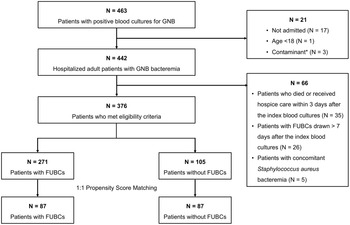
In total, 463 patients had 1 or more blood culture that grew GNB during the study period (Fig 1). Among them, 376 hospitalized adult patients met eligibility criteria. FUBCs were performed for 271 patients (72%) and were not performed for 105 patients (28%). The gram-negative organisms isolated in the initial blood cultures are presented in Table 1. FUBCs were obtained a median of 2 days (IQR, 1–4 days) after the initial blood culture, and 27 (10%; 95% CI, 6.7%–14.1%) of 271 FUBCs were positive. The isolates identified in by the FUBCs included Escherichia coli (n = 10), Klebsirella pneumoniae (n = 8), E. cloacae (n = 1), Pseudomonas. aeruginosa (n = 2), Serriata marcescens (n = 2), S Stenotrophomonas maltophilia (n = 2), Fusobacterium necrophorum (n = 1), Morganella morganii (n = 1), and Salmonella dublin (n = 1).
Study flowchart. *Three patients had initial positive blood cultures considered contaminants and were not treated by providers. The organisms were Brevundimonas diminuta isolated along with Micrococcus spp; Pseudomonas putida and Acinetobacter baumannii; and gram-negative bacilli, gram-positive cocci in pairs, and gram-positive cocci in chains, for which no further microbial evaluation was performed. Note. FUBC, follow-up blood culture; GNB, gram-negative bacilli.

Gram-Negative Bacilli (GNB) Identified in Initial Blood Cultures

a Each organism was isolated only once.
Baseline characteristics of the patients with and without an FUBC before and after propensity score matching are listed in Table 2. Compared with patients without an FUBC, patients with an FUBC were significantly more likely (1) to be in the ICU (40% vs 27%; P = .02), (2) to have ESRD on hemodialysis (14% vs 6%; P = .03); (3) to have an intravascular device (34% vs 21%; P = .01); and (4) to require source control measure (36% vs 21%; P = .007). Moreover, 14 patients diagnosed with CLABSI and 2 patients with probable endovascular infection had an FUBC. Overall, UTI was the most frequent source of bacteremia, accounting for 117 (42%) of 271 patients with an FUBC and 61 (58%) of 105 patients without an FUBC (P = .008).
Baseline Characteristics of Patients with Gram-Negative Bacilli Bacteremia With and Without Follow-Up Blood Cultures (FUBCs) Performed

Note. ANC, absolute neutrophil count; BMI, body mass index; CLABSI, central-line–associated bloodstream infection; ESBL, extended-spectrum β-lactamase; ESRD, end-stage renal disease; HIV, human immunodeficiency virus; ICU, intensive care unit; IQR, interquartile range. Statistically significant numbers were highlighted in boldface type.
After propensity score matching at a 1:1 ratio, 87 pairs of patients with and without an FUBC performed were included in the outcome analysis. Baseline characteristics of the matched groups were well balanced, and there were no significant differences in the selected covariates. UTI remained the most frequently presumed source of bacteremia in the matched cohort. On the other hand, only 2 patients with probable endovascular infection and no patients with CLABSI were included in the matched cohort. The results of the outcome analysis are presented in Table 3. In the propensity score–matched cohort, the median length of stay was significantly longer in patients with an FUBC than in patients without an FUBC: 9 days (IQR, 6.0–14.0) versus 7 days (IQR, 4.5–10.5), respectively (P = .017). The median duration of antibiotic treatment during hospital stay was also significantly longer in the group with an FUBC than in the group without an FUBC: 8 days (IQR, 5.5–13.0) versus 6 days (IQR, 4.0–10.0), respectively (P = .007). Also, 4 patients (4.6%) with an FUBC and 10 patients (11.4%) without an FUBC died during their hospital stays. We found no significant difference in in-hospital mortality between the groups, with an OR of 0.37 (95% CI, 0.082–1.4; P = .16).
Outcomes of Patients with Gram-Negative Bacilli Bacteremia With and Without Follow-up Blood Cultures (FUBCs) Performed

Note. OR, odds ratio; CI, confidence interval; IQR, interquartile range.
Discussion
The findings of our propensity-matched cohort study suggest that, among patients with GNB bacteremia, having had an FUBC was associated with both longer length of stay and longer duration of in-hospital antimicrobial therapy.
To the best of our knowledge, this is the first study to confirm an association between obtaining an FUBC for GNB bacteremia and longer length of stay, adjusting for confounding factors. Routine use of FUBC can increase the risk of false-positive results, potentially leading to increased adverse events due to prolonged antibiotic use and to the overutilization of resources, including imaging tests and echocardiography, as well as increased length and cost of hospitalization. Reference Mushtaq, Bredell and Soubani7,Reference Coburn, Morris, Tomlinson and Detsky13,Reference Chan, Bryson-Cahn, Kassamali-Escobar, Lynch and Schleyer14 Although several previous studies have reported longer lengths of stay among patients with an FUBC, these results were unadjusted based on baseline characteristics and severity of illness. Reference Giannella, Pascale and Pancaldi9,Reference Chan, Ta, Lynch and Bryson-Cahn15 One plausible explanation for the longer length of stay and duration of in-hospital antibiotic therapy in patients with FUBCs is that the treating physicians may have deferred discharges while waiting for the FUBC results. FUBCs are obtained to confirm clearance of bacteremia. With this in mind, it is logical for clinicians who ordered the test to continue antimicrobial therapy and hospitalization until the results of the FUBCs are negative, regardless of the patient’s clinical status. Although such practice appears logical, it may contribute to keeping clinically improving patients unnecessarily longer in the hospital. Although propensity score matching reduces the risk of selection bias due to known matched variables, it cannot eliminate the risk of selection bias due to unmatched variables or unmeasured confounders.
We detected no significant difference in in-hospital mortality between the groups with and without an FUBC, although we did detect a nonsignificant trend toward lower mortality among patients with an FUBC. This finding should be interpreted cautiously because the sample size of our study was not large enough to be adequately powered to exclude the possibility that performing an FUBC might be associated with mortality difference. The association between obtaining an FUBC and mortality among patients with GNB bacteremia has been a controversial topic. A retrospective cohort study conducted in Canada reported higher 30-day mortality in the group with FUBCs than in the group without an FUBC (27.0% vs. 11.2%; P <0.001). Reference Wiggers, Xiong and Daneman1 An important caveat of this finding is that the mortality rates were not adjusted for confounding factors. On the other hand, more recent observational studies using matched cohorts to compare outcomes have reported that obtaining an FUBC was associated with reduced mortality. Reference Maskarinec, Park and Ruffin6,Reference Giannella, Pascale and Pancaldi9 The relationship between mortality and not obtaining an FUBC may have been confounded by a greater reliance on supportive care (eg, comfort care or hospice care) or nonstandard care, which can lead to increased mortality. The possibility of this potential bias cannot be entirely excluded, although we excluded patients who died or received hospice care within 3 days after the index blood culture to minimize this possibility. The ‘culture’ at an institution regarding FUBC may have influenced the frequency and yield of FUBCs as well as the association with mortality reported in previous studies. Reference Wiggers and Daneman8 A randomized controlled trial is needed to determine whether the prognosis of patients with GNB bacteremia can be improved by performing an FUBC in some specific subgroups of these patients.
Recently published consensus guidance on the management of uncomplicated GNB bacteremia suggests that routine FUBCs are not necessary to document clearance of bloodstream infection. Reference Heil, Bork and Abbo16 Our findings build on the recommendations of the expert panel by providing further evidence that routine FUBC in GNB bacteremia can potentially be associated with prolonged length of stay and antimicrobial use. As discussed above, the decision making related to ordering an FUBC may reflect the clinical suspicion of persistent bacteremia or local clinical norms regarding routine FUBC. For example, a clinician who ordered an FUBC may intend to continue intravenous antimicrobial therapy and hospitalization until a negative result is confirmed, regardless of the pretest probability of persistent bacteremia or clinical improvement of the patient. However, to more carefully select cases for which an FUBC may be needed, Reference Mitaka, Gomez, Lee and Perlman3 clinicians may differentiate the following groups of patients: (1) the smaller proportion of patients with persistent bacteremia and higher all-cause and attributable mortality Reference Maskarinec, Park and Ruffin6 and (2) the larger group with a low likelihood of persistent bacteremia for whom early discharge and a transition to oral antibiotics may be appropriate. Based on the patient characteristics of our matched cohort, FUBC may be reasonably omitted in immunocompetent adults with GNB bacteremia due to a urinary source, including critically ill patients, assuming an appropriate clinical response within 72 hours and adequate source control in the absence of other risk factors such as intravascular devices. Reference Heil, Bork and Abbo16 On the other hand, FUBCs should be pursued in patients at higher risk for persistent bacteremia and those in high-risk populations. In our study, many patients with ESRD on hemodialysis or with intravascular devices did not have an FUBC even though FUBCs have been shown to have a high yield in this population. A real-time discussion about FUBCs between the primary team and antimicrobial stewardship team (eg, an “FUBC huddle”) could be an important next step in diagnostic stewardship for patients with GNB bacteremia.
This study had several limitations. First, we evaluated the association between the performance of FUBCs and the outcomes of GNB bacteremia, but we could not provide causal inference because of the retrospective nature of the study and the limited information available regarding the reason for ordering an FUBC. In other words, we were unable to distinguish between patients for whom the repeated blood cultures were ordered to confirm the clearance of bacteremia and patients for whom blood cultures were repeated because of clinical decompensation, lack of improvement, or a high pretest probability of endovascular infection. No information was available on the characteristics of the treating physicians and the presence or absence of infectious disease consultation, which could potentially have affected both the likelihood of obtaining an FUBC and outcomes. For example, physicians who preferred to order more FUBCs might also have favored longer intravenous therapy independently of FUBC practices. We used the diagnoses reflected in the medical record, rather than National Healthcare Safety Network case definitions; however, using routinely made clinical diagnoses aligned the analyses with the clinical impressions that influenced real-time blood culture and antibiotic practices. Several patients had polymicrobial bacteremia, and background rates of blood culture contamination were not available, which could have affected our findings, although GNB are not common contaminants. Given the retrospective nature of the study, we used in-hospital mortality as an outcome measure, rather than 30-day mortality or 30-day readmission rates, which could have introduced a bias. However, because retrospectively identified discharged patients may not have been reachable and could have been readmitted to hospitals outside the study, 30-day postdischarge assessments could also have introduced potential biases. In addition, censored data from patients who died during the hospital stay may have affected both the length of stay and treatment duration; the numbers of patients who died during the study period was unbalanced between the groups with FUBCs (N = 4) and without an FUBC (N = 10). Finally, our propensity score estimation did not take specific GNB species into consideration, whereas bacteremia due to ESBL or carbapenemase-producing organisms was included based on prior data. Reference Mitaka, Gomez, Lee and Perlman3 The matched cohort included few to no patients with some possibly important risk factors for worse outcomes, which precluded our ability to examine differences in outcome in these situations. Therefore, the findings of our study may not be generalizable to those who were not well represented in the study (eg, people living with HIV, neutropenic patients, and transplant recipients). In addition, these findings may not apply to those who were not included in the propensity score–matched cohort (eg, patients whose propensity scores for obtaining FUBCs were too high to have a matched pair, such as patients with endovascular infections or CLABSI (all of whom had FUBCs performed) as well as patients with ESRD on hemodialysis or intravascular devices, for which an FUBC should be considered due to a much higher likelihood of positive FUBC. Reference Mitaka, Gomez, Lee and Perlman3
In conclusion, current clinical practices of obtaining FUBCs in patients with GNB bacteremia may be associated with prolonged length of stay and duration of in-hospital antimicrobial therapy. Thus, the development of validated selection criteria for identifying subgroups in which FUBCs are likely to have a higher or lower yield is essential to optimizing clinical outcomes and resource utilization. A large prospective study is warranted in a population in which FUBCs are routinely obtained with sufficient numbers of patients with and without factors such as intravascular devices, CLABSI, multidrug-resistant GNB, and febrile neutropenia are represented. Such a study would better guide the utilization of FUBCs by identifying which subsets of patients with GNB bacteremia would benefit from an FUBC and in which subsets of patients an FUBC could be appropriately omitted to reduce length of stay, duration of in-hospital antimicrobial therapy, and their attendant risks.
Acknowledgments
Financial support
No financial support was provided relevant to this article.
Conflicts of interest
All authors report no conflicts of interest relevant to this article.