Introduction: Censorship in Belarus
Political humor directed at President Alyaksandr Lukashenka is beyond the official boundaries of the permissible in Belarus, a former Soviet Republic tucked away on the eastern border of the European Union and oft labeled “Europe's last dictatorship.” In August 2005, KGB officers raided the Minsk office of the civic group Third Way, confiscated the computer equipment, and threatened criminal charges for posting animated cartoons on the group's web site (http://mult.3dway.org).1
Reporters without Borders. 2005. “KGB Censors Satirical Internet Cartoons” (Press Release). August 18, www.rsf.org/article.php3?id_article=14724. Accessed June 30, 2006.
Since coming to power in 1994, Lukashenka has stifled press freedom.2
For a recent overview of the media situation in Belarus, see International Federation of Journalists (2006).
To a large extent, the Internet has emerged as the last vestige of media freedom in Belarus. According to recent estimates by the Ministry of Information and Communication, Internet users constitute 15% of the country's population (ByBanner 2005). Notwithstanding systematic attempts by the incumbent government to control access to Internet sites deemed inappropriate for its citizens, such non-state actors as human rights group Charter 97 (www.charter97.org) and the online publication Pahonia (www.pahonia.promedia.by) struggle to supply a stream of alternative news. Using the Chinese Internet-blocking technology, however, the government seeks to further filter the available content.3
The Belarussian government has recently introduced new obstacles to Internet access. On February 10, 2007, the Cabinet of Ministers issued a decree mandating all Internet cafes and computer clubs to keep electronic records of domain names of sites visited by each user. In addition, Internet café owners are required to report to security services any legal violations, including users' attempts to access unauthorized material. For the full text of the decree, visit The National Legal Internet Portal of the Republic of Belarus http://pravo.by/webnpa/text.asp?RN=C20700175 (accessed February 16, 2007).
Against the backdrop of the relentless clampdown on the media, web cartoons are well-suited to address the poignant tension between political reality and state propaganda. First, from the technological standpoint, cartoons released via Internet function as a medium of political communication capable of circumventing state censorship to reach a large audience. Second, by employing a mix of visual and verbal techniques, cartoons can tap into the rational concerns and emotional anxieties of media consumers. Finally, from the normative perspective, cartoons tend to convey a message that stimulates reflection upon the political situation and provides a motivation for action.
Why Animal Farm?
The purpose of this paper is to analyze cartoonist Oleg Minich's creative interpretation of George Orwell's Animal Farm as an allegory of contemporary Belarus. The British novel illuminating the dramatic slide of the Soviet Union into Stalin-led dictatorship has entered world literature as a classic example of political satire (Rossi 1981). Since its first publication in 1945, the book has sold over 10 million copies worldwide (Ash 1997). Building upon its success, Minich, a computer specialist from Grodno, created the animated cartoon “The Rule by the Pigs” (in Flash format) and disseminated it via the Internet in June 2005. The cartoon aims to expose the extant political regime's numerous faults at a moment of critical discourse: nine months before the 2006 presidential election. Prior to Minich's arrest in August 2005, approximately 1,000 viewers visited the MultClub's web page. If the government's goal was to limit the Belarussian public's exposure to the cartoon, then the government's repressive action backfired: visits to the site multiplied by 50 following Minich's arrest (Khalip 2005).
Given the resemblance between the Soviet Union and Lukashenka's Belarus, Minich's usage of the imagery of Animal Farm is well-grounded and ingenious. A common feature of the political order in the two states is the calculated attempt by the ruling elite to maintain its grip on power through a variety of repressive measures and the manipulation of electoral results. In the Soviet times, the Communist Party usurped state power by squashing any public manifestation of disagreement with its dominant ideology. In a stealthier manner, Lukashenka allowed the registration of opposition candidates, but then manipulated electoral procedures to win election for a third term in March 2006. According to the official electoral results, recognized only by such states as China, Iran, and Russia, Lukashenka gained a 76% advantage over his major rival, Alyaksandr Milinkevich. In recognition of its Soviet-style politics, Belarus has earned the nickname “Soviet Disneyland.”
The next section details how Minich adopted the well-known novel to the Belarussian context to portray a politically suffocating environment.
Cartoon as Narrative
“Cartoon” is understood here as a narrative that possesses at least three characteristics: setting, plot, and characters (Edwards 1997).
Setting
Like Orwell's masterpiece, the story in the Belarussian cartoon unfolds on the premises of an animal farm. As a cogent metaphor, the farm represents a miniature version of the country bogged down with authoritarian practices. Moreover, the farm imagery has an additional layer of meaning in Belarus; Lukashenka was the head of a collective farm prior to taking the center stage in national politics.
Plot
“The Rule by the Pigs” is a condensed version of the British novel. To demonstrate the gradual transformation of the Soviet Union into dictatorship, Orwell stretches the narrative across several years, starting with Lenin's bequeathal and ending with the consolidation of Stalin's rule. In contrast, Minich fast-forwards to the populace's mundane existence under Lukashenka's leadership, skipping the first years of independence in the 1990s. Rather than recounting the exponential growth of presidential powers, the cartoon concentrates on the end product—political stalemate. Day in, day out, citizens act as docile sheep to eke out a living, while the ruling elite, as pigs, lead a luxurious lifestyle. The incumbent government is notorious for embezzling state funds, extracting ‘donations’ from private sources to replenish the state budget, and shoving down the public's throat brazen declarations of prosperity and stability. Nothing seems to portend improvement. The explicit message here is that individuals should relinquish their pliancy and mobilize against the repressive regime.
Characters
Emulating Orwell's deft usage of metaphor, animals symbolize major political actors in the post-communist society. Pigs, cows, dogs, and sheep populate the farm. Human beings are missing from the narrative. Unlike Orwell, Minich depicts both friends and foes of the farm through the animal imagery. Furthermore, the cartoonist refrains from concocting fictional names for prototypes of real-life politicians. All the characters, except the dog Tuzik, remain anonymous in the story.
The pig symbolizes the ruling elite. The negative connotation attached to the image of the pig reveals the cartoonist's attitude toward those in power. Like the gluttonous animal, local politicians exhibit an insatiable appetite, but for the pursuit of personal, profit-maximizing goals at the expense of public interests. In addition, the pig's proclivity to roll in the dirt illustrates another characteristic of Belarussian parliamentarians—their stained reputation. The satirical depiction of picking deputies to the National Assembly is a vivid example of this. When the chief pig standing for president decides upon the composition of the National Assembly, he selects the pigs covered with the most dirt. To poke further fun at electoral procedures in Belarus, Minich refers to the National Assembly as the National Chamber of Appointed Representatives.
The cartoon highlights social relations marked by political domination of the few. One episode shows the sheep working in the field with their pig overseers keeping them at task with a whip woven of various decrees and regulations. Another episode reveals that the sheep have been fed in accordance with exorbitant world prices and poor local quality, with the resultant profits going into the chief pig's pocket. Similar instances of taxation without representation are found in Orwell's novel.
In Animal Farm, the recurrent project of setting up a windmill serves as a beacon that guides the animals' action in times of sorrow and hardship. No matter how many disasters befall the animal farm, the windmill is to be built.
The Belarussian cartoonist replaces the windmill with an image closer to home—the National Library, President Lukashenka's pet project. The construction of the 236-feet high, diamond-shaped building has been rife with controversy. Like the windmill, which was destroyed by a storm, the library was poorly planned; it was built on swampland and runs the risk of collapse. Yet, ironically, Lukashenka valorizes it as the embodiment of the country's might and prosperity (Naviny 2006). The multimillion dollar project has drained the city treasury and relieved the pockets of Minsk residents. The cartoon alludes to involuntary payments extracted from private citizens and business organizations to fund the construction work. “The sheep have bleated a little, but then chipped in,” one of the pigs remarks, suggesting acquiescence as a behavioral strategy of most Belarussians.
A combination of visual and narrative techniques aids the resemblance of the chief pig to the incumbent president. The pig sports a Lukashenka-style moustache that sets it apart from the other animals. Moreover, the chief pig exhibits a mania for sports, which compels him to try to ski in the summer. The president's fascination with physical exercise has become the butt of many jokes in Belarus, since Lukashenka tirelessly trumpets the idea of a healthy lifestyle and coerces citizens into paying for his obsession with sports. As reflected in the cartoon, the chief pig's next extravagant project is to build the Ice Palace housing an enormous skating rink. This implies further diversion of state resources from indispensable public services.
One of Belarus's friends helps the president patch a hole in the state budget. The cow symbolizes Lukashenka's close ally, Russia. As a low-income country with underdeveloped market mechanisms, Belarus depends upon the cheap provision of energy resources from its eastern neighbor. As a result of preferential treatment, Belarus, for example, paid $47 per 1,000 cubic meters of gas in 2006, almost five times less than what Western European countries paid (Mite 2006b). In the cartoon, the cow grudgingly moos at the pig's milking of it. The chief pig attempts to placate the animal by flaunting the promise of “Milk in Exchange for Kisses.” This episode hints at Lukashenka's unremitting talk of the close partnership between the two countries.4
Since the production of the cartoon, Russian-Belarussian relations have deteriorated. In December 2006, Belarus “reluctantly agreed to a doubling in price of Russian gas, to $100 per 1,000 cubic meters” (Weir 2007). Moreover, Lukashenka publicly delivered scathing remarks against the Kremlin and made overtures to the West (RFE/RL 2007).
The West, on the contrary, is represented as a dragon lurking in the bushes near the farm. As an illustration of state propaganda, the chief pig is shown warning the sheep that strict discipline is the only safeguard against being devoured by the merciless beast. The president has repeatedly asserted that the West detests the air of stability in Belarus and is constantly masterminding subversive action. To emphasize the president's abhorrence for political change, Minich puts a clipped audio statement from one of Lukashenka's speeches into the chief pig's mouth: “They suppose that Belarus has ripened for some Orange or Blue Revolution…. It surprises and infuriates me.” It is obvious that the incumbent president fears the spread of democratic ideas within the country's population.
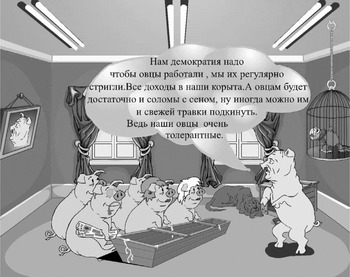
Instead, the self-centered conception of the political regime appeals to Lukashenka. In one of his public statements, President of Belarus identified the following requisites for democracy, “We need democracy so that people work, earn some wages, buy bread, milk, sour cream, cottage cheese, sometimes a little meat …”5
The original text of Lukashenka's statement is available in Russian at www.aphorism.ru/135_3.shtml.
We need democracy so that the sheep would work and we would regularly shear them. All the profits will go in our troughs. It will be enough to feed the sheep with hay; sometimes we might throw them some fresh grass. Our sheep are very tolerant.

Lukashenka-Style Democracy. “We need democracy so that the sheep would work and we would regularly shear them. All the profits will go in our troughs. It will be enough to feed the sheep with hay; sometimes we might throw them some fresh grass. Our sheep are very tolerant.” Reprinted with permission, Multclub/Belarus. Source: http://mult.3dway.org (accessed June 11, 2006).
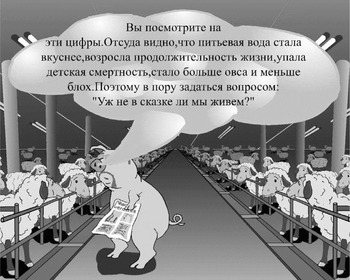
The mass media are portrayed in the cartoon as a tool of state propaganda. The broadcasting media parrot the government's position regardless of its crass contradiction with reality. By the same token, the newspaper Belarus' Segodnia (Belarus Today), with a circulation of 500,000 copies, blankets the country with news manufactured by the presidential administration.4 As shown in Figure 2, government messengers reassure citizens that they are blessed with wise political leadership and impressive socioeconomic conditions. “Drinking water has become tastier, life expectancy has increased, child mortality has declined,” the pig asserts, holding a copy of Svinarnik Segodnia (Pig Farm Today), a parody on Belarus' Segodnia, as the dubious evidence to back up his claim.

Life in a Fairytale. “Just look at these figures! It is obvious that drinking water has become tastier, life expectancy has increased, child mortality has declined; there is more hay and fewer fleas. Indeed, it is high time to ask, ‘Don't we live in a fairytale?’ ” Reprinted with permission, Multclub/Belarus. Source: http://mult.3dway.org (accessed June 11, 2006).
In response, the sheep, representative of ordinary citizens, seldom swim against the current. The cartoon illustrates how the chief pig reacts to humble complaints about unbearable living conditions: by issuing another barrage of propaganda and intensifying repressive measures. Under these circumstances, citizen inaction contributes to the perpetuation of the repressive political system. The cartoon's political message is quite clear: it is imperative that citizens abandon their meek attitude toward the incumbent government and demand political change. Making such a choice, however, poses a serious threat to an individual's career, economic well-being, family safety, and health. More than 300 civic activists were arrested in March 2006 alone (Peuch 2006), and the list of political prisoners is growing.
Conclusion
This analysis of the web cartoon offers a snapshot of the political order in Lukashenka's Belarus and draws several conclusions. First, this study adds to the growing body of literature on the cross-time diffusion of ideas through a non-relational channel. Orwell's Animal Farm is notable for more than its depiction of the Soviet Union. The novel catalogues a number of coercive methods that sustain autocracies in other states. By combining Orwell's toolkit of literary techniques with an insider's knowledge of the Belarussian context, Minich provides a compelling account of political reality in the repressive regime. Given the worldwide popularity of political cartoons as a form of self-expression and journalistic commentary, they deserve more attention in diffusion research.
Furthermore, this inquiry suggests that the Internet plays a vital role in breaking state monopolies on information and upsetting propaganda efforts in non-democracies. By releasing animated cartoons via the Internet, Minich was able to reach a large number of people and facilitate a common understanding of the political situation. The importance of the Internet in diverse political settings is a promising line of research in comparative democratization literature.
Finally, the study of political cartoons highlights the value of interdisciplinary scholarship. Since cartoons can be interpreted as a form of visual art, a part of popular culture, a record of national history, and a mode of political communication, different bodies of literature bear on this complex topic. To date, analysis of cartoons has been largely sidelined in political science research. By engaging in an academic dialogue with students of history, mass communication, and popular culture, to name a few, political scientists can develop a more profound understanding of the significance of cartoons in politics.