Introduction
Sediments of the La Matilde Formation crop out in several areas of Santa Cruz province (Argentina), some localities containing “in situ” silicified trees, with many fallen and fragmented examples (De Barrios et. al., Reference De Barrios, Panza and Nullo1999). The geological and paleontological characteristics of the La Matilde Formation have already been described by several authors (e.g., Delhaes, Reference Delhaes1913; Frenguelli, Reference Frenguelli1933; Feruglio, Reference Feruglio1949; Stipanicic and Reig, Reference Stipanicic and Reig1957; Spalletti et al., Reference Spalletti, Iñiguez Rodriguez and Mazzoni1982; Panza and Irigoyen, Reference Panza and Irigoyen1995; Panza, Reference Panza1998).
Sediments of the La Matilde Formation crop out in diverse sectors of the province of Santa Cruz: the central-eastern sector: Cañadón de La Matilde, where the type locality is situated (Criado Roque, Reference Criado Roque1953; Stipanicic and Reig, Reference Stipanicic and Reig1957; Panza, Reference Panza1984, Reference Panza1995, Reference Panza1998); the central sector, the best known from a paleontological point of view, comprising, among other localities, the “Monumento Natural Bosques Petrificados de Jaramillo” (Jaramillo Petrified Forest National Park) (Panza, Reference Panza1982, Reference Panza1995, Reference Panza1998); the central and south-western sector (Bajo El Puma and estancia Manantial Espejo, among other localities) (Panza, Reference Panza1986; De Barrios, Reference De Barrios1989; Panza and Marín, Reference Panza and Marín1996; Panza and Cobos, Reference Panza and Cobos1998); and the Gran Bajo de San Julián sector comprising localities such as Laguna del Molino, Laguna del Carbón, Mina del Gobierno, Mina La Pareja and Puesto Raspuzzi, among others (Panza and De Barrios, Reference Panza and De Barrios1989; Panza and Irigoyen, Reference Panza and Irigoyen1995).
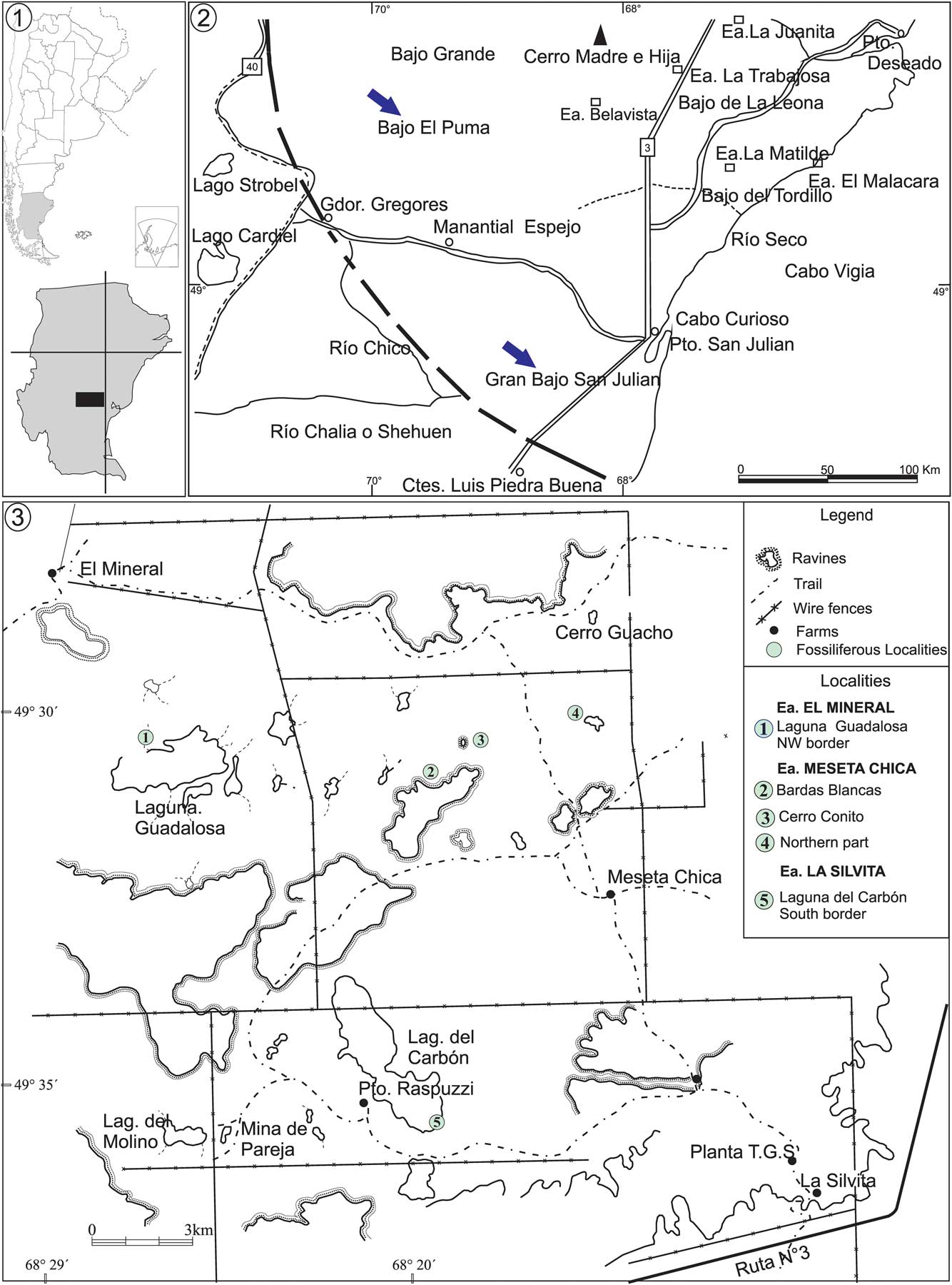
Herbst et al. (Reference Herbst, Lutz, Gallego and Acevedo1995) found new outcrops containing large quantities of petrified logs in the Gran Bajo de San Julián sector, which show the same characteristics as those from the north of the province (i.e., forests with in situ petrified trunks and rolled trees). These localities are found in the Estancia El Mineral (Laguna La Guadalosa), Estancia Meseta Chica (Barda Blanca, Cerro Conito, northern part), and Estancia La Silvita (Laguna del Carbón) (Figs. 1, 2).
(1) Map showing the location La Matilde Formation of the Santa Cruz Province in Argentina. (2) Map showing the location Bajo El Puma and Gran Bajo San Julián sector (arrows). (3) Geologic map of the Gran Bajo San Julián sector, the circle shows the location of the localities. (Adapted from Gnaedinger and Herbst, Reference Gnaedinger and Herbst2006).

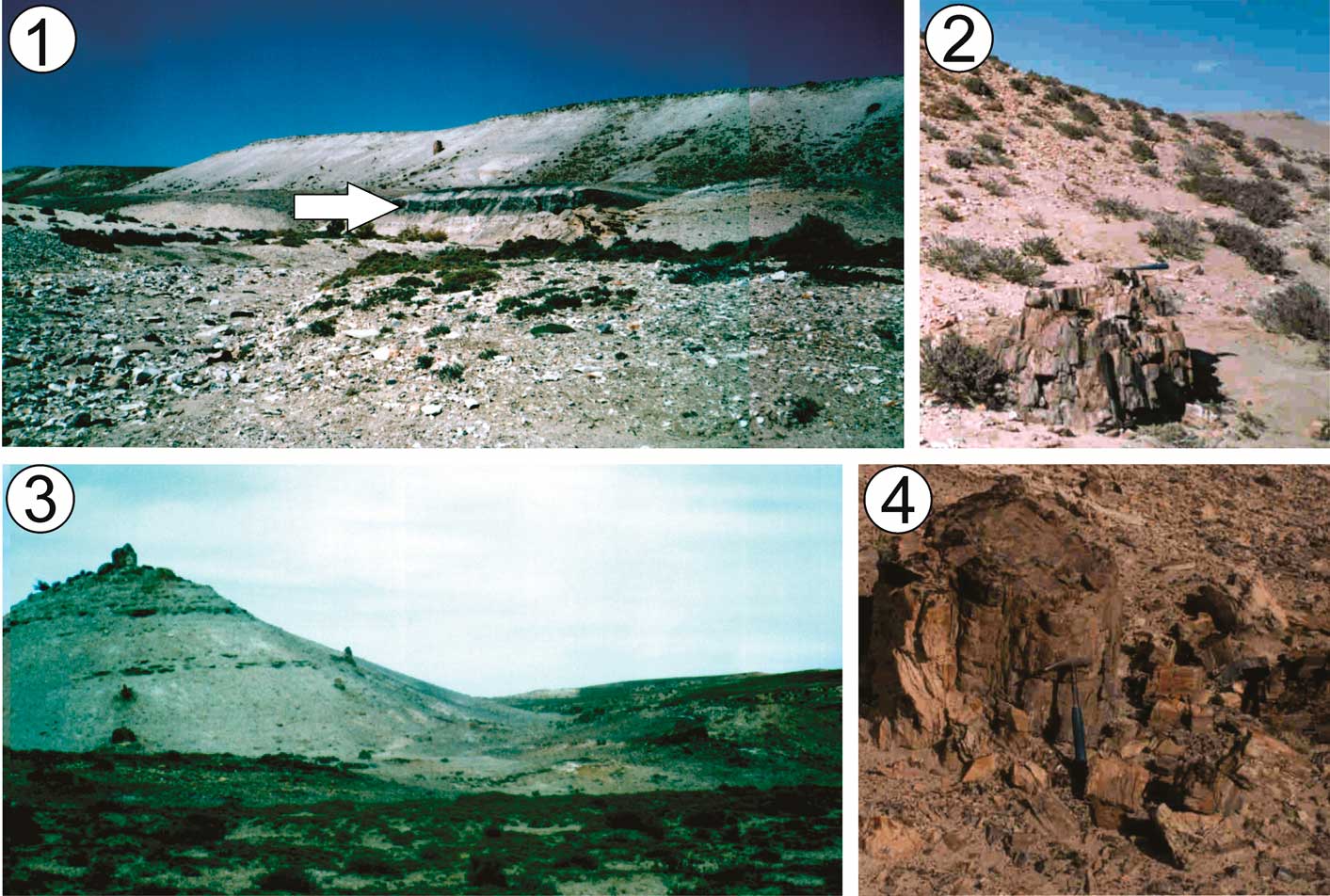
Gran Bajo San Julián localities. (1) Barda Blanca locality showing carbonaceous pelitic levels (arrow); (2) wood “in situ” from Barda Blanca locality; (3) Cerro Conito locality; (4) wood “in situ” from Cerro Conito locality.

Anatomical descriptions of Osmundales macrofossils and leaf impressions of the orders Equisetales, Osmundales, Bennettitales, and Coniferales have been made from these outcrops (Feruglio, Reference Feruglio1951; Archangelsky and de la Sota, Reference Archangelsky and De La Sota1962; Herbst, Reference Herbst1977, Reference Herbst2003; Baldoni, Reference Baldoni1981, Reference Baldoni1990; Herbst and Salazar, Reference Herbst and Salazar1999). In addition, also from this formation, petrified cones (Spegazzini, Reference Spegazzini1924; Calder, Reference Calder1953; Menéndez, Reference Menéndez1960; Stockey, Reference Stockey1977, Reference Stockey1978; Stockey and Taylor, Reference Stockey and Taylor1978), as well as silicified fungi (Singer and Archangelsky, Reference Singer and Archangelsky1957) and wood, Agathoxylon matildense (Zamuner and Falaschi, Reference Zamuner and Falaschi2005), have been described from the well-known “Jaramillo Petrified Forests,” including areas such as Cerro Madre e Hija and Cerro Cuadrado, among others.
In previous studies of the xyloflora from the Gran Bajo de San Julián sector, taxa of the order Coniferales were described: Protelicoxylon Philippe and Herbstiloxylon Gnaedinger, related to members of the Cupressaceae; Circoporopitys Gnaedinger, two new species of Podocarpoxylon Gothan, and Circoporoxylon Kräusel, belonging to the Podocarpaceae; and Planoxylon Stopes, of the group Protopinaceae. Specimens of Prototaxoxylon Kräusel and Dolianiti of the order Taxales, and Ginkgomyeloxylon tanzanii Giraud and Hankel of the order Ginkgoales, also have been described (Gnaedinger and Herbst, Reference Gnaedinger and Herbst2006; Gnaedinger, Reference Gnaedinger2007a, Reference Gnaedingerb, Reference Gnaedinger2012).
In this contribution, Agathoxylon species are described for the first time from the Gran Bajo de San Julián sector (northern part of Estancia Meseta Chica, Barda Blanca, Cerro Conito, Laguna La Guadalosa, and the south-east border of Laguna del Carbón) and the central and south-western sector (Bajo El Puma), collected from the Middle Jurassic of the La Matilde Formation in Argentina.
Geological setting
The La Matilde Formation is part of the Bahía Laura Group and is widely distributed in the province of Santa Cruz (De Barrios et al., Reference De Barrios, Panza and Nullo1999, fig. 28, p. 513) (Fig. 1). The specimens analyzed come from the Gran Bajo San Julián, central, and south-western areas (Fig. 1.2). In the Gran Bajo San Julián sector, the La Matilde Formation comprises ~70–80 m of tuffs, sometimes sandy tuffites, lithic tuffs (tufolites), and chonites of greatly varied coloration, generally in tabular strata; also present are very subordinate amounts of fine-grained conglomerates.
There are also carbonaceous pelitic levels, up to true coals, which are generally located near the base of the sequence cropping out in the Gran Bajo de San Julián sector, particularly in the Laguna del Carbón and Barda Blanca localities (Figs. 1.3, 2). Woods and some other fossil conchostracans, pelecypods, insects, and anurans (Stipanicic and Reig, Reference Stipanicic and Reig1957; Gallego, Reference Gallego1994; Morton and Herbst, Reference Morton and Herbst2001; Baez and Nicoli, Reference Baez and Nicoli2003) are associated in these levels. The rest of the abundant wood is distributed throughout the formation. The base of the Bahía Laura Group is either the Roca Blanca Formation (Lower Jurassic) or the Bajo Pobre Formation (probably Aalenian–Bajocian) (Panza and Irigoyen, Reference Panza and Irigoyen1995). The top is constituted by a series of brown clays (San Julián Formation), which, because they contain a fossil flora of angiosperm leaves, would be assigned to the Cenozoic (De Giusto, Reference De Giusto1955; Bertels, Reference Bertels1977; De Giusto et al., Reference De Giusto, Di Persia and Pezzi1980).
The age of the Bahía Laura Group is still subject to some dispute. In modern times, by means of radiometric dating, different authors have offered different age data, but all coincide between 157 Ma and 162 Ma±5–10 Myr; this means the La Matilde Formation can be assigned to the Bathonian interval up to the Callovian (Spalletti et al., Reference Spalletti, Iñiguez Rodriguez and Mazzoni1982; De Barrios, Reference De Barrios1993; Echeveste et al., Reference Echeveste, Fernández, Bellieni, Tessone, Llambías, Schlamuk, Piccirillo and De Min2001).
Paleoenvironmentally, the La Matilde Formation sediments indicate that it is a continental sequence, characteristic, in part, of a low-energy fluvial environment; in the flood plains, some bodies of water (lagoons) formed in some areas that partly came to be of marsh conditions (lentic and reducing). In the region, an intense volcanism developed, producing the extensively distributed ash and other pyroclastic products that constitute the bulk of the sediments (Mazzoni et al., Reference Mazzoni, Spalletti, Iñiguez Rodriguez and Teruggi1981; De Barrios et al., Reference De Barrios, Panza and Nullo1999).
Materials and methods
The specimens described come from the La Matilde Formation, Santa Cruz Province, Argentina, (Fig. 1.1) and were collected from the Bajo El Puma locality of the central and south-western sector and another four localities from the Gran Bajo de San Julián sector: Laguna La Guadalosa (Estancia El Mineral), Cerro Conito, Barda Blanca and the northern part of Estancia Meseta Chica (Estancia Meseta Chica), and the south-east border of Laguna del Carbón (Estancia La Silvita) (Figs. 1.2, 3). The in situ petrified woods and rolled trees reach diameters of up to 2.4 m (Fig. 2).
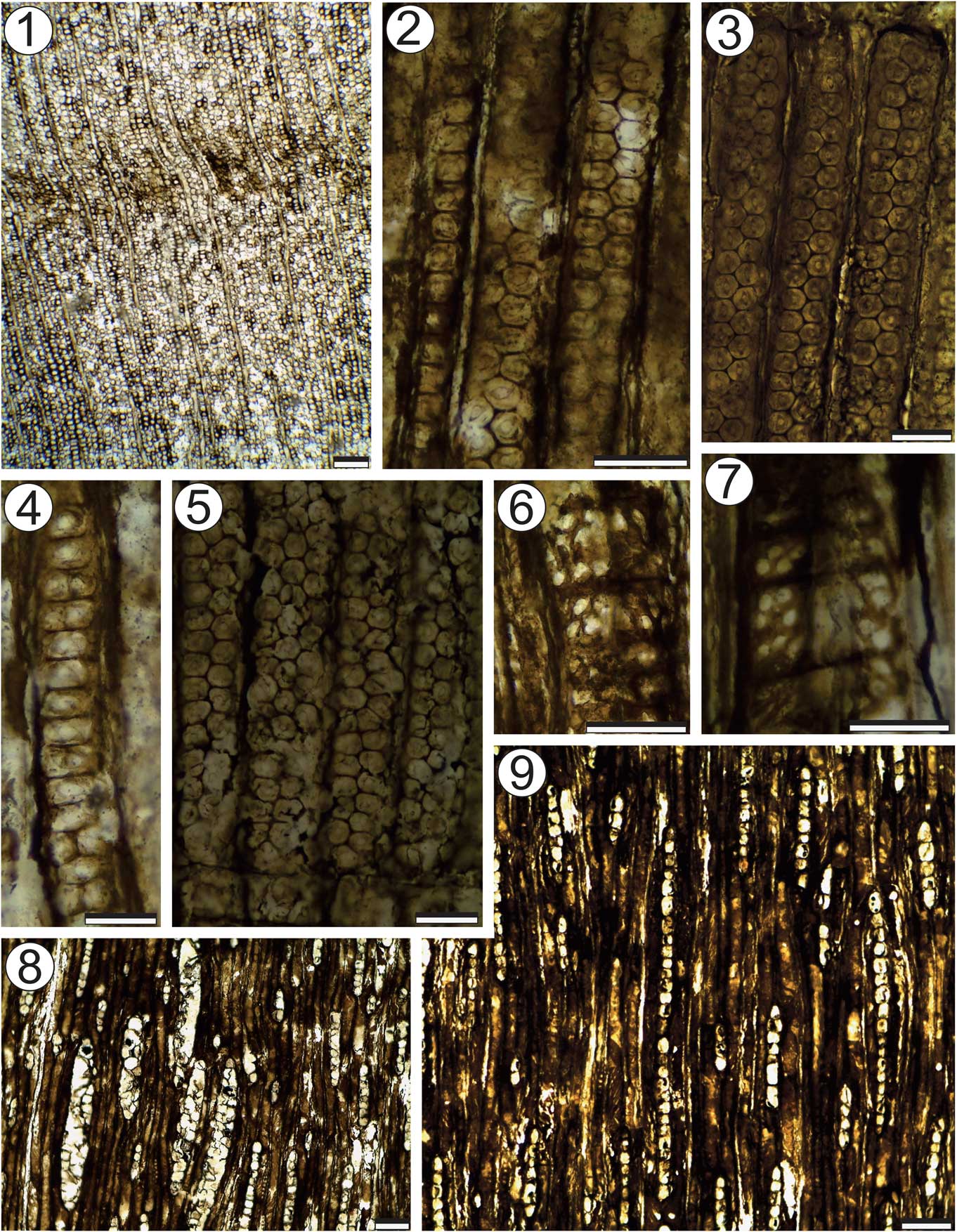
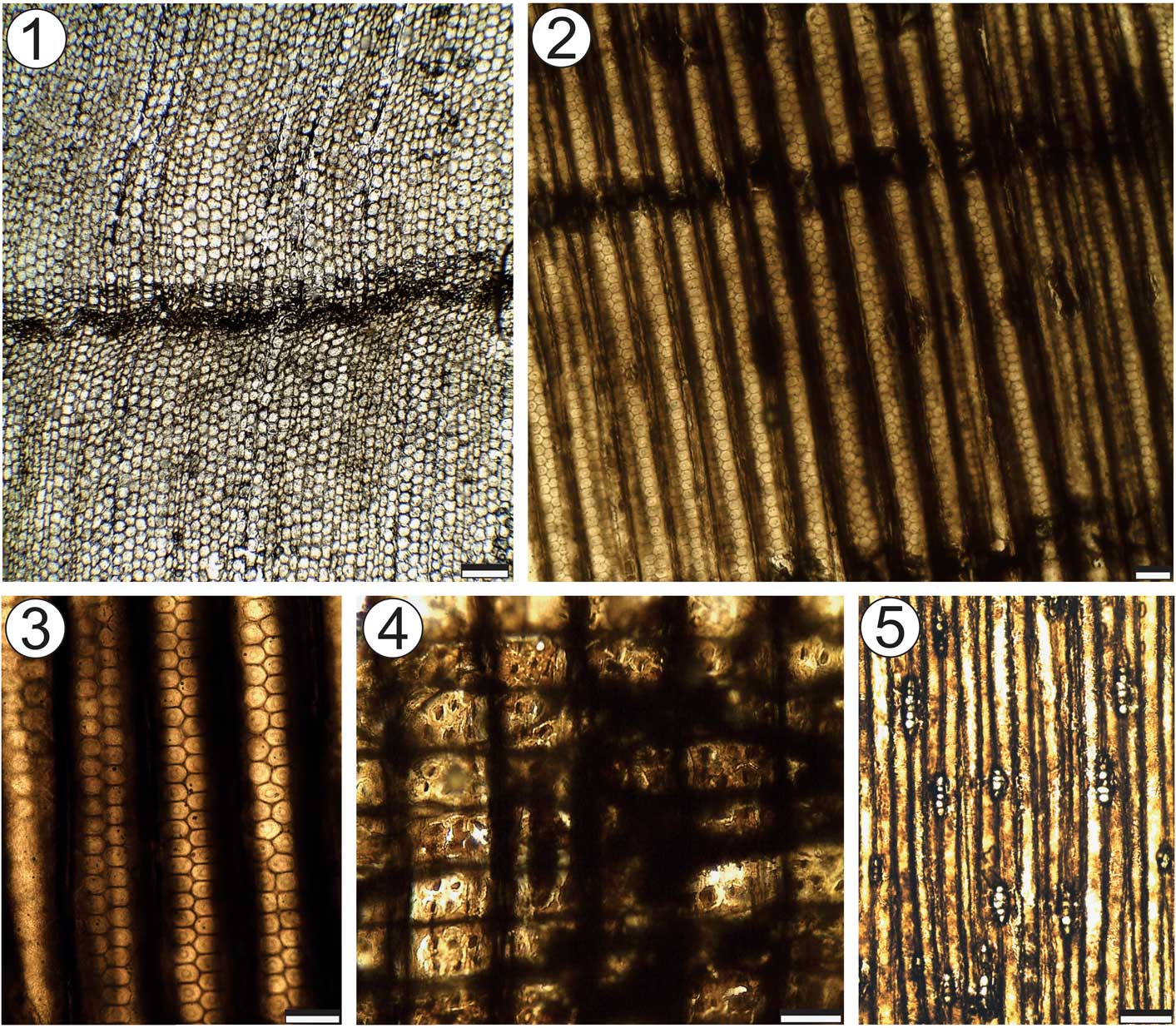
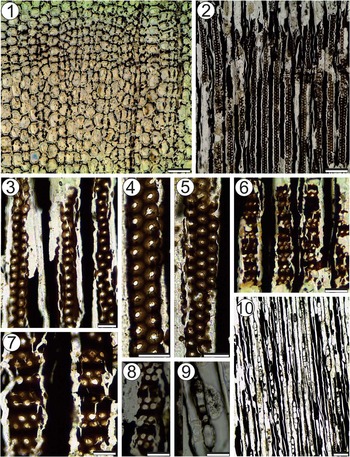
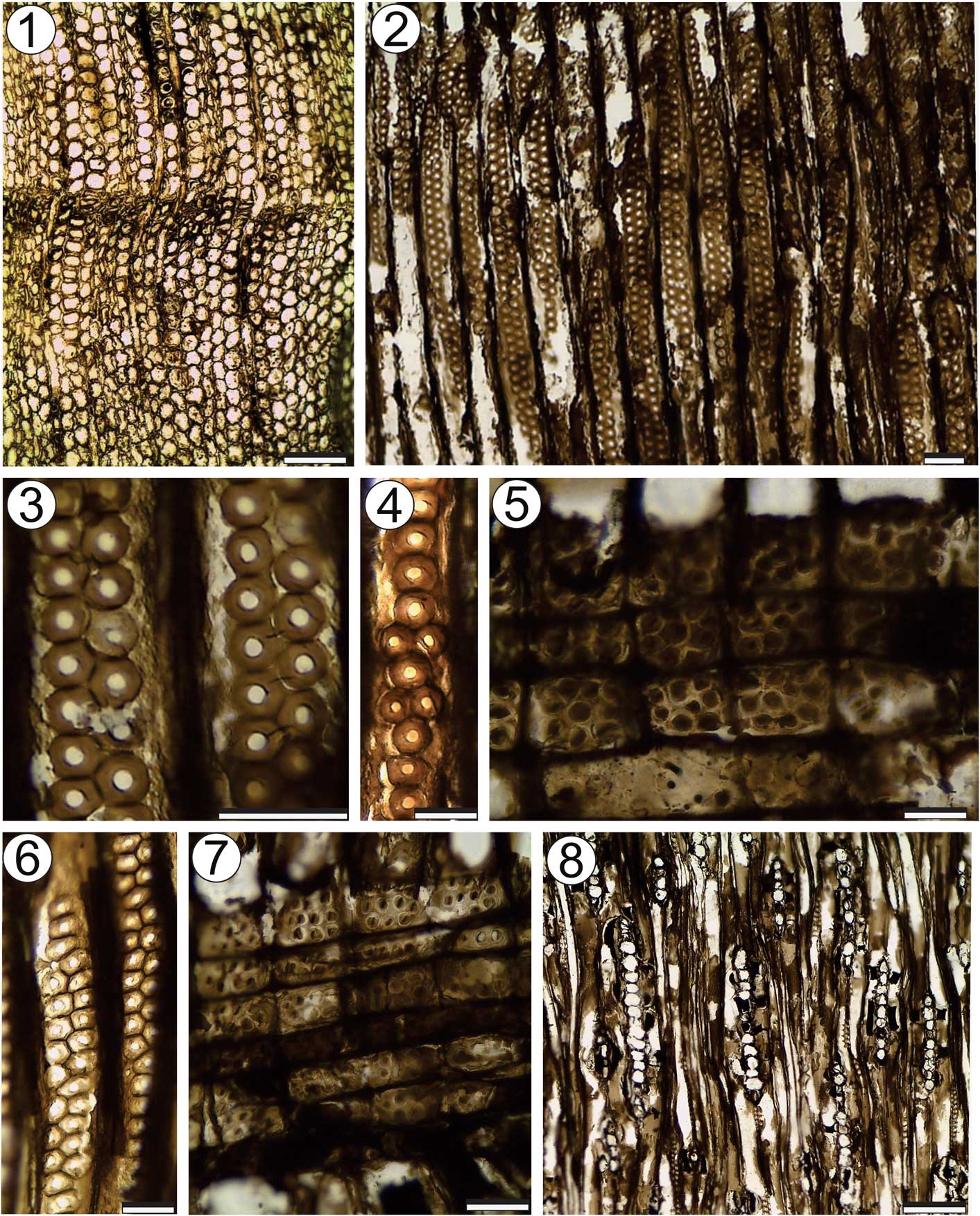
Agathoxylon agathioides. (1) TS, detail of the tracheids; (2–5) RLS, pits on tracheid radial walls; (6, 7) RLS, detail of cross-field pits; (8, 9) TLS, rays; (8) biseriate rays produced as a reaction to vascular cambium damage. Scale bars: (1)=150 µm; (2–7)=30 µm; (8, 9)=110 µm. (1, 2, 4, 6–9) CTES PB 10659. (3, 5) CTES PB 14236.

Fragments of silicified wood showing good cellular preservation were analyzed. Standard petrographic thin-sections were prepared for the wood fragments oriented along three planes: radial longitudinal (RLS), tangential longitudinal (TLS), and transverse (TS). In addition, techniques based on acetate peels and dissociated material (Jones and Rowe, Reference Jones and Rowe1999) also were employed. Thin-sections were studied in detail under a Leica microscope (DM500) and microphotographs were taken by digital camera (Leica ICC50) with Leica Application Suite EZ 3.2.3 software and a scanning electron microscope (SEM Jeol 5800LV) at the Universidad Nacional del Nordeste (Corrientes, Argentina).
The wood has been described in accordance with the list of microscopic features for softwood identification (García Esteban et al., Reference García Esteban, De Palacios, Guindeo Casasús, García Esteban, Lázaro Durán, González Fernández, Rodriguez Salvador, Fernández García, Bobadilla Maldonado and Camacho Atalaya2002, Reference García Esteban, Guindeo Casasús, Pereza Oramas and de Palacios de Palacios2003; Richter et al., Reference Richter, Grosser, Heinz and Gasson2004). Greguss’s (Reference Greguss1955) glossary of terms and the standard measurements established by Chattaway (Reference Chattaway1932) are followed. At least 20 individual measurements of the various anatomical elements were recorded, giving values for means, maxima and minima, and occasionally the maximum number established (e.g,. 42 µm [25–66 µm] or 3–14 [35] cells).
Systems of nomenclature and nomenclatural reviews are those found in Bamford and Philippe (Reference Bamford and Philippe2001) and Philippe and Bamford (Reference Philippe and Bamford2008).
Repository and institutional abbreviations
Specimens and microscopic slides are deposited in the paleontological collection of the Universidad Nacional de Nordeste (UNNE) “Dr. Rafael Herbst” Paleobotany Section (CTES-PB) and (CTES-PMP), Corrientes, Argentina.
Systematic paleobotany
Order Coniferales Engler, Reference Engler1897
Family Araucariaceae Henkel and Hochstetter, Reference Henkel and Hochstetter1865
Genus Agathoxylon Hartig, Reference Hartig1848
Type species
Agathoxylon cordaianum Hartig, Reference Hartig1848, p. 188.
Remarks
According to the criteria of Bamford and Philippe (Reference Bamford and Philippe2001), Philippe and Bamford (Reference Philippe and Bamford2008), and Rößler et al. (Reference Rößler, Philippe, Van Konijnenburg-Van Cittert, Mcloughlin, Sakala and Zijlstra2014), the genus Agathoxylon Hartig has nomenclatural priority over the genera Araucarioxylon and Dadoxylon; hence, the La Matilde Formation specimens are assigned to Agathoxylon Hartig.
Agathoxylon agathioides (Kräusel and Jain) new combination
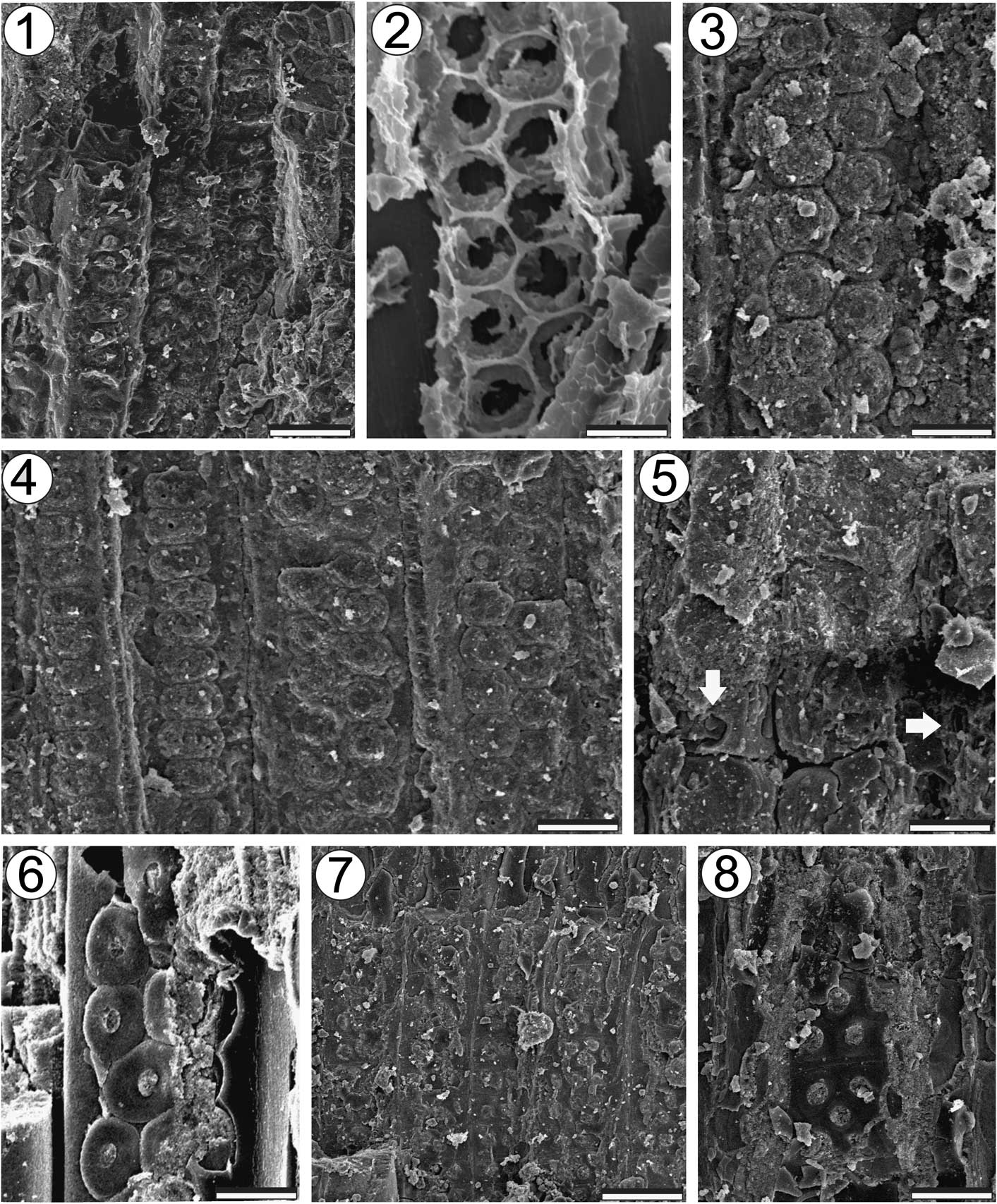
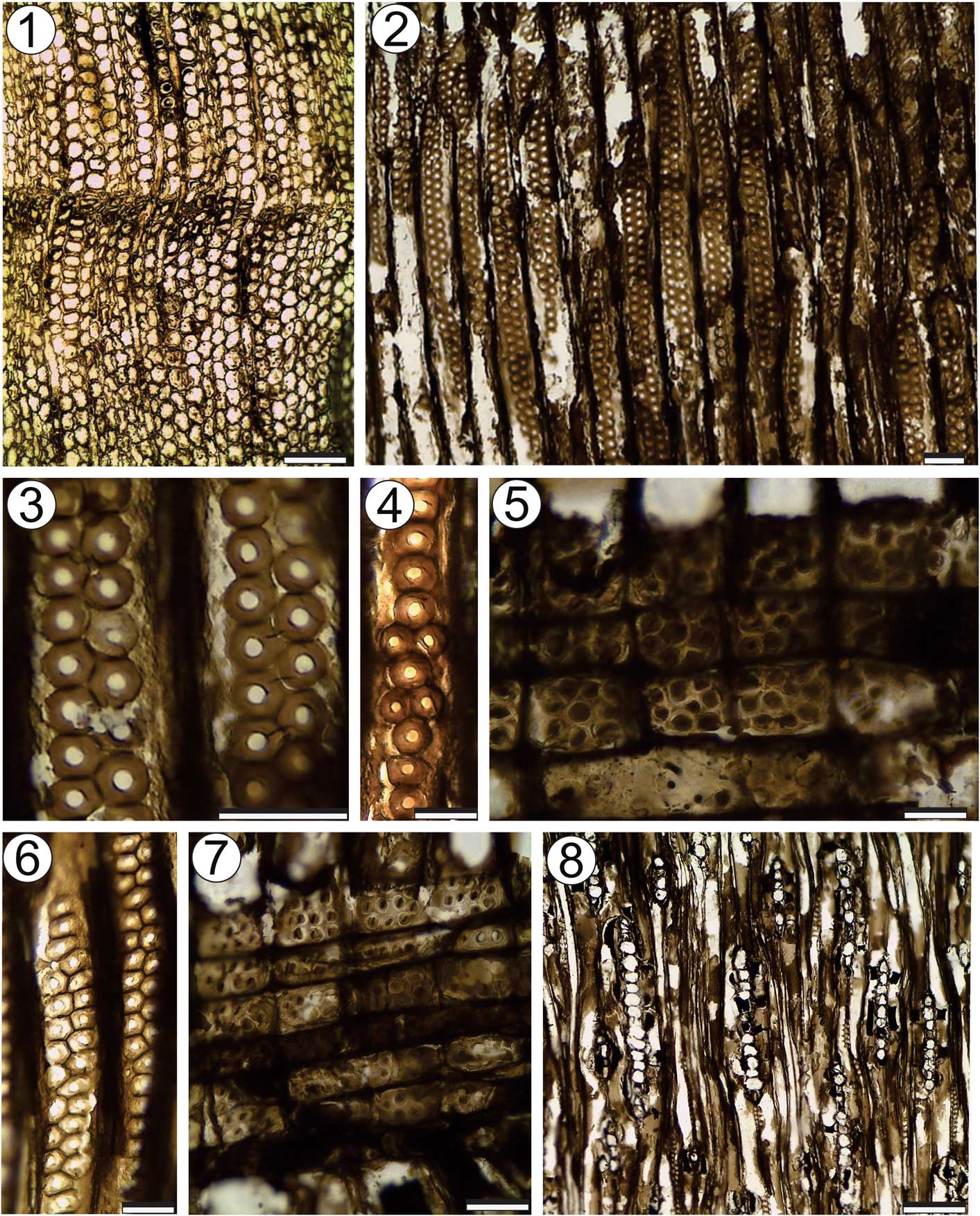
(1, 2) Agathoxylon agathioides. (3–5) Agathoxylon santalense. (6–8) Agathoxylon termieri. (1–4, 6) RLS, pits on tracheid radial walls; (5–8) RLS, detail of cross-field pits (white arrows). Scale bars: (1, 2)=30 µm; (3–5)=40 µm; (6–8)=35 µm. (1, 2) CTES PB 10659. (3–5) CTES PB 10649. (6–8) CTES PB 10693.
1964 Dadoxylon agathioides Reference Kräusel and JainKräusel and Jain, p. 59, pl. 1, figs. 1–3, pl. 3, figs. 14, 15, text-figs. 1, 4.
Reference Bose and Maheshwari1974 Araucarioxylon agathioides (Kräusel and Jain); Reference Bose and MaheshwariBose and Maheshwari [seen in Yadav and Bhattacharyya, Reference Yadav and Bhattacharyya1996, p. 59].
Holotype
24288/255 B.S.I.P. from Mandro, Rajmahal Hills, Bihar, India (Jurassic).
Description
Several fragments of silicified wood found in situ in the Barda Blanca, Cerro Conito, and Laguna La Guadalosa localities from the Gran Bajo de San Julián sector and Bajo El Puma locality (Figs. 1, 2) of the central and south-western sector were analyzed. The logs found in situ measure up to 1.50 m in diameter, and one of the logs reaches up to 4 m long by 1.10 m in diameter. Specimen CTES-PB 10647 has a wavy external appearance due to the effects of pressure during fossilization, because in making the conventional cuts it is observed that in the same section it shows a mixture of longitudinal radial and tangential and cross-sections. All specimens correspond to pycnoxylic wood, decorticated and with good preservation of the secondary xylem. The description is based on the specimen from the Barda Blanca locality (CTES-PB 10659), although examination of the other specimens supports it (Tables 1, 2). This specimen, in TS, does not show growth rings nor are they observed with the microscope, even though at first glance they are apparently well marked, which is due to the presence of “shearing zones” sensu Erasmus (Reference Erasmus1976) (Fig. 3.1). In TS, the tracheids have rectangular-quadrangular to polygonal outlines. The radial diameter of the tracheids is 31 μm (15–37 μm) and the tangential is 33 μm (22–45 μm). The average number of rows of tracheids separating the rays is 4, with a range of 1–11. The rays are presented in a non-continuous way through the section (Fig. 3.1). In RLS, the wood type (tracheid radial pitting) is araucarian (100% of the contiguous pits are araucarioid). Pits are bordered, uniseriate, and flattened (35% [32–38%]) biseriate, hexagonal, and alternate (32% [29–37%]), and occasionally triseriate or bi-triseriate, hexagonal, alternate, or opposite (0.4% [0–1%]). In addition, they are uniseriate, with biseriate portions (32% [30–36%]), flattened, and hexagonal, alternate (23% [21–25%]) and opposite in a single pair (8% [6–12%]) or in several pairs (1% [0–2%]). Rare groups of 6–10 pits are recognized; they start and end with a single pit and have portions without pitting in the walls of the tracheids. The size of the biseriate pits is 15 x 15 μm and the uniseriate pits are 15 x 11 μm. The aperture is cross-like (internal and external elliptical aperture), measuring 15 x 4 μm or 11 x 4 μm, or circular measuring 7.5 μm (Figs. 3.2, 3.3, 3.4, 3.5, 4.1, 4.2). Cross-fields show an araucarioid type arrangement, with 2–6 araucarioid pits (circular aperture) or cupressoid pits (elliptical aperture) whose frequency range is 4–6, arranged in groups or in horizontal or vertical rows. In some marginal cross-fields, 7–8 pits can be observed (Fig. 3.6, 3.7). In TLS, the radial system is homogeneous, with homocellular, uniseriate rays (84%), and some partially biseriate rays with 1–3 cells (16%). The height ranges from 1–22, 37 cells, with an average of seven cells. The radial end cells are elliptical and the central ones are rectangular-ovoid, and they measure 26 x 22 μm, 30 x 26 μm, or 34 x 30 μm in width and height. In tangential and radial section, the tracheids are recognized with resins, generally distributed near the rays. The resins occupy the entire wall of the tracheids in the form of resin plates. In some areas, fully biseriate rays can be observed, probably produced as a reaction to vascular cambium damage (Fig. 3.8, 3.9). The rameal and/or foliar traces are elliptical and measure 750 μm long, with some preserved tracheids 7.5–15 μm in diameter.
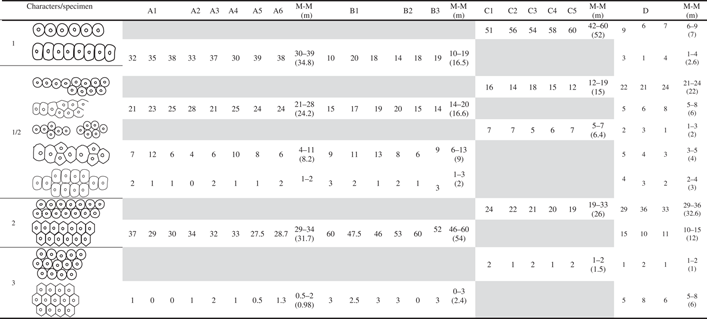
Quantitative data expressed in percentages; the following characters are combined: seriations radial pitting tracheids (column 1), type and shape of radial pitting tracheids (column 2: lineal schemes). M-M (m)=Minimum-Maximum (mean). Agathoxylon agathioides A1=CTES-PB 10659; A2=CTES-PB 10647; A3=CTES-PB 14236; A4=CTES-PB 10703; A5=CTES-PB 10702; A6=CTES-PB 12036; Agathoxylon santalense B1=CTES-PB 10649; B2=CTES-PB 14239; B3=CTES-PB 10665; Agathoxylon termieri C1=CTES-PB 10693; C2=CTES-PB 10696; C3=CTES-PB 10675; C4=CTES-PB 12043; C5=CTES-PB 12041; Agathoxylon santacruzense D=CTES-PB 12012.

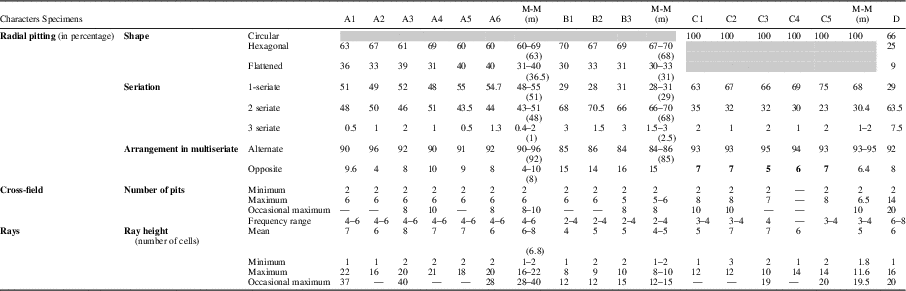
Quantitative data of the anatomical characteristics examined type radial pitting (contiguity) araucarioid. M-M (m)= Minimum-Maximum (mean). Agathoxylon agathioides A1= CTES-PB 10659; A2= CTES-PB 10647; A3=CTES-PB 14236; A4= CTES-PB 10703; A5= CTES-PB 10702; A6= CTES-PB 12036; Agathoxylon santalense B1= CTES-PB 10649; B2= CTES-PB 14239; B3= CTES-PB 10665; Agathoxylon termieri C1= CTES-PB 10693; C2= CTES-PB 10696; C3= CTES-PB 10675; C4= CTES-PB 12043; C5= CTES-PB 12041; Agathoxylon santacruzense D= CTES-PB 12012.

Materials
Gran Bajo de San Julián sector: Barda Blanca: CTES-PB 10647 (CTES-PMP 2324-2325); CTES-PB10659 (CTES-PMP 2353 a, b, c); CTES-PB 14236 (CTES-PMP 3535 a, b, c); CTES-PB 14237 (CTES PMP- 3536 a, b, c); CTES-PB 14238 (CTES-PMP 3537 a, b, c). Cerro Conito: CTES-PB 10702 (CTES-PMP 2426 a, b, c); CTES-PB10703 (CTES-PMP 2386 a, b, c). NW Laguna La Guadalosa: CTES-PB 12033 (CTES-PMP 2372 a, b, c); CTES-PB 12034 (CTES-PMP 2365 a, b, c); CTES-PB 12035 (CTES-PMP 2366 a, b, c); CTES-PB 12036 (CTES-PMP 2369 a, b, c). Central and south-western sector: Bajo El Puma: CTES-PB 14208 (CTES-PMP 3532 a, b, c); CTES-PB 14209 (CTES-PMP 3533 a, b, c); CTES-PB 14210 (CTES-PMP 3534 a, b, c).
Remarks
The description above coincides with the characters given by Kräusel and Jain (Reference Kräusel and Jain1964) for the taxon Dadoxylon agathioides. These materials are characterized by araucarian secondary wood types with mostly uniseriate to biseriate, some triseriate, alternate, flattened, and hexagonal radial pitting. Furthermore, they are arranged in groups over short distances of one to several pits, with rays of 2–20 cells in height and cross-fields with 2–8 pits arranged in an araucarioid pattern (Kräusel and Jain, Reference Kräusel and Jain1964). The specific epithet of this species comes from Kräusel and Jain’s (Reference Kräusel and Jain1964) comparison of this wood with some species of the genus Agathis Salisb, noting that they shared the cross-like shape of the opening of the pits and similar grouping of the pits in the radial walls of the tracheids, but this latter character is also observed in some species of Araucaria Juss (Kräusel and Jain, Reference Kräusel and Jain1964).
Tables 1 and 2 summarize the observed characters of six specimens from the La Matilde Formation, and quantitative data from three different portions of the early wood in sample CTES-PB 10659 are given. In the same data, it is possible to appreciate a certain uniformity in the percentages of the different combinations of the pits of the radial walls of the tracheids, but with a predominance of uni-biseriate pits. In addition, variability is observed in the number of pits in the cross-fields, but, always within the range of 2–8, some arranged in groups of 5–6, as in a specimen from India (Kräusel and Jain, Reference Kräusel and Jain1964). Also, it reflects differences in the height of the rays, with the Patagonia specimens occasionally exhibiting up to 40 cells.
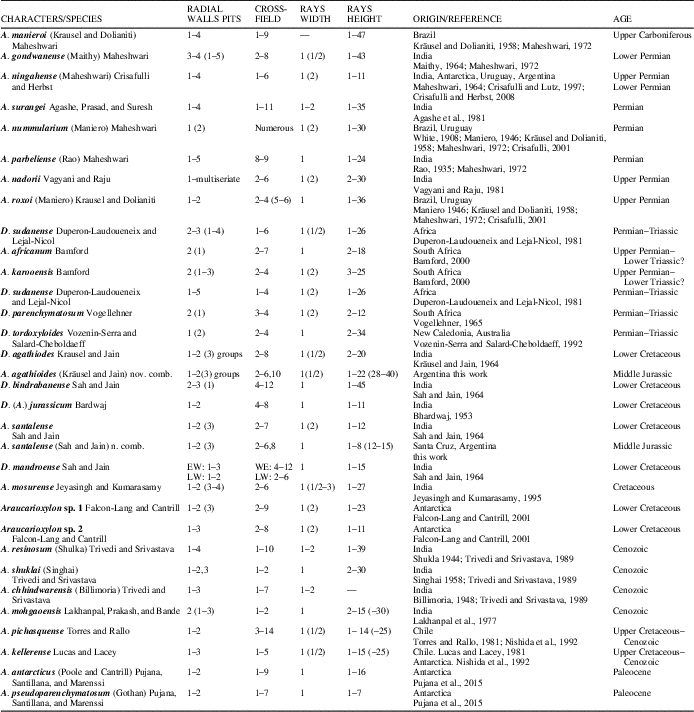
These differences do not invalidate the assignment of the specimens described here to Agathoxylon agathioides because they agree with most of the diagnostic characters. Agathoxylon agathioides (Kräusel and Jain) n. comb. is comparable to several species of Araucarioxylon, Agathoxylon, and Dadoxylon from Gondwana owing to the presence of hexagonal araucarioid pits, but it is identifiable by the presence of clusters of groups of pits and by the set of diagnostic characters (Table 3).
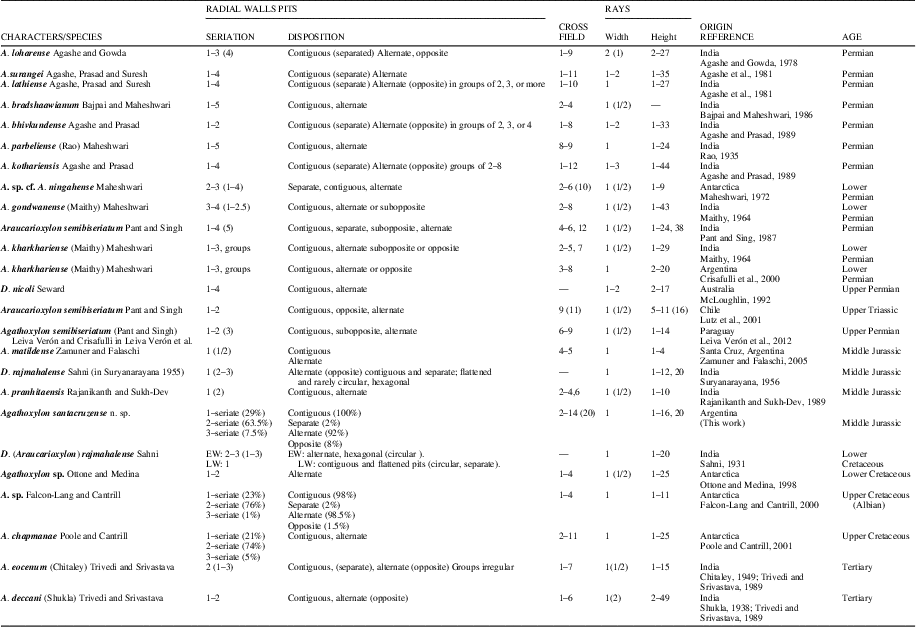
(1, 2) Comparison between some species of Agathoxylon/Araucarioxylon/Dadoxylon from Gondwana sharing the characters: presence of flattened and hexagonal and alternate (opposite) pits in the radial walls of the tracheids. (1/2: rays uniseriate partially biseriate; in parentheses=character with occasional condition).

Agathoxylon santalense (Sah and Jain) new combination
Agathoxylon santalense. (1) TS, detail of the tracheids and growth ring; (2, 3) RLS, pits on tracheid radial walls; (4) RLS, detail of cross-field pits; (5) TLS, rays and resin plates. Scale bars: (1)=140 µm; (2–4)=40 µm; (5)=130 µm. (1–4) CTES PB 10649. (5) CTES PB 14239.

1964 Dadoxylon santalense Sah and Jain, p. 178, pl. 2, fig. 11, pl. 3, figs. 15–18, text.figs. 9, 10.
1974 Araucarioxylon santalense (Sah and Jain); Reference Bose and MaheshwariBose and Maheshwari [seen in Yadav and Bhattacharyya, Reference Yadav and Bhattacharyya1996, p. 59].
Holotype
4506 B.S.I.P. from Mandro, Rajmahal Hills, Bihar, India (Jurassic).
Description
Wood fragments found in situ of 95 cm in diameter, and a trunk of 1.20 m long and 30 cm in diameter were studied. These materials come from the Barda Blanca locality of the Gran Bajo de San Julián sector and Bajo El Puma locality of the central and south-western sector (Figs. 1, 2). The description is based on specimen CTES-PB 10649, although examination of the other specimens supports it. Secondary xylem is pycnoxylic with distinct growth ring boundaries, and the transition from early wood to late wood is gradual. In TS, the tracheids are quadrangular-rectangular and irregular in shape. The radial diameter of the tracheids is 59 μm (45–82 μm) and the tangential is 50 μm (30–75 μm). The average number of tracheids separating the rays is 10, with a range of 3–26 tracheids. The rays are displayed in a continuous way through the section (Fig. 5.1). In RLS, the wood secondary type (tracheid radial pitting) is araucarian (100% of the contiguous pits are araucarioid). In the early wood, pits are bordered, uniseriate, flattened (16% [10–20%]), biseriate, hexagonal, and alternate (53% [46–60%]), and occasionally triseriate or bi-triseriate, hexagonal, and alternate (3% [2.5–3%]); in addition, they are uniseriate, with biseriate portions (30% [27–33%]), flattened and hexagonal, alternate (17% [15–19%]) and opposite in a single pair (11% [9–13%]) or in a several pairs (2% [1–3%]). In the late wood, pits are bordered, uniseriate and flattened. The size of the pits is 15–30 μm x 15 μm. The pits present a central circular aperture, which measures 6–7.5 μm (Figs. 4.3, 4.4, 5.2, 5.3). Cross-fields show an araucarioid type arrangement, with 2–6 araucarioid pits, measuring 11 μm with a circular aperture of 4 μm, whose frequency range is 3–4, arranged in groups or in horizontal rows. In some marginal cross-fields, 9–12 pits can be observed (Figs. 4.5, 5.4). In TLS, the radial system is homogeneous with homocellular rays, uniseriate, of 1–8, 12 cells in height, with an average of 4–5 cells. The central cells are ovoidal and measure 15–30 μm x 22–30 μm in width by height, respectively. Tracheids are observed with resins associated with the rays, which in radial and tangential section form the typical biconcave plates or “resin plates” (Fig. 5.5).
Materials
Gran Bajo de San Julián sector: Barda Blanca: CTES-PB 10649 (CTES-PMP 2328-2329); CTES-PB10665 (CTES-PMP 2321 a, b, c), CTES-PB 14239 (CTES-PMP 3538 a, b, c); CTES-PB 14240 (CTES-PMP 3539 a, b, c); Center and south western sector, Bajo El Puma: CTES-PB 14206 (CTES-PMP 3530 a, b, c); CTES-PB 14207 (CTES-PMP 3531 a, b, c).
Remarks
After comparison with species of the genera Araucarioxylon and Dadoxylon, the specimen from the La Matilde Formation was determined to be Agathoxylon santalense (Sah and Jain) n. comb. This species was erected by Sah and Jain (Reference Sah and Jain1964) as Dadoxylon santalense and is characterized by araucarian wood types with mostly uniseriate, sometimes biseriate, alternate, flattened, and hexagonal radial pitting; cross-fields with 2–6 pits arranged in an araucarioid pattern, usually four, with the aperture as big as the border and rays of 1–10 cells in height; and resin tracheids present, associated with the rays (Table 3).
This assignment is supported, essentially, by the type and number of pits in the cross-fields, by the height of the rays, and resin in the tracheids. The Argentine material differs in having rarely triseriate radial pitting; resins in the radial cells as well as in the tracheids associated with the rays; and because it shows a higher percentage of biseriate radial pitting in the early wood. In comparison, a specimen from India has mostly uniseriate pits, which would probably correspond mostly to late wood.
This species is similar to Araucarioxylon/Dadoxylon and Agathoxylon in the presence of uniseriate, flattened, and bi-triseriate, hexagonal, mainly alternate, radial pitting; the differences are given in the set of diagnostic characters and the same are expressed in Table 3. Araucarioxylon santalense is very similar to Araucarioxylon sp. described by Falcon-Lang and Cantrill (Reference Falcon–Lang and Cantrill2001) in most of the anatomical characters (Table 3), and to Araucarioxylon hoodii, described by Tidwell and Medlyn (Reference Tidwell and Medlyn1993) from the Upper Jurassic Morrison Formation (Utah, USA). The latter is distinguished by the presence of pits in the tangential walls of the tracheids, the shape and number of pits in the cross-field, and the greater height of the rays.
Agathoxylon termieri (Attims) Gnaedinger and Herbst, Reference Gnaedinger and Herbst2009
Agathoxylon termieri. (1) TS, detail of the tracheids and growth ring; (2–5) RLS, pits on tracheid radial walls; (6–8) RLS, detail of cross-field pits; (9, 10) TLS, rays. Scale bars: (1)=140 µm; (2)=100 µm; (3–7)=20 µm; (8, 9)=10 µm; (10)=50 µm. CTES PB 10693.

1965 Dadoxylon (A.) termieri Reference AttimsAttims, p. 33.
1985 Dadoxylon (A.) termieri Attims in Reference Giraud and HankelGiraud and Hankel p. 170, pl. 2, fig. a–e, text-fig. 3.
2000 Araucarioxylon allani (Kräusel) Maheshwari in Reference GnaedingerGnaedinger, p. 38.
2006 Araucarioxylon termieri Reference GnaedingerGnaedinger, p. 171, figs. 1, 2.
Holotype
QDS 226/3 from Lias (Lower Jurassic), Morocco.
Cotype
78-1 from Tanzania (Lower Jurassic).
Description
Fragments of fallen wood, one of them 3 m long and 30 cm in diameter and another 1.3 m in diameter, were analyzed from the Cerro Conito and northern part of the Estancia Meseta Chica localities from the Gran Bajo de San Julián sector. The following description is based on specimen CTES-PB 10693 and consists of a fragment of secondary xylem, pycnoxylic, with growth ring boundaries distinct and with a gradual transition from the early wood to the late wood. In TS, the tracheids of the early wood are polygonal with a thickness of the double wall of 7.5 μm. The radial diameter of the tracheids is 54 μm (37–75 μm) and the tangential 42 μm (22–67 μm). The tracheids of the late wood are generally of rectangular outline, some polygonal. The radial diameter of the tracheids is 31 μm (22–37 μm) and the tangential is 43 μm (30–60 μm). The average number of tracheids that separate the rays is 6, varying between 1 and 17 tracheids (Fig. 6.1). In RLS, the wood type (tracheid radial pitting) is araucarian (100% of the contiguous pits are araucarioid). Pits are circular (100%), araucarioid, uniseriate (51%), alternate biseriate (24%), uniseriate partially biseriate, alternate (16%) and opposite (7%), and triseriate and bi-triseriate, alternate (2%). The size of the pits is 11–15 μm x 11–15 μm. The pits exhibit a circular aperture, which measures 7.5 μm (Figs. 4.6, 6.2, 6.4, 6.5). Cross-fields are araucarioid, having 2–8, 10 pits that are circular, with circular or sometimes elliptical apertures, whose frequency range is 3–4 pits, arranged in groups or crown-shaped or in two or three horizontal rows (Figs. 4.7, 4.8, 6.6–6.8). The pits measure 12–15 μm in diameter and the apertures from 4 μm to 11 μm; some of the radial cells end in a pointed shape. In TLS, the radial system is homogeneous with homocellular rays, uniseriate, of 1–12 cells in height; the average is 4–5 cells. The cells at both ends are elliptical and the centers are rectangular or quadrangular, measuring 15–52 μm high by 15–30 μm wide. In addition, the rays show differences in the height of the central radial cells of the same rays; some radial cells measure 17–20 μm and others 6–11 μm (Figs. 6.9, 10).
Materials
Gran Bajo de San Julián sector: Cerro Conito: CTES-PB 10675 (CTES-PMP 2408-2409); CTES-PB 10693 (CTES-PMP 2381); CTES-PB 10696 (CTES-PMP 2391); CTES-PB 10697 (CTES-PMP 2392); CTES-PB 12004 (CTES-PMP 2390); CTES-PB 12017 (CTES-PMP 2438); CTES-PB 14265 (CTES-PMP 3540 a, b, c); CTES-PB 14266 (CTES-PMP 3541 a, b, c); Northern part of Ea. Meseta Chica: CTES-PB 12041 (CTES-PMP 2459); CTES-PB 12043 (CTES-PMP 2465-2466); CTES-PB 12052 (CTES-PMP 2472).
Remarks
Specimens identified as Araucarioxylon termieri (Attims) Gnaedinger and Herbst match with the description made by Giraud and Hankel (Reference Giraud and Hankel1985) for Dadoxylon (Araucarioxylon) termieri Attims and with the anatomical characters of the holotype given by Attims (Reference Attims1965) (see Giraud and Hankel, Reference Giraud and Hankel1985). In addition, these specimens from Argentina show differences in the height of the central radial cells within the same ray, as in the specimen from Tanzania (Giraud and Hankel, Reference Giraud and Hankel1985, pl. 13, fig. 3). Tables 1 and 2 summarize the observed anatomical features of five samples from the La Matilde Formation and show the numerical differences in the percentages of the seriation and combination of the radial pitting, but, always with a greater percentage of uniseriate pits, like the specimens from Africa.
Araucarioxylon termieri (Attims) Gnaedinger and Herbst is similar to other species of Agathoxylon (Araucarioxylon) from Gondwana in sharing the presence of circular pits in the radial walls of the tracheids, and is distinguished by the seriation and distribution of pits in the radial tracheid walls, the number of pits in the cross-fields, and the ray height (Table 4). However, A. termieri is identical to the Permian species Araucarioxylon allani (Kräusel) Maheshwari in presenting in the radial walls of the tracheids araucarioid, circular, uniseriate, biseriate, and rarely triseriate pits, and uniseriate, low rays, with a height of 1–12 cells (Kräusel, Reference Kräusel1962) (Table 4); and, therefore they are probably synonymous.
Comparison between some species of Agathoxylon/Araucarioxylon from Gondwana sharing the characters: presence of circular pits (some flattened) and alternate (opposite) in the radial walls of the tracheids. (1/2: rays uniseriate partially biseriate; in parentheses=character with occasional condition).

Agathoxylon santacruzense new species
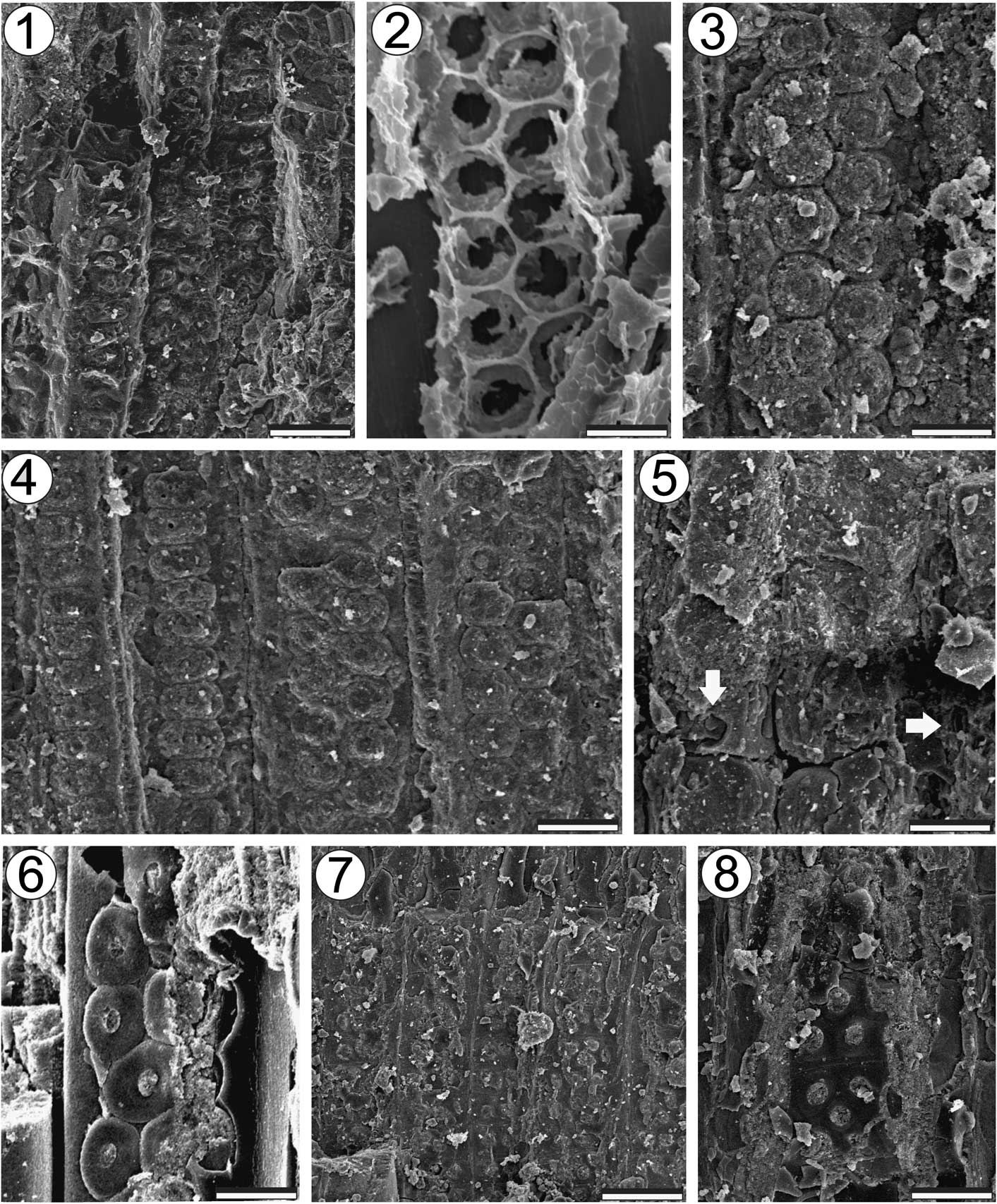
Agathoxylon santacruzense n. sp. (1) TS, detail of the tracheids and growth ring; (2–4, 6) RLS, pits on tracheid radial walls; (5, 7) RLS, detail of cross-field pits; (8) TLS, rays. Scale bars: (1)=190 µm; (2–7)=45 µm; (8)=130 µm. CTES PB 12012.
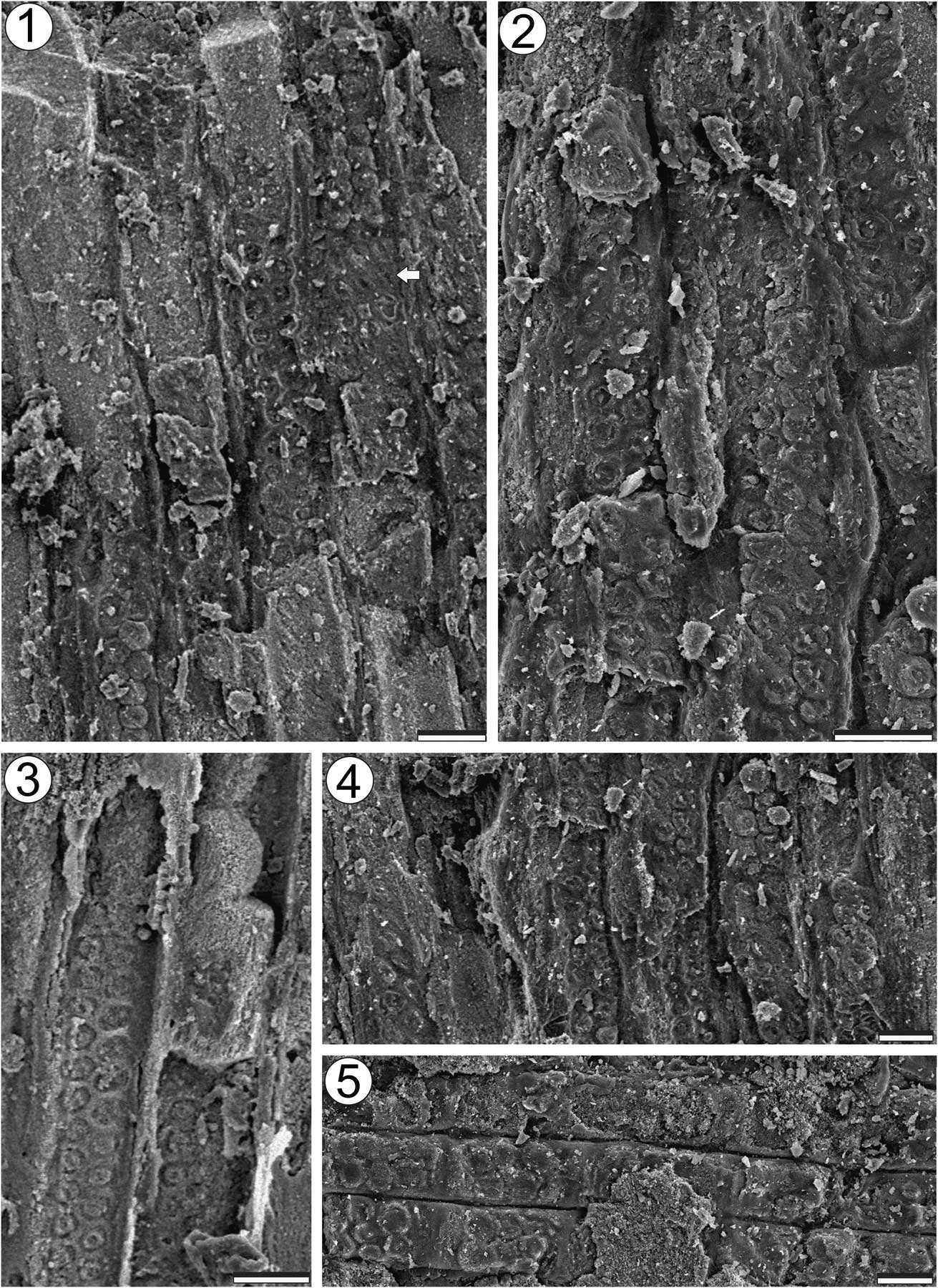
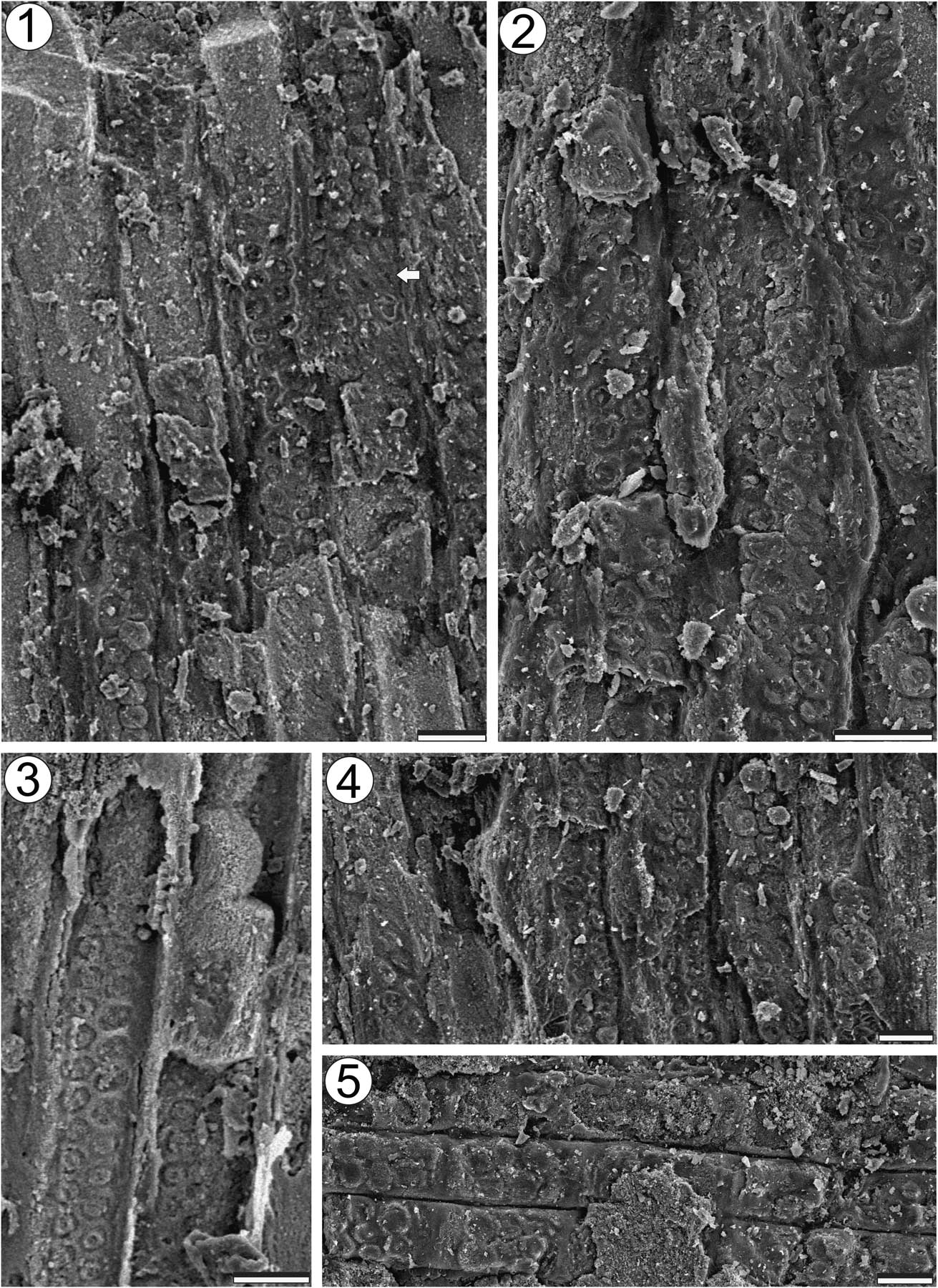
Agathoxylon santacruzense n. sp. (1–4) RLS, pits on tracheid radial walls; (1, 5) RLS, detail of cross-field pits (arrow). Scale bars=45 µm. CTES PB 12012.
Holotype
CTES-PB 12012, CTES-PMP 2433 a, b, c.
Paratype
CTES-PB 12013, CTES-PMP 2434 a, b, c.
Diagnosis
Wood type (tracheid radial pitting) is araucarian (100% of the contiguous pits are araucarioid). Pits are araucarioid, uniseriate, flattened, and circular; alternate biseriate, circular, and hexagonal; uniseriate, partially biseriate, alternate, circular, hexagonal-flattened; and opposite circular, hexagonal-flattened in a pair or several pairs (japonicum type); and triseriate and bi-triseriate, alternate circular and hexagonal. Cross-fields are araucarioid, with 2–14, 20 pits, circular, with elliptical or sometimes circular apertures, whose frequency range is 6–8 pits, arranged in disordered groups or crown-shaped or some in two or four horizontal rows. The rays are homogeneous, mostly uniseriate, and the height in number of cells is 1–16, 20.
Occurrence
La Matilde Formation, Santa Cruz Province, Argentina (Middle Jurassic).
Description
Fragments of logs found in situ of 1.5 m in diameter, with 1 m height preserved, and a fallen trunk with visible dimensions of 1.50 m in length and 60 cm in diameter were studied. These materials came from the southeastern border of Laguna del Carbón locality. The following description is based on specimen CTES-PB 12012, which consists of a fragment of secondary xylem, pycnoxyilic, with distinct growth rings. In TS, the tracheids of the early wood are rectangular-ovoidal and polygonal in the shape. Tracheids of the early wood have an average radial diameter of 47 µm (36–60 µm) and tangential diameter of 37 µm (24–52 µm). In the late wood, the tracheids have a tangential average diameter of 35 µm (24–40 µm) and radial diameter of 21 µm (16–28 µm). The average number of tracheids that separate the rays is 7–8, varying between 2–18 tracheids. The rays are presented in a continuous way through the section (Fig. 7.1). In RLS, the wood type (tracheid radial pitting) is araucarian (100% of the contiguous pits are araucarioid). Pits are araucarioid, uniseriate (9.6% [7–12%]), flattened (2.6% [1–4%]), and circular (7% [6–9%]); alternate biseriate (44.6% [39–51%]), circular (32.6% [29–36%]), and hexagonal (12% [10–15%]); uniseriate partially biseriate (37% [36–38%]), alternate, circular (22% [21–24%]), hexagonal-flattened (6% [5–8%]), and opposite circular (2% [1–3%]), hexagonal-flattened in a pair (4% [3–5%]) or in several pairs (japonicum type) (3% [2–4%]); and triseriate and bi-triseriate, alternate circular (1% [1–2%]) and hexagonal (6% [5–8%]). The size of the pits is 12–16 μm and 20 μm x 10 μm. The pits present a circular aperture, which measures 4–6 μm (Figs. 7.2–7.5, 8.1–8.4). Cross-fields are araucarioid, having 2–14, 20 pits that are circular, with an elliptical or sometimes circular aperture, whose frequency range is 6–8 pits, arranged in disordered groups or crown-shaped or some in two or four horizontal rows. The pits measure 8–10 μm and the apertures are elliptical measuring from 4–8 μm x 3 μm or circular and 2.5–4 μm (Figs. 7.5–7.7, 8.1–8.5). The rays are homogeneous and most uniseriate, the height in number of cells is 1–16, 20, the average is 6 cells. The cells at both ends are elliptical and the centers are rectangular or quadrangular, measuring 15–52 μm high x 15–30 μm wide (Fig.7.8).
Etymology
In reference to Santa Cruz province, Argentina, where the analyzed wood was found.
Remarks
The comparisons made with the species of Agathoxylon described for Gondwana justify assignment of the La Matilde Formation specimens to a new species. In Table 5, comparisons made between species of Agathoxylon, Dadoxylon, and Araucarioxylon of Gondwana show that they share the following diagnostic characters: presence of circular, hexagonal, and flattened radial pitting.
Comparison between some species of Agathoxylon/Araucarioxylon/Dadoxylon from Gondwana sharing the characters: presence of circular, flattened and hexagonal, (some flattened) and alternate (opposite) pits in the radial walls of the tracheids. (1/2: rays uniseriate partially biseriate; in parentheses=character with occasional condition).

The new species is distinguished from the other Gondwanan species by the arrangement of the tracheid pits, the number of pits in the cross-field, and by the height of the rays (Table 5). The most closely comparable species is Agathoxylon semibiseriatum (Pant and Singh, Reference Pant and Singh1987) Leiva Verón and Crisafulli in Leiva Verón et al., Reference Leiva Verón, Crisafulli, Herbst, Filippi and Molina2012 in most of the anatomical characters (Table 5), but there are differences in the radial pitting and rays.
Qualitative and quantitative analysis of anatomical characters
Tables 1 and 2 compare the four species of Agathoxylon identified from the La Matilde Formation, Santa Cruz, Argentina. The anatomical characters must be taken into account for the diagnosis of each species. Therefore, the differences between these species are mainly due to the seriation and different combinations of the tracheid radial wall pits; the type, number, and arrangement of the pits in the cross-fields and seriation; and height of the rays. Numerical differences between specimens of the same species, particularly in the seriation-combination percentages of the radial pitting, could be explained as intraspecific variation (Giraud and Hankel, Reference Giraud and Hankel1985), as well as the degree of preservation of the specimen or of the portion in the early wood (at the beginning or at the end) where the data were obtained.
Anatomical characteristics of the woods were quantified in accordance with criteria proposed by Falcon-Lang and Cantrill (Reference Falcon-Lang and Cantrill2000), Poole and Cantrill (Reference Poole and Cantrill2001), Gnaedinger (Reference Gnaedinger2012), and Gnaedinger et al. (Reference Gnaedinger, García Massini, Bechis and Zavattieri2015). The following features were quantified: in RLS: (1) the nature of the bordered pitting on the tracheid walls (a—percentages of uniseriate, biseriate, and triseriate pitted tracheids; b—percentages of circular, flattened, and hexagonal-shape pitted tracheids; c—percentages of alternately or oppositely arranged multiseriate pits); (2) the mean, minima-maxima, occasional maximum, and frequency range of pits in the cross-fields (in terms of most common number of pits per cross-field); and in TLS, ray height (in terms of number of cells high) was also recorded in terms of minima-maxima, occasional maximum, and means (Table 2).
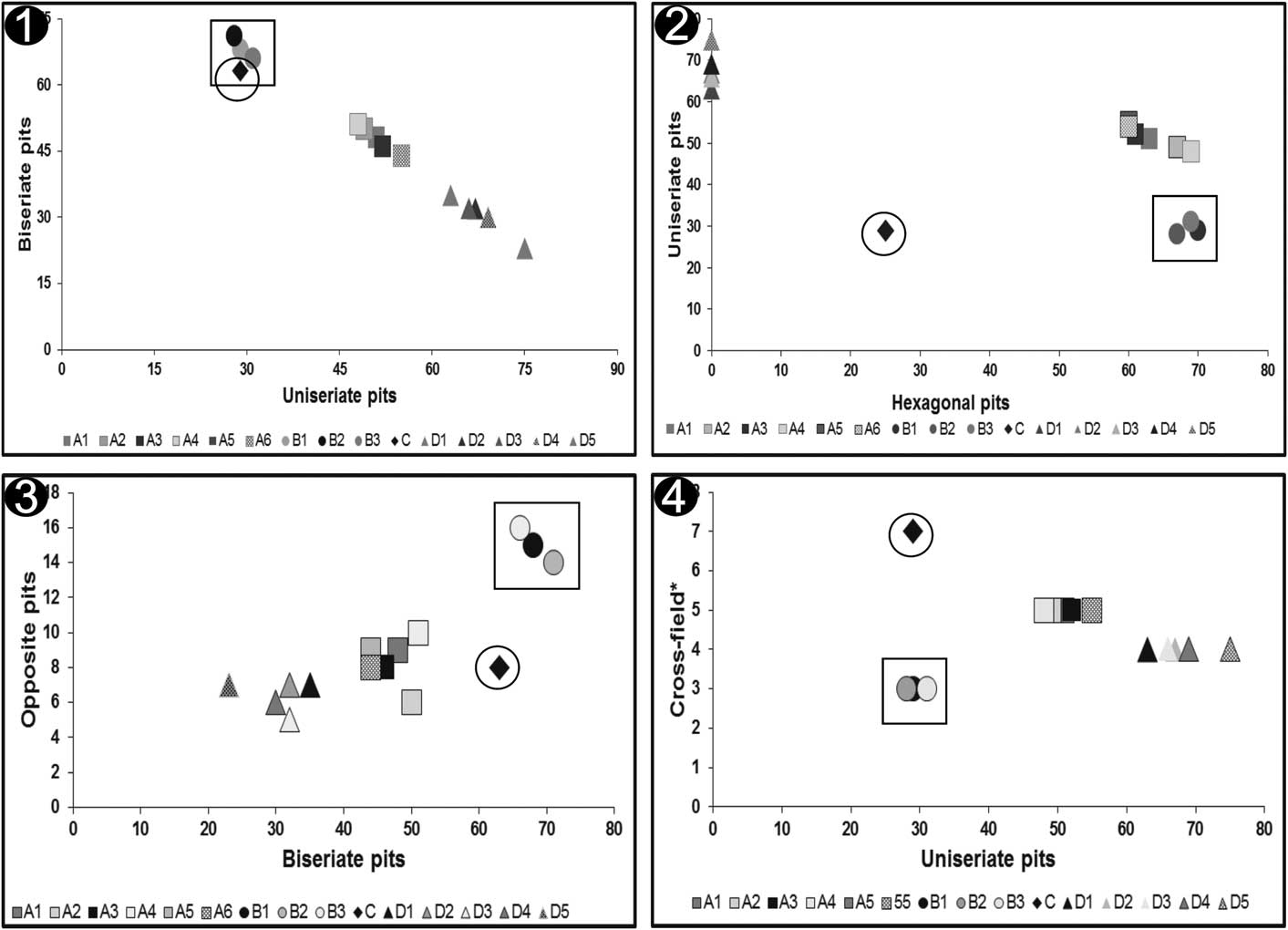
Plotted dispersion graphics based on quantitative data for each specimen (Fig. 9) clearly reflect the differences between identified species where these species plot as single continuous entities in “morphology space” (Falcon-Lang and Cantrill, Reference Falcon-Lang and Cantrill2000, Reference Falcon–Lang and Cantrill2001). Thus, four species with an araucarian secondary wood structure can be distinguished by their different percentages of tracheid radial pitting shapes and distribution (seriation), as well as by the range and mean number of pits in the cross-fields (Fig. 9). Figure 9.1 shows A. santalense and A. santacruzense n. sp. are grouped in the same “morphology space,” that is, they have similar percentages of uniseriate and biseriate pits, while in the other comparisons (e.g., uniseriate pits versus hexagonal shape, biseriate pits versus opposite pits, and uniseriate pits versus cross-fields), the species clearly differ from the other taxa (Fig. 9.2–9.4).
Plotted dispersion graphics based on quantitative data for specimen of the La Matilde Formation. Agathoxylon agathioides A1=CTES-PB 10659; A2=CTES-PB 10647; A3=CTES-PB 14236; A4=CTES-PB 10703; A5=CTES-PB 10702; A6=CTES-PB 12036; Agathoxylon santalense B1=CTES-PB 10649; B2=CTES-PB 14239; B3=CTES-PB 10665; Agathoxylon termieri C1=CTES-PB 10693; C2=CTES-PB 10696; C3=CTES-PB 10675; C4=CTES-PB 12043; C5=CTES-PB 12041; Agathoxylon santacruzense D=CTES-PB 12012.
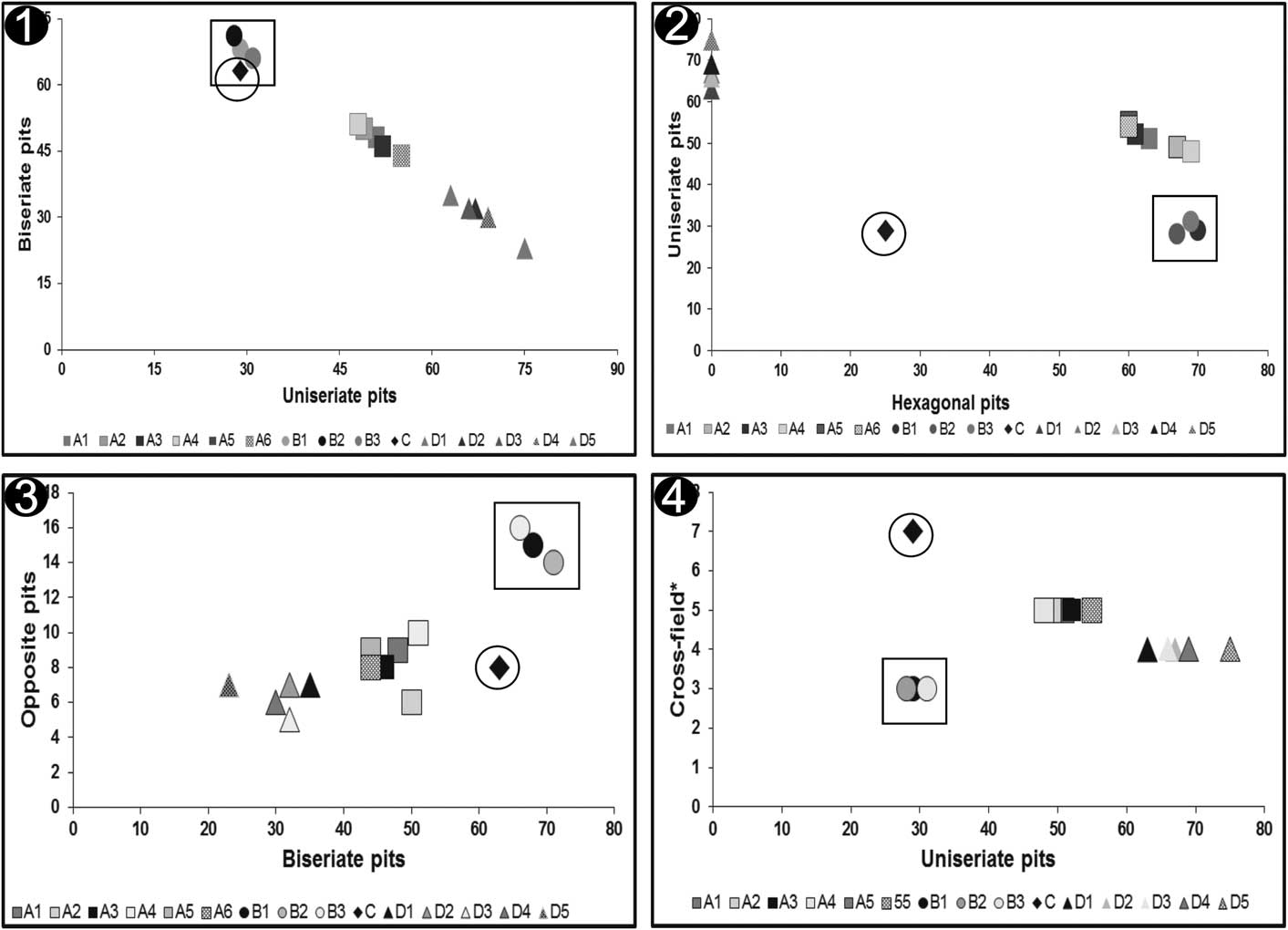
Thus, A. agathioides (Kräusel and Jain) n. comb. and A. santalense (Sah and Jain) n. comb. are identified by a series of 1–3 pits and their combinations of flattened-hexagonal pits, with a predominance of a series of 1–2 pits, as well as by the presence of groups of pits in the first species, while in the second, biseriate radial pitting predominates. In contrast, Agathoxylon termieri (Attims) Gnaedinger and Herbst is defined by a series of 1–3 pits and its different combinations of circular pits, with a predominance of uniseriate pits, and A. santacruzense n. sp. is well defined by a series of 1–3 pits and its different combinations of circular, hexagonal, and flattened pit shapes (Fig. 9).
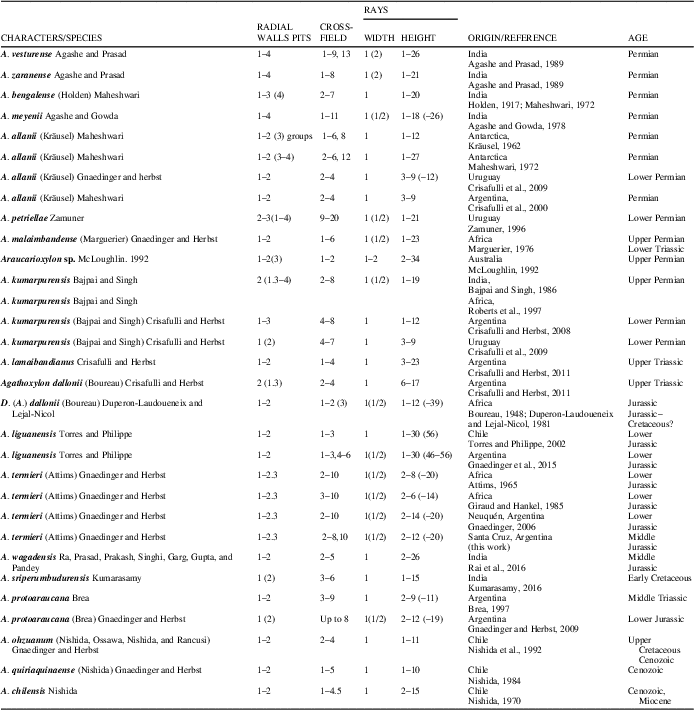
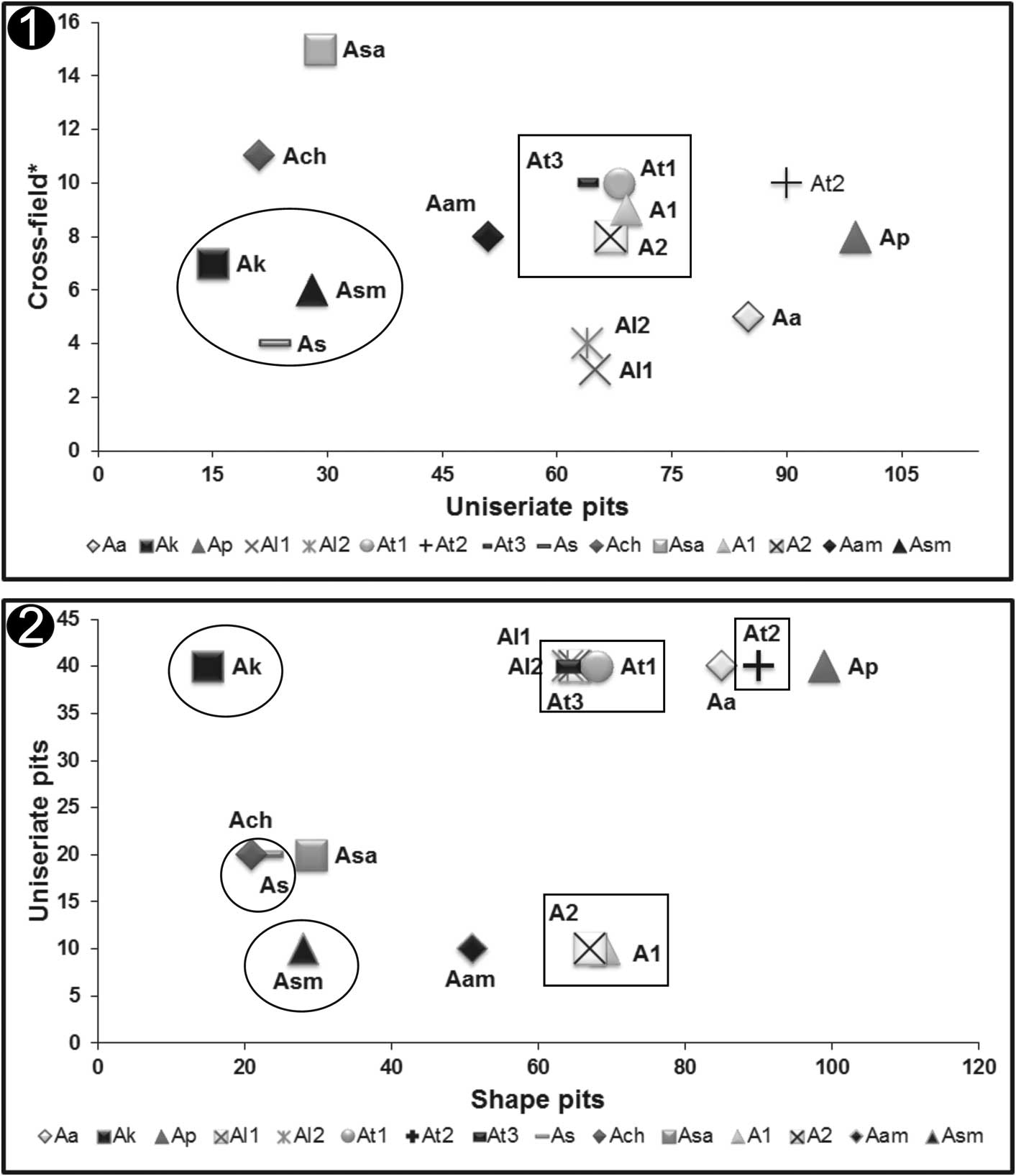
In Figure 10, the dispersion graphics compare species of the genus Agathoxylon using data obtained from the specimens analyzed in this contribution (Tables 1, 2) and from the literature. For this reason, in this study, data such as uniseriate pits, shape of the pits, and maximum number of pits in the cross-fields were collected from the following Agathoxylon species: A. africanum (Bamford) Kurzawe and Merlotti (Permo-Triassic, Jurassic–Cretaceous?) and A. karooensis (Bamford) Kurzawe and Merlotti (Permian and Cretaceous?) from South Africa (Bamford, Reference Bamford2000); A. protoaraucana (Triassic–Lower Jurassic) of Argentina (Gnaedinger and Herbst, Reference Gnaedinger and Herbst2009); A. liguaensis Torres and Philippe of the Lower Jurassic of Chile (Torres and Philippe, Reference Torres and Philippe2002) and Argentina (Gnaedinger et al., Reference Gnaedinger, García Massini, Bechis and Zavattieri2015); Dadoxylon (A.) termieri (Attims, Reference Attims1965; Giraud and Hankel, Reference Giraud and Hankel1985) of the Lower Jurassic of Africa; Cretaceous species described by Falcon-Lang and Cantrill (Reference Falcon-Lang and Cantrill2000, Reference Falcon–Lang and Cantrill2001); and A. chapmanae of Poole and Cantrill (Reference Poole and Cantrill2001).
Plotted dispersion graphics based on Agathoxylon from La Matilde Formation and from the Gondwana. Aa=Agathoxylon africanum; Ak=A. karooensis; Ap=A. protoaraucana; Al=Agathoxylon liguaensis: Al1=Chile, Al2=Argentina; At=A. termieri: At1=Attims, Reference Attims1965; At2=Giraud and Hankel, Reference Giraud and Hankel1985; At3=this work; As=Araucarioxylon sp. (Falcon-Lang and Cantrill, Reference Falcon-Lang and Cantrill2000); Ach=A. chapmanae Poole and Cantrill, Reference Poole and Cantrill2001; Asa=A. santalense (this work); A1=Araucarioxylon sp. 1; A2=Araucarioxylon sp. 2 (Falcon-Lang and Cantrill, 2001); Aam=A. agathioides; Asm=A. santacruzense (this work). *=mean value.

In Figure 10, the differences between fossil species are clearly observed; only two groups of taxa occupy the same “morphology space”: (1) A. karooensis, Araucarioxylon sp. (Falcon-Lang and Cantrill, Reference Falcon-Lang and Cantrill2000), and the Patagonia specimens identified as A. santalense; and (2) A. termieri, Araucarioxylon sp. 1 (Falcon-Lang and Cantrill, Reference Falcon–Lang and Cantrill2001), and Araucarioxylon sp. 2 (Falcon-Lang and Cantrill, Reference Falcon–Lang and Cantrill2001), when comparing characters like percentage of uniseriate pits versus maximum number of cross-field pits (Fig. 10.1). When looking at anatomical characters, such as uniseriate pits versus the shape of the pits, the groups of species mentioned are distinguished from each other, occupying different spaces in the above-mentioned graph (Fig. 10.2).
The results obtained show that not only is the number of pits in the cross-field a diagnostic character, but also the shape of the radial pits (IAWA Committee, Richter et al., Reference Richter, Grosser, Heinz and Gasson2004). These parameters cannot only be used to discriminate genera and species of wood found in the same Formation, but also to establish differences/similarities between other taxa described in other Formations.
Conclusions
This paper describes four coniferous wood taxa from the La Matilde Formation, clearly differentiated on the basis of their qualitative and quantitative anatomical parameters, that can be distinguished by their different percentages of tracheid radial pitting shapes and distribution (seriation) as well as by the range and mean number of pits in the cross-fields. This study contributes to the method proposed by Falcon-Lang and Cantrill (Reference Falcon-Lang and Cantrill2000) because these parameters can be used to discriminate species of wood found in the same formation and between other taxa described in other formations.
The findings in the La Matilde Formation of leaves and branch impressions and silicified seed and pollen cones indicate that the “Jaramillo Petrified Forest” was mainly composed of Coniferales belonging to the families Araucariaceae, Podocarpaceae, and? Taxodiaceae. According to the xylological analysis carried out in this study, the presence of the family Araucariaceae in the forests of the La Matilde Formation is corroborated.
Agathoxylon is cosmopolitan, but the species A. agathioides and A. santalense have been previously described from the Upper Jurassic–Lower Cretaceous of the Rajmahal Hills, Bihar, India (Sah and Jain, Reference Sah and Jain1964; Kraüsel and Jain, Reference Kräusel and Jain1964), while A. termieri was described from the Lower Jurassic of Africa (Attims, Reference Attims1965; Giraud and Hankel, Reference Giraud and Hankel1985) and Argentina (Gnaedinger, Reference Gnaedinger2006).
Based on the analysis of ~250 specimens carried out so far, in eight localities of the Gran Bajo de San Julián sector, and through data on the distribution of the in situ logs obtained from the census carried out in the forests, the Agathoxylon taxa described here presents a different floristic distribution in the La Matilde Formation. Agathoxylon agathioides and A. santalense together with Taxodioxylon Gothan and Prototaxoxylon intertrappeum Prakash and Srivastava species are found in the top of the sedimentary sequence that appears in the Barda Blanca and Cerro Conito localities, and in the NW Laguna La Guadalosa outcrop from Gran Bajo de San Julián sector and Bajo El Puma locality of the central and south-western sector (Gnaedinger and Herbst, Reference Gnaedinger and Herbst2006; Gnaedinger, Reference Gnaedinger2007b). Agathoxylon termierii associated with fern stipes and Podocarpaceae wood (Podocarpoxylon feruglioi Gnaedinger; Circoporopitys herbstii Gnaedinger) was identified in the base of the sedimentary sequence, near the carbonaceous levels in the Barda Blanca and Cerro Conito localities, as well as in the northern part of the Estancia Meseta Chica locality (Gnaedinger, Reference Gnaedinger2007b).
Finally, A. santacruzense n. sp. with Circoporoxylon austroamericanum Gnaedinger was found only in the southeastern border of Laguna del Carbón locality (Gnaedinger, Reference Gnaedinger2007b). The distinction of the species through qualitative and quantitative analyses and according to the distribution of the specimens in the different localities and in some localities in different strata of the sedimentary sequence could be indicating diverse forests at different moments during the Jurassic of the Patagonia (Gnaedinger, work in preparation). In this way, it could indicate, according to the distribution of the in situ logs of the fossil species found in the Barda Blanca and Cerro Conito localities, that these taxa formed small forests, or local forests, or small forests within dense forest, which is a habitat coincident with the extant Araucariaceae.
Acknowledgments
This contribution was partially funded by the Secretaría General de Ciencia y Técnica, Universidad Nacional del Nordeste (SGCyT-UNNE.PI 2015, 2018, Q005, 2014) and the Consejo Nacional de Investigaciones Científica y Técnicas-CONICET (PIP 2014, 2016, No. 112 201301 00317) in a grant conferred to SCG. The authors are grateful to Katarzyna Piper, Editorial Services (UK) for revision of the English grammar.