Introduction
The dwarf shrub Helianthemum oelandicum (L.) Dum. Cours. subsp. oelandicum (generally referred to as H. oelandicum in the text) is endemic to the Island of Öland in the Baltic Sea. This shrub is typical of vegetation types specific for Öland and Gotland, including many ice and wind tolerant plants that are often exposed to drought and flooding (‘the Great Alvar’; Sterner Reference Sterner and Lundqvist1986). Trees and shrubs are well-known hosts to lichens, but reports on the lichen flora of dwarf shrubs are less common. Shrubs differ obviously from trees by their smaller surface area available for colonization. Another factor which is presumed to be of great importance for the epiphytic lichen flora is the shorter life span of dwarf shrubs compared to many trees. On the area known as the Great Alvar on Öland, H. oelandicum hosts more than 40 lichen species (L. Fröberg, T. Johansson & T. Knutsson, unpublished data). Furthermore, it proved to be possible to determine the age of individual plants of H. oelandicum. We therefore decided to perform a more thorough study of this shrub, its associated lichen flora, and the relationship between the lichen flora and the characteristics of its phorophyte. The following questions were addressed. 1) Is it possible to predict the age of a living phorophyte of H. oelandicum by its maximum root dimension? 2) Are the cover, species number, and composition of lichens on living phorophytes dependent on the age of a phorophyte? 3) Are the cover, species number and composition of lichens dependent on the status (living/dead) of the phorophyte?
Materials and Methods
Study site
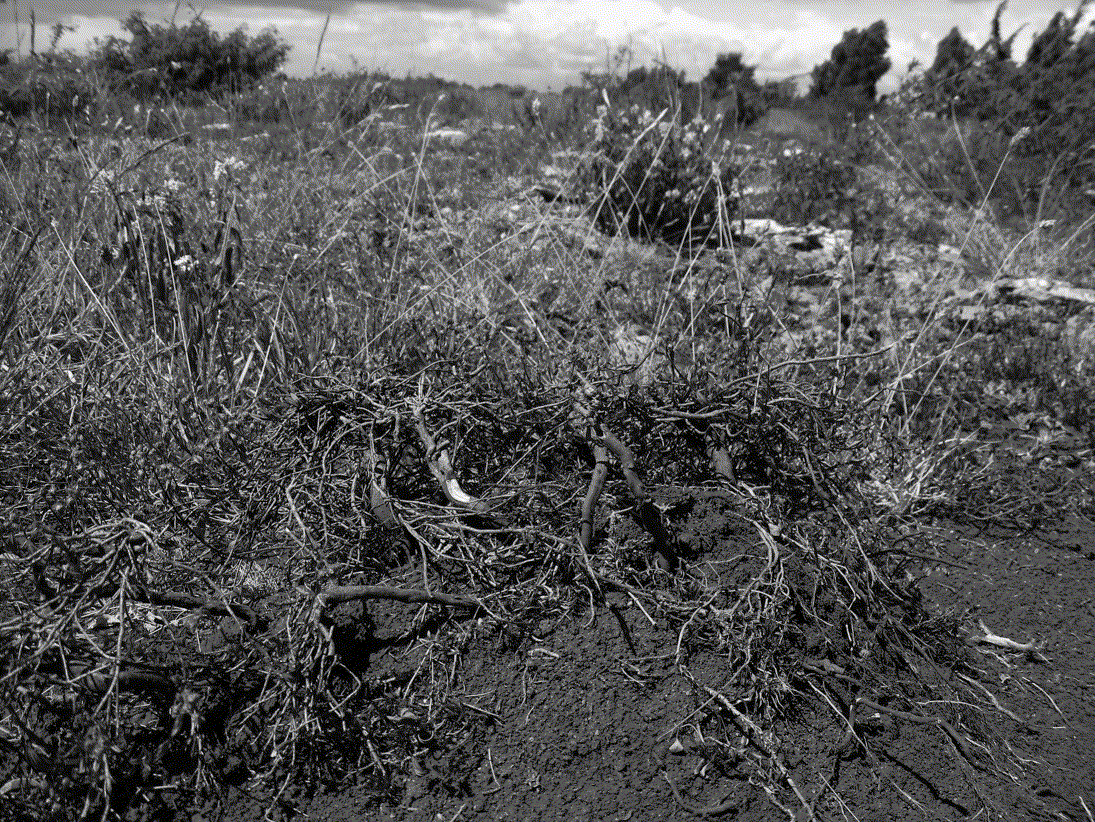
Twenty two individuals of H. oelandicum were sampled in an area of 100 m2 in an open calcareous grassland on the Great Alvar of Öland, Södra Möckleby parish, 300 m WSW of Tingstenen (X: 6247207, Y: 1540578), on 17 June 2008. The shrub consists of prostrate to ascending branches, diverging from a main root. Subsequently, the root rises above the ground level due to freezing (Fig. 1). Both living and dead plants of different sizes were collected, to sample the different plant ages present at the site. The bedrock was exposed or thinly covered with gravel or soil. Climate, geomorphology and vegetation of the Great Alvar are all described in Rosén (Reference Rosén1982).
Helianthemum oelandicum, individuals with the main roots exposed.

Determination of the age of H. oelandicum
The primary roots were cut with a fine-toothed saw at the highest point on the root, just below the ‘root collar’. A second cut was made 20 mm below the root collar. Experience from extremely suppressed trees with very irregular ring development (Niklasson Reference Niklasson2002) has shown that it is worth making counts at several heights above and below the supposed point of germination (the root collar). We found that 2 cuts were sufficient and making a third cut below 20 mm did not result in more rings. The cut root section was softened in water for 5 minutes. With a sharp scalpel, a clean and smooth cut was made across the section, and zinc paste was applied to the surface and lightly rubbed into the vessels. Excess zinc paste was removed and a droplet of water was applied on the surface before examination under a dissecting microscope.
Ring counting was carried out under a dissecting microscope at magnifications of ×30–50. Cross-dating between individuals by measuring the ring widths or by visual methods (noting conspicuous pointer years) was not attempted. However, it was noted that in many living specimens conspicuously narrow rings were formed in the 6th and 11th year before the sampling year 2008. Ring boundaries were usually clearly visible (see Schweingruber Reference Schweingruber1990 for a detailed description), with a contrasting and distinct yellow-green active xylem (the outer 6–10 rings in most cases) and usually dark brown dead xylem in the central parts (‘heartwood’). In older specimens, the wood near the pith was commonly dark brown to black, which sometimes made it difficult to distinguish the first 3 rings. Partial cambial death in small parts of the cambium, resulting in ‘micro buttresses’ was present in many cases and these very much resembled the cross sections of Juniperus spp. or many other Cupressacean species (M. Niklasson, pers. obs.; Schweingruber Reference Schweingruber1990). In older specimens, periods of 5–10 years with extremely narrow rings were often noted. In periods of slow growth, wedging rings were noted, with rings usually developed on the ‘micro buttresses’ outer curve and being partially absent in other parts. In periods with wider rings, sometimes an extremely narrow ring was found in between the wide rings (‘sudden singular narrow ring’). Without further investigation it is impossible to determine whether it is the result of extreme weather conditions during the growing season or if it is a ‘double ring’ formed in a period of very favourable growing conditions late in the season, when cambial growth has normally ceased.
From each section (0 and 20 mm below the root collar), the number of rings, excluding the sudden singular narrow rings, was counted. The rings were counted in the parts with best growth to avoid the problem with wedging rings as much as possible. The highest age of the two sections (0 and 20 mm) was selected for the lichen study. The ages are thus likely to be conservative rather than an overestimate, since periods with extremely narrow rings were noted (down to 0·01 mm) in many cases. It is very likely that single rings did not form at all during these periods in the sampled root sections.
Determination of lichen cover and diversity
For each individual of H. oelandicum, its status (living/dead) was determined and the plants were physically separated into the following categories: 1) thin branches (< 2·5 mm diameter); 2) thick branches (2·5–8 mm diameter); 3) main root, including root branches above the soil (2·5–11 mm diameter).
Branches thinner than 1 mm and the parts of the root system that were more or less covered with soil were not included in the lichen survey. The total areas of thin branches, thick branches and roots were determined by multiplying the total length of the branches/roots (determined to an accuracy of 1 cm) by an estimated average circumference of 0·4 cm in thin branches, and by the measured circumferences of thick branches and roots. For each category, lichen species were searched for using a dissecting microscope (×10–40 magnification), and identified. Cladonia furcata, which was loosely attached to two of living phorophytes, was omitted from the analyses. The lichen cover on thin branches was determined by multiplying the total length of the lichen cover (determined to an accuracy of 1 mm) by 0·15 cm (if the lichen covered less than half of the circumference), or by 0·3 cm (if the lichen covered more than half of the circumference). Lichen cover on thick branches and roots was determined by multiplying the length of the cover by the measured circumferences of the branch/root. A small proportion of unidentified, sterile lichen vegetation occurred, but was omitted from the analyses because it was usually difficult to estimate its cover. Furthermore, some non-lichenized fungi, green algae and cyanobacteria were present on the twigs, but these were also omitted. Nomenclature of the lichens follows Santesson et al. (Reference Santesson, Moberg, Nordin, Tønsberg and Vitikainen2004).
Data analyses
We analysed the relationship between the age of the living phorophytes of H. oelandicum and their maximum root dimensions by using generalized linear models (function ‘glm’) with logarithmic link function and Poisson distribution of errors (loglinear regression analyses; McCullagh & Nelder Reference McCullagh and Nelder1989; Faraway Reference Faraway2006, n = 15 living phorophytes). Log linear regression models were also used to analyse the relationship between species number and the ages of the living phorophytes (the total area of substratum was added as covariate to separate the effect of age from the effect of substratum area; n = 15 living phorophytes), and the relationship between species number and the status (living/dead) of a phorophyte (total cover of substratum was added as covariate; n = 22 phorophytes, of which 15 were living and seven were dead). The regression coefficients (estimated values) and their confidence limits were back-transformed from the original model: Et = exp(Em), where Et is the back-transformed estimated value and Em is the original model estimated value. The transformed values express the proportional change in species number per unit change in the predictor variable (Faraway Reference Faraway2006). The relationships between the lichen cover and the explanatory variables were analysed using linear regression models including ANCOVA (function ‘lm’). All regression analyses were carried out in the computer program R 2.5.1 (The R foundation for statistical computing, 2008). The explanatory variables used in each model were not strongly correlated to one another (Spearman R < 0·707; corresponding to R 2 < 0·50), as tested pair-wise using Spearman's rank correlation analysis.
For the most common lichen species, we used Fisher's exact test to analyse differences in their preferences for dead and living phorophytes of H. oelandicum. Paired two-tailed permutation tests to analyse differences in total cover (area) of individual species between dead and living phorophytes were used; only phorophytes with the species present were included in these analyses. Since it is not possible to account for the differences in substratum area among the phorophytes in the permutation tests, we also analysed the same relationships by using regression analyses with substratum area as covariate. The results from the regression analyses were similar to the results from the permutation tests. In addition, the effect of substratum area was not significant in all analyses indicating that it does not strongly influence the relationship between the total cover of lichens and occurrence of individual species. We report only the results from permutation tests, because the basic assumptions for regression analyses (e.g. normality of the data) were not fulfilled (e.g. many zeroes in the dependent variable). We also used paired two-tailed permutation tests to analyse differences between thin branches and thick branches/roots; only phorophytes with the species present were included in these analyses. The thick branches and roots were thicker and smoother than the thin branches, and rarely colonized by lichens until a phorophyte age of about 20 years. These categories were therefore pooled in the analyses. The sample sizes were generally very low, thus the power of the analyses is low. However, we consider the analyses meaningful because some species strongly prefer certain types of substratum. We also used paired two-tailed permutation tests in the comparisons of species number on thin branches versus thick branches/roots. All analyses except regression analyses were carried out in the statistical package SPSS 15.0.0 (SPSS 2006).
Taxonomic notes
Arthonia sp. The material has an inconspicuos thallus, 0·1–0·2 mm large, ± rounded ascomata and 2-celled, 9–11 × 4 μm large spores, but the identity of the species is uncertain.
Lecania cyrtella (Ach.) Th.Fr. This species has mostly 2-celled spores, while the closely related L. cyrtellina (Nyl.) Sandst. has mostly 1-celled spores. Both specimens with 1-celled and 2-celled spores predominating occurred in the material.
L. cf. koerberiana J.Lahm. The specimen was poorly developed, with spores that are 13–17 × 3–4 μm (i.e. slightly narrower than in typical L. koerberiana); the hymenium was also infected with a hyphomycete.
Lecidella elaeochroma (Ach.) M.Choisy. The material varied; the thallus was either thin and ± continuous or thick and granular; the apothecial disc was usually black without pruina, but could occasionally have a bluish pruina or be brownish black; the rim was usually shiny, but sometimes dull. Some of the specimens may belong to L. euphorea (Flörke) Hertel.
Physcia sp.: The material lacks soralia, and may refer to either P. adscendens H.Olivier or P. tenella (Scop.) DC. (both species have been observed on H. oelandicum on the Great Alvar).
Results
Age determination
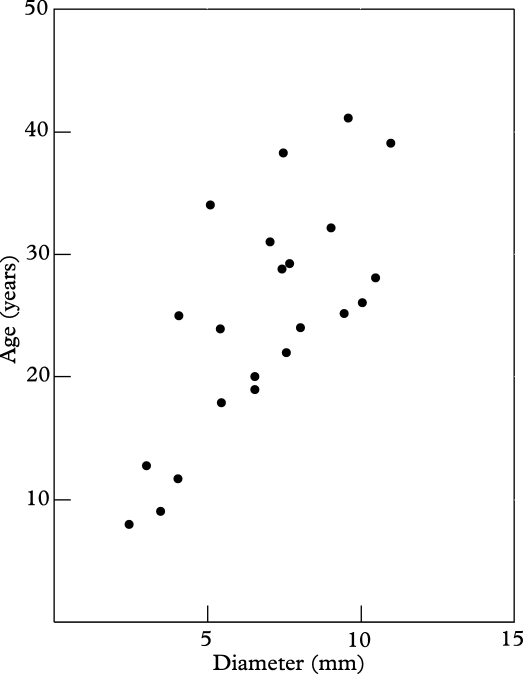
The age of the phorophytes varied from 8 to 41 years and the age increased with increasing diameter at the root collar (Fig. 2; Table 1). The mean ring width (radial growth rates) varied from 0·07 to 0·42 mm year−1. The difference in age between the two sections was usually in the range of 0–5 years. On average, more rings were found 20 mm below the root collar compared to the root collar.
Relationship between diameter of the root collar (mm) and age of H. oelandicum.

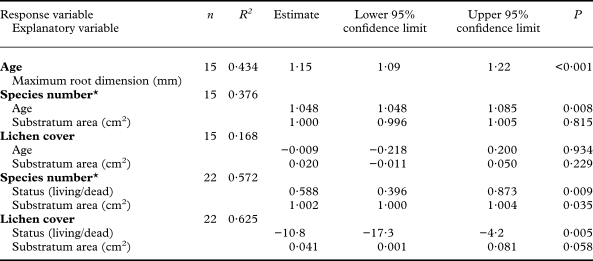
The predictive ability of maximum root dimension in explaining the age of a living phorophyte of Helianthemum oelandicum, and the predictive ability of various explanatory variables to explain species number/cover of lichens on a phorophyte: results from multipe regression models

* The estimates and their confidence limits from log linear regression models (i.e. when the response variable is species number) are back transformed. The back transformed estimated value expresses the proportional change in species number per unit increase in the explanatory variable, e.g. 1.05 and 0.95 express 5% increase and 5% decrease, respectively, in species number per unit increase in the explanatory variable.
Lichen cover and diversity
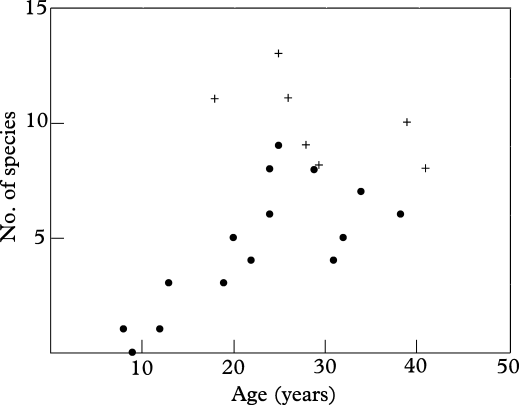
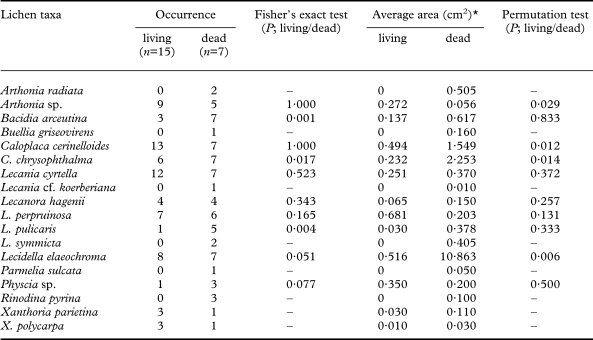
A total of 18 lichen species were recorded on exposed roots, branches and twigs of H. oelandicum. Living phorophytes hosted 12 species in total, while all 18 species were present on dead phorophytes. The number of species on each phorophyte varied from 0–13 (Fig. 3).
The relationship between number of lichen taxa and H. oelandicum. •, living phorophytes; +, dead phorophytes.

The number of lichen species on living phorophytes increased with increasing age of the phorophytes (Fig. 3), and this relationship was highly significant also when the total area of the substratum was accounted for (multiple regression model: Table 1). The total cover of lichens was neither related to the age nor the substratum cover of a phorophyte.
The number of lichen species was higher on dead phorophytes (8–13) compared to living ones (0–9), and this difference was still significant when the effect of substratum area was accounted for in the multiple regression analyses ( Table 1 & 2). In addition, the lichen cover was higher on dead (3·4–33 cm2) compared to living phorophytes (0–11 cm2), and the effect was highly significant when the effect of substratum area was accounted for (Table 1). The relative cover was 0–10% on living phorophytes and 5·8–22% on dead ones.
Occurrence and average area (cm2) of lichen species on living and dead phorophyte of H. oelandicum, and two tests analysing the preferences for status (Fisher's exact test and permutation test)

* Average area calculations are based on shrubs with the species present.
The species number and cover of lichens varied between the categories. In total, living phorophytes hosted 11 species and dead phorophytes hosted 17 species on thin branches, while living phorophytes hosted 10 species and dead phorophytes hosted 15 species on thick branches and roots ( Table 3). On average, the species number was higher on thin branches compared with thick branches and roots (Paired permutation test: P<0·001; n = 22), with 4·3 ± 2·6 species on thin branches of living phorophytes (mean ± SD, n = 15) and 8·6 ± 2·6 species on thin branches of dead phorophytes (n = 7). The corresponding figures on thick branches and roots were 2·7 ±1·8 species (living phorophytes, n = 15) and 6·6 ± 1·7 species (dead phorophytes, n = 7). The average cover of lichens on thin branches was 1·2 ± 1·5 cm2 on living phorophytes (relative cover 2·2%) and 7·8 ± 4·6 cm2 on dead phorophytes (9·4%); corresponding figures for thick branches and roots were 0·9 ±1·7 cm2 on living phorophytes (4·7%) and 8·9 ± 8·0 cm2 on dead phorophytes (12·6%). The total substratum area on thin branches was 51·4 ± 56·4 cm2 on living phorophytes and 94·0 ± 69·6 cm2 on dead phorophytes, while that on thick branches was 14·7 ± 9·6 cm2 on living phorophytes and 60·9 ± 25·1 cm2 on dead phorophytes.
Average area (cm2) of the lichen species on two categories of living and dead phorophytes of H. oelandicum (calculations based on phorophytes with presence of the respective lichen species), and paired permutation tests for the most common lichen species
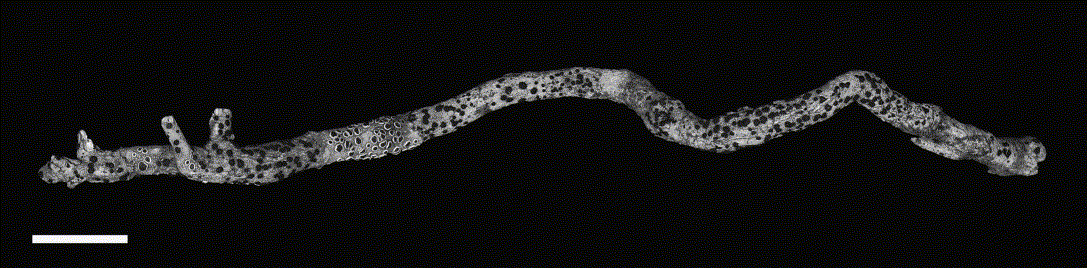
Some specific lichens showed preferences for the status and categories of the phorophytes. Bacidia arceutina, Caloplaca chrysophthalma and Lecanora pulicaris strongly preferred dead phorophytes over living phorophytes (Table 2). In addition, Arthonia sp., Caloplaca cerinelloides, Caloplaca chrysophthalma and Lecidella elaeochroma clearly covered a larger area on dead compared to living phorophytes (Table 2; Fig. 4). Arthonia sp., Caloplaca cerinelloides, Lecania cyrtella and Lecanora perpruinosa covered a larger area on thin branches compared with thick branches and roots (Table 3). The latter preferences were similar for living and dead phorophytes, although they were significant for only one of the status classes for each species.
A branch of a dead phorophyte, Helianthemum oelandicum, with Lecidella elaeochroma, Lecanora pulicaris and Caloplaca chrysophthalma. Scale = 1 cm.

Discussion
Although an exact dating of the germination to the year is probably very difficult in any dwarf shrub, careful preparation and examination under high magnification greatly reduces the likelihood of missing any rings. The specimens of Helianthemum oelandicum in our study were within the recorded ages of similar species of the genus. The maximum age in this study, 41 years, is not far from the recorded maximum age for H. nummularium (L.) Mill. (55 years) and H. canum (L.) Baumg. (42 years; the latter name partly misapplied for H. oelandicum) in Europe (Schweingruber & Poschlod Reference Schweingruber and Poschlod2005). Only Sterner (Reference Sterner1936) has to our knowledge presented age records for H. oelandicum (determined to 15–20 years). The 22 individuals in the current study showed a significant relationship between diameter and age, and it should thus be possible to estimate roughly the age of individuals in the field, within a specific site. The difference in ring numberat the root collar and 20 mm beneath the root collar underlines the importance of counting rings in more than one section in lignose species that have irregular ring development due to extreme environmental conditions. Helianthemum grandiflorum DC. from the same genus, has been used for dating glacial forefields (Erschbamer & Retter Reference Erschbamer and Retter2004). Many other species of herbs and dwarf bushes that have lignified annual rings are also currently used in various fields of plant ecology (e.g. Dietz & Ullman Reference Dietz and Ullman1997). We have however, not found any previous studies relating epiphytic lichen diversity to the age of the stems of dwarf shrubs. Thus, here we present a new application of herbchronology.
In a preliminary floristic study of corticolous and lignicolous lichens on the Great Alvar of Öland (L. Fröberg, T. Johansson & T. Knutsson, unpublished data), the dwarf shrub H. oelandicum hosted a total of 42 lichen species from seven sites. The species number at each site ranged from 7 to 23. This can be regarded as a very high number for a dwarf shrub. In a study of the lichens on herbarium specimens of Fumana procumbens collected from 35 sites in Hungary and adjacent areas, 14 lichen species were found (Lokös Reference Lokös1988). About half of them are conspecific with the lichen species in the present study. In a study of red-listed lichens in south-western Sweden, Vaccinium myrtillus L. was reported as a phorophyte with at least five lichen species (Arup Reference Arup, Arup, Ekman, Kärnefelt and Mattsson1997). Another study of lichens on twigs of thirteen deciduous tree species from several sites in north-western and central Europe, the number of lichen species was between 16 and 64 (Degelius Reference Degelius1978), which is at a similar level as in the present study although the samples derive from a much larger geographical area. The richness of lichens on H. oelandicum is probably explained by a combination of the plants being exposed to dust impregnation from the surrounding calcareous ground, and the fact that they can reach a high age for a dwarf shrub.
The present study has shown that dead phorophytes host a significantly higher number of lichen species than living ones, and that the number of lichen species on living H. oelandicum was correlated with the age of the phorophyte. The fact that lichen cover and species number was larger on dead phorophytes, may be explained by the longer period of time they have been available for lichen colonization, but different properties in the bark of living and dead phorophytes probably also affect the lichen vegetation. Johansson (Reference Johansson2006) has shown that lichen cover and species richness of lichens on ash are affected by both phorophyte age and size, while lichen species composition is only affected by phorophyte age.
Most of the species in the present study are corticolous, but Lecanora perpruinosa is saxicolous (mostly growing on calcareous rocks), and it probably occurs on H. oelandicum because of the dust impregnation of the twigs. Several of the species are typical for twigs, and appear as pioneers. Indeed, in a study on the lichen vegetation of twigs of ash, nine species also occurring in the present study were noted as pioneers (Degelius Reference Degelius1964).
Lecania koerberiana, which is tentatively reported in the present study, is red-listed and new to Öland. Caloplaca chrysophthalma, a species that was fairly frequent at the study site, was red-listed until the presentation of the most recent Red List (Gärdenfors Reference Gärdenfors2005). In addition, Caloplaca asserigena (Lahm) Oliv. was found on H. oelandicum at an adjacent site and is new to Sweden (Søchting & Fröberg Reference Søchting and Fröberg2003). These findings indicate that this is a substratum that may host many rare and/or overlooked species. The technique to determine the age of dwarf shrubs opens up possibilities for studying successional processes for the lichens, as well as other inhabitants, on these phorophytes.
This paper is dedicated to Ingvar Kärnefelt on his 65th birthday (former supervisor to LF and TK). Patrik Frödén took the photo in Fig. 4. Vikki Bengtsson improved the manuscript linguistically.