INTRODUCTION
Anautogenous mosquitoes use bloodmeals as a food source to maximize egg production and energy accumulation. Malarial parasites take advantage of the meals by gaining access to the invertebrate host, which they use as a medium for multiplication and subsequent distribution. It has been suggested that malaria infection might negatively affect some life-history traits in the mosquito, including fecundity (Hacker and Kilama, 1974; Hogg and Hurd, 1995; Hurd, 2001; Schwartz and Koella, 2001) and lifespan (Ferguson and Read, 2002). A. aegypti generally partition their bloodmeal equally into 3 categories: vitellogenesis, maternal lipid synthesis and energy substrate for metabolism (Briegel, Knusel and Timmerman, 2001). If the host they feed on is infected, the possible malaria-induced anaemia can result in a reduced energy intake (Shieh and Rossignol, 1992), which will in turn impact one or several of these categories. Furthermore the malarial invasion of a susceptible mosquito leads to destruction of midgut cells, followed by oocyst formation and sporogony lasting from 9 to 15 days (Sinden, 1999). In physiological terms the activity of the parasite cells requires energy as does the repair of damaged midgut structures in the mosquito host.
Few studies have investigated shifts in energy allocation resulting from infection by malarial parasites. Herman et al. (cited by Schiefer, Ward and Eldridge, 1977) describe a study in which isolated, infected midguts of both A. aegypti and Anopheles stephensi utilized up to 8 times more glucose than non-infected midguts. Carbohydrate levels of infected An. stephensi, were depleted at 4 days post-infection (Mack, Samuels and Vanderberg, 1979), but increased at 7 days post-infection (Rivero and Ferguson, 2003) compared to levels in uninfected mosquitoes. These studies suggest that the parasite affects energy allocation in its host, but they fail to measure the extent of the cost incurred by infection on the mosquito's overall metabolism. A precise quantitative method used to analyse directly the energetic costs of biological processes is the measurement of metabolic rate (MR). The MR of an animal is a measure of its energy consumption per unit time (Schmidt-Nielsen, 1997). In insects and other ectotherms, MR is dependent upon body size, environmental temperature and physiological processes (such as activity, food digestion and tissue synthesis). The mosquito Culex tarsalis shows a 10-fold increase in MR compared to resting values when flying and a 2-fold increase during blood digestion (Gray and Bradley, 2003). Activation of the immune system, investigated in pupae of the white cabbage butterfly, also causes an increase in MR (Freitak et al. 2003). On the other hand, stresses such as starvation can cause a reduction in MR (Bennett, Kukal and Lee, 1999).
In the present study we followed the rate of CO2 production (

) of mosquitoes following an infected bloodmeal, in parallel with bloodmeal size, fecundity and energy stores.

is an estimate of MR that can be measured in real time using flow-through respirometry. The aim of this study was to determine whether energy allocation and MR in A. aegypti are modified by malarial invasion and growth, and how they vary during the progression of the parasites' life-cycle in the mosquito. We predicted that mosquitoes, which fed on a malaria-infected host, would have a higher MR after feeding due to the effects of infection. We also hypothesized that following oviposition their MR would be higher than that of control mosquitoes as a result of the energetic cost of oocyst growth and sporogony. Our reasoning was that parasite invasion and development modifies the mosquito's energy balance and incurs a cost significantly affecting its MR. This cost may be linked to the mosquito mounting an immune response and/or simply the energy demands of the parasite growth within the mosquito. By analysing daily energy expenditure in mosquitoes throughout the invasion and development periods of the parasite, we hoped to further shed light upon life-history alterations in mosquitoes related to the Plasmodium-mosquito interaction.
MATERIALS AND METHODS
Mosquito and parasite maintenance
We used the RED strain of A. aegypti, which is highly susceptible to Plasmodium gallinaceum. The mosquitoes and infected chicks were provided to us by the laboratory of Dr Anthony A. James (University of California, Irvine). Mosquito rearing and infection methods have been described by Munstermann (1997) and Capurro et al. (2000a). In short, mosquitoes were reared at 12[ratio ]12 L[ratio ]D in pans at 150 larvae per litre of water. Pupae were placed in pint-size cups and allowed to emerge in an insectary at 28 °C and 80% RH. They were provided with water and dry raisins. P. gallinaceum strain 8A, originally obtained from B. Christensen (University of Wisconsin, Madison, WI), was maintained by having mosquitoes regularly feed on young infected chicks. Mosquitoes were always reared in identical conditions, randomly divided into groups on day 6 of adult life and blood-fed on day 7. In every experiment the mosquitoes had access to water, dry raisins as a sugar source and a site for oviposition following the bloodmeal. For each replicate experiment, infected and control chicks were of identical age, 2–3 weeks old. Blood feeding occurred when the infected chicks presented a gametocytaemia of at least 1%. Parasitaemia was then between 10 and 15%. Such high parasitaemias are sublethal for young chicks and the animals appeared ill yet not lethargic at the time of blood feeding. Blood smears were used to assess the infection rate of the chicks. Samples of approximately 10 mosquitoes were isolated from each group fed on infected chicks to check for midgut infections and these showed a prevalence near 100% with an average intensity of 20 oocysts per midgut.
Post-diuresis bloodmeal mass and fecundity measurements
We individually weighed approx. 30 female mosquitoes one day prior to the bloodmeal. Half of them were then blood-fed on a P. gallinaceum-infected chick and the other half on a control, non-infected chick. Mosquitoes were reweighed 3 h after the bloodmeal. In female A. aegypti, diuresis begins immediately after the bloodmeal and reaches low values after approximately 1·5 h (Williams, Hagedorn and Beyenbach, 1983). Consequently, the difference between the body mass pre-bloodmeal and that post-diuresis provided a measure of bloodmeal mass remaining to be digested after diuresis of the liquid portion. Following the second body mass measurement, each female was placed in a separate cup containing wet filter paper as an egg-laying substrate. Egg production was assessed 4 days later by dissection, since mosquitoes were often reluctant to lay their eggs in isolated conditions. This experiment was replicated 4 times using different pairs of chicks and successive mosquito cohorts.
Mass diuresed and fecundity measurements
Fifteen mosquitoes were blood-fed on an infected chick and 15 on a control chick, then immediately placed on ice and weighed. Icing the mosquitoes slows metabolism and retards the start of diuresis. Mosquitoes were then isolated into separate vials at room temperature and re-weighed 4 h later. We assessed fecundity of these mosquitoes as described previously. This experiment was replicated 3 times using different pairs of chicks and successive mosquito cohorts.
Daily measurements of body mass, lipid, carbohydrate and 

We performed measurements on female mosquitoes from one day prior to, to 10 days following a bloodmeal on either a control chick or a chick infected with P. gallinaceum. Mosquitoes of identical age were randomly divided into 2 cups of 100 females each and were fed on either an infected or a control chick. Following the bloodmeal, we briefly chilled the mosquitoes and eliminated from the cup those that had not fed. The cups were equipped with wet filter paper to permit oviposition and the mosquitoes had access to raisins as a sugar source during the 10-day measurement period. Measurements began on day 6 of adult life and the mosquitoes were blood-fed on day 7. Each day, we randomly selected mosquitoes from each cup and measured

, body mass, dry mass, lipid and carbohydrate content individually on 14 females (7 infected and 7 non-infected). This experiment was replicated 3 times using different pairs of chicks and successive mosquito cohorts.

was measured at 28 °C by flow-through respirometry and analysis of second-to-second CO2 release rate (for a detailed methodology see Gray and Bradley, 2003).

is less reliable than

for estimating MR because CO2 production from metabolism depends on the nature of the substrate utilized. The ratio of CO2 production to O2 consumption, named respiratory quotient (RQ) varies from 0·7 (lipid combustion) to 1 (carbohydrate combustion), even increasing to above 1·2 if fat is being synthesized.

cannot be measured on single insects with good time resolution as the proportion of oxygen consumed by a mosquito is extremely small compared to ambient pO2. We can successfully measure individual

on a second-to-second time-scale with high sensitivity. Real-time measurements are necessary for the determination of resting MR because of the need to distinguish between active and resting respiratory patterns. In the interpretation of the data it is important to keep in mind possible effects of RQ differences.
For

measurement, each mosquito was placed in a 0·5 ml chamber and attached to a multiplexor, which is a computer-controlled valving system that sequentially allows CO2-free air flowing through 1 of 8 chambers to be sent to an infrared CO2 analyser (LiCor 6251, Lincoln, NV). Up to 7 mosquitoes can be measured in one run, the eighth chamber being used as a baseline. The multiplexor is controlled by Sable Systems software (Datacan V, Sable Systems, NV), which also records values measured by the CO2 analyser. The use of flow-through respirometry permits the observation of the respiratory pattern of a single insect and the assessment of its activity level. The respiratory pattern of mosquitoes appears to be cyclical when they rest; their respiratory pattern is chaotic when they attempt to fly or move around. We consider the cyclical pattern in mosquitoes to represent a measurement of the energy requirements of resting metabolism.
Following

measurement, mosquitoes were weighed using a Cahn electrobalance (Cerritos, CA), dried for 24 h at 60 °C and weighed again. At the time of body mass measurement, the mosquitoes had not had access to a sugar source for approximately 3 h. Mosquitoes were then placed in micro-centrifuge tubes and left overnight in 500 μl of petroleum-ether to remove lipids. The difference in mass pre- and post-extraction consists of lipid mass.
Carbohydrate content was determined using Van Handel's hot anthrone reaction as modified by Djawdan, Rose and Bradley (1997). Following lipid extraction, females were individually placed in 1·7 ml micro-centrifuge tubes and 500 μl of distilled water were added to each tube and the mosquitoes were homogenized using a hand-held, battery-operated grinder. The tubes were placed in boiling water for 5 min, after which 50 μl from each were transferred to a 13×100 mm test tube. One point five (1·5) μl of anthrone reagent (150 mg anthrone/100 ml 72% sulfuric acid) were added to the tubes, which were then incubated in a water bath at 90 °C for 20 min. Two duplicate standard curves were prepared as well as 3 samples of a known amount of glycogen that were assayed in parallel to the mosquito samples. Following incubation, tubes were vortexed, 500 μl were transferred from each tube onto 96-well plates and absorbance was determined automatically at 620 nm.
Statistical analyses
We performed all statistical comparisons using linear mixed-effects models, in which each replicate was treated as a block effect (R version 2.0.1, www.r-project.org). The models included infection status as a fixed effect and replicate as a random effect.
In comparing the effect of infection and bloodmeal mass on fecundity, we initially used a regression model to test the effects of infection, bloodmeal mass and the interaction of these on fecundity. Since this model showed no significant effect of the interaction term (i.e., slopes were not significantly different, P=0·647) we then removed the interaction term from the model and compared the independent effects of infection and bloodmeal mass on fecundity.
Concerning the change in dry mass, lipid, carbohydrate and

during the days following the bloodmeal, comparisons were grouped by replicate and day. The sample size for these comparisons was between 143 and 154 mosquitoes per treatment. ANOVAs were also performed on each day separately.
RESULTS
Effect of vertebrate host infection status on bloodmeal mass intake and portions retained and diuresed
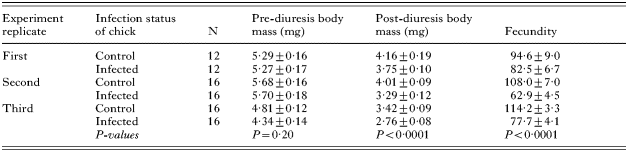
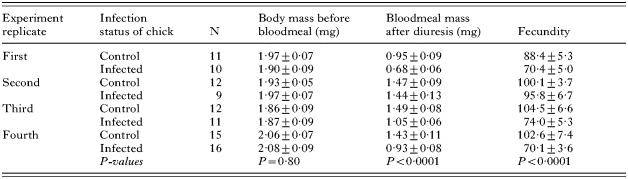
Immediately following their bloodmeal mosquitoes that had fed on infected and control chicks had the same body mass (Table 1, P=0·20). Following diuresis the mosquitoes which had fed on infected chicks had a lower body mass than those which had fed on control chicks (Table 1, P<0·0001). Considering similar pre-meal body mass (Table 2, P=0·80) this result indicates that mosquitoes fed on infected hosts imbibed the same mass of blood but diuresed more and retained less of the bloodmeal than if they had fed on a non-infected host (Table 2, P<0·0001).
Table 1. Comparison of mean body mass after blood feeding (pre- and post-diuresis) and fecundity between female Aedes aegypti fed on control chicks and those fed on malaria-infected chicks (mean±S.E.) (The P-statistics represent the significance of the difference between the infected group and the control group used in the first experiment, the replicates being treated as block effects.)


Tables 1 and 2 present separate data of each replicate performed in the 2 experiments. These data show variation between replicates. The statistics presented in each table represent the significance of the difference between treatments (i.e., infected versus control) once the variance among replicates has been accounted for.
Effect of infection on fecundity and energy allocation to fecundity
Mosquitoes fed on malaria-infected chicks had a lower fecundity than control mosquitoes (Tables 1 and 2, P<0·0001).
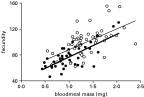
A regression model of the effect of infection on fecundity, using post-diuresis blood mass as a covariate, showed a significant positive correlation between post-diuresis blood mass and fecundity for both treatments (Fig. 1, P<0·0001). The regressions vary along the same slope (P=0·65) but have different y-intercepts (P=0·003), infected mosquitoes consistently laying fewer eggs than controls for a given post-diuresis blood mass.

Fig. 1. Relationship between fecundity and bloodmeal mass retained for both malaria-infected and control female Aedes aegypti (control: open circles, thin trendline, 49 D.F., r2=0·33, P<0·0001; infected: full circles, thick trendline, 45 D.F., r2=0·54, P<0·0001).
Change in body composition and following an infected bloodmeal

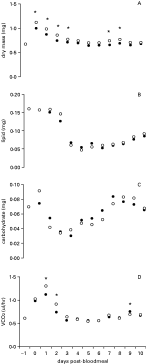
In both the control and infected treatment groups we found that the mosquitoes had produced dark excreta on the 2nd morning and had laid eggs on the 3rd and 4th mornings after the bloodmeal. In comparing the dry mass of both mosquito groups over the 10 days following feeding we found that non-infected mosquitoes had a significantly higher dry mass than infected ones (P<0·0001). The pattern of change in dry mass was similar for both groups (Fig. 2A). Dry mass strongly increased immediately after the bloodmeal then decreased until eggs were laid, remaining constant thereafter.

Fig. 2. Change in (A) dry mass, (B) lipid, (C) carbohydrate and (D) of female Aedes aegypti over time following a bloodmeal on either a malaria-infected chick (full circles) or a control chick (open circles). Day -1 indicates values pre-feeding. Measurements on day 0 were performed 3–4 h after the bloodmeal. Mosquitoes were 6 days old on feeding day. (* Indicates a significant difference at P<0·05 between treatments on a particular day).
Lipid content was not significantly different between both groups (Fig. 2B, P=0·39). It showed no change after the bloodmeal but dropped between days 2 and 3 post-feeding. Body lipid in both groups then slowly increased during the following days but did not reach pre-feeding levels during the experiment.
Following the bloodmeal the pattern of change in carbohydrate content was overall not significantly different between both groups (Fig. 2C, P=0·84). Carbohydrate content was generally highly variable from day to day for both groups. On the day of the bloodmeal (a few hours after bloodfeeding) infected mosquitoes had less carbohydrate than controls (P=0·05). Levels dropped in both groups until day 3 then reached pre-feeding levels on day 7 post-bloodmeal.
We found that overall

was lower in the infected group compared to controls (Fig. 2D, P=0·04). This difference was only significant on days 1 and 2 (P<0·0001). From day 3 to day 10 both groups had the same

except on day 9, where the

of the infected group was significantly increased (P<0·01).
DISCUSSION
The immediate consequence for A. aegypti of bloodfeeding on a malaria-infected host is a reduction in post-diuresis bloodmeal mass. Although the mass of blood imbibed from infected and non-infected hosts was identical, we found that the post-diuresis blood mass derived from an infected host is only 75% of that obtained from a healthy host (1 mg versus 1·34 mg). Less food to digest leads to a reduced specific dynamic action (SDA, the energy expenditure associated with digestion, transport and synthesis) and a lower fecundity. Vitellogenesis and egg production are part of the SDA in female mosquitoes and it would be very difficult to design an experiment identifying the respective costs of protein digestion, transport and synthesis. SDA can be estimated as the MR during digestion (in this case, on days 1 and 2) minus the MR of mosquitoes prior to bloodfeeding (corresponding to resting MR at 28 °C). If we assume both groups have the same RQ, our data suggest that infected mosquitoes have a 25% lower SDA than controls. Furthermore, we found a 22–31% reduction in fecundity following a bloodmeal on an infected host. These estimations illustrate that the reduced amount of energy ingested has direct effects later on the energy associated with digestion and investment in egg production.
Culicine mosquitoes such as A. aegypti differ from anopheline mosquitoes in that their pre-diuresis bloodmeal size is volume limited. Anophelines, by contrast, have the ability to expel plasma while feeding, allowing concentration of the blood (Briegel and Rezzonico, 1985). This concentration has its limits and Taylor and Hurd (2001) found that An. stephensi cannot compensate for the anaemia if it is too severe. Whereas nutrient uptake in anophelines is not affected by mild anaemias, energy intake in culicines is dependent upon blood quality and indeed for A. aegypti fecundity is proportional to RBC levels of the bloodmeal (Shieh and Rossignol, 1992). In this experiment we demonstrated the effect of host infection on the feeding characteristics of A. aegypti by a gravimetric method. We found that the mass of blood imbibed by mosquitoes was not affected by host infection. However, mosquitoes that fed on infected chicks diuresed a larger portion of their meal and had less remaining bloodmeal mass to digest.
Our data indicate that in A. aegypti, infected bloodmeals lead to a reduction in fecundity. In order to observe the effect of infection on egg production we plotted the relationship between fecundity and post-diuresis bloodmeal mass for both groups. Statistical comparisons showed that both correlations had similar slopes but different y-intercepts. Our analysis reveals a fitness cost of infection that is not dependent upon the size of the bloodmeal (since the slopes are not significantly different) but only on the fact of being infected. This result is consistent with those of previous experiments performed on A. aegypti, An. stephensi and An. gambiae (Hacker, 1971; Hacker and Kilama, 1974; Hogg and Hurd, 1995; Ahmed et al. 2001; Ferguson, Rivero and Read, 2003). Fecundity reduction in anophelines was found to occur by apoptosis of follicular cells about midway through the gonotrophic cycle (Hopwood et al. 2001). Whether fecundity is affected via a similar mechanism in A. aegypti is not known. It appears though that the presence of the parasite diverts energy allocation of the bloodmeal away from egg production towards other yet unknown processes.
Infected females invest less energy from the bloodmeal into egg production; yet following oviposition they consistently have a lower dry mass than the control group. This difference in dry mass, which averages 60 μg, is not due to lipid or carbohydrate. Mosquitoes are mainly composed of cuticle, water, lipid, carbohydrate and protein. Until the bloodmeal both mosquito groups were raised identically, therefore we can assume that the difference in dry mass observed was not due to a difference in cuticle mass between the two groups. Consequently, we propose that the difference between the infected and non-infected groups after oviposition is due to protein content. During blood digestion bloodmeal protein is deaminated, nitrogen is excreted and the resulting keto-acids are used to produce yolk lipid and restore maternal lipid and carbohydrate (Clements, 1992). Following a large bloodmeal, protein digestion may be interrupted hormonally once an egg batch is produced (Borovsky et al. 1994). The remainder is digested when the eggs are laid, and the product converted to fatty acids for storage or to proline, which can be used for flight (Scaraffia and Wells, 2003). We suggest that a portion of the bloodmeal products might also be converted to storage proteins. Hexamerin storage proteins have been found in larval and pupal A. aegypti (Gordadze et al. 1999) as well as in adult Ochlerotatus atropalpus (H. Benes, personal communication). Hexamerins exist in other Dipterans such as Musca domestica, where some forms are synthesized by the adult fat body in response to a protein diet (Capurro et al. 2000b). Perhaps A. aegypti have such a mechanism that enables them to store energy in the form of protein until it is needed for the following egg batch. Judging from our results this might be a main storage compound impacted by the infection.
One possible fate of the energy unaccounted for in the infected mosquitoes is utilization for energy metabolism. During digestion and egg production, lipid stores seem to drop more abruptly in the infected group compared to the control one, whereas the inverse happens with carbohydrate stores. This suggests that infection modifies energy utilization during the midgut invasion phase. A possible source of this lipid reduction is directly from the oocytes, by follicle resorption (Hopwood et al. 2001). We found that the difference in

between groups was consistent with the difference in post-diuresis blood mass and number of eggs produced. As stated in the Materials and Methods section,

is an estimate of MR and the most precise estimate that can technically be obtained for single mosquitoes at rest. Its accuracy to represent MR, however, depends on the nature of energy stores being consumed and produced in the animal. If the infected mosquitoes are preferentially consuming lipid, then

measurements underestimate the actual MR (due to the RQ of lipid combustion). Both groups are consuming lipid and carbohydrate, albeit in different proportions, so we cannot calculate the MR precisely based on

measurements. Nevertheless, our results do show that infection increases lipid consumption during the phase of midgut invasion and probably results in a higher MR than that predicted by the cost of blood digestion and egg production.
Lipid stores drop abruptly at the time of oviposition. Briegel, Hefti and DiMarco (2002) determined that oocytes each contain 0·96 μg lipid. We found that lipid content dropped by about 80 μg during egg production, consistent with the number of eggs produced. Following oviposition carbohydrate levels in both groups do not differ and return to pre-feeding values in a few days. This contrasts with the findings of Mack et al. (1979) who found that P. berghei-infected An. stephensi had lower haemolymph sugars than controls at both 4 and 11 days post-infection. On the other hand, Rivero and Ferguson (2003) report that An. stephensi infected with virulent P. chabaudi strains have more body sugar than controls at 7 days post-infection. Our study is the first to examine for several consecutive days the change in whole body carbohydrate of both control and infected A. aegypti and our results highlight its high day-to-day variability. This variability is likely due to the sugar feeding behaviour of the mosquitoes. In both groups, the increase in carbohydrate following oviposition probably indicates the ‘refilling’ of glycogen stores in the fat body after they have been depleted and this process does not appear to be modified by the infection. Lipid content during this time increases slowly and similarly in both groups, reflecting the synthesis of maternal lipid stores to replace those that were used for metabolism and oocyte lipid production (Ziegler and Ibrahim, 2001).
We expected to find that infected mosquitoes would have a higher MR during sporogony compared to control mosquitoes. Our reasoning was that the parasite requires energy for its growth. However we found no difference in

between groups. We found that after oviposition, both groups restore lipid reserves at about the same rate. The difference in dry mass, thought to be due to storage protein, does not vary much during the days of oocyst growth. Carbohydrate stores increase strongly in a few days but remain highly variable. Mosquitoes are known to catabolize lipid at rest (Clements, 1992). The parasites might catabolize sugars from the haemolymph since these are easily accessible. In turn, the mosquito host would sugarfeed more often to restore haemolymph sugar. If infected mosquitoes catabolize sugar at a greater rate than control ones, they might have a lower MR despite the identical CO2 release rates, because carbohydrate combustion would increase the overall RQ. Metabolic depression has been found in insects that are experiencing stress (Bennett et al. 1999; but see Djawdan et al. 1997). The mosquitoes might shut down some metabolic processes or reduce their overall resting metabolic demands in response to what they consider to be a stress. Metabolic depression is not incompatible with theories previously advanced concerning manipulation of the vector by the parasite (Hurd, 2001; Schwartz and Koella, 2001; Ferguson and Read, 2002).
In conclusion, we found that despite the fitness cost of infection on the fecundity of the mosquito, MR was clearly not increased during sporozoite sporogony. This does not mean that the mosquito is unaffected by the presence and activity of the protozoan. Resources are reduced in a parasitized mosquito and this is apparent as reduced meal size, increased lipid consumption during digestion, reduced fecundity and reduced body mass after oviposition. Observation of the infected mosquitoes' behaviour during the growth of the oocysts will be necessary to determine whether they are more quiescent or sugarfeed more often than non-infected mosquitoes.
We thank the laboratory of A. A. James (University of California, Irvine) and in particular Judy Coleman for providing mosquitoes and chicks. We thank the lab of A. Summers (University of California, Irvine) for use of the spectrophotometer. This research was supported by a GAANN fellowship to E.M.G.