Introduction
Diversity of agrarian dynamics in tropical areas complicates the analysis of integrated systems potentials
Integrated crop–livestock systems, or crop–livestock–forestry systems, have been seen as one of the main alternative routes to reach millennium development goals for agriculture and food production. Integrated systems may foster an increase in animal and crop production, as well as potentially greater expression of ecosystem services and protection of environmental quality to meet a growing demand for food during the next few decades1, Reference Russelle, Entz and Franzluebbers2. However, the contribution of integrated systems is still considered minor on a global scale. There is a need for greater diffusion throughout the main agricultural regions. The tropical region is considered strategic in this matterReference Tanaka, Karn and Scholljegerdes3, as it holds large portions of arable land. The region has a large potential in terms of land production and workforce, as well as an abundance of natural resources, such as solar energy, water, soil and biodiversity. However, agricultural systems in the tropics are very diverseReference Steinfeld, Mooney, Schneider and Neville4. Studies are needed to analyze the conditions and evaluate the adaptation and expansion potential of integrated systemsReference Sumberg and Thompson5. Agricultural diversity not only creates obstacles when trying to understand and compare systems, but also when seeking pertinent local adaptation options. Common ground is needed to identify windows of opportunity and pertinent lines of analysis.
With a view toward expansion of integrated crop–livestock–forestry systems, our focus was on understanding agricultural diversity to identify common threads among spatial arrangements in different tropical settings. We asked the following research question: what are the contributions of the spatial dimension in understanding the diversity of integrated systems in the tropics for identifying limitations and prospective development?
Integrated crop–livestock systems in different rural landscapes and social conditions
Our aim was to demonstrate how spatial and multi-scale analysis might enhance the concept of integrated crop–livestock–forestry systems, and its adaptation to various other agricultural situations in the tropics. Adapting to variability in the tropics is necessary, because of the inherent causes of variation that force farmers to recognize this situation. Our approach was focused on spatial models and not technical models.
We targeted flow paths among crop, livestock and forestry components in integrated systemsReference Belém, Manlay, Muller and Chotte6. In integrated systems, energy, water and nutrition flows are intended to benefit crop, livestock and forestry components. Tree species may, for instance, improve the water cycle for the benefit of crops or livestock, by limiting evaporation and creating shade. Animal manure may enrich the soil to benefit cultivated cropsReference Kante7. Herd management practices, crop rotations and spatial arrangements of farm operations can all help to improve cycling and flows among components.
The spatial dimension is key to the concept of material cycles and energy flows and management of integrated systems. Flow paths connect a point of origin to an end, materializing a spatial distance. In some systems, this distance is only vertical, e.g., flows between a tree crown and the soil. In other cases, the spatial distance is null, i.e., nutrient flows may be seasonal, resulting in a succession of management practices in the same place as time goes by (e.g., annual rotations). Flows are more complicated when considering the animal component due to spatial mobility and biomass transfer.
Types of flow, as well as inherent energy and economic costs, depend upon the system and the spatial scale. Nitrogen flow, for example, may occur at the scale of: (i) a field, using legumes in rotations to enrich the soil; (ii) the farm, with production of protein sources to feed livestock; or (iii) a region, with waste transport between production systems or industries, some with a surplus and others unprofitable.
Spatial flows also condition management steps, such that social systems work in different ways and at different scales (farm, community, region, etc.). Therefore, development and adaptation of integrated systems must be analyzed, not only in agronomic and biophysical terms, but also in social and functional terms. We cannot develop a spatial approach without considering the managers of that space, i.e., the social actors.
The rural landscape concept consists of a spatial structure and social scale where the components of an integrated system are located (crop land, pasture, forests, livestock, decision making and flow managing groups). We used the rural landscape as the analysis level in this study, allowing spatial and social dimensions to vary from one case to another in the tropical region.
Methodology
This analysis represents the work of a large team located in three continents with many years of scientific cooperation in agro-ecosystem and interdisciplinary research. With on-going expansion and adaptation of integrated systems in the tropics, we gathered and shared our experiences over the past few years from various analyses at each location. This individual approach did not allow sensu stricto comparison of results produced by a standard methodology, but aimed to build perspectives based upon refined and adapted analysis at each location. We describe successively three contrasted case studies, allowing readers a transverse and illustrated view of agro-ecosystem diversity in the tropics.
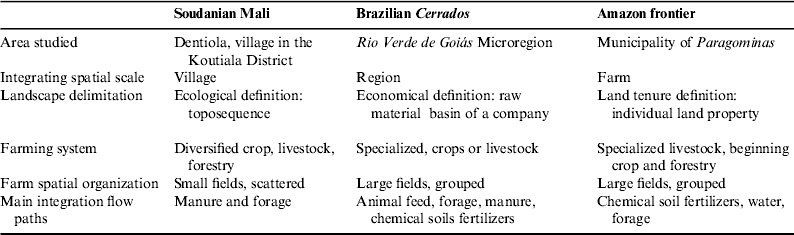
The spatial dimension was the focus of our descriptions of integrated systems within a landscape context, complemented by historic analysis of its development as a way to understand the essence of mechanisms and local adaptation. Table 1 synthesizes the details of the systems in each area studied.
Specifics of integrated systems in three case study areas.

Data collection in the three regions occurred in a distinct way, aiming for specific goals within each project. However, all projects contained information on flow paths, spatial dimensions, historic construction and management of rural landscape and associated social systems.
In Soudanian Mali, a broad database was developed in 2006 and 2007 from eight villages in the cotton belt in the districts of Koutiala, Sikasso, Bougouni and KitaReference Poccard-Chapuis, Coulibaly, Ba, Sissoko, Bengaly and Coulibaly8. A survey was conducted in all farms (826) of the eight villages. From a multi-criteria typology, a sample of ten farms in each village was selected. The subsample represented a diversity of practices regarding soil management, livestock feeding and diversity of farming production. All 80 farms were documented closely during 12 months, with type and quantity of farming operations evaluated for main operations, from herd management to biomass flows among cultures, pasture, herds and bush community areas. Labor from family and hired workers and financial budget of the farm were studied. The frequency of observations on each farm was every 15 days, and additional data were collected occasionally, such as in harvest season or from organic fertilizer applications produced on the farm. Other group and retrospective interviews were conducted in every village, referring both to the history of the practices, as well as to the community and natural resource management. Satellite images (Aster) were analyzed to map the main components of the rural landscape in each village.
Collection of data was less intensive in the Brazilian savannahs (Cerrados). Flow paths involved corn and soybean farmers, cereal crops, poultry, swine, beef and dairy farmers, slaughter houses and chemical dealersReference Coutinho9. These flows were not directly collected by the team, because data were available in the literature from a doctorate thesis in agricultural sciences, as well as in various technical papers from both private and public local institutesReference Bonaudo, Coutinho, Poccard-Chapuis, Lescoat, Losouarn and Tourrand10. The team mobilized the concepts of marketing chain and territory to characterize the social system that managed the integrated flows. Interviews were conducted with individuals from various sectors: 23 representatives of the local community, 16 public institutions and banks, 9 ethanol plant production managers, 29 crop and livestock farmers and 15 members of the slaughter and food agro-industrial complexReference Coutinho9. For every sector, a questionnaire was developed, highlighting two levels of analysis, i.e., the production chain and the practices or specific activity of each sector. An interview lasted c. 2 h and was organized for 1 year between 2009 and 2010.
In Amazonia, information was gathered during a long period, not in discrete events as in other fields of study. Since the mid-1990s, the team conducted studies of land use in three pioneer frontiers in the State of Pará (Brazil): Transamazônica, Southern Pará and Northeastern ParáReference Poccard-Chapuis11, Reference Poccard-Chapuis, Nahum, Ferreira, Carvalho and Tourrand12. Eight doctoral theses were realized by the team concerning the livestock expansion theme, focusing on degradation caused by pasture management, production chain and spatial dynamics, diversification of production and specialization of farms, dairy management practices and economic analysis of livestock systems. In 2011, a campaign of 38 interviews was conducted in the three regions, aiming to analyze the dynamics of livestock production and diversification of land use in response to deforestation policiesReference Poccard-Chapuis, Nahum, Ferreira, Carvalho and Tourrand12. Consequently in 2012, a land diagnosis was made in the municipality of Paragominas, combining 70 semi-open interviews with key informants (30 at the institutional level and 40 in communities and with farmers) and 160 interviews conducted survey-style in rural establishments. This information was intended to diagnose the role of family agriculture on land development and to analyze the dynamics of pioneer frontiers on integrated agriculture in the Paragominas.
Integrating the Spatial Dimension of the Three Case Studies
The three case studies were diverse in their description of farming production and level of integration. All three cases were described from an historical perspective. By understanding the current spatial dynamics and management of farming systems in these case studies our analysis sets the stage for building integration processes. Knowing the structure of farm conditions allows us to better understand its dynamics. However, we also wanted to discuss the perspectives and future situations, taking the reader beyond the observed situations. Therefore, our approach followed three stages:
(i) Historical description of systems and formation into the current condition.
(ii) Description of changes and management affecting such changes.
(iii) Perspectives on the advantages and limitations of the current system.
With uneven availability of data, the approaches we took had to vary. Contrasts among the integrated systems help enrich our understanding of different approaches.
Village systems in the Koutiala Cotton Belt of Southern Mali
Forty years of development from slash and burn to integrated systems
In Southern Mali, agro-systems are organized along toposequences: landscape relief determines the type of soil and its potential for production, whether native or cultivatedReference Kante7. Due to water flow in the watershed, upland portions have more fragile soils, with coarse texture and low fertility, while lowland sections of the watershed have deeper soils with a higher percentage of clay and fertilityReference Riou13. Sociologically, village residents sort along the toposequence by inhabiting the uplandsReference Dufumier14. In each village, native vegetation areas are community property, and therefore pastures and forests are used communally. Cultivated land is managed privately during the crop production season, but communally during the non-growing seasonReference Poccard-Chapuis, Coulibaly, Ba, Sissoko, Bengaly and Coulibaly8. A village leader defines the rules for common use of these areasReference Hardin15.
Up to the first half of the 20th century, farming practices were based on the slash and burn system, with regeneration cycles of about 20 years. At that time, upland portions of the toposequences were preferentially cultivated due to finer vegetation that was easier to clearReference Riou16. The low chemical fertility common to such soils was compensated for by the return of ashes from burned forests, which was also a technique to make the land easier to work. Local farmers did not own cattle at this time, and therefore, there was no crop–livestock integration. Cattle herds were managed by migrant ethnic groups from the northern regions of the Sahel.
During the past several decades, with the introduction of large cotton companies, land has been managed with the ‘cotton technical package’ using plowing with animal traction and improving soil fertility, with a strong impact on the rural landscapeReference Vall, Dugue and Blanchard17. In this contemporary system, the regeneration stage (also known as bush fallow) has largely disappeared, such that fields are permanently cultivated and the forest is disappearing from the landscapeReference Dufumier14. Crops are now predominantly grown in the clay-rich lowland areas, since the plow and traction bulls have made it easier to work these deeper soilsReference Gigou, Giraudy, Doucouré, Healy, Traoré and Guindo18. With greater water retention, these fine-textured soils have helped overcome susceptibility to drought in this area with large precipitation variabilityReference Crétenet, Rabi and Moussa19. Another advantage of the current system is that chemical fertilizer applications have produced greater cotton crop yields, positively affecting corn and sorghum grain grown in the typical rotation. In forming these permanently cultivated fields, some trees have been preserved from deforestation, such as the karité (Vitellaria paradoxa), néré (Parkia biglobosa) and even mango (Mangifera indica). Now there are ‘savanna parks’, with random trees growing in cultivated fields in these lower areasReference Riou16.
Livestock production became more directly integrated into the system, initially with traction bullsReference Bosma, Bengaly, Roeleveld and Traore20. Small cattle herds rapidly developed with available revenue coming from cotton sales. In a short time, the region became attractive to farmers with animal husbandry talents. More favorable precipitation in the Sudan than in the Sahel also made it possible to produce superior forage for livestock productionReference Crétenet, Rabi and Moussa19. Trypanosoma has been a limiting factor to cattle production in the area, but has diminished due to deforestation of the humid lowland areas, as well as the use of adequate veterinarian products. Thus, cattle often grazed upland vegetation that was more abundant and of high quality, of species such as Andropogon gaianus, while lowland native vegetation was spared from deforestation.
These animal and plant components began to work interchangeably, integrated, under the compound effects of demographic growth and ongoing deforestationReference Bosma, Bengaly, Roeleveld and Traore20. With consolidation of permanent fields, limited quantities of chemical fertilizers distributed by agri-business became insufficient to correctly manage the soil. Farmers were interested to utilize manure from cattle herds to improve fertility of cropland soil, such that cropland became an essential part of the fodder calendar, especially in the dry season, whereby grazing cattle deposited feces directly on cropland. With expanding cattle herds, upland pastures became excessively utilized, resulting in overgrazing and rapid degradation of pasture resourcesReference Blanc-Pamard and Boutrais21. Today A. gaianus is virtually extinct. Many innovations were implemented in the integration of crop and livestock systems in all villages of the Malian cotton beltReference Blanchard22.
Managing and recycling crops, fodder and animal manure
In the current system, nutrients are recycled through cattle manure, household waste and crop residues. Similarly, corn, sorghum and peanut residues are used to complement perennial grassland and arboreal forages for livestock fodderReference Ba23. This recycling of nutrients between organic fertilizers and forage is made from rural facilities, such as pits for manure production and storage areas for forageReference Kante7. Carts are essential for biomass transport between places of production, processing and application. Figure 1 schematically depicts these flows.
Integrated flows of nutrients in Southern Mali farms. Adapted from Lemaire et al.Reference Lemaire, Hodgson and Chabbi24.
It is clear that in this new scheme, biomass recycling is the core of animal and plant productivity, as well as the owner's investment and labor use. Management takes into account the spatial structure of the property, since fields are spread across the toposequence, as allocated by traditional authorities and family heritage. Thus, each property has a unique spatial distribution among the three types of fields (non-manured fields, manured fields and bushland) and size of cattle herdsReference Lemaire, Hodgson and Chabbi24.
Integrated management combines characteristics of each portion of the rural landscape with biomass flow (e.g., distance and type of soil) and characteristics of each property (e.g., equipment for transportation and processing, harvesting labor, processing and biomass distribution). In addition, there are community decisions at the village scale, mainly to regulate access of livestock to communal pastures and on crop residues after harvesting, but also for the use of fireReference Blanchard22.
Land carrying capacity at stressed condition
Nowadays, many villages in the northern part of the cotton belt face a crisis from this integrated system due to a natural limit on land carrying capacity. Production of each component is now insufficient, given human population density (demand for food) and bovine density (overgrazing and lack of forage). The amount of biomass involved in integration has been decreasing beyond necessary thresholds for sustainability. The necessity of growing food for families to achieve food security leads farmers to expand cultivated areas permanently at the expense of perennial pasturesReference Djouara, Belieres and Kebe25. As a consequence, the ability of farmers to feed cattle near to villages is decreasing, and herds now tend to spend long months in distant regions that are more favorableReference Ba, Lesnoff, Poccard-Chapuis and Moulin26. This separation decreases the ability to fertilize cropland soil and overall productivity of the territory declines.
Table 2 shows the productivity gains that the integrated system provides at the village scale, mostly related to the previous cut and burn system. It also indicates a maximum productivity ceiling, marking a crisis in the system.
Indicators of productivity at the village scale in three contrasting southern Malian situations.

Adapted from Poccard-Chapuis et al.Reference Poccard-Chapuis, Coulibaly, Ba, Sissoko, Bengaly and Coulibaly8.
Rio Verde de Goiás in the Brazilian Cerrados
System developed from successive agricultural colonization
In the Brazilian Cerrado, integrated systems work differently, despite having been implemented around the same period and a comparable natural environment. Native fields grazed by cattle herds with extensive ranching since the 17th centuryReference Deffontaines27 were converted into cultivated pasture in the 1950s, notably with Panicum species, and since the 1980s into fields for permanent crops (rice, corn and soybeans). Homesteaders from the south of the country were encouraged by public policy to inhabit the Cerrados by receiving 500 ha parcels of land. In the late 1970s, large companies introduced a technical package for soybean, based on no tillage and use of chemicals to fertilize the soil and reduce labor. After 3–4 years of corn and soybean crops (two crops per year), they planted a perennial forage grass, Brachiaria, for cattle fatteningReference Haddad28. The pastures received the carryover effects of fertilizers and soil corrections. This was a great technical and economic success with good harvests and low production costs, all of which transformed the Cerrados into one of the largest soybean and beef production areas of the world29.
However, the level of integration between crop and animal production was low, only by indirect pasture fertilization with chemical inputs applied to corn and soybeans crops. Everything changed when one of the largest national poultry companies demonstrated some interest in the region.
Introduction of an agro-industrial system integrated at the regional scale
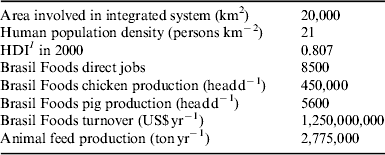
The abundant and relatively inexpensive supply of plant protein products has helped create a large agri-food industry by the company Perdigão, known nowadays as Brasil Foods, which has become the largest poultry producer in Latin America. The company has chick production plants, feed production, slaughtering, meat processing and conditioning, and a park of 900 aviary modules, distributed in the region. The company coordinated a large-scale transformation of domestic soybean protein into animal protein via chicken production for meat exportReference Bonaudo, Coutinho, Poccard-Chapuis, Lescoat, Losouarn and Tourrand10. Later they also developed swine production for the domestic market. Nowadays, Brasil Foods slaughters 450,000 birds daily. Soybean and corn are purchased from local farmers and turned into feed, then sold to 226 poultry producers, each with a flock of 100,000 birds. The birds are bought and slaughtered by the company, which exports frozen processed meatReference Coutinho9. Thus, Brasil Foods has developed an agri-business paradigm based on crop–livestock integration.
The last step of integration was with animal manure valuation. Unlike in Brittany France, where the density of farms with monogastric livestock is very high, causing excessive manure production and pollution of the environment, available land area in the Brazilian Cerrado is abundant (20,000 km2) and sparsely populatedReference França30. Therefore, the nutrient-rich manure is scattered onto pastures, which recycles nitrogen and contributes to other forms of animal production. The fertilized forage by manure from monogastric livestock allows ruminant livestock to graze pastures with weight gains of about 1 kg ha−1 d−1.Reference Rodrigues and MIZIARA31
Technical optimization of the integrated system with competition from macroeconomic and regional issues
With the success of the crop–poultry integration model, Brasil Foods is planning to add another module to the chain, with dairy. Manure application to pastures builds fertility and opportunity for ruminant production. They plan to stock dairy cattle on pastures at 5 animal units ha−1 yr−1,Reference Coutinho9 and to develop an industry–farmer partnership system similar to that for the poultry module. This strategy will cover a large radius surrounding processing facilities (∼80 km), enabling efficient grain, animal, manure and meat transport. Farms practice among themselves only mild levels of integration, but management of the flows (food, feed, animals, manure and fertilizers) by the company will enable multiple levels of integration. The boundaries of the territory being integrated are clearly economically driven and managed by the company.
Table 3 shows some productivity indicators at a regional scale, and the volume of integration in the Brasil Foods complex of Rio Verde de Goiás.
Indicators of productivity at the regional scale in the Brasil Foods basin of Rio Verde, Brazil.
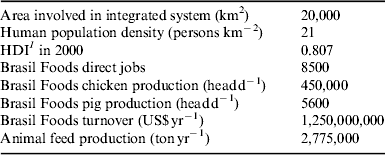
1 Human Development Index.
Despite the technical, economic and social efficiency of the integrated system, it has been threatened by two external processes. A sugar cane belt, located further south in the state of São Paulo, is expanding rapidly due to favorable infrastructure and market conditions. Croplands in Rio Verde are now having competition for use with sugarcane. Reduction in grain and pasture production could disrupt the integrated structure and affect performance of the agri-business company. Moreover, the construction of a railway linking the region with river and sea ports for export could increase grain prices that producers receive (thus negating the advantage Brasil Foods receives by purchasing local grain), since transportation of grain currently by truck is more expensive and consumes part of the cost of production. Therefore, the company may lose one of the main advantages of its presence in the territory: the existence of an abundant and cheap raw commodity. To keep the advantage, they would have to move northward into the Brazilian Amazon, where there are other grain production regions, but still isolated from major transport routes. Thus, we see that the technical system of integration bumps into the dynamic social system in which it operates.
Paragominas in the Amazonian frontier
Five decades of land degradation with deforestation
The Brazilian Amazon is animated by several agrarian dynamics. We focused our approach on the pioneering regions of the agricultural frontier requiring deforestation. This frontier is dynamically under construction, integrating the mechanisms of development of the national territoryReference Hébette32. The municipality of Paragominas is one of the most advanced on this path toward integration.
Settlement of this region is marked by the process of land ownership, or ‘land struggle’, in the now famous expression of Schmink and WoodReference Schmink and Wood33. Pioneers from other regions of the country, as well as indigenous people, seek opportunities to accumulate assets and develop agricultural productionReference Poccard-Chapuis11. In this frontier, social institutions and supply chains are not consolidated and functioningReference Hébette32, Reference Pacheco and Poccard-Chapuis34. Selfish behavior prevails in social relations and in agricultural production structureReference Villemaine, Sabourin and Goulet35. During the phase where territories are in the early stages of development, the only level of functional organization is the farm. In the early decades of settlement, the journey of pioneers is based more on land ownership, land hoarding or speculation, rather than in the pursuit of sustainable integrated crop and livestock production systemsReference Tourrand, Veiga, Ferreira, Ludovino, Poccard-Chapuis and Simão-Neto36. From technical and social points of view, at least initially, extensive cattle ranching is one of the few opportunities within reach of pioneers to achieve their goals, both for large and small producersReference Margulis37. This reality has led to widespread specialization in this activity. The settlement process with cattle ranching occurs without taking into account the characteristics of land relief, soil and moistureReference Poccard-Chapuis11.
Deforestation has been followed with widespread planting of Brachiaraia bryzantha as pasture forage, although not always with establishment success, leading to low forage productivityReference Dias-Filho38. Inadequate management of pastures causes oscillation in the number of animals and the need to clear new areas, typical of pioneer systemsReference Hostiou39. Fire is often used in old pastures to try to control weedsReference Navegantes-Alves, Poccard-Chapuis, Ferreira and Moulin40. Low productivity pastures have led to the ‘devastation of the Amazon’, resulting in ∼70 Mha of monoculture pastures of low productivity per hectare (about 0.7 tropical bovine unit ha−1)41.
Origin of new and dynamic integrated conditions
Federal policies from the 2005 Plan for Deforestation Prevention and Control (PCDAM), reinforced by the vote of the forest code in 2012, have resulted in a set of rules and mechanisms regulating loggers, farmers and various stakeholders of the bovine and timber chainReference Maia, Hragrave, Gomez and Roper42. Heavy fines, police operations, satellite monitoring and environmental compliance obligations administered by the Justice Department have forced stakeholders to comply with these rules, leading to a sharp decline in deforestation and the use of fire. In parallel, some territories and infrastructure were developed, allowing new land use for grain, oil palm, eucalyptus and fruit production. Cattle ranchers were forced to focus on the most favorable pasture areas from the point of view of fertility and logistics. Innovation to increase forage production from less area has become necessary, especially with the emerging concept of ecosystem services and the negative image of deforestation. A new relationship between livestock and people is under construction in the AmazonReference Poccard-Chapuis, Nahum, Ferreira, Carvalho and Tourrand12.
Crop–livestock integration, non-existent until recently, has been seen as a solution for the region. Two different integration approaches are emerging to reform systems specialized in livestock. Both occur on the scale of the farm.
Crop–livestock integration
Integration in many cases is seen as a solution for recovering degraded pastures, as well as diversifying income for the farmer. Cultivation of soybean and corn in a period of 1–5 years is promoted as a technical package with no tillage or conventional tillage and chemical inputs to fertilize and control weeds. After the crop period, improved grass is planted and high productivity pasture is formed due to residual soil amendments from cropping. The system is repeated in other portions of the farm over time until the entire pasture area is renovated. The farmer may also choose to plant trees for fruit and wood, as a way to generate an income in the long term and improve animal health and productivity. There is also an option to outsource the cultivation of grain, or rent land to plant commercial trees, to a specialized company.
Role of trees
Some integrated crop–livestock–tree systems have been developed. Apart from their own economic value to provide wood or fruit, trees may contribute to fertility of the soil in the case of legumes that fix nitrogen, as well as to protect crops and animals from heat and wind. Water stress during the dry season is a major limiting factor for forage production, increasing the risk of accidental fires. Furthermore, only the Nelore zebu is fully adapted to tolerate direct sun in the equatorial region, but productivity of meat and milk can be greatly enhanced with cross-breeding with European breeds. The absence of shade in pastures can prevent cross-breeding. Thus, silvopastural systems can be beneficial. Several arrangements exist in planting trees in strips, groves or thinning of woods, with varied spacing between trees. The most planted species are eucalyptus (Eucalyptus urophila) and the paricá (Schizolobium amazonicum), which have high productivity and are well accepted in the domestic market (coal to steel, plywood furniture, pulp for the paper industry). Many other species have potential, but cultivation is limited by availability of seeds and expertise.
Introduction of trees in the pasture also occurs spontaneously in the process of pasture degradation. Some species, such as babassu (Orbignya phalerata), considered invasive, are prevalent in pastures and assume roles of wind breaking and shade. Others, such as the Ipê (Handroanthus spp.), are often found due to selective grazing and where the producer seeks to preserve species considered useful.
Synthesis
Based on the three case studies, we describe four key issues to better develop integrated crop–livestock systems in the tropics.
Optimizing spatial organization of crop and livestock components within the landscape
Rural landscapes have inherent physical and functional characteristics that determine to some extent necessary spatial structure. Functional improvements in rural landscapes can occur over time and with consideration of crop and livestock components in spaceReference Poccard-Chapuis, Bonaudo, Tourrand and Lossouarn43.
In the Paragominas case, rural landscapes are still largely at an early stage of development following the removal of native vegetation. Spatial arrangements have not yet been refined due to the broad approach of deforestation and grassland cultivation, in which social considerations have outweighed environmental decision-making. Productivity gains through arrangements of various components in the landscape are potentially high, considering the challenges from recovery of degraded pastures and formation of eco-efficient landscapes. Besides, reforestation in areas of permanent preservation is now required by law, and farmers will need to identify critical parts of their farmland, such as relief, soil, distance, wetland and river network, in order to develop an efficient spatial arrangement of land use and appropriate management practices for optimizing biomass and water utilization. More than a static form, this arrangement should be thought of as a process of progressive pasture reform, with occasional diversification into other uses. Greater appreciation of where animal manure is deposited (i.e., on pasture for temporal rotation with cropland or in corral for collection and spreading on cropland) is needed.
Silvopasture systems are gaining acceptance in the international development community. Tree, livestock and forage components interact over time in the same area, with shade and soil fertility interactions of key importance. Productivity per hectare can be high, given mobilization of technology, knowledge and inputs, and environmental impacts of agriculture can be minimized due to more closed nutrient cycles.
In the case of the Brazilian Cerrado, spatial arrangements and nutrient flows are being optimized for productivity. However, this highly specialized form of crop–livestock integration has high environmental costs, with the extinction of native vegetation and little preservation of surface water. The integrated system is clearly based on strong manipulation of the landscape, from chemical inputs, cultivation of exotic species and full monitoring of agro-ecosystems. A challenge from the spatial point of view would be to release productive areas to the re-establishment of native vegetation, primarily not only in wetlands and river valleys, but also in some upland areas. There is also a risk of further diversification in land use, in which farmers may choose to plant sugar cane, and thus create unbalanced cycling among animal and crop production and biomass recycling.
In the Malian case, spatial arrangements are well optimized. To improve biomass production and avoid crisis situations, some land areas and times could be better managed, such as open areas between cultivated fields or during the agricultural calendar (after corn harvest, for example, or early dry season). Availability of labor becomes a limiting factor in some farms. Another option may be for farmers to maintain private control of croplands following harvest to be able to generate more organic fertilizers directly on the land rather than lost to wandering herds. Another option for improvement is to temporarily ban grazing of some forage banks, which could then be used during droughts for cattle feeding.
Role of institutions in integrated management
The three study cases show contrasting management structures: management by an agro-industrial company (Rio Verde de Goiás, Brazilian Cerrado), management by the farm (Paragominas, Brazilian Amazon) and combined management by farmers and community authorities (Koutiala, Mali).
It is interesting to compare the specific cases of Mali and the Brazilian Cerrado, with similarities from an ecological point of view but totally different from the social point of view, on the productive performance of the integrated systems. Management by the agribusiness company in the Brazilian Cerrado certainly facilitated several factors that Malian farmers lacked: finance access, equipment and technical support, quality inputs, training and complementarity among specialized components. Brasil Foods was able to mobilize public policies to support its project, particularly public funding for infrastructure development. However, above all, it completely leads the integrated system, by the direct control of livestock (number of birds and swine) and indirect influence on cultivated areas (e.g., prices paid to farmers), feed production, meat production and making components complementary. The company can monitor and adjust crops and livestock in the territory, as well as biomass circulating in the integrated system. Even transportation is managed by the company with a fleet of trucks and a dense network of passable country roads. Brasil Foods was responsible for assembling and balancing this system, economically and agronomically coordinating it in an effective way. However, this integrated structure has the risk that farmers may invest in other production systems, such as sugarcane as has been attractive in neighboring regions. It is possible that a decline in grain supply would lead Brasil Foods to forego the territory and move its activities to another region. This is one limiting factor in managing a large corporation: it can optimize an integrated crop–livestock system, but it can also change strategy and withdraw, compromising the development direction of the territory. Therefore, the social system may be influenced by an uncontrollable external agent, affecting the viability of an integrated crop–livestock system.
In the Mali case, where virtually none of these features exist, management was left to the farmers themselves and traditional authorities. Biomass production, transport and transformations are limited by the lack of investment, fertilizer, feed and processing plants. Connection to public policy is weak, limiting the impact on and from the agrarian system. Moreover, traditional management has difficulties in promoting technical innovations, such as controlling grazing on community land. This comparison clearly shows the role of managers in innovation, public policy mobilization, and management and tactical integration. The social system in villages combined with the former slash and burn and forest succession system can be considered hindrances to optimizing integrated systems at a regional scale. The trend is that farmers, as seen in the Amazon case, end up developing integration individually without collective mobilization of potentially shared resources and biomass.
The Amazon case of Paragominas is also noteworthy when it comes to integrated management. It shows the limits of a system managed individually at a property scale, to develop integrating systems and innovations in general. Some innovators may be able to master the technological leap for annual cropping, forestry and cattle production in combination, but we cannot say that this is common. Many farmers are not able to get this type of information and integrated technology package easily, so the contribution of public and private institutes seems essential. Technical assistance and rural credit are needed. In another approach, rather than individual scaling of integration on each farm, integrated systems can be developed spatially within a region, similar to the example in the Brazilian Cerrado.
Reliance on internal rather than external resources
One of the arguments for the development of integrated systems could be the substitution of imported chemical fertilizers from distant areas by local biomass. The three study cases partially confirm this characteristic, each in a different manner, pointing to improvements.
In the Rio Verde of the Brazilian Cerrado, there are virtually no biomass imports, except for seeds and chemical fertilizers. The structure works in a closed circuit, unlike other large monogastric production areas of the world. This reduces costs and limits negative environmental consequences. Manure management is made easier due to the large integrated scale structure: organic materials can be treated as fertilizer on abundant pastures without stockpiling to become toxic. This is certainly the biggest success of this model of agricultural production. However, reliance on external inputs is still strong, including pesticides and fossil fuels. In addition to environmental concerns with removal of natural ecosystems, public support of farming regions without concern for biodiversity may diminish, leading to future legal restrictions on marketing of food products. The economic cost of reducing external inputs would likely be high, with decreased productivity. This system is typical of an agri-business cluster whose competitiveness comes from expertise and a focus on productivity.
The inverse problem exists in the Soudanian Mali belt. The integrated structure is based on local biomass recycling, with a few external inputs to the territory (except cotton seeds and small amounts of fertilizer and herbicides). Farmers of this part of Mali build new knowledge locally to develop innovative integrated systems with their own resources. VigneReference Vigne44 proves the high energetic efficiency of these systems from the low use of inputs, lack of fossil fuel use through machinery, reliance on human labor and local biomass recycling. Greater use of external inputs, such as fertilizer and forage concentrates for herd concentration, could increase biomass production and the ability to recycle even more biomass. However, the cost of these inputs is still too high for farmers in this region.
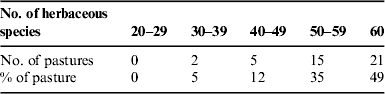
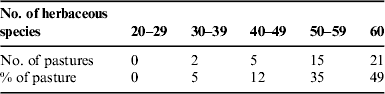
In Paragominas, the situation is in the middle ground. Deforestation is a huge artificialization of the ecosystem, with great impacts on the water cycle, biodiversity and greenhouse gas emissions. However, plant communities that have developed with extensive livestock systems have interesting ecosystem service characteristics from the integrated system point of view. AlmeidaReference Almeida, Valeriano, Escada and Rennó45 estimates that 20% of the deforested area in recent decades is derived from secondary forest after abandonment or fallow. Pasture degradation processes eventually lead to greater plant biodiversityReference Hostiou39. AlvesReference Navegantes-Alves, Poccard-Chapuis, Ferreira and Moulin40 noted the strong presence of trees in pastures in the Amazon, as well as a great diversity of herbaceous shrub species. Plant communities in Amazonian pastures are rich, as shown in Tables 4 and 5, with pastures initially established as monoculture forage species, natural succession of leguminous shrubs and trees in pastures certainly bring benefits to the production system. Some farmers intentionally monitor diversity of grass species, concluding that the livestock diet can be improved with limited intake of Bracharia bryzantha. Pasture diversity may also assist the functioning of soil, humus formation and provision of shade for animal comfort and productivity. Rural landscapes in the Amazon already have favorable characteristics for the development of improved integrated systems.
Occurrence and characteristics of tree species found in 41 pastures in Maraba, State of Pará, Brazil.

Adapted from Alves et al.Reference Navegantes-Alves, Poccard-Chapuis, Ferreira and Moulin40.
Number of herbaceous shrub species found in 41 pastures in Maraba, State of Pará, Brazil.
Adapted from Alves et al.Reference Navegantes-Alves, Poccard-Chapuis, Ferreira and Moulin40.
Since many producers do not have access to inputs, technology and assistance, and the landscape and climate are conducive to multi-layered plant communities, optimizing existing landscapes with internal resources only makes sense. Farmers have local knowledge about trees and leguminous shrubs found on their property. These resources dispense the need for external inputs and seeds, economic risks and investments. After the trauma of deforestation, the scientific community and farmers’ social networks need to develop further innovations in local agro-ecosystems, without necessarily thinking of artificial technology and external inputs.
Nitrogen flows
The example of the Brazilian Cerrado shows the importance of nitrogen flows to enable development of integrated systems. Whether for soil fertility or feed, nitrogen as the basis of protein is essential to increase productivity in crops and livestock. Recycling of nitrogen is a key for high system performance in the Cerrado.
Nitrogen is a limiting element in the other two cases studied. In Mali, primary production of plant protein is very low. Soybean, as a nitrogen-fixing grain legume, is not cultivated. Peanut is also a nitrogen-fixing food crop that typically occupies a minor role in the crop rotation. Leguminous trees are rare and have low productive potential for human or livestock consumption. Production of monogastric livestock is limited and feed is based on household waste and rambling. Biomass transformation is primarily through ruminant intake and meat or milk production. Cultivation of leguminous crops helps meet food security of farm families. Crops are almost exclusively for human consumption or for sale (e.g., cotton). Harvesting the non-edible portions of bean (Canavalia ensiformis) and velvet bean (Stizolobiun aterrinnum) could foster the development of production of small ruminants and poultry, thereby increasing the recycling structure for soil fertilization.
In the Amazon, nitrogen is more abundant, but less valued in integrated flows. As explained above, the leguminous trees and shrubs are present in pastures. However, pasture improvement tends to eliminate them, focusing only on the grasses planted. Forage mixtures with pueraria (Pueraria phaseoloides), estilosantes (Stylosanthes spp.), galopogonios (Calopogonium mucunoides) and arachis (Arachis pintoi) are still unpopular. Either way, nitrogen flow is usually directly from the decomposition of plant parts to the soil without animal transformation via grazing. Production of high-protein forage is limited, but when it is produced it is mainly for cattle. Manure is often not collected and recycled as fertilizer. Production of monogastric livestock has obstacles in access to grain, which is limited in the region where pastures dominate. Relative specialization of farms suggests that integration and nitrogen recycling are not strong within a farm, but could occur within a territory between specialized farms producing crops, monogastric livestock and cattle. A limiting factor is the presence of an industry to produce feed and meat through transformations and management of biomass flow.
Conclusion
The spatial approach we undertook allowed evaluation of different technical and sociological characteristics of farming systems in the tropics, as well as understanding of the material flows in integrated systems. Management of farms and farm communities in the rural landscape helped to frame the evaluation. We characterized the historical development of landscape characteristics in three different cases to better understand the possibilities for development of integrated crop–livestock–forestry systems in the tropics.
The rural landscape supports biomass and nutrient flows at levels of plot, property, village, belt production and region. Each level can be managed, but the type of social structure may limit influences for change to a more sustainable integrated system. Integrated systems cannot be viewed as universal models, but as a concept to adapt to each agro-ecological and social situation, unlike the current trend to develop ‘models’ of integration. Another limiting factor of these models is that they are usually designed to increase productivity from innovative solutions, artificial or at least external to local realities. However, there are enough elements in the agrarian history of each region, and its current landscapes, which can serve as a base for more endogenous integrating systems, less artificial and, therefore, more suitable to local agro-ecological and social systems. In both cases, since the integrating systems have a large spatial extent, development or improvement requires the involvement of local institutions and coordination of actors. Thus, research initiatives toward integrating crop–livestock–forestry in tropical regions should not only focus on technical and production factors, but assemble interdisciplinary teams addressing social and landscape analyses.