Implications
Raising livestock in an extensive rangeland environment relies heavily on the nutritive quality of grazeable forage. However, livestock producers in arid and semi-arid environments often encounter times of the year when grazeable forage quality is inadequate to meet animal requirements. Therefore, producers often resort to supplementing livestock with harvested feeds, which ultimately increases cost of production. A challenge for researchers is to provide producers with new and acceptable approaches to sustain optimal levels of production while ensuring economic feasibility. Present research suggests that obtaining an optimal level of additional feed inputs rather than maximizing intake has a similar impact on primiparous milk production. Therefore, by not maximizing but reducing the amount of supplementary harvested feeds during times of diminished forage quality lowers cost of production and maintains production goals.
Introduction
In Northern Great Plains, USA, a common practice is to supply harvested feedstuffs during the late gestation period to cows grazing senesced rangelands due to the low quality of forage available. The question then arises as to what extent this feeding paradigm has on subsequent growth and development of offspring. Any time harvested feeds are used to augment the nutritional environment in which grazing livestock are being raised, there is a associated, direct cost to production. This associated cost of providing harvested feedstuffs can have detrimental impacts on extensive livestock operations if less than desirable production goals are not achieved. This includes calving ease, calf vigor, milking ability of the dam, post-calving growth rate of calf, timely resumption of estrus for the dam and how post-weaning treatment of replacement females’ impact sustainability of extensive livestock operations. Pre-pubertal growth rate of heifers has been found to be positively related to their subsequent milk production (Buskirk et al., Reference Buskirk, Faulkner, Hurley, Kesler, Ireland, Nash, Castree and Vicini1996; Sejrsen et al., Reference Sejrsen, Purup, Vestergaard and Foldager2000). Further, cows with similar genetic potential for mature weight may differ in production efficiency depending on their milk yield (Montano-Bermudez and Nielsen, Reference Montano-Bermudez and Nielsen1990). Calves born to dams developed on 80% ad libitum feed after weaning and provided a reduced level of supplemental feed during winter before calving weighed less at birth and weaning than contemporary calves from dams that were provided with ad libitum feed during development and(or) before calving (Roberts et al., Reference Roberts, Paisley, Geary, Grings, Waterman and MacNeil2009b). One plausible explanation for this result is that milk yield or composition was affected by the imposed nutritional regimens during post weaning or in utero development. Thus our objective was to evaluate effects of the previously established nutritional paradigms (post-weaning and in utero nutrition) on yield and composition of milk.
Material and methods
Study location and environment
This study was conducted at the USDA-ARS Fort Keogh Livestock and Range Research Laboratory (LARRL) located ~1.6 km west of Miles City, MT (46°22'N 105°5'W) from April 2009 through August 2011. LARRL Institutional Animal Care and Use Committee approved all animal handling and experimental procedures used in this current study.
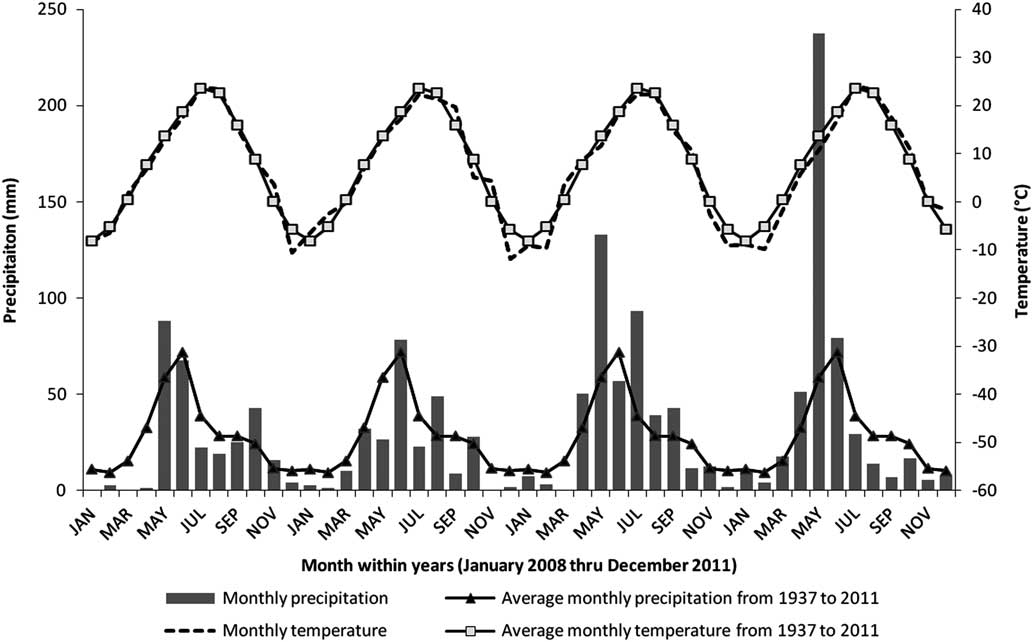
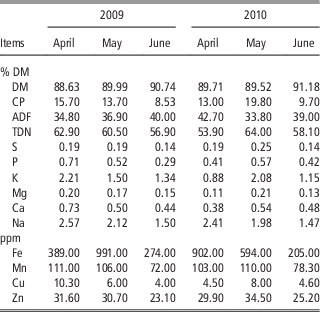
The LARRL encompasses 22 500 ha and has an average elevation of 730 m. Average daily temperatures range from −12°C in January to 24°C in July with daily maximum temperatures occasionally >37°C during summer and daily minimum temperature occasionally dropping <−40°C during winter. Winter mean temperatures during the study were similar to the long-term average (Figure 1). Average annual precipitation is ~340 mm and occurs primarily between April and September (Figure 1). Precipitation was 288 mm in 2008, 260 mm in 2009, 452 mm in 2010 and 481 mm in 2011. Thus, the year before initiation of the study and the 1st year of the study had less than average precipitation, whereas precipitation during the last 2 years of the study was greater than the long-term average. May precipitation was greater than the long-term average in 2010 and 2011 by 74 and 179 mm, respectively. Predominant grasses at this site include grama (Bouteloua), needlegrass (Hesperostipa) and wheatgrass (Pascopyrum; Küchler, Reference Küchler1964). Average standing crop of forage produced annually at the study site is 870±14 kg/ha (Grings et al., Reference Grings, Short, Klement, Geary, MacNeil, Haferkamp and Heitschmidt2005). Stocking rate was 1.27 ha/animal unit month and the quantity of forage available in the 53.8 ha pasture during 128 days that primiparous cows were on trial was in excess of cattle needs. Forage characteristics are described in Table 1 and indicate that CP concentrations typically are elevated in early to mid-spring and taper off as summer advances and plants senesce. However, CP concentrations during the period when primiparous heifers were nursing met or exceeded requirements (NRC, 2000) throughout the 128 day study when milk production was measured.
Precipitation and temperature measures during 2008 and 2011 along with 74-year averages at Miles City, MT. (National Oceanic and Atmospheric Administration, 2008–11).

Forage characteristics of rumen extrusa samples collected in April, May and June during the time when first parity heifers were grazing experimental pasture

DM=dry matter; TDN=total digestible nutrients.
Two ruminally cannulated cows grazed with experimental suckled primiparous cows throughout the study. Samples of grazed forage extrusa were collected and analyzed to estimate diet quality and describe nutrient composition of forages grazed. Diet extrusa samples were collected in April, May and June of 2009 and 2010. Diet extrusa was not collected in 2011 due to persistence of precipitation and inability to keep cannulated animals from consuming standing water that might bias nutrient analysis of the ruminally recovered samples. Diet samples were obtained following complete removal of rumen contents and immediately sponge-dried to remove any residual moisture as described by Lesperance et al. (Reference Lesperance, Bohman and Marble1960). Briefly, rumen evacuated cows were released into experimental pastures and allowed to graze for 45 to 60 min. After the grazing period, grazed forage extrusa was removed from the rumen and thoroughly mixed and individually frozen at −20°C, lyophilized, ground to pass a 2 mm screen and stored at −20°C until analysis by a commercial laboratory (Midwest Laboratories Inc. Omaha, NE, USA).
Herd management
Primiparous cows (n=48) from the stable composite gene population (1/2 Red Angus, 1/4 Charolais, 1/4 Tarentaise) described by Newman et al. (Reference Newman, MacNeil, Reynolds, Knapp and Urick1993a and Reference Newman, MacNeil, Reynolds, Knapp and Urick1993b) nursing steer calves were used in this study. Management of this population is such that dams receive a lifetime treatment of either adequate (ADEQ) or marginal (MARG) winter supplementation consisting of alfalfa hay (1.8 or 1.2 kg/day) for 80 day before parturition (Roberts et al., Reference Roberts, Grings, MacNeil, Waterman, Alexander and Geary2010). In Brief, at weaning heifer calves are removed from their dams and relocated to dry lots and developed in pens containing Calan gates (American Calan, Northwood, NH, USA) to facilitate individual feeding. Post-weaning heifer developmental diets consisted of either ad libitum (AL) or 80% of ad libitum (less than ad libitum (LAL)) feed availability throughout a 140-day development period. Subsequent adjustments in the amount to feed offered to heifers on the LAL treatment were calculated every 28-day using the following formula:
 $$\eqalignno{ & {\rm LAL}\,{\equals}\,[0.80{\times}({\rm mean}\,{\rm BW}\,{\rm of}\,{\rm restricted}/{\rm mean}\,{\rm BW}\,{\rm control})\cr&\quad{\times}{\rm mean}\,{\rm daily}\,{\rm feed}\,{\rm intake} \,({\rm as{\minus}}\,{\rm fed}\,{\rm basis})\,{\rm of}\,{\rm controls}\,{\rm over}\,\cr &\quad\quad{\rm the}\,28{\minus}{\rm day}\,{\rm period}]. $$
Following this 140-day developmental treatment period (just before breeding), developed heifers were commingled and managed similarly through their first breeding season. Upon pregnancy confirmation, the now primiparous cows were assigned to lifetime fall/winter treatments. The now primiparous cows, which had received the AL post-weaning development treatment, were supplemented at the ADEQ level (1.8 kg/day) and the primiparous cows that received the LAL post-weaning development treatment were supplemented at the MARG (1.2 kg/day) level of fall/winter supplementation. Just before calving, primiparous cows were again commingled and managed similarly throughout the year until the following year when they were once again separated into their respective fall/winter treatments. Description of experimental design and herd management has previously been reported (Roberts et al., Reference Roberts, Waterman, Geary, Alexander and MacNeil2007 and Reference Roberts, Geary, Grings, Waterman and MacNeil2009a; Waterman et al., Reference Waterman, Sawyer, Mathis, Hawkins, Donart and Petersen2011).
Experimental animals
In total, 16 2-year old, primiparous cows nursing steer calves were selected from the aforementioned paradigm in each of the 3 years studied. Primiparous cows were chosen to provide equal subclass numbers for in utero nutrition for 80 days before parturition (ADEQ and MARG, n=24 respectively) and post-weaning heifer development treatment (AL and LAL, n=25 and 23, respectively) and for having steer calves of similar age.
Measurements
Milk collection began ~27 days (earliest date to acquire selection criteria previously mentioned) after parturition (average 16 April each year) and continued at 14-day intervals for 112 days using a technique previously described (Waterman et al., Reference Waterman, Sawyer, Kane, Hawkins and Petersen2006). In brief, on the day of each milking, cows were gathered from pasture, calves were removed and cows were administered an i.m. injection of oxytocin (40 USP; Bayer HealthCare, LLC. Shawnee Mission, KS, USA) 5 min before milking to facilitate milk letdown (Beal et al., Reference Beal, Notter and Akers1990). Heifers were milked using a portable milking machine (SuperKart, Coburn Company Inc., Whitewater, WI, USA). Milk collected from the initial milking was discarded. Heifers were kept separate from calves for ~4 h (exact time (hundredths of a second) was recorded and used in calculation), and then milked a second time using the same procedures. Weight of milk from the second milking was recorded, and an aliquot (20 ml) was retained for analysis of milk protein, lactose, fat, solids non-fat and milk urea N by Rocky Mountain DHIA (Logan, UT, USA). Daily milk yield was estimated from the 4 h milk production yield (kg/day) and composition (g/day) was calculated by multiplying constituent concentration by daily milk production (Appeddu et al., Reference Appeddu, Sawyer, Serrato-Corona, Knox, Parker, Hawkins, Donart, Hallford and Petersen1997; Waterman et al., Reference Waterman, Sawyer, Kane, Hawkins and Petersen2006).
Statistical analysis
Milk yield for lactation period, peak milk yield, day to peak milk yield and milk yield from peak to final milk measure were determined using GraphPad Prism software (GraphPad Software Inc., San Diego, CA, USA). Trapezoidal summation was used to determine total lactation period milk yield and milk yield from peak to last milking. Persistency of milk production was calculated from day to peak yield to final milk measure for each cow using the following equation (DHI, 2015). The denominator days between tests had a mean of 78±3.1 day and ranged from 14 to 98 day.
 $$1{\minus}\left( {{{\displaystyle({\rm Milk}\,{\rm yield}\,({\rm kg})\,{\rm at}\,{\rm peak}{\minus}{\rm Milk}\,{\rm yield}\,({\rm kg})\,\atop \displaystyle{\rm at}\,{\rm final}\,{\rm measure}){\times}{{30\,{\rm days}} \over {{\rm Days}\,{\rm between}\,{\rm tests}}}} \over {{\rm Milk}\,{\rm yield}\,({\rm kg})\,{\rm at}\,{\rm peak}}}} \right){\times}100$$
Milk yield and constituents (protein, lactose, fat, solids non-fat g/day and milk urea N, mg/100 ml) were analyzed by fitting a repeated measures mixed model using the MIXED procedure of SAS 9.4 (SAS Institute Inc., Cary, NC, USA). The model included fixed effects of in utero nutrition, and post-weaning heifer development treatments, day of milking and all interactions for fixed effects. Animal and year effects were fitted as random effects. The covariance of the repeated measures factor was modeled with the first-order auto regressive covariance structure AR(1). Covariates used in the analysis of milk yield and composition included calf birth weight and days in milk. Statistical significance was set at P⩽0.05. The Bonferroni method was used to adjust P-values for multiple comparisons. Average milk yields and composition were analyzed using the MIXED procedure of SAS (SAS Institute Inc.). The model included fixed effects of in utero nutrition, and post-weaning heifer development treatments, year and all interactions. Data were fitted to the following statistical model:
 $$\eqalign{ y_{{ijklm}} \,{\equals}\,\mu {\plus}A_{{i\left( {jkl} \right)}} {\plus}\gamma _{l} {\plus}\alpha _{j} {\plus}\beta _{k} {\plus}\rho _{m} {\plus}\alpha \beta _{{jk}} {\plus}\alpha \rho _{{jm}} \cr{\plus}\beta \rho _{{km}} {\plus}\alpha \beta \rho _{{jkm}} {\plus}bw_{{ijkl}} {\plus}dim_{{ijkl}} {\plus}e_{{ijklm}} $$
Where У is the observation, μ is the overall mean, A i(jkl) the ith animal effect within each treatment and year, γl the lth year effect, α j the jth in utero treatment, β k the kth post-weaning treatments, ρ m the mth day effect (repeated measures factor and is a fixed effect), and ℮ the associated error. The denominator DF for significant testing were adjusted using the Kenward–Rodger approximation. The REPEATED statement included collection date with the subject cow by (in utero×heifer development treatment) using an autoregressive covariance structure. Covariates used in the analysis of milk yield and composition included calf birth weight, and days in milk. Statistical significance was set at P⩽0.05. The Bonferroni method was used to adjust P-values for multiple comparisons (SAS Institute, 2010).
Results and discussion
In utero and post-weaning heifer development milk production
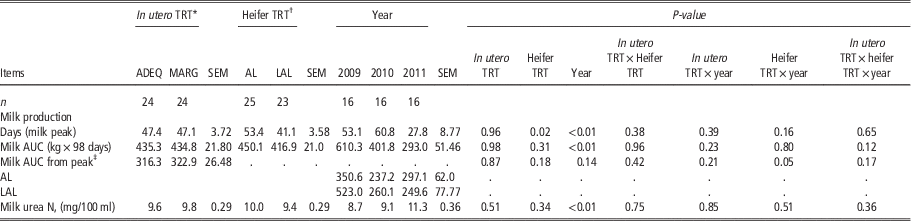
Days postpartum to peak milk production was affected (P=0.02) by post-weaning heifer development treatment (Table 2). Primiparous cows which received the post-weaning AL development treatment reached peak milk production ~12.3 days later (7.6 weeks postpartum), whereas heifers receiving the LAL post-weaning development treatment achieved peak lactation at ~5.9 weeks postpartum. Interval to peak milk yield has been shown to range from 3 to 7 weeks postpartum in beef cows depending on ecophysiological environment, season of calving and nutritional environment (Wood, Reference Wood1972; Totusek et al., Reference Totusek, Arnett, Holland and Whiteman1973; Grings et al., Reference Grings, Roberts, Geary and MacNeil2008). The 12.3 days less to peak milk production in primiparous cows developed on reduced heifer development diets may partially be explained by reduced BW postpartum in cows developed on the LAL treatment (361 v. 336±5.3 kg for AL and LAL, respectively). In the present study, it is not possible to differentiate whether the decreased BW postpartum was a carry-over effect of LAL during heifer development or the MARG diet that primiparous cows consumed just before their first parturition that resulted in the 12.3 day delay to peak milk yield.
Least square means for milk yield and constituents on in utero nutrition (cow) and post-weaning heifer development (heifer) over an 18-week period

ADEQ=adequate; TRT=treatment; MARG=marginal; AL=ad libitum; LAL=less than ad libitum; AUC=area under curve.
* Cows whom received in utero nutrition of ADEQ (1.8 kg/day) or MARG (1.2 kg/day) levels of winter supplement.
† Comparison of heifers fed ad libitum or 80% of ad libitum fed (LAL; adjusted to a common BW) for 140-day post weaning and fed the equivalent of either 1.8 kg/day (AL) or 1.2 kg/day (LAL) supplement during the winter preceding calving.
‡ Milk AUC from peak=kg×number of days from peak to last milking.
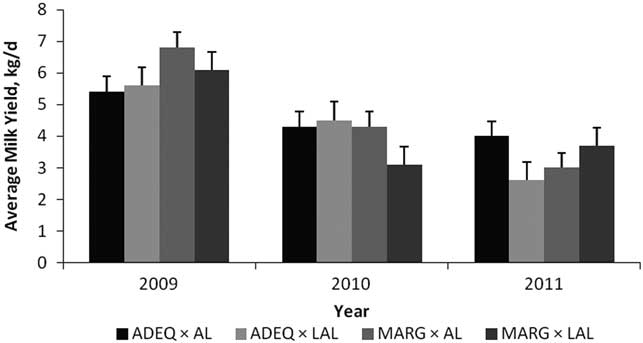
Effects of in utero nutrition and post-weaning heifer development treatment for total milk area under curve (AUC) were not different (P⩾0.31). However, when milk AUC from peak milk production to final milk measure collected in this study, a post-weaning heifer development treatment by year effect (P=0.05) was observed. Thus, indicating that primiparous cows that received the post-weaning LAL development treatment had greater milk yield in the first 2 years from peak to final milking and lower milk yield the last year compared with AL developed heifers. Looking at precipitation patterns across the years (Figure 1), milk yield from peak to final milking decreased as precipitation increased and in year 3 when precipitation was the greatest during the lactation period heifers developed on LAL produced the least amount of milk. This indicates that primiparous cows developed on LAL may be more susceptible to changes in environmental conditions than their primiparous cohorts developed on AL.
However, no differences (P=0.79) for milk persistency measures from peak milk to final milking were measured for in utero nutrition (82.2 v. 81.0±2.94%for ADEQ and MARG, respectively) or post-weaning heifer development treatment (P=0.31; 79.5 v. 83.7±2.84% for AL and LAL, respectively).
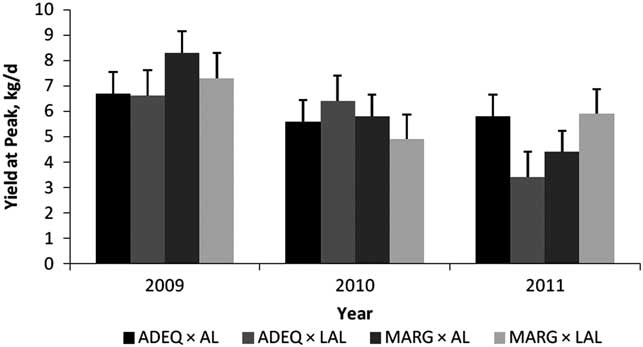
An in utero nutrition×post-weaning heifer development treatment×year interaction existed for peak milk yield (P=0.01; Figure 2). This interaction resulted from changes in rank across years. Primiparous cows that received ADEQ in utero nutrition and developed on AL had the least variability in peak milk yield across the 3 years of the study (5.6 to 6.7 kg/day) whereas ADEQ×LAL had the lowest peak yield the 1st and last year and the highest in the 2nd year (3.4 to 6.6 kg/day). Primiparous cows that received MARG in utero nutrition and developed on AL had the highest peak yield in year 1 and linearly declined (8.3 to 4.4, kg/day) in subsequent years. Lastly, primiparous cows that received MARG in utero nutrition and developed on LAL had the second highest peak milk yield in the 1st year of the study, the lowest peak yield in year 2 and the highest peak yield the final year of the study (7.3, 4.9 and 5.9 kg/day, respectively).
Yield at peak (kg/day; mean±SEM) for a in utero nutrition (adequate (ADEQ) or marginal (MARG) winter supplementation consisting of alfalfa hay (1.8 or 1.2 kg/day) for 80 days before parturition)×post-weaning heifer development treatment (either ad libitum (AL) or 80% of ad libitum (less than ad libitum (LAL)) feed availability for a 140-day development period)×year (2009–11) interaction (P=0.01).

In utero and post-weaning heifer development milk constituents
No changes in milk urea N were measured for in utero nutrition (P=0.51) or post-weaning heifer development treatment (P=0.34; Table 2).
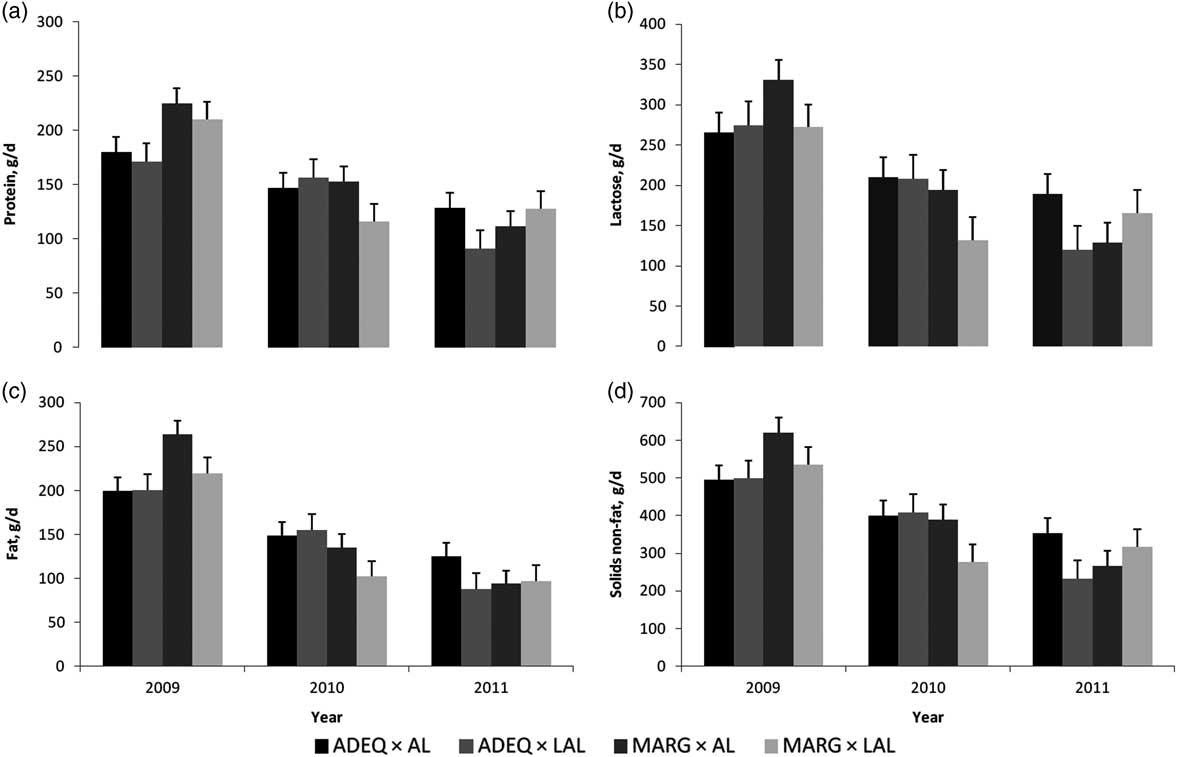
Average daily yields of milk constituents (protein, lactose, fat, solids non-fat, g/day) exhibited an in utero nutrition×post-weaning heifer development treatment×year interaction for peak milk yield (P⩽0.04; Figures 3 and 4). As would be expected, milk constituent yields followed similar trends to average daily and peak milk yield. In general, average daily yield and yields of constituents declined from year 1 to year 3 coincident with the amount of precipitation (Figure 1). As precipitation increased from year 1 to year 3, milk and nutrient constituents’ yields decreased. Primiparous cows reared in utero on the ADEQ and subsequently receiving post-weaning heifer development treatment of AL were least responsive to environmental changes across years. However, in certain years cows managed in this manner may not produce as much milk and supply as much nutritional constituents. Furthermore, primiparous cows subjected to the ADEQ treatment while they were in utero and subsequently to LAL treatment during their post-weaning development may be the more susceptible to changes in environmental conditions.
Average milk yield (kg/day; mean±SEM) for a in utero nutrition (adequate (ADEQ) or marginal (MARG) winter supplementation consisting of alfalfa hay (1.8 or 1.2 kg/day) for 80 days before parturition)×post-weaning heifer development treatment (either ad libitum (AL) or 80% of ad libitum (less than ad libitum (LAL)) feed availability for a 140-day development period)×year (2009–11) interaction (P=0.01).

Average milk constituent yield (g/day; mean±SEM) for in utero nutrition (adequate (ADEQ) or marginal (MARG) winter supplementation consisting of alfalfa hay (1.8 or 1.2 kg/day, respectively) for 80 days before parturition)×post-weaning heifer development treatment (either ad libitum (AL) or 80% of ad libitum (less than ad libitum (LAL)) feed availability for a 140-day development period)×year (2009–11) interaction for (a) protein: P=0.01, (b) lactose: P=0.01), (c) fat: P=0.04 and (d) solids non-fat: P=0.01.

Appropriate post-weaning pre-pubertal development depends on heifers obtaining an adequate BW before breeding. However, there is great latitude in how this can be achieved (Clanton et al., Reference Clanton, Jones and England1983). Development of heifers at an increased rate of gain post weaning can lead to low pregnancy rates (Ferrell, Reference Ferrell1982) and impaired milk production (Hixon et al., Reference Hixon, Fahey, Kesler and Neumann1982; Sejrsen and Foldager, Reference Sejrsen and Foldager1992; Sejrsen et al., Reference Sejrsen, Purup, Vestergaard and Foldager2000). However, Endecott et al. (Reference Endecott, Funston, Mulliniks and Roberts2013) suggests changes in mature BW have occurred over the decades and the recommendation for heifer target BW before breeding of 60% to 65% of mature weight may be different today than when first reported. Recent studies have shown that developing heifers to a lighter targeted BW of 50% to 57% allowed for reductions in heifer development costs and acceptable reproductive performance (Roberts et al., Reference Roberts, Geary, Grings, Waterman and MacNeil2009a; Mulliniks et al., Reference Mulliniks, Hawkins, Kane, Cox, Torell, Scholljegerdes and Petersen2013; Waterman et al., Reference Waterman, Roberts, Geary, Grings, Alexander and MacNeil2014). The question then arises; how is first parity lactation impacted by this change in growth curve of heifers developed at BW <60% of mature BW? In the present study, differences in total milk yield were not observed as a consequence of how heifers were reared after weaning or by in utero nutritional management during gestation. However, nutritional environment in which heifers were reared (year) was a major contributor to variation in total milk yield. In years, when precipitation was highest during the onset of lactation, milk yield was the lowest. This same response to year was evident in the number of days to reach peak milk yield where peak milk yield occurred earlier in the wettest year.
In conclusion, an in utero nutrition effect, implemented during the last 80 days of gestation was not observed for subsequent first lactation milk production in primiparous beef cows. Furthermore, the designed 20% reduction in harvested feed input during post-weaning development (on a common BW basis) ultimately accounted for a 27% decrease in overall feed input to heifers receiving LAL. This measured decrease in feed input for LAL heifers contributed to an earlier peak in milk production. Thus, no detrimental effects in first parity milk yield due to reduction in feed nutrient inputs during in utero or post-weaning heifer development were detected.
Acknowledgements
USDA-ARS is an equal opportunity/affirmative action employer and all agency services are available without discrimination. Mention of a proprietary product does not constitute a guarantee or warranty of the product by USDA or the authors and does not imply its approval to the exclusion of other products that may be also suitable. The authors gratefully acknowledge Susan Reil, Whisper Kelly, Valarie Ujazdowski, Lindsey Cook, R. J. Hubbard, Dennis Logan, Tom Mott and Brad Eik for their technical assistance.