





Introduction
In 2025, Italy remained under the leadership of Prime Minister Giorgia Meloni, whose right-wing majority stayed in office throughout the year. The governing coalition continued to rest on the three main centre-right parties, namely Fratelli d’Italia (FDI, Brothers of Italy), Lega Salvini Premier (LSP, League Salvini Premier), and Forza Italia (FI, GO Italy), and no major cabinet reshuffle altered the government’s overall composition. Following the 2024 European Parliament elections, in which FDI emerged as the largest Italian party, 2025 confirmed the unusual durability of the Meloni executive in a country historically marked by cabinet instability. Recent scholarship has in fact described the government as a ‘deviant case’ in the Italian context, explaining its longevity through the combination of favourable coalition dynamics, sustained public support, fragmented opposition, and the weakness of viable alternatives (Improta Reference Improta2026).
In this respect, the campo largo (broad alliance) project,Footnote 1 namely, the attempt to construct a broader opposition alliance around the Partito Democratico (PD, Democratic Party), Alleanza Verdi e Sinistra (AVS, Greens and Left Alliance) and Movimento 5 Stelle (M5S, Five Star Movement), remained unstable throughout 2025, marked by recurring tensions between PD and M5S over leadership and programmatic priorities. Although cooperation among opposition forces became more visible in some regional contests and in the referendum campaign, it did not yet crystallise into a fully coherent and credible governing alternative. Moreover, figures also suggest that support for the government remained comparatively robust over the course of 2025, with Meloni and FDI maintaining relatively high levels of approval and voting intention throughout the year. Although support showed some fluctuations, it did not undergo a sharp or sustained collapse.Footnote 2
The main electoral contests of 2025 left the government’s stability largely unaffected. An abrogative referendum held on 8–9 June, covering citizenship and labour issues, represented a significant attempt by the opposition to challenge the government, but failed to reach the required turnout quorum. Regional elections held across several regions during the year did not produce a clear shift in the balance of power. At the same time, the government continued to pursue its main institutional reform agenda, confirming the continuity of its political priorities.
However, 2025 was not a politically quiet year. Beneath the surface of executive stability and a strong reform agenda, the government faced growing political pressure and institutional conflict. On the one hand, growing tensions between the executive and the judiciary became an important dimension of the political landscape. Disputes over migration policy, most notably the government’s use of detention centres in Albania, and over the handling of the Almasri case generated repeated clashes between government ministers and the courts. These tensions reflected a structural antagonism that the government itself sought to politicise as part of its reform agenda, most visibly through the constitutional reform of justice.
On the other hand, demonstrations linked to Gaza took place in several cities in September and October, including major marches in Rome, clashes with police in Milan, and port blockades organised by dockworkers protesting Italy’s position and broader Western support for Israel. These mobilisations did not threaten the government’s parliamentary survival, but they represented the clearest expression of social conflict in Italy during the year.
Overall, Italy in 2025 was politically stable at the top but conflictual underneath: Meloni’s government remained firmly in office, retained comparatively solid public support, and weathered both the June referendum and the regional elections without major damage; yet this stability coexisted with intense institutional conflict and political pressure.
Election report
Regional elections
Regional elections were held in seven regions in 2025 and largely confirmed existing political alignments, with limited alternation in power. The centre-right retained control in Marche, Calabria, and Veneto, while the centre-left remained dominant in Tuscany, Campania, and Puglia. Valle d’Aosta followed its distinct autonomist logic.
In Marche and Tuscany, incumbents were comfortably re-elected, with Francesco Acquaroli (FDI) and Eugenio Giani (PD) both securing clear majorities against broad opposing coalitions. Calabria followed a similar pattern, although the election was triggered early by the resignation of incumbent Roberto Occhiuto in the context of an investigation concerning alleged corruption in projects in the region, who nonetheless returned to office with a solid margin.
The November elections further reinforced continuity. In Campania and Puglia, the centre-left achieved decisive victories. In Campania, Roberto Fico (former President of the Chamber of Deputies) won the presidency, marking a generational transition within the regional centre-left after the long incumbency of Vincenzo De Luca. In Puglia, Antonio Decaro (former Mayor of Bari and Member of the European Parliament) succeeded Michele Emiliano, confirming the region as a centre-left stronghold. Both candidates won by wide margins. In Veneto, the centre-right maintained its stronghold, with Alberto Stefani (LSP) elected with over 60 % of the vote.
Unlike the ordinary-statute regions, Valle d’Aosta elects the regional council, and the president is then chosen by the council, not directly by voters. In this region, the autonomist party Union Valdôtaine emerged as the leading force, and Renzo Testolin was subsequently confirmed as President in November.
Referendum
The June 2025 referendum was the most important national political event in Italy during the year. It consisted of five abrogative referendum questions under Article 75 of the Constitution, and voting took place on 8–9 June 2025. The five questions concerned labour law and citizenship: four dealt with dismissals, fixed-term contracts, and workplace safety, while the fifth concerned the reduction of the residence requirement for naturalisation from ten to five years.
The referendum brought together two partially distinct agendas. The four labour-law questions were primarily promoted by CGIL and sought to reverse parts of the Jobs Act, the labour-market reform enacted under Matteo Renzi’s centre-left government in 2014–2015. The citizenship question was promoted by a referendum committee led by +Europa, with its secretary Riccardo Magi playing a central role as promoter. Its supporters argued that Italy’s citizenship regime had become excessively restrictive in light of the country’s social and demographic transformation.
In political terms, the referendum became a test of strength between the opposition and the Meloni government. Opposition parties, trade unions, and civil-society organisations attempted to use the vote to mobilise discontent on social rights, precarious work, and citizenship reform. By contrast, the governing majority adopted a strategy centred largely on demobilisation, encouraging abstention rather than direct engagement with the merits of the questions. This strategy was particularly consequential because, under Italian law, abrogative referendums are valid only if turnout reaches 50 % plus one of eligible voters.
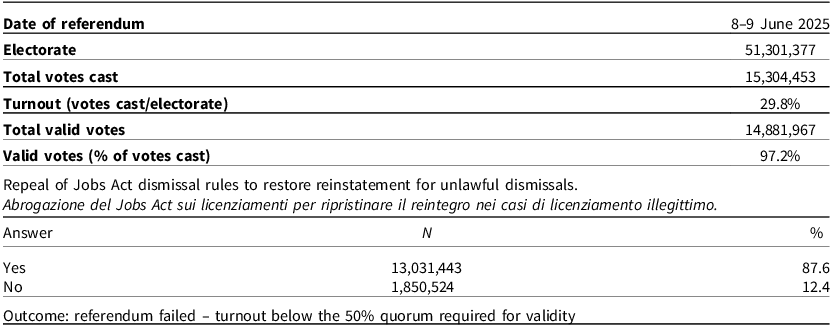
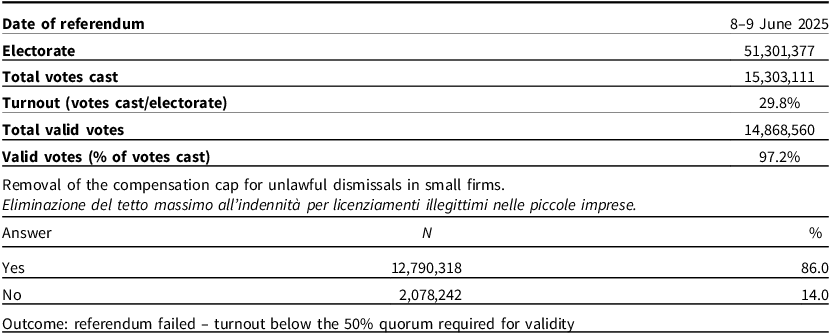
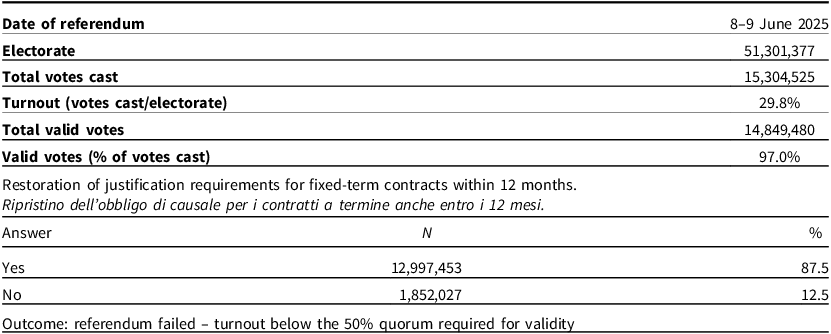
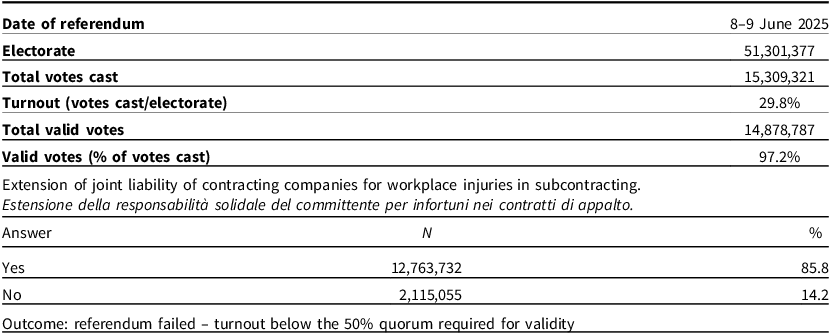
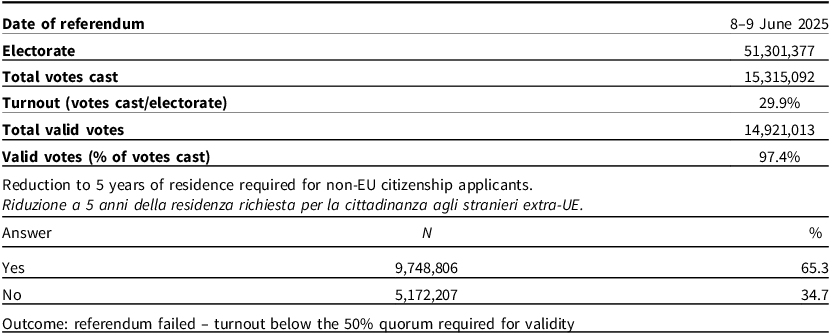
The referendum failed because turnout reached only 29.83 %, well below the quorum required for validity. Among those who voted, the four labour-law questions all received very high levels of support for the Yes option, at around 86–88 %, while the citizenship question also received majority support for repeal, though by a lower margin (65.3 % Yes), indicating that it was more politically divisive and contested than the labour questions. This result was particularly noteworthy in a referendum setting where opponents of repeal could help defeat the proposal through abstention: the fact that 34.7 % of participating voters chose No suggests the presence of a deliberate and non-negligible counter-mobilisation on citizenship. The detailed results of the five referendum questions are presented in Tables 1–5.
Results of the referendum on the repeal of the Jobs Act dismissal rules (increasing protection contract) in Italy in 2025

Table 1. Long description
The table presents the results of a referendum held in Italy on 8-9 June 2025, focusing on the repeal of the Jobs Act dismissal rules. It includes details such as the electorate, total votes cast, turnout percentage, total valid votes, and the percentage of valid votes. The table also shows the results for the specific referendum question on the repeal of the Jobs Act dismissal rules, with columns for the number of Yes and No votes and their respective percentages. The outcome indicates that the referendum failed due to turnout being below the 50 percent quorum required for validity.
Note: 1. Full legal text of the referendum question available from the Italian Ministry of the Interior.
Source: Italian Ministry of the Interior (2026) (https://elezioni.interno.gov.it/).
Results of the referendum on removing the compensation cap for unlawful dismissals in small firms in Italy in 2025

Table 2. Long description
A table summarizing the results of a referendum on removing the compensation cap for unlawful dismissals in small firms in Italy in 2025. The table has 10 rows and 3 columns. Row 1: Date of referendum, 8-9 June 2025. Row 2: Electorate, 51,301,377. Row 3: Total votes cast, 15,303,111. Row 4: Turnout (votes cast/electorate), 29.8 percent. Row 5: Total valid votes, 14,868,560. Row 6: Valid votes (% of votes cast), 97.2 percent. Row 7: Removal of the compensation cap for unlawful dismissals in small firms. Row 8: Answer, Yes, 12,790,318, 86.0 percent. Row 9: Answer, No, 2,078,242, 14.0 percent. Row 10: Outcome, referendum failed turnout below the 50 percent quorum required for validity.
Note: 1. Full legal text of the referendum question available from the Italian Ministry of the Interior.
Source: Italian Ministry of the Interior (2026) (https://elezioni.interno.gov.it/).
Results of the referendum on justification requirements for fixed-term contracts in Italy in 2025

Table 3. Long description
The table presents the results of a referendum held in Italy on June 8-9, 2025, regarding the restoration of justification requirements for fixed-term contracts within 12 months. The table has 10 rows and 2 columns. Row 1: Date of referendum, 8-9 June 2025. Row 2: Electorate, 51,301,377. Row 3: Total votes cast, 15,304,525. Row 4: Turnout (votes cast/electorate), 29.8 percent. Row 5: Total valid votes, 14,849,480. Row 6: Valid votes (% of votes cast), 97.0 percent. Row 7: Restoration of justification requirements for fixed-term contracts within 12 months. Row 8: Answer, Yes, 12,997,453, 87.5 percent. Row 9: Answer, No, 1,852,027, 12.5 percent. Row 10: Outcome, referendum failed turnout below the 50 percent quorum required for validity.
Note: 1. Full legal text of the referendum question available from the Italian Ministry of the Interior.
Source: Italian Ministry of the Interior (2026) (https://elezioni.interno.gov.it/).
Results of the referendum on joint liability for workplace injuries in subcontracting in Italy in 2025

Table 4. Long description
A table summarizing the results of a referendum on joint liability for workplace injuries in subcontracting in Italy in 2025. The table has 10 rows and 4 columns. Row 1: Date of referendum, 8-9 June 2025. Row 2: Electorate, 51,301,377. Row 3: Total votes cast, 15,309,321. Row 4: Turnout (votes cast/electorate), 29.8 percent. Row 5: Total valid votes, 14,878,787. Row 6: Valid votes (% of votes cast), 97.2 percent. Row 7: Extension of joint liability of contracting companies for workplace injuries in subcontracting. Row 8: Answer, Yes, 12,763,732, 85.8 percent. Row 9: Answer, No, 2,115,055, 14.2 percent. Row 10: Outcome, referendum failed turnout below the 50 percent quorum required for validity.
Note: 1. Full legal text of the referendum question available from the Italian Ministry of the Interior.
Source: Italian Ministry of the Interior (2026) (https://elezioni.interno.gov.it/).
Results of the referendum on reducing the residence requirement for Italian citizenship in Italy in 2025

Table 5. Long description
The table presents the results of a referendum held on 8-9 June 2025 regarding the reduction of the residence requirement for non-EU citizenship applicants in Italy. The table has 8 rows and 2 columns. Row 1: Date of referendum, 8-9 June 2025. Row 2: Electorate, 51,301,377. Row 3: Total votes cast, 15,315,092. Row 4: Turnout (votes cast/electorate), 29.9 percent. Row 5: Total valid votes, 14,921,013. Row 6: Valid votes (percent of votes cast), 97.4 percent. Row 7: Answer - Reduction to 5 years of residence required for non-EU citizenship applicants, Yes 9,748,806 (65.3 percent), No 5,172,207 (34.7 percent). Row 8: Outcome, referendum failed - turnout below the 50 percent quorum required for validity.
Note: 1. Full legal text of the referendum question available from the Italian Ministry of the Interior.
Source: Italian Ministry of the Interior (2026) (https://elezioni.interno.gov.it/).
Substantively, the referendum represented the opposition’s most significant attempt to turn social and citizenship issues into a broader political challenge to the government. However, despite cooperation among left-wing parties, trade unions, and civil-society actors, the results pointed to the limits of the still fragile campo largo and, more broadly, to an asymmetrical pattern of competition in which the centre-right remained cohesive and electorally robust, while the opposition continued to struggle with coordination and mobilisation (Gallina and Biancalana Reference Gallina and Biancalana2025).
Cabinet report
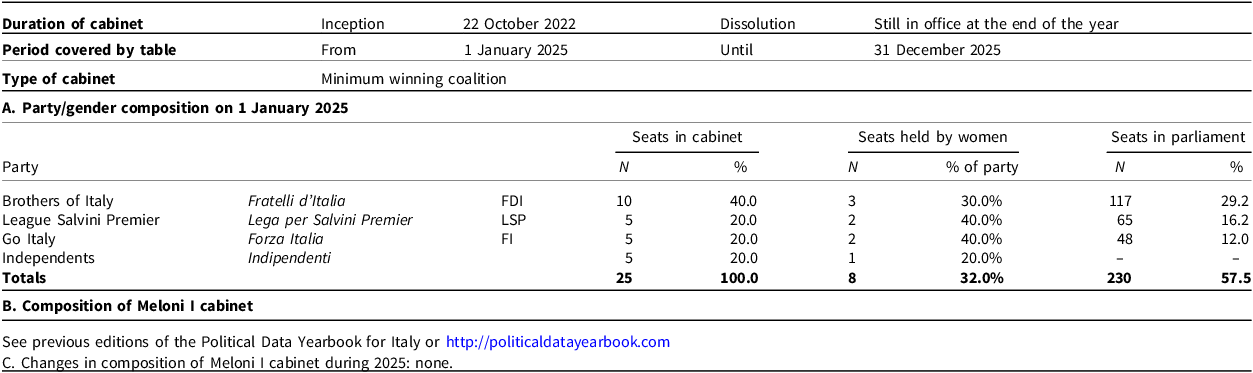
No major cabinet reshuffle occurred in 2025 (cabinet composition of Meloni’s government in 2025 is shown in Table 6). Some adjustments took place at sub-cabinet level, but the ministerial structure of the Meloni government remained essentially unchanged. The cabinet continued to consist of 10 ministers from Fratelli d’Italia (FDI), 5 from Lega per Salvini Premier (LSP), 5 from Forza Italia (FI), and 5 independents. Women remained underrepresented across the cabinet as a whole.
Cabinet composition of Meloni I in Italy

Table 6. Long description
The table provides details on the composition of Meloni I cabinet in Italy for the year 2025. It includes information on the duration of the cabinet, its inception, dissolution, and the type of cabinet. The table is divided into sections: A. Party/gender composition on 1 January 2025 and B. Composition of Meloni I cabinet. Section A lists parties, their seats in the cabinet, seats held by women, and seats in parliament. Parties include Brothers of Italy, League Salvini Premier, Go Italy, and Independents. Section B mentions that there were no changes in the composition of Meloni I cabinet during 2025. The table has 7 rows and 8 columns, with headers such as Party, Seats in cabinet, Seats held by women, and Seats in parliament.
Source: Italian government (https://www.governo.it/it).
Parliament report
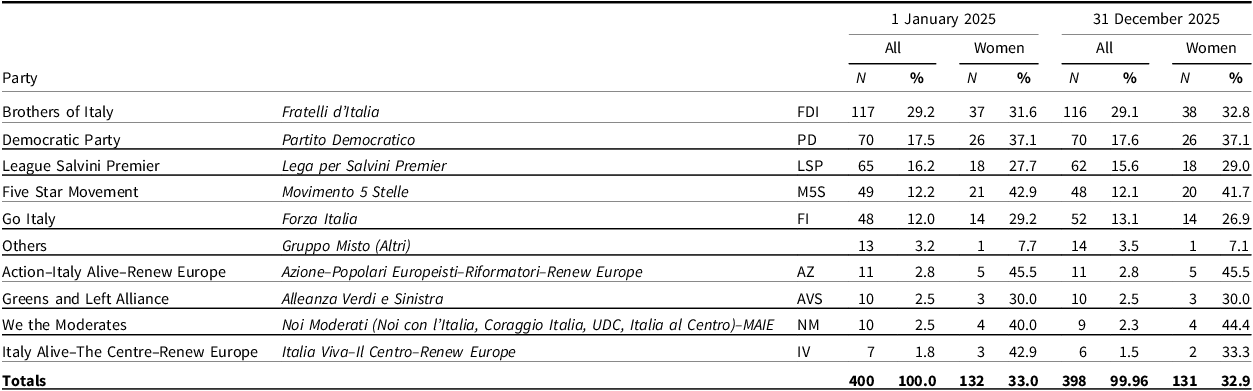
The parliamentary balance of power remained broadly unchanged in 2025. Table 7 shows the composition of the Chamber of Deputies. Fratelli d’Italia (FDI) continued to be the largest party, holding around 29 % of seats, followed by the Partito Democratico (PD), Lega per Salvini Premier (LSP), and Movimento 5 Stelle (M5S). Minor variations in seat shares are observable across the year, but these reflect limited individual changes in group membership rather than broader political realignment.
Party and gender composition of the lower house of the Parliament (Camera dei Deputati) in Italy in 2025

Table 7. Long description
The table presents the party and gender composition of the lower house of the Parliament (Camera dei Deputati) in Italy for the year 2025. It includes data for two specific dates: January 1 and December 31. The table has 13 rows and 8 columns. The columns are labeled as follows: Party, All N, All %, Women N, Women %, All N, All %, Women N, and Women %. The rows list different political parties and their respective seat distributions. Row 1: Brothers of Italy, FDI, 117, 29.2, 37, 31.6, 116, 29.1, 38, 32.8. Row 2: Democratic Party, PD, 70, 17.5, 26, 37.1, 70, 17.6, 26, 37.1. Row 3: League Salvini Premier, LSP, 65, 16.2, 18, 27.7, 62, 15.6, 18, 29.0. Row 4: Five Star Movement, M5S, 49, 12.2, 21, 42.9, 48, 12.1, 20, 41.7. Row 5: Go Italy, FI, 48, 12.0, 14, 29.2, 52, 13.1, 14, 26.9. Row 6: Others, Gruppo Misto (Altri), 13, 3.2, 4, 30.8, 14, 3.5, 5, 35.7. Row 7: Action-Italy Alive-Renew Europe, AZ, 11, 2.8, 5, 45.5, 11, 2.8, 5, 45.5. Row 8: Greens and Left Alliance, AVS, 10, 2.5, 3, 30.0, 10, 2.5, 3, 30.0. Row 9: We the Moderates, NM, 10, 2.5, 4, 40.0, 9, 2.3, 4, 44.4. Row 10: Italy Alive-The Centre-Renew Europe, IV, 7, 1.8, 3, 42.9, 6, 1.5, 2, 33.3. Row 11: Totals, 400, 100.0, 132, 33.0, 398, 99.96, 131, 32.9.
Note: 1. The total number of deputies at the end of the year differs from the beginning of the year due to two resignations that were not followed by replacement before 31 December 2025.
Source: Camera dei Deputati (2025) (https://storia.camera.it).
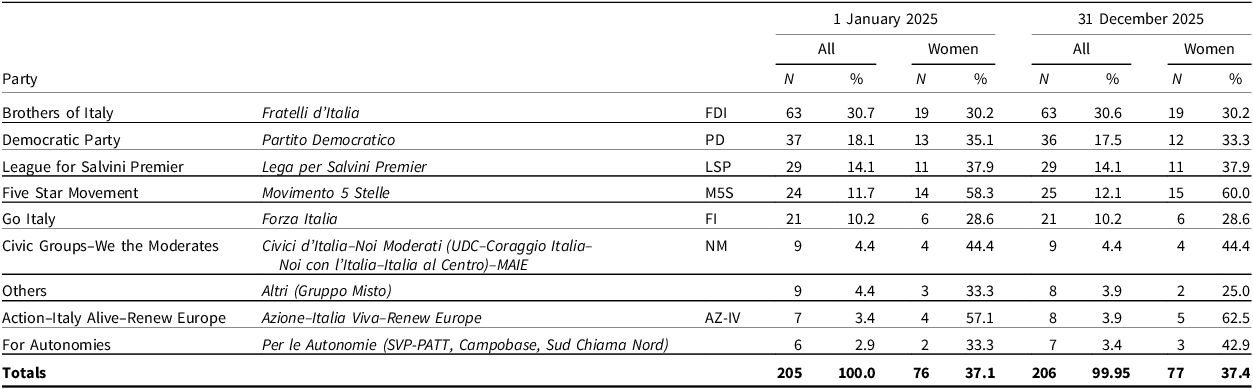
Table 8 shows a similarly stable pattern in the Senate. Fratelli d’Italia (FDI) remained the largest party, with just over 30 % of seats, followed by the Partito Democratico (PD), Lega per Salvini Premier (LSP), and Movimento 5 Stelle (M5S). As in the Chamber, only minor changes in seat distribution occurred during the year, indicating limited individual mobility rather than any significant reshuffle of parliamentary forces.
Party and gender composition of the upper house of the Parliament (Senato) in Italy in 2025

Table 8. Long description
The table presents the party and gender composition of the upper house of the Parliament in Italy for the year 2025. It includes data for two dates: 1 January 2025 and 31 December 2025. The table has 10 rows and 10 columns. The columns are labeled as follows: Party, All N, All %, Women N, Women %, All N, All %, Women N, Women %. The rows list different political parties and their respective data. Row 1: Brothers of Italy (Fratelli d’Italia), 63, 30.7, 19, 30.2, 63, 30.6, 19, 30.2. Row 2: Democratic Party (Partito Democratico), 37, 18.1, 13, 35.1, 36, 17.5, 12, 33.3. Row 3: League for Salvini Premier (Lega per Salvini Premier), 29, 14.1, 11, 37.9, 29, 14.1, 11, 37.9. Row 4: Five Star Movement (Movimento 5 Stelle), 24, 11.7, 14, 58.3, 25, 12.1, 15, 60.0. Row 5: Go Italy (Forza Italia), 21, 10.2, 6, 28.6, 21, 10.2, 6, 28.6. Row 6: Civic Groups-We the Moderates (Civici d’Italia-Noi Moderati (UDC-Coraggio Italia-Noi con l’Italia-Italia al Centro)-MAIE), 9, 4.4, 4, 44.4, 9, 4.4, 4, 44.4. Row 7: Others (Altri (Gruppo Misto)), 9, 4.4, 3, 33.3, 8, 3.9, 3, 37.5. Row 8: Action-Italy Alive-Renew Europe (Azioni-Italia Viva-Renew Europe), 7, 3.4, 4, 57.1, 7, 3.4, 4, 57.1. Row 9: For Autonomies (Per le Autonomie (SVP-PATT, Campobase, Sud Chiama Nord)), 6, 2.9, 2, 33.3, 6, 2.9, 2, 33.3. Row 10: Totals, 205, 100.0, 76, 37.1, 206, 99.95, 77, 37.4.
Note: 1. The total number of senators changed after Senator Francesco Castiello passed away on 31 December 2024 and was replaced by Felicia Gaudiano, who took office on 8 January 2025.
Source: Senato della Repubblica (2025) (https://www.senato.it).
In both chambers, gender representation remained uneven, with women generally underrepresented, although some parties, particularly Movimento 5 Stelle, showed comparatively higher female representation.
Political party report
No major party-level organisational changes occurred in 2025. The leadership of the principal parties remained unchanged, and there were no major splits or mergers among the main parliamentary forces. One notable internal development was the April 2025 congress of Lega per Salvini Premier (LSP), which confirmed Matteo Salvini in office and therefore reinforced the existing party leadership structure.
Institutional change report
No major institutional change was completed in 2025. Nevertheless, institutional politics continued to be shaped by three major reform tracks, each associated with one of the three parties that make up the governing coalition. First, the proposed premierato reform (mainly promoted by FDI), introducing the direct election of the Prime Minister and revising key provisions of the parliamentary form of government, remained under parliamentary examination and had not been enacted by the end of the year. The constitutional bill had already passed a first reading in the Senate in 2024, and examination continued in the Chamber in 2025, but the reform did not complete the constitutional amendment procedure.
Second, the process linked to differentiated regional autonomy (autonomia differenziata, mainly promoted by LSP) continued, but in a legally and politically constrained form. After the Constitutional Court’s 2024 ruling had struck down several parts of Law No. 86/2024 and substantially reduced its scope, the Court declared in January 2025 that the proposed abrogative referendum on the law was inadmissible. Differentiated autonomy remained on the government’s agenda in 2025, but its implementation became more uncertain after judicial intervention restricted important parts of the reform.
Third, the government advanced the constitutional reform of justice, of which the separation of judicial careers (separazione delle carriere) was one central component (mainly promoted by FI). The reform sought to separate the career paths of judges and prosecutors and to reshape the governance of the judiciary. In particular, it had implications for the structure and role of the High Council of the Judiciary (CSM, the self-governing body of the judiciary), envisaged separate self-governing bodies for judges and prosecutors and introduced a new High Disciplinary Court. This reform was advanced in a context of sharp institutional conflict. The Associazione Nazionale Magistrati (ANM), the main representative body of the Italian judiciary, openly opposed the reform throughout the year, arguing that it would weaken judicial independence, reduce the autonomy of prosecutors, and undermine the institutional balance of judicial self-government. The ANM’s public stance contributed to framing the reform not merely as a technical reorganisation of the judiciary, but as a politically charged confrontation between the executive and the magistracy.
In 2025, the reform moved beyond general political debate and advanced decisively through parliament: after the Chamber’s first approval in January, the Senate approved the text in its second deliberation in October 2025. Because the bill was approved by an absolute majority but not by the two-thirds majority required to avoid a popular vote, it was left open to a confirmatory referendum, which was subsequently called for 2026. The reform therefore did not alter the institutional rules in force during 2025, but the year was crucial in bringing the proposal to the threshold of direct popular ratification.
Overall, even though the reforms were not completed, institutional change remained at the centre of political debate in 2025.
Issues in national politics
Italian national politics in 2025 was shaped by a combination of institutional conflict, migration policy, public-order politics, and the domestic repercussions of international crises. These issues were not entirely separate: together, they reflected a recurring pattern in which the Meloni government faced challenges from judicial authorities, from organised civil society, and from international developments. At the same time, the broader economic context did not appear to generate acute destabilising pressure on the government, as economic activity remained modest, employment broadly stable, and inflation relatively contained (Banca d’Italia 2025).
The year opened with the Almasri case, which quickly became one of the most politically sensitive controversies of 2025. In January, Italian police arrested a man called Osama Almasri Najim, a senior member of Libya’s judicial police, in Turin on the basis of an International Criminal Court warrant accusing him of crimes including murder, torture and rape committed in Libya. Two days later, however, he was released after the Rome Court of Appeal found procedural problems with the arrest. The government then repatriated him to Libya on an Italian state aircraft, with the Interior Ministry later justifying the decision by describing him as socially dangerous and ordering his expulsion on security grounds. The case quickly turned into a parliamentary and legal controversy. On 28 January, Meloni announced that she, Justice Minister Carlo Nordio, Interior Minister Matteo Piantedosi, and Undersecretary Alfredo Mantovano had been placed under investigation by Rome’s chief prosecutor, Francesco Lo Voi, following a complaint over the release and repatriation of Almasri. The government defended its conduct by invoking reasons of state security and procedural flaws in the arrest, while Meloni portrayed the case as part of a broader pattern of judicial hostility towards the executive. The Almasri episode was thus significant not only as a diplomatic and legal controversy, but as an early signal of the executive-judiciary conflict that would define much of the political year.
A second major issue that contributed to tensions between the executive and judicial authorities was migration policy, a central pillar of Meloni’s political agenda (Ambrosini Reference Ambrosini2025). One of the Meloni government’s signature policies to control irregular migration was the plan to use Italian-run centres in Albania to process or detain migrants outside Italian territory. Yet, from its implementation, the scheme was repeatedly obstructed by judicial rulings, as courts ordered migrants transferred to Albania to be brought back to Italy. In March, the government responded by trying to convert the largely unused Albanian facilities into repatriation centres for failed asylum seekers, and in August, the Court of Justice of the European Union ruled against Italy’s legal approach, significantly weakening the scheme. Meloni nevertheless insisted that the government would continue pursuing the project. Taken together, the Almasri case and the Albania scheme illustrated a broader structural antagonism between the executive and the judiciary that the government itself sought to politicise.
A third important issue was public order and the government’s security agenda, particularly through the Decreto Sicurezza adopted in April 2025. The decree formed part of the government’s wider law-and-order agenda and introduced tougher provisions on policing, protests, occupations, and sanctions linked to public disorder. Supporters of this decree presented it as a necessary strengthening of public security and state authority, while critics argued that it risked criminalising protest and expanding police powers too far. The decree thus fed a broader ideological divide over security, civil liberties, and the boundaries of legitimate dissent, a divide that would become more visible later in the year, when pro-Palestinian protests triggered clashes with police in several cities.
Finally, foreign policy had unusually strong domestic repercussions in 2025. In September and October, pro-Palestinian mobilisations in Italy developed into the most visible protest wave of the year: dockworkers attempted to block arms shipments, unions called strikes, demonstrations were held in several cities, and clashes with police occurred in places such as Milan and Naples. The Gaza flotilla crisis, linked to the attempt by a convoy of aid vessels to reach Gaza by sea and to the controversy following its interception, further intensified these tensions, turning the conflict into a domestic political issue linked to protest rights, the role of organised labour, and Italy’s broader international alignment. Furthermore, Meloni’s close relationship with Donald Trump strengthened her international profile. Her January visit to Florida, followed shortly afterwards by the release of Italian journalist Cecilia Sala from detention in Iran,Footnote 3 reinforced the perception that the Prime Minister was seeking to use her ties with the incoming US administration to enhance Italy’s diplomatic leverage. In a context of growing uncertainty in transatlantic relations, experts suggest that this positioning may also have increased Italy’s relevance within the European Union, as Rome could present itself as a relatively stable interlocutor between Washington and Europe (Alli Reference Alli2025).
Looking across the developments of 2025, they confirm and extend the interpretation advanced by Bull and Polverari (Reference Bull and Polverari2025: 130), who described the Meloni government as marking a ‘return to politics in the strict sense’ after years of technocratic and anti-elite governance. The conflicts examined in this section can be interpreted as expressions of an openly political style of governing that thrives on antagonism and converts institutional tension into a resource for political consolidation.
Data availability statement
The data for this article can be found at the PDY Interactive website: http://politicaldatayearbook.com
Competing interests
The authors declare none.
AI use statement
The authors used generative AI only for limited editorial assistance, including language refinement and stylistic revision. All substantive scholarly work, including the formulation of arguments, interpretation of evidence, and final approval of the manuscript, was carried out by the authors.

 Open access

