Background
Contraceptives are the strongest weapons against the rapidly increasing number of births in high fertility countries. To make people aware and make the contraceptive methods acceptable, different approaches are popularised in family planning programmes throughout the world. When modern contraceptives were not so popular, India relied on Gandhian principle of periodic continence. From initiation of the Indian Family Planning Programme (FPP), initially reliance was on Intra-Uterine Devices (IUD) which did not succeed in the long run due to side effects and lack of infrastructure for proper insertion, monitoring and counselling (Coale, Reference Coale1983). Indian government’s focus was on reducing fertility at a higher pace within a short period of time. Hence, policies emphasised more on female sterilisation which is permanent and largely a one-time intervention, rather than other reversible methods like oral pills which needs monitoring to maintain the continuity (Bacci, Reference Bacci2017).
Female Sterilisation Scenario in India
Among all methods, 98% of currently married women are familiar with sterilisation as an available family planning method (IIPS & Macro International, 2007; IIPS & ICF, 2017; IIPS & ICF, 2021). No other method ever crossed the 90% hurdle of popularity, as Indian FPP targeted low births through permanent methods of contraception (Srinivasan, Reference Srinivasan2006). Though in the early phase of the FPP, government mostly concentrated on male sterilisation to stabilize the population growth (Harkavy & Roy, Reference Harkavy, Roy, Robinson and Ross2007), since the early 1980s under the new agenda of voluntary acceptance, female sterilisation became more popular (Singh et al., Reference Singh, Singh and Singh2021) and high dependency on female sterilisation surpasses the promotion and utility of other modern contraceptives. Abolition of demographic targets of family planning in April 1996 along with recommendations of International Conference on Population and Development (ICPD), Cairo were largely responsible for this policy change in 1990s (Marriott & Sanchez, Reference Marriott and Sanchez1998). But this welfare approach was not successful as the budget allotted was not sufficient for Reproductive and Child Health (RCH) goals in India (Maharatna, Reference Maharatna2002). Even though forceful sterilisation of the Emergency period was highly criticised, in the current age of voluntary female sterilisation is widely popular. According to United Nations, India contributed 37% to total female sterilisation of the world in 2011. 4.5 million women are being sterilised every year. The gap between male and female sterilisation is also profound vis-à-vis their mean age. Mean age of sterilisation for Indian women is 27 years only which extends up to 34 years for men (Epari et al., Reference Epari, Patnaik, Prasad, Sahu, Soodireddy and Acharya2017). Since National Family Health Survey 1 (NFHS) (1992) the share of female sterilisation has gradually increased from 27.4% to 34.2%, 37.3%, 36.0% and 37.9 % for NFHS 2, 3,4 and 5 respectively. This shows an increasing trend of female sterilisation but the pace is getting slower; 6.8% increase between NFHS 1 & 2; 3.11% between NFHS 2 & 3, which reduced to -1.3% between NFHS 3 & 4 but increased 1.9% between NFHS 4 & 5, among currently married women. On the other hand, male sterilisation is negligible in comparison to female sterilisation. It accounts for only 3.31% in NFHS-1 (1992-93), and it gradually decreased over time from NFHS 1 to NFHS 5 (0.30%). An intriguing fact behind this scenario is that a major share of sterilised women (around 68%) were neither informed that this method of contraception is permanent and irreversible nor about the side effects (Singh et al., Reference Singh, Singh and Singh2021). This dearth of knowledge causes regrets especially among young women who got sterilised before reaching their ideal family size or devoid of a male child (Singh et al, Reference Singh, Ogollah, Ram and Pallikadavath2012).
Even with this high prevalence of female sterilisation the facilities especially in governmental sectors, which accounts for more than 80% of the female sterilisation in India, has poor infrastructure and women’s health and sanitation is least prioritise. Guideline restricts the number of sterilisations up to 30 in a day per doctor but horrifying news reports such as a case from Bilaspur, Chhattisgarh where a surgeon performed 83 sterilisations in less than half of a day are not uncommon (Sharma, Reference Sharma2014). Studies also revealed that marginalised women of the society are targeted for forced and coerced sterilisation (Patel, Reference Patel2017). Provision of incentive as a method of popularising female sterilisation makes women belonging to the lowest wealth quintile, uneducated, of higher parity and less exposed to media, more vulnerable to forced sterilisation violating the basic goal of quality of care in FPP (Singh et al., Reference Singh, Singh and Singh2021) which also contributes the most in causing sterilisation regret (Bansal & Dwivedi, Reference Bansal and Dwivedi2020).
Contraceptive Information and Decision
Quality of available information is the major cause behind voluntary choice of irreversible method and unmet need of other available spacing methods. Several misconceptions as well as myths restrict the acceptance of temporary methods over sterilisation which increases the inequality in exposure to family planning methods (Mohanty et al., Reference Mohanty, Mishra, Chatterjee and Saggurti2020). So, women receiving better quality of care are more likely to adopt a temporary method, compared to those who received low service in terms of quality in many Asian countries (Koenig et al., Reference Koenig, Hossain and Whittaker1997; RamaRao et al., Reference RamaRao, Lacuesta, Costello, Pangolibay and Jones2003). Inter-personal relations between providers and users of contraceptives sometimes help to pass quality information before choosing any method which has direct relation to increase in contraceptive prevalence rate (Tumlinson et al., Reference Tumlinson, Pence, Curtis, Marshall and Speizer2015). In Indian scenario the availability of contraceptive information highly depends on marital status as well, when currently married women aged 15-24 receives required information, they are likely to choose temporary spacing method over sterilisation (Pradhan et al., Reference Pradhan, Patel and Saraf2020). From NFHS-3 and NFHS-4 it was reported that, only 16% and 31% of women respectively received full information about contraceptive methods they were currently using (Rana & Jain, Reference Rana and Jain2020). Similarly due to poor quality and non-systematic way of information provided, the contraceptive prevalence rate dropped from 2005 to 2015, even if the level of information increased (IIPS & Macro International, 2007; IIPS & ICF, 2017). Exposure to different mass media controls the accessibility of knowledge regarding available contraceptive methods to a large extent. It can also maintain the chain of information to reduce the percentage of discontinuation in case of temporary spacing method (Ghosh et al, Reference Ghosh, Mozumdar, Chattopadhyay and Acharya2021). Thus, India’s ‘Family Planning Vision 2020’ focused more on quality of services in the case of sterilisation and this quality information can mainly be achieved via mass media exposure and interpersonal counselling as declared by the report (Government of India, 2014). The decision-making power and gender of the decision maker influences the choice of contraception. Though level of female empowerment varies widely across the states in India, the participation of women in decision making for the choice of contraception increased both in terms of joint consent and single decision from 2005-06 to 2019-21. Economic independence of women also ensures women’s participation in choice of contraceptive method (Reed et al., Reference Reed, Donta, Dasgupta, Ghule, Battala, Nair, Silverman, Jadhav, Palaye, Saggurti and Raj2016).
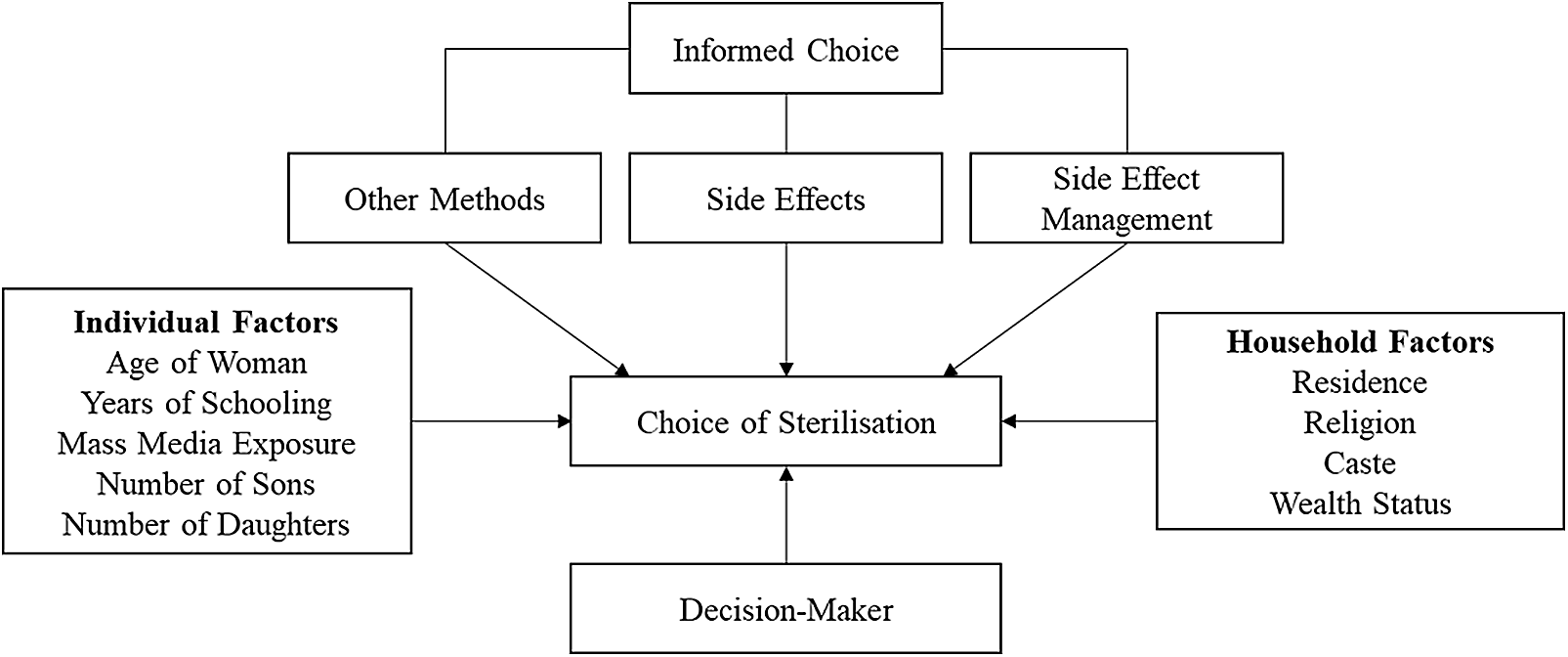
Existing literature mostly focused on the level of information of various contraceptive users and how this level of information is controlled by other socio-economic factors. The information regarding contraceptive methods is provided prior to the use of any method. How information provided, controls the choice of contraceptive methods is not addressed in existing studies. Thus, how this level of information is affecting the choice of sterilisation is the central theme of this study. The choice of contraception is also affected by the decision maker, whether it is the woman or her husband or it is a joint decision. So, the study has also incorporated the role of decision makers about contraceptive methods along with other controlling factors. Figure 1 shows the conceptual framework of the study including the control variables and the outcome variable.
Conceptual Framework of the Study.

Methods
Data Sources
Data is taken from the 3rd, 4th and 5th rounds of the National Family Health Surveys (NFHS) of India conducted in 2005-06, 2015-16 and 2019-21, respectively. NFHS is a nationally representative cross-sectional survey that includes representative samples of households throughout India. The survey provides state and national level estimates of demographic and health parameters as well as data on various socio-economic and programme dimensions, which are critical for policy implementation for demographic and health parameters. The NFHS-3 interviewed 109,041 households and 124,385 women aged 15-49, NFHS-4 interviewed 601,509 households and 699,686 women aged 15-49, and NFHS-5 interviewed 636,699 households and 724,115 women aged 15-49. In this study only married women are considered because almost 98% of the unmarried women were not using any contraceptive methods at the time of survey. The analysis done in the study only used those women who have started their current contraception use five years prior to surveys and women who were currently using Pill, IUD, Injectable and Female Sterilisation as the questions of ‘Informed Choice’ were only asked those particular women. The sample size used in the analysis are 13,682, 58,859 and 68,720 in NFHS-3, NFHS-4 and NFHS-5, respectively, as per availability of all the characteristics used in analysis per woman. Union territories were excluded in NFHS-4 and NFHS-5 for comparison with NFHS-3.
Variables
Outcome Variable
The current use of contraceptive method is coded into two categories; Not Sterilised (coded as “0”; using Pills, IUD and Injectables) and Sterilised (coded “1”; using Female Sterilisation). Only the aforementioned four modern contraceptive methods were chosen, as the informed choice questions were only asked to these particular four types of female method users i.e., Pill, IUD, Injections and Female Sterilisation.
Explanatory Variables
Level of information given to women were understood using 3 separate questions from the data set; at the time of initiation of the current method i.e., before they started using their current methods, “were you told about side effects or problems you might have with the method?”, “were you told what to do if you experienced side effects or problems?”, “were you told about other methods of family planning that you could use?”. All these questions were coded as binary variables. Another important explanatory variable, ‘Contraceptive Decision Maker’ has been categorised into 4 options; whether decision is solely taken by Respondent or Husband/Partner, Joint Decision and Others. ‘Mass Media Exposure’ is a composite variable using 4 separate questions; exposure to TV, Radio, News Paper once in a week and exposure to Cinema Hall once in a month. All these binary variables (0,1) were added together to get composite values and coded them into three separate categories; “No Exposure, Exposed to 1-2 Media and Exposed to 3-4 Media”. Other explanatory variables are ‘Age Group of Women’ (15-24, 25-34 and 35-49), ‘Number of Sons’, ‘Number of Daughters’, ‘Residence’ (Urban and Rural), ‘Years of Schooling’ (No Schooling, <5 Years, 5-9 Years and 10 or More Years), ‘Religion’ (Hindu, Muslim and Others), ‘Caste/Tribe’ (No Caste, Schedule Caste, Schedule Tribe, Other Backward Caste), ‘Wealth Index’ (Poorest, Poor, Middle, Richer and Richest). States were used for the Second Level variable and all respondents were nested in their respective states.
Statistical Analysis
The Multilevel Mixed Effect Binary Logistic Regression is used to understand the effects of various explanatory variables on the outcome variable. State-level variation in female sterilisation is higher in India and as respondents are nested in their respective states, the multilevel (Two levels) model is used. Cluster and Region levels were not included in the model as these were found not feasible. The level one is individual and the level two is state of residence. The logistic model with two level can be written as follows:
 $$logit\left[ {{\pi _{ij}}} \right] = \alpha + {\beta _1}{x_{1ij}} + {\beta _2}{x_{2ij}} + \cdots + {\beta _k}{x_{kij}} + {u_{0j}}$$
where,
 ${\pi _{ij}}$
= whether respondent i in state j is sterilised, α is the constant, β is the coefficients of k variables, x is the explanatory variable and the random effect
 ${u_{0j}}$
is the residual variance at second level (State). 3 separate sets of hierarchical models are used for each survey period to understand the consistency of the major explanatory variables over the dependant variable. For model I only the focused explanatory variables are taken into regression model, for model II individual level variables were added and in model III along with household level variables all the explanatory variables were controlled. A pooled data regression was applied taking into consideration all the 3 rounds together. Intraclass Correlation Coefficients (ICC) were also calculated. As the study used two level model and as the logistic regression do not have residual variance the following formula was used:
 $$ICC = \;{{\sigma _{between}^2} \over {\sigma _{between}^2 + {{{\pi ^2}} \over 3}}}$$
 $$\sigma _{between}^2 = variance\;among\;states\;in\;sterilisation$$
Further to estimate the contribution of explanatory variables in the change of mean of the outcome variable (sterilisation) between NFHS-3, NFHS-4, and NFHS-5, Fairlie Decomposition has been used. The Fairlie model was applied because the outcome variable is dichotomous in nature (Fairlie, Reference Fairlie2005). The model is defined as
 $${\bar Y^W} - {\bar Y^B} = \left[ {\mathop \sum \limits_{i = 1}^{{N^W}} {{F\left( {X_i^W{{\hat \beta }^W}} \right)} \over {{N^W}}} - \mathop \sum \limits_{i = 1}^{{N^B}} {{F\left( {X_i^B{{\hat \beta }^W}} \right)} \over {{N^B}}}} \right] + \left[ {\mathop \sum \limits_{i = 1}^{{N^B}} {{F\left( {X_i^B{{\hat \beta }^W}} \right)} \over {{N^B}}} - \mathop \sum \limits_{i = 1}^{{N^B}} {{F\left( {X_i^B{{\hat \beta }^B}} \right)} \over {{N^B}}}} \right]$$
where,
 $\bar Y$
is the average probability of the female sterilisation, N is the sample size, W and B are two groups (NFHS-3 & 4, NFHS 4 & 5, and NFHS 3 & 5), F is the cumulative distribution function from logistic distribution. In the equation, the first term in brackets represents the part of gap that is due to group differences in distributions of X between two surveys or the ‘Explained Part’ and the second term represents the part due to differences in the group processes determining levels of Y or ‘Unexplained Part’ (Fairlie, Reference Fairlie2005). Unexplained part is grown up with combine effect of coefficient of variables (Xs) and interaction of coefficient with distribution of X.
Results
Descriptive Results
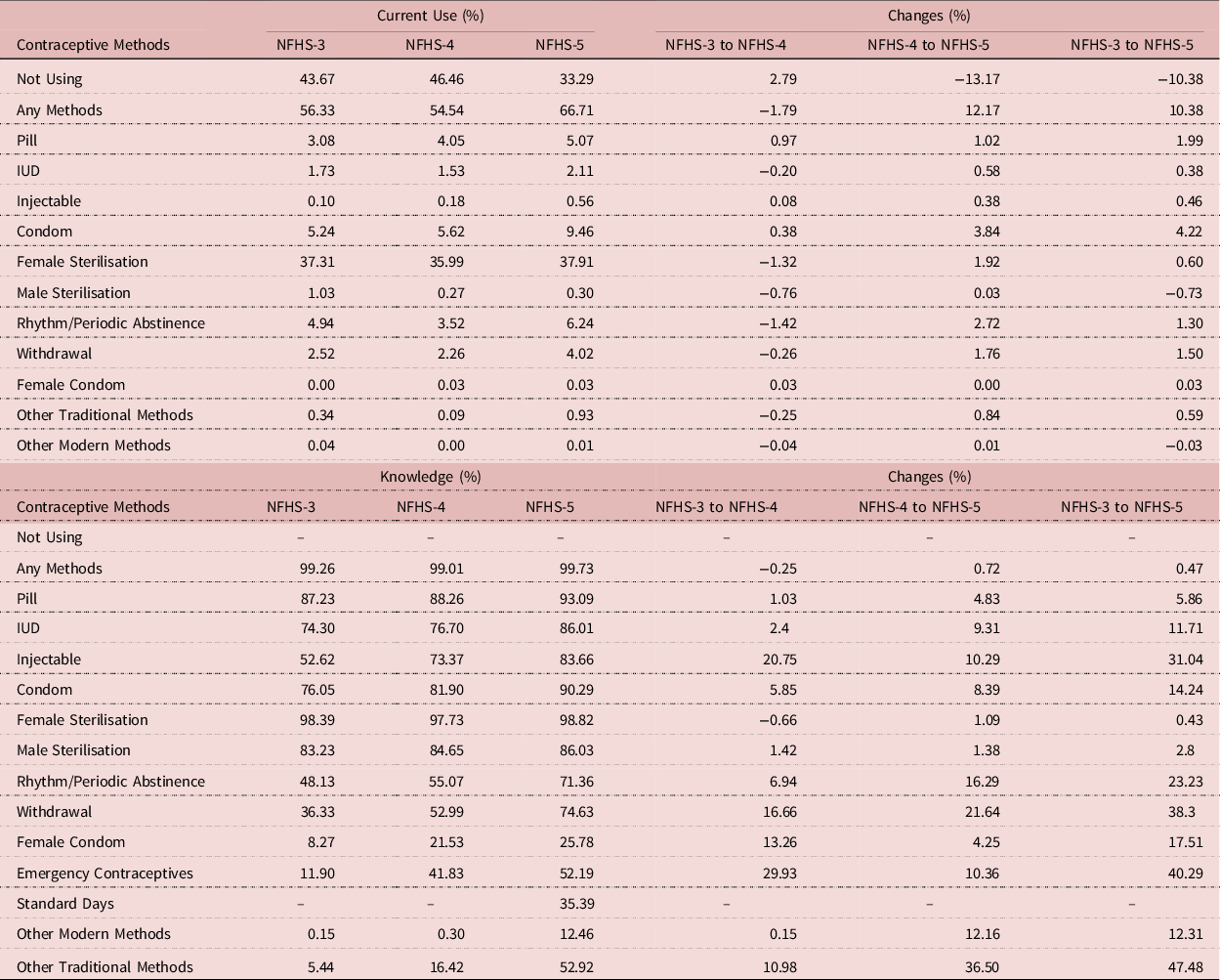
The survey data shows the most popular method in India is female sterilisation. It covers almost one-third of contraceptive use along with pills and condoms becoming more popular since last decade. Overall contraceptive prevalence has declined a little (1.79%) between 2005-06 to 2015-16; but it has risen sharply (12.17%) between 2015-16 to 2019-21 (Table 1). Similarly female sterilisation has also decreased 1.32% between NFHS-3 and NFHS-4 but again increased 1.92% in NFHS-5. Information given to the client (respondents) has improved notably from 2005-06 to 2015-16. Knowledge regarding available contraceptive methods has also increased in the time period. Since NFHS-3, knowledge regarding female sterilisation was around 98% which remains almost same throughout the time period. But knowledge regarding other contraceptive methods have increased notably; 87.23% to 93.09% for pills, 74.30% to 86.01% for IUDs, 52.62% to 83.66% for injectables from NFHS-3 to NFHS-5 respectively.
Current Use and Knowledge about Contraceptives among Currently Married Women aged 15-49

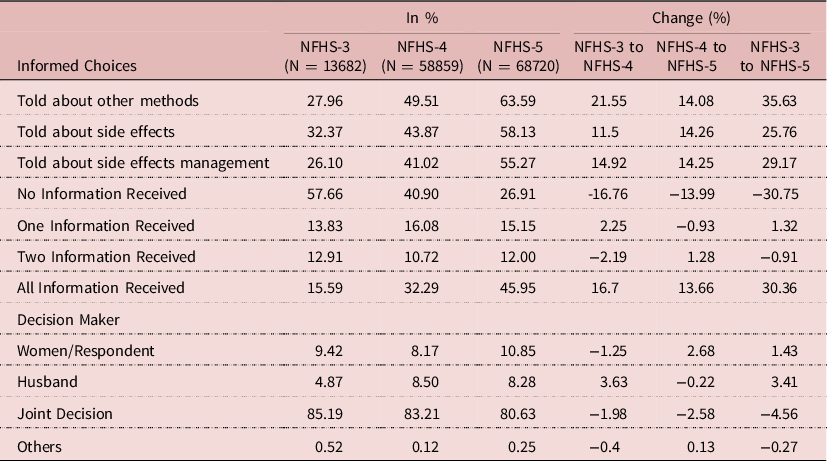
Table 2 shows that along with information about contraceptive methods, their side-effect and side-effect management has also increased in the time being. Information received about other method has increased from 27.96% to 63.59% between NFHS-3 and NFHS-5, whereas the information regarding side effect has increased from 32.37% to 58.13% and side effect management related information from 26.10% to 55.27% from NFHS-3 to NFHS-5 respectively. While all the aforesaid aspects show an increasing trend, the trend in joint decision-making regarding choice of contraception shows downward slope; 85.19% in NFHS-3 to 83.21% in NFHS-4 and 80.63% in NFHS-5, a total of 4.56% decrease within the time period.
Contraceptive Decision Maker and Informed Choices among Currently Married Women aged 15-49 in Study Sample

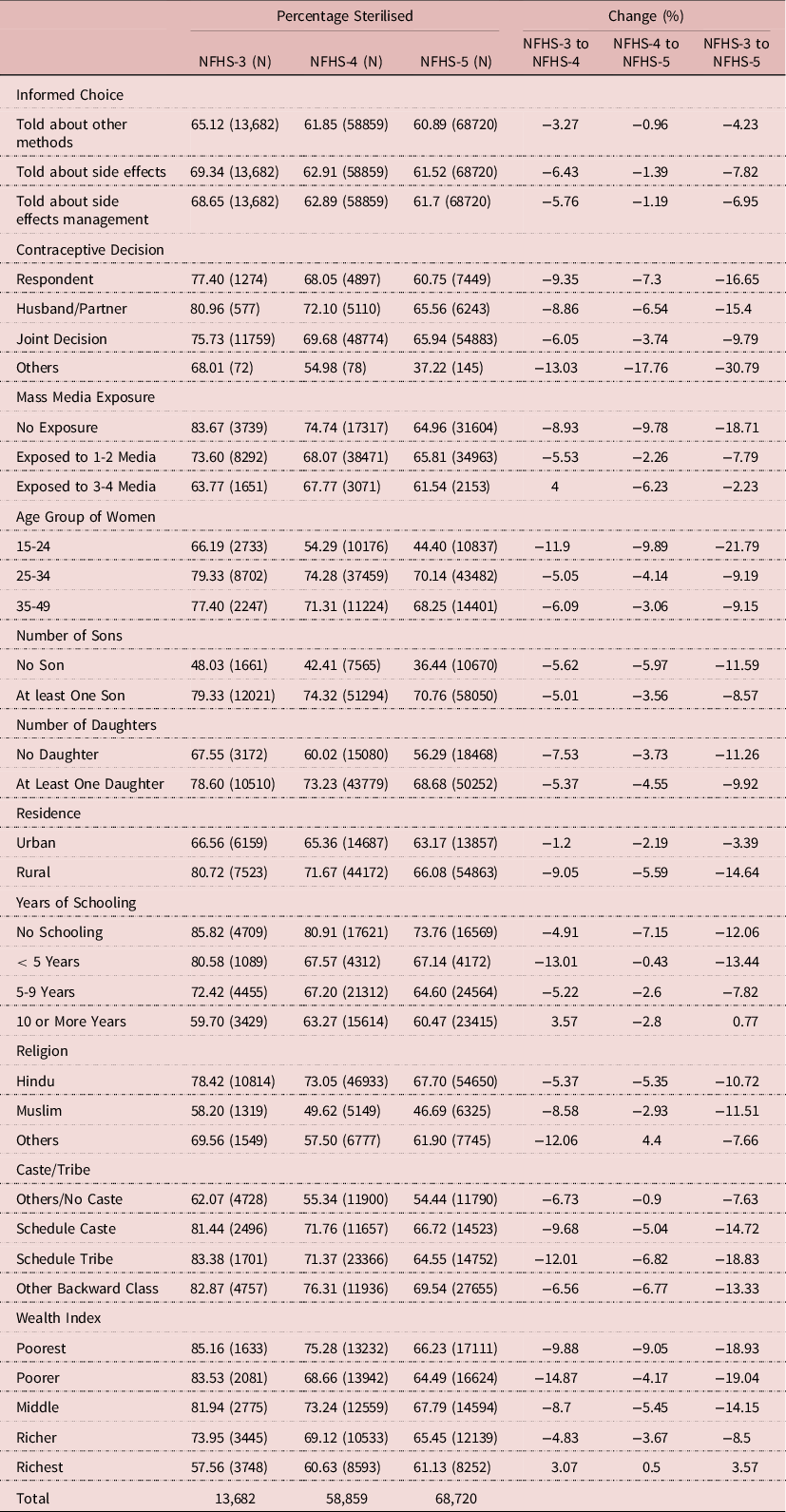
Table 3 shows female sterilisation prevalence according to some chosen background characteristics. 60.89% of the respondents who are informed about other methods also, are sterilised in NFHS-5, though the percentage decreased 4.23% since NFHS-3. 61.52% of the respondent who has knowledge about side effects and 61.7% of the respondents who knows about side effect management has opt for female sterilisation in NFHS-5. Here also, the percentage reduced 7.82% and 6.95% between NFHS-3 and NFHS-5. Within the time period, 65.94% of the respondents who took joint decision are sterilised in NFHS-5 which was around 75.73% in NFHS-3. Exposure to 3-4 types of mass media helped in lowering the sterilisation prevalence in between NFHS-3 and NFHS-5; 63.77% to 61.54% respectively. According to age group, women aged 25-34 years has highest prevalence in female sterilisation for NFHS-5, 70.14%. 70.76% of the female having at least one son and 68.68% of the women having at least one daughter are sterilised. Sterilisation prevalence has decreased sharply for the rural areas, from 80.72% in NFHS-3 to 71.67% in NFHS-4 and 66.08% in NFHS-5. Rural urban gap in sterilisation prevalence has also reduced manyfold since NFHS-3. Sterilisation prevalence is highest among the respondents who does not have any schooling, 73.76% in NFHS-5. 67.70% of Hindu respondents are sterilised in NFHS-5 which is only 46.69% for Muslim respondents.
Female Sterilisation Scenario with Various Background Characteristics in Study Sample

Regression Results
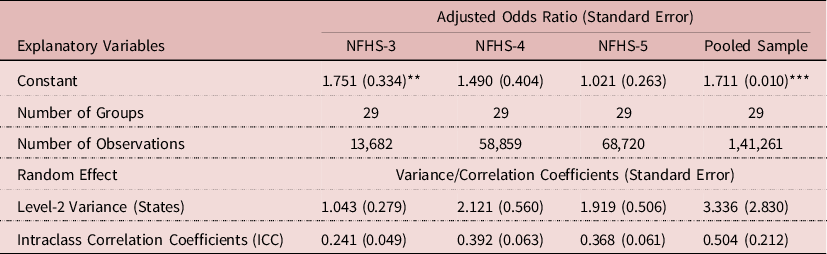
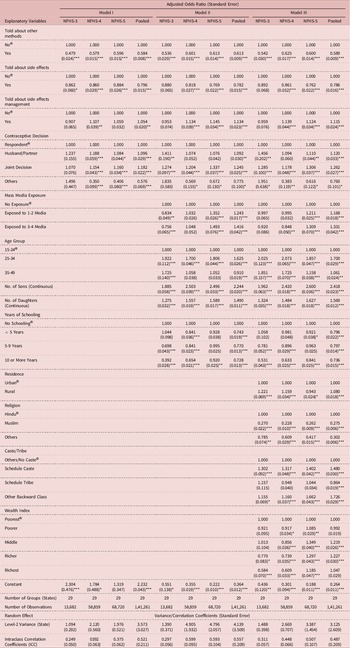
Table 4 and Table 5 show results of multilevel mixed effect logistic regression between female sterilisation and explanatory variables. The null model shows higher variance between the states in sterilisation prevalence as intraclass correlation (ICC) is increasing from NFHS-3 to NFHS-5. The null models showing 24.1%, 39.2% and 36.8% variance (ICC) in NFHS 3, 4, & 5 respectively due to difference in the use of female sterilisation among states. The analysis was also performed in the pooled data for robustness check and the pooled model shows 50.4% of variance due to difference among states in sterilisation prevalence.
Null Model showing the Variance of Female Sterilisation Users among States in India

Outcome Variable: Sterilisation (No/Yes); Level of Significance: ***p<0.001, **0.001<p<0.01, *0.01<p<0.05.
Adjusted Odds Ratios showing effect of various explanatory variables on Female Sterilisation in India

Outcome Variable: Sterilisation (No/Yes); ® Reference Category; Level of Significance: ***p<0.001, **0.001<p<0.01, *0.01<p<0.05.
The regression analysis shows information about other available contraceptive method lowers the chance of choosing sterilisation in model I by 52.1% (AOR 0.479), 42.1% (AOR 0.579), and 40.4% (AOR 0.596) for NFHS-3, 4, 5 respectively, whereas in model II after controlling individual level variables, the chance of sterilisation reduced by 46.4%, 39.9% and 38.7% for the respective three rounds. Similarly in model III, the probability decreases by 45.8%, 37.5% and 40% for the respective three rounds. The pooled sample regression also shows consistency over the models. Information about side effects also decreases the odds of choosing sterilisation from 23.8% to 11.6% significantly over the survey periods in all models. On the contrary, information about side-effect management increases the chance of being sterilised significantly almost 1.1 times in NFHS 4 (Model I, AOR 1.107; Model II, AOR 1.134; Model III, AOR 1.139) and NFHS 5 (Model II, AOR 1.145; Model III, AOR 1.124). Whether the husband is the sole decision maker or joint decision is taken regarding contraceptive methods, in both the cases, the chance of being sterilised slightly increases for all the models. With increasing age, the odds of sterilisation also increases though it is highest for the age group of 25-34 years (NFHS 4, Model III, AOR 2.073). Increasing number of sons and daughters both increase the chance of sterilisation 2.6 times and 1.6 times respectively after controlling all the variables (Model III). On the other hand, increasing years of schooling gradually declines the odds of female sterilisation. Being a rural residence increases the chance of sterilisation 1.1 times (pooled sample). In comparison to Hindus, Muslims have 72.5% lower odds of being sterilised in pooled sample.
The ICC values in the models indicating that there is a strong regional variation in the use of female sterilisation among Indian states. After controlling for all the variables in Model III, ICC explains 31.1%, 44.8%, and 50.7% variance among Indian states due to differences in prevalence of sterilisation among states. In all the models, ICC has been increased in later survey periods (NFHS 4 & 5) in comparison with NFHS-3, which is indicating increase variation or gap between states in terms of sterilisation prevalence.
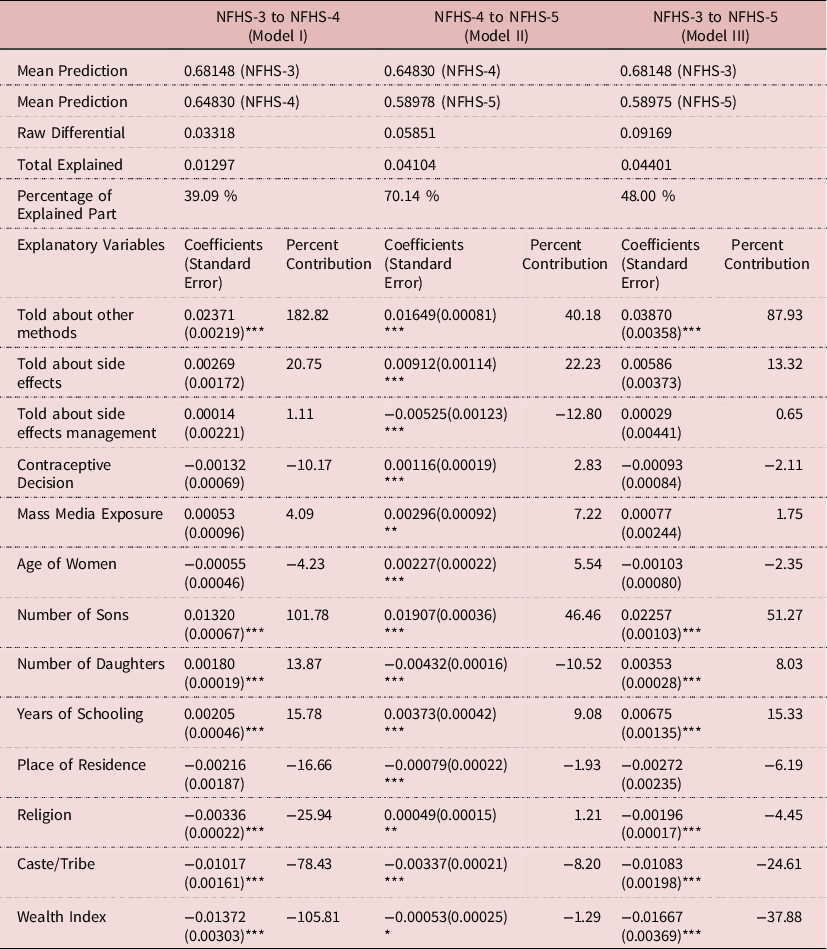
Decomposition Results
Table 6 provides the results of Fairlie decomposition for changes in sterilisation between 3 rounds of NFHS. This is a twofold decomposition where explained part indicates the gap due to differences in the distribution of determinants between two surveys. Model I, II and III can explain the sterilisation gap around 39.09%, 70.14% and 48% between NFHS-3 and NFHS-4, NFHS-4 and NFHS-5, NFHS-3 and NFHS-5 respectively. In all three models of decomposition, positive contributors are increasing the sterilisation gap between two surveys or reducing sterilisation over time, whereas negative contributors are decreasing the sterilisation gap or increasing sterilisation over time. The reason behind this is that, in each of the decomposition models, the mean value of sterilisation is decreasing from earlier rounds to later rounds of survey. Information related to other methods (182.82%) and higher number of sons (101.78%) contributed maximum in creating sterilisation gap in between the survey of NFHS-3 to NFHS-4. Other important factors contributed positively in increasing the gap are increasing number of daughters (13.87%), years of schooling (15.78%). Within this period, wealth status (105.81%), caste (78.43%), religion (25.94%) and contraceptive decision-maker (10.17%) favouring the sterilisation i.e., contributed significantly in reducing the sterilisation gap. In between survey period of NFHS-4 and NFHS-5 also, information regarding contraceptive methods, their side effect and higher number of sons contributed in increasing the sterilisation gap but the percentage of contribution reduced from the previous period, 40.18%, 22.23%, and 46.46% respectively. Whereas, information regarding side-effect management (12.8%), number of daughters (10.52%), caste (8.20%) contributed in decreasing the sterilisation gap. If the factors are decomposed between the time period of NHFS-3 to NFHS-5, information related other methods (87.93%) and number of sons (51.27%) are identified as maximum contributors in increasing sterilisation gap, i.e., reducing sterilisation over time and wealth index (37.88%) and caste (24.61%) are significant factors contributed in reducing the gap.
Fairlie Decomposition showing Major Contributors of Sterilisation Gap between Survey Years

Outcome Variable: Sterilisation (No/Yes); Groups: NFHS-3, NFHS-4, & NFHS-5; Level of Significance: ***p<0.001, **0.001<p<0.01, *0.01<p<0.05.
Discussion
The study has tried to capture the effect of information given to women regarding contraception and their impact on the choice of contraceptive methods along with her own decision-making power regarding use of contraception. The contraceptive prevalence rate though dropped from 2005-06 to 2015-16 but it again raised and the latest NFHS report 2019-21 reports highest ever prevalence levels of contraception. However, increasing informed choice and decision-making power of women vis-à-vis, significantly reduced the chance for opting sterilisation as a method in all three rounds of the survey. Along with the informed choice and decision-making power regarding contraceptive methods, there are few major factors which controls the sterilisation choice of a woman in India.
The major factors, the study revealed, for determining sterilisation among women are information given to women about other contraception, age, number of sons and daughters, years of schooling, religion and place of residence. But with increasing prevalence of full information regarding other methods, the choice of contraception is increasing towards other modern temporary contraceptive options avoiding sterilisation. The study by Baveja et al., (Reference Baveja, Buckshee, Das, Das, Hazra, Gopalan, Goswami, Kodkany, Sujaya Kumari, Zaveri, Roy, Datey, Gaur, Gupta, Gupta, Saxena, Singh, Kumar, Yadav and Saxena2000) also supported this finding, that most of the women who are sterilised are actually due to lack of information provided to them, not by their own choice or preference. On the other hand, information regarding side effects of sterilisation and its management also plays an important role. Where quality information regarding side effect management is provided, women are likely to opt for sterilisation as it has fewer side effects compared to other methods, less failure rate and is a onetime process (Gizzo et al., Reference Gizzo, Bertocco, Saccardi, Di Gangi, Litta, D’Antona and Nardelli2014). On the other hand, government incentive for sterilisation adds on the benefit to majority of the population. Work opportunities for women also increased after sterilisation as studies found from NFHS survey itself, that women who are sterilised or use traditional contraceptives, they have higher employment chances in agricultural and production sectors (McDougal et al., Reference McDougal, Singh, Kumar, Dehingia, Barros, Ewerling, Atmavilas and Raj2021).
The three different questions used to understand the quality of information has different magnitude and different directional impact in controlling contraceptive prevalence, “Told about other methods” was found to be most important controlling factor not only in reducing individual’s odds of choosing sterilisation but also significantly influenced in overall sterilisation reduction over the time period 2005-06 to 2019-21 (among the four methods used in the study), while other two questions did not have significant contribution in controlling sterilisation over the time period (Table 6). It must be noted that information was provided to women before they started their current contraceptive method, so all these information have immense importance in influencing their choice of contraceptive methods. Earlier studies also supported the finding that, most of the women who opted for sterilisation as a method, were not informed about other available methods and their side effects (Pradhan & Ram, Reference Pradhan and Ram2009). Awareness of information about contraception and availability of various methods of contraception lead women to choose the better method as per their need and choice.
The chance of getting information is also indirectly triggered by the level of education of women, where highly educated women may have chances to cross verify the information provided. And thus, education also plays a significant role in the dichotomy of choosing between temporary and permanent methods. With increasing years of education, chance for getting sterilised significantly decreased. It can be seen that sterilised women have higher chances of employment (McDougal et al., Reference McDougal, Singh, Kumar, Dehingia, Barros, Ewerling, Atmavilas and Raj2021), but it has also been noted that employment is in agriculture and production sectors only where most of the women have lower level of education, which again indicates that highly educated women have lower rate of sterilisation. The trend in gradual increase in quality of information provided, ensures good impact on improving the quality of care in choice of contraception. Moreover, delivering correct information by health workers becomes a more important aspect that assures quality.
It is found that decision-making power influences the choice of contraception to a large extent. This finding is supported by existing literature. If husband alone takes decision regarding contraception, women may be forced to conduct sterilisation after attaining a certain age and having a sufficient number of male children. Incentives available in government facilities can act as a pull factor for choosing sterilisation under husband’s sole decision-making power as well. The case could be worsened when third-party agent is incentivised to bring individuals for sterilisation (Wale & Rowlands, Reference Wale and Rowlands2020). Incentives for sterilisation can play dual role. It can benefit individuals who are willing to get. But on the other hand, it can create social and other pressures on individuals, who are not willing to accept sterilisation. Increasing age of women also directly impact in increasing sterilisation prevalence, with women belonging to age group of 25-34 years having highest probability of choosing sterilisation. One of the major reasons of such finding could be that, the study uses women initiating their current method five years prior to surveys and most women start contraception between 25-34 years of age. The average age of female sterilisation in India also lies within this age group (IIPS & Macro International, 2007; IIPS & ICF, 2017; IIPS & ICF, 2021). When women belonging to younger age chooses permanent method like sterilisation due to lack of information, the situation worsens. These women tend to regret their choice at later ages (Curtis et al, Reference Curtis, Mohllajee and Peterson2006; Singh et al., Reference Singh, Ogollah, Ram and Pallikadavath2012; Bansal & Dwivedi, Reference Bansal and Dwivedi2020).
Son preference also has a direct impact on sterilisation prevalence; after attaining desired number of sons the odds of being sterilisation jump up. Thus, along with age, women with higher number of children willingly choose permanent method, but having the desired number of male children acts as a triggering factor towards sterilisation (Edmeades et al., Reference Edmeades, Pande, Falle and Krishnan2011). The study has found clear distinction in how the effects of both the number of male and number of female children of women are working with different intensity (Table 5 & 6) in changing the sterilisation acceptance between two periods.
The sterilisation scenario in India hugely varies across the states of the country. Multilevel model reflects this phenomenon. This huge variation in Indian states is due to the government policies of individual state governments. States like Andhra Pradesh emphasised on female sterilisation to reduce the fertility level in the state and achieved the lower fertility rate successfully with female sterilisation as a major tool (IIPS & Macro International, 2007; IIPS & ICF, 2017; IIPS & ICF, 2021). A strong inverse relationship exists between this regional variation in female sterilisation and information regarding contraceptive methods. States with lower level of information have higher prevalence of female sterilisation (IIPS & Macro International, 2007; IIPS & ICF, 2017; IIPS & ICF, 2021), which again reinforces the interconnection between prevalence of sterilisation and level of information regarding different contraceptive methods.
Quality of care services also varies highly on a regional basis across India; many FPP centres are racing among each other for conducting higher number of sterilisations, overlooking necessary precautions to a great extent, which is found to often result in death or severe bad impact on health after sterilisation (Sharma, Reference Sharma2014; Brault et al., Reference Brault, Schensul, Singh, Verma and Jadhav2016). Studies showed, without the proper process of sterilisation, women can have pernicious health effects (Kumar et al., Reference Kumar, Gautam, Dey, Saith, Achyut, Gautam, Agarwal, Chakraverty, Mozumdar, Aruldas and Verma2020). Proper process is a wholesome term, which not only centres around the surgical process of sterilisation but starts from the quality of information given to the client. The human rights in patient care framework (HRPC) describes that ‘Right to Information’ is violated when “A state fails to provide information on health care services, Physicians fail to provide patients with information about treatment options and the potential risks and benefits of each procedure” (Cohen & Ezer, Reference Cohen and Ezer2013). Thus, in light of the aforesaid framework, lack of full information prior to choosing any contraceptive method over others is violation of not only human rights but also a symbol of poor quality of care. We find that to ensure the quality, ensuring complete information regarding contraception provided is the most vital aspect to be focused on.
Though the study unfolds many research gaps in the field of female sterilisation in India, but it has some limitations. Most of the decisions about contraceptive methods are taken jointly, but who is the dominated person in this joint decision is not available in data. The informed choice questions are limited and only limited to four contraceptive methods.
Conclusions
Female sterilisation in India is the most dominant contraceptive method in terms of number of users. Government has also promoted it more than other methods. But question arises that do all sterilised women accepted this method by their own choice? If information about other possible methods is given to women at the time they are thinking of starting use of contraception, then, the study found, women are less likely to choose sterilisation as a method. Moreover, choice of sterilisation is not solely dependent on the women herself, rather on her husband and others. So, correct and full information regarding availability of other methods, their side effects and management of side effects needs to be shared with prospective users. Government policies must stress on providing full information about all available contraceptive methods and monitoring of the same. Along with these, women empowerment via education, job opportunities etc. can also help women to choose methods as per their need and choice.
Acknowledgement
We would like to extent our gratitude to Anrudh Jain and Md. Juel Rana for their suggestions. We are also thankful to Ruchira Chakraborty and Viraj Mahesh Vibhute for helping in the formation of the draft.
Funding
This research received no specific grant from any funding agency, commercial entity or not-for-profit organization.
Conflict of Interest
The authors have no conflicts of interest to declare.
Ethical Approval
The study was based on publicly available data and did not use any individual identifiers. Thus, the work complies with the ethical standards of the relevant national and institutional committees on human experimentation and with the Helsinki Declaration of 1975, as revised in 2008.