INTRODUCTION
Since the early 2000s, pétanque, a game similar to bocce, has become extremely popular in Luang Prabang, Laos, especially among adult men. People rarely play without betting.Footnote 1 Usually, they gamble either for money or for beer. Yet the stakes of these two kinds of gambling implicate more than what the players wager. The kinds are instead socially elaborated, moral economic types––ideological differentiations (Gal & Irvine Reference Gal and Irvine2019)—that can be used to thematize sociality itself. Players contrast these types vividly and almost automatically, as if they were as distinct as good and evil, or night and day. “Gambling for beer is all fun”, one man explained to me, “it's like building friendship, it yields love…. Gambling for money only yields that stuff: it makes arguments, it's not fun. It's gambling (kaan3 phanan2)”. And yet, while players describe these types easily when they speak abstractly, they identify games as one type or another more circumspectly and with an eye toward influencing or evaluating the people participating in them. Many games, furthermore, exhibit hybrid qualities, appearing to mix the two kinds of stakes and the different temperaments and socialities that are said to distinguish the types.
Research into language in society has long paid attention to lexicalized types akin to ‘gambling for beer’ and ‘gambling for money’, which are salient and ideologically loaded. These words or ‘ethno-metapragmatic terms’ (henceforth EMTs; see Agha Reference Agha2007:74)Footnote 2 are essential tools for communication and social action. They are also analytically beguiling. Because of their salience and importance, they are often the centerpiece of whole monographs––think, for instance, of the place of the fono in Duranti's (Reference Duranti1994) From Grammar to Politics or, more recently, ‘the clean voice’ in Harkness's (Reference Harkness2014) Songs of Seoul. Scholars frequently begin with EMTs as boundary-makers that delimit the subjects they are studying (say, the ‘promise’ or the ‘lie’), but the words are inherently difficult to define or use felicitously. This is all the more true when they are loaded with moral weight. The locals that utter them—similar to gamblers in Laos—often do so in apparently contradictory ways. Some abstract about EMTs clearly but apply them irregularly or contest their applications; others do the opposite, and abstract about them unpredictably but apply them consistently. Most of the time, people eschew saying EMTs aloud entirely, and instead only appear to invoke them tacitly, with small gestures or different words.
The messiness of EMTs has hijacked many otherwise well-laid plans of research. Questions around what constitutes a ‘lie’ or a ‘promise’ are often unanswerable without better understanding how these linguistic practices are themselves delimited and contested in language. While some scholars are comfortable sweeping aside this murkiness and moving forward with what they see as an operable definitions of their subjects, many others have taken this epistemic hurdle as instructive, insofar as it shows that EMTs—and the metapragmatic regularities that surround them—are deserving objects of analysis in their own right, subjects that must be explored, explained, and tracked in interaction. Many research questions have thus morphed from what some linguistic practice is to how it is recognized. What counts, in a given corpus, as a promise? What counts as a lie? These new questions, with their Wittgensteinian undertones, have a pull-the-rug-out-from-under-you quality to them. They disorient. They force one to consider not just what is what locally, but what, in fact, one is actually studying.
In this article, I untangle the apparent messiness of ‘gambling for beer’ and ‘gambling for money’ in Laos, and thereby articulate a new way to approach salient and ideologically weighty EMTs with less confusion and more systematicity. I show that EMTs are difficult to pin down partly because the people we study use them primarily for social, rather than conceptual, ends—they are, in this sense, slippery by design. But they are also beguiling because locals use them in at least two, radically distinct ways that have not been distinguished clearly enough. ‘Explicit discourse’ can appear against the background of ‘tacit metapragmatics’ to be simple and straightforward, but it comes in different modes. Pulling apart these modes clarifies how and why people use EMTs both for reference and for social action, and where anyone studying EMTs—whether they set out to do so or are pushed there by epistemic necessity—should begin.
In what follows, I distinguish uses of EMTs as generics from uses of EMTs as specifics. This distinction captures the fact that people can talk about EMTs abstractly—defining them, for instance, ‘Lying is when someone doesn't say what they are thinking’ or ‘Promises always lead to pain’—as they can also wield EMTs to characterize actions, objects, and events—for example, ‘You lied’ or ‘You promised’. In the former generic uses, people refer to and characterize types as abstract kinds. In specific uses, they label real or imagined experiences in the world as tokens of one type or another. These are two ways of referring but they are also two modes of typification. With their different referential targets, they make use of types in distinct ways: generics present types, specifics use types as a mode of presentation.
Examples of generic and specific uses of EMTs are everywhere in studies of language in society, much as they are everywhere in language, but neither the distinction nor its epistemic consequences have been fleshed out theoretically (but see Agha Reference Agha2007:43–45). Doing so is essential for many reasons. It provides analytic precision, it allows us to specify the heterogeneity of ‘explicit discourse’, and it offers a way to study essentializations and abstractions—practices often presumed to be cognitive or amorphously cultural—as they unfold in interaction (see Gelman, Mannheim, McIntosh, Sidnell, and Zuckerman, this issue). The distinction also helps clean up the apparent messiness of EMTs in two respects.
On the one hand, it shows that generics and specifics—these two ways of referring and two modes of typification—afford distinct possibilities for social action. This is because they are differently anchored in speech events. Generics allow pétanque players to fashion themselves in relation to gambling without directly implicating other people or events; whereas specifics afford players the possibility of implicating people and events more directly. Recognizing these differential affordances helps show why EMTs often appear to be used in contradictory ways, and allows us to identify not just if a given EMT is politically or morally charged, but whether that charge adheres to certain kinds of referential practices—say, practices of abstraction—and not others.
On the other hand, distinguishing generic and specific uses of EMTs clarifies why analysts should be cautious in using EMTs as substitutes for ‘tacit’ typifications or short-hands for ‘types’.Footnote 3 EMTs can seem to mortar types together, binding them into composites of generic concepts and labeled objects in the world, which relate to one another like the parts of a syllogism. But taking these modes of typification apart and inspecting their relations with more ‘indirect’ typifications shows the extent to which identifying tokens of types and acts of typification relies on the analyst's own inferences. Ignoring such inferential processes can obscure the very practices that we hope to explain.
TWO KINDS OF TYPIFICATION
Lao pétanque players use each of the two EMTs ‘gambling for beer’ and ‘gambling for money’ for both generic and specific reference.Footnote 4 Generics such as ‘police dress in blue’, ‘ibises eat trash’, and ‘sourdough is delicious’ are statements that ‘express general claims about kinds and categories, rather than claims about particular individuals’ (Leslie & Lerner Reference Leslie, Lerner and Zalta2016). In generic uses of ‘gambling for beer’ and ‘gambling for money’, players refer to these types of gambling as types. They describe their general properties, compare, evaluate, and essentialize them, and so forth. For example, in transcript (1) below, a player uses the phrase tii3 ‘hit’ kin3 ‘eat’ ngen2 ‘money’ to describe the properties of gambling for money.
(1) Player:
(lip smack) suan1 laaj3 khòòj5 kaø- mak1 tii3 kin3 ngen2
mostly 1.sg topic.link like hit eat money
‘(lip smack) Mostly, I like gambling for money’
phòq- vaa1 nùng1 maa2 lèèw4 tii3 kin3 ngen2 lèèw4 man2 caø- bòò1 maw2
because comp one come already hit eat money already 3.sg irrealis neg drunk
‘because, first of all, in gambling for money [you] don't get drunk.’Footnote 5
In the case of specifics, players use the same EMTs to label, characterize, or typify actual or imagined games. Take, for example, how one player lectured an audience member who screamed during his turn (see Zuckerman Reference Zuckerman2016).
(2) Player:
taa3 bòø- mii2 qaq1 lin5 kin3 ngen2 nii4
eyes neg have q.polar play eat money deictic.prox
naq1 hêt1 hoo kaø- vaw4 dii3 dii3kaø- vaa1 san4 naq1
fac do hoo topic.link speak well-well topic.link comp like.that fac
‘[What], you don't have eyes? [We] are gambling for money here and you yell ‘hoo!’ Is that ‘speaking nicely’, [is that what you] are saying here?’
Here, the player used the form lin5 ‘play’ kin3 ‘eat’ ngen2 ‘money’ to put the particular game he was playing under a description.Footnote 6
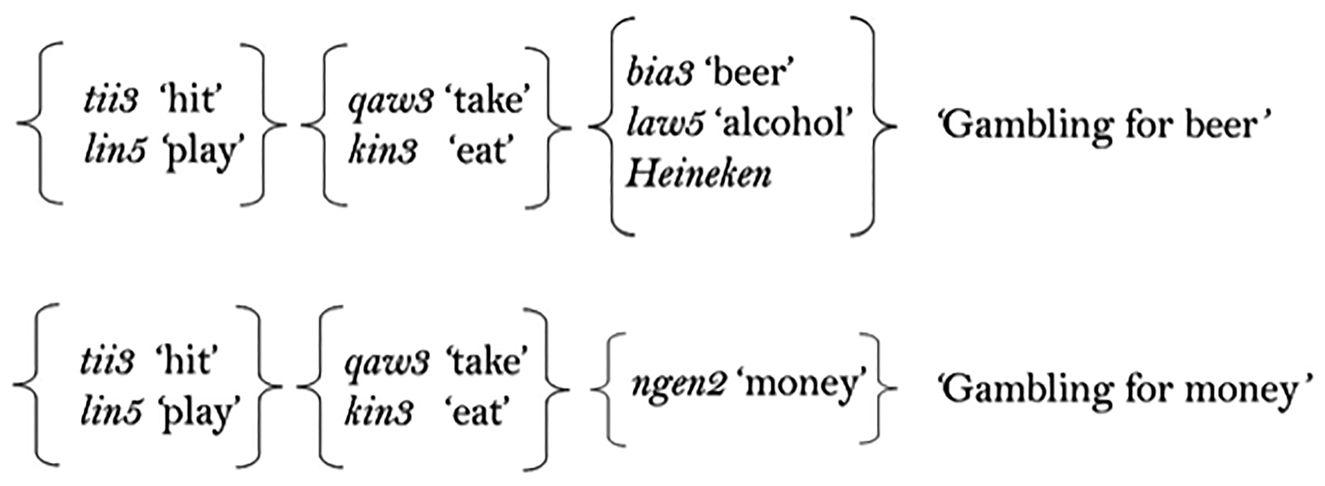
In these two examples, the players did not produce exactly the same EMTs to refer generically and specifically. Rather, they used two options from a broader ethno-metapragmatic array (see Figure 1). Players use the forms in this array in pragmatically and semantically similar enough ways that I here discuss them under the umbrella of the English ‘gambling for beer’ and ‘gambling for money’.
How to refer to the two kinds of gambling.Footnote 7

The forms in this array are the focal EMTs of this study. They contrast with the innumerable other—and for the purposes of this article, non-focal—ways players describe games of pétanque, as, for instance, ‘pétanque’ (pêêtang3 or pêêtòòng3), ‘sport’ (kaan3 kiilaa2), ‘gambling’ (kaan3 phanan2),Footnote 8 ‘wasting time’, ‘losing money’, ‘men working on their tans’, and so on. Any combination of the forms in the array can be used for either generic or specific reference without morphosyntactic modification. This flexibility is partly due to the fact that Lao, similar to Mandarin (Tardif, Gelman, Fu, & Zhu Reference Tardif, Gelman, Fu and Zhu2012:131) and Vietnamese (Sidnell, this issue), does not mark plurality, obligatorily signal aspect, or have nominal determiners. The sentence below, for example, has at least the following interpretations, including the patently generic (3a) and the patently specific (3c).
(3) maa3 kin3 kaj1
dog eat chicken
a. ‘Dogs eat chicken’
b. ‘The dog eats chicken’
c. ‘The dogs are eating the chicken’
d. ‘A dog ate the chicken’ (said, for instance, upon discovering the carcass)
That utterances are polysemous like this in artificial isolation calls attention to what disambiguates them in practice, namely the semiotic cotexts and contexts in which they are spoken. In the small but growing work on generics cross-linguistically, scholars have found that languages tend to leave generics unmarked and to mark specifics (see Mannheim, Gelman, Escalante, Huayhua, & Puma Reference Mannheim, Gelman, Escalante, Huayhua and Puma2010; Meyer & Gelman Reference Meyer and Gelman2016; Gelman, this issue; see also Agha Reference Agha2007:43 and Sidnell, this issue, on generics as non-selective deixis). Lao speakers use a range of resources, including non-linguistic ones, to do this latter work of marking lexemes or utterances as specific. Among other things, they point to objects (see Meyer & Gelman Reference Meyer and Gelman2016), delimit with numbers, look at their referents, say statements that resonate with previous comments about other specific referents, and offer utterances pragmatically anomalous enough to seem unlikely generics, such as, ‘The lion is green’ (Gelman Reference Gelman2003:224–26). They also frequently mark their utterances with various deictics. In transcript (2) above, for instance, the man uses a proximal deictic nii4. Footnote 9 The variety and heterogeneity of these resources makes clear that construals of reference as specific or generic are inseparable from issues some might call ‘pragmatic’ or ‘contextual’ (Declerck Reference Declerck1991; Ni Reference Ni1996).
Although different languages, and semiotic repertoires more broadly, have different resources for ensuring EMTs are construed generically or specifically, all languages and their users have the capacity to use EMTs in both generic and specific ways. These two ways of referring and modes of typification, in turn, afford distinct kinds of social action. It is these affordances to which I now turn.
GENERICS ABOUT GAMBLING
Gambling for money (tii3 bun1 kin3 ngen2) is really different, [people who] gamble for money tend to fight, [whereas] gambling for beer (tii3 bun1 kin3 bia3) only involves love, and people mutually constructing [solidarity] together.
–a pétanque playerPétanque was once banned in Laos because the socialist state deemed it a ‘problem’ that stimulated gambling. In contemporary late-socialist Laos, however, it has become something of a national sport (Zuckerman Reference Zuckerman2018). While most men and women in the city play or have played the game, it is most associated with (and commonly played by) men in their late-twenties to mid-fifties. These men, who tend to play in teams of two or three, are proud of their skill in these games, which often draw audiences. But they are also mindful of lingering criticisms of pétanque as unethical and unproductive. To discuss and diffuse these criticisms, they often make use of the distinction between ‘gambling for beer’ and ‘gambling for money’. This distinction—alongside the moral properties players tend to attribute to it—echoes a more widely circulating distinction central to Laos's 1975 socialist revolution: between ‘mutual aid’ and ‘solidarity’, on the one hand, and ‘greed’ and ‘noise’ on the other (Evans Reference Evans1990; High Reference High2014). Whereas gambling for beer is frequently treated as if it produced the kind of camaraderie the socialist government has yearned for since its inception, gambling for money is often derided as divisive.
When speaking generically, players talk about these two EMTs easily and consistently (see Agha Reference Agha2007:119–24; Hampton Reference Hampton and Pelletier2009:81). This ease and consistency evidences their social-semiotic status as distinct kinds (Krifka, Pelletier, Carlson, ter Meulen, Chierchia, & Link Reference Krifka, Pelletier, Carlson, Meulen, Chierchia, Link, Carlson and Pelletier1995:11). While, with enough intervention from a researcher, people can always be led to compare and contrast different categories (Pelletier Reference Pelletier and Pelletier2009:5–6), pétanque players need no nudging to talk about gambling for beer and gambling for money. During interviews, nearby people frequently even interrupt to collaborate on these generics, as if they were joining in to help sing the chorus of a popular song that everyone knew. To one man's comment that, “When you lose you drink together, and when you win you drink together”, another added, “[It's like] constructing [solidarity] together”.
These generics are never exclusively about the literal stakes of the two types of gambling, beer and money. Rather, players use these stakes and the EMTs that refer to them as shorthands for distinct socialities and ethical ends. They genericize about ‘gambling for beer’, in which losers buy beer that is then drunk together, as simply for ‘solidarity’, ‘love’, and good sociality. They paint ‘gambling for money’ as an activity for money won at the expense of relationships. In responses to a written survey I passed out, for example, most respondents stressed the types’ distinct purposes (see Zuckerman Reference Zuckerman2018). Some used the language of ‘goals’ and ‘targets’ (paw4 maaj3). Others sketched the difference in ends using the form phùa1, meaning ‘for’: “Gambling for beer”, one man wrote, “means to play for (phùa1) friendship, for (phùa1) drinking beer, it does not mean you are playing to lose or win. Gambling for money [in contrast] means to play for (phùa1) losing or winning, because if you lose, you lose money and if you win, you win money”. These answers focus on the ethical question of ‘What is a game of pétanque for?’. ‘What is its rationality?’ in Weber's language. ‘What are its ends?’ in the register of moral philosophy. They frame the choice between the two gambling types as something like the choice between gift and commodity exchange (Carrier Reference Carrier1995): as a choice between forming social relations with beer or destroying them for money. And they tie this choice to different actual courts in the city (where people tend to gamble for one stake or another), and to distinct social and gendered figures: prototypical beer gamblers are morally upright co-ed civil servants, tied to the state; while the paragon of a money gambler is a rougher, masculine tuk-tuk or mini-van driver in the tourism industry.
Generics as social action
Because generic utterances are abstract in reference and often consistent across speakers, it is tempting to overlook the moments in which people utter them. And yet, I found that as people in Luang Prabang refer to the timeless qualities of gambling, they also orient to potential judgment or praise in the enchronic (Enfield Reference Enfield2013) flow of interaction. When men filled out my written survey, for instance, they wrote generically about ‘gambling’, but they also worried and joked aloud about how their answers would be received, and what those answers would say about them. This was a pattern. When I interviewed a civil servant named Buun at a money gambling pétanque court, for example, he told me that, “Gambling for beer means whichever person wins… whoever wins or loses, you drink together. But when you gamble for money, the winner puts [the money] in his pocket and gets out of there”. As I followed up, “So you think that playing for money is…” he hastily interjected that it was “not good”.
Talking about these kinds is ‘sticky’ with ethics (Mathias Reference Mathias2019), and their mention often leads to ‘moralization’ (Lempert Reference Lempert2013) and ‘defensive detailing’ (Drew Reference Drew1998). This is especially evident in interviews with civil servants where I was recording or filming, but it is not limited to these more formal or on-the-record interactions with me. In conversations over coffee or late-night drinking sessions with one another, players also talk about gambling with a marked attention to how what they say implicates their desires for money or friendship, and their opinions of their partners and opponents in games. Unlike more ethically neutral subjects, about, say, where someone likes to fish or a new shoe shop in the market, the topic of gambling almost forces one to take a stance; saying nothing is liable to be construed as a tacit sanction of money gambling and thus a hint as to what sort of person the speaker is.
Such construals are possible only because generic utterances are never as timeless as their content. As Goffman (Reference Goffman1974:247) put it, ‘Fanciful words can speak about make-believe places, but these words can only be spoken in the real world’ (compare Gal & Irvine Reference Gal and Irvine2019:181). In that real world, generics are not floating amorphously, but rather indexically anchored to the people who produce or are held responsible for them.Footnote 10 At times, people explicitly tie their generic references to themselves or to others, for example, with first person pronouns and stance-taking verbs, in phrases like ‘I don't like money gambling’, or by embedding similar utterances in reported speech. At other times the mere fact of producing a generic utterance invites listeners to guess at what it conveys about the speaker or her motivations for saying it, or to read the alignment or non-alignment of that generic with the generics others have spoken as a diagram of her social relations with those people (Du Bois Reference Du Bois and Englebretson2007). This point is often forgotten in research that studies the semantics of generics, but starkly obvious in experience: when a politician gives an impassioned denunciation of ‘corruption’ in the middle of an investigation into his finances, we know he is not merely articulating a general opinion. Rather, he is refuting the allegations against him.
And yet, while those who speak generics are liable to be held responsible for them through the indexicality of speakership, the connection between generics about kinds and the real events and people that might fit those kinds is fundamentally less direct.Footnote 11 Instead, generics share a pragmatic affinity with other varieties of deictically non-selective forms of ‘indirect addressivity’ (Lempert Reference Lempert, Paulston, Kiesling and Rangel2012a), such as indefinites (see Brenneis Reference Brenneis1984; Whitehead & Lerner Reference Whitehead and Lerner2020).
For players in Luang Prabang, this makes generics good objects for stance-taking (see Pino Reference Pino2020). Their unanchored reference allows players to evaluate the types of gambling more strongly than they might otherwise. This is what generics afford. With them, a person can condemn and commend without specifying his target's connection to spatiotemporally individuated events and people; he can sing the praises of beer gambling while still claiming that he does not go to the courts much; he can distance himself from money gambling as a type of activity without directly censuring others or holding them accountable.
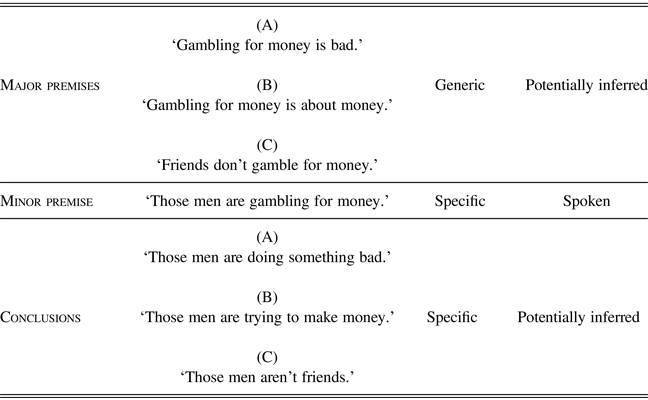
This is not to say, of course, that generics lack the capacity to be read as specific indictments of discrete people or events. They too can make addressees or overhearers ‘wonder, Is he talking about me?’ (Lempert Reference Lempert2012b:114). Such construals might follow a logic akin to the inferred syllogism in Table 1.
An inferred syllogism.

At times at the court, in fact, people grew uncomfortable making strongly worded generic evaluations about money gambling, presumably because of processes like these. Sometimes in interviews it felt as if the relevance of the abstractions was too clear, as if I were asking them to loudly discuss why healthy eating was important as we sat in a booth at McDonald's.
But, although possible, syllogistic movements from major premise to minor premise to conclusion are not always so natural, and generics often leave space for their utterers to plausibly deny that their generics implicate specific individuals or events. This is clear, for instance, when one looks closely at the way players describe the ethical limits of how they gamble for money. Almost all players distinguish some category of person with whom they would not wager money because doing so would be ‘bad’. Some men, like Buun, told me matter-of-factly that gambling for money was always bad, no matter against whom one was gambling. Others generically restricted their money gambling to strangers or acquaintances and refused to play with ‘friends’ (muu1 or siaw1).Footnote 12 These two positions differ starkly in entailment: one entails no gambling for money at all, the other allows it in some circumstances with some classes of people. But this is where practical syllogism meets discursive practice: actors can, and frequently do, deny that actions or people fit the types referenced in their generic utterances. Later in my interview with Buun, for instance, he bet money on the game in front of us. When he lost, he reframed the bet he had made: if he had won, he said, he would have bought us some beers. And so, a bet for money became something like a bet for beer.
Social scientists often analyze circumstances like these as contradictions between talk and action (e.g. Evans Reference Evans1990:143–44), but both generics describing events and people and specifics which ascribe types and statuses to events and people are linguistic; they can both use the same EMTs. The disjuncture is thus not between talk and action but between two kinds of talk. It is an effect of how people make use of the differential affordances of generics and specifics. Simply put, generics make for good stance objects because they allow people to paint the world with sharp lines, and thus communicate something about the world and themselves, without so explicitly entering the fray and declaring what counts as what.
SPECIFICS
In contrast, sorting out what's what, using EMTs to label tokens as tokens of a type (see Rumsey Reference Rumsey, Enfield, Kockelman and Sidnell2014:410; Gal & Irvine Reference Gal and Irvine2019:95), is exactly what specifics do best: put swaths of experience under description. Players use ‘gambling for beer’ and ‘gambling for money’ in this way more often than one might expect. These utterances tend to be clearly purposeful. Instead of neurotically organizing their games into money and beer gambling categories, players use these categories to get things done, to evaluate how others are acting, and to convince them to act differently (Enfield & Sidnell Reference Enfield and Sidnell2017; on ‘labeling’ and its effects see Becker Reference Becker2008; Thompson Reference Thompson2014).Footnote 13 Specifics afford such social force because they have the capacity to directly implicate people in the world.Footnote 14
Sometimes players refer specifically with ‘gambling for beer’ and ‘gambling for money’ for relatively straightforward purposes, for example, to satisfy some late arriving audience member's curiosity as to what kind of game is happening. Although hopeful gamblers do not need to characterize the type of gambling that is going to happen to make a bet—some bets are sealed with sequences as simple as, ‘50,000?!’… ‘[I'll] take [that]!’—gamblers do at times refer to their games as money or beer games in the process of negotiating stakes, balancing teams, splitting-off outside bets for audience members, discussing whether a neutral party should hold the wagered money, and more generally preparing for gambling. One man, for instance, enlisted people milling about to start a new game by shouting, “Yeah, OK, [let's] gamble for money here!”. In putting the games he wanted to play under a description, he moved the crowd.
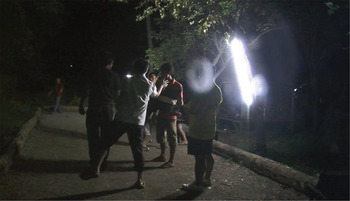
In more of my examples from games of pétanque, however, players use these EMTs with evaluative effect. In one game for beer, for example, a player was lifting his left leg up slightly each time he threw the ball, and someone complained that it violated the rules (see Figure 2). In response, another man defended the player who had raised his leg by pointing out that they were gambling for beer.
(4) Defender of the player who raised his leg
qoo3 ñok1 khaa3 qiø- pên3 ñang3 nòq1 tii3 kin3 bia3 nòq1
oh raise leg irr cop what q.polar hit eat beer q.polar
‘Ohh, what's the problem with raising [your] leg? [We are] gambling for beer, right?’
The player himself later repeated the same idea, given in (5).
(5) Player who had raised his leg
bòò1 ñòk2 kaø- bòø- pên3 ñang3 tii3 muan1 sùùn1
neg raise topic.linker neg cop what hit enjoy happy
‘No, lifting [your leg] is not a problem, [we] are playing for fun.’
tii3 kin3 law5 kin3 bia3
hit eat alcohol eat beer
‘[We] are gambling for alcohol and beer.’
Here, the description of this game as ‘gambling for beer’ is used, in conjunction with other descriptions and claims, to hold the leg-lifter's critic accountable, to remind him not to take the game too seriously.
Players talking about leg-lifting.

Players frequently use ‘gambling for beer’ like this: to mollify arguments or disagreements on the court or to correct others’ claims about the goals of the game, and thus, the goals of the interaction. For instance, when people sometimes voiced frustration at their own missteps or poor play, beer gambling opponents and partners often reminded them that we were playing for beer. Such descriptions assuaged guilt. In pointing out that we were gambling for drinks to be shared, they highlighted the social ends of the game rather than the material consequences of winning or losing.
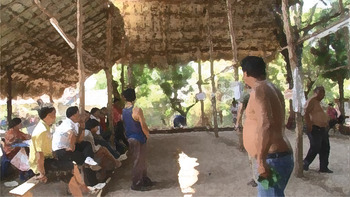
Uses of ‘gambling for money’, in contrast, offer players a tool for emphasizing these consequences, for stressing what may be won or lost. With the EMT, players can underline the seriousness of games, enforce decorum, and get in the heads and ears of their opponents by forcing them to think about the money they are risking.Footnote 15 Take the example in transcript (2) above, for instance, wherein my partner yelled at the man who distracted him: “[What], you don't have eyes? [We] are gambling for money here…!” (see Figure 3).
My partner chastises his distractor (image has been modified to preserve anonymity).

Notice how the force of this utterance centers around the type-identity of the game qua token: this is a money gambling game; such hijinks should not be allowed. Compare this with a scene from The Big Lebowski in which a bowler's foot goes over the line and his opponent, Walter, draws a gun in outrage. In response, the lead character, ‘the Dude’ tells Walter to calm down––it's “just a game, man” ––and Walter justifies his righteous officiousness with his own specific typification: “This is a league game”. These descriptions license action and hold others accountable (Enfield & Sidnell Reference Enfield and Sidnell2017).
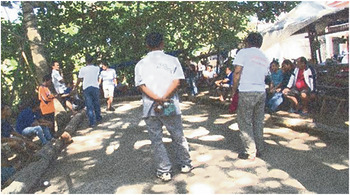
Across specific uses, ‘gambling for beer’ and ‘gambling for money’ become a part of social action in slightly different ways. Take the below three snippets from two different games (Figure 4), all of which are for money and between four players. In (i), a player in the game challenges his opponent who is about to take his turn, asking if, given that real money is on the line, he is brave enough to ‘shoot’ his pétanque ball, a riskier shot where one tries to knock the opponent's ball out of the way rather than merely approach the smaller target ball. Here the definition of the situation as ‘gambling for money’ is used to unsteady the opponent and bring his fortitude into question. In (ii), a player yells at his opponent for taking a practice shot in between turns, threatening to count the shot and reminding the man that they are gambling for 100,000 kip each ($12.50 USD per person at the time). The player's point is that, given the stakes, his opponent is being inappropriately casual. In (iii), finally, an audience member who is betting on the game takes issue with one of the players in the game's incessant heckling of his opponent, who has been mostly quiet. When the player retorts that his other opponent (the quiet player's partner) has been heckling too, the audience member refutes this by describing the stakes. Because they are gambling for money, the audience member's logic goes, the player really should be focused only on the game.
(i) kaa4 tii3 bòò1 liin5 haa3 ngen2 nii4 qaw3 ‘Are [you] brave enough to shoot it? [We are] gambling for money here, OK!’

(ii) qaw3 leej2 daj4 laj1 qaw3 leej2 daj4 jaa1 tii3 phuu5 laø- sèèn3 lêêw4 vaal ‘[We'll] count that, [we'll] count that, don't [take practice shots]!... [We're] gambling for 100,000 [LAK] per person!’

(iii) khaa3 khuu1 mèèn1 ñang3 kin3 ngen2 kan3 juul phii4 maa2 vaw4 khaa3 khuu1 nèè2 ‘So what about [your opponent's] partner? [We] are gambling for money here and [you're] talking about [his] partner?’
An array of specifics (images have been modified to preserve anonymity).

Of course, my brief explanations of the effects of these specifics are, in contrast to the specifics themselves, clumsy and stilted. In fact, specifics often work through concision. With the sharp knife of description, they cut efficiently, and explaining how they work can resemble the joyless task of explaining a joke.
The following slightly expanded example (see Transcript 6 below), taken from a game where Bot was gambling for money with his siaw1 or ‘close friend’, provides more detail as to what such specifics often feel like on the ground (on siaw1, see Zuckerman Reference Zuckerman, Djenar and Sidnell2022). When Bot and his friend began to bicker, an audience member laughed and called out the mismatch: the siaw1 are “gambling for money (kin3 ngen2 kan3)”. Later in the same game, the men began to bicker again. This time a different man in the audience, Phuumii Hii, described their gambling, and added that the pair was violating a pledge they had made weeks before, sealed with a handshake, that they would no longer ‘gamble for money’ with each other.
(6) Phuumii Hii: qaaw4 kuu3 hên3 suu3 cap2 mùù2 vaa1 suu3
hey 1.sg.bare see 2.pl.bare grab hands comp 2.pl.bare
bòø- kin3 ngen2 kan3
neg eat money reciprocal
san4 suu3 kaø- ñang2 kin3 ngen2 kan3
thus 2.pl.bare topic.linker still eat money reciprocal
‘Hey, I saw you two shake hands and say that you wouldn't gamble for money anymore, but you're still gambling for money.’ pointing at Bot and another man.
Bot: bak2 qan3 nan4 kin3 ngen2 mùng2
bare.prefix thing deictic.distal eat money 2.sg.bare
san4 naq1
thus factive.particle
‘That guy's gambling against you!’ pointing at Phuumii Hii's siaw1 whom he is gambling against.
Phuumii Hii: man2 siø- cap2 mùù2 kuu3
3.sg.bare irrealis grab hand 1.sg.bare
‘Did he shake my hand?’
(several people laugh)
caw4 tòòng4 cap2 mùù2 vaa1 bòø- qaw3 ngen2 kan3
2.sg.polite need grab hand comp neg take money reciprocal
thèè4 thèè4 qan3 nii4
true true thing deictic.proximal
‘You need to shake hands if you really aren't going to gamble for money.’
This passage shows the stakes of these types for these players. ‘Gambling for money’ is an important enough kind of activity that players take the time to pledge not to do it. They remember their pledges, and as they organize games of teams, they often reject otherwise balanced and appealing matchups because those matchups pit players against one another who should not be gambling for money: “we don't eat each other's money”, people say. The example also evinces the capacity of specifics to highlight and thus circulate the association of types with certain qualities and entailments. Phuumii Hii, like the audience member before him, labels Bot's ongoing bet as ‘gambling for money’ in response to, and as a sort of explanation of, Bot's bickering with his siaw1. The utterance is thus liable to be construed as underlining and concretizing this capacity of gambling for money, so often mentioned in generics about it: money bets make people, even friends, argue.
Specifics as social action
Players have flexibility in how, when, and whether they use EMTs. Often, they can plausibly refer to the same game as both ‘gambling for beer’ and ‘gambling for money’. This is because all games for beer are mediated by money; they are even frequently discussed in monetary terms. A game might be for ‘a bottle of beer’ or ‘10,000 Kip’. Beer gambling debts also often come to resemble money gambling debts in their size and seriousness. Over the course of a night, as bets balloon into more than can be consumed, the two kinds of debt can blur. So too are money games rarely as calculating, or asymmetrical, as players describe them generically. Debts are forgiven, forgotten, and discounted. Furthermore, games for money are concluded almost automatically with gifts of drinks (including beer) to the losers. These small gestures of commensality and friendship can end up costing the bulk of a wager.
But although beer and money gambling might seem to be categories with especially blurry boundaries, all EMTs are bound by shades of blur (compare Rosch & Mervis Reference Rosch and Mervis1975; Wittgenstein Reference Wittgenstein and Anscombe2009; Hampton Reference Hampton and Pelletier2009:91; on tokens’ fit with types, see Urban & Silverstein Reference Urban and Silverstein1996:9; Bauman Reference Bauman, Eckert and Rickford2002:59). In life, ‘[t]here is no one correct description’ (Enfield & Sidnell Reference Enfield and Sidnell2017:104) and ‘real-time phenomena… can always fit more than one socially recognized category’ (Gal & Irvine Reference Gal and Irvine2019:94). People thus have choices about how, when, and whether they specifically refer to experience.
This capacity to select a description matters because it means that when one uses a given term, say, the ‘evening star’ or the ‘morning star’, to put a person, an action, or entity ‘under a description’ (Anscombe Reference Anscombe1957, Reference Anscombe1979), that use might always be construed as a meaningful choice of sense and emphasis, one which, for example, evaluates the characteristics of a person, sketches the intentions surrounding an action, or evinces one's stance on an entity (see Jayyusi Reference Jayyusi1984; Sidnell Reference Sidnell2017). That any act of reference can be treated as a political, moral, or pragmatic move is a fact that infuses life. There is no time out of interaction to refer without consequence; humans can always be held accountable for their choices (Garfinkel & Sacks Reference Garfinkel, Sacks and Garfinkel2005:179). A given swath of experience's status as a token of a type, and others’ accountability in relation to it, can likewise change over time and subsequent construals. A ‘label’ can begin to peel off or fray at its edges (Thompson Reference Thompson2014:461); it can be pasted over or ripped off. ‘Typification’, in this sense, ‘is always a work-in-progress’ (Rumsey Reference Rumsey, Enfield, Kockelman and Sidnell2014:412; see also Merlan & Rumsey Reference Merlan and Rumsey1991).
As pétanque players do this work, they tend to orient to the EMTs ‘gambling for beer’ and ‘gambling for money’ in distinct ways. Because ‘gambling for beer’ is associated with a pro-sociality that people enjoy emphasizing publicly (Zuckerman Reference Zuckerman2018), players use the phrase constantly and proudly in relation to their activities. A man might refer to his game as ‘gambling for beer’ in the same way that a teacher brags that his students are ‘learning,’ or a doggy-day-care owner describes his canine clients as ‘having fun’. Players tend to use ‘gambling for money’, in contrast, as a description that invites contention. With it, they emphasize bickering, evaluate gamblers, and hold opponents accountable to the rules of the game or a bet rather than to the norms of friendship. In interviews where I pressed players to give me ‘examples’ of money gambling, they sometimes, and tellingly, hesitated, even when people were wagering money nearby. This reluctance tended to be inverted when I asked about examples of ‘gambling for beer’. ‘Gambling for beer’ is a description that players are typically proud to fall under; ‘gambling for money’ is one that they often try to weasel their way out of, especially in public scenes where they might be held accountable to the sensibilities of polite society or its avatars—their bosses, their in-laws, or nearby foreigners with recorders out.
Although beer and money gambling might seem to be EMTs that are especially infused with ideology (see Anscombe Reference Anscombe, Geach and Gormally2011 on ‘moral action descriptions’), any description can become a tool for social action. This is clear from decades of research on language in interaction. In referring to a language as Mexicano, rather than Nahuatl, Mexicano speakers can, for instance, be construed as doing social work (Hill & Hill Reference Hill and Hill1986:93). This points to the power and force of cotext and context. The use of an EMT is always an interactional product, never reducible to purely did this person use this term, but to a broad array of innumerable factors that socio-linguists have explored for years, including the content of the utterance, generally, the semantics of the term (Wierzbicka Reference Wierzbicka1988:475), whether it is linked to a well-established kind, the relation between the speaker and interlocutor(s) (e.g. a mother and child speaking; Gelman, Coley, Rosengren, Hartman, Pappas, & Keil Reference Gelman, Coley, Rosengren;, Hartman, Pappas and Keil1998:7), where the reference occurs sequentially (i.e. is it a first or subsequent reference), whether the reference was ostensive, e.g ‘that's a lion’, or part of an utterance with different goals, for example, warning someone ‘uhh, the lion is walking this way!’ (see Goldin-Meadow, Gelman, & Mylander Reference Goldin-Meadow, Gelman; and Mylander2005:14 on non-generic categoricals and non-categoricals), and so forth. In a given interaction, any EMT can awaken and become politically or morally alive. Over time, as this happens repeatedly and across a broad social domain, these forms can develop more perduring indexical linkages with different stances or ethical issues (Silverstein Reference Silverstein2003). The social work they do can thus become more obvious, more patent, as it is for ‘gambling for money’ and ‘gambling for beer’ in Laos, or the word ‘racist’ (Reyes Reference Reyes2011) in the United States. It is when EMTs become such frequent ethical battlegrounds that the differential affordances of generics and specifics become clearest, and when the problem of characterizing the social types that seem to lie beneath these EMTs becomes most salient for the analyst.
THE EXPLICIT AND THE TACIT
Recognizing that generics and specifics offer people distinct ways of using the same EMTs reveals why EMTs can seem so messy: the ‘explicit discourse’ that uses them is not only socially embedded, but it is differently embedded in ways that shape that discourse's form. This fact, in turn, brings into relief the difference between generic and specific modes of explicit typification and other, less direct, modes of typification.
In the last few decades, it is these latter modes that have received the most attention in studies of language in society. This is especially true in linguistic anthropology, my own field, where at least since Michael Silverstein's (Reference Silverstein, Basso and Selby1976) groundbreaking article on shifters, and in part as a corrective to the emphasis of non-specialists on ‘words’ (Ochs Reference Ochs2012:147–48), scholars have spent most of their energy excavating an array of more indirect, implicit, tacit, or underhanded typifications (see Silverstein Reference Silverstein, Enfield, Kockelman and Sidnell2014). These typifications function metapragmatically but are not necessarily identifiable as metapragmatic discourse (Silverstein Reference Silverstein and Lucy1993): think of the pitch contour of a ‘voice’ (Hill Reference Hill, Tedlock and Mannheim1995; Keane Reference Keane2011), the manner of a burial (Parmentier Reference Parmentier, Mertz and Parmentier1985:140), or the metrical structure of a stretch of discourse (Silverstein Reference Silverstein2005 on ‘type-sourced interdiscursivity’). While ‘indirect’ or ‘tacit’ typifications are a dizzyingly heterogenous bunch, two properties span many definitions of them: their lack of focal EMTs (Silverstein Reference Silverstein2010:345), on the one hand, and, their recognized capacity to, specifically and felicitously, be construed, glossed, or substituted with these same focal EMTs, on the other.Footnote 16 ‘Indirect typifications’ are thus ‘indirect’ insofar as they are ‘metapragmatically opaque’ (Silverstein Reference Silverstein1981:14), that is, insofar as they are formally distinct from the EMTs that are thought to gloss them most accurately. In this view, ‘indirectness’ is a situational, interdiscursive quality, identifiable only relative to a construal with a given focal EMT. The use of the word ‘illegal alien’ (Dick Reference Dick2011:E41), for example, may be construed as indirect in respect to ‘race’, but direct in respect to ‘immigration status’.Footnote 17
This understanding of indirectness means that even when focal EMTs, in all their messiness, are not the subject of study, they continue to be definitional of much of what counts as indirect for the analyst. Those who shift their focus ‘beyond labeling’ (Gelman et al. Reference Gelman, Coley, Rosengren;, Hartman, Pappas and Keil1998), but nevertheless want to investigate a subject that is locally salient, important, and named by an EMT, thus often continue to orient research questions and methods to that EMT. The EMT becomes a shorthand for a type—of genre, characterological figure, speech event, object, action, or material quality (see Wortham & Reyes Reference Wortham and Reyes2015).Footnote 18 In this role, the EMT is not the subject of analysis, but rather, a rough tool for delimiting the scope of research.
EMTs are good tools for this delimiting work—obviously enough—because they can be used in explicit discourse. In this role, they can offer unity and focus to the notion of types and connect tokens of them. They can serve as stand-ins for types, lexical links between the two modes of typification I have described here, through which actors (i) reflect on the properties of ‘ideal’ categories, generically, and (ii) label specific experience. And they can bridge and unite these scenes of typification, and consequently, anchor the idea that social ‘types’ exist outside of interactional time. When a person reflects on the essence of ‘lying’ over breakfast and, later that afternoon, calls a particular stretch of discourse ‘a lie’, there is a sense that the two utterances are connected by an underlying conceptual type, which exists by way of the shared lexeme ‘lie’. This lexeme becomes a semiotic hinge for deduction and induction (Agha Reference Agha2007:74–75; Gal & Irvine Reference Gal and Irvine2019:276). Its lexical identity makes the swing from generic discussions of ‘a lie's’ qualities to individual, identifiable ‘lies’ appear effortless.Footnote 19
But examining uses of EMTs in specifics and generics makes patently obvious that, in the flow of interaction, this sense of interdiscursive effortlessness is a mirage. An EMT may be a useful stand-in for a type, but one use of it is not inherently linked to another. Such links must always be construed. The role of construal is especially clear when speakers produce an EMT only specifically or only generically.Footnote 20 These utterances are syllogism-fractions. If a person produces only a generic (e.g. “gambling for money is bad”), with ‘no directions as such for extension’ (Silverstein, this issue), then any minor premise concerning what that generic applies to is left to inference, as in Table 1 above. If a person produces only a specific reference, then one is left to infer what that choice of EMT means. In Table 2, I have represented these possible inferences as if they were co-occurring generics, but that such generics are never uttered, but only (possibly) inferred, is the point: EMTs do not enter into syllogistic logic automatically.Footnote 21
An inferred syllogism, with a spoken specific.

All of this means that even EMTs used in ‘explicit discourse’ can be plagued by dimensions of tacitness.Footnote 22 But the inferential slope that ‘indirect’ typifications must climb to enter into such syllogistic logic is far steeper. If we should be cautious, then, about claiming that one use of an EMT relates to another, we should be even more circumspect about making claims about how EMTs relate to ‘indirect typifications’, on the whole. As many have pointed out (e.g. Dick & Wirtz Reference Dick and Wirtz2011:E2; Agha Reference Agha2015:315–16), the metapragmatic opacity of ‘indirect typifications’ is part of what makes them attractive to speakers, as it allows them to be less ‘on record’ about what it is they have done (see Hill Reference Hill2008). But this quality also raises fundamental methodological problems for analysts. When an analyst treats a tacit typification (see Schegloff Reference Schegloff2009 on ‘possible actions’) and its object—that is, a swath of experience unlabeled in situ—as a token of a type, and then glosses it with an EMT, she is affecting the scene she is studying. In one reading, she is translating the indirect into the direct; in another reading, she is conjuring the indirect, pointing it out where it may have never been. Either way, she is ‘appropriat[ing] the metapragmatic function’ to herself (Philips Reference Philips, Schieffelin, Woolard and Kroskrity1998:223), lending a hand to the typifying work that is underway (see Stokoe Reference Stokoe2006:471).Footnote 23
Focusing on specific and generic uses of EMTs by no means removes the analyst's interpretive role from the equation, but it does help us move beyond the coarse binaries of the implicit and the explicit, and the direct and the indirect (Gal & Irvine Reference Gal and Irvine2019:182). Taking the distinction between generics and specifics seriously makes clear that, at base, to understand how ‘types’ are brought to bear in discursive practice by EMTs requires us to explicate these different modes of typification and to begin by treating them as if they were non-substitutable. This involves, minimally, holding in suspension whether any ‘indirect’ or ‘tacit typification’ relates to some EMT.Footnote 24 Doing this has an obvious drawback. Being circumspect about what is or is not a ‘tacit typification’ lessens the immediate social power of the analyst (Philips Reference Philips, Schieffelin, Woolard and Kroskrity1998:223), who often gains ethical and political efficacy insofar as she can deploy the same EMTs that circulate in public discourse, and thereby make the tacit explicit. With analytic confidence as to what is what, we offer more convincing answers as to what is good and what is wrong. But while such work is often illuminating of—and frankly essential for meaningfully affecting—problems in the contemporary world, recognizing that EMTs offer this political efficacy only further evinces the depth of the conceptual problem: focal EMTs are useful as tools for analysts for the same kinds of moral, political, and interactional reasons they are useful for pétanque players. They are tools not just for tagging or reflecting upon experience, but for also, among other things, holding specific people accountable and taking stances on the world at a distance. This insight invites a more fine-grained understanding of the varieties of typification and their relations with politically and morally charged ‘social types’, so that we can identify power without eclipsing or flattening its mechanisms. The distinction between generics and specifics is one more step toward such a fine-grained understanding.
CONCLUSION
In Shifters, Silverstein (Reference Silverstein, Basso and Selby1976:54) argued that the best analogy between language and culture must be based not on the semantico-referential function of language, but on the pragmatics of language. It is these latter ‘iconic and indexical modes of meaningfulness’ that permeate much of cultural life. In contemporary thought, this argument seems as obvious and ingrained as it was incisive and difficult to articulate at the time of Silverstein's writing. But although semantico-referential meaning, and especially the symbolic meaning of denotational lexemes is not the proper analogy for cultural meaning, lexemes––particularly ideologically weighty contrasts between EMTs such as ‘gambling for beer’ and ‘gambling for money’––continue to organize how people and analysts talk about cultural practice and social types. In consequence, even as many studying language in society have moved toward the metapragmatic functions of ‘tacit typifications’, EMTs maintain a privileged, albeit spectral, role in how we understand typification and the intension and extension of types (see Silverstein Reference Silverstein, Enfield, Kockelman and Sidnell2014:152). The distinction between generics and specifics invites us to reinvestigate this role, as it also bifurcates ‘explicit’ typification into two domains of inquiry (and perhaps more such domains might be disentangled, for example, related to ‘indefiniteness’ or ‘modality’). To study generic talk is to study the interactional consequences of abstracting; to study specific talk is to study the effects of concretization. Because these two kinds of reference use the same terms, but afford different kinds of social action, they are worth unfastening from one another from time to time and inspecting separately. Doing so allows us to see where contestation lies in any given domain in which EMTs matter––in the generic regimentation of what a type qua EMT is or in the application of that type to experience––as it also helps us clarify who has the power to change these patterns.
In the above, I have taken apart ‘gambling for beer’ and ‘gambling for money’ in this way. I have shown that generics about these EMTs allow pétanque players to fashion themselves in relation to these types without directly implicating other people or events. Specifics, in contrast, afford players the possibility of implicating people directly; of holding them accountable in ongoing games for being too serious or not serious enough; of underlining acts of friendship or arguments over money. Whereas players tend to use generics consistently and as on-ramps to a rote moralization, reminiscent of the moral commitments of the socialist state, specifics, especially specifics about ‘gambling for money’, often occasion contention and disagreement. Broadly, I have found that players abstract about these EMTs in similar ways, but often disagree as to how and when they should be applied to the world. The resulting ideological contrast in types of gambling is thus not in any contentful sense ‘messy’ or ‘blurry’, but continually organized by the players who have good reasons to refer to that contrast in different ways.