


1 Introduction
We define saltation as a property of phonological alternations, as in (1).Footnote 1
-
(1)

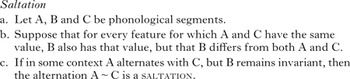
An example of saltation, taken from the work of Bolognesi (Reference Bolognesi1998), is given in (2). In the Sestu Campidanian dialect of Sardinian, the voiceless stops /p t k/ are lenited to [β ð ɣ] when they occur in intervocalic position (examples from Bolognesi Reference Bolognesi1998: 30–31, 36–39).Footnote 2
-
(2)
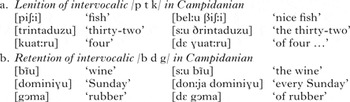
Bolognesi illustrates the productivity of the pattern with examples of application to borrowed or recently introduced words: [polonia] ‘Poland’~[sːa βolonia] ‘(the) Poland’, [tasːi] ‘taxi’~[sːu ðasːi] ‘the taxi’, [komputːε] ‘computer’~[sːu ɣomputːε] ‘the computer’ (1998: 32–33, 463). He further notes that the output pattern is maintained consistently:
speakers … not only do not spirantize voiced stops, but judge this … as entirely ungrammatical, instead. For them a phrase such as, for example, sαː βɔtːα could only be the output of underlying sːα pɔrtα (‘the door’), and never of sːα bɔrtα (‘the time’). They claim the second interpretation to be wrong. (1998: 36)
We adopt the term ‘saltation’ from Minkova (Reference Minkova and van Marle1993) and Lass (Reference Lass1997), who use it in the context of historical sound change; we discuss their claims about diachrony below. ‘Saltation’ derives from the Latin word for ‘leaping’.Footnote 3 As shown in (3), underlying /p/ can be seen as leaping over intervening /b/ in arriving at [β].
-
(3)
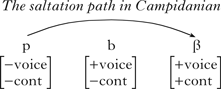
Intuitively, we can think of saltation as a case in which a non-alternating sound B is phonetically ‘intermediate’ between two alternating sounds, A and C. Although the diagram in (3) represents this relationship in a linear fashion for illustration, we are not claiming that this intermediate status must be defined on a single phonetic dimension. Indeed, by referencing phonological features, our formal definition of saltation in (1) explicitly allows the intermediate sound B to be defined in terms of multiple dimensions. The Campidanian case is an example of this, as seen in (3): voiced stops are intermediate between voiceless stops and voiced fricatives on the basis of two dimensions, voicing and continuancy.
The concept of saltatory alternation has been discussed before (Łubowicz Reference Łubowicz2002, Ito & Mester Reference Ito, Mester, Féry and van de Vijver2003, McCarthy Reference McCarthy2003) under the label ‘derived environment effects’. We prefer the term ‘saltation’ because it is theoretically neutral; it describes the data pattern rather than a proposed mode of analysis.Footnote 4
We think that saltatory alternation is disfavoured, in the sense that a UG bias causes language learners to disprefer saltation as a hypothesis. Our support for this claim comes from experimental evidence reported in White (Reference White2013, Reference White2014) and White & Sundara (Reference White and Sundara2014).
If we are correct in claiming that saltation is marked, we must ask why it should exist at all. The answer, we claim, is that diachronically, saltation arises through a variety of accidents, involving borrowing, telescoping and similar factors.Footnote 5 Thus it forms a classic case study for the interaction of synchrony and diachrony in phonology, a topic explored in Kenstowicz & Kisseberth (Reference Kenstowicz and Kisseberth1977) and much subsequent work.
The final topic we address is finding an appropriate theoretical account of saltatory alternations. We suggest that current accounts overgenerate in serious ways, and propose an alternative based on the *Map constraints of Zuraw (Reference Zuraw2007, 2013), which in turn is an implementation of Steriade's (Reference Steriade, Hume and Johnson2001, Reference Steriade, Hanson and Inkelas2009) P-map principle. Our account both avoids overgeneration and provides the basis for a learning bias to explain the experimental findings.
The article is organised as follows. §2 and §3 treat diachrony, arguing for the essentially accidental origin of saltatory alternations. §4 summarises the experimental evidence for a UG bias against saltation. In §5 and §6 we turn to theory, proposing an account that provides the appropriate UG bias, without leading to gross overgeneration in other domains. §7 and §8 address residual issues, and conclude.
1 Theoretical background: the classical theory of phonological change
We situate our discussion of the diachronic aspects of saltation in the context of what we will call the ‘classical’ theory of phonological change. This approach dates from the 19th century (see Anderson Reference Anderson1985), with continuation in more recent times in work such as Bach & Harms (Reference Bach, Harms, Stockwell and Macaulay1972), Hyman (Reference Hyman1975), Anderson (Reference Anderson1981), Labov (Reference Labov1994) and Blevins (Reference Blevins2004). The literature is vast, and we will only give a brief overview.
The key problem is: if, as many scholars believe, the structure of phonological systems is guided by language-independent principles of markedness, how is it that phonological systems can attain unnatural states? Such cases seem to arise especially often for patterns of alternation; in (4) we offer some cases from the literature.
-
(4)
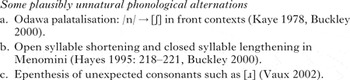
In the classical model, the origin of such unnatural alternations lies in a bifurcation of the sound system into phonetic processes and phonological processes.Footnote 6 The phonetic processes constitute the primary engine driving diachronic change, and are normally subphonemic, involving continuous variation along phonetic continua (e.g. height, rounding). Synchronically, they create free variation, and often reflect stylistic preferences. Phonetic change is seen as natural, involving for instance lengthening of stressed vowels, lenition of intervocalic consonants, palatalisation before front vowels, and so on. Gradient phonetic effects may act as precursors to phonological processes; for instance, /VpV/ may be pronounced more and more similarly to [VbV] over time, due to the voicing present in adjacent vowels, which may itself lead to a phonologised process of intervocalic stop voicing (e.g. Hyman Reference Hyman1975: 172–173, Blevins Reference Blevins2004, Moreton Reference Moreton2008).
The essential premise of the classical approach is that (at least to some degree) phonetic processes are indifferent to the consequences incurred by the higher-level phonological system; for explicit defence of this idea see Labov (Reference Labov1994). As a result, phonetic change, particularly as it accumulates over time, can end up creating patterns that are unnatural when construed in synchronic terms.Footnote 7 The phenomenon is sometimes referred to under the rubric of ‘telescoping’ (Hyman Reference Hyman1975, Kenstowicz & Kisseberth Reference Kenstowicz and Kisseberth1977). To give one example, the gradual changes that led to the modern pronunciation of Middle English long [iː] as [aI] led to the phonetically extreme alternation of [aI]~[I] (Dobson Reference Dobson1968: 659–662) in Modern English trisyllabic shortening alternations such as such divine~divinity. In another case, Kenstowicz & Kisseberth (Reference Kenstowicz and Kisseberth1977: 64–65) describe how Ukrainian acquired the process [o]→[i] in the environment /_C#: roughly, final [oC-I#] and [oC-Ʊ#] evolved to [oːC#] (apocope with compensatory lengthening), then [yːC#] (fronting and raising), then [iC#] (unrounding and loss of phonemic length), while other forms in the paradigm of [oC-V#] stayed unchanged. All the processes that were telescoped were natural, but the end result hardly so.
The telescoping of phonetic changes represents a common way in which languages acquire unnatural phonological patterns. However, the new generations that get exposed to the pattern in childhood are not always passive replicators, but sometimes engage in restructuring, i.e. imperfect phonological learning that creates a novel pattern (see e.g. Kiparsky Reference Kiparsky1965, Kenstowicz & Kisseberth Reference Kenstowicz and Kisseberth1977: 65–77). One classical case of this kind is rule inversion (Kiparsky Reference Kiparsky1965: 1–11, Vennemann Reference Vennemann1972a), of which a famous example has occurred in most non-rhotic dialects of English: what was originally a deletion alternation (sore [sɔː]~sore as [sɔːɹ æz] was restructured as epenthesis, and thus extended to ahistorical cases like saw [sɔː]~saw it [sɔːɹ It]. The reanalysis of formerly stem-final consonants as epenthetic consonants – the inversion of the historical deletion process – is indeed suggested by Vaux (Reference Vaux2002) as a common source of ‘unnatural’ forms of epenthesis. Rule inversion is not the only kind of restructuring; other cases include those treated by Kiparsky (Reference Kiparsky1965, 1982) as rule reordering, as well as paradigm levelling, which can be sporadic (e.g. English fungi [ˈfʌŋgaI] for historical [ˈfʌnʤaI]), or occasionally across the board, with massive changes across the entire vocabulary (see Bowers’ Reference Bowers2012 account of such a change in Odawa).
In sum: the classical theory explains the great variety of natural and unnatural phenomena through a dual bifurcation. At the synchronic level, the essential bifurcation is that of phonetic vs. phonological patterning, with a degree of independence of the former from the latter; this is the seed for the long-term creation of unnatural patterns. Diachronically, the bifurcation is between the cumulative effects of phonetic change on the one hand and grammar change on the other.
3 The historical origin of saltation
How does saltation fit into the classical theory? The first point is that it is unlikely that a saltatory alternation could arise in the simplest possible way, namely as emergence of a single sound change into the phonological system. The reason is straightforward: if (using the format of (1)) sound A gradually drifted in the direction of C, it would trigger a neutralisation with intervening B. This point is asserted by Minkova (Reference Minkova and van Marle1993), Labov (Reference Labov1994) and Lass (Reference Lass1997), all of whom who suggest that single sound changes are never saltatory.
If saltation cannot arise from a single unidirectional sound change, then how do saltatory patterns come to be? By studying the cases we could locate, we have arrived at a simple taxonomy of the origins of saltation, given in (5).Footnote 8
-
(5)
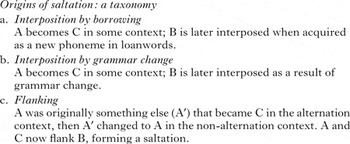
We elaborate these three cases below with examples.
3.1 Interposition by borrowing
A case of this type is described by Ito & Mester (Reference Ito, Mester, Féry and van de Vijver2003) for Standard German: in final position following atonic [I], /g/ surfaces as [ç] (the allophone of /x/ found after front vowels), as in /ˈkøːnIg/ → [ˈkøːnIç] ‘king’ (cf. [ˈkøːnIgə] ‘kings’). Yet underlying /k/ in this position is invariant: [ˈplastIk] ‘plastic’. The sounds [g] and [ç] differ in voicing, continuancy and place of articulation; [k] differs from [g] in voicing, and from [ç] in continuancy and place; hence by definition (1) the alternation is saltatory.
Inspection of the cases with [k] after atonic [I] shows that they are cosmopolitan words; Ito & Mester give examples like Plasti[k] ‘plastic’, Derri[k] (name of television detective) and Bati[k] ‘batik’, patently recent loanwords in German.Footnote 9 The likely reason that [k] had previously been missing finally after stressless [I] was because earlier historical [k] had been converted to [x] by the Second German Consonant Shift; see e.g. Salmons (Reference Salmons2012: 116).
Interposition by borrowing also characterises two other saltations reported by Łubowicz (Reference Łubowicz2002). In Slovak (Rubach Reference Rubach1993), the sounds [e o] alternate in a variety of contexts with the diphthongs [ie uo], thus saltating over [eː oː] ([eː oː] share their vowel qualities with [e o] and their status as heavy nuclei with [ie uo]). The long mid vowels are originally almost entirely from loanwords of the usual pan-European character such as [majoneːz] ‘mayonnaise’ (Rubach Reference Rubach1993: 177). Łubowicz reports a similar case in Polish: here, underlying /g/ surfaces as [ӡ] before front vowels, skipping over intermediate [ʤ] ([g] and [ӡ] differ in continuancy, stridency and place of articulation; [ʤ] differs from [g] in stridency and place and from [ӡ] in continuancy); thus /vag+i+tɕ/ → [vaӡ+ɨ+tɕ] ‘to weigh’, but /brɨʤ+ĭk+ɨ/ → [brɨʤ+ek], not *[brɨӡ+ek] ‘bridge (card-game)+dim’. The forms with invariant [ʤ] are evidently pan-European loans, like the word for ‘bridge’ (see Rubach Reference Rubach1984: §5.3, Łubowicz Reference Łubowicz2002: 245). We see these cases as showing that, at least in some instances, the pressure to be faithful to a foreign-language source can override whatever system-internal pressure there may be (see §4 below) to avoid saltation within the synchronic system.
3.2 Interposition by grammar change
We argue that Campidanian (§1) likewise is a case where B was interposed between a pre-existing alternation of the form A→C. But the mechanism is more interesting: it arose from grammar change. In our proposal, the Campidanian pattern originated as an ordinary lenition chain, shown schematically in (6).
-
(6)
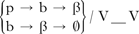
That is to say, historical [p b] (and similarly [t d] and [k g]) weakened intervocalically, while remaining distinct, along the same lenition path. [b], being in the lead, was the first to reach the extreme of full deletion. This was a radical step, in that it created extensive neutralisation (all three voiced stops) in a sensitive place, i.e. stem-initial position (see Beckman Reference Beckman1997, 1998, Casali Reference Casali1997, Becker et al. Reference Becker, Nevins and Levine2012).Footnote 10 We conjecture that when this merger became phonetically complete, the language reached a crisis stage, resolved when a new generation of children refused to accept the extreme alternation, and ‘fixed’ the language by restoring the isolation allomorphs postvocalically. Our scenario is summarised in (7) for the forms for ‘nice fish’ and ‘the wine’.
-
(7)
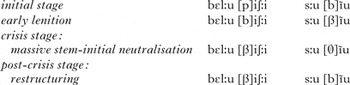
In defending this scenario, we first address whether the conjectured events happened; then, assuming that they did, we speculate on why they happened.
Concerning the factual accuracy of the scenario, we first note that, as Bolognesi points out (1998: 36, citing Virdis Reference Virdis1978), there are neighbouring dialects of Sardinian where the hypothesised early lenition stage in (7) is still attested; that is, voiced stops are still realised as voiced fricatives intervocalically. This increases the plausibility that Campidanian also went through such a stage.
Second, historical evidence indicates that the voiced stops that were intervocalic within morphemes in Campidanian disappeared entirely (Bolognesi Reference Bolognesi1998: 212). The examples in (8) (from Bolognesi Reference Bolognesi1998: 24, 31, 189) illustrate this.
-
(8)
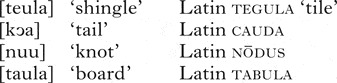
This is to be expected under our account, since a medial voiced stop would not have any other allomorph from which the underlying form could be recovered. In historical linguistics, such relic monomorphemic forms constitute a classical diagnostic for the scenario of sound change followed by grammar change; for examples see Kiparsky (Reference Kiparsky, Bach and Harms1968: 176–179), King (Reference King1969: 46–48), Vennemann (Reference Vennemann, Vennemann and Wilbur1972b) and Bynon (Reference Bynon1977: 144).
Third, Bolognesi notes the existence of particular words beginning with voiced stops that, even in contemporary Campidanian, alternate optionally with zero, as in (9) (from Bolognesi Reference Bolognesi1998: 37).
-
(9)

Such alternation is allowed only in ‘a restricted number of lexical items’ (1998: 190), forming a ‘closed class’ (1998: 215). Other words do not allow alternation at all, as in (10) (from Bolognesi Reference Bolognesi1998: 37).
-
(10)

An examination of the data throughout Bolognesi's work suggests the following generalisation: alternators tend to be words of the core vocabulary, with glosses such as ‘of’, ‘want’, ‘road’, ‘house’, whereas non-alternators are from more sophisticated vocabulary, with glosses such as ‘doctor’, ‘drill’, ‘rubber’, ‘chicory’. We suggest that the alternating forms are relics, dating from the time when intervocalic deletion of voiced stops applied across the board; in this respect they resemble English kept, a relic dating from when pre-cluster shortening was applicable across the board in English. As with relic forms elsewhere in historical phonology, they skew toward the core vocabulary, since it is in core vocabulary that relic forms tend to be retained over time (Bynon Reference Bynon1977: 42–43, Bybee Reference Bybee1985: 119–120).
A further remarkable property of the relic alternating forms is that their Ø-initial allomorphs are employed in careful, not fluent, speech (Bolognesi Reference Bolognesi1998: 36–37); this may reflect the demands of lexical retrieval for listed forms.Footnote 11
Thus, if the arguments just given are correct, Campidanian saltation was never a sound change; rather, it involved interpolation of the voiced stops in the intermediate position by grammar change. We return to the formal analysis of Campidanian below (§6), as well as the question of why the grammar change took place as it did (§7).
A second instance of saltation through grammar change is offered by Itô & Mester (Reference Itô, Mester and Roca1997). In the rendaku (compound voicing) alternations of Conservative Tokyo Japanese, basic /k/ saltates over /g/ in becoming [ŋ], as in /ori+kami/ → [oriŋami] ‘folding paper’. That the alternation is saltatory is shown by forms like /niwa+geta/ → [niwageta] ‘garden clogs’.Footnote 12 The historical evolution of this pattern is plausibly as follows: (a) [k] was originally voiced by rendaku to [g], in parallel with other obstruents; (b) [g] then further evolved to [ŋ] intervocalically in the Conservative Tokyo dialect; (c) lastly, [g] was optionally restored in paradigms (grammar change). As Itô & Mester suggest, this could have arisen through promotion of an output-to-output correspondence constraint (Benua Reference Benua1997) requiring an exact match to [g] in the base form, as in [niwageta]. No base form with [g] is available for [oriŋami], which accounts for its invariant [ŋ].
3.3 Flanking
Ito & Mester (Reference Ito, Mester, Féry and van de Vijver2003) report a saltation in certain northern varieties of German in which the surface form of underlying /g/ in final position is not the expected [k] (via the well-known process of final devoicing) but rather [x], as in [fraːx] ‘asked (1sg)’ (cf. [fraːgən] (1pl)). Since there are also non-alternating forms with [k] (e.g. [dIk] ‘fat’; inflected [dIk-ə]), this is saltation of /g/ to [x] over [k].
A plausible origin for this case is described by Robinson (Reference Robinson2001), relying on earlier work by Schirmunski (Reference Schirmunski1962) and Pilch (Reference Pilch1966): it appears to be not a consequence of sound change but of hypercorrection. In vernacular varieties of North German, earlier [g] evolved into the spirant [ɣ]Footnote 13 whenever it followed a vowel, including intervocalically (Schirmunski Reference Schirmunski1962). For these vernacular varieties, sample paradigms would have evolved as in (11).Footnote 14
-
(11)
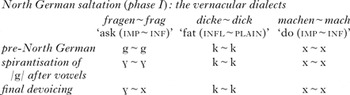
According to Pilch (Reference Pilch1966), North German varieties are subject to normative influences; he mentions the social ‘pressures of educated society’. This influence has given rise to a variety that Pilch calls ‘Refined’ (vornehm) North German, exemplified by the paradigms in (12).
-
(12)

As can be seen, in Pilch's Refined North German – which is in fact the variety Ito & Mester describeFootnote 15 – [ɣ] is replaced (either optionally or obligatorily) by the normative form [g]; thus fra[g]en instead of fra[ɣ]en. Less often, Pilch notes, Refined speakers also southernise forms like fra[x] to fra[k]. Yet it would seem easier to cleanse one's speech of all [ɣ]'s by replacing them with [g] (via a surface, perhaps postlexical operation) than to ‘fix’ only the [x]'s that derive from /g/ with [k]. When a speaker makes the easy repair but not the hard one, the resulting pattern is the saltation seen in (12).
The realism of this scenario is further increased by the existence of speakers (Armin Mester, personal communication) who produce the Refined North German variants in careful, public contexts, but the vernacular forms in casual contexts with family and friends.
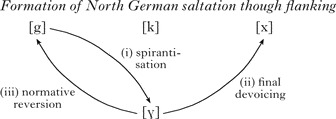
From the diachronic perspective, it can be seen that Refined North German acquired a saltatory alternation through a sort of flanking manoeuvre, as seen in (13): on one flank, historical [g] evolved into [ɣ], thence (in final position only) into [x]. This in itself did not produce saltation; however, a reverse change, the normatively driven shift of [ɣ] back to [g], moved the alternating pair [g]~[x] into a saltatory arrangement with respect to [k]. As with previous cases, saltation was not a direct historical innovation.
-
(13)
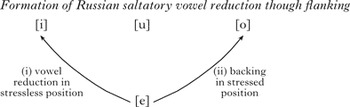
Crosswhite (Reference Crosswhite2000) offers another case of saltation from Russian that likewise can be considered as a case of flanking. Here, phonemic stressless /o/ is reduced to [i] when following a palatalised consonant (and not immediately pretonic), with phonemic stressless /u/ remaining as [u] in the same environment. Since [u] is high like [i] and back and rounded like [o], this is saltation. Crosswhite gives the diachronic background: ‘this unusual pattern of /o/>[i] but /u/>[u] derives historically from the fact that stressed /e/ became [o] when preceded by a palatalized consonant but not followed by one: CʲéC>CʲóC’. In our terms, this is saltation by diachronic flanking, as shown in (14).
-
(14)
Crosswhite also presents evidence that the Russian saltation pattern is no longer productive (at least in certain dialects): it fails to apply to real words newly introduced into Russian, it was emphatically rejected by native speakers in a nonce-word test conducted by Crosswhite and it gives rise to regularising shifts in the pronunciation of existing words. These facts will be relevant below when we consider the synchronic analysis of saltation.
To sum up our historical survey: the data so far given seem compatible with the view that saltation is never the result of a single sound change, but always of secondary factors such as borrowing, telescoping or restructuring.
3.4 Further saltatory alternations
We cover four further cases; these examples constitute all the instances of saltatory alternation of which we are aware.
3.4.1 Manga Kanuri
The Manga dialect of Kanuri (Schuh Reference Schuh2003, Reference Schuh2005, Jarrett Reference Jarrett and Blench2007) constitutes the biggest puzzle for our view that saltation cannot arise directly from sound change. In this language, basic /t/ surfaces as [ð] when between two sonorants, saltating over [d], which is invariant in this position. Historically at least, [ð] was an allophone (non-contrastive variant) of /t/, much as in Campidanian. There are also alternations that persist today, as with the nominaliser prefix /kә̀n-/; as in [tà] ‘catch (vb)’~[kә̀nðâ] ‘catch (n)’; [dóndì] ‘sick’~[kә̀ndóndì] ‘sickness’.
Similarly to the Russian example just given, the Manga Kanuri pattern seems to be breaking down: intervocalic [t] is now phonologically legal in the language and thus contrasts with /ð/; this is attested by about 24 stems with intervocalic [t] in the dictionary of Jarrett (Reference Jarrett and Blench2007), occurring both in European loans and otherwise.
Concerning the history of saltation in Manga Kanuri, we note a particularity of this dialect, namely that the region in which it is spoken was not originally Kanuri-speaking: historically, Kanuri spread westward into areas populated by speakers of Chadic languages, of which Bade and Ngizim still survive as near-islands, now separated from one another by a Kanuri-speaking area (Hutchison Reference Hutchison1981: 4, Schuh Reference Schuh2003, Reference Schuh2005). Both Bade and Ngizim include implosive [ɗ] in their phoneme inventories, making it reasonable to suppose that this was also true of the now-extinct Chadic varieties that were displaced by Kanuri. Our conjecture is that the Chadic speakers who first adopted Kanuri rendered Kanuri [d] with their own implosive [ɗ].Footnote 16 If this [ɗ] was still in place when [t] lenited to [ð] between sonorants; then it was not on the direct path between [t] and [ð] (neither of which are implosive) and the change was therefore not saltatory. Ultimately, the hypothesised Chadic-influenced variety of Kanuri lost [ɗ], shifting it to [d] in conformity with other Kanuri dialects. Thus [d] was interposed between [t] and [ð] (cf. §3.1 and §3.2 above), creating the saltation. This account of Manga Kanuri saltation is speculative, and the matter deserves further attention.
3.4.2 Suma
Discussing the tonal phonology of Suma, Bradshaw (Reference Bradshaw and Akinlabi1995, Reference Bradshaw, Maddieson and Hinnebusch1998, Reference Bradshaw1999) indicates that in the associative construction of this language, a final low tone becomes high when it is preceded by a high tone, resulting in an alternation between a HL pattern and a HH pattern. Bradshaw states that ‘nouns with final H or M tones do not alternate’ (1998: 117); however, no examples of this type are given, nor are the possible historical origins of the claimed saltation discussed.
3.4.3 Makassarese
McCarthy (Reference McCarthy2003) offers what may be an additional example of saltation from Makassarese (Aronoff et al. Reference Aronoff, Arsyad, Basri and Broselow1987), namely /{r l s}#/→[{r l s}Vʔ#], with a form of glottal epenthesis that is not found for simple underlying final vowels (i.e. /V#/→[V#]). This would be an interesting case of saltation, because it involves segment sequences, not individual segments, and thus falls outside the scope of the definition in (1). The case for saltation here is not ironclad, however, because the contexts of the two changes are different: given the Makassarese stress pattern, stable final [V] is always directly posttonic, whereas derived final [Vʔ] occurs only when there is antepenultimate stress. Inkelas (Reference Inkelas, Kager, van der Hulst and Zonneveld1999: 145) and Anttila (Reference Anttila, Cohn, Fougeron and Huffman2012: 87) have suggested constraints that forbid heavy syllables in clash; if present in Makassarese, such constraints could independently block the appearance of [ʔ] for underlying final [V]; i.e. [ˈCVCVʔ] from /CVCV/ would be clashing, [ˈCVCVCVʔ] from /CVCVC/ would not.
3.4.4 A second saltation in Campidanian
Campidanian also saltates voiced geminates /bː dː gː/ to [β ð ɣ] crossing over [b d g]; this saltation is discussed in §6.4 below.
3.5 Local summary
As summarised in §2, the classical framework of phonological change provides a plausible account of the origin of unnatural phonological alternations via telescoping and restructuring. We have supported the view, expressed by Lass, Minkova and Labov, that there is no need to appeal to saltatory sound changes to explain the existence of synchronic saltatory alternations. Indeed, saltatory alternations appear to constitute a classic illustration of the variegated ways in which telescoping and restructuring can give rise to surprising synchronic patterns, just as the classical theory maintains.
4 Evidence for a learning bias against saltation
We turn now to synchrony, asserting that saltation is a marked phenomenon, disfavoured as a hypothesis by language learners. In making this claim, we cannot rely on a traditional source of evidence in phonology, namely the rarity of a phenomenon across languages. Should saltation be rare (we suspect it is, but our data do not suffice to prove it), we already have an explanation, namely that it requires exceptional diachronic circumstances to come into being. Instead, the evidence must come from direct observation of language learners. For instance, we might expect that children learning Campidanian would have difficulty, making errors such as converting /b/ to [β] in intervocalic position.Footnote 17 Sadly, it would be difficult to verify this point, since it appears that very few, if any, young children are still learning this language (Bolognesi Reference Bolognesi1998: ch. 1).
A more feasible research path is to test the acquisition of saltatory patterns in artificial language learning experiments. Recent work in this area has yielded results that suggest that saltation is indeed difficult to learn. White (Reference White2013, Reference White2014) exposed adult English-speaking participants to an artificial language containing phonological alternations comparable to those seen in Campidanian: voiceless stops ([p t]) changed to voiced fricatives ([v ð]) intervocalically, but voiced stops ([b d]) did not alternate. Despite their training, participants frequently spirantised voiced stops in error when tested on novel forms. Control conditions indicated that the errors were due to an anti-saltation effect, and not merely to factors such as rule overgeneralisation or product-oriented learning.
Indeed, the same pattern emerges in experiments on infants. White & Sundara (Reference White and Sundara2014) exposed 12-month-old infants to potentially saltatory alternations (e.g. [p~v]) in an artificial language; infants who learned the [p~v] alternation generalised to [b~v], but not vice versa. Further, Sundara et al. (Reference Sundara, Jung Kim, White and Chong2013) show that American English-learning infants acquire the [d~ɾ] alternation (pad~padding), but not the [t~ɾ] alternation (pat~patting), by twelve months. Sundara et al.'s corpus search revealed that there is greater statistical evidence for the [t~ɾ] alternation in infants’ language input, suggesting that the earlier acquisition of the [d~ɾ] alternation is due to a learning bias. These results are consistent with our proposal that saltation is dispreferred: if infants had instead learned the [t~ɾ] alternation before the [d~ɾ] alternation, this would be a saltation, because [d] is intermediate between [t] and [ɾ] by our definition in (1).
In some instances, data from language change also suggest that saltation may be dispreferred during learning: as already mentioned (§3.3), Crosswhite (Reference Crosswhite2000) documented ongoing synchronic breakdown of the Russian [o] – [u] – [i] saltation, and in Manga Kanuri (§3.4.1) the formerly allophonic relationship of [t] and [ð] has broken down with the admission of new forms with intervocalic [t]. Yet we cannot always expect to see such traces: it may well be that adult speakers of languages with saltation are often exposed to such extensive data that they do learn their language successfully; in particular we noted in §1 Bolognesi's argument that Campidanian saltation is productive.
A striking case of acquisition error may be evident in the spirantisation pattern of Logudorese, a Sardinian dialect related to Campidanian (Ladd & Scobbie Reference Ladd, Scobbie, Local, Ogden and Temple2003). Here, the same kind of relic forms noted in §3.2 above for Campidanian ([ˈbakːa]~[sa ˈakːa]) demonstrate that in this dialect voiced stops originally lenited to zero intervocalically, just as they did in Campidanian. But the innovating (and probably productive) pattern in contemporary Logudorese is to lenite underlying intervocalic /b d g/ to [β ð ɣ], neutralising them with underlying /p t k/; thus [duˈtɔːɾε] ‘doctor’~[su ðuˈtɔːɾε] ‘the doctor’ neutralised with /t/ in [ˈtεra] ‘land’~[sa ˈðεra] ‘the land’.Footnote 18 It is tempting to suppose Logudorese ancestrally had the same pattern as Campidanian, and evolved into its current state by precisely the kind of acquisition error committed by White's experimental subjects.
In sum, evidence from recent experimental work with adults and infants as well as historical change suggests that saltatory patterns are difficult to learn or otherwise dispreferred by learners.
5 Synchronic theories of saltation: earlier accounts
We turn now to theoretical approaches to the synchronic analysis of saltation. The discussion above offers possible criteria of adequacy for such analyses. Whatever theory we adopt should include some element to which we can attach the imputation of difficulty in learning, in order to be able to explain the experimental and language-change evidence just adduced. More straightforwardly, the theory should predict that saltation is at least possible; since it appears that on occasion, when historical change dishes up a saltatory pattern, language learners have been able to maintain it productively for some period of time.
We will also invoke one further criterion of adequacy, namely restrictiveness. In general, phonologists have sensibly preferred theories that do not allow the generation of bizarre patterns unattested in the world's languages; and we will invoke this form of argument in assessing the theories reviewed below.
5.1 Why saltation cannot be derived in classical Optimality Theory
We begin by repeating the arguments of Łubowicz (Reference Łubowicz2002) and Ito & Mester (Reference Ito, Mester, Féry and van de Vijver2003) that saltation cannot be derived in ‘classical’ Optimality Theory. By the latter we mean Prince & Smolensky (Reference Prince and Smolensky1993), as modified by the Correspondence Theory of McCarthy & Prince (Reference McCarthy, Prince, Beckman, Dickey and Urbanczyk1995).
Consider first Campidanian. When /p t k/ shift to [β ð ɣ] in intervocalic position, they become voiced; in standard OT this will follow if a markedness constraint banning intervocalic voiceless sounds (*V[−voice]V) outranks the opposing faithfulness constraint for voicing, Ident[voice]. In addition, when shifting to [β ð ɣ], /p t k/ become [+continuant]. This will follow if a markedness constraint banning intervocalic stops (*V[−cont]V) outranks the opposing faithfulness constraint for continuancy, Ident[cont]. As shown in (15), a grammar that respects these rankings will generate [aβa] from underlying /apa/ for the bilabial case.Footnote 19
-
(15)
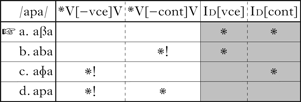
However, since V[−cont]V outranks Ident[cont], /aba/ will likewise surface as [aβa], as in (16), which is incorrect.
-
(16)

Thus there is a ranking contradiction: V[−cont]V must outrank Ident[cont] in order to let /p/ go all the way to [β], but Ident[cont] must outrank V[−cont]V in order to keep intervocalic /b/ unaltered.
Now consider the general case, A→C with intermediate unchanging B. The rankings that send A to C will also wrongly send B to C, for given our definition of saltation in (1), the faithfulness violations incurred in changing B to C are a subset of those incurred in changing A to C. Thus, the faithfulness constraints cannot prevent B from changing to C. Moreover, the same end cannot be achieved by assigning a sufficiently low ranking to the markedness constraints that favour changing B to C; under this strategy, A would wrongly change to B rather than C. Such considerations suggest that analysing saltation is, in general, beyond the scope of classical OT.
5.2 The constraint-conjunction approach
If classical OT cannot treat saltation, what can? Łubowicz (Reference Łubowicz2002) proposes to employ local constraint conjunction, in the sense of Smolensky (Reference Smolensky1995).Footnote 20 This solution was adopted by Crosswhite (Reference Crosswhite2000) for Russian and by Ito & Mester (Reference Ito, Mester, Féry and van de Vijver2003) for German. The crucial idea is to conjoin a markedness constraint with a faithfulness constraint, which for Campidanian would work as in (17).
-
(17)

This constraint says that a segment should not be simultaneously unfaithful (with regard to Ident[voice]) and marked (with regard to *V[−cont]V]). Intuitively, this can be expressed as: ‘do not have an intervocalic stop that already violates faithfulness to [voice]’. Under this set-up, intervocalic /p/ cannot surface as [b], though voicing-faithful /b/ is allowed to do so. (18) gives tableaux illustrating this point.
-
(18)
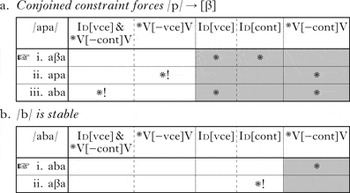
However, as originally pointed out by Itô & Mester (Reference Ito and Mester1998), the cost of this solution for phonological theory as a whole is extremely high: it leads to a broad licence for marked entities to be favoured over unmarked ones, contrary to typology. We demonstrate this here with our own example, constructing a hypothetical language whose phonology is highly implausible.
We assume some garden-variety constraints: (a) a markedness constraint, *[−son, +voice], banning voiced obstruents (e.g. Lombardi Reference Lombardi1999), (b) an opposing faithfulness constraint, Ident[voice], (c) a markedness constraint, *CCC, banning triple consonant clustersFootnote 21 and (d) an opposing faithfulness constraint, Max(C). We assume that our language in the normal case forbids voiced obstruents (as in Hawaiian and other languages), and hence employs the ranking *[−son, +voice]≫Ident[voice]. We also assume that our language permits triple clusters, so that Max(C)≫*CCC. Now we conjoin markedness and faithfulness constraints to create Ident[voice]&*CCC, and rank the resulting constraint above *[−son, +voice]. The result is that in our hypothetical language, voiced obstruents are allowed, but only when they occur as part of a triple cluster. The tableaux demonstrating this are given in (19).
-
(19)
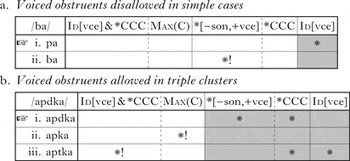
We certainly know of no language that permits voiced obstruents only in triple clusters, and do not expect to encounter one. At the very least, it is grossly counterintuitive to think that appearance in a highly marked configuration (CCC) would permit the appearance of otherwise illegal segments.
The example can be generalised as follows. Assume two markedness constraints, M1 and M2, which are independent and can be violated in the same location. In general, violations of M1 are not allowed, because M1 dominates the opposing faithfulness constraint, F1. Moreover, F2 is ranked above both M1 and M2, meaning that violations of these markedness constraints cannot be resolved by violating F2. Finally, a conjoined constraint, F1&M2, dominates M1. The result will be a language in which M1 can be violated only when M2 is also violated. For comparison, the rankings for both the general scheme and its specific instantiation above are given in (20).
-
(20)
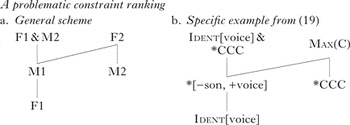
The general scheme can be cashed out as a panoply of bad typological predictions, for instance the existence of languages in which nasalised low vowels are confined to stressless syllables, front rounded vowels occur only in hiatus, contour tones are limited to creaky vowels, and so on. It is patently the case in phonology that adding a marked context does not make it easier to violate a markedness constraint; often it makes it harder (which is why conjoined markedness constraints often make sense; Ito & Mester Reference Ito, Mester, Féry and van de Vijver2003). For this reason, we feel that it would be sensible to ban markedness–faithfulness conjunctions from phonological theory entirely; this is proposed by Itô & Mester (Reference Ito and Mester1998: 13) under the title ‘restriction on conjoinability’.Footnote 22
5.3 The comparative markedness approach
Another earlier approach to saltation is provided by McCarthy (Reference McCarthy2003), who includes saltation among the phenomena to be treated in his proposed theory of comparative markedness. Under this approach, each markedness constraint M is replaced with two constraints, OM and NM. OM only assesses markedness violations that are ‘old’, meaning that the violations are present in the fully faithful candidate.Footnote 23 NM only assesses markedness violations that are ‘new’, meaning that the violations are not present in the fully faithful candidate. OM and NM may be freely ranked within the constraint hierarchy. It is easy to see that this scheme could give rise to saltation: in cases where A saltates over B to C, high-ranked *NB forces underlying A to surface as C, whereas low-ranked *OB permits underlying B to remain in place.
Applied to Campidanian, this would work as in (21). First, the markedness constraints N*V[−voice]V and O*V[−voice]V are both undominated, forcing all intervocalic obstruents to be voiced. In addition, we assume the markedness constraints N*VDV and O*VDV, which ban ‘new’ and ‘old’ intervocalic voiced stops. N*VDV is undominated, so newly derived voiced stops are not allowed intervocalically; as a result, underlying /apa/ becomes [aβa] rather than [aba] (see (21a)). Crucially, O*VDV is ranked below Ident[cont], so that the ‘old’ intervocalic voiced stop found in underlying /aba/ is protected from spirantisation, as seen in (21b).
-
(21)

Comparative markedness has a clear formal connection with the constraint-conjunction approach (see Łubowicz Reference Łubowicz2003). The crucial similarity is the ability of markedness constraints to assess violations only in cases where a candidate is also unfaithful. In constraint conjunction, this is accomplished by conjoining markedness constraints to faithfulness constraints. In comparative markedness, the same effect is accomplished by allowing NM constraints to assess only those markedness violations that are not present in the fully faithful candidate. In each case, markedness constraints are given access to faithfulness, blurring somewhat the traditional distinction between markedness and faithfulness.
Assessing the comparative markedness approach in general terms is a major undertaking, as it has many ramifications (see, notably, McCarthy Reference McCarthy2003 and the commentary papers in the same issue of the journal Theoretical Linguistics, as well as Hall Reference Hall2006). Here we point out only that the same kind of ‘phonotactic monsters’ (e.g. voicing contrasts only between obstruents) that were discussed above for the conjoined-constraint approach may also arise in comparative markedness. We demonstrate this with another hypothetical language.
Once again, we assume several garden-variety constraints: (a) two markedness constraints, O*[−son, +voice] and N*[−son, +voice], banning ‘old’ and ‘new’ voiced obstruents, (b) two markedness constraints, OAgree and NAgree, which are violated whenever adjacent obstruents disagree in voicing, (c) two markedness constraints, O*p and N*p, specifically banning [p] (e.g. as in Arabic and many similar languages with ‘[p]-gaps’ in their stop inventories; see Maddieson Reference Maddieson1984: 35), and (d) the faithfulness constraint Ident[voice]. Consider the ranking of these constraints in (22).
-
(22)

In this hypothetical language, there is no contrast between voiced and voiceless obstruents in general, as seen in (23). Underlying non-labial voiced stops surface as voiceless because O*[−son, +voice]≫Ident[voice]; underlying /b/ and /p/, however, surface as [b] because O*p≫N*[−son, +voice] (i.e. it is better to avoid an old [p] even if doing so requires a new voiced obstruent), and N*p≫O*[−son, +voice] (i.e. it is better to avoid a new [p] even if that means retaining an old voiced obstruent).
-
(23)
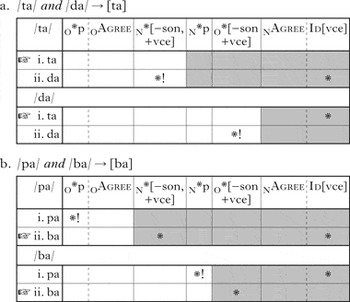
However, the contrast between /p/ and /b/ is maintained when the sounds are surrounded by two voiceless obstruents, as seen in (24). Moreover, the contrast is maintained by α-switching: /atbka/ surfaces as [atpka], whereas /atpka/ surfaces as [atbka].Footnote 24
-
(24)
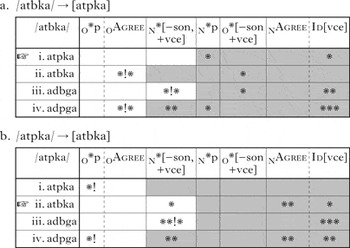
The reasoning is as follows. Because OAgree is undominated, the two Agree violations in underlying /atbka/ in (24a) must be resolved, ruling out candidates [atbka] and [adpga].Footnote 25 N*[−son, +voice]≫N*p, so the candidate with two new voiced obstruents, [adbga], loses to the candidate with a new [p]. Thus, /atbka/ surfaces as [atpka]. For input /atpka/ in (24b), undominated O*p rules out candidates [atpka] and [adpga], because the underlying /p/ cannot be maintained. Moreover, N*[−son, +voice]≫NAgree, so [atbka] wins over [adbga]; even though the winner introduces two Agree violations that were not present underlyingly, this is preferable to introducing three new voiced obstruents. The result is that the underlying contrast between /p/ is /b/ is maintained in this context, flipping the value of the feature [voice].
A look at the factorial typology suggests that this scenario is not an isolated one. We computed the factorial typology of this constraint set using OTSoft 2.3.3 (Hayes et al. Reference Hayes, Tesar and Zuraw2013). Of the 5040 possible rankings of the constraints, there were 45 unique patterns of winners based on the inputs listed above. Of these 45 patterns, five contained a contrast between /p/ and /b/ only in / C_C contexts.
Again, we judge that the type of phonological behaviour represented in this hypothetical grammar is unlikely to be encountered in any natural language. As with the conjunction of markedness and faithfulness constraints, the fact that such patterns are readily derived with comparative markedness raises questions about whether the potential cost of the theory is too high.Footnote 26 As with markedness–faithfulness conjunction, it is conceivable the absence of ‘monster’ phonotactic patterns has a purely diachronic explanation, but all else being equal it seems best to have a phonological theory that doesn't generate them.
Below we present an alternative analysis of saltation that does not make such typological predictions.
6 The analysis of saltation using P-map theory
6.1 Framework: *Map cum P-map
Zuraw (Reference Zuraw2007, 2013) proposes to augment the theory of faithfulness beyond the simple constraint types of McCarthy & Prince (Reference McCarthy, Prince, Beckman, Dickey and Urbanczyk1995). In her approach, a constraint of the form *Map(x, y) assesses a violation to a candidate if a segment belonging to natural class x in the input is mapped to a corresponding segment in natural class y in the output.Footnote 27 An aspect of Zuraw's theory that will be essential here is that unlike in classical correspondence theory with Ident constraints, *Map constraints can be non-minimal; specifically, they do not require that the corresponding segments x and y differ in just one feature. Thus, for instance, one could assume a *Map constraint that penalises input–output pairs like /p/–[β], which differ in both voicing and continuancy.
The theory is thus made more powerful; in compensation, it is constrained in substantive terms. Zuraw suggests that the natural rankings of *Map constraints are largely determined by phonetics. Specifically, Zuraw adopts from Steriade (Reference Steriade, Hume and Johnson2001, Reference Steriade, Hanson and Inkelas2009) the principle of the P-map, or perceptual map, which encodes the perceptual distance between all segment pairs in all contexts. In this approach, *Map constraints are assigned a default ranking as follows: constraints banning changes that cover a larger perceptual distance are assigned a default ranking higher than constraints banning smaller changes. This ranking preference is taken to be a learning bias in UG; however, given sufficient evidence in the ambient language, it is possible for learners to subvert the default rankings (Zuraw Reference Zuraw2007: 297). As we will see (§6.5), this learning bias is crucial in explaining the experimental data on saltation mentioned above in §4.
The basic prediction of the *Map-cum-P-map proposal – that phonetically salient alternation is disfavoured in comparison to less salient alternation – is supported by a wide variety of evidence. Zuraw uses it to explain the preferred locations for infixes in initial clusters of Tagalog: they occur where the phonetic change induced in the stem is least salient. Similarly, Fleischhacker (Reference Fleischhacker2001, Reference Fleischhacker2005) and Shademan (Reference Shademan2002) give evidence that in epenthesis alternations it is preferable to place the epenthetic vowel in the location that changes the stem least saliently. Wilson (Reference Wilson2006) discusses the direction of generalisation taken by participants in an artificial language study, and suggests that they generalise it to novel cases with less phonetically salient alternation, but not to novel cases where alternation is more salient. Similar experiments, showing that people have difficulty in learning arbitrary phonological alternations that are phonetically extreme, have been carried out by Skoruppa et al. (Reference Skoruppa, Lambrechts and Peperkamp2011) and Stave et al. (Reference Stave, Smolek and Kapatsinski2013). Lofstedt (Reference Lofstedt2010) shows that paradigm gaps in Swedish vowel-length alternations have arisen in precisely those cases where the distance between long and short vowel pairs is phonetically greatest, owing to concomitant differences of vowel quality. In language acquisition, children are observed to innovate non-adult-like forms that diminish degree of alternation in the paradigm (Hayes Reference Hayes and Kager2004, citing Kazazis Reference Kazazis1969 and Bernhardt & Stemberger Reference Bernhardt and Stemberger1998). Lastly, there is evidence that in historical change, phonologies are sometimes restructured by a new generation of learners in ways that reduce the phonetic distance of an alternation (Kiparsky Reference Kiparsky1982).
6.2 Basics of the proposed analysis
Consider now how the *Map-cum-P-map approach would be applied to the problem of saltation. The idea is that, given sufficient data to override a learning bias, the system permits rankings that make it possible to analyse saltation. In particular, a *Map constraint banning correspondence at a greater phonetic distance could be exceptionally ranked below a *Map constraint banning correspondence at a lesser, subset distance. For Campidanian, the required unnatural ranking is *Map(b, β)≫*Map(p, β).Footnote 28 Intuitively, this ranking means that it is less bad for voiceless stops to alternate with voiced fricatives than it is for voiced stops to do so, despite the phonetic distances involved. This is what permits /p/ to spirantise but not /b/. The crucial tableaux are given in (25).
-
(25)
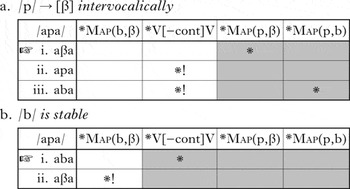
It is clear from the tableaux that for the analysis to work we must have *Map(b, β)≫*V[−cont]V (to block spirantisation of /b/) and also *V[−cont]V≫*Map(p, β) (so that /p/ will spirantise). By transitivity, this yields *Map(b, β)≫*Map(p, β), in violation of the P-map. Thus, although Campidanian is a possible phonology, it is claimed to be harder for language learners, since it requires a ranking that is not P-map-compliant.
6.3 The complete analysis
To make sure our analysis works, we carried it out again, with additional candidates and constraints. In addition to the core cases /apa/→[aβa] and /aba/→[aba], we must make sure that (a) /p/ and /b/ are stable when not intervocalic: /pa/→[pa], /ba/→[ba], and (b) [β] does not surface except when derived by spirantisation from /p/. For the latter, we follow the principle of the rich base (Prince & Smolensky Reference Prince and Smolensky1993: §9.3), requiring that illegal forms surface as something legal. In particular, hypothetical /βa/ must surface as some legal form, which (as it turns out) our analysis predicts to be [pa], and /aβa/ must likewise surface as something legal, which (as it turns out) our analysis predicts to be [aβa].
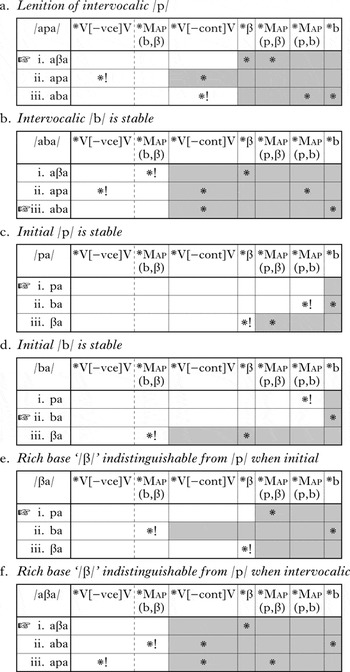
As candidates we included all three possible output consonants ([p b β]) for all of our input forms, which cover all three consonants in both initial and intervocalic environments. We also assumed for present purposes that the *Map constraints are symmetrical, so that /pa/→[ba] and /ba/→[pa] are equally penalised by *Map(p, b).
We executed the analysis using OTSoft 2.3.3 (Hayes et al. Reference Hayes, Tesar and Zuraw2013), which ranked the constraints using Recursive Constraint Demotion (Tesar & Smolensky Reference Tesar and Smolensky1995), suitably constrained to respect the a priori ranking *Map(p, β)≫*Map(p, b).Footnote 29 The resulting tableaux are given in (26).
-
(26)
For the sake of rigour we determined the ranking argumentation not by hand, but by using the Fusional Reduction Algorithm of Brasoveanu & Prince (Reference Brasoveanu and Prince2011), as implemented in OTSoft. Applied to the winner–loser pairs contained in the tableaux, the Fusional Reduction Algorithm yielded a simple pattern consisting of one strictly ranked chain of length six, plus one unranked constraint.
-
(27)

Intuitively, the ranking arguments are as follows. *Map(b, β) must dominate *V[−cont]V in order to avoid spirantisation of /aba/ in (26b). *V[−cont]V must dominate *β, because although [β] is generally avoided in the language, it is tolerated in order to avoid a spirantisation violation, as in (26a). *β must dominate *Map(p, β) (equivalent to *Map(β, p), under our assumption of symmetry), because in our analysis the rich-base input /βa/ surfaces as [pa] ((26e)). *Map(p, β) must dominate *Map(p, b) under the theoretical assumption that language learners adopt P-map-compliant rankings whenever evidence to the contrary is not present. *Map(p, b) dominates *b, the normal ranking in languages such as Campidanian, where voicing in obstruents is phonemic; see (26d). The constraint *V[−voice]V, though it can be placed top of the rankings (it is unviolated in winners), could actually be ranked anywhere at all; indeed, for the data given, the analysis works when *V[−voice]V is removed from the constraint set.Footnote 30
The analysis succeeds in ruling out any unattested patterns of alternation. If any forms are assigned underlying /β/, they will surface with [β] intervocalically and [p] elsewhere – i.e. exactly like underlying /p/. If Campidanian learners capriciously chose an underlying form with /β/, it would be undetectable in their speech, which is what we want. Appropriate rankings of the *Map constraints involving voiceless fricatives would likewise render any underlying /ɸ/ harmless.
For other cases of saltation, similar analyses can easily be constructed. The common theme is the non-default ranking of a *Map constraint that bans a long ‘phonetic path’ of alternation below a *Map constraint that bans a subset of this path.
6.4 A second saltation in Campidanian
For completeness, we mention that Campidanian possesses a second saltatory alternation. The voiced geminate stops [bː dː gː], which are themselves normally derived from underlying clusters, are in a state of free variation: sometimes they are realised as such, but more often they are lenited to [β ð ɣ], thus merging with underlying /p t k/ (Bolognesi Reference Bolognesi1998: 48). Since (as before) singleton [b d g] do not lenite, this is another saltation: [bː] – [b] – [β]. The diachronic origin of this saltation is the same as before; namely the restoration of [b] in intervocalic position by grammar change.Footnote 31
We have found that it is not hard to model this saltation with the same basic devices used above; the essential aspect of the analysis is a non-P-map compliant ranking, *Map(b, β)≫*Map(bː, β). Full tableaux and Hasse diagrams can be found in the online supplementary materials.
As a reviewer points out, our *Map approach makes predictions across phonological processes: the aberrantly high ranking of *Map(b, β) is the cause of both Campidanian saltations. Such predictions are not made by theoretical alternatives such as ‘crazy rules’ (in rule-based phonology) or ‘anticorrespondence’ constraints (Hayes Reference Hayes, Hermans and van Oostendorp1999).
6.5 Accounting for experimental results on learning bias with computational modelling
We briefly discuss here how the analysis we have presented can be adapted to explain the experimental results described above (§4). Recall that when experimental participants are exposed to alternations like [p]~[v], they tend to generalise the pattern to [b]~[v], despite the presence of non-alternating [b] in the training data. We show how this can be accounted for using the P-map framework assumed above; the discussion below briefly summarises White (Reference White2013: ch. 4).
In order to model the P-map-based learning bias, White shifts from the classical OT model used above to the closely related framework of maximum entropy grammar (Goldwater & Johnson Reference Goldwater, Johnson, Spenador, Eriksson and Dahl2003). White employs essentially the constraints assumed above in our Campidanian analysis, namely *V[−voice]V, *V[−cont]V and all relevant *Map constraints. As a first step, he establishes a phonetically realistic and quantitatively explicit P-map, using confusion matrices from earlier perception experiments. The P-map is then used as the basis for establishing Gaussian priors (i.e. preferred values) on the weights of the *Map constraints. As a result, the learning model has an a priori expectation that *Map constraints will be weighted more highly if they penalise correspondences spanning large phonetic distances. In implementing the P-map bias by way of the prior, White follows the general approach pioneered by Wilson (Reference Wilson2006), though White's implementation differs in various ways.
The model was used to conduct a learning simulation of the artificial language experiments described above in §4. The training data for the model were identical to the set of forms that the participants received in the experiments. When the learned grammar was tested on the same data used for the test items with human participants, it achieved a close approximation of human performance. In particular, when trained on alternations like [p]~[v], the model also generalised to [b]~[v], even when cases of non-alternating [b] were presented during training.
If these experimental and modelling results can be extrapolated to real languages, then they offer the possibility of explaining the cases of historical change (§4) in which saltatory systems broke down, the idea being that this occurred because saltation was difficult for new generations of language learners to acquire. Going further, if, as we suspect, saltatory alternations are rare, learning bias could be taken as a contributing explanation for their rarity. This idea must be regarded as quite speculative, for three reasons: we don't know for sure whether saltation is rare, we have only given limited evidence that it is unstable, and the rarity of saltation is already expected on diachronic grounds if, as we argued (§3), it cannot be produced by sound change. Thus saltation is a classic instance of Moreton's dilemma (2008): it is very often the case that we cannot confidently attribute a typological pattern to channel bias (i.e. diachronic explanation) or analytic bias (the factor demonstrated in White's experiments). In sum, we think far more evidence must be gathered if we are to make any sort of confident assertion that White's results bear on phonological typology.
6.6 Can the P-map approach overgenerate?
In §5.2, we argued that the conjoined constraint approach – specifically, the conjunction of markedness and faithfulness constraints – should be avoided in phonological theory due to the bad typological predictions about phonotactics that arise when such conjunctions are allowed. In §5.3 we suggested that similar bad predictions emerge from the theory of comparative markedness, though as yet we have no systematic understanding of the basis from which they arise. The *Map approach that we propose here also allows marked patterns to arise in synchronic phonology; indeed, saltation, as we have argued, is one of them. However, we hold that the *Map-cum-P-map approach is more principled in the types of marked patterns that it allows.
Let us return to our earlier example, in which theories wrongly predict the existence of languages that contrast /p/ and /b/ only when flanked by obstruents; as we showed, both constraint conjunction and comparative markedness can derive this pattern. Moreover, the relevant analyses employ only garden-variety phonological constraints. In the constraint-conjunction theory, it was sufficient to conjoin Ident[voice] with a constraint banning consonant clusters. For comparative markedness, the relevant constraints were ‘old’ and ‘new’ versions of Agree[voice], *[−son, +voice] and *p, all of which have strong typological support. Therefore, the problems seem to reside in the core mechanisms used in these theories, rather than in the particular constraints being employed.
Could the *Map-cum-P-map approach generate comparable phonotactic ‘monsters’? We judge that, suitably constrained, it will not. There are two circumstances under which the approach could generate a monster. First, and trivially, Con could include constraints that ban configurations that we recognise as phonotactically good rather than bad. An example would be a ban on non-branching onsets, so that /pa/ surfaces (say) as [pra]. This bad possibility is shared by all theories, and it seems reasonable for any theory to assume a Con component that does not include such pathological markedness constraints.
The special properties of the *Map-cum-P-map approach reside not in its markedness constraints, but in its faithfulness constraints, and especially in the possibility of their being ranked in ways that go against the P-map. Monsters could arise if a *Map constraint somehow permitted a repair to occur only in a marked context, as with, say *Map(p, b) / [−son]_[−son], forbidding changes in voicing for /p/ or /b/ flanked by obstruents. With a constraint of this sort, we could derive a pattern where obstruents contrast in voicing only when flanked by other obstruents by ranking the *Map constraints in the anti-P-map fashion: *Map(p, b) / [−son]_[−son]≫*p≫*Map(p, b) / #_V. This would permit /atpka/ and /atbka/ to surface faithfully, but would force /pa/ to be repaired as [ba], neutralising it with /ba/ and creating a monster similar to what we saw in §5.3.
The monster will arise only if we permit the theory to include faithfulness constraints that militate against alternation in marked contexts, such as [−son]_[−son]. The appropriateness of contextually limited faithfulness itself has been questioned (Prince & Tesar Reference Prince, Tesar and Kager2004: 277–278), but those contextually limited faithfulness constraints that have been proposed tend to invoke unmarked contexts; for instance, Beckman (Reference Beckman1998) proposes onset faithfulness, root-initial faithfulness and stressed-syllable faithfulness, all plausibly unmarked. Thus, assuming that we specify that phonological theory must forbid faithfulness constraints that specifically invoke marked contexts, we think that the phonotactic overgeneration problem that faces constraint conjunction and comparative markedness does not face the P-map approach.
Turning from phonotactics to alternations: it is unquestionably the case that the *Map-cum-P-map approach can generate pathological alternation types – but we think that these exist, and saltation is just one of them. We think it an advantage of the *Map-cum-P-map approach that it comes with a more principled way of determining how marked one pattern is relative to another, namely a substantive bias based on the P-map.
7 How does grammar change create saltation?
We turn finally to a problem about which we can only speculate. As we argued in §3.2, the saltatory pattern of Campidanian was itself created by grammar change; specifically, the voiced stop~Ø alternations were largely levelled in favour of non-alternating voiced stops. But how did grammar change achieve a configuration that we have just characterised as a marked one? We speculate as follows. First, some principle of neutralisation avoidance may have been at play (e.g. following Flemming Reference Flemming1995, Reference Flemming, Hayes, Kirchner and Steriade2004, Bolognesi Reference Bolognesi1998: ch. 5 and Padgett Reference Padgett2003, Reference Padgett2009): the reversion of voiced stops keeps the three places of articulation [b d g] from neutralising with each other, and is ‘better’ than reverting to [β ð ɣ], which would have involved neutralisation with underlying /p t k/. Second, there is the possibility that grammar change is sometimes ‘locally improving’, in the sense laid out by Kiparsky (Reference Kiparsky1978): the complete reversion of the voiced stop~Ø constituted a huge local improvement with respect to the P-map for these alternations considered alone, though it created a disfavoured ranking of the *Map constraints in the grammar as a whole, creating a less favoured grammar at the global level. We consider it a challenge for future work in modelling phonological learning and grammar change to provide formal models that can account for the Campidanian change, as well as the changes that appear to be levelling out saltation in Russian and Manga Kanuri.
8 Conclusion
We offer conclusions in three areas.
Concerning the role of biases in phonological learning, we think the evidence we have examined points to a moderate stance, ruling out two extremes. If the P-map bias we posit did not exist, then we could not explain the experimental results described in §4. But if the bias were extreme, saltatory alternations would not exist at all.
Concerning diachrony, our exploration of the origins of saltation supports the view of Minkova (Reference Minkova and van Marle1993) and Lass (Reference Lass1997) that it never arises from sound change but comes from factors like telescoping or restructuring; it is a classic case of ‘unnatural’ phonology.
Concerning restrictiveness in phonological theory, we argued that a learning-bias approach using Zuraw's *Map cum P-map is more promising than conjoined constraints or comparative markedness: *Map cum P-map is not only supported as a learning bias by experimental data, but also avoids the problems faced by earlier accounts of generating implausible phonotactic patterns.



