Introduction
At the scene of a major incident or disaster, medical first responders establish Command and Control, then proceed with the triage process.Reference Hodgetts and Porter1 Triage is a method of sorting patients into categories according to priorities and available resources. The goal is to identify rapidly the most seriously injured who are in need of immediate medical measures and/or transport to a medical facility, essentially getting the right patient to the right place at the right time. When there are a large number of casualties, triage principles emphasize “the greatest good for the greatest number.”Reference Hodgetts and Porter1 Simplified triage systems have been developed to allow the rapid determination of priorities for patients, taking into account both the victims’ conditions and logistical realities.Reference Schultz, Koenig and Noji2,Reference Garner, Lee, Harrison and Schultz3
Some triage scoring tools are based on physiological assessments. The Triage Revised Trauma Score (TRTS) is based on the victim’s ventilatory rate, systolic blood pressure, and Glasgow Coma Scale (GCS) score.Reference Hodgetts and Porter1 According to the Major Incident Medical Management and Support (MIMMS) concept, the TRTS is the most suitable system for use in prehospital triage.Reference Hodgetts and Porter1 Based on the scoring system’s algorithms, many Emergency Medical Services (EMS) use paper triage tags attached to the patient to indicate their triage category and to aid casualty processing.Reference Garner4 Triage categories are color-coded to aid in sorting, treatment, and transport operations. Tagging at the incident site is one measure taken to ensure that the most severely injured patients are the first to be transferred to the casualty collection area, and to the receiving medical facility. One type of triage tag is the Smart Tag (TSG Associates LLP, United Kingdom), which allows documentation of and changes to a casualty’s triage class without tag replacement.5 Upon arrival at the Emergency Department (ED) or trauma center, EMS personnel must efficiently and accurately communicate critical information to ED receiving staff. Traditionally, this handover is based on handwritten documentation and paper triage tags.
Communications Technology
Development of new technical solutions to improve medical responses to major and mass-casualty incidents is ongoing. In mass-casualty situations, communication and information management to improve situational awareness is a major challenge for responders. Some studies have highlighted the outcomes of real-time, integrated information systems that track casualties by integrating field-to-ED care workflow.Reference Chan, Killeen, Griswold and Lenert6,Reference Jokela, Simons and Kuronen7 In addition, Radio Frequency Identification (RFID) technology in health care already has been established within hospital supply chains using RFID tags to track medical equipment and devices.Reference Kumar, Swanson and Tran8,Reference Van der Togt, Van Lieshout, Hensbroek, Beinat, Binnekade and Bakker9 These technologies have been combined in the real-time RFID and commercial mobile network-based mTriage system introduced by Jokela et al.Reference Jokela, Simons and Kuronen7
The term situational awareness means the comprehension of situation-specific factors that affect performance in complex tasks to facilitate effective, real-time decisions during rapidly evolving events.Reference Fry and Lenert10 It is of particular importance in medical responses to major incidents, in which the effective use of limited resources has direct implications on the care and survival of the casualties.
The EMS systems in Finland and Sweden comprise a chain of medical facilities that provide various levels of medical care from incident sites to hospitals. The major difficulty in commanding the EMS has been the lack of sufficient and timely information from the site (e.g., information on the scale of the accident and the availability of resources).
The purpose of this study was to increase the knowledge of the applicability of RFID systems connected to mobile networks and their potential to provide real-time, overall situational awareness to those overseeing the medical management of mass-casualty situations.
Methods
Technology
Using RFID technology, information from casualty ID tags can be communicated to reader devices through radio waves. RFID tags can store large amounts of information, and can be read and written remotely. The tags can be integrated with priority tags, patient cards, or other forms; reader devices can be integrated into different data terminals. In this pilot study, the field terminal used was a mobile phone with an integrated RFID reader. The tested system consisted of:
1 RFID read/write capable mobile phones, or Terrestrial Trunked Radios (TETRA), with Logica (Reading, UK) mTriage software, Version 3.0 (Triage-Mobile Phone) distributed to rescue personnel on-scene;
2 RFID tags (Triage-tags) attached to “zipper necklaces” on casualties;
3 Rugged laptop and/or tablet personal computers with Logica Merlot Medi Mobile software, Version 2.1 (Triage-PC) for clerical officers at the scene, or at evacuation and treatment facilities;
4 A centralized disaster information system in the form of a Logica Merlot Medi Server (Triage-service);
5 Web-based information pages (Triage-web) and the means to access them for the real-time situation information on casualties and their evacuation.Reference Jokela, Simons and Kuronen7
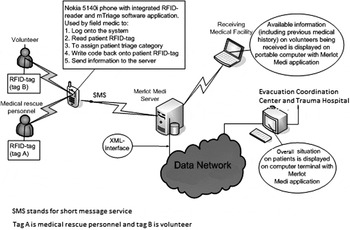
A Triage-Mobile Phone is intended to be used by all medical rescue personnel, whether professional or volunteers, who are capable of performing a triage. All victims are to be tagged on-scene with Triage-tags, regardless of their injuries (Figure 1). The Triage-PC enables the input of additional patient data, such as injury, evacuation, treatment, and personal information, by the clerical officers on the scene or at any time during the evacuation process. The Triage-service receives and distributes the triage and patient information to all necessary persons and levels of management, acting as a centralized storage point for information, and providing source material for performance analysis. Triage-web is a “read only” website for distributing the real-time situation information. It can be accessed via almost any web browser on any computer or smart phone.
The flow of data among triage system components
Abbreviations: RFID, Radio Frequency Identification

The System Process
Once at a disaster scene, triage personnel perform triage evaluation and tagging of the casualties. The triage class allocated to each category is stored on the tag and sent to the Triage-service via the Triage-phone. When a new Triage-tag identification number arrives at the Triage-service, a new patient record is entered into the system. All subsequent actions related to that Triage-tag are associated with this patient record. Ideally, the triage team consists of several medics carrying out evacuation procedures and a clerical officer with a Triage-PC entering additional data (i.e., wound types) into the patient records.
Test Settings
The system was tested for feasibility during two separate, simulated, mass-casualty incidents, one in Finland and one in Sweden. The test settings were chosen to reflect the feasibility of the system in situations as close to real-life disasters as possible. The simulations were not designed explicitly for testing or evaluating triage systems, but were standard, multi-actor exercises.
Finland
The first part of the study took place at Lake Vesijärvi in Lahti, Finland on September 27, 2008. The situation began as a search operation gathering information concerning unexploded ordnance discovered at the bottom of the lake. In connection with the search, a 30-passenger ship departing from the port ran aground close to the diving site. In the aftermath of the grounding, emergency services professionals rescued both floating and injured passengers. Of the simulated patients, eight had jumped off the boat; nine were classified as seriously injured, and 10 were classified as mildly injured. Of the 19 injured, five were triage Category 1 (Immediate) patients, four were Category 2 (Urgent), and 10 were Category 3 (Delayed/Walking Wounded). The Emergency Services Rescue Department participated in the training exercise, in cooperation with the police, Finnish Navy, the Centre for Military Medicine, Emergency Response Centre administration, the Finnish Border Guard, the local Lake Rescue Association, Finnish Red Cross (FRC), and the World Wide Fund for Nature (WWF).
Based on the near real-time information distributed by the Triage-service, all participants involved in the evacuation and recovery of casualties made informed decisions such as (1) directing the ambulances to specific hospitals based on the nature of each casualty’s injuries and the number of critically injured casualties; and (2) organizing the ED’s resources to meet the needs of the specific patients rescued.
In order to compare results, another group of 18 patients was triaged using traditional, paper-based triage tags (the Finnish National Triage Card, developed by Helsinki University Hospital) that were read by personnel in the receiving care units.
Each medical professional likely to be on the scene in Lake Vesijärvi in Lahti, Finland was issued a number of Triage-tags and a Triage-phone. The personnel included triage doctors and nurses, as well as conscript military medics, FRC volunteers, and airborne rescue unit medics. Training on the use of the Triage-phone simulated a real-life situation where the equipment had to be deployed, and usage explained, while in transit to the disaster scene. Typically, explanation of the use of the Triage-phone took several minutes, and was followed by a short amount of time to practice before deployment on-scene.
The first triage classifications were performed by the conscript military medics who were attending to the first casualties ashore, and transmitted to the server using the Triage-phones. Soon thereafter, triage classifications were sent from the passenger ship by airborne medics who had descended from a helicopter. This information included the Triage-tag identification number, triage class, time stamp, and medic identification; the latter data identified where the triage was performed. The triage information and other tag information (ambulance and position data) were transmitted through a secure TETRA network to the central computer at the Command Center.
The military medics established a Battalion Aid Station (BAS) onshore at the nearest possible landing site. The BAS Commander also was the triage doctor. The Commander was assisted by a Clerical Officer with a Triage-PC to inform him of the general situation and for entry of additional victim and wound data into the patient records. Both were officers of the Finnish Military Reserve. One mission of the Finnish Defence Forces (FDF) is to support other authorities in disaster or mass-casualty situations. In a disaster involving civilians, general management is performed by the rescue authority. Medical responsibility for leading the response to an event such as a large-scale accident is the duty of the health authority.
The data logged into the system provided time-tagged information about all events. The time data from the control group (paper-based system) was logged manually. Subjective data on the usefulness of the information provided by the system and its impact on situational awareness were collected during brief interviews with the commanding officers.
Sweden
The second part of the study was performed at Arlanda airport in Stockholm on October 9, 2008, during a large airplane disaster exercise in the harsh, sub-arctic conditions of Sweden. The full-scale major incident exercise involved a simulated passenger airplane crash landing, with a total of 99 passengers and crew aboard the airplane.
Of those victims, 20 patients were selected as “RFID patients” for the study. Each injured patient received a card describing his simulated injury profile; the card was hung on a lanyard placed around the neck of each patient. Based on the injury profile shown on their cards, the simulated patients were triaged by health care personnel participating in the exercise.13 An RFID tag was attached to each card. The system used was the same as that employed in the simulated event in Finland, except for fact that the simulated victims sent the information via Triage-phones themselves, because some medical personnel were not able to participate in the Triage-phone transmission in this exercise. The intent was to transmit the triage category to all levels of management to increase situational awareness.
Management of the event was organized into several hierarchical management levels. The highest, the strategic or gold command, was activated by a mass-casualty warning (the Emergency Medical Command Center SOS Alarm), and staffed in a special location away from the incident. The Dispatch Center referred the injured casualties to three receiving hospitals in the region, with one of the hospitals acting as the “target” hospital. At all management levels, situation awareness was dependent on the information that was sent from the airport using various telecommunication methods.
At the Arlanda airport in Sweden, the Merlot system was used mainly for situation awareness about where within the rescue chain the patients with RFID tags were, and about their respective triage categories. Triage-tags andTriage-phones were given to each of the 20 patients for transmitting information from each triage performed by the rescue personnel to theTriage-service for performance analysis. The Triage-web also was used to display information at the main receiving hospital and the Command Center. Typically, triage data were transmitted from the scene or evacuation location, from the airport gate (time stamp when leaving the airport), and upon arrival at the receiving hospital (simulated). The control group patients received Smart Tag triage tags.
In the Swedish exercise, the feasibility of the new triage system was evaluated using a standard post-test questionnaire. The questionnaire contained eight sections with a total of 27 questions regarding the patients’ subjective confidence in the personal use, general use, and applicability of the system. A section for comments was included at the end of the questionnaire. The technological suitability of the system for field use was measured by analyzing the recorded data transfers, tag events, and the number of failed data operations.
Results
Situational Awareness Timeline, Finland
A call to emergency services (1–1-2) was made at 10:20 AM from a passenger ship that had run aground. Subsequent damage caused a fire, mildly injuring 20 passengers on board and causing eight passengers to jump into the water. Two search operation divers at the same location received other injuries.
By 10:45 AM, the Battalion Aid Station (BAS) that had treatment capabilities received the first two patients: the injured divers. One diver experienced decompression sickness, and the other had an injured limb. One patient was triaged as Category 2; the other was triaged as Category 1, and evacuated to the University Hospital of Turku to receive hyperbaric oxygen therapy. Both casualties had been evacuated by 10:36 AM.
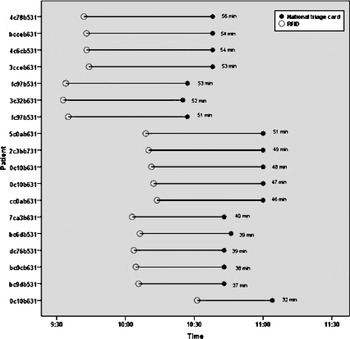
Each of the 20 RFID-tag patients also was given the National triage tag. Of the 20 patients, five were classified as Triage Category 1, five were Triage Category 2, and 10 Triage Category 3. The 18 control group patients consisted of five Triage Category 1, five Triage Category 2, and eight Triage Category 3. Data on two patients were not recorded, and were excluded. The mean difference between the times National Triage tag data and RFID-tag data reached the BAS was 47 minutes (Figure 2).
Triage information transmission times in the Lahti, Finland exercise. Transmission times were not provided for all mock patients. National triage card = the time when tag information from the patient’s first classification at the place of assembly arrived at the Battalion Aid Station; RFID = the time when mTriage application’s patient information reached the Battalion Aid Station and the entire emergency management chain.

Toward the end of the evacuation, one of the Triage Category 2 patients was reassessed, and the patient’s triage category was changed to Category 1. As this information was available at the scene, the Triage Officer responsible ordered the patient’s evacuation to another hospital outside of the city, as all the nearest EDs already were overwhelmed with patients.
Several hours after the simulation concluded, two missing Triage Category 4 victims were found nearby, and were recognized by their triage tags. After their data were fed into the system with the Triage-phone, the records were complete and no casualties were lost.
Situational Awareness Timeline, Sweden
The exercise started at 10:20 AM when the SOS-Alarm Emergency Line alerted the Duty Officer at Stockholm County Council that a commercial passenger airplane with 99 passengers and crew onboard had crashed as it attempted to land. The Regional Disaster Medical Administration (RKML) was put into disaster status.
Spontaneous evacuation from the airplane began, and first aid was initiated by Fire Department personnel at 10:24 AM. The first ambulance arrived at the scene at 10:30 AM, and the crew established its role as the Medical Incident Officer. Twenty-nine casualties were classified as Triage Category 1 or 2, 61 as Triage Category 3, and nine had died. The first evacuation of casualties to the hospital took place at 10:46 AM, and the last patient left the scene at 12:55 PM. During the exercise, communication difficulties resulted in inappropriate information being relayed to the strategic-level management. Lack of real-time information from the disaster site delayed ED decision-making on coordination of staff and resources in the hospital.
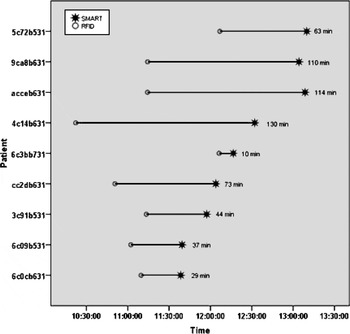
A total of 20 patients were RFID–tag patients; they also had been given the Smart Tag. Of these 20 patients, only 17 were sent to the exercise target hospital, eight initially classified as Triage Category 1; three as Triage Category 2; and six as Triage Category 3. The nine control group patients tagged with Smart Tags consisted of six Triage Category 1 and three Triage Category 2. The mean time difference between the transmission of information via the Smart Tag cards and the RFID system was 68 minutes (Figure 3).
Triage information transmission times in the Stockholm (Arlanda Airport), Sweden exercise. Transmission times were not provided for all mock patients. SMART = the time when Smart Tag information from the patient’s first classification at the place of assembly to reach Capio St Görans Hospital; RFID = the time when mTriage patient information was available to Capio St Görans Hospital and the entire emergency management chain.

During the Arlanda exercise, Capio St Görans Hospital set up a Medical Management Center (MMC). Medical Management Center personnel consisted of a Hospital Director, Security personnel, doctors, and the Chief Director of the hospital. To assess the improvement in situational awareness in the MMC, an interview with the Chief Director of the hospital was conducted after the exercise was terminated. According to the post-exercise comments made by the Chief Director, the new system provided a timely and accurate picture of the prevailing situations, and improved the general management of the exercise.
Usability and Subjective Evaluations of the System
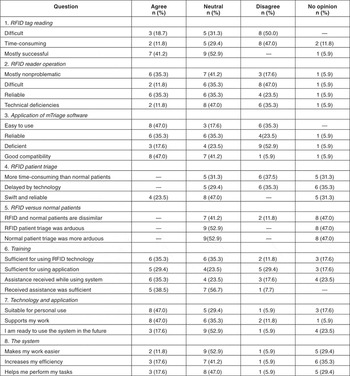
As shown by Swedish exercise participants’ responses to the survey, system users found the RFID mobile system sufficiently easy to use, and did not consider it more arduous than using the traditional paper tags (Table 1). The users further found the system to support their work, and to be no more time-consuming than using traditional methods.
Survey responses of Swedish participantsFootnote *

* Some respondents did not answer all questions
Discussion
The successful use and implementation of continuously evolving mobile and wireless technologies in several fields has highlighted their applicability to the field of health care and their potential value in supporting timely access to critical information.Reference Padmanabhan, Burstein, Churilov, Wassertheil, Hornblower and Parker14
Resource allocation in mass-casualty situations is a significant logistical problem. Particularly under rapidly changing environmental conditions, reliable and timely situational awareness is crucial for making the correct decisions for allocating the available resources. Under all conditions, the use of limited resources must be optimized to provide the maximum benefit to the largest possible number of casualties. In mass-casualty situations involving extensive areas, the ability to collect information on the number of casualties and their triage categories in different regions of the area makes possible efficient and optimal use of limited rescue capacities.
Comparing the use of RFID tags with the traditional paper method, patient data were forwarded on average 47 minutes faster using RFID tags in the Finnish exercise, and on average 68 minutes faster in the Swedish exercise. The system presented here has advantages over the traditional method of using a paper tag attached to patients. Though paper tags are a relatively inexpensive alternative, they are easily destroyed or lost. In addition, problems such as bad handwriting and missing information are associated with paper tags. An electronic system would eliminate these problems.
The RFID systems have weaknesses, including the need for a reader to access the information, and issues with data ownership and security. While the security threats that current health care RFID applications face are not as they are sometimes portrayed, they are real, and potentially dangerous for open-loop RFID applications. There has been an ongoing debate in health care and policymaking communities on the rights of these systems and users.Reference Fisher and Monahan15
In the future, this RFID triage system will be more valuable when it becomes applicable for other incidents, such as those with smaller numbers of casualties, or in events, such as earthquakes, storms or floods, affecting large areas.Reference Inoue, Sonoda and Yasuura16 More field tests are needed, as well as development of an implementation plan for the system.
The RFID system proved easy to use, and improved situational awareness in disaster management. Information about the numbers, status, and classification of the casualties was available for the coordinating units approximately one hour earlier than with the use of the traditional method using paper tags. Although the results of this study lack rigorous comparison among various triage and communication/disaster management systems, the results provide a picture of the possibilities the technology can offer.
Conclusion
Radio Frequency Identification is a feasible tool for providing situational awareness during disaster exercises. The tested system was easy to use, fast, stable, and worked seamlessly, even in harsh field conditions. It surpassed the paper-based systems in all respects except simplicity. It also improved the general view of mass-casualty situations, and enhanced medical emergency readiness in a multi-organizational medical setting. Situational awareness in all hierarchical management layers was based on common data generated in real-time at the incident scene. The timeliness of available information for disaster management was better using the RFID system than it was with the traditional methods.
Acknowledgements
The authors thank the Finnish Defence Forces, the Department for Disaster Medical Planning (REK), Capio St Görans Hospital, Karolinska Institutet Södersjukhuset, Juha Tammela from Logica, research nurses Nina Nakari and Heli Laapotti, and participants in the disaster exercises in Lahti, Finland, and Stockholm, Sweden.
Abbreviations:
BAS = Battalion Aid Station
ED = Emergency Department
EMS = Emergency Medical Services
FDF = Finnish Defence Forces
FRC = Finnish Red Cross
MIMMS = Major Incident Medical Management and Support
RFID = Radio Frequency Identification
TETRA = Terrestrial Trunked Radio
TRTS = Triage Revised Trauma Score
WWF = World Wide Fund for Nature