Introduction
The false codling moth (FCM), Thaumatotibia leucotreta Meyrick (Lepidoptera: Tortricidae), which has until recently been known as Cryptophlebia leucotreta (Komai, 1999) is a significant pest of fruit trees and field crops in Sub-Saharan Africa (Daiber, Reference Daiber1981; La Croix & Thindwa, Reference La Croix and Thindwa1986). It is a cryptic pest that has caused heavy economic losses to producers of citrus, avocado and pomegranates due to fruit infestations by the larvae. FCM is a sporadic pest in deciduous fruit and has been included in the list of quarantine pests of economic importance jeopardizing sale of fruits destined for overseas markets where the pest has a potential to be established.
Many studies have mainly focused on the control options of FCM (Newton & Odendaal, Reference Newton and Odendaal1990; Hofmeyr & Pringle, Reference Hofmeyr and Pringle1998; Bloem et al., Reference Bloem, Carpenter and Hofmeyr2003; Carpenter et al., Reference Carpenter, Bloem and Hofmeyr2004, Reference Carpenter, Bloem, Hofmeyr, Vreysen, Robinson and Hendrichs2007; Opoku-Debra, Reference Opoku-Debra2008) but its species status remains poorly understood. However, as a highly invasive species that is highly polymorphic with broad polyphagy (Kirkman & Moore, Reference Kirkman and Moore2007), there is a possibility that not all FCM populations sampled in the Western Cape belong to the same species, or alternatively there may be a possibility of subspecies or haplotypes (Timm et al., Reference Timm, Geertsema and Warnich2008a , Reference Timm, Geertsema and Warnich2010). FCM was first recorded on oranges in South Africa in the early 1950s (Stofberg, Reference Stofberg1954) and due to increased trade between other African countries and gross migration, a number of purportedly uninfested material have made their way into the Republic. As such some degree of speciation is inevitable. Speciation is a process whereby over time; one species evolves into a different species (anagenesis) or one species diverges to become two or more species (cladogenesis). Speciation is fundamentally interpreted using two concepts, which are the isolation concept (IC) and the recognition concepts (RC). IC involves species barriers such as geographic barriers and reproductive barriers as caused by incompatibility of mating organs, among others.
In order to determine the status of a specific insect species within an agricultural setting, certain population characteristics need to be investigated, which include the composition, distribution, dispersal and population dynamics. This investigation employed two approaches to determine the species composition of FCM in the Western Cape. These approaches comprise mating behaviour and phylogenetics. Mating between FCM populations was hypothesized to be random between populations and if mating would result in successful fertilization and subsequent production of viable offspring, it would imply that the FCM population in the Western Cape belongs to the same strain or biotype of T. leucotreta. To confirm or further understand this observation, a molecular approach was employed using mitochondrial DNA (mtDNA) (Whiting et al., Reference Whiting, Carpenter, Wheeler and Wheeler1997; Cameron, Reference Cameron2014; Sreejith & Sebastian, Reference Sreejith and Sebastian2015). Phylogenetic analysis of DNA sequence data can be utilized to detect previously unidentified variants in local or invasive populations and identify insects to species or biotypes by sequence comparisons.
Under RC, evolutionary change is not considered easily accomplished in large populations. The contributing factor is the nature and primary function of mating behaviour observed in a sexual species. In very motile organisms such as insects, of which FCM is an outstanding example, common signals are used prior to mating being achieved. Mating is an important and obvious part of the fertilization system that allows continuous existence of species. These signals, their recognition and their induced response together form species mate recognition system (SMRS) (Ritchie, Reference Ritchie2000; Paterson, Reference Paterson1978, Reference Paterson1980, Reference Paterson1981). The species status is only recognized by human observers but not by the insects themselves. Individual insects participate in sexual communication, and should the signals and responses of another individual match expectation (get recognized), sexual interaction will inevitably happen. Individuals have mechanisms that ensure that they mate with the appropriate partner. However, for the partner to be almost always a conspecific is a consequence of behaviour rather than reason making SMRS undoubtedly complex.
FCMs were collected in all sampling areas and multiple hosts, and the moths resembled each other morphologically. The main question to be addressed by this study is whether the mating takes place at random, in nature between individuals observed on the three host plant species and, in population genetics terms, whether there was any gene flow taking place between FCM from these alternative hosts.
The plasticity of FCM to reproduce under different weather/climatic conditions and its ability to thrive not only in citrus orchards, but minor cultivated fruits such as pomegranate and olive as well as non-cultivated nuts such as acorns could promote its variability into many strains with different biological and physical requirements making it complicated to apply control methods. The FCM has a wide geographic and host range mainly in tropical areas, and unpublished reports have indicated differences in behaviour of this tortricid such as the non-response of the male FCM to the synthetic female pheromone. This prompted the need to explore its species status and cryptic behaviour. Information on gene flow among geographic and host populations of FCM is required for the successful implementation of pest management programs such as Sterile Insect Technique (SIT), mating disruption and chemical control, which may be affected by gene structure and flow among populations.
Materials and methods
Rearing insects
From 2009 to 2010 fruits were collected regularly every 2 weeks from orchards (Bien Donne, Bonnievale, Ceres, Elgin and Riebeek Kasteel) as well as their surrounding areas. Acorns were collected throughout the sampling season, while pomegranate and olives were only collected during the fruiting season till harvest. For acorns and olives, at least 70 infested fruits were collected, while at least 10 infested pomegranates were collected. Differences in the number of fruits collected was determined by two factors; firstly for acorns and olives, only one FCM would be found in the fruit, while there were numerous FCM larvae in each pomegranate fruit and secondly, pomegranates are a high value crop and it would not be possible to collect a large sample of fruits due to economic restrictions. The fruits were incubated on sterile sand in 5 litre containers under laboratory conditions (25 ± 2°C; 60 ± 10%RH and 12:12LD photoperiod) until pupation of FCM. The pupae were collected into single ventilated vials and rearing continued at the same environmental conditions until adult eclosion. The FCM that came out of the pupae were identified using morphologial characteristics (Daiber, Reference Daiber1980). The insect cultures were labelled according to (i) the host plant (acorns, olives and pomegranates) and (ii) locality or area of origin (Bonnievale, Bien Donne, Ceres, Elgin and Riebeek Kasteel) from which the fruits were obtained. The control colony of FCM was reared from Citrusdal and maintained on an artificial diet in the laboratory at the same environmental conditions.
Cross-mating experiments
Reciprocal cross-mating experiments often provide credible methods for solving issues regarding species status of individuals coming from different hosts, or localities (Rosen, Reference Rosen1986; Mayr, Reference Mayr1963). The crucial interpretations or explanations of the findings of such rigorous experiments can be best argued upon using the species sexual theory. Following our previous results (unpublished) that FCM was predominantly sampled from acorns, pomegranates and olives, we used these three most preferred host species in the mating studies. In this study, FCM cross matings were conducted between FCM populations from:
Control culture (laboratory reared) a, host cultures, (e.g. acorns b, olives c, pomegranates d) and areas of study, (Bien Donne BID, Bonnievale BON, Ceres CE, Elgin EG and Riebeek Kasteel RBK). Infested oranges were collected once from Nelspruit and moths reared out of them were also crossmated with moths from the Western Cape and the laboratory reared colony.
In all experiments, naive or virgin moths were used. Moth virginity was ensured by individually holding the moth pupae in ventilated vials until adult eclosion. For the first crosses, all individuals were derived from field collected fruits, while for the F 1 crosses all individuals were derived from the eggs laid by the cross-mated field collected moths. Male and female moths used in the experiment were approximately 1–3 days old as at this age both sexes are sexually receptive. All individuals were used once only.
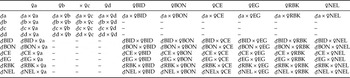
To conduct the cross-mating experiments, randomly selected five females and five males were placed in a ventilated wooden cage enclosed with wax gridded paper and allowed to mate as illustrated in Table 1. Reciprocal crosses were carried out for all individuals from different regions and hosts. Further crosses were carried out for any resultant F 1 generation to access the viability of the strains. An equal number of individuals of each sex was chosen to allow random mating. All individuals were used once, while egg counts were done until death of moths. After every 24 h, the wax paper was checked for eggs, and then sterilized by dipping them in 0.5% bleach and then air dried. When the eggs turned orange (a sign that they will hatch into neonates) they were counted under a stereo microscope (Olympus SZ51). The wax paper was placed on artificial diet in plastic trays (25 × 21 × 5 cm3) which was then placed in a sterilized khaki paper bag (bearing the name of the FCM culture) and left in an environment chamber at the above described environmental conditions until pupation of larvae. The pupae were again individually placed in ventilated vials until adult eclosion (F 1 generation) were recorded. This procedure was repeated five times. Upon adult eclosion, the offspring, (48 hours old) were crossmated as their parents.
Cross-mating combinations of false codling moths, T. leucotreta populations from the South African Provinces that were carried out in the laboratory ventilated wooden cages.

– No reciprocal cross matings were done.
The letters and acronyms denote host and area populations (a, laboratory reared (control); b, acorns; c, olives; d, pomegranates; BID, Bienne Donne; BON, Bonnievale; CE, Ceres; EG, Elgin; RBK, Riebiek Kasteel (Western Cape), and Nelspruit (NEL) (Mpumalanga).
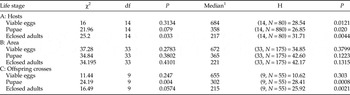
To analyze the data, nonparametric tests for comparing independent samples were carried out using a computer software program, Statistica (Stat-Soft 2011). Multiple comparisons on p-values using a 2-tailed test to obtain the Chi-square values (for viable eggs, pupae and eclosed adults) were followed by Kruskal–Wallis test H as the sample sizes were independent and of different sizes.
Molecular analyses
Total genomic DNA (mtDNA) was extracted from the heads and legs of wild FCM obtained from infested fruits and those caught on traps. The phenol –chloroform protocol was used to extract DNA (Nishiguchi et al., Reference Nishiguchi, Doukakis, Egan, Kizirian, Phillips, Prendini, Rosenbaum, Torres, Yael Wyner, DeSalle, Giribet, DeSalle, Giribet and Wheeler2002). To assess the impact of geographic separation on the molecular genetics of FCM, specimens were taken from FCM trapped from three other provinces namely Addo (ADD) (33.56844°S; 25.672344°E; 26 m) in the Eastern Cape province, Marble Hill (MBH (24.962497°S; 29.295711°E; 893 m) and Nelspruit (NEL) (25.433931°S; 30.939206°E; 693 m) in Mpumalanga province and Vaalharts (VAAL) (28.209933°S; 24.878178°E; 1211 m) in the Free State province. The DNA from 250 samples were then amplified using end point polymerase chain reaction (PCR) and the PCR products directly sequenced. PCR amplification of the mtDNA cytochrome oxidase subunit 1 (cox 1) fragment was done using primers Ron C1-J-1751 (5′ggatcacctgatatagcattccc 3′) and Nancy C1-N-2191 (5′cccggtaaaattaaaatataaacttc 3′), (Simon et al., Reference Simon, Frati, Beckenbach, Crespi, Liu and Flook1994). The resulting 240 DNA sequences were edited on a MAC OS X computer program, CLC DNA workbench (CLCBIO, 2011), which automatically trims and creates consensus sequences and alignment with high precision to 850 bp. The alignment was further analyzed using Mr Bayes (Huelsenbeck et al., Reference Huelsenbeck, Ronquist, Nielsen and Bollack2001; Ronquist & Huelsenbeck, Reference Ronquist and Huelsenbeck2003) and subjected to a jModel test (Posada, Reference Posada2008). A neighbour joining (NJ) phylogentic tree rooted with Cydia pomonella [JF707773 and HQ700336] and Cryptophlebia pelstatica [EF584431] after alignment using a computer program MAFFT version 6 with bootstrap resampling set at 1000 and a Jukes Cantor model (Zmasek & Eddy, Reference Zmasek and Eddy2001; Han & Zmasek, Reference Han and Zmasek2009. The parameter for scoring matrix nucleotide sequences was set to IPAM/k = 2 because the aligned sequences were closely related. Phylogenetic Analysis Using Parsimony Paup* 4.0 (Swoford, Reference Swoford2002) with 1000 bootstrap replicates was also run for comparison's sake. Incorporated in the alignment were T. leucotreta Genbank sequences [EF584430 and GQ149500]. Owing to the self pruning of mtDNA evolutionary trees due to the stochastic lineage extinction, it was predicted that mtDNA would display limited sequence divergence values with FCM populations that may have undergone a historically high level of gene flow.
Mitochondria were used to achieve a solid understanding of genealogical inference in FCM (Simon et al., Reference Simon, Frati, Beckenbach, Crespi, Liu and Flook1994). It is well known that nucleotide substitutions mainly occur on the mitochondrial compared with the nuclear genome due to maternal inheritance (Kondo et al., Reference Kondo, Satta, Matsuura, Ishiwa, Takahata and Chigusa1990). In the nucleus, recombination of genes occurs and therefore may not give reliable results. Thus the mitochondrion has been ultimately targeted as a reliable molecular marker to study population genetics of many insects including important agricultural pests.
Results
All the FCM populations except those involving Swellendam (obtained from citrus (oranges, clementines and natjies), successfully mated and produced viable offspring with no significant differences in the number of viable eggs, but significant differences in the number of pupae and eclosed adults (Table 2). The crosses involving Swellendan did not yield any eggs and no F 1 generation was produced.
Statistical values for the cross-mating experiments.

A, based on host populations, B, based on area populations and C, based on offspring crosses.
1 The median of at least one sample group is different from the median of one other group ((H1) resulted in in inconsistent results.
The values are based on non-parametric tests for comparison of multiple independent samples and a Kruskall–Wallis test H.
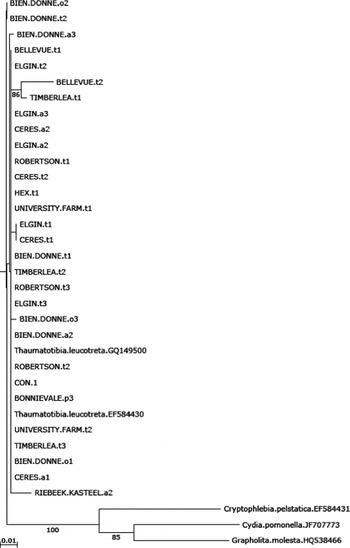
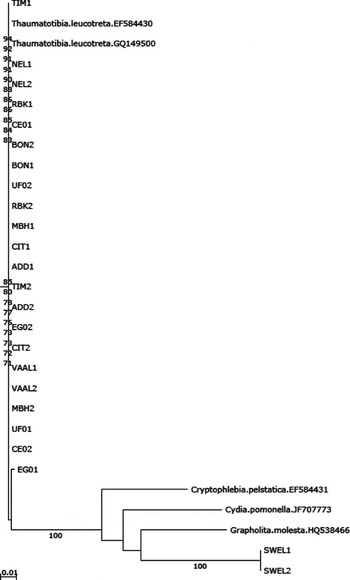
Molecular results indicate that FCM populations belonged to the same clade and are indeed T. leucotreta as indicated by the incorporated Genbank sequences, figs 1 and 2. All individuals except those from Swellendam were identified by BOLD (Barcode of Life Data System, http://www.boldsystems.org/) as belonging to the species T. leucotreta or C. leucotreta with a match of 98–100% (Ratasingham & Hebert, Reference Ratasingham and Hebert2007). The Swellendam samples grouped together with other totricids that are not FCM. The Swellendam samples were not identified in this investigation. Pair-wise values of the F ST analog, θ, were all less than 0.032, indicating little genetic differentiation and the presence of gene flow throughout the population (Weir & Cockerham, Reference Weir and Cockerham1984).
A neighbour joining (NJ) phylogenetic tree for the collected and cross-mated FCM specimens rooted with Cydia pomonella [JF707773 and HQ700336] and Cryptophlebia pelstatica [EF584431] after alignment using a computer program MAFFT version 6 with bootstrap resampling set at 1000 and a Jukes Cantor model.

A neighbour joining (NJ) phylogenetic tree for the collected FCM specimens rooted with Cydia pomonella [JF707773 and HQ700336] and Cryptophlebia pelstatica [EF584431] after alignment using a computer program MAFFT version 6 with bootstrap resampling set at 1000 and a Jukes Cantor model.

Discussion
Successful mating in all individuals dictates that all samples belong to one species even if they were morphologically distinguishable, for example, some melanic forms of FCM were obtained from Ceres, a lighter tan from Riebiek Kasteel and more usual colour obtained from the rest of the areas, while small individuals were reared from olives. This observation could be a mere adaptation to environmental conditions, for example colour changes as a strategy to escape predators, while small size could be due to the nature of the food reserves in the host plant (Peppe & Lomônaco, Reference Peppe and Lomônaco2003). No reproductive isolation is evident from the FCM sexual species as no sterility is observed after cross mating the offspring. The experimental individuals mated and produced viable offspring in all cases; therefore, the reproductive criterion suggests that all the six populations are conspecific.
Be that as it may, this observation is questionable as shown by the way the reproductive concept deals with the situation. Under the recognition concept, reproductive isolation is viewed as a bi-product of different sexual populations having evolved independently, with differences in their SMRS. The SMRS is a complex adaptation made up of a sequence of functional steps to ensure fertilization. Early steps in the sequencing usually function in long distance attraction from those of the second species (Goyer et al., Reference Goyer, Paine, Pashley, Lenhard, Meeker and Hanlon1995) where pheromones and auditory stimuli play a pivotal role. In the field, pheromone released by individuals of either species would not attract individuals of the second species. A practical example of this phenomenon is displayed by male FCM from Mpumalanga, South Africa, that are not readily attracted by the commercial synthetic pheromone used in delta traps to monitor FCM population in the Western Cape province, South Africa. When crossing tests are conducted, the initial step(s) of the SMRS may be omitted. Different moth species are sexually isolated due to differences in their SMRS. This is due to the fact that there are initial steps in the SMRS for distance attraction, including pheromone release, which should only attract members of the same species. Later steps within the SMRS can then be more general and more similar between the different species. This might however complicate mating experiments because when two different species are placed together inside a cage, if the distance attraction is not necessary, the heterospecific individuals would mate and possibly produce viable offspring. Nonetheless, sterility is still the ultimate way to implicitly delimit species (WHO, 2008). Therefore, because the eggs produced in the mating experiments were viable, this supports the conclusion that they are in fact from a single species.
The individuals from, were morphologically similar to those of FCM using the morphological keys, presented themselves as FCM but then absence of mating in the test crosses dictates that the two species are different.
The numbers of pupae and eclosed adults were always less than that of the viable eggs presumably due to cannibalism between neonates or larvae and some death due to infection. As some larvae matured, they did not manage to pupate. The survivorship and performance of the moth larvae was possibly influenced by differences in diet (wild diet versus artificial lab diet) (Newcombe et al., Reference Newcombe, Moore and Moore2015). Again, the lab-reared culture could have caused some significant differences because of its high adaptation to laboratory conditions compared with the wild populations, which had to adjust to unfamiliar laboratory conditions.
Management of FCM is being achieved by various means including use of pheromone trape to disrupt mating. However, moths in some orchards in Mpumalanga Province have not been responding to these pheromeone traps, raising suspicions that despite identical morphological appearances, there could be different subspecies or cryptic species. The molecular results in this study undoubtedly confirmed that the FCM populations in this study belong to the same species, T. leucotreta. All individuals from the various sampling areas belonged to one clade as indicated by the evolutionary trees obtained. The molecular results are a good indication of the absence of cladogenesis in the FCM populations despite the long standing presence of this highly polyphagous insect herbivore in the Western Cape Province and other provinces. In other words, T. leucotreta is a monotypic species but rather polytypic species, a modern species concept that does not include subdivisions within the species (Stamos, Reference Stamos2003). Given the absence of ecological barriers separating populations, there is a possibility of FCM in the Western Cape belonging to one species, contrary to the assertion by Timm et al. (Reference Timm, Geertsema and Warnich2008b , Reference Timm, Geertsema and Warnich2010), that subspecies exist between fruit orchards, results of this study indicate that FCM populations used belong to one species. Even results based on populations originating from other provinces where very wide geographic isolation could result in a subspecies did not provide evidence of possibility of a subspecies. If the reciprocal mating resulted in little or no cross mating as observed on Drosophila species by Kaneshiro (Reference Kaneshiro1976) then subspecies would be present. Such observations would suggest that some elements of behaviour are lost during speciation events. The females from different populations and hosts mated with the males from all regions, which would not be the case if they were different species (Watanabe & Kawanishi, Reference Watanabe and Kawanishi1979).
It can be deduced that there is high gene flow between populations as individuals randomly mate regardless of locality or host. Arguably, the phylogenetic concept of species qualifies the FCM to be one species as all individuals formed a somewhat irreducible cluster of organisms, which is diagnosably distinct from that of the other tortricids included in the phylogenetic tree. This is further justified by their reproductive compatibility demonstrated by the cross-mating experiments. Furthermore, the molecular results indicate host plasticity between FCM populations. While managing to utilize a wide range of hosts, the individuals can still manage to produce viable offspring despite some irregular phenotypic differences.
Conclusion
Although the mating results are open to more than one interpretation, the molecular results obtained in this study provide no reason for suspecting that these populations of FCM comprise more than one species. The results obtained indicate that cross-mating tests designed to establish whether individuals recognize each other as potential mates, are appropriate. The FCM population in the Western Cape deciduous fruit orchards in South Africa is made up of individuals that are mating randomly resulting in probable absence of genetic variation. There is no reproductive isolation of the FCM population in South Africa despite large spatial distances and geographic barriers. This result could be useful for implementation of area-wide control tactics such as SIT and mating disruption that are currently in use for the suppression of this pest together with other insect herbivores in the deciduous fruit orchards.
Acknowledgements
This work was funded by Fruit-Gro Science. We would like to thank two anonymous reviewers for proof reading earlier versions of this manuscript, producers on whose farms this work was conducted who are ARC experimental farms in Bien Donne and Elgin/Grabouw, Mr G Beukmann in Bonnievale, Cooperative farmers in Riebeek Kasteel and Timberlea farm, Mr Conradie and Jordaan in Hex River valley, the Smut brothers in Robertson and Molteno Brothers in Elgin as well as the University Welgevallen farm. We wish to express our sincere gratitude to the technical assistants, Miss N Mfeka and Mr S. Ntuli.