Introduction
Prospective studies indicate that neural changes associated with Alzheimer's disease (AD) often begin years prior to the onset of significant clinical symptoms. These changes include volume loss and cerebral blood flow or metabolic changes, most notably in the temporal lobe, that may lead to subtle cognitive deficits that can be detected several years prior to a diagnosis of AD (see Twamley, Ropacki, & Bondi, Reference Twamley, Ropacki and Bondi2006, for review). This observation suggests that subtle cognitive deficits in the elderly may be useful as prodromal markers of increased risk of AD and further cognitive decline. Characterizing accurate markers of future cognitive decline in older adults is particularly important to identify and target these individuals for early treatment interventions.
Although deficits in episodic and semantic memory are often observed during the initial stages of AD, subtle impairments in other cognitive domains have also been described (Salmon & Bondi, Reference Salmon and Bondi2009). In particular, deficits in executive functions have been noted in early AD (Albert, Moss, Tanzi, & Jones, Reference Albert, Moss, Tanzi and Jones2001; Backman, Jones, Berger, Laukka, & Small, Reference Backman, Jones, Berger, Laukka and Small2005; Baudic et al., Reference Baudic, Dalla Barba, Thibaudet, Smagghe, Remy and Traykov2006; Bisiacchi, Borella, Bergamaschi, Carretti, & Mondini, Reference Bisiacchi, Borella, Bergamaschi, Carretti and Mondini2008; Chen et al., Reference Chen, Ratcliff, Belle, Cauley, DeKosky and Ganguli2001; Dickerson, Sperling, Hyman, Albert, & Blacker, Reference Dickerson, Sperling, Hyman, Albert and Blacker2007) and may even mark the prodromal stages. Consistent with this possibility, many studies have shown that poor performance on episodic memory and executive function measures in non-demented elderly predict cognitive decline and progression to AD over 1 to 6 years (Albert et al., Reference Albert, Moss, Tanzi and Jones2001; Backman et al., Reference Backman, Jones, Berger, Laukka and Small2005; Blacker et al., Reference Blacker, Lee, Muzikansky, Martin, Tanzi, McArdle and Albert2007; Bondi, Salmon, Galasko, Thomas, & Thal, Reference Bondi, Salmon, Galasko, Thomas and Thal1999; Chen et al., Reference Chen, Ratcliff, Belle, Cauley, DeKosky and Ganguli2001; Fine et al., Reference Fine, Delis, Wetter, Jacobson, Jak, McDonald and Bondi2008; Lange et al., Reference Lange, Bondi, Galasko, Delis, Salmon and Thal2002). Taken together, findings indicate that decrements in executive function, particularly on complex tasks (e.g., inhibition or switching), may be evident in prodromal AD and signal future global cognitive decline.
Deficits in executive functions have also been shown to predict the development of dementia in individuals with Mild Cognitive Impairment (MCI), a condition characterized by documented cognitive deficits that are not severe enough to cause significant functional impairment (Petersen et al., Reference Petersen, Doody, Kurz, Mohs, Morris, Rabins and Winblad2001). MCI is often considered a risk factor for AD, but not all individuals with MCI progress to a diagnosis of dementia and, in some cases, may improve upon retesting and appear cognitively normal (Bickel, Mosch, Seigerschmidt, Siemen, & Forstl, Reference Bickel, Mosch, Seigerschmidt, Siemen and Forstl2006; Ganguli, Dodge, Shen, & DeKosky, Reference Ganguli, Dodge, Shen and DeKosky2004; Jak et al., Reference Jak, Bondi, Delano-Wood, Wierenga, Corey-Bloom, Salmon and Delis2009). Due to its heterogeneous nature, it is difficult to predict which individuals with MCI will eventually progress to dementia and an AD diagnosis. However, studies comparing the development of dementia across subtypes of MCI suggest that consideration of executive functions, or the relationship between episodic memory and executive function, may increase the accuracy of these predictions. Consistent with that notion are studies showing progression rates to AD to be higher for MCI patients with deficits in multiple cognitive domains than for those with isolated memory impairments (Ganguli et al., Reference Ganguli, Snitz, Saxton, Chang, Lee, Vander Bilt and Petersen2011; Mitchell, Arnold, Dawson, Nestor, & Hodges, Reference Mitchell, Arnold, Dawson, Nestor and Hodges2009; Tabert et al., Reference Tabert, Manly, Liu, Pelton, Rosenblum, Jacobs and Devanand2006). One study of individuals with MCI, for example, found that the combined predictive accuracy of deficits in verbal memory and executive function for progression from MCI to AD over 3 years was 86%, a level higher than any other potential cognitive predictors (Tabert et al., Reference Tabert, Manly, Liu, Pelton, Rosenblum, Jacobs and Devanand2006). A similar study used principal components analysis to reduce performance on 49 neuropsychological tests to underlying factor scores and then performed a discriminant analysis to classify individuals with MCI into those who subsequently progressed or did not progress to AD. A combination of memory and speeded executive function measures was the strongest predictor of progression to AD (Chapman et al., Reference Chapman, Mapstone, Porsteinsson, Gardner, McCrary, DeGrush and Guillily2010). These studies suggest that, in addition to memory performance, executive dysfunction predicts decline in cognitive functioning in individuals at risk for AD.
Given the relationship between executive function deficits and prodromal AD, clearer insight into the specific executive function changes that occur might lead to earlier and more accurate identification of older adults at higher risk of developing AD. “Executive function” is a broad concept that encompasses several abilities (e.g., set-shifting, planning, inhibition, flexibility) and these various components may be differentially affected in prodromal AD. Therefore, we carried out a prospective, longitudinal study to determine if changes in executive functions occur prior to global cognitive decline in older adults and, if so, to explore the particular aspects of executive functioning that most strongly predicted that decline. Several aspects of executive functions in non-demented older adults were examined 1 year prior to a decline in global cognition demonstrated via a Reliable Change Index (RCI)-based decrease (see Pedraza et al., Reference Pedraza, Smith, Ivnik, Willis, Ferman, Petersen and Lucas2007) on the Dementia Rating Scale (DRS; Mattis, Reference Mattis1988), a measure of global mental status sensitive to AD (Salmon et al., Reference Salmon, Thomas, Pay, Booth, Hofstetter, Thal and Katzman2002). Five measures from the Delis-Kaplan Executive Function System (D-KEFS; Delis, Kaplan, & Kramer, Reference Delis, Kaplan and Kramer2001) that measure verbal fluency/switching, spatial fluency/switching, spatial planning, inhibition/switching, and visual-motor switching, were used to compare the performances of individuals who demonstrated a subsequent 1-year decline in global cognition to those who maintained stable cognition over that same time period. The switching conditions of the tests were chosen because the processing demands created by their dual nature increases their sensitivity to frontal-system dysfunction (Delis et al., Reference Delis, Kaplan and Kramer2001).
Methods
Participants
Prospective longitudinal data were collected in a group of 71 healthy non-demented (i.e., DRS ≥ 130 cutoff; Monsch et al., Reference Monsch, Bondi, Salmon, Butters, Thal, Hansen and Klauber1995) older adults participating in a study that included annual neuropsychological assessments. Participants were all independently functioning older adults who were recruited into a longitudinal study of aging from the San Diego community via newspaper advertisements and flyers placed in senior centers as well as from the UCSD Alzheimer's Disease Research Center. The study was approved by the institutional review boards at UCSD and the VA San Diego Healthcare System, and informed consent was obtained from all participants.
Diagnosis
At the initial assessment, 51 individuals (72%) were classified as cognitively normal (NC) and 20 (28%) were classified as MCI. Diagnosis of cognitively normal status and MCI subtype was defined according to criteria set forth by Jak et al. (Reference Jak, Bondi, Delano-Wood, Wierenga, Corey-Bloom, Salmon and Delis2009) by the presence of at least two test scores within a cognitive domain that fell one standard deviation below normative means. From this sample, 15 participants (21%) had significant decline on the DRS within 24 months, whereas 56 participants (79%) did not decline over the same time period. Significant decline of the DRS total score (144 points possible) was defined by the Reliable Change Indices (RCIs) established by Pedraza and colleagues (2007) who found a drop of 6 or more points within a 9–15 month interval or a 7-point decline within a 16–24 month interval to be significant. At the evaluation prior to DRS decline in our sample, 5 of the decliners were classified as MCI (1 single-domain amnestic, 3 multi-domain amnestic, 1 single-domain non-amnestic) and 10 were classified as normal, whereas 15 non-decliners were classified as MCI (5 single-domain amnestic, 4 multi-domain amnestic, 3 single-domain non-amnestic, 3 multi-domain non-amnestic) and 41 were classified as normal.
Demographic and genetic comparisons
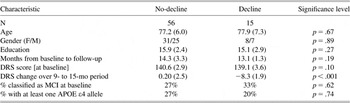
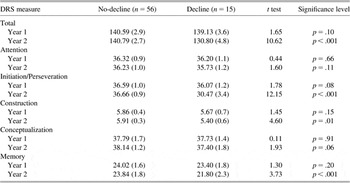
There were no significant differences between the two groups on age (t(69) = 0.42; p = .67), gender (χ 2(1, N = 71) = 0.02; p = .89), education (t(69) = 1.07; p = .29), interval from baseline to follow-up (t(69) = 1.31; p = .19), or DRS total score during the year prior to decline (t(69) = 1.65; p = .10) (see Table 1). The baseline diagnostic classification rates did not significantly differ between the decline and no-decline groups (χ 2(1, N = 71) = 0.25; p = .62). By design, the decline group demonstrated significantly greater decline on total DRS scores, with the largest declines occurring on the DRS Initiation/Perseveration (15.1%) and Memory (6.4%) subscales (see Table 2).
Demographic and clinical characteristics of the decline and no-decline groups

Note. Standard deviations are presented in parentheses. M/F = male to female; DRS = Dementia Rating Scale; MCI = Mild Cognitive Impairment; APOE = apolipoprotein E.
Raw total and subscale means and standard deviations on the Mattis Dementia Rating Scale (DRS) for the decline and no-decline groups

Note. DRS total score range at Year 1: No-decline (133–144); Decline (134–144). No differences in variance between groups on DRS total score at Year 1 (Levene's Test for Equality of Variances: F = 1.30; p = .26).
Of the 71 participants, 18 were APOE ε4 positive and 51 were ε4 negative (2 subjects did not have DNA samples analyzed). Three of the 15 individuals (20%) in the decline group were ε4 positive (2 ε3/ε4 and 1 ε4/ε4), and 12 were ε4 negative (9 ε3/ε3 and 3 ε2/ε3). Fifteen of the 56 individuals (27%) in the no-decline group were ε4 positive (13 ε3/ε4 and 2 ε4/ε4) and 39 were ε4 negative (36 ε3/ε3 and 3 ε2/ε3). The groups did not significantly differ on APOE allelic frequencies (Fisher's Exact Test; p = .74).
Diagnostic classifications from baseline to follow-up
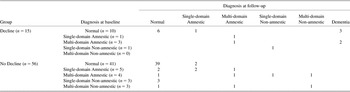
The pre- to post-decline diagnostic classifications for both groups are provided in Table 3. At follow-up, 5 of the decliners were classified as demented, 4 as MCI (1 single-domain amnestic, 2 multi-domain amnestic, 1 single-domain non-amnestic), and 6 as NC. Of those diagnosed with dementia at follow-up, 2 had multi-domain amnestic MCI and 3 were NC at baseline. Of those diagnosed with MCI at follow-up, 3 were diagnosed as MCI and 1 was NC at baseline. Of those diagnosed as NC at follow-up, none had MCI at baseline. In other words, all 6 of these decliners remained diagnosed as cognitively normal despite an RCI-based decline on the DRS.
Diagnoses for the decline and no-decline groups at baseline (year prior to DRS decline) and follow-up (year concurrent with DRS decline)

In contrast, none of the non-decliners were diagnosed with dementia at follow-up, 10 were classified as MCI (4 single-domain amnestic, 3 multi-domain amnestic, 1 single-domain non-amnestic, 2 multi-domain non-amnestic), and 46 were NC. Of those diagnosed with MCI at follow-up, 8 were diagnosed as MCI and 2 as NC at baseline. Of the 46 NC non-decliners, 7 were diagnosed as MCI (2 single-domain amnestic, 1 multi-domain amnestic, 3 single-domain non-amnestic, 1 multi-domain non-amnestic) and 39 were NC at baseline. In other words, 6 of the 15 non-decliners with MCI at baseline reverted back to cognitively normal at follow-up. Thirty-nine of the 41 non-decliners diagnosed as NC at baseline remained stable while 2 progressed to single-domain amnestic MCI at follow-up. As expected, these follow-up classifications significantly differed between the decline and no-decline groups (χ 2(1, N = 71) = 22.00; p < .001).
Materials and Procedure
Global cognition was measured with the Dementia Rating Scale (DRS; Mattis, Reference Mattis1988), a widely-used standardized test that assesses attention (37 points), initiation/perseveration (37 points), conceptualization (39 points), construction (6 points), and memory (25 points). Maximum score on the DRS is 144 points.
Executive function was measured using subtests of the Delis-Kaplan Executive Function System (D-KEFS; Delis et al., Reference Delis, Kaplan and Kramer2001): Verbal Fluency (VF), Design Fluency (DF), Tower Test, Color-Word Interference Test (CWIT), and the Trail Making Test (TMT). The category/switching condition on the VF test measured participants’ ability to generate words fluently while simultaneously shifting between semantic concepts (e.g., fruits and furniture). Two indices from this condition were recorded and used in the analysis: the number of accurate switches between semantic concepts (VF Switching Accuracy) and the total number of correct responses (VF Switching Total Correct). The DF switching condition assessed how quickly participants drew designs while alternating between filled and unfilled dots. The number of correctly drawn designs was used in the analysis. The Tower Test was used as a measure of spatial planning that assessed ability to construct towers by moving blocks across three pegs using the fewest moves possible. The number of moves was recorded as an achievement score and used in the analysis, with higher scores indicating more efficient tower construction. The inhibition/switching condition on the CWIT measured how quickly participants switched between reading words and naming the ink color of the words. Length of time to complete the task was used in the analysis. Finally, the TMT number-letter switching condition evaluated the ability to quickly switch between connecting numbers and letters and was used as a measure of visual-motor switching. Time to complete the task was used in the analysis.
Episodic memory was assessed with the California Verbal Learning Test (CVLT; Delis, Kramer, Kaplan, & Ober, Reference Delis, Kramer, Kaplan and Ober1987, Reference Delis, Kramer, Kaplan and Ober2000), a standardized verbal memory test that assesses rate of learning, retention after short- and long-delay intervals, recognition, and intrusion and perseverative errors. Participants were given five free recall trials of a 16-item word list (List A; four items in each of four semantic categories) and then given a single interference trial using a different 16-item word list (List B). Immediately after the List B trial, participants were given a free-recall and then a cued-recall (using the category names) test for the List A items. Twenty minutes later, the free-recall and cued-recall tests were repeated for List A, followed by a yes–no recognition test.
Statistical Analyses
All analyses were conducted on data collected during the year prior to DRS decline. Raw scores were used and age and years of education were included as covariates in all analyses. A between-subjects (decline, no-decline) multivariate analysis of variance (MANOVA) was performed on six dependent variables to assess group differences on executive-function performance prior to global cognitive decline: VF Switching Accuracy, VF Switching Total Correct, DF Switching, Tower Test, TMT Number-Letter Switching, and CWIT Inhibition/Switching. Logistic regression analyses examined the ability of baseline executive function scores to predict decline or no-decline outcome and compared executive function and episodic memory measures (CVLT List A 1–5 Total Recall, Long-Delay Free Recall, Recognition Discriminability). Since the prediction event of cognitive decline in our analysis was less than 0.5 (i.e., occurred in 21% of sample), we adjusted the cutoff value of the predicted probability to be used in the classification. To calculate an optimal cutoff value that would maximize both sensitivity and specificity we ran an ROC analysis on the observed predicted probabilities and used the “area under the curve” (AUC) statistic as an optimal cut-off value for the logistic regression procedure (0.81). Additionally, due to limited sample size, only the largest two predictors from the MANOVA analysis were entered as predictors in the initial logistic regression analysis. Bivariate correlations examined relationships between executive function and learning and memory measures.
Results
Mean-Level Differences 1 Year Prior to Decline
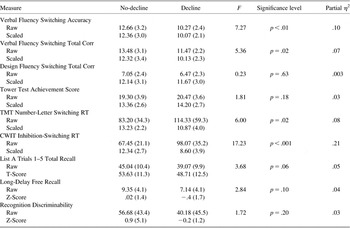
Baseline executive function performance for each group is presented in Table 4. Using an alpha of .001 to evaluate homogeneity assumptions, Box's M test of homogeneity of covariance (p > .001) and Levene's homogeneity test (all p values > .001) were not statistically significant. Using Wilk's criterion (Λ) as the omnibus test statistic, the combined dependent variables (VF Switching Total Correct, VF Switching Accuracy, DF Switching, Tower Test, TMT Number-Letter Switching, CWIT Inhibition/Switching) resulted in a significant main effect of group (F(6,62) = 3.96; p < .01). At the level of the individual variables (evaluated at α = .01 to control for Type I error), two measures demonstrated significant group differences: CWIT inhibition/switching (F(1,67) = 17.23; p < .001) and VF switching accuracy (F(1,67) = 7.27; p < .01). On both measures, the decline group performed worse than the no-decline group. There were no group differences in DF switching (F(1,67) = 0.23; p = .63), spatial planning (Tower Test) (F(1,67) = 1.81; p = .18), VF switching total correct (F(1,67) = 5.36; p = .02), or TMT number-letter switching (F(1,67) = 6.00; p = .02), although the latter two variables showed nonsignificant trends – again in the direction of worse performance in the decline group.
Baseline raw and scaled score means and standard deviations of the decline and no-decline groups on executive-function measures from the Delis-Kaplan Executive Function System and learning and memory measures from the California Verbal Learning Test

Note. Baseline variance differences between two groups on CWIT and TMT. CWIT differences remained significant after using separate variance estimates (p = .005). CWIT = Color-Word Interference Test; TMT = Trail Making Test.
Predictors of Cognitive Decline
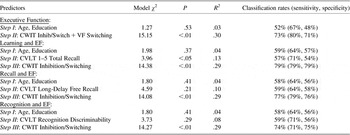
Table 5 depicts results of logistic regression models predicting the DRS decline or no-decline outcome. A model including baseline CWIT inhibition/switching and VF Switching Accuracy was statistically significant (χ 2(4, N = 71) = 15.15; p < .01), indicating that the predictors reliably distinguished between decliners and non-decliners. The CWIT inhibition/switching measure significantly contributed to this model (p < .05), whereas the VF switching measure did not (p = .38). Overall, 73% of the sample was correctly classified, with 80% of individuals who declined correctly classified as decliners (i.e., sensitivity) and 71% of individuals who did not decline correctly classified as non-decliners (i.e., specificity).
Summary of logistic regression analyses displaying ability of executive-function (EF) and episodic memory measures (year 1) to discriminate decline from no-decline outcome (year 2)

Note. R 2 = Nagelkerke R 2. VF Switching = Verbal Fluency Switching Accuracy; CWIT = Color-Word Interference Test; CVLT = California Verbal Learning Test.
As shown in Table 5, additional (stepwise) logistic regression models compared the predictive ability of the executive function and learning and memory measures to classify decline from no-decline groups. In the first model examining learning, initial loading of the CVLT Total Recall 1–5 measure produced a statistically significant model (χ 2(3, N = 70) = 3.96; p < .05) with sensitivity and specificity rates of 71% and 54%, respectively. Inclusion of CWIT Inhibition/Switching in the subsequent step improved the model (χ 2(1, N = 70) = 14.38; p < .01) and classification rates (sensitivity = 79%; specificity = 79%). Furthermore, the difference between these two steps was statistically significant (χ 2(1, N = 69) = 8.44; p < .01). In a second model examining retention, initial loading of the CVLT long-delay free recall measure was not significant (χ 2(1, N = 69) = 2.79; p = .10) and provided classification rates of 64% sensitivity and 58% specificity. Including CWIT Inhibition/Switching to this model provided significant model improvement (χ 2(1, N = 69) = 14.08; p < .01) and also increased the classification rates (sensitivity = 79%; specificity = 76%). The difference between these two steps was also statistically significant (χ 2(1, N = 69) = 9.49; p < .01). Lastly, initial loading of recognition discriminability resulted in a non-significant model (χ 2(1, N = 69) = 3.73; p = .29) with sensitivity and specificity rates of 71% and 56%, respectively. As in the above models, including the CWIT measure significantly improved both the model fit (χ 2(1, N = 69) = 14.27; p < .01) and classification rate (sensitivity = 71%; specificity = 75%).
Relationships Between Executive-Function and Memory Measures 1 Year Prior to Decline
Episodic memory was lower at baseline in the decline than the no-decline group on the CVLT total recall 1–5 measure, but this difference fell short of statistical significance (p = .06); there were no other notable differences between the groups at baseline (see Table 4). CWIT inhibition/switching significantly correlated with CVLT total recall 1–5 (r = −.48; p < .001), long-delay free recall (r = −.37; p < .01), and cued recall intrusions (r = .38; p < .01). VF switching accuracy significantly correlated with CVLT total recall 1–5 (r = .55; p < .001) and long-delay free recall (r = .45; p < .001). TMT number-letter switching correlated with CVLT total recall 1–5 (r = −.46; p < .001), long delay free recall (r = −.41; p = .001), and cued recall intrusions (r = .27; p < .05). VF switching total correct correlated with CVLT total recall 1–5 (r = .50; p < .001) and long-delay free recall (r = .40; p = .001). Tower Test and DF switching were not significantly correlated with any of the CVLT indices.
Discussion
Our study demonstrates that performance on certain executive function measures is useful in discriminating non-demented older adults with subsequent global cognitive decline (measured as Reliable Change Indices from the DRS) from those who remain cognitively stable. The decline and no-decline groups did not differ on demographic characteristics or on allele frequencies for the AD susceptibility gene (i.e., APOE), nor on total DRS scores in the year prior to decline. However, when controlling for important covariates including age and education, the decline group demonstrated poorer executive function performance in the year prior to global cognitive decline, particularly on measures with inhibitory or semantic processing demands such as CWIT Inhibition/Switching and Verbal Fluency/Switching. These results are similar to previous findings that switching or shifting between sets of items or different tasks is impaired in older adults with MCI (Brandt et al., Reference Brandt, Aretouli, Neijstrom, Samek, Manning, Albert and Bandeen-Roche2009; Schmitter-Edgecombe & Sanders, Reference Schmitter-Edgecombe and Sanders2009; Traykov et al., Reference Traykov, Raoux, Latour, Gallo, Hanon, Baudic and Rigaud2007) or early AD (LaFleche & Albert, Reference Lafleche and Albert1995; Logie, Cocchini, Della Sala, & Baddeley, Reference Logie, Cocchini, Della Sala and Baddeley2004) and extends these findings to the prediction of global cognitive decline in a sample of cognitively normal older adults and individuals with MCI.
The CWIT Inhibition/Switching task had the largest effect size and was the strongest predictor of subsequent DRS decline. Studies investigating executive function in individuals at risk for dementia (e.g., those with MCI) have also implicated executive function deficits in similar components such as response inhibition, divided attention, and inhibitory control (Brandt et al., Reference Brandt, Aretouli, Neijstrom, Samek, Manning, Albert and Bandeen-Roche2009; Traykov et al., Reference Traykov, Raoux, Latour, Gallo, Hanon, Baudic and Rigaud2007). Additionally, impairments in divided and sustained attention, as well as inhibition of irrelevant information on the Stroop test have been observed in mild AD (Stokholm, Vogel, Gade, & Waldemar, Reference Stokholm, Vogel, Gade and Waldemar2006). The current study's findings suggest that cognitive switching necessary for alternating between producing an automatic response (e.g., reading words) and inhibiting this automatic response to deliver a controlled response (e.g., naming colors) may be particularly sensitive to subsequent global cognitive decline in a sample of relatively healthy older adults.
Our results also indicate that a decreased ability to switch between semantic categories may be useful in predicting subsequent global cognitive decline. Notably, there were no significant baseline differences between groups on the number of words generated on the fluency task, but decliners produced significantly fewer switches between semantic categories. This distinction suggests that the switching component is particularly predictive of global decline beyond the capacity to generate sufficient numbers of correct words from the categories. Nutter-Upham and colleagues (Reference Nutter-Upham, Saykin, Rabin, Roth, Wishart, Pare and Flashman2008) showed that the D-KEFS category switching measure most strongly discriminated individuals with MCI from cognitively intact elderly compared to letter and category fluency. In a longitudinal study, Raoux and colleagues (Reference Raoux, Amieva, Le Goff, Auriacombe, Letenneur and Dartigues2008) observed that individuals who developed AD within 5 years produced significantly fewer spontaneous switches between sub-categories of animals on a standard fluency task compared to those who remained cognitively stable. Because similar numbers of words were produced, the authors suggested that impaired fluency performance may relate to switching deficits, rather than solely a semantic deficit. However, the latter study measured switches within a single category, whereas our VF switching task forced participants to switch categories following each word. Although switching within a category may reflect the integrity of semantic operations, rapidly switching between categories may depend both on semantic network integrity and executive function and, therefore, be particularly sensitive to impending decline.
Another finding from the present study is that performance on executive function measures (particularly CWIT inhibition/switching) predicted global cognitive decline above and beyond measures of episodic memory. Of course, most prior studies—including our own—have amply shown the sensitivity of episodic memory declines in the prodromal period of AD (see Bondi et al., Reference Bondi, Jak, Delano-Wood, Jacobson, Delis and Salmon2008, for review). Thus, our finding of the CWIT inhibition/switching measure's predictive utility could be due to our differing endpoint from prior studies since we predicted DRS decline rather than progression to AD or amnestic MCI. Because the greatest drop on the DRS occurred on the initiation/perseveration subscale, subtle changes in executive function detected by the CWIT inhibition/switching and VF switching tasks may be especially sensitive to impending decline measured by this subscale (largely comprised of supermarket item fluency). However, this may not entirely account for our findings, since Rozzini et al. (Reference Rozzini, Chilovi, Conti, Bertoletti, Delrio, Trabucchi and Padovani2007) also demonstrated that initially poor performance on tests of global cognition and progressive decline in executive functions, but not memory, was associated with progression to AD over a 1-year follow-up period (see Chen et al., Reference Chen, Ratcliff, Belle, Cauley, DeKosky and Ganguli2001, for similar findings over a longer interval). Additionally, the model that provided the most accurate classification of decliners and non-decliners in the present study included learning and inhibition/switching measures. Furthermore, baseline learning differences between the groups neared significance and stronger associations occurred between executive function and learning measures compared to delayed recall. Overall, these findings suggest that inhibition and switching measures may be useful in prediction of decline once learning is affected, but prior to retention impairments, and that perhaps a consistency between impairments in complex higher-order executive functions and learning may signal impending global cognitive decline. Recruitment of frontal-executive processes in prodromal AD has been suggested to compensate for deficits in episodic memory (Bookheimer et al., Reference Bookheimer, Strojwas, Cohen, Saunders, Pericak-Vance, Mazziotta and Small2000; Bondi, Houston, Eyler, & Brown, Reference Bondi, Houston, Eyler and Brown2005; Han et al., Reference Han, Houston, Jak, Eyler, Nagel, Fleisher and Bondi2007). The presence of executive dysfunction, in addition to worsening learning abilities, may signify a failure of compensatory strategies and thus presage global cognitive decline and/or a progression from MCI to dementia.
These findings suggest that simultaneous inhibition and switching may be an executive control measure demonstrating similarities with learning a word list. For example, Chang, Bondi, et al. (Reference Chang, Bondi, Fennema-Notestine, McEvoy, Hagler, Jacobson and Dale2010) showed that individuals with learning deficits exhibit more widespread gray matter losses—including frontal regions—than those with retention deficits, and learning deficits predict progression to AD as highly as retention deficits. In a companion study, MCI individuals with better executive function performance also did better on word-list learning, suggesting that executive support is critical for the successful organization of material to be encoded (Chang, Jacobson, et al., Reference Chang, Jacobson, Fennema-Notestine, Hagler, Jennings, Dale and McEvoy2010). Additionally, we found that worse performance on inhibition/switching was associated with increased CVLT cued intrusion errors. This latter measure often elicits aberrant responses from individuals with mild confabulatory tendencies (Delis et al., Reference Delis, Kramer, Kaplan and Ober2000) and is sensitive to detection of preclinical AD (Bondi et al., Reference Bondi, Salmon, Monsch, Galasko, Butters, Klauber and Saitoh1995, Reference Bondi, Salmon, Galasko, Thomas and Thal1999). This robust association between learning and executive function suggests that individuals demonstrating difficulty with simultaneous inhibition/switching also fail to sufficiently learn items or control responses necessary to maintain accurate verbal learning performance. This may reflect deficits coordinating attentional control and memory systems, as suggested by Hutchison, Balota, & Ducheck (Reference Hutchison, Balota and Ducheck2010), who found that incongruent error rates on a Stroop switching task best discriminated normal controls and individuals with very mild AD compared to other cognitive measures. Sinai, Phillips, Chertkow, & Kabani (Reference Sinai, Phillips, Chertkow and Kabani2010) recently demonstrated that the relationship between switching and episodic memory impairments assisted in predicting AD development over a 4-year period in individuals with amnestic MCI. Our findings also indicate that adding an inhibition and switching measure to that of learning and memory improves the ability to identify older adults at risk of global cognitive decline over 1-year beyond that predicted by either measure alone.
Importantly, the current study extends previous findings of switching deficits in MCI to a mixed sample of MCI and cognitively normal elderly. Because the definition of executive functioning is quite broad, it is likely that specific functions within this construct decline at different rates. Our results suggest that measures assessing inhibition and switching abilities may have particular utility in predicting cognitive decline at an early stage. Although our limited sample size did not allow for a statistical comparison between MCI and normal individuals, an exploratory analysis restricted to cognitively normal participants indicated that group differences on CWIT inhibition/switching were maintained (p < .001, partial η 2 = .34), but Verbal Fluency switching performance no longer significantly distinguished decliners from non-decliners (p = .03, partial η 2 = .10). This discrepancy suggests that CWIT inhibition/switching may be an especially early predictor of decline in cognitively normal elderly and that additional executive function measures will have increased value as cognitive declines become more apparent.
Furthermore, the present study demonstrates utility for RCI-based DRS declines in older adults ranging from cognitively normal to MCI, as declines were observed across diagnoses. Specifically, more individuals in the decline group progressed to an MCI or dementia diagnosis at follow-up and none reverted back to cognitively normal status (i.e., none diagnosed with MCI at baseline reverted to cognitively normal at follow-up). In contrast, a larger proportion of the no-decline group remained normal or reverted back to normal from a baseline MCI diagnosis. Interestingly, the majority of non-decliners who reverted to normal were classified as single-domain non-amnestic subtype at baseline, similar to other studies demonstrating instability of this subtype (Ganguli et al., Reference Ganguli, Snitz, Saxton, Chang, Lee, Vander Bilt and Petersen2011; Jak et al., Reference Jak, Bondi, Delano-Wood, Wierenga, Corey-Bloom, Salmon and Delis2009).
Finally, our findings perhaps offer some diagnostic implications for MCI and its putative subtypes. For example, Petersen et al. (Reference Petersen, Roberts, Knopman, Boeve, Geda, Ivnik and Jack2009) has suggested that the amnestic subtype is approximately twice as prevelant as non-amnestic MCI, although our findings suggest that early cognitive declines in complex executive function tasks, or the confluence of difficulties in executive functions and learning, may be more prevalent than an isolated deficit in delayed free recall. The higher amnestic MCI prevalence noted by Petersen et al. may also relate to most studies over the prior decade focusing on amnestic MCI and fewer studies using comprehensive neuropsychological definitions to more broadly characterize other subtypes. Indeed, recent neuropsychological studies of empirically-derived MCI subtypes have found that the majority of MCI cases present with a more heterogeneous cognitive profile rather than a circumscribed amnesia (Delano-Wood et al., Reference Delano-Wood, Bondi, Sacco, Abeles, Jak, Libon and Bozoki2009; Eppig et al., in press; Libon et al., Reference Libon, Xie, Eppig, Wicas, Lamar, Lippa and Wambach2010). Of course, whether these different MCI subtypes represent reliable prodromes of dementia, and of particular etiologies, will require longitudinal follow-up. Nevertheless, statistically-defined MCI subtypes derived from comprehensive neuropsychological assessments will represent improvements in profiling and characterizing MCI in older adults. Our preliminary data support that difficulties with complex executive control tasks requiring inhibition and switching may herald the onset of more global cognitive declines.
Several limitations of the present study should be considered. First, the sample size was relatively small due to the need for at least 2 consecutive years of data and the requirement that the decliners have at least a six-point decline on the DRS over 1 year. Although our sample is small, our study represents one of few prospective investigations parsing out specific types of executive function measures in very early stages of cognitive decline. Nevertheless, it will be important for our results to be replicated with larger samples to confirm these preliminary findings. Second, we evaluated participants only over a 1-year period and it is possible that some of the decliners will remain only mildly impaired or revert back to normal cognitive status rather than progress to a diagnosis of dementia. However, the majority of the decliners progressed to MCI or dementia diagnoses during the year of observation. The participants in this study continue to be followed, so we will eventually be able to confirm the accuracy of diagnoses and the utility of executive function changes as a marker of prodromal AD. Third, classification of participants as MCI was completed using comprehensive criteria set forth by Jak et al. (Reference Jak, Bondi, Delano-Wood, Wierenga, Corey-Bloom, Salmon and Delis2009). This procedure likely differs from methods used by other studies to classify individuals, but we attempted to mitigate the impact of definitional confusion surrounding MCI by examining cognitive decline rather than group differences between MCI and cognitively normal individuals. Finally, we examined only one to two measures of each executive function task. Future studies using multivariate methods to examine several measures within each component would more comprehensively canvass executive function changes. Despite these limitations, our findings suggest that executive function measures that simultaneously assess inhibition and switching are important predictors of global cognitive decline and may be sensitive markers of prodromal AD.
Acknowledgments
This work was supported by Alzheimer's Association grants IIRG 07-59343 (M.B.) and National Institute on Aging grants R01 AG012674 (M.B.), K24 AG026431 (M.B.), and P50 AG05131 (D.P.S.). Dr. Dean Delis has a financial interest in some of the neuropsychological measures administered as part of this study. He is the lead author of the Delis-Kaplan Executive Function System and the California Verbal Learning Test, both published by Pearson. No other financial or conflicts of interest exist pertaining to this manuscript. Portions of this research were presented at the Thirty-ninth annual meeting of the International Neuropsychological Society, Boston, Massachusetts. The authors gratefully acknowledge the assistance of Jason Gravano, Ashley McCauley, Sarah Jurick, and Sheena Dev, as well as the staff, patients, and volunteers of the UCSD ADRC.