Introduction
It is no surprise that children learn new words through exposure to the words that they hear other speakers using. Constructivist accounts of children's noun forms acknowledge the role of exposure to the adult language by proposing a frequency-based competition in children's words between stored ready-inflected word forms supplemented by phonological analogies between the forms (cf. Bybee, Reference Bybee2001; Aguado-Orea & Pine, Reference Aguado-Orea and Pine2015; Dąbrowska, Reference Dąbrowska2004, Reference Dąbrowska2006; Dąbrowska & Tomasello, Reference Dąbrowska and Tomasello2008; Gathercole, Sebastián & Soto, Reference Gathercole, Sebastián and Soto1999; Rubino & Pine, Reference Rubino and Pine1998; Savičiūtė, Ambridge & Pine, Reference Savičiūtė, Ambridge and Pine2018). We characterize these accounts as Whole Word theories due to their assumption that children store the words that they hear in their entirety including any inflections that occur on the words.
The word concept itself obscures many linguistic complexities. In western orthography a word is what occurs between spaces in a sentence, but this graphical representation obscures the complex phonetic interactions that glue words into phrasal units in spoken language. Words may be monosyllabic or polysyllabic. Words are frequently single morphemes in isolating languages like Vietnamese, and typically have many morphemes in polysynthetic languages like Inuktitut and Mohawk. Even the concepts that words denote exhibit surprising degrees of crosslinguistic variation that affects their acquisition (Bowerman & Choi, Reference Bowerman, Choi, Bowerman and Levinson2001; Imai & Gentner, Reference Imai and Gentner1997; Evans & Levinson, Reference Evans and Levinson2009). Children do not follow a simple path from concept to word (Pye, Reference Pye2020).
Constructivist theories have been deeply influenced by the inflectional paradigms for European languages (Ambridge & Lieven, Reference Ambridge and Lieven2011:139). Whether the language is English with a number contrast between singular and plural nouns, Spanish with a contrast between number (singular and plural) and gender (masculine and feminine), or Lithuanian with a contrast between number (singular and plural), gender (masculine and feminine) and case (nominative, genitive, dative, accusative, instrumental, locative and vocative), the nouns only bear a single, inflectional suffix which is the hallmark of languages with a fusional type of morphology. The number of nominal inflectional contrasts in European languages ranges between the singular-plural contrast on English nouns to over 100 inflectional contrasts in Lithuanian (Savičiūtė et al., Reference Savičiūtė, Ambridge and Pine2018). Germanic languages retain an internal vowel change option in addition to the plural suffixes, e.g., English foot, feet.
Languages with an agglutinative morphology such as Turkish and Zapotec use separate morphemes to mark contrasts for case, number, possession, etc. rather than packing all of these contrasts into a single affix. Turkish is the canonical example of a language with agglutinative morphology as seen in the noun göz-ler-in (eye-plural-your) ‘your eyes’. In this word the suffix -ler marks plural number and the suffix -in marks the second person possessor. Isthmus Zapotec, an Otomanguean language spoken in Mexico, provides another example of a language with agglutinative nominal morphology as seen in its word ka-ʒigi-du (plural-chin-our) ‘our chins’.
These examples expose a structural limitation of the datasets that inform constructivist theories of morphological development. The Whole Word assumption is ideally suited to languages like English that have frequent, uninflected words, as well as European languages like Spanish and Lithuanian that have words with a single inflectional suffix. Acquisition data from languages with more than one inflectional affix are needed to test the limits of the Whole Word assumption.
Turkish is not the ideal agglutinative language in which to test the Whole Word assumption because the nominative is the most frequent noun form in the adult language and is uninflected (Ketrez & Aksu-Koç, Reference Ketrez, Aksu-Koç, Stephany and Voeikova2009). Thus, instances of suffix omission in child Turkish can be interpreted as the children's use of a default nominative form, e.g., kedi ‘cat’, in place of an inflected accusative (kedi-yi) or dative (kedi-ye) form. In this way affix omissions can be construed as supporting the Whole Word assumption of constructivist acquisition theories because children acquiring Turkish produce uninflected nouns that can be interpreted as substitutions of nominative noun forms for accusative or dative noun forms.
The Isthmus Zapotec example illustrates another limitation of Turkish – it lacks noun prefixes. The Whole Word assumption of the constructivist approaches makes no specific predictions about delays in children's production of prefixes relative to suffixes other than those due to the production of default or frequent noun forms. Constructivist theories must attribute any advantage that suffixes have over prefixes in children's speech to factors other than input frequency. Such extraneous factors suggest a theoretical alternative to the constructivist approach is needed to account for any differences between children's use of prefixes and suffixes (Echols & Newport, Reference Echols and Newport1992; Slobin, Reference Slobin, Ferguson and Slobin1973).
We propose augmenting constructivist theory by integrating the development of prosodic structure into the theoretical model. Theories of prosodic development predict that children initially construct Minimal Words that, for example, may contain a single binary foot (Archibald, Reference Archibald and Archibald1995; Demuth, Reference Demuth, Morgan and Demuth1996, Reference Demuth, Weissenborn and Höhle2001; Fee, Reference Fee and Archibald1995; Fikkert, Reference Fikkert1994). Demuth (Reference Demuth, Morgan and Demuth1996, p.181) states that “the evidence presented here points strongly to the fact that children's early words are not randomly truncated forms, but well-organized Minimal Words.” Prosodic constraints in child speech are more visible in languages with long words, which contain many affixes, rather than in languages with short, uninflected words; it is necessary to explore the words that children construct across a wider range of languages in order to appreciate the role that prosody plays in the acquisition of inflection.
There are hints in the constructivist literature that children acquiring European languages build prosodic words rather than relying on frequent forms in the adult language. Ceitlin (Reference Ceitlin1988, pp. 39-43) observed that children acquiring Russian avoid stress shifts and stem alternations by producing a phonological stem that preserves the stressed syllable in the same position in all inflectional forms (Gagarina & Voeikova Reference Gagarina, Voeikova, Stephany and Voeikova2009, pp. 188-189). In the prosodic literature, Demuth (Reference Demuth, Morgan and Demuth1996, Reference Demuth, Weissenborn and Höhle2001) and Gerken (Reference Gerken1996) show that children's early words and phrases in English, Dutch, Sesotho, Spanish and K'iche’ Maya obey prosodic constraints.
Our paper explores the ways in which the structural and prosodic properties of nouns in Northern Pame (autonym Xi'iuy) support a Minimal Word approach to accounting for children's noun forms, and thus demonstrate the ways in which the Whole Word assumption of constructivist theories of language acquisition has to be augmented in order to accommodate syllable omissions in children's language. We focus our tests of the Whole Word constructivist and Minimal Word prosodic theories on three broad categories of nominal inflection: omission, production accuracy, and substitution.
The analysis of affix omission once constituted a central concern of acquisition research (Brown, Reference Brown1973; Cazden, Reference Cazden1968) before the advent of acquisition theories that explain affix omission as children's substitution of uninflected words for inflected words (cf. Wexler, Reference Wexler1998; Wilson, Reference Wilson2003). This substitution mechanism cannot account for children's omissions of obligatory noun prefixes in Northern Pame. Theories of prosodic development, on the other hand, do account for syllable omissions in children's language. Prosodic theories explain affix omission to the degree that the affixes correspond to the predicted syllable omissions.
We also evaluate the effect of input frequency on the accuracy of the noun forms that Northern Pame children produce. Constructivist theories predict that children will be more successful in producing target forms that are frequent in the input (cf. Ambridge, Kidd, Rowland & Theakston, Reference Ambridge, Kidd, Rowland and Theakston2015). Theories that admit a role for analogical extension predict that type frequency defined by the number of words that belong to each morphological class will predict children's success in producing adult forms. Children are predicted to be more successful in the production of prefixed forms for noun classes with many members than they are for noun classes with few members (cf. Bowerman & Choi, Reference Bowerman, Choi, Bowerman and Levinson2001; Bybee, Reference Bybee1995, Reference Bybee2001; Forrester & Plunkett, Reference Forrester, Plunkett, Ram and Eiselt2012; Köpcke, Reference Köpcke1998; Maratsos & Chalkley, Reference Maratsos, Chalkley and Nelson1980; Plunkett & Nakisa, Reference Plunkett and Nakisa1997).
Theories of prosodic development do not include a way for input frequencies to determine the prosodic structures that children produce. The Minimal Word theory of Demuth (Reference Demuth, Weissenborn and Höhle2001), for example, relies upon production constraints rather than input frequency to account for the limitations in children's developing prosodic structure. The proposed constraints are assumed to be universal, but produce different outcomes in languages with different prosodic structures. Children might still exhibit sensitivity to the input frequency to the degree that words in the adult language have different prosodic structures, e.g., baˈnana and ˈbicycle. If constructivist theories require a way to account for syllable omission, prosodic theories require a way to account for the developmental effects of input frequency.
Morphological substitutions provide critical evidence that children do not simply imitate what speakers say, but actively construct their own words. Children acquiring Spanish, English and Finnish use high frequency forms of nouns as substitutes for other word forms (Aguado-Orea & Pine, Reference Aguado-Orea and Pine2015; Räsänen, Ambridge & Pine, Reference Räsänen, Ambridge and Pine2014, Reference Räsänen, Ambridge and Pine2015). Children acquiring Spanish, for example, frequently substitute third person, singular verb forms for other verb forms (Gathercole, Sebastián & Soto, Reference Gathercole, Sebastián and Soto1999). Prosodic theories lack a mechanism to predict inflectional overgeneralization. We test a prediction of the Whole Word theory by evaluating the degree to which Northern Pame children substitute high frequency noun prefixes for low frequency noun prefixes.
In sum, Whole Word and Minimal Word theories of morphological development would seem to have much to offer one another. Constructivists have highlighted the effects of input frequency on children's noun inflections, while prosodic theorists have highlighted the pattern of children's syllable omissions. In this article we use acquisition data for noun inflections in Northern Pame to evaluate the predictions that Whole Word constructivist theories and Minimal Word prosodic theories make for the omission, production accuracy and overgeneralization of noun inflections.
We use corpus data recorded in natural settings around the homes of children acquiring Northern Pame. In the initial stage of investigating the acquisition of under-documented languages it is essential to record naturalistic data to establish a baseline for future experimental studies. Naturalistic studies do not impose artificial constraints on the use of words that result from a superficial knowledge of the language and culture. Detailed grammatical descriptions and dictionaries, not to mention million-word electronic databases, are typically unavailable for experimental design in under-documented languages. Naturalistic recordings document how adults speak to children which often departs from written grammars of the adult language. While experimental elicitation studies are useful in probing children's production of infrequent forms, naturalistic data can establish the basic parameters of inflectional productivity (Stephany & Voeikova, Reference Stephany and Voeikova2009). Corpus studies have yielded valuable insights about the omission and productivity of inflection in many languages (cf. Brown, Reference Brown1973; Gathercole, Sebastián & Soto, Reference Gathercole, Sebastián and Soto1999; Pfeiler, Reference Pfeiler2002; Pye, Reference Pye2017; Savickienė, Reference Savickienė2003). Before describing the theoretical predictions we test, we present a brief description of Northern Pame nominal morphology.
Nominal morphology in Northern Pame
Northern Pame (autonym: Xi'iuy) is a member of the Otopamean branch of the Otomanguean language family (Gibson & Bartholomew, Reference Gibson and Bartholomew1979). The Otomanguean language family contains 18 major languages that were once spoken across Mexico and Central America, although Campbell (Reference Campbell2017, p. 3) states ‘there is nothing near a consensus for the number of Otomanguean languages. In some areas, variation may be so great but too gradual to ever count “languages”.’ The only published acquisition research on Otomanguean languages reports investigations of Zapotec (Lillehaugen, Reference Lillehaugen2003; de López, Reference de López1999, Reference de López2002, Reference de López and Pfeiler2007; Stemberger & Lee, Reference Stemberger, Lee and MacLeod2007). The two living Pame languages situated in the Mexican state of San Luís Potosí are Northern Pame, spoken in communities near Río Verde (approximately 6,000 speakers), and Central Pame spoken in and around the town of Santa María Acapulco (approximately 4,000 speakers).
Recent linguistic studies of Northern Pame include those by Avelino (Reference Avelino1997, Reference Avelino and Levy2002, Reference Avelino2006) and Berthiaume (Reference Berthiaume2012). Northern Pame has extensive contact with Spanish, and according to the 2015 census from Mexico's National Institute of Indigenous Languages (INALI), 91.1% of the Pame population speaks Spanish. Language loss is increasing rapidly. Two-year-old children only speak Northern Pame in two of the seven principal Northern Pame villages that surround the town of La Palma. Due to massive lexical borrowing from Spanish in the adult language, children under three produce nearly half of their words in Spanish (Pye, Berthiaume & Pfeiler, Reference Pye, Berthiaume and Pfeiler2019); the use of Spanish increases sharply once the children enter public school at age three.
Northern Pame inflects nouns for animacy, number, class and possessor (Avelino, Reference Avelino2006; Berthiaume, Reference Berthiaume2012; Gibson & Bartholomew, Reference Gibson and Bartholomew1979). Nouns in Northern Pame have an obligatory prefix that marks class, e.g., da-nas ‘orange’, l-Ɂij ‘child’, ma-sà ‘ear of corn’, n-drù ‘dog’ and sə-lhawɁ ‘spoon’Footnote 1. Northern Pame has nine major noun classes, where the closed classes have between 5 and 150 members. Many of the noun classes are semantically motivated. D-class nouns generally refer to fruit, K-class nouns generally refer to liquids, G-class nouns generally refer to people or animals, L-class nouns generally refer to people, and S-class nouns generally refer to instruments. The N-class is a large, open class that contains the majority of Northern Pame nouns. It is divided between animate and inanimate noun sets by contrasting plural markers. The G- and S- classes are open in that they include nouns derived from verbs. The G-class includes derived agentive nouns, e.g., gəsawɁ ‘teacher’ from sawɁ ‘teach’. The S-class includes instrumental nouns derived from verbs, e.g., səlɁue ‘pen’ from Ɂue ‘write’. The smallest noun class, the L-class only has 5 members.
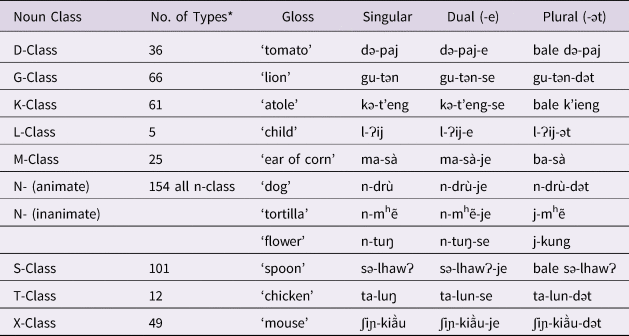
Northern Pame marks a number contrast between singular, dual and plural forms. The dual suffixes apply across-the-board to nouns in all classes. Singular and dual M-class nouns have a /ma-/ prefix that changes to a /ba-/ prefix in the plural, e.g., ma-sà ‘ear of corn’, ba-sà ‘ears of corn’.Footnote 2 Singular and dual inanimate N-class nouns have an /n-/ prefix that changes to a /j-/ prefix in the plural, e.g., n-tuŋ ‘flower’, j-tuŋ ‘flowers’. Animate nouns have the plural suffix /-ət/. Inanimate nouns in the S-class and mass nouns in the other classes form a phrasal plural with the word bale ‘many, much’, e.g., sə-lhawɁ ‘spoon’, bale sə-lhawɁ ‘many spoons’. Table 1 shows examples of singular, dual and plural noun forms in the major Northern Pame noun classes.
Major Northern Pame noun classes and number marking

*Counts derived from Baltazar Hernández, Castillo Izaguirre, Castillo Izaguirre, González Valdez & Hernández Gómez (Reference Baltazar Hernández, Castillo Izaguirre, Castillo Izaguirre, González Valdez and Hernández Gómez2007)
Northern Pame has assimilated many loan words from Spanish and Nahuatl to its phonology. Spanish loan words include bataj (< Sp. botella ‘bottle’), kaɁpiãjɁ (< Sp. café ‘coffee’), kantil (< Sp. candela ‘candle, light, lightbulb’), and pəgas (< Sp. vacas ‘cows, beef’). Two frequent loan words from Nahuatl are masat ‘deer’ and tamin ‘money’. These words fit a predictable template of nouns in Northern Pame with initial class prefixes. In many cases the Northern Pame nouns preserve the original position of the stressed syllable of the loan words, but in the case of pəgas ‘cow, beef’ the Northern Pame word has reanalyzed the binary foot, trochaic stress of Spanish vaca to an extrametrical syllable plus a monosyllabic trochee. The meanings of many of the loan words have also changed in Northern Pame. The Northern Pame word pəgas refers to a single cow as well as the meat derived from cows, and the word kantil broadened its meaning in Northern Pame to include lightbulbs and electricity in general. We have included these loan words in our analysis of the children's noun productions because they have been assimilated to Northern Pame phonology.
Northern Pame prosody
Northern Pame manifests monosyllabic or bisyllabic feet. Grammatical affixes are maximally one syllable long for prefixes and/or suffixes (Berthiaume, Reference Berthiaume2019). We assume the Prosodic Hierarchy shown in (1) where a phonological word contains at least one foot, the foot contains at least one syllable, and the syllable contains at least one mora (Hayes, Reference Hayes1995; Lahiri, Reference Lahiri2001; Selkirk, Reference Selkirk1984).
(1) Prosodic Hierarchy


Northern Pame has predictable stress on the lexical root, and this stress is manifested with contrastive tones. Footed syllables are the domain for tone assignment (Pearce, Reference Pearce2006). Tone occurs on the first syllable of word roots and is weight insensitive. Prosodic parsing occurs from left to right, beginning with the first syllable of the root. Unfooted syllables that occur before the word root are extrametrical. Despite its morphological significance, the initial syllable in Northern Pame nouns exhibits phonological weakening along a number of dimensions: it is unstressed; lacks tone, nasalization and voice quality; and only permits a restricted set of vowels. Phonological words in Northern Pame are parsed with binary feet with an extrametrical initial syllable. This template allows additional suffixes that can be accommodated by the binary foot, e.g., gu-tən-dat cl-lion-pl ‘mountain lions’ (2).
(2) Prosodic structures for singular and plural forms of gutən ‘mountain lion’

Northern Pame has two tones: high (H) and ascending (L). The low, ascending tone induces compensatory lengthening on short vowels, e.g., n-drù ‘dog’ → [ndrùú]. The low, ascending tone also spreads to suffixes attached to the word, e.g., n-drù-dət ‘dogs’ → [ndrùdə́t] ‘dogs’. The high tone does not induce compensatory lengthening or spread.
Grammatical affixes have two types of prominence: 1) a tone-bearing unit for tone spreading, or 2) a toneless unit, the vowel being reduced or elided completely. Syllables within the foot are licensed tone bearing units, while the extrametrical initial syllables manifest vowel reduction or deletion and do not manifest tone. This prosodic structure produces a stark contrast between the noun prefixes, which are extrametrical, and the suffixes, which can bear tone.
The inanimate, N-class plural prefix /j-/ cannot be accommodated within the extrametrical initial syllable. The glide therefore undergoes metathesis and mutates the initial consonant of the stem in predictable ways (3).
(3) Inanimate N-class underlying and surface plural forms (Berthiaume, Reference Berthiaume2012)

Predicting the acquisition of Northern Pame noun morphology
The acquisition of Northern Pame noun morphology poses many challenges for children. They cannot simply use the words that they hear older speakers using without understanding how certain groups of words such as the M-class nouns and inanimate N-class nouns change their initial consonants in plural and possessive contexts. These changes together with the absence of tone provide children with evidence that Northern Pame nouns have portmanteaux prefixes that mark a combination of noun class, number and possession. However some changes may lead to confusion between the noun classes. The plural of the N-class word kiuŋ ‘flowers’ begins with a consonant like the K-class word kət'eŋ ‘atole’. The plural of the N-class word lhiuã ‘maize (plural)’ has an initial consonant like the L-class word lɁij ‘child’. In the following three sections, we contrast the predictions that Whole Word (constructivist) and Minimal Word (prosodic) theories of language acquisition make for the omission, production accuracy and overextension of Northern Pame noun morphology.
Omission
Constructivist acquisition theories assume that children initially acquire inflected words as unanalyzed whole words. Previous investigations of this prediction center on the effect of input frequency on the words that children produce (cf. Dąbrowska, Reference Dąbrowska2004, Reference Dąbrowska2006; Dąbrowska & Tomasello, Reference Dąbrowska and Tomasello2008; Savičiūtė et al., Reference Savičiūtė, Ambridge and Pine2018). These theories do not predict the omission of obligatory prefixes in languages like Northern Pame because the obligatory prefixes are so frequent in the input to children. Demuth's (Reference Demuth, Morgan and Demuth1996, Reference Demuth, Weissenborn and Höhle2001) Minimal Word hypothesis predicts that children will initially produce words as binary feet that contain either two syllables or one syllable and two mora. The Minimal Word hypothesis predicts that children omit extrametrical syllables, and must learn how to attach these syllables at the level of the Phonological Phrase rather than at the Phonological Word. Importantly, the Minimal Word hypothesis predicts that Northern Pame children would produce inflectional suffixes that can be accommodated within a binary foot. We interpret the prosodic structure of Northern Pame to predict that children will omit the extrametrical noun class prefixes and produce the dual and animate plural suffixes. These predictions run counter to frequency-based predictions of Whole Word accounts that Northern Pame children will produce the frequently used noun prefixes and omit the relatively infrequent dual and animate plural noun suffixes.
Production accuracy
Constructivist theories recognize two ways in which input frequency promotes the use of target words. One mechanism is direct retrieval of the target form. Savičiūtė et al. (2018, p. 647) write “An important mechanism under input-based accounts is direct retrieval of the relevant word form (i.e., a stored noun form bearing the correct case + number marking) from memory. The assumption is that storage is probabilistic: the greater the frequency with which the relevant form has been witnessed, the greater the likelihood that it is available for retrieval.” This mechanism assumes there is a direct connection between the frequency of the word forms that children hear and the word forms that they produce. We assess the relation between the token frequency of word forms in the adult language and the accuracy of the word forms that the children produce.
A second mechanism is the indirect retrieval of a target form through analogy with other stored forms in the child's lexicon (Keuleers et al., Reference Keuleers, Sandra, Daelemans, Gillis, Durieux and Martens2007; Marcus, Reference Marcus1995; Pinker & Prince, Reference Pinker and Prince1988). Savičiūtė et al. (2018, p. 647) state “Since this process is probabilistic, the greater the number of forms available for analogy …, the greater the analogical support for the generalization.” This mechanism assumes that noun classes with many members have an advantage over noun classes with fewer members: in that children will be more practiced in retrieving inflections for large noun classes and less practiced in retrieving inflections for small noun classes. Applying the mechanism of indirect retrieval to the acquisition of Northern Pame nouns, we derive the prediction that the children will initially produce noun prefixes accurately in proportion to the number of nouns in the Northern Pame noun classes. This prediction has different implications for the dual and animate plural suffixes, which are present on dual and plural forms of most nouns.
The Minimal Word theories of Demuth, Fee and Fikkert do not predict any effect of input frequency on the children's production of the Northern Pame prefixes and suffixes. All of the words that children hear manifest a certain prosodic structure, and therefore the input frequency of any particular noun inflection builds the children's awareness of the prosodic structure of all nouns. Any frequency effects would be independent of the effects of prosodic structure on the children's productions.
Overextension
Constructivist theories predict that the retrieval of frequent words will interfere with the retrieval of infrequent words. Savičiūtė et al. (2018, p. 649) state “Often, this form maintains the case and number of the target but uses an incorrect declension class (e.g., Gvozdev's, Reference Gvozdev1949, study of Russian).” Northern Pame children would be expected to use singular noun forms in place of dual or plural noun forms, or substitute a class marker from a large noun class for a class marker from a class with few members. Studies of children's production of noun morphology have revealed incorrect uses of person, number, case and declension suffixes (Aguado-Orea & Pine, Reference Aguado-Orea and Pine2015; Savičiūtė et al., Reference Savičiūtė, Ambridge and Pine2018). This mechanism predicts that the majority of children's errors will take the form of substituting a frequent form for a less frequent form.
While the Minimal Word theory does not predict a frequency effect on the children's overextensions, it does predict a difference between the syllables where overextension would be expected. In the case of Northern Pame noun inflections, the Minimal Word theory predicts that children will be more likely to produce filler syllables in extrametrical syllables than within the binary foot. It therefore predicts that children will be more likely to produce overextensions for the Northern Pame prefixes than for the dual and animate plural suffixes. The Minimal Word theory does not predict that the children will produce prefixes from noun classes with many members in place of the prefixes from noun classes with few members.
The Northern Pame inanimate plural glide prefix offers an interesting test of the Whole Word and Minimal Word theories. Recall that the plural glide prefixes for inanimate, N-class nouns metathesize with, and in many cases mutate, the initial consonants of nouns. These glides provide evidence of whether the children omit the plural inflection in its underlying form before it metathesizes in the output or produce the surface forms of nouns with the metathesized glides. The children's production of these glides would provide evidence that the children have knowledge of the underlying forms of the glide prefixes but produce them in their surface position after metathesis. Constructivist theories predict that the Northern Pame children should omit the plural glides to the extent that they are not frequent in the input. Prosodic theories, on the other hand, predict that the children should produce the plural inanimate glide prefixes to the extent that they conform to the structure of Minimal Words.
Children produce a variety of other incorrect forms that do not fall within the strict division between omission or substitution errors. Whole Word theories predict that children will initially produce unanalyzed noun forms before they formulate more general rules of inflection through analogy across the stored nouns. This process predicts that once children begin adding inflection by rule or analogy, they will occasionally add inflections to unanalyzed noun forms that already contain an inflection resulting in a doubly-marked inflected form, e.g., !s-n-drù cl- cl-dog ‘dog’. These errors may be rare but, when they occur, they should take the form of a frequent noun class prefix added to an infrequent form rather than an infrequent noun class prefix added to a frequent form. A Prosodic Constraint Approach, by contrast, predicts that children would not produce such doubly-inflected words as prosodic words, but rather, as prosodic phrases.
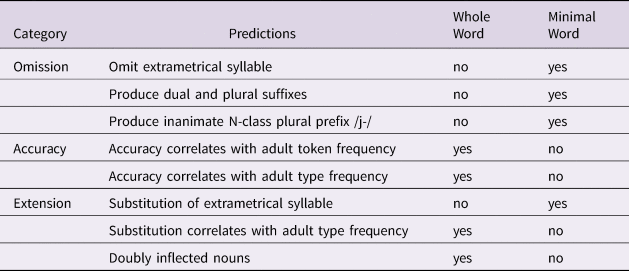
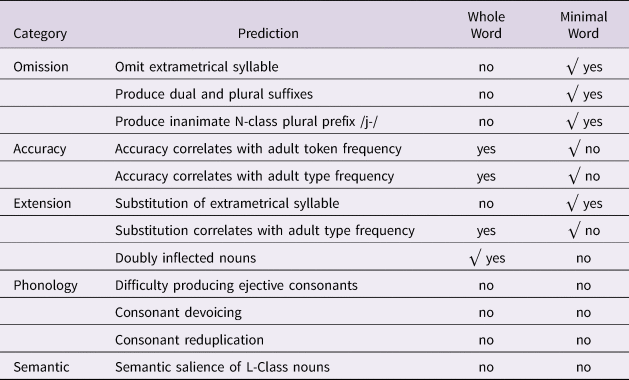
In summary, the present study investigates contrasting predictions from the Whole Word and Minimal Word accounts of the production of noun inflections by children acquiring Northern Pame. Whole Word theories predict that children will produce the noun class prefixes that occur frequently in Northern Pame and omit the dual and animate plural suffixes that occur infrequently. Whole Word theories predict that the accuracy of children's noun prefixes will reflect the input frequency of the target forms in direct retrieval, and the size of the noun classes in indirect retrieval, and that substitution errors will be dominated by the use of more frequent forms in place of less frequent forms. Whole Word theories also predict the occasional production of doubly-marked nouns. In contrast, Minimal Word theory predicts the variable omission of extrametrical syllables, i.e., the noun class prefixes, and the production of noun roots and suffixes. Minimal Word theory predicts that input frequency will not affect the accuracy of the children's noun forms for Northern Pame. We contrast the predictions of the Whole Word and Minimal Word theories in Table 2.
Predictions of Whole Word and Minimal Word theories.

Method
The language samples that we analyzed for this paper were recorded with 5 families living in four Northern Pame communities. All of the Pame communities are poor, rural villages with marginal economies. The families were selected on the basis of the children's use of Northern Pame and their willingness to participate in the study. Informed consent was obtained from the parents and the children in their language in accordance with university human subjects requirements. We visited each family twice a month to make a one-hour audio and video recording. We used a Canon Vixia HF M500 video camera to record social interaction within the families. During the recording sessions (between 2014 and 2016) the children interacted with other members of their extended families as well as with a Pame-speaking investigator from a nearby community. The interactions included both spontaneous discussions as well as elicited imitations and responses to questions. The parent data includes speech directed to the children as well as to other adults. The sampling times were limited by the 3-hour trips the investigators made to the villages, which limited the recording times to one late morning and one early afternoon session. The recordings were transcribed with the Elan transcription program and checked by two Northern Pame speakers. The transcriptions include all production data that was interpretable. We excluded exclamations, onomatopoeia and uninterpretable utterances from the analyses.
We extracted type and token frequencies from the adult and child recordings by means of a concordance that lists the utterances that contain each token for each lexical type for each speaker (Pye, Reference Pye2020). Due to the Whole-Word assumption of constructivist theories, we treated noun forms with different number inflections as different word types. For example, we counted the singular, dual and plural forms for the noun meaning child (l-Ɂij, l-Ɂij-e, l-Ɂij-ət respectively) as three different noun types parallel to our treatment of the singular nouns meaning child (l-Ɂij) and dog (n-drù). We included fully assimilated Nahuatl and Spanish loan words in the analysis. We included the B-form plurals of the M-class nouns in the analysis, but analyzed the inanimate plural forms of the N-class nouns separately.
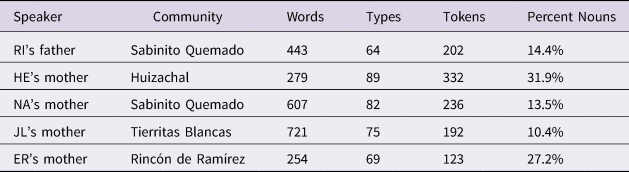
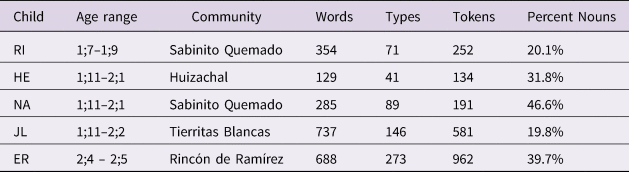
We analyzed 4 hours of production data from each of 5 children around the age of 2;0 living in four Northern Pame communities. For each child, we selected a one-hour session for the analysis of the speech of one adult participant. The children and adults produced words in Northern Pame and Spanish (Pye, Berthiaume & Pfeiler, Reference Pye, Berthiaume and Pfeiler2019). For the purpose of this study, we focus on the words that the child and adults produced in Northern Pame. Table 3 shows general measures for the adult speakers and Table 4 shows general measures for the children.
General measures and number of noun types and tokens for Northern Pame adults

General measures and number of noun types and tokens for Northern Pame children

We calculated the percentage of common noun types that the children and adults produced relative to their other Northern Pame words. The other lexical categories include adjectives, verbs, names, determiners, pronouns and interrogative expressions in addition to the nouns. With the exception of HE, the children produced a higher percentage of nouns than their parents.
Results
We present the results divided into three broad categories: omission, production accuracy, and substitution. We restate the predictions from the Whole Word and Minimal Word theories at the beginning of each section.
Omission
Affix omission provides a key test of the Whole Word and Minimal Word theories in that the Whole Word theories predict that Northern Pame children would produce the obligatory noun class prefixes and omit the dual and animate plural suffixes. In contrast, the Minimal Word theory predicts that Northern Pame children will omit the extrametrical syllables that contain the noun class prefixes and produce the dual and plural suffixes to the extent that they belong to binary feet.
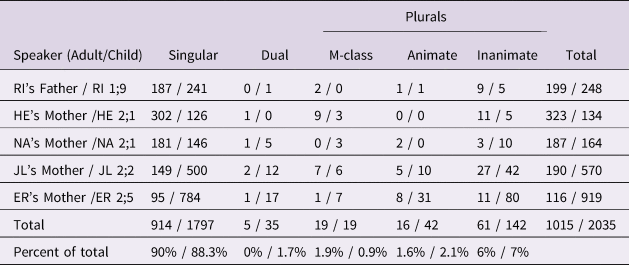
We analyzed the token frequency of number marking in Northern Pame child and adult speech by counting the number of Northern Pame nouns that the participants produced as singular, dual and plural noun forms. We separated the plural forms into the M-class plurals, the animate plurals, and the inanimate plurals of N-class nouns. Table 5 presents the token frequencies of the nouns produced by the adults and children.
Token frequency of Northern Pame number marking in adult/child speech

Singular nouns constitute 90 percent of noun tokens that adult speakers produced in their speech and 88 percent of the noun tokens that their children produced. The singular nouns far outnumber the dual and plural nouns the children and adults produced. Both adults and children produced more nouns with the inanimate plural prefix than with the animate plural suffix. The adults and children differed in the relative numbers of the dual and M-class plurals that they produced. These differences explain the statistically different distributions of the noun forms in the adults’ and children's speech (χ 2 = 14.6, p < .05).
The Northern Pame children hear their parents producing the noun-class prefixes in over 90 percent of their obligatory contexts. The only context in which adult speakers produce a form of the nouns that lacks an overt noun classifier is with the inanimate plural forms of the N-class nouns. Adults sporadically omitted classifier prefixes on some, high frequency nouns such as ndrù [drù] ‘dog’ in their speech to children. However, all five children frequently omitted the noun prefixes, yet regularly produced the noun suffixes for dual and animate plural. We provide examples of the children's noun productions in (4).
(4) Northern Pame children's noun productionsFootnote 3

The examples (4a), (4b) and (4d) illustrate words with omitted prefixes. Note that the default prefix n- (4d) is not an exception to omission despite its high frequency (see below). The form for ‘hands’ (4c) shows the omission of s- and the production of the dual suffix, -e. In (4e), s- is also omitted, while the animate plural suffix, -dət remains.
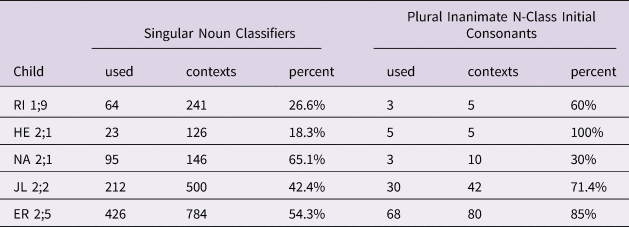
We tested the prediction that the children would produce Whole Word forms by analyzing how frequently the children use the noun class prefixes in their obligatory contexts. Table 6 shows the children's token frequency of use of classifiers on singular nouns and the token frequency of use of initial consonants on plural inanimate N-class nouns. The children produced the classifier prefixes on singular nouns in far fewer than 90 percent of their obligatory contexts. The two youngest children, RI and HE produced the noun-class prefixes in fewer than 30 percent of their obligatory contexts. ER produced the noun-class prefixes in 54 percent of obligatory contexts and NA produced the noun-class prefixes in 65 percent of obligatory contexts. The results indicate that Northern Pame children do not consistently produce the singular noun forms that they hear the most frequently in adult speech.
Children's token frequency of use of singular noun classifiers and the initial consonants of plural inanimate N-class nouns.

Inanimate plurals of N-class nouns
We turn now to the children's production of the N-class nouns with the inanimate plural glide prefix /j-/ such as lhiuã ‘maize, plural’ from j-thuã, cl/pl-maize. We separated the N-class inanimate plural nouns from the analysis of the singular noun prefixes because they lack overt noun-class prefixes and include changes to the initial consonants as well as the added plural glide. The inanimate N-class plural nouns do not have a classifier prefix, or, in prosodic terms, an extrametrical initial syllable. Thus, the inanimate N-class plural nouns provide an independent test of Whole Word and Minimal Word theories. Whole Word theories predict that children will substitute the far more frequent singular noun forms for the infrequent inanimate plural forms. The Minimal Word theory predicts that the children will produce the initial consonants of plural inanimate N-class nouns because the consonants belong to footed root syllables. Examples of the children's productions of plural inanimate N-class nouns are shown in (5).
(5) Northern Pame children's plural inanimate N-class noun productions

As shown in Table 6 above, the children (apart from NA) were relatively successful in producing the initial consonants of the plural inanimate N-class nouns. We counted the examples in (5b, c and d) as successful productions of the initial target consonants. The examples in (5c and d) include the syllabic consonants /l/ and /m/ respectively. The examples in (5a, b and c) exhibit an initial-consonant change. The initial target consonant in examples (5a and e) is the ejective consonant /k’/, which the children often omit. All of the children's examples have a phonetic realization of the plural prefix /j-/. RI's example in (5a) has the palatalization of initial consonant /t’/ to /tʃ/. The other examples contain the vowel /i/ after the initial consonant.
The results show that Northern Pame children of approximately 2 years of age have an early awareness of the phonological properties of the inanimate plural for N-class nouns. They are aware of the consonant change and the omission of the N-class singular prefix /n-/. They optionally may add a feature of the palatal plural prefix in the form of the vowel /i/. These productions support the Minimal Word prediction that the children will produce the initial consonants of noun stems that belong to footed syllables. Their omission of ejective consonants like /k’/ are most likely due to the extra articulatory difficulty in producing consonants with glottalic airflow (Bernhardt & Stemberger, Reference Bernhardt and Stemberger1998; Cook, Reference Cook2006; Pye, Ingram & List, Reference Pye, Ingram, List, Nelson and van Kleeck1987).
Production accuracy of noun classifiers
The preceding section provided a general overview of children's production of nominal prefixes in Northern Pame. In this section, we investigate the accuracy of children's production of the individual noun-class prefixes. Whole Word theories of nominal development predict that the frequency of adult use will determine the accuracy of the children's use of nominal inflections. Whole Word theories predict a direct impact on the children's production as evidenced by a correlation between the adults’ token frequency of use and the children's production accuracy as well as an indirect impact as shown by a correlation between the adults’ type frequency of noun use and the children's production accuracy. The Minimal Word theory does not predict a correlation between either the adult token or type frequency of use and the children's accuracy of production.
Adult token frequencies
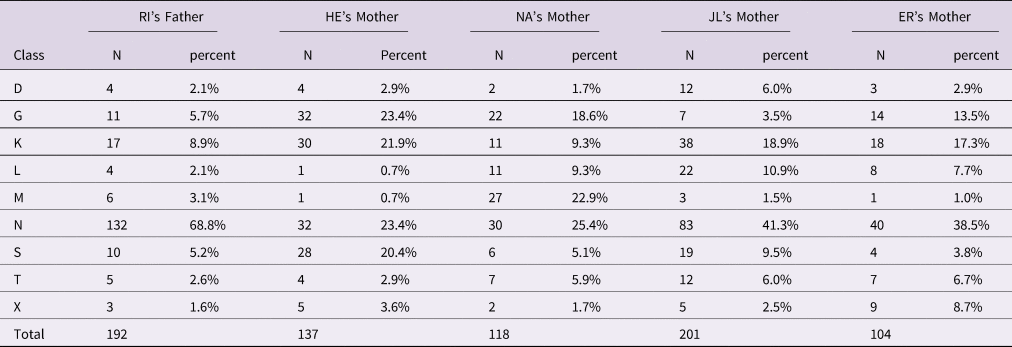
An analysis of the type and token noun frequencies in the adults’ speech shows a significant similarity between the two frequency patterns. Table 7 shows the token frequency of the noun classes in the adults’ speech. RI's father, JL's mother and ER's mother produced many more tokens of N-class nouns than the other classes. HE's mother produced similar numbers of tokens for nouns in the G-, K-, N- and S-classes, while NA's mother produced similar numbers of tokens for nouns in the M- and N-classes. In order to test the similarity of the parents’ frequencies of production, we combined the low frequency scores for the D, L, M and X noun classes into a single score for “other” classes. A chi-square test confirmed that the frequency profiles for the parents’ noun tokens were statistically different (χ2 = 176.9, df = 20, p < .05).
Token frequency of Northern Pame noun classes in adult speech.

The token frequencies for the parents of the two youngest children, RI and HE, contributed most of the variance to the test. These differences suggest the degree to which the noun tokens reflect particular features of the discourse context rather than the structure of the adult grammar. We combined the nouns that the adults produced into a single list in order to calculate an average type frequency score for the five adults. By combining their nouns in this way, we were able to evaluate the degree to which the adults produced the same nouns during the one-hour recordings that we analyzed. We found a minimal overlap between the individual nouns the adults produced. Seventy-three percent of the combined noun types were only produced by a single parent, and a further 17% of the noun types were only shared between two of the parents. Only 6% of the combined nouns were produced by four parents, and only one noun, lʔiy ‘child’, was produced by all five parents.
The lack of overlap between the nouns produced by the adult speakers adds to the diversity we found between the token frequencies of the adult nouns. This result indicates that the token frequency data that Northern Pame children receive from their parents contains a high degree of surface variation which can obscure underlying grammatical regularities. It is important to remember that we are interested in explaining how Northern Pame children acquire the structure of the noun morphology as much as how they acquire individual words. We can expect children in different families to learn different words, but all of the words should reflect the structure of Northern Pame classifier morphology.
Adult type frequencies
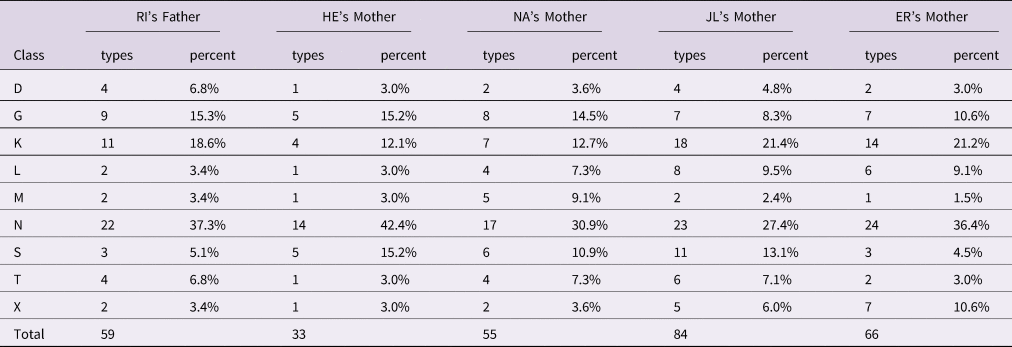
The type frequencies for the Northern Pame noun classes in adult speech tell a different story (Table 8). The type frequency of the noun classes counts the number of individual nouns that the parents produced for each noun class. As expected, most of the nouns that the adults produced belonged to the N-Class. Nouns belonging to the G- and K-Classes were frequent for most of the adults. The adults produced S-, M- and L-Class nouns with middle frequencies. The D-, T- and X-Class nouns were the least frequent classes the adults produced. In order to test the similarities of the parents’ type frequencies, we combined the low type frequency scores for the D, L, M, S, T and X classes into a single score for other classes. A chi-square test confirmed the similarity between the type frequencies of the adults’ noun use (χ2 = 11.9, df = 12, p > .05).
Type frequency of Northern Pame noun classes in adult speech.

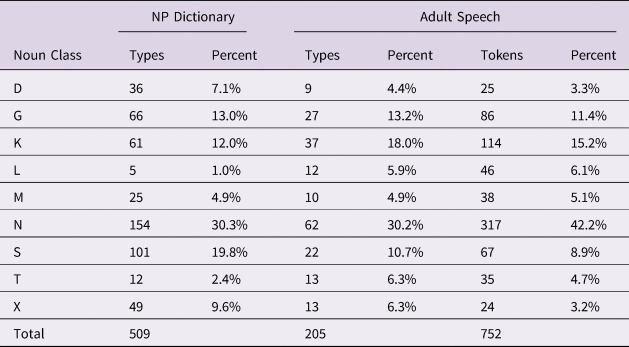
Due to the variation in token frequencies of nouns in the parents’ speech, we decided to compare the children's productions to the combined adult noun production shown in Table 9. We included the number of noun types listed in a Northern Pame Dictionary for comparison.
Northern Pame Dictionary noun types and combined adult type and token frequencies.

Table 9 shows an interesting discrepancy between the number of noun types listed in the Northern Pame dictionary and the number of nouns used in adult speech to children. The N-Class has the largest number of members in both counts, but there is a large difference between the number of S-Class nouns in the dictionary (19.8%), and the number of S-Class nouns that adults used in their speech to children (10.7%). The adults also produced a higher percentage of L-Class nouns (5.9%) than the dictionary contains (1%). Constructivist theories predict that children will produce the nominal classifiers more accurately that appear on the greatest number of noun types in adult speech. Thus, the theory predicts that the children will produce the N-, G-, K- and S- classifiers more accurately than the D-, L-, M-, T- and X- classifiers.
Child classifier production accuracy
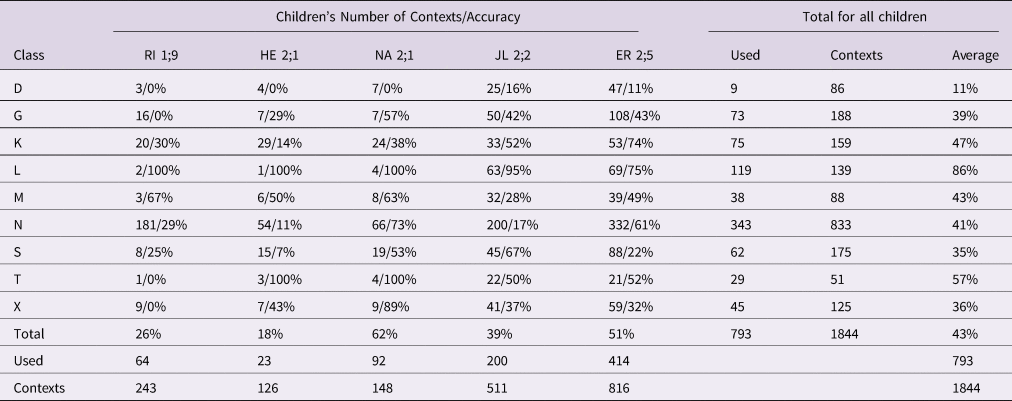
We followed the same procedure to determine the children's percent use of the classifiers for each noun class. Table 10 reports the number of obligatory contexts and production accuracy for the children's classifier use as well the total number of uses and contexts the children produced for each classifier. We used these totals to compute an average accuracy score for the children's production of each noun classifier. We excluded overextensions of classifiers for this analysis because they were not correct uses or omissions. The percent accuracy of the classifiers varies between the noun classes. The children were more likely to produce the classifiers for nouns from the L- and T- Classes.
Number of contexts/percent accuracy of Northern Pame noun classifiers in child speech.

Most of the nouns that the children produced belong to the N-Class, as shown in the column that reports the number of contexts for each noun class. With the exception of the oldest child ER, the children's use of the N-classifier was generally lower than their use of the classifiers for the L- and T-noun classes that have fewer members. There is the possibility that the younger children produced the classifiers for the L- and T- classes as frozen forms because the children produced those classifiers at a rate over 90%. The overall results suggest that the children had acquired the idea that Northern Pame nouns have class prefixes, but they were frequently unable to produce the class prefixes due to prosodic constraints.
Correlation between adult frequency of use and children's production accuracy
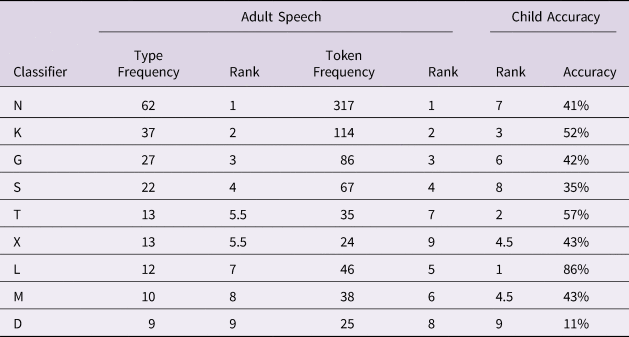
We next tested the prediction that parental frequency of use would correlate with the accuracy of the children's noun classifier production. We used the Spearman rank-order correlation to compare the adult rank order of classifier production with the children's rank order of classifier accuracy. We performed separate comparisons using the type and token frequencies for the parents as shown in Table 11.
Comparison of classifier use in adult speech and the accuracy of the children's use in obligatory contexts.

The rank orders of the adult type and token frequencies are statistically correlated (r s = .82; p < .05). The number of tokens that the parents produced in each noun class was correlated with the number of noun types in each noun class. The Spearman test showed there was not a statistically significant rank order correlation between the adult type frequency of use and the children's classifier production (r s = -0.03, p > .05), or between the adult token frequency of use and the children's classifier production (r s = -0.05, p > .05). The main contributors to differences between the adults and children were the ranks for the N-, L- and S- classes. The adults used many N- and S-class nouns and few L-class nouns, whereas the children were highly accurate in their production of the L-class prefixes and much less successful in their production of the N- and S-class prefixes. These results do not support the main predictions of the Whole Word theories. As predicted by the Minimal Word theory, the Northern Pame children did not produce the prefixes on highly frequent nouns more frequently than on low frequency nouns.
We conclude this section by noting that the children exhibited notable differences in their production of the different noun-class prefixes. They did not treat all of the prefixes in the same way. They were more successful at producing the classifiers for the L- and T- classes that had few members, and were less successful at producing the classifiers for the N- and S- classes that had many members. This result shows that the children had analyzed the role of the noun prefixes in some noun classes but were not yet proficient in producing the prefixes. Other factors were promoting or constraining the children's production of the noun classifiers. Before discussing this issue further, we turn to the children's classifier substitutions in the next section.
Overextension
Whole Word theories that admit a role for analogical extension also predict that type frequency defined by the number of members that belong to each morphological class will predict children's substitution of high type frequency affixes in place of low type frequency affixes (cf. Bowerman & Choi, Reference Bowerman, Choi, Bowerman and Levinson2001; Bybee, Reference Bybee1995, Reference Bybee2001; Forrester & Plunkett, Reference Forrester, Plunkett, Ram and Eiselt2012; Köpcke, Reference Köpcke1998; Maratsos & Chalkley, Reference Maratsos, Chalkley and Nelson1980; Plunkett & Nakisa, Reference Plunkett and Nakisa1997). Children acquiring Spanish, English and Finnish use high frequency forms of nouns as inflectional defaults (Aguado-Orea & Pine, Reference Aguado-Orea and Pine2015; Räsänen, Ambridge & Pine, Reference Räsänen, Ambridge and Pine2014, Reference Räsänen, Ambridge and Pine2015).
The Minimal Word theory does not predict a correlation between the adult frequency of use and the children's overextensions, but it does predict that the extrametrical syllables containing the noun prefixes will be vulnerable to idiosyncratic substitutions made by individual children. In this section, we evaluate the degree to which children substitute a high frequency inflected form for low frequency inflected forms.
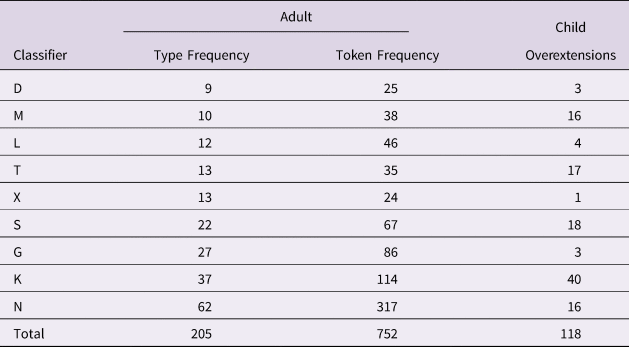
The data in Table 9 show that the N-, K-, G- and S- noun classes have a greater type and token frequency in adult speech to children than the other noun classes. Constructivist theories therefore predict that Northern Pame children will overextend the N-, K-, G- and S- noun class prefixes to nouns in other classes. We have noted that input frequency is far from the only factor that might lead children to overextend noun affixes. The observations about the children's production of the noun prefixes suggest that the children were treating the L- and T- classifiers as unanalyzed, frozen word forms. If this is the case, we would not expect the children to overextend the L- and T- classifiers to other words if they had not analyzed these words into separable morphemes. The semantic motivations for some of the Northern Pame noun classes might also block overextensions for noun classes with salient semantic motivation such as the D- (fruit), G- (agents and animals), L- (people) and K- (liquids) noun classes. The inanimate, N-class plural nouns, on the other hand, might promote overextensions of prefixes between noun classes because the plural forms of some N-class noun change the initial consonant to a /k/ or /l/.
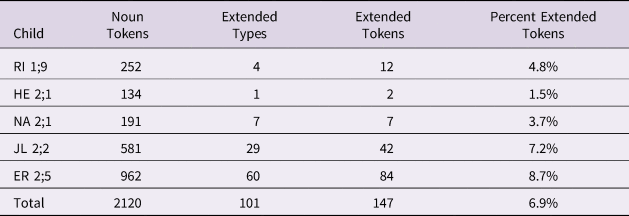
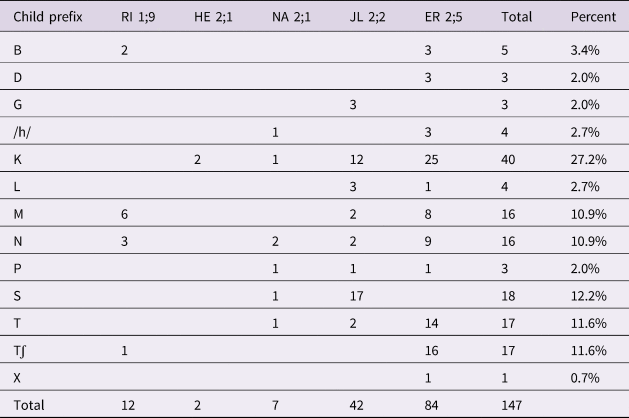
We did not analyze the cases where the children omitted the noun classifiers as overextensions. We only considered forms in which the children used a noun classifier inappropriately. For example, JL produced the noun n-drù ‘dog’ as [s-trù]. We interpret this production as a case in which JL extended the S- classifier to an N-Class noun. He also extended the N- classifier to the D-Class noun da-nã̀s ‘orange’, which he produced as [nanã̀s]. The Northern Pame children overextended approximately 7% of the noun classifiers that they produced. The two oldest children, JL and ER, overextended noun classifiers twice as frequently as the younger children (Table 12). This result supports the hypothesis that children begin to generalize morphological affixes once they have accumulated a large enough vocabulary to register general patterns (Ingram, Reference Ingram1989, p. 450).
Number of children's classifier overextensions.

Table 13 lists the types of classifier overextensions that the Northern Pame children produced. It is interesting to observe that /h/ was the only consonant that children overextended that was not a classifier. The children did not overextend other Northern Pame consonants such as /ɲ/, /ts/ and /r/. /h/ occurs initially on a number of frequent Northern Pame nouns, particularly the nouns hiŋ ‘grandfather’ and hiauŋ ‘land’. Four of the children overextended the K- and N- classifiers and three of the five children overextended the M-, P- and T- classifiers.
Distribution of children's classifier overextensions (tokens).

We compared the children's overextension frequencies to the adult input frequencies to determine if the children's classifier overextensions were influenced by the type and token noun frequencies in adult speech. As shown in Table 14, we used a subset of the classifiers in order to facilitate the comparisons between the adult prefixes and the children's overextensions. As before, we compared the adult type and token frequencies separately. The chi-square comparisons were significant for both the comparisons between the number of the children's overextensions and the number of noun types and tokens in adult speech (Type χ2 = 45.9, df = 8, p < .05; Token χ2 = 85.7, df = 8, p < .05). These outcomes show that the adult usage of noun classifiers was not a major influence on the children's classifier overextensions.
Comparison of classifier use in adult speech and the children's classifier overextensions.

We list all of the overextensions that the children produced in Appendix A. We provide a session code for each type as evidence that the children's overextensions occurred across the four sessions for each child that we analyzed. There is also evidence that the children produced different classifier overextensions for the same words across multiple sessions. JL produced the noun danã̀s ‘orange’ as [nanã̀s], [talaʔs], [lanas] and [sanã̀s] across multiple sessions. ER produced danã̀s ‘orange’ as [nanaʃ] and [tanas] in different sessions. The overextensions document the children's struggle to fix the form of the underspecified initial syllables in their words.
A look at the children's words suggests several other factors that influenced their overextensions. All of the classifier overextensions that the children produced with an M- prefix occurred on children's nouns with an initial, bilabial consonant, e.g., RI's production mbeʔe for the adult word nʔmeʔe ‘radio’ and ER's production mpuhu for the adult word nphuhu ‘chair’. Over half of the children's overextensions of the K- prefix were substitutions for adult G-class nouns, e.g., HE's production koboʔ for the adult word gaʔmuʔ ‘turtle’ and JL's production kaphe for the adult word gaphe ‘pig’. Some overextensions were almost entirely made by individual children; JL produced all but one of the S- overextensions and ER produced all but one of the Tʃ- overextensions. Some individual words were more difficult for the children to produce than other words. The word nʔmeʔe ‘radio’ was difficult for RI, the word masat ‘deer’ was difficult for ER, the word danã̀s ‘orange’ was difficult for NA, JL and ER, and the word pəgas ‘cow, beef’ was difficult for JL and ER. These examples show how phonological and individual differences between children override overextensions due to lexical frequencies in the adult input.
We conclude that the overextension results do not support a key prediction of Whole Word acquisition theories. There is no evidence of a widespread extension of the N-Class and S-Class prefixes to words in other classes. N-Class prefix extensions were not more frequent than the other types of overextensions. The children's overextensions of the T-Class prefix are problematic for the Whole Word theories because of the low type and token frequencies of T-Class words in child and adult speech with the possibility that the children produced the T-Class nouns as frozen forms. The results offer additional support for the Minimal Word theory. Other factors, such as the children's phonology and individual differences make greater contributions to prefix overextension in Northern Pame than the adult input.
Overextension to unanalyzed, inflected nouns
Northern Pame children might add a noun class prefix to words that already had a noun class prefix if they were unsure of the word's composition. Whole Word theories assume that children would initially acquire words as a whole unit without a complete understanding of its morphological structure. These unanalyzed words could remain in the children's lexicon for some time before the children recognize their parts, in which case children would be free to apply a rule that adds a noun class prefix to these unanalyzed words. The resulting production will appear to have two classifiers. The Minimal Word theory does not predict the production of extra, extrametrical syllables in the form of nouns with two classifiers.
We expect nouns with two prefixes to be infrequent because children must first become proficient at producing the inflections before they can overuse them. As the children become more proficient at producing the prefixes, they would be less likely to overextend them. We estimated the likelihood that Northern Pame children would produce nouns with two class prefixes by multiplying the percentage of words that the oldest child ER produced with a class prefix (54.3% in Table 6) by the percentage of nouns that ER produced with an overextended prefix (8.7% in Table 12). ER produced a total of 426 nouns with singular noun-class prefixes. We would therefore expect that he would add an additional prefix to 4.7% (54.3% x 8.7%), or 20 of his inflected nouns. We only found four examples of nouns in the children's speech with double classifiers. We list these examples in (6).

In (6a) NA added the N-classifier to a T-class word that already has the classifier T-. In (6b), JL added the S-classifier to a G-class word that still has the G- classifier on it. The absence of double-marked nouns in the speech of the other two children can be explained by the small number of utterances these children produced, but it also follows from the prediction that children will only produce double-marked nouns once they become proficient at producing the classifiers.
On balance, the acquisition data for Northern Pame offers greater support for the Minimal Word theory than for the Whole Word theory. Whole Word theories do not predict noun-class prefix omission, while the Minimal Word theory does. We did not find a correlation between the children's production of the noun-class prefixes and the type and token frequency of the noun prefixes in adult speech as predicted by the Whole Word theories. The overall pattern of children's prefix substitutions were predicted by the Minimal Word theory, but not by the Whole Word theories. The Whole Word theories do predict the production of nouns with two prefixes while the Minimal Word theory does not. We discuss the theoretical implications of these results further in the next section of the paper.
Discussion
We used naturalistic data on the acquisition of nominal prefixes in the Otopamean language Northern Pame to test predictions we derived for the Whole Word version of constructivist theories and Minimal Word prosodic theory of language acquisition. We evaluated the Whole Word and Minimal Word predictions for three key areas of inflectional development: omission, production accuracy and extension. Table 15 summarizes these predictions and their outcomes. A check mark indicates support for one of the predictions.
Tests of Whole Word and Minimal Word predictions.

Whole Word theories assume a copy and paste model of inflectional development in which children repeat the words that they hear other speakers using without analyzing their internal structure. The omission results for Northern Pame do not support the Whole Word assumption of constructivist theories. The Minimal Word version of Prosodic Theory predicts that children will produce Minimal Words consisting of binary feet and omit extrametrical syllables. The Northern Pame results offer strong support for this prediction.
Children's omission of syllables and affixes is a prominent aspect of language acquisition in languages with long words and robust morphologies. Languages with agglutinative morphology are ideal for observing the limitations of children's ability to produce whole words of the adult language (cf. Pye, Reference Pye1983; Courtney & Saville-Troike, Reference Courtney and Saville-Troike2002; Demuth, Reference Demuth, Farris-Trimble and Barlow2014; Mithun, Reference Mithun1989; Forshaw, Davidson, Kelly, Nordlinger, Wigglesworth & Blythe, Reference Forshaw, Davidson, Kelly, Nordlinger, Wigglesworth, Blythe, Fortescue, Mithun and Evans2017). In the case of Northern Pame, every noun carries an obligatory noun class prefix and may bear optional suffixes for dual and animate plural. Northern Pame children hear adults producing nouns with class prefixes and yet they frequently omit these prefixes. Acquisition theories of all types must recognize that affix omission is a fundamental feature of language acquisition and seek its explanation.
We used the parents’ type and token frequency of affix production as an additional test of the Whole Word and Minimal Word theories. Constructivist theories predict a correlation between the type and token noun frequencies in parental speech and the accuracy of the children's production of the classifier prefixes; the Minimal Word theory does not. The Northern Pame evidence does not support constructivist predictions that children will use frequently inflected nouns.
Current versions of the Minimal Word theory of prosodic development do not predict a role for input frequency in the children's use of noun affixes but, rather, assume a “poverty of the stimulus” as defined in generative grammar where all words in the adult language obey the prosodic constraints on syllables. We extended the Minimal Word theory by adding the prediction that the children would produce the syllables within the binary feet more accurately than the extrametrical syllables. Both the absence of correlations between the adult type and token frequencies and the children's production accuracy as well as the contrast between the children's production of the noun class prefixes and plural suffixes offer support for the Minimal Word theory.
Savičiūtė et al. (2018, p. 664) report that the overextension errors that Lithuanian children made in their study are not explained by constructivist accounts. Most of the errors that the Lithuanian children made involved near misses such as substitutions of singular for plural, masculine for feminine and nominative/accusative for one of the less frequent cases. We noted examples of phonological and individual factors that were evident in the Northern Pame children's prefix productions and overextensions. The children were more successful in producing the L- and T- noun classifiers for small, closed sets of nouns than the N- classifier that is the most frequent in adult speech. While the children overextended the most frequent classifier prefix, the N- classifier, the children overextended the K- classifier more frequently and specifically to nouns in the G-class. Individual children evidenced problems producing prefixes on individual words.
Taken altogether, the Northern Pame results point to the need for a multi-factor account of language acquisition. Constructivist theories overemphasize the role of lexical frequency and structure, and neglect the roles of prosody and phonology. Data from languages with a variety of morphological structures are necessary to understand how children acquire inflectional affixes. The Minimal Word theory still lacks a way to integrate children's developing phonologies with their prosodic structures (cf. Fee, Reference Fee and Archibald1995). This is an area of prosodic theory in need of further development.
We found some support for the proposal that children produce unanalyzed inflected words in the form of words with double marking for noun class. While such forms support constructivist observations about children's use of unanalyzed forms, they undercut the assumption that children only use words that they hear in adult speech. The double-marked nouns support theories which assume that children eventually formulate general inflectional rules to guide word formation. The onset of such rule formation must overlap with the use of unanalyzed word forms in order to result in the production of double inflection.
Conclusion
The history of research on the acquisition of nominal inflection demonstrates how the study of children acquiring European languages has shaped the development of language acquisition theories that purport to explain the language of all children. Nouns in many European languages bear a single, inflectional suffix with a fusional morphology for case, declension and number. Other languages, such as Turkish, have frequent uninflected noun forms. Research on European languages has generally supported constructivist theories that assume children begin with the production of whole words from the adult language and sometimes use uninflected default forms as substitutes for inflected words.
These theoretical approaches cannot be maintained in their current form when faced with acquisition data for languages with more robust morphologies. Acquisition data from languages with agglutinative and polysynthetic morphologies demonstrate that children often fail to produce parts of adult words. The abbreviated lexical forms that children produce are not licensed by the adult grammar, and thus demonstrate the active role that children take in inventing their own words. We propose an investigation of the prosodic constraints on children's words to document how the structure of the adult lexicon influences the forms of children's lexical inventions. Our investigation of Northern Pame underscores the importance of expanding the acquisition database beyond the current sample of languages (Pye, Reference Pye2020).
Children's productions of novel word forms provide additional evidence for the active role that children take in moving beyond the language of adult speakers. In Northern Pame, children sometimes add the wrong noun class prefix to words and occasionally add a second noun class prefix to a word that already has a prefix. Such innovations demonstrate that children do not wait to hear a word form before they produce it. Northern Pame children have a general understanding of the grammatical requirement to add a noun class prefix, but will occasionally add something even if it is not the same prefix that adults use.
Acknowledgements
We thank the Northern Pame families and children who allowed us into their homes for this study. We also wish to acknowledge the contributions of the Pame investigators, Felix Baltazar Hernández and Constantino Gomez González, who recorded the children and transcribed their speech. We also thank audience members at the SSILA 2018 and at the XX Encuentro de Adquisición del Lenguaje, Casa Chata, El Centro de Investigaciones y Estudios Superiores en Antropologia Social, Mexico City, Mexico, May 2, 2019. Research on the acquisition of Xi'iuy is supported by the National Science Foundation grant BCS-1360874. All errors of fact or interpretation are the sole responsibility of the authors.
Abbreviations
- cl
classifier
- du
dual
- pl
plural
- Sp
Spanish
Appendix A. Overextension types of children's Northern Pame noun classifiers