Introduction
Worldwide, the proportion of people aged 60 and over is growing faster than any other age group.Reference Louria1 By 2050, 2 billion people worldwide will be aged above 60 years with 80% of them living in developing countries.2 The current number of geriatricians is insufficient to meet the healthcare needs of increasing numbers of older people, particularly the very old.Reference Ebrahim3 We therefore have a responsibility to ensure that effective practices and essential skills are shared. All undergraduate medical students and postgraduates, including pre-registration house officers, core medical trainees, general physicians and practitioners should be familiar with the key principles and practices of geriatric medicine. Education in geriatric medicine is currently failing to meet these objectives.
In this review, we explore negative attitudes towards geriatric medicine and contrast these with factors motivating change. To investigate how processes of learning can be optimized, a PubMed search was undertaken using the key words ‘education’, ‘teaching’ and ‘geriatric medicine’. This yielded examples of effective teaching practices for different cohorts of undergraduate and postgraduate trainees in geriatric medicine, general practitioners and allied health professionals. These teaching practices are reviewed and their underpinning educational theories discussed.
Background: a worldwide perspective
In the early 1990s, a small group of European professors of medical gerontology (GEPMG) felt very concerned about growing geriatric training needs and raised awareness of the lack of structured geriatric core curricula. They also suggested the great need of an advanced postgraduate geriatric course for junior geriatricians in the European Universities.Reference Stähelin, Beregi, Duursma, Evans, Michel, Ruiz-Torres and Steen4 In 2006, a survey of geriatric education in 31 of 33 European countries reported that geriatric medicine was recognized as an independent specialty in 16 countries and as a medical sub-specialty of general or internal medicine in nine others. However, six countries (Austria, Greece, Luxembourg, Estonia, Moldavia and Slovenia) did not recognize geriatric medicine at all. Undergraduate teaching activities in geriatric medicine were organized in 25 (81%) of the surveyed countries, but to widely different extents. The content of the teaching in geriatric medicine, based on the European Union core curriculum recommendations, applied in only two countries. Geriatricians specifically organize postgraduate training in geriatrics in 16 of 31 countries and in collaboration with internal medicine in six other countries.Reference Michel, Huber and Cruz-Jentoft5
The national survey of undergraduate teaching methods and delivery in 2008 showed a mixed picture with regard to undergraduate teaching in ageing and geriatric medicine. The analysis from 17/30 (57%) respondents of the UK medical schools teaching a full 5-year course revealed that the ‘geriatric giants’ are widely taught amongst the UK medical schools surveyed; however, learning outcomes in geriatric medicine and ageing are inadequately assessed. This survey also showed that elder abuse, pressure ulcer, and physiology of ageing including cellular and social ageing is inadequately taught in UK medical schools. The UK medical graduates are not adequately trained to understand and meet challenges of common pathologies in older patients.Reference Gordon, Blundell, Gladman and Masud6
Data from the US in 2006 suggested that there was only one geriatrician for every 5000 Americans over the age of 65.Reference Gross7 It is estimated that by 2030, as many as 36,000 geriatricians will be needed to care for the ageing US population. However, in internal medicine nearly one-third of geriatric fellowship positions remain unfilled, despite introducing shorter yearly fellowship training programmes.Reference Brotherton and Etzel8, Reference Hirth, Eleazer and Dever-Bumba9 Given the small number of current geriatricians and the lack of interest in geriatrics by medical students and residents, the target number of geriatricians seems unrealistic.10
In Japan, 10.4% of the total population are over 75, making it the first country to have over 10% of the population in this range. In a 2008 survey, it was found that the country had the world's longest average life span of 79 and 86 years, in men and women, respectively.Reference Arai11 Adequate numbers of appropriately trained health and social care professionals are needed to deal with this ageing population, yet many geriatric medicine departments are managed without full professors and less than 30% of Japan's 79 medical schools have departments of geriatric medicine. Many medical students graduate without ever learning basic key skills in geriatric medicine. Though undergraduate education in geriatric medicine in Japan emphasizes the theoretical aspects of the ageing process and features of disease in the older population, the tendency is to omit attention to the practical aspects of care.
Negative attitudes towards geriatric medicine
Over the last 25 years, the number of medical schools and medical students in the UK has increased, but the teaching of geriatric medicine has not been promoted.Reference Bartram, Crome, McGrath, Corrado, Allen and Crome12 A survey undertaken in 2003 showed that geriatric medicine was taught separately only in 12% of schools, compared with 50% in the 1980s.Reference Bartram, McGrath, Crome, Crome, Corrado and Allen13 There has also been some decline in the number of medical schools with academic departments of geriatric medicine: from 59% in 1986 to 53% in 2003.Reference Bartram, McGrath, Crome, Crome, Corrado and Allen13
Some physicians openly question the need for geriatric medicine at all. Increasing numbers of older complex in-patients and the positive results achieved by non-geriatricians supervising multi-disciplinary teams have both been used as arguments to abolish the speciality.Reference Denaro and Mudge14 Most medical students do not consider pursuing a career in geriatric medicine,Reference Diachun, Hillier and Stolee15–Reference Fitzgerald, Wray, Halter, Williams and Supiano17 with medical students and junior and senior doctors ranking neurosurgery and thoracic surgery as the highest prestige specialities.Reference Album and Westin18
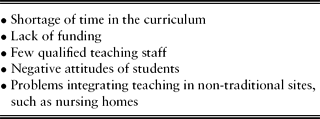
Negative societal attitudes towards older people are likely to influence medical students (Table 1). In 2005, a UK survey of 2000 adults aged over 16 years reported that one-third of people thought that the demographic shift towards an older society would make life worse in terms of standards of living, security, health, jobs and education, and one in three respondents viewed the over-70s as incompetent and incapable.19
Barriers to improving education in medical education
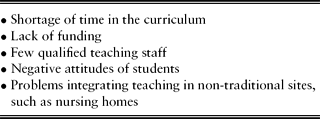
Another reason for the lack of interest in geriatric medicine by young physicians or medical students could be low compensation. A study of medical students in the US showed that students enter residency with an average debt exceeding $200,000; this figure is rising at a rate of 6–7% per year.Reference Jolly20 This debt load makes it difficult to devote extra years to a geriatrics fellowship, during which salaries are low. This will be further followed by a lower compensation if practising as a geriatrician since internists and family physicians in the US receive higher salaries.21
A survey in Australia showed that very few medical students would consider a career in geriatric medicine and prefer not to treat older people. The reason for this negative attitude was somehow secondary to their experience during geriatric training. The speciality was described as ‘low-tech’ where a primary issue remains psychological or placement rather than a cure.Reference Le Couteur, Bansal and Price22
Other reasons for negative attitudes toward geriatric medicine include the age difference between the young health provider and the older patient, lack of knowledge and lack of contact with elderly people and learning methods that create or reinforce negative stereotypes.Reference Hoffman, Brand, Beatty and Hamill23, Reference Bachelder24 These negative views and attitudes seem to become more entrenched as trainees have more exposure to and training in the speciality.Reference Kishimoto, Nagoshi, Williams, Masaki and Blanchette25, Reference Lee, Reuben and Ferrell26 The reasons for this are not clear, but do suggest that geriatric education and curricula need further review and modification.
Motivators for change
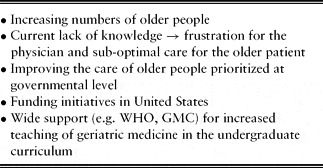
Several factors are motivating improvements to the education of geriatric medicine (Table 2). Perhaps the most powerful stimulus for change is the vast gap that currently exists between service provision and care need. Two-thirds of hospital in-patients in the UK are now aged over 65 years.27 Most medical and surgical specialities are currently facing increasing numbers of older people being admitted to hospital and thus need the competencies to care and work with older people. There are deficits in current knowledge of treating doctors, which may lead to sub-optimal care, stereotyping and frustration.Reference Adams, McIlvain, Geske and Porter28 The list of knowledge deficits in geriatric medicine identified by physicians includes prescribing in older people, incontinence, instability and balance problems, multidisciplinary working and ethical issues such as capacity assessment and treatment withdrawal.Reference Adams, McIlvain, Geske and Porter28, Reference Tanner, Eckstrom, Desai, Joseph, Ririe and Bowen29
Motivators for improving education in geriatric medicine

A more positive attitude to older people increases the likelihood of choosing a career in geriatric medicine.Reference Hughes, Soiza, Chua, Hoyle, MacDonald, Primrose and Seymour16 Early exposure to geriatric medicine has been advocated,Reference Fitzgerald, Wray, Halter, Williams and Supiano17 as students with more experience of older people, both positive and negative, are less likely to resort to stereotype and show more interest in geriatric medicine as a career.Reference Schigelone and Ingersoll-Dayton30 The World Health Organization,31 General Medical Council32 and the Association of American Medical Colleges33 all advocate the teaching of geriatric medicine in the undergraduate curriculum. Improving the care of older people has been prioritized also at governmental level, particularly in Australia34 and the United Kingdom.35
The European Academy for Medicine of Aging (EAMA) celebrated its 10th anniversary in 2005. Academic geriatricians from across the world organized a residential course of four 1-week sessions over 2 years, consisting of innovative and contemporary content, to teach the future teachers in geriatrics.Reference Bonin-Guillaume, Kressig and Gavazzi36 The EAMA training led to professional promotion for a majority of participants and non-European EAMA students exported the EAMA's teaching methods and spirit outside Europe to launch similar courses, such as the Middle East Academy for Medicine of Aging (MEAMA), Latin America Academy for Medicine of Aging (ALMA), Saint Louis University Geriatric Academy (SLUGA), and the European Nursing Academy for Care of Older Persons (ENACO). These collective efforts have motivated health professionals to increase and update their geriatric knowledge, to harmonize clinical management and to establish guidelines and accreditation criteria.Reference Bonin-Guillaume, Kressig and Gavazzi36
Educational theories
Any teaching session may be seen by the well-intentioned traditional medical educator as an opportunity to ‘pass on’ as much of this knowledge as possible, perhaps by recalling numerous ‘facts’ for the students to transcribe. The learners are expected to commit the information to memory, becoming ‘little living libraries’ capable of regurgitating the same information at a later date.Reference Bruner37 However, increasing the density of information given to students has detrimental effects on the amount of information actually retained.Reference Russell, Henricson and Herbert38 The objectivist, pedagogical teaching model is being supplanted by teaching methods based on alternative educational theories. These theories stem from five main sources:Reference Torre, Daley, Sebastian and Elnicki39 behaviourism, adult learning (andragogy), constructivism, cognitivism and social learning. Concern has been raised that these theories lack a solid evidence base and are founded on metaphor rather than science.Reference Colliver40 However, a familiarity with educational epistemology can improve the effectiveness of teaching practice by providing a basis for the selection of instructional and evaluation strategies to match intended goals of learning.
Behaviourism
The behaviourist model involves a teacher-centred approach and has traditionally been used for the development of competencies and for demonstrating psychomotor skills.Reference Skinner41 A behavioural objective should include the performance, conditions under which the behaviour must be performed and criteria to measure acceptable performance.Reference Quinn and Hughes42 Behaviourist objectives (performance, conditions, criteria) improved the functional assessment of an older person at the University of Michigan Medical School.Reference Supiano, Fitzgerald, Hall and Halter43 Performance included history taking (e.g. asking about falls and memory impairment), noting visual and hearing impairments and gait assessment. This was evaluated at a Standardized Patient Instructor station of an Objective Structured Clinical Examination (OSCE). The measure of acceptable performance was a score of 50% on a 17-item checklist. Student performance was initially poor (with a mean score of 43%), but improved significantly after the introduction of an integrated geriatric curriculum.
Adult learning theory
The objective of education in adult learning (andragogy) is for the learner to become autonomous and self-directed.Reference Knowles44 The role of the teacher is to facilitate the growth and development of the overall person. The andragogical principle of self-directed learning was the driving force behind the General Medical Council guidance in the UK that student-selected components should comprise a quarter to a third of medical school curricula.32 Geriatric medicine may not benefit from such initiatives, since students are unlikely to choose self-selected modules to address knowledge deficits. Another tenet of andragogy is that significant learning is acquired through doing.Reference Quinn and Hughes42 Experiential learning improves knowledge of and attitudes to the subject taught.Reference O'Connell, Rivo, Mechaber and Weiss45
Educational games represent a type of experiential learning where the learner ‘engages in some activity, looks back at the activity critically, abstracts some useful insight from the analysis and puts the results to work’.46 Gaming provides a safe environment and undesirable actions can be stopped or repeated to learn from mistakes. The most common type of education game used in the field of geriatric medicine is role-playing. The review of 10 years experience of conducting the ageing game at the University of Minnesota Medical School concluded, ‘ageing game is an effective tool for stimulating long-lasting awareness and understanding of key issues related to ageing and geriatrics’.Reference Pacala, Boult and Hepburn47 Another study had found similarly positive results in evaluating the use of role-playing games in geriatric education.Reference Varkey, Chutka and Lesnick48 However, a systematic review of eight US studies to assess the effect of geriatric educational games on the satisfaction, knowledge, beliefs, attitudes and behaviours of health care professionals did not support the use of role-playing interventions in geriatric medical education with the aim of improving attitudes towards the elderly. The limitations of this review were lack of generalizability to different cultures and the small number of low-powered studies that were included.Reference Alfarah, Schünemann and Akl49
Constructivism
Constructivists believe that learners build knowledge from their own perceptions and experiences. Learning is an active process, occurring within the minds of each individual.Reference Bruner37 The role of the constructivist teacher is therefore to support the learners’ own construction of knowledge.Reference Peters50 Constructivism has gained popularity as a framework for medical education. The emphasis on processes of learning and personal development of students is considered to be particularly effective in fostering professional attitudes and beliefs.Reference Howe, Billingham and Walters51
The principle of building on knowledge through the curriculum has been employed in the geriatric medicine programme at Southern Illinois School of Medicine.Reference Rull, Rosher, McCann-Stone and Robinson52 Students encounter a simulated older couple through standardized couple patient experiences, small group sessions and paper-based learning modules. The couple ages 10 years between each annual, 4-hour session. The woman represents healthy ageing whereas her husband becomes frail, with multiple co-morbidities, polypharmacy and functional decline. Thus the students gain insights into health promotion/illness prevention and caregiver burden, as well as medical complexity and the impact of frailty. Discussions are guided by the SEMPACE model, which aims to address all areas affecting older people's health: Social, Environmental, Medical, Psychological, Activities of Daily Living, Caregiver and Economic domains. While Aging Couple Across the Curriculum is currently in the development phase, early student evaluations have been positive and more students choosing geriatric electives suggest an increased interest in geriatric medicine.
Cognitivism
The cognitive scientists focus on the learner's thought processesReference Torre, Daley, Sebastian and Elnicki39 and the teacher's role is to develop the learner's capacity for effective self-directed learning.
Reflective practice, integral to cognitivism to develop critical thinking, is an increasingly advocated concept in the fields of medical and nursing education. Schon first described reflective practice in the early 1980s:Reference Schon53 reflection in action occurs during the experience, whereas reflection on action occurs, perhaps axiomatically, after the event. Reflection is more than simply replaying or thinking about practice.Reference Jarvis54 It is ‘not complete without action’Reference Cooney55 and should lead to the development of new perspectives, behaviours and practices.Reference Atkins and Murphy56
Cognitivist learning has been applied to geriatric medicine teaching. A mandatory 4-week clerkship in geriatric medicine introduced at McGill University, Montreal involved elements of independent and self-directed study, learning in and on practice and web-based teaching to reinforce learning.Reference Duque, Bonnycastle, Nazerali, Bailey, Ferrier, Heilpern and Gold57 An electronic evaluation portfolio seemed to motivate students’ self-reflectionReference Del Duca and Duque58 and to induce a positive change in attitudes.Reference Duque, Finkelstein, Roberts, Tabatabai, Gold and Winer59
Social learning
Social learning is the result of a continuous interplay between three factors: the person, the learning environment and the desired behaviour.Reference Bandura60 Role modelling and bedside teaching, both applications of social learning, have long been the mainstay of teaching to students and junior doctors.Reference Torre, Daley, Sebastian and Elnicki39 The teacher is responsible for creating the desired model (e.g. history taking, cognitive assessment) and should then observe and correct the student's performance.
Clinical geriatricians may be unaware of the extent to which they impact on students attending ward rounds or out-patient clinics. As role models, knowledge is essential, but there is also need to understand and articulate the reasons for actions.Reference Kenny, Mann and MacLeod61 The factors mitigating against referral for major surgery, for example, may be carefully weighed up by an experienced geriatrician, but without exploration and explanation, the observing student may interpret that the decision was based on chronological age alone. Positive forces such as government edicts to abolish ageist practices35 are undermined by what medical students hear and see on the wards.Reference Oliver62 Qualitative studies of trainees have confirmed ‘clinician-teachers sometimes make disparaging remarks about particular medical specialties which may act as a barrier to recruitment’.Reference Kenny, Mann and MacLeod61
Across the teaching spectrum
An understanding of geriatric medicine is important for all those who provide care for older people. The teaching of undergraduates, postgraduate trainees in general and/or geriatric medicine, general practitioners and allied health professionals present different challenges. For each cohort, there are opportunities to enhance learning and examples of effective teaching practices.
Undergraduate medical students
Challenges
In the Leeds (UK) Medical School there are robust methods of geriatric assessment and dedicated geriatric sessions for all students in the final medical examination, despite only 30–50% of the students being exposed to dedicated geriatric teaching during their 5 years of studies.Reference Pack, Fuller, Pell and Roberts63 The examination performance of the 50% of finalists undertaking dedicated geriatric/rehabilitation placements against those who did not suggested no significant differences between the global score of both groups. Another study reviewed the curricula for all 27 adult medical specialities taught in the United Kingdom to study the ‘geriatric’ component of the other medical specialities. The results presented at the British Geriatrics Society in 2006 showed that training in aspects of geriatric medicine across the medical specialities varied considerably, with 13 of the 27 specialities not including anything specific at all for older people in their curricula including gastroenterology, nephrology and respiratory diseases.Reference Jones, Crome and Panayiotou64, Reference Crome, Jones and Panayiotou65 In a survey of Spanish medical schools in 2000, the Spanish Geriatric Society found that 43% of medical schools did not include any geriatric teaching or training in their undergraduate curricula.Reference Bassan, Soldano, Vinuesa, Sebastian, Venezia and Di66
A study was conducted to analyse problem-based learning (PBL) and examination questions used in the School of Medical Sciences, Universiti Sains Malaysia (USM). The findings revealed that problems and examination questions mostly included acute and rapidly resolving illnesses in young people and under-emphasized elderly people (aged >60) with chronic, irreversible diseases. The main teaching–learning strategy in Phase II (Years 2 and 3) of the undergraduate course is PBL, which facilitates the integration of basic and clinical sciences. Such emphasis may contribute to the development of negative attitudes among the students towards older patients and people with chronic diseases.Reference Majumder, Rahim and Rahman67
Opportunities
Students exposed to geriatric medicine are less likely to resort to stereotypical attitudes and show more interest in geriatric medicine as a career. A questionnaire study evaluating the impact of a 1-month rotation in geriatric medicine during the internship or pre-registration year reported that 94% of students learnt new skills and ranked the rotation as highly important. Ninety-one per cent affirmed that the experience in the geriatric ward contributed to a more positive attitude toward older patients, 86% stated they would recommend young graduates to elect a geriatric rotation and 56% believed it should be included as an obligatory rotation. This study concluded that a month's rotation in geriatric medicine was an important contribution to young graduates’ medical education before entering practice.Reference Habot, Leibovitz, Gil, Lubart and Segal68
A model core curriculum has recently been developed by the British Geriatrics Society (BGS) to define key learning objectives in geriatric medicine education. The BGS states that medical students should understand the physiology of ageing, age-associated disease processes and their effect upon pharmacodynamics and pharmacokinetics, be familiar with biochemical, molecular, cellular and genetic theories of ageing, understand the pathophysiology, diagnosis and management of geriatric giants and specific diseases of older people like osteoporosis, parkinsonism and cerebrovascular disease and be able to perform Comprehensive Geriatric Assessment (CGA) including cognitive, affective, functional and nutritional assessment by the end of their placements.69 Other key learning objectives include the maintenance of a professional approach to the older person, recognition of the heterogeneity of older people and an understanding of the contribution of multidisciplinary professionals allied to medicine.69 Knowledge of ethical and legal issues including withholding of medical treatment and awareness of autonomy, mental capacity, elder abuse and deprivation of liberty safeguards (DOLS) are also advocated.69
Training needs may not be entirely met in hospital wards. Medical students may have an impression of chronically ill, dependent and frail patients who are dying, demented, institutionalized, or needing support from poorly funded social service agencies.Reference Weiss and Fain70 Training in geriatric medicine should include exposure to a variety of older patients in hospital, out-patient, care homes and community settings.69 The exposure to day hospital and out-patients would highlight that many older people discharged from hospital regain their capacity to perform activities of daily living. Further experience in the community may also teach students that many older adults are robust and independent, rather than needing care in institutions, and that only a minority have dementia.
Postgraduate trainees in general and/or geriatric medicine
Challenges
There are a number of important questions concerning the definition of geriatric medicine and its training requirements. The clinical practice of geriatricians and its sub-specialization and research training remain undefined in many countries.Reference James71 The curricula for geriatric training and assessment of satisfactory completion of training postgraduate trainees need to be standardized.
In a survey to assess training of Senior House Officer (SHO) grades in geriatric medicine, 87% of the respondents felt that their training requirement had been adequately or well fulfilled. However, more than a quarter of the SHOs received no formal teaching and involvement in the day hospital was apparently not available for more than a third of the SHOs.Reference George, Young and Tucker72 Since this survey was undertaken, training in geriatric medicine in the UK has undergone significant improvements and standardization. The geriatric medicine curriculum in the UK is designed to cover the entire specialist areas that are needed to provide optimum medical care to any older person. The curriculum provides detailed guidance for trainers and trainees in obtaining the appropriate level of knowledge, clinical skills, and competence to complete specialist training in geriatric medicine.73
The principal learning objectives, which will provide the trainee with the expertise to practise as a specialist in geriatric medicine, include performing a comprehensive assessment, diagnosing and managing acute illness and common geriatric syndromes including falls with or without fracture, delirium, incontinence and poor mobility. The trainee should be able to apply the knowledge and skills of a competent geriatrician in an intermediate care setting, managing chronic disease in old age, providing rehabilitation and working with the multidisciplinary team. The trainee should be able to demonstrate competence in the other specialist areas including palliative care, orthogeriatrics, old age psychiatry and specialist stroke care.73
The principal learning objectives cannot be met without appropriate knowledge of basic science and gerontology. The trainees should be able to explain the process of normal ageing in humans, its effect on the different organ systems and homeostasis and functional ability. The trainee should understand the concept of changes in pharmacokinetics and pharmacodynamics in older people.73 The trainees should also achieve competencies in relevant medico-legal issues, such as assessment of competence, appointment of power of attorney, advance decisions, assessment and treatment under the Mental Health Act, deprivation of liberty and resuscitation following cardiorespiratory arrest.73
CGA is an integral part of geriatric care throughout the world, where the assessment of physical, physiological, psychosocial and cognitive aspects in older people is essential.Reference Rubenstein74, Reference Rubenstein and Wieland75 CGA requires a multidisciplinary team approach to maintain activities of daily living and quality of life of older people. The aim is to address potentially reversible problems to restore and maintain functional independence. Physicians and trainees in geriatric medicine need to be familiar with CGA to offer holistic examination, treatment planning and setting of rehabilitation goals, with the aim to improve the cost-effectiveness of health care for older people.
Opportunities
Foundation year, core medical or postgraduate training in geriatric medicine represents a major opportunity for education about care of older people. An attachment to a geriatric firm for 6 months would be a reasonable time to get good experience. A suitable training programme in geriatric medicine should include experience in the management of acutely ill elderly patients, extended care, day hospital and rehabilitation. The principal learning objectives should include being able to perform a comprehensive assessment of an older person, including mood, cognition, gait and nutrition in an in-patient, out-patient or community setting, by the end of their placement in geriatric medicine. They should have gained experience in managing older patients’ common geriatric problems (syndromes) including poor mobility, imbalance, falls, delirium and incontinence. They should also gain experience in providing rehabilitation with the multidisciplinary team.69, Reference Lally and Crome76
Web-based instruction is an educational tool that medical residents readily accept and can be used to improve knowledge of core geriatrics content as measured using immediate post-testing. A few studies have addressed the use of web-based education in postgraduate medical education.Reference Bell, Fonarow, Hays and Mangione77, Reference Cook, Dupras, Thompson and Pankratz78 A randomized controlled trial comparing residents’ geriatrics knowledge and clinical performance after web-based and paper-based instruction has also been conducted.Reference Westmoreland, Counsell, Tu, Wu and Litzelman79 Residents who completed the web-based instruction showed significantly greater improvement on the knowledge tests. The findings of this study suggest that, given a multimedia content that is case-based with multiple levels of repetition, learners at the resident level may perform better on knowledge testing. More intensive educational interventions are needed to improve clinical performance by trainees in the care of older patients.Reference Westmoreland, Counsell, Tu, Wu and Litzelman79
General practitioners
Challenges
There has been a substantial increase in the need for effective health care for older patients in the community. Governmental policies in the UK have shifted many early intervention and rehabilitation services from acute hospitals to the community. The effective management of chronic diseases, multiple co-morbidities and degenerative conditions such as osteoporosis, dementia and Parkinson's disease needs more organized and structured training.
Joint guidelines by the Royal College of General Practitioners, the British Geriatrics Society and Department of Health describe a framework for the work of general practitioners with a special interest (GPwSI) in the Care of Older People. It embraces two main aspects of care: provision of service development and clinical services.80
The National Service Framework (NSF) for Older People was published to ensure the delivery of higher quality services to older people in England and Wales. Standard 3 of the NSF states that ‘Older people will have access to a new range of intermediate care services at home or in designated care settings to promote their independence by providing enhanced services from the NHS. Unnecessary hospital admissions should be prevented and effective rehabilitation services provided to enable early discharge from hospital and to prevent premature or unnecessary admission to long-term residential care.81
Opportunities
General practitioners (GPs) play a valuable role in providing safe and effective care to older people in the community, but this requires co-ordinated and competent care. This can be achieved by integration with clinical staff in the community and education, leadership and training of GP colleagues. It is vital that GPs who want to develop special interest in geriatrics should integrate effectively with the local network of services provided for older people in their communities and that they build and maintain strong links with their local geriatric departments.
The skills of a GPwSI in the care of older people can be built on advanced generalist competencies including good communication skills, competence in teaching and training health care professionals and a commitment to cascade knowledge and skills.80
GPs would need to develop advanced knowledge rather than specialist standard to ensure patient safety within their areas of care. This knowledge should particularly include understanding of the physical and psychological processes of ageing. They should develop appropriate skills to manage common psychological disorders such as anxiety, depression and alcohol dependence. The understanding of the psychosocial aspects of disease is relevant as this may influence presentation of disease in older people. The functional assessment as part of a clinical examination plays an important role in defining achievable goals of the ongoing rehabilitation process. Appropriate knowledge about pharmacology and use of medicines for older people and competencies in diagnosis and management of important clinical conditions in old age, particularly stroke, falls and degenerative diseases including dementia should be achieved.80, 82
Generalist skills are demonstrated by GPs who have passed the Examination of the Royal College of General Practitioners and who are current members or fellows of the College. The GPwSI in geriatric medicine can develop more skills by doing supervised work in out-patient clinics, rehabilitation and long-term care, which should be externally validated. The Diploma in Geriatric Medicine from the Royal College of Physicians (London) or the Royal College of Physicians (Glasgow) is designed to assess clinical competence in the care of older people in primary care settings.80, 82
The Royal College of General Practitioners recommends that GPwSI in all areas maintain a personal development portfolio to identify learning needs matched against the competencies required for the service. The evidence of the learning needs that have been met and knowledge gained through attendance at accredited courses or conferences should be documented. The ability to work in teams by evidence of taking part in multidisciplinary teamwork for individual patients and to plan and deliver service provision should also be demonstrated. GPwSI should have at least one session per week in caring and managing older people. It is also recommended that GPwSI should undertake a minimum of 15 hours CPD and undergo an annual appraisal in the care of older people.80, 82 The membership of a professional society, such as the British Geriatrics Society, would add value to any personal portfolio.
Inter-professional level
Challenges
No single health professional could possibly master the broad range of knowledge and skills needed to provide high-quality care for older adults.Reference Siegel83 In 1995, the John A. Hartford Foundation launched an initiative to strengthen geriatric interdisciplinary team training (GITT) for advanced practice nursing and masters-level social work students and residents in internal medicine and family practice in the USA. The evaluation of this initiative found that attitudinal and cultural traditions of the different health profession faculty and students (disciplinary split) remain as important obstacles to create an optimal interdisciplinary team–training experience.Reference Reuben, Levy-Storms, Yee, Lee, Cole, Waite, Nichols and Frank84
The healthcare needs of older adults require a multidisciplinary team approach where team members should have knowledge about the ageing process and skills are needed in assessment and management of chronic illness. They should have the ability to practice in an interdisciplinary environment to deliver appropriate care for older people, particularly those who are frail or at risk of adverse clinical events. Formal curricula of interdisciplinary team training in geriatrics are needed to prepare health professionals from other non-physician disciplines to achieve effective team working.
Opportunities
The Geriatric Interdisciplinary Team Training (GITT) model showed that, when educated together in geriatric teams, advanced practice nurses, medical residents, and social workers improve in attitudes towards teams and team skills.Reference Fulmer, Hyer, Flaherty, Mezey, Whitelaw, Jacobs, Luchi, Hansen, Evans, Cassel, Kotthoff-Burrell, Kane and Pfeiffer85 The evaluation of eight GITT programmes found that attitudinal and cultural traditions of the different health profession faculty and students (disciplinary split) remain as important obstacles to create an optimal interdisciplinary team–training experience. In general, physician trainees participated least enthusiastically in GITT. The disparity in level of training by discipline of GITT participants may have contributed to attitudinal barriers to interdisciplinary training. However, GITT experiences at some clinical sites, especially home visits, appeared to promote interdisciplinary training.Reference Reuben, Levy-Storms, Yee, Lee, Cole, Waite, Nichols and Frank84
Academic programmes such as a certificate or diploma in geriatrics or gerontology involving multi-health care professionals can develop discipline-specific recognition for interdisciplinary activities. This can further focus on case management and team building rather than individual skills.
Conclusion
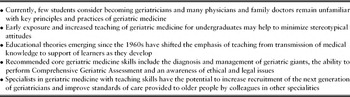
The early and increased exposure of medical students to geriatric medicine is essential to raise its profile throughout the world. Barriers to change in medical schools include negative attitudes of students, an overcrowded curriculum and lack of motivated teachers. Training in geriatric medicine should include experience in the community, including day hospitals and out-patient clinics to raise awareness of successful and healthy ageing. The availability of research opportunities and the emergence of charismatic educators with geriatric knowledge and teaching skills have the potential to increase recruitment of geriatricians.Reference Hubbard, Fillit, Rockwood and Woodhouse86
Educational theories emerging since the 1960s have shifted the emphasis of teaching from transmission of medical knowledge to supporting learners as they develop skills. Geriatricians should be familiar with some of these methods to optimize the effectiveness of their own teaching. Further studies investigating different educational techniques such as educational games could improve the learning of young health professionals involved in the care of older people. In order to improve the quality of care for all older people, increased recruitment of specialists in geriatric medicine and a greater understanding of the complex needs of older patients by our colleagues in other specialties are equally important goals.
Summary of key points

Conflict of interest
Neither author has any financial or any other kind of personal conflicts with this article.