Millions of radiograms and gramophones sat in British homes by the beginning of the 1930s, functioning variously as the providers of gentle background music and talk, the focal points of concentrated listening or the objects of inquisitive technical tinkering. Radio's indistinct valve-amp glow, the gramophone's boxy punch, the crackle and whoosh of both: for most listeners, that would do. But in the USA, soon after the Second World War, the collection of kit, thinking and modes of listening bundled up and branded by manufacturers and commentators as high fidelity – hi-fi – could be seen patching together kinds of audio experience (and kinds of prestige) not previously associated. This upmarket technology promised sonic clarity and presence way beyond that of commonplace equipment, the chance not to warm or to puncture, but truly to fill domestic space with mediatized sound; the outlay necessary to procure it and the connoisseurship needed to justify it brought a performance of musical taste that had usually been public into a more private setting. Hi-fi's name, ideals and commercial discourses soon spread to Europe and beyond. More modest machines – radios, gramophones and stereograms – were less privileged but were increasingly popular fixtures too.
To historians of music, such equipment has usually seemed distinct from (and distinctly less significant than) the sound it transcribed, even when that music could only have been heard mechanically. But studies of post-war audio, often made by scholars outside music studies per se, are growing in number. This work might be sorted into three categories. The first type, and the longest established, narrates the twin development of audio systems and musical culture, and – although work here considers the changing social meanings as well as the scientific details of sound technology – the domestic scene tends to feature less than the research laboratory or recording studio.Footnote 1 Following these are focused histories of specific sound media (radio, the spoken-word record), although again this work tends to concentrate on the agents of production rather than the living spaces in which such products were disseminated.Footnote 2 The third category, and the one most relevant to the present study, is also the newest: this consists of histories of home audio and listening which – often using the specialist press as their evidence base – attempt to show how cultural values of all kinds were constructed through the sound media and practice.Footnote 3
An early and influential outlining of the last category was made by Keir Keightley in his 1996 essay on hi-fi, gender and domestic space.Footnote 4 Reading American magazines like High Fidelity and Hi-Fi and Music Review, Keightley argues that the 1950s production of hi-fi – in the material and the abstract, its instruments and ideas – transformed audio equipment into a specifically masculinist technology. New trends in the spatial and social organization of American family life, most obvious in the new suburban developments that removed families from the dense multiplicity of the city and set them in static, open-plan contact, meant that men were spending more time at home, and in homes that sometimes allowed them less private space than previously. So a hi-fi hobby could be an assertion of power, since (to believe the magazines) those men who installed hi-fi at home enjoyed the Chicago Symphony Orchestra's brass-section fizz, or a demonstration disc's passing locomotive roar, for its ‘real’ presence, dynamic range and volume above all else. That meant trouble: as Keightley demonstrates, the literature was full of features both serious and satirical on the domestic strife that this assertive, territorial noisiness inspired. Whereas 1960s arguments over music's loudness were figured as conflicts between generations, Keightley writes, in the 1950s those arguments were described as taking place between men and women, or rather between husbands and wives.
Keightley's hi-fi study draws only on American sources. Perhaps that is understandable, given the country's centrality in both the invention and the early consumer take-up of the equipment described – and anyway, national differences in discourse and practice sometimes seem to have been minimal. A 2009 study by Alf Björnberg that takes mid-century Swedish consumer magazines as its principal materials (a piece all but alone in its extended treatment of a historical hi-fi discourse outside the USA) does not reveal a culture qualitatively different from the American model. Mobilizing ideas suggested by Keightley along with influential theoretical work by Jonathan Sterne, the writer surveys three decades of specialist journalism in which product commentary and excited audio idealism seem indistinguishable, new products are always presented as must-have breakthroughs, yet ‘true’ fidelity always remains just over the horizon.Footnote 5
The resonances between these national cultures may in part arise from Björnberg's synthesis of approaches taken in the field's dominant studies. And before looking at audio in the British home in any detail, it is important to think about the methods used to access historical experience and meaning: it is my contention that academic explorations of music reproduction technology emerging since the 1990s can be useful not just for what conclusions they reach, but for what they say about common – but underexamined – cultural-historical methods. Such methods, I will argue, tend to overlook the differences between those attitudes towards audio constructed in public, written discourse and those developed amid a more routine (and private) lived experience; they tend to focus on certain types of specialist, historical source and activity because those things permit certain types of contemporary theorization – but, in so doing, they often overlook practices that were less often critically staged while being more widespread. These kinds of problems are not limited to work on audio or technology, having been signalled in much wider debates around contemporary cultural history writing. And whatever the objections I raise, the texts I discuss remain highly valuable for those wanting to build on them.Footnote 6 My aims, then, are twofold. The first is to provide a critical historiography that might sharpen the focus of the second, which is to provide a new understanding of audio in the post-war British home: its changing status in a developing consumer culture, its varying roles in everyday listening lives.
Keightley opens his article by recounting a satirical vignette from a 1954 issue of High Fidelity in which a hi-fi enthusiast, besieged at home by the noise of his children and by his wife's admonishments to keep it down, designs a man-sized box in which to sit alone, his only portal to the outside world being a slot through which his partner can pass sandwiches. To write twentieth-century cultural history in the postmodern 1990s often meant looking back at popular discourses through the squint of suspicion, and the unremarkable or throwaway was often read for what was said, sometimes without saying, about fault-lines that would soon cleave wide open, for complacent claims of progress or superiority that would turn out hollow. So a critical reading of that comic article, such as Keightley provides, has to look beyond the joke to see the performance of gender role and willed autonomy already described: the piece's author, Keightley writes, ‘imagines high-fidelity technology as a means of simultaneously transforming and escaping domestic space’, and the article is thus ‘representative of the gendered values of high fidelity during the 1950s’.Footnote 7 But it was a joke, and one that worked not because a dominant masculinity was shown as having the power to transform and escape – in fact, precisely the opposite. Gags like this were common, showing that this was a subcultural discourse rather more ambivalent about itself than contemporary critical summaries might suggest; any historical conclusions drawn need to be equally open to ambiguity.
One of the challenges for the historian is to consider not just a discourse's textual products, but also the practical ways in which those texts were produced – and not just produced, but also received and answered. Journalistic copy has often been written to fill the maximum space in the minimum time, and the articles that Keightley cites, male- and female-authored, can sometimes constitute little more than a restatement of the rules of the game (‘hi-fi is a masculine activity’). Journeyman articles written according to the same code appear in the British press across the 1950s and 1960s. But it is a somewhat thin reading that imagines all of these statements to be sincerely made and sincerely understood, and a focus on historical media discourse makes it difficult to perceive how writers and readers might have lived in practice: what they wrote, what they chuckled at, was not necessarily what they did. If, for a moment, one turns the hermeneutics of suspicion prevalent in earlier cultural history towards suspicious cultural history itself, there is a suggestion that behind these two-dimensional ‘representations’ lingers a more complex set of relationships being lived in fluid motion, aspects of which should be within history's grasp.
Here is an example of how convincing cultural-historical interpretations can start to unravel when different voices intervene. Advertisement representations of the lone male home listener were remarkably widespread and stable across time: from the 1950s through to the 1970s, men were endlessly pictured in an armchair facing the speaker (or, after the introduction of stereo, between the speakers), attentive and thoughtful as they immersed themselves in the ‘Pastoral’ Symphony, or else tested for treble roll-off with a copy of My Fair Lady. In his contribution to the volume Living Stereo: Histories and Cultures of Multichannel Sound (2015), Tony Grajeda writes about these illustrations of men listening from the ‘sweet spot’, that place in the room where the stereo image was perfectly calibrated and those armchairs were supposed to be positioned. Following the established cultural-historical critique of hi-fi's gendered potential, Grajeda fingers this advertising trope as another patriarchal assertion of ‘mastery, control and the fetishisation of technology’ in the post-war home, a power play in which withdrawn and all-observing twentieth-century Man engages in a kind of domestic sublime:
Through both channels and in both ears, the discourse and the apparatus converge, together seeking to situate a listener in what has been billed as the sweetest of all possible spots: a single point from which a listening subject gathers in a world of sound, and for whom alone it is believed that world of sound exists.Footnote 8
It is a decent description of the images in question, and of the aggrandizing tribute that advertisers and writers offered the customer king in the USA as in Britain. Yet, very occasionally, female commentators on hi-fi were able to give public accounts of the private sphere, and these could show that this system of representation had different registers, and that this cipher of masculine connoisseurship and consumerism was exchangeable for its jokey twin. Responding in 1969 to a piece of sexist drollery in a recent issue of the British Hi-Fi News (one of many threadbare satires on chatterbox women and their supposed inability to listen with audiophile focus), Mrs P. Sindall of Burgess Hill wrote that, in fact,
Not many people can sit and do nothing for long. If my husband decides to do an hour's listening, he spends five minutes with eyes shut and ears glued, and the other fifty-five minutes jumping up and down adjusting bass, treble, and volume controls, exchanging a well-loved record for a test record, and assuming all sorts of weird poses all over the carpet […]. Having bought several records myself, I long to be able to spend a quiet evening on my own, actually hearing a complete piece of music from start to finish, without my husband's interference.Footnote 9
If it was an objection, it was made according to a shared, comic, discursive protocol. But other types of sources show – as if we could not imagine – that the stereo sweet spot was not always occupied by self-possessed masculine figures or even their satirical double. A change of approach, from the highly abstract to the truly quotidian: P. H., a clerical worker from Caterham, was a sporadic diarist. She was plagued by chronic ill health, and in 1964, nearing 40, she lived with her parents, themselves not infrequently ill. P. H. passed most of her free time with books, music and TV; as she reported in her diary, she listened attentively and with discernment to the music, but also to what she sometimes referred to as its ‘reproduction’, engaging with the stereo medium at a time when, in the UK, mono still predominated.Footnote 10
Monday 2 March 1964: Pleased to get one or two new records – mummy collected today the record I ordered Saturday – ‘The White Heather Club’ in stereo. This is an extremely pleasant record with a lot of spirited music and a very friendly atmosphere. Am disappointed Duncan MacRae was not doing ‘The Sparrow’, but am very pleased with it all the same.
Thursday 23 April 1964: Received records from the Concert Club – excerpts from ‘Die Fledermaus’ sung in German – was a little disappointed in it at first, because the tone didn't sound quite right, but later this seemed to wear off and I enjoyed the record very much indeed. It is gloriously vivacious. Played it through twice and enjoyed singing to it in German. In to front-room to watch ‘This is Your Life’ – Olivia de Havilland – and the news.
Saturday 25 July 1964: On return played Canasta, Beat your Neighbour. New records arrived today … ‘Sweethearts on Parade’, ‘Drums & Pipes of the Highlands’ – a very good record full of skirling bagpipes – and ‘Le Pompom Rouge’, the band of the French marines playing a number of French marches. Very enjoyable (this is in stereo) but the tone of the record is higher than I quite like. It may improve later on as they sometimes do.Footnote 11
P. H.'s use of the mail-order Concert Club, one of several record clubs designed above all for neophyte collectors, might have attracted the disdain of some hi-fi buffs.Footnote 12 Yet the music she was buying closely matched the repertory covered in those buffs' specialist magazines, and – apart from being recorded in private rather than public – the critical language she used to describe music and media differed little from that found in Hi-Fi News 's record reviews. Still, her relationship to that constructedly serious, powerful, masculine home listener Grajeda describes could not have been more tenuous.
I do not contrast these accounts in order to argue that the smallest scrap of dissenting empirical evidence can automatically invalidate broad theoretical suggestion. Historical investigations need to be conducted on both levels, and without necessarily seeking simple accordance between the two. Nor do I suggest that the study of media representations should be done away with – indeed, later parts of this article will make use of what is still a vital method. The problem I see here is that the complexity of socio-historical experience is not signalled; despite its critical stance, Grajeda's reading ends up taking a media discourse given to hyperbole at face value, and the overheated, somewhat judgmental interpretation he is obliged to offer is not uncommon.Footnote 13 Too often, cultural histories of this kind seem overly keen to chide the marketeers and consumers of the past. Those people, touting or buying into progressivist narratives of material or interior comfort, are presented not just as the shills and dupes of earlier consumer culture, but even – it is sometimes implied – the dutiful footsoldiers of a more sinister force, Western techno-capitalism, its professed rational superiority masking a primitive chauvinism, rapaciousness and vulnerability that would be exposed by later generations. The historical gaze that locates only naive or reactionary views of the past, picturing traces, gestures and practices as epoch- or epistemology-defining truths, is one that needs checking.
In this article, then, I will try to pick a new route through the history of audio in the 1950s and 1960s home. A basic aim will be to situate the study in a new region – Britain – so as to cross-check Keightley's conclusions in a related context, and to begin to ask how far hi-fi and audio cultures varied within what was a transnational phenomenon. But a slight difference of methodological emphasis will, I hope, locate more complexity of meaning, more multiple experience of home audio than is allowed by sometimes reductive studies of media representation and of the voices privileged therein. Making more use of economic data, I want materially to recast what risk becoming presentist, theoretical arguments, and that means considering audio as one domestic technology among many; it means using different kinds of sources and information (those that can give us either wider or much narrower perspectives on home life than readings of magazine editorials alone can manage), but it also means using similar sources in a slightly different way. If the words of the magazine discourses give a masculinist, elite point of view, then perhaps the images – and the adverts – can be read as speaking to readers otherwise; if those sources do not tell us much about home consumerism in a broader sense, then trade reports will, and if they do not often allow different voices to be heard, then diaries and other papers do. Underpinning the project is an attempt to understand hi-fi and home audio as an often new kind of experience – an experience of modernity – and, without renouncing criticality, to try to touch and feel that newness rather than to offer one more comment on its ideological delusions.
The most basic change of approach here is to extend the study of audio beyond niche hi-fi culture, opening up the investigation to include the experience of different technologies, classes and age groups. But, of course, walls remain in place, most notably in terms of ethnic-cultural difference. In Britain, the volume of domestic recorded music came to form a key trope in debates around mass immigration in the 1950s and 1960s, with West Indian audio culture in particular often charged with straining boundaries between public and private, or else with bearing the weight of collective identity and memory; if those uses of audio do not appear here, it is because they need their own full-length study.Footnote 14 Nor does that broader focus mean that hi-fi will receive short shrift. Indeed, since that kind of technology was assessed in such detail, and since it has accounted for almost all academic study of domestic music reproduction up to now, it is as well to begin there.
Hi-fi and the modern British home
A simple narrative of hi-fi's development over the 1950s and 1960s goes like this: at its emergence (the term became widely used, and attached to expensive and high-quality instruments, from the early 1950s), hi-fi was a hobbyist's pastime, and equipment that looked much like those instruments its enthusiasts would have used in the field at Monte Cassino or Okinawa came almost uncased, wired together at home with little concern for appearance.Footnote 15 But over the 1950s, hi-fi manufacturers seeking a mass market began to present boxed units that, with wires hidden and fascia discreet, could sit quietly in a living room until called upon. By the end of the 1960s the transformation was complete, and something like high-fidelity audio was a fixture of many homes (if still concentrated in the affluent classes).
Hi-fi's story is thus the story of modern consumerism, and an experience of both musical and industrial modernity that found its meaning precisely through its mass-produced, mass-market nature. That accounted for all kinds of trends in household design and organization at the time. But hi-fi was not simply invented and plugged into an existing domestic setting; rather, in its development and uptake, it played a part in the aesthetic, sensual and economic transformation of the post-war home. Those transformations are the subject here.
To the British of the 1950s, domestic ‘modernity’ was not an abstract thing. A third of houses had been destroyed or damaged during the war, and an unparalleled reconstruction effort in social and private housing, often heady with social-democratic idealism, continued through the 1950s and 1960s. In the rhetoric and literature of urban planning, building and renovation, the word ‘modern’ was applied with uniform optimism. In new developments the trend was not so much towards increasing the number of rooms – and thus opportunities for audio privacy and sound insulation – as it was towards increasing room size. Limited plot sizes inspired an increasing use of open-plan layouts so as to maximize the experience of space and light, and architect-led construction initiatives working to realize these new environments, like those of the Span practice, were mimicked by the many speculative builders whose imitative estates soon dotted the country. Features on the ‘modernization’ of tired or bomb-damaged Victorian and Edwardian buildings were a staple of magazines like Ideal Home, and the projects pictured usually entailed the knocking through of small ground-floor rooms to create single, larger spaces; post-war government directives ensured even greater internal volumes for social housing than was common in private developments.Footnote 16 New utilities joined. Light and heat, spareness and space, the gadgets to keep everything clean: this was the modern, at least in theory.
Some of the figures in that space represented a kind of design modernity that had already taken root in homes across the class and taste spectrum, if only because it had been imposed: in wartime, furniture had been manufactured to government-approved ‘Utility’ models, Scandinavian-styled and lean to save manufacturing time and materials. Despite much objection to its lack of cosiness, what was called the ‘contemporary’ furniture style endured after 1945, standing in contrast to – and often in the same room as – the heavy, dark and decorative reproduction styles that had been in favour for decades.Footnote 17 That old styling was often given to the bulky radiograms that commonly buttressed a sitting-room wall, and which, like the nineteenth-century parlour piano, could function as furniture as much as sound source. Sound, indeed, was usually indifferent, and the radiogram – utilitarian if not incommunicado – was viewed with suspicion by hi-fi enthusiasts. As Keightley remarks, hi-fi's unruly early appearance set up a contrast between ‘seriousness’ and looks, the specialist and the popular.Footnote 18
Yet if these new audio systems were to make an appearance in shared domestic spaces, they would have to be hidden somehow. Concealing sideboards, chests and coffee tables with sliding tops were very often home-made, though a number of advertisers offered cabinet-making services through the later 1950s and early 1960s. To a limited extent, they were also offered as ready-mades – Heal & Son were early to market – and with ‘Scandinavian’ being the prime signifier of the modern project, that already familiar language of design economy played a leading role. Unadorned teak units floating on splayed legs abounded: from 1958 the Record Housing Co. advertised its ‘Nordyk’ cabinet, Howland-West following a few years later with its own ‘Karelia de Luxe’ and ‘Malmo’ models.Footnote 19
The mix of handmade, semi-custom and limited mass-production methods used in furniture manufacture at the start of the 1950s was the same as that seen in audio production, so early hi-fi was not a home-constructed feature out of place in a mass-produced culture: before the Common Market and a thoroughgoing globalization, imported equipment was comparatively rare and expensive, and a good proportion of British kit would come to be made by the dozens of small audio firms springing up – in light industrial units along the back streets of suburbs like Catford and Holloway – through that decade.Footnote 20 But ways of making and buying household goods were changing across the board. The identity of a furniture producer had been of less importance to buyers than that of the retailer, and it was only when a few companies began to develop coherent house styles around standardized mass-produced ranges that manufacturers seized the industry balance of power. E. Gomme's G Plan series, launched in 1953, was soon the most famous and powerful among them. At a time when manufacturers of reproduction furniture would add small, handcrafted details to bulk-produced units (figleaves both literal and metaphorical), ranges like G Plan or Stag's Modern C flaunted their machine-tooled modernity, becoming synonymous with a certain kind of aspiration, status and self-image. They also signalled a new form of consumption, since – buyable piece by piece rather than in traditional combinations like the three-piece suite – they made possible smaller, staggered and more personalized purchases. It is symbolic that G Plan also advertised a range of hi-fi cabinets from 1958; that company's branding, modularity and replacement of craft production with mass production was increasingly to be seen in the hi-fi field from around that time.Footnote 21
Also synchronizing were public interests in home design and home media. At first, the taste for modern design was part of a wider system and sense of cultural capital that could be organized and constrained along class lines. At a 1953 London exhibition staged by the Design and Industries Association, a modern sitting room was staged next to a traditional set-up. Interviewed there, an anonymous typist in her early twenties said of the modern:
Wonderful tones of colour are picked up all around the room. But I would never live in it. For one thing, my family would have a fit, they'd think I'd gone quite mad and all arty. You see, I'd have to be a different person, I'd have to read the best books and listen to the Third Programme, don't you agree?Footnote 22
By dint of its technological ambition, hi-fi too was a modern household project; by dint of its expense and cultural associations (not least with the classical music evoked here in the mention of the BBC's highbrow radio station), it was one that belonged largely to the professional classes. Home and hi-fi magazines shaped and pictured the same modern bourgeois imaginary, with Hollywood another key broker: along with the Scandinavian, the image of domestic modernity – mostly unattainable to the British, apart from a new fireplace or section of wood panelling – was defined by the American modern house after Frank Lloyd Wright, with its celebration of stone, brick, wood, glass and volume. Hi-Fi News 's cover feature of June 1960, ‘Hi-Fi in America’, pictured and verbalized the writer's awe at the space and style on offer stateside, and the audio-equipped open plan on show in that piece was replicated in many of the magazine's spreads: ‘Mr Farr, in common with many readers,’ ran one photo feature on readers' installations, ‘appears to combine an interest in audio with a fondness of architecture and interior decoration, and white-painted brick walls […] are very well matched by the surrounding furniture and lighting.’Footnote 23 A contents-page note on the cover illustration of the journal's December 1968 issue – brick walls, pendant lighting, Eames chair, Armstrong hi-fi units – asked readers not to write in, complaining that the last such picture set-up had excited more queries about the furniture than about the audio equipment.
Eames and Armstrong were not household fixtures, but they occupied the top end of a modern design market that had by that time expanded to include all classes of consumer and budget. The anonymous typist's qualms had soon subsided – by the end of the 1950s, mass-produced contemporary furniture styles had grown to account for around half of all furniture purchases – and by the middle of the following decade, the field of the contemporary could be seen to encompass the relatively exclusive designs of a Robin Day, the innovative branding of Terence Conran's Habitat, and G Plan's High Wycombe low modernism.Footnote 24 As we shall see in more detail, home audio markets developed in similar ways at the same time, and in both areas, popularizing ranges and strategies were criticized from ‘above’ for their debasing of innovative design.Footnote 25
But the British were acquiring new kinds of economic agency that rendered production-line modernity ever more routine. Harold Macmillan's (actually rather wary) claim that people had ‘never had it so good’ was taken at face value, as well it might have been. At a time of extremely high employment, average weekly earnings were rising quickly – they would grow by 130% between 1955 and 1969 – and those gains were shared equally by the working and middle classes.Footnote 26 Necessities like food and medical treatment accounted for a decreasing proportion of average household expenditure: rises in food prices did not keep pace with those of earnings or other costs, and since 1948 the National Health Service had provided healthcare that was still largely free at the point of use. People were spending more money on a wider variety of products. By one contemporaneous calculation, in real terms the British spent 53% more on durable goods in 1967 than they had a decade earlier, and they were by that time buying more of their expensive items like furniture and hi-fi on credit, to boot.Footnote 27 Like their counterparts across what would later become known as the global north, the British were learning how to perform and reproduce new consumer roles. The consumer magazine Which? was established in 1957, and ‘admag’ television programmes like Jim's Inn (ITV, 1957–63) strung together discussions of new products in a soap-like setting. As this new culture of consumption took shape, the middle class was expanding; the rate of manual employment was in decline, but a million white-collar jobs were added across the 1950s, and that trend would continue. Traditional class- and occupation-based political allegiances had begun to weaken, these ceding to new, more socially mobile kinds of consumer identity.Footnote 28
Experience of modern domestic design was not limited to a static middle class. And however it looked in Architects' Journal or Ideal Home, neither was it commonly lived with total aesthetic rigour, or without ambivalence. As the 1960s began, working- and lower-middle-class residents of modern housing developments routinely upset architects whose attempts to create light and space through provision of windows and open floorplans were disrupted by net curtains, extravagant pelmets and room-dividing reproduction furniture.Footnote 29 This was not just a class-based misconstrual of an unofficial stylistic code, and neither was ‘middle-class’ hi-fi a project entirely belonging to the modernist vanquishers of homely tradition. The distinctive forms and claims of design in the modern style and era, the design historian Kjetil Fallan has argued, can lead historians to overlook what was the enduring presence of the ‘non’-modern. So it is important to record the reality of post-war British modernity as lived (and featured in Hi-Fi News) in the early 1960s, rather than idealized then or later: the super-modern, glass, wood and butterfly-roofed entertainment annexe adorned with a shelf-ful of porcelain dogs; the article on readers' set-ups that pictured one system in an elegant and lean wooden cabinet, another inside an ornate Queen Anne chest topped with a hand-carved Spanish galleon.Footnote 30 As I will come to argue, it is only the acknowledgement of hi-fi's ‘non-progressive’ other that can reveal its full domestic meaning. Situating an innovative domestic technology within a British home that was – whether by class, ideology or taste – conflicted in its attitudes towards the modernity on display suggests that other meanings might be equally murky (even if few of them are apparent from an analysis of hi-fi's written commentary alone).
Still, audio equipment claimed an increasingly visible place in the home through the 1960s. In West Germany, Hans Gugelot and Dieter Rams had in 1956 designed for Braun the SK4 Phonosuper, a machine that did not attempt to conceal its purpose and workings: it was made to sit on rather than in a cabinet, and its clear plastic lid dramatically staged the turntable and tone arm which justified its presence.Footnote 31 Braun's audio products were visually rather than sonically distinguished, and they made little impact on the UK market at the time. Yet their stylistic influence was powerful, and by the mid-1960s acrylic turntable lids were everywhere: hi-fi was achieving living-room transparency.Footnote 32 A 1965 Goldring advert featuring a clear-lidded turntable trumpeted its in-keeping with ‘the modern trend towards shelf and table installations’, one equally applying to tuners and amplifiers; the changeover to unconcealed separate units was quick enough that by 1969 a Hi-Fi News writer could mourn the ‘older and perhaps more “homely” method’ of installing kit in a cabinet, with shelf-mounting ‘now becoming the rule rather than the exception’.Footnote 33 The divide had been articulated: on one side a generation for whom the ‘homely’ excluded technology, and on the other a group for whom the home could be an avowedly mediatized space.
Hi-fi did not stake a place in the home without modifying its accessibility, and a more fully consumerist positioning of audio technology supplanted the handmade and the home-made. Hi-fi hobbyism – self-build projects, radio operation – receded in British hi-fi discourse through the early 1960s.Footnote 34 Previously, equipment adverts had been laden with graphs and spec, but now a new, non-specialist market was targeted by different kinds of appeal: ‘The man who knows what's inside says – you get more out of Telefunken,’ read one advert, its illustration showing a technician looking on at potential buyers rather gravely, twiddling a knob while he did the knowing on their behalf.Footnote 35 Appeals to the hobbyist and the generalist were juxtaposed through the 1960s (and would remain so), but the level of knowledge and interest in hi-fi's inner workings that advertisers had once assumed quickly declined. A 1969 Wharfedale pitch attempted to capture this attitude: ‘Why get up to your eyes in statistics,’ it asked, ‘when it's really up to your ears?’Footnote 36
But increasingly it was up to the eyes. In 1960, Pye claimed to have ‘today's best-looking listening’, and months later Truvox claimed of its tape recorders: ‘THEY LOOK SO GOOD. THEY SOUND SO GOOD. THEY ARE SO GOOD.’Footnote 37 Still a common perception was that British-made equipment was less than fully competitive in international markets, and this was sometimes attributed to a rather austere approach to styling, which contrasted with the metallic sleek of American firms like Fisher and Marantz.Footnote 38 Nevertheless, by 1960 a number of firms had evolved recognizable aesthetic identities across their ranges, and this at a time when such brand uniformity was relatively unusual in product design. Quad's components all bore the nearly blank fascia, flush rotary dials and sans-serif font that they had used and would continue to use for decades (and the company's famous and free-standing ESL electrostatic speaker was equally identifiable); Armstrong, pioneers in the integrated tuner/amplifier and separates market, cultivated a similarly muted identity.Footnote 39 By the mid-1960s, Ideal Home began to offer advice to readers on hi-fi that was often concerned with placement and look rather than sound, and that reflected a growing interest in newly visible equipment on the part of the design community as a whole: in 1966, the Council of Industrial Design included in its laudatory Design Index two Pye receivers styled by Britain's leading furniture designer Robin Day. It was hi-fi's visual aestheticization as much as its sonic capability that was making it an attractive proposition in non-specialist markets.Footnote 40
Women as consumers
If studies of hi-fi have not yet given a full picture of the audio-equipped mid-century home, it is partly because – while gender has been a key concern – that technology has not been situated among the full range of activities, roles, experiences and aspirations dwelling there. When during the later 1960s and early 1970s women contributed articles or letters to Hi-Fi News, the trials of a husband's hobby were the subject. But it is significant that in Britain it was not always, pace Keightley, hi-fi's volume, visual presence or territorial claims that were in question: another major sticking point was audio's competition for household resources with other emerging domestic technologies – those allied with women's work rather than men's leisure.Footnote 41 In 1970, Hi-Fi News published a piece by Mary Morgan that offered ‘a wife's point of view’ of the hi-fi hobby, and which smouldered with anger:
I am probably only one of many wives who, out of necessity rather than through their own choosing, have had to alter their way of life for the sake of this all-demanding, all-consuming hobby […]. Possibly the greatest irony of all is that I am still without a washing machine, an electric cleaner, and carpets in all rooms but the lounge. And the only reason my husband so readily agreed to buying this carpet was because it would damp the acoustic resonance of the room.Footnote 42
‘Men's’ magazines of the time, even those as different as the British Hi-Fi News or the American Playboy, habitually represented the world outside as the domain of work and the home as a place of repose. That separation, whether imagined or lived, was largely unavailable to women, whose journals were full of models who looked like the young queen wiping innumerable plastic surfaces clean with endless disposable paper towels, putting a trifle in the fridge, sweeping up, making ice. Likewise, women's experiences of home audio did not always mark the distinction, sometimes only a couple of movements removed, between employment and enjoyment. Claire Langhamer's oral history of mid-century British women's leisure shows many then working as housewives recalling dedicated radio listening – with the pop and light music of Radio Luxembourg a favourite – because it accompanied and provided variation to their tasks.Footnote 43 This was true of single women as well, as G. C. (a rugby- and music-loving 18-year-old training in an Edinburgh accountant's office) recorded on several occasions in her 1950s diaries. On Monday 1 August 1955, she declined a usual night in the coffee bar or at the Dominion cinema: ‘I have stacks of washing to do and there is a one in a million Promenade Concert on tonight – Grieg's Piano Concerto in A minor, Schubert's Unfinished Symphony & Overture to William Tell. At the moment’, she wrote between suds and mangle, ‘I am in the world of dreamland and music.’Footnote 44
Feminist historians have positioned the post-war culture of consumerism and interior decoration as a new kind of middle-class women's work, this coming into being following the departure of the servants and ‘help’ that had been fixtures into the 1930s. The new duties – design, ordering, maintenance – were not leisure, but labour, and labour towards something like an old patriarchal end; as Judy Wajcman argues, in recognizing as much, feminist studies from the 1970s were wont to view consumer technologies as inherently exploitative of women.Footnote 45 Yet, Angela Partington has written, new consumerist decision-making offered its own satisfactions, even if these were ‘channelled, regulated and controlled’ by the journalistic and commercial arbiters of good housekeeping.Footnote 46
Moreover, hi-fi manufacturers and discourses ascribed to women an ambiguous domestic agency of their own. While the study of hi-fi at mid-century is a study of aspirational middle-class life (and as such will never reveal much in the way of thoroughgoing ‘resistance’ to unbalanced domestic power relationships, or consumer capitalism), it can pick up quiet indications of middle-class women's changing status in the home, as partners, consumers, listeners and critics. After all, hi-fi businesses did not simply elect to redesign their products and transform their market from a specialist to a general one: that process entailed a complex series of negotiations, abstract and concrete, between producers and consumers, offers and take-up. The challenge is to find a way of reading this move from concealing cabinets to visible separates that might circumvent written hi-fi discourses, in which women are either put upon or passive.
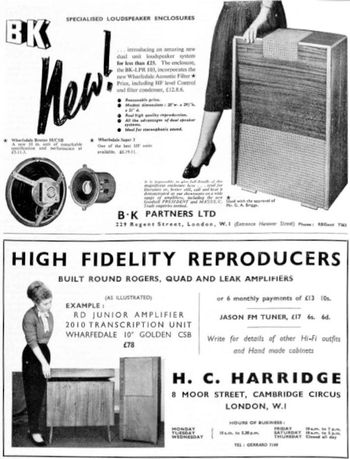
It may be that the nature of domestic female agency is revealed by what the cabinets could not contain. In the 1950s loudspeakers were often large, self-standing and articulated in a design language native to the front room: many corner speakers were plinth-like, and the Quad electrostatic unit was shaped like a firescreen. But their visibility, the space they demanded, evidently posed a political problem in a domestic territory traditionally (if not wholly) seen as female, and it is here that visual materials tell us something the male-authored written discourse does not. From the mid-1950s, women's power of veto over hi-fi purchasing decisions was implicitly acknowledged, and fears were assuaged, by a remarkably durable advertising trope in which a woman – sometimes, as Freudian audiophiles might have noted, just a leg, seen from a child's eye view and metonymic of ‘woman’ – was positioned next to such a speaker in its domestic setting (see Figure 1). If the women were elegant, they were hardly eroticized ‘objects’, and whatever the brand, the message was always the same: female co-consumers will judge this product neat, affordable and compatible with their homes.Footnote 47
Adverts in Hi-Fi News, 1/5 (October 1956), 186.

Indeed, far more than the sense of manly superiority trumpeted by American written commentary and critiqued by later historians, advertisers in Britain attempted to sell their products as the agents of domestic consensus – which, in the 1950s, meant marital consensus. Firms at all levels of the market pictured happy couples at home with their new products, clasping each other in celebration of their consumer wisdom and (the two were related) their unimpeachable heteronormativity. Like other visual tropes, this one was imported into the hi-fi imaginary from a wider advertising discourse, and any number of similar couples stood in intimate but respectable proximity in furniture ads through the 1950s and 1960s.Footnote 48
These devoted pairs illustrated a particular domestic-historical situation. The period spanning the interwar years to the 1960s represented the peak of long-lasting marriage in Britain (death kept it short before, divorce thereafter), and, as sociologists observed, in the decades following the war British men were becoming more ‘home-centred’. Studies reported a new kind of companionate marriage that entailed greater domestic privacy across the classes, a greater social self-sufficiency within the family unit – with long-declining birth rates producing the two-child nuclear family by the start of the post-war period – and increased uptake of female-identified activities, like home design, among men.Footnote 49 ‘The assumption that post-war domesticity and “traditional” gender roles were mutually reinforcing’, Langhamer writes, ‘needs to be challenged.’Footnote 50
At the same time, and largely because they were spending comparatively less of their adult lives tending to children, women were forming an ever greater part of the workforce outside the home, and the married among them especially: the proportion of those women working roughly doubled between the start of the 1950s and the mid-1970s, by which point it was around 50%, with much of this growth occurring after 1960.Footnote 51 Whatever the limitations of agency they continued to experience (the housekeeping allowances doled out weekly, the shopkeeper enquiring whether their husband had authorized a large purchase), women's share of economic productivity increased greatly through this period, and ideological notions of status and power within the family unit and the home also shifted.
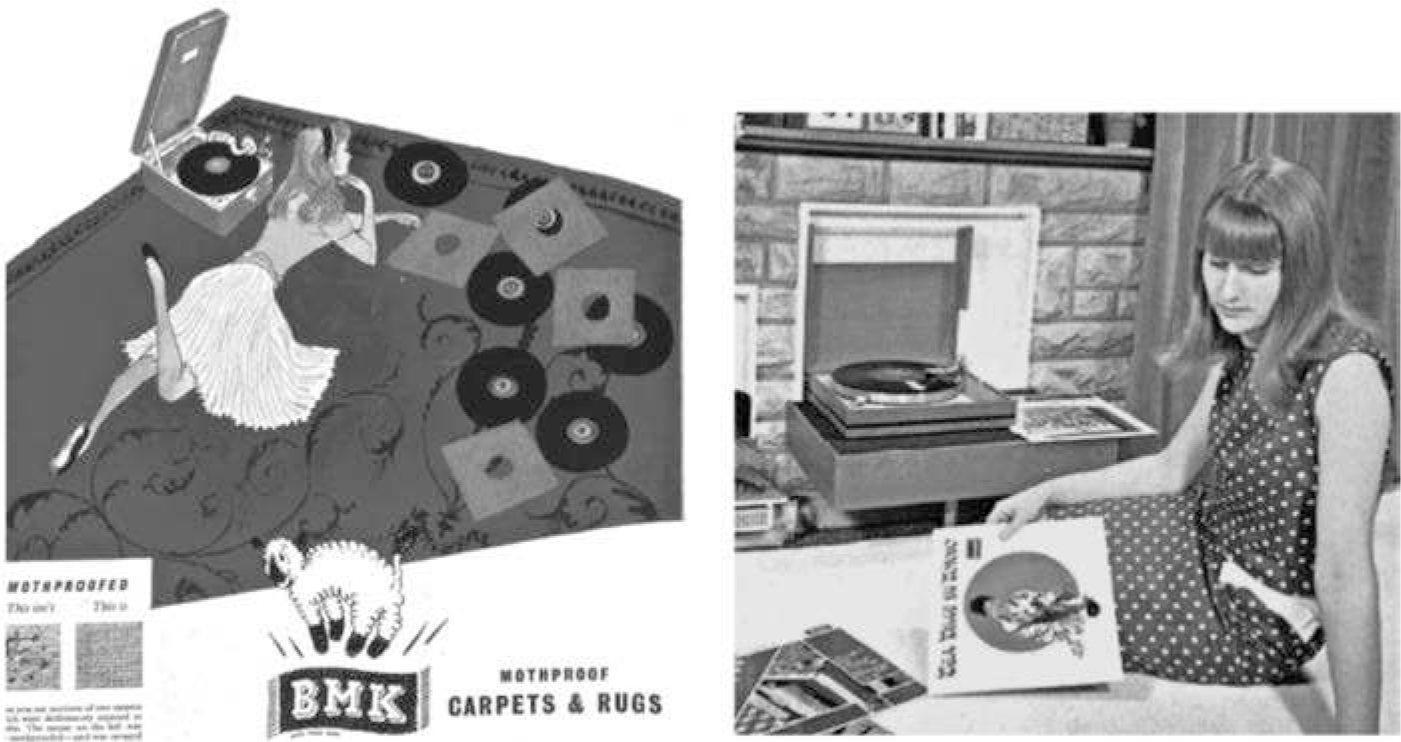
That mutation of roles can be read in the changing approaches that hi-fi businesses made to an imagined female consumer. The women of 1950s adverts showed a contentment derived from domestic order, not musical engagement, but by the end of the decade manufacturers and the specialist press would position and target women as listeners and buyers as much as obstacles to household purchasing. Old representations of female pleasure in order, and new ones of pleasure in audio, can be seen meeting in a Goodmans advert from 1964 in which a woman alone listens in front of her bookshelf speaker – this a technology newly arrived from the USA, and one more compact and fully integrated with regular furniture than speakers ever had been.Footnote 52 During the latter part of the decade, women were increasingly pictured as the sole users of stereo systems, and – while these images did little to overturn standard ideals of male-observed female beauty – they could now be seen taking the contemplatory poses that, as we have seen, had been reserved for men (see Figure 2). Meanwhile, as part of a plainly deliberate editorial strategy, a spate of Hi-Fi News covers in 1968–9 pictured young women listening at home, alone or as part of a couple, and often to pop records. As I will explore later, newly constructed associations of gender and genre were significant in home audio's growing adoption.
Detail of SME tone-arm advert, Hi-Fi News, 13/8 (February 1969), 135.

Touch
Although women were increasingly framed as attentive hi-fi users, their listening was still often portrayed as qualitatively different from men's. From the 1950s and well into the 1970s, when women were pictured listening in the hi-fi literature they were only sometimes sitting upright in chairs, like that male occupant of the ‘sweet spot’; to hear music, women usually sprawled, often on the carpet but sometimes on the settee (see Figure 3). This suggested a different kind of sensual engagement with the immediate environment: if supposedly rational man's attention was focused on a single point, then supposedly sensual woman was submerged in a dreamy kind of multi-sensory experience.
Back cover detail, Ideal Home, 69/2 (February 1954), and front cover detail of Hi-Fi News, 12/6 (November 1967).

The critique of gendered representation here hardly needs to be made. What does need to be elaborated is the historical meaning of this figure in the domestic imaginary, because, once again, it was not an invention of the hi-fi press: the image of the woman on the floor, often listening to music but sometimes reading or just lolling, was found across domestic advertising. And it was an entirely modern thing to find relaxation and sensual abandon at that level. What would have been idle, louche or unladylike (and, perhaps, a class apart) a generation earlier was now, in an age of imagined domestic leisure, a pose to aspire to; what would have been cold, dirty or rough before the invention of central heating, vacuum cleaners and affordable, synthetic, wall-to-wall carpets, was now signalled as warm and clean by interested companies. Children, too, could sometimes be found pictured in this pose. But not men. The floor sprawl signalled a tactile contact with consumable modernity just as the audio indicated another kind of sensual, bought contemporaneity. Yet it was allied to familiar gender expectations: for as long as consumerist discourses had existed, women had been associated – willingly or not – with domestic cleanliness.Footnote 53 The sensual abandon to music and carpet helped describe the comforts of the ideal modern home, yet, once again, it also set pleasure in relation to domestic work and responsibility.
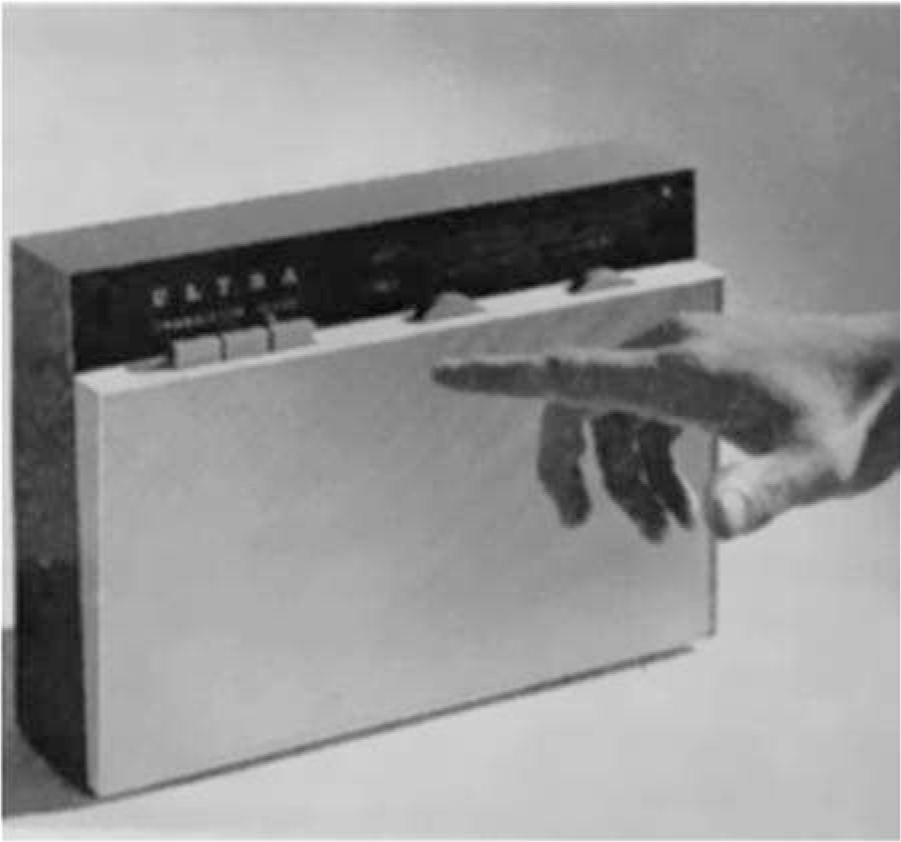
Modes of tactile interaction with audio technology were developing beyond these gendered specifics, however. Happy couples and order-policing wives tended to disappear from adverts as the things they had vouched for became less of a concern, as audio systems were accepted into homes on their own visual terms and by a broader range of consumer; indeed, humans of any kind were increasingly extraneous to promotional pictures that, like consumer gazes, were now focused on the materiality of these uncovered machines. Incidentally marking that transition from hobbyism to consumerism, Hi-Fi News 's regular commentator John Berridge complained in 1960 about the complexity and abundance of knobs and dials on contemporary hi-fi equipment, especially American: he did not want to fiddle with minutiae or run tests, but to listen to music. Returning to the interface between user and unit some months later, Berridge launched a request for manufacturers to make more use of the push button, the ‘beautiful simplicity’ of which gave the pushing action – and the click into place – its own tiny pleasure.Footnote 54 These features gained currency with the growing use of plastics in domestic product design. In his study of plastics in 1950s and 1960s British domestic settings and discourses, the design historian Tom Fisher shows the new synthetic materials being systematically described as ‘modern’ and ‘gay’, and positioned against the drabness of the immediate post-war years. The tactility, shine and practicality of plastics heralded a new way of living; they were intriguing in their shapeability, softness, warmth, colour; they invited a new kind of touch and micro-experience of home life.Footnote 55 The polystyrene Ultra transistor radio that won a 1961 Council of Industrial Design award suggested as much in its promotional photo (see Figure 4); and in higher-fidelity contexts, too (most notably Braun in Germany, clearly an influence on Ultra's own design), much attention was being paid to the interface, and the inviting, finger-shaped concave of the push button.Footnote 56
Ultra transistor radio, Ideal Home, 83/6 (June 1961), 84.

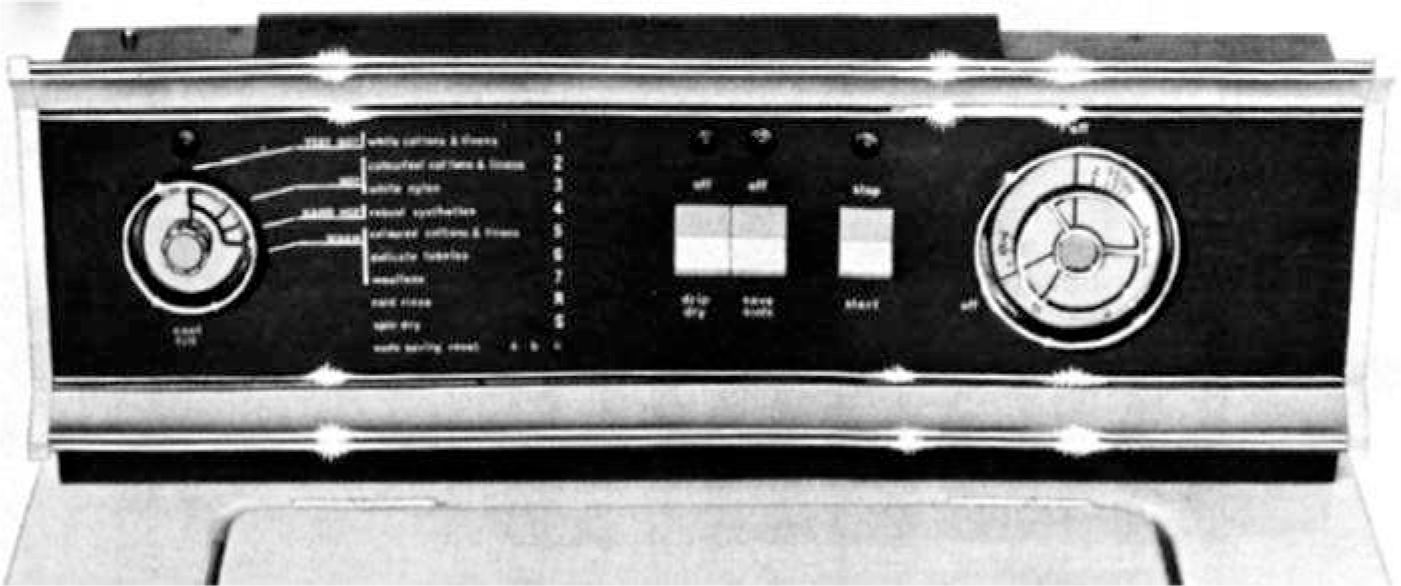
The reviewer of the Bang & Olufsen Beomaster 1000, who in 1966 praised the unit's styling (including its ‘quite aristocratic knobs’), described and responded to what was a new manufacturer attention to tactile interaction.Footnote 57 This development was not limited to hi-fi, but was seen across the field of consumer engineering of which hi-fi was a part. Increasingly, controls and interfaces on amplifiers, washing machines and even car dashboards resembled each other (see Figure 5). In the early 1970s, interfaces resembling those of contemporary mixing desks and synthesizers were introduced: ‘IT'S TOTALLY DIFFERENT – in sight, touch and sound!', claimed a 1972 advert for a Metrosound amplifier that replaced dials with faders, whether in recognition of a new popular awareness of the recording studio's visual language or of a desire for late-stage participation in the production process.Footnote 58 Later in that decade, hi-fi interfaces would mimic the controls and indicators of an aeroplane's cockpit.
Detail of Parnall spin-washer advert, Ideal Home, 93/5 (May 1966), 120.

Studies of hi-fi tend to imagine it in isolation from the rest of the household, but it was only one of several different domestic technologies then converging in appearance, feel, presence and meaning; as Morgan's article showed, it was part of a struggle for resources in the modernization of home utilities and comforts. But just as important, and just as neglected, is the task of setting hi-fi in relation to its audio ‘other’ – the cheaper, non-audiophile record players, tape machines and radios that not only outnumbered and outnoised high-end equipment, but did so on behalf of different constituencies. That kind of domestic audio was far more common than hi-fi, and, as Morgan had gone on to write, the two could be ideologically and even technologically incompatible:
I had brought with me to our mutual home quite a selection of records collected over several years […]. Little did I realise at the time, but three and a half years later my treasured record collection would be neglected, unused and stored carelessly in some dusty cupboard […]. My records cannot be played, since they would damage the stylus – having once used an inferior set-up. And since we only have one stylus, I therefore never hear them.Footnote 59
Morgan's piece tells us about masculine authority. But – continuing the search for lived experience and agency rather than familiar critique – it also invites us to think about how, and using what, she had listened to her records before marrying. Rewinding to the start of the 1960s and taking another pass through the decade will add another dimension to the study of a growing market for audio equipment, and show something of the musical lives of those groups largely absent from earlier hi-fi culture.
Transistors and mid-fi
The greatest transformation of domestic life in the post-war era – and one abetted by the same transistors that would power radio and later hi-fi products – surely followed the introduction of television. In Britain, the hi-fi press kept an eye on TV's development (waxing technical or moralistic, mood depending), but uptake of the new device was far wider, and far less dependent on class or gender, than it was for equally pricey audio equipment. BBC research found that ‘well over’ half the sets in use in mid-1952 were in working-class homes: a budget set cost £50, while the average weekly wage sat in the region of £7, but hire purchase was an enabler and, much more than high-end audio, television ownership was a sign of status and modernity seen as worth shelling out for.Footnote 60 Between 1954 and 1964, the number of household TV licences issued rose from 3 million to almost 13 million, the latter ‘effectively a national audience’, as the television historian Rob Turnock comments.Footnote 61
Keightley argues that, as much as hi-fi was coded masculine, television could be coded feminine, and the new medium was criticized (by a certain kind of commentator) as fatuous, too obviously made to a family pattern. Programmers of the 1950s were aware that a show's success could be dependent on it being authorized by a wife or mother to enter into daily routine.Footnote 62 But however the roles and rhythms of women's, children's and men's lives butted up against each other, and however fraught music's treatment on the new medium could often be, still – especially in pop form – TV music was central in developing new affective, gestural and intellectual ways of being in a newly visible wide world. That is another story. But if nothing else, it is important to note here the front-room reach of programmes based on pop music. The weekly Six-Five Special – ‘quite intolerably noisy’, as one supposedly representative older viewer reported to the BBC – was watched by five million in 1958; Top of the Pops – ‘a loathsome session of horrible cacophonous noises’ – by around 17 million in the mid- and late 1960s.Footnote 63 There is little point in imagining hi-fi audio in the home without listening to the racket from the next room, fuzzy, rattling and cramped in sound, but immense in significance.
Those ratings were achieved despite pop's central, teenage market containing fewer TV viewers than other age groups, as the sociologist-cum-market-researcher Mark Abrams reported in 1959. Instead, this newly identified, economically empowered group was out and about, spending – in Abrams's perhaps optimistic estimation – £17 million per week, largely on leisure, and in the process accounting for 44.1% of the market for records and record players.Footnote 64 Manufacturers knew about the money, and they knew about the mobility; by the early 1960s a huge market existed for compact record players (with Dansette the best-known brand), reel-to-reel tape machines (and, after 1963, compact cassette players) and the new transistor radios – 22 million of which were in use by 1964, with retailers linking sales to pirate radio and Britain's first continual pop service.Footnote 65 The relative portability of budget equipment attested to a culture of sociality and resource-pooling, and to a desire for territory, privacy or freedom. A 1961 Minivox tape-recorder advert invited buyers to ‘tape the top ten and play them at the party!’ – as in hi-fi circles, home-taping was a popular practice – and promised ‘“pops” at a picnic or “blues” at the barbecue!’Footnote 66 In Edinburgh, G. C. wrote in her diary entry for Sunday, 6 January 1957:
E. brought his girl friend S. back for tea. Very attractive Miss for only sixteen & a damned sight more grown up than I was at her age. We had quite a pleasant afternoon. She had brought her gramophone with her & they pounded out Rock & Roll for hours until R. put Capriccio Espagnol on. It wasn't at all well received by either of them & E. appeared to have gone to sleep.Footnote 67
Portable equipment could bring friends and families into musical proximity, and into conflict. The multiplying of sound sources, and of musical desires, inevitably led to domestic struggles over their control. But portability could also individualize, and the same was true of headphone listening, which in Britain began in earnest around the mid-1960s: although the presence, sound quality and exclusion of outside noise they offered was attractive to hi-fi listeners, it was their privatization of listening that was most remarked upon. Perhaps this was not coincidental, given what we will see to have been the remarkable boom in pop-record sales at the time. A February 1965 Hi-Fi News feature was illustrated with a photo of a small boy sitting on the floor, A Hard Day's Night on the portable record player and headphones in place; his mother sits nearby, sewing while listening to the radio, as oblivious to the boy's chosen listening as he is to hers.Footnote 68
Styling and touch were, if anything, more important to this market. The bold visibility of portable units contrasted with hi-fi still emerging from its smooth-planed Scandinavian cabinets, the mod angularity and bright colours common in Dansette culture described instead as ‘Italian’.Footnote 69 These players were made of wood and metal, but also (washable) pigskin, vinyl and plastic: soft-padded and pleasingly artificial, they felt to the touch how everything that was modern about the house did.Footnote 70 That somewhat unreal quality certainly applied to the dull, small sound of the average Dansette or pocket radio, although, as Sterne and others have noted, every period has its idea of fidelity and power (‘G. C.’ could hear a weak portable player as ‘pounding’ out rock and roll because of the style's qualities relative to the Capriccio espagnol). But pop culture was marked by a new appreciation of the synthetic, just as music was increasingly identified with its recording, and with those who recorded it (see Figure 6).Footnote 71
Adverts in Melody Maker, 24 June 1961, 5; Melody Maker, 14 October 1961, supplement, i.

The divide between high- and low-fidelity equipment, and their markets, began to be bridged. In the specialist, musical and domestic press across the 1960s, introductory articles reassured readers that access to quality sound was possible, the entry-level set between £70 and £100 at each point in the decade.Footnote 72 And what had been a historical British middle-class ambivalence towards electrical goods, much in evidence (or rather absence) in the domestic magazines of the mid-1950s, began to recede as more and more articles were devoted to audio and television equipment, if only gradually.Footnote 73
Yet while those articles sometimes featured high-end equipment by companies like Quad, even as audio caught on, the middle-class, middle-brow market that was Ideal Home 's readership was more often offered the middle-fi of brands like Pye and Bush.Footnote 74 The strong growth seen in the audio-equipment industry was not driven by audiophile manufacturers. In one of many comments that reflected a lack of faith in British audio manufacturing – and what was a collective loss of confidence in British industry as a whole – Hi-Fi News 's Berridge wrote in 1964 that British equipment was not faring well in the USA because of its adherence to high prices and specialist separates. It was the combination system, beginning with combined amplifiers and tuners and moving towards the integrated music centres prominent from the 1970s, that was motivating the growth and popularization of better-quality audio in the home.Footnote 75 This was an increasingly international field. Middle- and entry-level markets especially were coming to be seen as the province of Japanese manufacturers like Sony, which had developed a reputation for providing technical innovation at low prices (and since the start of the 1960s had prompted worried questions in Parliament because of it).Footnote 76
Nevertheless, the widening of the market continued, attracting new mid-market manufacturers and retailers. By 1970 a Hi-Fi News editorial was hailing the fact that ‘high quality domestic music reproduction is achieving a break-through to a larger public’, but was wary of the fact that mass marketing and discount stores that were part and parcel of that trend would drive specialists from the market.Footnote 77 This was a common complaint after the 1964 abolition of resale price maintenance (the long-established manufacturers' price-fixing charter), and was also made by record (and furniture) retailers. These fears would be realized in the 1970s, when superstore chains would come to dominate those markets.
Pure music
The growing success of home audio was not solely the doing of the specialists, nor was it entirely owed to a public awakening to the possibility of improved fidelity in the abstract (or even in its new material, usable form). Perhaps the central driver of this market expansion in hardware was, instead, the new cultural and material ubiquity of pop music, of the records and tapes the equipment served. In the space of a few years in the 1960s, music, kit and market would develop in trio from a lo-fi culture into one that accommodated mid- and even hi-fi aspirations.
Articles in the popular-music press around the turn of the 1960s explicitly positioned the pop fan's standard, low-budget equipment against hi-fi. That, as Melody Maker had it, was ‘a minority cult for the wealthy’, for a bunch of boffins ‘in search of an ideal’ and ‘more preoccupied with pure sound than pure music’.Footnote 78 That was surely unfair to the writers and readers of Gramophone, the magazine which, founded in 1923, had played a central role in developing a critical discourse around recorded art music, with audio equipment a central but nonetheless secondary concern. Still, the perception of hi-fi as a rarefied preoccupation of the snobbish classes remained widely meaningful. What it meant to be one of Melody Maker 's pure-music fans was shown in one of the quasi-sociological reports that the same paper published mid-decade: while many paid for recorded music only once in a while, a significant number of pop and beat fans – at their purchasing peak in their early twenties – bought records, usually singles, continuously.
I buy a couple of singles a week, sometimes three, including all the ones by the Beatles, Rolling Stones and Cliff Richard. I don't usually go for girl singers but I get Cilla Black's new releases. Never buy records by Adam Faith or Marty Wilde. I can't usually afford to buy LPs. So I ask for them as birthday presents. My father bought my record player for Christmas – Wendy Draper, 17-year-old £7-a-week glass sorter, of Coventry.
I buy about three LP's a year, and spend between nothing and 15s a week on records – mostly singles. I don't consider myself a heavy record buyer. One of my friends regularly spends £2 a week or more – Mavis Pain, 18-year-old office worker, Leyton, London.Footnote 79
As the hi-fi press frequently complained, 45 rpm pop singles, cheaply recorded and often pressed on cheap vinyl before being played on cheap record players, evinced little concern for purist audio standards. And it was singles sales that drove the dramatic expansion in record manufacturing in the early 1960s (see Table 1). Increasingly, though, those few annual purchases of LPs would grow and help transform pop music into a culture whose basic unit could be either single or album – the latter hitherto classical or jazz, and the hi-fi format par excellence. From Christmas 1963, when business was centred on the release of With the Beatles, the trade papers were beside themselves with excitement over a record sales boom; by 1966, only around a third of LPs sold in Britain were described as classical, the balance covering a broad spectrum of pop and light music (with a small amount – around 5% in the case of EMI's output – given over to jazz, folk, spoken word and educational records.Footnote 80
| 78 rpm | 45 rpm | 33⅓ rpm | Total | |
|---|---|---|---|---|
| 1955 | 46,347 | 4,587 | 8,989 | 59,922 |
| 1956 | 47,508 | 6,903 | 12,116 | 66,527 |
| 1957 | 51,359 | 13,161 | 13,765 | 78,285 |
| 1958 | 28,314 | 27,521 | 15,620 | 71,455 |
| 1959 | 8,126 | 43,230 | 15,404 | 66,761 |
| 1960 | 3,803 | 51,811 | 17,057 | 72,670 |
| 1961 | 2,181 | 54,757 | 19,388 | 76,327 |
| 1962 | 1,944 | 55,239 | 20,361 | 77,544 |
| 1963 | 1,846 | 61,342 | 22,267 | 85,454 |
| 1964 | 587 | 72,841 | 27,829 | 101,257 |
Source: ‘The Complete Figures’, Record Retailer and Music Industry News, 8 July 1965, 16.
Figures – including minor discrepancies in the totals column – are reproduced here as originally printed. As retailers protested, these figures, calculated by the Board of Trade, showed records pressed by manufacturers, not sold at the tills, but the trend was clear. Anon., ‘Many Dealers Say Sales Figures Not Accurate’, Record Retailer and Music Industry News, 24 March 1966, 9.
Growing record collections helped grow equipment sales. The Economic Intelligence Unit identified Beatlemania as the force behind 1964's peak record-player sales (576,000 units that year); the Unit calculated that nearly half a million record players were still being sold in Britain during 1967, 70% of them to first-time buyers, and with a ‘distinct ownership bias’ towards 16- to 24-year-olds hailing from the professional middle classes. Most of the equipment sold was mid-market (75% of 1967's record players had sold for less than £35), with the average spend being £24 (which bought a product like Philips's Audioplan model; cheap portables could be had for not much more than £10). Some 28% of homes had a record player by 1967, up from around 20% in 1960.Footnote 81
The growing youth and pop demographic made inroads into bona fide hi-fi circles too. Musical content in Hi-Fi News had often been limited. In the later 1950s, reviews (and adverts) tended to cover light-music orchestras, light classical music and opera, military bands and parts of the core classical repertory. By the mid-1960s things were more serious, and – with a full roster of canonical works by then easily available on LP – were more fully geared towards classical music. The emphasis on what was sometimes thought ‘heavy’ music brought some complaint, but a restatement of long-standing policy by the magazine's editors in May 1966 clarified that since it was a hi-fi magazine only recordings of a high technical standard could be reviewed, and that that ruled out a lot of popular musics and music recorded for budget labels. ‘The only type of music that is excluded’, the editors wrote, was ‘the ocean of ephemeral “pop” and dance music which lies between genuine jazz on the one hand and good light music on the other’.Footnote 82
But a sea change was upon them. In summer and autumn 1966 a couple of readers countered that, rough and ready as it sounded, they liked the Rolling Stones in hi-fi, even if their peers did not: ‘If I mention anything about hi-fi and record care to my friends (auto-changer radiogram types),’ one wrote, mobilizing old technological snobbery in a new taste context, ‘they think I am being unnecessarily fussy, and genuine(?) hi-fi enthusiasts believe that anything that cannot be listed as classical is complete rubbish.’Footnote 83 Blimpish magazine commentary on the artificiality and transience of modern pop continued (‘Will anyone even have heard of the Beatles, etc, a generation from now?’ an editorial asked in April 1967); but it was that Stones fan who was soon identified as the future, and representative of a market the hi-fi industry would want to capture.Footnote 84
So the magazine increasingly published letters from those asking for more pop, and – a notable gambit of the period – commissioned legitimating articles in which groups like the Beatles and the Beach Boys were hailed for the musical complexity of their work.Footnote 85 By 1968 a much greater range of jazz records was being reviewed, and as advertisers spent more on promoting pop records and tapes, so pop and rock reviews increased until, by 1969, the magazine offered a genuinely eclectic mix of music: Don Ellis, Bob Dylan, Frederick Delius, Otis Redding, Three Dog Night, Olivier Messiaen, Archie Shepp and Arnold Schoenberg rubbed shoulders across a couple of issues, with letters-page dissent either absent or suppressed in the name of market realpolitik.Footnote 86
The maleness of those artists was not coincidental: what was being accepted into the hi-fi fold was not that ‘ephemeral pop’ which, as a great many commentators have noted, was often gendered as female, but the newly arrived – and authentically masculine – rock, jazz and R & B. That distinction was made again and again in articles, often with a sign-of-the-times triangulator in the shape of the formerly staid BBC, which was by now playing continuous pop on (low-quality, AM mono) Radio 1.Footnote 87 The best statement of the new market reality was made by a reader, John G. C. Stepney, of Edinburgh:
In the last few years a new type of ‘pop’ music has developed, namely ‘rock’ or ‘underground music’, practically all of which is issued on LP (stereo) records, the sales of which exceed those of singles. In America, where the system of broadcasting is somewhat different, this distinction has been recognised and there are multitudes of ‘Top Forty’ stations broadcasting on AM, while the ‘Rock’ stations go out on FM, in stereo. It is about time the BBC acknowledged the existence of ‘rock’ as something other than the interest of what they seem to think is a minority.Footnote 88
Pop for the masses, and rock for the cultivated, sonically discerning few: thus spoke a hi-fi enthusiast for the new decade.
Conclusions
Domestic audio cultures had changed irrevocably. Over 20 years, Britons' earning and spending power, not least that of women and young adults, had grown in tandem with a culture and ideology of consumerism, and with the design and marketing strategies that both sought and shaped those new markets. Entertainment technologies and media had been accepted into the home across class and age groups, although a youth market, culturally and financially empowered, was especially forceful in driving the expansion of entry-, mid- and eventually high-level audio in the home. An increasingly lucrative industry was subject to increasingly aggressive competition, particularly as the British market opened up to international manufacturers like those Asian companies which, famously, came to produce innovative technology at prices that were beyond the lower reach of smaller British firms. This is a picture of change that is fully visible only when the cultural-historical emphasis on representation is reinforced by a different kind of source-work.
But there was also an amount of continuity in the ways in which audiophile tastes and identities remained sectioned off from those of the ‘masses’ (even if popular music was now accessible to those on both sides of the imagined divide). Continuous also were gendered aspects of the discourse (even if female consumers were now more often courted and heard from), including the visual tropes that did so much signifying work. Here, that cultural-historical study of representation remains valuable: the cover of February 1974's Hi-Fi News featured a woman in time-honoured listening pose, sitting on the floor and gazing at album covers, a ‘feminine’ way of being fixed once more on the page and in the imagination.Footnote 89 Other things had moved along though, and a discount store's advert in January 1972 had a model laid out, naked, smiling, a contrast indeed with the twin-setted wives of the mid-1950s. This was to be a newly permissive era, one in which controls over both retail price and the stark mainstream sexualization of women had been removed. The advert's seedy slogan: ‘We take off more.’Footnote 90