INTRODUCTION
When a child is diagnosed with cancer, uncertainty and fear of death affect the entire family. Throughout the cancer trajectory, the ill child will naturally be the parents’ main focus of concern. This may result in unintentional neglect of the other children in the family (Alderfer et al., Reference Alderfer, Long and Lown2010). The International Society of Pediatric Oncology (Spinetta et al., Reference Spinetta, Jankovic and Eden1999) has acknowledged the sibling's need for information and involvement from the time when a brother or sister is diagnosed with cancer and throughout the illness, and in some cases even after death. The psychological health of siblings of children with cancer has been the focus of several studies, yielding conflicting findings: both psychological distress and satisfactory or better psychological health have been reported (Alderfer et al., Reference Alderfer, Long and Lown2010; Houtzager et al., Reference Houtzager, Grootenhuis and Last1999; Murray, Reference Murray1999; Wilkins & Woodgate, Reference Wilkins and Woodgate2005). At present, the available data on bereaved siblings’ long-term psychological morbidity are limited. Eilegård and coworkers (Eilegård et al., Reference Eilegård, Steineck and Nyberg2013; Havermans & Eiser, Reference Havermans and Eiser1994) found that bereaved siblings are more likely to suffer from sleeping difficulties, low self-esteem, and low maturity as compared to age-matched peers, two to nine years after the loss.
Several studies highlight the importance of information and involvement for siblings of children with cancer (Durall et al., Reference Durall, Zurakowski and Wolfe2012; Giovanola, Reference Giovanola2005; Nolbris & Hellstrom, Reference Nolbris and Hellstrom2005; Wilkins & Woodgate, Reference Wilkins and Woodgate2005; von Essen & Enskar, Reference von Essen and Enskar2003; Zigmond & Snaith, Reference Zigmond and Snaith1983), but little research has been done on their impact on bereaved siblings’ long-term psychological morbidity. It is well recognized that healthcare professionals find it hard to break bad news and to have discussions with the families of children with life-threatening conditions (Durall et al., Reference Durall, Zurakowski and Wolfe2012). Durall and coworkers (Reference Durall, Zurakowski and Wolfe2012) also found that nurses reported ethical considerations as an obstacle more frequently than physicians, whereas physicians more often reported having difficulty finding the right thing to say.
The purpose of our study was to examine bereaved siblings’ long-term psychological morbidity in relation to their perception of communication with family, friends, and healthcare professionals, both during a brother's or sister's illness and after his or her death.
METHODS
Procedures
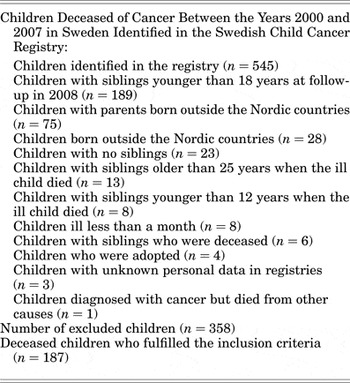
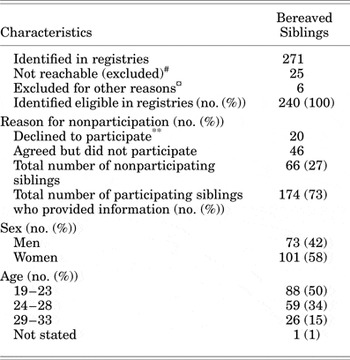
Between the years 2000 and 2007, 545 Swedish children died from cancer, according to the Childhood Cancer Registry. Some 187 of these met the criteria for inclusion in our study (Table 1). We traced the deceased children and their siblings through the Swedish Population Register. Siblings were included if they were born in one of the Nordic countries, understood and spoke the Swedish language, and had an identifiable address and phone number. All siblings were 12 to 25 years of age when they lost their brother or sister. At follow-up, all were above the age of 18. For this nationwide study, 271 siblings were identified, 240 of whom were eligible for our study (see Table 2).
Swedish children deceased of cancer between the years 2000 and 2007

Characteristics of siblings bereaved due to cancer

# Unknown phone number, known phone number but not reachable, lives abroad, and not reachable.
¤ Mental retardation, death of sibling due to cause other than cancer.
** Bereaved: 14 men, 6 women.
19–23 years 10 men, 3 women.
24–28 years 2 men, 2 women.
29–33 years 2 men, 1 woman.
A letter of invitation that briefly explained the purpose of the study was mailed to bereaved siblings. A few days later, a research assistant contacted the siblings and asked if they were willing to participate. To maintain anonymity, the study-specific anonymous questionnaire and a separate response card were mailed to those who had agreed to participate. A week after the questionnaire was sent, a combined thank-you-and-reminder card was mailed to those who had agreed to participate. If the questionnaire had not been returned by a few weeks later, the same research assistant made a phone call to ask if the participants had any problems filling out the questionnaire or needed assistance.
Measures
We employed the Hospital Anxiety and Depression Scale (HADS) (Zigmund & Smaith, Reference Zigmond and Snaith1983) to assess siblings’ levels of anxiety. The HADS is a psychometrically validated self-administered scale that is often used in the clinical setting to measure patients’ anxiety and depression. There are 14 questions: 7 measuring anxiety and 7 measuring depression. The score for each question ranges from 0 to 3 points, and the score for each outcome (anxiety or depression) can thus range from 0 to 21. Scores of 11 and above indicate that the individual may need medical attention. In the current paper, the term “anxiety” refers to clinical levels of anxiety—in this case, a HADS score equal to or greater than 11. Anxiety is the main outcome reported in our paper. We had previously reported on the lack of statistically significant differences in depression when comparing bereaved and nonbereaved siblings (Eilegård et al., Reference Eilegård, Steineck and Nyberg2013). The regional ethical review board approved the current study (No. 2007/862-31).
Statistics
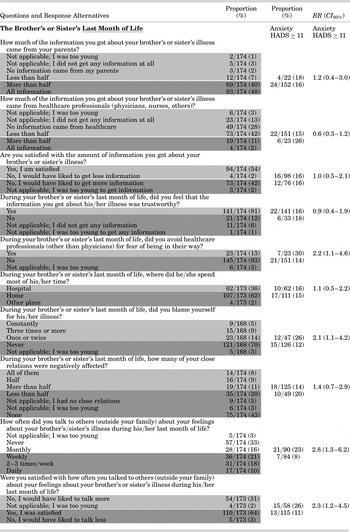
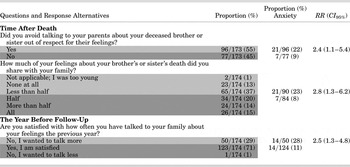
In Tables 3 (before death) and 4 (after death), the questions and response alternatives are specified, and the data are shown as proportions (%) and relative risks (RR). Relative risks (RR) are presented with 95% confidence intervals (CI 95%). Individuals with missing data were excluded in each calculation. We employed SAS software (v. 9.2) for all calculations.
Information and communication before the brother's or sister's death and self-assessed anxiety* in bereaved siblings

The different gray shadings in the table show the combination/dichotomization of the response alternatives combined.
* Anxiety is defined in the Hospital Anxiety and Depression Scale as a score of 11 or more (HADS ≥ 11).
Communication after the brother's or sister's death and self-assessed anxiety* in bereaved siblings

The different gray shadings in the table show the combination/dichotomization of answer alternatives combined.
* Anxiety is defined in the Hospital Anxiety and Depression Scale as a score of 11 or more (HADS ≥ 11).
RESULTS
Of the 240 bereaved siblings who were approached, 174 (73%) participated (73 men and 101 women). The characteristics of participating siblings are presented in Table 2.
Source of Information About Brother's or Sister's Illness
The vast majority of siblings reported receiving most of their information about their brother's or sister's illness at the end of life from their parents. Fewer got their information from healthcare professionals. Most siblings reported that the brother or sister with cancer was cared for at home. They also reported having been satisfied with the amount of information they received at the end of life. The vast majority trusted the information they received about the brother's or sister's illness (see Table 3).
Information and Communication Near the End of Life
The majority of siblings 110/173 (64%) reported being satisfied with how often they talked about their feelings with others during their brother's or sister's last month of life. Siblings who expressed that they would have liked to talk more reported anxiety to a greater extent than those who were satisfied: 15/58 (26%) versus 13/115 (11%), RR = 2.3(1.2–4.5). During their brother's or sister's last month of life, 23 of 174 (13%) siblings avoided healthcare professionals for fear of being in their way. Anxiety was more prevalent among this group of siblings (RR = 2.2(1.1–4.6)) than among those who did not avoid healthcare professionals, especially in the hospital setting (RR = 6.8(2.5–18.2)). No correlation was seen between avoidance or non-avoidance of healthcare professionals and anxiety among those whose ill brother or sister was cared for at home (data not shown). More than half of the siblings (90/174, 52%) reported that they seldom (once a month or less) talked with others about their feelings regarding their brother's or sister's illness during his or her last month of life. Within this group, 21 (23%) reported anxiety as compared with 7 (8%) among those who discussed their feelings more frequently. This corresponds to a relative risk of 2.8 (1.3–6.2) for reporting anxiety among siblings who shared their feelings less frequently. Siblings who reported that they had on at least one occasion blamed themselves for the brother's or sister's illness (47 of 168, 28%) were at greater risk of reporting anxiety (RR = 2.1 (1.1–4.2)) as compared to those who never blamed themselves (see Table 3).
Communication Following the Loss
A majority of siblings (96/173, 55%) reported that they avoided talking to their parents about their deceased brother or sister out of respect for their parents’ feelings following the loss. Their risk of anxiety was increased (RR = 2.4 (1.1–5.4)) as compared to those who talked with their parents. Siblings who reported that they shared none (23/174, 13%) or less than half (65/174, 37%) of their feelings about their deceased brother or sister with their family following the loss were at greater risk of reporting anxiety (RR = 2.8 (1.3–6.2)) as compared to those who shared more of their feelings. Most siblings (123/174, 71%) were content with how often they talked about their feelings with their family during the year before the follow-up. The risk of anxiety was increased in siblings who wanted to talk more with their family (RR = 2.5 (1.3–4.8)) (see Table 4).
DISCUSSION
Our study indicates that insufficient communication is associated with a sibling's risk of long-term anxiety. Siblings who were not satisfied with their communication, and in particular with their family, were more likely to report anxiety at follow-up. As mentioned earlier, the International Society of Pediatric Oncology (Spinetta et al., Reference Spinetta, Jankovic and Eden1999) highlights siblings’ needs for information and involvement. Nonetheless, we found that siblings avoided healthcare professionals for fear of being in their way, especially at the hospital, and this avoidance is also associated with an increased risk of reporting anxiety at follow-up.
Our finding that siblings avoid talking to their parents about their deceased brother or sister out of respect for their parents’ feelings is in agreement with what Havermans and Eiser (Reference Havermans and Eiser1994) reported more than two decades ago. Siblings seem hesitant to bother their parents. We know of very few studies that discuss what siblings find helpful after the loss of a brother or sister to cancer. In an effort to learn more about this issue, Thompson and coworkers (Reference Thompson, Miller and Barrera2011) interviewed 41 bereaved family members (36 mothers, 24 fathers, 39 siblings) one year after the death of their child, brother, or sister to cancer. Both parents and siblings stated that social support, self-expression, and faith and religion, as well as memories of the loved one, helped them to manage their grief. Moreover, both siblings and parents expressed that they found it valuable to talk about their experience of the child's illness and death, even though it could be difficult. Notably, few parents and siblings suggested that bereaved families should seek professional support. The value of sharing feelings with others about the loss is in agreement with our findings that the siblings’ perceived insufficient communication increases the risk of long-term psychological distress.
Our study revealed that a small number of siblings report they avoided healthcare professionals for fear of being in their way. This seems to be associated with an increased risk of long-term anxiety in bereaved siblings. Healthcare professionals are closely involved in the ill child's care, but they also play a role in advocating that siblings receive open and honest information and can be actively involved in the brother's or sister's end-of-life care (Giovanola, Reference Giovanola2005; Spinetta et al., Reference Spinetta, Jankovic and Eden1999) . The intense care at the end of life may frighten siblings. It appears that healthcare professionals may need to pay more attention to how they behave when caring for the seriously ill child with cancer, so as not to give siblings the impression that they are in their way, as that may impact the siblings’ risk of long-term anxiety after the death of a brother or sister. Notably, most siblings in our study did not report fear of being in the way of healthcare professionals. Von Essen and Enskär (Reference von Essen and Enskar2003) interviewed nurses and parents of children with cancer, and more parents than nurses mentioned the importance of giving information to the patient's siblings and getting them involved in the process of care for a child with cancer.
According to their siblings’ responses, most of the children with cancer in our study spent their last month of life at home or in some place other than a hospital. This raises questions about the impact of home care on bereaved siblings. Our findings suggest that siblings whose brother or sister was cared for at home rather than in the hospital during the last month of life were not at increased risk of reporting anxiety. It might be that siblings as well as parents of children with cancer are more aware that death is imminent when the ill child is cared for at home, and this awareness may influence their risk of reporting anxiety (Dussel et al., Reference Dussel, Kreicbergs and Hilden2009; Surkan et al., Reference Surkan, Dickman and Steineck2006).
The literature review by McCarthy (Reference McCarthy2011) concluded that information regarding prognosis, treatment, and side effects are important for family members in order to cope with a loved one's illness and treatment. O'Shea and coworkers (Reference O'Shea, Shea and Robert2012) studied interventions used to meet the needs of siblings of children with cancer. Four main themes and six subthemes were reported, among them the theme “wanting to know,” which revealed siblings’ desire to know what is going on. One of the consequences noted was that siblings who were not informed were left with questions and misconceptions, which in turn led to fear and thoughts about whether they had contributed to the brother's or sister's illness in some way. Our results show that almost a third of the siblings (47/168, 28%) reported that they had on at least one occasion felt that they might be partially to blame for their brother's or sister's illness. Even though the nurses in another study identified many of the sibling's needs, they expressed divergent views about their role in meeting those needs (O'Shea et al., Reference O'Shea, Shea and Robert2012). It appears that a majority of the nurses in that study wanted the parents to step in and take more responsibility in supporting the siblings. It might be that the best way for nurses and healthcare professionals to support the siblings of children with cancer is to keep the siblings informed and encourage parents to maintain open communications within the family throughout the illness and bereavement. Still, the question of how to best support siblings is difficult, and since the healthcare system has limited resources, nonprofit school and healthcare organizations or social networks may need to fill that gap.
Our study has both strengths and limitations. Among its strengths was the use of population-based registers, which enabled us to identify all cancer-bereaved siblings in Sweden. The high participation rate is another strength. One limitation may be the way in which the data were collected, as we do not know if psychological distress at the time of follow-up may have influenced participants’ recollections of earlier events. We cannot exclude that their perceptions of the communication during their brother's or sister's last month of life might have been influenced by current anxiety rather than the communication that actually occurred. Exclusion of families born outside of Nordic countries may lessen the possibility of generalizing our findings beyond the studied population.
CONCLUSIONS
Our study suggests that insufficient communication is associated with a risk of anxiety in cancer-bereaved siblings over the long term. In order to reduce this risk, healthcare professionals may encourage families to talk more openly about the illness and its trajectory. This may also promote siblings’ involvement in the care of their ill and dying brother or sister.
ACKNOWLEDGMENTS
We would first like to thank all the participating siblings, who helped us conduct this study by taking the time to share their experiences. The study was supported by funds from the Swedish Childhood Cancer Foundation, the Swedish Research Council, the Swedish Cancer Society, the Karolinska Institutet, and Sophiahemmet University. The funding sources had no involvement in any part of the study. The authors had full access to all the data in the study and take responsibility for the integrity of the data and the accuracy of the data analysis. The authors have no conflicts of interest to declare.