


The past decade has seen an efflorescence of scholarship complicating the commonplace conclusion that organized Christianity has been a uniquely and uniformly hostile force to queer life in the United States. This work has called into question linkages forged at the inception of the gay liberation movement, which set out to disrupt perceived foundational injustices with demands to “smash the church; smash the state,” a call being articulated even as churches supplied critical organizing spaces for these activists.Footnote 1 In fact, to repurpose Ann Braude’s framework for re-centering gender in the history of US religion, enough research has emerged to make it incumbent on scholars to integrate a new motif into the throughline of US religious history: a narrative of queer presence rather than homophobic absence.Footnote 2
This article proposes to contribute to this effort by shedding light on the women couples who served in professional leadership roles with the Young Women’s Christian Association of the USA (YWCA), an interdenominational Protestant women’s voluntary organization, between the 1910s and 1940s. While the YWCA’s counterpart, the Young Men’s Christian Association (YMCA), gained considerable notoriety as a center of gay life, particularly after the hit Village People song made the institution’s reputation as a cruising spot the most open of secrets in the 1970s, the handful of accounts about same-sex intimacy in the YWCA have drawn little notice.Footnote 3 Nevertheless, the YWCA provides a valuable lens into queer presence in US religious history at a pivotal pre-Stonewall moment.
This article’s account of YWCA leadership not only indicates a history of “open and affirming” spaces in religious life that preceded the discrete congregations of “self-identified homosexuals” in the 1940s and the 1950s, which have been described by the scholars Jim Downs, Heather R. White, and Melissa Wilcox; it also provides a window into the institutional and intellectual resources that enabled women’s non-normative intimate configurations during a period of heightened repression of same-sex sexuality.Footnote 4 Building on the work of the historian Kathi Kern, I emphasize that principles of religious faith were instrumental among these resources. For a number of YWCA administrators, righteous dedication to the association’s mission “to bring young women to such a knowledge of Jesus Christ as Saviour and Lord as shall mean… fullness of life and development of character” was inextricable from the attachments they formed with each other in a collective effort to create a more Christian society.Footnote 5 The religious ideals promoted in this organization shored up a work culture that supported loving bonds among women, and, in turn, gave women couples a purposeful means of self-support.
The article proceeds by first piecing together material from the organization’s archives to provide a group portrait of prominent couples in the YWCA’s professional leadership in the first half of the twentieth century. During the years of their tenure, a period of growth for the organization, the YWCA reckoned with a declining cultural emphasis on separate spheres of gendered activity by affirming the value of women-centered ventures, defying trends toward companionate heterosexuality.Footnote 6 The second half of the article homes in on the life and work of a single staff member whose writings provide unique insight into ways in which progressive Christianity could sustain a sense of righteousness in same-sex love. Taken together, this assemblage traces a homosocial gospel that flourished in the interwar YWCA of the USA, providing a perspective on a corner of liberal Protestantism that evaded the rigidities of emergent discourses of sexual modernity. Bridging the nineteenth-century era of romantic friendship to the dawning years of pre-political resistance to the oppression of gays and lesbians, this history of an organizational culture invites further excavation and serves as a reminder of the inaccuracies of commonplace assumptions about the antinomies between Christianity and same-sex sexuality.
The Last Days of Love and Ritual: A Generational Cohort of Women Couples
Throughout its history, the YWCA of the USA dedicated itself to what Estelle Freedman named the “separatist political strategy” of “female institution building.”Footnote 7 In no small part, it remained a welcoming environment for women who loved women because it held to the gender separatist spirit that inspired its mid-nineteenth-century founding. As the wider culture placed greater emphasis on companionate heterosexuality and mixed-sex socialization, the YWCA anchored its identity in a homosocial mission. This mission created something of a sanctuary to many women professionals: for some, because it provided meaningful employment amid the gender inequities of the wider workforce; for others, because it underwrote a place of employment where women who loved women were openly integrated into the workforce.
The organization had its start in a transatlantic, evangelical Protestant revival animated by ideologies that idealized separate spheres of gendered activity. Inspired by the success of the YMCA, which was started in the 1840s over concerns about moral dissipation among male wage workers in the cities, middle-class women established the first YWCAs in London in the 1850s, to extend the reach of their domesticating and Christianizing influence in the face of industrialization and urbanization. (The men’s and women’s organizations were unaffiliated and operated independently). YWCA volunteers aimed uplift efforts and intercessory prayers at the putatively endangered women of the working class. The organizational model spread quickly in the United States, where women’s voluntary clubs were carving out a distinctive place in the public sphere.Footnote 8 Imagined as a supplement to denominational church life, the YWCA supplied its organizers with opportunities for autonomy they would not find in male-dominated bodies, as it was premised on the notion that single-sex fellowship was key for unlocking women’s capacities and addressing their needs.
Offering boarding facilities, vocational assistance, and recreational opportunities alongside religious activities, YWCAs attracted the interest of a diverse range of women and girls as both volunteers and participants, and the US association grew from a handful of city groups to hundreds of organizations in cities, towns, and colleges at the turn of the twentieth century.Footnote 9 Its programming branched out in multiple directions, stretching from student clubs to foreign mission outposts, health and hygiene instruction to cultural appreciation, social morality to political advocacy, and beyond. The loosely affiliated local groups unified into a national organization (officially titled the Young Women’s Christian Association of the USA) in 1906. An extensive administrative apparatus named the National Board operated the organization as a corporate enterprise from Manhattan headquarters. This governing body of professional staff and volunteer boards played an executive role in coordinating the activities of community YWCAs, and it affiliated with a bustling world network of YWCAs, providing staff to dozens of overseas associations enmeshed in the mission movement. In 1922, the US YWCA claimed a membership of over 600,000 women, making it the third-largest women’s membership organization in the country, behind the General Federation of Women’s Clubs (one million members) and the Woman’s Christian Temperance Union (800,000).Footnote 10
Some shared qualities among the cohort of women profiled in this article, who assumed professional leadership roles in the National Board in the years before World War II, suggest important ways in which the nineteenth-century legacy of female institution-building created a means for resistance to the heteronormative terms of sexual modernity that crystallized in the early twentieth century. Most formatively, this legacy extended to the legitimation of women’s interpersonal intimacy. The women documented in this article came of age in the waning years of an era when romantic friendships among middle-class women were “condoned, even celebrated,” in the words of Leila Rupp. Summarizing the “enormous literature” surrounding romantic friendship inaugurated by Carroll Smith-Rosenberg’s pioneering 1975 account of “The Female World of Love and Ritual,” Rupp explains: “an ideology of profound sexual difference, in conjunction with economic and social sex segregation, opened up spaces for passionate, intense, loving, physically affectionate relationships between women.”Footnote 11 These YWCA women were born in and around the 1880s to families that were, by and large, white and middle class. They were drawn from the ranks of college graduates who had been educated in homosocial spaces where same-sex romantic friendships flourished. The rituals and intensely emotional atmosphere of higher education modeled for them a way of life in which women established intellectual and intimate ties to each other in collective living spaces.Footnote 12 The historian Jacquelyn Dowd-Hall notes, in reference to the YWCA-affiliated cultural critic Katharine Du Pre Lumpkin, that, for many, that experience “marked the beginning of a lifetime spent in women’s institutions and in partnership with other women.”Footnote 13
Alongside experiencing a culture of romantic friendship, this generation of women collegians often discovered an abiding sense of purpose through their immersion in Christian student life, Dowd-Hall emphasizes. Campus YWCAs exposed many of them to the Social Gospel movement, the “praying wing of Progressivism” that called on Christians to labor for the perfection of life on earth through the application of gospel principles of loving cooperation to social problems.Footnote 14 Moreover, Dowd-Hall contends, the Social Gospel provided a language of “spiritual unions” to explain romantic friendship, and it promoted “the infinite worth of every individual, the Kingdom of God as a new social order, [and the] the belief that the world could be understood, acted on, and changed.”Footnote 15 Concepts such as these stood in contrast to medicalized and stigmatizing discourses of same-sex desire that came to supplant separate spheres ideologies over the turn of the twentieth century.
During this transitional period of sexual modernity, the YWCA uniquely offered women graduates a faith-driven outlet for their activist yearnings and career ambitions. Having established around 1,100 community and campus associations in the early 1920s, the organization was a significant employment destination for women with professional training.Footnote 16 For many women at this time, dedication to a professional career precluded marriage. The responsibilities of YWCA administrators—called secretaries, in the executive sense of the word—made a traditional home life difficult, particularly as positions often entailed travel and fieldwork. However, the partnerships that developed among YWCA workers were not simply circumstantial substitutes for the heterosexual family. They were intentional and profound. In her biography of a US secretary who served in China, the historian Karen Garner underscores that Maud Russell “chose a career that separated her physically, intellectually, and emotionally from the genteel middle-class family and society that she was born into.” Russell created “a new ‘family’ and community of like-minded women in the YWCA,” and her chosen family included romantic partnerships with her colleagues Anne Seesholtz and Mary Bentley.Footnote 17
Moving from the generalities that can be drawn around this generation of YWCA leadership to the specificities of the lives of these couples requires an acknowledgment of the vast silences in the archival record. As has been the story for countless histories of same-sex intimacy, I am compelled to work with a scant documentary record to assemble this account.Footnote 18 Source material that lends insight into YWCA partnerships tends to be minimal and superficial: letter salutations, terse obituary notices, and photographs that provide a momentary glimpse of the women’s emotional ties. Garner was compelled to contend with a similarly conspicuous lack of material in her account of Maud Russell’s intimate relationships—an executor destroyed correspondence between Russell and Bentley marked “love letters.”Footnote 19 Nevertheless, the available documents supply a fleeting glimpse of the domesticity of YWCA couples, and this glimpse shows that, within the organization, their private lives were staged as public partnerships.
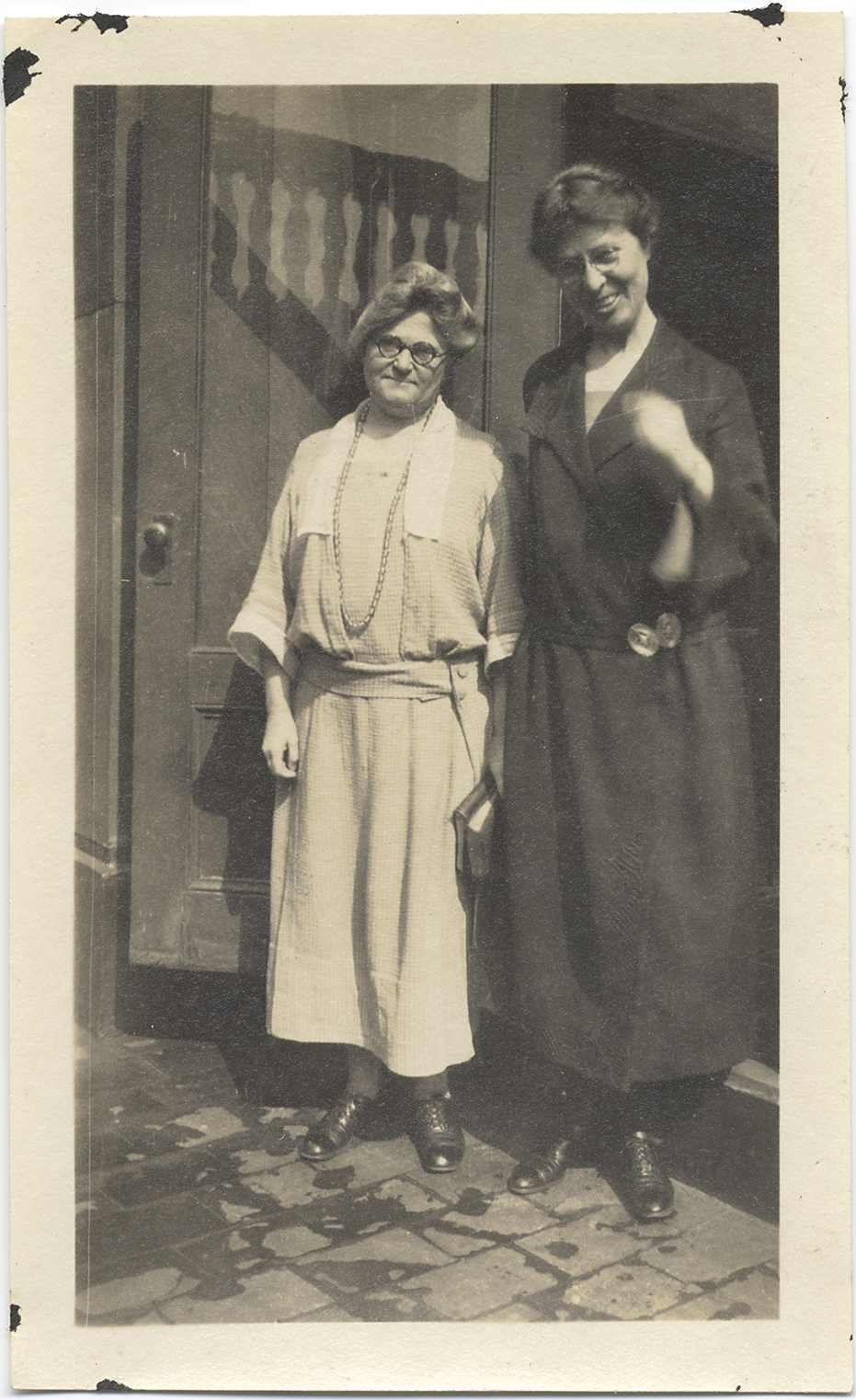
Two of the more influential staffers, Anna Rice (1880–1966) and Charlotte Adams (1873–1979), left just such a mark in the record (Figure 1). Both women spent their careers with the YWCA, each starting after college and remaining until retirement. They published extensively within the organization and moved between various leadership roles, with Rice holding the executive administrative post, General Secretary, from 1929 to 1938. Correspondence provides brief references to their shared household: for example, Rice’s quick notes to another YWCA couple (Margaret Burton and Margaret Hiller)—“Love to you and to M.H. from both Charlotte and me”; as well as official communications directed to them—“my best to you and Charlotte,” the YWCA’s public relations director wrote to Rice.Footnote 20 Eulogies evoked, if not detailed, how the partnership ran through the center of their households and careers alike. At Rice’s 1967 memorial service, the executive Grace Loucks Elliott stated it plainly: “I cannot lead you in giving thanks for Anna Rice without including Charlotte Adams … with whom Anna for years shared her thinking and her home.” Identifying this partnership as a sustaining force in the religious life of the association, Elliott told the assembly, “it has been the skill and the training of these two women that has enabled the National Board from its beginning to interpret its Christian basis in terms relevant to the first half of the century.”Footnote 21 Their closeness was comfortably acknowledged within the organization.
Left to right, Anna Rice and Charlotte Adams, ca. 1923. YWCA of the USA Records, Sophia Smith Collection, Smith College Special Collections, Northampton, Massachusetts.

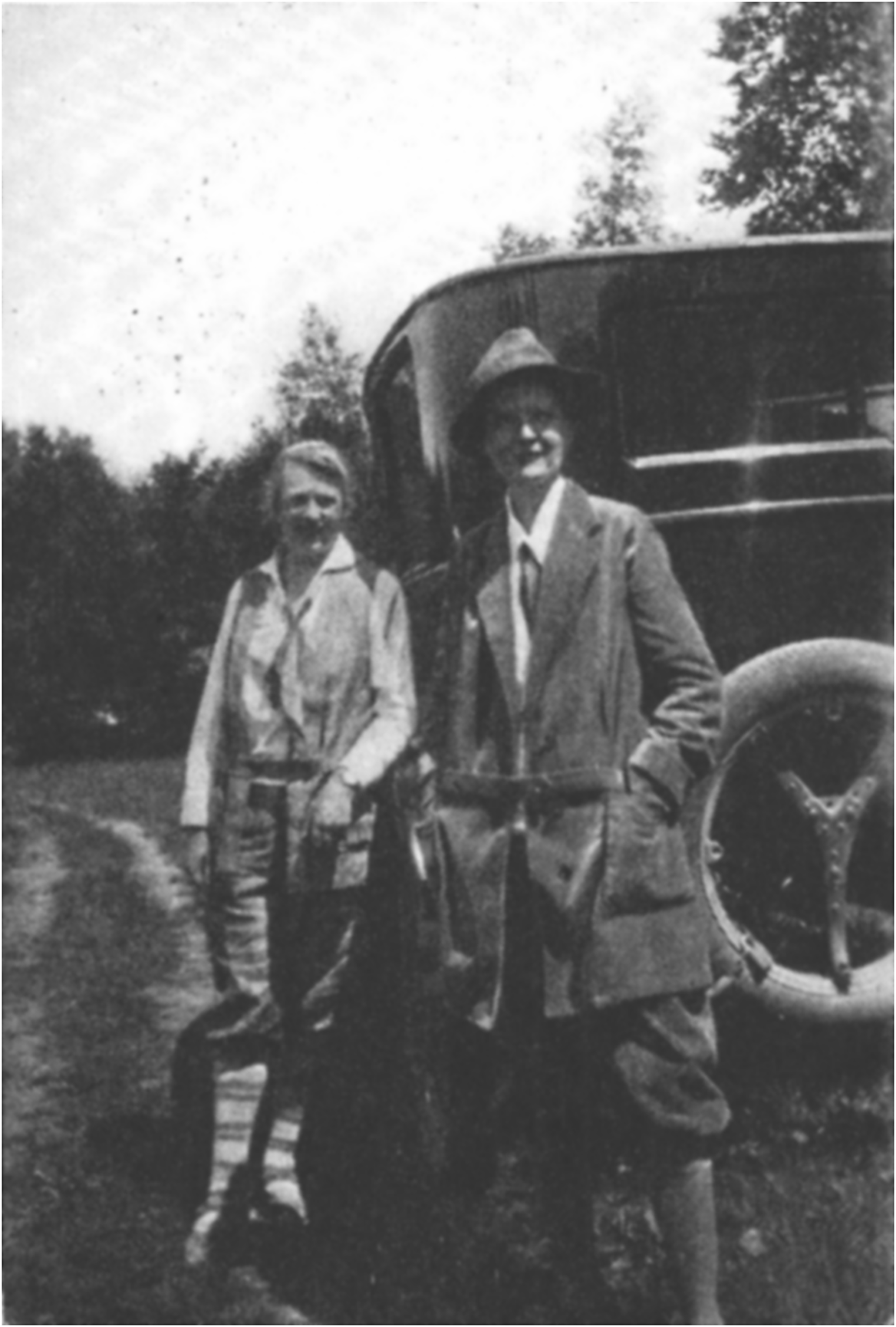
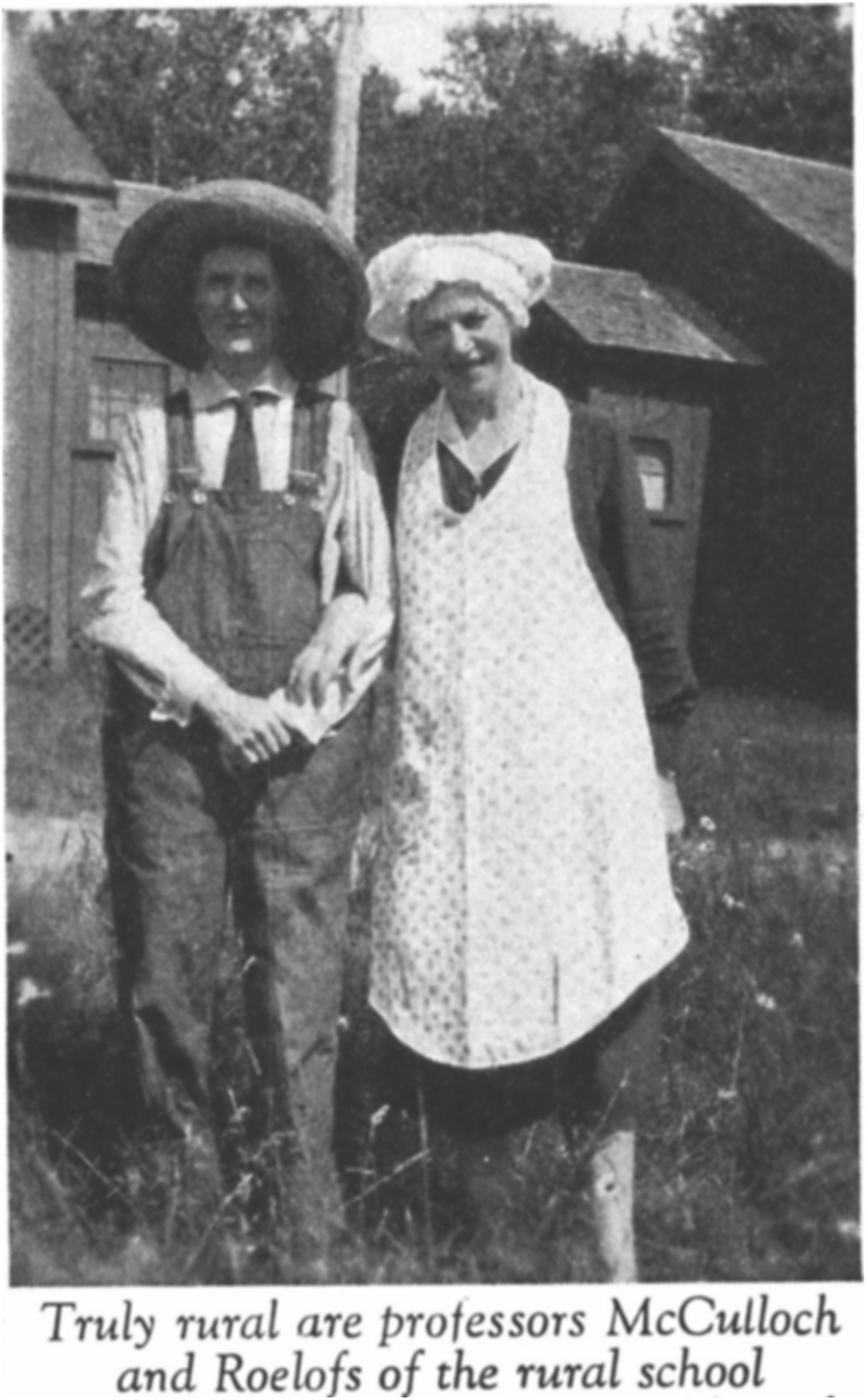
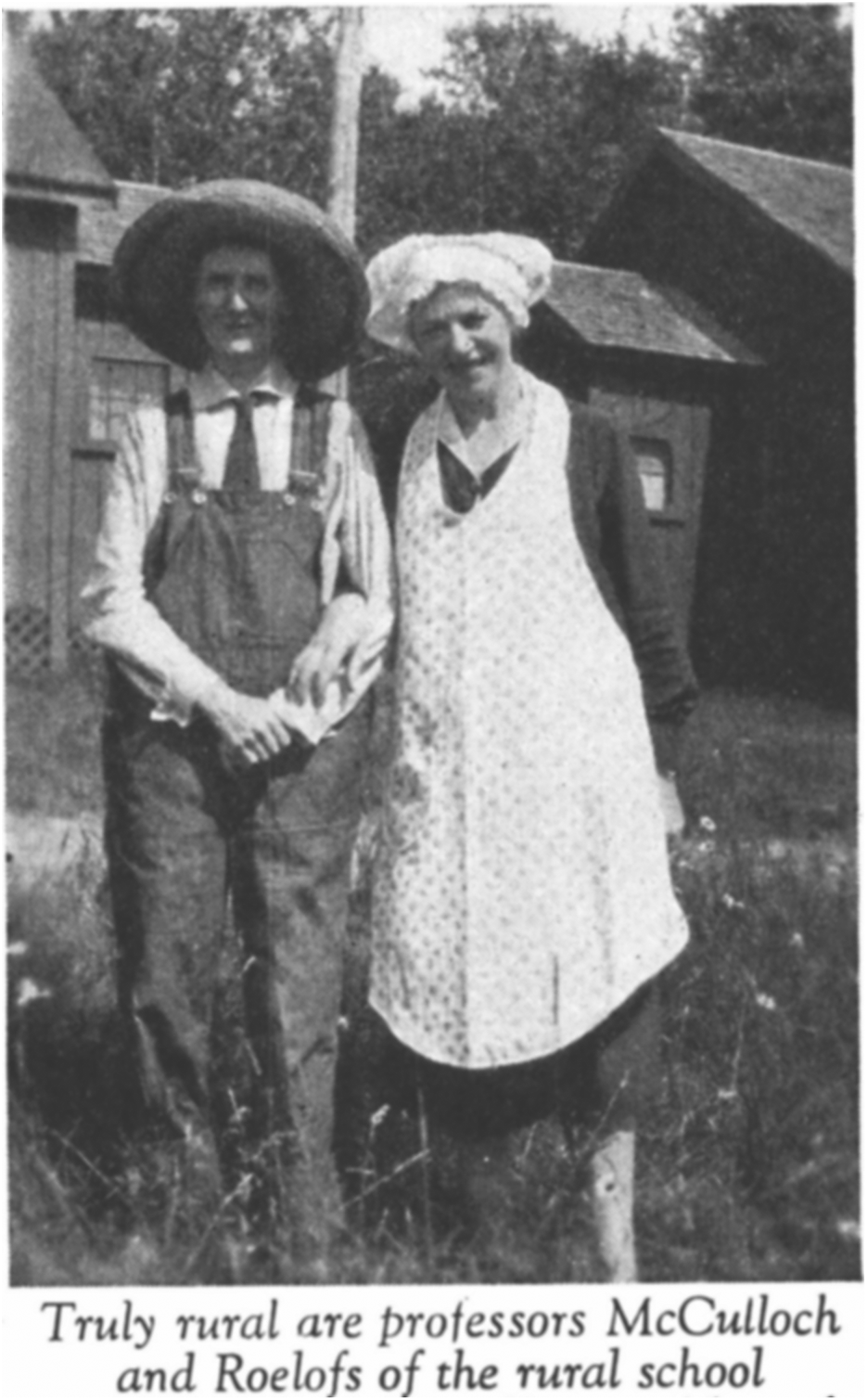
Like Rice and Adams, Henrietta Roelofs (1880–1942) and Rhoda McCulloch (1884–1978) were pivotal figures in association leadership. Obituaries give some access to their personal lives. Upon Roelofs’s death in 1942, the New York Herald-Tribune mentioned their partnership: “Miss Roelofs … lived with Miss Rhoda McCulloch, editor of [the] national organ of the YWCA.”Footnote 22 Roelofs’s New York Times obituary omitted this decades-long relationship while recounting highlights of her thirty-three-year tenure on the National Board staff: World War I work in France, rural outreach in the US, and an executive role in political education. McCulloch’s YWCA career was no less distinguished, particularly her responsibilities with the publication division. Friends, family, and coworkers commemorated her passing in 1978 by recounting the partnership that continued to define her thirty years after Roelofs’s death. Writing a condolence note to McCulloch’s family, Roelofs’s nephew reminisced about childhood visits to the couple’s pleasant domicile: “I never forget her or Aunt Henry. It is always with happiness that I remember them, think of them, and I think of them often.”Footnote 23 In their lifetimes, the couple literally made themselves visible to readers of the YWCA magazine. Once, a YWCA colleague had playfully described McCulloch (in a letter marked “destroy”) as being “mannish in clothes but quite feminine in smile and point of view,” and, in a set of 1927 articles, she indeed dons masculine attire standing side by side with Roelofs (Figures 2 and 3).Footnote 24 With the caption, “truly rural are professors McCulloch and Roelofs,” the two pose as a farmer couple, with McCulloch wearing overalls, a tie, and straw hat, and Roelofs in a dress, apron, and bonnet. Their arms are intertwined.Footnote 25
Left to right, Henrietta Roelofs and Rhoda McCulloch in The Womans Press, November 1927. YWCA of the USA Records, Sophia Smith Collection, Smith College Special Collections, Northampton, Massachusetts.

Left to right, Rhoda McCulloch and Henrietta Roelofs in The Womans Press, February 1927. YWCA of the USA Records, Sophia Smith Collection, Smith College Special Collections, Northampton, Massachusetts.
As with the other couples, Grace Coyle (1892–1962) and Abbie Graham (1889–1972) remained committed to each other over a lifelong partnership that took shape in the personal and professional realms. Both worked for the National Board in the 1920s, until Coyle accepted a position in the social work school of Case Western Reserve University. Upon Graham’s death, a YWCA colleague noted that the women “were close friends for many years, [though] their careers were quite different,” eliding the fact that the close friendship extended to a shared household. Coyle had a prominent place in the organization’s educational and social work divisions, while Graham “wrote extensively and imaginatively for the YWCA [but] did not have a highly visible or authoritative position.”Footnote 26 Though it was not a central subject in her academic publications, Coyle believed that “the most basic need of human nature is to love and be loved,” and a few items testify to the expressive love she found with Graham. Her biographer, Robert Bremner, drawing upon information provided by Coyle’s family, reported that she was “devoted to her housemate and longtime friend, Abbie Graham.” The women “shared a love of Vermont, built a summer home there, and for several summers in the 1930s drove a horse-drawn milkman’s cart about the state, camping at night in farmers’ fields.” It is difficult to imagine what rural Vermonters made of the two forty-some-year olds, “professional in appearance and manner,” tramping around the countryside.Footnote 27 In a small way, they made their relationship visible beyond their work sanctuary.
Others left fewer traces in the YWCA records, though a thorough examination of the archives yields some documentation of intimate bonds that connected women such as Margaret Burton and Margaret Hiller;Footnote 28 Katherine Gerwick and Lucy Randolph Mason;Footnote 29 and Eleanor Coit and Amy Bruce.Footnote 30 As all of the aforementioned women were white, it is worth highlighting the minimal evidence testifying to the homosocial attachments of African American National Board secretaries. The historian Lauren Kientz Anderson dedicated an undated web exhibit to a rumor about whether the renowned YWCA secretary and educator Juliette Derricotte was a lesbian. Indicative of the “problematic of silence” surrounding “black female queer sexualities” described by Evelyn Hammonds, Anderson’s conclusions prove evasive.Footnote 31 Nevertheless, the exhibit highlights Derricotte’s ambivalent perspective on heterosexual marriage and includes a passionate declaration of friendship to another YWCA secretary, Jane Saddler. “I think I shall jump overboard when I get a glimpse of thee,” Derricotte wrote while returning from an overseas trip.Footnote 32 Marion Cuthbert—like Derricotte, a prominent activist in African American education and a YWCA secretary and author—likewise left behind an evocative fragment in a book of poetry celebrating God-ordained love, which “opens wide the portals / Of all the richest treasures of the universe.” The volume was dedicated to her fellow secretary Lucile Lippett.Footnote 33
While I could not possibly have identified every relevant document in the YWCA’s vast archives, these accounts were composed by viewing hundreds of boxes over many years of research. During that time, I encountered only a single example of concern about same-sex relationships among YWCA employees. The administrative response betrayed no alarm. In 1940, Jo Brown, a secretary stationed in the Philippines, was the subject of a confidential letter between her supervisor, Anne Guthrie, and a National Board executive, Sarah Lyon. Guthrie wanted to secure Brown for a long-term assignment, but she worried about “strange unexpressed criticisms” of Brown’s work, “the cause for which I’ve never known.” Guthrie relayed one coworker’s suspicion: “Someone suggested it was personal relationships that were too intimate.” She thought that this conclusion was out of place at the YWCA. “I can’t believe this the cause,” she mused, “for if it were a lot of folks would be discounted, for our organization like all women’s organizations is filled with intimate friendships from coast to coast.” The tendency was only natural: “It’s inevitable when we work in a setting where men are absent.”Footnote 34 If Guthrie’s response did not exactly affirm Brown’s inclination for mixing business with pleasure, it suggests an atmosphere in which women couples did not need to fear reprisals. Guthrie portrayed women’s intimacy with each other as a byproduct of single-sex organizing structures, and she, like YWCA administrators more generally, saw nothing so troubling in the prevalence of intimate female friendship as to call into question the organizing model on which the group depended.Footnote 35
Because sex scandals tainted its reputation, the YMCA “abhorred same-sex erotic inclinations in its sex education work,” as it placed a distinctive emphasis on heterosexual personal development in its programming and printed materials.Footnote 36 According to the historian Courtney Q. Shah, the YWCA “avoided the topic” of explicit sex education, remaining “timid and euphemistic” so as to protect a female audience presumed to be passionless.Footnote 37 Nevertheless, its hygiene and sex education materials brought a progressive agenda to matters such as menstruation and women’s athleticism, with the pioneering physician Anna Brown and the controversial sex educator Clelia Duel Mosher penning publications that emphasized the open exchange of knowledge and urged physical activity as the productive outlet for sexual energy.Footnote 38
These authors treated same-sex intimacy evasively, when they addressed it at all. Grace Loucks Elliott’s Understanding the Adolescent Girl (published in 1930 and reprinted in 1949) is the YWCA sex education publication that most expressed concern about same-sex sexuality, and it provided a reassuring account of “crushes” that interpreted a young woman’s attachment to “an older or more mature” woman as “a normal stage in the process of being weaned away from her family.”Footnote 39 The author brooked same-sex caressing and kisses as typical of youthful attachments but drew the line at overtly sexual contact, warning her readers that “there are cases, which we have not included here, of sexual perversion, where an older person seeks for direct sex gratification with a younger person; but such cases are relatively rare, and when they are found can be handled only by expert psychological help.”Footnote 40 The tract acknowledged, but did not linger on, the danger of homosexuality but distinguished this “rare” danger from the commonplace occurrence of “extreme friendships” among young women.Footnote 41
While these histories speak to the ongoing relevance of gender separatism, the organization’s capacity for accommodating women couples on its staff, and its ambiguous relationship to discourses of homosexuality, they are silent on the effect of these shifting discourses on their professional employees. Given the limitations of the documentation, it is reasonable to conclude that there is no readily accessible material that provides a perspective on how the above women understood their intimate partnerships, or insight into how they grappled with changes in cultural conversations around same-sex sexuality. However, their contemporary Winnifred Wygal (1884–1972) uniquely detailed an organic relationship between the YWCA’s work, Christian faith, and same-sex love over several decades of diaries. The article will turn now to an extended consideration of Wygal’s self-narration as a YWCA theologian and as a lover of women at a time when love between women became cast as the pathology of homosexuality.
While the historian Kathi Kern has adeptly interpreted Wygal’s diaries to reveal “the unexamined capacity of Christian faith as a source of self-affirmation” amid “the emergence of a scientific paradigm of pathology,” I would like to revisit these materials to contend that the principles of faith articulated there were not solely the result of this individual’s self-journey; they were influenced by, and had an influence on, the wider intellectual milieu of the YWCA.Footnote 42 They give evidence to the discursive resources for resistance to the pathologization of same-sex love that were accessible to YWCA women. Wygal’s diaries tell a personal story of how one woman made sense of romantic entanglements using the interpretive tools of modernist mainline Protestant theology, but they are indicative of the collective commitments of YWCA professionals. Her meditations on love, sin, and religious obligation drew upon a vocabulary of progressive Christianity that was crafted within the context of the organization. And just as Wygal developed her principles of faith in response to the ideas she imbibed as a decades-long participant in YWCA ventures, she too made critical contributions to this discourse in her various staff positions, which culminated in her appointment as Secretary of Religious Resources from 1934 until her retirement in 1944.Footnote 43
I propose that Wygal’s diaries offer something of a Rosetta Stone for understanding the intellectual and spiritual underpinnings of how the YWCA of the USA remained a commodious space for same-sex couples at a time when the wider culture became hostile to them. The body of ideas she worked through in her professional and personal writings suggest how the faith principles promoted in the organization could be mobilized to reject the limiting terms of sexual modernity for women who loved women. Though the logic of separate spheres had shored up homosocial institutional life and same-sex intimacy during the youth of Wygal and her cohort, the sun had set on the “female world of love and ritual” while they ascended the ranks of their workplace. Such ideals were displaced by a science of sexuality that established, in the words of Michel Foucault, the “homosexual [as] a species,” prompting scrutiny of the perceived deviance of those who pursued same-sex attachments.Footnote 44 The historian Heather R. White has examined how this scrutiny took shape in the realm of mainline Protestantism, documenting how a turn to therapeutic culture replaced the diffuse, “confused category of ‘sodomitical sin’” with the diagnostic category of homosexuality, “the unnatural opposite of a healthy heterosexuality.”Footnote 45
My work on Wygal supplements White’s foundational account by illuminating an alternate perspective on same-sex sexuality that was opened by liberal Protestant adaptations of therapeutic insights of the social sciences, which enabled YWCA women to follow their own path on questions of same-sex intimacy.Footnote 46 Wygal’s writings provide insight into a body of principles that connected therapeutic Christianity, ethical social engagement, and the affirmation of women’s expressive love for each other; if ideological commitments to same-sex structures provided the institutional means of resistance to norms of companionate heterosexuality in the YWCA more broadly, such principles of faith provided spiritual sustenance for resistance for Wygal and her like-minded colleagues. In this way, the YWCA makes it possible to recognize how the adaptation of therapeutic concepts into religious discourses not only “hailed” the homosexual subject into being in terms of pathological personality development—and hence a subject of pastoral care, as detailed by White—but also created opportunities for liberal Protestants to interpret their own lives and personal development in ways that affirmed same-sex love.Footnote 47
The following examination of Wygal’s meditations expands upon Kern’s and White’s work as it highlights three avenues for understanding how a Christianity crafted within the institutional setting of the YWCA could provide accommodating terms for sexual self-fashioning in the face of regimes of heteronormativity that were then reshaping understandings of personal development and sexual sin in mainline Protestantism. First, in elaborating love as an inherently righteous, universal force, Wygal, like other YWCA thinkers, destabilized the patriarchal family as the privileged site for women’s intimate ties. Second, with a definition of sin oriented around social justice, her theories of a Christian social order set aside concerns over sexual transgression. Finally, the traces of her encounters with restrictive discourses of sexual identity demonstrate that, while the pull of heteronormativity could not be escaped, its pressures and prohibitions did not have an absolute reach in defining women’s love for each other.
The Superb Adventure
Wygal belonged to the same cohort as the women couples described above: a generation of middle-class white women born in the 1880s who had been awakened by immersion in Christian student life and who found in the YWCA an activist outlet for their career ambitions. After graduation from Drury College in her hometown of Springfield, Missouri, she secured a position as a secretary of student work at the University of Nevada in Reno. Subsequently, she rose in the ranks of the National Board of the YWCA, an ascent bolstered by graduate work at Union Theological Seminary with some of the most renowned theologians of the day, including Reinhold Niebuhr. Though she began her YWCA career as a congregant of the Disciples of Christ, she ultimately took an ecumenical path in her denominational affiliations, serving as one of the early women deacons of the progressive bastion Riverside Church.Footnote 48
The first intimate relationship documented in her diaries is from the early years of her YWCA employment. It is an attachment suggestive of the storied nineteenth-century female world of love and ritual in which same-sex friendships could be characterized by “closeness, freedom of emotional expression, and uninhibited physical contact,” in the estimation of Carroll Smith-Rosenberg.Footnote 49 Wygal’s entries in the line-a-day diary of the 1910s were brief reports on everyday activities. Short passages nevertheless relay the passion and physicality of the friendship she developed with Rachel Rand, a teacher in Reno city schools. Wygal recorded the highs and lows of an intense relationship: reports of dejection, such as “RR very cross” and Wygal “very blue over her,” were punctuated by the frequent, simple notation, “all night with RR.” Though the two did not live together, nearly every day they met for meals and leisure or a quiet overnight in Wygal’s room. A diary entry occasioned by Wygal’s departure reveals something of what happened behind closed doors: “both wept at bed-time and hugged each other good.” A few photographs testify to their closeness: a snapshot of the two—labeled “life-long friends!”—shows Wygal beaming at the camera, her hand in Rand’s lap.Footnote 50 The unselfconscious physicality bears resemblance to the photos of Rhoda McCulloch and Henrietta Roelofs in the YWCA magazine—and those of countless female friends at the turn of the century.
Wygal’s grief upon Rand’s drowning death in 1917 was profound, and Rand’s parents sent her Rachel’s ring and lock of hair. The ritual marked the family’s affirmation of the bonds between the women, giving Wygal an enduring, tactile memento of her lover. However, the archival record of their intimacy suffered a spell of censorship. Wygal soon felt compelled to destroy some of the relationship’s documentation, though she did not explain what prompted her to do so: “Read Rachel’s letters, 1913–1916, all day, sorted and discarded. Hurt me terribly to burn them but I did. Very tired … Tired and sad.”Footnote 51 In addition, excisions dot the diary’s last two months. This denouement to her early romance suggests the standard periodization of the history of sexuality at the turn of the century, where the uninhibited and expressive world of same-sex love and ritual gave way to repressive cultural forces.Footnote 52
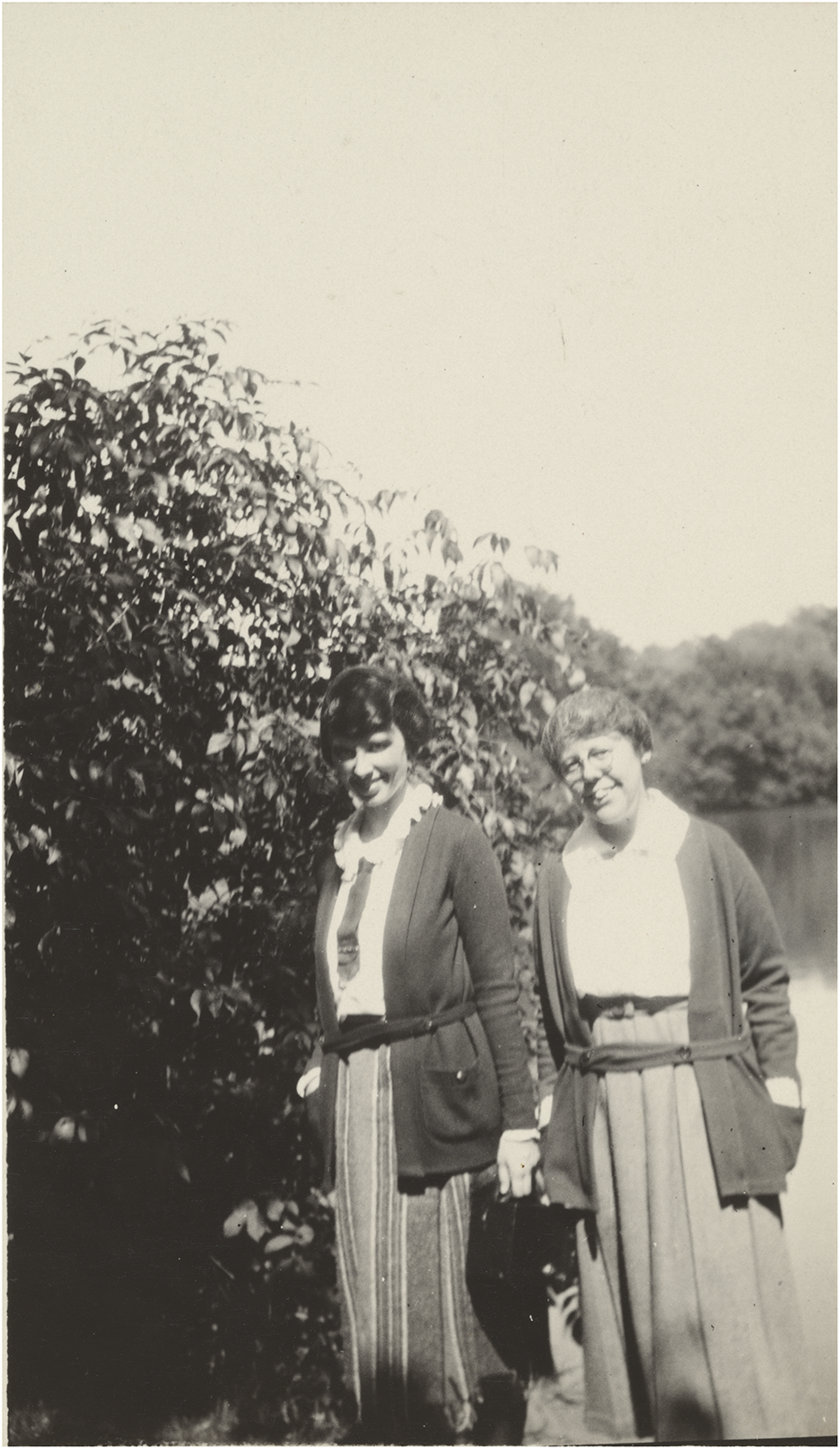
But the record of Wygal’s love for women does not stop there. Writings on a decades-long entanglement with Frances Perry (1895–1971), her subsequent object of devotion, follows a more complicated trajectory (Figure 4). The Rosetta Stone quality of her theological meditations comes across in her account of a spiritual journey traversed over the unstable course of this partnership, for it was the relationship that pushed Wygal to plumb her faith for resources to navigate its depths. This was not the schoolgirl romance she had once had with Rachel Rand. It prompted a searching quest for the meaning of love, the experience of which Wygal tagged “clear evidence of God’s reality.”Footnote 53 For her, faith in bonds that linked individuals into mutual dependence on God and each other was the very measure of Christianity, and she, like many of her YWCA colleagues, experienced these bonds most deeply with women.
Left to right, Frances Perry and Winnifred Wygal, 1922. Winnifred Wygal Papers, Schlesinger Library, Harvard Radcliffe Institute, Cambridge, Massachusetts.

Wygal often felt that she and Perry achieved a love of the highest order, one infused with God’s presence. They first met shortly after Rand’s death, when Perry was overseeing YWCA work in Kansas high schools. The relationship deepened over the course of the 1920s, when the two relocated to the Manhattan National Board headquarters. Both became involved in leftist Protestant circles. Most prominently, they took leadership roles in the Fellowship of Socialist Christians (FSC), Reinhold Niebuhr’s Popular Front-era organization devoted “to Christianity and radical social change.”Footnote 54
Wygal’s volunteer work for the FSC enabled her to explore Marxist-tinged commitments, but, in her writings for the YWCA, she meditated most frequently on a commonplace theological tenet that animated the religious ideals of the organization and her personal outlook alike: love as the center of the Christian message. This emphasis was critical in Social Gospel templates for the Christianization of the social order, which would be set into motion through the ethical imperatives generated by the model of care set by New Testament accounts of Jesus’s ministry.
Wygal joined numerous other YWCA writers in reflecting on the activist implications of the Social Gospel. Women highlighted in this article stand among the most vocal of the Social Gospel crusaders. As Anna Rice—then a secretary of religious education—explained, relaying a basic principle of this movement to readers of the association magazine: “If Christianity is to triumph and bring the Kingdom of God in its fullness it must save not only individuals, but society as well.”Footnote 55 Devising decisively liberal, but often racially segregated, programming to cultivate interracial and interclass harmony, world cooperation, and the morally conscious practice of citizenship, the YWCA located the font of social regeneration in the emotional commitments of loving fellowship. Rice’s partner, Charlotte Adams, captured this personalist vision of social change in instructing YWCA readers on the transformative potential of everyday encounters: “it is through persons and persons only that anything great can be achieved. One vital personality in contact with another, lights the torch which illumines the world.”Footnote 56 The search for meaningful personal development, argued Rhoda McCulloch, called for YWCA participants to seek “a deeper understanding of Jesus” by examining “their practices and relationships in the light of the world’s need for adventurous righteousness.”Footnote 57 In such renderings, Gospel accounts of interpersonal fellowship provided the model for action on such temporal struggles as world peace and industrial harmony.
Wygal achieved a pivotal role in communicating Social Gospel concepts about the bonds of human love to YWCA audiences when she assumed responsibility for religious education and publications in the early 1930s. She placed love at the center of her religious instruction, impressing upon YWCA readers the maxim that God is love: “God is a fact. We know this because we know the reality of love.” The taxonomic divisions between types of love were inconsequential and included “romantic love and brotherly love, since marriage, friendship and all ethical relationships depend for ultimate success on active goodwill.”Footnote 58 Unlike many theologian contemporaries, she disregarded the lines drawn between different categories of love: agape, eros, philia. Privately, she flattened those distinctions in reflecting on decidedly gender-neutral romantic circumstances. “Loving one specific person,” she wrote in her diary, “merges with all human life to a glory of loving all people and the capacity for loving all people with the same passion and delicacy that characterizes the love of one’s Lover.”Footnote 59 Infused with the immanence of God, love under Wygal’s schema was a universalizing binding principle, a divine presence that could hardly be limited to heterosexual couples.
God-infused love, accordingly, was not confined to a narrowly defined women’s domain, nor were male-female relationships the privileged staging ground for personal development. In a tract about “acquiring a theory of living” entitled The Superb Adventure, Wygal insisted that religion could not be held apart from the everyday relationships that unfolded in the multiple spheres of one’s life:
It is in the way one lives in one’s family, deals with friends in the sorority house, works in the physics laboratory, participates in the political and economic struggles of America today, faces insecurity in the form of low wages or unemployment, views industrial standards and racial tensions across the United States.
This “inter-relatedness of life” demanded an ethics centered on the “inner relationship between oneself and God and oneself and other men.” When obedience to God’s will governed this network of relationships, a spirit of selflessness and caring outreach would set personal transformation into motion. It made it “possible to be so realized, so open to adventure, so secure in one’s relationship to the best one can imagine” that personal and social constraints “can change or disappear.” Quoting a popular hymn, Wygal identified the gospel message as one of liberation: “‘Make me a captive, Lord, and then I shall be free.’”Footnote 60
Fickle Frances Perry put considerable challenges in the way of Wygal’s quest to achieve this transcendence. When things were good, Wygal found evidence of the sacred, an experience of the divine that came from true love. At a high moment, she enthused, “we really are coming thru to a fine deep eternal trust and mutuality.” “There is merging of body, mind, and spirit,” she wrote, asserting that an abiding intimacy allowed the two to go beyond the unnatural divisions between those fields of experience.Footnote 61 The despair at low points was just as profound. Wygal recognized that their relationship was lopsided, and Perry’s fits of pique devastated her: “Frances letter plunged me into torture. I went away and wept as I have not in a year!”Footnote 62 Viewing from afar, one might see Perry as domineering, pulling close or pushing away at whim. Wygal took this behavior as evidence of spiritual fortitude. “I do not blame her and I adore her and always shall of course,” she insisted. Perry was to be admired: “She is strong, strong, strong!!!”Footnote 63 Moving between feelings of abjection and intoxicating love, Wygal held herself responsible for Perry’s lack of reciprocity, and this self-castigation tied into her understanding of sin.
The interplay of Wygal’s public and private writings indicates how the YWCA’s promotion of a universalizing understanding of love, which upheld care as the bond that connected God to humanity and held humans in obligation to each other, could affirm same-sex intimacy as Christian practice. Wygal’s interpretation of sin, which defined transgression in a similarly universalizing manner, lends insight into another way in which the YWCA’s religious ideals could be marshaled to evade the press of ascendent medical models of sexual deviancy. She and her colleagues linked moral rectitude to the collective pursuit of fellowship and justice, rejecting the evangelical emphasis on purity and piety that had been pivotal in the previous generations of YWCA leadership. The organization’s interwar religious thinkers highlighted structural injustices in order to identify sin as a social phenomenon, proposing that the power of God’s love, when applied to social struggles, could result in the eradication of a sinful social order. In such fashion, Anne Seesholtz encouraged readers bewildered by the cataclysms of 1930 to view Jesus’s redemptive suffering as incitement for renewal, not renunciation: a “call to give up … current ways of thinking; to change … standards of good and evil for truer ones; to leave their present selves to attain a higher plain of living together.”Footnote 64 Though prohibitions against homosexual sex would come to be understood as the biblical measure of deviance, ultimately corroborating sexologists’ opinion of the unnaturalness of same-sex intimacy, the YWCA rendering of sin as injustice implied no such scrutiny of bedroom acts.Footnote 65
Wygal joined her teacher Reinhold Niebuhr in emphasizing the inexorable persistence of sin in the social order, a critique that defined the Christian Realist movement in liberal Protestantism.Footnote 66 She offered a therapeutic gloss on sin’s intractability. Incorporating the rhetoric of popular psychology, her writings explained the message of the Gospels as a call to achieve personal growth and fulfillment through repentance of selfishness. “At root there is but one sin,” she wrote in a YWCA pamphlet. “Sin is devotion to self. Sin is putting oneself in the center instead of putting God … in the center of one’s life.”Footnote 67 Sin radiated outward from individual willfulness, in which sin “is any act or attitude that closes the channel of communication between oneself and God or between oneself and one’s fellow men,” to the interpersonal and structural, a dedication to self “rather than devotion to the highest good for oneself and for all men—God, love, and justice.” “One’s country, or the white race, or, on the individual level, business success and even a happy marriage, viewed as ends in themselves” served as examples of the ways individuals pursued sinful, selfish ends instead of following the will of God.Footnote 68 Should a YWCA woman dedicate herself primarily to achieving a satisfactory marriage, she would abrogate the Christian responsibility to love universally.
These definitions of sin pushed YWCA readers to reject complacency in the face of social inequality. Wygal applied such self-abnegating standards to her love life, and the sins of selfishness and lack of empathy loomed large as the impediments to securing the love of Frances Perry. When their relationship entered a crisis period, Wygal assessed the problems that prevented the two from reaching “deep eternal trust and mutuality.” The early years, she wrote, were marked by a “possessive and jealous love” at odds with the selflessness of God’s love. Wygal deemed herself “demanding, romantic, possessive, fervid, madly in love and resentful with the resentfulness which love of that kind surely begets.”Footnote 69 A yearning for Perry to reciprocate with emotional intensity troubled her because the true, God-infused spirit of love was achieved only through spiritual discipline.
The contrasting aloofness of Frances Perry stood as an ideal. Perry held a superior “scale of values” and was “the way Jesus said we must all be,” Wygal concluded. She relayed a tense exchange where she told Perry that she felt cowed in her presence and was then “chided for having so much sense of self.” Wygal responded with deference: “She is right. She is always right and the fact that I am so damned uncomfortable is good evidence that I am a little soul in the presence of truth.”Footnote 70 She admired Perry’s inclinations toward the ascetic life, from her emotional reserve to the degree to which she lived out activist commitments, including a stint living in a New Jersey tenement “in order to identify herself as much as possible with the worker,” according to a newspaper account.Footnote 71 Perry’s elusiveness spurred Wygal on. “Frances Perry is for no casual reason in my life—she came sent by God.” The pain Perry caused would benefit her in the end, Wygal reasoned. Perry was a “hairshirt” who might usher in “the freedom which can come only from discipline.”Footnote 72
The hairshirt part of Perry that kept Wygal in line combined with a mutual affection that kept them together. The struggle to harmonize the two proved the depth of the relationship, according to Wygal. At their best, the bonds reflected something of the way Jesus himself loved other men. Making the connection explicit during a time in which they negotiated their commitment to each other, she wrote to Perry (transcribing the letter to her diary): “You see I think Jesus loved all men who crossed his path because he loved perfectly the 12 [apostles], he [was] ‘on fire’ to love the Gentiles.” After pointing out that the need to achieve love was shared by Jesus himself and necessarily called for a Christlike dedication, Wygal conceded, “I have never loved you perfectly.” She was nevertheless
sure … of two things. 1. That if I ever gave up our relationship I had lost the main battle of my life in myself. 2. That my breathless delight in you even in our worst moments and my longing for you were valid and prophetic of a state [when] I began to accept you and expect nothing from you and then I began more perfectly to love.Footnote 73
In love and friendship, redemptive pain went along with the fulfillment it could bring. The self-abnegating experience of losing oneself reflected the concentric chain of Christian love.
As much as Wygal assured Perry—and herself—that their spiritual connection superseded the physical, she was passionate and demonstrative. Ironically, given Wygal’s admiration for restraint, an outburst of possessiveness and desire from Perry brought about an unusually satisfying period of their relationship. The episode seems to have been prompted by Wygal’s ultimate indifference to monogamy, a circumscribed notion of love that contrasted with her belief in its boundlessness.Footnote 74 She did not limit her affections to Perry alone. Frances was decidedly first-string but, over their years together, Wygal maintained an emotionally sustaining connection to Helen Price, who inspired her to invoke a variety of sensual literary nicknames: “the Iris, the Bow of Burning Gold, the Eucalyptus, and Arrow of Desire!”Footnote 75 She had once bestowed similarly charged nicknames on a YWCA traveling companion, Ruth Fertig. Deemed “very lovely, cuddly, pink, shining, sparkling,” Fertig elicited the pet names “attenuated polka dot, tiddlywinks … , beautiful kewpie, pink thing.”Footnote 76
When Perry pressed Wygal to pull back from her coterie of friends, Wygal resisted. Finally, the sight of Wygal and Price “together fooling and gay was too much” for Perry. “She was terribly upset and hurt,” Wygal reported triumphantly; “that she was capable of being jealous and hurt was so amazing and so ‘sweet’ to me.” Paying no heed to her own warnings against possessive love, Wygal embraced the possibilities raised by a reciprocal affection. This promised “a real new and zestful period in our friendship and much learning and deepening of ties for us all.” The “hairshirt” of Frances Perry might become “silken.”Footnote 77 The next few months were bumpy, with Perry announcing her “need for renouncing me and turning to a new asceticism,” while holding out tantalizing, if typically evasive, vows. “This friendship of ours is something made beautiful by being in a crucible of fire, of pain, of agony,” Perry wrote to Wygal, adding a chastening modifier: “If we can increasingly strip it of impurities burned away by fire it will be a thing in time of utter loveliness.”Footnote 78 A telegram from Perry tucked away in the diaries reveals that perhaps momentarily, Wygal passed muster: “loving you constantly in new completely free profound way.”Footnote 79
Underscoring this sentiment were the physical delights that followed in the wake of the new devotion. “Luminous life, soul in eyes, gentle giving body, utterly lovely is Frances Perry,” Wygal effused. “She is exquisite. She pours herself out upon me and adores me. She clings to me and cries out to me. I adore her and need her and crave her and follow her.”Footnote 80 After a long separation, she reported with staccato intensity: “FP all night. Rarely wonderful reunion. No words.”Footnote 81 The sensuous idyll came to an end when Wygal made the agonizing discovery that Perry had become interested in a male colleague, “having fallen out of love with me after four years of deepest devotion and romantic love.” Wygal concluded that Perry’s intermittent passion for her had not grown out of the spiritual unity that she had so frequently hailed: “I knew all thru the past four years that there was an intensity and a desire in her physically that was not for me and was using me—I do not mean that she was using me but it was.” It was her physical needs, her sex drive. High-minded Frances Perry would not be so cruel as to use and discard a person, Wygal reasoned. But an inevitable force of biology, unchecked by the responsibilities of love, would influence her to do so. The inexorability of these needs drove Perry to give herself physically when she did not feel a deep love. Wygal predictably blamed herself for foolishness, not Perry for inconstancy. Still, “I worship her and I respect her and I admire her too.” She turned to therapeutic Christianity for lessons about the experience, reassuring herself, “pain is the stuff of clarification and growth.”Footnote 82
Over the subsequent years, the two remained friends, still crossing paths in YWCA circles (Perry would become a long-term volunteer member of the National Board, while Wygal retired in 1944) and sharing leisure time. Wygal’s admiration did not disappear—“Frances has come to be such a distinctive person, so etched and so beautiful to behold”—but an emotional distance supplanted the passion that had once been so overpowering.Footnote 83 Looking back from the perspective of 1944, Wygal found an equanimity that had not been present amid her infatuation with Perry: “I must grow in calm and in trust of God as I approach later years and live alone and have no intimate near person to lean on.” She no longer pursued one-on-one intimacy. With “such wonderful friends and so many of them,” she was “really not afraid nor alone.”Footnote 84
Throughout this saga, Wygal remained oriented toward sin as disconnection from the demands of love, much as the religious life of the YWCA remained oriented toward the Social Gospel emphasis on sin as unjust social relations. As sexual sin did not figure centrally in these visions, medical pathologies associated with homosexuality could not easily be grafted onto them. Still, if examination of two bedrock principles of Wygal’s faith—the inherent godliness of love and the self-centeredness of sin—offers an outline of Christian ideals germinated in the YWCA that made space for same-sex intimacy, a consideration of the effect of those regulatory discourses on Wygal’s self-fashioning provides a further lens for interpreting the possibilities for queer religious life in the early to mid-twentieth century. This perspective indicates the limitations that circumscribed the degree to which an organization like the YWCA could provide institutional and discursive resistance to regimes of heteronormativity.
Regardless of the depth of Wygal’s affirmation of same-sex intimacy, ideals of companionate heterosexuality shaped her sense of self and how she curated that self for the historical record. Spiritual resources, which encompassed the texts she pored over as well as the fellowship she crafted with YWCA coworkers, program participants, and lovers, enabled Wygal to understand her emotional attachments to women as authorized, beneficial, even sacred. Still, she could not entirely evade constrictive discourses that cast same-sex intimacy as perversion. In an unpublished autobiography that dates from around 1956, when she was in her seventies, Wygal devoted some time to explaining her personal journey into maturity as a single woman. “Sex and boys excited and haunted me from the age of eight on,” she wrote, “until that time thirty-five years later when the pattern fell into place and a sense of peace and destiny ensued.”Footnote 85
Her diaries, distinguished from the autobiography by their temporal immediacy and intended audience, suggest a different arc for this life narrative. They do confirm something of the sentiment expressed in the autobiography: the mentioned thirty-five years put her at forty-three years old, in 1927, a year she characterized retrospectively in a 1934 entry as a transition point from a period of “possessive and jealous love” of Frances Perry to a time of emotional wisdom.Footnote 86 During that time, she had occasionally puzzled in her diary over relationships with men, but those isolated moments conveyed anxiety and distaste more than excitement. Referring to lonesome YWCA secretaries who sought male companionship, she reflected in 1928, “I wish they all cared as little as I for men and marriage.” Still, she summoned the tones of psychology as she reassured herself about the legitimacy of such a declaration: “in a way I have wanted and needed it as much as any—I am not abnormal.” “Yet I am so contented with my present state,” she concluded, and hearkened to the root of her faith, the boundlessness of love, as the justification for remaining unmarried: “I long for love and life and people and believe that it is all a part of God.”Footnote 87
Wygal used the term “abnormal” elsewhere in the diaries to signal a threshold of healthy personal development. She was familiar with the insights of popular psychology, and as she incorporated its theories of therapeutic personal development into her YWCA output, she encountered dire warnings against deviancy.Footnote 88 Yet, her writings never invoked the language of sexual deviancy or pathology to characterize her relationships with Perry or other women, prompting Kathi Kern to conclude that Wygal consistently “resisted a tone of defensiveness about her same-sex love.”Footnote 89 Instead, the diaries detail these loves in their exuberance and despair. Wygal had once declared that she and Perry longed to hold themselves up as an example to the world: “We often say and I am inclined to think it is true that if the story of our friendship were told, all the ins and outs of … our struggles towards life as we journeyed toward each other … it would appear that ours is a most unique and most wonderful relationship.”Footnote 90
There is no shortage of reasons why, when she drafted her autobiography in the 1950s, Wygal no longer felt inspired to make that journey public, identifying “sex and boys,” rather than the love of female friends, as soul-stirring. Notably, the manuscript is missing several chapters—those “seemingly in her youth-end of college up to age 43,” according to a third-party handwritten note.Footnote 91 The writings leave out a period about which she was ashamed, a time when her will was governed, according to her diary’s assessment, by a selfish demand to be loved by Perry. It was also a period in which the realm of same-sex romantic friendship became illegible and illegitimate in the face of discourses of homosexual pathology.Footnote 92 The chapters simply could have been lost. Given the prevalence of the erasure of same-sex love in the historical record, however, it is equally plausible that Wygal or an intermediary deliberately eliminated this portion of the manuscript. Perhaps this erasure was influenced by fears that her ideas about same-sex intimacy might be associated with homosexuality, a term that she never used for the relationships that she documented in her diaries. It is also possible that Wygal’s left-leaning political commitments, which had subjected her to attack by the far right pamphleteer Joseph Kamp in 1948, inspired concern over McCarthy-era repression and prompted censorship.Footnote 93
Conclusion
Mysteriously missing chapters of an autobiography, as well as the occasional intrusion of concern over abnormality in the diaries, indicate the contours of how sexual modernity shaped Wygal’s narrative. By the 1950s, a public accounting of her life could not invoke the boundless, genderless love that her diaries had celebrated two decades earlier. Likewise, love did not have the same place in the social agenda of liberal Protestants in the 1950s as it had when Wygal started her YWCA career. The gentle optimism of Social Gospel ideals of cooperative fellowship had lost ground in mainline Protestantism. Reinhold Niebuhr, Wygal’s one-time mentor, led the charge against the weakness of love as an instrument of social change, and, in the Cold War years, he stood as a figurehead for a new sort of liberal politics and theology, stridently anti-communist, with a neo-orthodox aloofness toward contemporary social and political crusades.Footnote 94 If voices like Niebuhr’s drowned out those of women like Wygal, with their steadfast faith in the power of emotional connection to work social transformations, they could not quiet such women’s pursuit of a more caring and more just society, one created by interpersonal bonds. This was certainly evident in the church-based phase of the civil rights movement, as a powerful rhetoric of Christian love propelled the Black freedom struggle to new heights.Footnote 95 It would manifest itself differently in the feminist movement of the late 1960s, with its reaffirmation of homosocial culture and its reclamation of personalist perspectives on social change.
The ideological frameworks for understanding same-sex intimacy had similarly hardened by midcentury, cementing in place rigid discourses of binary sexual identity as hetero- or homosexual, normal or deviant. Yet, though these discourses were broadly integrated into Protestant adaptations of the therapeutic social sciences and mobilized in pastoral agendas, the writings of Winnifred Wygal suggest the limitations of their regulatory reach. Such frameworks did not define the bonds that had united women like Wygal and Perry, Anna Rice and Charlotte Adams, or Grace Coyle and Abbie Graham. While these women did not stage an avowed challenge to the dictates of compulsory heterosexuality, they crafted forms of resistance out of the separatist impulses and close-knit relationships of a turn-of-the-century women’s culture. As women who loved women, they labored to make Christian institutions such as the YWCA capacious enough to accommodate their vision of God-ordained love, leaving traces of a homosocial gospel made flesh.
The YWCA of the USA may not be a representative organization that reflects wider trends in liberal Protestantism, nor are the white middle-class women profiled in this article representative of the diversity of the organization’s wider workforce. The scope of the claims of this article is therefore necessarily limited in its breadth, as well as constrained by the restricted availability of documentary evidence. Nevertheless, the women’s intertwined personal and professional lives give insight into a workplace culture and a body of Christian ideas that treated same-sex intimacy as unremarkable and unobjectionable at a time when the perceived pathologies and sins of homosexuality assumed critical importance in discourses of sexuality. The endurance of older ideals—those of separate spheres and romantic friendship—alongside the YWCA’s adaptability to modern ones, evident in the forward-thinking theological work of Winnifred Wygal, provides some explanation for this peculiarity. That said, recognizing the organization’s distinctiveness is not to write off its significance; indeed, the significance and influence of a theologian like Wygal are diffuse and hard to measure. But if the YWCA’s homosocial gospel should not be taken to represent a broader revolt against heteronormativity staged within organized Christianity in the US, the complex story of the group, its couples, and the innovative religious thought that took shape in the writings and beliefs of its professional leadership reaffirms the need to excavate queer religious histories at the same time that it gives insight into ways in which Christianity was a source of resistance and affirmation, rather than repression, for women who loved each other.