





1. Introduction
Surprise out-of-network bills occur when insured patients unknowingly receive care from nonparticipating clinicians or facilities – often in emergencies or at in-network hospitals – and are billed the non-covered balance. The No Surprises Act (NSA) was enacted in 2020 to end these practices and constrain related health-care spending and was hailed as a major win for health care consumers (Adler and Trish, Reference Adler and Trish2021). In addition to protecting individuals from out-of-network balance bills, the NSA aimed to curb rising insurance premiums by reducing the amounts insurers pay for out-of-network services (Adler et al., Reference Adler, Fiedler and Ippolito2021).
Following the NSA’s passage, health care provider groups filed dozens of lawsuits challenging the law’s implementation. This litigation has undermined the NSA’s cost-containment design by expanding the attractiveness and volume of independent dispute resolution (IDR) for providers, in large part by minimising the emphasis the IDR process places on the qualifying payment amount (QPA) (Keith, Reference Keith2025). Many anticipated that the QPA, which is a payer-calculated amount that approximates the median of an issuer or plan’s in-network rate, would serve as a key factor in the determination of final out-of-network payments. However, provider-led litigation upended these expectations. Early evidence suggests that IDR determinations, which overwhelmingly favour providers, have added roughly $5 billion in payments and administrative costs between 2022 and 2024 (Hoadley and Watts, Reference Hoadley and Watts2025). We synthesise the NSA’s regulatory implementation, the extensive use of lawsuits, and the evidence on IDR usage and outcomes to show how legal challenges shifted the bargaining power toward out-of-network providers and threaten the premium savings Congress anticipated. In the wake of the U.S. Supreme Court’s elimination of Chevron deference in the Loper Bright decision, federal agencies face legal constraints on recalibrating payment rules through regulation alone. We offer policy options for Congress, the federal agencies, states, and stakeholders to restore the NSA’s cost-containment aims while sustaining its core consumer protections against surprise medical bills.
2. Background: Enactment of the NSA and initial regulatory framework
The NSA represented a bipartisan effort to protect individuals from surprise medical bills in situations where individuals commonly receive unexpected or unplanned out-of-network care.Footnote 1 Prior to the NSA, these bills were common. One study estimated that in 2014 roughly 20 per cent of hospital inpatient admissions originating in the emergency department involved a potential surprise bill (Garmon and Chartock, Reference Garmon and Chartock2017). Another study estimated that 42.0 per cent of inpatient visits to an in-network hospital involved out-of-network billing in 2016 (Sun et al., Reference Sun, Mello, Moshfegh and Baker2019). Another reported that fewer than 25 per cent of air ambulance transports were in-network (Fuse Brown et al., Reference Brown, Erin, Trish, Ly, Hall and Adler2020). The NSA guaranteed individuals with private health coverage would not face surprise medical bills when receiving out-of-network emergency services, out-of-network non-emergency services at certain types of in-network facilities, or air ambulance services, provided their plan would cover the services if furnished in-network. In these situations, the NSA caps the individual’s cost-sharing liability at approximately the in-network cost-sharing amount.
Prior to its passage, the goal of protecting consumers from unexpected medical bills had widespread support in Congress and among stakeholders, but not the mechanics of how to determine the amount payers would pay out-of-network providers (Hoadley and Lucia, Reference Hoadley and Lucia2022). Congress considered multiple options for determining the out-of-network payment amount, and the Congressional Budget Office (CBO) provided Congressional staff with approximately 150 informal estimates of the budgetary impact of various options with estimates ranging from deficit reductions of about $20 billion to increases of about $50 billion (Pelech, Reference Pelech2024). Projected savings were driven by anticipated reductions in premiums resulting from reduced payments to providers. In general, CBO assumed that an approach that relied on arbitration rather than a benchmark would reduce savings by creating uncertainty regarding payment outcomes. CBO also assumed that benchmarks would increase spending if set above or (to a lesser degree) at the average in-network payment rates, and decrease spending if set at the median in-network rate.
Ultimately, Congress adopted a bifurcated approach for determining the out-of-network payment amount. For claims subject to either an All-Payer Model Agreement under section 1115A of the Social Security Act or a ‘specified state law’, that approach is determinative of the out-of-network payment amount. Notably, several states had enacted surprise billing protections with payment methodologies for establishing the out-of-network payment, and in those states the NSA applies the state’s payment methodology (Centers for Medicare and Medicaid Services, 2023; O’Brien and Hoadley, Reference O’Brien and Hoadley2023; Stovicek, Reference Stovicek2024). Under the NSA’s implementing regulations, the state’s payment methodology can also apply to self-funded employer-based plans that are typically beyond the state’s regulatory jurisdiction if the state allows plans to opt in.Footnote 2 For all other NSA claims – the predominant type of such claims – the statute created a process for determining the out-of-network payment amount, which begins with payers making an initial payment (or providing a notice of denial of payment), followed by an optional ‘open negotiation’ period during which payers and providers can negotiate the payment amount. If either side is unsatisfied with the payment amount when open negotiation concludes, they can initiate an IDR dispute. Both sides submit an offer, and the IDR entity (IDRE) selects one side’s offer (in a process called ‘baseball style’ arbitration) as the final payment amount. Under baseball-style or final-offer arbitration, the arbitrator is constrained to choose one party’s final offer rather than craft a compromise award, a design intended to induce parties to submit more reasonable ‘final offers’ and encourage settlement (Farber, Reference Farber1980). In selecting an offer, the NSA requires IDREs to consider the QPA, an amount generally defined as the ‘median of the contracted rates recognised by the plan or issuer’, among other factors.Footnote 3 CBO estimated this approach would result in decreases in payments to some providers and premium reductions of between 0.5 and 1 per cent, and that the reduction in premiums would reduce the federal deficit (Congressional Budget Office, 2021). CBO almost certainly assumed that Congress intended the QPA to serve as a benchmark in the arbitration process (Pelech, Reference Pelech2024). In addition, statements by key Congressional committee leaders indicated they intended the NSA to produce these budgetary savings, specifically citing CBO estimates of earlier bill drafts and the QPA’s consistent central role (House Committee on Energy and Commerce, 2020). However, the view that the QPA should act as a benchmark in the IDR process was not universally held (U.S. House of Representatives Committee on Ways and Means, 2023), a fact that has since played out in the litigation.
The Departments of Health and Human Services (HHS), Labor, and the Treasury (the Departments) quickly issued several key regulations that prioritised key protections that protected consumers from surprise bills, while taking steps to contain costs. Two features were especially important to achieve the cost savings anticipated by CBO – the methodology for calculating the QPA and the use of the QPA as a benchmark in the IDR process.
On 13 July 2021, the Departments published interim final rules (IFR1) establishing the precise parameters of the QPA methodology.Footnote 4 The NSA defined the QPA as the median of the contracted rates recognised by the plan or issuer determined with respect to all such plans of such sponsor or all such coverage offered by such issuer that are offered within the same insurance market for the same or a similar item or service that is provided by a provider in the same or similar specialty and provided in the geographic region in which the item or service is furnished.Footnote 5 But, it entrusted to the Departments key decisions regarding how to operationalise this definition.Footnote 6 For example, the Departments’ rules established what constitutes a ‘contract’,Footnote 7 ‘same or similar items or services’,Footnote 8 and ‘same or similar specialties’,Footnote 9 and defined the geographic region that payers must look to in identifying the contracts from which they select the median.Footnote 10 , Footnote 11 The methodology also addressed payments that were made on a non-fee-for-service basis, and additional incentive-based payment adjustments.Footnote 12 The Departments, in several places, acknowledged a preference for a methodology that avoids inflating the QPA, citing a concern that a higher QPA translates to higher cost sharing for individuals.Footnote 13 As a result, several aspects of the IFR1 methodology put downward pressure on the QPA (for example, the exclusion of incentive-based payments). Early results from the IDR process showed that QPAs associated with disputed services were generally lower than the mean in-network rates, as CBO expected but by a greater margin (Fiedler and Adler, Reference Fiedler and Adler2024). However, keeping QPAs low was not the driving factor shaping the methodology. Rather, the Departments were primarily concerned with (1) maximising when payers have sufficient contracted rates to calculate the QPA, based on the Departments’ view that Congress intended the QPA to generally be calculated using contracted rates, and (2) ensuring consistency with the statutory language.Footnote 14 Nevertheless, even this relatively cautious approach to rulemaking, was not sufficient to avoid the rule becoming a litigation target.
The other key cost-saving element of the regulations came in a 7 October 2021 interim final rule (IFR2), which instructed IDREs on how to decide which offer to select when adjudicating disputes.Footnote 15 The statute requires IDREs to consider the QPA for every dispute. In addition, the statute permits, but does not require, disputing parties to submit information related to the provider’s level of training, experience, or quality; provider market share; patient acuity or case complexity; characteristics of a nonparticipating facility; and demonstrations of good faith efforts to enter provider networks. If submitted by a disputing party, the NSA requires IDREs to consider this information as well.Footnote 16
Faced with this statutory structure, the Departments crafted rules that reasonably distinguished the QPA from other information. The rules specified that an IDRE must ‘begin with the presumption that the QPA is the appropriate out-of-network rate’ for the item or service, and ‘select the offer closest to the QPA unless the [IDRE] determines that credible information submitted by either party clearly demonstrates that the QPA is materially different from the appropriate out-of-network rate’.Footnote 17 These rules effectively created a rebuttable presumption that the offer closest to the QPA was the more appropriate payment amount. The rules also required the IDRE to provide a written explanation of its decision, including (if applicable) an explanation of the credible information that the IDRE determined demonstrated the QPA was materially different from the appropriate out-of-network rate.Footnote 18 It is likely that these rules, if implemented as intended, would have resulted in frequent selection of the offer equal to or closest to the QPA, with the long-term effect of reducing health care spending, as CBO anticipated.
However, the Departments’ attempt to put downward pressure on health care spending resulted in providers perceiving the regulations as heavily favouring payers. This set the stage for an aggressive, primarily provider-driven, litigation campaign that has radically shifted the NSA’s chances of reducing health care spending, made the IDR process more attractive to providers, and threatened (as yet unsuccessfully) the core protections against surprise billing.
3. Legal challenges tilt NSA in favour of providers but fail to overturn it
Almost before the ink dried on the Departments’ interim final rules, health care provider groups filed dozens of lawsuits challenging the validity of the rules’ implementation of core features of the NSA: the QPA and IDR process. Other lawsuits facially challenged the NSA’s constitutionality. A third strand of lawsuits (brought by both providers and payers) is further shaping the NSA experience as parties attempt to bend the behaviour of IDREs, payers, and providers. Though providers have not uniformly prevailed, the net result of the provider-led legal challenges has been to bend the NSA decisively in providers’ favour. A timeline of key legal developments and challenges to the NSA is provided in Figure 1 below.
This figure displays a detailed timeline that illustrates the key legal and regulatory developments related to the No Surprises Act. The timeline spans from late-2020 to mid-2025, detailing events across four vertical tracks: Rulemaking, Complaint, District, and Circuit / En Banc. The figure does not include the proliferation of cases initiated by providers and payers against each other or IDREs. Key dates for rulemaking are marked above the timeline, beginning with the act’s enactment on 27 December 2020, followed by the publication of interim final rule 1 on 13 July 2021, interim final rule 2 on 7 October 2021, final rule on 26 August 2022, and the independent dispute resolution operations proposed rule on 3 November 2023. The litigation events are represented by labelled oval markers, such as TMA I, LIFENET I, and AAMS V DHHS. A key on the right-hand side details abbreviations and meaning of colour markers. The colour of the marker’s fill indicates the status or substantive outcome of the case: a transparent fill with black dotted border signifies the initial complaint, a beige fill indicates the case stayed/Briefing ongoing, a white fill signifies a substantive win for the plaintiffs, a black fill for the defendants, a grey fill for a mixed outcome, and a transparent fill with grey dotted border for dismissed. The figure effectively documents the parallel progress of major litigation, like the multiple Texas Medical Association (TMA) cases, as they move from initial complaint (e.g., TMA I and TMA II in 2021–2023) through the district court (e.g., TMA II in 2023) and up to the appeals court level (TMA III (Circuit) and TMA III (En banc) in 2024).

3.1. Provider challenges to the QPA
Provider-led litigation targeted the two key cost-saving elements of the Departments’ rules: the special status given to the QPA in the IDR process, and the QPA methodology.
3.1.1. The QPA ‘rebuttable presumption’
Numerous provider groups challenged the requirement that IDREs use the QPA as the rebuttable presumption in selecting an offer.Footnote 19 Months before parties would have begun to see whether IDR would favour payers or providers, the Texas Medical Association filed the first of several lawsuits that massively impacted the NSA’s implementation.
In TMA I, filed on 28 October 2021, TMA raised several challenges to IFR2 under the Administrative Procedure Act (APA), which governs agency actions.Footnote 20 The plaintiffs alleged that IFR2 unlawfully established a ‘rebuttable presumption’ that gave ‘outsized weight’ to the QPA in IDR, in conflict with the statute.Footnote 21 They argued Congress granted the IDREs discretion in selecting an offer, without requiring prioritisation of the QPA or otherwise limiting IDREs’ decision-making.
In contrast, the Departments argued the Act did not unambiguously prohibit the Departments from guiding arbitrator discretion. They argued that, because the Act was ambiguous, the Departments’ rules were entitled to deference under Chevron (which has since been overruledFootnote 22 ). According to the Departments, the directions to IDREs were part of a reasonable exercise of their authority under the NSA to establish the IDR process. They pointed to textual clues in the NSA as evidence that the statute itself treats the QPA uniquely among the factors considered in IDR. The Departments also argued that the plaintiffs misconstrued IFR2 as making the QPA determinative of the out-of-network amount. Separately, the Departments challenged the plaintiffs’ standing to bring the lawsuit.Footnote 23
On 23 February 2022, the court found in favour of the plaintiffs.Footnote 24 The ruling, by Judge Kernodle, was the first of several of his rulings to significantly shape the implementation of the NSA. Applying the Chevron framework, he concluded that the Departments were not entitled to Chevron deference because he found the NSA to be unambiguous, explicitly instructing arbitrators to “consider” the QPA and five other factors without dictating a specific procedure or assigning priority. Had he concluded otherwise, Chevron deference would have provided the Departments significant latitude to provide direction to IDREs. But, instead, he concluded that the rule impermissibly ‘rewrites statutory language’. In finding that the plaintiffs had suffered an injury sufficient to establish standing, the court acknowledged that the rules would have reduced provider payments. Judge Kernodle’s ruling in TMA I vacated portions of the rule privileging the QPA, as well as the requirement that IDREs provide a written explanation of their rationale for selecting the offer farther from the QPA.Footnote 25 Outside observers noted that the plaintiffs had selected a particularly sympathetic forum in Judge Kernodle, who had represented providers as a private attorney before assuming the bench. Substantively, they disagreed with Judge Kernodle’s conclusion because it disregarded the ample evidence that Congress intended the QPA to be given significant or even presumptive weight by the IDREs, particularly as this would be necessary to generate the budgetary savings anticipated from the NSA (Keith, Reference Keith2022).Footnote 26 The upshot of the court’s ruling in TMA I was that IDREs were not required to place special weight on the QPA–the median in-network contracted rate–in their decisions, which freed the IDREs to select providers’ higher-priced offers.
In response to the TMA I decision, the Departments published a Final Rule on 26 August 2022 to address the court’s substantive and procedural concerns, while still providing guidance to IDREs.Footnote 27 They pointed to language in the NSA that authorised the Departments to ‘establish by regulation one IDR process’ and explained that, under this authority, they were promulgating rules to establish an IDR process ‘that encourages a consistent methodology for evaluation of information when making a payment determination’.Footnote 28 They explained that ensuring all IDREs take a similar approach to payment determinations would ‘promote consistency and predictability in the process, thereby lowering administrative costs and encouraging consistency in appropriate payments for out-of-network services’.Footnote 29 To promote such cost savings, the final rules set standards for how the IDREs must consider the information presented to them. The rules required that the IDRE should ‘select the offer that best represents the value of the item or service under dispute after considering the QPA and all permissible information submitted by the parties’.Footnote 30 The rules also provided additional direction in how to evaluate additional submitted information. The IDREs were instructed to first consider the QPA, and then give additional information weight if the IDRE determined it was (1) credible; (2) relevant to the offer; and (3) not already accounted for by the QPA or other credible information.Footnote 31 The rules also amended the requirement that IDREs provide written explanation of their decisions to focus on the new standards.Footnote 32
TMA and Lifenet immediately challenged this new rule (TMA II).Footnote 33 Plaintiffs argued that the Departments had replaced the vacated ‘rebuttable presumption’ with new requirements that effectively perpetuated QPA prioritisation. Plaintiffs argued that requirements regarding how to weigh additional information were not found in statute. On 6 February 2023, Judge Kernodle issued the District Court opinion in TMA II, again finding that the Departments’ rules conflicted with what he viewed as the unambiguous terms of the Act. The court vacated parts of the rules that gave the QPA special treatment, including the requirement to consider the QPA first, the requirement to only give weight to an additional factor after considering the information’s relevance and credibility and whether it was already accounted for by other information, and the amended requirements related to the written explanation of the decision. This judgment was affirmed by the Fifth Circuit.Footnote 34 In both decisions, the courts concluded that plaintiffs had standing to challenge the rules based on likely financial injury, acknowledging that the rules would have put downward pressure on health care spending.
Together, the TMA I and TMA II rulings have effectively undone the Departments’ efforts to ensure IDREs use the QPA as a benchmark in their decisions, precluded similar regulatory efforts in the future, and made the cost savings anticipated by CBO increasingly unlikely.
3.1.2. QPA methodology
Although the QPA no longer receives priority in the IDR process, it continues to factor in the reimbursement level that providers receive for items and services subject to the NSA. Payers frequently set their initial payment at the QPA (Congressional Research Service, 2025). When a provider does not initiate open negotiation (and sometimes even if they do), this amount is the final payment amount. In addition, the QPA remains a factor that IDREs must consider in the IDR process.
Not surprisingly, provider-led litigation has also targeted the rules’ methodology for calculating the QPA. The Association of Air Medical Services (AAMS) filed a complaint on 16 November 2021 (Association Of Air Medical Services v. U.S. Department of Health and Human Services et al.), challenging the methodology used to calculate the QPA for air ambulance services.Footnote 35 AAMS argued that the rules purposefully depressed the QPA for air ambulance providers, and that the following methodological requirements were contrary to the statute, in violation of the APA: (1) exclusion of single-case agreements from the QPA calculation;Footnote 36 (2) using Metropolitan Statistical Areas as the geographic basis for calculating the QPA; and (3) requiring that the QPA be calculated using contracts with both hospital-owned and independent providers of air ambulance services, rather than treating such providers as not belonging in the ‘same or similar specialty’. The Departments argued they reasonably exercised their statutory authority to set the QPA methodology, meeting the requirements of the APA. The court (Judge Leon) agreed, even stating that the Departments provided ‘the very type of well reasoned analysis the APA requires!’Footnote 37 However, the Departments’ victory was short lived.
Another case challenging the QPA methodology was moving through the courts. This one was again brought by TMA and Lifenet (filed on 30 November and 1 December 2022, and consolidated into one case, TMA III) and again heard by Judge Kernodle. It would throw the Departments’ methodology into disarray. Like the AAMS lawsuit, this suit challenged key aspects of the QPA methodology, alleging they were contrary to the NSA’s unambiguous terms and arbitrary and capricious under the APA. However, TMA and Lifenet found a more sympathetic judge in Judge Kernodle.
At the District Court, Judge Kernodle found in favour of the plaintiffs on several elements of the QPA methodology.Footnote 38 His decision was partially appealed to the Fifth Circuit, where the court largely sided with the government and reinstated the QPA provisions vacated by Judge Kernodle.Footnote 39 Plaintiffs requested and were granted an en banc hearing before the full Fifth Circuit.Footnote 40 Recognising that recalculating QPAs is a substantial undertaking and that the required methodology might change based on the Fifth Circuit decision, the Departments issued guidance announcing enforcement relief for a payer that uses the IFR1 QPA methodology originally for items and services furnished before 1 February 2026 (Department of Labor et al., 2026). TMA III targeted aspects of the QPA calculation that the plaintiffs argued resulted in artificially low QPAs, and vacatur of any of these requirements will probably increase the calculated QPAs. Therefore, when payers eventually recalculate their QPAs, patients’ cost sharing liability and provider payments will likely increase.
The Departments opted not to appeal two provisions that Judge Kernodle vacated in TMA III.Footnote 41 First, the plaintiffs successfully challenged a provision allowing self-insured group health plans to use QPAs calculated based on either their plan’s contracted rates, or the contracted rates recognised by all self-insured group health plans administered by their third-party administrator (TPA). Plaintiffs worried this allowed plans to select the approach that produced lower QPAs. Following the District Court decision, self-insured group health plans must calculate QPAs based on the contracted rates recognised under only their plan on 31 January 2019.Footnote 42 Unfortunately, lack of access to TPAs’ contracted rates may make this impossible for many self-funded plans – particularly plans that offer multiple benefit packages administered by different TPAs and plans that no longer use the TPA(s) they used in 2019. Second, Plaintiffs challenged a provision requiring payers to calculate separate QPAs by provider specialty ‘only where the plan or issuer otherwise varies its contracted rates based on provider specialty’. Plaintiffs were concerned this approach allowed for the inclusion of ‘ghost rates’ (contracted rates for services rarely or never provided) that artificially depressed QPAs. The Departments had previously attempted to address the issue of ‘ghost rates’ in guidance, but Judge Kernodle vacated both the regulatory provision and guidance. The Departments have yet to address how to calculate QPAs following the vacatur of these methodological requirements.
In addition to these provisions, Kernodle vacated several provisions of the QPA methodology that the government appealed to the Fifth Circuit, specifically: (1) the inclusion of contracted rates regardless of the number of claims paid at that rate; (2) the exclusion of case-specific air ambulance agreements; and (3) the exclusion of incentive-based and retrospective payments. The initial Fifth Circuit decision, which was decided after Loper Bright had eliminated judicial deference to agency interpretations of statutes, concluded that these provisions were neither inconsistent with the NSA nor arbitrary and capricious, and reversed the District Court’s vacaturs. However, in granting the request for rehearing, the Fifth Circuit vacated these reversals, which restored the vacaturs in Judge Kernodle’s original decision. Then, on 11 August 2026, the full Fifth Circuit issued its ruling. The court concluded the QPA methodology’s requirements that payers (1) include contracted rates regardless of the number of claims paid and (2) exclude incentive-based and retrospective payments were contrary to the statute. In contrast, the court upheld the requirement to exclude single-case agreements from the QPA calculation.Footnote 43 (Because our analysis focuses on the litigation timeline from the passage of the NSA through April 2026, this en banc decision is not included in either Table 1 or Figure 1.) While it remains to be seen how the Departments will amend the methodology in response to the decision, the litigation will have increased payers’ administrative costs by requiring them to recalculate the QPA to reflect the vacatur of certain provisions, and is likely to increase the value of the QPAs for services furnished by certain specialties. In addition, as discussed below, IDREs appear to be giving little weight to the QPA, which may be partially attributable to the heightened scrutiny the QPA has received in litigation.
Summary of litigation against Departments related to the No Surprises Act

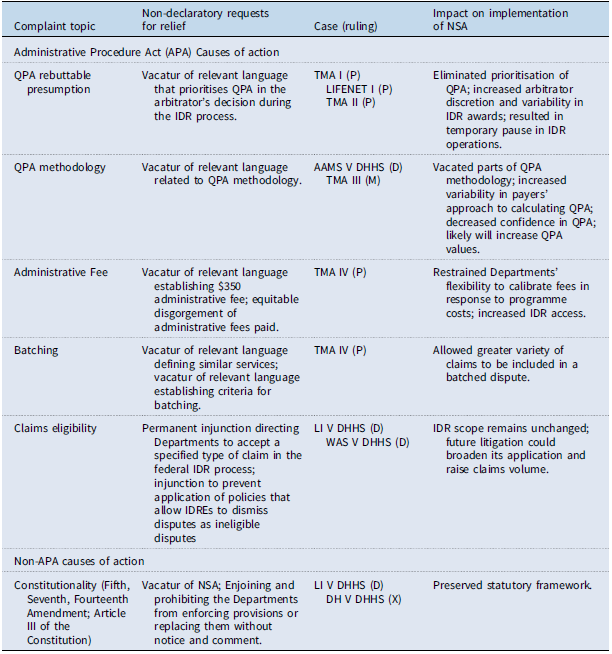
This table summarises litigation related to the No Surprises Act that is detailed within this paper, organised by complaint topic. The table distinguishes six main topics by causes of action that fall under the Administrative Procedures Act and those that do not. These topics include the QPA rebuttable presumption, QPA methodology, administrative fee, batching, claims eligibility, and constitutionality. It identifies the relief sought, the relevant cases and rulings, and the resulting impact on the NSA implementation. Rulings indicate which party the judgement was substantively in favour of, not simply who was granted it. P, D, M, X stands for Plaintiff, Defendant, Mixed, Dismissed, respectively. QPA refers to qualified payment amount; IDR refers to independent dispute resolution. This table does not include cases that have stayed or for which briefing was ongoing as of April 2026, nor cases with non-government defendants (i.e., provider-payer-IDRE litigation).
3.2. Leveraging litigation to make IDR more provider friendly
Provider wins in court have also shaped the administration of the IDR process, including by lowering barriers for bringing disputes to IDR. These changes will likely increase the already high volume of disputes.
Disputing parties face upfront costs in the form of two user fees. An administrative fee covers the Departments’ costs of operating the Federal IDR portal (paid by both parties), and the Certified IDRE fee covers the IDRE’s costs (paid by the party whose offer is not accepted).Footnote 44 In IFR2, the Departments established the basis for setting the administrative fee and provided that IDREs must charge one fixed fee for single claim disputes and another for batched disputes, each within an allowable range. The rules provided that the administrative fee and the range of allowable Certified IDR entity fees would be announced in guidance, allowing the Departments to adjust the fees based on experience and actual costs without notice and comment rulemaking. The Departments initially set the administrative fee at $50 for 2022 and 2023 (Centers for Medicare & Medicaid Services, 2022b). But, in late 2022, facing pressure from provider groups, the Departments decided they needed to act to address the enormous backlog of IDR disputes, much of which was attributable to difficulty determining if a dispute was eligible for IDR. To fund this effort, they released the December 2022 Fee Guidance, which increased the administrative fee from $50 to $350 (Centers for Medicare & Medicaid Services, 2022a).
Texas Medical Association quickly brought suit again (TMA IV), arguing that this sevenfold increase in the administrative fee was implemented without required notice and comment, violating the APA.Footnote 45 They contended the fee increase diminished access for small-value claims. The Departments argued the fee was reasonable and supported by the administrative record, reflecting a statutory mandate to cover estimated costs, and that Congress did not guarantee IDR access regardless of economic sense. They argued the fee guidance was an interpretive rule, exempt from the APA’s requirement to issue notice and comment rulemaking.
On 3 August 2023, the District Court, in another ruling by Judge Kernodle, vacated the December 2022 Fee Guidance, ruling that the guidance was a substantive rule, not an interpretive one, because it ‘create[d]’ law by establishing the specific fee amount and including new pre-eligibility review costs without notice and comment rulemaking.Footnote 46 In the short term, the ruling resulted in the administrative fee dropping back to $50 per dispute, lowering the cost barrier to filing a dispute significantly. Long term, because it generally takes, at a minimum, months to issue notice and comment rulemaking, this ruling limits the Departments’ ability to adjust user fees as the costs of maintaining the IDR portal change. This is likely to reduce the speed at which the Departments would lower the administrative fee when costs decrease, and may lead them to set the fee higher than necessary to provide a cushion that covers unanticipated costs.
In addition to challenging the fee increase, the TMA IV plaintiffs challenged a regulatory provision from IFR2 that limited the number of claims they could combine into one “batched” dispute. The regulations allowed parties to submit claims as batched disputes only for items with the ‘same service code’,Footnote 47 in contrast to the statutory language allowing for batching for ‘items and services [that] are related to the treatment of a similar condition’.Footnote 48 In addition, the regulations allow batching only if the items and services are billed by the same provider (or group of providers), paid for by the same self-funded plan or issuer, and furnished within the same 30-business-day period (except for in certain cases when a 90-calendar-day window applies).Footnote 49 Notwithstanding statutory language authorising the Departments to specify the criteria under which items can be batched,Footnote 50 the plaintiffs argued the regulations violated the APA, as they were issued without the opportunity for notice-and-comment, and were arbitrary and capricious because they were significantly narrower than the statute allowed and made it difficult for providers to batch small-value claims effectively. The Departments argued that the batching rule was exempt from the APA requirement for notice-and-comment rulemaking both because it concerned agency procedure for efficiency and because the ‘good cause’ exception applied. Siding with Texas Medical Association on procedural grounds, the court concluded (1) that the batching rule was not a rule of agency procedure, and (2) that the ‘good cause’ exception did not apply. Judge Kernodle therefore vacated the provision regarding ‘same service code’.
Judge Kernodle’s ruling in TMA IV made it easier to include larger numbers of claims per dispute. In addition, the fee structure incentivizes the submission of large batched disputes. The same administrative fee applies to both single and batched disputes,Footnote 51 and the allowed Certified IDRE fees offer a discount for combining claims into one dispute. The permitted range is $200–$840 for a single determination and $268–$1,173 for a batched determination, with IDREs allowed to charge an additional fixed fee between $75 and $250 for every 25 line items within a batched dispute.Footnote 52 Thus, the practical effect of TMA IV was to substantially increase the ability of providers to submit high volumes of claims to the IDR process.
Finally, with providers prevailing in IDR, we are seeing cases that attempt to broaden access to IDR, which if successful would enable providers to bring more cases to IDR and increase the volume of disputes. In Neurological Surgery Practice of Long Island, PLLC v. Department of Health and Human Services et al., the plaintiffs sought to clarify that a certain category of claims qualify for IDR (rather than being subject to a specified state law, which would make such claims ineligible for IDR).Footnote 53 Although the case was dismissed as moot,Footnote 54 HHS issued a letter, clearing the way for these claims to proceed to IDR (Department of Health and Human Services, 2024). An air ambulance company also sought unsuccessfully to broaden access to IDR to allow providers to dispute denied claims.Footnote 55 Success in such a case would expand the authority of the IDRE to determine whether a patient’s coverage includes benefits for a claim, whereas now the IDRE is responsible for determining only the out-of-network payment amount for covered services.Footnote 56 Future litigation to expand the scope of IDR would, if successful, increase the volume of IDR disputes handled, and, assuming current trends regarding IDR wins continue, magnify the cost-inflationary impact of IDR.
3.3. Constitutional challenges to the No Surprises Act have failed thus far
Although providers have successfully used litigation to shape how likely they are to win at IDR and how attractive the IDR process is for providers, some providers would prefer to see the NSA or its implementing regulations overturned on constitutional grounds.
The first constitutional challenge to the NSA was filed on the last day of 2021 by a surgeon in Haller v. Department of Health and Human Services et al., Haller centred on two aspects of the NSA. First, the case challenged the requirement that payers and providers use the IDR process to resolve payment disputes if they cannot otherwise come to an agreement. Second, the case challenged the NSA’s prohibition on balance billing consumers for the difference between the billed charge and the plan’s payment.
At the core of the challenge is the argument that providers have a property right in being compensated at a ‘fair value’ for providing out-of-network services, and that the Constitution guarantees them certain protections concerning this property right. Haller argued that the NSA’s IDR process and balance-billing prohibition was a constitutionally prohibited government ‘taking’ of his property without just compensation in violation of the Fifth Amendment’s Takings Clause. Haller argued that the NSA ‘impermissibly delegates the authority to determine the physicians’ state-created common law claims to an administrative tribunal’ apparently in violation of Article III of the Constitution. Haller also argued that the requirement to use IDR deprives him of the right to a jury trial under the Seventh Amendment. In addition, Haller raised due process arguments under both the Fifth and Fourteenth Amendments arguing that the required use of IDR and the prohibition on balance billing patients to obtain what they consider a ‘reasonable value’ together deprive providers of their property right without due process.Footnote 57 After the District Court (Judge Donnelly)Footnote 58 and Second CircuitFootnote 59 rejected Haller’s Takings Clause, Article III, and Seventh Amendment claims and dismissed his due process claims as unripe (because he had never used the IDR process), Haller voluntarily dismissed the case in 2024.Footnote 60
A second constitutional challenge to the NSA was filed in April 2023 by Neurological Surgery Practice of Long Island. The plaintiffs argued that the NSA’s IDR process, as implemented by the Departments, violated the Due Process and Takings clauses of the Constitution. The plaintiffs also challenged the Departments’ IDR implementation as contrary to statutory authority under the APA. In July 2023, District Court Judge Cogan (same district, but different judge than decided Haller) rejected Neurological Surgery’s constitutional and APA claims.Footnote 61 The Second Circuit affirmed the District Court’s ruling in July 2025.Footnote 62
A third constitutional challenge to the NSA under the Due Process Clause and Takings Clause of the Fifth Amendment was asserted by the air ambulance company PHI, along with APA challenges to the Departments’ IDR and QPA rules, in the Eastern District of Kentucky in 2022.Footnote 63 Although the case was stayed in 2023 following Judge Kernodle’s decisions in TMA II and III,Footnote 64 the PHI case and its constitutional claims are still pending and could be revived.
Both the New York provider cases challenging the constitutionality of the NSA have failed, leaving intact the NSA’s core consumer protections against out-of-network surprise balance bills and cost-sharing. Yet Haller’s Fifth Amendment Due Process challenge and his Seventh Amendment (right to a jury trial) challenge to the IDR process were dismissed without prejudice, meaning that the plaintiffs (or others) can bring these constitutional challenges again. And the providers in the PHI case still have live constitutional claims under the Fifth Amendment’s Due Process Clause and Takings Clause pending in Kentucky. Thus, it is too soon to declare the NSA safe from constitutional challenge. Unlike the challenges to the Departments’ QPA methodology or IDR guidelines, a successful facial challenge to the underlying statute would strip consumers of the core protections of the NSA, exposing them again to unexpected balance bills.
3.4. Stakeholders increasingly take each other to court
Stakeholders – not limited to providers – are also increasingly taking other parties to court to address perceived problems with the NSA’s implementation, particularly with the IDR process.
Recent lawsuits against IDREs and payers challenged arbitration results favouring payers. Providers sought to vacate IDR awards and compel rehearings, primarily alleging the awards were secured through undue means and payer misrepresentations, such as submitting improperly calculated QPAs and failing to disclose details related to the QPA.Footnote 65 Crucially, the lawsuits assert that IDREs violated federal law by applying an illegal presumption in favour of the QPA, the standard invalidated by courts, which resulted in the selection of the payer’s offer. Courts have generally concluded that the NSA does not create a cause of action against IDREs and that IDREs are entitled to arbitrator immunity for their role in IDR. In addition, courts have concluded that the NSA allows for judicial review of IDR determinations in only narrow instances. However, this remains an area of active litigation, and the ongoing threat of litigation may influence IDRE behaviour.
Frustrated by payers failing to timely pay after an IDR determination, providers have also sued payers to compel payment.Footnote 66 At issue in these cases is whether the NSA supplies providers with a basis to bring suit. In a May 2025 Northern District of Texas decision that the Fifth Circuit affirmed, Judge Boyle concluded the NSA does not contain a private right of action for a provider to enforce the IDR award. In addition, she concluded that air ambulance providers were unable to bring a derivative ERISA claimFootnote 67 on behalf of a beneficiary because the beneficiary does not suffer harm from the alleged failure of the plan to pay providers.Footnote 68 Many other courts reached the same conclusion.Footnote 69
However, not all have agreed. A May 2025 ruling in the District of Connecticut concluded both that the NSA conveys a private right of action to enforce IDR awards, and that providers could bring suit under ERISA, as assignees of the beneficiaries.Footnote 70 Similarly, a Maryland district court reasoned that the NSA creates a narrow implied private right of action to ‘convert a ‘binding’ IDR determination to a judgment if the obligated party does not comply with its statutory payment obligation’.Footnote 71 In addition, another court enforced an IDR award in a case that appears to be against a travel insurance company, without considering whether the NSA provided a private right of action.Footnote 72 If the defendant’s assertion that the plan was travel insurance is accurate, the NSA is inapplicable, and the dispute should never have been accepted into the IDR process, much less the IDR award enforced by the courts. Ultimately, the Supreme Court may need to resolve whether IDR awards can be enforced in court, a decision that is likely to significantly impact how stakeholders interact going forward.
Lastly, stymied by the IDR system, payers have also turned to the courts for recourse (Keith, Reference Keith2026). Many of the cases stem from problems related to IDREs incorrectly determining a dispute is eligible for IDR.Footnote 73 Payer lawsuits allege that defendant providers are abusing the IDR process, specifically that they submitted claims that were ineligible because the services were not subject to the NSA, subject to specified state laws instead of IDR, lacked the mandatory open negotiation period, or were for services actually rendered by in-network providers.Footnote 74 , Footnote 75 , Footnote 76, Footnote 77 These alleged tactics rely on submitting false attestations of eligibility to IDREs and federal agencies, leveraging high volume to overwhelm health plans and IDREs, resulting in millions of dollars in improper IDR awards. It remains to be seen whether payer-led litigation will be an effective balance to provider-led litigation. However, early decisionsFootnote 78 in these cases suggest payers may not find relief in the courts.
4. Early evidence of impact of legal challenges on NSA implementation
Early evidence suggests providers have successfully leveraged litigation to ensure the NSA is implemented in a provider-friendly manner, and are using that success to their advantage. Providers initiate the vast majority of disputes (Hoadley et al., Reference Hoadley, Watts and Baron2025), and initiate at high and increasing volumes. In the first six months of 2025, 1,186,812 disputes were initiated (Centers for Medicare & Medicaid Services, 2026), compared to 288,810 disputes in the first six months of 2023 (Centers for Medicare & Medicaid Services, 2024). These numbers far exceed the 17,333 claims that the Departments estimated would be submitted to IDR annually.Footnote 79
In addition, the volume and proportion of the disputes that are batched disputes is growing. In the first six months of 2025, 31 per cent (335,442) of all IDR determinations were batched disputes, up from 15 per cent in the first six months (Centers for Medicare & Medicaid Services, 2026). The increase in batched disputes means the total number of claims being determined is growing faster than the raw number of disputes. This trend is likely partially attributable to the litigation that vacated the requirement that batched items be billed using the same service codes. Although TMA IV vacated the requirement based on procedural rather than substantive concerns, the agencies have proposed rules that would expand the types of items and services that can be batched together, suggesting both that the trend will continue and that provider-litigants have been successful in moving the Departments to issue more provider-friendly rules.
Providers are also overwhelmingly winning at IDR. In the first six months of 2025, IDREs selected the provider’s offer in 88 per cent of dispute determinations (Centers for Medicare & Medicaid Services, 2026). Furthermore, whereas under both IFR2 and the Final Rule one would expect the IDRE to most often select the offer closest to the QPA, the opposite is true. Indeed, IDREs appear to be giving the QPA little weight with the prevailing offer often magnitudes higher than the QPA. For example, in quarter 1 and quarter 2 of 2024, the median prevailing provider offer was 383 per cent and 447 per cent of QPA, respectively. In contrast, the median prevailing plan offer was much lower, at 105 per cent of QPA (Hoadley et al., Reference Hoadley, Watts and Baron2025). The final payments determinations appear to be closer to the historical out-of-network rates paid by payers than either the mean or median of the in-network rates (Adler et al., Reference Adler, Fiedler and Agarwal2026). These outcomes suggest that litigation may have tainted the QPA, such that IDREs may give greater weight to other factors.
With providers winning big in IDR, we anticipate the volume of disputes will continue to rise. Currently, a small number of providers, particularly those backed by private equity investors, are driving the volume of disputes (Hoadley et al., Reference Hoadley, Watts, Keith and DeGarmo2026). In the first six months of 2025, approximately 69 per cent of disputes were initiated by the top ten initiating parties (Centers for Medicare & Medicaid Services, 2026). Many providers never or rarely use IDR. Instead, the majority of claims subject to the NSA are paid at the initial payment amount or an amount agreed upon in open negotiation. For example, according to a survey of payers, less than 25 per cent of claims subject to the NSA were submitted to IDR in 2023 (AHIP, 2024). However, for the high-volume users of the IDR and their investor-backed management, the aggressive flooding of claims through IDR is a lucrative revenue strategy for driving payments higher. It is also a self-perpetuating spiral: the more the providers win IDR claims and the higher the awards, the more incentive they have to remain out-of-network and use IDR, driving the volume and the value of the IDR awards even higher. Knowing that providers overwhelmingly generate these disputes, IDREs may be motivated by the fee-for-service IDR payment incentives to induce more claims by favouring providers in their awards (Chartock and Whaley, Reference Chartock and Whaley2026).
If allowed to continue, the trends witnessed in the first years of the NSA’s implementation are likely to increase health care spending, contrary to CBO’s predictions. The IDR process is estimated to have already added roughly $5 billion in excess payments and administrative costs between 2022 and 2024, with costs substantially higher than expected due to high payment determinations and dispute volume that far exceeds original estimates (Hoadley and Watts, Reference Hoadley and Watts2025). These costs are increasing over time, with preliminary data from 2025 suggesting a growing volume of disputes and even higher win rates (88 per cent) and awards for providers (Hoadley et al., Reference Hoadley, Watts, Keith and DeGarmo2026). The CBO budget estimate assumed that significant decreases in health spending would arise from a reduction in negotiated prices for all in-network care, due to altered negotiating dynamics if the benchmark amount for payment disputes was the median in-network rate. However, the option to pursue IDR and obtain a determination for potentially several times the median in-network amount (or QPA) makes these effects unlikely. Instead, it is likely that consumers will see increases in premiums as payers pass on the costs of complying with the NSA and any costs associated with increased payments to providers.
5. Policy options to restore the NSA
The NSA continues to offer valuable protections to individuals who receive unexpected out-of-network care, achieving its core goals by reducing out-of-pocket spending and/or medical debt. A payer survey estimates that the NSA prevents individuals from receiving more than one million surprise bills per month (AHIP, 2024). In an environment of ever-escalating health spending, containing costs is critical to safeguarding these protections. Yet, the comprehensive challenges outlined above, and summarised in Table 1 above, highlight the contentious nature of the NSA’s implementation and the persistent efforts by various stakeholders to influence its interpretation and application.
With significant rulings still pending and new cases probable, litigation is likely to continue to shape the NSA landscape. We discuss options that could be taken by Congress, the Departments, states, and stakeholders to mitigate the current trends towards increasing costs.
5.1. Congressional action to update the NSA
Due to the court decisions regarding the Departments’ rules, Congressional action is likely necessary to achieve the magnitude of cost savings that CBO originally anticipated from the NSA. Congress could amend the NSA to prioritise the QPA in IDR, using either approach previously introduced by the Departments. To achieve even greater savings, Congress could benchmark out-of-network payment amounts to the QPA, an approach that was rejected in the drafting of the NSA. Alternatively, Congress could adopt a different benchmark, such as one that is based on the median in-network contracted rate for the service by any payer in the area (not just the payer’s own rates as does the QPA), utilising the Transparency in Coverage data regarding in-network rates that plans and issuers have been required to disclose publicly since 2022 (Whaley et al., Reference Whaley, Radhakrishnan, Richards, Simon and Chartock2025). Congress could also take a less proscriptive approach, and explicitly authorise the Departments to provide direction to IDREs regarding how to consider information presented during a dispute. This approach would provide the Departments with greater flexibility, allowing them to adopt rules that put downward pressure on IDR outcomes, but would not guarantee they would do so.
Although dedicated lobbying by vested industry interest makes these Congressional actions more difficult, there appears to be continued interest from members of Congress in ensuring the NSA’s smooth implementation (U.S. House of Representatives Committee on Ways and Means, 2025). Moreover, there are other actions Congress could take to reduce administrative costs associated with NSA implementation that may garner more support. For example, compliance with the TMA III decision regarding the use of TPA contracted rates in the QPA calculation will be extremely costly (if even possible) for plans. Legislation requiring the use of QPAs calculated using TPA rates (rather than the plan’s data) would reduce plans’ administrative expenses, and address providers’ concerns that plans might gain an advantage in IDR by using whichever methodology produces lower QPAs. Congress could also wield their appropriations power to support the NSA implementation, for example by providing the Departments with additional resources to ensure ineligible disputes do not progress through IDR or to enforce the NSA, for example in conducting QPA audits.
5.2. Administrative actions by the departments
The Departments should finalize IFR1 and IFR2, as well as consider additional rulemaking. This would help the Departments defend litigation by addressing the procedural risks associated with issuing interim final rules, and by giving the Departments an opportunity to better explain their rationale, which would aid in defending against arbitrary and capricious challenges. For example, the Departments should finalize the QPA methodology in a manner that addresses (1) submitted comments; (2) litigation; and (3) their implementation and enforcement experience. Addressing stakeholder concerns through the rulemaking process may reduce the likelihood of future litigation. In addition, the Departments should leverage HHS’s experience conducting QPA audits to amend the QPA methodology, such that payers have less discretion to apply the methodology in ways that depress the QPA. This could include addressing how specific contracting approaches that HHS has encountered in its audits should be handled in calculating the QPA. If an amended QPA methodology improves the ability of the QPA to approximate the in-network value of items and services and decreases opportunities for payers to calculate the QPA to their advantage, IDREs may have more confidence in the QPA, and consequently give it more weight.
Implementation of the recently finalised Federal Independent Dispute Resolution Operations Rule,Footnote 80 which includes several provisions to improve communication between providers and plans and reduce the frequency with which ineligible disputes end up in the IDR process, could also reduce costs associated with the NSA. Conversely, some of the changes facilitate dispute submission (for example, a reduction in the administrative fee to $15 per dispute and increased flexibility regarding batching rules), which could increase spending associated with eligible disputes and exacerbate the inflationary trends of IDR. The Departments should consider additional rulemaking to target ineligible disputes, including creating formal processes for appealing eligibility determinations, and making it unlawful to knowingly submit ineligible disputes. They should also consider ways in which IDREs are incentivized to select the providers’ offer (for example, to appear attractive to the entities predominantly initiating disputes), and whether they have the authority to mitigate such incentives.
5.3. State actions to shore up the NSA
States can protect against increasing costs attributable to the NSA by adopting specified state laws that determine the final out-of-network payment amount. For example, states could set the out-of-network amount using a benchmark, or could adopt an approach that mirrors the Departments’ original rules. To maximise the impact of a specified state law, states should ensure the laws apply to both their fully-insured plans and state employee plans, and also allow self-insured plans to opt-in. This would allow self-funded plans to choose to apply the state law to its disputes with providers in that state. States that are interested in adopting a specified state law should carefully consider other states’ experience, as some specified state laws are contributing to increased spending (Adler, Reference Adler2019; Chartock et al., Reference Chartock, Adler, Ly, Duffy and Trish2021; Garmon et al., Reference Garmon, Li, Retchin and Xu2024).
States that lack resources to implement specified state laws might also reduce the NSA’s potential premium impact through legislation governing the behaviour of state-licensed providers and issuers. For example, states could require a minimum initial payment for services subject to the NSA. Higher initial payments should decrease the likelihood that providers bring claims to IDR by reducing the potential payoff. A state law could also limit the offer amount that state-licensed providers and issuers submit to IDR to a benchmark amount, for example a percentage of the Medicare payment amount. This would put an upper bound on the IDR award for disputes in which the higher offer is submitted by a state licensee, and would have spill-over effects to self-funded plans.
5.4. Stakeholder actions to shape IDR outcomes
Lastly, payers could more immediately impact the IDR outcomes by increasing offer levels and modifying what information they submit to IDR. Lack of transparency around how IDREs make determinations impedes payers’ (and our) ability to predict what will be compelling to an IDRE. However, payers should evaluate their experiential data to determine if any particular information is persuasive, and should adjust accordingly. In addition, payers that submit offers equal to or close to the QPA should re-examine their practices, as the IDR results strongly suggest that IDREs are minimally weighting the QPA. Setting offers close to an alternate benchmark amount may prove more persuasive than centring offers at the QPA. Lastly, payers may be able to minimise the cost-inflationary potential of IDR by minimising its use. The majority of disputes are initiated by a small number of provider groups or provider representatives. Many providers may want to avoid the administrative burden associated with IDR (Heller et al., Reference Heller, Rao and Reising2024), but may feel compelled to begin using the process due to the high win rates and payment determinations. Increasing initial payments and engaging with providers during open negotiation could help discourage such providers from adopting IDR as a regular business practice.
6. Conclusion
Five years after its enactment, the No Surprises Act has largely succeeded in protecting privately covered patients from out-of-network balance billing. Yet adversarial legalism has derailed the NSA’s cost-containment aims – unmooring the QPA as an anchor for payment, flooding the dispute resolution process and tilting it decisively in favour of providers, and adding roughly $5 billion in health care costs between 2022 and 2024. State and federal administrative policymakers have a variety of options to realign the statute with its original promise, but full restoration of the NSA’s promised cost savings would require Congressional action. Without these course corrections, the NSA will continue to protect consumers while quietly shifting its costs back to them through higher premiums.
Acknowledgements
None.
Funding statement
The authors report receiving funding support from Arnold Ventures, which had no role in the design, analysis, or writing of this article.
Competing interests
Lindsey Murtagh contributed to the drafting of the rules implementing the NSA, during her former employment at the Centers for Medicare and Medicaid Services. Erin Fuse Brown and Ayesha Rahim declare none.


 Open access

