I have seen a medicine
That's able to breathe life into a stone,
Quicken a rock, and make you dance canary
With spritely fire and motion …
Shakespeare, All's Well that Ends Well (Act 2 Scene 1)Like Italy itself as imagined by a later generation, Gasparo Angiolini's theatre was populated by statues: human simulacra who dwelt among the living, arousing longing, wreaking vengeance or simply assisting in colonization. Yet unlike, say, the marble goddess in Heine's Florentinische Nächte or the gallery of Canova's sculptures in Madame de Staël's Corinne, ou l'Italie, which unsettled in their very stillness, Angiolini's statues came to life to interact with the living, their newly animated limbs moving rhythmically in time to a musical accompaniment. Angiolini was the foremost Italian choreographer of the late eighteenth century. He is best known today for his Don Juan (Vienna, 1761, with music by Gluck), which of course featured the return of the sepulchral ‘stone guest’.Footnote 1 In 1767 he choreographed a Pygmalion, in which a sculptor falls in love with his statue and Venus brings her to life. In Angiolini's late propaganda ballet Deucalione e Pirra (Milan, 1797) the hero and heroine create humans from rocks in order to repopulate the world. Yet surely the most peculiar of Angiolini's animated statues is found in La vendetta spiritosa, which had its premiere in May 1782 at Milan's new opera house, the Teatro alla Scala. For one thing, La vendetta spiritosa was something of a Gesamtkunstwerk: Angiolini wrote the story, choreographed the dance steps and gestures, and even composed his own musical accompaniment. This pantomime is, though, most notable for its plot: Arcadian shepherds and shepherdesses enact a portion of Étienne Bonnot de Condillac's philosophical tract Traité des sensations (1754), bringing a statue to life by stimulating its sensing organs. Angiolini's aim, as he later described it, was to communicate ‘the abstract ideas of philosophy’ through bodily motion and music. Despite the challenges that La vendetta spiritosa must have posed to its audience, it was deemed a success, and revived a decade later for Venice as La vendetta ingegnosa o La statua di Condilliac.
This pantomime attests to its creator's belief in the powers of theatrical pantomime: no other choreographer has ever attempted to render a philosophical treatise in dance, and Condillac's Traité is among the more prolix of its kind. Angiolini had argued since the 1760s that gesture could function as a language – provided, of course, that it had an appropriate musical accompaniment. His three well-known Viennese pamphlets – the prefaces to Don Juan (1761) and Citera assediata (1762) and the ‘Dissertation sur les ballets pantomimes’ accompanying his Sémiramis (1765) – drew heavily on recent French theories of language.Footnote 2 But his ‘philosophical ballet’ on the statue theme must be understood as a monument to Milan: that ancient, sprawling capital of Austrian Lombardy where Angiolini lived for the last three decades of his life, and which was home to one of Europe's most distinctive projects of mass enlightenment. Among his colleagues there were Pietro Verri and Cesare Beccaria: figures now remembered as legal and political theorists, but who were energetic participants in contemporary debates on literature, music and theatre. As we shall see, Angiolini and his Lombard compatriots created something like an antique semiotics that spanned language and the fine arts: they sought a reformed relationship between meaning and its avatars, and new uses for representative sound. Their goal was nothing less than a revitalized Italian culture. However, as they discovered, cultural reawakening could verge dangerously on patriotic fever in an age of war and revolution.
WHO DO YOU THINK YOU ARE?
We can begin with a genealogy of the moving statue, dwelling in particular on two immediate ancestors of La vendetta. Such figures have, of course, featured in Western imaginations since Classical times: Prometheus was said to have created humans from clay, Pindar lauded a race of stone men, the story of Pygmalion is told in Ovid's Metamorphoses. Of these, the last had the most vibrant afterlife, transmitted within early modern romance, didactic literature and art criticism.Footnote 3 Such figures are also found within early opera: Wendy Heller has recently written of troupes of dancing statues in seventeenth-century Venetian dramma per musica.Footnote 4 Less well known is that this literary tradition existed alongside one of improvisatory performance, and was continually informed by it. The moving statue was a staple of commedia dell'arte players, found in innumerable lazzi set in sculptors' ateliers and ruins, and in improvised versions of the plays and stories with that theme. For instance, Don Juan entered the repertoire of the commedia upon its arrival in Naples in the early 1630s and remained there for the next two hundred years; the half-dozen comic operas on that text that appeared between 1777 and 1787 bore the marks of this tradition.Footnote 5 Metamorphosis had always been a favourite inspiration for Harlequins and Pulcinellas. Indeed, the tradition of the itinerant moving statue survives to this day in the gently shifting Marilyn Monroes, Elvis Presleys and other historical figures clustered along routes of tourist transit in the United States.
Before the photographic era, statues within improvised theatre left few traces. But there is one important exception: Gregorio Lambranzi's New and Curious School of Theatrical Dancing (1716), the single most important iconographic source for Italian dance before the nineteenth century.Footnote 6 Like Angiolini a half-century later, Lambranzi was a choreographer and dancer; he worked in Italian and foreign theatres that generally featured dances between the acts of operas.Footnote 7 Unlike Angiolini, though, he was a master of the Italian comic style, which combined the steps of French belle danse with commedia characters, plots and slapstick humour.Footnote 8 His treatise describes about a hundred of his own compositions: so-called ‘national dances’ from Italy, France, Germany, Spain, Turkey and other countries. Lambranzi aimed not to provide a complete record of his work, but simply to encourage other dancers to improvise in a similar style: for each dance, he provided no more than a melody, a picture and a brief account of the plot.Footnote 9 In the Preface he reminded his readers to use only the traditional steps (he mentions cabrioles, coupés, jetés, chassés, pas graves, contretemps and the pas de chaconne, courante, gavotte, minuet, bourrée and so on): even the Harlequins, Scaramouches and other stock characters in the comic dances should use no step, figure or costume other than those usually employed in Italian theatres. He also noted that these characters have their own ‘absurd and burlesque’ (‘ridiculi e burleschi’) versions of these traditional steps.Footnote 10 For instance, the treatise contains several scenes for Scaramouche, the bad-tempered gentleman from Naples; in these dances, the performer should move with ‘long, unformed and heavy steps’ (‘grandi, lunghi, e spropositati passi’).Footnote 11
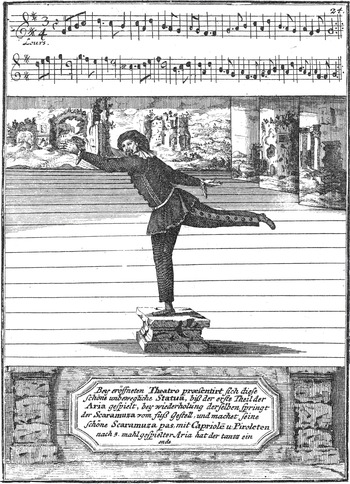
The New and Curious School contains three dances for moving statues. The second and third,which appear in Part 2, are straightforward: plates 12 to 17 show the animation and stop-motion tussle of two stone servants in a palace, while plate 24 shows sculptors carving a statue (of another dancer) from a large block of marble.Footnote 12 The first of Lambranzi's statue dances, though, is more mysterious: it is on plate 24 in Part 1's collection of ‘national dances’ and is reproduced here as Figure 1. As the curtain rises, the dancer is frozen on a decrepit stone podium amidst overgrown ruins. He stays motionless until the first half of the dance has been played once; when it repeats, he leaps from the pedestal and dances around the stage, performing ‘Scaramouche's steps, cabrioles and pirouettes’. The music given at the top of the figure – a two-part loure – is to be played twice or three times. When it comes to an end, the dancer departs.Footnote 13 Lambranzi supplies no clue as to instrumentation or harmonization, but custom, and the melody itself, would suggest nothing more exotic than violin-dominated string textures and the most basic harmonic progressions.
Gregorio Lambranzi, Neue und curieuse theatralische Tantz-Schul (Nuremberg: Johan Jacob Wolrab, 1716), Part 1, plate 24. Image from University of Toronto Music Library. Used by permission

This dance contains a few points of ambiguity. The first concerns the identity of the figure: stone or flesh? The disintegrating pedestal and scenic ruins suggest that the figure is very old, quite possibly classical. And yet the costume and attitude place him firmly within the commedia dell'arte. The verbal indications are vague: caption and preface describe him first as ‘a lovely, motionless statue’ and then, following the animation, by the name of Scaramuzza. Is Scaramouche himself therefore an animated statue, his awkward gait the result of stiff legs? Or was he merely hiding among the ruins for his own amusement, to leap out and frighten the tourist? The music provides no further clues: while the tunes associated with statues in Part 2 are rife with tone paintings, this particular one seems oblivious to the action. Its lilting melody, dotted rhythms and repetition schemes place it firmly within the domain of French courtly dance. The animation itself occurs in the liminal spaces between musical events: after the end of the first statement and before its literal repetition.
Also ambiguous is the relationship of this dance to the treatise as a whole. Lambranzi pretends to supply ‘fifty dances from different nations’, but what nation may be inferred from this combination of a French courtly artefact and a commedia-style lazzo within a setting of classical ruins? The presence of Scaramouche suggests that this is an Italian dance: indeed, the commedia characters, with their acrobatic and often distorted motions, were emblematic throughout Europe of ‘Italy’, just as clogs were indices of Holland and eunuchs of the East (this language of ‘national’ signifiers is employed throughout Lambranzi's treatiseFootnote 14). Of course in 1716 ‘Italy’ existed only as historical memory and as a contested literary and linguistic terrain (about which more below). By the time Lambranzi published his treatise Italian comedians were perhaps the peninsula's most successful export: they could be found in fairgrounds and theatres across Europe.Footnote 15 Italian literature was then seldom noticed beyond the Alps (or, indeed, by any but a few thousand on the peninsula); in the eighteenth century travellers visited simply to meet the past in the form of Roman ruins, Michelangelan statuary and eventually the excavations around Vesuvius.Footnote 16 Italy's former hegemony now belonged to France, whose language, like the steps of its belle danse, was in use from Moscow to Gibraltar. Although it seems unlikely that Lambranzi imagined such a pointed allegory, this dance does seem representative of his project as a whole. Cues to such a reading are displayed on the title page: in the upper half of the engraving Athena holds a scroll containing a louré with French steps in Feuillet notation; below, Lambranzi-as-Scaramouche strikes his characteristic pose amongst a gallery of statues.
Lambranzi's moving statues were denizens of a strange wonderland, also home to dwarfs, hunchbacks, the blind, three-legged men, Turks, Dutchmen and gypsies. His treatise provides a vivid glimpse into the repertoire of the Italian comic dancer in the first part of the eighteenth century: he took on alternate physical identities, playing with the borders of humanness (not by accident was this known as the stile grottesco). His scenes are brief, entertaining and opaque, neither adapting pre-existing verbal texts nor lending themselves to comprehensive transcriptions (as we have seen). Yet these dances and the popular Italian theatre they represent were the source of later developments in pantomime ballet: there are traces of them even in the self-consciously high-minded ‘reforms’, which dismissed the Lambranzian style in the strongest terms.Footnote 17 Marie Sallé, the acknowledged idol of David Garrick, Noverre and Angiolini, was trained by the famous Harlequin John Rich during the 1720s and became perhaps the most famous early performer of ‘action ballet’.Footnote 18 Sallé's international fame was launched by a Pygmalion: she danced the role of the statue to great acclaim in London in 1733. In her version the newly animated statue is brought to maturity in a series of courtly dances, their diverse steps and metres supplying her with a gamut of enticing affects. The Mercure de France rapturously recalled how Sallé descended from her pedestal and learned the steps that, of course, she already knew well. Sallé was said to have composed her own music for this dance; if she did, it is now lost, but a similar score survives for the Parisian revival of the following year.Footnote 19 Sallé's ballet – which has been called ‘the first modern dramatic ballet’ – is thought to have been the inspiration for the most important Pygmalions of mid-century, Rameau's opera-ballet and the pantomime by Angiolini's Viennese predecessor and teacher, Franz Hilverding.Footnote 20 During these decades, arguably through the gradual acceptance of such pantomime within mainstream French theatre, the image of the moving statue traversed the ground from the margin to the centre.
Thus when one of France's foremost philosophers, Étienne Bonnot de Condillac, sought to demonstrate how we develop our higher cognitive faculties purely from information acquired through the senses, he used a statue as his tabula rasa.Footnote 21 The statue within his Traité des sensations (1754) will supply the second figure in our brief genealogy: of course that pilgrim from the world of philosophy would appear at La Scala three decades later. Initially, though, Condillac's statue was a thought experiment, invented to illustrate the gradual formation of the human self. The Traité asks its audience to imagine a statue; Condillac then activates a single sensing organ, the nose. From the scents detected by its nostrils, the statue experiences pleasure and pain, and these sensations create the faculty of attention. The next faculty is that of memory, accomplished via the simple, mechanical procedure of placing a sequence of objects beneath the statue's nose. By comparing these various stimuli, the statue acquires the faculty of judgment – and so on. In subsequent chapters, Condillac describes the statue in other states of extreme sensory deprivation: after ‘Man limited to the sense of smell’ comes ‘Man limited to the sense of hearing’, ‘Man limited to the sense of taste’ and ‘Man limited to the sense of sight’. Once he has established the various effects of each sense in isolation, Condillac begins to investigate various combinations: ‘Man with sight and smell combined’, and so forth.
The keystone of this argument was the final sense: touch. For Condillac, touch signified consciousness of one's body and the ability to move it. Touch was the ‘lowest level of feeling’ or ‘the fundamental feeling’: ‘it is at this play of the machine that animal life begins. It depends uniquely upon it’.Footnote 22 From touch came what Condillac called the ‘I’: the statue may draw its hand along itself and discover that the various parts of its body are connected and have extension through space. For Condillac, movement was motivated by pleasure and pain: pleasure prolonged repose, but pain triggered a muscle contraction, causing the affected body part to be moved away. The statue's first motions were pure, uncontaminated by intention or learned behaviours: ‘it moves, naturally, mechanically, by instinct and without knowing that it does it’. The statue's discovery of the ‘I’ would naturally lead it to other bodies, which it will identify as ‘not I’ because in touching those things ‘the “I” does not reply’.Footnote 23 (Rousseau would later recycle this odd monologue for the animation scene in his melodrama Pygmalion.)
Condillac's treatise is organized around a single basic impetus: to isolate and compartmentalize the effects of each individual sense and trace its effects over time. As such, it took on a central preoccupation within contemporary medical research, which had recently begun to consider the senses as fundamentally separate from one another and to conduct experiments on their precise functions.Footnote 24 Individual sensory impulses were considered to precede language: they were the ‘natural’ forebears of modern systems of communication. Condillac followed the Abbé Dubos in distinguishing between ‘natural’ and ‘artificial’ signs.Footnote 25 While the former were imitative of their objects and thus required only an animate sensorium for their meanings to be perceived and felt, the latter were man-made and required education to be understood. For Condillac and many of his contemporaries, natural signs represented an earlier stage in human development: both infants and infant civilizations communicated via icons. Much of what had been lost in the civilizing accrual of indices could be uncovered by observing the blind, the deaf and the mute. Diderot's ‘Lettre sur les sourds et muets’ sought to translate the sign language of a mute, while his ‘Lettre sur les aveugles à l’usage de ceux qui voient' instructed readers in the potential benefits of sight deprivation.Footnote 26
In this respect Condillac's Traité continued the work of his Essai sur l'origine des connoissances humaines (1746), which traced the development of modern systems of communication from what he called the ‘langage d’action': the gestures and cries of the first humans.Footnote 27 Why, then, did Condillac use a statue to demonstrate the subcutaneous processes that precede language; why not a wild man, an inanimate human body or an infant?Footnote 28 He did not provide even basic facts about his statue: are these nostrils cut through stone? Do its thoughts simply striate cold marble? Is its memory the engraved memory of the tablet? It was an odd move for a thinker otherwise so opposed to the metaphysical speculations of contemporary philosophy, and would seem to distance the project from human history, medical research and the real constraints of organic matter. And yet perhaps it was not so strange. By using a statue, Condillac located the experiment within the domain of the aesthetic object and its motions within the realm of the theatrical: what is theatre, after all, if not art in motion? Indeed, considered thus, the treatise begins to resemble the extended contemplation of a work of art. It created, purposefully and unmistakably, a blank presence – a rhetorical figure of emergent sensibility – onto which the readers could project themselves, to feel the statue's tinglings in their own eyes, nose and fingertips.Footnote 29
Condillac opened his Traité with a call for precisely this kind of reading. In the prefatory ‘Important advice for the reader’ he asked his audience to imagine themselves as the statue in question, so that they could not only observe but also participate in the gradual awakening:
I wish the reader to notice particularly that it is most important for him to put himself in imagination exactly in the place of the statue we are going to observe. He must enter into its life, begin where it begins, have but one single sense when it only has one, acquire only the ideas which it acquires, contract only the habits which it contracts: in a word he must fancy himself to become just what the statue is.Footnote 30
In this formulation, therefore, the statue became a kind of figurative foundation for aesthetic engagement, permitting the reader to uncover a pre-linguistic self by progressively attending to his or her sensations.
A PROCESSION OF STATUES
Condillac's Essai and his Traité enjoyed extraordinary popularity both in France and elsewhere, their influence spanning many cultural domains. For one, they provided a theoretical apparatus for the new ‘reform’ pantomime: Georges Noverre's Lettres sur la danse (1760) and Angiolini's three Viennese prefaces drew heavily on Condillac's account of a prelapsarian ‘langage d’action'.Footnote 31 The revivalist nature of their pantomime was twofold: these choreographers drew on the Edenic language of gestures and spontaneous cries in order to recreate Greek and Roman mimic theatre. Might one also detect the influence of the Traité des sensations on Angiolini's early writings? The Viennese prefaces certainly display a heightened awareness of the independence of the senses, and the means by which each individual sense achieves its effects. According to Angiolini, some ancient dramas employed two persons per role: one offstage to voice a text, another onstage to act it out, bodily but silently.Footnote 32 His own pantomime preserved this principle, but with a ‘speaking’ orchestra replacing the invisible actor: ‘It's the music that speaks; we only make the gestures’ (‘c'est la musique qui parle, nous ne faisons que les gestes’).
If dance music was to function like the auditory component of a language, it needed to fulfil different requirements. These were outlined by Angiolini in the Preface to Citera assediata, the most original of the Viennese writings and the only one in which Ranieri de' Calzabigi had no hand. It must not simply provide form and rhythm for the dancers, but transmit the content of the drama directly into the listeners via the ear. It needed, therefore, to be directly and immediately representative, moving in real time along with the dancers. This principle had implications for dance melodies: they must be simple, devoid of excessive diminutions and ‘uncorrupted by regional prejudice’. But there were implications for timbre as well: Angiolini wrote that ‘it is the instrument, and not the note, that produces the effect’. While ‘melody, harmony and tempo must concur’, a composer could not hope to create a particular effect ‘without the correct and varied application of instruments’ (‘La Melodia, la Modulazzione, ed i variati moti devon concorrervi, ma senza la giusta, e variata applicazione degl'Istrumenti mai non si speri un particolare effetto’). In vain did composers use high-pitched or sweet-toned instruments to communicate terror or courage (‘Per isvegliar terrore, o pur coraggio in vano adopransi i Flauti, i Violini, i Violoncelli’). Furthermore, dance orchestras should increase in size in order to accommodate a wider gamut of affects.Footnote 33 As we shall see, the consequences of Angiolini's distinctive musical ideas would be fully realized only in the 1770s, following his relocation to Milan.
First, though, I want to trace this aesthetic of auditory mimesis in the broader field of eighteenth-century theories of language. The capacity of French literary objects to traverse international borders was attributed to what one might call their onomatopoeic qualities: the extent to which their sounds imitated their objects.Footnote 34 A few writers attempted to demonstrate the innate symbolism of certain phonemes by tracing them back to Condillac's ‘langage d’action'. Charles de Brosses, for example, imagined that modern verbal language had ‘primitive roots’, derived from Condillac's original monosyllables, which the latter incorporated into his Grammaire of 1775: for instance, ‘fl-’ indicated fluidity, ‘st-’ fixity and ‘tr-’ evoked a body slipping between two others.Footnote 35 French's direct subject–verb–object syntax was justified by native linguists both as more rational than Italian and, increasingly, as more natural as well.Footnote 36 Further, French was held to have the most efficient correspondence of words to things of any language; Condillac himself noted proudly that French was the only language without any synonyms.Footnote 37 Notwithstanding the contributions of Rousseau, these arguments for the superiority of French continued through the 1770s and 1780s; works such as Rivarol's De l'universalité de la langue française argued presciently for policies of francization throughout the civilized world.Footnote 38
By contrast, Italian was ‘sick from an excess of literariness’, an illness whose symptoms were a tolerance of inversions, an abundance of synonyms and an unnatural veneration of the syntax and lexicon of renaissance poetry.Footnote 39 Such, at least, was the position advanced in the Milanese magazine Il Caffè, published under the direction of Pietro Verri during the years 1764–1766. Pietro Verri, along with his brother Alessandro, his friend Cesare Beccaria and a handful of other progressive-minded individuals, had broken away from the mainstream Accademia dei Trasformati. Calling themselves the Accademia de' Pugni (the Academy of Fists), they sought to replicate the encyclopédistes' well-organized publishing culture and mass education explicitly for the benefit of Italians. During the early 1760s, while Angiolini was working in Vienna, the Verris, Beccaria and their entourage brought international renown to the Lombard capital; it is doubtless owing partly to the success of the so-called ‘école de Milan’ that Angiolini wished to publish his ‘Dissertation sur les ballets pantomimes’ simultaneously in Vienna and Milan in 1765, and eventually established himself permanently there to begin his own ‘Italian’ projects.Footnote 40 While we should be wary of subsuming such projects within a Risorgimento teleology, we may none the less observe that their goal was indeed an Italy of sorts, if not the Italy that came into being in the nineteenth century. The Pugni aimed at a national audience (‘L’Italia'), defined by geographical area: ‘from the Kingdom of Calabria to the Alps’.Footnote 41 The Italy they sought, although still divided politically, would be unified by language and an enlightened ‘universal culture’. In their view, the prevailing climate of superstition and ignorance prevented Italians from benefiting from innovations both at home and abroad – something that put them at the mercy of those foreigners who wished to gain advantage over them.Footnote 42
The Lombard illuministi were impaired by one critical factor: the extraordinary limitations of all available verbal media. Put simply, there was not a shared language among their intended audience. Literary Italian was archaic and artificial from its inception and had been protected from modernization in the intervening centuries by the conservative Accademia della Crusca.Footnote 43 In theory this obliged writers like the Verri brothers, Beccaria and their contemporaries to participate in Enlightenment debates on matters of economics, politics and the fine arts equipped with terminology several centuries old; those who did not were met with censorship.Footnote 44 So many vernaculars were in use on the peninsula that, in Pietro Verri's immortal metaphor, a traveller in Italy changed nations as often as he changed horses.Footnote 45 Both published prose and private communication in Lombardy were subject to severe Austrian censorship. Faced with such a situation, the Pugni held up the French language as an example of what Italian might be: a medium whose flexibility made it adaptable for various kinds of modern use. By comparison, literary Italian (la toscana favella) was in a state of rigor mortis, a reputation perhaps aggravated by the continuing pseudo-archaeological attempts, in such works as Scipione Maffei's Degl'itali primitivi (1727) and Marco Guarnacci's Origini italiche (1767), to trace its roots through Etruscan to ancient Hebrew.Footnote 46
The attacks on literary Italian in the Caffè are often identified as a watershed in the history of the language: these writers sought to proclaim the arrival of a new era for Italy, with Milan as its cultural and literary capital. This would open the door to Gallicisms and other modernizing influences, providing Italians with a new freedom to align expressive sounds with ‘things’(-in-themselves). Less well known, however, is the extent to which they marshalled anatomical imagery and the metaphor of the human simulacrum in the service of this semiotic revolution. The war began in the fourth issue of the Caffè with Alessandro Verri's ‘Rinunzia … al Vocabolario della Crusca’. He claimed that the Accademia della Crusca brought about the intellectual enslavement of Italians by constraining them to sterile play with old and empty signs. The ‘Rinunzia’ opens with mock legal solemnity, casting the opposition of ‘words’ and ‘ideas’ in charged political terms:
Cum sit that the authors of the Caffè should be extremely inclined to prefer ideas to words, and being staunch enemies of every unfair bond that one may wish to impose on the honest freedom of their thoughts and their reason, therefore they have decided to make, in solemn terms, a renunciation of the supposed purity of the Tuscan language.Footnote 47
If Petrarch, Dante, Boccaccio and Casa had been able to invent new words, then the caffetisti should do likewise: like the old masters, they were human, possessed of ‘two arms, two legs, a body and a head between two shoulders’ (‘due braccia, due gambe, un corpo ed una testa fra due spalle’).Footnote 48 Were those long-deceased masters to return from their graves, they would be amazed by the voluntary servitude given them by mediocre minds. Alessandro construed traditional Italian as a choir of dead men, their voices channelled through ‘oracles’ by the empty-headed wordsmiths of la Crusca. The resultant prolixity had the effect of reducing vital mobility. In a later article in the Caffè, he suggested that the Tuscan language in its very resonance was resistant to direct reference, and prohibited rapid motion between thoughts: ‘with our resonant sentences [‘rotondi periodi’], it is impossible for the mind to deal in things [cose], to develop its thoughts by fleeing rapidly from one thing to the next’.Footnote 49
Beccaria's sarcastic response to the ‘Rinunzia’, which adopted the persona of a pedant, parodied the Crusca's vacant signs by invoking a series of representations of humans at progressive levels of remove from the living. He opened by informing Alessandro that, as he was a living author, ‘all the force of truth annihilated itself in his mouth’.Footnote 50 Only after his death might anyone suspect that he had been correct; indeed, Alessandro might be better advised to record his thoughts in scriptis than in a ‘pathetic little newspaper’. Who, asked ‘B’, was the author of the ‘Rinunzia’ to deny the ‘sacred majesty of the Dizionario della Crusca’ and invent new words? He had never made the glorious sacrifice of thoughts for the sake of words, as had the venerated fathers of the language. He had never moulded an ordinary thought into a gigantic entity of many constituent parts, whose bloated ‘head’, ‘limbs’ and ‘body’ were stitched together (like Frankenstein's monster) by ‘tiny threads’.Footnote 51
And was it not a glorious thing, rhapsodized ‘B’, that an Italian oration should resemble a procession of gigantic, hollow, papier-mâché statues, all aquiver? He went on to describe such a procession in glowing terms. These statues were posed in traditional attitudes representing their rhetorical affects. Exordium was on his knees, with one hand imploring charity and the other making a ‘grand gesture’ of weakness. The centrepiece was a particularly eerie statue whose parchment skin was composed of indices of signs, such as footnotes and book indexes; his torso was composed of pages from Cicero, but he had the thighs of a Holy Father. Other similar figures had eyes formed from Juvenal's verses and noses of Petrarch's poetry. All these statues emitted a narcotic odour, putting the common people to sleep. The final statue carried a placard providing one final layer of representation: on it are drawn in miniature all the preceding figures.Footnote 52 Beccaria's figures are, in a sense, the dark antitheses of Condillac's newborn human statue. They are not animated per se: rather, they seem to float by already frozen in their characteristic poses, their only motion the tremor of paper in the wind.
Similar imagery may be found also in Pietro Verri's ‘Thoughts on the Spirit of Italian Literature’, which appeared in the Caffè the following year.Footnote 53 He compared the lexical fixations of Italian traditionalists (‘tenacious word-lovers’) with those who observe only the imprint of a coin and not the value of the metal, or who form a library based only on the elegance of the covers rather than the works themselves. He blamed the Cinquecento Bembists for having giving the language such ‘immobile confines’ that Italian writing took on the ‘rigidity of a dead language’ rather than the ‘suppleness’ befitting a living one. The ‘relentless wordsmiths’ and ‘frigid pedants’, maintained Verri, were the primary obstacle to intellectual growth in Italy. They were occupied only with musty arcana: the archaeological study of medals and coins, chronicles, ancient parchments and inscriptions, sepulchral lanterns, pedestals and pateras.
As should now be evident, the statues and other simulacra populating the caffetisti's writings on language represented the cultural burden exerted by a now defunct Renaissance: the oppressive presence of Italy's glorious past personified in empty, man-shaped shells. Those who kept these statues among the living were, however, paradoxically loquacious; Pietro Verri called them ‘parolai’ – wordsmiths. They were recognizable by their privileging of the sonority of words over their content. They dealt in ‘freddurai’ (literally, ‘coldnesses’) or puns, acrostics, anagrams and other sign play. They arranged their thoughts according to sonic associations, as in the following Cinquecento verse quoted by Verri:
Mi sferza e sforza ognor lo amaro amore
A servire, a servare a infida fede;
Miei danni donna cruda non mi crede,
Mi fere e fura, e di cure empie il core.Footnote 54
Such fetishization of repeated sounds merely created the effect of harmony (armonia). And this in turn carried a wealth of further implications, not lost on its author: for sound arranged according to repetition and metre was better known as music.
With this we come full circle: to the ways in which music-as-sound could signify, and how it related to words-as-sound. Verri sketched a few general principles of musical and linguistic expression in a Caffè article entitled ‘Music’.Footnote 55 The lowest level of sonic phenomena was that of ‘simple sound’ (‘il semplice suono’): it was the ‘mere fabric’ of music and words, devoid of real ideas.Footnote 56 The next level of expression was harmony: in music, as in language, this was an undesirable quality. Indeed, Verri noted elsewhere, ‘armonia’ was more likely to congeal than to move: ‘the harmonious arrangement of words and sonorous periods has frozen the souls of many’ (‘l'armoniosa disposizione delle voci e de' rotondi periodi hanno gelata l'anima di molti’).Footnote 57 The frequent repetition of sonic events prohibited that most germane indicator of vitality: rapid motion from one object to another. True eloquence consisted of a ‘succession of sounds’ that moved the soul to ‘tenderness, ardour, compassion, shame and so on’.Footnote 58 In other words, eloquent thoughts would have a rougher auditory surface.
Like Angiolini, Verri believed that sonic phenomena were imprinted on the hearer through sympathetic vibration: music created its effect by transferring the vibrations of different vocal or instrumental sounds directly onto the ‘internal sensibility … the muscles of one's physiognomy’. As a result, listeners would relinquish control of their physiognomy, experiencing ‘bodily disquiet and involuntary applause’.Footnote 59 Specific instrumental sounds ‘seize the soul, shake it from inaction and transmit to it the sweet motions of the music’: he named the oboe as particularly passionate.Footnote 60 If this seems familiar, it is because Verri's theories of language, sound and sensibility greatly resembled those of Angiolini. After Angiolini returned to Italy in 1773, these men would begin a collaboration of sorts, each benefiting greatly from the other's work. As we shall see, Angiolini and Verri both came to understand pantomime in terms of the particular physical sensibility of Italians – a reorientation not without political undertones.
ANIMATION IN MILAN
Angiolini left Vienna with the closure of the theatres in 1765. He spent the remainder of the 1760s in St Petersburg, returning to northern Italy in the 1772/1773 season, and settling in Milan despite the failure of his bid to direct the Regio Ducal Teatro. One of the first orders of business in Angiolini's two Lettere a Monsieur Noverre (Milan, 1773) – the first major publication since the ‘Dissertation’ of 1765 – was to indicate his continued aversion for commedia-style acrobatics.Footnote 61 But this time he explained these national styles in terms of the sensibility – and even the temperature – of the human body. He dismissed Italian comic dance as ‘barbarous, indecent, unnatural’ and the dancers as ‘shameful and indecent mimes’. Their lack of sensibility and cultivation made them mere ‘automatons’, and the ‘gentle souls’ in the audience were made physically uncomfortable when observing them.Footnote 62 While French courtly dance was the highest form of ‘material dance’, it was also cold (‘fredda’) and inexpressive (‘non dice nulla’). To generate heat (‘calore’), these steps must be wedded to pantomime.Footnote 63 The heat-giving effects of Angiolini's pantomime depended on a certain narrative density, which imparted continuous change and development over time. Pantomime permitted a ‘gradated series of ideas that render [it] so alive, so varied, so interesting’. This linearity was what animated the spectator: ‘the impression made by these continuous and successive ideas excites the soul gradually, and leads it always to a greater interest’.Footnote 64 Angiolini had earlier suggested that pantomime functioned much like the ‘living portraits’ of Titian and Van Dyck, or the ‘animated composition of a great tableau by Raphael or Rubens’.Footnote 65 Now he disavowed such comparisons, and criticized Noverre for making them. Painting was rendered a ‘dead’ art by its lack of temporality:
As concerns the analogy you make between dance and painting, my ideas are a little different. These two arts will be comparable only when painting has gained that gradated series of ideas that render pantomime so alive, so varied, so interesting, compared to which painting remains so dead, so weak, so monotonous.Footnote 66
This illusion depended on one crucial factor: the synchronization of its media. Recalling Condillac, Angiolini called this ‘vertical’ element the art of ‘combination’. Because pantomime was a multimedia art, Angiolini theorized, the choreographer's task was to create and align the various streams of sensory information into particles (‘particelli’). By means of ‘all these tiny particles, [pantomime] is able to touch our hearts’.Footnote 67 The total absorption of the spectator demanded a unified illusion, achieved through the perfect combination of its elements: ‘Any tiny dissonance would destroy the effect’ (‘ogni minima disonanza guasta l'armonia’), and the spectator's heart would ‘halt, and return to indifference’.Footnote 68 Angiolini had a term for this total effect: ‘L’Una'.Footnote 69 Small wonder, then, that while he had collaborated to great acclaim with Gluck in the 1760s, Angiolini now came to believe that dual authorship was likely to produce spoiled icons: the choreographer must compose the music himself.
Angiolini noted that Hilverding had made small steps toward the ideal of ‘L’Una': he often painted and wrote little tunes, which Angiolini claimed to have in his possession at the time. While originally a mere choreographer of steps, Hilverding eventually learned to ‘conceive, combine and produce a complete stage work’ (‘concepire, combinare e produrre un'azione completa’).Footnote 70 Angiolini had been composing the music for his pantomimes since he left Vienna in 1765. He ensured that this was well known, and always displayed prominently within the libretti – a fact notable in itself, given that these programmes tended to credit the composer only infrequently. Indeed, his insistence on this new rubric occasionally took a surprisingly literal form: Kathleen Kuzmick Hansell has uncovered a libretto for one of his first Milan choreographies with the attribution pasted in.Footnote 71 In the Lettere he mentioned in particular his recent production of Telemaco nell'Isola di Calisso (St Petersburg, 1770), in which he was especially touched by the character of Mentore: the great effect was because this dancer made ‘no step, nor gesture, nor glance, that did not correspond to the rigid tempo of the various musical ideas with exact precision’.Footnote 72 Until other choreographers learned to compose their own music and couple it perfectly to gesture, they would remain in enforced servitude to their collaborators.
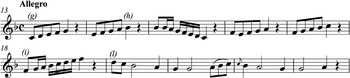
It is not difficult to find this principle of musical onomatopoeia within Angiolini's own music. Though only a small fraction of his oeuvre survives, we are informed by one particularly rich source: in 1773 the Venetian firm of Canobbio/Marescalchi printed his music for La partenza d'Enea, complete with annotations in the first violin part for the mime. Angiolini based his pantomime on Metastasio's libretto on the topic. Example 1 reproduces a few bars of the first violin part of No. 19, which occurs near the work's climax. The movement occurs just after Dido has discovered Aeneas's departure and fainted upon a rock. The villain, Jarba, has entered the stage with torch in hand, intent to raze Carthage; seeing Dido alone, he decides to give her one final chance.
The letters written above the staff refer to alphabetized directions given below the movement. Number 19 begins in D minor as Jarba and Mori ‘dance with lit torches’. The consistent rhythms and repetition schemes, and the verb ‘ballare’ in the annotations, suggest that the dance here is diegetic: the characters realize they are dancing and this dance can be seen by others. In the ensuing exchange between Jarba and Dido, though, the music follows different principles and regularity is disrupted. At (g) Jarba sees his unconscious beloved; Angiolini provides dominant harmonies and a new, questioning melody. During the rapid descending scale just after (h) he kneels to embrace her prone body. Dido initially believes he is Aeneas; when she discovers her error, she pushes him away at (i) with an ascending figure that inverts the melody of the initial embrace. Yet more new music arrives at (l) as Jarba pleads with her. Such ‘narrative’ music can tolerate no literal repetition; the movement is through-composed. These, then, are Angiolini's particelle: analogous pairs of sights and sounds arranged in a series, at least somewhat to the detriment of musical regularity.
Gasparo Angiolini, No. 19 (Allegro) from La partenza d'Enea (Venice: Canobbio/Marescalchi, 1773), violin 1, bars 13–22. New York Public Library, Performing Arts collection, JMB 87–44

Ever practical, Angiolini did not think that his creation could replace verbal language: indeed, he expressed support for any system of notation that might be useful, provided it did not ‘disgust the spirit, confound the memory and fill the mind more with signs than with things’.Footnote 73 He contradicted Noverre's assertion that dance notation was useless, claiming to have transcribed the statue's awakening in Hilverding's Pigmalion. He did, however, come to believe that verbal language had no place in pantomime, either as narrative explication or within the bounds of the drama: verbal language and ‘gestural language’ (‘la lingua de' cenni’) were mutually exclusive.Footnote 74 Paraphrasing Condillac's description of the ‘langage d’action', Angiolini wrote that ‘pantomime as an imitative art has its own means, and these means are the gestures that nature has given to man; and with which man explains naturally his needs, passions, emotions. These gestures cannot radically be enhanced or diminish with education’. When gestures operated together with learned verbal language, the result was ‘uselessness, corruption and monstrous absurdity’.Footnote 75 The language of action could be enhanced or diminished only by means of ‘combination’ with other pure sensory streams. Any mediated or otherwise compound ideas, including allegories, past and future tenses, self-identification and the supernatural, were to be banned. Furthermore, knowing details of the plot in advance disturbed the crucial animating effects of linear unfolding – ‘the reading of programmes … weakens or removes the surprise of the situations, which is one of the principal vehicles for the fine arts, and especially pantomime’.Footnote 76 This tricked the ignorant multitudes into believing that they perceived something not communicated by the dancers (again, signs without any signified).
It appears that Angiolini's public exchange of letters with Noverre captured the attention of the Milanese as no other aesthetic quarrel during that period: anonymous supporters of each party published polemical pamphlets and the Gazzetta letteraria reported in 1774 that the battle played out in ‘the theatre, the café and the salon’.Footnote 77 After Noverre's brief and failed tenure at the Regio Ducal Teatro in 1774 Pietro Verri gave his own public endorsement to Angiolini, agreeing that Noverre's pantomime was poorly equipped to harness the sensibility of the audience. Verri had seen Noverre in Vienna in 1770 and had attended Angiolini's ballets regularly since the latter's arrival in Milan.Footnote 78 Verri perceived immediately that the Angiolini–Noverre rivalry could inform – and lend currency to – his recent writings on the sensibility of the human mechanism and the basic physical impetuses underlying advanced culture.Footnote 79 In his ‘Lettre à Monsieur Noverre’ of 1776 Verri claimed that Noverre had appeared before Milanese audiences with ‘the air of a genius who came to enlighten a barbarous country’.Footnote 80 He accused Noverre of considering Lombardy a cultural backwater by virtue of its status as a political satellite: ‘ultimately you perceive Lombardy as a little province detached from the monarchy, or as an American colony’. Noverre had failed to win over Italian audiences because he had underestimated them. Verri noted in particular the jeers directed by the Milanese at Noverre's Agamemnon vangé, which had met with resounding success in Vienna only months previously. The difference in reception was, he claimed, due to more acute Italian sensibilities: as Pietro wrote to his brother Alessandro, ‘one needs a hammer to move a stupid nation’, but Italians were mortified by the brutality of Noverre's dramas, and ‘so as to not to feel their souls being torn apart, a more sensitive people will distract themselves by looking for something to laugh at’ (‘per non sentirsi squarciare l'anima appunto una nazione troppo sensibile si distrae e cerca avidamente se v'è un canto sul quale ridere’).Footnote 81 Verri asked Noverre, ‘is it not true that a sensitive nation cannot tolerate an excess of horror?’.Footnote 82 Massacres and carnage in a pantomime ‘can be attempted in a cold nation, whose sentiments have little in the way of liveliness; but with a people who are less phlegmatic, and have a greater proportion of feeling, Sir, they can't succeed. It's too much mustard for a delicate palate’.Footnote 83
Though Verri believed Angiolini to be the inferior of the two choreographers in matters of costume and scenery, he felt he had much better gauged the sensibility of the Lombards. He praised Angiolini's model of gradual excitement as superior to Noverre's preference for sudden shocks: ‘one must manage the attention of the spectator; one begins by making him curious; then one captures his interest, develops it, augments it, heats it, and thus one can push his sensibility to the brink’.Footnote 84 From the moment of his arrival in Milan the Italian choreographer had thus moved the audiences there, training them in absorption through the new genre of pantomime:
We came to admire, to taste this new dramatic genre with the same attentiveness, the same sensibility that that vast parterre must have felt on the occasion that the incomparable Du Fresne and his troupe staged the most beautiful pieces in your Theatre François. I saw, Sir, the room regularly full of spectators, and from the first representation I noticed a silence and an interest that one could not have predicted in a nation whose theatre is ordinarily given over to comic actors; I saw the spectators in tears, I saw them moved, and it is no small credit to the sensibility and natural taste of a nation that, despite the misfortune of having its theatre defiled, has seized and felt the true and the beautiful from one day to the next.Footnote 85
Compared to his writings on Italian culture from the mid-1760s discussed above, Verri's ‘Lettre à Monsieur Noverre’ displays a palpable optimism. No longer were the Milanese frozen into artifice by a morbid, unnatural culture; no longer were philosophers separated from the multitude by an intractable barrier of language. Angiolini transformed them into sensitive, weeping, silent, ardent people. He seized the spectators' bodies and made them feel the vivid impression of thoughts; he animated them. Crucially, Verri believed that Angiolini was able to do this ‘because he composed the music for his own ballets’ and thus ‘better combined gestures to sounds’.Footnote 86 In his last letter mentioning dance, written to his brother Alessandro in 1781, Verri recounted a story: ‘they say that Angiolini improvises on his violin when he is given a topic [for a ballet] and that this process functions as a charm for the new ideas that arise from him’.Footnote 87 This telling anecdote, whether or not it is accurate about Angiolini's compositional process, indicates the extent to which the choreographer had managed to link dance with music in the imagination of his supporters. While it is difficult to believe that he might really have created his art like a fiddler on the roof – violin in hand and feet dancing – we can see that music has attained a supremacy in this anecdote. It has become itself an ‘incanto’ – a charm to animate body and mind.
LA STATUA DI CONDILLIAC
Pietro Verri never published his ‘Lettre à Monsieur Noverre’: for a while he had intended it as a supplement to his Osservazioni sulla tortura, which spoke eloquently on behalf of the injustices suffered by the ‘poor unfortunate and uncultured souls who were only able to speak the plebeian Lombard language’ (‘poveri sgraziati e incolti che non sapevano parlare che il Lombardo plebeo’).Footnote 88 This class of people was identified by its linguistic limitations: dialect was the glass ceiling that separated them from the enlightenment that Verri wished were theirs. The potential of Angiolinian ‘sign language’ to fill in the gaps in popular education had already been noted ironically by its critics: Ange Goudar suggested in 1773 that ‘if I had to put an inscription on the door of the theatre, I would write, Public school, in which everyone must instruct himself with his own money’.Footnote 89 A decade later, the Milanese critic Matteo Borsa scorned minuets with, as he put it, pretensions to be encyclopaedias.Footnote 90 For Angiolini, though, the didactic powers of his ‘sign language’ were a serious matter. To this end, he began a new project in 1782, using mime to communicate ‘ideas, even the more abstract ones of philosophy’ (‘le idee anche più astratte della filosofia’) to Milanese audiences.Footnote 91 Because ‘the Art of Signs’ required no mediation – or so he boasted – it could render these complex philosophical ideas more vividly than verbal language, and thus was capable of effecting the mass enlightenment that had eluded the Milan illuministi: ‘moving the spirit and the heart with a more unmediated effect, the Art of Signs may one day forge a closer link between philosophy and imagination, reason and sentiment’ (‘Attaccando con un effetto più immediato lo spirito, ed il cuore, potrà l'Arte de' cenni pervenire un giorno ad unire con un più stretto legame la filosofia e l'immaginazione, il raziocinio ed il sentimento’).Footnote 92 The project had its debut with La vendetta spiritosa. As we have seen, Angiolini had created the plot, choreographed the dance steps and the pantomime, composed the music and subjected all his visual and auditory streams to rigorous combination.
Given his opposition to explicit verbal programmes during these years, Angiolini provided no description of the plot; the later revival for Venice fills in the gaps for the historian.Footnote 93 Following ‘various encounters and incidents’ of an amorous nature, the magical shepherdess Amarilli animates the statue of a naiad by means of sensory stimulation in order to cause discord between Tirsi and Clori:
Dagli amori male assortiti fra un numero di Pastorelle, e Pastorelli d'Arcadia ne risultano varj incontri, varj incidenti. Una delle Pastorelle più delle altre mal corrisposta, che possiede la Magia risolve di volersi vendicare; il che fa ingegnosamente, dopo d'aver compiuta una Magica operazione in compagnia delle sue seguaci. Consiste questa sua vendetta nell'animare una Statua, che rappresenta una Najade dai Pastorelli festeggiata in Arcadia, la quale acquista le idee per la via dei sensi, a imitazione dell'ingegnosa Statua di Condilliac, e d'oggetto in oggetto preferendo sempre quello che più le piate fissa la sua attenzione, e si dichiara amante del Pastorello Tirsi, che per l'amor di Clori, ha male corrisposto a quello, che per lui risente la Pastorella Maga. Per questo nuovo, e singolare amore nasce la disunione fra Clori, e Tirsi, che è lo scopo della Pastorella vendicativa. Finalmente dopo varj contrasti, e varie situazioni la Pastorella Maga riconverte la Statua in duro marmo, Clori, e Tirsi restano disuniti, e un'ordinata confusione, cagionata dai diversi sentimenti de' Pastorelli, termina la Favola pantomima.Footnote 94
Various encounters and incidents result from unrequited love in a group of Arcadian shepherds and shepherdesses. One of the shepherdesses, who is unpaired, and who possesses magic, resolves to take her revenge; she does it ingeniously following a magical operation in the company of her followers. Her vendetta consists in animating the statue of a naiad celebrated by the shepherds in Arcadia, which acquires ideas through her senses, in imitation of Condillac's ingenious statue. As the statue always prefers whatever object is just then receiving her attentions, she declares herself in love with the shepherd Tirsi, who had angered Amarilli in his love for Clori. This new and strange love causes discord between Clori and Tirsi, as was the goal of the vengeful shepherdess. Finally, after various conflicts and situations, the magic shepherdess reconverts the statue into cold marble, Clori and Tirsi remain apart, and the story ends in confusion caused by the different sentiments of the shepherds.
Like Lambranzi's statue ballet examined earlier, La vendetta effects a marriage of Italian elements with French ones: the characters are taken from renaissance pastoral poetry, where they featured in works like Giovanni Battista Guarini's Il pastor fido; indeed, they may be familiar to musicologists from the sixteenth-century Italian madrigal settings of Guarini's text. Also like Lambranzi, Angiolini provides his ballet with a background of deteriorating classical artefacts. The second act takes place among ancient ruins. Indeed, it would seem that the ‘ingenious vendetta’ of the title – Amarilli's animation of the naiad through stimulation of its senses – is possible only after something of a magical incantation conducted among these ruins.Footnote 95
Despite this rather incongruous dramatic context, Condillac's treatise appears to have been used with surprising philosophical fidelity. For Milanese audiences, the choreographer/composer provided this brief, evocative statement of intent:
Io tento in questo lavoro d'avvanzare d'un grado l'Arte mia, col trasportarvi una nuova serie d'idee, spiegando col solo ajuto de' gesti non solo le sensazione, che gli oggetti esterni risvegliano in un anima nuova, ed i paragoni, ch'ella ne può formare, ma rendendo anche sensibile la traccia, che dalla prima impressione degli oggetti i più indifferenti conduce fino al sentimento, e dalla stupida curiosità ai più delicati moti del cuore.Footnote 96
I attempt in this work to advance my art by a degree, in conveying to you a new series of ideas, explaining merely with the help of gestures not only the sensations that external objects may arouse in a new soul, and the comparisons that the soul can make with them, but also making sensible the path from the first impressions of the most indifferent objects up to sentiment itself, and from foolish curiosity to the most delicate motions of the heart. [my italics]
What Angiolini attempted, in other words, was to make spectators feel the reawakening of the statue tingling in their own bodies; make them feel the onset of human sensibility (‘I attempt to … make sensible the path from the first impressions of the most indifferent objects up to sentiment itself’). He used the verb ‘trasportare’ to describe his communication: a mechanical word evoking the transmission of an impression. Like the readers of Condillac's treatise, Angiolini's viewers were thus participating in an archaeology of their own selves, designed to help rediscover their most natural bodily impulses and sensing mechanisms. In order to effect this transmission, Angiolini called for a sustained imaginative absorption: ‘the only favour that I request is a slight effort of continuous attention’ (‘la sola grazia, che io domando, si è un leggiero sforzo d'attenzione continuata’). Thus La vendetta made use of a rhetoric of becoming sensible in much the same fashion as the treatise it professed to contain, with the statue serving similarly as a figure of aesthetic attention.
As should be clear by now, the animation of the statue through sensory stimulation mirrored the very same animation that Angiolini professed to create in his audience through his music-mime. In the passage quoted above, Angiolini draws an unmistakable parallel between the effect of sensory impressions on the statue's ‘new soul’ and the effect of La vendetta's own ‘new series of ideas’ conveyed through the eyes and ears: both are transformative, moving the object(s) from immobility to sensibility through stimulation. His unanimated statue – the naiad situated in a grotto-temple, leaning gracefully on an urn – thus assumes a symbolic function much as Beccaria's gigantic papier-mâché monsters or Pietro Verri's coins do. All are frozen humans representing a frozen humanity, whose congealment has resulted from ancient artifice. The quickening of the ‘statua di Condilliac’ in La vendetta was a sign that contained – and created – its own truth. It may have been Angiolini's most perfect onomatopoeia.
The animative powers of pantomime were not welcomed by all. Opera theorist Stefano Arteaga agreed that such dance was derived from the original language of gestures and cries, and attributed its effects to a combination of visual immediacy with extension through time: ‘mime has all the advantages of painting and sculpture in the variety, choice and strength of its attitudes, and furthermore the incomparable advantage of putting its images in succession, giving them motion’.Footnote 97 But the resultant stimulation of the spectators could have unforeseen and troubling consequences. These effects were stronger because mime was not to be reflected upon but only felt; ‘it seizes the soul with a cluster [folla] of compound sensations which hold the sensibility in a state of perpetual stimulation. It unites with the energy of gesture the vague yet vivid and voluptuous impression of sounds’.Footnote 98 Noting that the arrival of mimes heralded the fall of Roman culture, Arteaga suggested a ban on such dance in Italian theatres, and he invited the ‘prophetic spirits’ amongst his readers to tell him what would come of this ‘dangerous influence’.Footnote 99 Arteaga thus implicitly warned of an incipient revolution: crowds of plebeian Italians whipped into a bacchanalian frenzy by entr'acte pantomime. He remarked on the tendency of the ‘plebeian multitudes’ to dominate Italian theatres, though they were servile elsewhere. It is impossible to deny, though, that Angiolini and many of his supporters sought to animate the Milanese crowds for political ends. The choreographer's desire for a political union to match the cultural rebirth of Italy became unequivocal a decade later: he welcomed the French invaders openly.Footnote 100 Both Angiolini and Verri believed that the French unification of Italy could have been the triumphant result of decades of passionate Gallicism: free from Austrian and Spanish domination, and with the help of their beneficent Gallic occupiers, Italy could take its place as the equal of France. The latent political imagery in La vendetta ingegnosa, o La statua di Condilliac returned with a more explicit function in Deucalione e Pirra (La Scala, 12 July 1797).Footnote 101 Here the symbolism of quickened stones representing politically awakened Italians was unmistakable: the libretto referred to the story as an ‘Allegorico programma’ and included a preface from the ‘Inventore’ instructing the audience to interpret the drama in political terms. After a deluge a shipwrecked couple, Deucalione and Pirra, arrive in a land populated only by abandoned temples and rocks. The heroic pair learn from an animated statue of ‘Peace’ how to create companions from the rocks. The stones miraculously come to life, but they are ignorant and crass. Accompanied by an enchanting music that calms the rioting stone-people, the gods descend from the heavens to teach them how to be both cultivated and free. As the libretto's Introduction makes clear, these stones represent Italians, made rough and inhuman by centuries of Austrian and Spanish rule. Teachers rather than tyrants, their French occupiers Deucalione and Pirra bring about the requisite ‘regeneration’. The ‘nuovi creati’ are taught to dance by watching the ‘noble and voluptuous dance’ of Pirra, Deucalione and the muses, including Terpsichore herself. The eponymous couple declines the crowns that are offered to them. At the close the Statue of Liberty emerges from the ground, carrying the tricolore, and is surrounded by little spirits representing Italian cities, united at last.Footnote 102
What musical medicine did Angiolini use to breathe life into these stones? Alas, regarding those most vital of sounds, we ourselves must remain unstirred: the music for La vendetta is lost, buried under the sediment of more than two and a quarter centuries. It is a sad irony that this most loquacious of men should have been made mute in this most germane of his interests. Of Angiolini's many animated statues only that in Don Juan has left any auditory traces, and that music, as we know, is Gluck's. In assessing Angiolini's talents as a composer, we must make do with those few works that, like La partenza d'Enea, have resisted the depredations of time. Modern musicologists have seen little in these scores to excite their sentiments. Bruce Alan Brown and Kathleen Hansell have noted awkward doublings and parallel fifths, regular processions of two-, four- and eight-bar phrases and a near-total reliance on tonic and dominant harmonies.Footnote 103 There is certainly nothing to be found that approaches the rapid fluctuation of that most speech-like music, operatic recitative. In much of his music, the rigorous metre and high degree of repetition recalls more the armonia of poetry like ‘Mi sferza e sforza’, condemned by Verri as cold and immobile. Movements such as those from La partenza d'Enea examined above are reserved for periods of rapid dramatic flux; elsewhere, though, onstage events continue to occur in the musical interstices. Even the most through-composed of his pieces retain a near-inexorable rhythmic regularity. And although Angiolini might theorize about ever-unfolding change, both musically and onstage, with dance steps always integrated within pantomime, his scores contain a number of two-part minuets, chaconnes and gigues; even later scenarios such as Deucalione e Pirra display a significant quantity of diegetic dance. This last of Angiolini's pantomimes ends with ‘everyone coming together in happy, varied, noble dances, which denote general contentment and perfect democratic harmony’: beneath the new political patina, the semantic contours of poetic feet in divertissement remain intact.
But it may be unfair to fault Angiolini for these characteristics. The notion of a constantly changing stream of musical events, flowing around the supple and real bodies onstage, is the relic of that other, later, more famous idea of Gesamtkunstwerk. The choreographer's description of his Teseo containing ‘neither step, nor gesture, nor glance that did not correspond to the rigid tempo of the varied music with exact precision’ might encourage us to imagine a different kind of staged corporeality – one that is much more rhythmical, more mechanized, every motion enchained to the music. The fact remains, though, that Angiolini's goals of music-gestural alignment and linear change would provoke a different kind of musical experimentation in his disciples. It was through these pantomime scores that the motivating principle of sustained iconicity, or perfect alignment between music and gesture, was introduced to Italian theatrical music. Elsewhere, this was the province of melodrama, which bore the influence of Noverre's and Angiolini's projects in its inclusion of mimed passages with representative music. On the Italian peninsula, Rousseau's Pygmalion was understood to revive Greek melopoeia, and with it the onomatopoeic pronunciation of the ancients; it was staged there dozens of times during the years around 1800, and received about ten new musical settings.
But now that we have come to the end of our narrative, let us dwell for a few moments on that most recurrent of his visions: human animation. Surveying Angiolini's moving statues – the Commendatore in Don Juan, his notated ‘score’ of Hilverding's Pigmalion, the two versions of his Condillac fable and the statue of Peace and new Italians in Deucalione e Pirra – one might argue that the theme becomes itself a floating signifier, its elusive meaning undermining the very bodily iconicity it was marshalled to support. But it is worth noting that the statues within Italian music, dance and literature ceased to move in the early years of the nineteenth century just as the dream of unity lost its lustre: Angiolini's disciple Salvatore Viganò removed the animated statues from his Prometheus ballet when he revived it for Milan in 1813; the last Pimmalione (1816) was a student exercise by the young Gaetano Donizetti, never performed during his lifetime. This image seemed to lose its potency just as Italian writers like Ugo Foscolo and Alessandro Manzoni re-embraced both the Tuscan language and the renaissance poets, seeking a fatherland built around the monuments of its dead.Footnote 104 And it was just then that the spectres of Italy began to haunt the romantic imagination. But that is another story.