Introduction
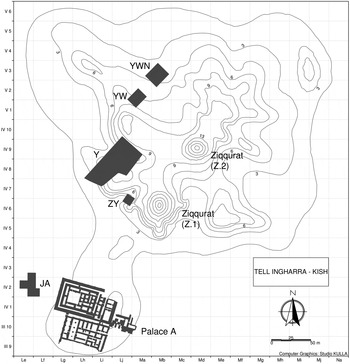
Between 1927 and 1930 a joint expedition by the University of Oxford and the Field Museum of Chicago to the site of Kish opened a series of soundings (ZY, Y, YW and YWN) on the mound of Tell Ingharra in order to investigate the earliest periods of the settlement (Watelin and Langdon Reference Watelin and Langdon1934: 4). These excavations provided an uninterrupted chronological sequence spanning the entire third millennium b.c., together with evidence relating to the layout and function of a number of buildings. Along the north-western slope of the mound the excavators cut a large 2 metres deep sounding, named YWN (Fig. 1).Footnote 2 Although a general assessment of the stratigraphy and chronology of this sounding has been provided by Moorey (Reference Moorey1966: 32–33; Reference Moorey1978: 114) and Gibson (Reference Gibson1972: 90), this paper presents a detailed analysis of the unpublished documentation and excavated objects now housed in the Ashmolean Museum of the University of Oxford and the Field Museum of Chicago and offers a new interpretation of the evidence. In addition, a radiocarbon date from a stratified sample from Phase 2 of the sounding, belonging to the transition between the late Early Dynastic III and Akkadian periods, can be compared usefully with existing dates for the destruction of numerous sites in northern Mesopotamia and Syria usually attributed to the expansion of the Akkadian empire.
Topographic map of Tell Ingharra (after Gibson Reference Gibson1972: 289, fig. 42).

Archaeological Stratigraphy and Finds
As the YWN sounding lays towards the sloping edge of the mound, its northern end had suffered from heavy erosion. In addition, several later intrusions such as drains, burials and debris, perhaps from pits, had caused considerable damage to the uppermost layers (Gibson Reference Gibson1972: 90). Nonetheless, the reanalysis of the stratigraphical and architectural sequence of the sounding presented here has allowed the identification of two previously unrecorded building phases: one at the plain level (0 metre); the other about 1 metre below that.Footnote 3 No architectural plans exist for either level, but it is possible to make a reconstruction of the lower one (Phase 1) by comparing the excavators' sketch plans with contemporary photographs (Watelin and Langdon Reference Watelin and Langdon1934: pl. XXXII). Many artefacts were discovered on the floors of the buildings (especially that of Phase 2), including gold and silver objects, cylinder seals, and cuneiform tablets.Footnote 4 Based on these finds, it is possible to suggest the function of the structures.
Phase 1
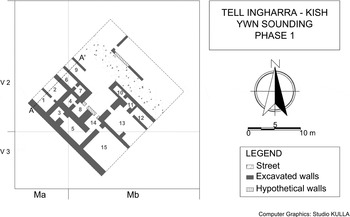
Floors of the earliest phase lay about 1 m below the plain level.Footnote 5 A schematic reconstruction of the structures uncovered there can be undertaken (Fig. 2) using a rough sketch made by the field director L.Ch. Watelin, together with photographs of the sounding taken at the time of excavation (Watelin and Langdon Reference Watelin and Langdon1934: pl. XXXII).Footnote 6 The new plan reveals a southern building, oriented north-west by south-west, with at least fifteen rooms of different sizes and shapes, separated from the poorly preserved remains of a northern unit by a rectilinear space some 4 m wide and tentatively interpreted as a street. The buildings were made of mud brick walls preserved to a height of approximately 2 metres and of variable thickness (from less than 50 centimetres to about 2 metres) with a coating of a whitish plaster. According to the excavation report, the floors and/or street were made of “organic debris” (Watelin and Langdon Reference Watelin and Langdon1934: 48) which we will take to mean beaten earth flooring.Footnote 7
YWN sounding. Plan of Phase 1.

While the limited excavations, the complex plan of the southern building, and the lack of information about the context of the associated finds do not permit a complete understanding of the function of the structures, some general conclusions can be reached. The number of rooms as well as the overall dimensions (about 300 square metres and only partially revealed) suggest a wealthy and extended household. Two large rooms to the south (13, 15) may have functioned as important public spaces, while the north-west sector consisted of smaller often interconnected rooms (1, 2, 3, 4, 6, 7). The architectural evidence can be partially integrated with the associated stratified finds. Indeed the presence of cylinder seals together with tools and containers may indicate small scale administrative as well as domestic activities.Footnote 8
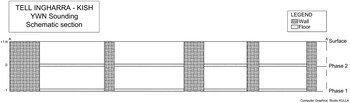
A guide to the dating of Phase 1 is provided by stratified diagnostic material: a small, handmade cylindrical strainer with irregular holes and a miniature vessel with vertical rim, slightly globular wall and a pointed base.Footnote 9 These shapes are widely attested from the Early Dynastic IIIa to the end of the Akkadian period in southern and central Mesopotamia, and are especially well known from neighbouring sites such as Abu Salabikh (Moon Reference Moon1987: 62–63, figs. 300–01, 304) and Nippur (McMahon Reference McMahon2006: pl. 82.3). The rooms of Phase 1 were filled with a thick packing of clayish soil sealed by the pavements of Phase 2, suggesting that the rooms had been cleared and the building rebuilt with the same plan (Fig. 3).
YWN sounding. Schematic section of phase 1 and 2.

Phase 2
In a letter to Stephen Langdon, Watelin records “…. on a découvert un certain nombre des constructions sous le plain level….”.Footnote 10 In the 1929–30 unpublished report, he revises his previous description saying that he found “la partie d'un monument qui s'étend encore sous un terrain non excavé…”.Footnote 11 In the final report, the excavators specify that this building was found in the topmost metre of the sounding (i.e. 0 metre) (Watelin and Langdon Reference Watelin and Langdon1934: 48). Some burials were attributed to this layer, at least one containing diagnostic material such as the so-called “mother goddess jars” (also known as up-right handled jars) dating to Early Dynastic III.Footnote 12 The excavators report the same building techniques as in the earlier phase, that is, plano-convex mud brick walls coated with plaster together with beaten earth flooring (Watelin and Langdon Reference Watelin and Langdon1934: 48). Based on the preserved walls of Phase 1, it is likely that the general plan of this building was maintained into Phase 2 (further changes are not visible) and that a new beaten earth floor was established at 0 m following the filling with clay soil and levelling of the earlier rooms (Fig. 3).
The artefacts from Phase 2 range from working tools (such as hooks, awls and spindle whorls), containers and administrative objects (cylinder seals and inscribed documents), to items of jewellery (such as pins, gold rings and silver earrings), and other élite goods (shell inlays and stone statuettes).Footnote 13 These are indicators of a wealthy household with some administrative and other small scale manufacturing activities evident.
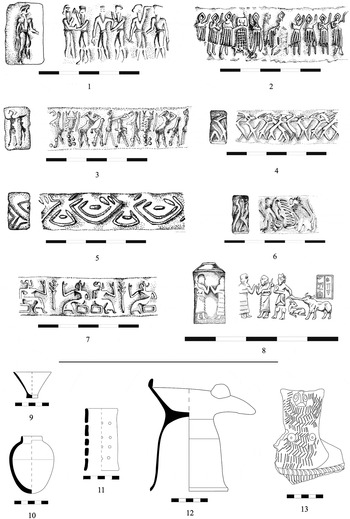
A number of cylinder seals and one seal impression were retrieved from Phase 2. Taken as a whole, the glyptic repertoire can be dated stylistically within the Early Dynastic III to Akkadian periods.Footnote 14 The Early Dynastic III examples are represented by banquet scenes (Fig. 4.7), files of humans (Fig. 4.2) and a scene of rampant lions attacking an antelope (Fig. 4.6). Seals dating to the Akkadian period include a white limestone example carved with a scene of three pairs of fighting gods (Fig. 4.1) and another depicting a procession of sacrificial animals towards a standing deity together with an inscription (Fig. 4.8).Footnote 15 Further examples may belong to a more archaic tradition (Figs. 4.3–5).
Cylinder seals and the pottery assemblage from phase 2. 4.1–4.8 redrawn after Buchanan Reference Buchanan1966; 4.9–4.11 courtesy Ashmolean Museum, University of Oxford; 4.12–13 courtesy The Field Museum, Chicago (FM 156326, FM 231050).

The pottery assemblage from Phase 2, is characterized by several diagnostic shapes such as a small handmade cylindrical stand/strainer with irregular holes (Fig. 4.11), comparable with the example from Phase 1. A ceramic stand with a top dish and pouring lip (Fig. 4.12) may have been used in association with bowl shaped strainers. These types of ceramics are generally attested from the Early Dynastic IIIb to the Akkadian period in southern and central Mesopotamia (Moon Reference Moon1987: 44–45, nos. 210–12). Similarly, a fragmentary jar handle with an applied anthropomorphic and geometric decoration (Fig. 4.13) attested in the Cemetery A at Kish (Mackay 1929: pl. II.4–6) as well as in other Early Dynastic IIIb central and southern Mesopotamia sites (Moon Reference Moon1987: 151, 157–62), was found in this phase. Other shapes include a small jar with rounded body and a vertical rim (Fig. 4.10) and a miniature conical bowl (Fig. 4.9), both widely attested through the entire Early Dynastic period.
A further indicator of the chronological range of this phase comes from a group of inscribed clay tablets (Gelb Reference Gelb1970: 36–42, nos. 45–51) and stone inscriptions (Gelb et al. Reference Gelb, Steinkeller and Whiting1991: 64–66) dating from the Early Dynastic IIIa to the Akkadian period and reporting administrative activities such as lists of workmen, purchase of fields and distribution of barley.Footnote 16 The majority was found at + 0.5 metres in a deposit covering the floors of Phase 2, while both the inscribed stones and one tablet were found on the floor itself.
A Radiocarbon Date and the Absolute Chronology of Early Dynastic Mesopotamia
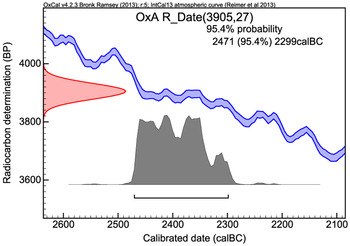
The chronology of Early Dynastic Mesopotamia and the immediately succeeding period is based largely on internal comparison of diagnostic finds (such as pottery, glyptic or inscribed objects) that provides a relative framework. Attempts to tie the relative chronology to absolute dates have been dependent on few stratified radiocarbon samples from some major Mesopotamian sites such as Ur, Mari, Nippur and Abu Salabikh (Wright Reference Wright1980). In order to help address this issue, thirteen samples of stratified bone, wood and shell objects from different areas of Kish, now housed in the Ashmolean Museum, were submitted to the Oxford Radiocarbon Accelerator Unit in the spring of 2013 for radiocarbon dating. All but one of the samples produced negative or unreliable results due to bitumen contamination on the wood and bone tools, lack of sufficient collagen for analysis on bones or the reservoir effect on shells.Footnote 17 However, a bone awl from Phase 2 in the YWN sounding produced a date range in the second half of the third millennium b.c. (Fig. 5):

C14 analysis revealed a chronological range between 2471 and 2299 b.c. (95.4%).

This result represents a useful addition to the existing dates for the absolute chronology of the late Early Dynastic-early Akkadian transition of southern and central Mesopotamia. Nevertheless, as noted by Wright (Reference Wright1980: 94), context is crucial in determining the chronological significance of each sample. In our case the sample comes from a well-defined macro-context, while no information is available for the micro-context.Footnote 18 It is therefore essential to point out how this new datum will be of significance within a future framework of radiocarbon samples from controlled contexts.
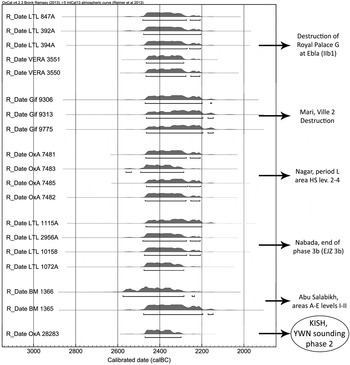
Considering the importance of the historical period to which Phase 2 can be assigned, comparisons with the absolute chronologies from some major centers of central and northern Mesopotamia as well as Syria can be undertaken (Fig. 6). In central Mesopotamia, the only available parallels come from the site of Abu Salabikh.Footnote 19 A sample of wood from area E, phase IC (Burleigh and Matthews Reference Burleigh and Matthews1982: 164; Postgate Reference Postgate1977: 275, n.2) provided a date range between 2576 and 2286 b.c., while the second sample, recovered from a slightly later phase (area A, phase II) (Burleigh and Matthews Reference Burleigh and Matthews1982: 164; Postgate Reference Postgate1977: 275, n.2), had a date range 2478 to 2196 b.c. Footnote 20 The latter result is of particular interest since it matches with the evidence from the YWN sounding sample.
Comparison of radiocarbon ranges for Ebla, Royal Palace G (Calcagnile et al. Reference Calcagnile, Quarta, D'Elia, Matthiae and Marchetti2013: 455, fig. 27.4), Mari Ville 2 (Margueron Reference Margueron, Matthiae and Pinnock2007: P. Buterlin p.c.), Tell Brak/Nagar L, area HS 2–4 (Ristvet Reference Ristvet and Lebeau2011: 303, table 1) and Tell Beydar/Nabada (ibid.: 303–304, table 1).

More useful insights are possible when this datum is placed in the wider context of a synchronism of absolute chronologies of the third millennium b.c. combined with stratigraphical and historical data. This situates it very clearly into a period when a number of sites in north Mesopotamia, such as Ebla, Mari, Nagar and Nabada, apparently fell to the expanding power of the kings of Akkad (Postgate Reference Postgate1992: 41–42). In inland Syria, radiocarbon data from Royal Palace G at Ebla (IIB1) suggest that the destruction of the city should be dated to the second half of the twenty-fourth century b.c. (Calcagnile et al. Reference Calcagnile, Quarta, D'Elia, Matthiae and Marchetti2013: 454). This dating is strengthened by the archaeological evidence from Ebla that demonstrates connections between that state and Old Kingdom Egypt (Scandone-Matthiae Reference Scandone-Matthiae1979). According to textual evidence, the fall of Mari should be placed about seven to ten years later than that of Ebla (Archi and Biga Reference Archi and Biga2003). This datum is also supported by a number of radiocarbon dates that place the destruction of the Ville 2 at Mari to around 2335 ± /15 b.c. (Margueron Reference Margueron, Matthiae and Pinnock2007; Lebeau Reference Lebeau, Baker, Kaniuth and Otto2012: 310). For the region of the Jezirah, the absolute date from the YWN sounding at Kish corresponds to the EJZ3b period (Ristvet Reference Ristvet and Lebeau2011: 322). In particular, it may be paralleled with period L at Tell Brak/Nagar and the fall of the city around 2340/35 ± 15 b.c., and perhaps also Tell Beydar/Nabada IIIb-IVa where the dates range between 2420 and 2270 ± 10 b.c. (Lebeau Reference Lebeau, Baker, Kaniuth and Otto2012: 306, 310).
Conclusions
Through a combination of the analysis of stratified archaeological materials, textual evidence and radiocarbon dating, supported by archival records, it has been possible to shed light on the stratigraphy and chronology of the YWN sounding at Kish.Footnote 21 This has revealed two structural phases consisting of an extensive building probably separated by a broad street from fragmentary remains of a smaller structure. This general layout seems to have been maintained across both phases, with the southern building comprising at least fifteen rooms extending over an area of more than 300 square metres. This large construction, probably to be dated between the late Early Dynastic IIIa and early Early Dynastic IIIb, was mostly cleared of its contents, deliberately filled with soil, and rebuilt on the same plan during the late Early Dynastic IIIb into the Akkadian period (Phase 2). The rich artefacts, including cylinder seals, cuneiform tablets and a range of exotic materials, together with the scale of the building, suggest that it represents the residence of a wealthy household engaged in administrative and other domestic activities.
An absolute date provided by the C14 analysis of a stratified bone sample supports the relative chronological attribution of the levels in the YWN sounding. Based on the stratigraphic comparison and the analysis of the material culture, Phase 2 should correspond to Cemetery A at Kish as well as the contexts overlying the destruction of the “Plano-convex Building” and the buildings in the Y and YW soundings (Gibson Reference Gibson1972: 112; Zaina Reference Zaina2015: 179–180; Zaina Reference Zainaforthcoming).Footnote 22 In addition to this, the date range of 2471–2299 b.c. means that Phase 2 was probably contemporary with the series of destructions at several central and north Mesopotamian and Syrian sites most likely explained as a result of the expansion of the Akkadian empire (Lebeau Reference Lebeau, Baker, Kaniuth and Otto2012).
This paper has also highlighted that at a time when the political situation in Iraq makes it difficult to acquire newly excavated samples for C14 dating, the use of excavated material within museum collections continues to provide an important resource—the bone sample from Kish was excavated in the late 1920s and has been in museum storage in Oxford for more than eighty years. Clearly, however, the modern excavation of well stratified material for C14 analysis is essential to test further the validity of the chronology of the YWN sounding as well as its broader implications.