Introduction
The pension landscape in western countries is rapidly changing. Public pension programmes are in the process of being reformed to cope with the economic challenges brought about by population ageing. In fact, according to the Organisation for Economic Co-operation and Development (OECD 2012), pension reforms that have taken place over the past decade are expected to reduce future public pension payouts in the OECD by some 20–25 per cent. To supplement public pensions, people have to rely on privately organised savings, either through voluntary or contractual arrangements. However, supplementary pension programmes are also in the process of being reformed. Defined benefit programmes, in particular, are susceptible to the forces of population ageing and a changing labour market. The broad economic outlook for current and future workers is therefore quite different from that of current retirees. As summarised by the OECD (2012: 11), individuals ‘will have to work longer before retiring and have smaller public pensions. Their private pensions are much more likely to be of the defined-contribution type, meaning that individuals are more directly exposed to investment risk and themselves bear the pension cost of living longer’. In short, individuals face increased responsibility for managing their own pensions and investments (Earl, Bednall and Muratorem Reference Earl, Bednall and Muratorem2015; Heraty and McCarthy Reference Heraty and McCarthy2015; Hershey, Jacobs-Lawson and Austin Reference Hershey, Jacobs-Lawson, Austin and Wang2013) and these developments may feed on the worries which individuals display about the adequacy of their pensions (Hershey, Henkens and van Dalen Reference Hershey, Henkens and van Dalen2010a ; van Dalen, Henkens and Hershey Reference van Dalen, Henkens and Hershey2010).
In light of the changing pension dynamics described above, access to high-quality information about investments and pension planning will increasingly be a critical determinant of success when it comes to retirement preparation (Koposko et al. Reference Koposko, Kiso, Hershey and Gerrans2016). Some believe that financial education may offer help to deal with workers' pension planning needs and the gathering of information, but in general, evidence in support of this belief has been mixed (Hastings, Madrian and Skimmyhorn Reference Hastings, Madrian and Skimmyhorn2012) and sometimes outright negative (Willis Reference Willis2009, Reference Willis2011). An alternative route to gaining access to high-quality information is to seek the help of financial advisers, which is the topic of this paper. The two central research questions addressed in this paper are as follows: To what extent do people experience anxiety at the prospect of seeking help from a financial adviser, and how can this anxiety be explained?
Anxiety can come into play in a wide range of different situations (see e.g. Gino, Wood Brooks and Schweitzer Reference Gino, Wood Brooks and Schweitzer2012; Onwuegbuzie Reference Onwuegbuzie2004) in which people face choices concerning the expectation of a future threat. This expectation results in feelings of fear, worry and uneasiness. Anxiety may help prevent an individual from acting upon this threat, by leading them to consult an expert, or procrastinate by backing away entirely from making a decision. This phenomenon is especially relevant in the area of financial decision making, where financial literacy among the masses is poorly developed. Seeking professional help to manage one's financial affairs is the sensible thing to do for financially illiterate individuals, but certain psychological barriers may prevent one from taking steps to engage a professional. First, due to privacy issues, not all individuals are comfortable discussing their pension situation with others, and in particular, with professional financial advisers (Gerrans and Hershey Reference Gerrans and Hershey2013). Second, not everyone trusts financial advisers to have their best interests at heart, or to handle their case professionally. Indeed, the level of competence and professionalism displayed by financial advisers has been called into question in recent years. Hackethal, Haliassos and Jappelli (Reference Hackethal, Haliassos and Jappelli2012) show that financial advisers do not improve returns nor ensure greater risk diversification over and above that of their potential customers. Eriksen and Kvaløy (Reference Eriksen and Kvaløy2010) show that financial advisers display the same type of myopia their potential clients possess when making investments. Furthermore, financial advisers have a dubious reputation in some countries because of steep incentive structures that result in misselling practices – that is, advisers selling customers products that fail to match their needs (Inderst and Ottaviani Reference Inderst and Ottaviani2009; Mullainathan, Noeth and Schoar Reference Mullainathan, Noeth and Schoar2012). In the United Kingdom (UK), for example, misselling has taken place in the past on a large scale as part of the privatisation of public pension programmes.
The need to investigate the adviser anxiety of older adults, as well as the underlying drivers of this form of worry and concern, seems pivotal at this point in time for a number of reasons. This is because older individuals are preparing for retirement, yet few are in a good position to appreciate the potential consequences of pension reforms. It would be difficult at best to make informed investment decisions without a firm grasp of the implications of changes in fiscal rules tied to pension savings, and the subtle distinctions that exist among different investment opportunities. Furthermore, as a group, senior citizens are at a higher risk of being conned into investing in unprofitable plans, because they often fail to comprehend fully the nature of the financial products being offered (Agarwal et al. Reference Agarwal, Driscoll, Gabaix and Laibson2009).
The current study focuses on adviser anxiety among older Dutch adults. This focus is indeed fitting as the pension system in the Netherlands is currently undergoing significant reform, and the practical consequences of such reforms may only be known to a small percentage of the population who are particularly financially savvy. Older adults in the Netherlands are expected to be more actively involved and responsible for providing care for themselves and their relatives. This increasingly involves complex financial decision-making processes where seeking professional financial advice is important.
In addition to examining financial adviser anxiety, we will examine a complementary psychological dimension – financial adviser distrust. As a construct, adviser distrust is a timely one to investigate, in light of the fact that the Netherlands is recovering from a large-scale misselling scandal that took place in the 1990s and 2000s. This scandal not only brought negative attention to the financial industry at large, but it also resulted in a heightened degree of distrust towards professional financial advisers who were seen as carrying out questionable sales practices that did not have the customers' interests at heart.
This study stands to make three contributions to the literature. First, we extend the concept of adviser anxiety as it was developed in psychology and the medical sciences, to show how the construct applies to the prospect of working with financial advisers among older adults. Second, we use a recently developed scale to measure financial adviser anxiety in a sample of older Dutch adults. By doing so, our hope is to establish the incidence rate of adviser anxiety in the Netherlands among a cohort that will soon need to rely on the retirement resources they have amassed. Third, we explain the drivers of financial adviser anxiety among older adults by focusing on the predictive power of a set of socio-demographic and psychological indicators.
However, before describing how we arrived at these contributions, we first offer some information on the institutional background in relation to pensions and the need for advice in the Netherlands, to be followed by a basic overview of adviser anxiety as a theoretical construct.
Institutional context of financial advice
The Dutch financial sector had been the pride of the Netherlands until the Great Recession. The financial sector was seen as a growth industry that attracted the best and the brightest of finance specialists. In fact, the Dutch pension system was viewed as a model for pension systems around the world (Ambachtsheer Reference Ambachtsheer2011) and banks and insurance companies were emulating the practices of Anglo-Saxon firms. In short, the sector was booming when at the start of the 21st century cracks appeared in the system. The Dutch government started to reform the welfare state as a response to population ageing and a changing labour market, increasingly shifting risks on to the shoulders of the individual.
Moreover, it became clear in 2006 that during the 1990s, many banks and insurance companies promoted investment-linked insurance and mortgage products, which turned out to be excessively expensive, and had unreasonably high commission fee structures (Commission Scheltema 2010: 116–22), which these financial intermediaries sought to obfuscate from their customers in difficult to understand disclosures or disclosures which were misleading (Authority for the Financial Markets 2008). As van Dijk, Bijlsma and Pomp (Reference van Dijk, Bijlsma and Pomp2008) have argued, the Dutch market for financial advice does not function properly and in a way that is generally fair to the consumer. Both low-income and high-income customers were prone to become entangled in the web of financial intermediaries as the cost of financial advice was never made explicit to customers or only made explicit once a deal was closed. As of 1 January 2013, all financial intermediaries – at banks, insurance companies and independent advisers – were prohibited from using commission fee structures and were obliged to make the cost structure of their advice explicit.Footnote 1 Because the cost of advice was made explicit, this may have become an important barrier to seeking advice for members of low-income groups.
However, the most radical change felt by consumers across the entire income spectrum appeared to be in the pension sector. The pension sector has been in transition for a considerable time as the government, pension funds and insurance companies try to adapt to an ageing labour market, and financial reforms are becoming increasingly visible to employees (van Dalen et al. Reference van Dalen, Henkens, Koedijk and Slager2012).
As of 2012, the public pension system has been reformed and changes in the retirement age have started to take effect. The retirement age in the Netherlands will gradually increase from 65 to 67, and from 2022 onward, the retirement age will be linked to the national average life expectancy, which is projected to lead to a retirement age of 71.5 years by the year 2060 (European Commission 2014). The supplementary pensions sector is also being reformed. More risks have been transferred to individual employees, tax-subsidised pension savings are curtailed for high-income groups, individual choice options have been put in place with respect to retirement age, the pension pay-out phase can be varied over the remaining lifetime and further individual choice options are being considered (Ministry of Social Affairs and Employment 2015).
One key problem the Dutch financial sector is facing is that consumers are confronted with significant choices that are far too complex for most individuals to solve independently. However, the agents that could alleviate this problem – financial advisers – are deeply mistrusted by consumers, even though consulting an adviser is quite common for a number of topics. Financial advice in the Netherlands mainly concerns mortgages, life insurance and fiscal affairs. Explicit pension advice is not so much sought after, although pension issues are touched upon in dealing with taxation issues for households. Most of the advice on pensions is provided by pension funds, and this is mostly done through help desk advisers, participant meetings or the websites of pension funds. Approximately 90 per cent of employees accumulate pension rights due to the mandatory nature of supplementary pension savings (through employer-sponsored schemes). However, more and more financial intermediaries focus on pension issues not only because pension reforms will allow for more individual choice, but also because the number of self-employed has increased at a spectacular rate – as of September 2015 there are one million self-employed, whereas in 2010 there were 705,000 self-employed – and this group has to make its own decisions with respect to saving for retirement.
Worries about trusting financial advisers and their services is not restricted to the Netherlands, but can be traced in many countries that are granting individual participants more freedom to choose their own pension provisions, most notably in the UK, Australia and the United States of America (Garcia-Huitron and Ponds Reference Garcia-Huitron and Ponds2015). The UK has an extensive history of misselling financial products (Casey Reference Casey2003; Ginn and Arber Reference Ginn and Arber2000), and for some, this may be a reason to forego private insurance to cover risks that the government is no longer willing to bear (see e.g. Clasen and Koslowski Reference Clasen and Koslowski2013). This has made it increasingly necessary for individuals to make wise investment choices and act on them. With respect to assumption of pension risks, individual choice may become a particularly prominent issue in the years to come. This is because, as of April 2015, tax rules have been simplified to give members of defined contribution pension schemes unrestricted access to their pensions. They are allowed to withdraw their entire accumulated pension savings as a lump sum starting at the age of 55, subject to their marginal rate of income tax in that year. The option of taking up 25 per cent of their pension savings as a tax-free lump sum already existed before April 2015 and has remained so. People can keep control of their finances and draw down their pension as they see fit, but they can also seek the security of an annuity. If people decide to buy an annuity they face another choice problem, namely which insurance company offers the best value for money. The Financial Conduct Authority (FCA) discovered in their report on annuities sales practices (FCA 2014) that 60 per cent of consumers do not switch providers when they bought an annuity, and 80 per cent of these non-movers could have obtained a higher income on the UK market for annuities. As the FCA (2014: 5) notes: ‘firms’ sales practices are contributing to consumers not shopping around and switching, and at times to consumers potentially buying the wrong type of annuity’. To support people in making their choices, the government announced in co-operation with the FCA to offer a guidance guarantee: free, impartial guidance for everyone with a defined contribution pension fund. Furthermore, the government has also established the so-called Financial Advice Market Review (FAMR) which intends to examine how financial advice could work better for consumers. Some of the goals of the FAMR, like investigating whether there is an advice gap and addressing barriers which put consumers off seeking advice, are issues which are at the core of this paper.
The case of Australia is no less interesting. A 2003 ‘secret shopper’ investigation conducted by the Australian Consumer Association and the Australian Securities and Investments Commission (ASIC) found that just over half of financial plans developed by advisers were ‘grossly inadequate’ or had ‘major deficiencies’ (ASIC 2003; Martin and Xiang Reference Martin and Xiang2015). Accordingly, a consumer survey of 30 occupations fielded annually from 2009 to 2013 repeatedly found that only 25 per cent of individuals consider financial planners to exhibit honest and ethical standards (Roy Morgan Research 2013). Criticism of the field in Australia comes amidst highly publicised misselling scandals involving major Australian banks, the widespread practice of independent advisers charging exorbitant fees and commissions, conflicts of interest involving product sales and general advisory misconduct involving financial planning firms. Much of this tumult led to significant industry reforms that were enacted in 2012 (ASIC 2015). Yet, concerns remain ongoing, which have led consumer advocacy groups to call for compensation for wrongdoing and others have suggested the need for institutions which regulate financial planning.
The concept of adviser anxiety
The concept of adviser anxiety was first noted and developed in the medical sciences, where it was acknowledged that patients differed in the extent to which they disclosed information to a medical practitioner. An investigation by Consedine, Krivoshekova and Harris (Reference Consedine, Krivoshekova and Harris2007) examined the nature of medical embarrassment among a sample of 250 young American adults (mean age = 19.9 years). According to these authors, in the past medical embarrassment has been viewed as a uni-dimensional construct that can represent a barrier to individuals when it comes to seeking advice from their physician. Following administration and psychometric refinement of a newly developed scale, the researchers found evidence for two separable factors associated with medical embarrassment: a bodily embarrassment factor and a social judgement factor.
The bodily embarrassment dimension was associated with, for example, disrobing in front of a physician, describing bodily functions to a doctor, being touched by a physician and embarrassment associated with ‘letting one's body go’. The social judgement factor, in contrast, was associated with the possibility that one would be negatively evaluated by a physician during an examination. Examples of this include fears associated with an imagined illness turning out to be nothing, concerns that the doctor will scold the patient for the bad state of his or her health, and feeling humiliated when one fails to understand certain treatment options described by a medical doctor.
Anxiety has also been witnessed among individuals faced with the prospect of interacting with those in other professions. Perhaps one of the more common forms of anxiety is seen among individuals who anticipate visiting the dentist. Fears of this type may be severe and clinically significant, as in the case of dental phobia, taking the form of a diagnosable psychological disorder (so-called ‘dentophobes’; Armfield Reference Armfield2010; Muschik and Kallow Reference Muschik and Kallow2015), but more commonly it is experienced by individuals at the sub-clinical level. Another well-documented form of anxiety is seen among students faced with taking a college course in statistics (Chew and Dillon Reference Chew and Dillon2014). Indeed, one of the key dimensions tapped in measuring statistics anxiety involves fears and concerns related to interacting with the instructor (Onwuegbuzie Reference Onwuegbuzie1998; Vigil-Colet, Lorenzo-Seva and Condon Reference Vigil-Colet, Lorenzo-Seva and Condon2008). Heightened anxiety levels have also been discussed in the context of meeting with a tax auditor (Feldman Reference Feldman2012), going on a job interview (Smith Reference Smith2013) and seeing a psychologist for help (Lackey Reference Lackey2013). The work cited above serves to inform the methodological approach taken in the present investigation. Typically, scales are used as a way to assess the severity of anxiety, and statistical models (usually multiple regression) are then examined in order to predict those most likely to experience elevated fears and concerns.
We posit that a parallel construct may be operating in the financial advice-seeking arena. That is, perhaps individuals feel anxious about the prospect of visiting a financial professional because they will either be embarrassed (by, for instance, the poor state of their financial records) or negatively evaluated (for poor financial decisions made in the past). One important difference, however, between the study performed by Consedine, Krivoshekova and Harris (Reference Consedine, Krivoshekova and Harris2007) and this investigation is that Consedine and co-authors view patient concerns as leading to embarrassment during the appointment, whereas we take the perspective that rumination about an upcoming appointment with a financial adviser could lead to anxiety prior to the meeting. Thus, in the financial domain, adviser anxiety can create a barrier to taking the steps necessary to seek professional assistance in the first place.
To assess financial adviser anxiety for older adults, we use a six-item scale that involved items drawn from the Gerrans and Hershey's (Reference Gerrans and Hershey2013) 11-item scale. In explaining differences in financial adviser anxiety, we focused on key socio-economic predictors as well as the psychological profile of respondents. We hypothesise that those who have more income and education are increasingly likely to have previously worked with a financial adviser, thereby buffering the development of high anxiety levels. With respect to the psychological dimension, we investigate how adviser anxiety is related to psychological factors that predict people's dispositions for planning. Those with a high future time perspective (i.e. who like to think about the future) might be more mindful and worried about their future retirement income and living conditions than those with a lower future time perspective, and more likely to plan and save for retirement. As such, we expect that a higher future time perspective is related to lower financial adviser anxiety. In a similar vein, those with high levels of financial knowledge arguably have a superior basis for judging whether an adviser is working in their best interests, which can provide a degree of confidence in the professional not found among individuals with minimal financial knowledge.
A third psychological characteristic that is assumed to be related to financial adviser anxiety is one's level of risk tolerance. Those who are risk averse (the opposite of risk tolerant) would be committed to maintaining the status quo (Kahneman, Knetsch and Thaler Reference Kahneman, Knetsch and Thaler1991). Furthermore, a consultation with a financial adviser is likely to result in some form of change, for example, through the purchase of a new insurance product, refinancing a mortgage, a realignment of one's investment portfolio or a shift in one's long-range financial goals. The risk-averse individual would likely avoid any such changes (Oreg Reference Oreg2003) and display higher levels of adviser anxiety.
One important element that is missing from adviser anxiety studies is an assessment of the level of distrust (or alternatively, trust) the individual has in the expert. In particular, it would be interesting to know whether the potential client believes the expert has his or her best interests at heart. In the medical profession this may not be as critical an issue, as medical professionals are generally perceived to be working on the patients' behalf. But it is quite a different story in the financial services industry – particularly in the Netherlands – in which professionals are often viewed with a significant degree of distrust. We add this element of perceived distrust to the current investigation, to determine whether trust levels serve to attenuate perceptions of adviser anxiety.
To control for the socio-economic and psychological make-up of the respondents in assessing adviser anxiety, we include conventional measures such as age, gender, personal income and education, and psychological measures such as future time perspective, self-reported risk tolerance, financial knowledge and perceived current income adequacy.
Method
Sampling and participants
In June 2014 an online survey was carried out among older adults in the Netherlands, defined as those over the age of 50 (N = 950). The survey was conducted by the CentERdata, a survey institute of Tilburg University that maintains a large panel of households in the Netherlands (for details, see http://www.centerdata.nl/en/). The panel is representative of the Dutch population with respect to sex, age, education and regional variation. Members of the panel are all interviewed through an internet connection. Participants who do not have internet access are provided with a facility by CentERdata, allowing them to access the internet through their televisions. Households that do not have a television set are given one by CentERdata to facilitate the data collection process. As such, there is no selectivity with regards to whether people have access to the internet or not. In general, people participate for about four years on the panel, during which time they are interviewed regularly on a variety of different topics. When a respondent leaves the panel, a new respondent is selected on the basis of matched socio-demographic characteristics, so that representativeness of the sample will be maintained.
In the present study, the response rate for the solicitation was 69 per cent. Among members of the sample, the average age was 64.6 years (standard deviation (SD) = 7.70); the sex distribution was somewhat skewed with 61 per cent of respondents being male. At the time of testing, 436 members of the sample (45.9%) were working, 433 self-identified as pensioners (45.6%) and 81 respondents were either unemployed or disabled (8.5%).
Measures
Eleven different scales or measures were administered to study participants as part of this investigation; they are as follows.
Financial adviser anxiety
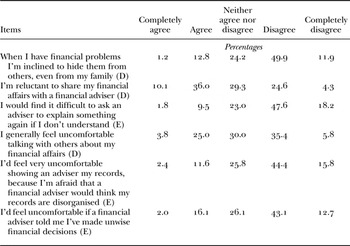
The six-item adviser anxiety scale used in this investigation included three disclosure anxiety items and three evaluation anxiety items. These six statements were drawn from the 11-item Hershey and Gerrans (Reference Gerrans and Hershey2013) financial adviser anxiety measure. Each of the six items are displayed in Table 1, along with the percentage of respondents who endorsed each of the five response categories (1 = strongly agree; 5 = strongly disagree). A confirmatory factor analysis using data from the present study revealed a unitary factor structure in which 44.51 per cent of the variance was explained. The minimum observed factor loading was 0.46. Based on this analysis, we constructed a six-item scale that was found to have a coefficient alpha value of 0.74.
Level of agreement for financial adviser anxiety items

Notes: N = 950. D: disclosure anxiety item. E: evaluation anxiety item.
Future time perspective
This construct was assessed using a single-item indicator: ‘I more or less live my life from day to day’ (reverse coded) that was scored using a five-point Likert-type response format (1 = strongly disagree; 5 = strongly agree). This item was drawn from the future time perspective scale developed by Hershey, Henkens and van Dalen (Reference Hershey, Henkens and van Dalen2010b ).
Risk tolerance
Respondent's risk level was assessed with the following single-item indicator: ‘How do you perceive yourself: Are you someone who is prepared to take risks, or do you try to avoid risks?’ Responses were scored using a ten-point scale (1 = not prepared to take any risks; 10 = very much prepared to risks).
Financial knowledge
This construct was also assessed using a single-item indicator: ‘I know a lot about financial affairs’. A five-point Likert-type response format was employed (1 = strongly disagree; 5 = strongly agree).
Current income adequacy
To assess income adequacy respondents were asked ‘How well do you get by on your current household income?’ A six-point Likert-type response format was provided (1 = very difficult; 6 = very easily).
Financial adviser distrust
To assess distrust, participants were asked to respond to the following statement: ‘When I receive advice from a financial adviser I often doubt whether the advice is in my best interest’. Responses were made using a five-point Likert-type response format (1 = strongly disagree; 5 = strongly agree).
Types of financial advising
In addition to the measures listed above we queried participants as to the type(s) of financial advice seeking they have engaged in over the past five years. The wording of the question was: ‘Did you approach in the past five years a financial adviser for the following topics: (a) pensions; (b) mortgages; (c) portfolio investment; (d) insurance (damage insurance, life insurance, funeral insurance, etc.); and (d) fiscal issues’. The respondents could answer ‘yes’ or ‘no’ to each of the different advice topics.
Socio-demographic indicators
Socio-demographic indicators included: (a) highest educational attainment in three levels: low (primary education and low secondary education), moderate (secondary education) and high (higher education at vocational and university level); (b) gender of respondent (male = 0; female = 1); (c) monthly net individual income; and (d) age of respondent (in years). All socio-demographic indicators were measured in the conventional fashion.
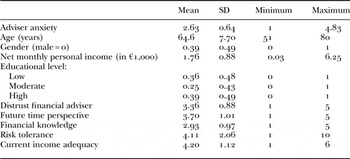
Table 2 offers an overview of the descriptive statistics for the measures in the study. These data reveal that, on average, respondents are slightly distrustful of financial advisers (mean = 3.36), somewhat future oriented (mean = 3.70), averse to taking risks (mean = 4.11), and neither very knowledgeable nor particularly ignorant about financial affairs (mean = 2.93).
Descriptive statistics for each of the major constructs in the investigation

Notes: N = 950. SD: standard deviation.
Results
Initial analyses focused on the characteristics of the adviser anxiety scale. The distribution of raw scores for the scale was found to approximate normality, albeit slightly leptokurtic. The sample mean was 2.63 (SD = 0.64); not far from the mid-point of the five-point response range.
Incidence rate of anxiety
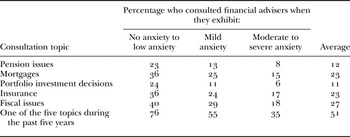
Adviser anxiety scores were grouped into three categories: little or no anxiety (values of 1.00–1.99; 10.8% of respondents), mild anxiety (2.00–2.99; 57.5%), moderate anxiety (3.00–3.99; 28.6%) and severe anxiety (4.00–5.00; 3.1%). Notably, this classification approach revealed that at the time of testing, nearly one-third of respondents (31.7%) experienced moderate to severe levels of financial adviser anxiety. Table 3 illustrates how financial adviser anxiety levels correspond to respondents' advice seeking over the past five years for a variety of personal finance issues. As seen in the far right column of the Table 3, older adults rarely visit an adviser for pension issues (12%) or advice on portfolio management decisions (11%). The most popular topic for consultation involved general fiscal issues (27%).
Percentage who consulted a financial adviser about various topics (at least once) during the past five years, distinguished by level of anxiety

Note: N = 950.
The most important outcomes associated with Table 3, of course, have to do with the anxiety levels linked to the different advising domains. For instance, the first row of the table shows that 23 per cent of the respondents that report no or low adviser anxiety have sought advice for pension issues in the past five years, whereas this is true of only 8 per cent of the respondents with moderate to severe adviser anxiety. Notably, older adults who displayed lower anxiety levels were also more likely to visit financial advisers than respondents who displayed severe adviser anxiety.
Predicting adviser anxiety
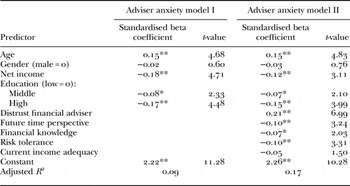
In an effort to identify the dimensions that underlie financial adviser anxiety, a hierarchical regression analysis was computed in which respondents' anxiety scores served as the criterion. Two levels of predictors were included in the model (see Table 4). Four socio-demographic indicators were included in the first level of the model, including respondents' level of education (low = reference category), gender, net monthly income and age. The second stage of the model included the five psychological predictors including: distrust of financial advisers, future time perspective, financial knowledge, risk tolerance and current income adequacy.
Hierarchical regression model with socio-demographic and psychological indicators predicting financial adviser anxiety

Note: N = 950.
Significance levels: * p < 0.05, ** p < 0.01.
The version of the model that only contained demographic predictors was statistically significant (F(5, 944) = 20.58, p = 0.001). Collectively, the five predictors accounted for 9 per cent of variance in anxiety scores. Gender was the only independent variable that failed to exceed the significance threshold. The first model shows clearly age is positively associated with the anxiety level, with higher anxiety levels among the oldest respondents. Furthermore, a higher income and higher level of education are related to lower levels of financial adviser anxiety.
The extended model – which included both demographic and psychological indicators – was also statistically significant (F(10, 939) = 20.12, p = 0.001). The psychological indicators explained an additional 8 per cent of the variation in financial adviser anxiety scores, with four of the five predictors emerging as significant. Statistically reliable indicators of anxiety included financial adviser distrust (β = 0.21, t = 6.99, p = 0.001), future time perspective (β = −0.10, t = 3.24, p = 0.001), risk tolerance (β = −0.10, t = 3.31, p = 0.001) and financial knowledge (β = −0.07, t = 2.03, p = 0.043). Income adequacy failed to exceed the significance threshold. The overall regression was found to explain 17 per cent of the variance in adviser anxiety scores, with roughly equivalent amounts of variance captured by demographic and psychological measures. It suggests that other factors not captured in the survey, e.g. social or cultural factors, could be important drivers of adviser anxiety. The model including psychological indicators revealed that higher levels of anxiety are found among those respondents with lower future time perspective, lower levels of financial knowledge and among those who are relatively risk averse. As a final point, distrust of whether financial advisers are primarily focused on their self-interest instead of the interest of the advice-seeking individual proved to be strongly associated with adviser anxiety as a separate psychological factor.Footnote 2
Cluster analysis to determine group membership
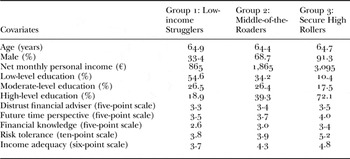
Subsequent to the regression analysis, K-means cluster analyses were computed that were informed by the pattern of significant outcomes in the hierarchical analysis reported above. The goal of these cluster analyses was to identify groups of individuals who would be likely to differ in terms of their level of adviser anxiety; therefore, anxiety scores were purposely excluded from this analysis. Covariates chosen for clustering included: age, gender, education, income, financial knowledge, risk tolerance, future time perspective, income adequacy and financial adviser distrust. Two-group, three-group and four-group cluster configurations were computed and examined; however, only the three-group configuration provided an interpretable solution. Final cluster centres for this analysis are shown in Table 5. All covariates in this analysis with the exception of age were found to emerge as significant (i.e. p < 0.05). Upon consideration of pattern of scores in the final solution, the three groups were subsequently named Low-income Strugglers, Middle-of-the-Roaders and Secure High Rollers.
Final cluster centres for covariates from the cluster analysis

Note: N = 950.
Significance levels: All covariates except age were statistically significant at the p < 0.05 level.
The first group (N = 317) – the Low-income Strugglers – were predominantly women with relatively low levels of income, education, future time perspective and risk tolerance. They reported having an average amount of financial knowledge and were unsure as to whether financial advisers could be trusted. Finally, they were found to have a lower income adequacy. Relative to this first group, the third group (N = 183) – the Secure High Rollers – were predominantly male with a relatively high level of income, education, future time perspective and income adequacy. These individuals also reported knowing more than an average amount about finances and they had a higher than average level of distrust in financial advisers. Finally, the Secure High Rollers were found to have a moderate level of risk tolerance. The cluster centres for the second group (N = 450) – the Middle-of-the-Roaders – fell squarely between the scores of the Low-income Strugglers and Secure High Rollers on nearly each of the dimensions. Predominantly males, the Middle-of-the-Roaders were found to have moderate levels of educational attainment, income and future time perspective relative to members of the other two groups. They reported knowing a moderate amount about financial affairs and had a moderate degree of distrust in financial advisers. In absolute terms, this group reported higher than average levels of risk tolerance and income adequacy; however, on both of these dimensions the Middle-of-the-Roaders were found to have lower scores than members of the Secure High Roller group. This finding is in line with the findings of Collins (Reference Collins2012), who demonstrated that financial advice acts as a complement to, rather than a substitute for, one's financial capabilities. What remains odd, however, is the fact that Secure High Rollers are more distrustful of financial advisers than members of the other two groups. A possible explanation for this is that the High Rollers have to consult an adviser because of the complexity of their finances. Also whereas they see the need to consult with an adviser, at the same time they are likely to be wary of whether the adviser's interests are aligned with their own.
As a validity check for the cluster analysis, a one-way analysis of variance was computed in which adviser anxiety scores served as the dependent variable and cluster membership (representing the three groups) was the independent variable. The omnibus F-ratio for the test was significant (F(2, 947) = 23.42, p < 0.001). Student–Newman–Keuls post hoc tests revealed that all three pair-wise means on the anxiety dimension were significantly different from one another. As a group, the Low-income Strugglers group had the highest mean anxiety score (mean = 2.76; standard error (SE) = 0.04), followed by the Middle-of-the-Roaders (mean = 2.60; SE = 0.03) and the Secure High Rollers (mean = 2.45; SE = 0.04). Of the Low-income Strugglers group, 42 per cent were in the moderate to severe anxiety category, followed by Middle-of-the-Roaders (29% moderate to severe anxiety) and the Secure High Rollers (22% moderate to severe anxiety).
Conclusions and discussion
Seeking advice in old age is an increasingly important issue in many domains of life and individual responsibility for the choices made during the lifecourse is much more important than before as the state rolls back its responsibility and the complexity of products and services exceed the cognitive powers of large parts of the population (cf. Lusardi and Mitchell Reference Lusardi and Mitchell2011). In this study, we examined the anxiety of older adults in the Netherlands to seek advice from a financial professional. This study shows that some 32 per cent of older Dutch individuals reported a moderate to severe degree of adviser anxiety. At the opposite (low anxiety) end of the spectrum, only 11 per cent of older Dutch adults revealed little or no financial adviser anxiety. Comparable figures for a country that also experiences some of the problems concerning financial advice can be found in the study by Gerrans and Hershey (Reference Gerrans and Hershey2013) for the case of Australia. Australians with little or no anxiety amounts to 31 per cent of the sample, and 24 per cent of the sample include those with moderate to severe anxiety. This suggests that the problem in the Netherlands is considerably worse, which may be explained by the recent history of misselling scandals that have taken place. Given these numbers, it is well worth considering the implications of such a large segment of the population experiencing anxiety at the prospect of scheduling a financial consultation. One implication is that many individuals are likely to forego soliciting financial advice from a professional when it could clearly be in their best interests to do so.
Another intriguing question addressed by this investigation is what types of individuals are most likely to experience financial adviser anxiety? Findings from the multivariate regression and cluster analyses paint a clear portrait of the types of individuals who are likely to experience adviser anxiety. At an incidence rate of 42 per cent, members of the Low-income Struggler group were the most likely to experience this form of psychological distress. The need for independent choice and advice may seem limited because these predominantly low-education, low- financial knowledge, low-risk tolerance women are covered by public pension coverage. However, in light of substantial recent structural pension reforms, members of this group may also require assistance in developing a long-range financial plan. Yet, they are probably the least likely to be able to afford such assistance. Things look a bit brighter for members of the other two groups, although the percentages of those who experience anxiety remain substantial and worrisome. For instance, 22 per cent of the Secure High Roller group reported moderate to severe levels of adviser anxiety. Recall that members of this elite group were over-represented by highly educated, high-income, high-knowledge males. Furthermore, it is conceivable that they would have been more likely than members of the other two groups to have worked with an advisor on previous occasions. Perhaps previous consultation experiences and more advanced financial knowledge put the Secure High Rollers in a superior position to ensure financial advisers are not only fully vetted, but also that the quality of their advice is critically scrutinised. From this perspective, it becomes clear why the Secure High Rollers were likely to experience lower levels of anxiety than members of the other two groups.
This study also clearly shows that those with higher anxiety levels are much less likely to have consulted a professional adviser in the past five years. This holds for all different types of advice ranging from pension, mortgages, fiscal issues, insurance and investment portfolio decisions. To what extent financial adviser anxiety is likely to prevent older Dutch adults from actually soliciting professional financial advice in the future is an interesting issue for further study. In future studies of adviser anxiety we see the value in collecting prospective attitudinal data regarding advice seeking. These future studies might also look into the differentiated impact of adviser anxiety on seeking professional advice from private-sector financial consultants (from banks and insurance companies) and professional advisers who are publicly funded at, for instance, the municipal level, who help people to reschedule their debts.
This study has several noteworthy strengths. First, the methodological and analytic approaches employed in the study of medical anxiety, dental anxiety and statistics anxiety have been adopted in the present investigation. Specifically, a scale was administered to respondents and regression models were then used to identify the types of individuals who were most prone to experiencing financial adviser anxiety. Second, the extension of the concept of adviser anxiety, developed in the medical sciences, to other domains where professional advice seeking is important opens new avenues of research on the level of agency that people have over their lifecourse. Research from the medical arena has revealed that patients differ in the extent to which they are willing to disclose information to a medical practitioner, and this investigation suggests that similar forces are at work when it comes to seeking financial advice. Third, we were able to demonstrate that the level of anxiety older adults display is highly graded along socio-economic lines, with individuals in the lower strata showing much more adviser anxiety than those in the higher strata.
This study also has certain limitations. The research design was of a cross-sectional nature, which limits causal interpretations of the findings. Furthermore, several predictor variables were based on single-item indicators that have unknown reliability. With respect to our measure of trust in financial advisers, this study did not differentiate between generalised trust and individualised or personalised trust with respect to financial advice. The latter concept is based on face-to-face interactions and can possibly differ from the generalised concept that is a mixture of trust in persons or institutions in general. Some will base this type of trust on experience and others, who do not have the benefit of experience, on norms and values (Bjørnskov Reference Bjørnskov2007; Helliwell and Putnam Reference Helliwell and Putnam1995; La Porta et al. Reference La Porta, Lopez-De-Silane, Shleifer and Vishny1997). Future researchers might benefit from incorporating this distinction into the models they develop and test. Finally, we did not have information about the wealth level of the households of respondents, which can be considered a limitation, although this is to some extent alleviated by controlling for the household income and education of respondents. Both indicators are generally correlated with financial wealth.
There is no question that as pension programmes in developed countries continue to shift more responsibility to individuals in the years to come, individuals will face increased pressure to manage their own long-term financial investments competently. One key to their success will probably be access to high-quality advice that will help inform their decisions. Although numerous sources of information are available to the personal investor, advice from financial professionals will remain critical, particularly when individuals are faced with complex financial products and scenarios. One important step towards rebuilding client trust in professional advisers will involve instituting further regulatory reforms designed to ensure full disclosure and transparency in the banking and finance industries. This is true not only in the Netherlands, but also in other developed countries.
This article presents a first step to understanding the anxiety of older adults in seeking professional advice or help in personal finance. This study clearly portrays that the seeking of advice is not something every person easily does. It points to an important dilemma in ageing societies: the older adults who display high levels of anxiety forego advice but are in general the ones who may need the advice most dearly. Across countries older adults are made more responsible for organising their own lives not only in the domain of pension finance, but other domains of life (health care, housing, social security and assistance) are equally important and increasingly complex. Understanding the roots of anxiety may prove to be crucial and tone down the high expectations of offering the freedom to choose.