Introduction
Neck dissection is an essential procedure for managing head and neck malignancies. Cervical lymphadenectomy as salvage surgery (following Cervical lymphadenectomy as salvage surgery (following chemo-radiation failure), or as primary treatment, has undergone significant evolution since its original description by Butlin, Kocher [1] and Crile. [2].Reference Rinaldo, Ferlito and Silver1, Reference Crile2
Upon graduating from an Otolaryngology-Head and Neck Surgery residency program, residents are expected to be competent in performing a neck dissection. We believe that the modifications in neck dissection, which have resulted in significant implications on head and neck practice, must be translated into the skills attained by residents.
The goal of this study was to evaluate changes in neck dissection over time at a tertiary university hospital and to determine their influence on residency training.
Materials and methods
All procedures contributing to this study comply with the ethical standards guidelines on human experimentation and were approved by the local Internal Review Board, according to the Helsinki Declaration of 1975, as revised in 2008.
The epidemiology, aetiology, technical description, dissection type, treatment plan (salvage vs primary surgery alone or together with chemoradiation) and complications of neck dissection were retrospectively analysed, and data from a recent decade (2003–2012) were compared with equivalent data from an earlier decade (1981–1990).
All patients who underwent neck dissections (matching International Statistical Classification of Diseases and Related Health Problems (‘ICD-9’) code 40.4: Radical excision of cervical lymph nodes) during both periods with available pre- and post-operative descriptions were included in the study. Pathology reports were investigated for all patients.
In this study, the term ‘neck dissection’ for metastatic thyroid disease only included cases of at least lateral neck dissection: cases in which surgical notes mentioned thyroidectomy, central neck dissection, and dissection limited to levels VI and VII were not included in the analysis. Collected data were analysed using the chi-square test. For all purposes, a p value of less than 0.05 was considered statistically significant.
Results
Of the 229 neck dissection procedures performed, the necessary details were available for 196 (85.6 per cent); thus, only these were eligible for inclusion in this study. Overall, 155 patients underwent 196 neck dissections during both periods (168 and 28 operations in 2003–2012 and 1981–1990, respectively).
There were no significant differences in mean patient age (47.0 and 51.3 years in 2003–2012 and 1981–1990, respectively). However, there was a trend towards more females: the female-to-male ratio changed from 1:2 in 1981–1990 to 1:0.91 in 2003–2012. A third of patients in both study periods had risk factors for cancer development (e.g. smoking and alcohol consumption).
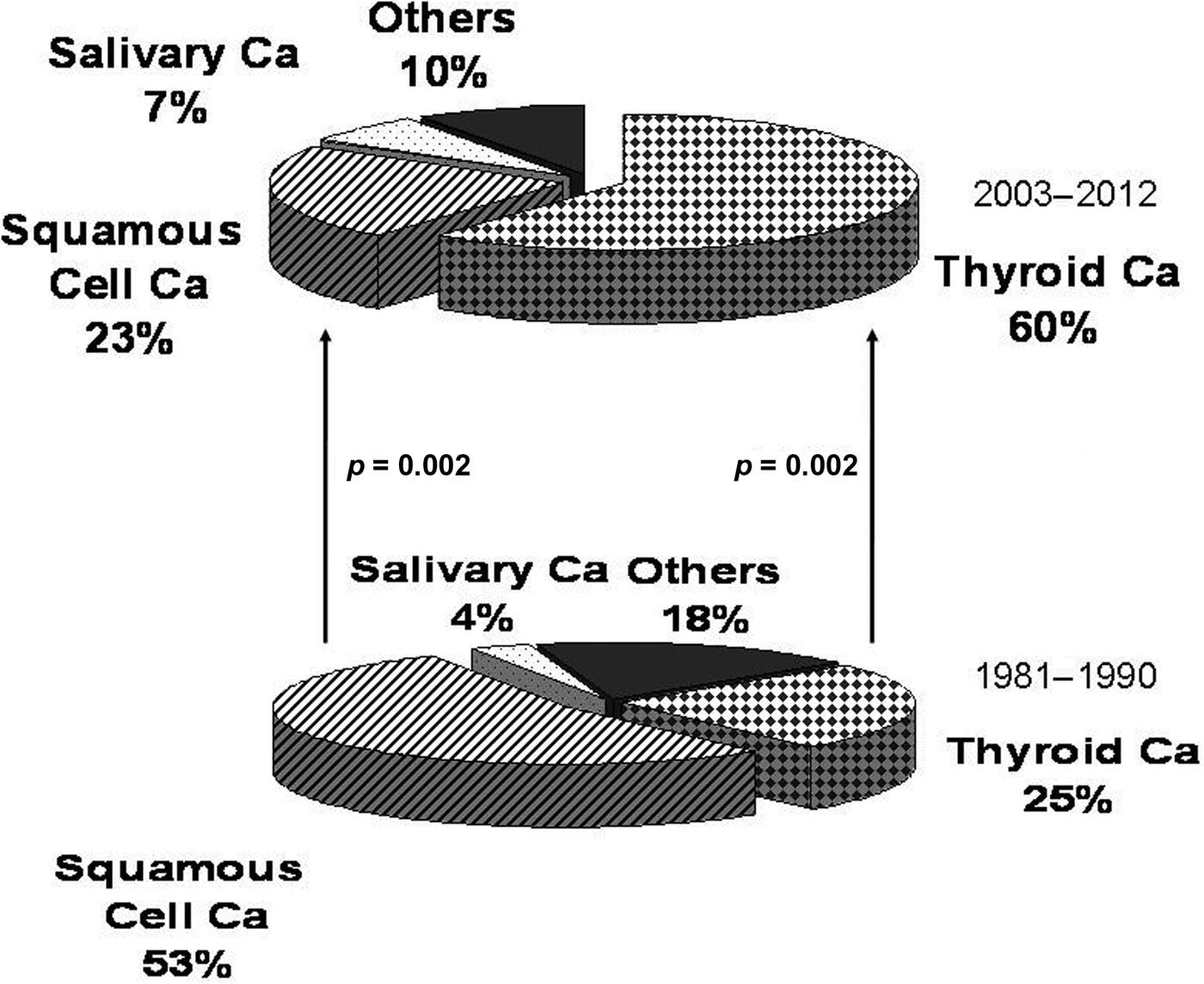
There was a 6-fold increase in neck dissection cases throughout 2003–2012 (compared with 1981–1990), mainly due to a 15-fold increase in neck dissections for metastatic thyroid disease (102 vs 7 dissections). In 1981–1990, neck dissections were mainly performed for epithelial malignancies (53.5 per cent) and less so for thyroid malignancies (25.0 per cent). However, a significant reversal was noted in the 2003–2012 period: 39 (23.2 per cent) and 102 (60.7 per cent) dissections for epithelial and thyroid malignancies, respectively (p = 0.002; Figure 1).
Charts showing the disease aetiologies for which neck dissections were performed in 1981–1990 and 2003–2012. Ca = cancer

Analysis of neck dissections performed for epithelial malignancies in 1981–1990 revealed an equal distribution of oral cavity and laryngeal cancers (46.1 per cent each). However, a significant change in distribution was observed in 2003–2012: 85.7 per cent of procedures were for oral malignancies (p = 0.005) and 14.2 per cent (p < 0.0001) for laryngeal malignancies.
During 2003–2012, there was a tendency towards more bilateral neck dissections (19 per cent vs 7.14 per cent in 1981–1990, p = 0.1), and significantly more re-operations on the same side (17.8 per cent vs 0.0 per cent, p = 0.037). Far fewer radical neck dissections were performed more recently (2003–2012 vs 1981–1990: 9.5 per cent vs 46.4 per cent, p < 0.0001); in contrast, more node-positive (i.e. therapeutic) neck dissections were conducted in 2003–2012 than previously (72 per cent vs 57 per cent, p = 0.05).
During 2003–2012, 25.6 per cent of dissections for epithelial malignancies were salvage operations after chemoradiation failures, whereas none of the dissections for thyroid spread were salvage operations (p < 0.0001). Moreover, level I dissection was included in two-thirds of squamous cell cancer lymphadenectomies but only in 4.9 per cent of thyroid neck dissections (p < 0.0001).
Discussion
This study demonstrates the changes in neck dissection procedures over time in an academic tertiary university hospital. There is an increasing preference for the conservative treatment of epithelial cancers combined with a sharp increase in the diagnosis and surgical treatment of thyroid cancer. This shift may have an important effect on residents’ learning curves and on their ability to achieve competency in performing neck dissections.
Since the Veterans Affairs study [3], published in 1991, is considered a paradigm breakthrough in the management of head and neck cancer, we decided to compare a recent decade to the decade prior to this publication. Concurrent with the conservative non-surgical treatment for laryngeal cancer, a similar approach has been adopted in treating oropharyngeal [4,5] and hypopharyngeal [6] squamous cell carcinomas. The effect of a preferred oncologic non-surgical management of the above squamous cell carcinomas resulted in significantly fewer neck dissections after 1991.
During the same period, the prevalence of thyroidectomies consistently increased in the USA [7] as well as in our department (a nine fold increase). As a result, neck dissection is now much more commonly performed for treating thyroid malignancy spread than for epithelial malignancies. This may explain the findings that in 2003-2012 more women were treated and more bilateral neck dissections, re-operations, and node-positive neck dissections were performed than previously.
Interestingly, since surgical management remains the preferred treatment modality for oral cavity squamous cell carcinomas, a significantly greater proportion of neck dissections for oral cavity cancer (85.7 per cent) than for epithelial malignancies from other sites (14.3 per cent) were performed in recent years.
It is likely that neck dissections for epithelial malignancies require greater technical skills because relatively more salvage operations (with radiation damage to neck tissues) and more extended dissections (including those involving level I) are performed for these tumours than for primary selective lymphadenectomy for thyroid malignancy spread.
• There is an increasing preference for the conservative treatment of epithelial cancers
• There has been a sharp increase in the surgical treatment of metastatic thyroid disease
• Neck dissection for epithelial carcinomas now requires greater technical skill and more extensive surgery
• A significant dominance of neck dissections for oral cavity cancer, compared to epithelial malignancies from other sites has been noticed during the recent decade
Limitations of this study are that it is retrospective and the results are based on data from a single tertiary medical centre. However, these findings may be applicable to other residency programmes. To investigate this possibility, a multicentre analysis should be undertaken.
Conclusion
Over time, the technical complexity of neck dissections and the aetiology of diseases requiring this treatment have dramatically changed. Recent preferences for the conservative treatment of epithelial cancer have a substantial effect on the current resident training program.
Today's residents gain relatively less surgical experience of squamous cell cancers. This study suggests that surgical training should involve a stepwise head and neck residency programme, starting with thyroid cancer dissection and progressing through more challenging operations for epithelial cancers to salvage neck dissections.