INTRODUCTION
No universally agreed definition exists for what constitutes a family meeting, but perhaps Hansen summarizes its key components best by suggesting it to be “a meeting which involves a number of family members, the patient and hospital personnel in discussions concerning the patient's illness, treatment and plans for their discharge or their care outside the hospital” (Hansen et al., Reference Hansen, Cornish and Kayser1998). The World Health Organization recognizes the importance of family in its definition of palliative care as “an approach that improves the quality of life of patients and their families facing the problem associated with life-threatening illness …” (WHO, 2002). Clinical experience bears this out and suggests that family meetings represent a potentially powerful clinical tool in facilitating communication between healthcare professionals and families. Such meetings enable patients, family members, and healthcare providers to discuss current medical issues, prognosis, goals of care and place of care (Cohen Fineberg, Reference Cohen Fineberg2005). This is particularly important in the palliative care setting, where patient preference to die at home often means that family members provide much of a patient's end-of-life care. Where families are more involved in the day-to-day care of a patient, they may also have a role in decision making regarding goals of care and ultimate place of care. Family members are, therefore, often recognized as members of the multidisciplinary team themselves (Christ & Blacker, Reference Christ and Blacker2005).
Despite their perceived value in palliative care settings, there is a dearth of published data to support the effectiveness of family meetings. Much of the published work focuses on communication techniques rather than broadly assessing the effectiveness of family meetings as an intervention (Dumont & Kissane, Reference Dumont and Kissane2009; Gueguen et al., Reference Gueguen, Bylund and Brown2009). Others have reflected upon the characteristics of family meetings in terms of patient demographics and information discussed at meetings (Yennurajalingam et al., Reference Yennurajalingam, Dev and Lockey2008). Furthermore, a significant amount of data is extrapolated from psychiatry or intensive care settings rather than directly from patients in hospice or palliative care settings (Curtis & White, Reference Curtis and White2008; Hudson et al., Reference Hudson, Quinn and O'Hanlon2008). To date, only one study has measured the effectiveness of family meetings in a palliative care setting (Hudson et al., Reference Hudson, Thomas and Quinn2009).
Prior to this study, we conducted an audit of our practice of conducting and recording family meetings in our inpatient hospice unit. Our findings revealed a poor level of documentation regarding both the individuals attending the meetings and the issues discussed (Hannon et al., Reference Hannon, O'Reilly and Bennett2010).
The aim of this study was to prospectively assess the effectiveness of family meetings in an inpatient specialist palliative care unit.
METHOD
Research Subjects
Prospective Study Participants
Patients admitted to the inpatient unit of Our Lady's Hospice, Harold's Cross, (Dublin, Ireland) from December 2009 to May 2010 were recruited. Patients were included if they were ≥18 years of age, spoke English as their first language, had a primary diagnosis of cancer, and had capacity to give informed consent. Patients were excluded if they were actively dying on admission to the unit (in such cases an urgent family meeting may have been necessary), or if they declined a family meeting following discussion with a member of the multidisciplinary team. The exclusion criteria also included a primary diagnosis of a non-malignant condition, and the need for a translator or interpreter to aid communication with either the patient or family member(s).
Data Collection
Routine Practice
On average, there are 400 patient admissions per annum to our 36-bed hospice inpatient unit. Approximately 75% of patients are admitted for terminal care and die on the inpatient unit, with the remainder being admitted for periods of symptom control, respite, or rehabilitation. Family meetings account for a significant amount of the clinical workload, with up to four meetings offered per week on each of two 18-bed wards. The meetings are primarily organized and chaired by the medical social worker and attended by at least one member of the medical team; a nurse; and representatives from physiotherapy, occupational therapy, and/or chaplaincy, where relevant. The number of healthcare professionals at such meetings is sometimes proportionately reduced to avoid intimidating the patient and the patient's family. Meetings last between 40 and 60 minutes each on average, and offer family members an opportunity to meet with several key members of the multidisciplinary team simultaneously. Most family meetings serve to provide a medical update, to discuss potential discharge plans where feasible, to sensitively discuss prognosis, and to give an opportunity to open lines of communication among family members themselves. Family meetings are also used as an opportunity to identify potentially vulnerable family members or families who may require additional bereavement aftercare support.
Study Protocol
Once a patient was deemed eligible and written consent was obtained, the patient's designated next-of-kin (as per their admission documentation) was approached. Written consent was also obtained from this family member. Baseline demographic data were collected on both the patient and designated family member. The meetings were scheduled by and chaired by a medical social worker. A physician consultant and/or a specialist registrar in palliative medicine and a member of nursing staff were present at each meeting. Where relevant, a physiotherapist, occupational therapist, and/or chaplain were invited to attend.
A standardized approach was used for data collection: for each patient, a single designated family member was invited to complete both a standardized self report instrument (SRI) and a Family Inventory of Needs (FIN) tool prior to the family meeting (T0), immediately after the meeting (T1) and 48 hours after the meeting (T2).
SRI
The self-report instrument was devised by and utilized by Hudson et al. (Reference Hudson, Quinn and O'Hanlon2008). Based on four leading questions, it was used to identify key concern(s) for family members prior to the meeting (T0), thus forming an agenda, via a free-text component. It also included a numerical rating of how worried family members were about these concerns, how often these concerns arose, and how much the problem interfered with their lives on a scale of 1 to 10 (where 1 represents “not at all” and 10 “all the time”). Family members were also asked to rate how confident they felt in dealing with this concern, again on a numerical scale of 1 to 10, (where 1 represented “not at all” and 10 “all the time”). Immediately following the family meeting (T1) and 48 hours later (T2), a modified version of the self-report instrument was completed by family members. It reminded the family member of their identified concern(s) pre-meeting and repeated the four original questions, which were again scored numerically 1 to 10, reflecting the perceived usefulness of the meeting.
FIN
The FIN is a 20-item questionnaire that has been shown to be a reliable and valid tool in assessing the importance and fulfilment of care needs of family members of advanced cancer patients. It has two subscales, each designed to quantify a separate concept; “Importance of Family Care Needs” and “Fulfilment of Care Needs”. “Importance of Family Care Needs” is defined as the family member's perception of the significance of requirements for care as provided by healthcare professionals. Each of the 20 statements is rated on a continuum from unimportant to extremely important, which is reflected by a numerical score on a 0–10 scale, where the 0 and 10 anchors indicate the perception of an unimportant and a very important care need, respectively.
The second subscale, the Fulfilment of Care Needs subscale, uses the same 20 statements as the Importance of Family Care Needs subscale. This subscale has been defined as the judgement made by individual family members regarding whether their perceived needs have been satisfied by healthcare professionals. Rather than lying on a continuum, this is considered a dichotomous concept and is scored as being either “met” or “unmet” at each of the time intervals (T0, 1, 2), (Kristjanson et al., Reference Kristjanson, Atwood and Degner1995).
Data Analysis
Based on Hudson et al.'s (2009) previous study, which utilized the same assessment tools, we estimated that a sample size of 30 participants would be necessary to achieve 80% power with an α level of 0.05. Descriptive analyses are presented as proportions, means, and standard deviations (SD). Paired t tests were used to make comparisons between pre and post-measures. Fisher exact test was used to compare FIN pre- and post-measures. Graph Pad Prism (Version 4.00) was used for statistical analysis. Because a number of univariate analyses were performed, and to reduce the risk of a Type 1 error, a Bonferroni correction was used for the data analysis shown in Table 1. The conventional significance level was adjusted from 0.05 to 0.0125, meaning that any p values < 0.0125 were considered significant.
Self-report instrument (SRI) results at T0 (pre-meeting) and T1 (post-meeting)

aQ1: How upset or worried are you about these concerns?
Q2: How often do these concerns arise?
Q3: How much are these concerns interfering with your life?
Q4: How confident do you feel in dealing with these concerns?
bUsing paired t test and Bonferroni correction (adjusted significance: p < 0.0125)
SD, standard deviation; CI, confidence interval
Ethical Considerations
This research was approved by our local Research Ethics Committee, based at St. Vincent's University Hospital, Dublin. Written informed consent was obtained from each patient and designated family member after explaining the purpose of the research, the voluntary nature of the participation, the respect for privacy in the handling of data, and the other research protocols. Additional support from the multidisciplinary team was offered to any participants who became distressed as a result of any issues raised during the course of a family meeting.
RESULTS
We recruited 31 participants over the study period (from December 2009 to May 2010), of whom 28 completed data across all three timescales (T0, T1, T2). In two instances, the patient deteriorated and died before data collection was complete, and in one case we were unable to contact the designated family member following the family meeting within the allotted time scale for data collection. All 31 participants were included in data analysis.
Demographic Data
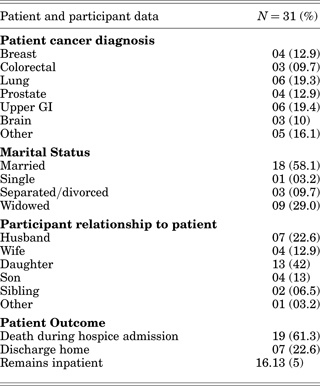
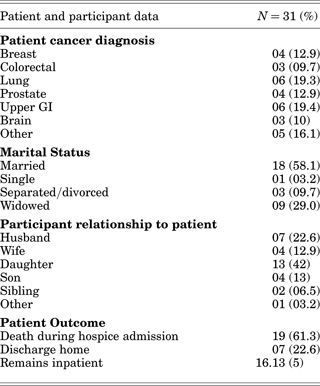
Demographic data relating to patients and their respective designated family member participants are summarized in Table 2. Of the 31 patients who consented to the study, 14 (45.2%) were male. Eighteen (58.1%) were married, nine were widowed (29.0%), three (9.7%) separated or divorced, and one (3.2%) single. In the majority of cases the participating family member was either a spouse (35.5%) or adult child (48.4%). Table 2 also shows patient outcomes at the end of the study period. Nineteen (61.3%) patients died in the hospice during the study period, seven (22.6%) had been discharged home and were being attended to by the community palliative care team, and five (16.1%) patients remained inpatients at the end of the study period.
Patient and participant data
SRI Results
The most common concerns identified by family members in the SRI were related to the patient's current medical status, prescribed medications, anxieties regarding the expected trajectory of illness and prognosis, and fears for the psychological well-being of the patient.
The results of the four numerical rating scales in the SRI are shown in Table 1. Paired t tests were performed comparing scores before and immediately after the family meeting (at T0 and T1) and immediately after and 48 hours after the meeting (T1 and T2). There was no statistically significant difference between scores at T1 and T2; therefore, Table 1 shows the T0 and T1 t test results only. The 95% Confidence Intervals in Table 1 represent the difference in scores pre- and post- family meeting.
Item one on the self-report instrument asked participants to rank on a numerical scale their current level of upset or worry. At T1, the mean difference in score was 3.4 lower than at T0, (95% confidence interval 2.4–4.3, p value < 0.0001). In terms of the frequency with which concerns arose, mean scores fell by 2.3, (95% confidence interval 1.5–3.0, p value < 0.0001). How much these concerns were interfering with participants' lives also fell by a mean score of 1.3, (95% confidence interval 0.3–2.2, p value <0.01). Participants generally felt more confident in dealing with their concerns following the meeting, with scores increasing by a mean of 2.0, (95% confidence interval −1.0–2.9, p value <0.001).
FIN Results
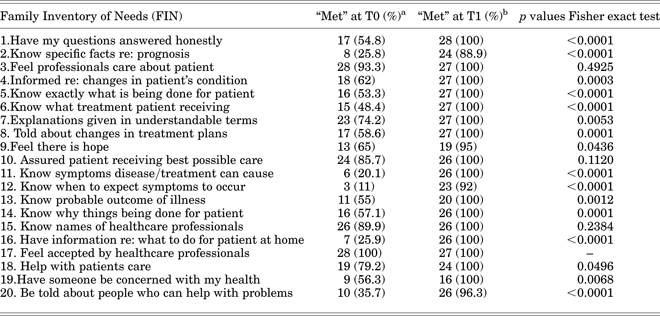
The two FIN questionnaire subscales were scored separately. In terms of the Importance of Family Care Needs, participants tended to score items divergently as either very important indeed (i.e., 10) or not important at all (0). The areas of lesser importance related to expected outcomes of the illness and to providing support for participants themselves. These included the need to feel there was hope (Item 9), the need to know the probable outcome of the patient's illness (Item 13) and the need to have someone concerned with the participant's own health (Item 19). Following the family meeting at T1 and on review at T2, there was no statistically significant change in scores on the Importance of Family Care Needs subscale. Family members consistently reported the same items on the scale as very important or not important at all, irrespective of discussion at the meeting. Results in Table 3, therefore, refer only to the Fulfilment of Care Needs subscale.
Family Inventory of Needs (FIN) results
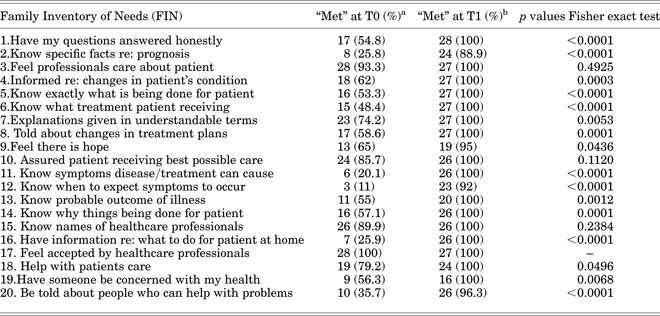
aIndicates item on FIN scored as “met” by family member prior to family meeting.
bIndicates item on FIN scored as “met” by family member following family meeting.
For the second subscale, the Fulfilment of Care Needs Subscale, any item scored at zero on the Importance of Family Care Needs Subscale was not included in this part of the questionnaire as it was deemed unimportant and therefore not necessitating further discussion. There was no statistically significant difference in scores between T1 and T2. T0 and T1 scores are shown in Table 3. Scores reflect the number of participants who identified each individual item as “met” at T0 and T1, as a percentage of the number who scored it as important. In all cases, participants scored a greater number of items “met” following the family meeting. Areas of greatest improvement were seen in answering questions honestly (item 1) and offering information regarding prognosis (item 2). Participants felt they had a greater understanding regarding patient's current care (items 5 and 6), as well as having a greater awareness of what to expect in the future, in terms of symptoms and estimated time frames or prognosis (items 11 and 12). Participants felt they had more information regarding caring for the patient at home (item 16) and were more aware of available supports (item 20).
DISCUSSION
In view of the limited data supporting the effectiveness of family meetings, coupled with the significant time spent facilitating family meetings in our inpatient palliative care unit, we conducted a study exploring the benefits of such meetings from the perspective of family members. Our study demonstrates that family meetings are an effective means of communicating with family members in this setting. The level of family members' concerns and worries decreased following the meeting, and these improvements were sustained over a 48-hour period. Family members reported increased confidence levels in dealing with these concerns following a family meeting, which was also sustained over time.
This study provides further evidence that family members of cancer patients have unmet information needs, particularly in relation to medical updates, prognosis estimation, and discharge planning. Our intervention, however, demonstrates that structured family meetings can offer an effective and valuable means of information sharing. These results were independent of the patient's overall outcome, with family members benefiting from meetings even in situations in which discharge home was not achieved.
Historically, family meetings were often conducted in emergency situations or in an ad hoc fashion, rarely planned in advance, and seldom formed part of a patient's overall care plan while in hospital. Despite the long-held recognition of family members as an integral part of patient care at the end of life, few studies have yet to assess the manner in which we communicate with families, or, indeed, what tools are used. The results of our study compare favorably with those of Hudson et al. (Reference Hudson, Quinn and O'Hanlon2008), where the same data collection tools were utilized. In terms of the SRI, our results showed statistically significant improvements in scores across all domains. The FIN (Fulfilment of Care Needs Subscale) results were similarly impressive, with dramatic improvements in meeting the care needs of family members in most areas assessed. This adds further weight to the arguments supporting involving family members in discussions with members of the multidisciplinary team to optimize patient care planning. Furthermore, family meetings offer family members an opportunity to access personal support, and for multidisciplinary team members to identify family members who may require additional support. Hudson et al.'s recently published systematic review of instruments used to support family caregivers, and Aoun et al.'s reliability testing of a tool measuring family carer satisfaction with palliative care services, demonstrate the growing interest in offering structured assistance to family members, and the evolving areas for further research (Aoun et al., Reference Aoun, Bird and Kristjanson2010; Hudson et al., Reference Hudson, Trauer and Graham2010).
Our study has a number of limitations. First, data collection was performed by the same personnel conducting the family meetings, and this may have introduced a positive response bias. Second, not all patients admitted to the inpatient unit are routinely offered a family meeting, mainly because of the time constraints associated with conducting frequent meetings. This may result in a selection bias. Third, our study was wholly quantitative and was not designed to capture qualitative data to support our results. A further study with qualitative elements and independent data collectors may add further weight to the benefits of family meetings as demonstrated in this study. Fourth, the psychosocial needs of family members are incompletely captured by the tools employed in this study, and could form the basis of further studies. Finally, the benefits of family meetings specifically from a multidisciplinary team perspective, were not formally evaluated in this study.
An unexpected outcome of the study was the value of the SRI in setting an individualized agenda for each family meeting. This allowed the multidisciplinary team to tailor meetings based on the particular needs of each family, as outlined in the completed instrument prior to each meeting (at T0). Although not directly measured, this appeared to be associated with greater levels of satisfaction among the attending members of the multidisciplinary team as well as family members. It may also have positive implications in terms of time spent conducting individual family meetings, given that time constraints are regularly identified as barriers to greater numbers of family meetings. Future studies exploring the satisfaction levels among members of the multidisciplinary team following family meetings would be useful. It may also be interesting to explore whether routinely offering a family meeting, planned soon after admission, with a well-defined agenda, actually has an efficiency advantage and reduces the need for, and frequency of, informal discussions with family members on the ward.
CONCLUSIONS
This study adds further weight to the previously published data supporting the benefits of conducting family meetings in inpatient palliative care units. The use of a self-report instrument in conjunction with a validated tool such as the FIN, affords the opportunity to objectively assess the effectiveness of family meetings. Further studies are required; these should include a qualitative component to address the effectiveness of family meetings from the perspective of both family members and members of the multidisciplinary team. To fully address the holistic care needs of patients, and thereby fulfill the true definition of palliative care in practice, ongoing involvement of family and the assessment of family members' needs are fundamental requirements.