Introduction
Anxiety disorders are the most common class of mental disorders in the USA (Kessler et al. Reference Kessler, Berglund, Demler, Jin, Merikangas and Walters2005), with a lifetime prevalence of 28.8% in US adults (Kessler et al. Reference Kessler, Berglund, Demler, Jin, Merikangas and Walters2005). Suicide attempts are also prevalent in the USA with between 2.6% and 4.6% of US adults having attempted suicide in their lifetime (Neeleman et al. Reference Neeleman, de Graaf and Vollebergh2004). Understanding who is at risk of suicide is an important first step in preventing suicide. There are multiple types of suicidal behavior including but not limited to suicidal ideation, suicide attempts, and completed suicide. Further complicating matters, there are overlapping and unique predictors for these types of suicidal behavior. For example, Nock & Kessler (Reference Nock and Kessler2006) found that social phobia was a risk factor for suicide attempts but not for suicidal ideation. In this paper, we focus on risk for suicide attempts, defined as any self-injurious behavior with unclear or at least minimal suicide intent, and not including self-injury when suicidal intent was completely denied.
Retrospective epidemiologic data has shown that a range of anxiety disorders individually and as a group are associated with increased likelihood of a past history of suicide attempts (Sareen et al. Reference Sareen, Cox, Afifi, de Graaf, Asmundson, ten Have and Stein2005; Boden et al. Reference Boden, Fergusson and Horwood2007; Cougle et al. Reference Cougle, Keough, Riccardi and Sachs-Ericsson2009; Chartrand et al. Reference Chartrand, Sareen, Toews and Bolton2012) as well as increased risk of future attempts (Sareen et al. Reference Sareen, Cox, Afifi, de Graaf, Asmundson, ten Have and Stein2005; Bolton et al. Reference Bolton, Cox, Afifi, Enns, Bienvenue and Sareen2008; Tidelmalm et al. Reference Tidelmalm, Langstrom, Lichtenstein and Runeson2008). Several studies have examined whether the risk for a suicide attempt associated with anxiety disorders can be accounted for by co-morbid mood or other psychiatric disorders. Cross-sectional or retrospective studies have yielded mixed results (Vickers & McNally, Reference Vickers and McNally2004; Diaconu & Turecki, Reference Diaconu and Turecki2007; Brown et al. Reference Brown, Gaudiano and Miller2010; Nepon et al. Reference Nepon, Belik, Bolton and Sareen2010; Nock & Kessler, Reference Nock and Kessler2006), although prospective studies have indicated that the elevated risk for attempts among individuals with anxiety disorders such as panic disorder is not due to a co-morbid mood or other psychiatric disorder (Sareen et al. Reference Sareen, Cox, Afifi, de Graaf, Asmundson, ten Have and Stein2005; Boden et al. Reference Boden, Fergusson and Horwood2007). Anxiety disorders, considered as a group, increased the risk of suicide attempt 2-fold over 13 years (Bolton et al. Reference Bolton, Cox, Afifi, Enns, Bienvenue and Sareen2008), and 3.6 times over 3 years (Sareen et al. Reference Sareen, Cox, Afifi, de Graaf, Asmundson, ten Have and Stein2005), even when mood, substance use, and other psychiatric disorders were included in the model.
Longitudinal risk factors for suicide attempts within the context of mood disorders have been well-studied, and consistently include amount of time spent symptomatic as well as a history of suicide attempts (Coryell et al. Reference Coryell, Haley, Endicott, Solomon, Keller, Turvey, Maser and Mueller2002; Coryell & Young, Reference Coryell and Young2005; Goldstein et al. Reference Goldstein, Ha, Axelson, Goldstein, Liao, Gill, Ryan, Yen, Hunt, Hower, Keller, Strober and Birmaher2012; Sokero et al. Reference Sokero, Melartin, Rytsala, Leskela, Lestela-Mielonen and Isometsa2005; Oquendo et al. Reference Oquendo, Currier and Mann2006; Holma et al. Reference Holma, Melartin, Haukka, Holma, Sokero and Isometsa2010). Other predictors of a future attempt may include lack of a partner or low social support, family history of depression (in adolescents), role impairment, hopelessness, anxiety symptoms (including panic attacks), history of drug or alcohol use disorders, or a Cluster B personality disorder (Maser et al. Reference Maser, Akiskal, Shcettler, Scheftner, Mueller, Endicott, Solomon and Clayton2002; Coryell & Young, Reference Coryell and Young2005; Sokero et al. Reference Sokero, Melartin, Rytsala, Leskela, Lestela-Mielonen and Isometsa2005; Holma et al. Reference Holma, Melartin, Haukka, Holma, Sokero and Isometsa2010; Goldstein et al. Reference Goldstein, Ha, Axelson, Goldstein, Liao, Gill, Ryan, Yen, Hunt, Hower, Keller, Strober and Birmaher2012). Researchers have also looked longitudinally at risk factors for suicide or suicide attempts in the context of personality disorders (e.g. Yen et al. Reference Yen, Shea, Sanislow, Skodol, Grilo, Edelen, Stout, Morey, Zanarini, Markowitz, McGlashan, Daversa and Gunderson2009) or discharge from inpatient psychiatric units (e.g. Links et al. Reference Links, Nisenbaum, Ambreen, Balderson, Bergmans, Eynan, Harder and Cutcliffe2012). However, there is very little research about specific risk factors for suicide attempts within the high-risk sample of individuals with anxiety disorders. Retrospective data with anxiety disorder patients suggests that ‘self-medicating’, i.e. drinking alcohol to cope with fear (Bolton et al. Reference Bolton, Cow, Clara and Sareen2006) is associated with a lifetime history of suicide attempts among anxiety disorder patients. Another retrospective study found that, among individuals with social anxiety disorder, the greater the number of feared situations, the more likely an individual was to have had a suicide attempt (Chartrand et al. 2011). Finally, in a retrospective epidemiologic study of panic disorder patients, those with a history of suicide attempts had lower income, were more likely to be separated, divorced, or widowed, less likely to be White or Catholic, more likely to be Protestant, were more likely to report that the panic attacks interfered with their lives, had a earlier age of panic disorder onset, more symptoms during their worst attack, and indicated that their worst panic attack included fear of acting crazy, things seeming unreal, or pain in parts of their body (Vickers & McNally, Reference Vickers and McNally2004).
Using the subset of individuals with current or lifetime panic disorder in the current dataset (i.e. The Harvard/Brown Anxiety Research Program (HARP; n = 527), with 46 individuals having made a suicide attempt or gesture), Warshaw and colleagues (Reference Warshaw, Massion, Peterson, Pratt and Keller1995) found that increasing age, post-traumatic stress disorder (PTSD), bipolar disorder, any substance abuse, a mood disorder, and not being married/living with a child were all associated with a past history of suicide attempts or gestures. Prospective univariate analyses of risk of suicide attempts during 30 months of follow-up revealed that attempters had lower GAS scores at baseline, earlier age of onset of their first mood/anxiety disorder, were younger, and were more likely to be unmarried and not living with a child, report suicide behavior prior to intake, have history of hospitalization, meet criteria for an eating disorder, double depression, substance abuse/dependence, borderline personality disorder, or dependent personality disorder, and meet criteria for two or more personality disorders. These results were largely confirmed in a subsequent paper including 498 HARP participants (25 made a suicide attempt) with panic disorder who were followed for up to 5 years (Warshaw et al. Reference Warshaw, Dolan and Keller2000). Taking fluoxetine during follow-up was not associated with a higher risk of suicide behavior (Warshaw & Keller, Reference Warshaw and Keller1996). However, we note that a limitation of these studies was the definition of suicide attempt: Warshaw included what were previously called ‘suicide gestures’ – i.e. self-harm behavior in the context of no suicidal intent – in their definition of suicide attempt.
Thus, limitations of the previous research on predictors of suicide attempts among individuals with anxiety disorders include: (1) inclusion only of individuals with panic disorder; (2) few prospective studies, with the only ones including up to 5 years of follow-up data; (3) lack of multivariable analyses so as to examine the independent contributions of potential risk factors for suicide attempts; (4) no examination of potentially important variables such as psychosocial functioning and physical health problems; and (5) what is now an outdated definition of suicide attempt. In particular, it is important to determine what predicts a suicide attempt over and above one of the most robust predictors of suicide attempts in the literature, i.e. a past history of attempts.
The current study seeks to address these limitations by examining longitudinal predictors of time to suicide attempt within a sample of individuals with anxiety disorders. The goals of the current data analyses are to examine: (1) which specific anxiety disorders and co-morbid psychiatric disorders predict increased likelihood of suicide attempt in this sample of individuals with anxiety disorders; and (2) which demographic variables, physical health problems, and aspects of psychosocial functioning predict subsequent suicide attempt; (3) which problems predict suicide attempt over and above a history of previous attempts; (4) whether there are specific anxiety disorders that predict risk for suicide over and above risk accounted for by mood disorders and previous attempts in this anxiety disordered sample; and (5) whether physical health problems and psychosocial functioning add to the prediction of suicide attempts over and above suicide history and psychopathology. We hypothesized that: (1) among this group of participants who all have anxiety disorders, the presence of some specific anxiety disorders,(e.g. PTSD and panic disorder), as well as major depression, would predict increased likelihood of suicide behavior; (2) being female, unmarried, poor general health, and poor work and social functioning would predict suicide behavior. For aims (3), (4), and (5) we hypothesized that major depression, panic disorder, PTSD, poor general health, and poor psychosocial functioning would be independent risk factors for subsequent suicide behavior.
Method
Procedures
HARP is an ongoing, naturalistic, multi-site, longitudinal study of adults with DSM-III-R anxiety disorders. The overarching aim of HARP is to better understand the long-term course of anxiety disorders. This study was approved by the Brown University Institutional Review Board.
In 1989–1991, 711 adult participants (aged ⩾18 years) were recruited from clinical settings in the New England area. To be enrolled, participants were required to have a current or past anxiety disorder diagnosis [panic disorder, generalized anxiety disorder (GAD), social phobia, or agoraphobia without panic disorder] (Warshaw et al. Reference Warshaw, Dolan and Keller2000). Exclusion criteria consisted of the presence of an organic brain syndrome, a history of schizophrenia, or current psychosis at intake. All participants signed informed consent at an initial assessment visit. Subsequently, research participants completed follow-up interviews at every 6 months for the first 2 years, once per year for years 3–6, and every 6 months in years 7–12.
Assessment
Suicide attempts
As part of the Longitudinal Interval Follow-Up Examination (LIFE; Warshaw et al. Reference Warshaw, Keller and Stout1994; Keller et al. Reference Keller, Lavori, Friedman, Nielsen, Endicott, McDonald-Scott and Andreansen1987), interviewers used the Suicide History Assessment to gauge the frequency, lethality, and degree of intent for any suicide attempts since the previous LIFE interview (Keller et al. Reference Keller, Lavori, Friedman, Nielsen, Endicott, McDonald-Scott and Andreansen1987). As described above, interviews were scheduled for every 6 months or every 12 months. If the participant made one or more gestures/attempts, they were categorized by suicide intent: 1, obviously no intent, purely manipulative gesture; 2, not sure or only minimal intent; 3, definite but very ambivalent; 4, serious; 5, very serious; 6, extreme (i.e. careful planning and every expectation of death). For the purposes of these analyses, and consistent with modern definitions of suicide attempts (Silverman et al. Reference Silverman, Berman, Sanddal, O'Carroll and Joiner2007a,b; Posner et al. Reference Posner, Brent, Lucas, Gould, Stanley, Brown, Fisher, Zelazny, Burke, Oquendo and Manne2009), only those behaviors coded as 2 or higher were considered to be suicide attempts. The approximate date of the most serious gesture/attempt in the given assessment period was also recorded. The inter-rater reliability of the LIFE is excellent, with the intraclass correlation coefficients (ICCs) ranging from 0.88 to 0.95 (Keller et al. Reference Keller, Lavori, Friedman, Nielsen, Endicott, McDonald-Scott and Andreansen1987). The test–retest reliability of the LIFE is very good, with ICCs ranging from 0.85 to 0.93 (Warshaw et al. Reference Warshaw, Keller and Stout1994).
History of suicidality
At baseline, participants were asked if they had ever made a suicide gesture or attempt. Participants were coded as having a previous history (1) or not having a previous history (0) of attempts.
DSM-III-R anxiety, mood, and substance use disorders
Trained and experienced clinical interviewers assessed these disorders at baseline using the Structured Clinical Interview for DSM-III-R Non-affective Disorders – Patient Version (Spitzer et al. Reference Spitzer, Williams, Gibbon and First1990) at baseline. For the purposes of the current analyses, we used current (i.e. baseline) DSM diagnoses. Individuals were permitted to have a concurrent diagnosis of major depressive disorder (MDD) and GAD. Raters assessed for ‘intermittent depressive disorder’ (IDD), which has similar criteria to that of dysthymic disorder: depressed mood much of the time for the past 2 years, with some periods of normal mood lasting from a few hours, days or weeks, but not as long as 2 months, with at least two other depressive symptoms, and related social/work impairment or treatment seeking. We also created a variable which reflected whether a participant had more than one anxiety disorder at baseline.
Demographics, including gender, age, marital status, race/ethnicity, and amount of education were assessed at baseline. Individuals who were unmarried, separated, divorced, or widowed were considered ‘unmarried,’ whereas those who were married or in a marriage-like relationship were considered ‘married.’ Because there were few non-white, non-Latinos, we collapsed race/ethnicity into two groups: white non-Latino and minority. Education was rated on the Hollingshead scale, in which 1 = completed graduate or professional training; 2 = completed 4 years of college; 3 = completed at least 1 year of college but not 4; 4 = completed high school; 5 = completed 10th or 11th grade, but did not graduate from high school; 6 = completed 7th–9th grade; and 7 = completed less than 7th grade.
Physical health problems were assessed via a medical history interview at baseline. Participants were asked a series of questions about whether they ever had different types of health problems, including cardiac diseases, autoimmune diseases, cancer, headaches, diabetes, epilepsy, or head injury.
General health perceptions, pain, and physical functioning were assessed using subscales from the MOS Short-Form General Health Survey (SF-36; Stewart et al. Reference Stewart, Hays and Ware1998). This is a self-report scale. Raw scores range from 0 to 100, with 0 representing poor health and 100 representing good health. For ease of interpretation of hazard ratios, and consistency with other variables (where higher scores represent poorer health), we reversed the raw score and then divided it by 10, such that 0 represents good health and 10 represents poor health.
Social and work functioning were assessed at baseline using the LIFE psychosocial functioning ratings. For overall social impairment, the interviewer was instructed to take into account information about education, social background, and level of functioning with regard to work, self-satisfaction, interpersonal relations, and sex, and then to rate an overall level of social adjustment in the previous week. Work impairment for the previous week was rated only if the participant spent time in employment. Ratings of these domains were made using a 5-point rating scale. A rating of 1 indicates very good functioning/no impairment. A rating of 2 indicates good or satisfactory functioning/no impairment. Ratings of 3–5 indicate mild impairment, moderate impairment, and severe or marked impairment, respectively. Prior studies showed acceptable reliability for the LIFE psychosocial functioning ratings (see Warshaw et al. Reference Warshaw, Keller and Stout1994).
Data analysis plan
For all analyses, we set alpha at 0.01 in order to account for the large number of predictors that we examined. First, we entered all predictors into a linear regression, with length of follow-up as the dependent variable, in order to characterize unique predictors of length of time in follow-up and determine whether any were clinically significant and thus might bias our results. Second, in order to find significant univariate predictors of time to suicide attempt in this longitudinal dataset, we used Cox regression [allowing examination of hypotheses (1) and (2)]. In order to examine whether the assumption of proportional hazards held true, we graphed sample log cumulative hazard functions by group (for categorical predictors), and we plotted Schoenfeld residuals versus time (for continuous predictors).
In order to reduce the number of variables used to examine hypotheses (3), (4) and (5), we used forward stepwise Cox regression. First, all demographic variables were entered into a single model predicting time to suicide attempt; any variables that were retained as significant were then used in subsequent analyses. We repeated this procedure for (1) psychopathology variables, including the variable reflecting whether individuals had more than one anxiety disorder at baseline; and (2) physical health variables. There were two psychosocial functioning variables (work functioning and social functioning); however, we could not use the work functioning variable in the multivariate analysis because of the large amount of missing data (i.e. many people were not working outside the home). Therefore, we used only social functioning in the subsequent analyses. Once we had a reduced set of variables, we used multivariate hierarchical Cox regression to understand the independent contribution of different risk factors to the model. We planned to first enter history of suicidality, followed by significant demographic variables, significant psychopathology variables, significant physical health variables, and last, social functioning.
Results
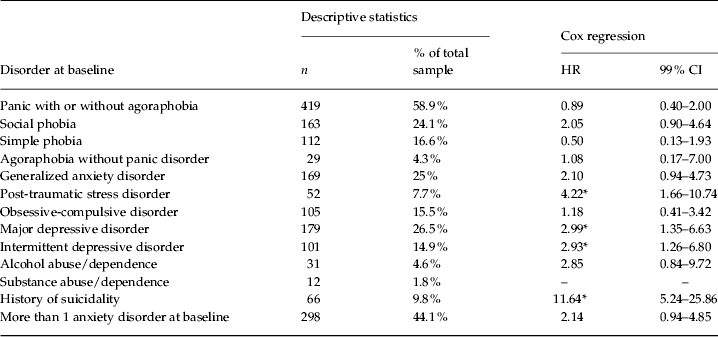
A total of 711 individuals with a baseline diagnosis of panic disorder (with or without agoraphobia), social phobia, GAD and/or agoraphobia without panic disorder were enrolled in this study. See Table 2 for frequencies of each disorder in this sample. The average number of months for which follow-up data were available was 137 (s.d. = 79, median = 174 months, range = 0–216 months). Of these 711 individuals, 35 did not have any follow-up data, and therefore were not included in subsequent analyses (leaving 676 participants for subsequent analysis).
Forty-two (6% of the total sample with follow-up data) individuals had a suicide attempt at some time during the follow-up period. The average number of months from baseline to the first attempt was 55 (s.d. = 50, median = 39, range = 1–193 months). Regarding attempt severity, 20 of these attempts were coded as ‘2’ (not sure or only minimal intent); six were coded as ‘3’ (definite but very ambivalent); nine were coded as ‘4’ (serious); four as ‘5’ (very serious) and three as ‘6’ (extreme). There was one known completed suicide.
Significant predictors of length of time in follow-up included: minority status (B = 84.15, s.e. = 20.33, t = 4.14, r = 0.13), in MDD at baseline (B = − 22.21, s.e. = 6.49, t = − 3.42, r = − 0.14), history of headaches (B = 18.15, s.e. = 5.63, t = 3.23, r = 0.10), general health perceptions (B = − 3.55, s.e. = 1.09, t = − 3.29, r = − 0.12), and work functioning (B = − 5.43, s.e. = 2.71, t = − 2.01, r = − 0.18). However, the nature of these associations was very modest, with correlations ranging from 0.10 to 0.18 (R 2 ranging from 0.01 to 0.03) with time in follow-up. Given the large sample size, it is not surprising that we would find some significant correlations, and we believe that, because the effect sizes are small, the clinical impact is likely to be minimal, and unlikely to impact our primary results.
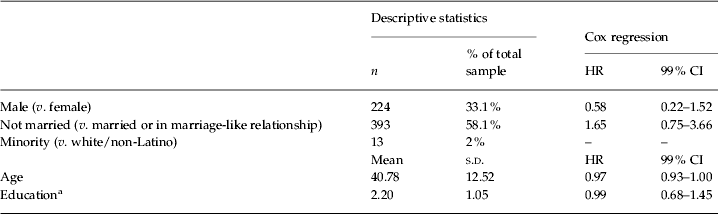
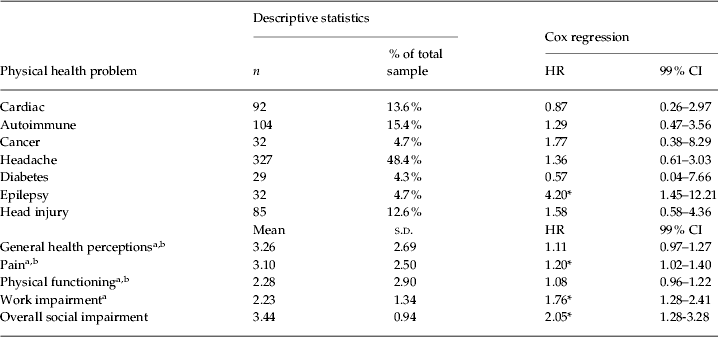
Tables 1–3 present the hazard ratios and confidence intervals for univariate Cox regression predicting time to suicide attempt. As can be seen in these tables, significant predictors of shorter time to attempt included (a) baseline diagnosis of PTSD, MDD, or IDD; (b) history of suicidal behavior and number of anxiety disorders at baseline; (c) epilepsy and physical pain at baseline; and (d) baseline work and psychosocial impairment. No demographic variables were significant univariate predictors of time to attempt. Diagnostic tests for each predictor variable did not reveal any significant violations of the proportional hazards assumption.
Demographics and results of univariate Cox regressions predicting time to a suicide attempt
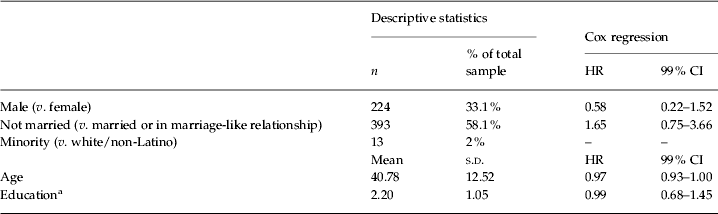
HR, Hazard ratio; s.d., standard deviation; CI, confidence interval.
Total (N = 676).
a Education was rated on the Hollingshead scale, in which 1 = completed graduate or professional training; 2 = completed 4 years of college; 3 = completed at least 1 year of college but not 4; 4 = completed high school; 5 = completed 10th or 11th grade, but did not graduate from high school; 6 = completed 7th–9th grade; 7 = completed less than 7th grade.
Psychiatric disorders and results of univariate Cox regressions predicting time to a suicide attempt

HR, Hazard ratio; CI, confidence interval.
* p < 0.01.
Physical health and functioning and results of univariate Cox regressions predicting time to a suicide attempt
HR, Hazard ratio; s.d., standard deviation; CI, confidence interval.
a Sample sizes for some variables were smaller due to missing data. For general health perceptions and physical functioning, n = 666; for pain, n = 664; for work impairment, n = 464 (due to the fact that many participants were not working outside the home).
b For ease of interpretation of hazard ratios, we reversed the raw score and then divided it by 10, such that 0 represents good health and 10 represents poor health.
* p < 0.01.
As described in the Data analysis section, prior to our final set of data analyses, we used stepwise Cox regressions to reduce the number of variables within each group of variables (i.e. demographic, psychopathology, and physical health variables). In the model including all demographic variables, there were no significant predictors of suicide attempts. In the model including psychopathology variables, PTSD, MDD, and IDD were significant independent predictors of time to a suicide attempt. Among the physical health variables, only epilepsy and pain were significant independent predictors of time to a suicide attempt.
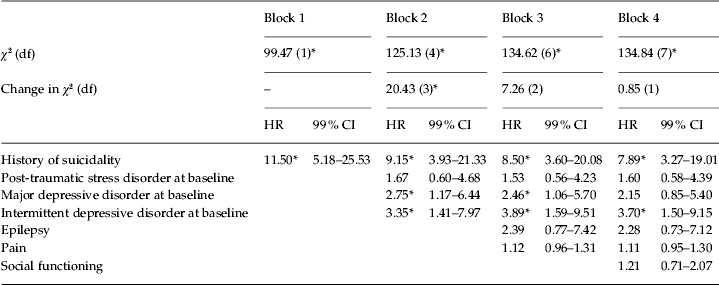
Finally, we conducted a hierarchical Cox regression. As can be seen in Table 4, current MDD and current IDD (at baseline) were independent predictors of time to suicide attempt, even when controlling for a past history of suicide attempt. Adding baseline physical health variables and social functioning did not improve the ability of the model to predict time to suicide attempt.
Results of multivariate hierarchical Cox regression predicting time to suicide attempt
HR, Hazard ratio; CI, confidence interval.
* p < 0.01.
Discussion
Suicide attempts were a significant problem in this sample of individuals with anxiety disorders. Six percent of this sample had a self-harm behavior that met our definition of suicide attempt (i.e. ranging from not sure or only minimal intent to extremely severe attempt or death) within an average of 12 years of follow-up from enrollment. This may be lower than what one would find in a sample selected for mood disorders. For example, Holma et al. (Reference Holma, Melartin, Haukka, Holma, Sokero and Isometsa2010) found that, in a sample of individuals with MDD, 14% attempted suicide during 5 years of follow-up. However, a 6% rate of attempts seems high in comparison to the general population. In the National Comorbidity Surveys, the estimated population prevalence of suicide attempts over a 10-year period was 0.9% (Borges et al. 2008).
In this anxiety disordered sample, we found that PTSD, MDD, IDD, epilepsy, pain, and poor work and social functioning all predicted a shorter time to a suicide attempt in univariate analyses. These results are consistent with previous work on PTSD (Nepon et al. Reference Nepon, Belik, Bolton and Sareen2010), MDD (Kuo et al. Reference Kuo, Gallo and Tien2001), dysthymia (Nrugham et al. Reference Nrugham, Larsson and Sund2008; Nock et al. Reference Nock, Hwang, Sampson and Kessler2010), epilepsy (Jones et al. Reference Jones, Hermann, Barry, Gilliam, Kanner and Meador2003; Christensen et al. Reference Christensen, Vestergaard, Morensen, Sidenius and Agerbo2007), pain (Braden & Sullivan, Reference Braden and Sullivan2008; Ratcliffe et al. Reference Ratcliffe, Enns, Belik and Sareen2008), and work and social functioning (Sokero et al. 2003; Robinson et al. Reference Robinson, Cotton, Conus, Schimmelmann, McGorry and Lambert2009) in samples not limited to individuals with anxiety disorders. We do note, however, that with only a few exceptions (e.g. Bolton et al. 2010; Kuo et al. Reference Kuo, Gallo and Tien2001), much of this previous work was cross-sectional or retrospective rather than prospective.
Contrary to our hypotheses, neither being female nor being unmarried/separated/divorced predicted time to attempt. Although women are more likely than men to make a suicide attempt in the general population (Krug et al. Reference Krug, Dahlberg, Mercy, Zwi and Lozano2002), it is also true that women are more likely than men to have a mood disorder (Kessler et al. Reference Kessler, Berglund, Demler, Jin, Merikangas and Walters2005) or anxiety disorder (Kessler et al. Reference Kessler, Berglund, Demler, Jin, Merikangas and Walters2005). Similarly, there is some evidence that individuals who are separated, divorced, widowed or never married have increased risk of a mood or anxiety disorder (Pirkola, 2005; Grant et al. 2009). Therefore, these demographic variables may not be good predictors in a sample already determined to have an anxiety disorder.
Turning to our multivariate results, we first note that as previously found in samples of individuals with mood disorders, having a history of suicide attempts is clearly a robust predictor of future attempts in individuals with anxiety disorders (Coryell & Young, Reference Coryell and Young2005; Sokero et al. Reference Sokero, Melartin, Rytsala, Leskela, Lestela-Mielonen and Isometsa2005; Oquendo et al. Reference Oquendo, Currier and Mann2006; Holma et al. Reference Holma, Melartin, Haukka, Holma, Sokero and Isometsa2010). In this sample, mood disorders were also important predictors of a future suicide attempt, even when considering past history of suicide attempts. At least one other prospective study has found that, among psychiatric outpatients, a history of suicide behavior and MDD at baseline were independent risk factors for future suicide (Brown et al. Reference Brown, Beck, Steer and Grisham2001).
In this sample, no specific anxiety disorder provided predictive power above and beyond MDD, IDD, and history of suicide attempts. This must be interpreted in the context of the fact that all participants must have had an anxiety disorder (panic disorder, social phobia, GAD, or agoraphobia without panic disorder) in order to be included in this study. Given this fact, it is likely more difficult to find an effect of a specific anxiety disorder in this sample. Because MDD and IDD are always co-morbid disorders in this sample, some of the increased risk found in mood-disordered individuals may be due in part to increased co-morbidity. Although disorders like PTSD are also always co-morbid in this sample, it may be experientially different to have more than one class of disorder (e.g. a mood and anxiety disorder) than it is to have two different anxiety disorders. Indeed, we failed to find that having more than one anxiety disorder at baseline predicted time to a suicide attempt. Consistent with our findings, Sareen et al. (Reference Sareen, Cox, Afifi, de Graaf, Asmundson, ten Have and Stein2005) found that the combination of having a mood and anxiety disorder increased the risk of a subsequent suicide attempt 10-fold in a sample with no history of suicide ideation or attempts at baseline. This risk was significantly larger than the risk conferred by mood disorders alone. However, having an anxiety disorder alone (no mood disorder) also conferred increased risk for a suicide attempt; therefore, our results should not be interpreted to mean that anxiety disorders are not associated with increased risk for suicide in a more general sample.
There are several limitations to this sample, including the fact that it is predominantly white. We are currently making efforts to correct this by recruiting Latino and African American individuals with anxiety disorders into a new study for long-term follow-up. A second limitation includes the fact that the terminology used to assess suicide attempts does not match more modern terminology. Newer studies have improved instruments for assessing self-harm ideation and behavior (e.g. the Columbia Suicide Severity Rating Scale; Posner et al. Reference Posner, Brent, Lucas, Gould, Stanley, Brown, Fisher, Zelazny, Burke, Oquendo and Manne2009). However, this is the limitation of all studies with a longer-term follow-up. Third, we note that associations between risk factors and suicide attempts may be complex, i.e. they may be moderated by demographic or other factors. Unfortunately, given the number of actual attempts in our sample, we did not believe it appropriate to expand our analyses further and examine interaction variables. In relation, we note that it is possible that this study was underpowered in terms of being able to find clinically significant predictors of suicide attempts. This is a limitation inherent to attempting to predict relatively infrequent events.
Despite these limitations, this study provides important information about suicide risk specifically for individuals with anxiety disorders. This information – i.e. the primary importance of assessing previous history of suicide behaviors and current mood disorders as indicators of risk – has implications for clinicians as they attempt to weigh different risk factors for suicide among anxiety disordered patients.
Acknowledgments
HARP is supported by NIMH grant 2R01MH051415-13A1. HARP was supported in the past, in part by Upjohn Co., Wyeth-Ayerst Laboratories, Eli Lilly, and NIMH (MH-51415). Since 2008, HARP has been funded solely by NIMH.
Declaration of Interest
During the past 3 years Dr Weisberg has received grant funding from Pfizer Pharmaceuticals, honoraria from AstraZeneca, Eli Lilly and Company, and from Bristol–Myers–Squibb, and has served as a consultant for Sci Med. During the past 3 years, Dr Keller has received grant funding from Pfizer Pharmaceuticals, and honoraria or consultant funding from Cenerex, Medtronic, and Sierra Neuropharmaceuticals.