Introduction
Numerous studies have used parasites as biological tags, both in freshwater and marine species, and a review of many of these is given by Williams et al. (Reference Williams, MacKenzie and McCarthy1992), MacKenzie & Abaunza (Reference MacKenzie and Abaunza1998) and MacKenzie (Reference MacKenzie2002). Parasites have been used for stock discrimination between areas, e.g. adult Hysterothylacium aduncun was used by Bøje (Reference Bøje, Stenmark and Malmberg1987) to separate cod stocks and Brickle et al. (Reference Brickle, MacKenzie and Pike2005) used parasite composition to differentiate between toothfish stocks in the sub-Antarctic. Parasites have also been employed to give information on migratory movements of their hosts: MacKenzie (Reference MacKenzie1985) used the plerocercoid of the trypanorhynch cestode Lacistorhynchus sp. to examine the recruitment migrations of North Sea herring, and Oliva (Reference Oliva2001) examined migratory movements of Macruronus magellanicus by using parasites that remain in the host for a long time, such as larval anisakids, larval Cestoda and larval Corynosoma sp. Various parasites also provide evidence of what species have been preying on, feeding behaviour and also where the host lies within a food web. Parasites remain within the stomach much longer than the prey host from which they came, therefore parasite data can give an indication of diet over a longer time period than stomach contents analysis (Williams et al., Reference Williams, MacKenzie and McCarthy1992; Gallagher & Dick, Reference Gallagher and Dick2010).
Sixty-two parasite taxa have been identified in Dissostichus eleginoides across the species range (Parukhin & Lyadov, Reference Parukhin and Lyadov1982; Gaevskaya et al., Reference Gaevskaya, Rodyuk and Parukhin1990; Hamilton, Reference Hamilton1995; Rodriguez & George-Nascimento, Reference Rodriguez and George-Nascimento1996; Brickle, Reference Brickle2003; Brickle et al., Reference Brickle, MacKenzie and Pike2005, Reference Brickle, MacKenzie and Pike2006; Oliva et al., Reference Oliva, Fernandez, Oyarzun and Murillo2008). The parasite fauna differs with location and Brickle et al. (Reference Brickle, MacKenzie and Pike2006) identified 27 parasite taxa in Patagonian toothfish around the Falkland Islands; of these, 13 were found in the stomach or stomach wall. Brickle et al. (Reference Brickle, MacKenzie and Pike2005) concluded that the high diversity of parasite fauna found within adult toothfish was due to their extremely predatory nature. The majority of parasites identified were adults, although the presence of some larval stages indicated that Patagonian toothfish can act as both definitive (final) and intermediate hosts.
The present study examined the parasite fauna of the stomach of juvenile toothfish from the shelf waters around the Falkland Islands. Seasonal, spatial and ontogenic changes in parasite composition were investigated with the aim of gaining an insight into toothfish population structure and also to provide evidence of the species that had been preyed upon and where toothfish lie within food webs.
Materials and methods
Collection and examination of toothfish
Observers on-board trawlers fishing within Falkland Island waters collected 502 toothfish for analysis during 2007, 2008 and 2009 (n= 50, 414 and 38, respectively). Fish were either processed on board and their stomach removed and frozen, or they were frozen whole and then dissected and the stomach removed ashore. For each individual fish, station depth, date, location and toothfish total length (LT, measured from tip of snout to mid-part of the caudal fin), weight, sex and maturity were recorded. For parasite analysis, once the entire stomach contents had been scraped into a Petri dish, all parasites were separated from the dietary items and identification and counts of parasite taxa were made. Identification of parasites was conducted with the aid of Berland (Reference Berland1989), Bray (Reference Bray1991), Zdzitowiecki (Reference Zdzitowiecki1991, Reference Zdzitowiecki1997) and Brickle (Reference Brickle2003).
Data analysis
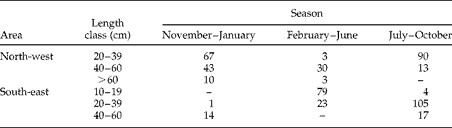
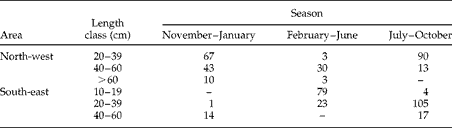
Examination of modal peaks in length frequencies gave size classes of 10–19, 20–29, 30–39, 40–49 and over 50 cm; however, to give larger sample sizes for analysis these were grouped together and size groups of 20–39 and 40–60 cm were selected. Sample sizes used in analyses are given in table 1. To describe the stomach parasite fauna from juvenile toothfish from the Falkland's shelf, prevalence, mean intensity and mean abundance of all parasites were calculated as described in Bush et al. (Reference Bush, Laffterty, Lotz and Shostak1997). Due to the overdispersed frequency distribution in their hosts, as indicated by a high variance to mean ratio, parasite numbers were log transformed [log(abundance +1)] for analysis to reduce the variance and help normalize the data. Only parasite taxa with a prevalence of >5% (thus removing ‘rare’ or satellite species) were used for analysis of temporal or ontogenic variations. To examine ontogenic changes in parasite number log(abundance +1) data were compared to host length using the Pearson correlation coefficient (r) and simple linear regression for the three separate seasons (with 95% confidence intervals). The prevalence of parasite infection was also examined with increasing host length for the three seasons. Seasonal changes in abundance of Elytrophalloides oatesi and Hysterothylacium spp. were examined by size class for fish 20–39 and 40–60 cm LT.
The range in the body lengths (cm) of juvenile toothfish, Dissostichus eleginoides, from the north-west and south-east regions over three seasons, November–January, February–June and July–October, from 2007 to 2009.
To investigate any spatial differences in toothfish parasite fauna, the sampling area was split into two regions, separated ecologically by different dominant water masses: the north-west which is dominated by warmer waters of the Argentinean drift flowing southwards, and the south-eastern area dominated by the Falklands Current bringing cold sub-Antarctic waters northwards (Arkhipkin et al., Reference Arkhipkin, Grzebielec, Sirota, Remeslo, Polishchuk and Middleton2004, Reference Arkhipkin, Brickle and Laptikhovsky2010). Linear discrimination analysis (LDA) was performed in Brodgar® (Highland Statistics Ltd, http://www.brodgar.com) to assess the similarity in parasite fauna log(abundance +1) for fish of length 40–60 cm caught in one season (between November and January) in the two regions. For the LDA, only taxa with a transformed abundance of >0 can be used in the analysis (i.e. 8 out of 15 taxa in this study). Further investigation of prevalence of taxa between regions was conducted using a Fisher's exact test, and abundance of the predominant taxa was examined using a non-parametric Mann–Whitney U test.
Results
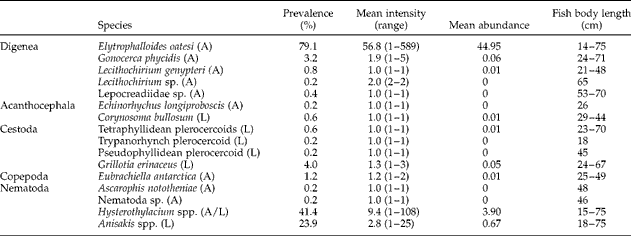
A total of 24,943 parasites of 15 different taxa were found in 502 individual toothfish stomachs, with the most abundant taxa being the digenean, E. oatesi, and the nematodes Hysterothylacium spp. and Anisakis spp. The parasite fauna consisted of 2 acanthocephalans, 4 species of cestodes, 5 digeneans, 3 nematodes and 1 copepod (which is likely to have come from the toothfish mouth and carried to the stomach with an item of prey) (table 2).
Levels of infection of adult (A) and larval (L) stages of parasites in juvenile toothfish, Dissostichus eleginoides (n=502).

Seasonal and ontogenic changes in parasite abundance
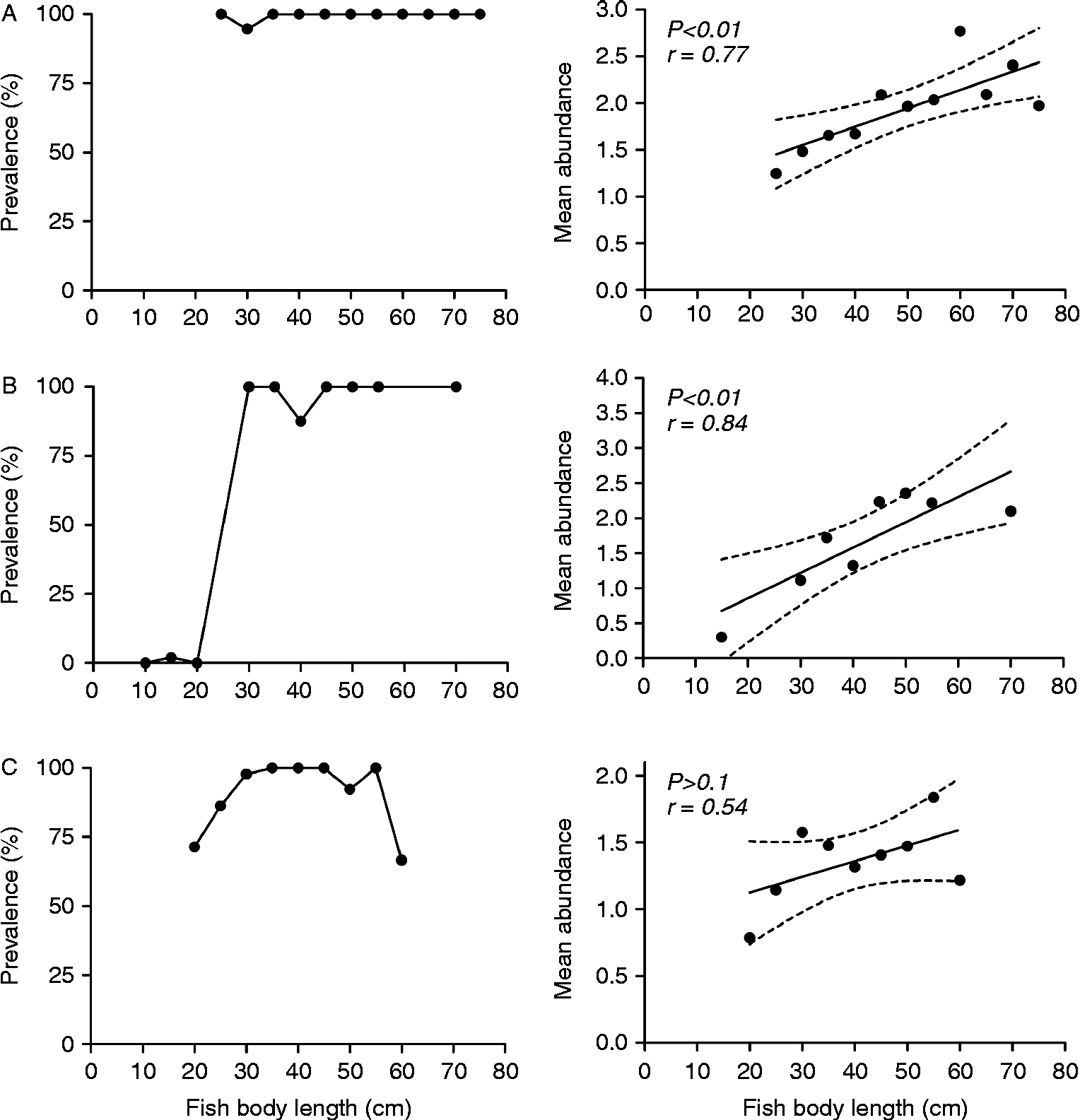
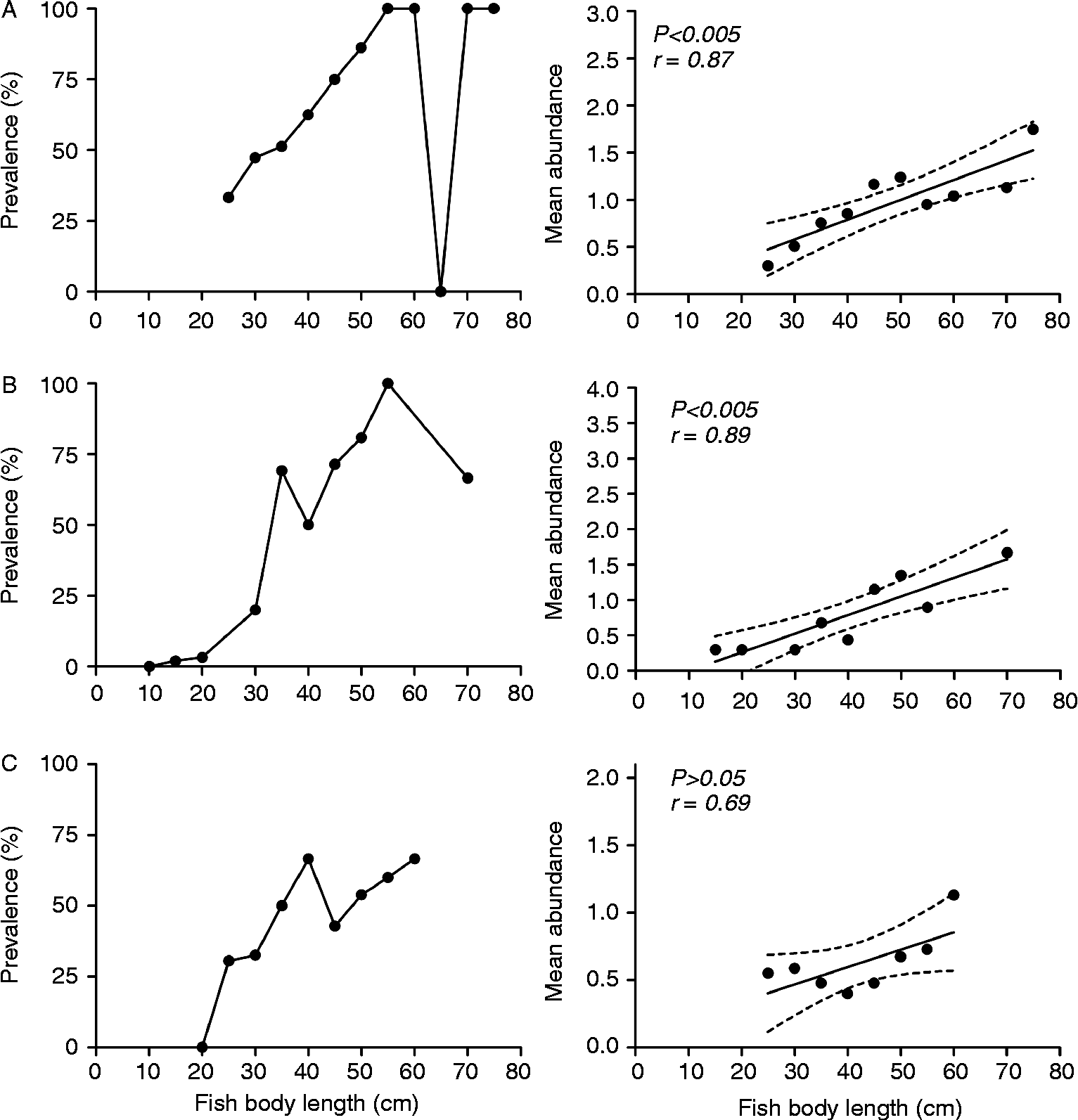
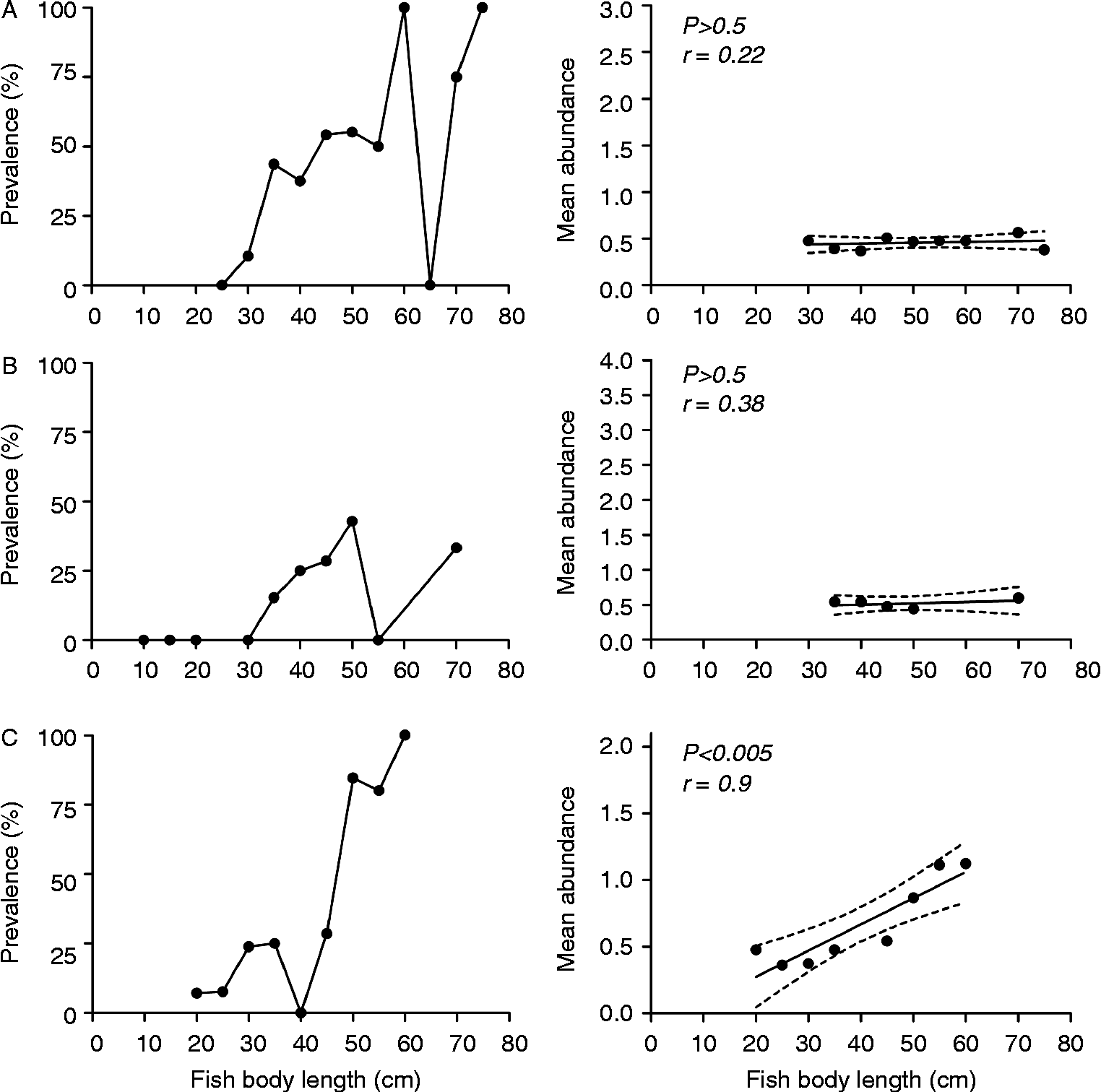
Three of the parasite taxa had a prevalence in the stomach of more than 5% and for these, mean abundance and prevalence were examined with host length for the three seasons (figs 1, 2 and 3). Elytrophalloides oatesi and Hysterothylacium spp. showed positive correlations between abundance and host length but only during November –January (P< 0.01 and P< 0.005, respectively) and February–June (P< 0.01 and P< 0.005, respectively). There was a positive correlation between mean abundance and host length for Anisakis spp. only during July–October (P< 0.05).
Correlation analysis (95% confidence intervals) between the seasonal prevalence (%) and mean abundance [log(Ab+1)] of Elytrophalloides oatesi and fish body length (cm) during November–January (A), February–June (B) and July–October (C).
Correlation analysis (95% confidence intervals) between the seasonal prevalence (%) and mean abundance [log(Ab+1)] of Hysterothylacium spp. and fish body length (cm) during November–January (A), February–June (B) and July–October (C).
Correlation analysis (95% confidence intervals) between the seasonal prevalence (%) and mean abundance [log(Ab+1)] of Anisakis spp. and fish body length (cm) during November–January (A), February–June (B) and July–October (C).
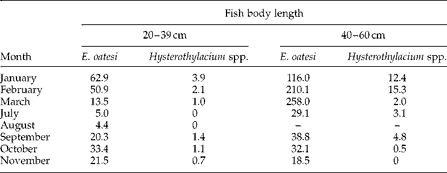
The prevalence of Hysterothylacium spp. and Anisakis spp. increased with host length for all seasons (the 0% at 65 cm LT for both taxa during November – January was due to only one fish being sampled). For E. oatesi the prevalence in fish less than 20 cm was virtually zero, then there was a dramatic increase in infection, and fish over 30 cm were almost all infected. During July–October, once toothfish reached an LT of greater than 55 cm, prevalence of E. oatesi appears to start to decline with host length. As there were ontogenic changes in abundance of the digenean E. oatesi, seasonal variations in abundance were examined for 20–39 cm and 40–60 cm toothfish. Table 3 shows that abundance of E. oatesi is dependent on time of year, with the greatest average abundance found in the stomach of toothfish during summer and lowest average abundance in autumn/winter. The nematode, Hysterothylacium spp. was also seasonal, with the greatest average abundance found in the stomach of toothfish during summer and abundance levels much lower in the winter (table 3).
The mean abundance of the digenean Elytrophalloides oatesi and the nematode Hysterothylacium spp., relative to fish body length (cm) and month.
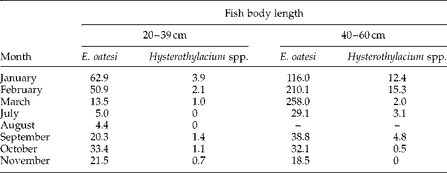
–, Not sampled.
Spatial differences in parasite fauna
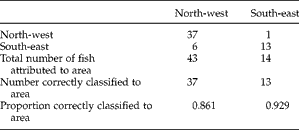
The results of the linear discriminant analysis for all taxa of parasite during the season November–January for fish 40–60 cm LT is given in table 4 and shows an overall correct classification of 87.7% for the north-west and south-east. Although three species (Gonocerca phycidis, Lecithochirium genypteri and Corynosoma bullosum) were only found in the north-west of the Falklands (in November–January for fish 40–60 cm), the difference in their prevalence with the south–east was not significant (Fisher's exact test for all three species P>0.05, n= 57). Examination of abundance of parasites for 40–60 cm fish sampled during November–January showed there were significantly more E. oatesi and Hysterothylacium spp. in the north-west than in the south-east (Mann–Whitney U test P< 0.001, U statistic = 60.5 and P< 0.001, U statistic = 81, respectively) with an average abundance of 139 E. oatesi and 17 Hysterothylacium spp. in the north-west and 31 E. oatesi and 3 Hysterothylacium spp. in the south-east.
Linear discriminant analysis of the parasite fauna of juvenile toothfish, Dissostichus eleginoides within the body length range 40–60 cm during the season November–January for the years 2007–2009.
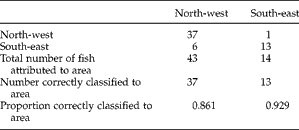
Overall correct classification = 87.7% (50/57) (Wilks' lambda 0.511, P< 0.001).
Discussion
For the first time the abundance and prevalence of stomach parasites of juvenile D. eleginoides on the Falkland's shelf have been examined for both ontogenic and spatial differences in relation to different seasons. Fourteen taxa of stomach parasites were found in juvenile D. eleginoides from the Falklands (plus one species that likely came from the mouth with a piece of food). Gaevskaya et al. (Reference Gaevskaya, Rodyuk and Parukhin1990) reported the high diversity of parasite fauna in toothfish to be most likely due to their highly predatory nature, and proposed that it would also vary depending on the general parasite fauna of the area.
Hoogesteger & White (Reference Hoogesteger and White1981) found that diversity of endoparasites varied with diet, with fish that have fed predominately on krill having a reduced diversity of endoparasites, whereas fish that fed on benthos or other fish had a greater range of parasites. This would help explain the lack of parasites in very small fish, and of the two fish < 10 cm in this study (which had fed only on euphausids) few parasites were found in the stomach (i.e. four E. oatesi in one fish and no parasites in the other fish). As the juveniles grow, they switch to a diet of fish (Brown, Reference Brown2011) and have a greater abundance of parasites.
Brickle et al. (Reference Brickle, MacKenzie and Pike2006) reported that Echinorhynchus longiproboscis showed an increasing prevalence with toothfish length. Little is known of the life cycle of E. longiproboscis, although it is known to infect macrourids (in the deep waters of the southern Patagonian shelf (Gaevskaya & Rodjuk, 1988)) which form a dietary component of larger D. eleginoides (Arkhipkin et al., Reference Arkhipkin, Brickle and Laptikhovsky2003). Interestingly, in this study the only recorded occurrence of E. longiproboscis was in a small fish (26 cm), suggesting that the infected intermediate host (most likely an amphipod as acanthocephalans use amphipods as intermediate hosts (Zdzitowiecki, Reference Zdzitowiecki1991)) occurs on the shelf in shallower waters.
In their study on parasite fauna of the Falkland Islands, Brickle et al. (Reference Brickle, MacKenzie and Pike2006) recorded four taxa of parasite from the stomach of toothfish (from fish 23–150 cm LT) that were not found in this study. These were two Digenea, Derogenes varicus and Glomericirrus macrouri, and two Nematoda, Contracaecum spp. and Pseudoterranova decipiens. In their study, all four of these taxa were found to have a prevalence of < 6% and an abundance of < 0.22 (Brickle et al., Reference Brickle, MacKenzie and Pike2006). Derogenes varicus uses gastropods (Natica sp.) as its first hosts, then fish as intermediate hosts, and it is possible that, as Brickle et al. (Reference Brickle, MacKenzie and Pike2006) studied larger toothfish than in the present study, D. varicus infests fish species which are only predated on by larger toothfish. Little is known about the biology of G. macrouri; however, it is reported to occur, only with low prevalence, in Antarctica; it was found at 100–300 m depth in demersal fish around the South Shetland Islands (Zdzitowiecki, Reference Zdzitowiecki1991, Reference Zdzitowiecki1997); and Brickle (Reference Brickle2003) only found this species in deeper water. Gaevskaya et al. (Reference Gaevskaya, Rodyuk and Parukhin1990) suggested that G. macrouri is transferred predominately when D. eleginoides predates on grenadiers, explaining its absence in this study as juvenile toothfish are not reported to feed on grenadiers (Brown, Reference Brown2011). Pseudoterranova decipiens is mainly found in the liver (which was not investigated in this study) and only occasionally on the stomach wall (Brickle, Reference Brickle2003), which may explain its absence in this study.
Brickle et al. (Reference Brickle, MacKenzie and Pike2006) reported Ascarophis nototheniae for the first time in D. eleginoides around the Falklands. Ascarophis nototheniae was also found in one individual toothfish, of length 48 cm, in the present study. Brickle et al. (Reference Brickle, MacKenzie and Pike2006) stated that this species was likely to be at the extent of its range in the Falklands as it is normally found in the sub-Antarctic and Antarctic regions; however, it was found to the north-east of the Falklands in this study (50.2°S, 55.6°W), although in the region which is affected by the cooler sub-Antarctic waters brought northwards by the Falklands Current.
Both E. oatesi and Hysterothylacium spp. showed increasing abundance with host length, although for both taxa this relationship was not significant for the months February–June when their abundance was at its lowest. Brickle et al. (Reference Brickle, MacKenzie and Pike2005) also reported Hysterothylacium spp. abundance and prevalence to increase with host length (from toothfish from Shag Rocks) and they attributed this to an increasing surface area (larger stomach) for the parasite to infest. Brickle et al. (Reference Brickle, MacKenzie and Pike2006) found a decreasing prevalence of E. oatesi with host toothfish length and postulated that this change in abundance was related to ontogenetic changes in diet. However, they only sampled fish greater than 25 cm LT so did not see the increase in prevalence in fish of length between 15 and 30 cm, as seen in this study. This initial infestation with E. oatesi in the small fish is likely to occur when they switch from feeding on euphausids (which are not hosts to E. oatesi) to predating on nototheniids (which will be infected as they feed on copepods that are the intermediate host of E. oatesi). Brickle et al. (Reference Brickle, MacKenzie and Pike2006) only examined ontogenic changes in parasite abundance for all seasons combined, and hence their results may be affected by the reduced number of E. oatesi during winter. They reported a decrease in abundance at larger sizes, which is likely caused by the broader niche breadth and the switch in diet from nototheniids to more predatory fish, e.g. Micromesistus australis and Macrourus spp. (Arkhipkin et al., Reference Arkhipkin, Brickle and Laptikhovsky2003; Brickle et al., Reference Brickle, MacKenzie and Pike2006). This decrease was only seen during the winter months in the present study; however, in this study only juvenile fish were examined, which fed predominately on nototheniids (Brown, Reference Brown2011).
Brickle et al. (Reference Brickle, MacKenzie and Pike2006) found no correlation between abundance of Anisakis spp. and host length, which was also true for the present study in the seasons November–January and February–June. They also reported an increase in prevalence in Anisakis spp. with host length, which again was corroborated by this study. However, in this study, Anisakis spp. abundance was significantly correlated with host length for July–October. Dissostichus eleginoides will accumulate Anisakis spp. through predating on infected euphausiids and, as it grows, through feeding on infected fish and squid. As there was a greater occurrence of squid in the diet during July–October (Brown, Reference Brown2011) and larger fish will consume a greater amount of prey, this may result in the significant relationship with host length during this season.
A lower prevalence of E. oatesi was recorded during winter in this study. Gaevskaya et al. (Reference Gaevskaya, Rodyuk and Parukhin1990) and Brickle et al. (Reference Brickle, MacKenzie and Pike2006) also studied parasites of D. eleginoides around the Falklands and reported a decrease in E. oatesi during winter. Brickle et al. (Reference Brickle, MacKenzie and Pike2006) reported the prevalence of E. oatesi as 94.4%, 60% and 91.6% for summer (January/February), winter (July/August) and spring (October and December), respectively. Gaevskaya et al. (Reference Gaevskaya, Rodyuk and Parukhin1990) suggested that this was due to a seasonal change in feeding intensity combined with the life span of E. oatesi, and Brickle et al. (Reference Brickle, MacKenzie and Pike2006) also thought this could be evidence of ‘temporal niche separation to reduce interspecific competition’ with other parasites.
Anisakis spp. only showed a significant increasing abundance with host length during the season July–October. As mentioned above, July and August were the months with the highest percentage frequency occurrence of squid in the diet (Brown, Reference Brown2011). Anisakis spp. uses euphausiids as a first intermediate host, and squid and fish as a second intermediate host, therefore it is possible that this significant relationship between host length and Anisakis spp. abundance is related to a seasonal change in diet, with the appearance of squid in the diet (Brown, Reference Brown2011).
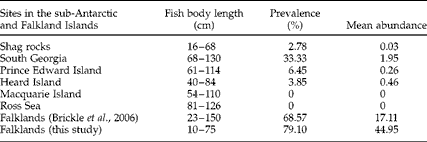
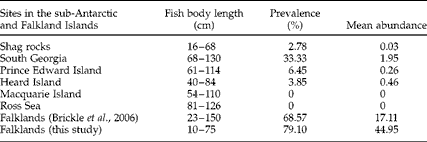
Elytrophalloides oatesi and Hysterothylacium spp. were both present in significantly higher abundance in the north-west compared to the south-east. Warmer waters of the Argentinean drift flowing southwards dominate the north-west region whereas the south-east is dominated by cold sub-Antarctic waters (being brought northwards by the Falklands Current) (Arkhipkin et al., Reference Arkhipkin, Grzebielec, Sirota, Remeslo, Polishchuk and Middleton2004, Reference Arkhipkin, Brickle and Laptikhovsky2010). Brickle et al. (Reference Brickle, MacKenzie and Pike2005) examined the parasite fauna in different parts of the sub-Antarctic and found a lower prevalence and abundance reported for E. oatesi around Prince Edward and Heard Island compared to South Georgia, and no E. oatesi reported for Macquarie Island or the Ross Sea (table 5). Prevalence and abundance of E. oatesi from all the sub-Antarctic islands (Brickle et al., Reference Brickle, MacKenzie and Pike2005) were much lower than for the Falklands (Brickle et al., Reference Brickle, MacKenzie and Pike2006; this study), again indicating a lower abundance in colder waters. The prevalence of E. oatesi decreases from west to east, with Chile at the end of the eastern range. Molluscs are reported as the hosts of the parthenogenetic generations (asexually reproducing generations) of the digeneans (Zdzitowiecki, Reference Zdzitowiecki1997) and it is possible that it is the distribution of these hosts that affects the abundance of the parasite E. oatesi within D. eleginoides.
The prevalence (%) and mean abundance of Elytrophalloides oatesi from Patagonian toothfish, Dissostichus eleginoides from the sub-Antarctic (Brickle et al., Reference Brickle, MacKenzie and Pike2005) and the Falklands (Brickle et al., Reference Brickle, MacKenzie and Pike2006; this study).
Few parasite investigations had been carried out on D. eleginoides in the Falkland Islands prior to the work of Brickle (Reference Brickle2003) and Brickle et al. (Reference Brickle, MacKenzie and Pike2005, Reference Brickle, MacKenzie and Pike2006), and the present study provides new data on the seasonal, spatial and ontogenic variations in parasites in juvenile toothfish ( < 75 cm LT). Elytrophalloides oatesi is found to have varying abundance in different regions in the Falklands and it is reported to be absent in toothfish from central Chile (Rodriguez & George-Nascimento, Reference Rodriguez and George-Nascimento1996; Oliva et al., Reference Oliva, Fernandez, Oyarzun and Murillo2008) and from Macquarie Island and the Ross Sea (Brickle et al., Reference Brickle, MacKenzie and Pike2005). This makes this species a candidate for use as a biological tag to study host movements and population structure; however, more seasonal data would be required from the different areas as abundance of E. oatesi varies seasonally. Laptikhovsky et al. (Reference Laptikhovsky, Brickle and Arkhipkin2006) suggested two types of migration of D. eleginoides in the Falklands; however, on the contrary, Brown (Reference Brown2011) found that spawning migrations were not as extensive as Laptikhovsky et al. suggested. We used specific size ranges to compare regional differences and negate ontogenic effects of migrations and community structure change. Several taxa were only found in the north-west area in the Falklands, but only in low abundance, and so a greater sample size would be required to study this further. Oliva et al. (Reference Oliva, Fernandez, Oyarzun and Murillo2008) also reported the digenean Brachyphallus crenatus in high prevalence throughout the year, which was not found in either this study or those of Brickle et al. (Reference Brickle, MacKenzie and Pike2005, Reference Brickle, MacKenzie and Pike2006). Perhaps this species is only found in the Pacific and not in the South Atlantic, and could therefore also be a potential species for use as a biological tag.
Acknowledgements
We gratefully acknowledge funding of this work by Consolidated Fisheries Limited and the invaluable assistance of the captain and crew of the CFL Gambler; without them this work would not have been possible. Thanks to J. Barton, Director of Fisheries, Falkland Islands Government Fisheries Department for supporting this work, and to the observers who helped collect samples at sea.