In many domestic and international bargaining situations, we often observe one or both negotiators making public statements in front of their constituents about the share of the benefits that they expect to obtain in the negotiations. For example, before the Copenhagen Summit of the European Union (EU) in December 2002, the Turkish government asked the EU to choose a date to start membership negotiations with Turkey. Anticipating that it was more likely that the EU would instead simply select a date to review whether Turkey had met membership conditions, the leader of Turkey's incumbent Justice and Development Party, Recep Tayyip Erdoğan, publicly announced that a review date was “not acceptable.”1
Similarly, in the negotiations surrounding a peace deal in Northern Ireland in the mid-1990s, all of the parties involved made numerous public statements about their bargaining positions. For instance, in the lead-up to the negotiations that culminated in the “Good Friday Agreement” of April 1998, Prime Minister John Major of Britain declared that all of the Irish paramilitaries had to “decommission” their weapons before negotiations could begin. Similarly, the leader of the pro-union Ulster Unionist Party (UUP), David Trimble, publicly stated that there was “no question of negotiations without decommissioning.” Meanwhile, Gerry Adams, head of the Irish Republican Army's (IRA) political wing, Sinn Fein, publicly announced that the IRA's weapons would be decommissioned only after the conclusion of the negotiations.2
As a final example, since a tentative peace dialog began between India and Pakistan in January 2004, each side's government has repeatedly rebuked the other for presenting its bargaining position and intentions directly to the press rather than privately to the other government. President Pervez Musharraf of Pakistan has publicly stated that unless a final agreement is reached on the disputed region of Kashmir, talks on all other issues between the two sides, including trade, cross-border terrorism, and nuclear safeguards, would collapse. On the other hand, the Indian foreign minister publicly compared India's dispute with Pakistan to its traditional but recently declining tensions with China, implying that important progress on other issues could be made even if a final settlement on the border dispute remains elusive. The escalating public statements on both sides led the Pakistani foreign minister to call for a “rhetoric restraint regime.”3
These examples pose a number of questions. First, what is the motivation behind making public statements like these, especially if backing down from them can carry domestic political costs? Second, why do the sides often make mutually incompatible public demands, since this means that at least one side's demands will go unfulfilled? Third, what is the incentive for each side to restrain itself from making public commitments, and will a “rhetoric restraint regime” ever be honored?
In this paper, we examine these issues by analyzing a game-theoretic bargaining model in which leaders can make public commitments prior to the bargaining, but backing down from these commitments is costly. That is, we assume that public statements generate potential “audience costs” for the leader (Fearon 1994, 1997; we discuss the possible sources of such costs later). Our analysis builds on Schelling's (1960, 28) intuition that, “When national representatives go to international negotiations knowing that there is a wide range of potential agreement within which the outcome will depend on bargaining, they seem often to create a bargaining position by public statements, statements calculated to arouse a public opinion that permits no concessions to be made.” In particular, we explore how public commitments can be used to generate bargaining leverage in negotiations.
Our results speak to the old debate about whether the public nature of foreign policy decision making in democracies is a disadvantage or a benefit. Writers such as de Tocqueville ([1835] 1945) and Morgenthau (1956) have argued that effective diplomacy requires secrecy and freedom from domestic constraints. Our results indicate the conditions under which leaders as well as their citizens prefer negotiations to be held publicly or secretly. Contrary to the claims of de Tocqueville and Morgenthau, we show that publicity in negotiations can sometimes be an advantage.
The effects of audience costs have been explored in quite some detail in recent formal work on crisis bargaining, that is, bargaining in the shadow of war (e.g., Fearon 1994; Schultz 1999; Smith 1998). There has been much less work done on how audience costs can affect noncrisis bargaining, for example, the negotiation of trade agreements or treaties. We present such an analysis here.
THE MODEL
The model is an extension of the following version of the Rubinstein (1982) bargaining model. Two players, labeled player 1 (a “she”) and player 2 (a “he”), take turns making proposals to divide a pie of size 1. Negotiator 1 is chosen to make the first proposal with probability 0≤ p≤ 1, and negotiator 2 makes the first proposal with probability 1−p, after which they alternate making proposals. Negotiators discount future payoffs with common discount factor 0<δ<1.
If player 1 is chosen to make the first proposal, let
, where 0≤ x≤1 denote player 1's proposal. If player 2 accepts this proposal, then player 1 receives payoff x, player 2 obtains utility (1−x), and the game ends. If player 2 rejects the proposal, he makes a counterproposal in the next period, denoted by
, where 0≤ y≤1. If player 1 accepts this proposal, player 1 obtains utility δ(1−y), player 2 receives payoff δ y, and the game ends. If player 1 rejects the proposal, she gets to make the next offer.
The game continues until one player accepts the other's proposal. In general, if an agreement
is reached in period t (
), then player i's payoff is
(i=1,2). If an agreement is never reached, both players receive utility 0. Rubinstein (1982) shows that there is a unique subgame perfect equilibrium (SPE) of this game in which the players always propose
for their own share and
for the other player's share, and in which the players reach an agreement in the first period of the game.
Here, we consider a variant of this model in which the two players (henceforth called negotiators) can make public commitments in front of their domestic constituents to obtaining some minimal share of the pie before the formal bargaining process begins. In the first move of the game, the two negotiators simultaneously announce their public commitments. Negotiator 1 publicly commits to receiving an amount of the pie at least equal to a, where 0≤ a≤ 1, and negotiator 2 commits to obtaining at least b, where 0≤ b≤ 1. If negotiator 1 receives at least a in the bargaining subgame, then her payoff is simply the share of the pie that she obtains (appropriately discounted by time). Otherwise, if she obtains less than a, then she pays a cost for backing down from her public commitment, and her overall payoff is the share of the pie minus the cost (appropriately discounted by time).
Let
denote negotiator 1's cost for violating her public commitment when she commits to receiving at least a and actually receives m. Then we assume the following:
Similarly, if negotiator 2 publicly commits to receiving at least b and actually receives n, then the cost he pays is
The interpretation is that the cost increases linearly with the deficit between what the negotiator publicly commits to and what it actually receives: the greater the deficit, the greater the cost. The “cost coefficient” ϕ measures how costly it is for the negotiator to violate a public commitment by a given amount: the higher ϕ is, the more costly it is.
Note that in this model, in contrast to most previous formal models of audience costs, the magnitude of the audience cost is endogenous and depends on the negotiator's commitment level and the share of the pie it ends up accepting in equilibrium. The only part of the audience cost that is exogenous is ϕ, and later we discuss how this parameter can vary by regime type and the leader's domestic political situation.
The timing of the game is as follows. First, the two negotiators simultaneously announce their public commitments a and b. Then nature chooses which negotiator gets to make the first proposal to divide the pie, with negotiator 1 chosen with probability 0≤ p≤ 1 and negotiator 2 chosen with probability 1−p, after which they alternate. If they reach agreement on
in period t (
), then player 1's payoff is
and player 2's utility is
. If the two negotiators never reach an agreement, both of them receive payoff 0.
In the economics literature, Muthoo (1992, 1996, 1999) also provides a formal analysis of the commitment tactic (so does Crawford 1982; however, he examines a very different type of problem and model). The primary way in which our work differs from his is that he uses the Nash bargaining solution (Nash 1950) to characterize the solution of the bargaining subgame, whereas we use an alternative-offers bargaining protocol and the subgame perfect equilibrium solution concept. Binmore (1987) shows that the unique subgame perfect equilibrium payoffs of the alternating-offers Rubinstein (1982) model converge to the Nash bargaining solution as the players' discount factor converges to one, and indeed our results converge to Muthoo's (1992) as the discount factor in our model converges to one. Thus, Muthoo's results emerge as a special case in our model, when the discount factor approaches one.
Proposition 1
For any
, the following is the unique stationary subgame-perfect equilibrium of this game: negotiator 1 makes the public commitment {
, negotiator 2 makes the public commitment
, and when they do, in the bargaining subgame the negotiators use the following strategies:
- (a) Negotiator 1 always proposes and always accepts any proposal such that .
- (b) Negotiator 2 always proposes and always accepts any proposal such that .
Note that agreement is reached in the first period. If a player deviates from its equilibrium public commitment, then the strategies used in the bargaining subgame are specified in the proof in the appendix.5
If
(i=1,2), then negotiator i can make any public commitment in equilibrium, as the commitment has no effect anyway.
We discuss this result in a number of parts.
One-Sided Public Commitment
First consider the case where only one negotiator, say negotiator 1, pays a cost for backing down from a public commitment (i.e., suppose that
and
). This might be the case, for instance, if country 1 is a democracy and country 2 is an autocracy. In this case, country 1's expected share of the pie is larger than what it would be if public commitments were not allowed (i.e., in the Rubinstein 1982 model), and country 2's is smaller.6
Negotiator 1's expected share of the pie is
. It can easily be shown that when
and
,
and
.
In other words, being the only side to be able to make a costly public commitment provides bargaining leverage to that side. When a leader makes a public commitment that would be costly to back down from, that leader requires a larger share of the pie for it to be worthwhile to reach an agreement, and the other leader realizes this and hence compromises. Therefore, the public commitment tactic provides bargaining leverage.
Note that in equilibrium, the share of the pie that negotiator 1 proposes for herself when she makes a proposal is the same as her equilibrium public commitment (i.e.,
). Hence, negotiator 1 does not pay an audience cost when she gets to make the first proposal (which negotiator 2 accepts). However, negotiator 2's proposal for negotiator 1 is less than negotiator 1's commitment level (i.e.,
). Therefore, negotiator 1 pays an audience cost when negotiator 2 gets to make the first proposal (which negotiator 1 accepts). Hence, negotiator 1's optimal commitment level in equilibrium is such that unless she makes the first proposal with certainty (i.e., unless p=1), she expects to pay an audience cost.
Because she expects to pay an audience cost, negotiator 1's expected payoff is a little less than her country's expected share of the pie. However, her payoff is still larger than it would be if public commitments were not allowed (i.e., in the Rubinstein 1982 model),7
Negotiator 1's expected payoff is
. It can easily be shown that when
and
,
and
.
and hence the negotiator benefits from being the only side to generate costly public commitments. The other negotiator, on the other hand, is worse off.
Two-Sided Public Commitment
When both sides face costs for backing down from public commitments (i.e., when
), then whether public commitments are beneficial depends on the relative magnitudes of each side's audience cost rate, ϕ1 and ϕ2.
In determining whether public commitments are beneficial to a side, there are two payoffs to consider. One is the country's share of the pie, which can be thought of as the welfare of the citizens of that country. The other is the negotiator's personal payoff, which is the share of the pie minus the audience cost, if any, that is incurred.
It turns out that negotiator 1 benefits from public commitments if and only if she pays a significantly larger cost for violating a public commitment by a given amount than does negotiator 2 (i.e., if and only if ϕ1 is sufficiently larger than ϕ2). Why is this the case? First note that the equilibrium proposals for negotiator 1, x* and 1−y*, are both increasing in ϕ1 and decreasing in ϕ2, which means that negotiator 1's expected share of the pie is also increasing in ϕ1 and decreasing in ϕ2. Finally, note that negotiator 1's equilibrium public commitment a* is also increasing in ϕ1 and decreasing in ϕ2.
These results mean that as ϕ1 increases (or ϕ2 decreases), negotiator 1 is demanding a bigger share of the pie and getting more. The net result is that her expected payoff is increasing in ϕ1 and decreasing in ϕ2. The more costly it is for a negotiator to violate a public commitment by a given amount (and the less costly it is for the other side), the greater its equilibrium public commitment, its share of the pie, as well as its personal payoff.8
Muthoo (1992) also finds that a negotiator's payoff is increasing in its cost coefficient.
It turns out, then, that whether a negotiator benefits from public commitments depends on the relative values of ϕ1 and ϕ2. In particular, negotiator 1 benefits from public commitments (relative to the Rubinstein 1982 model in which public commitments are not allowed) if and only if ϕ1 is sufficiently larger than ϕ2 (in particular, if and only if
). Similarly, negotiator 2 benefits from public commitments if and only if ϕ2 is sufficiently larger than ϕ1 (in particular, if and only if
). When ϕ1 and ϕ2 are close to each other, both sides are worse off than they would be without public commitments.
We normally think that democratic leaders pay significantly greater costs for violating public commitments than do autocratic leaders who are less accountable to the public (e.g., Fearon 1994 uses this as a working assumption; also see Schelling 1960, 28); that is, a democratic leader has a significantly greater ϕ than does an autocratic leader. Thus, a prediction of the model is that democratic leaders can and will use public commitments to obtain bargaining leverage when negotiating with autocratic leaders. On the other hand, the cost of losing power for autocrats is often higher than for democratic leaders, including the possibility of imprisonment or execution, among others (Gowa 1995). Therefore, this assumption does not always have to hold.9
Another way of saying this is that democratic leaders face a greater likelihood of losing office for backing down from a public commitment, but the payoff for this outcome can be significantly worse for autocrats.
Even if two democratic leaders are negotiating with each other, they may differ quite a bit in how costly it is to violate a public commitment by a given amount. For example, it seems that violating a public commitment would be especially costly just prior to elections, because elections provide a particularly convenient method for voters to punish their leader for violating a public commitment. This would especially be the case if the leader is also politically vulnerable domestically, for example, if it is facing a weak economy or other domestic problems. We might call this type of leader, which (we presume) has a very high ϕ because it is facing elections and is politically insecure, a high audience cost leader.
A leader who is domestically secure and not facing elections would seem to face the lowest cost for violating a public commitment, and we might call this a low audience cost leader. Leaders who are facing elections but are politically secure, as well as leaders who are politically vulnerable but are not facing elections, would seem to have an intermediate cost for violating a public commitment, and we might call these medium audience cost leaders. The model predicts that a high audience cost leader would be able to use public commitments to gain bargaining leverage when negotiating with a low audience cost leader, and possibly with medium audience cost leaders as well, depending on the difference in their audience cost coefficients. Similarly, medium audience cost leaders may have bargaining leverage when negotiating with a low audience cost leader.
An autocratic leader who is domestically vulnerable may have bargaining leverage when negotiating with a low audience cost democratic leader. And all types of leaders who face positive audience costs can generate bargaining leverage when negotiating with entities that do not, such as when developing countries are negotiating with international institutions such as the International Monetary Fund (IMF) for the terms of financial assistance.
A Prisoner's Dilemma and a Rationale for Secret Negotiations
We have seen that when only one side can generate costly public commitments or one side pays a significantly greater cost for violating a public commitment by a given amount than does the other, then the former negotiator benefits from public commitments and the latter is worse off. On the other hand, if ϕ1 and ϕ2 are both positive and close to each other (in particular, if
), then both negotiators are worse off with public commitments than without.
To understand why this is the case, consider the situation where
and p=1/2 (i.e., each side has an equal chance of being chosen to make the first proposal, so there is no first-mover advantage in expectation). Then each side makes the same public commitment
, which is greater than 1/2, but each side only expects to receive 1/2 in the bargaining subgame. That is, each side expects to obtain merely the same amount of the pie that it would if public commitments were not allowed, but also pays an audience cost with positive probability (if the other side is chosen to make the first proposal). Hence, both sides would be better off if neither made a public commitment.10
They are better off ex ante as well as ex post, that is, before nature chooses the first proposer as well as afterwards.
The same general result holds whenever ϕ
1 and ϕ
2 are close to each other. We would expect this to be the case, for instance, when two leaders facing similar domestic political conditions negotiate with each other.
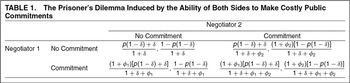
This suggests that prior to entering into negotiations, two farsighted leaders facing fairly similar costs for violating public commitments would make an agreement to refrain from making public commitments. This resembles the “rhetoric restraint regime” proposed by the Pakistani foreign minister, as discussed earlier. However, the problem turns out not to be so simple, because the ability of both sides to make public commitments actually creates a prisoner's dilemma in which each side has a dominant strategy of making a public commitment.
Table 1 shows the strategies and the resulting payoffs. Each side's most preferred outcome is where it makes a public commitment but the other side does not. Each side's least preferred outcome is where it does not make a public commitment but the other side does. And when ϕ1 and ϕ2 are sufficiently close to each other (in particular, when
), then each side prefers the outcome where neither makes a public commitment to the outcome where both make public commitments.
This preference ordering induces the familiar prisoner's dilemma in which each side's dominant strategy is to make a public commitment (in the traditional parlance of the prisoner's dilemma, to “defect”). If you believe that the other side is not going to make a public commitment, you want to make one in order to obtain the bargaining leverage of the one-sided case; and if you believe that the other side is going to make a public commitment, you also want to make one in order to mitigate the bargaining leverage that the other side will otherwise have over you. Thus, no matter what you believe that the other side is going to do, you are best off making a public commitment. Each side's dominant strategy leads to the suboptimal outcome where both make public commitments, an outcome which is Pareto-dominated by both not making public commitments.
Therefore, the model illustrates how difficult it is for two leaders facing fairly similar costs for violating a public commitment by a given amount to refrain from making public commitments and winding up in a suboptimal outcome. This suggests that any nonbinding “rhetoric restraint regime” is unlikely to work. And indeed, just prior to a meeting between the two countries' foreign ministers in early September 2004, an Indian foreign ministry spokesman stated that, “There is considerable disappointment here today at the unifocal statement made by the Pakistan foreign minister about India-Pakistan relations… This is not in consonance with the spirit in which we have conducted the composite dialogue so far. It also violates Pakistan's own call for a rhetoric restraint regime” (emphasis added).11
However, the possibility of keeping the negotiations secret provides a solution to this problem. Although neither side will abide by an unenforceable agreement not to make a public commitment because the dominant strategy is to make a public commitment, if the negotiations are being conducted secretly without the public's knowledge, then there is nothing to publicly commit to; hence, the suboptimal outcome can be avoided. Conducting the negotiations secretly provides a mechanism for both sides to avoid making public commitments and winding up in the suboptimal outcome. Moreover, detecting violations of such an agreement is relatively easy, making countries more willing to rely on them (e.g., Keohane 1984). Hence, our model provides a new rationale for secret negotiations.
For example, the negotiations that led to the 1993 Oslo Accords between the Israelis and the Palestinians were conducted secretly and only made public once an agreement had been reached. Public talks sponsored by the United States were occurring at the same time in Washington with a different Palestinian negotiating team. The Washington talks were publicly known, and the Palestinian team there was making large demands regarding settlements and Jerusalem that the Israeli team found unacceptable (Perlmutter 1995). An agreement was only able to be reached in the secret negotiations being held in Oslo.
Subsequent negotiations between the two sides have taken place in the public eye and have been much more difficult to negotiate, up to the point that in recent years the negotiation process has almost completely come to a halt. These subsequent negotiations have occurred amidst public posturing on both sides. For example, regarding the final status of Jerusalem, which the Oslo Accords left for future negotiations, the late Palestinian leader Yasser Arafat repeatedly made public statements promising that Jerusalem would become the capital of a Palestinian state, whereas Yitzhak Rabin and subsequent Israeli prime ministers have made public promises that Jerusalem would remain the undivided capital of Israel (Perlmutter 1995).
Arafat also made numerous statements promising to secure a right of return for Palestinian refugees to their former homes in Israel, whereas all Israeli prime ministers have publicly declared that that is not an option. Makovsky (2001) writes:
The process also allowed each side to make contrary claims at home…Israeli leaders were able to continually promise their constituents what they wanted—including a united Jerusalem under Israeli sovereignty—while Arafat could promise his people what they wanted—including the right of return for all Palestinians to long-abandoned homes inside Israel. Arafat sold Oslo to his public by telling them it guaranteed a return to the 1967 lines and entailed no compromises. He led his people to believe that they would get 100 percent of the land they wanted.
When Arafat was not offered all of what he had promised to his people at the 2000 Camp David talks, in particular a right of return for the Palestinian refugees, the talks ended without an agreement, and the negotiation process ground to almost a complete halt soon afterwards when the second Intifadah began and Ariel Sharon was elected prime minister of Israel. Our model, which does not incorporate third-party actors such as extremists who can scuttle an agreement by diminishing trust between the two sides (see Kydd and Walter
2002), does not predict that an agreement will fail to be reached—it does predict, however, that the two sides will make mutually incompatible public demands and that the two leaders will have less of an incentive to reach an agreement than if public commitments were not allowed.
Indeed, it turns out in equilibrium that
: the two sides make mutually incompatible public demands; that is, the sum of their commitments exceeds the amount of pie that is available to be divided.12
Muthoo (1992) finds that the sum of the commitments is exactly 1. This is a special case of our results, since
(from above) as
.
Hence, at least one side gets less than what it publicly committed to (
ex post, exactly one side gets less in equilibrium, but
ex ante both sides expect to get less whenever 0<
p<1). A consequence of this is that the ability to make public commitments leads to an inefficiency in the bargaining outcome for the negotiators, because the negotiator that does not get to make the first proposal pays an audience cost in equilibrium. In addition to the Israeli–Palestinian case just mentioned, mutually incompatible public commitments were also made in the three cases discussed in the introduction.
As another example, Israeli and Egyptian leaders made mutually incompatible public commitments in the course of their tentative peace overtures to each other in the late 1970s. In a speech to the Israeli Knesset during an historic visit to Israel in November 1977, Egyptian president Anwar el Sadat stated that Egypt would only make peace with Israel if all Arab territories captured in the 1967 Six Day War were returned. During a visit to the Egyptian city of Ismailiyya the following month, Israeli prime minister Menachem Begin proposed that “autonomy” would be granted to Palestinians in the West Bank and Gaza Strip, but those territories would remain under Israeli sovereignty. Sadat rejected this as unacceptable, and the tentative peace process came close to a halt.
The Carter administration then intervened and after many months of discussion with both sides, Sadat and Begin agreed to meet with Carter at Camp David in September 1978. Partly to isolate each side from domestic pressures (and perhaps to make it easier for each side to restrain itself from making public commitments), Carter insisted that no reporters and television cameras be allowed during the course of the negotiations. Unlike the Oslo negotiations, the outside world was aware that negotiations were taking place—however, the negotiators were secluded from the press until the negotiations concluded after 13 days with an agreement that would eventually become a peace treaty between Egypt and Israel (Telhami 1990). In this case, a third party (the United States) was able to enforce a ban on public statements by hosting the negotiations under controlled conditions, which suggests another possible solution to the prisoner's dilemma.
A Principal–Agent Problem
So far, we have been examining the payoffs of the negotiators and their incentives to conduct the negotiations secretly or publicly. However, examining the payoffs of the citizens shows that there is a type of principal–agent problem that can arise from the ability to make costly public commitments.
We saw that negotiator 1 prefers public commitments to no commitments if and only if she pays a significantly greater cost for violating a public commitment by a given amount than does negotiator 2, that is, if and only if her cost coefficient ϕ1 is significantly larger than ϕ2. Recall that the negotiator's payoff is the share of the pie minus the audience cost, if any, that is incurred. Because they do not incur audience costs, only the leader does, the payoff of the citizens of a country can be thought of as simply that country's share of the pie. Recall that country 1's share of the pie (as well as negotiator 1's personal payoff) is increasing in ϕ1 and decreasing in ϕ2. Because of this, country 1's share of the pie with public commitments is larger than what it would be without public commitments if and only if ϕ1 is sufficiently large relative to ϕ2. However, it turns out that the threshold that ϕ1 has to exceed is not as large for the country's share of the pie as it is for the negotiator's payoff.
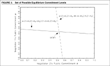
This is illustrated in Figure 1. This figure shows the range of values of ϕ1 relative to ϕ2 for which the leaders of countries 1 and 2 as well as their citizens want public commitments rather than no commitments. Leader 1 wants public commitments if and only if ϕ1 is sufficiently larger than ϕ2 (in particular, if and only if
), and leader 2 wants public commitments if and only if ϕ1 is sufficiently smaller than ϕ2 (in particular, if and only if
). Neither leader wants public commitments if ϕ1 and ϕ2 are close to each other (in particular, if
). The citizens of country 1 want public commitments if and only if
(where
), and the citizens of country 2 want public commitments if and only if
. Of main importance, as shown in the figure, is that the threshold of the citizens,
, lies between the thresholds of the negotiators.13
Note that
is an increasing function of ϕ2 and that
for
. Also note that
(from below) as
, and
(from above) as
. When
,
.
Range of Values of ϕ1 Relative to ϕ2 for Which Negotiators 1 and 2 and Their Publics Benefit from Public Commitments
The basic intuition behind this is that because they do not pay an audience cost, only the leader does, the citizens of country 1 have a lower threshold for ϕ1 above which they prefer public commitments to no commitments than does their leader. Hence, they want the negotiations to be held publicly under some conditions in which their leader wants them to be held secretly (namely, when ϕ1 is somewhat large but not too large). The same is true for the citizens of country 2.
Therefore, as seen in the figure, for all values of ϕ1 relative to ϕ2 (except the knife-edge case where
), it is the case that at least one of the four “actors” strictly wants public commitments. Even if ϕ1 and ϕ2 are close enough to each other that neither leader wants public commitments, one (and only one) of their publics wants public commitments.
This result has a number of implications. It can be seen from Figure 1 that our model predicts that (under complete information) it is never the case that both executives want public negotiations—if one side is benefiting, the other is worse off. However, in the real world we often observe public negotiations occurring. One answer to this puzzle is that public negotiations are the “normal” way of negotiating and that secret negotiations require the active assent of both parties. If one side objects to secret negotiations, the negotiations will be held publicly (and indeed, in our model in which no gains are made if the two sides do not negotiate, even the negotiator that does not want to negotiate publicly gains more from negotiating publicly than from not negotiating at all).
Another answer is incomplete information: if the two sides are uncertain of the other side's audience cost rate ϕ, each might believe that it will benefit from public commitments. An incomplete information extension of this model would be worthwhile for future research.
Finally, Figure 1 suggests a domestic politics-based explanation for why negotiations might be held publicly even when both negotiators want them held secretly. As seen from the figure, even when both leaders have an incentive to keep the negotiations secret (i.e., when ϕ1 and ϕ2 are close to each other), one side's public wants the negotiations to be held publicly. Although we do not explicitly model this, if this public can impose sufficient ex post costs on their leader for negotiating secretly, the leader will want to negotiate publicly even though its own preference (absent that cost) is to negotiate secretly. The citizens thus “force” their leader to to go public and incur audience costs in order to bring the citizens net benefits. This suggests that the secret negotiations mechanism will be hard for one negotiator to implement, if it anticipates that an ex post cost will be imposed by its citizens for negotiating secretly.
This also provides an explanation for the conventional wisdom that democratic publics dislike secret negotiations. One common explanation for this is that the people are suspicious that their leader is secretly “giving away the store.” For example, such an interpretation could be applied to Israeli prime minister Ehud Barak's relatively large concessions to Palestinian leader Yasser Arafat during the 2000 Camp David negotiations, and was also part of the basis for Woodrow Wilson's call for “open covenants, openly arrived at” (Jordan, Taylor, and Mazarr 1999, 54). However, the “giving away the store” explanation assumes that the public and the leader have (or may have) quite different preferences. In our model, the two have the same basic preference: they both want to obtain as large a share of the pie as possible for their country. However, there exist circumstances in which the leader wants the negotiations to be held secretly because it will otherwise incur audience costs which are greater than its side's increase in the share of the pie, but the public knows that the leader will obtain a larger share of the pie with public negotiations and hence does not want the leader to hold them secretly. The model thus provides an explanation for the conventional wisdom that democratic publics often dislike secret negotiations, without assuming that the leader has (or might have) different preferences from the majority of the public.
Finally, note that these results speak to the old question of whether the public nature of foreign policy decision making in democracies is a disadvantage or a benefit. Writers such as de Tocqueville ([1835] 1945) and Morgenthau (1956) have argued that effective diplomacy requires secrecy and freedom from domestic constraints. However, our results indicate that under some conditions a negotiator as well as its citizens benefit from public negotiations. Contrary to the claims of de Tocqueville and Morgenthau, publicity in negotiations can sometimes be an advantage.
Another Principal–Agent Problem
It turns out that there is another type of principal–agent problem that arises from the ability to make costly public commitments: namely, the negotiator does not make as large a public commitment as its citizens would like.
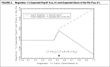
This is seen in Figure 2, which shows negotiator 1's expected share of the pie
and expected payoff
(share of the pie minus the audience cost, if any, that is incurred) as a function of her public commitment a as a ranges from 0 to 1, when negotiator 2 is choosing his equilibrium commitment level b*.
Negotiator 1's Expected Payoff V1(a, b*) and Expected Share of the Pie P1(a, b*)
As seen from the figure, when negotiator 1 makes a very low public commitment, then the commitment is too low to have any effect on the bargaining subgame. Extremely low public commitments have no effect, because the share of the pie that goes to the negotiator if she did not make a commitment is enough to satisfy a low commitment, and so it is as if no commitment were made.
On the other hand, when negotiator 1's public commitment a gets in the medium range, then her expected share of the pie starts increasing in a because the higher her public demand, the bigger are negotiator 1 and 2's equilibrium proposals for negotiator 1, x and 1−y, respectively. In this region, negotiator 1's expected utility is slightly lower than her expected share of the pie, because when negotiator 2 gets to make the first proposal, he offers negotiator 1 less than her public commitment (1−y<a), and so negotiator 1 pays an audience cost. However, the difference between negotiator 1's share of the pie and her personal payoff is only slight, because when negotiator 1 is chosen to make the first proposal, her proposal for herself is larger than her public commitment (x>a); hence, she does not pay an audience cost in this case.
Once negotiator 1's public commitment a gets too large, however, her expected payoff starts decreasing in a. She is still getting bigger and bigger offers (x and 1−y); hence, her share of the pie is still increasing in a. However, these offers are now increasing at a smaller rate than before. More importantly, her public commitment a is now high enough that even negotiator 1's own proposal for herself is less than her public commitment: x<a in addition to 1−y<a. Therefore, although she is still getting bigger offers, she is now always paying a cost for violating her public commitment, and the net result is that her expected payoff is decreasing in a.
Therefore, as seen in the figure, negotiator 1's expected payoff is maximized at
, and in equilibrium, this is the public commitment that she makes.14
Note that as
, the equilibrium public commitments in Proposition 1 converge to those in Muthoo's (1992, 383) Proposition 1.
One implication of
Figure 2 is that the negotiator does not make the commitment that maximizes the welfare of her citizens. Because the share of the pie is always increasing in the commitment level, the citizens want their negotiator to demand the entire pie. However, the negotiator chooses not to do this, because the cost she would pay for getting less than her public commitment makes it not worthwhile.
This illustrates an interesting point. It is the credibility that the leader will be punished for backing down from a public commitment that allows the leader to use a public commitment to extract a bargaining concession from the other side, a concession that benefits both the leader and the public; however, it is this very credibility that also ensures that the leader will not use the commitment tactic to the public's maximum advantage. The public's ability to impose costs on their leader is to their benefit; however, it also ensures that the benefit will not be all that it can be. The ability to make a public commitment generates a principal–agent situation in which the agent brings benefits to the principal (and to itself), but the agent's own interests limit the extent of the principal's benefits.
Equilibrium Public Commitments and Offers
The final interesting result to note from Proposition 1 is that in equilibrium
and
. That is, each negotiator's proposal for itself is the same as its public commitment. Hence, a negotiator never pays an audience cost in its own proposal (which is accepted by the other negotiator). However,
and
. That is, a negotiator's share of the pie when the other side makes a proposal is less than its public commitment; hence, each negotiator pays an audience cost in the other side's proposal (which it accepts).15
In Muthoo's (1992) results, each side's proposal offers each side exactly its public commitment, and so audience costs are never paid. In our results, this is a special case since
and
(from below) as
.
Hence, if the two negotiators probabilistically decide who gets to make the first proposal (or if they are uncertain about who will get to make the first proposal), then each side's optimal commitment in equilibrium is such that it expects to pay an audience cost. However, because the equilibrium does not depend on the value of $p$, even if one negotiator knows for certain that it will not make the first offer (i.e., even if p=0 or p=1), it chooses a public commitment high enough that it knows that it will pay an audience cost.
The intuition behind this is as follows: by making a higher public commitment, a negotiator makes it more likely that it falls in the range where it pays an audience cost, as well as increases the magnitude of that cost (when it is in the range where an audience cost is paid). However, it also increases the share of the pie that it obtains. In equilibrium, the optimal tradeoff is that the negotiator chooses to pay a limited audience cost in order to obtain a larger share of the pie.
This provides a rationale for why leaders typically make greater public demands than they expect to actually achieve (in fact, the model predicts that the optimal demand is such that the negotiator might obtain as much, but never more). Although the negotiator expects to pay a cost for doing so, the increased share of the pie that the commitment leads to more than compensates for this. The model explains why leaders publicly demand a lot, but not as much as the citizens would like.
CONCLUSION
In this paper, we analyze a formal model to help explain why negotiators often publicly commit themselves to obtaining certain benefits prior to entering into negotiations. And although most of our examples have been drawn from international politics, we believe that this bargaining tactic is also often used in domestic negotiations. For example, in the early 1950s, there was an attempt in the U.S. Senate to pass a constitutional amendment that would have put severe limits on the president's ability to negotiate executive agreements with other countries that do not require congressional approval. The Eisenhower administration first used quiet means to try to sink the Bricker amendment (named after its sponsor, Senator John W. Bricker (R-Ohio)), for example, by supporting an alternative, weaker version of the amendment. But when it became clear that the Bricker amendment was likely to pass on the Senate floor, the administration escalated to open confrontation, including placing an open letter in the Congressional Record stating that the president was “unalterably” opposed to the amendment (Martin 2000, 77). Ultimately, the amendment was defeated. Under the reasonable supposition that because of far greater media coverage the president can generate much greater audience costs than individual senators can, this outcome is consistent with the predictions of our model.
There has been much discussion in the crisis bargaining literature (bargaining in the shadow of war) on the microfoundations of audience costs (e.g., Schultz 1999; Smith 1998). At least four possibilities have been discussed in the literature, and our results suggest an additional one. First, Fearon (1994) argues that a leader that backs down from a public commitment may pay a domestic cost (e.g., is less likely to be reelected) because the domestic audience has perceived that the leader has violated the “national honor.” Second, he and Smith suggest that a leader that makes a public commitment and then has to back down from it may be perceived by the domestic public to be incompetent, hence, be less likely to be reelected. Third, Sartori (2002) argues that a leader caught bluffing may pay an international audience cost because that leader's rhetoric is less likely to be considered credible by leaders of other countries in the future: the cost is due to loss of future international credibility. Finally, Guisinger and Smith (2002) point out that this international audience cost can also lead to a domestic audience cost: if the rhetoric of a leader caught bluffing is less likely to be believed by other leaders in the future, and this leads to welfare losses for the nation because its diplomacy lacks effectiveness, this may be reason for the public to depose that leader and insert a new one with a fresh reputation.
We believe that all of these arguments, especially the last one, have merit. However, our own analysis suggests an additional rationale for audience costs. In our model, the ability to generate audience costs provides bargaining benefits to a negotiator, benefits that accrue to the public as well. Therefore, in a repeated negotiations framework in which a country is repeatedly negotiating international agreements, if the public's strategy is to punish a leader (perhaps electorally) who violates a public commitment, then this strategy allows their leader to generate audience costs and to secure bargaining benefits for them. On the other hand, if their strategy is to not punish their leader for violating a public commitment, then no extra bargaining leverage is obtained. Hence, voters in a democracy have an incentive to punish their leader for violating a public commitment not because of any vindicative or “national honor” related reasons, but simply because such a strategy provides them with a stream of bargaining benefits over the long run.16
Schultz (1999, 237) makes a related argument in the context of crisis bargaining—namely, that higher audience costs make it more likely that a state will prevail in international crises (Fearon 1994), and this is a rationale for the citizens to impose audience costs. Our argument focuses on bargaining benefits, and hence is related, but also quite different. In a technical supplement to this article, which is available from the authors' web sites or on request from the authors, we analyze a formal repeated negotiations model and derive the conditions under which the citizens will rationally choose to impose audience costs on their leader.
Our results have potentially important implications for the literature on signaling in international crises. Previous analyses of audience costs focus on a crisis bargaining setting in which two countries are in a dispute over an indivisible good and each is uncertain of the other's resolve for going to war (e.g., Fearon 1994, 1997; Schultz 1999). In this setting, it is argued, leaders (especially of democracies) can credibly convey their resolve by making public threats that generate potential audience costs. This literature concludes that audience costs, by allowing for credible information transmission in an incomplete information setting, generally has a beneficial effect: it reduces the frequency of suboptimal wars due to incomplete information (e.g., Fearon 1995).
However, our model, which considers a divisible good and allows for genuine bargaining, shows that audience costs can also be used as an instrumental source of bargaining leverage, even in a complete information setting in which audience costs have no signaling value. Moreover, the mutual use of audience costs can lead to a suboptimal outcome for both sides. Although ours is not a crisis bargaining model, its results suggest that in crisis bargaining over a divisible good, the use of audience costs as an instrumental source of bargaining leverage may lead to suboptimal outcomes, perhaps even war. If this is the case, we would have to reconsider the traditional beneficial view of audience costs that we have due to their signaling value. We leave this important examination of the effects of audience costs in crisis bargaining for future research.
Another important extension of this paper would be allowing for incomplete information about the other side's audience cost coefficient ϕ. With uncertainty like this, the two sides might end up making commitments that are jointly so large that there no longer exist agreements that both negotiators prefer to the status quo; hence, negotiations would break down (e.g., Muthoo 1999; this is a persuasive explanation of the failure of the 2000 Israeli-Palestinian Camp David negotiations, prior to which Arafat committed to a right of return for the Palestinian refugees, a concession which was not granted by Barak). Some of our findings might be modified under incomplete information. For example, we find that the public wants its leader to make as large a public commitment as possible, as this secures the largest share of the pie. With incomplete information, however, this incentive may no longer exist, as a larger public commitment probably would lead to a larger probability of negotiation failure. This also suggests, however, that leaders might modify their public commitments in response to the other side's commitment. We leave these important extensions of the model for future research.







Comments
No Comments have been published for this article.