The outlines of György Ligeti's biography are by now well known in academic music circles.Footnote 1 After a dangerous emigration from Hungary in December 1956 Ligeti and his wife Vera remained in Vienna for a few weeks. He then secured a small stipend through Herbert Eimert at Westdeutscher Rundfunk (WDR) in Cologne and in February 1957 began an internship in electronic music.Footnote 2 Ligeti entered this new and complex world of electronic music without much preparation:
The encounter with the composers in Cologne, being suddenly relocated to the electronic studio in the basement of the Westdeutscher Rundfunk, meeting Stockhausen, Koenig, Evangelisti, Helms, Kagel, and others there – this was a shock for me, perhaps the best shock of my life.Footnote 3
A six-week stay at Stockhausen's flat eased Ligeti's transition to Cologne; while there he encountered Stockhausen's compositional ideas for Gruppen, Gesang der Jünglinge, and other projects.Footnote 4 Yet once they were in the electronic music studio, it was Gottfried Michael Koenig who tutored Ligeti in the workings of the new machinery, allowed him to assist in the realization of Essay (1957), and helped him realize his own ideas for electronic compositions.Footnote 5 As Ligeti later recalled, ‘Koenig was the best and most helpful person that one can imagine.’Footnote 6
While an intern at the WDR studio Ligeti composed three electronic works. Two of these, Glissandi (1957) and Artikulation (1958), are fairly well known,Footnote 7 while a third, Pièce électronique Nr. 3 (1957), remained unfinished.Footnote 8 Although he valued the experience, Ligeti never returned to electronic composition after leaving the WDR studio in 1958. He explained, ‘I have found myself over recent years in a state in which I am a little dissatisfied with the acoustic results that one can produce in the electronic studio, independent of which studio equipment is available; the perfection of the studio equipment is beside the point.’Footnote 9
Although Ligeti did not find the electronic studio to be the right medium for his ideas, his experience there was in fact crucial for his compositional and stylistic development.Footnote 10 This article develops the idea that Ligeti's exposure to elektronische Musik and its discourses at the WDR studio spurred the development of his sound-mass style, introduced famously in Atmosphères (1961).Footnote 11 The close relationship between elektronische Musik and Atmosphères provides one way of understanding his elevation of timbre in the sound-mass works. I explore his transfer of three mainstream WDR compositional techniques into the acoustic realm: additive synthesis, filtering, and Bewegungsfarbe. By internalizing and reusing these electronic techniques and their related discourses, Ligeti addressed timbre as the central compositional issue in the acoustic work Atmosphères.
The ‘problem’ of timbre is a theme that runs through postwar discussions about the future of music. In the early 1950s many in the postwar generation of European composers believed that acoustic instruments and traditional orchestral techniques did not offer enough specific knowledge of or control over timbral parameters, especially for serial composition.Footnote 12 Electronic music, on the other hand, offered an expanse of new sonic possibilities to be quantified and exploited.Footnote 13 As Werner Meyer-Eppler explained in his 1951 lecture to the Darmstadt Ferienkurse audience:
If one were to require the composer's sound-concept to rely upon conventional instruments that are usually hard to play, then his project would be doomed in most cases for collapse. Here I believe that the electronic musical instruments that are not welcome in the concert arena can offer help. Their sonic diversity, which threatens to bar their way into the concert hall, is like a ‘colour palette’ in which the composer's sound-concept appears uniquely practical.Footnote 14
Tape music initially appeared to circumvent the instrument-builder-as-middle-man, allowing the composer complete control over the production and manipulation of all the sonic elements of the composition for the first time.Footnote 15 Consider Herbert Eimert's enthusiastic address at the 1952 Ferienkurse:
The new technological means have opened up a whole sound world of undreamed-of richness: sounds can be split up, combined, displaced, or multiplied; timbres can be organically adjusted (a process which cannot be achieved with orchestral instrumentation); for the first time the tone material shows itself to be inherently boundless.Footnote 16
Eimert and his colleagues in the Cologne studio, especially Stockhausen and Koenig, became increasingly committed to the idea that the true power of electronic music lay in the composer's ability to generate, control, and serially manipulate every element of the sound.Footnote 17 The utopian striving that characterized early writings about electronic music was quickly dampened in the later 1950s, as composers discovered that electronic studio equipment was cumbersome, at best, for realizing their ideas.Footnote 18 At this juncture composers such as Ligeti began to apply electronic techniques and concepts outside of their original locus in the studio.Footnote 19 If the elektronische Musik studio in Cologne was a laboratory for exploring the problem of timbre, the discoveries and techniques that emerged inspired a whole new approach to orchestral sound as well.
The relevance of Ligeti's experience at the WDR has probably never been in doubt amongst scholars.Footnote 20 He himself acknowledged the importance of meeting with Boulez, Stockhausen, Eimert, and Koenig, and working in the electronic studio of the WDR.Footnote 21 We would do well to remember, though, that in many interviews Ligeti simultaneously emphasized an immanent rationale for his compositional development. As such, he actively sought to diminish the relevance of both the sociopolitical situation behind the Iron Curtain in Hungary and his new post-emigration Darmstadt milieu in shaping his mature sound-mass style.Footnote 22 This ‘rhetoric of autonomy’, as Charles Wilson has termed it, can be apprehended from the numerous interviews in which Ligeti claims that the sound-mass music was always in his head: ‘the change in my musical style did not really coincide with my leaving Hungary. My first “static” piece dates back to the summer of 1956.’Footnote 23 At times he revised this date backwards, saying that he actually imagined the sound-mass works much earlier: ‘I first began to think about a kind of static music you find in Atmosphères and Apparitions in 1950; […] Around 1950, I could hear the music I imagined but I did not possess the technique of imagining it put on paper.’Footnote 24 At other times his inspiration for the sound-mass works was located even earlier. Ligeti's childhood dreams – particularly his alternating fear of and fascination with spiders and spider's webs – are often invoked as an explanation for his signature micropolyphony.Footnote 25 After reading a number of his interviews, as Wilson observes, ‘we arrive at a purely immanent rationale for a technique that one would otherwise probably seek to explain in terms of Ligeti's responses to the work of fellow composers.’Footnote 26 Without necessarily undermining the personal dimension of Ligeti's compositional process (after all, we cannot know the content and import of his youthful imaginations), I focus here on his encounter with the WDR techniques and discourses – that is, his response to fellow composers' work in electronic music. This article uses critical and analytical examples to demonstrate specifically how he made use of contemporary electronic techniques in his acoustic music. Let us now turn to the mainstream sound synthesis and manipulation techniques in circulation at the WDR studio.Footnote 27
Additive synthesis
In the 1950s the WDR composers turned their attention to composing almost exclusively with sine tones. Boulez may have been the first of the younger Darmstadt generation to experience electronic music in Schaeffer's studio at Radiodiffusion-Télévision Française (RTF) in Paris (autumn 1951 – March 1952),Footnote 28 but quickly Karel Goeyvaerts released plans for his Compositie nr. 4 met dode tonen (‘with dead tones’, December 1952),Footnote 29 and Stockhausen began experimenting with pure sine tones at the RTF studio in Paris and the WDR studio in Cologne (December 1952 – June 1953).Footnote 30 Sine tones are frequencies without overtones and represent sound in an elemental state – Klangatoms, as Stockhausen called them.Footnote 31 Owing to the absence of partials sine tones have a stark, artificial sound; aside from the first experiments in 1952 and 1953 composers almost never used bare sine tones in their electronic compositions. Instead, they collectively adopted a standard sound production method known as ‘additive synthesis’. Composers used a generator to sound a sine tone at a desired frequency, and recorded this tone. A second sine tone was mixed with the first by playing it together with the first recorded sine tone and recording the resulting mixture. This process of layering together sine tones was repeated as desired, as long as tape noise did not overwhelm the mixture.
Stockhausen, who is usually thought of as the innovator of this technique, had overcome his initial difficulties and frustrations with it and is usually credited with making it a standard sound production method at the WDR studio by the end of 1953.Footnote 32 However, Goeyvaerts may in fact have been the first to employ this compositional method to reasonable aesthetic ends. His Compositie nr. 5 met zuivere tonen (‘with pure tones’), which was sketched in March 1953 and produced in the WDR studio that autumn, uses mixtures of six sine tones layered upon one another and related to each other and to the duration by a proportional scheme – a structure that is remarkably similar to the one Stockhausen employed in Studie I (June–October 1953).Footnote 33
Additive synthesis gave composers more control over sound than ever before because each partial and its relative loudness, which has a strong bearing on timbre, was individually generated. When sine tones were spaced as partials of a harmonic spectrum (above a real or implied fundamental), composers could produce a sound that resembled an acoustic instrument. By using sine tones that corresponded to an inharmonic spectrum, they could build sounds that had qualities of noise and roughness, produced by beats between competing partials.Footnote 34 Such precisely controlled timbres were impossible in acoustic music, as Ligeti makes clear: ‘Up until that point it was not possible to fan out transitional values between two instrumental timbres – how can one mediate between a piano timbre and a horn timbre?’Footnote 35 For Ligeti, Stockhausen, Goeyvaerts, Koenig, and the others working at the WDR studio, additive synthesis presented a tantalizing solution to the ‘problem’ of timbre, at least in theory. With the control afforded by additive synthesis, it became possible to imagine how timbre could be quantified and defined as a primary parameter like pitch and rhythm. Furthermore, the serialist paradigm underlying Goeyvaerts' and Stockhausen's experiments provided a methodology for organizing timbres into continuums, for example from bright to dark. The WDR composers believed that in elektronische Musik timbre could shape and structure the compositional form rather than merely decorating it.
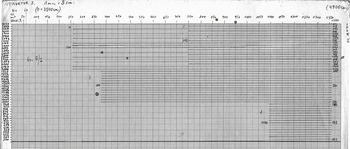
Ligeti capitalized on the potential to control timbre through additive synthesis when he was apprenticed at the WDR studio in early 1957. His unfinished Pièce électronique Nr. 3 (1957), while less well known than Glissandi (1957) or Artikulation (1958), provides compelling evidence of his involvement with additive synthesis methodology. The hand-drawn score shows that his concept was to layer forty-eight individual sine tone voices together. As Example 1a shows, a number of sine tones are combined to create a static figure placed near the beginning of the work. The frequencies of the tones are given on the vertical y-axis of the graph, while the horizontal x-axis corresponds to the temporal dimension. Ligeti used the graph paper to correlate the imagined duration of the figure with the length of tape necessary to produce it; his scale at the top of the page shows that each tiny one-millimetre square on the graph paper corresponds to five centimetres of magnetic tape. The numbers across the x-axis – 50, 100, 150, and so forth – mark off tape lengths in centimetres. This figure is 1360 cm long and, at the WDR standard playback speed of 76.2 cm/second, lasts about 17.8 seconds.
Opening figure from Pièce électronique Nr. 3. György Ligeti collection, Paul Sacher Foundation, Basel. Used by permission.
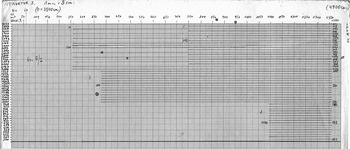
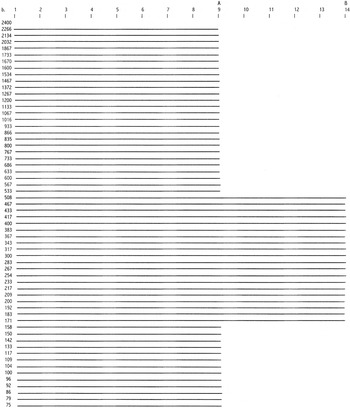
Writers often make reference to the fact that the electronic work was originally titled Atmosphères – that is, until the orchestral work assumed that title.Footnote 36 The similarity implied by this shared title is telling indeed. When Ligeti could not realize his ideas in the studio, Pièce électronique Nr. 3 became a conceptual bridge to his acoustic sound-mass works. The static figure shown in Example 1a, for instance, bears a remarkable similarity to the opening figure of Atmosphères (see Example 1b). By translating pitch into frequency (y-axis)Footnote 37 and using bar numbers to define the temporal domain (x-axis) as in Example 1b, the opening clusters of Atmosphères can be notated graphically for the purpose of comparison with the score of Pièce électronique. Of course in Atmosphères Ligeti had to notate the cluster in terms of pitches on the stave for the orchestral players: ‘The orchestra “understands” only traditional rhythmic and pitch notation. Thus music, in order to be performed by an orchestra, must be converted to an “orchestral language”.’Footnote 38 The translation from electronic music concept to orchestral work requires notational transcription, but nevertheless the conceptual foundation of both passages is additive synthesis.
Graphic representation of Atmosphères, bars 1–13.
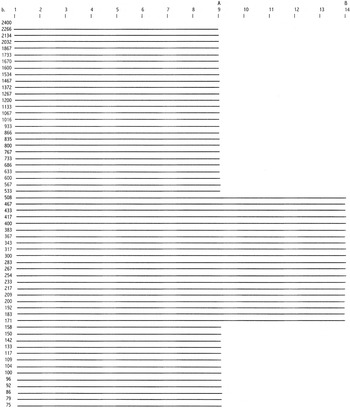
Ligeti transferred the complex, stationary clusters built with additive synthesis from Pièce électronique Nr. 3 to Atmosphères as directly as possible, but one should bear in mind that this does not mean there is a direct transfer of sound. The sine tones that produce the mixture in the electronic work are ‘pure’ tones without overtones. When each of the frequencies in the opening cluster of Atmosphères is imagined in an analogous way (as in Example 1b), as a tone contributing to the mixture through additive synthesis, we must remember that each of the pitches of Atmosphères is not a pure sine tone but rather contains numerous overtones of its own. Thus the cluster produced at the beginning of Atmosphères is much richer and more complex than the sound produced by the same additive synthesis technique in Pièce électronique Nr. 3. The resonance of the overtones above each of the instrumental pitches, where sine tones have none, guarantees this result. Still, the clusters of Atmosphères can all be thought of as extensions of the WDR tradition of additive synthesis, since Ligeti treats the sound of each instrumental player not as a ‘finished’ sound that could stand alone, but rather as a building block in a more complex cluster.
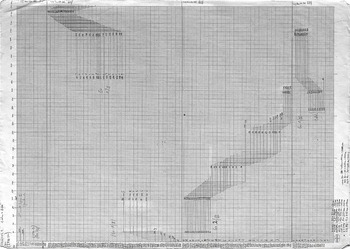
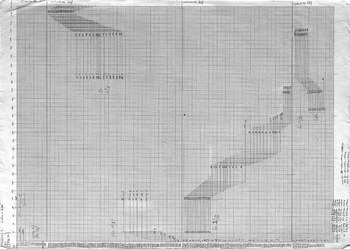
Beyond the static figures in Pièce électronique Nr. 3 Ligeti also wrote mixtures that move through pitch space, and he worked out an elaborate voice-leading network to move the sound-masses fluidly.Footnote 39 Example 2a is characteristic of many of the shapes in the electronic piece; the technique of additive synthesis is obvious at the start of the groups, where a number of frequencies (still shown on the y-axis) have been layered together to create the sound; however, the masses migrate in register as voices climb over one another to progressively higher or lower frequencies. This leapfrog voice-leading technique results in a remarkable continuity of sound at the perceptual level – the constant asynchrony between the voices' leaps means that it is nearly impossible to hear which voice is moving at which time. The leapfrog voice-leading technique ensures that the mass behaves more like a liquid than a solid with discretely defined boundaries; in fact, these figures in Pièce électronique Nr. 3 sound like seamless glissandos despite the painstaking detail in their notation. Careful study of the Atmosphères sketches reveals that the voice-leading technique pioneered in the electronic work had a direct impact on the composition of the micropolyphonic acoustic sound-masses as well.Footnote 40
Pièce électronique Nr. 3 (score page 4). György Ligeti collection, Paul Sacher Foundation, Basel. Used by permission.
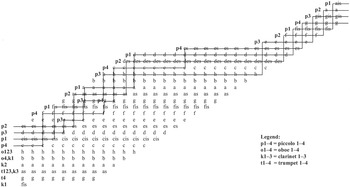
Example 2b provides an especially clear rendering of the direct voice-leading relationship between Pièce électronique Nr. 3 and Atmosphères. The Atmosphères sketch traces the upward spiral of the winds beginning roughly at rehearsal figure F (bars 34–9). It should be noted that I have eliminated many of the instrumental annotations present in Ligeti's original sketch, since it was simply impossible to include them all legibly. Instead of reproducing the sketch exactly, I have added lines that trace Ligeti's instrumental designations in the piccolos (incidentally the highest and most prominent instruments in the passage) in order to clarify the leapfrog voice-leading technique as it is deployed in this sound-mass. A similar voice-leading scheme applies to the oboes, clarinets, and trumpets, but it has been omitted for reasons of space. It should also be noted that the original sketch proceeds in the opposite direction – that is, the sketch begins from the highest point and spirals downwards, adding instruments. It is unclear from the sketch material when exactly Ligeti decided to reverse the direction of the passage, but all scored versions change the register through a mirror reversal while preserving the instrumentation, the pitch, and the shape of the passage from the sketch. It is possible that he reversed the direction to heighten the dramatic import of the passage: perhaps he wanted the winds to continue directly from the string ascent in the preceding bars (Atmosphères, bars 31–3).
Transcription and adaptation of Ligeti's sketch for Atmosphères, bars 34–9, winds. Lines are my annotations. György Ligeti collection, Paul Sacher Foundation, Basel. Used by permission.
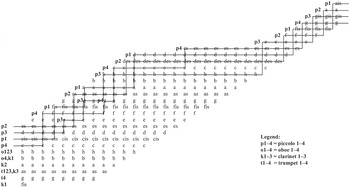
The leapfrog voice-leading technique, when deployed to govern the micropolyphony of Atmosphères, creates a particularly surreal, dramatic quality: as the winds climb over one another, the shape seems to move itself almost magically. In contrast to the fleeting glissandos of Pièce électronique, the parallel passage from Atmosphères presently under discussion (bars 31–9) takes about 50 seconds; this dilated duration creates a sense of dramatic anticipation. While Ligeti transferred the electronic compositional technique to the orchestral work as literally as possible, he revised the temporal scope. He drew out the procedure in Atmosphères, which allows our perception to settle on the directional unfolding of the passage. Thus the leapfrog voice-leading technique is perhaps more impressive for the listener when acoustically rendered, despite the obvious technical complexity of the additive synthesis in the electronic version. The audience is party to a slow-motion drama between rehearsal figures E and F, rather than the abrupt glissando-like fluctuations of Pièce électronique Nr. 3.
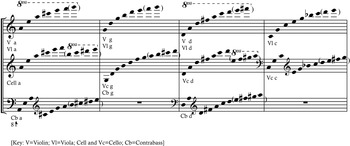
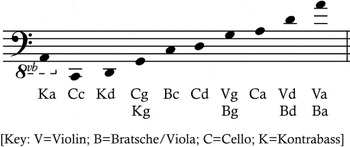
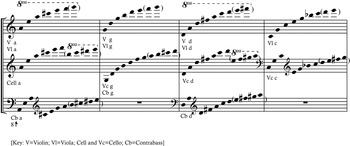
As a third demonstration of the technical kinship between Atmosphères and Pièce électronique Nr. 3, consider the penultimate section of Atmosphères (Letter T, bars 88–101). The strings play entirely in harmonics, creating a delicate, crystalline sound quality.Footnote 41 Ligeti's sketches reveal that the entire passage is derived from the simultaneous combination of a number of different overtone series, where the strings are assigned to play the ‘partials’ above particular absent, but implied, ‘fundamentals’ (see Examples 3a and 3b).Footnote 42 Example 3a shows that Ligeti wrote out the overtone series in various octaves for pitch classes A, D, G, and C, and also assigned instrumentation to these series.Footnote 43 Example 3b, which appears later on the same manuscript page, shows that he was indeed thinking in terms of the implied but absent fundamentals that would account for the partials he wished to use.
That Ligeti's use of partials and implied fundamentals in this passage is an extension of the additive synthesis techniques from which Pièce électronique Nr. 3 was built can be ascertained from his comments on his working procedures in the Cologne studio:
I worked in this piece [Pièce électronique Nr. 3] with harmonic partial tones of imaginary fundamental tones: for example I selected in one instance a differential of 250 Hz, and in another one of 120 Hz, and so forth. If there is, for example, a tone of 4000 Hz, then the next partial is 4250, the following 4500, then 4750, and so on. There are different harmonic spectra in the piece, in which the differentials of the partial tones are always constant. From that follows: through a difference of 250 Hz each, the partials produce an imaginary fundamental of 250 Hz.Footnote 44
In the above quotation Ligeti describes using additive synthesis to pile up the harmonic partials of an absent fundamental. He alludes to the phenomenon of ‘difference tones’, where evenly spaced partials give listeners the impression that the fundamental is sounding, even if the fundamental itself is not played.Footnote 45 ‘My idea was that a sufficient number of overtones without the fundamental would, as a result of their combined acoustic effect, sound the fundamental.’Footnote 46 Ligeti goes so far as to speak of an ephemeral Bassmelodie that could be implied, and perhaps even heard, as the harmonic partials of different, absent fundamentals alternate in Pièce électronique Nr. 3.Footnote 47
Ligeti's sketch for overtone series used in Atmosphères, Letter T. György Ligeti collection, Paul Sacher Foundation, Basel. Used by permission.
Ligeti's sketch for the implied fundamentals for overtone series of Ex. 3a. György Ligeti collection, Paul Sacher Foundation, Basel. Used by permission.
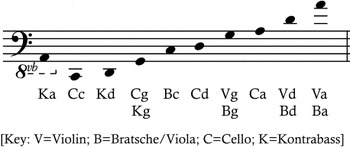
The use of the overtone series at rehearsal letter T in Atmosphères is, in technical terms, identical to the electronic difference tone technique except for the translation into the acoustic realm. The sort of ephemeral sound quality that Ligeti hoped to capture with the difference tones and absent fundamentals may not have been perfectly rendered in Pièce électronique Nr. 3 – to my ears no Bassmelodie of absent fundamentals emerges. However, he painstakingly sought an ephemeral sound quality in the Atmosphères passage. The strings, playing in harmonics, produce a delicate timbre that is quite distinct. Thus the string harmonics become significant on multiple levels – the partial tones (harmonic overtones) are themselves rendered in string harmonics. It is not merely a coincidence of terminology: by choosing the timbre of harmonics and therefore denying the full-voiced rendering of the partial tones, Ligeti reinforces in the passage's sound the idea that the compositional method is derived from partials rather than fundamentals. That is to say, the fundamental is only implied in the compositional technique, and it is also missing from the acoustic landscape in the Atmosphères passage. Ligeti's exploitation of harmonics above absent fundamentals in Atmosphères testifies to the powerful influence of studio experiments. The passage exhibits a demonstrable link to studio technique, in as much as he exploited the difference tone technique that he had experimented with in the studio. But the passage also serves as a metaphor for the ‘ephemeral’ and ‘impossible’ sounds, such as harmonics without a fundamental, that were first possible only with sound synthesis in the electronic studio. In Atmosphères Ligeti ensures that the aesthetic import of the ‘impossible’ studio sounds is translated into the acoustic dimension.
Filtering
About three minutes into Atmosphères the winds and high strings climb in an upward spiral, gathering dynamic strength as the pitch rises. As the winds reach their apex, teetering at what seems to be the upper limit of audibility, the frequency suddenly drops four octaves. The basses, playing a cluster between C♯2 and G♯2, abruptly replace the high, straining winds. The combination of the climbing strings and winds (Letters E and F, bars 30–39) and the subsequent ‘bottoming out’ to the bass cluster (Letter G, bars 40–43) together create one of the most dramatic gestures in the piece. While reading this gesture according to its narrative import is one possibility – the metaphors of a wound spring and Katastrophe are compellingFootnote 48 – it is also possible to understand the passage as an instantiation of the electronic technique of filtering.
Filters hone a large, complex sound into a bounded, simpler sound by attenuating certain frequencies.Footnote 49 Depending on the centre frequency of the filter and the sharpness of its attenuation, adjustable filters can progressively modify the timbre of a complex sound – from the audible spectrum of white noise, to a narrower band of coloured noise, to a very narrow band of almost pure sine tone around the filter's centre frequency. Since filtering or ‘subtractive synthesis’ exploits the progressive attenuation of frequencies, it is often imagined as a complementary procedure to additive synthesis. Ligeti certainly would have had some experience with filtering equipment; as Thom Holmes notes, ‘the audio filters found at the Cologne studio were some of the most advanced in any electronic music studio of the time and provided the composer with a fine degree of control over audio frequencies across the spectrum.’Footnote 50 Some of the most common filters in the 1950s electronic studio were adjustable ‘high-pass’ and ‘low-pass’ filters. A high-pass filter allows frequencies higher than a certain limit to pass, or sound, while a low-pass filter allows frequencies below a certain limit to pass. The persistent high-frequency wind in bars 32–9 of Atmosphères is the acoustic equivalent of applying a high-pass filter, while the drop to the low basses in bars 40–43 can be understood as an abrupt switch of the filter to low-pass.
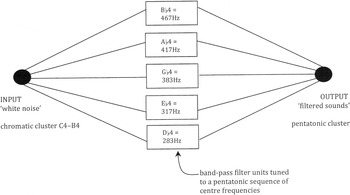
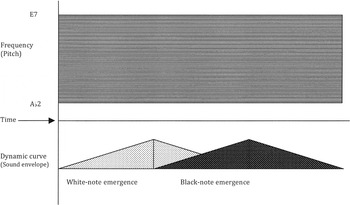
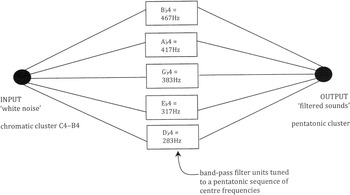
Another possible instance of filtering techniques applied in the acoustic sphere is the passage early in Atmosphères that features an alternation between diatonic (white-note) and pentatonic (black-note) clusters (Letter B, bars 14–22). As Example 4 shows, filters in the Cologne studio were often wired in parallel in a ‘filter bank’ that allowed them to work together.Footnote 51 The band-pass filters shown in the centre of the schematic in Example 4 are adjustable and allow only a narrow band of sound around their centre frequency to pass. Thus, in theory the filters could be ‘tuned’ to allow only pentatonic or only diatonic frequencies to pass, while screening out all of the other frequencies that were initially part of the more complex input sound. In Atmosphères the emergence of the diatonic and pentatonic clusters at Letter B could be an acoustic reproduction of the filter bank of the electronic studio.
Filter bank schematic and its possible application in Atmosphères, bars 14–22.
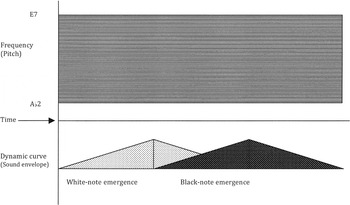
Careful readers might object to this interpretation by noting that, in fact, in Atmosphères at Letter B, all of the pitches in the chromatically filled cluster between A♭2 and E7 are constantly present. Rather than eliminating certain diatonic or pentatonic members of the cluster entirely, Ligeti accomplishes a sort of perceptual emergence of the white- and black-note families in the passage, using carefully shaped dynamics. As the instruments playing the white notes (bright and metallic trumpets, with oboes, bassoons, and trombones) crescendo to fortissimo, those playing black notes decrescendo to quadruple piano (pppp). The process is then reversed, and the voices playing the black notes (rounder and darker horns, clarinets, and flutes) crescendo while the white-note voices simultaneously decrescendo. A second possible interpretation of this passage takes these dynamic fluctuations into account within another contemporary context: dynamic curves were handled in a similar way at the WDR studio.
Oscillators in the early electronic music studios produced tones at a consistent amplitude, or volume. While the amplitude settings could be changed, one needed to record a tone or a mixture onto a tape in order to apply a dynamic envelope to the sound. This was an inherently imprecise process – a number of assistants simultaneously turned volume knobs during playback, trying to replicate the composer's hand-drawn shape or curve – but it was an important step for polishing the aesthetic results of the electronic work.Footnote 52 For instance, the realization of Pièce électronique Nr. 3 sounds a little more abrupt and primitive than a work like Stockhausen's Studie II, owing in part to the absence of dynamic envelopes. Ligeti envisaged sound-envelope curves that would accompany the Pièce électronique score, though these were apparently left unfinished, lost, or both, and therefore could not be included in the realization.Footnote 53
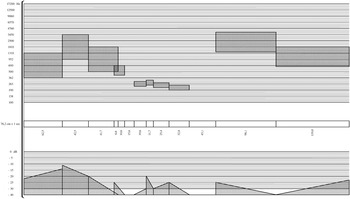
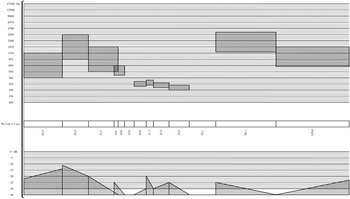
The process of adding dynamics to mixtures can be grasped by examining Stockhausen's Studie II, which was produced at the WDR in 1954. The score excerpt in Example 5 shows frequency (pitch) on the top stave, the length of the tape in centimetres on the middle stave, and the sound envelopes in decibels on the lowest stave. As Stockhausen describes in the introduction to the score, he or his assistants produced the dynamic curves by manually turning the volume dial while a mixture was played back, and recording the result. A similar process could have produced the Atmosphères passage in question: the emergence of the white-note and black-note clusters could be attributed to the application and superimposition of dynamic envelope curves over the two interleaved mixtures, as the schematic in Example 6 demonstrates.
Stockhausen, Studie II (1954), score, page 4. Archive of the Stockhausen Foundation for Music, Kürten, Germany. Used by permission.
Dynamic curves schematic and its possible application in Atmosphères, bars 14–22.
It should be clear by now that the electronic techniques that Ligeti adapts in Atmosphères owe a debt to Stockhausen's work in the WDR studio; his creative influence was considerable, even while Eimert was technically the studio director in the 1950s. In the following section, let us examine the evidence that suggests that Ligeti internalized the pitch/time discourses that Stockhausen famously articulated in the essay ‘… wie die Zeit vergeht …’ (‘… how time passes …’).Footnote 54 Though Stockhausen's writing on the relationship between pitch, time, and timbre has become canonical, we should also continue to bear in mind the important roles played by the ‘lesser’ figures in the WDR studio, such as Karel Goeyvaerts and Gottfried Michael Koenig. In fact, it was Koenig who took time to tutor Ligeti and help him learn the studio's standard electronic compositional techniques. In the process Koenig helped him to understand the significance of WDR discourses, such as the pitch/time ideas Stockhausen articulated in ‘… how time passes …’, and apply them in his electronic works. Koenig's patient tutoring no doubt also helped him to internalize the electronic discourses well enough to adapt them for the acoustic Atmosphères.
Bewegungsfarbe
In ‘… how time passes …’ Stockhausen contended that his experiences in the electronic music studio had shown him that discrete articulations could become timbres.Footnote 55 Durations and pitches, when played fast enough to elude our perceptual faculties, appear as composite sounds:
Until a phase-duration of approx. 1/16″ [one sixteenth of a second], we can still hear the impulses separately; until then, we speak of ‘duration’, if of one that becomes extremely short. Shorten the phase-duration gradually to 1/32″ [one thirty-second of a second], and the impulses are no longer separately perceptible; one can no longer speak of the ‘duration’ of a phase. The latter process becomes perceptible, rather, in a different way: one perceives the phase-duration as the ‘pitch’ of the sound.Footnote 56
In his own writing Ligeti formulates this concept by using the metaphor of film. He notes that if one watches a sequence of stills at the rate of 16 frames per second, one can see that the sequence is a succession of individual pictures. At the speed of 18 or 20 frames per second, there is some continuity, but the film still flickers. At the standard projection speed of 24 frames per second, it is impossible to perceive that the film is made of individual still frames.Footnote 57
In spite of the similarity between Ligeti's film metaphor and Stockhausen's description in ‘… how time passes …’, Ligeti claims to have learned the practical significance of this pitch/time phenomenon in the course of his tutorials with Koenig at the WDR.Footnote 58 In particular, he consistently suggests that it was Koenig's electronic composition Essay (1957), which he assisted in realizing, that awakened his interest in the speed of successions:
In Koenig's Essay there are sequences of sine tones, which in some places are understandable as melodic lines, but in others, due to the shortness of the individual tones and the great velocity of the sequences, appear no longer as melodic but rather as a curious agglomeration of pitches.Footnote 59
Bewegungsfarbe, informally translated as ‘sound colour in motion’, was apparently Koenig's term for this process, by which discrete sound events are played so fast as to become continuous.Footnote 60
Stockhausen and Koenig's interest in the relationship between pitch, duration, and timbre, and later Ligeti's interest in the same, was probably born of their intimate knowledge of the studio equipment. In the electronic studio of the late 50s there were two ways to speed up a succession of discrete sounds. The first was to use a variable speed tape recorder to play the tape faster.Footnote 61 However, this produced a proportional change in the pitch – that is, as the tape speed increased and the discrete sounds became continuous, the pitch also rose. A fairly clear demonstration of this procedure can be heard in Koenig's Essay between 0′30″ and 0′45″.Footnote 62 A steady drone slows into a sequence of lower-pitched pulses and is then sped up to become a higher-pitched, continuous sound once again. If one wanted to use Bewegungsfarbe without changing the pitch, the other option was to cut increasingly shorter segments of tape for each of the ever-shorter durations, paste them onto a leader tape, and record the segment.Footnote 63 This splicing process preserved the invariance of pitch, but was quite labour-intensive and could sometimes introduce unwanted noises. According to Ligeti, Koenig also used this splicing technique to produce Bewegungsfarbe: ‘Koenig made up his tunes by splicing small bits of tape together in such a way that the whole duration was under 1/20 of a second (fifty milliseconds); the tune was transformed into a chord; a tune consisting of six notes became a six-note chord.’Footnote 64
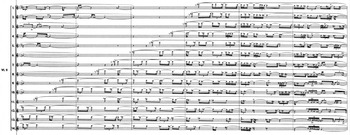
In bars 23–9 of Atmosphères (Letter C) Ligeti applies a process that is akin to the second, splicing method described above for transforming discrete pitches into a continuous sound-mass. He circumvents some of the technological difficulties of the manual tape work in the studio, however, by transferring the compositional technique into the acoustic realm. In this passage, an excerpt of which is shown in Example 7, string, flute, and clarinet players are each assigned two different pitches. The speed of the alternation between the two pitches gradually increases as the passage progresses. The instrumentalists begin playing triplets, then semiquavers, then quintuplets, sextuplets, and so forth in a constant tempo of 𝅘𝅥 = 40. At the climax the violins are playing between 14 and 20 demisemiquavers per crotchet beat unit, so fast as to be indistinguishable from a tremolo. To highlight the connection to Bewegungsfarbe through tape splicing, we can imagine that each note of the passage is from a sine tone or mixture prerecorded on a tape. In the studio the sine tone tapes would have been cut up into increasingly shorter segments (corresponding to noteheads with increasingly shorter durations) and manually spliced onto a leader tape. Like a sequence of stills projected to make a film, upon playback this sequence of ever-shorter tones would eventually pass the perceptual boundary and would soon be heard as a continuous timbre. The Atmosphères passage (Letter C, bars 23–9) explores the very same process of changing discrete events into a continuous sound. As the instruments gradually increase the speed of their alternations, the listener is invited to explore the perceptual boundary between discrete events and a continuous sound. The pitches are definitely perceptible in succession early in the passage, but quickly the tones blend together and produce a buzzing, trilling timbre that could be termed ‘sound colour in motion’, or Bewegungsfarbe, to use Koenig's term.
Atmosphères, bars 23–7 (Letter C), first violins. © Copyright 1963 by Universal Edition A. G., Vienna / UE 11418. Reproduced by permission. All rights reserved. International copyright secured.

For Ligeti, the electronic studio was the key to bringing forward the continuum between discrete events and continuous sound, in as much as it is difficult for humans to play fast enough to cross the perceptual boundary:
Experience with the blurring phenomenon was not really available before 1950, when the proliferation of tape recording started. The quickest trills and figurations that a pianist, flautist or violinist can play rarely contain more than sixteen individual tones per second. Apparently the neuromuscular boundary in our nervous system lies in close proximity to the blurring boundary for the perception of successive events.Footnote 65
Although he seems to understand the neuromuscular limitations of human performers, Ligeti calls for the instrumentalists to play the fastest notes in Example 7 at a speed of about thirty notes per second. Whether or not it is physically possible to play fast enough to realize the notation in this passage is an open question: his commentaries and interviews show that Ligeti certainly understood that he wrote figuration that was on the edge of performability and that he accepted mistakes or human errors as part of the complex textures of his sound-masses.Footnote 66 Yet each player is also asked to attain maximal speed – to try to cross the boundary from discrete events to continuous sound – even if the notation is difficult or impossible to realize fully.
In practical terms the mass of voices is crucial to creating the blurred effect in Atmosphères. In fact, Ligeti often referred to the classic ‘micropolyphonic’ passages as examples of his use of the Bewegungsfarbe technique.Footnote 67 Using instruments of the same timbre and offsetting their entrances slightly allows one to cross the perceptual boundary much more quickly, because the unsynchronized instruments can easily multiply the number of notes heard within a certain span of time. Apparently this was an insight gained from Koenig as well. As Ligeti explains,
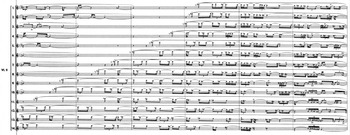
Atmosphères, bars 45–7 (Letter H), second violins. © Copyright 1963 by Universal Edition A. G., Vienna / UE 11418. Reproduced by permission. All rights reserved. International copyright secured.
Koenig's other idea was that he kept a given number of notes in a tune under 1/20 second, below our threshold for perceiving them separately, whilst the whole tune was longer than 1/20 second. The result was something like seeing the tune through a narrow slit, which was moving forward so that at any time you could hear two or three notes together, which gave the impression of polyphony. It was still a tune but a strangely blurred one. My idea was to apply in instrumental music what I had learned from Koenig in the electronic studio.Footnote 68
Ligeti knew that it was difficult or impossible for a single instrumentalist to play multiple notes of a melodic or contrapuntal line in 1/20 second, but if one wrote for multiple instrumentalists whose entries are slightly staggered, it was quite easy to accrue many notes in a short time span. Example 8 shows an excerpt from the famous micropolyphonic passage of Atmosphères (Letter H, bars 44–53). As can be discerned from studying the individual second violin parts shown in the example, each instrumentalist is given the same sequence of pitches with slight rhythmic variations. If we understand each bar, or any vertical slice of the score, as the ‘narrow slit’ through which we hear the music, we can understand how this passage relates to the Bewegungsfarbe Ligeti described above. The melody is longer than the slit, but because of the piling up of the instrumental parts we hear the unsynchronized notes echoing off one another and blending into timbre as the orchestral players take their slightly different paths through the melody. Thus Ligeti's classic micropolyphonic techniques, as elaborated by Bernard, Clendinning, and Roig-Francoli, may actually be an acoustic reproduction of the Bewegungsfarbe he had learned from Koenig.Footnote 69
The emergence of timbre
As the foregoing discussion has shown, the techniques and discourses emerging from the WDR studio in the 1950s reveal a collective obsession with gaining compositional control over timbre. Electronic compositional techniques – additive synthesis, filtering, and Bewegungsfarbe – increasingly offered the WDR composer a chance to define, organize, and control timbre to a greater degree than was previously possible. Writings from the period consistently thematize the potential for composers of electronic music to gain compositional control over timbre.Footnote 70 At the same time, however, composers increasingly realized that the studio equipment had its own limits. As Ligeti recalls, ‘When Koenig composed and produced his 1957 Essay in the Cologne studio, the euphoric feelings of the first half of the 1950s, when total sound-synthesis still seemed possible, had passed.’Footnote 71 Ligeti himself ran up against the limit of technical possibilities in Pièce électronique Nr. 3 and consequently failed to realize his ideas in the studio. However, this failure ended up spawning new insights into the composition of his acoustic music. In fact, his experiments with electronic composition under Stockhausen and Koenig at the WDR gave him new tools for manipulating timbre, which he applied in the sound-mass works.Footnote 72
In Atmosphères in particular Ligeti translates electronic compositional techniques with surprising fidelity into the acoustic realm. Perhaps as a consequence of his extensive experience with additive synthesis in Pièce électronique Nr. 3, he treats individual instrumental voices in Atmosphères as building blocks of a composite sound, rather than musically complete entities in their own right (such as melodies). Individual voices can no more stand on their own in Atmosphères than can a bare sine tone in elektronische Musik. This additive synthesis methodology provides the conceptual and technical framework for the cluster writing Ligeti popularized in the sound-mass works. Likewise, filtering and subtractive synthesis are a conceptual foundation for honing and foregrounding select components of sound-masses. Ligeti's understanding of the perceptual blurring phenomenon of Bewegungsfarbe seemingly offers a methodology for melding discrete articulations into a continuous sound in micropolyphonic passages.
It is noteworthy that all of these techniques move perception away from discrete pitches and rhythms and towards the hearing of the composite timbre of a sound-mass. By mapping electronic compositional techniques into the acoustic realm in Atmosphères, Ligeti circumvents some of the technical difficulties of studio work but capitalizes on the potential for timbre to play a primary role in shaping passages. Though having a good grasp of orchestration is also crucial, we should not underestimate the importance of the discourses of elektronische Musik, which brought timbre forward as the central compositional problem. In fact, it is doubtful that Ligeti would have been able to conceive of the timbral possibilities of the orchestra as he did in Atmosphères without having thought so carefully about – and experimented with – timbre in the Cologne studio.Footnote 73 The foregrounding of timbre, for which Atmosphères remains so famous, is inextricably linked to the innovations of Stockhausen and Koenig, through the discourses and techniques that grew up with elektronische Musik at the WDR studio. Although Ligeti ultimately did not find the electronic studio to be the right locus for his compositional ideas, applying the concepts he learned there allowed him to make a revolutionary move towards foregrounding timbre in his acoustic sound-mass works.