Introduction
Inselbergs (from the German, insel = island, berg = mountain) are crystalline rock outcrops found mainly in tropical and subtropical regions (Barthlott et al., 1993). In Brazil, they are common along the tropical Atlantic coast (Safford & Martinelli, Reference Safford, Martinelli, Porembski and Barthlott2000) and in the Caatinga domain (Ab’ Sáber, Reference Ab’ Sáber2003).
Inselberg floras have been studied in several parts of the world, especially in Africa (Porembski et al., Reference Porembski, Seine and Barthlott1997) and in the United States (Wyatt & Alisson, 2000). In Brazil, botanical studies have most often been carried out in the Southeast (e.g. Meirelles et al., Reference Meirelles, Pivello and Joly1999; Safford & Martinelli, Reference Safford, Martinelli, Porembski and Barthlott2000; Oliveira et al., 2004; Medina et al., Reference Medina, Ribeiro and Scarano2006; Caiafa & Silva, Reference Caiafa and Silva2007; Ribeiro et al., Reference Ribeiro, Medina and Scarano2007). They are still ongoing in the Northeast (França et al., Reference França, Melo and Santos1997, 2005, 2006; Costa, Reference Costa2000; Carneiro-Torres et al., 2002; Almeida, Reference Almeida2004; Pitrez, Reference Pitrez2006; Porto et al., Reference Porto, Almeida, Pessoa, Trovão and Felix2008).
The environmental conditions in these areas, such as high temperatures, low humidity and low nutrient availability, give rise to important ecological processes which determine the structure and composition of the vegetation (Porembski, Reference Porembski2007). The vegetation is extremely well adapted to these conditions and distinct from the surrounding flora (Barthlott et al., 1993; Ribeiro et al., Reference Ribeiro, Medina and Scarano2007).
The aim of this study was to characterise an inselberg in northeastern Brazil and carry out a floristic survey of its angiosperms. An investigation was also carried out into the relationship of its flora to that of the surrounding area. The following questions were asked: (i) is the species richness comparable to other inselbergs in northeastern Brazil; (ii) is the floristic composition of the inselberg more similar to other inselbergs or to the surrounding Caatinga vegetation; and (iii) do the similarities in the floristic composition of inselbergs depend on the distance between them?
Methodology
The inselberg selected for this study, Pedra Antônio Bezerra (08°20′S, 35°50′W), is a crystalline rock outcrop composed predominantly of granite. It has an altitude of 713 m at the base and 835 m at the top, with a total area of approximately 70,000 m2. It is located on private property in Bezerros county in the semi-arid region of the State of Pernambuco, Brazil, 115 km from the Atlantic coast. The native vegetation of the surrounding area has been greatly impacted by agricultural and grazing activities.
The study site is situated on the Borborema Plateau (Jatobá, Reference Jatobá and Andrade2003). This highland plain is formed from a series of strongly weathered massifs dating from the Pre-Cambrian, which extend across the eastern portion of the Northeast region (Morais-Neto & Alkmim, Reference Morais-Neto and Alkmim2001; Jatobá, Reference Jatobá and Andrade2003).
The area has a semi-arid climate, with an irregular and limited rainy season (Velloso et al., Reference Velloso, Sampaio and Pereyn2002). The annual mean precipitation is 896 mm and is generally concentrated between the months of May and August (130–249 mm). There is an accentuated hydric deficit (0–70 mm) between four and eight months of the year (ITEP, 2008). The annual mean temperature is 21.2°C and ranges from 19.4 to 27.3°C (ITEP, 2008).
Eight field trips (from April 2005 to April 2006) were carried out, five during the rainy season and three in the dry season. Each expedition lasted six hours on average, for a total of 48 hours of field work. Fertile angiosperm specimens were collected randomly and processed according to Mori et al. (Reference Mori, Silva, Lisboa and Coradin1985).
The specimens are deposited in the herbarium at UFP, with duplicates in IPA and PEUFR (for explanation of herbarium codes see Index Herbariorum at http://sweetgum.nybg.org/ih/). Identifications were carried out with the aid of the literature and advice from specialists, and by matching to collections in local herbaria. Family delimitation follows APG II (Angiosperm Phylogeny Group, 2003).
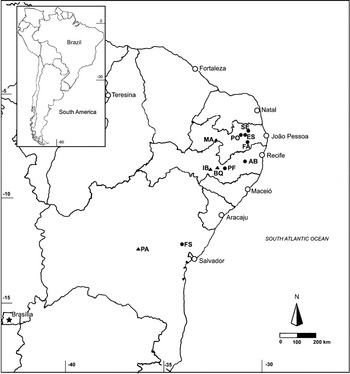
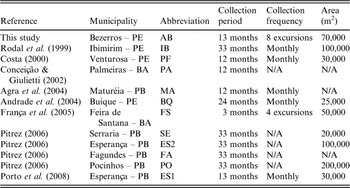
In order to assess the relationship between the flora of the Pedra Antônio Bezerra inselberg and the floras of other parts of northeastern Brazil, the floristic richness (at the specific level) was compared with that known for other semi-arid areas (Table 1; Fig. 1). These included inselbergs in Pedra Furada Municipal Park (Costa, Reference Costa2000) in Pernambuco State; Esperança (Pitrez, Reference Pitrez2006; Porto et al., Reference Porto, Almeida, Pessoa, Trovão and Felix2008), Pocinhos, Serraria and Fagundes (Pitrez, Reference Pitrez2006) in Paraíba State; and Feira de Santana (França et al., Reference França, Melo and Santos1997, 2005) in Bahia State. Other types of Caatinga formation were also used in this comparison: shrub and subshrub, dense semi-deciduous vegetation, without thorns (Andrade et al., Reference Andrade, Rodal, Lucena and Gomes2004), in Buíque municipality of Pernambuco State; caducifolious shrub vegetation (Rodal et al., Reference Rodal, Nascimento and Melo1999) in Ibimirim municipality of Pernambuco State; rock outcrops with brejo de altitude, a humid forest vegetation type in high altitude areas in Caatinga (Agra et al., Reference Agra, Barbosa, Stevens, Porto, Cabral and Tabarelli2004) in Maturéia municipality of Paraíba State; and a campo rupestre, a shrubby vegetation on rocky soil (Conceição & Giulietti, Reference Conceição and Giulietti2002), in Palmeiras municipality of Bahia State.
Floristic studies used in the analysis of similarity and the studied area (•, inselbergs; ▲, other types of vegetation in the Dominium Caatinga). AB – Pedra Antônio Bezerra, Bezerros (study area), BQ – Buíque (Andrade et al., Reference Andrade, Rodal, Lucena and Gomes2004), IB – Ibimirim (Rodal et al., Reference Rodal, Nascimento and Melo1999) and PF – Pedra Furada Municipal Park, Venturosa (Costa, Reference Costa2000), in Pernambuco; MA – Maturéia (Agra et al., Reference Agra, Barbosa, Stevens, Porto, Cabral and Tabarelli2004), PO – Pocinhos (Pitrez, Reference Pitrez2006), ES – Esperança (ES1 – Porto et al., Reference Porto, Almeida, Pessoa, Trovão and Felix2008; ES2 – Pitrez, Reference Pitrez2006), SE – Serraria (Pitrez, Reference Pitrez2006) and FA – Fagundes (Pitrez, Reference Pitrez2006), in Paraíba; PA – Palmeiras (Conceição & Giulietti, Reference Conceição and Giulietti2002) and FS – Feira de Santana (França et al., Reference França, Melo, Santos, Melo, Marques, Silva-Filho, Moraes and Machado2005), in Bahia.

Floristic studies in the semi-arid region of northeastern Brazil used in the analysis of similarity

N/A, not available.
The last area is a vegetation type that, in the State of Bahia, is found mainly surrounded by Caatinga vegetation (Conceição et al., Reference Conceição, Rapini, Pirani, Giulietti, Harley, Silva, Juncá, Funch and Rocha2005), while in other areas of the country it is frequently surrounded by Cerrados (Oliveira-Filho & Ratter, Reference Oliveira-Filho, Ratter, Oliveira and Marquis2002).
In all studies selected for comparison (Table 1) the collections were made randomly. Based on the species lists for each area, an area dendrogram was produced using the Jaccard similarity index (Sj) and the clustering method UPGMA calculated using PAST software, version 1.77 (Hammer et al., 2001). Only taxa identified to species level were included and all synonymies were included only under the actual species.
Results and Discussion
Floristics
A total of 201 angiosperm species in 62 families were identified from the Pedra Antônio Bezerra inselberg. Cyperaceae (28 spp.), Euphorbiaceae (19), Poaceae (15), Orchidaceae (11) and Bromeliaceae (9) were the richest families and accounted for approximately 40% of the total (Table 2).
List of families and species collected on the Pedra Antônio Bezerra inselberg, Pernambuco, Brazil

* Species observed in the study area, but not collected due to difficult access or to the lack of fertile material.
Richness was higher than that found by Costa (Reference Costa2000) in the Pedra Furada Municipal Park in Venturosa (88 spp.), where Fabaceae, Euphorbiaceae and Cactaceae were the largest families. Floristic inventories carried out in other inselbergs in the semi-arid region of northeastern Brazil (where richness ranged from 62 to 192 species; França et al., Reference França, Melo and Santos1997; Pitrez, Reference Pitrez2006; Porto et al., Reference Porto, Almeida, Pessoa, Trovão and Felix2008) and the data presented here indicate great variability in floristic richness in the Northeast. The reasons for this are still not well known in relation to inselbergs, but abiotic factors – such as substrate and its heterogeneity – are possibly the main causes (Porembski et al., Reference Porembski, Seine and Barthlott1997; Safford & Martinelli, Reference Safford, Martinelli, Porembski and Barthlott2000).
Another possible explanation for these differences is the fact that identification of some taxa is difficult in the field. In the above-mentioned lists, identification problems are most acute in Asteraceae, Cyperaceae, Myrtaceae and Poaceae.
The five families with the highest number of species are considered characteristic of inselbergs in South America and in the tropics in general (Porembski et al., Reference Porembski, Seine and Barthlott1997).
Cyperaceae and Poaceae, two of the largest families in our study, are also two of the largest families in other inselberg floristic studies in the tropics (Barthlott et al., 1993; Ibisch et al., Reference Ibisch, Rauer, Rudolph and Barthlott1995; Barthlott & Porembski, Reference Barthlott, Porembski, Porembski and Barthlott2000). However, their representatives do not characterise the physiognomy of the area under study.
The same is true for Orchidaceae. This family has a large number of species but they do not stand out physically in the environment. It is a very important family in terms of number of species on Brazilian inselbergs (see Porembski et al., Reference Porembski, Seine and Barthlott1997).
The species richness found for Euphorbiaceae and Bromeliaceae in our study agrees with the findings of Barthlott et al. (1993), Porembski et al. (Reference Porembski, Seine and Barthlott1997, 1998) and Seine et al. (Reference Seine, Porembski, Becker, Porembski and Barthlott2000). These studies show that the two families are among the largest groups in inselberg floras in several different regions of the Americas.
The Bromeliaceae are cited as the group which best characterises the flora of inselbergs in Paraíba and Bahia (França et al., Reference França, Melo, Santos, Melo, Marques, Silva-Filho, Moraes and Machado2005, 2006; Porto et al., Reference Porto, Almeida, Pessoa, Trovão and Felix2008).
In the Euphorbiaceae, species of Croton L. are important components of the shrub layer of inselbergs of the Caatinga domain (França et al., Reference França, Melo and Santos1997, 2005, 2006; Carneiro-Torres et al., 2002).
General characterisation
The Pedra Antônio Bezerra inselberg is characterised by large areas of bare rock, colonised by lichens and cyanobacteria. Consequently the vascular vegetation of the outcrop is not continuous, being found in islands separated by bare rock.
In the study area these islands are of three main edaphic types, related to the degree and style of weathering of the rock: exposed rock, rock fissures, and depressions in the rock.
1. Exposed rock. Annual plants, such as Cyperaceae and Eriocaulaceae, often associated with cryptogams, are found in vegetation islands established on exposed rock. According to Porembski et al. (Reference Porembski, Martinelli, Ohlemüller and Barthlott1998), vegetation is able to attach itself on this surface using a film of cyanobacteria as a substrate. These plants need a lot of water in order to settle on the bare rock (Barthlott et al., 1993).
2. Rock fissures. The vegetation islands in rock fissures mainly include herbaceous plants such as species of Poaceae. França et al. (Reference França, Melo and Santos1997) describe fissures on an inselberg in Bahia (which were called frestas – crannies) that had even been colonised by trees. Burbanck & Platt (Reference Burbanck and Platt1964) explain that this large variation among inselbergs is due to the fact that cracks in granite outcrops vary substantially in size and depth. The presence of larger fissures is critical for the establishment of shrubs and trees. The same conclusions can be reached for natural rock depressions with great variation in soil depth.
3. Rock depressions. At the Pedra Antônio Bezerra inselberg the islands formed in depressions in the rock are commonly occupied by Marsdenia loniceroides (Apocynaceae) (species authorities are given in Table 2). The woody species Clusia nemorosa, Clusia intermedia (Clusiaceae), Cupania revoluta (Sapindaceae) and Norantea brasiliensis (Marcgraviaceae) are also present in some of the larger islands.
During the rainy season, a group of short-life-cycle plants from different families (such as Asteraceae, Commelinaceae, Gentianaceae, Lentibulariaceae, Melastomataceae and Rubiaceae) were seen in depressions along the edges of the islands. These ephemeral species account for approximately 31% of the flora surveyed (Table 2). This confirms the importance of seasonality to floristic richness in inselbergs (Burbanck & Platt, Reference Burbanck and Platt1964; Porembski et al., Reference Porembski, Becker, Seine, Porembski and Barthlott2000).
However, Encholirium spectabile (Bromeliaceae) is the species that visually characterises the physiognomy of the study area, a finding which agrees with França et al. (Reference França, Melo, Santos, Melo, Marques, Silva-Filho, Moraes and Machado2005, 2006) and Porto et al. (Reference Porto, Almeida, Pessoa, Trovão and Felix2008). From an elevation of 760 m to the summit, another species of Bromeliaceae, Portea leptantha, and a species of Orchidaceae, Acianthera ochreata, also form a great number of islands.
The predominance of monocot species in our study corroborates the findings of Porembski et al. (Reference Porembski, Seine and Barthlott1997, 1998), França et al. (Reference França, Melo, Santos, Melo, Marques, Silva-Filho, Moraes and Machado2005) and other authors. Because of this predominance the term ‘Monocotyledonous Mats’ (sensu Barthlott et al., 1993) is commonly used to designate these areas.
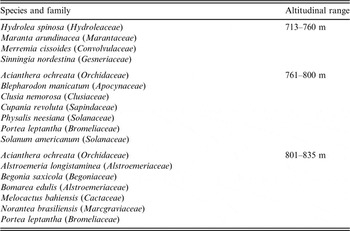
The distribution of species in the islands is dependent on variables such as island size, soil texture, pH, depth and content of organic matter in the soil, altitude, and also the distance from the edge of the outcrop (Collins et al., Reference Collins, Mitchell and Klahr1989; Medina et al., Reference Medina, Ribeiro and Scarano2006). On Pedra Antônio Bezerra some species are restricted to specific altitudinal ranges, allowing us to divide the area into three zones: lower (713–760 m), middle (761–800 m) and upper (801–835 m) (Table 3). Variations in floristic composition with altitude have previously been observed by Safford & Martinelli (Reference Safford, Martinelli, Porembski and Barthlott2000). Therefore, we believe that the variability in the vegetation is possibly associated with altitude. Reeder & Riechert (Reference Reeder and Riechert1975) have also observed the influence of altitude, at another site.
Distribution of some species along an altitudinal gradient on the Pedra Antônio Bezerra inselberg

Similarity
The study site has species in common with all other areas with which it has been compared (83 species in all). However, no species were found in all of the areas. Forty-one species (49%) were found in only one other area; 17 species (20%) in two others; another 17 species (20%) in three, four or five other areas; and eight species (10%) in six or seven other areas.
Among the species in common, 11 are ruderals: Alternanthera brasiliana (Amaranthaceae), Jacquemontia densiflora, Merremia macrocalyx (Convolvulaceae), Stylosanthes viscosa (Fabaceae), Marsypianthes chamaedrys (Lamiaceae), Waltheria indica (Malvaceae), Mollugo verticillata (Molluginaceae), Echinolaena inflexa, Rhynchelytrum repens, Setaria cf. geniculata (Poaceae) and Solanum americanum (Solanaceae) (Lorenzi, Reference Lorenzi1991; Kissmann, Reference Kissmann1997). It is possible that these species are introductions from the surrounding region where agriculture and grazing predominate.
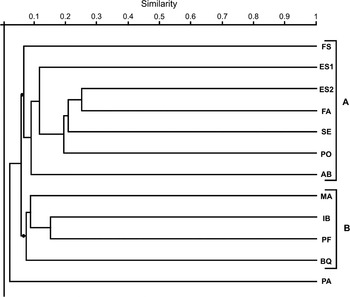
In the area dendrogram, the flora of Pedra Antônio Bezerra is closer to the other inselbergs analysed than to the other Caatinga plant formations included in the study (Fig. 2). The flora of a campo rupestre in Bahia (Conceição & Giulietti, Reference Conceição and Giulietti2002) separates first in the analysis, with the other floras forming two major groups (A and B in Fig. 2). Climatic differences appear to explain this pattern, as the campo rupestre in Bahia has a wider temperature range than the others (4–20°C; Conceição & Giulietti, Reference Conceição and Giulietti2002). Another important finding is that the campos rupestres of Bahia, despite being mainly found within regions otherwise characterised by Caatinga vegetation, have floras more closely related to Cerrados (Oliveira-Filho & Ratter, Reference Oliveira-Filho, Ratter, Oliveira and Marquis2002).
Floristic similarity dendrogram obtained through the group mean (UPGMA) and Jaccard's similarity index (Sj) (r: 0.9196). Localities in northeastern Brazil: ES – Esperança (ES1 – Porto et al., Reference Porto, Almeida, Pessoa, Trovão and Felix2008; ES2 – Pitrez, Reference Pitrez2006), FA – Fagundes, SE – Serraria, PO – Pocinhos (all Pitrez, Reference Pitrez2006) and MA – Maturéia (Agra et al., Reference Agra, Barbosa, Stevens, Porto, Cabral and Tabarelli2004), in Paraíba; PA – Palmeiras (Conceição & Giulietti, Reference Conceição and Giulietti2002) and FS – Feira de Santana (França et al., Reference França, Melo, Santos, Melo, Marques, Silva-Filho, Moraes and Machado2005), in Bahia; IB – Ibimirim (Rodal et al., Reference Rodal, Nascimento and Melo1999), BQ – Buíque (Andrade et al., Reference Andrade, Rodal, Lucena and Gomes2004), PF – Pedra Furada Municipal Park, Venturosa (Costa, Reference Costa2000), and AB – Pedra Antônio Bezerra, Bezerros (study area), in Pernambuco. See text for explanation of A and B.

Climatic differences may not explain the pattern of other areas in the dendrogram, as most of them have a typical semi-arid climate (Ab’ Sáber, Reference Ab’ Sáber2003). The only known climatic difference is a more homogeneous rain distribution in MA (Maturéia in Paraíba State; Agra et al., Reference Agra, Barbosa, Stevens, Porto, Cabral and Tabarelli2004), which does not appear to have affected its relationship to the other areas (Fig. 2).
Group A in the dendrogram combines the floras of all inselbergs used in this comparison (Fig. 2), except for Pedra Furada in Pernambuco (Costa, Reference Costa2000). This suggests that in these areas the vegetation found on the inselbergs is quite distinct from the vegetation of the neighbouring Caatinga. In Pedra Furada the survey covered the inselberg and the surrounding area (Costa, Reference Costa2000), masking any distinction.
Pedra Antônio Bezerra and the inselbergs in Paraíba, which form a subgroup (Fig. 2), are all in the Borborema Plateau subregion. Based on these studies geographic proximity is an important factor in determining the floristic composition of northeastern Brazil's inselbergs.
Concluding Remark
The data obtained from this study demonstrate the high richness of angiosperms on an inselberg of the Brazilian semi-arid region. However, only additional floristic surveys will generate more conclusive data and provide a better understanding of the degree of interaction between the inselbergs and their surrounding vegetation.
Acknowledgements
The authors thank Dr Fábio Scarano, Dr Maria Jesus Nogueira Rodal, Dr David Middleton and the anonymous reviewers for making suggestions on the manuscript; the curators of UFP, IPA and PEUFR for allowing access to their respective collections; FACEPE/CNPq and PIBIC/CNPq for the undergraduate research grant awarded to the first author; and the specialists M. C. Abreu (Oxalidaceae), A. Alves-Araújo (Amaryllidaceae), D. Araújo (Passifloraceae), M. F. Cavalcanti (Asteraceae), E. Córdula (Fabaceae), M. F. Lucena (Euphorbiaceae and Phyllanthaceae), J. R. Maciel (Poaceae), S. Martins (Cyperaceae), Y. Melo (Alstroemeriaceae), J. Oliveira (Erythroxylaceae), M. Oliveira (Sapindaceae), K. Pinheiro (Begoniaceae) and M. T. Vital (Convolvulaceae) for their collaboration.