During my college years (around the early 1960s), students at Korea University [in Tokyo] used summer vacations to visit Korean-concentrated areas in various locations. We gathered the children of “Korean slums” (Chōsenjin buraku) to hold study sessions on the Korean language and Korean history. People in “Korean slums” welcomed us warmly, provided us with their residences for our accommodation, and even prepared meals for us. The residences we stayed in were humble sheds only a little better than makeshift huts. Twenty or thirty of them stood tightly together in places like riverbanks. In some places, the electricity company or the municipal waterworks bureau refused to set up electricity wires or water pipes as these sheds were considered illegal construction. Not a few “Korean slums” connected wires and water pipes from a nearby Japanese house by themselves and paid special fees. Japanese people in the vicinity gave a peculiar look as if it were a foreign nation, and there was no interaction with the Japanese society across the street.
—Kim Ch'an-jŏng (Reference Ch'an-jǒng2004, 173)People who grew up in Japan during the early postwar period, in large cities or even in many small towns and remote villages, often recall the existence of a nearby Korean shantytown. They all remember the same images: the squalor because of the lack of proper water and sewage systems, flimsy makeshift sheds, great numbers of children, the smell of animal organ barbecues, day laborers, pull carts to collect metal scraps, and voices shouting in the Kyongsang (or Cheju) dialect of Korean. This part of the city or town was beyond the reach of ordinary Japanese people; taxis refused to enter, policemen hesitated to step in, and Japanese children were told to stay away. Many of these quintessential slums of underclass minorities remained untouched by Japan's postwar recovery and economic growth until about the late 1960s.
Secluded and impoverished, these Korean slums seem to confirm the transwar continuity of Japanese oppression.Footnote 1 Since the times of Japanese imperialism, they embodied Frantz Fanon's colonized world—a “compartmentalized world . . . divided in two . . . inhabited by different species” (Fanon [1961] Reference Fanon2004, 5)—and served as the ugly and miserable Other in “Japanese-style Orientalism” (Sugihara Reference Tooru1998, 28–29). Their presence was a visible, unwelcome reminder of Japan's failed imperial ambitions, which now stirred anti-Korean racial anxiety in Japanese society (Choi Reference Choi2013). To American Occupation officers, the slums were a source of grave security concern and a breeding ground for communist sympathizers (Kobayashi Reference Tomoko1994). Japanese Communist Party (JCP) members, who worked closely with zainichi Korean activists until 1955, viewed them as evidence of ongoing oppression by the capitalist and imperial world.Footnote 2
But zainichi Koreans who grew up in these slums often offer spectacular epic stories and fond memories of living there. Their recollections of the harsh experiences of poverty and violence in these quarters, which they call tongne (“neighborhoods” in original Korean), carry a distinct sense of nostalgia, pride, and heroism. Tongne played indispensable sociopolitical functions among the Koreans, beyond providing a roof for families. On the surface, the end of World War II might have appeared to leave the tongne unchanged. But their meanings shifted dramatically after Japan's defeat as they came to symbolize a liberated space, which residents did not see emerging in their original hometowns in southern Korea. Tongne enjoyed new dynamics that restored the masculine authority of male leaders, provided a cultural rebirth for youth through education, and impacted the perceptions of women's roles. By sheltering refugees from southern Korea, people in tongne linked their physical space to their homeland. In other words, tongne embodied the intense sentiments and powerful sense of agency that Koreans in Japan produced in the new era.
By recovering the meanings of tongne, this article seeks to bridge the gap between zainichi Koreans’ own positive recollections of these slums and the scholarly tide that has focused on the cruelty of the surrounding Japanese society. In the Japanese language, zainichi's individual voices can be easily found. Memoir writing has been a common way for zainichi elderly to share their ethnic heritage with their grandchildren. Second-generation zainichi scholars, who now constitute the oldest generation still active, have also produced a large volume of analytical work on zainichi society over several decades. In this literature, the community strength of Korean neighborhoods is a common assumption. Even popular novels and films such as Yakiniku Doragon (2018) depict tongne with a certain sense of nostalgia.
On the other hand, recent scholars, increasingly of non-zainichi origin, do not necessarily share what was self-evident to older zainichi generations. To outside scholars, zainichi's narratives of tongne life appear barely distinguishable from the political propaganda of pro–North Korean zainichi activists. Outside scholars’ effort to critically evaluate the celebratory tone in tongne memories is understandable, and their purposeful use of zainichi as a lens through which to deconstruct the once widely accepted image of homogeneous or democratic postwar Japan is noble (e.g., Ghadimi Reference Ghadimi2018; Lie Reference Lie2004; Morris-Suzuki Reference Morris-Suzuki1998, 196–98; Morris-Suzuki Reference Morris-Suzuki2010). But, as a result, the powerful agency experienced in tongne has been neglected, and zainichi Koreans have been turned into subaltern victims, and tongne into their social dead ends.
Memory, being invisible and fluid, has its own limitations as a historical source, but it compellingly explains emotional dynamics within and among groups. The zainichi are an ethnic category of people who have long suffered from the dilemma of assimilation and discrimination in Japanese society. They often live in the loop of reaffirming and questioning their identities, and in their self-search, memory narratives operate as the central device. In light of the fluid and selective nature of such retelling of ethnic memories, the consistency among zainichi people's narratives of tongne is striking—from Kim Tal-su's novels written in the late 1940s to interviews with illiterate old women conducted yesterday. I realized their strong attachments to tongne through conversations with more than a hundred individuals. Helped by a zainichi research partner, I gathered firsthand testimonies of zainichi people from a variety of backgrounds.Footnote 3 We carefully examined the information from both insider and outsider perspectives and compared the interviews with a large number of memoirs, novels, and other writings from the postwar period. We noticed that regardless of their political orientations, their organizational loyalty (or lack thereof), their proximity to tongne in the past, or their experience of living and leaving North Korea, and despite variations by region, gender, generation, and class, those who were born in or before the late 1950s shared a vivid memory of postwar tongne, and their impressions and explanations were very similar to one another.
The existence of this shared memoryscape—and its political consequence—is the main assertion of this article: the physical space of the tongne and the social processes that produced and reproduced its meanings lie at the foundation of zainichi's collective memory. Most obviously, the tongne were home for their residents. As a number of geographers have argued, home is saturated with meanings, which are continuously (re)produced and contested through mundane and intimate interactions, personalization of and self-identification with the space, and segregation from the outside world. These social and individual meanings turned tongne from mere space into a place (Relph Reference Relph1976, 64; Withers Reference Withers2009). But the significance of tongne was not limited to affective attachments, which these geographers viewed as a fundamental human function. Their existence was highly political, expressing an ethnic-based territoriality, claimed over and against Japan and the American Occupation by a postcolonial collective. Geographer Robert David Sack (Reference Sack1986, 2) classically defined territoriality as “a human strategy to affect, influence, and control”—to which tongne experiences would add a strategy to defy. Despite lacking official sovereignty or jurisdiction, Koreans operated according to their own logic in this territory. Its subversive nature is aptly captured in the expression that American officers used: “self-granted extra-territoriality” (GHQ/AFPAC, Military Section 1946, 87).Footnote 4 The lack of historical roots undergirding any sense of natural belonging or permanency made the tongne a unique seminational territory and an expression of clear political intentions. The residents’ determination to actively maintain their place required a tremendous amount of energy and devotion but also provided them with the moral confidence of decolonized people.
Paying attention to the tongne as place allows us to easily interweave generational and gender dynamics as fabrics of memory. Generations are basic categories that scholars and zainichi people alike apply when discussing zainichi society. The connotation of “the first generation” often triggers an affective reaction among zainichi people; their “strong personalities” mirrored colonial suffering, the hardship of manual labor and poverty, discrimination, and all the reasons why the category of zainichi existed at all (Yoon Reference Cha [Yun Kwon-ch'a]1992, 73). The first generation, with their native command of the language and close family connections in Korea, authentically represented their ethnic land and culture. In particular, the presence of first-generation Korean mothers, who endured lifelong suffering that often hardened their worldviews, have a distinct place in the zainichi memoryscape. Kang Sang-jung (Reference Sang-jung2010), probably the best-known zainichi scholar, famously expressed his intense love for his mother, with a great emphasis on her illiteracy, hard labor, and resilience. Inside and outside academia, memoirs and histories of first-generation mothers are numerous. Although one might think these memories are about people, memories are never detached from specific locations. Most of the second generation's interactions with their parents took place at home, and tongne and first-generation Koreans are often inseparable in their recollections (Choi Reference Sǒk-ŭi2004, 9–42; Yoon Reference Cha [Yun Kwon-ch'a]1992, 67–72). Those who lived in or near a tongne—the majority during this period—had direct exposure to patriarchal familial rules and witnessed mothers fighting the police and making a living through the illegal brewing and sale of alcohol. In other words, tongne signify a deeply imprinted memory of social interactions that characterized the Korean communities.
By viewing the tongne as a foundational memory site, we can gain a new perspective that explains the topography of power relations among the zainichi population. Previous studies have amply demonstrated the diversity among zainichi Koreans: some supported further integration into Japanese society, whereas others furiously opposed it; some grew up confidently as Koreans, while others suffered from a persistent sense of insecurity (Fukuoka Reference Fukuoka and Gill2000). But along with diversity, shifts, and fragmentations, there were also power dynamics. The Chongryun, the pro–North Korean organization that still operates today, long exercised an overwhelming cultural power that defined desires and anxieties among zainichi Koreans at large. Be it a diasporic identity or the rejection of Japanization, the Chongryun tended to define what it meant to be Korean while living in Japan. I argue that this was because the Chongryun community inherited and still maintains the legacy of the tongne.
The Chongryun's hegemony was strongly felt outside the organization. Chǒng Tae-gyun (Tei Taikin), a second-generation zainichi Korean and social theorist, grew up outside Chongryun circles but encountered that formidable wall of Chongryun norms in his youth. In search of self-salvation about his ethnic origin, he picked up many studies of zainichi Koreans. These writings drove him further into isolation and confusion because, as he would realize later, the Chongryun dominated the zainichi discourse, at least until the 1970s (Chŏng Reference Tae-gyun [Tei Taikin]2006, 91–95). A strong remnant of the Chongryun's hegemony over zainichi people's psyches remains, even though the organization has lost popularity in recent decades. Interactions with Chongryun-educated youth, rather than with visiting Koreans from the peninsula, have been the strongest trigger of a catalytic awareness of ethnic identity among non-Chongryun zainichi youth (see Fukuoka Reference Fukuoka and Gill2000). Viewing ideologies as a form of logical persuasion, sociologist John Lie (Reference Lie2008, 119) argues that “there was no compelling rationale for [Chongryun-origin] Zainichi ideologists to represent the Zainichi population” of the 1970s, because of increasingly diverse zainichi mentalities and higher levels of education. I counter that, instead of a rationale, they had an emotional underpinning generated by tongne collectivity, which the Chongryun inherited through its grassroots network.
The discursive dominance of the Chongryun might seem to reflect its enormous political apparatus. Leftist zainichi organizations, such as the Korean League (1945–49, see note 2 herein) and the Chongryun (established in 1955), were the main organizations for the zainichi population through the mid-1960s. Approximately 80 percent of zainichi Koreans supported the Korean League, and consequently North Korea, even though 97 percent of Koreans remaining in Japan came from the southern part of the peninsula (Tsuboi Reference Toyokichi1977, 728). With its large membership, Sōren (the Japanese pronunciation of Chongryun) was considered one of the three powerful “Sō's” in early-1960s Japanese politics, along with Sōhyō (the General Council of Trade Unions) and Sōka Gakkai (the Value Creation Society, a religious organization) (Pak Reference Tu-jin2010, 62). This political power was a manifestation of the close overlap between the political apparatus and tongne across the country. Their power to mobilize grassroots communities distinguished these organizations from the pro–South Korean Mindan (the forerunner established in 1946). The Mindan's youth division wrote in 1959, “Our organization has the shape of a reverse pyramid . . . since regional headquarters do not stand upon grassroots branch groups, the reality is that the connection with young masses is extremely weak” (Zainichi Daikan Seinendan Chūōbu Reference Seinendan Chūōbu1959, 56–61). Although supporters of the two opposing camps often shared tongne in the early years, the visibility of the Korean League and its offspring organizations was stark in most of the Korean neighborhoods. Over decades, thanks to robust grassroots support, the Chongryun resisted institutional collapse and change despite repeated political crises, and it still enjoyed great member loyalty in the 1980s and even the 1990s.
The Chongryun's resilient cultural power rested on its image of legitimately replacing tongne with another form of physical space, hakkyo (schools). Underclass slums across Japan gradually disappeared by the late 1960s. Especially because their original place had been lost—and because Korea-born generations were passing away—hakkyo became the equivalent of tongne for zainichi Koreans of a variety of political orientations. It is quite understandable why so many scholars and documentary filmmakers have been fascinated by the operations of Chongryun schools, because hakkyo were (and still are) clearly the pivot of Chongryun lives (e.g., Ryang Reference Ryang1997; Song Reference Kichan2012).Footnote 5 I contend that the key to the hakkyo's affective strength was not ideological indoctrination, language education, or North Korea's educational support, although graduates themselves might claim so. Rather, it was the continuous reproduction of a sense of place, equipped with physical space and historical continuity from the prior tongne experience. Owning this symbolic place, far more than the actual content of instructions, gave the Chongryun authenticity and confidence in representing Koreanness. Even when the Chongryun community lived without much interaction with outsiders, other zainichi Koreans were influenced by hakkyo graduates’ ethnic confidence, whether it eased or exacerbated identity insecurity. In other words, the physical space and the social process of (re)producing the place shaped the emotional dynamics and power relationships among zainichi society at large.
From Minority to Diaspora
Anthropologist Sonia Ryang (Reference Ryang1997, 197), who grew up in a Chongryun community, has described the Chongryun as a “typical diaspora,” characterized by its “[i]nsulation and anachronism, withdrawal from the Japanese social milieu, [and] symbolic boundaries of the community.” This self-identification as diaspora strikes many people as unique to the Chongryun community, in contrast with the non-Chongryun zainichi population, who generally advocate better integration into Japanese society or pursuit of cosmopolitan identities. But in the immediate postwar period, diasporic sentiments predominated. To be sure, the sense of being an independent ethnic community in a foreign land had existed before the war ended, and many Korean migrants to Japan—who numbered 600,000 by the mid-1930s and were rapidly increasing—opted for Korean education for their children (Higuchi Reference Yūichi1977). Even though Koreanness was celebrated and deliberately maintained among these families, testimonies reveal another aspect of their self-identification during the preliberation period: many Koreans were forced to consider themselves an inferior minority group living at the bottom of the Japanese system, causing many children to aspire to be “truer” Japanese. Some communities took the approach of electing local representatives to pursue civil rights, a strategy often pursued by minority leaders and one that further promoted integration into the majority society (Miwa Reference Yoshio1983, 57–58). Liberation in August 1945 was a life-changing event for many of those who had lived as second-class subjects. Their postliberation lives started with ceasing to be an inferior minority and establishing a status as their own people.
Becoming a diaspora group was thus a process of personal and familial decolonization common among Koreans in the first months and years after liberation. The Korean League articulated this consciousness in official speeches: “Today we are not the same people from the era of Japanese imperialism. We are liberated people and people whose independence is promised in the not-far future.” League leaders declared that Koreans in Japan were “foreigners” (Zai Nippon Chōsenjin Renmei Reference Chōsenjin Renmei1946). Wide swaths of Korean residents lived out this consciousness by establishing semiautonomous living spaces where Korean parents rescued their children from a degrading self-image as an inferior minority and raised them to be obviously and proudly Korean, waiting to go home.
There exists no systematic study on the spread of tongne across Japan, but a number of ethnographies give us some detail.Footnote 6 New Korean neighborhoods spontaneously erupted in port cities and provincial capitals as soon as the Japanese surrender was declared, as nearly two million Korean people hurriedly gathered in these cities, trying to get on a train and a boat to repatriate. For many Koreans, this mass migration prompted a renewal of their self-image. “I had never imagined that so many Koreans lived in the same prefecture,” one female interviewee (born in 1931) stated, recalling the excitement about seeing a large Korean crowd in Aomori City: “I saw a colorful chogori [Korean dress] for the first time then, and I was impressed for the first time by how beautiful it was.” Large ports were packed by Koreans waiting to get on a boat. Shimonoseki and Senzaki in Yamaguchi and Hakata in Fukuoka, the three ports closest to Pusan, were particularly overcrowded. According to the 1940 census, 6,452 Koreans lived in Fukuoka City, already a large number. But within a few weeks after liberation, 20,000 to 25,000 Korean people gathered at Hakata port to board a boat to Pusan (Shimamura Reference Takanori2010, 57–58). A Japanese officer in Hakata described the abysmal conditions: “They slept on hay; there was no piece of board that would keep them from winds; even if they had a small plank, they quickly tore it down to make fire; it was truly a miserable situation” (quoted in Kim T'ae-gi Reference T'ae-gi1997, 103). Luckier people slept in tents, abandoned factories, and empty buildings. To survive, they formed large black markets and killed time by gambling. Disease spread and people died from malnutrition and other illnesses (Choi 2014, 54–56; Kim T'ae-gi Reference T'ae-gi1997, 10–45).
By the spring of 1946, when the American authorities established a plan to transport all Koreans who wished to return home, about three-fourths of the two million Koreans had already done so through Korean League and Japanese facilitation and by privately arranging boats (Suzuki Reference Hisami2010). As of March 1946, 647,006 Koreans were registered with the Japanese government, and 80 percent of them expressed a desire to return home (Tsuboi Reference Toyokichi1977, 733). But soon Koreans started to smuggle themselves back into Japan, carrying news and rumors about the spread of cholera, the lack of farmland and employment, and social chaos in their hometowns (Morris-Suzuki Reference Morris-Suzuki2010, 52–82).
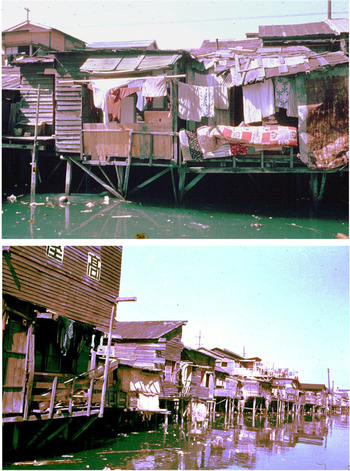
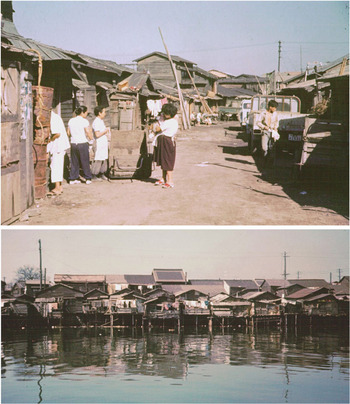
Suspending their plans to repatriate, the remaining Koreans formed slums in nearby places, renting or occupying any available space. This was the birth of the new tongne sphere. One large slum in Shimonoseki was called “shithole tongne” (ttongkkul tongne) because it was located near pig sheds, causing houses to become soaked in pig excrement after a rain (interviews). The slum stretched into a hill where no Japanese wanted to live, as a cremation facility, a graveyard, and a prison stood there (Shimamura Reference Takanori and Tooru2003, 10–11). Meanwhile, Koreans gathered in Hakata quickly built eight slums within a 5-kilometer radius of the port. The most visible one stretched along both sides of the Ishidō River, with three hundred huts lining each side (Shimamura Reference Takanori2010, 59). To passersby, the growth of these Korean shantytowns was a new feature of postwar Japan.
Slums along the Ishidō River, 1961. Courtesy of Nishiyama Uzō Photography Archives.

Slums along the Ishidō River, 1961. Courtesy of Nishiyama Uzō Photography Archives.

The flip side of the emergence of new tongne space was that many older slums across Japan faced new dynamics.Footnote 7 Some previous Korean shantytowns grew significantly bigger, while others shrank or disappeared. Kobe already had a sizable Korean slum built under bridges and on riverbanks, but more people gathered in the hope of departing from Kobe port after August 1945, thereby expanding the shantytown, which had more than 160 huts as of 1951 (Motooka Reference Motooka2006, 212–15). Those who opted to stay in Japan were again engulfed by its rapidly changing postwar economy, just as in the years before 1945. Tongne located near large factories and other sources of day labor jobs absorbed migrant workers, Koreans and Japanese alike. Ikegami town in Kawasaki City was such an example of rapid expansion; it grew from 870 people in 1950 to 2,735 in 1961 (Chŏng Reference Tae-gyun [Tei Taikin]1978, 4). People quickly left their old tongne that had surrounded wartime coal mines—many in Kyushu and Hokkaido—once the companies discontinued their operations. Large reconstruction projects and new employment opportunities in the 1950s also prompted Korean families to move from one tongne to another.
Although these massive postliberation movements triggered some people to self-identify as newly freed Korean nationals, that did not automatically lead to the establishment of a utopian community of fellow nationals. At the beginning, the joy of going home might have overridden anxieties. Kim Tal-su ([1949] Reference Tal-su and Tal-su1980, 249), a prominent zainichi novelist, stated that “if there was one time when all the Koreans living in Japan became extremely generous and giving [to one another], that's the few months after August 15.” Within a few weeks, as they started building sheds near Hakata port, however, Koreans faced the cold reality of survival of the fittest among themselves. “Everyone was busy surviving. There was no way we could be friendly and cooperate just because we were Koreans,” an interviewee told ethnographer Shimamura Takanori (Reference Takanori2010, 82, 85). The messy processes of repatriation also produced grave difficulties. Several interviewees remembered an experience of losing their family's entire belongings to theft or because ships sank, or when the family canceled their travel plans (see also Kim Reference Pong-ok2004, 12–14). For them, what Lie (Reference Lie2008, 36) calls “year zero” of zainichi history, between August 1945 and August 1946, meant rebuilding from scratch.
Through these years, temporariness was the basic mindset in the tongne, even for those who had abandoned their postliberation repatriation plans and despite the Korean War, which consolidated the Cold War split among all Koreans (Choi Reference Choi2013, 189–225). Most Korean families stored ash urns of their deceased parents in designated temples for decades instead of building a tomb, planning to take them back to their homeland soon. Given the significance of maintaining family graves according to Korean customs, this pervasive act of postponing proper burial testifies loudly to their determination to repatriate eventually. First-generation Koreans long retained a feeling of displacement in a foreign land. But it soon grew into a more celebrated diasporic identity as they gained confidence in protecting their decolonized territory, the tongne.
Establishing Autonomous Territory
Whether they had existed since the colonial period or arose immediately after the war, the tongne grew into a peculiar place for zainichi Koreans and Japanese society after liberation. Around this time, a renewed discourse of “Korean criminality” prevailed in Japanese media and political debates, exemplified famously by legislator Shiikuma Saburō's question at an August 1946 session of the National Diet, in which he accused Koreans of “ignoring Japanese law and order, daring to behave arrogantly” and illegal Korean migrants of “carrying lethal weapons, forming gangs, demonstrating astonishing viciousness by taking advantage of the disempowerment of the [Japanese] police, and posing an indescribable threat to residential life” (Choi Reference Choi2013, 124–25; Mizuno Reference Naoki2000, 17). The hostility coming from Japanese society was so painfully visible—with the exception of low-class Japanese laborers, who often lived as friendly neighbors in tongne—that the secluded tongne are rarely considered the source of zainichi pride. But tongne were more than a colonial remnant, the target of neo-imperial oppression, or a dead end for zainichi lives. Amid their seclusion, the (re)production of an autonomous territory began. Of course, the tongne territorial claim was extremely artificial in that it occupied miscellaneous parts of another nation, one where many hated living. But rather than weakening their sense of autonomy, the precarious sense of roots constantly called residents to active engagement in the (re)production of their place, and it amplified a sense of achievement in a version of nation building.
Most significantly, tongne served as a cultural birthplace for many second-generation Koreans who had received wartime Japanese education. This was the defining characteristic of postwar tongne. Throughout the colonial and postwar periods, Korean neighborhoods practiced Korean customs and ceremonies. Women made kimchi; people argued with each other in their regional dialects; families worshipped ancestors according to their regional customs and shared ceremonial dishes with others; shamans healed sickness and misfortune; men often engaged in Korean gambling games; and communal festivities featured music played on Korean drums and flutes as residents sang and danced. But even in an environment rich with Korean cultural elements, children who attended Japanese schools before Japan's defeat tended to view their own ethnicity through the colonizer's lens (Ozawa Reference Yūsaku1973, 86–136). A scholar and himself a second-generation zainichi, Mun Kyǒng-su has highlighted the psychological shift among second-generation zainichi at this time. Before 1945, hatred for the conservative Korean household, symbolized by a violent father and a suffering mother, had often driven these youth to reject what they perceived as Korean backwardness, turning them into “more extreme imperial youth than the Japanese” (Mun Reference Kyǒng-su1993, 88). But Japan's defeat turned their value compass upside down, and a sense of guilt quickly overwhelmed them. Literary scholar Takeda Seiji (Kang Su-ch'a) (1983, 27) views this turn as a shared experience for second-generation Koreans: “Pushed by that sense of guilt, they almost unanimously had to accept the first generation's mass nationalism, or ethnic nationalism, as the absolute judge” (see also Ozawa Reference Yūsaku1978, 10–11). To these youth, the tongne signified their experience—often a painful one—of re-Koreanization.
With a new sense of being “liberated people” and with second-generation youth's psychological turn, the first generation's confidence and their visceral hatred of the Japanese grew stronger than before (e.g., Choi Reference Sǒk-ŭi2004, 9–42). Equipped with firsthand experiences of colonial subjugation, these adults could defy Japanese postwar rules without complex arguments or legal measures; all they needed was to unleash powerful rhetoric on the empire's guilt. One first-generation woman in Osaka recalled how she fought the police every time she was caught carrying black-market rice. She would shout, “Let me go back to Korea. Give me back the rice paddies and fields as they were! Didn't you guys drag me here?” (Ōsaka jinken hakubutsukan Reference hakubutsukan1999, 41). Many first-generation Koreans rejected the civility and appropriateness imposed on them by Japanese society and countered Japanese rules by claiming that their inability to comply was a natural consequence of Japanese imperialism. The police, tax collectors, or municipal governments had no effective counterargument when Koreans repeated, “We are illiterate because of you” or “We are uncivilized because of you” (interviews). This rejection of engaging in Japanese-set rules was something that only first-generation adults could tactfully performed. Their performance awed younger Koreans who had grown up learning how to survive and excel within the Japanese system, but not how to completely reject it (interviews in Osaka and Hyogo).
A firm sense of territoriality was generated through tongne residents’ clashes with the Japanese police. Koreans’ bold defiance grew not only because of their new consciousness as liberated people, but also from the sheer need to make a living by the few means available. Japan's high unemployment rate hit underclass laborers the hardest; a 1951 study indicated that only 40 percent of working-age adults in a Korean slum in Tokyo had a job, legal or underground (Zainichi Chōsen kagaku gijutsu kyōkai [1951] Reference kagaku gijutsu kyōkai and Yūsaku1978, 285). Besides working as laborers, men, women, and children collected small pieces of metal in dumpsters for resale, raised pigs, and managed any kind of small business available. Confrontations with the police were an inevitable consequence of the Koreans’ black-market business activity, which included production of illicit liquor and narcotics that the Japanese called hiropon. Tongne residents viewed violence against inspectors partly as a means of survival and partly as a form of defiance. For children, these fights with the police were the most memorable heroic moments in tongne life. In fact, tongne relied on children's agility and familiarity with the maze-like structure of the slums to counter police incursions. The children ran through the tongne to announce the police's imminent arrival, broke the barrels to dump stored alcohol, threw pig-excrement bombs, hammered nails in the tires of the police cars, and sometimes knocked policemen into a river. Police incursions inevitably made Korean residents wary of strangers walking in or near their territories, and this protectiveness reaffirmed the borders of tongne and their territoriality.
In and around the tongne, human interactions and relationships grew intimate and dense. One reason for such tight connections was that the Korean custom of looking after large extended families was plugged into complex migrant-specific family situations.Footnote 8 Many men had more than one wife—they had married a woman back in Korea in their early teens but often had another wife or concubine in Japan.Footnote 9 Sometimes the wife in Korea came in search of her missing husband and found him living with another woman, or did not find him at all. As a result, she had to live with the other wife or become a concubine to a different man. Complicated marital situations were common, and many accepted them as their fate. One interviewee in Yamaguchi told us that during the 1950s and 1960s, she had a Japanese (blood) mother and a Korean mother, who lived together with their children. Impressively, they amicably helped each other to run a shop while the father worked as a leftist activist. Typically, a large number of children were born into different forms of unions, and many were casually adopted by relatives or friends. Sometimes the children themselves decided whether to be adopted or go back to their original parents (interviews in Osaka regarding the late 1940s). Entangled and dense family ties rendered the boundaries between family units fluid, making the whole tongne feel like a tribal community.
Amid dire poverty, mutual assistance was the only safety net. Women in particular formed a network; they breastfed and looked after others’ children, helped neighbors to cook for ceremonies, and organized a system of financing called tanomoshi in preparation for large expenses. These interactions provided an important function beyond survival; tongne culturally transformed Japanese women who married Korean men into Korean mothers. Japanese women were a common existence in Korean families: 15 percent to 33 percent of Korean households, depending on the survey, had a Japanese mother in the late 1940s (Aoki Reference Atsuko, Sōji and Chǒng-jing2005, 126). Especially in the areas distant from the ports connected to Korea, such as northeastern Japan or Hokkaido, Korean men often married local working-class Japanese. Many of these wives, who lost their Japanese nationality when their husbands lost theirs after the San Francisco Treaty came into effect in 1952,Footnote 10 learned the Korean language, cooking, and customs by living in tongne, assimilating themselves into their husband's ethnic group, and raising Korean families.
For children, tongne provided a big protective shell in which privacy was conspicuous by its absence. One female interviewee shared a typical depiction of 1950s tongne life in Hyogo, in which children had a great degree of autonomy and responsibility inside the tongne's boundaries: “No one locked the door and we freely entered anyone's house and joined in their meals.” She also shared stories of helping her neighborhood friend pull a tapeworm from her anus; children bringing food and blocks of coal to do a barbecue on their own; and stealing pieces of metal from a scrap collector, who then (perhaps knowingly) bought them back from her. The children also took care of farm pigs, delivered illegally brewed alcohol, and watched smaller kids. Many of this postliberation generation of zainichi internalized the tongne as their hometown and largely escaped a sense of displacement. When Japanese children shouted, “Go back to Korea!” at her, the above-quoted interviewee yelled back, “Go back to Japan!” She laughed, in retrospect, at her own misunderstanding of what home, or “Korea,” meant, but the story indicates how natural and secure the life of tongne felt to Korean children.
The dense human relationships in tongne absorbed South Korean refugees like a sponge. Some Southern Korean Labor Party activists escaped arrests by the staunchly anticommunist Syngman Rhee regime and smuggled themselves into Japan. Other refugees arrived incessantly, as the national borders were still porous after 1945. One interviewee shared a memory that shows how casually and frequently South Korean refugees joined communities: zainichi leftist activists dropped off a Korean at her tongne, saying, “Your clan name is Yun, right? So is his. Your families must be related at one point in the past. Look after him,” and left. Care arrangements varied, but tongne mothers usually took turns providing food and shelter to these political refugees. Since tongne residents looked up to South Korean activists, as many were well educated and politically respectable, zainichi fathers were eager to let their daughters marry these men, thereby completing their integration into the zainichi community. These activists often became teachers in Korean schools and prominent cadres in the Chongryun organization. Undocumented refugee children were also placed in Korean schools. The seclusion of tongne created a safe haven for them and, in turn, helped the tongne residents reimagine their ties to their South Korean home, despite the legal, political, and geographical separations between the two spaces.
Organizational Life in the Tongne
The postliberation leftist organizations of zainichi Koreans—the Korean League, the underground Minjǒn, and the Chongryun—functioned as the backbone of tongne communities across Japan. These organizations were tremendously attractive to Korean residents for multiple reasons. First, the League realized legal and political representation of Koreans in Japan for the first time: for nearly illiterate older Koreans, the presence of university-educated, eloquent Korean men who spoke out against the Japanese and American authorities on their behalf was the closest thing to having their own government. For Korean leaders, the League restored their masculine authority, which had long been denied under imperialism. The combined energies allowed the League to achieve large-scale projects. For example, it arranged free trains for repatriation and managed registrations and applications for social security when Koreans in Japan were victimized by ever-shifting legal statuses. It helped run local Korean cooperatives that purchased wholesale commodities in bulk to counter inflation. The League also created private security forces to protect against a possible massacre of Koreans by Japanese mobs, a fear that reemerged out of the memory of the terror after the 1923 Kanto Earthquake. It demanded compensations for wartime labor to large companies. It also investigated crimes against and by Koreans. Local cadres negotiated with the Japanese police to free Korean arrestees (see Zainichi Chōsen kagaku gijutsu kyōkai [1951] Reference kagaku gijutsu kyōkai and Yūsaku1978, 304–5; see also Chǒng Reference Yǒng-hwan2013; Kim Reference Kyǒng-ho2010). In short, the Korean League and its offspring organizations provided stability and order to the anarchic lives of zainichi and solved their day-to-day anxiety and problems, enhancing the status of manly cadres along the way. After the Democratic People's Republic of Korea was officially established in 1948, popular confidence in the League, which developed a link to the brand-new socialist state, grew stronger.
In most tongne, organizational activities were community based rather than imposed from above. High-level cadres were busy negotiating with the Japanese authorities and the JCP, arranging repatriation transportations, discussing political goals, publishing news and journals, soliciting donations from business leaders, and organizing demonstrations and events. These men were usually absent from tongne's family lives. Instead, adults more rooted in local communities usually took on local organizational titles, such as “branch head” and “branch education division leader.” The use of these bureaucratic titles in tongne thus accompanied a sense of intimacy. The transmission of the organization's political messages was also integrated into daily lives and consumed eagerly by residents. One interviewee shared a vivid memory of adult men, after a day's labor, gathering to drink, chat, and watch North Korean propaganda films shown by a projector in the open space of his tongne in Ōita. In view of the intense interpersonal connections in tongne communities, there was no clear boundary between organizational (or public) and private life. Many tongne developed into grassroots communities and political communes at the same time.
One phenomenon that characterized the postliberation period was a new feminist awareness, in accordance with socialist ideology. Women in Korean families, especially wives, had been widely enduring subservient roles and slave-like duties, and the socialist ideal of male-female equality gave many of them an opportunity at least to gather by themselves. Most visibly, branch offices provided night schools that taught illiterate women of all ages how to read Korean. The Women's Union (Nyǒsǒng tongmeng) was established by the Korean League in February 1946, and its regional branches spread through mid-1947. It sought to educate women in literacy, knowledge, and socialist feminism (Ri Reference Ryongsil2017, 19–28, 57–64). The organizations were soon training women as activists through a ladder of programs, creating a status progression similar to that for male cadres. Although the deep-rooted traditional gender relationships remained robust in families, this institutional system for women was already an unprecedented development toward gender equality from the viewpoint of any Korean person.
At the grassroots level, women's activism was born out of interactions between bottom-up forces and the organization's leadership. In the Arakawa district of Tokyo, Pak Chǒng-hyǒn, a female activist and wife of a branch head of the Korean League, started organizing a local women's association even before the official establishment of the Women's Union. To create a list of women in her tongne, she had to start by rediscovering their original Korean names, which they often had forgotten, or converting Japanese names into Korean-sounding ones. She taught them how to read Korean hangul in evenings. Researcher Kim Yǒng (Reference Yǒng1997, 56), who conducted an oral interview with Pak Chǒng-hyǒn, reported,
Almost all mothers worked during the day. These women enthusiastically gathered, but once they held a pencil, many fell asleep. Literacy classes largely did not seem to function at the beginning. But once the time of “exchange” started, the class quickly turned loud as if they had waited for it all day. They traded rumors, complaints, life advice, and information—this segment was the real essence of the night school.
Encouraged by the official principle of the Women's Union that emphasized the liberation of women from oppressive family structures, Pak's group engaged in vigilante activities to punish abusive and alcoholic husbands. They also put on a play, with themselves as actors, to advocate for wives’ rights over oppressive mothers-in-law (Kim Yǒng Reference Yǒng1997, 56–58). These early feminist activities pursued a radical shift in women's consciousness based on the merger between the organization and the tongne. In comparison to Mindan women's activism of the same time, which was more top-down and conservative in character, as Kim Puja and Kim Yǒng (Reference Yǒng and Puja1993, 18) have argued, women in the Korean League and the Chongryun embraced mass-oriented activism and had a clearer policy goal of gender equality.
But such a commune-like merger between grassroots communities and the political apparatus meant that personal tensions and institutional politics also overlapped. Even as institutional titles elevated women's social personas for the first time, skepticism and personal conflicts could interfere with their agendas (Ri Reference Ryongsil2017). Male cadres tended to use their positions for personal gain, often magnifying the grievances felt by other members. In one interview at a branch office where a very small Korean neighborhood still exists, an old couple explained how the previous branch head personally spent the branch's money for decades. The money at issue was compensation from a construction company that had been polluting the air in the neighborhood. As a political organization, the Chongryun made it easier for Korean tongne residents to demand compensatory payments from big corporations and the state. But branch leaders and cadres generally had great liberty in how they used the money—another result of the blurred boundary between public and private arenas for them. Our interviewee couple's complaints did not stop at the branch leader's abuse of power but quickly moved to a much more personal dimension, as they described the reputation of his children. Their comments showed how inseparable institutional positions and interpersonal tensions were in old tongne communities.
Project Hakkyo
The most important site among tongne residents from the very beginning of the postliberation era—the place within the place—was undoubtedly hakkyo (schools). The community focused considerable energy on building and protecting its school, typically a small shed packed with children of various ages and taught by someone with basic literacy. Through this effort to build and expand a school, a tongne could transform itself from a dead-end slum for underclass minorities into a decolonizing community that embraced a future-oriented goal and enjoyed a great sense of unity.
Hakkyo began with the simple goal of teaching Korean to children. By early 1946, the number of small language schools ballooned to six or seven hundred, according to one estimate (O Reference YongHo2019, 44). For the central organizations, education always occupied (and still occupies) the highest priority. By devoting energy and money to hakkyo, the organizations gained trust from Korean communities across Japan. Despite the ad hoc and grassroots origin of hakkyo, it is likely that without the organizations’ political leverage and mobilization, Korean residents would have had difficulty in financing them, training and dispatching teachers, issuing textbooks, and resolving property-related issues.
Many testimonies illustrate how dramatically hakkyo shaped students. The open embrace of being Korean restored many lives that had been marginalized in Japanese schools. One interviewee, in his seventies, shared a story of hakkyo changing his family relationship: “I hated my mother—a typical Korean woman who did not understand Japanese ways—when I was in a Japanese school. I completely changed once I entered a hakkyo. I realized how wrong I was. I kneeled down, bowed deeply with my forehead touching on the floor, and apologized sincerely to my mother for my stupidity of the past.” Hakkyo even produced a peculiar phenomenon, in that children became more Koreanized than their parents. Many first-generation parents had moved to Japan at a young age, attended Japanese schools, and acquired little competence in Korean. One interviewee in his eighties was part of such a generation. He did not belong to the Chongryun at the time but decided to send his son to a hakkyo. With tears in his eyes, he shared his life-changing experience of visiting South Korea for the first time, with his son; his son's fluency in Korean impressed their relatives, breaking through the initial skepticism with which the Chongryun-leaning zainichi relatives had been received. Another piece of noteworthy evidence of the cultural and linguistic authenticity attached to hakkyo is the fact that even Mindan-leaning families preferred getting wives from hakkyo (Ra Reference Ki-tae2010, 231). Many families sent their sons to Japanese schools but their daughters to hakkyo, likely to fulfill a gendered expectation to maintain their cultural heritage.
The operations of hakkyo depended on tongne residents’ incessant labor and donations. Hakkyo were usually located inside or near the tongne. Nearly everyone, including children, participated in their construction, which was facilitated by the fact that many Koreans worked in the construction industry. Women constantly ran small campaigns to support the operations, such as committing to “save one scoop of rice every day” to be used for the hakkyo. Teachers received a very low salary, but they never starved because tongne families invited them for meals every day. The hakkyo was the hub of community life; the building often served as the branch office and hosted women's night school, film showings, and drinking gatherings for neighbors. The handmade feel of hakkyo permeated the community and was cherished. One interviewee recalled that in the late 1940s, at age seven, although her parents enrolled her in a Japanese school, she decided to go to the nearby hakkyo and sat in the classroom every morning. Similar stories have been preserved in different parts of Japan. The children's autonomy was secured by the flexible and private nature of hakkyo operations.
The American Occupation authorities ordered the closure of these Korean schools in early 1948, on the basis that since Koreans had held Japanese nationality continuously since the colonial period, their children had to go to Japanese schools. This action showed their grave ignorance of the emotional dynamics of postliberation Korean communities. In the context of building up territoriality, both a communal and individual sense of mission to protect hakkyo led to large-scale demonstrations and uprisings, culminating in the famous Education Struggle of 1948 and 1949, which started in Yamaguchi, intensified in Kobe and Osaka, and ultimately spread across the country (Caprio Reference Caprio2008; Ghadimi Reference Ghadimi2018). During this uprising's violent confrontations with the police, men were arrested randomly, sometimes tortured for days, and tried in martial courts without civil procedure. A sixteen-year-old student, Kim T'ae-il, was shot to death during a clash in Osaka. Many women collected rice from neighbors and tirelessly prepared rice balls for activists. According to interviews in Yamaguchi, some women risked their lives, lying down in front of the police trucks to block their movement and joining in the front line of demonstrations. Children sent letters of appeal to General Douglas MacArthur, the Supreme Commander of the American Occupation, and gathered inside hakkyo to hold the fort against the military police's intrusion. One male interviewee from near Kobe, who was ten years old in 1948, remembered sleeping in hakkyo with other students during the struggle and added a personally unforgettable aspect: “This experience triggered my sexual awareness, because upper-class boys talked about sexy stuff.” Students and remaining teachers continued to hold classes outside, demonstrating their will to continue with or without government permission.
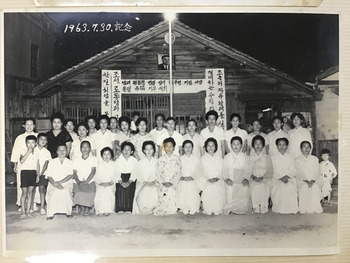
A tongne women's union gathering to celebrate the Democratic People's Republic of Korea's gender equality law in front of the hakkyo in Nishiwaki, Hyogo, 1963. This hakkyo was built right at the center of the tongne. Photo courtesy of KumHee Cho.

For the Japanese authorities, the American order was consistent with the larger movement of red purge. But Koreans viewed it as a regionwide postcolonial struggle. Through the lens of their already established transborder sense of belonging to Korea, these years of clashes with American forces caused Korean residents in Japan to relate to the social revolutions taking place on the Korean peninsula—if not in contemporary eyes, then at least in the Chongryun community's memory. Across the Korean peninsula, movements for self-rule erupted after Japan's defeat. A great number of “people's committees” were established, serving as the foundation for the ground-up North Korean Revolution, but facing oppression by Syngman Rhee's regime in the south. Large-scale massacres were being perpetrated in Taegu, Cheju, and other cities (Cumings Reference Cumings1981). The Education Struggle placed tongne in Japan firmly within the postcolonial movements occurring on the Korean peninsula. In fact, given that US Occupation forces also saw these Korean actions as the same security threat stretching across the region (Morris-Suzuki Reference Morris-Suzuki2010, 102), the Koreans’ perception of fighting the new imperial oppression as a unified ethnic movement had a tangible ground, more so than the JCP's efforts to provoke joint resistance. Thus, the Chongryun's core slogan, “Stand Against the American Empire,” was not merely an echo of North Korea's propaganda; rather, it was packed with their community memories and their sense of belonging to their homeland's postcolonial struggle.
In this way, hakkyo became a key ethnic symbol for tongne residents, beyond the importance of language education. All hakkyo were officially closed in 1948, but some of them continued as unauthorized night schools or were absorbed into branches of Japanese public schools. Ironically, soon after the Japanese government stripped Koreans of their Japanese nationality in the San Francisco Treaty, Koreans’ obligation to send children to Japanese schools was also relinquished. Instead, public education became their bestowed privilege, and many municipalities discontinued the already few classes conducted in Korean. Rebuilding hakkyo became the central goal for the Chongryun, and the hakkyo's popularity peaked in the 1960s and the early 1970s (O Reference YongHo2019, 31–33, 41–79). As the Chongryun built more middle and high schools as well as their university, students came to internalize the wide network of tongne communities across Japan by living with their peers from different regions. The proven resilience of Korean residents and organizations that repeatedly reestablished their network of hakkyo serves as the founding story of the Chongryun's collective memory.
While representing such pride, however, hakkyo also worked as a powerful device to deny Koreanness to Koreans who deviated from this course. Those who went to Japanese schools were viewed as traitors by hakkyo supporters. After 1952, many Korean families kept their children in Japanese schools for a variety of reasons—the closest hakkyo was too far away, Japanese schools were cheaper, or sending children to hakkyo could disqualify the family from obtaining social welfare. According to historian O YongHo's (Reference YongHo2019, 32) estimate, fewer than 20 percent of Korean children went to hakkyo in the late 1950s, though the share rose to 25 percent in the late 1960s. One interviewee, who had lived in a tongne but had attended a Japanese school, shared a story of being harassed by hakkyo students in the 1950s:
I had to pass the front entrance of a hakkyo on the way to the Japanese school. There was always this girl waiting there for me coming home. She shouted, “That girl is Korean, but she goes to a Japanese school!” every day. Sometimes I was walking with my Japanese friends. Some of them even guarded me, saying, “Why do they say things like that to you?” I tried to avoid that girl all the time.
This interviewee did not experience discrimination at the Japanese school, but her brother, attending the same school, was targeted by bullies, and she had to console him and help him look for his missing shoes. With the frequent and drastic legal changes, Korean parents understandably became cautious about their education choice, even if their desire for ethnic autonomy remained strong. As a result, most Korean children were left unsupported in Japanese schools, and their mixed feelings and identity crises were exacerbated even further as they confronted both a xenophobic Japanese society and the exclusivity of hakkyo-based Koreanness.
After Tongne: Hakkyo as the Place
As Korean slums disappeared in the late 1960s as a result of Japanese authorities’ urban planning and overall economic growth, zainichi Koreans lost their physical place of origin. In contrast, the Chongryun inherited the authentic place, the hakkyo, which now replaced the tongne and became the community itself. Based on observations of linguistic code switching among students, Ryang and other anthropologists have argued that Korean schools in more recent years have represented “public life,” while the surrounding Japanese culture and language represented “private life” to students (Ryang Reference Ryang1997, 44; Song Reference Kichan2012, 215–19). But an examination of the meanings of the hakkyo makes it clear that students’ code switching does not give us a full picture. Hakkyo continued to embody public and private lives for the community as tongne did, and this overlap still characterizes Korean schools today. For the Chongryun organization, to be sure, they provided a mechanism of reproducing leadership and ethnic identity. Throughout the organization's political upheavals, hakkyo served its changing goals, transmitted political messages, and allowed the organization to connect to the masses. But for individual residents, hakkyo symbolized their communal home, packed with memories of earlier generations, who had viewed tongne as a space continuous with the Korean homeland.
Today, after many upheavals in the DPRK-Japanese relationships, rounds of moral crises among the Chongryun community, and financial difficulties, the number of existing hakkyo has shrunk to fewer than four dozen, with some having only a few students in each grade. But their small size further reinforces the village-like atmosphere. When a hakkyo holds a sports day for schoolchildren, the entire community puts on a festival with alcohol and outdoor barbecues. Students grow up in the protective shell of the community: on one occasion, my research partner and I visited a Korean high school for interviews, and we asked a student where his grandfather came from. He could not answer, but his teacher told us the student's detailed family background dating back several generations. In our observation, more than the Korean language, Korean cultural instructions, or North Korean indoctrination, hakkyo continue to be primarily about introducing students to enter this tight-knit, public-private communal network. Many alumni have thus developed a strong attachment, not just to the particular schools they attended but to the network of hakkyo across Japan. This spread of affective connection goes far beyond what we usually see in other schools in Japan. The closing of hakkyo in many cities and the shrinking size of those that remain have caused emotional pain to many, attesting to the fact that hakkyo were more than an educational institution imposed by a top-down organization.
At the same time, the reverse effect also continues. For the zainichi Korean population outside the hakkyo environment, Korean schools have been an over-sacralized, anachronistic, bizarrely politicized institution that excludes others in claiming authentic Koreanness. Many threads of zainichi theories and expressions of new identities, such as “the third way”—neither Korean nor Japanese—or cosmopolitanism, have developed outside of the Chongryun circle since the 1970s. Yet the tongne-hakkyo heritage still towers as the cultural establishment against which non-Chongryun zainichi theorists had to consciously position themselves. On more than a few occasions, I have seen hakkyo graduates unwittingly stir up anxiety in other zainichi's sense of belonging. Today, since the Chongryun organization itself has long lost its former political and economic power, it is even easier to identify the affective power of the living place itself in negotiations of zainichi identities.
Conclusion
In the early 1960s, two books of writings by zainichi youth were published, and they could not have been more opposite from each other. The first one (Nam Reference Il-Ryong1961) was a collection of Korean students’ essays about growing up in a foreign land, going to hakkyo, and preparing to move to North Korea. The essays were filled with passionate love for their nation and community as well as youthful hope for a bright future in North Korea. The other (Pak Reference Su-nam1963) was a compilation of letters exchanged between a zainichi journalist and Yi Chin-u, a young zainichi who had been executed in 1962 on the charge of murdering a Japanese schoolgirl. The sophisticated knowledge and philosophical expressions that Yi exhibited in his letters surprised Japanese intellectuals and generated public interests and sympathy. Despite Japanese society's fascination with him, Yi—a monster figure created by the poverty and misery of an ethnic minority—became a symbol of the dark zainichi life. These two contrasting images coexisted in zainichi society in the early 1960s.
The vast emotional discrepancy between the two books is noteworthy, but so is the fact that the Chongryun community viewed Yi Chin-u, who grew up in Japanese schools, as a product of the deletion of Korean ethnicity, and as a tragedy that could have been averted by hakkyo. The corresponding Chongryun-affiliated journalist, Pak Su-nam, argued that if Yi had gone to a Korean school, he would not have committed the crime (Cho Reference Kyǒng-hŭi, Tae, Ki and Noriko2017, 255). This opinion was widely expressed by Chongryun people whenever a tragedy involving Korean youth, such as a crime or suicide, was reported in the 1960s and 1970s. The hakkyo were the solution to all the problems. These people did not realize that their absolute sense of ethnic confidence itself contributed to casting a dark shadow outside their community.
This snapshot of zainichi affects of the 1960s highlights the essence of the tongne-hakkyo sphere. Choosing a Chongryun school was not a mere expression of a certain political preference. The place of hakkyo symbolized the community's pride in having established an autonomous territory despite Japanese hostility and aggressive American measures. For the community, the hakkyo were shiny crystals produced by myriad human bonds and life-risking commitments since the moment of liberation, visually proving that they had achieved complete decolonization. Their moral confidence and sense of heroism attached to this tongne-hakkyo sphere fueled the Chongryun's massive campaigns for many other projects, including migration to North Korea. Today, the community's devotion is still present. However, a number of unfortunate political developments—especially the bleak DPRK-Japanese relationship and continuing dictatorship in the DPRK—have added many layers of inexpressible emotions to this tongne memoryscape.
Acknowledgments
I owe KumHee Cho greatly for her research help, and I am indebted to all the interviewees and helping hands in zainichi communities across Japan and the Korean peninsula. I am thankful for the comments I received upon presenting earlier versions of this article at Johns Hopkins University, Yale University, Columbia University, and the National University of Singapore. I am also grateful to Taomo Zhou and three anonymous reviewers for providing me with thoughtful feedback on the article.