Introduction
Recent increases in global temperatures and shifts in precipitation worldwide have disrupted the longstanding equilibrium between conifers and bark beetles. Higher annual temperatures and shorter winters extend and enhance beetle reproduction, causing additional stress to trees that beetle larvae use as a food source (Bentz & Jönsson Reference Bentz, Jönsson, Vega and Hofstetter2015). In pine forest ecosystems, bark beetles contribute to the welfare of plant communities through nutrient cycling, canopy thinning and biodiversity generation (Glare et al. Reference Glare, Reay and Etxebeste2011). Conversely, beetle-induced mass mortality dampens forests’ capacity for water purification, slope stabilization, carbon sequestration, wildlife conservation and soil formation (Kurz et al. Reference Kurz, Dymond, Stinson, Rampley, Neilson, Carroll, Ebata and Safranyik2008). Because of these impacts, measurements of the effect of climate change on host trees’ natural defences against bark beetles are especially important. Tree growth rates are usually so slow that space-for-time proxies, such as altitude gradients, are often used in climate change forecasting (Ferrenberg et al. Reference Ferrenberg, Langenhan, Loskot, Rozal and Mitton2017). In this investigation, we attempt a direct measurement of changes in relative percentages of 4-allyallanisole (estragole, methyl chavicol) in Caribbean pine (Pinus caribaea Morelet) using a longitudinal study of xylem oleoresin volatiles related to bark beetle attack that spans 12.7 years.
Southern pine beetles (SPB, Dendroctonus frontalis Zimmermann) and possibly D. mesoamericanus Armendáriz-Toledano and Sullivan (Armendáriz-Toledano et al. Reference Armendáriz-Toledano, Niño, Sullivan, Kirkendall and Zúñiga2015) have significantly affected Caribbean pine populations in Central America. SPB is predicted to kill 439 000 km2 of pine forests by the year 2080 (Katz Reference Katz2017). Caribbean pines can produce enough defensive oleoresin and resin flow to ward off beetle attack. However, especially under stressful conditions such as drought, trees often succumb to larval feeding on the phloem and to symbiotic fungi that grow from spores carried by female beetles in their mycangia.
The phenylpropanoid 4-allylanisole (1-methoxy-4-(prop-2-en-1-yl)-benzene, CAS #140-67-0, hereafter 4-AA) has received attention as a semiochemical mediator between bark beetles and pine trees (Werner Reference Werner1995). It is produced by a different synthetic pathway than terpenes, and it appears to be repellent to various species of scolytid beetles including SPB (Hayes et al. Reference Hayes, Strom, Roton and Ingram1994). Higher xylem oleoresin levels of 4-AA have been correlated with lower attack by Dendroctonus ponderosae Hopkins in Pinus ponderosa var. scopulorum Engelmann (Emerick et al. Reference Emerick, Snyder, Bower and Snyder2008, Hobson Reference Hobson1995). In addition, sufficient levels of 4-AA deter fungal growth, allowing an attacked tree to survive the fungal infections that arrive with bark beetles (Hofstetter et al. Reference Hofstetter, Mahfouz, Klepzig and Ayres2005).
In previous analyses of 4-AA in the monoterpene fraction of Caribbean pines of the Mountain Pine Ridge (MPR) Forest Reserve in Belize, Snyder & Bower (Reference Snyder and Bower2005) found significantly more 4-AA (>2.5%) in the xylem oleoresin of low-mortality (little or no visual evidence of beetle-induced mortality) stands of P. caribaea var. hondurensis than in high-mortality (≥90% mortality) stands that had sustained high levels (median of 35 pitch tubes per tree) of SPB attack. Furthermore, levels of 4-AA > 2.5% in individual trees were found to be negatively correlated with the magnitude of beetle attack, quantified as the number of pitch tubes per tree.
There are at least three varieties of P. caribaea: P. c. var. hondurensis, P. c. var. bahamensis and P. c. var. caribaea. Coppen et al. (Reference Coppen, Gay, James, Robinson and Mullin1993) analysed the xylem oleoresin of these varieties grown in SPB-free plantations from seeds obtained from nine Caribbean locations. The varieties exhibited different constitutive levels of 4-AA, with the P. c. caribaea and P. c. bahamensis varieties averaging below the 2.5% threshold (1.3%, and 1.5% to 2.2%, respectively). Furthermore, P. c. hondurensis grown from seeds obtained from coastal sites in Belize and Nicaragua had average levels at or below 2.5% (2.5% and 1.6%, respectively). These differences, coupled with the findings of Snyder & Bower (Reference Snyder and Bower2005) at MPR and a predicted increase of 0.32oC and a decrease of 1.2% in precipitation per decade in Belize (Richardson Reference Richardson2009), suggested a longitudinal study of 4-AA levels in indigenous stands of P. c. hondurensis should be conducted to determine if these climate variables might impact the levels of monoterpenes and 4-AA that mediate beetle attack.
Methods
In 2007, three coastal stands of P. caribaea var. hondurensis without visible signs of SPB attack were sampled. Given the patterns found in the MPR forests studied in 2004 (Snyder & Bower Reference Snyder and Bower2005), trees in the Forest Reserves of Mango Creek I (MC1), Mango Creek IV (MC4) and Swasey-Bladen (SB), were predicted to have average levels of 4-AA > 2.5% in the oleoresin’s monoterpene fraction, potentially protecting them from SPB attack. In addition, two stands of P. c. hondurensis in premontane forests of Guatemala with two levels of beetle attack were sampled in 2008.
Our results from 2004 suggested that stands with >2.5% 4-AA should resist SPB attack. In this longitudinal study, trees from two of the three 2007 coastal sites (SB and MC4) were resampled in 2016 for their monoterpenes and 4-AA and evaluated for their mortality levels. (MC1 had human encroachment that prevented resampling.) The samplings in March 2004 (25.3oC; 4.7 cm rain/month), March 2007 (23.9oC; 4.3 cm rain/month), August 2008 (20.5oC; 35 cm rain/month) and November 2016 (25.0oC; 22 cm rain/month) included stands that were paired with high and low levels of attack, wet and dry seasons, and coastal (~40 m) and premontane (~500 m) elevations.
Samples were collected for chemical analyses by drilling 1.2 cm holes into trees with diameters at breast height (dbh; 1.2 m) between 14 and 43 cm. Holes were drilled at a slight upward angle. Sample vials were immediately inserted into the predrilled holes and left to collect xylem oleoresin for 24 hours. The vials were removed, capped, and subsequently refrigerated until analysed. Samples were analysed for their 4-AA and monoterpene composition using GC-MS (Agilent 7890A-5975C) with 30 m HP-624 and (cross-calibrated) HP-5MS columns. Samples were diluted with heptane and analyses were conducted on the HP-5MS using total-ion chromatography and the 68, 93 and 148 ions with the temperature programme: 10 min at 50oC, followed by a 15 min temperature ramp to 250oC. This procedure resolved and quantified 4-AA and 10 monoterpenes. The data were converted to relative mass percentages using authentic standards, and identities of the components were verified via the mass spectra and retention times. Data analyses were performed using Minitab ver. 18.1 (Minitab Inc., State College, PA, 16801, USA).
Results and Discussion
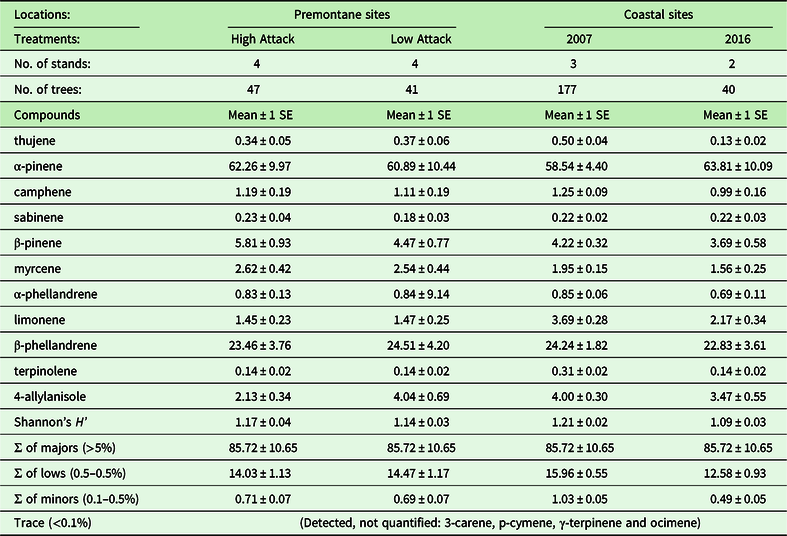
Table 1 summarizes the relative percentages of the analysed compounds in the oleoresin. Higher levels of chemical diversity within the host and surrounding plants have been shown to reduce insect damage (Richards et al. Reference Richards, Dyer, Forister, Smilanich, Dodson, Leonard and Jeffrey2015). Monoterpene diversity was quantified with the diversity index, H’ m = −Σpiln(pi), where pi = the proportion of each of the 10 monoterpenes. In this study, H’ m was inversely correlated with α- and β-pinene (Spearman rs2 = 0.77 and 0.20 respectively, P < 0.00001, n = 305 trees).
Summary of the mean relative percentages of xylem oleoresin monoterpenes and 4-AA and their standard errors (SE), sample sizes, and the measured chemodiversity of P. caribaea

Recently, Ferrenberg et al. (Reference Ferrenberg, Langenhan, Loskot, Rozal and Mitton2017) found H’ m increased with P. ponderosa age. We found a similar increase related to dbh for H’ m and % 4-AA in P. caribaea (rs2 = 0.15, P = 0.002; and rs2 = 0.22, P = 0.0001, n = 62, respectively) at Mountain Pine Ridge during the dry season. Adding wet season data from comparable elevations in Guatemala suggests % 4-AA reaches a maximum near dbh = 30 cm and then marginally declines. The combined data (n = 102 trees) also suggest H’ m is more independent of size during wet seasons.
Using only the linked, paired data sets and after removing five outliers (three MPR and two SB pines with >80% α-pinene), the H’ m data met the assumptions of normality and equality of variances for a three-factor, two-level GLM ANOVA of high versus low attack status, high versus low altitude and wet versus dry seasons. (Because of their collinearity, temperature, precipitation and time could not be used as separate predictors.) H’ m was found to be significantly higher during warm and dry periods (F = 92.2, P < 0.00001, n = 239). Attack status and altitude were not significantly related to H’ m. While Ferrenberg et al. (Reference Ferrenberg, Langenhan, Loskot, Rozal and Mitton2017) found H’ m decreased with elevation in some pine species, their study involved a wider range of higher elevations (1800 − 3300 m).
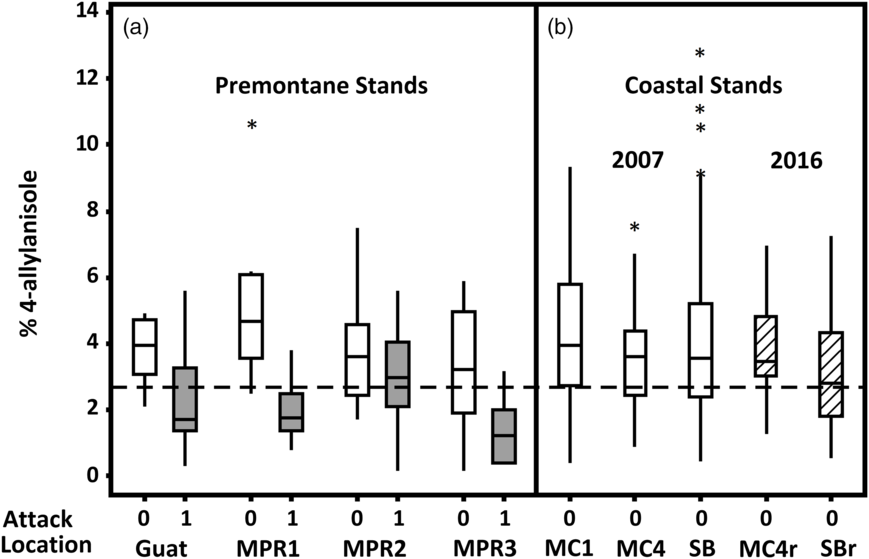
An arcsine, square root transformation successfully normalized percentages of 4-AA without rejecting outliers. As predicted, the three-factor, two-level GLM ANOVA of attack status, altitude and season for paired sites found stands of P. caribaea that avoided mass-mortality from beetle attack over the course of this study (Figure 1) had higher relative percentages of 4-AA (4.04% vs 2.13%; F = 28.60, P < 0.00001, n = 245). Furthermore, altitude, season and interactions were all insignificant for 4-AA (P ≥ 0.3). Even higher levels of significance were found including unpaired trees from the MC1 stand with Mood’s median tests for 4-AA vs attack status (χ2 = 24.91, P < 0.00001, n = 305), and for season vs H’ m (χ2 = 55.05, P < 0.00001, n = 305). While H’ m and 4-AA could be transformed to meet the assumptions of a GLM ANOVA, individual monoterpenes often did not meet these assumptions. Mood’s median test makes no assumptions about normality or equality of variances, so it was used to examine individual monoterpenes. Except for a positive association with β-pinene (χ2 = 11.26, P = 0.0008, n = 305), none of the monoterpenes was significant with respect to beetle attack after Bonferroni correction.
Box plot displaying the variation of 4-AA (a) between low-attack (0) and high-attack (1) stands in premontane sites sampled in 2004 (MPR) and 2008 (Guatemala), and (b) between the coastal 2007 and 2016 repeated (r) samplings. Boxes = inner quartiles; whiskers = max and min within 1.5 × of box height; lines within boxes = medians, asterisks are outliers. Dashed line = the 2.5% threshold. Shaded stands had significantly higher levels of mortality (χ2 = 20.14, P < 0.00001, n = 88). The 2016 stands (hatched) showed a borderline significant decline in 4-AA (χ2 = 4.28, P = 0.039, n = 217) compared with 2007 that may be due to factors such as seasonal variation and/or increasing stress from climate extremes.

Altitude, attack status, rainfall and temperature (which was inversely correlated with rainfall) are not fully orthogonal factors in the unbalanced experimental design, so the significance of factors extracted using a GLM ANOVA must be treated cautiously. The reported temperature increase and rainfall decrease during this 12.7 year study are +0.22oC and −2.6% (World Bank Group 2019). Based on work such as Ferrenberg et al. (Reference Ferrenberg, Langenhan, Loskot, Rozal and Mitton2017), we expected our study to find inverse correlations between 4-AA and altitude, attack status and time, but a direct correlation with rainfall. Based on all 305 trees, only attack status was significantly associated with 4-AA.
Because many compounds are summarized by H’ m, only some of them defensive, the correlations with H’ m are harder to predict. Still, we expected to find H’ m inversely related to altitude, attack status and rainfall, and directly related to temperature. Only rainfall (and/or temperature) was significantly associated with H’ m.
Changes in H’ m found in this study are within the normal range of plant plasticity for the compounds analysed. Lower H’ m values in this study correspond to higher levels of monoterpenes such as α-pinene, β-pinene and/or myrcene that act synergistically with beetle pheromones as attractants (Sullivan Reference Sullivan2016). Beetle antenna analyses have shown that SPB responds to α-pinene, β-pinene, myrcene and 4-AA (Sullivan Reference Sullivan2016). High levels of 4-AA inhibit the growth of symbiotic fungi (Marei et al. Reference Marei, Rasoul and Abdelgaleil2012), so it may act as a deterrent to pioneering beetles. 4-AA may also be directly toxic to the beetles (Werner Reference Werner1995). Thus, increases over time of the relative percentages of α-pinene, β-pinene and myrcene, coupled with decreases in 4-AA due to dilution by monoterpenes when higher temperatures and/or cumulative water deficits increase resin flow (Blanche et al. Reference Blanche, Lorio, Sommers, Hodges and Nebeker1992), are likely to intensify future beetle attacks. Such dilution effects may explain what appears to be a modest decline in 4-AA over time shown in Figure 1.
Outside of the seasonal monoterpene dilution effect, the essentially constant level of 4-AA found in this study is consistent with the idea that 4-AA levels in P. caribaea are constitutive. Stressors such as photochemical smog have been correlated with lower levels of 4-AA released from ponderosa pine needles and higher levels of beetle attack. However, xylem oleoresin levels were constant (Cobb et al. Reference Cobb, Zavarin and Bergot1972). The different levels of 4-AA found by Coppen et al. (Reference Coppen, Gay, James, Robinson and Mullin1993) in the P. caribaea varieties free from SPB attack also suggest 4-AA is constitutive. The lowest mean levels (<2.0%) are found in Caribbean pine varieties from the Bahamas and Cuba while the highest levels (>2.5%) are found in Belize and Guatemala where populations of P. caribaea have been subject to selective pressure from SPB attack. Similar selection has been suggested for mountain pine beetle (Six et al. Reference Six, Vegobbi and Cutter2018).
This study expands earlier findings (Snyder & Bower Reference Snyder and Bower2005), suggesting 4-AA is a constitutive component that mediates SPB attack in P. caribaea. It also suggests that trees with insufficient levels of this semiochemical, such as from the use of inappropriately sourced seed stock and from stressors such as large shifts in temperature and rainfall, are likely to make stands of P. caribaea more susceptible to mass mortality from future bark beetle attacks.
Acknowledgements
We thank the Belize Ministry of Natural Resources and the Environment and personnel of the Forest Department for their counsel and permission to undertake this project. We also thank Cesar Archila for help with collecting samples in Guatemala, and our anonymous reviewers for their helpful suggestions.
Financial support
This research was funded by the Otis and Margaret Barnes Trust, the Fairchild Foundation and Colorado College.