N95 filtering facepiece respirators (FFRs) are commonly used to protect healthcare workers (HCWs) from airborne pathogens. The adequate facepiece fit of FFRs is critical for achieving optimal protection; thus, the US Occupational Safety and Health Administration (OSHA) requires every user to undergo a respirator fit test. However, many countries, including Korea, have no clear regulations for a respirator fit test, and HCWs often use FFRs without proper fit testing.Reference Han and Choi 1 Additionally, respirator users are recommended to perform a user seal check (USC) after each donning, but its accuracy for predicting a tight face seal has been questioned.Reference Derrick, Chan, Gomersall and Lui 2
In this study, we examined the fit-test pass rates of different models of N95 FFRs commonly used in Korea to determine the factors associated with passing the fit test. Furthermore, we aimed to address the diagnostic accuracy of the USC compared to a quantitative fit test (QNFT).
METHODS
Models of FFRs Tested
We selected 4 respirator models, consisting of 3 types of N95 FFRs, for testing (Appendix Figure 1). The 3M 1860/1860S (3M, Maplewood, MN) and the Maskin MS6115 (Suzhou Sanical Protective Product Manufacturing, Jiangsu, China) are cup-shaped; the 3M 1870+ is a flat-fold model; and the Kimberley-Clark (K-C) 46727 (Kimberley-Clark, Irving, TX) is duckbill-shaped. Although the 3M 1860 respirator comes in 2 sizes (standard and small), which were tested separately, both of these respirators were considered to be the same model for analysis and are referred to as 1860(S) in this study. All N95 FFR models have been approved by the National Institute for Occupational Safety and Health (NIOSH).
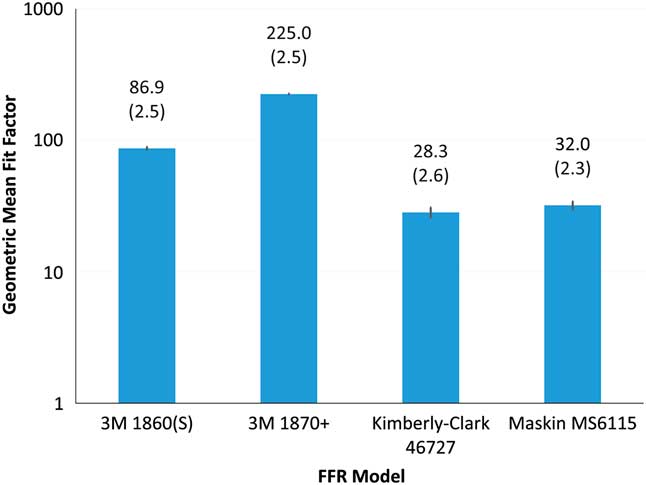
Geometric mean fit factors for different models of N95 filtering facepiece respirators (FFRs). Error bars and numbers in parentheses show geometric standard deviations. Note that vertical scale is logarithmic. The 3M 1860(S) respirator model shows a higher fit factor between the 1860 and 1860S models.

Study Protocol
The study participants were recruited in a military hospital through advertisement emails. The details on the exclusion criteria and previsit instructions are provided in the Appendix. Menton-sellion length and bizygomatic width were measured with spreading calipers (Mitutoyo, Kawasaki, Japan). The facial measurements were used to determine the subjects’ placement according to the NIOSH bivariate panel.Reference Zhuang, Bradtmiller and Shaffer 3
The subjects donned an FFR and performed a USC by inhaling and exhaling sharply while cupping both hands over the FFR, according to the manufacturers’ instructions. If the participant perceived a leakage, 3 opportunities were given to adjust the FFR before calling it a failure.
A QNFT was conducted in accordance with the OSHA Respiratory Protection Standards (29 CFR 1910.134 Appendix A) using the TSI PortaCount Pro+ 8038 (TSI, Shoreview, MN). Details on the QNFT methods are available in the Appendix. Before beginning the main sequence of the QNFT, fit factor (FF) was measured during normal breathing. FF was calculated as FF = (average particle concentration inside the FFR)/(average ambient particle concentration). The overall FF was calculated as the harmonic mean of the FF in each stage, excluding the FF during grimacing. An overall FF ≥100 was considered passing. All 4 FFR models were tested in random order.
Statistical Analysis
The geometric mean of the FF (GMFF) was used for comparative analyses, as the distribution of FF is known to be log-normal or near log-normal.Reference Bergman, Zhuang, Brochu and Palmiero 4 A χ2 and Fisher exact tests were used to compare the categorical variables, whereas unpaired Student t tests were used to compare the GMFFs. For the diagnostic characteristics of the USC, the sensitivity for predicting QNFT fail and the negative predictive value for predicting pass were evaluated. The accuracy of the USC was calculated as (the number of concordant results between USC and QNFT)/(the number of all tests)×100. We used the multiple logistic regression model with stepwise backward selection to elucidate the independent prediction factors for passing QNFT. P values of .10 and .05 were used as exclusion and inclusion cutoffs, respectively. All statistical analyses were performed using SPSS Statistics software version 20.0 (IBM, Armonk, NY).
RESULTS
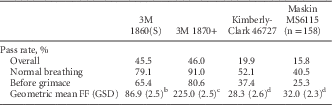
A total of 211 subjects were recruited (Appendix Table 1). Distribution of respirator sizes were medium (59.2%), small (33.2%), and large (6.2%) (Appendix Figure 2). The GMFFs varied highly among different N95 FFR models (Figure 1). The 3M 1870+ FFR model showed the highest GMFF, followed by 3M 1860(S). The K-C 46727 and Maskin MS6115 models had comparable GMFFs, which were lower than the previous 2 models. The overall QNFT pass rates of the 4 models reflected the distribution of GMFFs (Table 1 and Appendix Figure 3). The highest proportion of subjects passed the QNFT using the 3M 1870+ and 1860(S). The other 2 models showed lower pass rates, both <20%. Overall, 69.2% of our subjects passed the QNFT using at least one N95 FFR model (Appendix Figure 4).
Quantitative Fit Test Pass Rates and Geometric Mean Fit Factors (FF) by Different Models of RespiratorsFootnote a

NOTE. GSD, geometric standard deviation.
a For 3M 1860, pass for either standard (1860) or small size (1860S) was shown as a pass for 1860(S).
b,c,d Geometric fit factors with different superscript letters are significantly different.
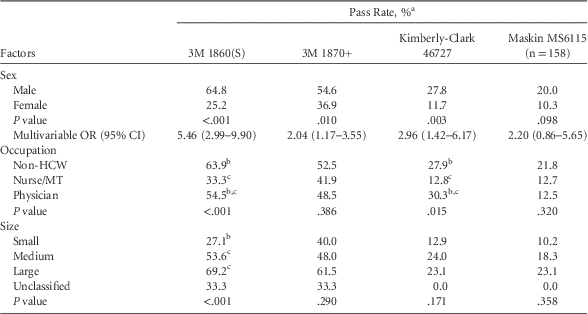
Male sex was associated with higher pass rates in all models, but the difference did not reach statistical significance with MS6115 (Table 2). Subjects with larger face sizes showed higher pass rates, although this trend was statistically significant only for 3M 1860(S). In multivariable analyses, only male sex was found to be an independent prediction factor for QNFT pass in 3 of 4 models (all except MS6115).
Factors Associated With Pass for Overall Quantitative Fit Test

NOTE. OR, odds ratio; CI, confidence interval; HCW, healthcare worker; MT, medical technician.
a Unless otherwise specified.
b,c Each superscript denotes the same group of variables with P ≥.05 with Bonferroni correction.
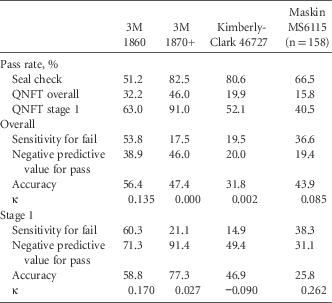
To evaluate the diagnostic accuracy of the USC, the USC results were compared against QNFT as the gold standard (Table 3). The sensitivity of the USC for QNFT fail was very low at 17.5%–53.8%. Accordingly, the negative predictive values for QNFT pass were 19.4%–46.0%. The overall accuracy was <50%, except for 3M 1860.
Accuracy of User Seal Check in Predicting Quantitative Fit Test (QNFT) Pass

DISCUSSION
Our study demonstrated low QNFT pass rates for the 4 commonly used models of N95 FFRs with Koreans. Previous studies from the United States and Canada demonstrated high (81%–95%) overall pass rates with volunteer subjects.Reference Bergman, Zhuang, Brochu and Palmiero 4 , Reference McMahon, Wada and Dufresne 5 Studies from Asian countries are rarer, but recently Yu et alReference Yu, Jiang and Zhuang 6 reported that the pass rates of Chinese volunteers were much lower (0–44.7%). A more recent Korean study found that the QNFT pass rate of a single model (3M 1860/1860S) was 73.5%.Reference Kim, Baek and Seo 7 The pass rate of the same model in another study from China was slightly lower (57.4%–61.3%).Reference Lam, Lee, Yau and Charm 8 Despite a moderate difference in pass rates, our results are in line with those of previous Asian studies reporting low QNFT pass rates. The differences in the FFR face fit in ethnic groups might be caused by different head forms. A previous study from Korea reported that the bitragion-menton arc, which reflects the lower face shape and was not considered important in the US studies, correlated with the face fit of a half-mask respirator.Reference Han and Choi 1
We found that only sex was consistently associated with QNFT pass. Previous reports from the United States suggested that there were no sexual differences in respirator fit,Reference Oestenstad, Elliott and Beasley 9 while Asian studies showed lower QNFT pass rates among women.Reference Han and Choi 1 , Reference Lam, Lee, Yau and Charm 8 Our results also suggest a differential effect of sex on respirator fit among Asians.
This study revealed that the flat-fold–type respirator (ie, 3M 1870+) was more likely to pass the QNFT than other types, which may be explained by its flexible design. The larger effect of face size on non–flat-fold respirators observed in our study supports this hypothesis. Moreover, a previous study has reported that flat-fold–type respirators have higher pass rates than cup-type respirators.Reference Niezgoda, Kim, Roberge and Benson 10
Our study has several limitations. First, our subjects, recruited from a single military hospital, may not fully reflect the wider population of HCWs in Korea. Second, we did not measure the facial dimensions other than the menton-sellion length and bizygomatic width.
In conclusion, the fit-test pass rates of 4 different models of N95 FFRs commonly used in Korea were relatively low. Our results have implications for infection control and occupational safety. Legislative action, financial support, and further research on optimal FFRs for Asians are warranted to protect HCWs in Asian countries, where the burden of tuberculosis is high.
ACKNOWLEDGMENTS
Financial support: This work was supported by a grant from the Armed Forces Medical Command (grant no. 2016-KMMRP-030). The manufacturers and/or distributors of the N95 FFRs used in this study did not provide any support for or input to this study.
Potential conflicts of interest: All authors report no conflicts of interest relevant to this article.
SUPPLEMENTARY MATERIAL
To view supplementary material for this article, please visit https://doi.org/10.1017/ice.2017.271.