Introduction
[In 1983–84] behavioral economics essentially did not exist. Kahneman and Tversky had written their Econometrica paper on prospect theory, but not very many economists had taken much notice. There was no dialogue between psychology and economists, and there hadn't been since Herb Simon's days as an economist. Now much of the credit for what has happened since must go to K&T who were so brilliant that economists simply could not ignore them. But I think that the value of the Sloan-Sage program should not be neglected. Simply by having such a program, a sense of mission was created (Thaler's letter to Wanner, 27 May, 1992, Rockefeller Archive Center [hereafter RAC], emphasis in the original)
As much as rewarding psychologist Daniel Kahneman (b. 1934), the Nobel memorial prize in economics in 2002 was a celebration of his and Amos Tversky's (1937–1996) scientific achievements, it was a recognition of the rapid ascendance of behavioral economics (e.g., Sent Reference Sent2004; Angner and Loewenstein forthcoming; and Camerer and Loewenstein Reference Camerer, Loewenstein, Camerer, Loewenstein and Rabin2004). Moreover, it was implicitly a recognition of the early support of behavioral economics through the Alfred P. Sloan and later Russell Sage Foundation's behavioral economics program, which ran from 1984 through 1992. The primary contribution of the Sloan and Russell Sage behavioral economics program were not the resources it provided, which were relatively modest. Instead, the program's contribution lay in nourishing what Richard Thaler (b. 1945) in the above quote aptly calls “a sense of mission.” The behavioral economics program catalyzed in the researchers it supported a sense of contributing to a new direction of the economic discipline. Partly this reflected the common strategy of American foundations to pick an individual or small group of scientists and stick with them until scientific success had been achieved (Jones and Rahman Reference Jones and Rahman2009; Hauptmann Reference Hauptmann2006). In addition, it reflected the good luck of being at the right place at the right time. But, moreover, it was a consequence of the careful management of the program's director Eric Wanner (b. 1942). This paper shows how the various actors involved in the behavioral economics program – Kahneman, Thaler, the advisory committee and, particularly, Wanner – constructed a new behavioral economic sub-discipline in economics by on the one hand tapping into existing missionary sentiments in the economic and psychological disciplines, while on the other hand actively shaping this sense of mission.
As such, this article contributes to broad-scale discussions of postwar American patronage of the social and behavioral sciences (e.g. Goodwin Reference Goodwin1998; Dowie Reference Dowie2001; Solovey Reference Solovey2001; Porter and Ross Reference Porter and Ross2003; Mirowski and Sent Reference Mirowski and Sent2003 and Reference Mirowski, Sent, Hackett, Amsterdamska, Lynch and Wajcman2008; Crowther-Heyck Reference Crowther-Heyck2006; Scheiding and Mata Reference Scheiding and Mata2010), as well as to more detailed studies of patronage (e.g., Cochrane Reference Cochrane1979; Leonard Reference Leonard1991; Pooley and Solovey Reference Pooley and Solovey2010; Solovey Reference Solovey2004; Sutton Reference Sutton1987). While this literature mostly focuses on the first three postwar decades, the present article extends the investigation to a more recent period and is the first to discuss the Sloan and Russell Sage behavioral economics program. It is to be specified from the outset that although the behavioral economics program was loosely connected to Herbert Simon, it was, despite its name, not directly related to the short lived Ford Foundation's Behavioral Sciences Program (1951–1957) or to George Katona's Institute of Social Research at the University of Michigan, established in the late 1940s.
Behavior as a concept encapsulating all acts of the human being – and, more controversially, of the animal being – originates in the United States of the early twentieth century (Danziger Reference Danziger1997; Senn Reference Senn1966). Subsequently, this new concept of behavior provided the basis for the label of the new approach to psychology baptized behaviorism (Mills Reference Mills1998). Behaviorism in its strictest sense was a scientific program which dominated psychology in the 1920s and 1930s. It was after World War Two that “behavioral” was introduced in relation to “science” and “economics.” As early as 1943 Clark Hull from Yale University spoke about “the behavioral (social) sciences” in his Principles of Behavior (Senn Reference Senn1966). Yet it was only after James Miller created the Committee on the Behavioral Sciences at the Psychology Department of the University of Chicago in 1949, and the creation of the Ford Foundation's Behavioral Science Program in 1951 that the term became widely used, albeit from the start in different ways by its different users (Hammond and Wilby Reference Hammond and Wilby2006; Pooley and Solovey Reference Pooley and Solovey2010; Berelson Reference Berelson, Sills and Merton1968; Senn Reference Senn1966).
The term “behavioral economics” was initially popularized at the University of Michigan's Institute of Social Research in the late 1940s, where Katona understood behavioral economics to be investigating economic behavior, that is the sub-class of behavior produced in the course of the agent's activities in the economy (e.g. Festinger and Katz Reference Festinger and Katz1953; Juster Reference Juster, House, Juster, Kahn, Schuman and Singer2004). Other users of the adjective ‘behavioral’ included Ward Edwards, also at the University of Michigan, who, starting in the late 1950s, employed it as the name of his branch of operations research called behavioral decision research (Edwards Reference Edwards1954 and Reference Edwards1961); and Simon, who in the 1950s and 1960s advanced what he labeled behavioral economics as an alternative to the dominant neoclassical school in economics (e.g., Simon Reference Simon1955, Reference Simon1959, Reference Simon1962). The label, behavioral economics, was later picked up by economists who sought to reform the dominant neoclassical view of the day along the lines set out by Simon.
Throughout his career, Edwards was of the opinion that although people may be prone to mistakes in their decision making, they are ultimately capable of and willing to avoid mistakes when they are given the correct information and sufficient time. Moreover, he was convinced that people want to comply with – what he understood as – the normative theories of expected utility theory, Bayesian statistics, and behavioral axioms of von Neumann and Morgenstern (1944) and Savage (Reference Savage1954) (Heukelom Reference Heukelom2010). Starting in the early 1970s some of Edwards’ students began to question this conviction. Tversky in particular questioned whether people indeed by and large behave in accordance with the normative theories (e.g. Tversky Reference Tversky1967, Reference Tversky1969, and Reference Tversky1972). Tversky's celebrated work with fellow Israeli-psychologist Kahneman, which became known as the heuristics and biases program, assumed that people make their decisions on the basis of decision heuristics and not on the basis of Savage's axioms and other normative theories. As a result, Kahneman and Tversky argued, these heuristics often produce systematic and predictable biases from the predictions of the normative theories (Tversky and Kahneman Reference Tversky and Kahneman1971, Reference Tversky and Kahneman1973, Reference Tversky and Kahneman1974; Kahneman and Tversky Reference Tversky1972, Reference Tversky and Kahneman1973; Heukelom Reference Heukelom2012).
An alternative behavioral theory appeared in 1979 as “Prospect Theory: An Analysis of Decision under Risk,” published in Econometrica, the article referred to by Thaler in the quotation above. In prospect theory, Kahneman and Tversky maintained utility maximizing and the other theories of rational decision making of the economists and mathematicians as the universal, normative benchmarks by which all decision making was to be judged. But in addition they argued that economists had focused too much on the normative theories, and that they should devote more energy to developing descriptive accounts of human decision behavior. In the second part of the article, Kahneman and Tversky provided their own detailed theory of how people actually make their decisions, the now famous prospect theory, which argued that after a first heuristics-based editing phase, the human being makes her decisions from the perspective of a context-determined reference point and based on a preference for risk-avoiding in the gain-domain and a preference for risk-seeking in the loss-domain. Prospect theory was initially picked up by a only few economists, the young Thaler among them (Heukelom Reference Heukelom2011b).
The major catalyst of Kahneman and Tversky's work in economics was the behavioral economics program of the Sloan and Russell Sage Foundations. The second section briefly discusses Wanner's background and introduces the Sloan and Russell Sage Foundations. Section three explores in detail the behavioral economics program from start to finish.
Eric Wanner and the Alfred P. Sloan and Russell Sage Foundations
In 1960 psychologists Jerome Bruner and George Miller founded the Center for Cognitive Studies at Harvard University. The initiative sprang from their desire to formulate a non-behaviorist, cognitive approach to psychology in which the mind's black box would be opened and broken down into different interacting compartments. Cohen-Cole (Reference Cohen-Cole2007) carefully illuminates how upon its creation the Center was conceived as an interdisciplinary institution which through its organization and its separate location from the rest of the Harvard campus, would actively pursue cross-fertilization of different scientific disciplines related to cognition, including psychology, linguistics, philosophy, biology, mathematics, anthropology, pediatrics, history, psychiatry and psychoanalysis. The psychologists included among others Bärbel Inhelder and Daniel Kahneman, participating linguists were for instance Noam Chomsky and Jerry Fodor, while decision theory and industrial administration were represented by Herbert Simon.
The interdisciplinary focus of the Center's founders also influenced their students. Wanner started his dissertation research as a psychologist in 1967 under the supervision of Miller, but when Miller left for Rockefeller University in 1969 before Wanner had finished writing, the supervision was transferred to psycholinguist Roger Brown. Yet, Wanner's dissertation on experimental psycholinguistics – an experimental psychological investigation of Chomskyan linguistics – remained more an example of Miller's interdisciplinary cognitive psychology than a further exploration of the language acquisition research Brown had specialized in (e.g. Brown Reference Brown1965; Bellugi and Brown Reference Bellugi and William Brown1971). After completing his dissertation in 1969 Wanner was hired as an assistant professor at Harvard's department of psychology to teach the course Miller had left vacant after leaving Harvard and other courses. Wanner's career initially developed along the usual academic lines. He completed a partial revision of his dissertation in 1972, which was published at Mouton in 1974, and further developed his experimental psycholinguistic research in a number of articles (e.g., Wanner Reference Wanner1973; Wanner, Shiner, and Kaplan Reference Wanner, Shiner and Kaplan1975; Wanner and Shiner Reference Wanner and Shiner1976). Following a conference at the University of Pennsylvania in 1978, Wanner and Lila Gleitman edited and wrote the introductory chapter to Language Acquisition, The State of the Art published by Cambridge University Press in 1982.
However, in the second half of the 1970s, Wanner gradually left the active practice of science. In 1976, Wanner joined Harvard University Press as an editor, where he initiated the Cognitive Science Series which aimed to provide up-to-date overviews of different subject areas within cognitive science. As such, its scope was similar to the scientific landscape the Center for Cognitive Studies had aimed to cover a decade earlier. The Cognitive Science Series ran from 1979 to 1989 and eventually consisted of nine volumes, many written by foremost cognitive scientists such as John R. Anderson and Steven Pinker. As many other scientific series, the Cognitive Science Series had an advisory board which invited, selected, and reviewed books at different stages of development, and a number of whose members were themselves authors of books in the series. Wanner managed to get many prominent cognitive scientists on the 46-member advisory board, including Fodor, Anderson, Chomsky, Robert Abelson, Donald Davidson, Hilary Putnam, John Searle, his former supervisors Miller and Brown and his former co-authors Gleitman and Kaplan.
The advisory board also included Kahneman and Tversky. As said, Kahneman had been a member of Bruner and Miller's Center for Cognitive Studies in the early 1960s, and Kahneman's book Attention and Effort (1973) had been well-received among cognitive psychologists (Dawes, interview 2008). In addition, Wanner had been aware of Kahneman's research from the time of his dissertation research onwards, as Kahneman's research on attention and cognitive errors was more or less related to Wanner's own research on experimental psycholinguistics. Wanner, Shiner, and Kaplan (Reference Wanner, Shiner and Kaplan1975), for instance, referred to Wright and Kahneman (Reference Wright and Kahneman1971). Moreover, as Wanner recalls, Kahneman and Tversky's collaborative research had been brought to his attention from the early 1970s onwards by colleagues at Harvard, so that by the late 1970s he was generally familiar with their work. Also the later famous prospect theory article in Econometrica was brought to Wanner's attention relatively early, in 1980 or 1981. Yet, it was only when Kahneman and Tversky agreed to be on the Cognitive Science Series’ advisory board that Wanner met them personally. That is to say, as two members of a 46-member advisory board. Wanner got to know them better after he had moved to the Sloan Foundation in 1982.
Both in the size of their funds and in their visibility, private foundations are a twentieth-century American phenomenon (Weaver Reference Weaver1967, xv; Goodwin Reference Goodwin1998; Leonard Reference Leonard1991; Grossman Reference Grossman1982). In the interwar period, only four of these foundations provided substantial support to economists: the Carnegie philanthropies, the Rockefeller philanthropies, the Alfred P. Sloan Foundation, and the Russell Sage Foundation (Goodwin Reference Goodwin1998, 74). After the Second World War, the Ford Foundation joined their ranks with a generous program supporting economists (Leonard Reference Leonard1991). The foundations were self-conscious in their support of economics, which had to serve the advancement of some larger social purpose like the alleviation of poverty, maintenance of full employment, or protection of the environment. In other words, economics had to be useful (Pooley and Solovey Reference Pooley and Solovey2010; Crowther-Heyck Reference Crowther-Heyck2006). For that reason a general strategy was to select one or a few scientists that best fitted the social purpose the foundation had in mind, and then to stay with this individual or individuals until the objectives had been achieved (Jones and Rahman Reference Jones and Rahman2009; Hauptmann Reference Hauptmann2006).Footnote 1
Throughout the twentieth century, the Sloan Foundation's board of trustees was dominated by present and former presidents of General Motors; presidents of financial institutions such as Morgan Stanley, American Express, and Mutual Life Insurance; high-ranking government bureaucrats such as a Secretary of State and World Bank president; and professors and science administrators such as a president of the National Academy of Sciences and a director of the Institute of Advanced Studies. The behavioral economics program was a Sloan program from 1984 to 1989.Footnote 2 In sharp contrast to the Sloan Foundation, the board of trustees of the Russell Sage Foundation in the postwar period predominantly consisted of accomplished professors of the social and behavioral sciences, including sociologists, political scientists, economists, and historians. The behavioral economics program ran at the Russell Sage Foundation from 1986 to 1992.Footnote 3
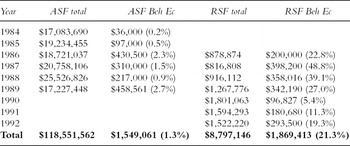
A major difference between the Sloan and Russell Sage Foundation was the amount of annual funds available for grants. Table 1 below shows that throughout the six years of its existence, the behavioral economics program was a relatively small program at the Sloan Foundation. By contrast, the Russell Sage Foundation's total annual endowments between 1986 and 1992 were much smaller than those of the Sloan Foundation, and the share spent on the behavioral economics program thus larger.
Total annual endowments and annual behavioral economics endowments of the Sloan and Russell Sage Foundations.

The Behavioral Economics Program
The behavioral economics program was created at the Sloan Foundation in 1984 under the presidency of Rees. An accomplished labor economist, Rees obtained his Ph.D. from the University of Chicago under the supervision of H. Gregg Lewis in 1950. Rees stayed at Chicago until 1966, serving as the editor of the Journal of Political Economy from 1954 to 1959 and as chair of the economics department from 1962 to 1966. During the 1950s and 1960s, the economics department of the University of Chicago was an exception to the formalist, neoclassical sway that ruled the majority of economics departments (Blaug Reference Blaug, Samuels, Biddle and Davis2003; Emmet Reference Emmet2010; Rizvi Reference Rizvi, Samuels, Biddle and Davis2003). Inspired and dominated by George Stigler and Milton Friedman, the so-called Chicago School in economics was neoclassical, but much more empirical and Marshallian in its focus than the other economics departments. In addition, it was characterized ideologically by a strong and outspoken free-market libertarianism (Emmet Reference Emmet2010).
While Rees was clearly a product of, and a life-long contributor to the Marshallian and empirical focus of Chicago, his political views were more nuanced (Ashenfelter and Pencavel Reference Ashenfelter, Pencavel and Emmet2010; Ashenfelter Reference Angner and Loewenstein1990; Levy Reference Levy1992). He served Democratic and Republican presidents in various (sub-)committees and councils, and despite his outspoken support of the free market also noted for instance that “Competition does not make sense where it involves great waste through duplication of facilities” (Rees quoted in McCleery Reference McCleery1976, 14). In addition, Rees advocated exploring the implication of John Rawls’ Theory of Justice for economics, and regretted that “There is not as much interest in history among economists and economics students as there used to be, and that may be too bad” (Rees quoted in McCleery Reference McCleery1976, 15). Towards the end of his life Rees described himself in a letter to a colleague and friend as “a labor economist who (despite a Chicago Ph.D.) is a rabid Keynesian, at least on this issue [of wage rigidity]” (Rees’ letter to Lebergott, 8 February, 1989, Box 1, Rees Papers, Duke University Libraries). Perhaps that explains why Rees moved to Princeton University in 1966. The central theme in Rees’ research was the economics of labor markets, including the proper public policy role of trade unions, wage differences between sectors and social groups, and the determinants of individual trade-offs between leisure and income (e.g. Rees Reference Rees1963 and Reference Rees1973; Rees and Schultz Reference Rees and Schultz1970). Later in his career Rees sought to apply his research more directly to policy making, both in his writings (Rees Reference Rees1984) and as the chair of the new Council on Wage and Price Stability, created by President Ford in 1974.
In 1979, Rees became trustee and president of the Sloan Foundation, which at the time had $250 million in assets and gave $15 million in grants a year. Three years later, Rees managed to persuade Wanner to join the Sloan Foundation as a program officer to take care of Sloan's cognitive science program, impressed as Rees probably was by Wanner's Cognitive Science Series at Harvard University Press. The Sloan Foundation's cognitive science program had been running for some ten years and during his years at Harvard Wanner had been a researcher on one of the program's projects. However, managing the cognitive science program was not too interesting a job for the newly recruited program officer “because really all the big grants had been made and it was just a matter of tying everything up and writing reports to finish it off and so forth” (Wanner, interview 2009). Therefore, Wanner set out to look for something new to do. His first proposal was a new program on decision theory. The idea was straightforward enough. The Sloan Foundation had had a program on neuroscience in the 1960s and on cognitive science in the 1970s and early 1980s, so a natural continuation would be the application of cognitive science to decision making. But Rees judged Wanner's plans too ambitious, not in the least because Wanner proposed to spend some $20 million on the project. Thus Wanner had to look for something cheaper and more confined.
Wanner's next plan was to concentrate on the application of cognitive science to economics. The new plan gradually sharpened during 1982 and 1983. Early in 1983 Wanner mentioned as “a possible area for investment” for the Sloan Foundation the theme of “what might be called the psychological foundations of economic behavior” (Wanner's letter to Fischoff, 26 January, 1983, RAC). During a conversation between Wanner, Kahneman, and Tversky a few months later in which they explored the topic, the two star psychologists were not very optimistic, reasoning that to get economists’ attention psychologists would have to be more economically sophisticated than they actually were, and advised Wanner not to spend too much money on the project, if anything at all (see also Kahneman Reference Kahneman2002). Nevertheless, over the course of 1983 “behavioral economics” as the name for the new program emerged and Wanner planned a few exploratory meetings with Kahneman and Tversky, and through them with Thaler. As a result, word was spread in the academic community that the Sloan Foundation was considering setting up a new program on behavioral economics, and during the second half of 1983 the first unsolicited grant requests started coming in. The only application that was considered and funded by Wanner and Rees in 1983 was a proposal by Thaler to spend a sabbatical with Kahneman at the University of British Columbia. However, after the program officially commenced also the other early proposals were reviewed and decided upon. Throughout this whole process, Wanner worked closely with Rees on the new program, who as an empirically-oriented Marshallian Chicago economist was skeptical but tolerant towards the idea that an empirically-grounded psychology could be usefully employed in economics.
Rees and Wanner started by composing an advisory committee to the program that would review the incoming proposals and award the funds available. To avoid the possibility that one of the two groups that the program aimed to bring together would dominate and to ensure that it would be an interdisciplinary program, Wanner and Rees decided that there should be two psychologists and two economists on the advisory committee. Also the label “behavioral economics” was understood to be deliberately half psychology-half economics. The first person they picked for the advisory committee was Leon Festinger, a social psychologist and colleague of Katona in the Institute of Social Research at the University of Michigan in the 1950s. In addition, Festinger had been involved with the Sloan Foundation's cognitive science program and was interested in economics. Second, Wanner approached economist Thomas Schelling, whom Wanner knew from Harvard and whose work on paradoxes and conflict strategies seemed related to the new program (e.g. Schelling Reference Schelling1960 and Reference Schelling1969). Rees recommended economist William Baumol, an organization theorist and early critic of von Neumann and Morgenstern's axiomatic approach to decision making (von Neumann and Morgenstern 1944; Baumol Reference Baumol1951). The fourth member Wanner and Rees agreed on and who accepted was cognitive psychologist Abelson, a member of the advisory board of the Cognitive Science Series Wanner had initiated at Harvard University Press.
In May 1984, the Sloan Foundation supported a conference at Princeton University on the behavioral assumptions of economic theory. During the conference, Wanner had a discussion over dinner with the prospective members of the advisory committee as well as with Kahneman, Tversky, and Thaler regarding who might be the appropriate researchers to invite for the new behavioral economics program. After the dinner, Kahneman, Tversky, and Thaler discussed possible names in more detail and individually made more or less similar suggestions to Wanner. Then, mid-June 1984, the board of trustees of the Sloan Foundation officially installed the advisory committee and endowed it with $250,000 to fund a number of “seed projects” in subsequent years, to see if the program could work (Wanner's notes on the advisory committee meeting, 7 December, 1984, RAC).Footnote 4 As is clear from Table 1, the amount of money spent on the behavioral economics by the Sloan Foundation was comparatively small and the board of trustees basically took Rees’ word for it. Thus, while the idea and organization of the new behavioral economics program was entirely Wanner's, the skeptical but tolerant support of Rees in the background was crucial.
As early as July 1984, Abelson expressed a view that seems to have been shared by the other advisory committee members as well as by Wanner, namely that Kahneman and Thaler should be at the center of the new program: “Getting Thaler and Kahneman together is bound to produce progress. Their teamwork could be as seminal as the Tversky and Kahneman pairing, but more market oriented” (Abelson's letter to Wanner, 26 July, 1984, RAC). The first behavioral economics meeting was planned for 7 December, 1984, at the Waldorf-Astoria Hotel, New York. In addition to the advisory committee and Kahneman and Thaler, the following economists and psychologists were invited: Hillel Einhorn, Baruch Fischoff, Donald Hood, Thomas Juster, Charles Plott, Howard Kunreuther, Howard Raiffa, Herbert Simon, Oliver Williamson, and Richard Zeckhauser.Footnote 5
Simon was unable to attend or to get directly involved in the new program, as anticipated by Kahneman, Thaler, and others during the Princeton meeting. Nevertheless, Simon attached “the highest importance to the exploratory program you [Wanner] are starting,” and hoped to “be of some help to you [Wanner] in its further development” (Simon's letter to Wanner, 5 December, 1984, RAC). Moreover, Simon stressed that “a major component in any program that is mounted in behavioral economics should be directed at securing training for doctoral students and young economists in the techniques of making field studies, getting information directly from executives in business firms, and possibly also running experiments,” which also had been recurring themes in Simon's criticisms of neoclassical economics in the 1950s and 1960s (Simon Reference Simon1955, Reference Simon1959, and Reference Simon1962).
When the first exploratory meeting took place on 7 December 1984, the participants advanced and discussed a number of possible projects, which then could be worked out into more detailed proposals by the participants individually. In a separate meeting between the general discussion and drinks and dinner, Wanner and the advisory committee convened to discuss and make decisions on the first few proposals received. This format was often repeated in the behavioral economics meetings during 1984–1986. In a morning and/or afternoon session the economists and psychologists invited advanced and discussed their tentative ideas for new projects and directions into which the program could develop, after which the advisory committee convened to decide on proposals sent to them in advance by Wanner.Footnote 6
Simon was considered to be one of the creators of behavioral economics and in addition was the towering 1978 Nobel memorial laureate. However, from the start he was not expected to be much involved because he was busy and because he had moved away from his earlier psychological criticisms of neoclassical economics’ behavioral assumptions.Footnote 7 Yet, in its early stages the new behavioral economics program was clearly understood as a further exploration and advancement of Simon's behavioral economics. Not only did Wanner, Kahneman, Thaler, and the others involved adopt Simon's label of “behavioral economics” without any apparent discussion, also Simon's language and ideas are clearly visible in the early program statements and objectives. For instance, in a letter to Sloan's board of trustees in mid 1985 the advisory committee remarked that
progress in this new field will depend on moving beyond laboratory demonstrations of the inaccuracy of the behavioral assumptions employed in economics and toward efforts to develop and test more behaviorally sophisticated economic theory. Accordingly, the Committee recommends a funding program in 1986 offering support for research on behavioral economic models, for observational studies of economic decision making in real settings, and for simulated market experiments designed to examine the market consequences of individual psychological processes. (Advisory committee's letter to Sloan's board of trustees, no date (+/- mid 1985), RAC)
But the new behavioral economics program was also understood to move beyond Simon's earlier criticisms of neoclassical economics, by focusing on the systematic distortions of Kahneman and Tversky rather than on the random limits on rational decision making of Simon. Thus, while initially the major source of inspiration was Simon, during 1985, Wanner, Kahneman, Thaler, and the advisory committee quickly developed their own focus and language. First of all, the new program was concentrated more specifically on “the potential contribution of psychology and other behavioral sciences to the study of financial markets” (Wanner's letter to “Everyone,” no date (+/- early October, 1985), RAC), in particular because “financial markets are often considered the most efficient of markets and thus might be thought to be the most immune to non-rational factors” (ibid.). Anomalies of rational behavior would hence have their strongest impact on theories of financial markets, and alternative behavioral theories that incorporate the “non-rational” behavior would be most visible there. To make this focus stand out more clearly, the label of “behavioral finance” was appropriated as one area of behavioral economic research.Footnote 8 Moreover, the program's organizers stressed that “for the [11 October 1985] meeting to be most productive, we cannot afford to get too bogged down in discussions of whether or not a particular empirical finding is or is not an anomaly, i.e. whether there exists some explanation within the rational, maximizing, economic paradigm. Rather, we should try to work toward an evaluation of competing explanations, and the evidence that might be used to discriminate between behavioral hypotheses” (ibid.). In other words, the program's organizers – Wanner, Kahneman, Thaler, and the advisory committee – actively tried to prevent a theoretical, economic discussion of neoclassical economic theory, and in advance tried to steer the discussions towards behavioral terms.
In addition, on behalf of the Sloan board of trustees Wanner asked the advisory committee members prior to the 11 October 1985 meeting to reflect on the possible future of the behavioral economics program. Wanner offered three possibilities: 1) “close up shop”; 2) finish the funds provided and then stop; and 3) “to move the program ahead into a somewhat more substantial phase” (Wanner's letter to the advisory committee, 2 October, 1985, RAC). The eventual decision by the board of trustees, which essentially was a careful balance between the positions of Wanner, Rees, and the advisory committee, was something in between options 2) and 3). The document noted that although the behavioral economics program up until then had “been an extremely interesting exercise, it has nevertheless left us with the conclusion that behavioral economics is largely a promise to be fulfilled” (Wanner's letter to unspecified, no date [+/- November, 1985], RAC). Moreover, “[t]he promise upon which behavioral economics rests is that such anomalies [of rational economic behavior – FH] might be rendered explicable by means of new economic models that employ more realistic behavioral assumptions than those of standard theory. But delivery on this promise is still pending. In the meantime, simply accumulating more demonstrations of anomalies or of the unrealistic character of foundational assumptions seems unlikely to have a serious impact on mainstream economics” (ibid.). Therefore, the Sloan Foundation would support work along the lines of 1) “efforts to develop economic models on the basis of behavioral principles”; 2) “observational studies of economic decision making in real settings”; and 3) “experiments with simulated markets designed to examine the market consequences of individual and social psychological processes” (ibid.). Moreover, the board of trustees was only willing to do so on the condition that the Sloan Foundation's staff would “stay in fairly close contact with all projects on the 1986 round,” that all grantees would agree to occasional “visits by Foundation staff and/or the program's advisory committee” and would agree to the possible request “that grantees hold a brief symposium on their work-in-progress” (Wanner's letter to list of forty invited researchers, 18 December, 1985, RAC). With these extra precautions put into place, the Sloan Foundation agreed to a substantial increase of the number of grants from four in 1985 (three between $25,000 and $35,000 and one of $6,000), to twelve in 1986 (all between $20,000 and $63,000). Thus, the behavioral economics program continued for another year.
The first real test of the new behavioral economics program was a conference on “The Behavioral Foundations of Economic Theory,” 10–15 June, 1986, organized by Robyn Hogarth and Melvin Reder at the University of Chicago.Footnote 9 The conference did not go very well for the members of the Sloan behavioral economics program:
[Eric Wanner:] In the old days people tried to kill [behavioral economics]. You talked about behavioral finance. . . I remember a conference that we ran in probably 1985 at the University of Chicago.
[Floris Heukelom:] That's 1986. It's the. . .
[Eric Wanner:] Good, you know all about it. Really the finance economists were out to kill them. People like Merton Miller. . . I'm trying to think . . . some of those papers are brutal. They're basically just efforts to ridicule behavioral finance, and to kind of laugh it out of existence. So in those days it really was a hard thing to do.
(Wanner, interview with the author, 14 April, 2009)
In the meantime, the number of researchers invited to participate in the behavioral economics program had expanded to forty names in December 1985, including George Akerloff, Kenneth Arrow, Robert Frank, David Grether, Robyn Hogarth, George Loewenstein, Mark Machina, James March, Richard Nelson, Charles Plott, Howard Raiffa, Robert Shiller, Vernon Smith, Lawrence Summers, and Sidney Winter. All forty researchers were told that “[t]he Sloan Foundation has decided to develop a limited funding program in behavioral economics in 1986. The purpose of this letter is to describe the program briefly and to invite you to consider making an application” (Wanner's letter to forty invited researchers, 18 December, 1985, RAC).Footnote 10
Also Simon was of course on the list of the now forty invited economists and psychologists. While Simon had been quite supportive of the new program in his first response to Wanner a year earlier, he now offered some critical remarks on the approach taken by Wanner, Kahneman, Thaler, and the advisory committee. According to Simon, Wanner's new program took “too seriously the premises of contemporary economic methodology that theories (‘models’) come first and empirical work afterwards” (Simon's letter to Wanner, 6 January, 1986, RAC). In addition, Simon noted that following his own work of the late 1950s a “considerable body of empirical work” (ibid) had already been built. The problem was not that the empirical work was not there, but that economists had not noticed it, as “mainline economists continue to ignore vast bodies of relevant evidence in their preferred pursuit of armchair model building” (ibid). Therefore, Simon considered “rather insulting” (ibid) the behavioral economics program's first objective to “develop economic models on the basis of behavioral principles and to show that such models represent a clear improvement over traditional models, either in terms of accuracy or empirical coverage” (Wanner's letter to forty invited researchers, 18 December, 1985, RAC). That said, Simon was “greatly mollified” by the list of people invited, which he considered to be “just the right people” who would not “be put off by the things I object to in your letter” (Simon, letter to Wanner, 6 January, 1986, RAC). Out of courtesy, Wanner and the advisory committee decided to invite Simon for discussion and dinner after one of the advisory committee meetings. Following this meeting, Simon continued to be a background consultant to the program.
During the same period, Wanner stepped up his efforts to encourage researchers to send in a proposal or to collaborate with one another. Following a short but cordial note from Stanford psychologist, former collaborator of Simon, and Russell Sage Foundation trustee James March – one of the new names on the list of researchers invited – Wanner responded by suggesting March could put together a proposal with fellow Stanford researchers Arrow and Tversky who seemed “interested in making a proposal for support for graduate or post doctoral students” (Wanner's letter to March, 10 January, 1986, RAC). Quickly thereafter, March became involved with the behavioral economics program in another way as well. After being promoted to the position of vice-president of the Sloan Foundation in the summer of 1985, Wanner was appointed as a trustee and president of the Russell Sage Foundation in the summer of 1986. He started officially on October 1, 1986. Wanner hinted to the behavioral economics advisory committee that he suspected a positive recommendation by some of them might have had something to do with this appointment: “Some of you may even have had a hand in advising Russell Sage to take this rash step, in which case I am both in awe of your persuasive powers, and extremely grateful for them” (Wanner's letter to the advisory committee, 21 August, 1986, RAC). At the same time, Wanner realized that this would probably mean that “this program will not be continued at Sloan after I leave” (Wanner's letter to March, 22 July, 1986, RAC) and organized a meeting with March to discuss the possibility of “transplanting some version of it [the behavioral economics program] to Russell Sage” (ibid). March quickly responded that he “was delighted that you [Wanner] started it [the behavioral economics program] and would be equally delighted if we continued it at the Russell Sage” (March's letter to Wanner, 29 July, 1986, RAC).Footnote 11
But of course there were more members of the board of trustees of the Russell Sage Foundation to be convinced of adopting another foundation's behavioral economics program. It was by no means self-evident that the Russell Sage trustees would approve. As March recalls
I think the Board generally felt the program had few prospects for social usefulness (i.e., did not fit the general philosophy of the foundation). I and one or two others felt the scientific value warranted support and argued for the program; but I think most of the Board voted to approve the program primarily as a kind of reward to Eric Wanner for his good work. If it had not come from Eric, it would not have been approved.
(email March to author, 4 April, 2010)
Thus, after some negotiation, Wanner could report to the advisory committee that “the RSF Board approved the idea of a joint program with the Sloan Foundation” (Wanner's letter to the advisory committee, 18 February, 1987, RAC). However, there were two conditions, or at least strong suggestions. First, the “RSF would be particularly interested in supporting an extension of the program which includes sociologists, organization theorists, and other social scientists, in addition to the nexus of cognitive psychologists and economists so far funded in the program” (Wanner's letter to the advisory committee, 18 February, 1987, RAC). Second, the board of trustees of the Russell Sage Foundation wanted some influence in the behavioral economics advisory committee. Wanner set out to meet both requirements.
The first requirement proved to be difficult. Wanner suggested to the advisory committee that “there is still quite a lot of work to be done on this border between psychology and economics. But one might take a different view. For instance, I enclose (agnostically) a paper of Amitai Etzioni's which outlines his vision of what he calls social-economics” (Wanner's letter to the behavioral economics advisory committee, 16 October, 1986, RAC). The advisory committee was not impressed. Baumol, for instance, replied that “I would indeed be prepared to entertain proposals by psychologists or economists that call for participation of persons from other social science disciplines. However, I think it would broaden the program excessively to invite proposals from sources outside our two focal disciplines” (Baumol's letter to Wanner, 17 November, 1986, RAC). That effectively ended the attempt to broaden the program to include social-economics.
The second requirement on the other hand was quickly met. The board of trustees of Russell Sage suggested that one of its members, March, could be on the advisory committee. Wanner and the advisory committee were in favor but also feared that this would tip the balance too much to psychology.Footnote 12 Thus, in a letter dated 17 February, 1986, Wanner and Rees (still President of the Sloan Foundation) invited March to join the advisory committee, which invitation March accepted, while at the same time Rees, as a labor economist, was asked by the advisory committee to join its ranks. As a result, the advisory committee now consisted of six members, three psychologists and three economists. It was headed by the president of the Russell Sage Foundation and had on its advisory committee both the president of the Sloan Foundation and a trustee of the Russell Sage Foundation.
Having Rees on the advisory committee in particular seems to have helped to ensure at least another few years of Sloan support for the program – thus positively allaying Wanner's earlier fears, which he had expressed in his letter to March, that the behavioral economics program at the Sloan Foundation would end. With the two new members on the advisory committee, the behavioral economics program proceeded.Footnote 13 From the start, however, the behavioral economics program had a different status at Russell Sage as compared to Sloan, and not only because Wanner was the president of Russell Sage. At Sloan, the board of trustees simply took President Rees’ word for the small behavioral economics program. Table 1 shows that the amount of grants awarded to the behavioral economics program never exceeded 2.7 per cent of the total amount of grants issued. At Russell Sage, however, the behavioral economics program consumed a much larger portion of annual spending, up to nearly 50 per cent in 1987.Footnote 14
Yet, the future of the behavioral economics program was by no means self-evident. To give the program more focus, and thereby to encourage the participating researchers to provide more concrete results, Wanner suggested that the advisory committee set up a few working groups at Russell Sage “which focus on a particular topic” (Wanner's letter to the advisory committee, 16 October, 1986, RAC). Eventually, three non-residential working groups emerged over the course of 1987 and 1988, which would come to define the core of research that ascended to prominence in the economic discipline in the 1990s and 2000s (Heukelom Reference Heukelom2011a). The working group on “Intertemporal choice” was led by Loewenstein and Jon Elster and among others resulted in Loewenstein and Elster's Choice over Time (1992). The working group on “Behavioral approaches to financial markets” was headed by Thaler and Robert Shiller, and provided input for Shiller's Market Volatility (1989) and Irrational Exuberance (2000). The proposed working group on experimental economics, however, proved more difficult to organize. Initially, the idea was to have Smith or Plott lead or co-lead a working group on experimental economics together with a behavioral psychologist such as Kahneman or one of his associates. That however did not work out because of different theoretical interests. Smith and Plott wanted to concentrate on the question how the market eventually steers individual behavior towards rational equilibrium, and what the equilibrium exactly looks like. Wanner, Kahneman, Thaler, and the advisory committee, on the other hand, were more interested in how initial individual behavior deviates from the theoretically defined equilibrium, irrespective of whether it exists or not. In addition, Wanner, Kahneman, and Thaler questioned how often economic markets are allowed the time to mature towards equilibrium. Thus, the plan was abandoned and in the end Colin Camerer was put in charge of the working group on experimental economics.
The advisory committee and in particular Kahneman, Thaler, and Wanner were thus closely monitoring the content and development of the behavioral economics program. The focus and inclusion of disciplines in the “portfolio” of grants was carefully managed and Wanner was constantly looking for new researchers who might submit a proposal that could fit the program. Early 1987 the 1986 Sloan recipients were asked by Wanner and Rees to provide reports of the work they had done and were offered a chance to submit a proposal for a continuation of their work. As a result of the growing visibility of the program the number of proposals submitted to Wanner steadily increased. To relieve the advisory committee of some of its reviewing work, in 1987 Wanner began to ask external researchers to review some of the proposals submitted. However, the advisory committee continued to convene once in a while to make decisions on the proposals received and it was not bound by the referee reports. To further support the advisory committee in its decision making, Thaler was invited to join for a part of the advisory committee meeting of 27 April, 1987, and again a few times afterwards. In addition, the reviewing was now divided among the advisory committee members, so that not all of them had to read all the proposals.
During 1988 and 1989 the behavioral economics program continued along the lines developed in the years 1983–1987 supported by the two foundations. Early in March 1988 Wanner suggested that the then recently appointed Russell Sage trustee and economist Howard Raiffa could join the advisory committee on an ad hoc basis, and this was accepted by the other advisory committee members. In addition to Thaler and Raiffa, also other researchers, including Kahneman, were sometimes asked to join the advisory committee meetings for one or more sessions. In 1989, Festinger, Rees, and March stepped down as advisory committee members, and were replaced by Kahneman. The advisory committee now consisted of economists Baumol and Schelling and psychologists Abelson and Kahneman. In 1989 a program of visiting scholars was initiated under the heading of the behavioral economics program at the Russell Sage Foundation, through which researchers were invited to spend up to a year at the Russell Sage Foundation's office in New York to collaborate on projects with other visiting scholars or to finish a book. Over 1989–1991 the visiting scholars program was given increasing importance by Wanner and the advisory committee. The Russell Sage Foundation Behavioral Economics books series began in 1991. The first book to be published in this series was Thaler's Quasi-Rational Economics (1991). Eventually, eleven books were published, among which were Loewenstein and Elster's Choice over Time (1992), and Thaler's Advances in Behavioral Finance (1993).
Compared to the stepping down of Festinger and March, the retirement of Rees because of advancing age and deteriorating health from the Sloan presidency and from the advisory committee had by far the greatest impact. As anticipated it implied the end of the Sloan Foundation's support of the behavioral economics program. Thus, as of 1990, the behavioral economics program would continue as only a Russell Sage program. At the same time the amount of grant proposals submitted to the behavioral economics program continued to grow, up to the point in the second half of 1989 when Wanner and the advisory committee felt it became increasingly difficult to carefully review all the incoming proposals. This growth in the number of proposals reflected an increasing awareness of the behavioral economics program among psychologists and economists, but more importantly reflected a growing popularity of behavioral economics research. In order to work out how the program should continue after it was only supported by Russell Sage and in order to reduce the number of grant proposals, Wanner and the advisory committee decided to put 1990 in a “wait and see mode.” No official calls for proposals would be issued, but everything that came in would be reviewed. The non-residential working groups, the visiting researchers program, and the Behavioral Economics Books Series, however, continued unabated. In 1991, the amount of grants increased again.
But all things come to an end. Early in 1992, the Russell Sage board of trustees told Wanner it planned to end the behavioral economics program towards the end of the year and to seek other purposes for the roughly 30 per cent of the annual budget the program was consuming. Although Wanner judged this a fair point, he explored the possibility of saving a part of the program in one way or another. In a first step he asked all researchers who had received grants or other support under the behavioral economics program between 1984 and 1992 to briefly express to the board of trustees “whatever effect the program may have had on your own research” (Wanner's letter to recipients, 30 April, 1992, RAC), and to “offer an appraisal of the current state of behavioral research in economics” (ibid). Second, Wanner asked the recipients to address “the general prospects for future work in behavioral economics” (ibid). The letter was sent to some ninety economists and psychologists. About a third of the recipients responded, among them of course those researchers most closely involved, such as Thaler, Kahneman, Loewenstein, and Camerer. It will be no surprise that their responses were positive, as exemplified by the letter written by Thaler quoted at the beginning of this article. Others, however, were less positive. In a long a letter to Wanner, Vernon Smith for instance severely criticized both the organization of the behavioral economics program and the research on which it had focused (Smith's letter to Wanner, 15 May, 1992, RAC).
In the summer of 1992, the behavioral economics program officially closed and the advisory committee was disbanded. Put together, however, the letters of the recipients convinced the board of trustees to agree to one last form of financial support through what would be the organizational novelty of a “Behavioral Economics Roundtable,” composed of former recipients of behavioral economics grants and endowed with $100,000 annually. To the Russell Sage Foundation the main advantage of this organizational novelty was that Russell Sage staff no longer would be involved in behavioral economics and that an advisory committee would no longer be required. The board of trustees and Wanner agreed that the first ten members of the Behavioral Economics Roundtable would be elected by the former grant recipients or selected by the Russell Sage Foundation. Thus, in August 1992 Wanner again wrote to the ninety recipients, asking them to cast their votes for creating a Behavioral Economic Roundtable. Two months later, the first ten members installed on the Behavioral Economic Roundtable were Akerlof, Blinder, Camerer, Elster, Kahneman, Loewenstein, Schelling, Shiller, Thaler, and Tversky. Since its creation in 1992, the Behavioral Economic Roundtable has been an effective promoter of behavioral economics through its bi-annual summer institute and its support of young researchers through a small-grants program. The Behavioral Economics Roundtable still exists at the time of writing.
Conclusion
The social and behavioral sciences in the United States have had a number of patrons in the postwar era, who exerted a substantial influence through the financial support they provided (e.g. Pooley and Solovey Reference Pooley and Solovey2010; Crowther-Heyck Reference Crowther-Heyck2006; Leonard Reference Leonard1991; Goodwin 1997). Yet, Crowther-Heyck's detailed overview reminds us that “there are many ways in which a patronage system can affect a science” (Crowther-Heyck Reference Crowther-Heyck2006, 444). The primary contribution of the Sloan and Russell Sage behavioral economics program, then, was not the resources it provided, which were relatively modest. Instead, the program's contribution lay in catalyzing “a sense of mission” in the collaboration between psychologists Kahneman and Tversky, economist Thaler, and their associates. It supported and encouraged a new scientific effort that had begun in the late 1970s with the publication of Kahneman and Tversky's prospect theory in Econometrica, and which promised to continue with the collaboration between Kahneman and Thaler. With the retrospective wisdom of the scientific achievement of Kahneman, Thaler, and behavioral economics, it is tempting to conclude that behavioral economics would have developed anyway, with or without the support of the Sloan and Russell Sage Foundations. But that would gloss over the efforts of Rees, Wanner, and the advisory committee to bring economists and psychologists together and to support the research that the more regular research funding institutes were unwilling to support. The careful balance between psychologists and economists Wanner maintained both in the advisory committee, in the list of researchers invited, and in the proposals granted ensured that neither one nor the other would feel dominated. Helped in part by his background in the interdisciplinary cognitive research at Harvard University in the 1960s and helped also by his management of the Cognitive Science Series at Harvard University Press, Wanner created the conditions in which the interdisciplinary program of economists and psychologists could thrive.
Rees and Wanner's strategy to pick a small group of researchers with potentially new and influential research and to stay with them until success had been achieved reflects a common strategy of postwar American foundations (Jones and Rahman Reference Jones and Rahman2009; Hauptmann Reference Hauptmann2006). It was among others laid down and perfected by Weaver, a precursor and example to Wanner at the Sloan Foundation (e.g. Weaver Reference Weaver1967). The goal of this strategy was to develop a social and behavioral science that could be employed as an agent of the desired societal changes the foundations wished to bring about. Initially, it was not exactly clear how the behavioral economics program would contribute to either the Sloan or the Russell Sage Foundation's societal objectives. Changing some assumptions in economists’ theories did not have the direct outcome that, say, documenting poverty in America's cities had. As this paper has shown, the behavioral economics program existed from 1984 to 1992 mainly because of Rees and Wanner. Behavioral economists’ turn to more clearly defined policy implications that started in the 2000s is one reason why the Russell Sage Foundation continues to support behavioral economics up to the present.
Thaler's remark quoted in the opening of this article that in 1983–1984 “behavioral economics essentially did not exist” (Thaler's letter to Wanner, 27 May, 1992, RAC), is a slight overstatement. Simon had criticized economists in the 1950s and 1960s for more or less the same reasons as had Kahneman and Tversky in the 1970s. Moreover, in his letter to Wanner, Simon was correct that his work had been followed by a substantial amount of empirical research that showed where economics went descriptively off the track and which suggested theoretical alternatives. But Simon was also correct when he wrote Wanner that economists simply failed to pay attention. By giving Kahneman, Thaler, and their associates “a sense of mission,” Wanner's behavioral economics program helped to ensure that economists now came to pay attention.
Acknowledgments
A first major source for this article are two interviews with Eric Wanner at the Russell Sage Foundation, New York, on 14 April 2009, and on 7 April 2010. A second major source is the Russell Sage Archives at the Rockefeller Foundation Archives, Rockefeller Archive Center, Sleepy Hollow, New York (RAC). A third source are the annual reports of the Sloan Foundation of the 1970s and 1980s, made available by the Sloan Foundation. Unless otherwise specified this paper represents a triangulation of these three sources. Research at the RAC has been supported by a Grant-In-Aid from the RAC, which is gratefully acknowledged. I thank Harro Maas, Craufurd Goodwin, Esther-Mirjam Sent, Malcolm Rutherford, Eric Wanner, and two anonymous reviewers for comments. Any remaining mistakes are my own.