1 Introduction
In an early attempt to describe stylistic variations within the (then relatively new) discipline of linguistics and using only auditory analysis, Crystal & Davy (Reference Crystal and Davy1969) studied phonological variation including intonation in five varieties of English. They noted differences between conversation (e.g. between housewives and between close friends over the telephone) and unscripted commentary (e.g. radio commentaries on a cricket match and on a state funeral) in the use of contrastive accent (more in conversation), in the length of intonational phrase (shorter in conversation), in pitch range (wider in conversation) and in the frequency of various nuclear tones (more falls in conversation but at the same time use of a wider variety of tunes).
From the nineteen-nineties onwards various aspects of stylistic variation in intonation have been investigated instrumentally. Bruce (Reference Bruce, Elenius and Branderud1995), using both auditory and acoustic analysis, reported a wider pitch range in Swedish when feedback was sought from a listener. In a stylistic study very relevant to the present article, Hirschberg (Reference Hirschberg and Horne2000) confirmed intonational contour as one of the factors contributing to the difference between read and casual speech in American English. In read speech falling nuclear tones occurred in 93.1% of declaratives compared with 70.5% in spontaneous speech; in 83.8% of question word interrogatives compared with 62.2%; and in 30.0% of polar interrogatives compared with 43.3%.
Stylistic differences have been reported in the use of High Rise Terminal (HRT) in Australia (McGregor Reference McGregor1980, Guy et al. Reference Guy, Horvath, Vonwiller, Disley and Rogers1986) and in New Zealand (Britain Reference Britain1992, Warren & Britain Reference Warren, Britain, Bell and Kuiper2000). HRT was found to be more frequent (on declaratives) in narratives than in opinion texts (both from spontaneous speech). Ayers (Reference Ayers1994), reporting on a similar tone in American English, found more use of high rises in spontaneous compared with read speech. HRT is clearly different in form and usage from the rising tone regularly used in a number of northern British cities, so-called Urban North British (UNB) (Cruttenden Reference Cruttenden and Windsor Lewis1994). The type of intonation known as UNB typically has a rise (with or without a following ‘slump’, i.e. a slight fall to somewhere around a mid pitch) as the default intonational contour for declarative clauses. UNB has been shown to be present in Belfast and Derry (Northern Ireland), Liverpool, Newcastle, Birmingham and Manchester (Knowles Reference Knowles1975, Reference Knowles and Trudgill1978; Pellowe & Jones Reference Pellowe, Jones and Trudgill1978; McElholm Reference McElholm and Kirkwood1986; Cruttenden Reference Cruttenden and Windsor Lewis1994; Grabe Reference Grabe, Gilles and Peters2004). UNB will be seen below to be a feature of our present speaker in that she uses both rise and rise-slump on declarative clauses.
In studies of intonation in English dialects over the last quarter century a distinction has generally been recognised, implicitly or explicitly, between the intonation of conversation and the intonation of reading (e.g. Brown, Currie & Kenworthy 1980, Lowry Reference Lowry2002). More recently the IViE corpus (Grabe Reference Grabe, Bel and Martin2002, Reference Grabe, Gilles and Peters2004; Grabe & Post Reference Grabe, Post, Bel and Martin2002; Grabe, Coleman & Kochanski Reference Grabe, Coleman and Kochanski2007) collected data in five speaking styles across nine dialects of British English but published results so far have been based only on independent sentences.
From all the references above it can be seen that reports of stylistic differences in the use of tones have related principally to differences of frequency of use. It has not been suggested that different systems of intonation are used in different styles of speech. This article presents data showing such a case of different systems in the two styles of reading and conversation.
The case study presented here concerns Glasgow. Greater Glasgow is the largest conurbation (both in extent and in population) in Scotland. In Glasgow, as in other parts of Lowland Scotland, the traditional language was Scots, which derived from an Old English dialect akin to Northumbrian. But from the seventeenth century onwards the middle and upper classes took to speaking (or approximating their speech to) Standard Southern British. A dialect of English now referred to as Standard Scottish English (SSE) came to be taught in Scottish schools and used in Scottish institutions while Scots continued to be used in less formal situations (Aitken Reference Aitken, Aitken and McArthur1979, Reference Aitken and Trudgill1984). Moreover, many people came to vary their language according to situation. Thus, a form of diglossia (Ferguson Reference Ferguson1959) arose. ‘A diglossic situation exists in a society when it has two distinct codes which show clear functional separation; that is, one code is employed in one set of circumstances and the other in an entirely different set’ (Ferguson Reference Ferguson1959: 87).
The anglicisers of the seventeenth and the eighteenth centuries did not entirely succeed in adopting southern British, and what is known today as Standard Scottish English (SSE) represents an amalgam of Scots and southern British (see Jones Reference Jones and Jones1997). In the phonology of SSE a number of distinctions present today in ‘Received Pronunciation’ or RP (an ‘educated standard’ in south-eastern England) may be absent, e.g. that between the vowels of cot and caught (Abercrombie Reference Abercrombie, Aitken and McArthur1979). Urban Scots speakers (including Glaswegians) may continue the diglossic situation, controlling use of both Scots and Standard Scottish English or they may indeed control a continuum between the two (Stuart-Smith Reference Stuart-Smith, Corbett, McClure and Stuart-Smith2003). We have almost no way of knowing how intonation was involved in the earlier diglossic situation but, given the historical and current language situation in Scotland, it is interesting to check on variation in intonational use at present. Hence a study of Glasgow intonation may contribute not only to our knowledge of dialectal variation in intonation but also to our understanding of the role of intonation in a potentially diglossic situation.
There have been a number of brief articles and mentions concerning Glasgow intonation. In Brown, Currie & Kenworthy (1980: 19) it was reported that ‘in Glasgow Scottish the base-line is raised above the stressed syllables which act as scoops down in pitch from this raised base-line, yielding the characteristic rising-contour of Glasgow (and Belfast) intonation’. Cruttenden (Reference Cruttenden and Windsor Lewis1994: 158; 1997: 133) referred to it as one of the cities exhibiting ‘Urban North British’ (UNB) and suggested that a simple low rise was the predominating tone while other varieties of UNB preferred a rise-plateau or a rise-slump. Ladd (Reference Ladd1996: 124 and 143–7) presented examples suggesting the typical Glaswegian contour was a rise-fall, the key features of which are a low valley immediately preceding the accented syllable followed by a high peak followed by a gradual fall. Mayo, Aylett & Ladd (1997: 231) refine this to say that the accent aligns with the actual movement from low to high and refer to ‘the prototypical Glaswegian rise-plateau-slump’.
There have been suggestions that there is neutralization of statement and question patterns in the west of Scotland (e.g. Samuels Reference Samuels1972: 57). It seems likely that this refers to the possible absence of a regular distinction between fall and rise in Glasgow; it also seems likely that other features (e.g. higher/lower rises) may be used instead. Vizcaino-Ortega (Reference Vizcaino-Ortega, Bel and Martin2002) finds both low rise and rise-slump (both ending up at mid pitch) on Glaswegian polar interrogatives.
The present article details a manifold systemic difference between the intonation of reading and of conversation in the speech of one speaker (although it is believed to be more widespread), at the same time adding to the database of information about variation in dialects of English and commenting on difficulties in using ToBI as the transcriptional framework for one such dialect.
2 Method
The speaker was a female linguist in her late twenties, and was born, bred and educated in the Greater Glasgow area; more specifically she was born and brought up in Chryston (a commuter suburb of Glasgow) and did her first and second degrees at Glasgow University. Her dialect is judged to be a variety of SSE (Standard Scottish English) typical of a particular sociolect of Glasgow, namely young middle-class women, and it cannot be assumed that speakers of broad Glaswegian vernacular (i.e. a type of Scots) would use intonational variation in a very similar way. A preliminary judgement that her intonation in speech was ‘interesting’ had been made before the recording took place. Prior to data-collection the speaker knew that the interest was in her pronunciation although she did not know that it was specifically her intonation that was of interest. As will be seen below, the ‘interesting’ intonation (i.e. apparently having a preponderance of rises and thus very unlike that reported for Edinburgh, for areas of northern Britain outside a number of big cities, and for southern Britain generally), which was first informally observed while listening to her speaking to friends and colleagues, continues into the recording of her conversation with me while the recording of her reading was very different.
Data were collected in an acoustically treated chamber at the Phonetics Laboratory, University of Oxford, using a Marantz Professional CD Recorder CFR 300 and AKG C451E condenser microphone and B46E preamplifier. Acoustic analysis was done using Praat 4.4.12 for Macintosh (Boersma & Weenink Reference Boersma and Weenink2006) with a smoothing bandwidth of 10 Hz. Figures are presented in Macromedia Freehand MX 11.0.1.
Two types of data were collected: (1) a reading of the Cinderella Story (as in the IViE data, Grabe et al. Reference Grabe, Coleman and Kochanski2007). (2) Free Conversation between the author and the speaker covering themes usually initiated by the author, e.g. the speaker's upbringing and her work. The speaker's phonology and grammar appeared to vary little (if at all) between the reading and the Free Conversation (i.e. there was no apparent change from standard Standard Scottish English to Scots, the local vernacular). A number of setting-response dialogues were also recorded, where the author read the setting and the speaker read the response. This controlled for sentence-types (including tag interrogatives and imperatives) and for various attitudinal meanings (e.g. statements with contrast and reservations, softened imperatives, declarative questions). These sentence-response dialogues were principally collected for the purpose of filling accidental gaps in the main data. They are referred to in this article only to fill the gap of only one example of High Rise in the Free Conversation.
The total recording time for the Cinderella story was 4 minutes 34 seconds and for the Free Conversation 14 minutes 28 seconds (the latter time includes both interviewer and speaker plus pauses). A continuous set of 70 IPs in the Cinderella story (starting from the beginning of the story and lasting 4 minutes 1 second) and in the Free Conversation (starting from a point 2 mins 1 second into the recording – so that the speaker was as much at ease as possible – and lasting 2 minutes 14 seconds excluding the interviewer's contributions) were transcribed auditorily (including the division into intonational phrases), using inspection of F0 traces to resolve uncertainties. If there was uncertainty about an intonational phrase boundary, it was generally taken that there was no boundary and hence no nuclear tone preceding that boundary (using the premise that there is one nuclear tone per IP). The location of the last accent (the ‘nuclear syllable’) was then decided and finally the pitch from the nuclear syllable up to the end of the IP was transcribed, i.e. the ‘nuclear tone’. Acoustic measurement were made of all the rises and ‘rise-slumps’. Results from both auditory and acoustic analyses are shown below.
Essentially ‘tonetic types’ were transcribed, (i.e. recurring pitch patterns which were judged to be the same auditorily). Henceforth these are referred to as ‘tunes’. No judgment was made (at least initially) that the tunes were in any sense phonological (i.e. that they constituted either cognitive categories or minimal distinctive units of meaning). The tunes involved some patterns that were not easily represented either in British nuclear tone transcription (as used, for example, in O'Connor & Arnold Reference O'Connor and Arnold1973, and as illustrated in Cruttenden Reference Cruttenden1997a) or in the type of representation used in the Tones and Break Index (ToBI) (Beckman & Ayres 1997) where the pitch at turning-points in the contour and at the boundaries of intonational phrases is transcribed with H(igh) and L(ow). In order to accommodate the peculiarities of Glaswegian intonation it was necessary to make modifications to both traditions to introduce new nuclear tones and new ToBI tones.
The initial transcriptions were done using a nuclear tone approach primarily because it was initially easier to transcribe contours. The nuclear tones were subsequently converted to ToBI-like transcriptions. For ToBI, I follow Grabe (Reference Grabe, Gilles and Peters2004) in modifying more usual ToBI conventions by having no phrase tone and by having, in addition to L% and H%, a third phrase boundary possibility of no tone: Grabe (Reference Grabe, Gilles and Peters2004) uses simple % for this; I use 0%, purely for the sake of possible transcriptional confusion between H% (no space between H and %) and H % (space between). 0% indicates the possibility of a final plateau (low, mid, or high) following a previous tone.
The ToBI-like representations are here used simply as a tonal changepoint description as an alternative to the contour analysis of the British tradition. The ToBI website (http://www.ling.ohio-state.edu/~tobi) specifically claims that ‘ToBI is not an International Phonetic Alphabet for prosody’ but that ‘there are many different ToBI systems specific to different languages and dialects’ Nevertheless in practice the use which has been made of ToBI does suggest at least one universal: that there are only two tonal targets H and L (see also discussion in Hirst Reference Hirst, Hirose, Hirst and Sagisaka2005). It will be a basic finding of this article that a third tone M (=Mid) is unavoidable in any description of Glasgow intonation (at least if strings of symbols are to represent anything near the reality of pitch variation). M will be necessary to show the difference between the Rise-Fall and Rise-Slump and between Full Rise (low to high), Low Rise (low to mid) and High Rise (mid to high), all of which will be shown to be clearly different auditorily, acoustically, and semantically. M can be glossed as half the height of a preceding H except in the case of the Rise-Fall with no earlier accent where it can be glossed as half the height of the following H. Use of three boundary tones within ToBI, L%, M% and H% (as well as 0%), will be shown to be particularly useful when, for a first attempt at descriptive adequacy, we make some preliminary remarks below about the semantics of the tones in Glaswegian.
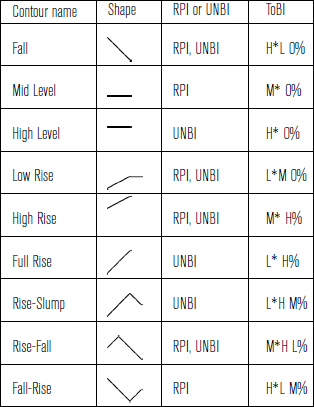
This study is not concerned with details of pitch alignment. The beginning of all the pitch accents appears to align with the centre of the nuclear syllable (although this is only a provisional judgement); matters of alignment would clearly be relevant to a more detailed study, in particular of the Rise-Slump and the Rise-Fall. The phonetic types identified in the data are given in table 1. I use the acronym UNBI (Urban North British Intonation) here since UNB on its own might imply that the cities of UNB formed a group in general phonetic terms as well as in just intonational terms, and this is not the case. Glasgow intonation as analysed in the earlier brief studies noted in the introduction and as used by the present speaker is regarded as a variety of UNBI. I use the acronym RPI (Received Pronunciation Intonation) in parallel fashion to UNBI: RPI is a cover term for the set of intonation systems which are similar to the intonation of RP (Received Pronunciation), specifically in having some variety of falling contour as the default tone on (neutral) (one-clause) declarative sentences. The speaker studied here, while using a segmental system in accord with Standard Scottish English, uses both RPI and UNBI.
Contour types in the data.
Key: RPI = Intonation of RP, UNBI = Urban North British Intonation

3 Results
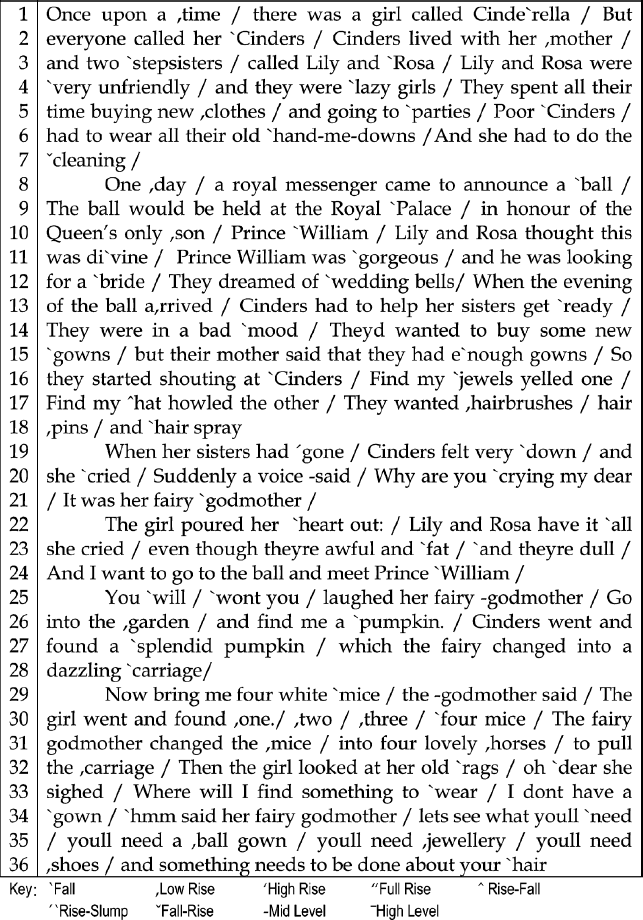
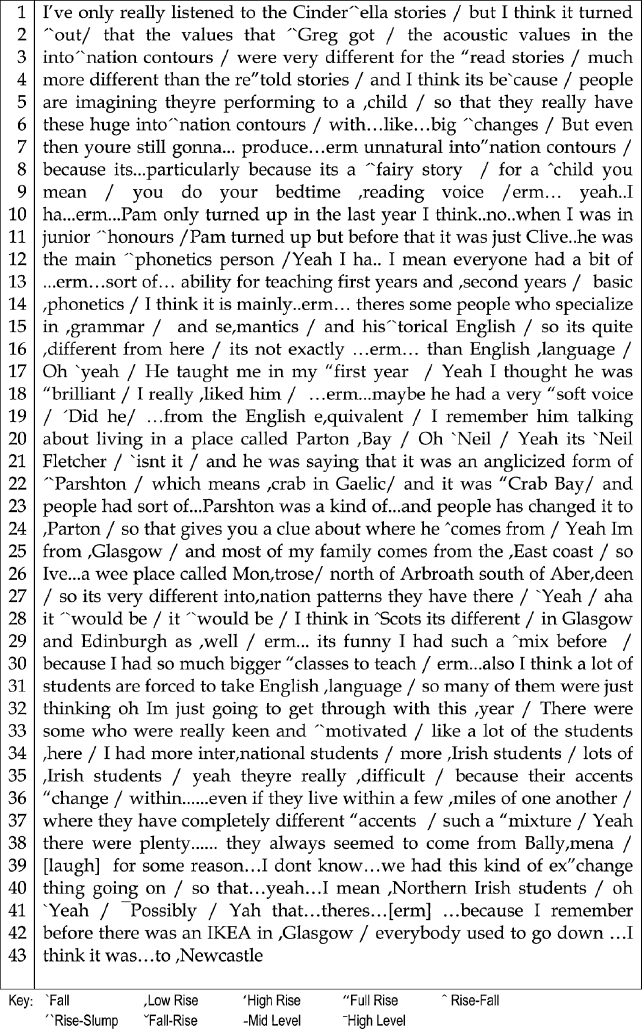
Transcriptions of the continuous stretches of 70 intonational phrases in the reading (Cinderella) and in the Free Conversation are given in panels 1 and 2. To avoid confusion, readers should note that in the Free Conversation, the speaker starts off talking about the Cinderella story and various analyses of it done for other dialects. Transcriptions have no orthographical punctuation but make use of punctuation marks as intonational contour descriptors in the tonetic-stress marks tradition. A comparison of the phonetic types in the two styles is given in table 2.
Transcription of a continuous stretch of 70 intonational phrases in the reading (of the Cinderella story).

Transcription of a continuous stretch of 70 intonational phrases in the Free Conversation (investigator contributions omitted).

Comparison of the 70 continuous intonational phrases in the reading and in the conversation.
Key: F = Fall, R = Rise, S = Slump, L = Low, M = Mid, H = High, Fu = Full, L = Level

In the reading (Cinderella) it is apparent that Falls (46 occurrences) and Low Rises (18 occurrences) account for the majority of the nuclear tones. As can be seen from the text, the Low Rise typically occurs in sentence-medial position, as do the three occurrences of Mid Level, which is regularly reported as a variant of Low Rise in RPI (Cruttenden Reference Cruttenden1997a: 93). The tonal profile is indeed similar to the intonation of RPI. See, for example, the dialogues in O'Connor & Arnold (Reference O'Connor and Arnold1973) or the figures of tonal frequency quoted in Quirk et al. (Reference Quirk, Duckworth, Rusiecki, Colin and Lunt1964), whose RP speakers produced 51% falls (including rise-falls). In the IViE data for Cambridge, which is presumed to represent RP, there were 93.8% falls on declaratives (Grabe Reference Grabe, Bel and Martin2002).
On the other hand, the data from the Free Conversation (panel 2) show a very different system. As noted in the introduction, Glasgow has previously been reported as one of the northern cities using a variety of UNBI, intonation which is characterised as having a low frequency of Falls and a high frequency of Rises or Rise-Slumps. In the data reported here, although the Falls which occur are similar to those in the reading (RPI) data (some starting relatively high in the pitch range, some lower, and some almost approaching low level), they are considerably less frequent than in RPI (only 11 including 4 Rise-Falls). The Low Rises, though similar to the RPI data in the Cinderella story, are considerably more frequent (31 occurrences as opposed to 18) and occur regularly in sentence-final position (18) as well as sentence-medially (13). Judgement on what is ‘sentence-medial’ and what is ‘sentence-final’ is difficult in conversational data. The figures here are based on conservative counting: if in doubt a position was counted as sentence-medial (e.g. count two successive clauses as co-ordinate rather than independent if connected by any sort of conjunction). It is the occurrence of Low Rise in sentence-final position that shows UNBI usage.
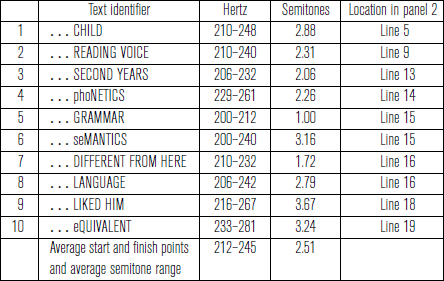
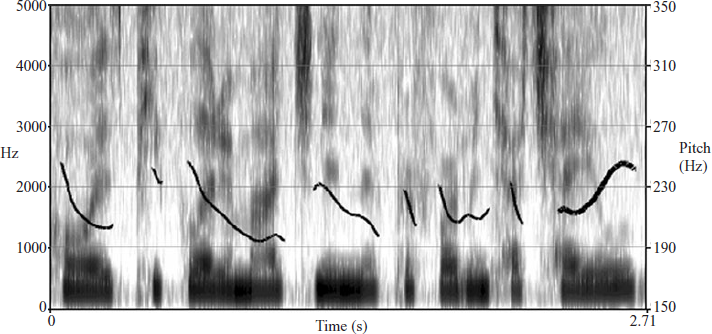
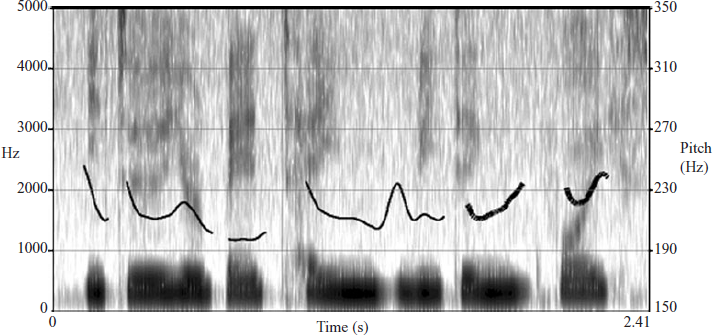
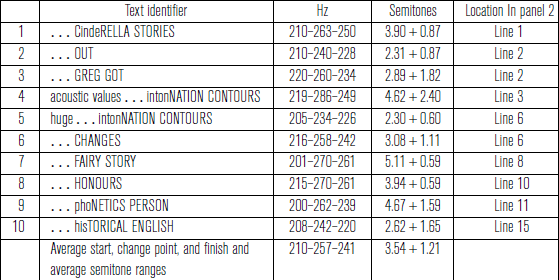
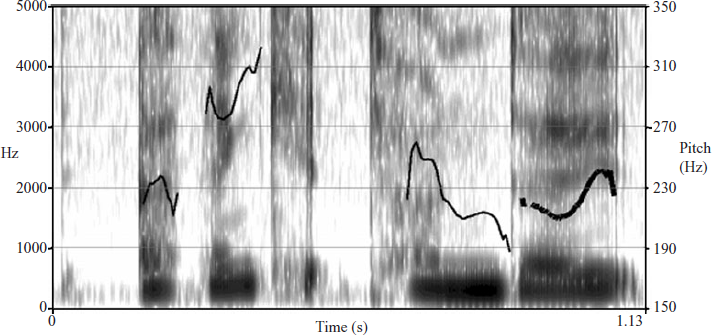
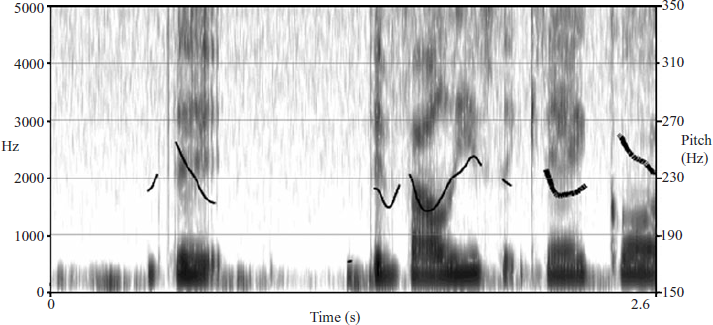
Detailed analyses and averages for the first 10 Low Rises in the conversational data are shown in table 3. Typical Low Rises in the conversational data on monosyllabic and on polysyllabic utterances are shown in figures 1 and 2. In these examples the Low Rises are from 210 Hz to 248 Hz and from 210 Hz to 240 Hz (2.88 and 2.31 semitones, respectively). These Low Rises in the conversational data are impressionistically somewhat different from the Low Rises of RPI and this is perhaps due to more lengthening of the nuclear syllable (i.e. the syllable on which the nuclear tone begins).
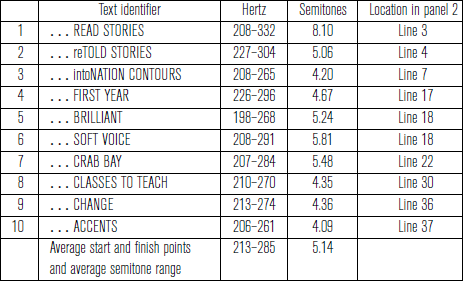
Hertz and semitone ranges for first 10 Low Rises in panel 2 (conversation).

Female Glaswegian speaker saying (in conversation) ‘People are imagining they're performing to a CHILD’ [Low Rise].

Female Glaswegian speaker saying (in conversation) ‘. . . you do your bedtime READING VOICE’ [Low Rise].

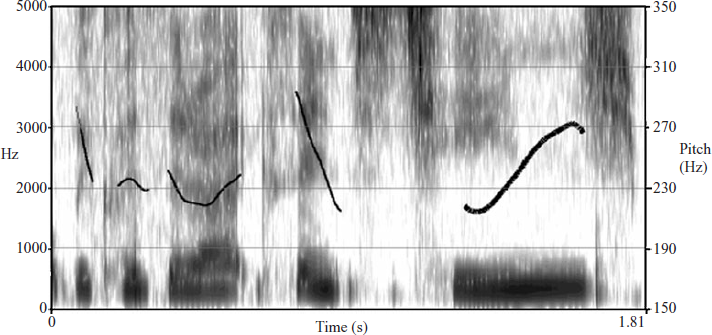
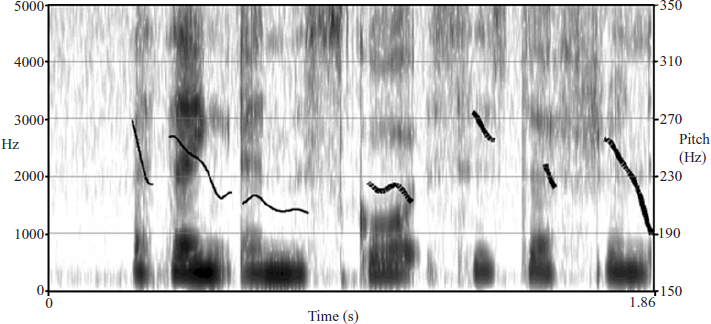
The Full Rise (low to high) in the conversational data is different from the Low Rise (low to mid). Analyses and averages of the first 10 examples of the Full Rise in panel 2 (conversation) are shown in table 4. Examples of the Full Rise on monosyllabic and polysyllabic utterances are shown in figures 3 and 4. In these examples the pitch span is from 213 Hz to 274 Hz and from 208 Hz to 332 Hz (4.36 and 8.10 semitones respectively).
Hertz and semitone ranges for first 10 Full Rises in panel 2 (conversation).

Female Glaswegian speaker saying (in conversation) ‘. . . because their accents CHANGE’ [Full Rise].

Female Glaswegian speaker saying (in conversation) ‘. . . were very different for the READ STORIES’ [Full Rise].

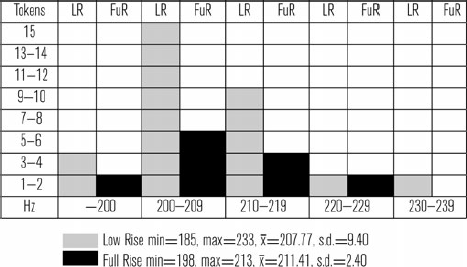
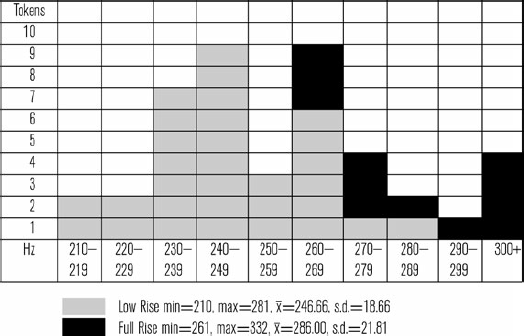
As stated above the original transcription of the 70 IPs in the panels was done auditorily; the auditory basis for the distinction between Low Rise and Full Rise lies not only in the apparent higher finishing-point of the Full Rise but also in its apparent ‘querying’ nature (even though the query appears to be of a very general nature: something like ‘Are you following me?’). The distinction made in the auditory analysis is supported by additional acoustic analysis of the 70 IPs in panel 2. A breakdown of the starting-points and finishing-points of all the Low Rises and Full Rises in the 70 IPs of the conversation is shown in tables 5 and 6. The data in these tables show the starting-point for both Low Rise and Full Rise to be remarkably stable at around 200–219 Hz. The analyses of the finishing-points show some overlap implying either that acoustic analysis of F0 does not exactly correlate with perceived pitch, or that there is a region around 260–280 Hz where there is some neutralisation of the distinction – my intuition is that both factors apply. In the examples of Full Rises in figures 3 and 4, the pitch span is from 213 Hz to 274 Hz and from 208 Hz to 332 Hz (4.36 and 8.10 semitones, respectively).
Hz values of starting-points of Low Rises (31) and Full Rises (12) in the conversation.

Hz values of finishing-points of Low Rises (31) and Full Rises (12) in the conversation.

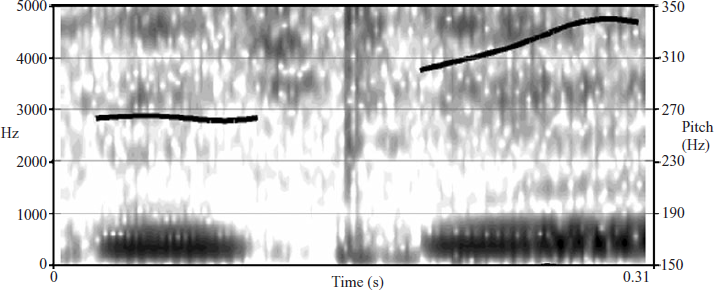
There is only one example of the High Rise in the conversational data (shown in figure 5), but in this one example (on an independent tag interrogative ‘Did he?’ – such usage is a common, though infrequent, use of High Rise in varieties of English) it is shown to have a higher starting-point than the Low Rise or the Full Rise (it rises from 263 Hz to 332 Hz, 5.40 semitones). Since there was only the one occurrence in the conversational data, four examples of High Rise were extracted from the setting-response dialogues (which were collected for the purpose of backup for infrequent tones). These all occurred as echo queries (e.g. (A: ‘How far is it to King Street?’) B: ‘King Street?’). The pitch movements in these occurrences of the tone were (Hz) 231–454, 243–506, 242–374, 252–364, all of which finish at a level higher than Full Rises. As will be discussed later, the existence of Low Rise, Full Rise and High Rise has implications for the representation of the conversational data in a ToBI framework.
Female Glaswegian speaker saying (in conversation) ‘DID HE?’ [High Rise].

A tone which does not appear in RPI but is common in and partly definitive of UNBI is the Rise-Slump. The voice starts low, goes high and then descends to mid. Analyses and averages of the first 10 examples of the Rise-Slump in panel 2 are shown in table 7. Examples of the Rise-Slump on monosyllabic and polysyllabic utterances are shown in figures 6 and 7. In these examples the tune starts at 210 Hz and at 220 Hz before rising to 240 Hz and 260 Hz, and then falling to 228 Hz and 234 Hz, respectively (these represent rises of 2.31 and 2.89 semitones followed by falls of 0.87 and 1.82 semitones, respectively). The statistics from all fourteen occurrences of the Rise-Slump in the conversational data show the following values: starting-point – min=190, max = 228, x = 210.78, s.d. = 2.62; turning-point – min = 234, max = 290, x = 261.29, s.d. = 16.14; finishing-point – min = 226, max = 261, x = 240.46, s.d. = 13.04. From the averages, it can be seen that Rise-Slump has rise values which relate it to the Low Rise rather than the Full Rise and this suggests the two tones are variant default tones.
Hertz and semitone ranges for first 10 Rise-Slumps in panel 2 (conversation).

Female Glaswegian speaker saying (in conversation) ‘I think it turned OUT’ [Rise-Slump].

Female Glaswegian speaker saying (in conversation) ‘. . . that the values that GREG GOT’ [Rise-Slump].

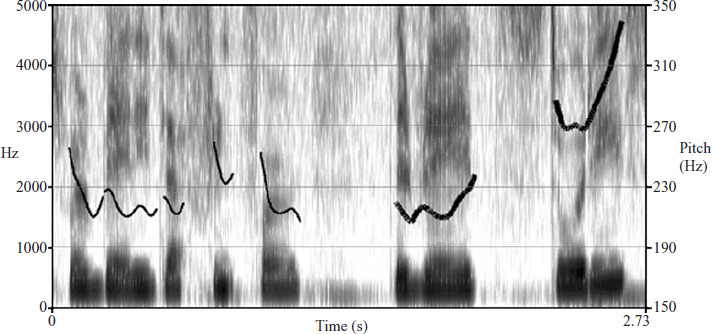
The Rise-Slump is very different from the Rise-Fall, which does occur three times in the conversation and which is exemplified in figure 8. Whereas the Rise-Slump ends somewhere in the mid range, the Rise-Fall falls to the bottom of the speaker's pitch range. In figure 8 the Rise-Fall rises from 228 Hz to 272 Hz before falling to 190 Hz – a rise of 3.05 semitones followed by a fall of 6.21 semitones.
Female Glaswegian speaker saying (in conversation) ‘I think in SCOTS IT'S DIFFERENT’ [Rise-Fall].

As previewed in the introduction, the existence of three types of rise, Low Rise, Full Rise and High Rise, creates problems for any two-tone description, like that used in ToBI, without recourse to an undesirable level of convention (e.g. that the three should be represented as L*H%, L*H-H% and H*H% with the convention that an H following an L is lower than an H following an H) so an M tone has been used in the representations, making the three neatly and transparently L*M%, L*H% and M*H%. Similarly, the difference between Rise-Slump and Rise-Fall can be represented as L* + H M% and L* + H L%.
Usage of tones is also evidently different in the conversation (UNBI) from the reading (RPI). While L% (and 0% following L) is the most common boundary tone in the reading (RPI), M% (and 0% following M) is the most common in the conversation (UNBI) (14 Rise-Slumps and 31 Low Rises respectively). When occurring in sentence-final position, M is also the least marked semantically, Low Rise and Rise-Slump being the most frequent contours on declaratives. As well as the data on declaratives reported here, M% is also found to be the regular choice for polar interrogatives in Vizcaino-Ortega (Reference Vizcaino-Ortega, Bel and Martin2002). For reasons of both frequency and semantics, M is to be considered the default edge tone. On the other hand, L% (or 0% following L) in the conversational data (UNBI), involving the Fall (7 occurrences) and the Rise-Fall (3 occurrences) is of low frequency and appears to be the tone of emphasis (a similar low occurrence of falling tunes is recorded for Belfast, e.g. in Jarman & Cruttenden Reference Jarman and Cruttenden1976, Grabe Reference Grabe, Bel and Martin2002, Lowry Reference Lowry2002).
Tonal patterns ending H%, i.e. the Full Rise (8 occurrences) and the High Rise (1 occurrence) are of very marked meaning. The Full Rise acts as a discoursal ‘check’ (‘Are you following me?’ ‘What do you think of that?’, etc.) even though it occurs in the full flow of narrative (and is usually in declarative form). The Full Rise in the conversation (UNBI) evidently indicates further spreading of the High Rise Terminal (HRT) referred to in the introduction. After earlier reports in Australia and New Zealand, the tune was regularly reported as spreading through England from the early nineteen-nineties onwards (e.g. Bradford Reference Bradford1997, Cruttenden Reference Cruttenden1997b) and is often called Uptalk or Upspeak (for discussion of a similar tune in American English, see Hirschberg & Ward Reference Hirschberg and Ward1995). This is said to be typical of the speaker's social accent group, i.e. young middle-class women, especially when talking to those who are not very familiar to them. More recently various informal reports on the Internet have suggested that it is spreading to Englishes around the world and even into other languages; it has also been suggested that it is leading to an upsurge in the use of commas in written English. It has not previously been documented for Scotland. Full Rise in this text shares another characteristic with HRT, namely its occurrence in clusters (see Britain & Newman Reference Britain and Newman1992: 10), e.g.:
(″indicates Full Rise) Theyre really ˏdifficult / because their accents ″change/ even if they live within a few ˏmiles of one another / where they have completely different ″accents / such a ″mixture / They always seemed to come from Ballyˏmena/[laugh] for some reason . . . I don't know . . . we had this kind of ex″change thing going on.
A High Rise (M*H%) is regularly reported in RPI, as an ‘echo’ (see e.g. Cruttenden Reference Cruttenden1997a: 99), namely querying what a previous speaker has just said, e.g.:
[A: I couldnt go.] B: You ′couldnt or ′couldnt you.
And it is used in this way on did he (panel 2, line 18) in the conversational data here. Use of High Rise on an echo question marks this as different from a simple polar interrogative (which takes the default Low Rise or Rise-Slump according to Vizcaino-Ortega Reference Vizcaino-Ortega, Bel and Martin2002).
4 Discussion
The intonational system in use in my Glaswegian speaker's reading is consistent with RPI while the system in use in the conversation is a variety of USBI where the default tones are Rise-Slump and Low Rise. (No conditioning factor has yet been identified for the use of one or the other.) The speaker uses her variety of RPI in the more formal situation of reading; on the other hand, in the more informal situation of conversation, she uses her variety of UNBI. Intonational usage is diglossic in the sense of Ferguson (Reference Ferguson1959). However, though she is using two varieties of intonation, the speaker does not apparently use two varieties of phonology (and grammar/lexis), e.g. she is not varying between SSE and Scots (but no detailed study of the characteristics of her speech apart from its intonation has been made here). Moreover, Glasgow is the only area of Scotland that is reported as using UNBI; see, for example, the descriptions of intonation of Edinburgh in Brown et al. (Reference Brown, Currie and Kenworthy1980), Anstruther in Aufterbeck (Reference Aufterbeck2003) and western Lowland Scotland outside Glasgow in McClure (Reference McClure, Waugh and van Schooneveld1980), which do not show this type of intonational system.
The tunes used by this Glaswegian speaker are similar to those used in Belfast. However, in Belfast, the local intonation system, another variant of UNBI and again represented largely by the high frequency of rising tunes, predominates both in reading (read sentences in Grabe Reference Grabe, Bel and Martin2002) and in conversation (e.g. in Jarman & Cruttenden Reference Jarman and Cruttenden1976). But even in Belfast there is some indication that UNBI does not totally dominate. Lowry (Reference Lowry2002), reporting on the number of falls used on declarative sentences in 17-year-old grammar-school boys and girls (like Grabe Reference Grabe, Bel and Martin2002, arising out of the IViE project), found proportions ranging from 0.26% (girls) and 2.5% (boys) in spontaneous speech to 14.1% (boys) and 45.4% (girls) in reading. Nevertheless UNBI appears to be more strongly established and more pervasive in Belfast than in Glasgow. In Belfast the strength of the local intonational system is reflected in its use in both informal and more formal situations (greater use of local dialect features in informal situations is well documented from Labov (Reference Labov1972) and Trudgill (Reference Trudgill1974) onwards). We can also speculate that UNBI may have spread from Belfast (and from other areas of northern Ireland; for example, see McElholm (Reference McElholm and Kirkwood1986) on intonation in Derry) to Glasgow, and that it may have spread from a variety of Irish in the north of Ireland into Irish English: Dalton & Ní Chasaide (Reference Dalton and Ní Chasaide2005) find the similarities between Donegal Irish and Ulster English very pervasive and as hardly due to coincidence.
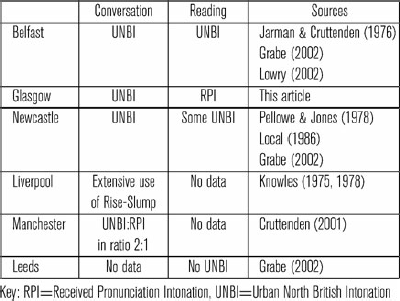
The name ‘Urban North British Intonation’ implies an intonational system that operates in a number of cities in northern Britain. If UNBI intonation is more pervasive in Belfast than in Glasgow, how are the two intonational systems (UNBI and RPI) represented in other northern British cities? Present knowledge is summarised in table 8. This shows that available data are very mixed and in some cases absent altogether. For the conversational data, Belfast and Glasgow have the strongest claim for UNBI, followed by Liverpool, Manchester and Newcastle. For all three of the latter there has been some report of the use of UNBI, though – because of the different nature of the data collection – it is difficult to compare the three. Knowles (Reference Knowles1975, Reference Knowles and Trudgill1978) details the tunes of Liverpool, suggesting that the more local tunes (including the ‘Step’ representing a rise-plateau or a rise-plateau-slump) are used less by middle-class speakers. Cruttenden (Reference Cruttenden2001) shows four Manchester speakers using UNBI tunes around twice as frequently as RPI tunes. Local (Reference Local and Johns Lewis1986) shows rises occurring as rise-plateaux and utterance-finally in Newcastle. All three authors report mixtures of UNBI and RPI tunes: in the case of Cruttenden (Reference Cruttenden2001) the mixture is at the level of individual speakers; in the other two cases it is not clear whether the mixture is simply in the way the data are presented or whether it implies that individuals are mixing intonation systems. But from none of the three can we extract evidence of diglossia in intonational usage. Consideration of other northern British cities reveals no academic study of Birmingham (considered for this purpose to be among the ‘northern’ British cities) or other conurbations of the West Midlands, although informal observation suggests many speakers do use UNBI, whereas for Leeds informal observation suggests the opposite (that use of UNBI is minimal or non-existent); certainly there is no trace of it in the IViE Grabe et al. (Reference Grabe, Coleman and Kochanski2007) recordings of Leeds. Information on the more formal style of reading, besides that in the present article, is almost entirely limited to the results presented from the IViE data (e.g. Grabe Reference Grabe, Bel and Martin2002). As noted at the beginning of this section, this shows UNBI to be heavily used in Belfast. It also shows some usage in Newcastle and no usage in Leeds.
UNBI and RPI intonation in six northern British cities.

Although there is a reasonably strong case for the existence and varying usage of UNBI across northern British cities, really only a beginning has been made in the study of its distribution (across cities), use (across styles) and variation (in detailed realisational differences). It is to be hoped that this article has added to our knowledge of intonation and its use in two ways: firstly, in adding to the database concerning UNBI: and secondly, in adding a little to our knowledge of Glasgow intonation and its use in a diglossic way.
Acknowledgements
I am grateful for comments from Daniel Hirst, Rachael-Anne Knight, Greg Kochanski and Jane Stuart-Smith.