Introduction
Information obtained from conspecifics can greatly increase foraging efficiency of free-ranging ungulates and other animals. Experienced individuals often influence the foraging decision process (i.e. what to eat and where to eat) of naïve peers (Galef and Giraldeau, Reference Galef and Giraldeau2001; Launchbaugh and Howery, Reference Launchbaugh and Howery2005). Social influences are predicted to play an important role in increasing an individual’s fitness in environments with high spatial heterogeneity and moderate temporal variability of food resources (Boyd and Richerson, Reference Boyd and Richerson1983). Most free-ranging domestic ungulates in arid and semi-arid regions forage in such environments (Suttie et al., Reference Suttie, Reynolds and Batello2005); therefore, a better understanding of how social learning influences foraging behaviour of individuals can have far-reaching implications for the improvement of grazing management decisions and free-ranging animal welfare.
Social influence by conspecifics can alter diet selection patterns by promoting increased preference for previously avoided foods. This trend has been observed in cattle (Ralphs and Olsen, Reference Ralphs and Olsen1990), sheep (Thorhallsdottir et al., Reference Thorhallsdottir, Provenza and Balph1990), rodents (Galef, Reference Galef1985) and birds (Mason et al., Reference Mason, Arzt and Reidinger1984). Conditioned flavour aversion behaviours in cattle typically persist for a number of years if all animals in a herd are subjected to the conditioning procedures (Ralphs and Provenza, Reference Ralphs and Provenza1999). However, aversions rapidly extinguish when trained animals are placed in a feeding environment with naïve peers (Ralphs and Olsen, Reference Ralphs and Olsen1990). Interestingly, the converse (i.e. socially mediated flavour aversion acquisition) has only been documented in birds (Mason et al., Reference Mason, Arzt and Reidinger1984). At least two experiments with rodents (Galef et al., Reference Galef, Wigmore and Kennett1983 and Reference Galef, McQuoid and Whiskin1990) and one experiment with sheep (Pfister and Price, Reference Pfister and Price1996) failed to induce social facilitation of flavour aversions. To our knowledge, this phenomenon has not been tested in cattle.
Social learning also plays a central role in moulding feeding site selection patterns of both domestic and wild ungulates (see review by Launchbaugh and Howery, Reference Launchbaugh and Howery2005). Experienced cattle are thought to function as visual cues facilitating naïve animals’ search for nutritious feeding sites (Bailey et al., Reference Bailey, Howery and Boss2000). Furthermore, search patterns of inexperienced cattle become more concentrated (and therefore more efficient) when exploring new feeding sites in the presence of experienced peers (Ksiksi and Laca, Reference Ksiksi and Laca2000). Although an individual’s experience or specific environmental conditions (drought, proximity to drinking water) can modulate social influences, cattle raised on rangelands show fidelity to locations grazed by their mothers or foster mothers (Howery et al., Reference Howery, Provenza, Banner and Scott1996 and Reference Howery, Provenza, Banner and Scott1998). Free-ranging feral and semi-wild cattle develop tightly knit social groups that also maintain high fidelity to habitats and feeding sites through time (Reinhardt and Reinhardt, Reference Reinhardt and Reinhardt1981). Social influences on an individual’s feeding site choices are widespread among other vertebrates such as sheep (Lawrence, Reference Lawrence1990), goats (Biquand and Biquand-Guyot, Reference Biquand and Biquand-Guyot1992), rats (Galef, Reference Galef1982) and birds (Avery, Reference Avery1994). Nonetheless, social learning of feeding site avoidance has been rarely reported in domestic ungulates (but see Black-Rubio et al., Reference Black-Rubio, Cibils and Gould2007) and to our knowledge has not been investigated in cattle.
We conducted an experiment with cattle to determine whether yearling steers that had been averted to a food, a feeding site or to both could induce diet and feeding site avoidance behaviours in naïve peers. We hypothesised that: (1) naïve steers would initially be influenced by the foods and feeding sites selected or avoided by social models; (2) social model influence would wane when naïve steers foraged alone; and (3) naïve steers would behave like their social models when they experienced the same treatment contingencies as their social models.
Material and methods
Animals, routine feeding procedures and adaptation to experimental foods
We conducted our study in a large pen at the University of Arizona’s West Agriculture Centre in Tucson between the months of January and March 2003. The University of Arizona Institutional Animal Care and Use Committee approved animal handling, housing and treatment protocols used in this study (University of Arizona IACUC protocol no. 01-006). Thirty-two Hereford or Hereford-cross yearling steers (from The University of Arizona’s V-V Ranch in central Arizona) with an initial mean weight of 114.5 ± 3.4 kg were randomly assigned to four groups of eight animals each and housed in four separate holding pens with fresh water and shade. Groups were penned in late September 2002 and remained there until the end of the study. Half the steers in each holding pen had been trained in a previous experiment using: (a) no aversive punishment (control group); (b) shock aversion; (c) conditioned flavour aversion; or (d) conditioned flavour + shock aversion (Cibils et al., Reference Cibils, Howery and Ruyle2004), and were used as social models in this experiment. The remaining penmates were not conditioned and were naïve to the aversive treatments and the arena where tests were conducted.
Steers were fed a controlled mixture of corn and ground Sudan grass hay offered in a single morning ration at approximately 0715 to 0745 h, except on trial days when feeding occurred at approximately 1300 to 1330 h after trials were complete for that day. Any food leftovers were removed from the feeding bunks at 1800 to 1830 h on the evening prior to a trial day to control the level of satiety and ensure adequate foraging motivation of steers during trials.
All steers had been exposed to experimental foods and containers (25.4 cm diameter and 10 cm-deep rubber bowls) at the beginning of a previous experiment following the protocol described by Cibils et al. (Reference Cibils, Howery and Ruyle2004). Bermuda grass hay (6% crude protein) and a mixture of rolled barley and crimped oat grain (9.8% crude protein) were, respectively, the MQ and HQ experimental foods used throughout the trials.
Experimental arena and feeding sites
All trials were conducted in a 0.25-ha arena (85 m × 30 m) located approximately 200 m from the holding pens in an area that was not visible to animals while they were in their holding pens or in a squeeze chute where they were occasionally handled. All vegetation in the arena was removed using chemical and mechanical methods. Therefore, experimental foods in the rubber bowls were the only foods available to steers during trials.
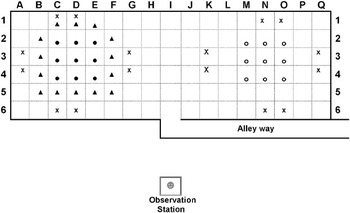
We arranged a 17 × 6 grid system in the arena by mounting visible signs at 5-m intervals along the fence perimeter. Letters or numbers painted on the signs were clearly visible from an observation station located approximately 50 m away from the centre of the arena, allowing us to unequivocally determine animal location during trials (Figure 1). The arena contained three experimental feeding sites consisting of either eight or nine bowls, each containing 30 g (single-steer trials) or 60 g (trials with pairs of steers) of experimental foods. Individual bowls were placed in separate grid cells; consequently, bowls within a feeding site were approximately 5 m apart. Feeding sites were laid out symmetrically on either side of the arena to ensure equal distance to feeding sites from the arena entrance (Figure 1). The group of nine bowls containing HQ food was surrounded by bright orange-coloured traffic cones (71 cm high, 18 and 5 cm diameter at the base and top, respectively) and served as visual cues that delineated the unsafe (i.e. associated with the risk of LiCl and/or shock) high-quality feeding site (UHQ). A second group of nine bowls with MQ food was not associated with visual cues and represented the safe moderate-quality (SMQ) feeding site. The safe high-quality feeding site (SHQ) surrounded the UHQ and SMQ feeding sites and consisted of two groups of eight bowls containing HQ food (Figure 1). The three experimental feeding sites occupied 32 of the 102 5-m2 grid cells of the arena; therefore, steers could also select grids outside the experimental feeding sites that contained no bowls or food.
Experimental arena layout. (●) Bowls in unsafe high-quality (UHQ) feeding site; (▴) cones surrounding UHQ feeding site; (x) bowls in safe high-quality (SHQ) feeding site; (o) bowls in safe moderate-quality (SMQ) feeding site. Half the steers on each treatment were always exposed to the UHQ feeding site on the right, and the SMQ feeding site on the left, whereas the remaining half were always exposed to feeding sites in the opposite locations.

Retraining and animal pairing
Social models (trained steers) were familiar with the arena and had learnt to avoid either the UHQ feeding site (shock aversion treatment), the HQ food (conditioned flavour aversion treatment) or both the UHQ feeding site and the HQ food (conditioned flavour aversion + shock aversion treatment) during a previous experiment (Cibils et al., Reference Cibils, Howery and Ruyle2004). Immediately prior to beginning this experiment, social models were individually retrained for 10 min during 3 days. During this period, steers in the shock aversion treatment (shock) were fitted with shock collars (Trashbreaker Ultra; Tri-Tronics, Thampa, FL, USA) equipped with long contact points and special straps for cattle. Whenever more than half of a steer’s body penetrated the coned area surrounding the UHQ feeding site, it received a 2-s momentary electrical shock stimulation that was repeated as many times as necessary to induce the animal to leave the UHQ feeding site. Shock was administered remotely (from the observation station) using a hand-held transmitter set to deliver an intermediate level of stimulation, i.e. level 4 (5.0 to 6.4 kV) on a scale from 1 (0.8 to 1.2 kV, lowest) to 6 (5.0 to 6.5 kV, highest). This stimulation level was comparable to the standard shock discharges produced by conventional electric fences used in animal agriculture (5.0 to 10.0 kV). Steers in the conditioned flavour aversion treatment (LiCl) were given an intra-ruminal dose of LiCl (200 mg/kg body weight; 99%, molecular weight 42.39) whenever they consumed 30 g or more of the HQ food. LiCl dosing was administered via a stomach tube in a squeeze chute after all animals in this treatment had concluded their daily 10-min trial, and was administered at least 2 h before routine feeding in pens to avoid averting animals to their base ration. Steers in the conditioned flavour aversion + shock aversion treatment (LiCl + shock) received shock any time they entered UHQ and LiCl if they consumed more than 30 g of the HQ food.
Untrained steers were naïve to the experimental arena and to treatment contingencies but had shared pens with their social models since September 2002, and were therefore familiar with social model steers in their group. Each naïve steer was randomly assigned to a trained penmate who was its social model throughout social conditioning trials.
Social conditioning
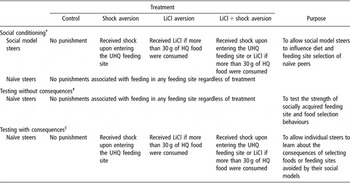
The purpose of social conditioning was to allow social models to influence the feeding site and diet selection choices of their naïve partners. Social conditioning trials began at 0730 h and ended at approximately 1330 h and were conducted every other day for 6 days to allow steers to recover from possible treatment-induced stress between experiment days. On each experiment day, a pair of steers that consisted of 1 social model + 1 naïve animal was exposed to the arena for 10 min with all three feeding sites in place (Figure 1; Table 1). Steers therefore had a choice among three experimental feeding sites (UHQ, SHQ, SMQ) and two experimental foods (HQ or MQ). Social models in the control group were allowed to enter all feeding sites and to eat both experimental foods with impunity. Social models in all other treatments were subjected to remedial punishment whenever they entered the UHQ feeding site (shock and LiCl + shock treatments) or consumed the HQ foods (LiCl and LiCl + shock treatments). Remedial punishment consisted of the same treatment contingencies described in Retraining and animal pairing. Naïve steers were allowed to enter all feeding sites and feed on both foods with impunity. The order in which steer pairs were led to the arena was randomised to minimise potential time-of-day effects. Two technicians observed and recorded location, type of feeding site and activity (standing, feeding or moving) of both the social model and the naïve steer at 15-s intervals. Food refusals from each feeding site were collected in separate labelled bags and weighed, and empty bowls were replenished after each 10-min trial.
Experiment protocol

HQ = high-quality; SHQ = safe high-quality; SMQ = safe moderate-quality; UHQ = Unsafe high-quality.
†Steers exposed in pairs to arena with SMQ, UHQ and SHQ feeding sites for 10-min sessions during days 1 to 6.
‡Naïve steers exposed individually to arena with SMQ, UHQ and SHQ feeding sites for 10-min sessions during days 7 to 12.
§Naïve steers exposed individually to arena with SMQ, UHQ and SHQ feeding sites for 10-min sessions during days 13 to 18.
Testing without contingencies
The purpose of this experiment phase was to test the strength and persistence of socially acquired feeding site and food avoidance behaviours of naïve steers when foraging alone without their social model. Trials began at 0730 h and ended at approximately 1330 h and were conducted every other day for 6 days. Individual naïve steers were exposed to the arena for 10 min with all three feeding sites in place in the identical configuration they experienced during the social conditioning phase of the experiment (Figure 1; Table 1). Each steer was allowed to enter all feeding sites and to eat both experimental foods with impunity. No aversive conditioning was conducted during this phase. The order in which naïve steers were exposed to the arena was again randomised to minimise potential time-of-day effects. Technicians observed and recorded animal location, type of feeding site, and activity (standing, feeding or moving) at 15-s intervals, and weighed refusals from each feeding site in separate labelled bags and replenished empty bowls after each 10-min trial.
Testing with contingencies
The purpose of this trial phase was to allow naïve steers to experience the same consequences of selecting foods or feeding sites that their social models had experienced during training and social conditioning. Testing trials were conducted for 10 min daily for 6 days on every other day, immediately following the previous phase (Table 1). Individual naïve steers were again exposed for 10 min to the arena with all three feeding sites in place (Figure 1; Table 1). Naïve steers that had first been exposed to the arena with a social model in the control group were allowed to enter all feeding sites and consume all foods with impunity. Naïve steers that underwent social conditioning with a social model in the shock aversion treatment (shock) were fitted with shock collars and received electrical stimulation whenever more than half their body penetrated the coned area surrounding the UHQ feeding site as described in Retraining and animal pairing. Naïve steers that had been paired with a social model in the conditioned flavour aversion treatment (LiCl) were given an intra-ruminal dose of LiCl whenever they consumed 30 g or more of the HQ foods. Because naïve steers in this treatment were exposed to both HQ and MQ foods during this phase, they were offered a bowl with HQ food just prior to LiCl dosing while being held in individual pens close to the squeeze chute area. The purpose of this procedure was to allow animals to associate the induced gastro-intestinal distress with the flavour of the food most recently ingested and avoid potential confusions in flavour–malaise associations (Provenza, Reference Provenza1995). LiCl dose, chemical characteristics and dosing procedures were identical to those described in Retraining and animal pairing. Treatments of naïve steers that were socially conditioned with social models in the conditioned flavour aversion + shock aversion treatment (LiCl + shock) were also identical to treatments described in Retraining and animal pairing.
The order in which naïve steers were exposed to the arena was again randomised to minimise potential time-of-day effects. Technicians observed and recorded animal location, type of feeding site, and activity (standing, feeding or moving) at 15-s intervals, and weighed refusals from each feeding site in separate labelled bags and replenished empty bowls after each 10-min trial.
Data analyses
Social conditioning
Data were analysed using mixed effects ANOVA to detect differences in food and feeding site selection patterns (a) between social models and naïve penmates and (b) among naïve treatments. The fixed effects included in the model were: (a) the aversion conditioning treatments of social models; (b) trial day; (c) animal category (social model or naïve); and (d) two-way interactions among these factors. Individual steers (nested within treatment) were included as a random effect. The response variables analysed were (a) number of times observed in each feeding site or non-feeding site grid cells expressed as a percentage and (b) number of times observed standing, feeding or moving. Arcsin square-root transformations were used on all percentage data. Means were compared using Tukey’s honest significant difference test (P ⩽ 0.05). The JMP IN version 4.0.4 (Statistical Analysis Systems Institute, 2001) statistical package was used to conduct all statistical analyses.
Testing trials (with and without contingencies)
Data were analysed using the ANOVA model described above to determine whether food and feeding site selection behaviours of naïve steers differed among treatments. The response variables analysed were: (a) number of times observed in each feeding site or non-feeding site grid cells expressed as a percentage; (b) intake (g) of food consumed in UHQ, SHQ and SMQ feeding sites; and (c) number of times observed standing, feeding or moving also expressed as a percentage. Mean comparison tests, levels of significance and software used for these analyses were the same as those described above.
Results
Social conditioning
UHQ feeding site
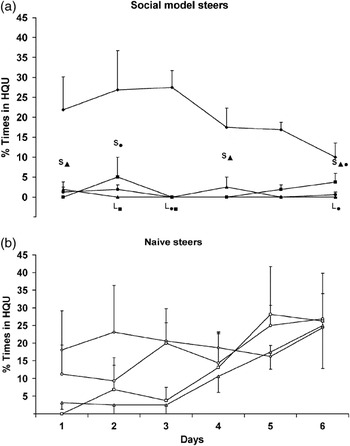
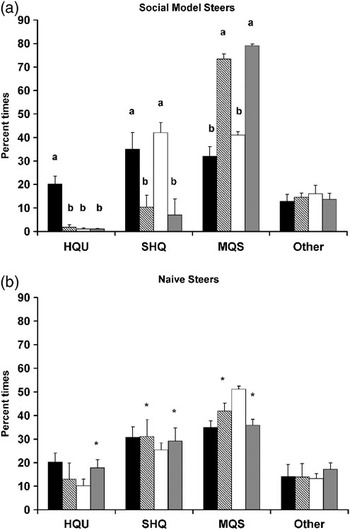
During the first 2 days of social conditioning, UHQ feeding site use by naïve steers in all treatments closely resembled that of their social models (Figure 2a and b). After day 3, however, naïve steers on all treatments entered the UHQ feeding site more often than their social models, probably because the latter ceased to have an influence on naïve steers’ feeding site choices. Overall, social models in the shock, LiCl and LiCl + shock groups spent less time in UHQ than their control counterparts. Conversely, all naïve steers, regardless of treatment group, spent a similar amount of time in the UHQ feeding site (Figure 3a and b). Remedial punishment (shock, LiCl, or both) was necessary to ensure persistence of feeding site and food avoidance behaviours of nine of the 12 social models (Figure 2a); social models required on average eight remedial shocks to enforce previously conditioned place aversions during this phase of the experiment (range = 2 to 15), but only one remedial LiCl dose per steer to enforce a previously conditioned flavour aversion.
Social conditioning. (a) Per cent times that social model steers on the control (⋄), LiCl (▪), shock (▴), or LiCl+shock (●) treatments were observed in unsafe high-quality feeding site (UHQ). Letters with symbol suffixes indicate shock remedial punishment administered to at least one social model steer on either the shock (S▴), or shock+LiCl (S•) treatments, or to steers on both of those treatments (S▴•), and LiCl administered to at least one social model steer on either the LiCl (L▪), or shock+LiCl (L•) treatments, or to steers on both of those treatments (L▪•). (b) Per cent times that naïve steers on the control (⋄), LiCl (□), shock (▵), or LiCl+shock (○) treatments were observed in UHQ feeding site during the social conditioning phase. Pairs including a social model steer and a naïve pen mate were jointly exposed to the experiment arena during this phase.

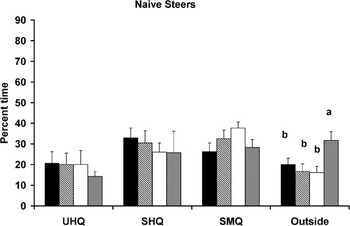
Social conditioning. Per cent of times that social model (a) and naïve (b) steers on the control (black bars), LiCl (hatched bars), shock (empty bars), or LiCl+shock (grey bars) treatments were observed in unsafe high-quality feeding site (UHQ), safe high-quality feeding site (SHQ), safe moderate-quality feeding site (SMQ), or outside experiment feeding site grid cells (Other). Pairs of steers (one social model and one naïve pen mate) were jointly exposed to the experiment arena during this phase. Different letters indicate statistical differences (P≤0.05) among treatment groups for times observed in a given feeding site. No letters indicate no statistical difference. Asterisks indicate significant differences (P≤0.05) between social model and naïve steers for times observed in a given feeding site.

SHQ, SMQ and non-feeding sites
Social models in the control and shock treatments spent more time in the SHQ and less time in the SMQ feeding site than their counterparts on the other two treatments, which had been averted to the HQ food. All naïve steers, however, spent a similar amount of time SHQ and SMQ feeding sites (Figure 3a and b), possibly because induced avoidance of HQ food and UHQ feeding site was transient. Naïve steers on LiCl and LiCl + shock treatments spent detectably less time in the SMQ feeding site than their social models that had been averted to the HQ food and/or the UHQ feeding site (Figure 3a and b). This may have been due to naïve steers’ tendency to progressively spend more time feeding from food bowls that were avoided by their social model peers. Pairs on all treatments were observed a similar number of times in grid cells outside of the experimental feeding sites (Figure 3a and b).
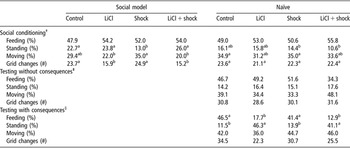
Activity. Steers on all treatments were observed feeding a similar number of times (Table 3). Social models on the shock treatment spent less time standing and more time moving than social models on the other treatments (Table 3). Naïve steers on the control, LiCl and shock treatments were observed standing, moving or changing grid cell location as often as their social models (Table 3). Conversely, naïve steers on the LiCl + shock treatment spent detectably less time standing and changed grid cell location more often, presumably because their behaviour was the least influenced by social models whose feeding choices had been severely restricted during conditioning (Table 3).
Testing without contingencies
UHQ feeding site
Socially induced differences in feeding site avoidance behaviours were not detectable during this experiment phase. Naïve steers on all treatments were observed a similar number of times in UHQ feeding sites (Figure 4). However, individual trends in food intake (LiCl naïve animals) or time spent in UHQ (shock naïve animals) varied greatly among steers.
Testing without consequences. Per cent times that naïve steers on the control (black bars), LiCl (hatched bars), shock (empty bars), or LiCl+shock (grey bars) treatments were observed in unsafe high-quality feeding site (UHQ), safe high-quality feeding site (SHQ), safe moderate-quality feeding site (SMQ), or outside experiment feeding site grid cells (Other) during testing. Naïve steers were exposed individually to the experiment arena and were allowed to explore all feeding sites with impunity. Different letters indicate statistical differences (P≤0.05) among treatment groups for times observed in a given feeding site. No letters indicate no statistical difference.

SHQ and SMQ and non-feeding sites
Naïve steers on all treatments were observed a similar number of times in SHQ and SMQ feeding sites (Figure 4). Steers on the LiCl + shock treatment were observed more often outside the experiment feeding sites than steers on all other treatments (Figure 4).
Activity
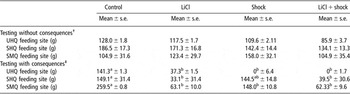
Although no detectable differences were observed in food intake (Table 2) or activity patterns (Table 3) of steers across treatments, LiCl + shock animals tended to move more often and spend less time feeding than steers on the other treatments (Table 3). In addition, LiCl + shock steers showed a tendency, albeit not statistically significant, to consume less HQ and MQ food than steers on other treatments (Table 3). The cumulative effect of small differences in activity and intake patterns may have been associated with the tendency of LiCl + shock animals to spend more time outside experimental feeding sites (Figure 4).
Individual intake of foods in each feeding site by naïve steers during the last two phases of the experiment when naïve steers were exposed to the arena individually

SHQ = safe high-quality; SMQ = safe moderate-quality; UHQ = unsafe high-quality.
a,bDifferent letters indicate differences (P ⩽ 0.05) among values within a row.
†Naïve steers received no punishment during this phase.
‡Naïve steers received punishment when visiting UHQ feeding site.
Activity of social model and naïve steers on all treatment groups during the three phases of the experiment

During social conditioning, steers were exposed to the experimental arena in pairs including a social model and a naïve penmate. During the other two phases, steers were exposed to the arena individually.
a,bDifferent letters indicate differences (P ⩽ 0.05) among values within a row.
†Social model steers received remedial punishment when visiting the unsafe high-quality (UHQ) feeding site.
‡Naïve steers received no punishment during this phase.
§Naïve steers received punishment when visiting the UHQ feeding site.
Testing with contingencies
UHQ feeding site
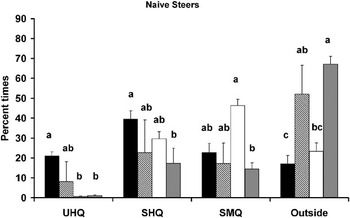
Steers on the shock and LiCl + shock treatments, all of which were trained to avoid the UHQ feeding site with shock, spent less time in this feeding site than steers in the control group (Figure 5). Time spent in the UHQ feeding site by steers on LiCl treatment, which were averted to the flavour of the HQ food, was intermediate between the control group and the other two treatments (Figure 5). Control steers consumed more HQ food than steers on all other treatments, which had been trained to avoid the UHQ feeding site, the HQ food or both (Table 2). Steers that received shock (shock and LiCl + shock treatments) learned to avoid the UHQ feeding site, whereas steers that were averted to the flavour of the HQ food (LiCl treatment) but not to the UHQ feeding area itself avoided the HQ food but not the UHQ feeding site.
Testing with consequences. Per cent times that naïve steers on the control (black bars), LiCl (hatched bars), shock (empty bars), or LiCl+shock (grey bars) treatment groups were observed in unsafe high-quality feeding site (UHQ), safe high-quality feeding site (SHQ), safe moderate-quality feeding site (SMQ), or outside experiment feeding site grid cells (Other) during testing. Naïve steers were exposed individually to the experiment arena and were allowed to explore all feeding sites but with the same contingencies as their social models. Different letters indicate statistical differences (P≤0.05) among treatment groups for times observed in a given feeding site. No letters indicate no statistical difference.

SHQ, SMQ and non-feeding site
Steers on the control, LiCl and shock treatments were observed a similar number of times in the SHQ feeding site (Figure 5), whereas steers on LiCl + shock treatment spent detectably less time in the SHQ feeding site than the control steers (Figure 5). Control and shock steers, which had not been averted to the HQ food, consumed similar amounts of HQ food in the SHQ feeding site, whereas steers on LiCl and LiCl + shock treatments ingested significantly less HQ food than control animals (Table 2). Shock steers that had been averted to the UHQ feeding site but not to the HQ food readily consumed this food when offered in a different location (SHQ feeding site). Conversely, steers on the LiCl and LiCl + shock treatments that had been averted to the flavour of the HQ food avoided this food regardless of its location (UHQ and SHQ feeding sites).
Steers on the shock treatment tended to spend more time in the SMQ feeding site than steers on all other treatments (Figure 5). Steers on the LiCl and LiCl + shock treatments were apparently not able to clearly distinguish between the induced sickness and the flavour of the HQ and MQ foods because their intake of both foods declined dramatically after LiCl conditioning (Figure 5). Steers on the LiCl and LiCl + shock treatments tended to spend the most time in grid cells outside the experimental feeding sites.
Activity
Steers on LiCl and LiCl + shock treatments spent the most time standing and the least time feeding (Table 3). Steers on all treatments were observed moving and changing grid cells a similar number of times.
Discussion
During social conditioning, each of the social model treatments spent less time in UHQ feeding sites than the control group. Thus, food and location choices of social models were strongly constrained by aversion training before the experiment, as well as by remedial punishment as was necessary for some individuals throughout the experiment. Conversely, naïve treatments spent similar amounts of time in UHQ feeding sites compared with control groups, indicating that little social learning had occurred between social models and naïve animals. Interestingly, social models and naïve steers did spend similar amounts of time in the UHQ feeding site during the first 3 days of social conditioning, indicating that social models influenced naïve peers early on. However, use of the UHQ feeding site by all naïve treatments was similar to control groups by day 4. This general trend continued for the remainder of social conditioning (social models present) and testing without consequences (social models absent) phases of the experiment. It is likely that by day 4 of social conditioning, naïve animals had learnt that consuming UHQ food produced positive post-ingestive consequences (Provenza, Reference Provenza1995), after which they began to preferentially select HQ foods in UHQ feeding sites. These results are consistent with previous research in rats (Galef et al., Reference Galef, Wigmore and Kennett1983 and Reference Galef, McQuoid and Whiskin1990), sheep (Pfister and Price, Reference Pfister and Price1996) and cattle (Ralphs and Olsen, Reference Ralphs and Olsen1990) that failed to induce long-term socially mediated diet aversions experimentally.
The tendency for naïve steers on LiCl + shock treatment to preferentially use UHQ feeding sites and apparently consume HQ food regardless of its location occurred even though the social models on this treatment rarely entered the UHQ habitat. It was therefore surprising that naïve steers on this treatment consumed the lowest amount of UHQ food of all treatments when they were tested alone during the testing without consequences phase of the experiment (67% of the control group’s UHQ intake).
Most research studies addressing social learning of feeding site selection in cattle have investigated the development of preferences for rather than aversions to specific locations (Sowell et al. (1999) and references therein). To date, direct induction of feeding site avoidance in cattle has been achieved by administering controlled electrical stimulation to individual free-ranging animals. For example, Anderson et al. (2004) showed that containment of cows within predetermined areas on desert rangeland could be achieved using an apparatus that combines GPS, GIS and sensory cue delivery (electrical stimulation + sound). Tiedemann et al. (1999) used radio-activated electrical stimulation devices mounted on ear tags to generate cattle-grazing exclusion areas in small, irrigated pastures. Our results and a recent experiment with sheep (Black-Rubio et al., Reference Black-Rubio, Cibils and Gould2007) demonstrated that animal–animal behavioural interactions influence the strength and persistence of induced location avoidance.
An individual’s behavioural repertoire can be influenced by social interactions with conspecifics although, ultimately, the persistence of socially acquired behaviours depends on the consequences of such behaviour to the individual (Skinner, Reference Skinner1981; Galef, Reference Galef1988; Provenza et al., Reference Provenza, Lynch and Nolan1993). In our study, the influence that social models had on their naïve penmates was short lived. By day 4 of the social conditioning phase and throughout the testing without consequences phase, naïve steers selected forage locations and exhibited intake and activity levels similar to control steers. Once naïve steers on the three treatments experienced the same punishment contingencies previously administered to their social models, they quickly exhibited forage and site selection tendencies similar to the ones previously exhibited by their social models.
During testing with consequences, shock conditioning paired with visual cues (traffic cones surrounding the UHQ feeding site) induced a clear avoidance of HQ food in the UHQ feeding site for naïve steers on the shock treatment as well as steers on the LiCl + shock treatment. This response was consistent with results from field studies discussed above (Tiedemann et al., 1999; Anderson et al., 2004), with experiments conducted with cattle or sheep in controlled arenas (Cibils et al., Reference Cibils, Howery and Ruyle2004; Black-Rubio et al., Reference Black-Rubio, Cibils and Gould2007), and with trials involving goats (Fay et al., Reference Fay, McElligott and Havstad1989) and deer (Gallagher and Prince, Reference Gallagher and Prince2003). Contrary to what occurred with flavour aversion conditioning in this experiment (discussed below), familiarity with the UHQ feeding site and its surrounding visual cues did not preclude location avoidance learning for naïve steers on the shock treatment. Thus, steers on this treatment learnt to avoid the UHQ feeding site but consumed as much HQ food from bowls in the SHQ feeding site as the control steers.
Administering LiCl to naïve steers on the LiCl treatment and on the LiCl + shock treatment caused them to avoid the HQ food irrespective of its location just as their social models did when they experienced the same punishment contingency. However, naïve steers on the LiCl treatment continued to enter both the UHQ and SHQ feeding sites as predicted by Garcia et al. (Reference Garcia, Lasiter, Bermudez-Rattoni and Deems1985). Thus, LiCl naïve steers learnt to avoid the flavour of the HQ food but not the locations where it was offered. In a previous experiment, Cibils et al. (Reference Cibils, Howery and Ruyle2004) found when steers were conditioned to avoid the same HQ food they became averted both to the flavour and to the location of the food. Familiarity with the flavour and the experimental feeding site may have caused naïve LiCl steers in our experiment to exhibit different feeding site use patterns than the steers in the Cibils et al. (Reference Cibils, Howery and Ruyle2004) study where steers were unfamiliar with both the HQ food and the experiment arena. Garcia and Holder (Reference Garcia and Holder1985) and Garcia et al. (Reference Garcia, Lasiter, Bermudez-Rattoni and Deems1985) proposed that sickness-induced flavour aversion is mediated by affective rather than cognitive responses and is thus location independent (i.e. sickness induces flavour avoidance but not location avoidance). Our results and those reported by Cibils et al. (Reference Cibils, Howery and Ruyle2004) add new insights into these currently upheld principles about the relationship between flavour avoidance and location avoidance learning that deserve further investigation. Cattle possibly ‘rate’ (sensu Bailey et al., Reference Bailey, Gross, Laca, Rittenhouse, Coughenour, Swift and Sims1996) new sites with novel toxic foods (i.e. novel site/novel food) more negatively than sites that are familiar and contain familiar foods (i.e. familiar site/familiar food) that were previously nourishing but became toxic. If this were true, the likelihood of returning to explore each of these sites could be substantially different.
Some naïve steers on the LiCl treatment and on the LiCl + shock treatment that were averted to the HQ food with LiCl became partially averted to both HQ and MQ foods in the arena. These animals tended to spend more time in grid cells outside the experimental feeding sites, and spent less time feeding and more time standing than their control and shock counterparts. Lack of flavour novelty (Launchbaugh et al., Reference Launchbaugh, Provenza and Burritt1993) and familiarity with both HQ and MQ foods and the experimental arena (Lubow et al., Reference Lubow, Rifkin and Alek1976) may have precluded exclusive flavour aversion learning to the HQ food in some naïve LiCl steers. Their social models, on the other hand, had been trained to avoid the HQ food offered in an unfamiliar arena with a single experimental feeding site (Cibils et al., Reference Cibils, Howery and Ruyle2004). Animals more readily acquire conditioned flavour aversions to novel foods than to familiar foods (Launchbaugh et al., Reference Launchbaugh, Provenza and Burritt1993).
During social conditioning, naïve and social model steers on all treatments, fed similar amounts of time. Social models on the shock treatment generally stood less and moved more compared to steers on the other two treatments, while there were no consistent differences in activities among naïve animal treatments. During testing without consequences, naïve steers on all treatments spent similar amounts of time in all activities. During testing with consequences, the naïve control steers and steers on the shock treatment fed more and stood less than steers on the other two treatments. Thus, LiCl significantly reduced the overall intake of steers on both treatments involving LiCl.
In conclusion, social induction of food and habitat avoidance by social models was transient. Consequences to the individual overrode social influences. Naïve steers learnt to avoid an HQ food associated with gastro-intestinal distress (LiCl), or a feeding site associated with the risk of pain (shock), or both, when they received the same contingencies as their social models. Conditioned food and location aversions were apparently influenced by prior exposure to target foods and feeding sites. Steers that were conditioned to avoid familiar foods offered in familiar locations appeared to learn to avoid the foods but not the location where these foods are offered. A prior study (Cibils et al., Reference Cibils, Howery and Ruyle2004) showed that when steers were averted to unfamiliar foods in unfamiliar locations, they learnt to avoid both the food and the location where the food was offered. Conversely, conditioned feeding site avoidance via shock was apparently not influenced by prior exposure to either the visual cues or the location itself. In this experiment, fear-induced location avoidance (Garcia et al., Reference Garcia, Lasiter, Bermudez-Rattoni and Deems1985) occurred regardless of familiarity with the feeding site and distal cues involved. This finding suggests there may be greater flexibility to train animals to avoid familiar sensitive grazing areas using fear-conditioning techniques than with gastro-intestinal malaise techniques.
Acknowledgements
This research was funded by USDA-IFAFS grant no. 2001-52102-11215 and the Arizona Agriculture Experiment Station. Tri-tronics provided shock collars and on-site support through Tim Crist, Tim Duncan, Sean Haynes and Hank Hartnek, to whom we are particularly indebted. We acknowledge Chandler Birch, Wendy Kramer, Mamadou Niane and Richard York for valuable assistance in conducting trials. Keith Cannon, Todd Edwards, Dave Schafer and Mike Townsend provided animals, facilities and logistic support necessary to complete this study.