For the last forty years, authors of histories of country and folk music have been invoking an inaccurate story about Henry Ford and the fiddle contest phenomenon of 1926. Versions differ, but they generally contain elements of the following narrative: Upset with social change caused by immigration and migration of southern African Americans to northern cities, Ford, an outspoken anti-Semite, unleashed upon the country a campaign to restore the dancing and dance music of his Anglo-Saxon, rural childhood by sponsoring fiddle contests and promoting old-time dancing.Footnote 1 Because the Ford phenomenon coincided approximately with, and in some cases influenced, early radio broadcasts and phonograph records of early country music, it is a powerful argument. The subject usually is tangential to the story that writers tell about local traditions or aspects of country music (West Texas, Carter Family, Wisconsin, Cumberland, folk festivals, or authenticity, for example) or is used as a point of departure for polemics about racism and music, and thus these writers tend not to explore the phenomenon in any detail. The broad brush is sufficient to make their points. Some writers have offered reasonably accurate, but brief, treatments of the subject.Footnote 2 However, for anyone to understand it properly, the phenomenon needs analysis at four levels:
1. How Ford's passion for dancing and interest in dance music developed
2. How he cultivated it in his personal environment
3. What constituted Ford's campaign
4. How the North American public reacted to it.
Without an assessment of these factors, the Ford phenomenon will remain forever an empty canvas.
Ford's Early Interests in Dancing and Music
Ford grew up on a farm outside of Detroit, which in 1880 was a bustling, industrial Great Lakes port with a diverse population of over 100,000, including numerous European immigrants (Germans, Irish, British, Poles, and others), as well as native-born Americans (white and black) and Canadians (both Anglo- and French-).Footnote 3 Ford's own forebears were Anglo-Irish, who, with other British immigrants in the neighborhood, created an agricultural community centered on an Episcopal church. In the townships to the immediate west and north of the city, most of the farmers were descended from Yankees who had left New York State, but German immigrants were dominant farther south and east. Although he grew up on a farm, worked as a farmer, and operated a steam-powered threshing machine into his twenties, Ford was exposed to industrial, urban life from an early age. His frequently stated birthplace as “rural Michigan” needs contextualization. Although he knew farm life well, he was also a mechanic familiar with an industrial city. He quit school after the sixth grade, at age sixteen, and found work in Detroit, first at a jewelry store and later building steam engines. After moving back to Dearborn in 1882, he moved to Detroit in 1891 to work as an engineer in one of Edison's power plants.
When Ford was ten, his mother gave him a violin as a Christmas present, and, like other boys of his era, he taught himself to play a few tunes on it, one of them “Sallie Waters,” which accompanied a locally popular dance of the same name.Footnote 4 He began going to dances in his late teens. In 1882 he joined a dancing club (a popular phenomenon of the period) called the Greenfield Dancing Club, which held dances at Joseph Coon's hotel on the Plymouth road.Footnote 5
The chief musicians at these dances were J. Wesley Phelps, a fiddler, and Albert B. Race, a disabled man who played the hammered dulcimer and fiddle and called the figures of the dances. Race's brother-in-law William Cox also called frequently.Footnote 6 Phelps was a house painter in Detroit, and Race at times ran a cigar and candy store there. The duo was professional enough, however, to advertise in the 1883 Detroit city directory as the Race & Phelps Orchestra.Footnote 7 Like other professional musicians, they probably could provide more musicians (particularly additional violins and a bass) on demand. In other cases, the two might play alone.Footnote 8
In the hierarchical scheme of dance orchestras in the Detroit area, contemporaries probably regarded the Race & Phelps Orchestra as more appropriate for common, perhaps rustic, events than for fashionable balls. For the latter occasions, organizers might engage the orchestras of Theodore Finney, a prominent black violinist, or Edward Schremser.Footnote 9 Such professional orchestras would typically include first and second violin, a bass viol, and one or two wind instruments, usually clarinet and cornet, but could be enlarged with other instruments. The fiddle-dulcimerFootnote 10 combination, on the other hand, typically was an amateur ensemble encountered at more informal, rural events. One Michigan writer recalled those instruments as the usual music, in the years after the Civil War, at roadside taverns between Pontiac and Lapeer that catered to lumber teamsters.Footnote 11 Farther to the west, around Eaton Rapids, one local historian wrote that dances in town were accompanied by an orchestra consisting of two violins, bass fiddle, cornet, and organ or piano, but parties in nearby rural Hamlin Township made do with a couple of different dulcimer players who accompanied local fiddlers.Footnote 12
However the Race & Phelps Orchestra ranked in popularity among Detroit ensembles, clearly Ford and his fellow Dearborn dancers loved it. Henry met his future wife, Clara Bryant, the following winter at a dance at a roadside hotel about two miles from the Bryant home and six from the Fords’.Footnote 13 Race's music provided the backdrop for their romance.
Surviving sources from the Detroit area dating between 1875 and 1895, including diaries of a musician and a dancer, a few dance programs, and manuscripts and sheet music that belonged to a Detroit musician, provide an indication of the particular dances and music that Ford experienced. The old standby contradances were the Money Musk, Opera Reel, and Virginia Reel. Square dances of various kinds, including plain quadrilles and fancy or novelty quadrilles (including the waltz quadrille, Prairie Queen quadrille, Caledonians, Lancers and others), made up the bulk of the dances. Circle dances included the Sicilian Circle and the Fireman's Dance. Round dances included both the older waltz, polka, and schottische and newer, ephemeral dances such as the ripple, raquette, gavotte, and (by the early 1890s) the Berlin, Detroit, bon ton gavotte, Oxford minuet, seaside polka, rye waltz, and dutchess.Footnote 14 Balls began with a grand march and ended with a waltz.
The musicians relied on published and manuscript music. The program for the 1879 Michigan Military Academy ball, an elite event, lists the composers of the dance music as Emil Waldteufel, Charles Mueller, John J. Braham, and Sir Arthur Sullivan, among others. A collection of dance music in the author's possession that originally belonged to Detroit violinist George W. Winterhalter (b. 1862) includes, for example, The Peri Waltzes by D'Albert, collections published by Elias Howe, of Boston, manuscripts of Congress Grand March, H.M.S. Pinafore Quadrille, An der schönen blauen Donau Walzer, Detroit Polka, and Berdan's Medley, containing Galop and Telephone, Ripple, and Heel and Toe Polka. Footnote 15 The decentralization of the popular music industry at this timeFootnote 16 promoted the development of local fashions; it is unlikely that the dance called the Detroit and its associated music, for example, spread very far beyond the area. Because these musicians earned a substantial part of their income from playing for dances,Footnote 17 they needed to keep up with the latest fashionable dances that the local dancing masters taught. Doing so required the ability to read music. At the same time, it is likely that the musicians also played a substantial number of older, traditional tunes for some of the square dances. Thus we should consider most of the dance music played by professional orchestras for the dances that Ford attended as “popular,” rather than strictly folk, music, because it incorporated published music, some of it, like the Strauss waltzes or Sullivan quadrilles, cosmopolitan in nature.
Nevertheless, the musicians playing dulcimer and bass (and probably second violin) certainly did so by ear, and they played older traditional tunes for dances such as the Money Musk, Sicilian Circle, and Virginia Reel and for the last change of many quadrilles. As such, the music blended newer commercial with older traditional material. We might also regard the style of dance music found in the rural townships just west of Detroit as more urban than what would be found in more remote parts of the state, because the musicians who played for the balls lived in the city or had more frequent contact with urban amenities. In addition, dance music from southeastern Michigan displayed a regional character because of migration patterns, the nature of music publishing and dancing schools, and the regional distribution of dulcimer manufacturers.Footnote 18
The music was associated with dancing masters, who needed to create and popularize new dances in order to attract youngsters. In addition to dancing, the teachers instructed them in deportment. They organized their classes on a weekly basis, the instructors renting local hotel ballrooms on a given day. After perhaps six sessions, the pupils were treated to a ball, accompanied by an orchestra. Margaret Ford Ruddiman claimed that her brother never took lessons, learning by doing at parties,Footnote 19 but others in the area certainly did, and as a consequence Ford may have long felt somewhat inadequate about his dancing.
Ironically, given his later activity, Ford's dancing era witnessed changes in styles. New round dances were becoming more popular, while the older contradances and jigs were receding. These new fashions alienated older people, such as D. C. Page, who, in an address before the St. Joseph County (Michigan) Pioneer Society in 1882, asked: “What do you think the [pioneer] . . . would say were he to attend a modern ball of to-day, and see the youngsters dancing the ripple? I suppose they call it the ripple because it makes one ripple all over with laughter to see them scull around the ball-room in all sorts of inhuman shapes and figures which are called graceful.”Footnote 20 (The ripple was one of the dances that Ford would try to revive in the 1920s.) As a challenge to these changing terpsichorean tastes, some Midwesterners and New Englanders organized so-called old folks dances, which featured the older dances.Footnote 21
Ford married Clara Bryant in 1888, moved to Detroit in 1891, and became consumed with designing and producing automobiles. He had little time for dancing, but while he lived on Edison Avenue (1908–12), he hired William Finzel two or three times to provide music for parties of twenty or so people, mostly business associates and old Dearborn friends. Finzel used a four-piece group, and the guests danced the waltz and schottische.Footnote 22 On one occasion in 1910, Ford hosted a reunion of the Greenfield Dancing Club at a farmhouse in Dearborn, with William Cox as floor manager. The invitation announced that it would be an “old time dancing party consisting of square dances, Virginia reels, and old fashioned polkas.”Footnote 23
In subsequent years, with the success of the Model T and the 1914 five-dollar-a-day announcement, Ford became so famous that the public attributed to him rare insights not only about technology and business, but also about virtually everything else. In Richard Hofstadter's words, Ford was “the last” of a group of businessmen who were “prominent national figures in their own right, sages to be consulted on almost every aspect of life.”Footnote 24 Despite his limited education, Ford offered his opinion on any number of subjects, and he now had the means and organization to carry out whatever ideas or schemes he happened to have. David L. Lewis comments that he lost his earlier modesty and, as he found himself responding to so many interviews from the press, he “began to accept the tacit implication that his was a wisdom extending beyond mere Model T's, mass production, and labor relations.”Footnote 25
Ford left the presidency of his company in 1918 (turning it over to his son) to allow time for other activities. However, his political efforts met with failure. His projects outside the Ford Motor Company included chartering a ship to travel to Europe in 1915 with other peace advocates in a fruitless attempt to end the war, and losing a race for the Democratic Party's nomination as senatorial candidate from Michigan. He blamed his loss on “Wall Street and war profiteers.”Footnote 26
Then, as he turned his animus more and more toward an imaginary cabal of European Jewish financiers, Ford purchased a local newspaper, the Dearborn Independent, turned it into a national magazine, hired an editor and group of researchers, and began an anti-Semitic campaign. The magazine ran a series, “The International Jew: The World's Foremost Problem,” from 1920 to 1921. Ford published the articles in copyright-free books and distributed them through Ford dealerships. In translation, Ford's book influenced Hitler and other Nazis, but at home, his anti-Semitic campaign, spread through his magazine and versions of the series in books that were distributed through dealerships, had little impact. Although some fought these writings actively and Jews individually boycotted the company, the organized Jewish community largely ignored it.Footnote 27 The public in general increasingly regarded him as a crackpot.
Whatever his motives or the reasons for his growing obsession, it is clear that World War I and its effects devastated Ford personally. In a 1925 interview about his old-time dancing campaign, he commented to a reporter, “You must admit that the war came near to destroying the good things and decent things in life, and put a premium on legalized murder. We haven't recovered from that period or overcome those unfortunate results. I'm trying in a small way to help America take a step, even if it is a little one, toward the saner, sweeter idea of life that prevailed in pre-war days.”Footnote 28 Perhaps he, too, wanted to recover from the unpleasant nature or results of his political and social projects.
Some commentators have used quotes from articles that appeared in the “International Jew” series—“Jewish Jazz Becomes Our National Music” and “How the Jewish Song Trust Makes You Sing,” which appeared in the Dearborn Independent on 6 August and 13 August 1921—to conclude that Ford began his campaign to revive old-fashioned dancing as a means to counter the influence of jazz.Footnote 29
Although these articles contain hateful comments and Ford personally was (in his associate Harry Bennett's words) a bigot,Footnote 30 closer examination of the facts does not suggest any causal relationship. Whether or not Ford personally read each article in the series, his interest was probably not in the particulars, but rather in the broad idea of the “international Jewish financier.” It is quite unlikely that any man of his age, after all, would have much interest in or concern about jazz, which was, in 1921, a very recent fad appealing to youth. The subjects of the articles were chiefly Irving Berlin and Leo Feist, and the articles appeared in the context of alleged Jewish influence in popular culture, including music.
Personal Hobby
Ford's efforts in dancing and fiddling began in association with his purchase of the Wayside Inn in Sudbury, Massachusetts, in 1923. Many wealthy individuals were solicited in June of that year to help restore the seventeenth-century tavern, and Ford responded favorably, leading him to buy it. He began to supply it with period furnishings and soon was buying truckloads of antiques. Ford, of course, associated dancing with such roadside hotels and must have thought of holding dances such as those he experienced while courting his bride-to-be. In addition, the circumstances surrounding the birth on 9 April 1923 of John Côté Dahlinger, who, many years later, made a convincing claim that he was Ford's illegitimate son,Footnote 31 may have caused Ford to seek a way to rekindle the romance.
At some point in advance of his August 1923 camping trip with Thomas Edison and Harvey Firestone to northern Michigan (which preceded his purchase agreement for the Wayside Inn by a month), Ford decided to stop and visit an elderly fiddler, Jasper (“Jep”) Bisbee, in the small village of Paris. Bisbee's son Earl worked as a bookkeeper for Ford's brother-in-law, Milton D. Bryant, in Traverse City. On 16 August, the party stopped at Bisbee's home, and the fiddler played for them. Unexpectedly transfixed by the experience, Ford promised to repay him with a homecoming party and send him to New Jersey to record at the Edison studios.Footnote 32 Ford later commented that “Old Jasper started this thing in a way. It was listening to him and his old fashioned dances that helped to crystallize my belief that the time had come for a revival of the old dances. . . . Our meeting was an accident in a way. I wanted to find an old fiddler who knew the old tunes.”Footnote 33 Avoiding the advances of local boosters and publicists, Ford never attended a ball the county luminaries planned in his honor. Instead, he hosted a private party at his brother-in-law's home on 4 January 1924. Bisbee played until 3 a.m., and Ford, exhilarated by the dancing, then invited the guests to a sleigh ride.Footnote 34 In February, while at the Wayside Inn, the press learned that Ford played his fiddle and called off for an impromptu dance. The next night, he held a housewarming party for a hundred neighbors of the tavern.Footnote 35
At this point, Ford's involvement with dancing and fiddling was private. News of his activities was rare and largely limited to Detroit newspapers. Even the limited publicity, however, was enough to inspire the Junior Chamber of Commerce in Flint to hold a fiddlers’ contest and dance there on 19 February.Footnote 36 Ford evidently turned down the organizing committee's invitation to act as a judge—the first of many such rejections. With little advance planning and no local tradition of contests, the contest packed the new high school auditorium and turned “several hundred” away.Footnote 37 Another one was organized in Owosso, Michigan, its organizers again inviting Ford to judge.Footnote 38
In the meantime, Ford was so anxious to start dancing regularly that he partitioned off a corner of his new Engineering Building in Dearborn, creating a ballroom big enough for seventy couples.Footnote 39 It is unclear who played the music for these earliest efforts, although violinists of various stripes appeared. It is also certain that Ford wanted to replicate Albert Race's dulcimer playing. However, the first dulcimer that appeared there was actually its Hungarian cousin, the cimbalom, and it was played by a Ford bus driver, whose instrument, according to Harold Cordell, was “rather rude.”Footnote 40 Ford must have liked the instrument, as he said that “out of Budapest we brought a cymbalom—without knowing whether we could find any one to play it.”Footnote 41
Having purchased a new cimbalom, Ford hired a professional player who was living in Cleveland, William (Billy) Hallup, a Rom whose parents had emigrated from what is now Slovakia and settled in Cleveland before his birth there in 1893. He was part of an interrelated community that extended from various industrial towns in Pennsylvania through Youngstown and Cleveland in Ohio and Detroit and Chicago, playing largely for Hungarian and Slovak immigrants.Footnote 42 Although a trained note reader, Hallup customarily played the cimbalom by ear, like other Gypsy musicians. Presumably he was unfamiliar with most of the dance music Ford wanted, but he soon adapted, and he wrote out the first arrangements of the dance music, copied tunes from visiting fiddlers, and contributed light classical, salon, and Hungarian music to the orchestra's mix.Footnote 43 All of Ford's efforts took place in a few short months, because Hallup accompanied him to Traverse City to play for a party there with Jep Bisbee on 26 July 1924.Footnote 44
While on a visit to Massachusetts and the Wayside Inn in August, Ford and his friends attempted to dance. Trying to recall the steps of the ripple, the fad of Ford's youth, he called a local dancing master, Benjamin B. Lovett, for instruction. Lovett contacted other older dancing teachers and learned that it was a variation of the Newport, which he knew well. Impressed by his diligence, Ford invited Lovett to visit Dearborn.Footnote 45 After a brief visit, Ford found Lovett's style so captivating that he offered him a job, and Lovett began teaching in the Engineering Laboratory.Footnote 46
Lovett had been running a commercial dance studio in Marlboro, Massachusetts. Active in the professionalization of his trade, he had served as president of the National Association of Teachers of Dancing of the United States and Canada in 1913. Although he had learned many of the older dances, Lovett was teaching modern ballroom dancing and children's exhibition dancing at the time Ford approached him. Harold Cordell recalled that Lovett at first did not know much about “old-fashioned” dances, and “for months and months, Lovett was one of the quartet then down there, going over those dances on the floor. That is really where Lovett learned a whole lot of dances he never heard of before in his life. He got to be quite an expert later on, but at that time his knowledge was quite limited.”Footnote 47 These first attempts were informal, largely consisting of Ford and a small number of his executives, as well as friends and acquaintances from his youthful years in Dearborn.
Because he made it a high priority to get a dulcimer player, even to the extent of being satisfied with a Hungarian cimbalom player, it is clear that Ford wanted to recreate the dance music that he had experienced in the 1880s. Had his priorities been nativist, he would have rejected the cimbalom. Clearly Ford's intent was to reproduce the dance music as well as the dances of his youth.
Over the next few months, with an instructor, a permanent accompanist (Hallup), and guest fiddlers, Ford foisted his dancing lessons on his executives and invited his relatives and friends to come to the Engineering Building. Around Halloween, he hosted a dance in the barn of his childhood home. At that point, Lovett and his wife were still spectators.
Around August 1924, a chauffeur, Roy Baxter, told Ford about his dulcimer-playing brother Edwin, a conductor on the interurban railroad that ran from Detroit to Port Huron. A native of northern Michigan who had learned his instrument from his father, Edwin made a good impression on Ford, who hired him as a member of his orchestra and even ordered a new instrument for him with additional chromatic notes. By February Baxter was playing this new instrument and earning a monthly salary of $225.Footnote 48 At some point Ford brought in an employee, watchmaker Maurice Castel, who had played in the Ford Motor Company Band, on bass and sousaphone. A guitar and mandolin player was playing with the orchestra in the summer of 1925, but he had disappeared by December.Footnote 49
Finally, by the middle of 1925, Clayton A. Perry (1889–1959) was hired as the violinist in the orchestra. From the Ashtabula, Ohio, area Perry had learned to play from his farmer grandfather before studying the instrument formally. He later played in vaudeville theaters and in dance orchestras on excursion boats that plied the Great Lakes. He was working in a theater in Detroit when approached by a Ford executive.Footnote 50 Presumably Ford and Lovett liked him because, in addition to his early experience playing for square dances, his ability to read music meant that he could learn tunes from books that Ford was collecting.
Because Ford was able to use the Wayside Inn only on occasional visits to New England, he purchased another old tavern, the Botsford Inn, in Clarenceville, northwest of Detroit, in order to pursue his new hobby. In October 1924, he had the building moved away from the highway and began to restore it, including its spring dance floor. His next task was not just to hire musicians to play for dances there, but also to recreate its earlier dance culture by locating the musicians who had played there. Soon after the restoration began, he called on Volney Gunning, a Livonia Township farmer who had played bass there in the 1880s and 1890s, and took him over to show him his new project, pleading with him to take up his instrument again.Footnote 51 Gunning had stopped playing thirty years earlier and had given the bass to his son-in-law in Kansas City. Ford immediately determined to find it. In reporter William Richards's words, “Telegrams flew to Ford dealers in the area. The boss wanted a certain violin [sic: bass]. Drop everything!”Footnote 52 The instrument was found, and Ford proudly delivered it in person to Gunning.Footnote 53 During the next three months, Ford's chauffeur drove Gunning on several occasions to practice with John Tinham and Joe Brooks, his musical partners in the 1890s. They played for little parties at the Engineering Laboratory in April, with Jep Bisbee at the Botsford Inn on 9 May 1925, as well as on other occasions at the Botsford Inn and in Dearborn.Footnote 54
Ford himself was settling into regular dance-related activity with his orchestra. He and his wife and about thirty-five or forty other couples danced at the Engineering Laboratory each Tuesday and Thursday evening.Footnote 55 Each weekday morning Ford would spend an hour or two with the orchestra before attending to his business. Clayton Perry wrote that they would “talk over the day's work, make plans for the future, try over some tunes, etc.” He might have the orchestra play for friends after lunch. Each week he held a dance at the Botsford Inn, Dearborn Golf Club, or at his home. Ford took an avid interest—in Perry's words, an “obsession”—in what Perry called “old-fashioned dance music”:
It is his chief diversion and recreation rolled into one and quite frequently important matters which have to do with the largest industrial enterprise of its kind in the world must wait while Mr. Ford listens to an old dance tune which he has not heard before. He may be considering a decision involving far reaching consequences such as when a high official representing large interests recently came from the East to see him about a matter of country-wide importance. Mr. Ford was hearing a certain tune when the gentleman was announced. But when Mr. Ford hears a tune which pleases him, all else is forgotten.Footnote 56
In addition to dancing, Ford took a keen interest in details concerning the orchestra. He suggested the design of a chair with some sort of swinging rest for the sousaphone player.Footnote 57 Ford had favorite tunes of the sort we might expect, such as “Jeanie with the Light Brown Hair,” and “I'll Take You Home Again, Kathleen,” but also instrumental dance tunes, such as “White Cockade,” “Gypsies’ Hornpipe,” and “Soldier's Joy,” that nonmusicians would not generally know.Footnote 58 Probably more than one visiting musician left Dearborn unable to satisfy Ford's request for a particular, obscure tune.Footnote 59 Clearly Ford took more than a casual interest in music and assumed an active role in producing it; his interest was that of someone, we should remind ourselves, who very modestly played the fiddle, jew's harp, and mouth organ.Footnote 60
Ford actively sought out other musicians as well, primarily fiddlers. Some of them played for dances in Dearborn or at the Botsford Inn or the Wayside Inn. Others merely entertained him. Most were local, but their ethnic backgrounds varied. They included, in addition to those already mentioned, Detroiters Ed and John Campbell, both originally from Dresden, Ontario, and sons of a Kentucky-born ex-slave fiddler; Lucien Miller, leader of an old-time orchestra in nearby Monroe, Michigan; and George Pariseau, of Bad Axe, Michigan, whose family orchestra played for dances all over the Thumb.Footnote 61 As news of Ford's interest spread, he received letters from fiddlers and dulcimer players. Fiddlers W. J. Hartford and Dr. G. C. Vincent, of Pontiac and Deckerville, Michigan, respectively, and dulcimer player H. A. Hertzer, of Detroit, wrote to Ford in 1925 and received invitations.Footnote 62 Henry Thorne, of Sault Ste. Marie, Michigan, a Civil War veteran of French-Native American descent, played for him in Dearborn in April 1926.Footnote 63 When Ford retreated to his winter home in Fort Myers, Florida, in March 1926, O. J. Lindsey, a “Florida cracker” and champion fiddler, and J. F. Secrist came to play for his entertainment.Footnote 64
According to one account, forty to fifty fiddlers had visited Dearborn by 1926.Footnote 65 In response to a reporter's question about these visits, Ford remarked, “Well, we are trying to find out what they have. I mean what music they have that we have not already. We take what they have and we give them what we have. We give them a book of music we have gathered.”Footnote 66 Hallup copied out tunes from some fiddlers and arranged them for a standard dance orchestra.Footnote 67 Although it is certain that the orchestra played tunes that had been learned from the visiting fiddlers (one program, for example, lists “Varsovienne: Hartford's and Dunham's Medley”),Footnote 68 and Ford must have eagerly sought tunes that he liked, ultimately the visits were principally entertainment.
Public Dancing Campaign
Ford seems to have decided to turn his personal interest into a public campaign within a few months of hiring Lovett. One of its earliest manifestations was dancing classes for Dearborn children. On 21 May 1925, he formed a dancing and etiquette class with sixteen in the group that met in the Engineering Building.Footnote 69 Soon, according to Lovett, there was more demand than the facilities could accommodate, and, in the fall, Lovett requested and received cooperation and space from the physical education department of the Dearborn Public Schools.Footnote 70 The Detroit schools soon followed suit by introducing Lovett's etiquette and dancing program.Footnote 71 Lovett and Ford's orchestra appeared at various conferences and public exhibitions around the country during this period.Footnote 72 Ultimately, by the late 1940s, Lovett and his staff of a dozen teachers had introduced their dancing program to twenty-four colleges and more than 150 public schools.Footnote 73
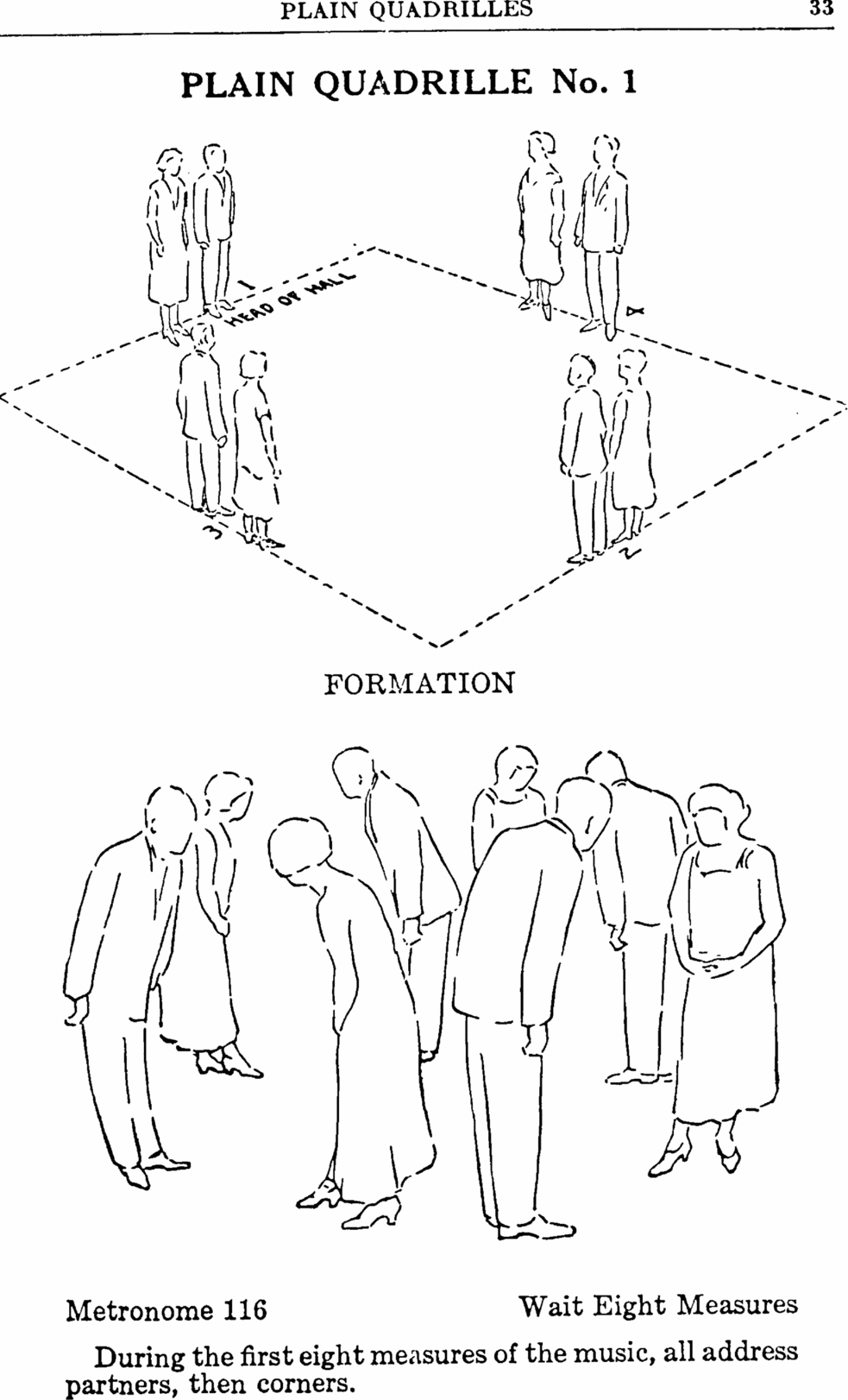
In addition to teaching dancing and etiquette, Lovett began compiling a dance manual. Ford's idea, according to his secretary, Ernest Liebold, was that, because particular dance calls existed in different variations around the country, it was necessary to “standardize” them in order to revive them,Footnote 74 much as manufacturing required standardization. The result was “Good Morning”: After a Sleep of Twenty-five Years, Old-fashioned Dancing is Being Revived by Mr. and Mrs. Henry Ford. Footnote 75 It contained directions for plain and novelty quadrilles, lancers, contradances, and round dances of various kinds (including a minuet), as well as general dancing and etiquette guidelines. It was similar to such earlier efforts as the Gems of the Ball Room Call Book (Chicago: E. T. Root & Sons, 1896), except that the new book contained particular round dances that Ford remembered from his youth. (See figures 1a and 1b.)
Title page of “Good Morning!” published by the Dearborn Publishing Company, Dearborn, Michigan, 1926.

Sample page from “Good Morning!” showing the “Plain Quadrille No. 1.”

“The Club Quadrille” by Henry Ford's Old-Time Dance Orchestra, Edison Record 52067-L. One of many records made in 1926 by Henry Ford's orchestra.

“Good Morning” also included an introduction, “The Return of the Dance,” that placed the revival in a political context and has bolstered the argument that Ford's motives were racist:
Denunciation of the dance by the protectors of public morals has usually been occasioned by the importation of dances which are foreign to the expressional needs of our people. With characteristic American judgment, however, the balance is now shifting toward that style of dancing which best fits with the American temperament. There is a revival of that type of dancing which has survived longest amongst the northern peoples. The tide has swung in favor of such dances as are described in this book.Footnote 76
This introduction, which originally appeared as “Mr. Ford's Page” in the Dearborn Independent of 6 June 1925, served as the opening salvo of the campaign; until then, the Independent had run no articles on the subject. Subsequent issues, however, serialized “Good Morning.” Footnote 77
Whether or not we consider the introduction to be the work of Henry Ford or of William Cameron, editor of the Independent,Footnote 78 it is clear that the author was attempting to win the favor of readers from the “northern peoples” (i.e., whites), who could be persuaded that moral opposition to particular dances (typically from members of certain religious denominations) was due to their introduction from abroad, presumably South America (the tango) or “Africa” (the Charleston, thought to have originated among African Americans in that city). The implication was that, because many found new dances such as the tango and Charleston offensive, a revival of dances popular in the past and their identification as “American” would satisfy those who might oppose dancing on moral grounds.
What exactly were the dances that Ford opposed? The title of “Good Morning” suggests any dance introduced after 1901. Ford told a reporter in July that “there is no style or grace in the tango, the Chicago, one-step and modern dances.”Footnote 79 In another interview, he defined “modern” dances as those introduced in the wake of Vernon and Irene Castle's “Castle walk” in 1912, including the one-step, the hesitations, fox trot, and tango.Footnote 80 More important in the context of this issue, however, was that in 1925 newspapers regularly featured tawdry stories involving the Charleston, the dance associated with flappers and speakeasies and everything that older, conservative, more rural people found distasteful about U.S. society in the 1920s.
Although the Dearborn Independent editorial on 6 June inaugurated the campaign, Ford used other journalists to spread the word. The first article appeared in the Port Huron Times-Herald on 11 July;Footnote 81 the Detroit News ran an interview on 2 August 1925;Footnote 82 the New York Times Magazine Section of 16 August featured a lengthy, detailed interview and article on the subject; and a story appeared in the September 1925 issue of Country Gentleman, a farm periodical with a large circulation. With these stories and the serialization of “Good Morning” in many newspapers around the country,Footnote 83 much of the country now knew of Ford's new hobby.
Reporters were always looking to Ford to philosophize on aspects of life, and now, in these and later articles, he refined his opinions about dancing. Simply put, he liked to dance, but, like others of his age, preferred the style of his youth. He justified dancing as part of a regimen that balanced work with leisure and insisted in one interview (stressing a point he repeated in others) that “we are not, as has been imagined, conducting any kind of a crusade against modern dancing. We are merely dancing in the way that gives us the most pleasure.”Footnote 84 Of course, Ford commented that he did “like those old tunes—no question about that—that old music does make a great appeal.”Footnote 85
Despite his preference for older dances and music and his criticism of contemporary dancing styles, Ford reiterated that he had nothing against jazz or modern dancing per se. He understood that contemporary dance hall operators could make more profit with fox trots than square dancing, simply because more people could fit into the available spaces, for example. He remarked, “When I invite my friends to learn the square dance and to dance it, I am not doing it to reform the dance in this country. I am bringing back for them and for myself the flavor of a day that is gone. If other people become interested, fine! But I'm not setting out to reform anything or anybody.”Footnote 86
At the same time, however, Ford considered the dances he was reviving more wholesome than modern ones. Dancers came into contact with each other more in the square dance and circle two-step than in the fox trot. People of different social backgrounds would mix more. For Ford, square dances brought “back a time that was less hurried and more neighborly. People lived further apart, but knew each other better.” They also belonged to the country's historical tradition: The dances were “beautiful for the same reason that a Colonial interior is beautiful.”Footnote 87 Because of the dances’ virtues, he felt that young people would benefit by learning them and that both churches and schools should encourage them.Footnote 88 In this sense, the movement presages that of the recreational square dance movement that flourished in the postwar years in school gymnasiums and church halls.
Ford used these interviews not only to share his views about a topic readers saw as fun and timely, but also to project a persona lighter than that of the dour industrialist they already knew. Dancing helped him escape the urban, industrial present and idealize and romanticize the neighborly, rural past. The irony, of course, is that his Model Ts did the opposite, enabling rural people to travel easily to cities, changing rural life irrevocably.
At this point Ford seems to have conceived his old-fashioned dancing campaign along the lines of his earlier anti-Semitic campaign. A series of articles was to appear in the Dearborn Independent, which would be followed by publication of a compilation of the articles that dealerships would distribute. However, in contrast to the indifference, incredulity, and hostility that the earlier campaign engendered, the new one led to enthusiastic letters and favorable editorials.Footnote 89 The media phenomenon that would grow around the Mellie Dunham visit made it clear that North Americans loved this topic.
By the end of 1925, Ford felt that he was now ready to show off publicly what he had been doing for some time in private. In what the Detroit News called “the first step in the comprehensive plan . . . to nationalize a revival of the old dances, particularly emphasizing the square dances,”Footnote 90 the orchestra broadcast from WWJ (Detroit) for a half hour on 14 December. The next evening, over Lovett's initial objection, it played at the Arcadia Ballroom, a large, commercial operation in Detroit, at the request of William Finzel, leader of the house orchestra.Footnote 91 On a Tuesday evening, 5,223 guests paid admission fees, and the management had to turn away an estimated two thousand people. Lovett called it “the greatest gathering I ever saw under one roof at a dance.”Footnote 92 The commercial success of this event led the ballroom's management to feature old-time dancing in succeeding weeks.Footnote 93 News spread. The Book-Cadillac Hotel, the leading hotel in the city, engaged George Pariseau's Orchestra to play for old-time dances one, and later two, nights a week, which WWJ broadcast. In Boston, the Copley Plaza Hotel announced it would hold old-fashioned dances.Footnote 94
Part of the promotion of “Good Morning” was the production of phonograph records by Victor, Columbia, and Edison. The orchestra planned to record in the company's studios while in New York City in January, but Victor apparently wanted to beat the others to the punch. Victor engineers arrived in Dearborn on 30 December and recorded eight sides. Although the label was prepared to pay, Ford levied no charge for the orchestra, although he paid a fee for each mother record that Victor made.Footnote 95
The orchestra then went to the Wayside Inn, accompanied by Ford, who was there ostensibly to arrange to move the highway away from the Inn.Footnote 96 On 9 January, President Coolidge's uncle by marriage, John J. Wilder, of Plymouth, Vermont, along with seven other New England fiddlers and John B. Tinham from Michigan, assembled at the Inn and played with Ford's orchestra for dancing. Responding to reporters’ questions about his dance and music “movement,” Ford commented, “Well, you have to have different movements. You have to have them to keep things stirred up. You have to have an explosion now and then. It's just like the Jews in this country. We couldn't get along without them. They keep things stirred up by their business ability”Footnote 97—a rather bizarre analogy, to be sure, and one perhaps gratuitously designed to alleviate the damage caused by his anti-Semitic campaign.
The Arcadia Ballroom turnout and the publicity that ensued from the visit of Maine fiddler Mellie Dunham indicated to Ford and his executives that they were witnessing an unpredicted cultural phenomenon. By instinct, they tried to capitalize on it. Indeed, Charles Sorensen later commented that Ford “saw that [his interest in fiddlers] was a good source for publicity,”Footnote 98 and furthermore it came at a time when the company needed it. In November dealers were informed that the company's car business was down 11.8 percent for the first seven months.Footnote 99 Ford and his executives thus sought to combine the success of the Arcadia Ballroom dance and the sensation of the Dunham visit with the promotion of the new line of cars.
The Advertising Department and Ernest Liebold sent a general letter to all dealers on 28 December informing them of the plans for the broadcast of the Ford orchestra from the Ford branch in New York City in January. It urged “all dealers within good receiving distance of these stations” to “capitalize on this feature to attract hundreds of people to their show rooms” by installing loudspeakers. It also suggested that dealers “arrange to hold dances in their show rooms during the hours of this broadcasting and should likewise urge similar dances throughout their communities.”Footnote 100 New York branch manager Gaston Plantiff, in planning for the announcing of the programs, wrote to Campsall: “I believe Mr. Ford is going to get a lot of good advertising out of it, and it will help him to accomplish something along the lines he is working, to interest the country at large.”Footnote 101
The Ford Motor Company New York branch on Broadway was the focus of the “Ford National Show Week,” held between 11 and 16 January 1926. Lovett and the Ford orchestra played there on Tuesday, 12 August, and Friday, 15 August, an hour each evening at 10 p.m., for a broadcast over WEAF, linked to thirteen other stations in the Northeast and Midwest, an early and still experimental example of network broadcasting.Footnote 102 Local Ford dealers had already received copies of “Good Morning” with a request that they cooperate with local dancing instructors and event promoters.Footnote 103 Some events proved very successful. A dealer in west Detroit had to turn people away and schedule an additional dance.Footnote 104 In Marshall, Michigan, five thousand attempted to participate.Footnote 105
Perhaps because WSAI in Cincinnati, one of the linked stations, did not broadcast on Fridays, planners at the Louisville branch, in tandem with dealers in Tennessee and southern Indiana, decided to organize fiddlers’ contests on Friday, 15 January, at their dealerships. They had little time to organize; in Bardstown, the dealer had twenty-four hours to find fiddlers, distribute handbills, and make other arrangements. Nevertheless, crowds estimated at 1,000 and 1,200 attended the contests at St. Helens and Bardstown, Kentucky, respectively.Footnote 106 Winners in local contests moved on to state competitions; those winners then progressed to a regional contest whose finalists would play for Ford personally. Although Ford covered travel expenses for the three finalists, we should remind ourselves that he did not sponsor the contests; the Louisville branch and the dealers in Tennessee and Indiana were the competition sponsors. Other Ford dealers also hosted fiddlers’ contests, such as Walter Livingstone, who planned one at his showroom in Worcester, Massachusetts, on 12 January, and Clyde M. Ford, the dealer in Dearborn, who scheduled one on 14 January.Footnote 107 After this week, the campaign largely ended. The orchestra repeated its performance and broadcast a year later,Footnote 108 but apparently with much less attention and popular success.
Public Reaction and Ramifications
When newspapers and magazines published stories about Ford's dancing hobby in the summer of 1925, no one could have predicted the interest they would arouse. Journals unlikely to comment on such a subject now took notice, academic conferences featured speakers on the subject, book publishers suddenly became attracted to manuscripts on square dancing, and music publishers rushed to fill a new demand.Footnote 109
Ford himself received a large amount of mail from the general public. Correspondence in August 1925 alone included dozens of congratulatory letters on his interest in dancing and a few from dance callers and fiddlers offering their services.Footnote 110 Such correspondence continued regularly. One letter, written in October, announced that the writer had just won a contest in Lewiston, Maine, and offered to “try out” for a position in Ford's orchestra. Frank Campsall initially responded that his employer already had musicians, but later, apparently at Ford's urging, followed with a second response inviting Mellie Dunham, of Norway, Maine, to come to Dearborn for a visit. Dunham's friends and neighbors soon spread the word, and by 7 December, when he and his wife boarded the train for Detroit, a media sensation was already in the making.Footnote 111 The governor of Maine, a band, reporters, and newsreel cameras sent them off, and newspapers followed every subsequent move. The event provoked a reaction across North America. The description of Dunham as the “champion fiddler” in the many stories about him caused fiddlers from all parts of the country, as early as 11 December, to challenge him,Footnote 112 thus providing a new impetus for fiddlers’ contests.
In urban theaters, Dunham's new vaudeville act drew large crowds. A writer for Variety commented that in New York, it “got over heavy here on its novelty and undoubtedly can do as well elsewhere.”Footnote 113 Dunham played to packed houses until the end of May. Seven months later, he wrote to Campsall: “The public seems to have gone crazy and I can't begin to fill all the dates I could have and all because Mr. Ford invited me to visit him and then gave me the O.K. mark to the world. No one could have dreamed of anything as improbable as what happened to me, but here we are.”Footnote 114 Whatever Ford thought personally of Dunham and his fiddling,Footnote 115 the success of this stage act inspired others. Jesse Martin, of Frewsburg, New York, the dulcimer player whose visit to Ford immediately followed that of Dunham, appeared in numerous theaters and shows in his area.Footnote 116 New acts, such as Ohio's “Ford's Famous Fiddling Five,” capitalized on the craze.Footnote 117 So many fiddlers suddenly became local stars that a cynical writer for a vaudeville trade journal complained that “it is suggested that those acts which hope for success and fame go to Henry Ford. That is enough to bring them newspaper headlines, at any rate. It's no use going to President Coolidge, or to Rockefeller, because they are only worth a few sticks. But Ford—that's different.”Footnote 118
During the first months of 1926, contests sprouted up everywhere. Radio stations, newspapers, vaudeville theaters, fraternal organizations, and boosters’ associations, among others, sponsored callers’ contests, talent shows, and fiddlers’ contests.Footnote 119 A trade journal writer felt that in New England the phenomenon was hurting theater attendance, because “every form of fraternal order is discovering among its members fiddlers or dancers. The result is that these orders are staging their own contests. . . . Thus the theatres are being emptied while the town halls are crowded.”Footnote 120 Although Henry Ford's interest inspired these contests, Ford himself had little to do with any of them. Organizers would have loved to have Ford in attendance. Although they could hardly have expected him to come, they sent invitations anyway, because his interest seemed to give validity to their own local traditional music. His secretaries invariably responded with polite regrets.Footnote 121 Station WOS, in Jefferson City, Missouri, held a Missouri state contest on 31 December, with fifty-two contestants, and invited Ford to listen and cast a ballot.Footnote 122 The All New England Fiddle Contest, sponsored by a booster organization, the Town Criers, in Providence, Rhode Island, and held in January, had a “Ford representative” in attendance, as local reporters noted.Footnote 123 John J. Sullivan, organizer of the 1925 contest that Mellie Dunham had won and now organizer of a “World Wide Fiddlers Contest” at Lewiston, Maine, invited Ford as the guest of honor, but, as usual, to no avail.Footnote 124 The Missouri State Marketing Commissioner attempted to get him to provide a Ford car as a grand prize for the Interstate Old Fiddlers’ Contest to be held in March over WOS, also without success.Footnote 125
The number and variety of contests became so large that Ford and his staff simply decided to avoid involvement in any of them. Responding to a request to donate a prize for a fiddlers’ contest that was planned for the Kansas Free Fair in Topeka, Lovett declined, writing that “several thousand contests are now on in different parts of the country and they would also have to be considered. To make an exception would be unfair to those he has been compelled to refuse.”Footnote 126 To circumvent this problem, contests in Colorado and Iowa featured Henry Ford impersonators.Footnote 127 Ford's direct involvement in fiddlers’ contests was limited to paying for two loving cups given as prizes at contests in Detroit and Boston. The latter, for the North Atlantic States Contest held on 13 March, was awarded to James H. McCauley, of Hopedale, Massachusetts, after votes from thirty thousand listeners.Footnote 128
The contest in Detroit was the principal one in which Ford was involved. The original organizers were J. L. Woods, manager, and William Finzel, director of the orchestra at the Arcadia Ballroom. Winners of preliminary contests, held in about fifteen Michigan cities, competed in a statewide contest at the Arcadia Ballroom on 19 January, attended by five thousand people, including Ford himself, who sat unseen in the balcony.Footnote 129 Ford had asked Finzel, one of the judges, to “be absolutely square as far as the judging.” However, Jep Bisbee, already well known as Ford's favorite, never went through the first round. Finzel felt he was the best fiddler, and virtuoso violinist Mischa Elman, who was in Detroit on tour, presented the “Ford Cup” to Bisbee.Footnote 130
The Myth of the National Fiddling Contest
Country music historians who mention Ford's sponsorship of a “national” contest follow a line of sources that begin in 1970 with an article on “Uncle Bunt” Stephens.Footnote 131 Unfortunately, however, Stephens, whatever his musical ability, was a braggart who stretched the truth. In fact, he went to Detroit as one of three finalists in a dealer-sponsored contest at Louisville in order to play at a banquet during a convention of Ford dealers. Ford himself was present. On those credentials, Stephens tried to replicate Mellie Dunham's commercial success. Appearing in Chicago to play over WSM, Stephens was called the “world's champion old-time fiddler, who won the blue ribbon at the recent contest held by Henry Ford in Detroit.”Footnote 132 Returning home to Tennessee, Stephens claimed that Ford had given him a Lincoln car, $1000, and a broadcloth suit of clothes; had his teeth fixed; and entertained him at his home for a week.Footnote 133 Back in Chicago to play over WMAQ, accompanied by his manager, the Tennesseean claimed he had beaten 1,876 other contestants and that Ford had unsuccessfully offered him $8,000 for his 1663 violin.Footnote 134 While in New York City, about to record for Columbia,Footnote 135 Stephens cited the same number of contestants and claimed he had won “a ribbon around the fiddle tied by Mr. Ford's own hands and a substantial check.”Footnote 136 The Tennessee fiddler's backwoods braggadocio apparently charmed the reporters so much that they did not bother to verify his claims, and the story was widely reprinted. Nor did the reports mention the details of Ford's actual involvement. It is impossible now to determine the truth of many of these statements, but it appears that most were nonsense.
Although Stephens's claims stressed Henry Ford's personal involvement, the role of the Ford dealers in Tennessee and Kentucky was actually more influential. Having won the local contest at a dealer's showroom in Lynchburg, Tennessee, Stephens competed against about twenty-five fiddlers at the statewide contest in Nashville on 19 January, where he placed third. He and the other winners then went to Louisville to compete against the four Kentucky finalists and two southern Indiana finalists. In this “Champion of Dixie” contest, held 26–27 January, William H. Elmore, of West Baden, Indiana, placed first; Stephens placed second; Marshall Claiborne, of Westmoreland, Tennessee, third, and Cooney Perdue, of Tompkinsville, Kentucky, fourth. The three winners then went to Detroit.Footnote 137
More accurate accounts of the fiddlers’ performance in Detroit were given by more disinterested witnesses. Elmore, although he won, was not interested in promoting himself as a touring performer. He told his local newspaper that he was there on 9 and 10 February, accompanied by the local Ford dealer. In company with several other dealers and old fiddlers, he received a tour of a Ford plant and attended a banquet the second day at the Book-Cadillac Hotel. Following his introduction to Ford, Elmore asked if there was to be a contest. Ford then “laughed and said, ‘No, no contest. You have won enough.’” Each fiddler played different selections, and Elmore was allowed to play Ford's Stradivarius.Footnote 138 The banquet was held during a convention attended by 1,500 Ford dealers from around the country. A dealer from Booneville, Indiana, who was part of the contingent accompanying the fiddlers said that Ford was “deeply impressed” by the one-armed fiddler Marshall Claiborne. Ford's assistants took the fiddler to a barber, bought him a suit of clothes, and promised him medical help.Footnote 139 In a letter requesting reimbursement of expenses totaling $305.51 for “taking care of the Old Time Fiddlers,” William H. Chase, of the Louisville branch, remarked to Frank Campsall that Claiborne was satisfied with his treatment at the hospital in Detroit and arrived in Louisville on 4 March, playing for a Rotary Club meeting there.Footnote 140
Epilogue
The fiddle-contest craze of the winter of 1926 died down by the summer. Contests and radio fiddlers, of course, continued, although it is difficult to determine to what extent contests that were held in 1926 became annual events. George Pariseau and his family orchestra played for square dances and broadcasts at the Book-Cadillac Hotel and Grande Ballroom in Detroit until the Depression hit.Footnote 141 Mellie Dunham, Jep Bisbee, and some of the other musicians who rose to prominence during this period kept a busy schedule until 1930 or so, and fiddlers and other musicians came to play for Ford into the 1930s. Ford, for his part, held dances with his orchestra until 1941. The ensemble made a number of records around 1943 and appeared on a nationally broadcast, weekly radio show the following year. Many of the instructors in the dance program that Lovett originally oversaw adapted to the new “Western”-style recreational square dancing of the postwar years. Clayton Perry played for dances at the Michigan State Fair and elsewhere until his death in 1959.
Ford lit the match that fired a frenetic, national phenomenon during the winter of 1925–1926. Dancing and music continued in much the same way, however, as they had earlier. Ford's manual went through three more editions and had some influence at local dancing venues. Fiddlers’ contests declined during the Depression but saw a revival in the postwar period. Perhaps the phenomenon influenced the early radio shows that created modern country music. The most significant part of the phenomenon, however, was the public reaction to Ford's interest. Even if the contests and dances did not last, the fact that special events featuring fiddlers and square dancing arose in so many parts of North America at the same time meant that, in the face of major social change, the public shared with Ford a need to recognize an important part of popular cultural tradition.
Appendix
Discography of Recordings by Henry Ford's Orchestra (Early American Orchestra)

Clayton A. Perry, violin; Edwin F. Baxter (listed incorrectly as Edwin “P.”), dulcimer; William Hallup, cimbalom; Maurice Castel, sousaphone; 1Benjamin B. Lovett, caller; 2Edwin “P.” Baxter, dulcimer solo, accompanied by orchestra.

Clayton A. Perry, violin; William Hallup, cimbalom and vibraharp; Gino Caporali, bass; Edwin F. Baxter, dulcimer, on some; Roy Austin, guitar; Donald Van De Ven, piano accordion, on some; unknown, trumpet, on 111B and 112B; unknown, piano, on some; 1Benjamin B. Lovett, caller; 2Francis X. Brancheau, caller.